

The $24 Million Disability Staffing Business

The United States has a large minority population that is its most overlooked and under-leveraged workforce: people with disabilities. People with disabilities have an unemployment rate twice that of people without disabilities, according to the Bureau of Labor Statistics, and just one-third of people with disabilities participate in the workforce, as compared to three-quarters of people without disabilities.

This despite the fact that there is a strong business case for employing people with disabilities – including reduced costs, increased productivity, and reduced employee turnover. Based on the above figures, about 6.4 million jobs will need to be filled by people with disabilities in order to close the existing employment gap between people with disabilities and people without disabilities. At DePaul Industries, our social enterprise approach (known as alternative staffing) utilizes the commercial staffing model to help people with disabilities find jobs.

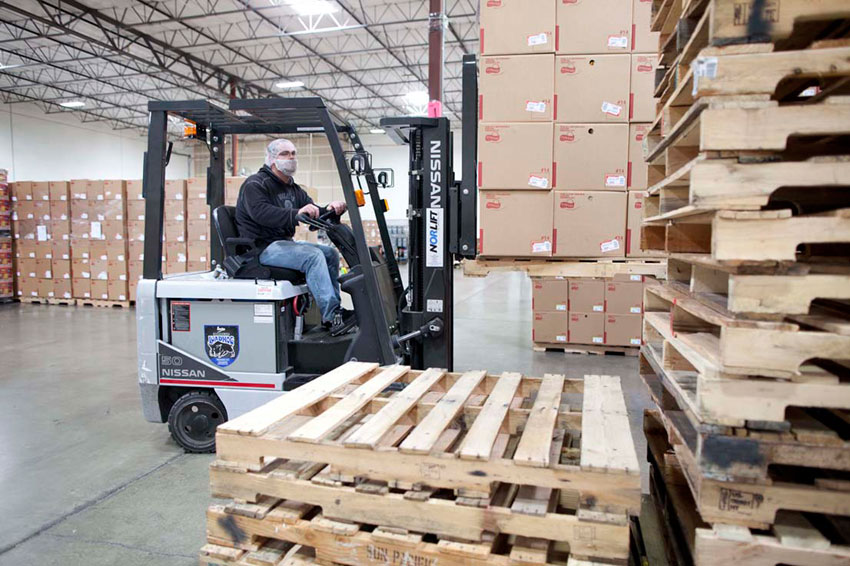
This year, our staffing business is on track for $24 million in sales, and more than 300 of our employees will go on to find permanent work with our customers, an important metric that we use to help measure our impact. DePaul’s focus is on changing the employment landscape for people with disabilities; other alternative staffing organizations focus on different barriers to employment, such as a criminal record, a lack of stable housing and/or homelessness.

Annually, American and Canadian alternative staffing organizations employ 25,000 people and exceed $100 million in sales, according to the Alternative Staffing Alliance. While this may be a good start, it’s only a start. This model has such great potential for sweeping change that DePaul Industries is looking to expand the model nationwide with a staffing network to help individuals with barriers to employment gain jobs: PurposeSTAFF. The strength of the alternative staffing model is that it is demand-driven and beneficial for both parties, without sacrificing quality for either.

Businesses hire alternative staffing organizations because they provide qualified, reliable employees – not to fill a diversity quota. But with an increased emphasis on corporate social responsibility, some companies do find the social mission to be a unique selling point. The social benefit is that people who face high barriers to employment are connected to jobs. The experience and job skills many employees learn while working for a staffing firm will help them to earn permanent, higher-paying jobs, whether with customers or elsewhere.

Alternative staffing organizations are no different than other social enterprises in the search for balance between business and mission. At DePaul Industries, the concept we’ve found that works best is 51% money versus 49% mission. We can’t achieve our social mission if we don’t have the revenue and solid financial footing to sustain it, but mission remains the foundation and guiding principal for the organization.

Legal structure also varies for alternative staffing organizations: whether to organize as a nonprofit, for-profit, or a hybrid of the two. The benefit corporation legislation now passed in 20 states and the District of Columbia is a viable and welcome option, as a benefit corporation must prioritize both a positive impact on society and profit. In January, DePaul Industries registered PurposeSTAFF as an Oregon benefit company, whose bylaws contain our mission of employing people with disabilities, and it is now a Certified B Corporation.

Alternative staffing is just one example of a social enterprise approach that brings about real change, and I’ll be speaking about it during an intensive session at the Social Enterprise Alliance Summit 14 in Nashville April 13-16.

Diverse organizations around the United States are using the power of business and the marketplace for the common good, and the Summit will bring these social enterprise leaders together to connect, collaborate and learn. I hope to see you there.

This post was written by Dave Shaffer, President and CEO of DePaul Industries, an integrated social enterprise providing employment opportunities for people with disabilities. Shaffer will be speaking on two panels, one on alternative staffing and one on accessing capital, at the Social Enterprise Alliance Summit ’14 in Nashville April 13-16.
The Power of the Collective: Co-location & the Social Economy

The socio-political and economic conditions in North America have been undergoing a considerable shift over the last several decades. The end of the post-WWII “golden age” heralded a gradual erosion of the Keynesian welfare state social safety-net and as a result, state funding has been continuously withdrawn from social services.

The reason for this shift is due to the rise of a neo-liberal brand of capitalism that has the ability to create vast amounts of wealth but does not adequately account for the social and environmental externalities that result from ‘business-as-usual’ practices. These externalities can be understood as the destruction of the environment and the systemic social exclusion and poverty that arises due to the inherently dispassionate and detached nature of Neoliberalism – best captured by the sentiment of one of its staunchest supporters, Milton Friedman, “there is one and only one social responsibility of business – to use it resources and engage in activities designed to increase its profits.”

By design, this economic system creates an ongoing need for non-profit organizations to fill the void in social service provision; however this responsibility has been undertaken in an economic environment increasingly characterized by limited fiscal and human resources. Enter the Social Enterprise.

Social enterprises operate at the intersection of the private, public and third sectors. In this space, the social enterprise fulfills a critical role of furthering social and environmental agendas within the confines of the capitalist system. That is to say, they utilize the tenets of capitalism to appeal to society’s consumer culture, but do so as a means of achieving social change.

This is an important distinction – one that has the potential to revolutionize the status quo and create a more socially equitable and environmentally sustainable reality. Having the triple bottom line (social, environmental and profit) as the guiding principle instead of solely profit, allows for a more inclusive system that can appropriately account for (if not eliminate) negative externalities.

My work as an independent researcher has focused on the ways we can adapt and enhance the social economic paradigm to create better business models capable of competing on larger scales, with private sector giants. The most recent article I’ve published on this subject deals with the concept of Co-location as a viable model that can reduce financial and administrative burden of social enterprises while generating social innovation.

Co-location is a popular concept for supply chain integration in the private sector and has incredible potential for social enterprise. The theory is based on the fact that throughout our history, humans have always thrived when working together towards common goals. The power of our collective action has built cities, transformed entire societies and even changed the course of history.

Co-location builds on this fundamental principle of human system interaction and is premised on the notion that sharing space can be an effective way for smaller non-profit or social enterprise organizations to reduce their costs, expand their services and improve their operational efficiency. Co-location also offers an avenue to capture and harness the creative energies of like minded people. Sharing space has been a practice of the third sector for decades, however new social research has uncovered that the benefits of sharing space go far beyond simple economic considerations.

Specifically, sharing space can “break down silos, reduce costs, increase opportunities for collaboration and cooperation, create knowledge and learning networks and spark social innovation”. So while this may not be a new concept, it is certainly one worth looking at again.

The research on co-location over the last two decades has found that the social, political and economic advantages of sharing space are profound. This is particularly important for non-profits or social enterprises that are more often than not: understaffed, underfunded and overworked. At a very mechanistic level, sharing space can reduce the administrative burden on non-profits through cost-sharing for common tools such as advertising, printing, heating and water costs etc.

There are also political advantages to sharing space: the political leverage that can be exacted from having strategic clusters working together on bids or lobbying can be significantly more than a singular organization working towards the same ends. Most importantly, there are tangible synergies that transcend these more technical advantages. The real magic of the shared space concept is predicated on the equation: Physical Space + Community = Social Innovation. The theory of co-location asserts that by sharing space (and costs) with driven, talented and like-minded individuals social innovation can occur at a more rapid and frequent pace.

Being immersed in such a creative environment allows for continuous learning, inspiration and accelerated growth and development. The upcoming Social Enterprise Alliance Summit 14 employs the tenets of co-location at the temporary but macro-cosmic level by bringing together giants in the social economy to help foster an atmosphere of learning by creating opportunities to engage with each other in order to harness the power of our collective action.

Summit 14 provides a platform to explore the potential of this emergent sector to create lasting and meaningful change that will ensure a better future for our children – and to remind us that together, we CAN make a difference.

This post was written by Andi Sharma, MPA, Policy Analist, Government of Manitoba. She will be speaking on this topic at the upcoming Social Enterprise Alliance Summit ’14.


Unexpected Workforce Excels in Recycling Industry

My name is Bill Morris and in 2008 I was recycled. After a 25-year career in the telecom industry, there didn’t seem to be much demand for my experience and technical expertise, which had become mostly obsolete. After trying to start my own for-profit business (which failed) and working for other businesses (which I could no longer do), I decided I needed to find something where I could give back. In order to do that I took a job for the lowest wages I have ever received, and for which I had no qualifications – Program Director for a Disability Services Provider. 

I found myself managing a building full of adults with a wide range of developmental disabilities. The average day involved everything from screaming, seizures, incontinence, fights between the people we served and fights between staff members over who had to serve the lowest functioning person in the building that particular day. Not quite the image conveyed on the side of those thrift store trucks, huh? In the back of this building I came across a small group of people taking apart unwanted electronics that had been donated.

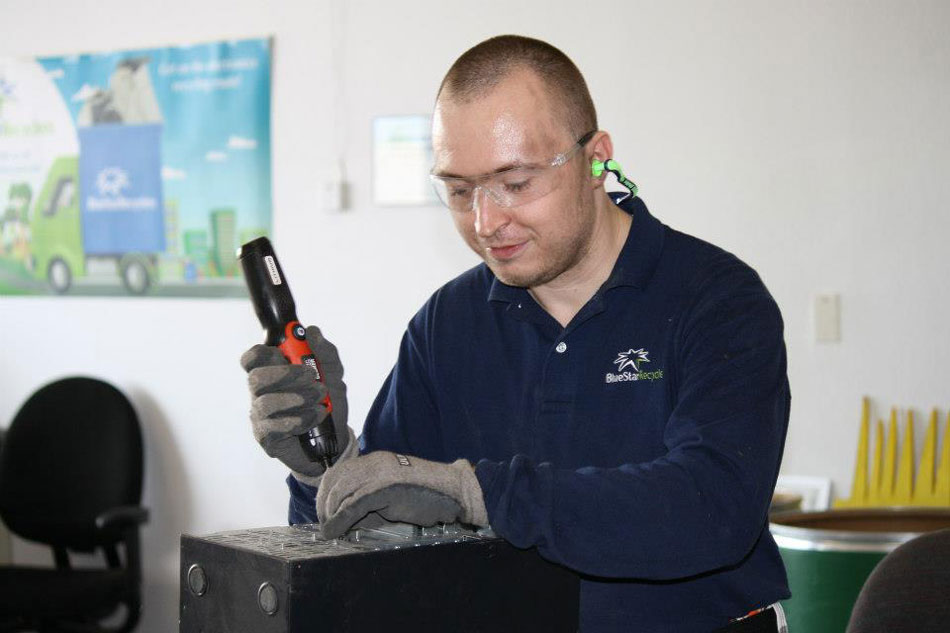
They were languishing a bit, but this group actually seemed to enjoy being there. I investigated more closely and discovered they were really good at the work. You could place an old computer in front of one of them and they would have it broken down to its base materials in a matter of minutes.  I inquired where they learned this skill, and they shrugged their shoulders. After a few more days of observing their proficiency at the task, I looked at their files and found virtually every one of them was on the autism spectrum.

Since I had no knowledge of autism or electronics recycling, I did a little research and discovered two sobering facts:

1) Adults with autism face over 80% unemployment.

2) Less than 20% of electronics are recycled ethically.

Not having the nonprofit service provider perspective, my first thought was, “Why aren’t these folks employed doing this task?” That question spurred me to create a business plan for an electronics recycling vocational training and employment program. Next I found a recycler who would pay us five cents a pound to take computers apart, and within a few months we had our first four adults employed. Then I experienced the very definition of serendipity through a chance meeting with a local business owner and his wife. They just happened to own a warehouse with a prior tenant who had gone out of business, and who had left behind a truck and a huge pile of electronics.

We needed all three. And if that wasn’t good enough, they also put a large sum of money to get the enterprise up and running. That was five years ago. Today Blue Star Recyclers is an award-winning social enterprise, with 24 employees in Colorado Springs. Along the way we’ve ethically recycled 5 million pounds of electronics, produced over $1.5 million in earned income, which has enabled us to become 90% financially self-sustainable.

In addition, the workers we employ are less dependent upon government-funded services, resulting in taxpayer savings of another $1.5 million. In 2011 we established a program called VERN (Vocational Electronics Recycling Network).  VERN is our way of sharing our mission and proven model with other communities and recyclers who want to create local jobs for people with autism. VERN has created another 30 such jobs, mostly in smaller communities where unemployment for adults with autism is often 100%.

Here’s the best part of our story: In five years we have had zero turnover, zero absenteeism, and no lost time accidents (absolutely unheard of in our industry). People with autism are not just good workers; they are phenomenal workers every employer should seek to employ. Adding a significant social deliverable to a recycling enterprise business model has created an entirely new market, which has enabled us to triple the size of our organization in five years. You see, we don’t just have customers- we have advocates.

Recycling is about two things: convenience and motivation. We don’t lead with the social deliverable. We don’t have to. We provide the best recycling services and value in Colorado and we just happen to provide a world-class workforce with an opportunity to show the world how great they are.

By Bill Morris, CEO of Blue Start Recyclers.