RealLeaders Selects New CEO


Written by: Julie Van Ness, Executive Director and Chair (former CEO)


When is the right time to think about your successor?

I would recommend it be with almost every new hire as it may surprise you. 


I essentially hired mine 10 years ago, although I didn’t know it at the time. He was just an intern working his way through college, studying for a business degree in management information systems. He immediately demonstrated his entrepreneurial drive by recruiting a young videographer to shoot “Real Leaders Shortcuts”— walking video conversations with purpose driven CEOs— to show his peers a shorter path to a fulfilling career. 


After graduating, he launched a new podcast for social impact CEO’s titled “The Real Leaders Podcast” where he grew it to be one of the Top 100 business podcasts in the US, shining the light on over 1,000 impact oriented CEOs. For the remainder of the decade, he went on to tackle other vital company functions such as: Marketing Manager, Director of Digital Operations, VP of Growth, General Manager and President. 


Many of you within our community already know who I’m talking about, since you’ve been interviewed by the “keep it real” pro or you connected with him at the dynamic Real Leaders UNITE events in San Diego. He is, of course, the incomparable Kevin Edwards and he will be promoted to CEO starting this February!

Julie Van Ness, Executive Director and Chair hugs new CEO, Kevin Edwards at RealLeaders UNITE 2025


I am thrilled to see Kevin’s new initiatives and fresh ideas come to life with all of you in the years ahead as you continue to elevate “Better Leaders for a Better World”. Because you are in the Real Leaders Impact Community, you will get the first opportunity to become a part of the new adventures, leveraging digital media and AI for good, while simultaneously creating closer personal connections. The thought “when you walk with the wise, you rise” fills my mind with the soul of what’s to come.


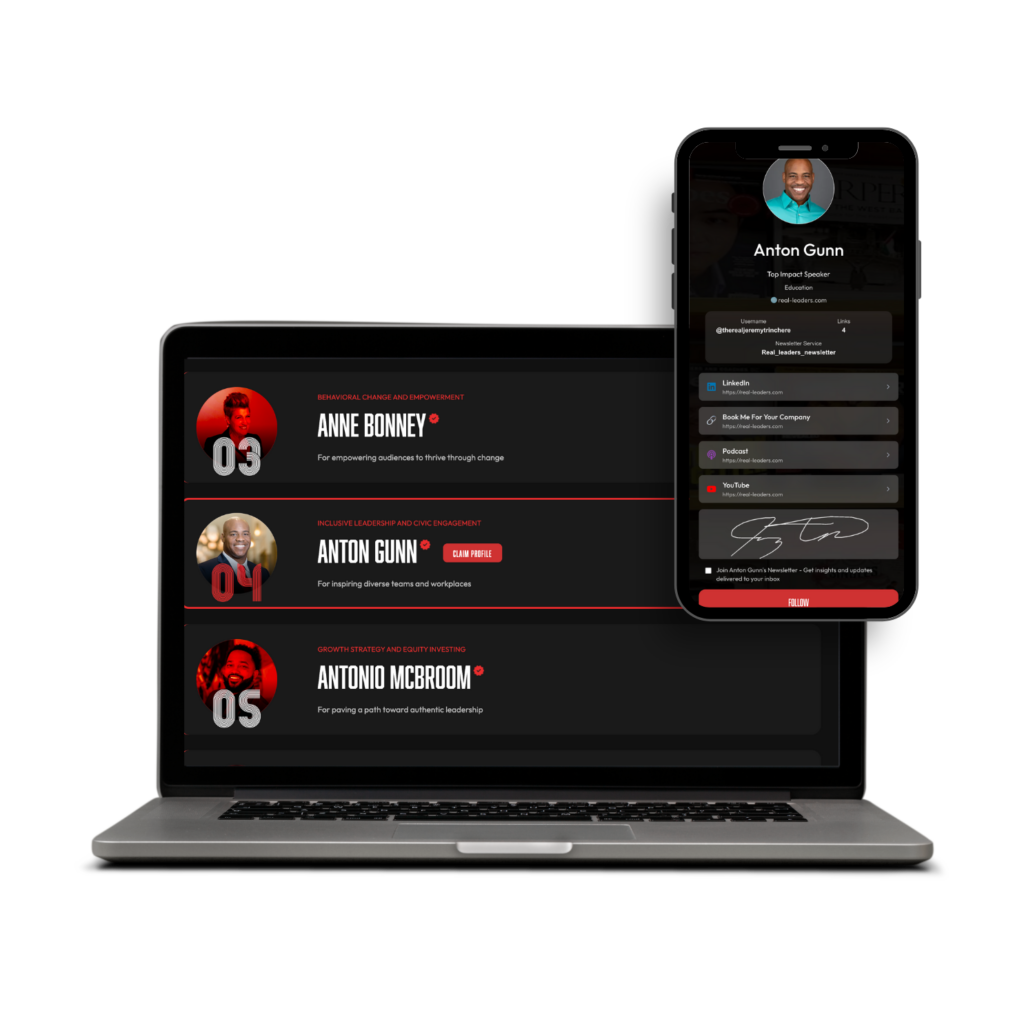
First Look at the New RealLeaders Verified Lists and Link

As the CEO over the past decade, experiencing both the progress and challenges that we’ve all faced, I want to express how much I respect and value all of you. Your collective leadership, grit and determination is changing the world for the better and is needed now more than ever. 

I hold high regard for Kevin’s courageous mindset and know that he shares our strong commitment to supporting you, the Real Leaders of our world! His continuing leadership will help accelerate the growth and impact of our entire community. 


Thank you all and know that we will all “go far together”.


Written by: Julie Van Ness, Executive Director and Chair (former CEO)

Is People Pleasing Your Leadership Blind Spot?

Each time we say yes when we mean no, we leak away our power.

By Eric Kaufmann


Me, a people pleaser? No way. I’m an independent-minded, self-determined leader — or so I believed for years — until a specific high-stakes strategy session with my team.

As Melissa rose to present her pitch, I already knew where she was going. I also knew I hated the idea and she’d been socializing it for two weeks. As she presented, I mentally prepared my rebuttal. But when she concluded, I looked at the pleased expressions of my team and instead of objecting, found myself nodding in agreement. Why? I was afraid of their disapproval.

That’s when I realized I was choosing acceptance over authenticity — I was people pleasing. Immediately my self-critic spoke up, I felt a bit of shame, and I sensed my team’s confusion.

At times throttling our passions or ideas is smart. But more often we contain ourselves to please someone or a group like I did — and I’m not alone. A 2022 YouGov poll showed that 49% of adults self-identify as people pleasers, and 92% reported that they engage in people-pleasing behaviors.

What People Pleasing Looks Like


People pleasing takes energy and feeds stress and burnout. It is inauthentic, limits our decision effectiveness, dilutes accountability, and squanders our power — all for fleeting validation. If you’re wondering what people pleasing looks like, here are classic behaviors:

  • Going to great lengths to avoid conflict
  • Putting other people’s needs first at the expense of your own
  • Toning down a strong message for something more palatable
  • Feeling that you can’t say no when someone asks for something
  • Thinking you’re responsible for how other people feel
  • Struggling to establish boundaries with others
  • Apologizing or accepting fault when you aren’t to blame
  • Mirroring the behavior of others in social situations to make them feel comfortable
  • Having a hard time recognizing how you really feel about something
  • Saying you agree with others, even when you don’t actually agree


One form of people pleasing is self-deprecation — reducing your value. That’s not the same as humility. If you reply to a compliment, “I couldn’t have won this project without Jane and Stan,” you are being humble. But if you reply, “I hardly know what I’m doing. Thank God for Jane and Stan saving the day,” you are self-deprecating. Humility is realistic, while self-deprecating is diminishing. You self-deprecate so that others don’t feel threatened and will be pleased with you.


Another form is going along to get along — in other words, preventing conflict by discounting your needs. If you say, “Sure Stan, I’m on board with the changes you’re proposing,” when you, in fact, disagree, you are going along to keep Stan happy. Unfortunately, by discounting your needs, you also siphon off your enthusiasm. If you don’t show who you are, voice your thoughts, or express your uniqueness, you can’t access your innate power. And when you’re not known and seen, you won’t be respected for your talents and strengths.


Then there’s overachieving, working your butt off to please people before they even ask. You over-deliver, sacrifice yourself, and work extra hard to prevent anyone being displeased. You bring so much value that they must be happy with you. Work, work, work, give, give, give, do the most you can, volunteer endlessly, and sacrifice your needs (and probably your family’s needs too).

Breaking the People-Pleasing Habit

What, then, is the opposite of people pleasing? Being an uncaring jerk? Of course not. It’s important to work well with your boss, peers, and direct reports. But throttling yourself back, tamping down your presence, and watering down what you have to are people-pleasing habits that dissipate your innate power. Power isn’t granted; power is claimed. To claim your power and stop people pleasing is to be authentic.


Start with self-awareness. My awareness kickstarted at that meeting. It grew as I noted my patterns — moments of hesitation and pinches of discomfort that drove me to prioritize others’ needs. I journaled and worked with a coach to get real about underlying fears that fed the behavior, and I confronted those beliefs with courage and loads of self-compassion.


We need courage to express more than just our conforming self. We need courage to share our convictions and creativity, especially in the awkwardness of opposition. We need courage to set and hold boundaries and to say no when appropriate. This is how we honor our needs and priorities and stop trading our authenticity for conformity.


When we’re ready, we can go further and embrace vulnerability. Paradoxically, our power lies not in invulnerable perfection, but in the willingness to show up as our imperfect, authentic selves. This also fosters genuine connections that support the all-important foundations of trust.


While people pleasing is a popular trope, I’m not advocating self-centered, to-hell-with-everyone anarchy. It’s imperative to collaborate and connect well with others. Be considerate. Be collaborative. But Don’t. Give. Away. Your. Power.


I implore you to take this journey with me as leaders who claim their power and lead with authenticity. The diminishing influence of people pleasing is clear — and costly. We can help liberate one another from the limitations of people pleasing and support each other as conscious leaders defined by self-awareness, self-acceptance, and service. We can live a new paradigm of leadership rooted in authenticity, empathy, and the unwavering conviction that true power comes from within.

10 Ways You Shouldn’t Go About Hiring an “A” Player

Companies want to hire high impact “A” players. To accomplish this goal, senior executives and HR have developed detailed hiring methods. 

However, within the company, there are always managers who want to short-circuit the process.  There are no shortcuts when hiring “A” players. Here are 10 ways not to hire an “A” player:

  • The hiring manager does not have a clear picture of the job’s current and future needs, challenges, and goals.
  • The hiring manager is unprepared or arrives late to the interview.
  • The hiring manager seems distracted, stressed, or impatient.
  • The hiring manager hires based on first impression.
  • The hiring manager is intimidated by the candidate’s qualifications.
  • The hiring manager is not an “A” player.
  • The hiring manager is living in a “that’s the way we have always done it” world.
  • The hiring manager has an antiquated “I’m a good judge of character” attitude.
  • The hiring manager talks too much during the interview.
  • The hiring manager thinks their current hiring skills do not need to be changed.

The world is changing at speeds never seen before. Whole industries are experiencing revolutionary change. Is the human side of your hiring process keeping up? Is hiring your competitive advantage?

To Dye For: Indonesia’s Carbon-rich Mangroves in Fashion with Women Weavers

Mangroves play an important role in sequestering planet-heating carbon dioxide emissions, but they are disappearing fast in Indonesia. In a rural office on Bengkalis island, off the northeast coast of Sumatra, 30-year-old Mayasari runs a face mask dyed with tree sap through an antique sewing machine.

The day before, Mayasari, who goes by one name, and a dozen other women in Pedekik village, learned to make hand sanitizer with an extract from the mangrove trees that fringe the coast. “Alhamdulillah (praise be to God) — if this comes from nature in Bengkalis, then it’s great,” says Mayasari.

The Bengkalis training is the first government program addressing the double hit from coronavirus and climate change among mangrove-dwelling communities in Indonesia. The face masks made by the Pedekik women’s group are sold for 2,000 rupiah ($0.14) each, offering a new source of income for members.

Besides this scheme in Riau province, others are also underway in South Sumatra and South Kalimantan, demonstrating to communities the practical value of keeping their mangroves standing. Indonesia — the world’s largest archipelagic country and the biggest home of wetland forests — counts about 3.3 million hectares of mangroves across its rivers, basins, and shorelines, an area larger than Belgium.

These mangrove ecosystems provide vital services to local communities, from food to protection against storm surges. Mangroves also store one-third of the world’s coastal carbon stock and about five times as much per hectare as Indonesia’s upland forests.

But according to a 2015 study from the Center for International Forestry Research (CIFOR), about 40% of Indonesia’s mangroves were lost in the previous three decades. They are often ripped out to make way for shrimp ponds and other small businesses like charcoal production, which provide economic security for millions but account for most mangrove loss.

Last year, President Joko Widodo expanded the remit of Indonesia’s peatland restoration agency to include ambitious plans to restore 600,000 hectares of damaged mangrove forests by 2024.

About 90% of the budget allocated this year to Indonesia’s Peatland and Mangrove Restoration Agency (BRGM) was for planting seedlings, but a small amount was earmarked to foster change in how communities view mangrove forests.

Mayasari first learned to weave local batik and tenun textiles at age nine. Today, she makes 13 feet of traditional fabric every few weeks, earning about $150 a month. But as a single parent with two children to put through school, she makes only a small profit because she must buy expensive and unhealthy chemical dyes. This year, the mangrove agency began working with Achmad Nur Hasim, an Indonesian designer who has supplied tenun fabric to French fashion brand Christian Dior.

Achmad says 90% of traditional textiles in Sumatra are dyed using synthetic products. He hopes textile weavers in Pedekik and elsewhere will instead adopt natural dyes derived from the sap and fruit of local trees, supporting broader efforts to conserve mangroves. Just outside her home, Mayasari says she can find the jengkol tree used for darker shades, pinang for orange, and bixa for red. The Bengkalis women’s group recently won a public vote for the best collection of handwoven clothes at the TENUN Fashion Week in Malaysia, which showcased work by 45 women’s weaving communities across Southeast Asia.

One key reason to stop further destruction of Indonesia’s mangroves is to ensure the climate-heating carbon they store remains in their biomass and the soil they grow in. Research shows global warming also hikes risks to mangrove ecosystems. A 2016 study published in the journal Wetlands Ecology and Management indicated coastal mangroves in Indonesia and elsewhere could face inundation from rising sea levels within 35 years without stronger action to curb climate change.

Promoting mangroves as the source of natural clothing dye is just one way communities can treat these valuable trees as a resource to nurture, which can hold back rising tides and become a new source of income for impoverished communities.

Harry Jacques is a contributing writer to the Thomson Reuters Foundation, based in Indonesia.

Businesses Fighting for Justice – this Nonprofit Shows How

When employers and investors speak up, lawmakers pay attention. The Responsible Business Initiative for Justice (RBIJ) was founded in 2017, and the award-winning nonprofit has partnered with hundreds of companies across the world to advance fairness and quality in systems of punishment and incarceration.

By engaging businesses to use their voices, resources, and working practices, the organization has worked to change criminal justice narratives, support legislation, and create real opportunities for deserving individuals. 

Founder and CEO Celia Ouellette (pictured above with Richard Branson) spent a decade practicing as a defense attorney, primarily on capital cases across the United States. As a lawyer, she found herself constantly fighting a criminal justice system that was cruel, expensive, racist, and broken. Despite working to save people from execution, she could only help individuals one at a time. “It’s not enough to pull people from the river one by one,” she often reminds conference audiences. “We have to go upstream and change the system — so they don’t fall in the river in the first place.” 

When it came to delivering systemic change, Ouellette recognized that businesses could make a difference. No constituency is as important to lawmakers, and it was clear that business support would be decisive in driving policy campaigns over the line. So RBIJ was set up to rally and strategically deploy that support. 

Across the United States, there is an established and growing need for companies to speak out. Six in ten Americans feel that it’s no longer acceptable for companies to remain silent on social issues. The same number says they will reward businesses that actively address these issues. The past two years have been a reckoning for the American justice system, and its flaws are now recognized as some of the most glaring social problems facing the United States today. 

An excellent example is Business Leaders Against the Death Penalty, which RBIJ launched at the South by Southwest Festival in 2021. Spearheaded by Virgin Group founder Sir Richard Branson, the campaign brought together more than 250 international business leaders to back an end to capital punishment around the globe. Supporters include Meta COO Sheryl Sandberg, Salesforce CEO Marc Benioff, Unilever CEO Alan Jope, and author and entrepreneur Arianna Huffington. Their support has already been deployed in campaigns from Utah to Singapore through op-eds, interviews, joint statements, and private advocacy. In addition, the campaign has been covered by over 250 media outlets in more than 10 countries. By amplifying business support for change, we have helped shift narratives around criminal justice issues and given campaigners invaluable ammunition for advancing reform. 

We’ve also convinced businesses that criminal justice reform isn’t just a moral or a reputational imperative for companies – it’s an economic one. Take The Clean Slate Initiative as another example; it closes certain types of criminal records after a specific time. The group’s motto is: A criminal record shouldn’t be a life sentence to poverty. The United States loses more than $80 billion each year from the underemployment of people with criminal records. One in three American adults now has a record and faces substantial and often wholly unnecessary work, education, and housing barriers. Removing these restrictions for deserving individuals who have done their time will automatically allow employers access to a vast, diverse, underutilized talent pool. With over 11 million vacant jobs to fill in the Great Resignation, it’s a strategy that could benefit businesses greatly. 

This demonstrates another critical aspect of criminal justice reform — marshaling key business voices to support specific local policy campaigns. Last year, for example, RBIJ brought together companies to help end juvenile life-without-parole sentencing in Ohio. It was an essential step forward; no other country sentences children to die in prison. We worked closely with state campaign partners on the ground to end this cruel practice. 

We also work with employers to create change within their operations, most notably through hiring. In March 2022, again at South by Southwest, we launched Unlock Potential with the support of the Walmart.org Center for Racial Equity. The program is a groundbreaking intentional employment initiative to keep young people away from encounters with the justice system. By providing meaningful, long-term career opportunities for individuals aged 16 to 24 (who are most at risk), Unlock Potential aims to break cycles of poverty and incarceration while at the same time advancing economic mobility and racial equity.

Our work at RBIJ has never been more critical. While the United States makes up just 4% of the global population, it accounts for 21% of its prisoners. The country’s justice system is rightly decried as inefficient, wasteful, cruel, and racist. Internationally, lack of access to stable and accountable justice systems remains “a great threat to sustainable development,” according to the United Nations. There is an existential need for corporations to “walk their talk” on issues like systemic racism and embrace their responsibility as a force for good. We work with them to do precisely that. 

Does Remote Work Contribute to Inflation? Let’s Look at the Numbers

BlackRock CEO Larry Fink claimed in a recent interview with Fox that “we have to get our employees back in the office.” According to him, doing so would result in “rising productivity that will offset some of the inflationary pressures.” 

Fink did not provide any data in the form of statistics, surveys, or studies to support his claims. He insisted, without evidence, that in-office work would reduce inflation. So what does the data say?

A widely-cited July 2022 study from the highly-respected National Bureau of Economic Research (NBER) found strong evidence that remote work decreased inflation. Namely, because employees strongly prefer mostly or full-time remote work, they are willing to accept lower wages to work remotely. As a result, the researchers found that remote work decreased wage growth by 2 percent over the last two years. Notably, the decrease in growth occurred specifically in the mostly higher-paid, white-collar positions that could be done remotely, leading to wage compression that reduced wage inequality between blue-collar and white-collar work. Given that higher wages result in more consumer spending, leading to inflation, the study concluded that remote work reduces inflation.

Plenty of other evidence supports the finding that remote work reduces wage growth, such as a June 2022 survey by the Society for Human Resources. It reports that 48% of survey respondents will “definitely” look for a full-time WFH job in their next search. To get them to stay at a full-time position with a 30-minute commute, they would need a 20% pay raise. A hybrid job with the same commute would need a pay raise of 10%. A different survey of 3,000 workers at top companies such as Google, Amazon, and Microsoft found that 64% would prefer permanent work-from-home over a $30,000 pay raise. Indeed, companies that offer remote work opportunities are increasingly hiring in lower cost-of-living areas of the US and even outside the US to get the best value for talent. That’s a significant reason why one of my clients, a late-stage software-as-a-service startup, decided to offer some all-remote positions. 

This data shows that remote work decreases costs of labor and thus reduces inflation. What about Fink’s claims about productivity?

Surveys have long found that workers report being more productive working remotely, but we might feel some skepticism toward self-reported answers. It’s harder to feel skeptical of evidence from employee monitoring softwarecompany Prodoscore. Its President David Powell said, “after evaluating over 105 million data points from 30,000 U.S.-based Prodoscore users, we discovered a five percent increase in productivity during the pandemic work-from-home period.” 

And we have become better at working remotely over time. A Stanford University study found that remote workers were 5% more productive than in-office workers in the summer of 2020. By the spring of 2022, remote workers became 9% more productive, since companies learned how to do remote work better and invested in more remote-friendly technology

A July 2022 study in another NBER paper found that productivity growth in businesses relying on remote work like IT and finance grew from 1.1% between 2010 and 2019 to 3.3% since the start of the pandemic. Compare that to industries relying on in-person contact, such as transportation, dining, and hospitality. They went from a productivity growth of 0.6% between 2010 and 2019 to a decrease of 2.6% from the pandemic’s start.

Case study evidence backs up these broader trends, as reported in another NBER paper about a study at a real-world company, Trip.com, one of the largest travel agencies in the world. It randomly assigned some engineers, marketing workers, and finance workers to work some of their time remotely and others in the same roles to full-time in-office work. Guess what? Those who worked on a hybrid schedule had 35% better retention, and the engineers wrote 8% more code. Writing code is a standardized and tough measure of productivity and provides strong evidence of higher productivity in remote work.

The evidence demonstrates that remote labor costs less and is more productive, reducing inflation at both ends. What about ancillary costs?

Employees can save much money, up to $12,000, for full-time remote work, according to a Flexjobs analysis. That involves savings on transportation, such as gas, car maintenance, parking, or public transport. Workers also don’t have to buy expensive office attire or eat out at overpriced downtown restaurants. Workers need to pay somewhat more for cooking at home and higher utilities. Yet these costs are much smaller than the costs of coming to the office.

Companies save much money on real estate, utilities, office furniture, cleaning services, and related costs. An average office space per employee can be up to $18,000 annually, which means savings can add up fast. No wonder office occupancy is down, and companies are cutting their real estate footprint. For example, Amazon – which allows full-time and part-time remote work – recently paused its construction of five towers in Bellevue, Washington, due to remote work. 

Companies are investing more into support for work from home, such as IT and cybersecurity. And more forward-looking ones are providing remote work support for home offices. For instance, Twitter, Facebook, and Google provided a flat stipend of $1,000 for home offices. As another alternative, one of my clients, the University of Southern California’s Information Sciences Institute, researched the best options for home offices and provided a standardized and wide range of home office technology and furniture to its staff. Doing so improves productivity and is a wise long-term investment. And such expenses are much less than the costs of employees in the office. 

Thus, in addition to lower labor costs and higher productivity, employees and employers pay much less to have staff work remotely. All the evidence shows that remote work decreases inflation. 

Such information is readily available, and Fink could have assigned a summer intern at BlackRock to find the evidence but chose not to do so. He’s not the only one joining many prominent CEOs in driving employees back to the office. What explains this seemingly contradictory behavior?

As a behavioral science expert in decision-making around the future of work, I can tell you that I’ve observed many leaders exhibiting poor judgment, likely due to a combination of cognitive biases. One is called the belief bias, where our belief in the desirability of an outcome – such as Fink’s desire for workers to return to the office – causes us to misinterpret the evidence supporting this outcome. Another is confirmation bias, where we look for evidence that confirms our beliefs and ignores evidence that does not. 

Thus, while the facts clearly show that remote work reduces inflation, improves productivity, and reduces costs, it took many efforts to convince some traditionalist executives within my client organizations about the benefits of remote work. Their discomfort – due to these cognitive biases – undermined their judgments. It discussed cognitive biases and how to avoid trusting our intuitions in new contexts to turn them around.

Hopefully, prominent CEOs like Larry Fink and many others will recognize the dangerous consequences of inflation and the bottom lines of their companies driving employees back to the office. Otherwise, their companies and the economy as a whole will suffer. Their poor judgment should teach all business leaders to rely on facts and not wishful thinking in their public communication and decision-making.

If You Can Answer “Yes” to 5 of These Questions, You’re a Good Leader

CEOs are asking, “How can we increase employee retention and engagement?”

Maybe that’s the wrong question.
What if you asked: “What are our employees grateful for?”
How would your employees respond to these statements?

  1. I am respected by my boss
  2. My manager helps me to learn and grow
  3. I have the tools and the necessary training to succeed
  4. I am motivated to do my best
  5. I trust my manager and the company’s senior executives
  6. The company deals with employee issues honestly and fairly
  7. I am valued for my ideas, my talents, and my diversity

People stay where they are wanted, respected, and appreciated. If you answer “Yes” to five or more – CONGRATULATIONS – your employees are grateful for more than just their paycheck.

Is Your Well-Meaning Intervention Having the Opposite Effect? Here’s How to Fix it

Imagine you’re driving along the highway, and see an electric sign saying “79 traffic deaths this year.” Would this make you less likely to crash your car shortly after seeing the sign? Perhaps you think it would have no effect? 

Neither are true. According to a recent peer-reviewed study that just came out in Science, one of the world’s top academic journals, you would be more likely to crash, not less. Talk about unintended consequences!

The study examined seven years of data from 880 electric highway signs, which showed the number of deaths so far this year for one week each month as part of a safety campaign. The researchers found that the number of crashes increased by 1.52% within three miles of the signs on these safety campaign weeks compared to the other weeks of the month when the signs did not show fatality information.

That’s about the same impact as raising the speed limit by four miles or decreasing the number of highway troopers by 10%. The scientists calculated that the social costs of such fatality messages amount to $377 million per year, with 2,600 additional crashes and 16 deaths.

The cause? Distracted driving. These “in-your-face” messages, the study finds, grab your attention and undermine your driving. In other words, the same reason you shouldn’t text and drive.

Supporting their hypothesis, the scientists discovered that the increase in crashes is higher when the reported deaths are higher. Thus, later in the year as the number of reported deaths on the sign goes up, so does the percentage of crashes. And it’s not the weather: the effect of showing the fatality messages decreased by 11% between January and February, as the displayed number of deaths resets for the year. They also uncovered that the increase in crashes is largest in more complex road segments, which require more focus from the driver. 

Their research also aligns with other studies. One proved that increasing people’s anxiety causes them to drive worse. Another showed drivers fatality messages in a laboratory setting and determined that doing so increased cognitive load, making them distracted drivers.

If the authorities actually paid attention to cognitive science research, they would never have launched these fatality message advertisements. Instead, they relied on armchair psychology and followed their gut intuitions on what should work, rather than measuring what does work. The result was what scholars call a boomerang effect, meaning when an intervention produces an effect opposite to that intended.

Unfortunately, such boomerang effects happen all-too-often. Consider another safety campaign, the National Youth Anti-Drug Media Campaign between 1998 and 2004, which the US Congress funded to the tune of $1 billion. Using professional advertising and public relations firms, the campaign created comprehensive marketing efforts that targeted youths aged 9 to 18 with anti-drug messaging, focusing on marijuana. The messages were spread by television, radio, websites, magazines, movie theaters and other venues, and through partnership with civic, professional, and community groups, with the intention for youths to see two to three ads per week.

A 2008 National Institutes of Health-funded study found that indeed, youths did get exposure to two to three ads per week. However, on the whole, more exposure to advertising from the campaign led youth to be more likely to use marijuana, not less! 

Why? The authors find evidence that youths who saw the ads got the impression that their peers used marijuana widely. As a result, the youths became more likely to use marijuana themselves. Indeed, the study found that those youths who saw more ads had a stronger belief that other youths used marijuana, and this belief made starting to use marijuana more likely. Talk about a boomerang effect!

Of course, it’s not only government authorities whose campaigns suffer from boomerang effects. Consider Apple’s recent highly popular “Apple at Work” advertising campaign. Its newest episode, launched in March 2022, is called “Escape from the Office.” It features a group of employees who, when told they must come back to the office as the pandemic winds down, instead chose to quit and launched an office-less startup using Apple products.

A week before the launch of its ad campaign extolling remote work and slamming the requirement to return to the office, Apple demanded that its own employees return to the office. That juxtaposition did not play well with the 7,500 of Apple’s 165,000 employees who are part of an Apple Slack room for remote work. 

One employee wrote “They are trolling us, right?” and others termed the ad “distasteful” and “insulting.” After all, the ad illustrates how Apple helps corporate employees work from home effectively. Why can’t Apple’s own staff do so, right? That hypocrisy added to the frustration of Apple employees, with some already quitting. Again, a clear boomerang effect at play.

We know that message campaigns – whether on electric signs or through advertisements – can have a substantial effect. That fits broader extensive research from cognitive science on how people can be impacted by nudges, meaning non-coercive efforts to shape the environment so as to influence people’s behavior in a predictable manner. For example, a successful nudging campaign to reduce car accidents involved using smartphone notifications that helped drivers evaluate their performance during each trip. Using nudges informing drivers of their personal average performance and personal best performance, as measured by accelerometers and gyroscopes, resulted in a reduction of accident frequency of over one and a half years.

Those with authority – in government or business – frequently attempt to nudge other people based on their mental model of how others should behave. Unfortunately, their mental models are often fundamentally flawed, due to dangerous judgment errors called cognitive biases. These mental blindspots impact decision making in all life areas, including business to relationships. Fortunately, recent research has shown effective strategies to defeat these dangerous judgment errors, such as by constraining our choices to best practices and measuring the impact of our interventions.

Unfortunately, such reliance on best practice and measurements of interventions of such techniques is done too rarely. Fatality signage campaigns have been in place for many years without assessment. The federal government ran the anti-drug campaign from 1998 to 2004 until finally the measurement study came out in 2008. 

Instead, what the authorities need to do is consult with cognitive and behavioral science experts on nudges before they start their interventions. And what the experts will tell you is that it’s critical to evaluate in small-scale experiments the impact of proposed nudges. That’s because, while extensive research shows nudges do work, only 62% have a statistically significant impact, and up to 15% of desired interventions may backfire.

Nonetheless, Texas, along with at least 28 other states, has pursued mortality messaging campaigns for years, without testing them effectively by behavioral scientists Behavioral science is critical here: when road signs are tested by those without expertise in how our minds work such as engineers, the results are often counterproductive. For example, a group of engineers at Virginia Tech did a study of road signs that used humor, popular culture, sports, and other nontraditional themes with the goal of provoking an emotional response. They measured the neuro-cognitive response of participants who read the signs and found that messages “messages with humor, and messages that use word play and rhyme elicit significantly higher levels of cognitive activation in the brain… an increase in cognitive activation is a proxy for increased attention.”

The researchers decided that because the drivers paid more attention, therefore the signs worked. Guess what? By that definition the fatality signs worked, too! They worked to cause drivers to pay attention to the fatality numbers, and therefore be distracted from the road. That’s an example of how NOT to do a study. The goal of testing road signs should be the consequent number of crashes, not whether someone is emotionally aroused and cognitively loaded by the sign.

But there is good news. First, it’s very doable to run an effective small-scale study testing an intervention in most cases. States could set up a safety campaign with 100 electric signs in a diversity of settings and evaluate the impact over three months on driver crashes after seeing the signs. Policymakers could ask researchers to track the data as they run ads for a few months in a variety of nationally representative markets for a few months and assess their effectiveness. More broadly, any leader should avoid relying on armchair psychology and test their intuitions before deploying internal and external initiatives. Our feelings about how other people may respond often lead us astray due to our mental blindspots, requiring leaders to show humility and decrease their confidence in their gut impulses.

Today’s CEO vs. Tomorrow’s CEO

In coaching processes, the coach – either implicitly or explicitly – works

With the idea of ‘old way v. new way’. It’s a way of aggregating the total behaviors of what is not working, and transitioning them to a newly aggregated set of behaviors that is fit for purpose.

For example, choosing to be more high-performance orientated by being more disciplined, keeping purposefulness in mind, and communicating more effectively. As opposed to the opposite – the ‘old’ way. The same applies to CEOs, but it’s more layered. The CEO role isn’t just about actions, it’s about an entire worldview:

● Who you are

● What you believe in

● Your views on business performance

● Your attitude to self-development

These are all big questions and ones that won’t be answered overnight. They take time to craft, shape, refine and become used to, eventually turning them into a coherent and tight CEO package. My experience working with CEOs is that this sort of thinking is not top-of-mind due to the operational pressures of driving successful results. Which is fine – it’s understandable and it’s not a dynamic that is ever going to change. There will always be busyness. However, holding the question of old way v. new way should not be something that is equated to being a task and thus shouldn’t take up operational bandwidth. If it’s seen or experienced this way, it’s a sub-optimal way to go about it.

Rather, the contemplation of your ‘new’ way of being a CEO should be something you warm to, are compelled by, and are attracted to. If it’s not, there is probably work to be done about how you’ve set up your CEO role. Is it one that allows for thriving, or are you condemning yourself to the drudgery that can easily accompany the CEO role? If you do nothing more, on the back of this missive, than contemplate whether a new way could exist for you, that’s sufficient. It will likely catalyze something that will bear fruit in its own way, according to its own timeline. But, get it started, at least.