Here’s how to take back control of your life in 2024.
By Tony Robbins
As we look ahead for 2024, one thing is clear: We are living in uncharted territory — a time when the economic, political, and social landscapes are changing at a record pace. We are all being touched by the events happening around the globe. No matter where you live or what you do for a living, what is happening is unlike anything we have ever experienced.
While this is a time of massive uncertainty and endless complexity — if you’re prepared — it’s also a time of exponential opportunity. The winter season offers us the unique opportunity to grow, become more, give more, and share more. It can be the greatest season for any leader if you can develop an unwavering confidence amidst the storm.
What Will Hold You Back
What will hold you back is only one thing: fear. Fear that you’re not enough or don’t know enough. Fear of failure, fear of rejection. Fear can hold you back in subtle and insidious ways. Fear can also outright paralyze you from taking action.
The truth is, there is a part of you that will always be fearful — but you can’t let it be in charge because it will rob you of the life you deserve. It will cause you to miss the call — the call to become more, to experience that incredible nectar of growth, expansion, and contribution, meaning, impact, and achievement. The call to rise up and feel fully alive.
As we move forward in 2024, to have the life you desire, you must feed the best part of yourself every single day, demand the best part of you, and not settle for less than you can be, do, share, create, or give.
Here are five keys to help you to rise and make 2024 the best year yet.
Feed your mind.
You need to feed your mind daily with substance — not social media or news. My original mentor, Jim Rohn, taught me that you must stand guard to the door of your mind. Bring something new to it; otherwise, you will keep operating off the same old beliefs, the same old thoughts, and the same old emotions that will not get you to the level you want.
Growing up as a kid, I didn’t have any role models, so I found them in books. I read history, biographies of great leaders, businesspeople, philanthropists. I learned what made them successful and extracted the principles and applied them to my own life.
Strengthen your body.
Strengthening your mind is crucial, but equally important is strengthening your body. The mind and body feed each other. Go on a sprint, lift some really heavy weights, go on a really long walk. The key is to push yourself.
Every single day, I begin my morning by plunging into a pool of 56-degree water. And if I’m not home, I’ll jump into a nearby river. I don’t do that because it’s fun; I don’t do that because I want to do it. I do it because I’m training my body so that when I say go, we go. I don’t negotiate with my mind.
Priming your physical body can set the stage for the change you want to drive in yourself mentally and emotionally.
Find a great role model.
If you want the best year of your life, you need to decide to find a great role model, someone who is already getting the results you want.
Why? Because success leaves clues.
One person that I identified in my own journey was Sir John Templeton, once called arguably one of the greatest investors of the 20th century by Money magazine. He started out with nothing, just like me, and became the first billionaire investor.
Whom can you model?
Surround yourself with high-level people.
Think about whom you spend time with. If you want to raise your game this year, you must get in proximity to someone who is playing the game at a higher level than you are. Proximity is power.
Say you’re playing a sport like tennis. If you’re always playing against someone worse than you, you’re never going to get better. Always surround yourself with people playing at a higher level.
Pay it forward by giving more than you expect to receive.
In 2024, you must also find a way to add value to others. I truly believe that the secret to living is giving, and it’s what truly makes us alive and live not just a successful life, but a fulfilled one.
For me, feeding people and making sure families are nourished has been my passion for nearly five decades. I was fed by a stranger on Thanksgiving when I was just 11 years old. As a result, I started to feed others. Even when I did not have a dime to spare in my younger years, I managed to find a way to provide a meal or two for struggling families.
You can find a way to give back too, no matter what your current situation is.
As we all look to rise out of fear in 2024, one gift I would like to give you is an opportunity to join me for my Time to Rise Summit. This is a completely free virtual event that I do every January as a way to give back. The goal is to help you create momentum in your life by arming you with the psychology, tools, and strategies to make 2024 the best year yet. Find details at https://timetorisesummit.com/join-now.
Looking forward to seeing you there!
Tony Robbins is one of the world’s leading life and business strategists and ranked No. 1 on the 2023 Real Leaders Top 50 Keynote Speakers list.
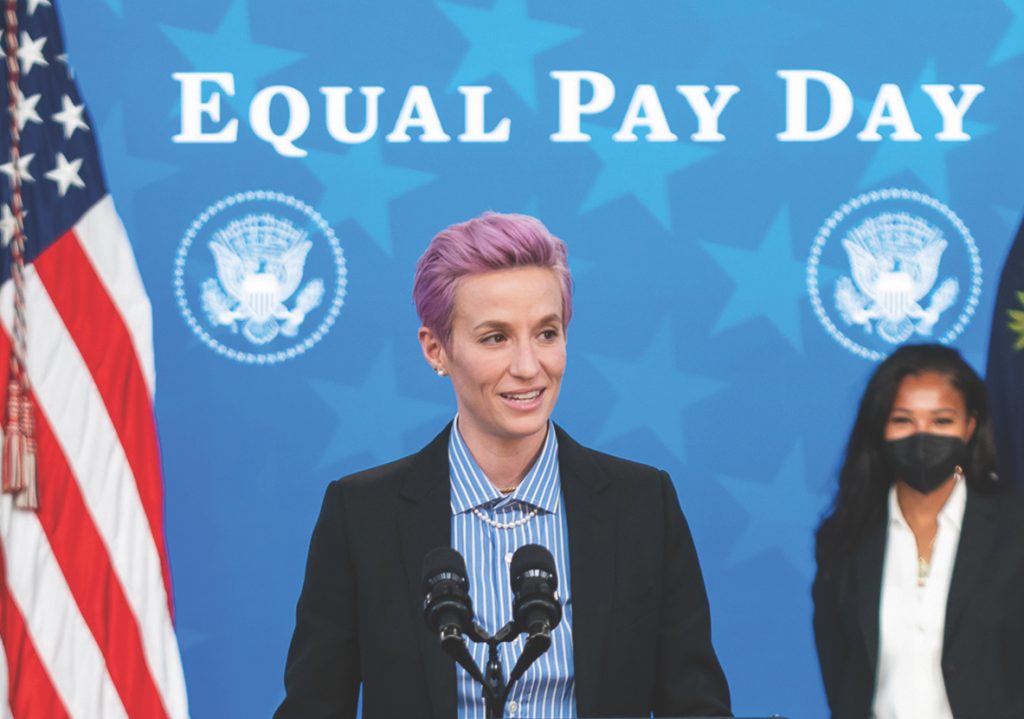
Retiring Soccer Megastar Megan Rapinoe kicks up her fight for equality in the world arena — and shares why businesses have no excuse but to close the gender pay gap now.
She has been cheered from the stands by pro soccer fans for 15-plus years. She has been called upon by Congress to testify in a historic fight for gender pay equality. And she has become synonymous with being a disruptor on both world stages. Megan Rapinoe may be hanging up her cleats this year, but her advocacy work is far from finished. In fact, she tells Real Leaders that she is just getting started.
Hanging Up Her Cleats: Rapinoe’s Transition to Full-Time Advocacy
Rapinoe will retire as one of the most influential athletes on the planet with two World Cup titles, an Olympic gold medal, and a Presidential Medal of Freedom, and one of the first soccer players to publicly come out as gay. Now, Rapinoe is taking the field for gender equality in full force and is kicking up her activism efforts for LGBTQIA+ rights and racial justice.
Known to passionately speak her mind, Rapinoe reflects with Real Leaders on her leadership lessons from the game, why businesses have no excuse but to close the gender pay gap now, the impact company she recently launched with her fiancée, WNBA legend Sue Bird, her desire to make politics “cool,” and a whole lot more. Rapinoe’s new chapter is shaping up to be her most impactful one yet, and in true Rapinoe fashion, she is embracing it with arms wide open.
Real Leaders: Congratulations on your upcoming retirement from pro soccer. How did preparing for and competing in four World Cups, including as co-captain in 2019, transfer into your leadership strategy in business?
Rapinoe: When you’re playing on a team that has been as successful as the U.S. Women’s National Team where you’re literally playing with and against the best players in the world all the time, you need to have a level of even aspirational confidence in yourself and your teammates. If you’ve made it to the World Cup on the Women’s National Team, you’ve run the gauntlet. You’ve been in a pressure cooker. You’re resilient.
I apply these same qualities — confidence, teamwork, performance under pressure — to leadership in business. For me, I was born with this amazing talent to be an athlete. Just as I grew into a leadership role on the team and tried to be the best player I could be, I’m trying to leverage these skills off the field as well.
Being a leader on a team or in a business means you have to be accountable to yourself and to your teammates. I’ve always been a team-first player, and that definitely carries over to my businesses outside of soccer. I want to be successful, of course, and I want everyone to be successful with me, and I want to be successful with them. I don’t think individual success actually exists, and the foundation of that belief came from playing on the biggest stage with my teammates. You need everyone to really win at anything.
RL: You helped lead the charge in the U.S. Women’s National Team’s class action gender discrimination lawsuit against the U.S. Soccer Federation, settled in 2022 with a promise for equal future pay with the men’s team. How is this affecting employee equity in business today? How would you characterize the progress that has been made, and what will it take to reach equal gender pay everywhere?
Rapinoe: We’re definitely experiencing a paradigm shift in how we understand the value and potential of women, which has been undervalued for so long. The Equal Pay Act became law six decades ago, and yet we still hear the statistics: Women make 82 cents for every dollar a man earns. For Black women and women of color, the gap is even greater. The wage gap has hardly moved in 15 years. It’s absurd. It’s not acceptable or sustainable, and finally it seems like enough people are starting to say “enough” — whether that’s U.S. women’s soccer, protesters, investors, or employees.
Our victory as a team was really momentous for women’s soccer and for all of women’s sports and the equal pay movement, but the average person doesn’t have the platform — much less the bandwidth or the ability or the freedom — to engage in a fight like we did. We need to ensure all working women and all marginalized groups are being paid equitably. As chief equality officer for Trusaic, my goal is to use my platform to bring awareness not only to the problem-because we all know by now that there’s a problem- but also to talk about the solutions.
And it’s not just about compensation, although obviously being paid fairly is important. For the team, it was also about equal investment and equal caring — that’s equal access to resources, investment in coaching, marketing, ticket sales, sponsorship, all of it. In a corporate setting, that looks like equal access to opportunity — who gets the new assignments, the great projects, who gets additional training and development, and who gets promoted.One thing I believe is that you have to create a space that signals to people that it’s safe before they even enter that environment. Maybe that’s diversity training, but it’s also: What are your hiring practices? How diverse is your workforce? Who do you do business with? What does your executive suite look like? Does everyone look exactly the same? Because that’s not going to signal to other people that there’s space for them there.
The pressure’s been turned up. We know investors are looking more closely at companies and their workplace practices, employees want to work for companies that pay fairly, and customers want to do business with companies that do the right thing. So the pressure is coming from a lot of places, and industries and companies should also put pressure on one another. There should be an element of holding their feet to the fire in this. Legislation and legal action are obviously part of that pressure too.
Companies hold the key to closing the wage gap. There are no longer any excuses. At this point, we have enough information and the tools, like Trusaic’s PayParity technology, for companies to get on the other side of this in a real, meaningful way.
Megan Rapinoe and her fiancée, WNBA legend Sue Bird, recently announced their retirements from sports and co-founded A Touch More production company to give a voice to underrepresented groups.
RL: As a mission-oriented leader, what are your personal and professional missions right now? Rapinoe: My professional mission while I am still playing is to be the best teammate and the best player I can be and to leave the game in a better place for the next generation of players.
My personal mission is to use my platform to fight for gender equality, LGBTQIA+ rights, racial justice, and equal pay. I hope to inspire others through my advocacy and actions to join the fight for equality and justice and help create a more fair and inclusive world.
I am very selective about who I work with, and value alignment is something I take seriously in business. I became chief equality officer last year for Trusaic, which I know your publication recognized earlier this year. (Trusaic was a 2023 Real Leaders Top Impact Company.) They are a workplace equity technology company focused on achieving pay equity, which is obviously very close to my heart. And, of course, I’m involved with my own businesses as co-founder of A Touch More, the production company my fiancée, Sue Bird, and I have formed together to really change what kind of stories are being told and who is telling them.
RL: Speaking of co-founding A Touch More with Sue Bird, what are you learning about yourself and each other in this process? Rapinoe: A Touch More was actually created early in the pandemic as an Instagram Live show really just for fun. We had games and different guests. Sue produced the show and it was a blast. It really became about creating community in new ways under unprecedented circumstances. There was so much heaviness, and we just wanted to be a light however we could, even if it was just for a few hours.
So we kept that title for the production company, and our goal now is to create content that centers on stories of revolutionaries who move culture forward. If we can get eyes on these stories, we can broaden the cultural understanding of what it means to move in the world and to be successful when you don’t look a certain way or fit a certain mold. We want to partner with people and organizations and brands who want to do the same kind of thing: uplift the culture through powerful narratives.
We’ve never had any qualms about working together professionally. This experience just reinforces that we’re really passionate about the same things. We probably appreciate each other’s unique strengths even more, and we can pick each other up in those areas where the other one might fall short. It’s really cool to work with someone you love to advance your shared vision for the world. I truly think Sue’s brilliance is one of her most underrated qualities publicly.
RL: Do you and Bird have any other projects in the works together? Rapinoe: In terms of future projects, activism is probably always going to be at the heart of what we want to do. It’s what we both have always believed in as individuals, so it makes sense. We’ve both had these really influential platforms as athletes, and we know the impact we can make on the world together. It’s not about our story and our personal success. Everyone’s heard our story. We want to get eyes on things that we feel are really important and not getting enough attention, and we have the resources between us to turn up that light.
Fueling Change for Future Generations
RL: What areas of your work and mission excite you the most? Rapinoe: I’m really fueled by the opportunity to make a difference for the young athletes who look up to me, for women in the workforce, for trans kids, for marginalized groups that deserve to be championed and to be seen and heard.
I’m excited about finding ways to get more people interested and invested in politics to make politics “cool,” not necessarily in the traditional sense, but actually getting people to understand that politics is engaging with you, whether you’re engaging with it or not. So those could be the decisions that your school system, city government, and insurance company are making. If people realize that when they participate in politics at whatever level, then policies will better reflect the needs and desires of their communities. We can impact our ability to live a better life by being a little bit more involved. If we take the time to understand all the issues we can have a say in, we can hold our elected officials accountable, so that’s a big mission of mine.
RL: How can you leverage your personal brand as an advocate for the businesses you align with? Rapinoe: Many of the brands that approach me do so because they feel a connection to what I’m doing on the field or what I’m doing and saying off the field, probably some of both. So that might be finding a way to win or to push yourself to the highest level or taking a stand for things that matter — justice, equality, fairness. I’m obviously not shy about putting myself out there, and so I imagine the brands that want to work with me and the brands I want to work with feel the same.
For me, it’s how can I leverage my personal “brand” — who I am — for good? How can I make a difference? I’m fortunate to have people who do pay attention to what I say, so I feel a responsibility that comes with that — a responsibility to do what I can with that influence and try to make the world better, whatever that might look like.
Megan Rapinoe delivers remarks during a virtual Equal Pay Day event Wednesday, March 24, 2021, in the South Court Auditorium in the Eisenhower Executive Office Building at the White House. (Official White House Photo by Adam Schultz)
RL: You’ve spoken publicly about impact investing. What led you to commit to it? Rapinoe: Values apply to every aspect of your life, not just some. My personal financial advisor and firm are really committed to impact investing. We definitely want to be successful and make money, but we also want to think about a new path forward. Doing the same things obviously isn’t working. I like to invest in companies that are disruptive and progressive and concerned with making a difference in people’s lives. My goal is to keep doing this. My portfolio includes Mendi, which is run by my sister, Rachael, and makes CBD products for athletes; Real, which is a mental health startup; and STATSports, which makes wearable technology for athletes. We are just getting started in this space. There will be more to come. I want to continue to carve out a path for women — who don’t acquire as much capital — to come together and build for everyone.
RL: Whose leadership has inspired you the most — in sports or otherwise? Rapinoe: My biggest influence on leadership is my mom, Denise Rapinoe. She has always been the leader of our family and like so many women, has worked tirelessly her entire life to provide for her family, herself, and anyone who needed her. My mother gave me the strength to be who I am today. She taught me how to stand up for what is right, fight for myself, and fight for others who need a helping hand. I absolutely would not be the person everyone knows today without her leadership.
RL: What is your definition of a real leader? Rapinoe: A real leader is someone who is confident and accountable and creates an environment where everyone feels seen and heard and like they have a place on the team. Being a leader is about being faced with the choice to make the right decision for the greater good and actually choosing it every time. A real leader is not afraid to challenge the status quo to make positive changes within their company, industry, or the world. I don’t think there’s one right leadership style. It’s about serving the person next to you and the people around you and giving them what they need. Real Leaders need to make a point of understanding the people they lead and then being intentional in their actions to support them and bring the very best out of them.
Rapinoe Embraces Her Next Chapter
RL: What’s next for you? Rapinoe: Knowing this year would be my last in soccer, I’ve just tried to really enjoy every moment and appreciate what a special opportunity I have had playing for so long. I’m so grateful for everything this game has given me and so honored to have represented my country for so many years, and it, of course, has opened up many other doors.
I definitely want to continue to use my platform to expand the conversation. It would be irresponsible of me not to. I want to push people and companies to re-imagine the status quo. We obviously need more women in leadership positions. We need more gay and trans people in leadership. We need a bigger commitment to pay equity and inclusion. It’s easy for everyone to say they agree with this until it comes time to actually invest in or hire or promote someone who doesn’t look like you. We’ve made some progress, but we certainly have a long way to go. I think a lot about how we can break down these barriers and open more doors for women, Black people and all people of color, gay people, and the people who live in intersecting spaces and have so much perspective to offer all of us.
I’d like to continue to be involved in more projects that get people energized about the civic process and more active in their communities. I don’t think enough people get involved when it’s not literally their skin in the game, but if you look at the intersectionality of everything, it is all of our skin in the game, so I hope to encourage people to speak up or to take positive action. The most important thing for anyone is to do something — and you don’t have to do it perfectly. You don’t have to have all of the answers, but don’t be scared into inaction because you don’t think you have it exactly right.
I feel strongly that the business of Megan Rapinoe can go in all kinds of different directions. I have a lot of irons in the fire. Soccer will always be that touchstone for me, but how can I use that foundation to enter other spaces? That might be fashion, technology, investing, or who knows? We’re just getting started.
Market forecasts have a common denominator – it is the word “change.” There has been an increased focus on performance management, employee engagement, and development. Among these activities has been a war for talent. By 2030, the lack of qualified workers could leave 85 million jobs empty. It is now more important than ever to develop innovative solutions and attract the right talent to ensure success.
Why IQ is not enough?
It is said that the world has never changed so fast, and on the other hand, it will never change so slowly again. We are judged today somewhat differently than in the past, not only according to how smart we are and what kind of education or expertise we have but also from the perspective of how we manage ourselves and others. Finding the perfect balance between being in touch with your own emotions and recognizing the emotions of those around us may be key to success in the professional world. Gone are the days when qualifications and results came first, now employers are looking for a workforce with exceptional soft skills, including the ability to communicate, give feedback and make meaningful connections. Individuals with a high EQ have a head start when it comes to achieving their goals, as they are able to better connect with their colleagues, clients, and target audience. A computer may be able to outwit a grandmaster in chess, but it still lacks the ability to understand the query “Do you want to play?” as it cannot comprehend the game being proposed. Technology can be capable of making our work more efficient, but it can’t replace the human touch. The ability to ask the right questions of machines, as well as to collaborate as a team and with the customer, are dramatically needed skills. Therefore, a valued competency in employees is both the ability to discover meaning and create meaning, as well as unconventional and adaptive thinking.
An Employee Shouldn’t Be Seen as a Piggy Bank
People are an organization’s most valuable resource. Rather than viewing them as a financial burden, they should be recognized as an investment. According to the World Economic Forum, more than 1.3 billion people worldwide lack basic digital skills. Companies need to get with the times and equip all departments with tech-savvy employees. In fact, every area, not just IT, will need personnel well-versed in technology. Amidst a scarcity of talent, businesses that want to stay ahead of the competition must invest in upskilling their workforce. They should not only focus on what kind of employees they need but also understand those already employed. At the end of the day, they are all searching for something beyond a paycheck – a sense of purpose. Rather than feeling like a commodity, they crave to be recognized, heard, and valued.
Angry and dismayed Amazon employees are pushing back against the recently-announced return to office policy by the Amazon leadership. Amazon’s policy joins other high-profile companies such as Disney, Starbucks, Tesla, Google, and others that are forcing employees back to the office.
Some are claiming they need to do so for the sake of productivity. For example, Elon Musk, the CEO of Tesla, claimed that those working remotely only “pretend to work” and are “phoning it in.” Others say you need to be in the office to innovate: Disney’s CEO Bob Iger demanded the return to the office because “nothing can replace the ability to connect, observe, and create with peers that come from being physically together.”
So what explains the situation?
As a globally-known expert in the field of hybrid and remote work, I have seen firsthand how working remotely, whether part of the week or full-time, enables worker power by facilitating autonomy, decentralizing power, and preventing micromanagement. Unfortunately, too many old-school managers like Iger and Musk prefer a rigid, top-down power structure; indeed, Elon Musk is well-known as an extreme micromanager.
Such an authoritarian approach is well-suited to the assembly line model of the early 20th century, but not well-suited for a modern knowledge economy. That’s why we’re seeing employees use worker power to fight against these authoritarian mandates, resulting in empowered labor unions.
It’s important to recognize that this turn to worker power is happening in the context of massive layoffs by tech companies, which are becoming less willing to offer perks like remote work to their workforce. In fact, there’s evidence that some companies such as Twitter are using return to office mandates to get workers to quit voluntarily, to avoid paying severance. Employers are increasingly getting the upper hand, as workers who feel anxious about the economy are reluctant to make demands for more remote work. However, such strategies may well backfire against employers in the long term if they spur increases in labor union organizing; even though individual employees might be anxious about their jobs, together they can press their case, especially given an unemployment rate of 3.4%, the lowest in over 50 years. And even tech workers are finding new jobs in three months or so, pointing to the strength of the labor market despite some shift toward employer power.
Three Case Studies of Worker Power and the Return to Office
YouTube contractors in Texas went on strike in protest of rules requiring such workers to report to the office. The workers, who are technically employed by Cognizant, were notified of the Feb. 6 return-to-office date in November. The vast majority of the contractors were hired during the pandemic and have always worked remotely. Workers say their pay, which starts at around $19 per hour, isn’t enough to cover the costs of relocating to and living in Austin. The workers’ strike came after they filed a prior month for union recognition, leading some to conclude the move was being made in retaliation. The workers are also seeking to have Google and Cognizant recognized as joint employers.
The New Mexico State Personnel Office ordered state employees working remotely to return to in-person work at the start of the new year. Many voiced their frustrations against the order, citing issues with commute, health, poor in-person work conditions, lack of child care, and low pay, among other things. State workers rallied against the state’s return-to-office order at the roundhouse in Santa Fe. Dan Secrist, president of CWA Local 7076, said the state’s return-to-office mandate has worsened problems it was intended to solve while creating new ones.
Tensions Between Employers and Workers Over the Return to Office
These cases illustrate the increasing tension between employers and workers, particularly over the return to the office. The pandemic has accelerated the trend toward remote work, and workers are now resisting the idea of returning to the office. Many workers have become accustomed to the flexibility and freedom that come with remote work, and employers who refuse to allow it are facing backlash.
Employers are forcing their employees back to the office to impose control over workers, but they are failing to recognize that remote work enables worker power. In fact, remote work is empowering workers by giving them more control over their lives and work. With remote work, workers can choose where and when to work, which gives them more control over their schedules and their work-life balance.
Employers who are forcing their employees back to the office are trying to reassert control over their workers, but they are finding that it is backfiring. Workers are pushing back against these efforts, and many are joining unions to protect their rights and interests. Employers who refuse to recognize this trend risk alienating their workers and facing the consequences.
Cognitive Biases in the Return to Office Increases Worker Power
The drive to return employees to the office to regain control over employees is a prime example of how cognitive biases can lead to poor decision-making. Cognitive biases are mental shortcuts that we use to process information quickly and efficiently. They can lead us to make decisions that are not based on facts or rational thought, but on our personal beliefs, emotions, and past experiences. In the context of the return to the office, employers are making decisions that are based on cognitive biases that are leading them to overlook the dangers of their actions.
One of the most common cognitive biases at play in this context is confirmation bias. This is the tendency to seek out and interpret information in a way that confirms our pre-existing beliefs or biases. Employers who are determined to bring their employees back to the office are more likely to seek out information that supports this decision, while ignoring or downplaying information that contradicts it. This can lead them to make decisions that are not in the best interests of their organizations by harming relations with employees, leading both to challenges with retention and resistance by employees through worker power.
Another cognitive bias that is prevalent in this context is the status quo bias. This is the tendency to prefer things to stay the way they are, rather than change. Employers who are used to having their employees work in the office may be resistant to change, even if remote work has proven to be effective and beneficial for their employees. They may be more inclined to return to the office simply because it is the way things have always been done, rather than because it is the best decision for their employees or their organization.
The dangers of cognitive biases in this context are significant. By ignoring the benefits of remote work and forcing their employees back to the office, employers risk alienating their workers, and they may also be creating a situation where workers are more likely to unionize. This is because when employees feel that their needs are not being met, they are more likely to band together and form a union to protect their interests.
In Conclusion
It is time for employers to recognize the value of remote work and to work with their employees to create hybrid or remote work arrangements that meet the needs of both parties. Employers who do so will enjoy a happier and more productive workforce, while those who refuse to adapt risk falling behind in a rapidly changing world.
Remote work enables worker power, and employers who recognize this fact will be better positioned to succeed in the years ahead. As a manager, it is important to listen to your employees and to work with them to create the best possible work environment for all. By doing so, you can create a strong and vibrant workplace culture that will help you succeed in the long run.
The leaders of the next generation of business will have to be prepared to handle the accelerated pace of change, and the best skill these leaders can build is one of lifelong learning. The best career arc must have a strong foundation, and with three specific skills, emerging leaders will have a strong advantage in the uncertain future.
Current leaders know that the nature of leadership has evolved, especially over the last couple of decades. Between emerging technologies and global events such as the pandemic, the way your employees’ work has changed and will continue to do so. Naturally, this means leaders must also continue to evolve as the business world faces any number of challenges.
The future of business leadership will require emerging leaders who can quickly adapt and execute in the midst of changing technologies, cultures, and priorities. To keep up with the accelerated pace of change, staying aware of new developments and technologies that could disrupt the status quo are crucial, as is the ability to upskill quickly when necessary.
How can you, an existing or emerging leader, do that successfully?
Stay Educated and Adaptable to Lead Successfully in the Future
There is a strong connection between leadership and lifelong learning. The best way to stay nimble as a leader is to commit to continuing to educate yourself. Whether that means reading widely, talking to people outside of your industry, or staying connected across different sectors and geographic areas, practicing a learning mindset will help you see the latest best practices as they develop within the industry and potentially even spearhead the leadership trends in business.
Additionally, you should cultivate a desire for lifelong learning within your teams. By sponsoring your mid- and early-career pipeline talent in executive degree programs, you can ensure your employees are networking, staying involved with community organizations and professional associations, and remaining open to new information.
Being educated on what’s happening in the world also requires an interest in learning from others. Business leaders are incredibly busy, so it can be easy for you to narrow your focus to only tasks that have immediate ROI. But to remain in the know, you can and must create daily or weekly rituals where you consistently reach outside of your organization to listen to and internalize ideas and best practices.
This can be as simple as listening to podcasts on the commute, reading the paper each morning, joining a book club for professionals, or being active in a professional group with executives from other organizations. Staying connected to people outside of the organization will pay dividends in seeding new ideas and consistently testing the strength of existing beliefs.
What Skills Should Be Priorities for Emerging Leaders?
For emerging leaders, there’s a lot to focus on. Avoid getting overwhelmed by all of the potential options, which will only hinder your progress or lead to early burnout. Instead, focus on building and expanding on these three specific skills:
1. Accurately draw conclusions from data.
A tremendous amount of data is available to leaders. Next-generation leaders need to create systems—dashboards, automated reports, or live data pipelines—where they can instantly access meaningful, purposeful data and accurately draw conclusions. This kind of data goes beyond quick performance indicators. Instead, it allows the leader to study long-term trends and competitive strengths and weaknesses so that each can be handled appropriately.
2. Practice genuine empathy.
Thanks to technology, we know more about one another than ever, and we expect to get a sense of the humanity of one another. Likewise, we expect empathy in business leadership. Modern professionals want leaders who don’t see a binary split between running a business that is strong financially and respecting the diverse group of people who work there. They want both. The leaders we most admire achieve core business goals while also treating people well and building a culture that attracts and retains talent.
3. Master interpersonal communication.
Good leaders are strong communicators. People in leadership positions must be able to speak well on a public stage and communicate effectively with professionals at every level of their company—from the new hire right out of college to the senior executive they have worked with for a decade. The strongest leaders will specialize in strong interpersonal communication and will galvanize a culture behind their leadership style as a result.
How Can You Strategize and Prepare for the Complexities of Future Leadership?
Study how other leaders speak, act, and behave during and following crises. In this age of social media and fast-moving news cycles, leaders must prepare to be at the helm of decision-making and public speaking in times of crisis. This is why many of our students at Washington University’s Olin Business School choose our Strategic and Crisis Communication class as an elective in their graduate degree, giving them that extra preparation for leadership in the 21st century.
Remain curious about new technologies. I recall Professor Hank Feeser at Purdue University, my alma mater, who was near retirement and was more excited about new technologies than anyone I’ve ever met. He instilled that curiosity in our class and he consistently told us that technology would transform many of the processes in organizations. Scan the environment to see what competitors are using technology for.
This is not always because it is something that must be blindly adopted—there are many inopportune or not strategic ideas about technology too that are only adopted for a moment—but so you can assess the strength of a technology and make good decisions about when it’s time to act. Building that core strength and intuition around technology is difficult for non-digital natives, but staying curious is a great way to stay current. Remember that technology might change processes, but it doesn’t change the core principles of good business.
Develop a set of core values and visibly display them in several places in your daily life. You might consider listing them by hand. Olin Business School has a set of core values that guide our decision-making and courses; they act as our North Star. As a business leader, you should decide on your own core values. Hold true to these, no matter how the winds of change pass through. They will provide an anchor that you can rely on during times of severe change or difficulty. Alignment between core values and company vision gives both you and your organization a strong sense of purpose. And carrying that purpose through into action ensures that you will lead with authenticity.
When you think of your favorite brands, how do you feel? Whatever those feelings are, for successful brands, the way you feel has been fully orchestrated from the day you first encountered the brand.
For instance, for those who embrace Nike’s brand, it elicits very strong feelings. And from the brand’s culture to its designs to its marketing, those feelings are intentional. Apple elicits strong feelings. Netflix, Harley Davidson and Red Bull also elicit strong feelings. Until recently, Southwest Airlines was among that set, although now, feelings about the brand seem to be shifting. More on that in a minute.
In his marketing classic, Becoming a Category of One, author Joe Calloway gives what has become our favorite definition of branding. Calloway says, “Your brand is what people think it’s like to do business with you.” That statement isn’t grounded in product attributes and quarterly profits. It’s grounded in feeling.
How does engaging with your brand make me feel? Is your brand congruent? Do what you say and do align, and will they every time I interact with your brand? When the interaction makes me feel good, strong, proud and happy, and the brand is fully congruent, that’s how brand evangelists are born.
At their core, brands are meaning-making systems designed to reflect, signal and communicate a company’s values. That’s why brands that focus on culture win. It’s also why company culture is something that requires constant curating. Let’s jump back to Southwest Airlines.
Even Cultures Built to Last, Don’t
On January 4, 2019, the day after Southwest Airlines founder Herb Kelleher passed away, an article ran in Forbes, “20 Reasons Why Herb Kelleher Was One of the Most Beloved Leaders of Our Time.” In it, authors and leadership experts Kevin and Jackie Freiberg said this about their longtime friend:
“Herb played the game of life full throttle. One of the most passionate people we have ever known, he had a zest for life, an indefatigable spirit, a contagious sense of humor, a servant’s heart and an intellectual acumen that allowed him to carry on an interesting conversation with anyone, anywhere, about anything. For almost 30 years we’ve been asking, ‘What if you could build a company that is as human as the human beings in it? What if you could create a culture that inspires passionate people to come to work fully awake, fully engaged, firing on all cylinders because they know they are doing epic work?’ Herb did.”
Yes, Herb did. But even cultures that seem perfect can crumble when left unattended. For years, the team at Southwest could do no wrong and we loved them for it. From turning planes in record time day after day, to making flying fun again, Southwest was a cultural touchstone and one of the most beloved challenger brands of all time. But the events of the last month show there were also cracks in the culture at the top that company leaders ignored until their infrastructure was imploding along with consumers’ trust across the country.
While the long-term fallout remains to be seen, Southwest Airlines is now a cautionary tale for the leaders of every company and brand culture. Leadership isn’t a top-down edict that demands buy in. It’s an employee-first, customers-second, leaders-third mindset. The debacle at Southwest happened the week of Christmas but it started 20 years ago when a leader wholly committed to his employees and customers gave way to a CEO who focused exclusively on ROI, cutting expenses, and Wall Street. When that happens, culture becomes the sacrificial lamb for profit, and while that can certainly inflate numbers temporarily, it’s not sustainable. You can only cut your way to profitability for so long.
3 tips for building a strong brand
Building a brand your team will embrace and your customers will love in perpetuity takes time, energy and vision. It also takes the realization that brand building — just like culture building — is a constant process. When those two efforts work in strong, strategic alignment, the world sits up and takes notice. Here are three tips for how to make that happen:
1. Start with “lighthouse leadership.”
The single-most effective way to differentiate your brand is to firmly ground it in company culture and that culture has to begin with leadership. In challenger branding, we talk about brands having a “lighthouse identity” — an identify based on an authentic truth that burns so brightly even those not looking for it will see it. Lighthouse leadership is what happens when self-aware leaders have crystal clarity about who they are, where they want to take their companies and how they intend to get there. Your team doesn’t need a manager. It needs a beacon of clarity. It needs an inspired thinker. It needs a champion who can build team members up and lead them into battle with clear direction, conviction and support.
2. Embrace the greater good.
If you’re unaware of the Conscious Capitalism movement afoot across the country, read up and learn all you can. Conscious Capitalism is about embracing the idea of doing well by doing good espoused by a stakeholder model that rewards all the constituent groups involved in commerce — versus the shareholder model that squeezes everyone possible to drive all profit to the shareholders. The movement’s mission is more than simply elevating humanity through good business. It’s something that delivers results. In his book Firms of Endearment: How World-Class Companies Profit From Passion and Purpose, author Raj Sisodia (co-author of Conscious Capitalism), cites research that, from 1996 to 2011, consciously led publicly traded companies outperformed the S&P 500 by a factor of 10.5. That’s the power of positive culture.
3. Think like your customers and deliver for them without fail.
Remember the Joe Calloway quote we started with? “Your brand is what people think it’s like to do business with you.” Great brands — challengers or not — never lose sight of the customers’ perspective. Thousands of brands die on the vine every year because they never stop to ask, “What kind of experience do our customers want from us?” It’s not about faking it or trying to be something you’re not. Brand loyalty is built on authenticity as much as anything. Smart, successful, lasting brands understand they have to consistently show up in a meaningful way for their customers, not the other way around. Whatever your authentic truth, be the brand you say you are, build the culture that will support your team, and do whatever you have to do to deliver without fail. Do that, and when failure inevitably comes, it’s something you’ll most likely survive.
As many in society are losing trust in our systems and institutions, business leaders need to step up and lead the way. Trust in Action is a leader’s guide to drive the sense of urgency and change needed to address the big issues we face today. The book, which will be released on April 10, 2023, is part memoir, business case, and model instruction, where readers learn to define trust, identify the building blocks of trust, and apply a novel model to maintain, and if needed, regain trust.
Trust in Action was written by Jim Massey, a former VP of ESG Sustainability, Ethics, and Compliance at AstraZeneca, who led and developed Ambition Zero Carbon, the world’s most comprehensive corporate environmental programs aimed at reducing greenhouse gasses.
“As ESG topics become more relevant, more and more business leaders were asking me what they should do,” says Massey, currently Chief Sustainability Officer at Zai Lab, a global biopharmaceutical company. “My answer and the reason I wrote this book, is that it comes down to trust, and trying to help others understand that we can’t afford not to be singularly focused on social impact.”
The book is based on the premise called the trust model, an idea Jim developed that focuses on three elements: can, care, and do. For trust to be present each of these elements must be present. The model demonstrates how trust is the connective tissue that makes positive action possible, as it creates the building blocks for a successful self, team, and system. Here’s how it works:
● Can: Leaders need to have clarity of their vision or purpose first, as this will enable them to be secure in their ability to tackle whatever issue or problem needs solving. This idea of ‘can’ allows leaders to try new solutions.
● Care: Leaders need to demonstrate that they and their company will engage, listen, and take actions that benefit those who depend on them, balancing company profits with impact. Employees, customers, communities, and investors want companies to be successful, just not at all costs. Leaders and companies must show they care about people and our planet when they do business.
● Do: Leaders and organizations must turn aspirations into operations and walk their talk. To make sense of the chaos, humans create built systems. Since we created these systems we can fix them and potentially use them to regain society’s trust.
“Jim’s most distinguishing characteristic is his ability to deliver on what he committed. He walks his talk,” says Dame Polly Courtice, Emeritus Director and Senior Ambassador, University of Cambridge Institute for Sustainable Leadership. “He has used these leadership qualities to help define the trust model of can, care, do.”
Book Launch Events: There will be two launch events for the book on April 10. During these events, Jim Massey will speak about what prompted him to write the book, and how the trust model he developed can help leaders gain trust to achieve their goals. To register for either event, visit: Monday, April 10, 8 AM – 9 AM EDT or Monday, April 10, 5:30 PM – 6:30 PM.
High-stakes negotiations can be nerve-racking. There’s a lot riding on the outcome, and because of it, you place enormous pressure on yourself. Will you secure that sought-after client? Will you seal that big deal? Land that investor? And what happens if you don’t?
Preparing for and engaging in these kinds of negotiations generates beta brain waves, which keep you alert and focused. That’s a good thing. Negotiations can be complex; so much information is exchanged in the back-and-forth of all the bargaining. You need to keep track of what you committed to, what the other party committed to, and any contradictions that may arise.
But as you do, you may produce more beta waves than you need, which isn’t a good thing. Spikes in beta waves ultimately lead to poor concentration, brain fog, and fatigue. In addition, your body ramps up cortisol, a stress hormone, and stress can be debilitating, especially when it comes to your creativity.
What exactly is happening during negotiations that causes so much stress? One possibility is that when preparing for a negotiation, you’re solely focused on the outcomes you want. This is a natural tendency.
Perhaps you map out the path you intend to take to get to those desired outcomes. You might even identify mini-milestones along the way that will let you know you’re on track. However, as we all learn at one point or another in life, things don’t always go according to plan. Sure, you planned how you wanted the negotiation to flow, but this wasn’t a dialogue with your negotiating partner. The person you’re negotiating with doesn’t have your road map!
So, when the unexpected happens, you start to stress because the situation has deviated from your carefully drawn map. The beta-cortisol cycle in your brain and body picks back up, keeping you in a frenzied state and limiting your ability to be flexible and creative. As a result, you end up in a rigid cycle and don’t advance the negotiation to where you want it to be.
How do you get back on track?
Here are three ways to transform some of those beta waves into alpha waves, which will help you relax and flex your negotiation muscles:
01. Map out different scenarios during your negotiation preparation.
It’s always a good idea to map out multiple scenarios of how the negotiation might flow. What detours should you anticipate? What resistance points and constraints might you run across? At these junctures, you can either try to get back on your pre-planned path or follow the new path the detour presents.
You can do this by asking questions that uncover why there are roadblocks and resistance. Start with easy-to-answer questions that get the other side talking and more comfortable sharing information. For example, you might ask, “Can you tell me more about why you think this won’t work?”
If the other party answers, “This isn’t a good time,” you can respond with, “So, it’s not a good time now?” By doing this, you’re integrating the person’s response into your clarification without sounding defensive. Your new mini-goals is to figure out when a good time might be.
02. Center yourself in the moment.
Habits and practices that allow you to remain physically and emotionally present in your negotiations are essential.
Reciting mantras, visualizing tranquil images, or remembering soft melodies will generate alpha waves in your brain and keep you centered and calm. If you can’t actually perform these practices, recall a time when you did and the benefits you gained as a result.
Slowing down your breathing is also a good stress reducer. Breathe in to the count of four, hold for four, breathe out for four, and repeat. When you’re tense, your breaths are short and rapid. Slowing your breathing will relax you and send more oxygen to your brain so that you can be more agile and creative in the moment.
3. Listen throughout the process to hear what’s most important.
During a negotiation, you may think you need to have all the answers, but that’s an unrealistic expectation to place on yourself. Your negotiation partner is a treasure chest of information; your role is to unlock it to find out what you need to know.
Spend more time listening than speaking. This will give you insights into how to move the negotiation forward. As part of your alternative scenario preparation, identify what you should be listening for.
Listening is a complex activity, and too often, we lack focus and miss collecting the information we seek. This includes listening for the other party’s underlying needs, their constraints, and what might sweeten the deal. Identifying these tidbits in advance will make it easier for you to recognize them when you hear them. This listening practice will hone your skills so that you’ll be able to surface critical information that may have previously been overlooked.
Combining these three tips will lead you to easier, calmer, and more creative negotiations.
Being a leader isn’t about having all the technical know-how or business acumen; it’s about being emotionally intelligent. By forming deeper emotional bonds with your team, you can create a more inspired, kinder workplace.
Some leaders like to think that showing no emotion is what makes them successful. They strive to keep emotions and even intuition out of the workplace, and they face societal pressure to appear strong rather than vulnerable (as if vulnerability were not a strength).
But that type of thinking couldn’t be more wrong. Studies have found that emotional intelligence makes up nearly 90% of what sets high performers apart from their counterparts with the same knowledge and skills. What matters in a business setting is not so much technical know-how and financial acumen, but softer leadership skills.
Being a leader myself, I’ve experienced deeper connections with my team after being vulnerable and opening up about my emotional life. When I was dealing with mom guilt after going back to work, I decided to tell my team about it. Employees really responded — they told me it was relatable to hear about my work and personal hurdles, and it showed them that I was a real human being. It also validated their own feelings, which they might have kept hidden for fear of seeming weak or unprofessional.
Communicating my feelings and leading with emotional intelligence became a strength of mine, creating deeper bonds with my coworkers and motivating them to open up about their struggles.
What is Emotional Intelligence?
Emotional intelligence is about self-awareness. Although the majority of people believe they are self-aware, only about 10% to 15% can show that they practice self-awareness in their daily lives.
To be emotionally self-aware, you have to be able to take a minute and ask yourself which emotions are affecting your actions. What are you feeling right now?
Emotional intelligence also involves viewing things from a different perspective. Self-awareness is a starting point, and from there, you can venture into other people’s viewpoints and imagine their emotional lives too. How might emotions be playing a role in your employees’ behaviors?
Practicing emotional intelligence — for yourself and others — can make leadership more rewarding and more effective. For yourself, emotional intelligence helps dissolve the mask between work and home. It allows you to be yourself confidently, open up, and make more meaningful relationships with the people you work with.
Emotional intelligence helps you begin to fulfill your “hierarchy of needs,” which, according to Abraham Maslow’s theory, includes social needs such as acceptance, belonging, friendships, and community groups.
For others, a leader who shows emotional intelligence will be more likely to inspire their team. Research from the Yale Center for Emotional Intelligence found that people who work for supervisors with higher emotional intelligence scores feel 50% more motivated and inspired than employees whose leaders have low emotional intelligence.
Emotional intelligence helps people feel cared about. A workplace with leaders who ask, “How are you feeling today?” is a place people want to work and contribute to growth. Just show interest in your people and create the space for them to show up as they are.
How to Start Leading with Emotional Intelligence
Start putting those leadership soft skills to work, tap into the power of intuition, and bring your team along with you by actively practicing emotional intelligence. Here are a few actions you can take to start this journey:
Start with yourself. It might seem like an uphill battle to ask your team members to start practicing and valuing emotional intelligence when society has been telling them to avoid it. Starting with your own emotional life can help. Explore your own emotions at work. Be open to whatever they might be, and if you need to, ask for help exploring them — a therapist or leadership mentor can be a good sounding board.
Share your experiences. Like I did when I shared my mom guilt with my team, sharing a personal, emotional experience (especially when it relates to work) can help others offload too, and makes you more relatable as a leader. Lower your own taboo and try talking about your struggles and perceived weaknesses; this vulnerability will show others that it is OK to struggle.
Ask questions. As you learn to approach the world of work through an emotional lens, questions will be extremely helpful. This is true for gauging your own emotional responses, but it’s especially true when you start reviewing your team. Questions can help you discover what other people are going through. Could your teammate possibly have factors within or outside the workplace that impact their performance? Has their engagement with work changed? Do they seem distracted or irritable?
The most important way emotional intelligence operates in the workplace is by making us aware of ourselves, our well-being, others, and their well-being. The more aware we are, the more we can move in the right direction to make a kinder, more motivating, and inspiring (and ultimately productive) workplace.
Yes, this is a difficult hiring environment, but quick decisions to fill job openings will have major consequences on your time while dealing with employee issues like engagement, absenteeism, workman’s comp cases, turnover and more.
Here are Five questions to answer BEFORE you make any hiring decision.
Will this candidate add talent to the team?
Will the candidate take ownership of their job responsibilities?
Will this candidate get along with the other team members?
Can I manage this candidate?
If hired, how can I help this candidate learn, grow, and succeed – quickly?
If you answer these questions honestly, your new hire will have a better chance of fitting your management style, being a productive member of the team, and embracing the company’s culture. Additionally, you will have more time leading the team and less time trying to fix a poor hire. Benefit: Less turnover and more employee engagement.
Note: You can improve your hiring skills by writing your answers down and reviewing your notes in the future.