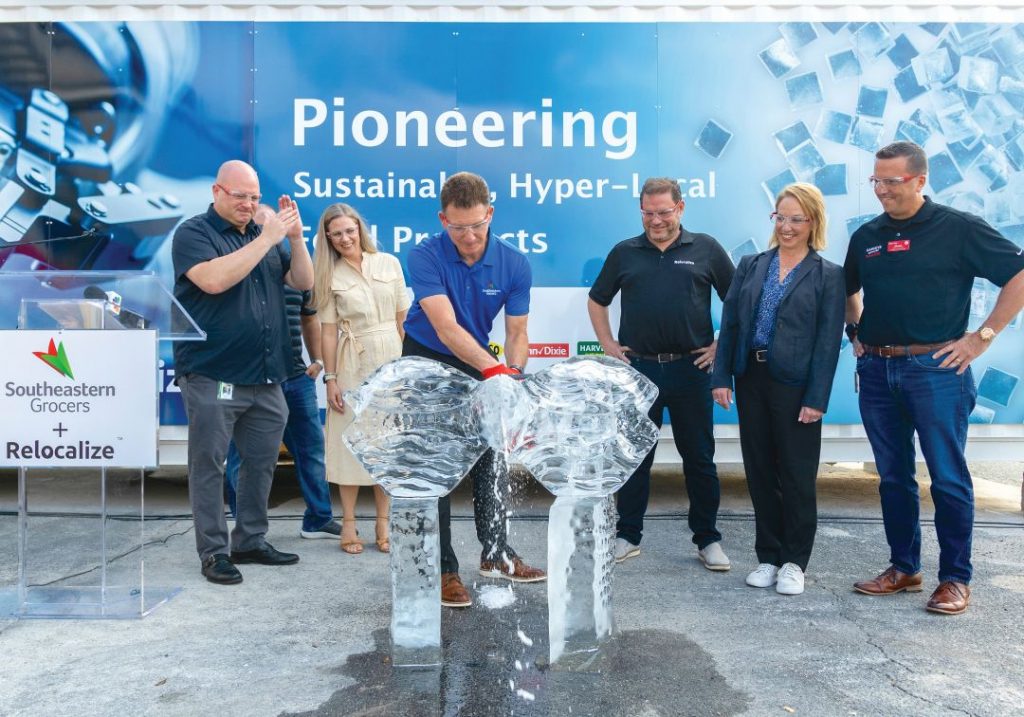
Southeastern Grocers (SEG) and Relocalize partnered to pilot ice manufacturing in the world’s first autonomous micro-factory, which was recognized by Real Leaders with an Impact Award for Best Collaboration. The partnership helps eliminate middle-mile logistics and reduce global greenhouse gas emissions, water waste, and plastic pollution.
Southeastern Grocers is an omnichannel retailer and one of the largest conventional supermarket companies in the U.S. with brands like Winn-Dixie and Harveys Supermarkets. This innovative and automated manufacturing process empowers the grocer to scale production and create waste-reduction solutions through the full lifecycle of the product.
“Our collaboration with Relocalize has allowed us to push the boundaries on what’s possible in our industry,” Dewayne Rabon, chief merchandising officer for Southeastern Grocers, tells Real Leaders. “By pioneering this revolutionary approach to ice production with the world’s first AI-powered micro-factory, we’ve enhanced the quality of our products and significantly reduced waste and carbon emissions.”
Here’s how it works: Relocalize sells automated food production platforms as a service (PaaS) to grocery and convenience retailers. These micro-factories (RELOs) are located at retailer distribution and fulfillment centers, where they produce CPG products on-demand for 100–200 retail stores. Each RELO performs all the processes of a traditional factory (e.g., production, processing, material handling, packaging, palletizing, inventory management, food safety) at about 1/20th scale. By eliminating middle-mile transportation and 100% of production labor with robotics, the retailer is supplied with fresher products at a much lower environmental and economic cost. Relocalize says its goal is to disrupt the $1+ trillion ice and beverage CPG category by hyper-localizing production to eliminate transportation CO2 and waste.
“We set out on a mission to decarbonize food supply chains,” says Wayne McIntyre, CEO and co-founder of Relocalize. “Fully autonomous, hyper-local food manufacturing is now a reality. This ice microfactory represents a fundamental shift in how packaged food is produced and distributed, ushering in the era of the one-step food journey from production to consumption.”
Through the partnership, SEG has introduced Party Cubes, which the duo says is the world’s first hyper-local, certified plastic-negative, packaged ice produced on-demand. The partners say this super-premium cubed ice stores better and costs less for consumers compared to traditional bagged ice, and the smaller, leak-proof packaging is 100% recycle-ready. For every one pound of plastic used in packaging, Relocalize will remove and recycle two pounds of ocean plastic. The process produces zero water waste (compared to 50% normally) and reduces trucking carbon dioxide emissions by 90%.
Highlights of the SEG-Relocalize Partnership
100% of production labor is self-contained to the microfactory at one of SEG’s distribution centers in Jacksonville, Florida.
Packaging is 100% recycle-ready and plastic-negative.
Relocalize removes 2 pounds of ocean plastic for each pound of plastic used.
Ice quality is improved and costs are reduced compared to traditional bagged ice.
It produces zero water waste and reduces trucking CO2 emissions by 90%.
The world’s leading industrialized nations are taking these actions together.
The Group of Seven’s leaders gathered for the 50th G7 Summit in June 2024 in Apulia, Italy. The G7 is made up of leading industrialized nations Canada, France, Germany, Italy, Japan, the United Kingdom, and the United States, as well as the European Union. Here are several actions on which they pledged to collaborate.
Promoting Economic Resilience and Security
The G7 is looking to take further steps to protect workers, industries, and the investments being made from being undermined by unfair practices, which create global spillovers that undercut market firms and lead to supply chain dependencies in several sectors. This includes:
Leveling the playing field and protecting economic security
Promoting resilient supply chains and reducing critical dependencies
Protecting critical and sensitive technologies
Investing in Developing Countries’ Future
The G7 is taking steps to scale up support to developing countries and accelerate progress toward the UN Sustainable Development Goals. These include:
Backing the Nairobi-Washington Vision that calls on the international community to step up support for developing countries to make critical investments and reforms
Planning contributions to multilateral development banks which once approved domestically would make it possible for the World Bank to boost lending by $70 billion over the next decade
Reaffirming their commitment to unlocking public and private capital for investments in partner countries
Accelerating the Clean Energy Transition
The G7 is accelerating its work to address the challenges of climate change, pollution, and biodiversity loss. G7 members reaffirmed ambitious COP28 commitments to triple renewable energy capacity, double global energy efficiency by 2030, and strengthen energy security. These efforts include:
A first-time commitment to phase out unabated coal power generation in energy systems during the first half of the 2030s, a target to deploy 1,500 gigawatts of long-duration energy storage by 2030, and building on the COP28 pledge to triple globally installed renewable energy by 2030
Building clean and resilient supply chains through its Partnership for Resilient and Inclusive Supply-Chain Enhancement, launched by the G7 last year, which supports low- and middle-income countries to drive the clean energy transition and promote resilient supply chains
Recognizing nuclear energy as a clean/zero-emissions energy source that can reduce dependence on fossil fuels to improve global energy security, and pledging to support multilateral efforts to strengthen the resilience of nuclear supply chains
Promoting Health and Food Security
The G7 continues to lead global efforts to address the food security crisis and support strong, resilient, and responsive health systems around the world. Efforts include:
Launching the Apulia Food Security Initiative, which addresses structural barriers to food security and nutrition and builds more resilient, sustainable, and productive agriculture and food systems
Transforming global health security financing by calling for at least $2 billion in new pledges for the Pandemic Fund, and pledging equal to or greater than that for catalytic financing, which helps developing countries build pandemic prevention, preparedness, and response capacities
Expanding immunization coverage through a sustainable replenishment of Gavi, the Vaccine Alliance with the goal of significantly expanding immunization coverage globally this year
Addressing the emergence, spread, and impact of antimicrobial resistance
Investing in Childcare
The G7 is tackling the unequal gender distribution of care work, which contributes to gender inequality. The G7 committed to support, by 2035, at least 200 million more women to join the workforce by investing in efforts to close the global gap in the availability of childcare. G7 partners have contributed more than $100 million to the World Bank to support high-quality investments in childcare globally.
Enhancing the Partnership on Migration
The G7 affirmed a collective commitment to addressing migration. Leaders endorsed a three-pronged approach focused on addressing root causes of irregular migration, strengthening safe and regular migration pathways, enhancing border management and enforcement, and curbing transnational organized crime.
Cooperating on Artificial Intelligence
The G7 is building partnerships around the world to ensure the benefits of artificial intelligence and other technologies are widely shared while mitigating risks. G7 leaders affirmed the importance of international partnerships to bridge the digital divide and ensure people everywhere access the benefits of AI and other technologies to make scientific advancements, promote sustainable development, improve public health, accelerate the clean energy transition, and more. G7 labor ministers will develop an action plan to leverage AI’s potential to increase quality jobs and empower workers while addressing its potential challenges and risks to workers and labor markets.
Promoting AI Safety
G7 leaders committed to stepping up efforts to enhance interoperability between their approaches to AI governance and risk management. This includes deepening cooperation between the G7 countries to advance international standards for AI development and deployment. The G7 welcomed the establishment of a Semiconductors G7 Point of Contact Group to bolster its coordination on issues impacting this critical sector underpinning the AI ecosystem.
For the 50th G7 Summit, leaders from Canada, France, Germany, Italy, Japan, the United Kingdom, and the United States as well as the European Union gathered in June 2024 in Apulia, Italy, to set global priorities.
Club de Madrid, the world’s largest forum of democratic former presidents and prime ministers, is calling for collaborative efforts to fight climate change in its latest Leadership for Net Zero report. Club de Madrid presented the report before King Felipe VI and several high authorities in Spain earlier in 2024.
“In the journey towards net zero, decarbonizing global supply chains stands as a formidable challenge,” says Helena Viñes-Fiestas, co-chair of the Net Zero Policy Task Force. “While some may opt for the easy route of offsetting, true progress demands more.
What is Leadership for Net Zero?
The Leadership for Net Zero initiative is an international platform for fostering reflection and mobilizing multidisciplinary expertise in implementing practical strategies toward achieving net zero. It brings together political, business, and civil society leaders to address the intertwined challenges of climate change, environmental degradation, and inequality.
The initiative convened three working groups led by distinguished figures from political, business, and civil society sectors, including Prime Minister Han Seung-Soo of South Korea, President Jorge Quiroga of Bolivia, President Felipe Calderón of Mexico, and President Carlos Alvarado of Costa Rica.
Leadership for Net Zero’s final report comprises a summary of the recommendations outlined by the three working groups with conclusions and next steps.
Key Recommendations
The report provides a set of recommendations for current leaders across government, civil society, and business spheres. It builds on the indispensable role of democratic leadership in securing and maintaining citizens’ backing for the transformative actions needed to achieve net zero. Key recommendations include:
Business leadership. Business leaders are urged to decarbonize supply chains, including enhancing measurement and reporting, setting science-based targets, and integrating climate criteria into procurement and supplier contracts. The report also emphasizes the importance of supporting small and medium enterprises, ensuring just transition strategies, and advocating for policy support.
Political leadership. A concerted global effort must mobilize finance, prioritize equity, and enhance urban resilience. The report emphasizes the need to share responsibility and empower citizens, revise economic metrics for sustainability, promote positive narratives for climate action, and implement carbon pricing initiatives.
Citizen leadership. Recommendations focus on climate finance for vulnerable communities, global governance for climate finance justice, and empowering citizens to participate in decision-making processes, demand action from governments and companies, and rethink economic and social models to create a sustainable future.
What’s Next?
Club de Madrid calls for collaborative efforts between governments, businesses, and civil society to prioritize citizen engagement, equitable distribution of resources, and integration of climate action with broader socio-economic development goals. Leaders across all sectors must observe these recommendations and take decisive action towards net zero, safeguarding the planet for future generations.
In response to these challenges, Club de Madrid will continue to promote these recommendations, advocate for climate neutrality, and mobilize stakeholders through high-level advocacy or public information campaigns.
About Club de Madrid
Club de Madrid is the world’s largest forum of democratic former presidents and prime ministers who leverage their individual and collective leadership experience and global reach to strengthen inclusive democratic practice and improve the well-being of people around the world. As a nonpartisan and international nonprofit organization, it counts on the hands-on governance experience of more than 100 members from over 70 countries, along with a global network of advisers and partners across all sectors of society.
The UN asks companies to help accelerate progress on 5 Sustainable Development Goals.
By Real Leaders
Only 15% of the United Nations Sustainable Development Goals (SDGs) are on track for 2030, and the UN is calling upon the private sector to help improve that number.
The UN identified five action areas for companies: gender equality, climate action, living wage, finance and investment, and water resilience. These targets can accelerate progress across all 17 SDGs and are where the private sector can collectively make the biggest, fastest impact by 2030, the UN says. They also help build more resilient companies and can lead to positive corporate returns.
The UN’s Forward Faster initiative aims to increase accountability and transparency by calling for companies to publicly declare their commitments, highlight the actions they will undertake, and report on progress annually to the UN Global Compact, which provides a framework to guide all businesses regardless of size, complexity, or location.
Gender Equality
At the current rate, it will take over 160 years to achieve gender equality in terms of women’s economic empowerment and participation.
Companies can increase profitability and performance by ensuring inclusive workplaces and parity in their workforce. When women are empowered and included, economies grow, communities thrive, and businesses flourish. By taking action on gender equality, companies can gain important advantages:
When women serve as leaders and employees of companies, businesses benefit and performance improves.
On average across countries, long-run GDP per capita would be almost 20% higher if gender employment gaps were closed.
When boardrooms are gender balanced, enterprises are 2% more likely to have improved business outcomes.
Gender equality in the workplace can help unlock more than $12 trillion in new market value linked to the SDGs.
Action
Target 1: Equal representation, participation, and leadership across all levels of management by 2030.
Target 2: Equal pay for work of equal value by 2030.
Climate Action In order to limit global warming to 34.7°F above pre-industrial levels, emissions need to be cut in half by 2030.
Businesses can protect themselves from long-term volatility by working toward net zero and a just transition. Taking climate action will help future-proof businesses. Here’s how taking ambitious action in this area benefits companies:
Improve efficiency and cut operating costs by reducing energy usage and emissions. Strengthen companies’ reputation with customers, suppliers, investors, and regulators whilst reducing companies’ exposure to climate risks.
Stay one step ahead of policy changes and climate regulations.
Ensure businesses leave no one behind in the transition to an environmentally sustainable economy.
Action
Target 1: Set corporate science-based net-zero emissions reductions targets in line with a 34.7°F pathway with the goal of halving global emissions by 2030 and reaching net-zero by 2050 at the latest.
Target 2: Contribute to a just transition by taking concrete actions that address social impacts of climate change mitigation and adaptation measures in partnership with actors such as workers, unions, communities, and suppliers.
Living Wage Over a billion working people worldwide — one third of all workers — are estimated to earn less than they need to afford a decent standard of living.
Companies can reduce inequalities and build more resilient supply chains by ensuring a living wage across their workforce. By paying living wages, companies can improve productivity and gain important advantages:
Reduce staff turnover and absenteeism, increase retention and motivation, attract new talent, and increase staff productivity.
Improve supply chain relationships, performance, resilience, and transparency.
Create a pathway to tackle poverty and reduce inequalities.
Demonstrate a commitment to respecting and promoting the human rights of workers.
Action
Target 1: One-hundred percent of employees across the organization earn a living wage by 2030.
Target 2: Establish a joint action plan(s) with contractors, supply chain partners, and other key stakeholders to work toward achieving living wages and/or living incomes with measurable and time-bound milestones.
Finance and Investment The world will need to spend between $3–5 trillion annually to meet the SDGs by 2030.
Shifting corporate capital towards the SDGs is critical to closing existing financing gaps. Aligning financial strategies with the SDGs unlocks new revenue possibilities. By taking action in this area, companies can increase performance and gain new opportunities:
Attract investors and open up new avenues for capital investment
Protect long-term financial performance and avoid potential legal and reputational issues.
Identify and mitigate risks associated with environmental, social, and governance factors.
Attract top talent who prioritize purpose-driven work and seek employers committed to sustainability.
Expand into new markets and attract environmentally and socially conscious customers.
Action
Target 1: To the fullest extent possible, align corporate investment with SDG policies and strategies, set targets, and track and report on the amount and proportion of such SDG investments.
Target 2: Establish a corporate financing strategy linked to SDG investments and performance, and report on the amount and proportion of such SDG finance.
Water Resilience More than 2 billion people lack safe drinking water. It’s estimated there will be a 40% gap between available water and demand for water by 2030.
Companies can increase efficiency and reduce supply chain disruption while helping vulnerable communities in water-challenged regions. Building water resilience at your organization can improve business performance and accelerate growth. Taking ambitious action in this area will help businesses:
Reduce potential business risks caused by water challenges (operational and supply chain).
Enhance companies’ reputation in the communities you operate and with your investors.
Profoundly impact the ability to fulfill the UN human right to water and sanitation and broader SDGs.
Support ecosystems that capture, filter, and store water resources, while supporting biodiversity and helping reduce the impacts of climate change.
Action
Target 1: Build water resilience across global operations and supply chains and join hands to achieve collective positive water impact in at least 100 vulnerable prioritized water basins by 2030.
Real Leaders: What can business leaders do to promote peace without it becoming too partisan?
T.D. Jakes: Business leaders are uniquely positioned to become forces for good and positive change in their communities and throughout the country in a broad spectrum of areas. Many communities have benefited immensely from the work of business leaders who use their vast talent and clout to champion civic, educational, charitable, and humanitarian causes.
Inequality is the soft underbelly of our nation. The United States has deep inequalities in many areas, including housing, education, healthcare, and criminal justice. These are issues that continue to marginalize and frustrate communities. They are leading triggers of crime, violence, illiteracy, and unrest. As Dr. Martin Luther King said, “Riots are the voice of the unheard.”
Business leaders can enhance peace in their communities and almost anywhere by proactively addressing issues of inequality. They could begin by addressing wage inequality at their own companies. People of color make less overall than their White counterparts for doing the same work. According to the Society of Human Resource Management, Black men make 87 cents for every dollar made by White men. Among Hispanic men, it is 91 cents for every dollar earned by White men.
In addition, business leaders could develop creative strategies to provide gainful employment to the recently incarcerated, arguably the most marginalized group in our society. The United States incarcerates more people than any other country on the planet. Most of these returning citizens find it impossible to re-enter society because their records deny them access to housing and jobs, putting them on a path to recidivism.
In many communities, business leaders sit on civic and community boards and champion charitable causes. And that is as it should be. But there are emerging opportunities to serve in ways that could have ramifications for peace. A growing number of communities have civilian oversight committees that police the work of law enforcement agencies. Business leaders could play a critical role here by sitting on these committees and looking for issues of wrongdoing or disparities in law enforcement.
What leadership traits are needed in the 21st century?
Many of the traits that have helped leaders and their organizations thrive for centuries will serve us well in the 21st century. However, I believe there are some that we need to pay attention to now more than ever. These include:
Adaptability. Our society is evolving rapidly. There are some things we can foresee: collapsing industries, disappearing jobs, an increasingly fragile environment, and an education system that appears to struggle with meeting the needs of our children or competing with other advanced countries like China and Scandinavian nations like Norway and Finland. Then there are the unexpected — like the pandemic, the worst in more than a century. The pandemic brought the best out of many leaders by forcing them to pivot. Many of the nation’s most prominent colleges and universities shut down their campuses but found a way to continue to engage stakeholders through teaching, research, and service. Many of our largest corporations took a similar approach.
Inclusivity. Our nation is more diverse than it’s ever been. A great 21st century leader must have the ability to work with people from all backgrounds — racial, ethnic, nationality, physical or mental ability, and all kinds of life experiences. The last 60 years have taught us that our greatest strength as a nation is our diversity. But it is not enough to merely hire a diverse team. You must be strategic and purposeful in utilizing them, including their voices in key decisions, and giving them seats at the table for the betterment of the organization. Remember, diversity invites a person to the party; inclusion asks them to dance. Leaders who fail to embrace differences do so at their peril.
Character. Many recent scandals, including the Me Too movement and well-documented instances of improper behavior, have pushed character back to the top of the list of desired traits for leaders. Character is synonymous with trustworthiness. It is symbolic of good leadership, integrity, and honor. A leader’s character can sink or buoy an organization’s reputation.
Visionary. The most successful leaders in the 21st century are those who can see around the corner and look far into the future. But it’s one thing to have a vision; it’s another to communicate that vision and inspire your team. Your ego must be sturdy enough to withstand all kinds of feedback about your vision. And you have to show the members of your team that you care enough about them and take a personal interest in them to solicit their feedback. Engaging with employees is critical to morale and company success.
What new work opportunities and jobs could help promote peace?
According to the National Alliance on Mental Illness, one in five adults experienced mental illness in 2020. Let that sink in. We’ve had many instances in recent years in which mentally ill individuals were needlessly shot in confrontations with police, leading to tension in that community. Mental health workers could play a huge role in de-escalating some of these confrontations by educating and guiding authorities. Social workers, too, are some of our nation’s great unsung heroes. They are advocates, champions who help people overcome many of life’s toughest challenges, such as poverty, discrimination, addiction, re-entry and recidivism issues, unemployment, and disability. They play a critical role in averting crises. We live in an age in which the ranks of the marginalized are increasing steadily. Social workers will play an essential role in helping meet the needs of these groups and serving as their bridge to society. Consider approaching mental health or social workers to advise your board or help with your social impact strategy.
With leadership crises all around us today, we need to ask ourselves who we want representing us and decide if we are willing to do the necessary work to get those people in positions of leadership.
Do you want a leader who will agree with everything you say and do, or do you want a leader who will do the most good and with whom you may not always be in lock-step agreement but are willing to accept? We must ask ourselves where America’s Zelensky is: Where are our heroic leaders? We all need to be engaged in society and understand the issues that matter to us. The more engaged people in society, the better the society functions in holding leaders accountable, and the more likely we’ll collectively push hidden heroes from obscurity to greater prominence and impact.
My call to action is this: Spend some time thinking about what you want in a leader and what is most important to you. You may also wish to journal about it, talk to your friends about it, or get clear in your mind about what is essential in a leader. David Gergen’s book, Hearts Touched with Fire: How Great Leaders Are Made, is a good starting point to help you think about what makes a good leader. We can all play a part in how we move forward as a nation, and we all have a responsibility to be informed and fight for what we care about.
The Importance of Moral Leadership
What is moral leadership, and how do we find moral leaders? I agree with David Gergen when he speaks of leadership as a journey that has to start from within. That thought struck a chord with me, and it sheds some light on why leaders behave as they do when they assume leadership roles. The way people lead reflects who they are. They need to understand themselves, control their emotions, and master their inner selves before they can exercise leadership and be of service to others. These elements develop character, help them grow, and develop a sense of purpose. For a leader, knowing their values and having the ability to follow their true north in a complicated world is important. This is essential for developing moral courage and moral leadership. The journey starts within.
When you think of a leader, what or who comes to mind? Some will think of past leaders, and others will think of today’s leaders (many possibly not fitting the bill). If you think of what you would want a leader to be, on the other hand, what comes to mind? Many would say a role model and pillar of the community who dares to act, not in one’s self-interest, but in the interest of the communities they serve. Moral leadership is essential, and it’s about people making choices for the benefit of others while trying to convince others of the merits of different ways of thinking.
A leader who came to power at a relatively young age was the Prime Minister of New Zealand, Jacinda Ardern, sworn into office at age 37. Key issues of concern have been cutting child poverty, homelessness, climate change, and equality. Ardern has forged a different path based on courage, strength, empathy, and compassion, stressing kindness and well-being as a governing virtue. She has sought to lead by example, demonstrated in the aftermath of the horrific attack in Christchurch on March 15, 2019, which took the lives of 50 people while praying in a mosque. She sent a powerful message around the world about New Zealanders’ shared values, that those who seek to divide us will never succeed and that New Zealand will always protect its strength’s diversity and openness.
The next generation is rising. Young people across the United States are becoming energized and inspired. They are demanding more from leaders and those in positions of power and are informed on the issues that will affect them in the coming years. Thrust into the world of activism by the largest school shooting in American history, Parkland school shooting survivor David Hogg has become one of the most compelling voices of his generation on gun violence and control. The co-founder of March for Our Lives, his call to “get over politics and get something done” challenges Americans to stand up, speak out, and work to elect morally just leaders, regardless of party affiliation.
Unfortunately, in today’s world, many leaders are more concerned with their status and solidifying their power base than with morality and doing what is right for the highest good of all people. We need leaders of moral courage, compassion, and character more than ever. The world has no shortage of challenges, and now is the time for strong moral leadership. How do these leaders emerge that we so desperately need? How do we develop leaders who will stand up and be courageous?
There is no simple answer to these questions, but perhaps a clue to the thinking we need is found in Dr. Timothy Shriver’s commencement address to Georgetown University’s College of Arts and Sciences in May: “People think, love your enemies? That’s for saints — not for the hard-edge reality I live in.’ But nothing about loving your enemies says you shouldn’t fight for justice, you shouldn’t fight for equity, and you shouldn’t work for peace. It does say you will not get there with hatred and contempt. You will not win the battles this generation must win for our country with hatred and contempt for your fellow countrymen and women. Love your enemies is no longer the strategy for saints; it is the new requirement for citizenship.”
In the sunny outdoor restaurant of a small country hotel, a former guerilla commander and a wealthy businesswoman greet each other by name.
The workshop organizer tells them he’s surprised they know each other. The businesswoman explains: “We met when I brought him the money to ransom a man who’d been kidnapped by his soldiers.” The guerilla adds: “The reason we’re at this meeting is so that no one will have to do such things again.”
How did these two very different people come together to solve their shared problem? A process called transformative facilitation enabled this breakthrough.
The workshop they attended brought together a diverse group of leaders to talk about what they could do to transform their country. Seventeen months earlier, in June 2016, the government of Colombia and the Revolutionary Armed Forces of Colombia guerillas had signed a treaty to end their 52-year war. Thousands had been kidnapped, hundreds of thousands killed, and millions displaced.
After decades of being at one another’s throats, Colombians were now trying, amid much turmoil and trepidation, to break through and work together to construct a better future. Our workshop was part of this effort.
The beginnings of their collaboration
In January 2017, in the troubled southwest of the country, two civic-minded leaders, Manuel José Carvajal, a businessman with connections to the elite, and Manuel Ramiro Muñoz, a professor with links to the grassroots, decided to organize a project to contribute to rebuilding the region’s society and economy.
Their idea was to bring together leaders who were representative of the region’s stakeholders: everyone with a stake in the area’s future and, therefore, an interest in making it better. They recruited 40 influential people from different sectors—politicians from opposing parties, former guerilla commanders, businesspeople, nonprofit managers, and community activists—who, if they could collaborate, could make a real difference in the region.
In November 2017, the first workshop of this group took place over three days at the country hotel. On the morning of the first day, the participants were tense. They had significant political, ideological, economic, and cultural differences—and significant disagreements about what had happened in the region and what needed to happen.
Some of them were enemies. Many of them had strong prejudices. Most of them felt at risk in being there; one politician insisted that no photographs be taken because he didn’t want it known that he was sitting down with his rivals. But all of them showed up anyway because they hoped the effort would create a better future.
To work together, the participants needed to create enough of a common language to be able to talk about the situation and how they could change it. We started by conducting open-ended interviews with every participant to enroll them in the project and hear their views on the key issues facing the region. We then compiled these views into a report containing a selection of their unattributed, verbatim statements, which we distributed in advance of the first workshop.
Our methods
On the first morning of the workshop, participants presented their perspective on the current reality of the region, along with a physical object they had brought (these included a stone, a book, a seed, and a machete), which produced fresh, symbolic images. They used toy bricks to build models of the social-political-economic-cultural system of the region in its larger context, enabling them to share and combine their different tacit understandings visibly and fluidly. And they wrote and organized their ideas on sticky notes, helping create and iterate their composite understanding of the current reality.
These methodologies created space for all the participants, including minority and marginalized ones, to express themselves equally and openly and make visible some of what had been invisible.
Most crucially, the participants needed to be willing and able to work together. To support them in connecting better with one another, we:
Agreed on a set of ground rules, especially about confidentiality, which helped them feel safer to make their contributions.
Ate our meals together at long tables, which created a space for informal conversations.
Invited them to go on walks in pairs, which enabled the development of personal connections across divides.
Introduced a framework for open, nonjudgmental, empathetic listening, which they practiced in pairs; the final step in this exercise involved looking into their partner’s eyes, and the unfamiliar and unexpected sense of connection in the room was palpable.
Facilitated an hour during which the participants told personal stories about their lives, which enabled them to understand better why some of them had ended up on opposing paths.
This approach—though unconventional—enabled the participants to contribute and connect equitably, and it helped this deeply polarized group move forward.
A veterans law attorney explains what critical questions to avoid when interviewing a military veteran for a job — and interacting with those already on-staff — to avoid legal landmines and to help foster a military-friendly employer status. While this story has a U.S. focus in honor of Veterans Day, these same questions can apply to any military veteran anywhere in the world.
According to the U.S. Department of Labor, in August 2019 the 3.4 percent veteran unemployment rate represented the 12th consecutive month this metric was lower than the non-veteran unemployment rate (currently at 3.6 percent). This is an indication that the hiring of veterans is going strong. According to NCSL.org, there are 18.8 million veterans living in the United States today, representing 7.6 percent of the country’s population. They are a robust, trained and skilled employee pool that have the potential to make a significant impact on U.S. industry and, in turn, the global economy at large.
While the many benefits of hiring a military veteran have been well-publicized in the media, and U.S. employers are starting to take heed, there are a number of critical considerations business owners must keep in mind when considering appropriate language to use when dealing with a person who has served in the military. There are also some legal landmines to avoid when interviewing a veteran for employment — whether full or part time, contract, freelance or other.
A Soldier with the Tennessee Army National Guard’s 278th Armored Cavalry Regiment, celebrates his reenlistment after swearing in a UH-60 Black Hawk, 200 feet above Tullahoma, Tennessee. Photo: US Army / Sgt. Sarah Kirby
According to retired Army Lieutenant Colonel John Berry of Berry Law Firm, you can improve your veteran hiring and retention by making small changes to your interview process. Berry, whose law firm became the first to ever receive the Department of Labor’s HIREVets Platinum Medallion, has filled his staff with veterans by following a few simple rules. Among them are a list of questions to NEVER ask. These include:
• Do you have PTSD? Firstly, in an interview situation, it’s illegal to ask this mental health question before a job offer has been made under the Americans With Disabilities Act. It can’t be asked afterwards either, unless certain conditions are met. So, avoid this line of questioning (even after a hiring decision has been made) or risk exposing the company to legal repercussions. Second, it’s just disrespectful. The veteran will likely think they’re being stigmatized and labeled as “damaged goods” in some way, or regarded as the stereotypical “unstable veteran.” It will make it difficult to establish trust, a healthy rapport and a sustainable professional relationship going forward.
• Have you ever killed anyone? Most veterans who served in combat don’t want to discuss the details of their military service with a civilian, whether it be a boss or workplace colleague. This question can be offensive, disconcerting or generally uncomfortable to the veteran who did, in fact, have to take a life in the defense of his or her country. This question can be equally objectionable for veterans who made many sacrifices, but did not have to take the life of another. The idea of taking another human being’s life in the line of duty is a highly sensitive and emotion-evoking topic that demands the utmost courtesy and privacy.
Soldiers assigned to the 615th Engineer Construction Company, 4th Engineer Battalion, build Somali-style huts for a training area near Dire Dawa, Ethiopia, as part of Justified Accord 19. The accord is an annual joint exercise designed to strengthen partnerships, promote regional security and support peacekeeping operations for the African Union Mission in Somalia. Photo: US Army / Sgt. Aubry Buzek
• Have you ever been shot? While the veteran may not have a current disability from an injury, you don’t want to take the chance of touching on what could be deep-seeded emotional wounds and traumatic memories of physical distress that have been difficult to come to terms with. Furthermore, the veteran who was not in combat is likely proud of his or her accomplishments in the military, and, whether or not they’ve engaged in gunfire or been hit, may perceive the comment as belittling. In a DiversityInc.com workplace article, Army veteran Ryan Kules stated, “Far too often, people assume a level of familiarity with former military that not only breeches proper office conduct but also invades one’s ‘personal space’.”
U.S. Air Force Capt. Christa Lothes (left) hands donated materials for a sewing class to a local Afghan women during an afternoon tea. The regular event provides an opportunity to educate the local women on various humanitarian and security programs in place for them and their communities. Afghan women are very influential in their communities and talking with them is a powerful way to get information spread throughout the region. “They are just like us in that they want their roads to be free of bombs,” says Heather Kekic, the local military public affairs and information officer. “They don’t want their families hurt or killed by the violence.” Photo: US Air Force / Staff Sgt. Julie Weckerlein
With that in mind, according to a Military.com article, here are a few other things one should avoid asking military veterans in a job interview or any other form of conversation:
• Is it hard to get back to real life after being in the military? • How could you leave your family for so long? • What’s the worst thing that happened to you? • Were you raped?
There are also some key concerns owners and managers should bear in mind when managing veterans who are already on the payroll as formal hires. According to Berry, here are a few main things to avoid:
• Don’t make combat references or analogies. It’s bad form to tell a veteran that dealing with a competitor or other professional foe is like “hand-to-hand combat” or that you’re taking “friendly fire.” Relating these kinds of serious phrases in the mind and heart of a veteran to civilian experiences can be distasteful at best — and even deemed utterly reprehensible.
The night before American Soldiers stormed the beaches of Normandy, Joseph Reilly and the 101st Airborne Division parachuted behind enemy lines. He and his fellow soldiers helped secure Utah Beach and the first foothold in America’s liberation of Western Europe. Joseph also fought in Operation Market Garden, Battle of the Bulge, and the battle of the Ruhr Pocket. He now lives in San Diego, California. Photo: White House / Keegan Barber
• Don’t make fun of any military branch if you didn’t serve. It’s generally accepted for veterans to lightheartedly make fun of the other branches of service with and among fellow veterans. You might hear a vet refer to Marines as “crayon eaters,” joke about the Air Force “not really being military,” and other such tongue-in-cheek remarks. However, veterans greatly frown upon a person who has never served making fun of their branch of service or any other.
• Don’t bad-mouth military conflicts. You may think you are showing empathy by talking about “unnecessary” wars and deployments and that our veterans should not have had to make sacrifices. Political views aside, you may be speaking to a veteran who is proud to have served in that conflict and, irrespective of all, respects the governmental decisions made to go that route. Don’t risk degrading the veteran’s actual service — and choice to throw themselves into the fray — because you disagree with the nature of the conflict.
The ban on women in combat was lifted Jan. 23, 2013. Though 99 percent of the careers offered in the Air Force are open to women, the decision will open more than 230,000 jobs across all branches of the military. 2019 marks the 26th year that the Department of Defense allowed women to serve as combat pilots. Photo: US Airforce / Senior Airman Micaiah Anthony
Also as reported on Military.com, as part of American coffee company Starbucks’ growing commitment to empower military veterans, it advises civilians to, “Get to know somebody and take it slowly, just like you would with anyone else. Ask questions about who they are, where they’re from and what they like to do.” Conversation starters included on Starbucks’ list include:
• How long did you serve? • What did you do (in the Army, Navy, Marines, Coast Guard, Air Force, Guard, or Reserves)? • Why did you choose that branch? • Do you come from a military family? • Did you visit any other countries? • Where was your favorite place you lived?
A Soldier with the 3rd U.S. Infantry Regiment (The Old Guard) participates in a Joint Armed Forces Color Guard in support of Honor Flight Chicago at the World War II Memorial, Washington, DC. An Honor Flight is conducted by non-profit organizations dedicated to transporting as many United States military veterans as possible to see the memorials in D.C. of the respective war they fought in at no cost to the veterans. Photo: US Army / Sgt. Nicholas T. Holmes
“Veterans are some of the hardest working, dedicated and loyal employees you could ever hope to hire,” Berry notes. “I know, because I have hired dozens of them on my team. “In fact, they are the most important asset in my company. If you get the chance to hire a veteran, don’t mess up what can be a hugely fruitful and rewarding engagement by saying something distasteful — or downright stupid. As a hiring manager or a colleague, you can establish camaraderie with veteran coworkers by being a mindful and respectful person. The vet will undoubtedly ‘cover your six’ no matter what challenges come your way.”
If respect for diversity brings about change, why is MLK’s dream still so poignantly unrealized?
We have been “respecting” diversity by paying lip service to it for decades with little reward for African-Americans. For many of us, this “respect” has been the “right thing to do,” a manifestation of evaluation apprehension, or our fear of how others will see us (and the social punishments we will receive) if we voice anything to the contrary.
The social, economic, and political outcomes of this “respect” for diversity are visible everywhere. Go to your favorite restaurant and see who almost all of its patrons are sitting with: others who look like them.
A friend who worked in a Palo Alto tech company experienced this respect firsthand. An African-American Yale graduate, he did not feel like he fit in with the predominately white-male culture and avoided going to the sports and rock bars with his coworkers at the end of the day. That’s where the deals were made. His choice was implicit: adapt to the dominant culture or fade into the background. After a year, he left.
“Respecting” diversity isn’t enough. In an individualistic culture like the United States — where most people strive to display their uniqueness in all facets of their lives, including how they name their children — respect for diversity is interpreted as valuing individual rights no matter what.
How, then, do we express this respect for the individual? By not encroaching upon their rights by engaging with them — which might have tragic consequences for your career if you say something that’s not politically correct and offend them. This approach does not create community. Nor does it truly create respect for diversity.
As a clever study by Robin Ely and David Harrison of Harvard University found, when whites accept diversity for moral or ethical reasons, they subsequently cross it off their To-Do list — “accepted diversity today” — and move on with their lives. For this reason, people of color detest this rationale for diversifying organizations more than any other.
When, on the other hand, whites engage with people of color by integrating them into decision-making processes and learning from their perspectives, they generate new ideas that can lead to innovation and meaningful change.
This takes us to the etymological foundation of the word respect, which is “to see again.” If we wish to see each other again — which we need to do because, as Stanford psychologist Emma Seppala has found, social connection is vital to our well-being — then we need to do much more than respect diversity. We need to reach out to people of other ethnicities, income levels, genders, disabilities, and sexual orientations and try to understand the world through their eyes. In other words, we need to engage with diversity.
It is not respect for diversity but diversity within unity that needs to be a healthy society’s goal. To achieve this goal — and also reduce the pandemic loneliness within yourself and others that has taken over our unprecedentedly polarized society — it’s imperative that you take the social risks involved with interacting more with people who look different.
A Japanese proverb warns us that vision without action is a daydream, and action without vision is a nightmare. Without engagement, our respect for diversity creates this individualistic, mutually isolated nightmare where fear dominates and the potential for understanding and compassion remains unrealized.
To truly understand respect, we must consider the wise counsel of Freud that “Those don’t believe who don’t live according to their belief.” To shift our own and other’s values around diversity, we can begin by asking people who look different from us how they are experiencing life and Then. Just. Listen.
As former president Barack Obama admonished, this advice should also be taken to heart by the other side: if you are a member of the non-dominant social group (e.g., a person of color, a woman, gay, a vegan, the list goes on and on as there are so many demographic and social markers that differentiate us), you can make the transformative decision to perceive the ignorant verbal transgressions of dominant group members as an opportunity for discussion and learning rather than for “cancelling” further interaction — which only serves to send a message to dominant group members that it’s better to safely avoid than riskily engage.
By crossing these psychological bridges with increased curiosity and sensitivity as we learn more profoundly about each other, we can come together to create a better world.
Landmines are among the most insidious and cruel weapons because they do not distinguish between armed soldiers, civilians, or even children. According to the Landmine Monitor 2020, explosive devices hidden in the ground killed or injured at least 5,554 people worldwide last year alone — that’s an average of 15 deaths and serious injuries per day.
With her International Campaign to Ban Landmines (ICBL), Professor Jody Williams (above, third from right) has been advocating a ban on landmines for almost 30 years. Together with her campaign for banning landmines, she received the Nobel Peace Prize in 1997 for her commitment.
Professor Williams, thank you for taking the time for this interview with the Faces of Peace initiative. First of all, we would like to ask you: What does “peace” mean for you?
Peace is not simply the absence of armed conflict. That is the baseline on which sustainable peace can be built. For me, sustainable peace is peace built on human security, not national security. We do not need more “modernized” nuclear weapons. We do not need fully autonomous weapons that, on their own, can target and kill human beings. We need to use our resources so that people’s needs are met, not the needs of arms producers. People should live dignified lives, with equal access to education, health care, housing, etc. We need to focus on human security for sustainable peace, not national security, to protect the state’s infrastructure. Peace and security should be people-centered!
On 3 December 1997, 122 states signed the treaty for the banning of landmines. You and your campaign received the Nobel Peace Prize for this. How did you, as an American, come on the topic of landmines?
I was asked by two organizations – the Vietnam Veterans of America Foundation and a German humanitarian relief organization, “Medico International” – if I thought I could create an international coalition of non-governmental organizations to pressure governments to ban antipersonnel landmines. It was a fantastic challenge that sparked my interest, so I accepted that challenge, and the International Campaign to Ban Landmines was born. Today, some 164 nations are part of the Mine Ban Treaty.
Speaking of the Landmine Monitor 2020: With 5,554 dead, the global death toll remains high 23 years after the ban on landmines. Is this a sobering figure? What else can the international community do?
It is a very sobering question and demonstrates how long it takes to clean up the mess of the chaos caused by war and violence. The international community must maintain its focus on supporting countries still plagued with landmines and working on mine clearance.
The danger of landmines – especially improvised explosive devices – still exists. And the world has not become more peaceful anyway. What are the biggest threats to peace in 2021?
To my mind, the global obsession with weapons and violence while at the same time painting people who believe that peace is possible as intellectual “light weights” who don’t understand the harsh reality of the world are the two sides of the double-edged sword that keeps the world believing that only more weapons will keep us safe. The biggest threats are the “modernization” of nuclear weapons and the new “revolution” of weapons – killer robots. The weapons are fully autonomous and can target and kill human beings on their own. A devastating “marriage” of artificial intelligence and weapons of war!
Bombs do not kill ideology: Just in office, U.S. President Joe Biden ordered an airstrike in Syria – and another was called off at the last minute. What are your thoughts about that?
As you point out, bombs cannot kill an ideology. In fact, bombing and other acts of violence can strengthen ideological conviction and make recruiting new people easier. I did not support Obama’s extensive use of drone warfare either.
And speaking of Joe Biden: The U.S. has so far not signed the Ottawa Convention. What do you think the chances are of this happening during Joe Biden’s presidency? Does the world need U.S. leadership?
I cannot predict what Biden will do regarding the Mine Ban Treaty. But he will likely roll back Trump’s policy and align his administration’s policy with that of the Obama administration, which brought the U.S. very close to compliance with the treaty even if it was not signed.
Professor Williams, you are also chair of the Nobel Women’s Initiative. What exactly does this initiative do, and how can one support your important work?
The Nobel Women’s Initiative was launched in 2006. It brings together five women recipients of the Nobel Peace Prize. They use our influence and access to shine a spotlight on grassroots women’s organizations in conflict areas worldwide, working for sustainable peace with justice and equality.