How to Inspire Yourself When You’re the Victim of Bias

Victimhood has a bad name. People who feel like victims are told they are weak. Psychologists even have a name for it… learned helplessness. But in my experience being victimized is often a reality. 

It’s not true that you are responsible for all your own troubles. There are many people who have judged you and have prevented you from getting opportunities or rewards that you deserve because of your gender, your age, your color, your weight, your education, your personality and dozens of other irrelevant personal attributes. It is also true that there are mean people who feel stronger by making you weaker.  You’re not making this up.  It’s real. And the sooner you face that fact the faster you can transcend the depressing effects of being unfairly disadvantaged.
 
For the past several years, I have been working in large corporations who are trying to untangle the knots of invisible bias that systematically disadvantage women. What I’ve learned doesn’t just apply to gender bias, which is indeed rampant in the workplace and the wider society; the effects of bias are felt by anyone who is being treated unfairly because they have been categorized in a class of people who don’t deserve what the privileged class automatically gets.
 
It’s called discrimination.
 
When people are discriminated against they don’t receive the same opportunities, resources, support, training, education, mentoring, sponsorship, or access to power and leadership.  I have learned that there are many, many subtle but deadly effects of discrimination.
 
For instance, in my work I document how much more slowly qualified women are promoted then males with the same education and experience. This slow promotion effect is a root cause in women being consistently not listened to or even acknowledged when they make suggestions or for volunteer for assignments. Being unheard, overlooked, interrupted, and having others take credit for your work has a depressing effect on initiative.

It’s logical. If no one in the established authority structure is interested in what you think, or what you know, it is only reasonable to quit offering your ideas.  If hard work doesn’t result in recognition or rewards for you, but mediocre work or even failure results in promotions and raises for the privileged class, it is only reasonable to quit speaking up and just do what you’re told. This phenomenon is called the “psychology of discrimination.”

The psychology of discrimination has a powerful effect on both confidence and motivation.
 

Psychologists have determined that our confidence grows when we believe that making our best efforts will result in achieving our goals. When the link between our effort and our results is broken we begin to lose our confidence and our motivation to keep trying.  Demotivation grows exponentially when we see other people achieving their goals without making the same efforts that we are.  It feels unfair… because it is.
 
This creates a vicious cycle because others notice that you are not motivated.
They label you as an unmotivated person and withhold opportunities or support that would trigger your motivations. Thus, you become the stereotype that fits their bias.  But it’s not true that you’re an unmotivated person or not a hard worker or that you’re not smart or have good ideas. What is true is that systematic unfairness has depressed your initiative, your creativity, and your grit. The danger of staying in a job or life situations in which you were systematically marginalized, is that your depressed behavior becomes your new normal.  It becomes the story of you.

 Just look at this graphic to understand the cycle.

Don’t let this happen. You must defend your true identity.  Fortunately, studies show that most people can identify a deep, intrinsic, inner self. This is the part of you that you identify as your core identity. Many people call it your soul. This essential part of you enables you to be true to your self-chosen values in spite of your circumstances. This is what prisoner of war survivors rely on to maintain hope and sanity when all power and dignity is taken from them. This part of you is also your power source to overcome being a prisoner of bias.
 
We are learning more about our powerful core identity through the work of child psychologists who are studying the path that high functioning children take to become high functioning adults. Here is what we are learning.
 

  1. Self-Reflection leads to clarity about your intrinsic values and goals. Your values and goals become the framework for personal rules that you will not violate. Here are some common rules that individual clients have developed that reflect healthy values and goals.

    I will not work for a jerk because it will make me “smaller” than I.
    I will build a career that contributes to a better world and a better future.
    I will be trustworthy by making and keeping important commitments.
    I will live my life in balance and optimize my health and energy.
    I will invest my most positive feelings in the people I love everyday.


  1. Self-Persuasion is the art of creating an inner story based on the narrative that everything happens for a reason. Psychologists have found that this belief (independent of its actual truth which is unknowable), gives people the greatest amount of inner power to overcome difficult or tragic events. It makes us psychologically strong it enables us to maintain our commitment to our values and goals when we experience setbacks.
     
  2. Creative Grit is the proven personal habit most associated with success.  It simply means that you will persist in pursuing your vision of your best future self and your ideal future work and lifestyle in spite of any obstacles. Creative grit does not mean you’ll do the same thing over and over again but rather you will be constantly learning, adapting and finding better ways of fulfilling your core identity. The key to creative grit is managing your emotions and actions. This requires that you focus on endless hope, optimism, problem solving, meeting new people, seeking new experiences, and telling others your hopes and dreams. Studies show these emotions and activities are the most accurate predictors of success.

 
The bottom line.
 
Dammit the world is unfair. And the world is unfair to certain classes, races and genders in ways that are completely outrageous. What’s encouraging is that more people in privileged classes understand this and want to change it.
In the meantime, I encourage you to transcend whatever bias you are facing by going deep within yourself and affirming and supporting your highest self and highest potential.
 
I can assure you that that I have personally discovered many heroes who have transcended past and present traumas and disadvantages to achieve a state of persistent fulfillment.
 
The greatest gift you can give to the people you love and to the wider world is the gift of your true identity. Look straight into the eye of bias and spit!


 

6 Steps to Get a Promotion or Raise

Equal Pay Day raises awareness of the gender pay gap and symbolizes how far into the year (3 months) a woman must work to earn what her male counterparts earned for doing THE SAME JOB in the previous year.

If you’re a woman you’re almost sure to be underpaid. The vast amount of pay equity research over the last decade consistently confirms that equally qualified women are paid anywhere from 4 to 44% less than men doing the same job. The average is 20% less.

What new research is uncovering is that opportunity inequality creates even more unfairness. The promotion pace of professional women is 33 to 50% slower than professional men. The pay gap is a direct result of bias. It is not because women do not work as hard or as long as men. It is not because they have children. It is not because they’re less committed to their careers. And it is definitely not because they’re less qualified. The reason women are paid less than men is primarily because they are women.

We know this because when the gender of candidates for higher paying jobs is unknown, women are twice as likely to be selected than if the recruiter can distinguish between men and women via their resume.

Last year the Columbia University School of Public Health released research showing that women were four times more likely to be depressed by work-related stress than males. But they also found out the cure to the depression was equal opportunity and equal pay. 

It’s true… what they discovered was that depression rates among working women who knew they had reached pay equality was no greater than males.  So it’s not that women are more emotionally fragile than men, rather, women are stressed by work when they’re not treated fairly.

So I have defined the problem.  But the solution may not be what you think it is.  Often women are told that they don’t get raises because they are not aggressive enough in asking for them. But simply asking for a raise is not likely to solve pay inequality. Research reveals that’s because when women advocate for themselves, it backfires. Women who ask for raises are frequently labeled as whiny, unrealistic or demanding. They may be labeled as difficult to manage, which becomes a career killer. So you might get a raise but lose the opportunity for the next promotion. Brain science actually gives us clues to the “SMART” approach to getting paid what you deserve.

Simply…Turn negotiation into collaboration.

Gender research confirms that most men are competitive, so negotiating with a man is a psychological contest. Most negotiators want to feel like they won the negotiation.  When I worked with Stephen Covey, we taught win-win negotiating as Habit 5 of the 7 Habits of Highly Effective People. Then for decades, I used the win-win principles to help clients negotiate high-stakes agreements with oppositional groups. What I consistently found is that most men wanted win-lose outcomes. For many people it isn’t enough for them to get what they want. They also enjoy the feeling of you getting less than what you want. It’s the primal competitive urge of domination. And many men are still driven by the psychological payoff of dominating women. For many men the last thing they want to feel is that they lost to a woman. So don’t try to negotiate for a higher salary. Instead, collaborate.

Collaboration occurs when people share a common goal and agree to solve common problem. One goal of every good employer is to have highly productive employees.  They may not care if employees are happy but they should care about creating conditions in which employees are committed to doing their best work. In human resource language this is called employee engagement, but it’s kind of a soft, squishy concept for male business leaders.  Generally, what I have found is that most leaders are interested in their employees being focused on producing results that matter.

Recently Bain and Company found there is a 300% productivity difference between a dissatisfied employee and an inspired employee. They also found the dissatisfaction with pay was a critical productivity killer. Very few people are productive when they feel exploited. People actually reduce their effort to achieve psychological fairness when they feel their efforts are not being fairly rewarded.

When I am coaching women to create a collaborative, problem-solving discussion these are the SIX STEPS I TEACH THEM TO HELP GET A PROMOTION OR RAISE:

  1. Use a salary estimator such as Glassdoor or Know Your Worth to give you hard data on what your job should pay. That is your target.
  2. If possible, start applying for better jobs with equal or better employers. When you have alternatives, you increase your psychological power.
  3. Calculate the business value of your position. What is the value you really create for your employer?  Can you estimate the positive financial impact of your productivity in either saving money or driving growth?
  4. Confirm that you are capable of and committed to making an even bigger impact on your team or organization. Advocate for yourself so you can do more for the company.
  5. Share success stories of situations in the past year in which your contribution made a big difference and emphasize that you would like to do more.
  6. Ask for an increase in quality-of-life compensation such as flex time, telecommuting, less travel, or a childcare allowance IN ADDITION to a higher wage.

That’s it. The SIX STEPS TO COLLABORATING A RAISE OR PROMOTION.

As I mentioned earlier, most men hate to lose but many men love being “knights in shining armor.” This primal drive doesn’t require you to become a damsel in distress.  Rather, it gives you an opportunity to present practical problems that giving you raise or a bonus might solve.  For instance, if you are saddled with student debt or have a change of circumstance in which you need more extensive childcare you can establish a problem-solving discussion by making the solution the key to unlocking greater productivity and contribution to the enterprise.A successful, bright woman I recently coached was able to DOUBLE her sign-on bonus because she told the male recruiter it would completely pay off her student debt. Solving her problem became the recruiter’s goal. She simply asked, “Is there any way I might be able to get a bigger sign-on bonus because it would make my decision final.”

To make this problem solving strategy work, tell your boss you need a raise. Don’t tell him what your personal problem is, just that you need to make more money. Ask him what can you do that would bring more value to the company that would justify the raise you need.

Some bosses will want to know why you need a raise.  However, answering that question can be tricky. If your boss is highly analytical and judgmental, it would be best to keep the reason private but emphasize it is urgent. If your boss has more of a problem-solving, empathetic personality he might derive great satisfaction in helping you help yourself. The critical issue here is to retain your power and keep your dignity. Never fall into the trap of manipulating your boss by trying to get his sympathy to bail you out.  The frame for every successful collaborative promotion or raise, is that you want to earn more by creating more value.

With the SIX STEPS TO A PROMOTION OR RAISE, I’ve also found there are SIX STEPS TO AVOID.

  1. Don’t apologize for asking what it would take to get a raise or bonus.
  2. Don’t expect for your work to speak for itself, it never does.
  3. Don’t use negative words to challenge the fairness of your boss or company.
  4. Don’t manipulate your boss or company by trying to gain sympathy.
  5. Don’t ask for what you think you might be able to get. Instead ask what your contribution is worth and how you can make it worth more.
  6. Don’t accept any offer in the moment. Give yourself a chance to reflect.

The bottom line. Unless something dramatic happens, pay inequality is likely to persist for another 50 years.  So…

  • Be proactive – set a goal and make a plan to achieve it.
  • Educate yourself on what you deserve.
  • Ask for a promotion so that you can do more for your employer.
  • Your current job is not your career. Loyalty to your employer is overrated. The highest paid people job hop. Create options.
  • Take control of your financial future.

I challenge you to use these SIX STEPS to become great at what you desire to be great at and get paid for it. Here’s to many promotions and raises in your future! 


5 Proven Strategies to Supercharge Your Career

We live in an age of moral dyslexia. Over the last 40 years, we’ve systematically created an economy that both favors people who don’t need any more favors and disadvantages people who have no advantages.
 
The truth is one of the most disadvantaged groups in America are single mothers. And it’s not just because it’s hard to raise children alone. It’s also because the rising demands of work, miserly wage gains and cost of childcare create a 10 ton anchor that sink the hopes, dreams and health of millions of mothers every day. In a minute I’m going to share with you five proven ways to increase you’re worth, your opportunities and your wages at work but first I just want you to consider the following.
 
The Wall Street Journal just reported research, (Why You Work for a Giant Company, April 7, 2017) that confirms that over the last 30 years inflation adjusted pay for the highest paid workers has risen by over 40%. But pay for the lowest paid workers has fallen 41%. This trend is found in companies of all sizes. But in very large companies mid level workers are also seeing their pay shrink relative to inflation while the well-paid top-tier leaders enjoy double digit gains.
 
These trends are troubling for women in the workforce because in most companies women are stuck in the middle or in lower level jobs. Stagnant pay for women with children is an extreme problem because daily childcare for two children costs more then the medium rent in all 50 states! I know, it sucks.
 
And, it’s extremely hard to get a top job without being married to your work. Harvard’s school of Public Health recently reported that:
 

  • 2/3’s of working age adults work overtime or on weekends.
  • 30% of us work while on vacation.
  • 65% of us monitor and respond to email after work hours because we’re expected to.
  • and 20% of us report high levels of emotional exhaustion known as burn-out.

 
That makes raising a family while trying to accelerate your career extremely challenging.  
 
Just for a minute I want you to consider what it might be like trying to be a successful working mother, or single mother, swimming in our shark infested economy. In my experience, most of these women suffer in silence, give all they’ve got, and are increasingly viewed as disposable employees in the new world of data-driven, strategic talent strategies. This is a trend in HR circles where companies pay their stars like royalty and everyone else like peasants.
 
Is this really the best we can do?
 
 No, of course not but it’s going to take an army of female business leaders to change the social Darwinism celebrated in most corporations, and create pro-growth cultures in which every employee’s capabilities are valued and intentionally developed.
 
I spend a great deal of effort working with senior officers to help them see the business value of the women who are stuck in the middle of their organizations. In that process, I have learned what senior leaders really value and what they will pay a premium for. This list is just as valid if you work for a tiny company or a huge one. I have used it to help scores of women change their career trajectory and financial success.

  1. Become the CEO of Me, Inc. All jobs…and I mean all of them are insecure. You may be getting a W-2 paycheck but your job is still just a “gig.” There is no amount of excellent work that will ensure you have a job with your current employer. I have lived through decades of people losing their jobs due to mergers or divestitures that they have no control over. The wisest way to look at your current job is to behave as if it is a consulting engagement. A successful consultant is constantly connecting their daily work to the CEO strategy and their bosses’ priorities. You do this by verbally communicating that you get “it.” It is what’s strategically most important to the people who control organizational resources and your job opportunities.  Make it a point to let everybody know that you get “it.” 
     
  2. Demonstrate that you understand and make decisions that will add to your employer’s growth and profitability. Advocate for the company’s financial success. Research has shown that employees are judged to be high potential when they consistently verbalize both the financial drivers of the enterprise. This is especially important for women because bias research confirms that most males assume that most females don’t get the big picture and don’t understand what is necessary to profitably grow. (They still unconsciously think your primary job is to be a secretary and get coffee for the smart guys.)
     
  3. Take 100% responsibility for your relationship with your boss.  IBM’s research shows that people who get ahead are the people who spend the most time with their boss.  They also reported that low-power people tend to avoid high-power people because of feeling stressed by the difference in power. Don’t give into that. Fast-rising employees interact with their boss every day! The primary reason this works is that it helps you stay aligned with your boss’ priorities and enables you to demonstrate your capabilities.  When talking to your boss demonstrate confidence by using descriptive language rather than emotional language. Talk about what’s really happening and what actions you are taking to make things better. Ask for a raise or promotion when needed or deserved using these techniques. Make recommendations with fact-based arguments rather than just voicing your opinions or over-describing the problem.  All good consultants are terrific problem solvers.
     
  4. Ask for feedback on your performance. Most men are reluctant to give women feedback because they’re afraid they will trigger emotions and raise questions they don’t want to deal with. Research shows that this significantly dampens the opportunities for women because it’s difficult to improve without feedback. The best way to request feedback is to simply ask:

    (1) What am I doing that’s adding the most value right now?
    (2) What can I improve that would have the most positive impact.
    (3) Is there anything I should stop doing?

    Google’s internal research confirms that their most outstanding employees ask the boss these questions once a week. It doesn’t take a formal sit-down to have this conversation. If you have it frequently it normally takes 5 to 10 minutes. Imagine how fast your improvement will accelerate if you’ve got a steady stream of actionable feedback. This will also make it easier for your boss to give you more important assignments.
     

  5. Tell your boss what your career goals are.  Don’t wait for your boss to ask you.  Ask for his or her advice and confidently request opportunities that are at the edge of your current capabilities. Let your boss know that you would really value their sponsorship or support in taking on new and higher impact challenges. If you are being overlooked for important assignments, ask what it would take to get them. If you get a vague answer, you probably need a new boss. Remember you are running your career as CEO of Me, Inc.

Not all clients are good clients. Sometimes you have to fire a client to get a better opportunity.  And sometimes you have to “fire” your boss to push your career to the next step.
 
The bottom line.

  • The world of work is getting increasingly imbalanced. Don’t expect to be treated fairly or compassionately.  You simply have to create your own future.
  • There are 5 specific proven strategies that will help you become more valued by your employer. Use them.
  • Be prepared to job hop. In consulting, I have found the optimal time for an engagement with one client is 2 to 3 years. After that my impact and contribution seems to be less valued. That same time spent seems to be the new “tour of duty” for ambitious employees. Since we’re finding ourselves working in the jungle, it seems best to swing from tree to tree if you want to climb to the top! 

All this may seem like a lot…even overwhelming. But the future of work is going to be very challenging especially for mothers and single mothers. Don’t wait for the world to change. Take charge of your future.


Four Behaviors For Creating Opportunity

Do you consider yourself lucky? Did you know that some people are actually far luckier than others? Do you believe you could become luckier?

Researcher Richard Wiseman, The Luck Factor, used social experiments to identify why some people have consistently more positive opportunities than others. These are the people we consider lucky. Wiseman discovered that the old idea of carrying a rabbit’s foot in your pocket to improve your luck actually works… on one condition.

You have to believe the rabbit’s foot will make you lucky and that belief has to change your behavior. Of course, it’s not the rabbit’s foot but your inner optimism that creates good fortune.

There are four human behaviors that create luck and a stream of positive opportunities.

1. Constantly Scan for Opportunity Relevant to Your Values and Goals

You must be careful what you wish for. Your wishes create a mental filter that focuses your attention and actions that you believe will lead to wish fulfillment. You see, in our daily lives we are overwhelmed with stimulation. What we see, read, and the people we interact with create so much mental data that we are constantly sorting for threats and opportunities. Unlucky people are extremely threat sensitive, so much of their behavior is to avoid uncertain situations.

This is a problem because new opportunities typically arise dressed in a costume of uncertainty. Fortunate people tend to be smart risk takers. This simply means that when you were presented with the potential opportunity you figure out a “baby steps” strategy that enables you to keep moving toward the opportunity without taking big leaps of faith or reckless risks. So, we make our own luck first by filtering new information for personal opportunity.

2. Pursue Opportunities that Fulfill Your Values

Only pursue opportunities that are consistent with a vision of your future self that fulfills your values and ideals. Everyday people are offered jobs that they are capable of doing that will make them miserable. At the time you are offered such a job you might feel lucky but you’re not. If you are not clear on your ideal future you’re much more likely to be whipsawed by random chance that will ultimately leave you frustrated and exhausted. Your ideal future is fundamentally found at the intersection of your happiest life and most successful career. (And it’s important to recognize that many of us have careers that don’t pay money. Many women have a lifelong career of child raising, nurturing and community volunteerism that is both valuable and fulfilling. 

Unpaid work becomes a career when you dedicate yourself to become excellent at whatever you are investing your mental, emotional, and physical energy into.) Your values determine what’s most important to you. It is that foundation of how you define opportunity. Determining your own values requires self reflection and conversations with people whose only agenda it is to help you become clear on what your soul desires. 

Throughout our life we encounter many well intended “coaches” such as parents, teachers, and friends who are telling us how we should live and what we should do. But you are not here to live someone else’s life. It’s up to you to sort through all the advice you’ve been given and to examine your inner moral compass to get a vision of a life you won’t regret. The path to achieve the vision will be rocky, poorly marked, and you’ll hike up, and descend your life’s path, like following an overgrown mountain trail. Nevertheless progress can only be made through continued movement.

3.  Forward Movement and Creative Grit

What lucky people do is consistently and thoughtfully act on opportunities that are aligned with their future self vision. When they get off track or find themselves lost in a pool of frustration they consult their inner compass and keep moving.

Forward movement is essential because once you decide you are willing to take smart risks to achieve your ideal life the final ingredient to good luck becomes creative GRIT. Grit requires effort.

According to “end of life” research, virtually everyone who gets to their final chapter feeling deeply fulfilled has achieved fulfillment through grit.  If your dream is based on turning your values into a vision of your ideal future…  just don’t give up.

4. Tell People Your Dreams

Finally, continue to tell people your dreams. Wiseman found that the greatest opportunities people get is from strangers. Your circle of family and friends probably already know what you want or perhaps even have a different idea about what you should want. The people who can give you new opportunities are people who don’t know your deepest desires for your life and your work. These may be people you already know or people you need to meet. Either way they will only become aware of how they can link you to new opportunities and people who can help you when they understand your big desires.

The bottom line.

 Lucky people do indeed have more opportunities to find personal fulfillment.

  1. They constantly scan for new opportunities.
  2. They screen their opportunities through their the deeply held, self-selected personal values and vision.
  3. They pursue their visions with Grit.
  4. They tell everyone, at least one new person a day, what they desire for their life and their career to multiply their positive opportunities

So where are you right now? If you have a clear enough picture of your ideal future tell someone new what you’re trying to accomplish.  Don’t expect immediate miracles.  Challenge yourself to tell one new person a day for the next 100 days and see what happens.

Seriously, if you are clear enough on what you want, start talking to the wisest people you know. Talk to people who are living and working in a way that you want to live and work.  Talk to people who don’t have a specific agenda for you. The good news is that you don’t have to be crystal clear on your ideal future, just clear enough to start climbing your way up your trail of life.

Our future needs the life you most want to live. The greatest gift you can give is to pursue your best life.


The Three Things We Must Teach Our Daughters

In today’s society, women are suffering. Our young women are suffering.  My granddaughters are suffering. Not because they are incompetent or weak, but because society tells them day-in and day-out that they are NOT good enough.

These conflicting messages become apparent as early as pre-teen years because our daughters look around and become very aware that males have privileges that they do not, and they realize they live in a male centered world. So, it’s no surprise girls become great at becoming something they are not. Change is needed.

My advocacy of women came about because of deep and sustained research of leadership effectiveness that the Gap company asked me to do. What I discovered at Gap was that women have distinctive advantages in leading teams and organizations that rely on collaboration. Women are especially able to create and implement innovation that people and their customers valued, and women especially excel in conditions of ambiguity and change. 

My subsequent research took me deep into the field of neuropsychology. This is a new field that studies the interactive effects of our brain biology and social environment. This led me to understand how negative impact of systemic bias severely limits the lack of confidence that most women battle when fulfilling their potential in the workplace. It also inhibits women’s happiness and life satisfaction.

Put simply, it’s a man’s world. It has been for thousands of years. And the world we currently have is about as good as male brains can make it. It doesn’t appear to be good enough.

Due to the explosion of world population from 2.5 billion to 7.5 billion people the last 60 years, and an unprecedented advancement of technology, everything in our world has become more intensely interconnected. It turns out, the holistic neuro networks of female brains are better designed to deal with this complexity than the linear brains of most males. However, unless women’s voices and thinking versatility is elevated to the highest levels of our institutions, the short term, binary, blue brain thinking of testosterone thinking will continue to dominate.

We need to train our daughters to overcome the female self-doubt that is driven by the bias in our world culture. We need to obliterate the limits of women’s contributions that will lead to better business, better government and a better world.

In my women’s leadership training I summarize the mindset of successful high functioning women leaders. It is based on years of leadership science that examines the results of 360° leadership surveys and the business results achieved by high impact women leaders. It is also very relevant in teaching and raising young girls.

The Confident Mindset

 The foundation is confidence.  Confidence arises when you believe that the result of your best efforts will be successful. When you don’t have that experience because others, who are less capable, are consistently given more opportunities and advantages than you, it is natural for your confidence to erode. Too often, women settle for jobs which are designed to help other people achieve their goals.  But for our world to work for everyone young girls and women need to pursue their goals.
 
The confident mindset is built on three principles:
 
1.Be BRIGHT: Carol Dweck’s  growth mindset research ( insert amazon link book link) confirms that if you have an IQ of 115,  you can learn anything.  You can become a rocket scientist or a brain surgeon. You can certainly become the President of United States.   This idea is new for women.  In 1960, nearly all major universities would not except women into their engineering programs.  1960! Most states would not license women to become architects until the 1950s because architecture was considered too technical a field for women to master.  Unfortunately, that mindset lingers.  We have to actively build a confidence of our girls that they are intellectually, socially, and emotionally gifted to learn whatever they need to learn to make the greatest contribution they can make in whatever field they choose. Teach your daughters that they can learn anything.

2.Be BRAVE. Personal bravery is a willingness to try things at the outer edge of your competence. When you are  brave enough to push yourself out of your comfort zone your learning and development expands.  One of the greatest abilities of women is their mental and social agility which allows them to move beyond mistakes and shortcomings to endlessly become better and better. Recent research from McKinsey and Company reveals that women continue to seek and grow from feedback after age 40. The research found that as men age they tend to respond to negative feedback defensively. They become more self justifying. For women, the greatest deterrent to bravery is perfectionism.  Teach your daughters that a well lived life is a life of progress not perfection.

3.  Be TRUE. In the Facebook era, we swim in an ocean of social comparison. But high functioning people do not define themselves by comparing their looks, their achievements or their stuff to anyone else’s. To be true means that you consistently invest the inner energy necessary to understand your unique motivated talents.  These are the abilities that you love to use and develop. These are talents that can be harnessed in the service of what intrinsically rewards you. When your highest motives and your greatest talents are combined you’re on the path to fulfillment.

You are not your body.
You are not your achievements. 
You are not your grades. 
You are not your friends. 
You are not your emotions. 
You are not your fears.  

You are not any of these things because all of these things change. You are something much deeper.  You have an intrinsic, essential self that is gently seeking to be fully realized.  You’re not seeking self-fulfillment as much as soul fulfillment. This is not an airy- fairy, quacky notion. It is the conclusion of the collective wisdom of thousands of years of philosophers and spiritual leaders worldwide. And after three decades of helping people fulfill their inner sense of purpose as well as their professional and personal goals, it is also my strongest conviction.  Teach your daughters not to be defined by anyone else, and to seek soul fulfillment.
 
Be bright.

Be brave.

Be true.
 
These are the things to teach your daughters and the young girls in our communities. One of the greatest benefits in teaching them these three principles is that you will more fully become the truth that you teach. For it is in our examples that the most powerful teachers emerge, always.


The Future Architects of Healthcare Will Be Women

The first principle of classical ethics is that no human being should willfully cause other human beings to suffer. The second principle is if you have the ability to prevent or alleviate human suffering you should. Obviously, those principles are violated constantly.

When philosopher Adam Smith wrote about the benefits of capitalism, he did not promote the misguided notion that all human provided services would be better if driven by the profit motive. There is a distinct difference between commercial markets needed community services. Whenever people misuse the profit motive to serve essential human needs, whoever has the least amount of money will get the least benefit. That’s why Benjamin Franklin founded our country’s first community fire departments. If only wealthy individuals could afford to pay to protect their houses with private fire departments, entire cities would’ve burned to the ground because the widespread devastation of fires can’t be contained.

So what about our health?

The fact is, that unless every American citizen is in one 330 million-shared risk pool, the only way profit-making insurance companies can make money is restricting coverage for the truly sick and gouging the healthy. Therefore, one all-inclusive pool is the only way we can harness the law of averages to keep healthcare remotely affordable.  And that’s only the beginning.

The problem we face is profit-driven health care requires so much regulation to avoid profiteering and exploitation that all we can create is a bureaucratic mess. That’s what politics is doing to healthcare. And it’s creating needless human suffering.

Why Women Must Take the Lead in Healthcare

I have little confidence in our male political leaders to do anything creative or collaborative to solve the healthcare cost crisis. So, it’s time to get female candidates ready for 2018. The answer: we must elect many more women to Congress.

Here’s why women need to take the lead in solving this problem:

  1. Women are more likely than men to need medical services. They need to visit doctors more frequently and as a result, have to pay a greater proportion of their income for healthcare.
  2. Women earn less than men, and are more likely to live in poverty. So they’re less likely to afford medical care. As a result, uninsured women are nearly 20% more likely to have trouble obtaining health care.
  3. Young women, rural women, Latinas, and African American women all face severe obstacles to obtaining medical care. Cost and access to competent care is much more limited for these women.
  4. Because women are more likely to work part-time jobs, they’re less likely to have employment-offered health insurance.
  5. Women are economically disadvantaged because they now spend nearly 1/3 of their lives caring for their children, and for relatives who are sick, disabled, or elderly.
  6. Women are much more vulnerable to losing healthcare coverage because of divorce than men.
  7. Reductions in Medicaid disproportionately harm women because more women live beneath the poverty line.

(All of these statistics come from Dr. Susan Sered; Suffolk University Boston.)

The Answer to Healthcare is Unlikely to Arise from Males

The answer to these problems is unlikely to be addressed by blue-brained males who mistakenly believe that marketplace competition creates quality and efficiency in all cases. The concept of limited government is appealing but quickly loses its practical value in the face of virtually unlimited, powerful, supersized corporations. When the size and power of our institutions become imbalanced, power becomes concentrated for a few at the expense of the many.

The conservative Heritage Foundation promotes a severely limited government. They espouse a fundamentalist belief that taxes rob the worthy wealthy of their just rewards for their hard work and give it to unworthy lazy people who are either poor or sick because they have brought it on themselves. This sincerely held belief is cloaked in the costume of personal responsibility, as if every struggling, abused, or single mother has brought her suffering on herself.

Although that might seem far-fetched, it’s not.

The roots of William F. Buckley’s 1950’s arguments for modern conservative values, are deep in the soil of New England Calvinism. Calvinists believed that whether you were going to heaven or hell was pre-destined. Worthy people who are pre-selected to go to heaven were born to good families, who could afford to give them good educations and opportunities. Unchosen people were usually born to poor families or slaves, where they lived out there pre-destiny of suffering both in this life and the next. Moreover, many of these fundamentalists believed that trying to empower the poor or the unchosen was against the divine will. They believed people got what they deserved.

These misguided 17th-Century beliefs are so buried deep within conservative dogma, that they would never be openly acknowledged.

Yet, you clearly saw this kind of thinking when Congressman Jason Chaffetz told a journalist last week that people “are just going to have to choose between a new iPhone or their healthcare.” He is simply representing the self-righteous condemnation of the poor and the disadvantaged, as if they have only themselves to blame.

 As this kind of thinking creates a binary society of winners and losers, of the deserving and the undeserving, we lose the reality of our new level of interconnectedness. We lose the aspiration of creating a society that honors both personal responsibility and our common good.

Often Conservatives plead that they’re just being practical.  They argue we can’t afford what is necessary to create a more ideal society. That is simply not true. It is a matter of priorities.  And priorities are guided by whatever your inner story is. Countries on the rise invest their taxes in the capacity and well being of their citizens. If we taxed investment gains in exactly the same way we tax wages we could create a 21st Century country. The only reason we don’t is we choose not to.

Why is the value of money made by high-speed stock trading more valuable and taxed less than money earned by hard-working nurses? For instance, if we were willing to tax the first $125,000 of investment gains at the same rate we deduct Social Security and Medicare taxes from wages those programs would have ample money.

Investing in a Level Playing Field

The research is clear; we know what to invest in. There are five conditions that create a level playing field that actually empower people’s self-reliance, discipline, and vision to elevate themselves. The five are universal access to:

  1. quality education,
  2. healthcare,
  3. capital,
  4. justice,
  5. and infrastructure from transportation to high-speed internet.

Countries that provide free education, healthcare, justice, low cost capital and life leveling infrastructure have the highest rates of social mobility. That means were you start in life doesn’t determine where you end. That was once the American dream but is now more likely to be found in countries like Canada and New Zealand.

My concern is that as long we have authoritarian, highly-competitive males determining how citizens can access healthcare, we will only come up with costly answers that cause unnecessary suffering and lack of access by the people who need healthcare the most—especially  women.

I don’t believe the answers will be found on the Right or Left. I don’t believe government run healthcare will be the best and most efficient. And I am certain that healthcare rationed by a few highly profitable insurance companies, obscenely profiteering drug companies, and a competitive swirl of hospitals and doctors, will never sort itself out into something remotely effective or fair for all.

The answer?

We already have some well-established models that rely on collaboration and commitment to provide the best care for the most people. They’re called Accountability Care Organizations (ACO’s).  They are collaborative, non-profits that invest surpluses in new technologies, thus eliminating waste and breakthroughs like tele-medicine. The best governance model, to scale these organizations to serve every American, is the medical cooperative.

Medical cooperatives are run for the primary benefit of every member they serve.  They’re governed by citizens not bureaucrats. The promise of citizen-led organizations with proper rules of governance and a clear and narrow guiding mandate will provide innovative choices of how to provide high-quality services, that every citizen needs, without the bureaucracy, corruption, and greed that clog our path to the future.

The architects of Citizen Healthcare will be Women. Because women are the force of civilization.

Women have always wanted a future that is better, safer and fairer for their children, their community’s children, and the world’s children.

We need something new. We need it  now.


How to Control Your Boss

Working for a bad boss is a nightmare. It is so bad that 35% of women working in technology companies say they would pay to have their boss fired!

It’s true that about one-third of people in management positions are grossly incompetent at management and leadership. That’s according to worldwide research from Zenger-Folkman and Google.

Like most problems the indicators of it are the path to the solution. You know you have a bad boss when:

  • Your daily priorities are constantly changing.
  • You are swamped with fire drills and rework.
  • You have a hard time connecting your work to your organization’s strategic goals.
  • You get little, useful feedback.
  • Your boss isn’t accessible and is usually overstressed.
  • You are frequently overlooked for work you’re qualified to do.
  • You’re assigned too much work with too few resources to be accomplished in too little time.
  • Your boss has little interest in your growth and development.
  • You are frequently held accountable but rarely empowered.

The three major underlying drivers of bad bosses are incompetence, stress and bias. These are also limitations of good bosses when they are not at their best. So if you want to do consistently satisfying work it’s essential that you take control of your work-life.

In my last blog I laid out personal behaviors that reduce gender bias. The principle behind reducing the effects of unconscious bias against you and dealing with an incompetent boss is the same. It’s simply to be proactive.  When you are proactive you assume control in an unfair or chaotic relationship. You literally become self empowered.

The tool is the SMART Power Self-Empowerment Checklist.

It works like this.

You take control by asking 7 questions. Management research conducted by Google informs us that there are seven critical questions you must know the answers to that enable you to do consistently good work.  Using these questions are your path to both success and satisfaction.  So when your boss gives you a task, here are the questions to ask. Don’t accept the task until they are answered. They are:

  1. What’s the goal? What is the desired result? How will it be measured? How will you define success?
  2. Why is it important now? How does it support the organization strategy?
  3. Who is responsible for the overall success of the project your task may be supporting? Do they know they are responsible?
  4. What is the deadline? Are there measurable milestones and regular progress reports?
  5. What resources are needed? Are they available?
  6. How will decisions being made? Who will make them?
  7. What exactly is my role and my responsibility? Do others already know or will I have to tell them?

So, can you imagine having a management conversation with your boss using those questions?  It might be uncomfortable at first because in most organizations formal management was done away with in the 1990s. Organizational engineers thought it could be replaced with email. They were wrong. In most companies I consult with management is a lost art. Fire drills and chaos are the norm. Blame and excuse making swirl like constant tornadoes.

Too often I hear from senior leaders that what is lacking is accountability. But it is impossible to have accountability without empowerment. And you cannot be empowered without knowing the answers to those seven questions.

It is unlikely your manager will provide you those answers when you are assigned a task. So it’s up to you to ask for those answers.

Using the seven questions as a checklist will make your work life better. Bad bosses will quit overloading you with work because you will make it difficult for them to just toss tasks at you. When they try to, make sure to tell them that you need those questions answered in order to be successful and accountable. More importantly, good bosses we’ll see that you have leadership potential.  This will lead to more important and more satisfying work assignments.

If your a woman who wants to get ahead who has a boss who loves to shoot from the hip and get into action make sure you tell them that you only have seven questions. When you present a finite checklist to an alpha male they will usually turn completing the checklist into a goal. They want to know that your list is finite.  Thus answering the seventh question becomes the goalpost. (Gender research reveals that most men are frustrated by never-ending questions and requests from women.  However completing a checklist from either men or women energizes most men.)

The bottom line.

You are in charge of your work life.  Take control of it. If you are consistently overworked or find yourself doing work that doesn’t matter please experiment with the 7 question Self-Empowerment Checklist. It will give you more opportunities to do good work with good people.


The One Phrase You Need to Use to be Happy

“Let me tell you what I see is happening and why it isn’t working for me.” 

That’s it. That’s the phrase.  And this is why you need to use it… Most of us choose language that is either direct or indirect.

Direct Language

Brain research reveals that direct language often generates a defensive response in competitive personalities. There are a lot of people that just don’t want to be told what to do.  So, if they experience your language as an order for them to follow, it triggers the fight response in their amygdala brain center.  Telling people they must do this, or they have to do that, often generates resistance or fear based compliance. It’s simple. Insistence triggers resistance. 

Direct language can also trigger the flight response in people who perceive themselves as having low power. Low power people also don’t like being told what to do. The way most low-power people maintain a sense of inner security is to adopt a passive aggressive strategy with authoritarian personalities.

Indirect Language

Indirect or passive aggressive communication is loaded with blame, excuses, claims of unfairness and victimhood. The classic response is a young teenager ordered to comply with some restriction on their freedom, then blows up in screams of angry blame and withdraws to sulk. 

The “teenage response” is not limited to teenagers. In any asymmetrical relationship, where one person wields power with authoritarian insistence, the other person will find defensive ways to cope. This is true at home or at work.

Low power people, or people who are conflict-intolerant, tend to create conditions under which resentments flourish. At the extreme, these perpetual peacemakers will endure continuous psychological stress. Often their inner voice will become viciously self-critical. The terrible consequence of living or working in a condition of powerlessness is often clinical depression or self- comforting addictions ranging becoming a shopaholic, workaholic or alcoholic. In my experience, people who end up trapped in low power relationships at work or home are not intrinsically week willed.

Virtually everyone is conscious of their important values and have legitimate wants and needs.  It is normal to desire autonomy and respect. Unfortunately, research reveals that people who have strong desires for belonging and interpersonal harmony use words and body language that invite strong-willed people to discount the desires of people who have a higher value for human harmony.

Research points to the root difference between people who wish to dominate, and people who wish to harmonize, is that harmonizer’s have a more highly developed brain capacity for empathy. They have stronger and more complex neural networks to read people’s tonal emotions, facial expressions, and words that make them highly sensitive to disapproval or conflict.

High empathizers also tend to look for ways they can help others achieve their goals rather than focus on their own.  Often, they unrealistically hope for reciprocity without having to ask for it. High empathizers often create personal communication patterns that invite dominance and reduce their power. Here are some of the ways:

They’re not clear on their own desires or goals. They spend so much time trying to help other people achieve their goals they project themselves as being need-less and want-less.  This invites others to take advantage of them.
 
They over-use qualifying language. They say things like… “It seems to me that…”or…”would you consider…” or “ what would you think of…” Of course there is nothing inherently wrong with using indirect language that invites others to offer their opinions, or objects to your point of views when you’re dealing with lots of uncertainty.  However if indirect language becomes your predominant way of communicating your preferences, opinions and recommendations, you will find yourself feeling very weak.
 
They’re reluctant to give feedback. Ironically, high empathy people are often not very good developing others.  People need feedback to grow and improve. But the anxiety of giving people needed feedback most often leads to avoidance and ultimately weakens the relationship.
Aggressive communicators also have their share of problems. Frequently they become perceived as jerks that care only about themselves and their agenda. They develop enormous blind spots that often ultimately lead to social isolation, superficial relationships, loneliness and failure.

Cognitively Accurate Language

The answer is to learn how to communicate your TRUTH with RESPECT. 

Telling the truth means that you are to communicate your whole truth…even the parts of the situation that make you feel uncomfortable. No sugar coating. Telling your whole truth is the foundation of trust. All high functioning relationships are lubricated with the oil of trust.

Respect means that you stay calm and use cognitively accurate language to describe the situation, the behavior, and its consequences that you observe, rather than attacking the person’s character.  Respect means saying, “chronically being late to our meeting frustrates the team” rather than “you’re always late because you’re so disorganized and flaky.”

Cognitively accurate language describes your experience of another person’s behavior. That is why it is respectful. Language that labels the character of another person is volatile and creates instability.  

Using more cognitively accurate language is critical to finding the higher path between aggressive and indirect communication styles.  Cognitively accurate language enables you to say very difficult things without generating an explosive response from others. While nothing works one hundred percent of the time with one hundred percent of people, research is clear that peoples’ brains become extremely emotionally agitated when they feel attacked by unfair labels.  But cognitively accurate language that describes your experience of the situation is much more likely to generate a positive discussion because it doesn’t trigger emotional defenses. 

The Swiss Army knife of cognitively accurate language is the phrase I opened with. I invite you to try it today.  There is something going on right now in your life that involves another person’s behavior that is not producing the results you expected. Perhaps you’ve been avoiding that difficult conversation because you “just don’t want to get into it.”  But are you willing to live with the consequences if nothing changes?  If not, it’s time to try out the phrase… “ Let me tell you what I see is happening and why it’s not working for me”…. and then describe with cognitive accuracy what you are experiencing and the impact that it’s having on you. Don’t sugarcoat it and don’t dramatize it. Just describe it. 

I urge you to try this phrase out with someone you consider reasonable. Some of you might consider this approach a bit bold because you rarely ask for what you want. If you use this phrase with people where there is already a good level of trust, I think you’ll find it is very empowering.  As you get used to communicating your truth with respect, you can try it out with more difficult people. However, you will find some people who are incredibly aggressive and resistant to listening to your experience of their behavior.  For these people you will need to do a work-around. You’ll need to figure out how to minimize your dependence on their behavior and emotional engagement. 

The bottom line.

  1. Try the simple power phrase… “Let me tell you what I see is happening and why it’s not working for me…” 
  2. Use cognitively accurate language describing the behavior that isn’t working and its impact on you. 
  3. Problem solve. 
  4. Ask for what you want. Tell them that you would “prefer it if they would do…”
  5. Invite them to offer suggestions about how to meet your needs. But don’t settle for an excuse or a delay. If that’s what is offered go back to the phrase. “Let me be clear, this isn’t working for me. We need to fix this now.”  You can be clear, calm and respectful.  You can also expect results. 

You have too much to offer to be marginalized by the bad habits of others. We all need you to make your difference. So don’t get bogged down by the bad habits of overly aggressive people. Emotional liberation is a powerful feeling. 


Why You’re Not Aware of How Your Bias Holds You Back

“How often have you had an exceptional leader over the course of your career?”

The most common answer to that question is 10% of the time. Some people say 5%. No one has ever said over 20%. This means if you have had 10 bosses only one was exceptionally competent. This response is completely consistent with large-scale leadership research that objectively confirms that no more than 10% of bosses are exceptionally competent.

Let’s do a thought experiment. Suppose that all the bosses in your group of 10 were men. One was great, three were bad, and six were average. (That would be consistent with leadership research.) As your career moves on imagine that you had three additional bosses, all of them women. None of them were particularly exceptional.  One was even incompetent. Then you were asked if you agree with this statement:

“On the whole men make better business executives than women do.”

What do you think?  Well, nearly 70% of women and over 80% of men agree with that statement. Yet, based on objective scientific research they are wrong. Validated research of nearly 50,000 business leaders reveals that women are generally more effective than men at the same leadership level. I will present more detail on that leadership research in a minute. But first I want you to consider why the vast majority of respondents to that question in the World Value Survey wrongly believe that men are more effective business leaders than women.

Our inner misperception of male leadership superiority is fundamentally caused by not having enough female bosses to fairly judge their abilities. It’s called ‘small sample size error.’ It works like this.  If you were to flip a coin 1,000 times you would very likely come up with the result of 500 heads and 500 tails. You would correctly conclude that every time you flip a coin the odds are 50-50 for either heads or tails. However if you only flip the coin five times and three of the flips came up heads you might conclude that heads is your “lucky” side because 60% of the time heads comes up for you. The problem of course is that when you only flip the coin five times one side is going to come up three times. It is also much more possible for one side to come up four times or 80% of the time with five coin flips than heads coming up 800 times (80%) with a thousand coin flips.

When I give a speech presenting the scientific evidence that, in general, women are actually better leaders than men I face a lot of skepticism. That’s because it’s far more likely for members of the audience of either gender to have had an exceptional male leader then an exceptional female leader . . . simply because they’ve had more male leaders. Duh!

Until recently most economists assumed educated people have ‘good judgment.’ They believed smart people to be highly rational. They thought people examine data dispassionately and make fair-minded decisions unemotionally. But people don’t do that.  And it doesn’t matter their education level. In a new best-selling book, The Undoing Project author Michael Lewis tells the story of how Amos Tversky and Daniel Kahneman discovered that virtually all of us are constantly making judgments about ourselves and others based on biases and flimsy beliefs than confirm our opinions despite the fact they are factually incorrect. When we see other people acting this way we consider them unreasonable, prejudiced and ignorant. The problem is we don’t see ourselves this way despite the fact all of us are unreasonable, prejudiced and ignorant. This is a huge problem because it affects the quality of our life, our life choices and the nature of our society.

Let me give you an example from my world. I am increasingly asked to conduct workshops addressing workplace bias.  When I talk to CEOs about the business impact of devaluing women through the invisible bias that permeates their corporate cultures they simply don’t believe it. Virtually every CEO I talk to is under the illusion that their workplace is a meritocracy and the good work speaks for itself. But it’s not true. It’s not true because of workplace bias.  So I have to conduct focus groups and administer surveys to produce data to open their minds to the fact that their culture undermines and disengages women. Even with data it usually takes a jackhammer to crack the concrete that encases most executive’s thinking.

That’s OK, I expect male baby-boomer executives to be biased. But what’s even more frustrating is that so many women suffer from self-bias. They believe that men are better leaders.  Even successful women swim in the mental soup of the imposter syndrome, fearful that their inadequacies will be discovered and that they will have to take responsibility for some public failure. The impact of self-bias leads women to defer to men simply because they’re men.  After all, if you assume that men are better leaders than women you are also likely to assume they know something you don’t. So you become compliant which reinforces your view that you are a better supporter than a leader. You’re compliant behavior reinforces the primal bias held by many men that women are here to help them not to lead them.

A Few Facts:

The Zenger Folkman company has been gathering 360° leadership effectiveness data for over 30 years. They have validated their research methodology that connects leaders’ behaviors to business results. In 2014 they started to examine their data using a gender screen that enables them to compare men and women. They found that, generally, women are better than men at these high impact leadership skills:

  • Taking initiative
  • Driving for results
  • Seeking feedback to develop themselves
  • Developing others
  • Inspiring others
  • Collaboration and teamwork
  • Connecting the big picture to individual jobs

(The one thing men excel at over women is communicating powerfully and prolifically . . . of course they do.)
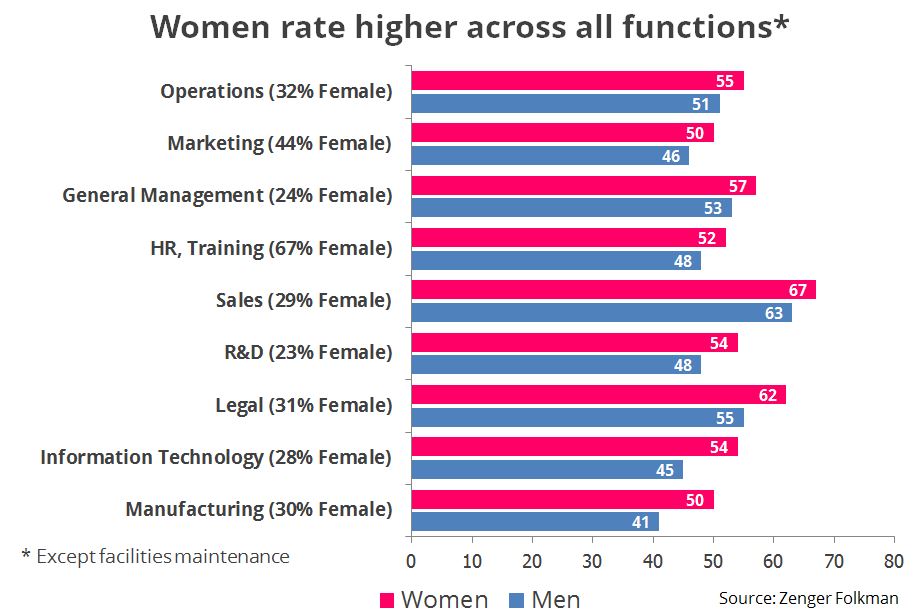
Moreover, Zenger- Folkman’s research confirms that women are better leaders across all job functions from general management to operations to finance to marketing to R&D: everything . . . except building maintenance.


In pure economic terms women CEOs also outperform male CEOs. According to Fortune magazine’s research on the performance of the 1,000 largest companies, the 51 females that lead enterprises produce 37% more profit on average than the 941 Male CEOs.

And yet, when you look at those pictures of Jack Welch and Steve Jobs it is still hard for most women to believe they are the equal of male business executives let alone even better.

Here’s why:

Confirmation bias. For the nearly 5,000 years of recorded history what’s been recorded are the exploits of male leaders. So aggressive, decisive, competitive behavior is a deeply ingrained bias that is equated with how outstanding leaders behave. Once that is our hypothesis we are constantly on the lookout for confirming evidence. Even more damaging is that we ignore or overlook any contrary evidence. If we assume that men are better leaders we simply look for and remember anecdotal evidence or experiences that support our prejudice. Even worse if we see a woman leader struggling we discount the scientific truth that in general women are better leaders.

Attribution error. Most people I talk to attribute Steve Jobs’ leadership success to his uncompromising arrogance. This is false. His arrogance forced the Apple, Inc. of the 1980s to create the Lisa, which was a complete product failure. It also led him to getting fired. According to current Apple executives, his success the second time around was due to his faithful collaboration with a leadership team of six executives with complementary skills. Jobs suffered 10 years of failure after being fired which added just enough humility to him to become great. Not much has been written about Steve Jobs’ leadership transformation because it doesn’t conform to our irrational belief that great leaders kick ass and take names. This thinking fallacy is a big problem for women since most women do not succeed by being overbearing, insistent and verbally aggressive.

Unscientific conclusions. This refers to the small sample size problem. Most people trust their prejudice instead of data. We take a selective look at our own experience and if we don’t find an outstanding women leader we look at the pictures of Jack Welch, Steve Jobs and Marilyn Monroe and mistakenly conclude that those stereotypes accurately represent how men and women actually excel.
 

The Bottom Line:

Bias against women in leadership is real. The research evidence is overwhelming that women have to be twice as competent for twice as long to even have a chance at equal opportunities.  Today’s work cultures do not work for women. That is a big, big problem because women bring distinct leadership advantages to all organizations that create genuine value for customers, employees and society that we desperately need.

So, if you’re a man who has not worked for or with an exceptional woman leader, keep an open mind . . . you have not worked with enough of them.

If you’re a woman, be a leader, have a vision for yourself and your work. Act in confidence.  The world needs the difference you make.


What’s Your Big Decision That Will Make 2017 Great?

Living your best life most likely requires you doing something extraordinary. Few of us maximize what’s possible by just doing what we’re already doing. The big breakthroughs; the big improvements come from making big decisions.

What is the big decision your life has been asking you to make? The clue to answer this question is to inquire of your deepest self “What have I settled for?”  Put another way, the question I most often asked my clients is “If nothing changes, what will your life be like a year from now, or two years from now, or five years from now?  Is that okay?” If it is, nothing will change. If it isn’t okay then you’re in need of a big decision.

Big decisions are often risky. But safe decisions or no decisions at all will dull your mind and numb your heart. So how do you make big decisions without being reckless?

It’s simple. Every decision you make should be leading you toward the vision of the life you want to live. This isn’t as common as it sounds. Many times we make decisions to avoid stress. Being clear on what you don’t want is much easier than being clear on what you do want. But stress avoidance isn’t a vision. And your personal vision is absolutely essential to your ultimate fulfillment and deep life satisfaction.

So what big decision would lead you to greater happiness, health, love, work and joy?  Do that.

Don’t be impulsive. Don’t be selfish. Be both brave and wise. Plan carefully. Prepare yourself and others who might be affected by your big decision for the worst that can happen . . . then act. Learn what’s working and what’s not.  Be flexible, but have the grit to sustain your direction. Unless you’re planning to skydive without lessons you can survive any setback . . . and you will have setbacks. All big decisions unleash some surprising consequences but nothing you can’t handle if you’re committed to your vision.

The best advice I ever received is to just start living the way you want to live.

That’s it . . . just start.

That’s what I am doing.