Anxiety is often baked into the heart of effective leadership.
When you’re out-front enacting a vision, setting the tone, managing people, and ensuring outcomes, much depends on you, and your self-image and effectiveness are reflected in the job you do. If you care about your job and are personally invested in it, you will likely experience some anxiety.
But instead of a harmful impediment to leadership, anxiety can be a helpful ingredient. The key is learning how to manage it so you can experience just enough of it that it can serve you, while leaving behind the kind of debilitating anxiety that undermines leadership and inhibits growth.
Understanding how your anxiety plays out at work is valuable for any leader, even though identifying and facing anxieties can be difficult and even painful.
Have faith, though. Decades of research have shown that those who understand their emotions have higher job satisfaction, stronger job performance, and better relationships. They’re more innovative and can synthesize diverse opinions and de-escalate conflict. Their self-awareness makes them knowledgeable about what gets to them, enabling them to prevent anxious situations at work. They’re able to respond to anxiety and stressors in a far more effective manner, leading to better outcomes for everyone. Why? They understand themselves and what triggers their anxieties. They have created strategies to manage anxiety instead of just coping and pushing through. They are no longer trapped by acting out automatic behaviors that punish themselves and their team.
It’s really quite simple: Leaders who understand how anxiety motivates their behavior and who have developed the skills to manage their reactions are better leaders who deliver better outcomes for their organizations.
Play Detective
Getting to know your anxiety will require you to tune in and take an honest look at yourself and your behavior. Approach this exercise with as little judgment and as much compassion as you can. You may have an obvious form of anxiety, such as panic disorder or glossophobia (fear of public speaking). Or maybe you wake up every morning with a pit in your stomach and an undefined sense of dread about starting the day. You may have a fear of death or personal loss that impacts your business leadership. Like me, there may be a meeting or even a person whose very existence causes a flip in your stomach. Whatever your experience, start right there in the moment, and play detective with your own experience.
Rebecca Harley, a psychologist at Massachusetts General Hospital and assistant professor of psychology at Harvard Medical School, suggests starting with turning inward and noticing what’s happening in the present moment. Like a detective who is simply observing and gathering facts, tune in to whatever is happening in the moment and see what you discover. Playing detective is a fact-finding mission. Your job isn’t to judge what’s happening or do anything about it at all. It’s to observe impartially.
Then, see if you can put some words to the most prominent experience. It may be a thought (This presentation is going to be a disaster); a physical sensation (dizziness, nausea, dry mouth, racing heart, excessive sweating); or a behavior you automatically turned to (mindless scrolling or snacking, for example).
Note how you react when anxiety is present.
I call this reaction a “tell,” and it can take many forms — from tightness in the chest or a stomach flip, to impatience and irritability, to insomnia and indigestion, and all the way to a bout of depression (a loss of interest in life, for example). Your anxiety “tells” may not always be negative behaviors with harmful consequences. For instance, many of us connect more often with friends and family during stressful times, or we exercise.
A physical experience is often the first “tell” for many people. This is because our body will register anxiety even if our conscious mind isn’t yet aware of it, or if we simply aren’t ready to admit our anxiety to ourselves. One of the first signs that my anxiety is ramping up is that my shoulders are bunched up under my ears. Much of the time, I won’t even notice that it’s happening until I stop and check in. If I don’t, my neck and shoulders will eventually tell me in the form of pain and tension.
If you don’t know where to start, tune into your body for a workday, and monitor how you feel in your body and mind.
Understanding and managing anxiety isn’t just a personal journey — it’s a cornerstone of effective leadership. By embracing and deciphering the signals anxiety sends, leaders can not only navigate challenges but also foster better relationships, innovate, and steer their teams toward success. Take that first step of observation, listen to your body, and let self-awareness guide you toward transforming anxiety from a harmful impediment to a helpful ingredient.
As a teen, my bedroom walls were lined with Nike ads:
“Too often we are scared. Scared of what we might not be able to do. Scared of what people might think if we tried.” “Just do it,” they declared, offering inspiration and encouragement. The ads sparked my lifelong passion for advertising.
My journey took me not only deep into the inner workings of the marketing and advertising industry but also into the heartbeat of corporations themselves. My college honors thesis, Nike: The Role of Advertising in Global Corporate Responsibility, explored ads championing girls by proclaiming, “If you let me play … I will have more self-confidence, [and] I will be less likely to get pregnant before I want to.” At the same time, headlines exposed the outsourcing of labor to sweatshops that hired children overseas.
Working at a top-tier New York City ad agency on a coveted car account, I saw how creative egos were satiated with big ad budgets. And working at a tech startup, I experienced the thrill of going public on the New York Stock Exchange only to be sold to private equity, which would “operationalize the business,” translating our vision into no more than a payment processing platform.
These were normal business practices. Yet, I couldn’t ignore the dichotomy between the vision and the forced reality of making short-term, exclusively profit-driven decisions. In each case, increasing value for shareholders — the very raison d’être of a company — came at the expense of employees, customers, and the communities in which we live.
I wondered if there was a different way.
A Positive Pivot
That brought me to Rescue Agency, a full-service marketing agency that focuses exclusively on creating health-behavior-change marketing campaigns. I joined over a decade ago when Rescue was a 30-person organization that had successfully launched a few state-focused tobacco control campaigns testing approaches to make smoking less desirable, despite decades of image-focused advertising. Today, we’re home to over 275 people with $100 million in billings.
Soon after I joined, we began campaign implementation for the Food and Drug Administration to develop the very first national tobacco prevention campaigns for multicultural teens and LGBTQ+ young adults. These campaigns (in the years that preceded electronic cigarette company JUUL) did something no other health campaign had done before: We specifically communicated to the highest-risk and highest-use subcultures and created environments that made it more normal not to smoke. We were the first health campaign to spend more on digital, social, and experiential media than traditional advertising and the first to target smaller audiences. In late 2017, after two-and-a-half years of our campaigns (in conjunction with other efforts), smoking among high-risk teens was at its lowest levels ever recorded. We were using cutting-edge advertising tactics to change social norms and behaviors.
Expanding the Fight
Every day at Rescue, we harness the power of marketing and communications to help people live healthier lives. We’ve since applied our behavior change models and messaging frameworks to the most important health topics facing our nation today, from substance use prevention to mental health treatment promotion, from early childhood education to nutrition assistance, and much more.
Over time, we’ve been able to measure the impact of these campaigns. Our work with the nation’s largest tobacco cessation service providers led to triple-digit increases in adult quitline enrollments. 81% of teens who saw our Behind the Haze vaping prevention campaign (currently running in 17 states) reported an intention to quit. We’ve urgently educated young people about the fentanyl crisis and accidental overdose risks and helped thousands gain access to life-saving naloxone.
Yet, our work not only allows us to address crises but promotes health too. We’ve increased nutrition assistance benefits enrollment among college students, immigrants, and families. And, we’re in a unique position to see how mental health challenges contribute to nearly every other health issue. 96% of those aware of our very targeted mental health stigma reduction campaigns have taken action to find out more about mental health concerns.
Creating a business that delivered more than results against the bottom line fueled my pursuit of our certified B Corp status within the first few months of taking the helm at Rescue in 2014. We transitioned to a public benefit corporation in 2017, cementing our mission of making healthy behaviors easier and more appealing into the legal charter of our company. And as of Jan. 1, we transitioned to being a 100% employee-owned company through an employee stock ownership plan. When we grow, we deliver improved health results in more communities at the county, state, and national levels. At the same time, Rescue’s profits go back into a retirement plan to support employees’ long-term financial health.
Challenging Industry Norms
With these important steps, we’ve reimagined how an advertising agency can work. Instead of promoting products or angling to create purpose-driven brands, we are delivering improved measurable impact outcomes and are poised to contribute to the long-term financial success of our team. For me, building this type of company that channels business for good on so many levels has been an incredible learning journey. Almost every part of our corporate structure and economic engine works against the inertia of a traditional corporation — let alone typical marketing practices.
It’s not easy to be impact-driven. Trade-offs are real, and the pull toward profitability over doing the right thing creates tension almost every day. Whether it’s saying no to an attractive new contract that doesn’t fit our mission or adding 12-week paid parental leave for all our new parents, Rescue is proving that doing the hard work is worth it.
Our work is deployed at the national level as well as across 27 U.S. states, sharing life-changing and life-saving messages where more than half of the U.S. population lives. We know our model can positively impact value-driven health care models as well.
I know young Kristin would be proud of our work, and I know our incredible team is always pushing to create those unskippable ads that will end up in someone’s Instagram story or even on their bedroom wall propelling other young people to create new, better realities for themselves and the world in which they live, work, and play.
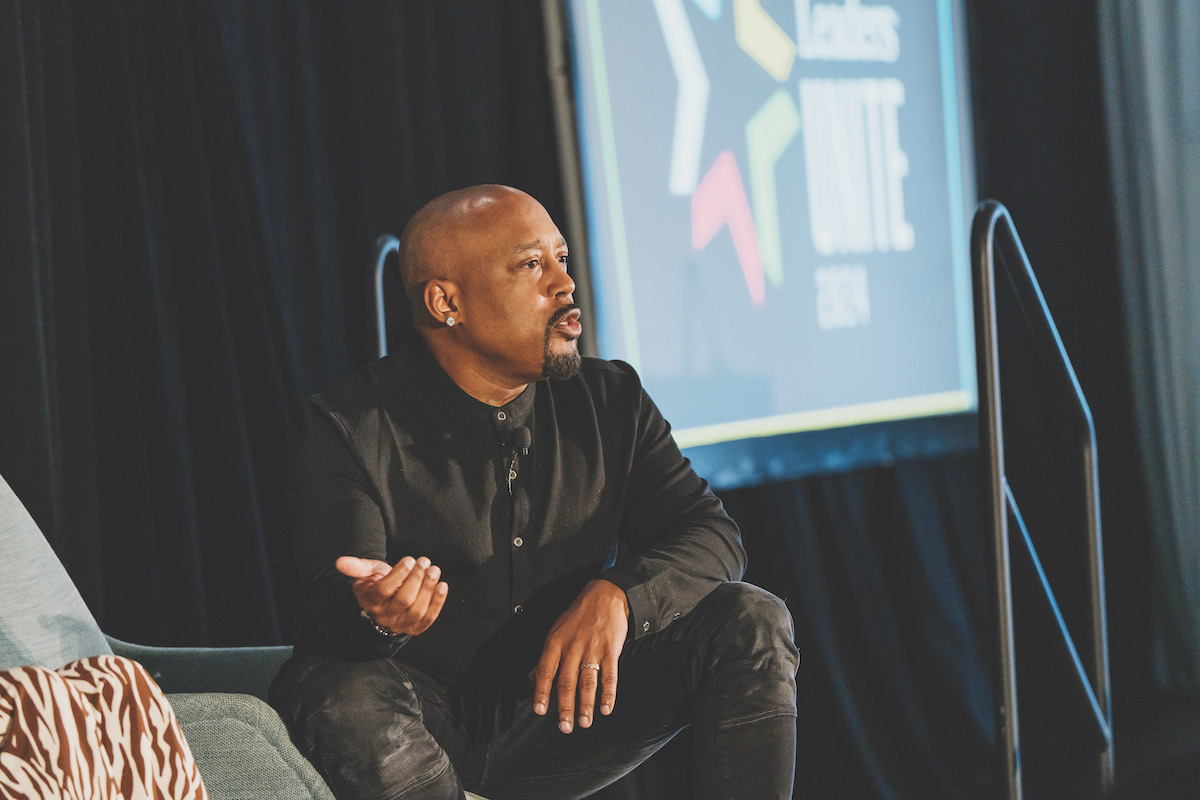
If you have even one good business idea in your head, you’ve probably fantasized about pitching it to Daymond John. What would you say if you had 3 minutes alone with Shark Tank’s branding and marketing guru?
Well, I didn’t get 3 minutes with Daymond John — I got over 30. And while I didn’t pitch anything, I made the most of my time with a broad swath of questions to capture the best of America’s favorite entrepreneur. John opened up about the big shift in the second half of his career, why he’s not leaving his kids any money, and much more.
Real Leaders: Our readers are impact company leaders, founders, entrepreneurs — that’s our sweet spot. So, I wanted to start with your experience in hearing and making pitches. What are the most important qualities you look for in a founder or entrepreneur in order for you to make an investment?
John: First of all, can they articulate the story to get my attention? Because that’s the human interaction aspect of it. What are you talking about, and why would I care? Are you educating me that this is a problem, or are you assuming that I should just know about it?
Then I ask myself: Is this person a rock star? Do I want to know this person? Is there a need for me to be in this business with this person? If the founder is a rock star, then whether this business works out or not, we’re going to do something else together. I hope your thing is baked. I really do. But guess what, if it fails, alright, you’ll work with me, and we’ll do something else. At the end of the day, that’s what it is.
RL: What are the mistakes people make when they pitch investors — the things that make you cringe?
John: Not studying the investment target. Why would you want me as a partner? Do you know what’s in it for me? Some people come to Shark Tank, and they think because I have a successful clothing company, I should invest in their clothing idea. Well, if you really knew me, you’d know those are the only companies I don’t want to invest in because I have too many clothing companies. I need to diversify my portfolio.
RL: How have your own investment criteria changed over time? What’s that journey been like for you?
John: Originally, it was, “I don’t have any money,” so I had to concentrate on what I could do. Then it was, “I have money and I want to invest in sectors I know.” But I made a lot of mistakes in those sectors because I thought money was the solution without putting in the work and doing my homework. Then I moved to being in various sectors. I’d throw money at it, and I was right in the middle trying to learn on the fly. I’m throwing a lot of money at it, and I’m trying to tweak it to find better ways to be more effective.
But what I’m doing now is purely about the people. I have to see where I truly add value. I have to have a passion for it. And I have to really trust that the founder has a massive amount of information in the industry.
RL: What role has social entrepreneurship played in your life?
John: It’s huge. My biggest, most successful investment on Shark Tank is Bombas socks (a 2023 Real Leaders Top Impact Company), which is about social. I care about what I do. All my investments have some kind of social driver to it. FUBU may not have been a nonprofit and the messaging wasn’t social, as in let’s make a better planet or something of that nature, but it was about one culture empowering another culture. Then I move on to Shark Tank, which is about investment empowering other people. My books and everything else I do now are about empowering people. So it’s critical.
The first half of my career, from an investment standpoint, the social aspect wasn’t a big topic. But now, with the success of Bombas, I’ve learned that it’s critical to have that component. Customers want to stand for something, and it has to be genuine. I’ve had some experiences with companies wanting me to be the face of their brand, and I saw that social impact was not their driving force, and they were not being honest with their intentions.
RL: When you look at the investment landscape and how that might impact business leaders, what are some of the market disruptions you’re seeing?
John: Well, AI is the common one everyone is talking about. But I want to give you some meat on the bones. AI is the market assumption, but it’s the use of AI analysis that will cause disruption. AI is such a big conversation. It’s in everything in a big way. Think about your newsletters. With AI, maybe you can go from a copywriting and social team of 20 down to five. People think that AI is going to replace those people, but maybe there will be other jobs created as a result of AI. We just don’t know what they are yet.
The big thing all CEOs are struggling with is how to get effective work from people, how to deal with remote and semi-remote and virtual, fragmented teams. This virtual, remote, fragmented way of the world working is not working.
RL: You’ve done a lot of motivational speaking. What makes a great speech and a great speaker, and what are you still trying to improve in your own speaking?
John: A great speaker is self-aware. This is extremely important because they’re not making any more attention in this world, and captivating people in the beginning and keeping their attention is very hard. Maybe you can captivate somebody for the first 10 minutes, but then you lose them after 20 minutes. So how do you pack in what you need to say in 20 minutes? How do you relate to them, feel equal to them even though you’re the one on stage who is deemed as somebody with this greatness or special information?
It’s all in your presentation of the message and how you make people feel. Do you make them feel like they’re connecting because you’ve had the same struggle? And you’re both, at the end of the day, arriving at the same solution or inspiration.
A great speaker has a takeaway action that somebody is motivated to do at home. I mean, even if you had the person in tears, what is the takeaway? It’s always got to be about what’s in it for them. And of course, last but not least, are you in tune with what the client needs? The person or group who asked you to speak — what do they want? The client has a vested interest in your talk. Everything is on the line for them. Some speakers take up the stage with their own priorities, and if you act like that, then you let people down.
RL: Do you like public speaking?
John: Oh, I love it. I absolutely love it. I love that we find a way to connect through the conversation and the struggle.
RL: What are some of the most valuable life lessons that have profoundly made a difference in your thinking and actions?
John: You have to be extremely hard on yourself in striving for knowledge and constantly tweaking yourself to be better. But at some point, if you have put in the time, then you also have to take a moment to smell the roses. Be proud of yourself. You have to really take inventory of yourself.
You know, the three pillars to success are pretty simple: You got to know your why, you got to set goals, and then you got to do your homework. If your why is the why your parents told you, then that’s what success looks like to you. Do you want to belong to a bunch of people you don’t know who will never change your life? Then you’re setting the wrong goals and you’re going to do the wrong homework to get to those wrong goals. Being brutally honest is a really big key to success.
RL: Many of our readers are the heads of family businesses, and they’re working on succession planning. You have said that you’re not going to leave your daughters any money, citing the importance of a legacy versus an inheritance. Can you talk a little bit more about that?
John: The percentage of generational wealth that gets passed through to children and grandchildren is not that great. It’s been said that the first generation makes the money, the second generation enjoys it, and the third destroys it. I’m not going to say the third destroys it, but in only a small percentage of businesses do the second and third generations take the business to another level or expand it significantly. Now, does that money stay there in the family? Absolutely. Do the Rockefellers still have their money? Of course, and their foundation still does great things for this country. But are the children running their own businesses or extending what the family has? Not as much as probably people would think.
So that brings us to inheritance versus legacy. The thing that any parent wants to do is give their children the things that they themselves never had access to — whether it’s education, freedom, whatever the case is. But when you give your child everything, you make them the poorest person in the world.
I started off letting my girls know I would not leave them anything. And I did that for various reasons. Number one, someone might come into their life to use them for something that was not best for them. I want them also not thinking there is going to be a pot for them at the end of the rainbow. They need to work hard for themselves. They must become really great people to society.
I’ve been to many funerals, but I have never been to one where they talk about what somebody had, their possessions. I only heard of how they made people feel and how they impacted people’s lives. If my legacy is that my children can say, “My father was an everyday man who tried to empower people,” then I think that example will open way more doors for them. I don’t want the door open because they got money hidden behind that door.
RL: You once said that anything worth doing is worth overdoing. What is your passion these days? What are you overdoing right now?
John: My passion is giving access to people who deserve it — but not just giving access — also, showing them they already have access. The one thing people don’t realize is access is all around us — it’s the use of access that is not utilized. As connected as we are, I truly feel like we are at the dumbest goddamn time in history because people hit the top link on Google and then wonder why what they’re asking for does not work. They say all they get is “no.”’ They say, “I did this and then didn’t get that.” Did you pick up the phone? No? Pick up the damn phone. It’s pretty simple, right? I just don’t get it.
I am not about giving access to people who get stuck on these little devices that they’re not going to be further than 3 feet away from for the next 97% of their lives. I give access to a CEO who says, “Listen, I’m somebody who nobody knows, but I’m doing a lot of great work out there, and I want to be the voice of authority.” Or I will give access to a kid who has no financial intelligence. I want all our children to have financial intelligence. It’s not about having my own personal Shark Tank. It’s about giving access to the people or foundations who are going to use it for the right reason. That’s my passion.
Somebody told me something the other day: “The first half of your life, you do it for your ego. The second half, you do it for your soul.” If I think that you’re going to do something to make the world a better place — no matter where you are in life — I’m going to give you access by showing you how to utilize the access that you have.
RL: Now that’s a legacy.
John: Well, hopefully, the windfall is that I’ve inspired people of more colors to say, “Whatever my culture, my beliefs, I can work within my community and empower people.” No matter what side of the table you’re on, you can create investments or ways that people can have a synergistic relationship with those outside America. This is the American dream that’s been given to us, that corporate America doesn’t care about your color, your creed, your gender. And look at me — if I can do it, you can do it.
But our education system is broken. We’re still going off of an 80-year-old system that teaches kids shop and how to build things, but it doesn’t teach them financial intelligence — and that’s one of the few needs we all have in common. A lot of people don’t know if they want a formal education, but they don’t have financial intelligence starting off as children, and then they get marketed by predatory companies at 16 or 17 years old, and they end up with a $700,000 debt for a college education that they were not even certain they wanted.
I do believe in higher education. But the data shows that 57% of the kids graduating now will retire with a job title that doesn’t exist today. It’s like telling somebody 20 years ago, “You’re going to be an AI expert or a social media expert.” So you have no financial intelligence, but you do have $700,000 worth of student debt that you’re not going to pay off until your 50s for a career that you didn’t even know if you wanted. What does that do to our country?
Here’s what it does: All of a sudden, it’s expensive to eat clean. So what happens? Well, you start having a bad diet because the cheapest thing to consume in our country is made of butter, sugar, and salt. Domestic violence rises and incarceration rates rise because if you don’t have an education or you cannot afford enough, what are you going to do? It is a big problem, and it can easily be adjusted if we give our children financial intelligence. We don’t need them starting off with 18% on their credit cards and student loans, with careers they don’t want to have so they can buy a whole bunch of stuff they’ll never need.
RL: Anything you want to say specifically to our readers who are trying to use business as a force for good?
John: I think they need to be more intentional about what they’re doing. We always hear there are so many absolutely amazing leaders and corporate citizens who are doing great things, but they feel dirty about trying to say and show what they’re doing because it feels like they’re trying to make a profit off of doing good.
When George Floyd was killed, a lot of my friends and business associates called me for advice. They felt compelled to do something. I was honest with them. Even though I’m African American, and I want to steer all the help I can to the African American community, I advised them not to take any action just because it’s the trendy thing to do. If your action isn’t coming from a genuine place, the community — be it the African Americans, LGBTQ+, veterans, whoever — will recognize that, and it could end up hurting you and your brand. As they say, real recognizes real.
If you want to be authentic, start by talking to the people closest to you — your staff, your friends, your colleagues, or business partners. Many of your people have been a part of these communities for years and you may not even know it. That’s a bloodline through which you can take very intentional steps.
People like to be associated with good causes. If you can give them a way to do it, they will talk about it. That’s user-generated content. That’s why Bombas has worked so well. People want to do good and brag about it. Yes, they’re great socks, but they’re just socks. When I did the deal, they were doing 700,000, and they will do 1.4 billion this year. When I did the deal, I had a million dollars’ worth of socks in my warehouse that I couldn’t sell. The only way I sold them is that I was sneaking into your laundry room at night and taking one out of your basket.
RL: I know that’s true.
John: People buy Bombas because they want to brag that they are giving back. If you have a business that’s also doing good, now you save them from having to go and intentionally give because they buy from you and will tell your story for you.
I will tell you a story. My daughter worked at a pizza parlor. She says, “Daddy, I gave 20 times this year. Every time I bought this, I helped clean up the ocean. Every time I bought this, I stopped human trafficking, and every time I bought a pair of socks, a pair of socks went to one of the homeless shelters. And by the way, Daddy, I’m going to buy every person I know socks for Christmas so they can help 10 other people.” That’s an example of why you have to be very intentional about what you’re doing because people want to brag about what you’re doing and what they’re doing. You can be a force for good — and your customers will help you.
The deeper you dig, the more you’ll come to realize how broken the fashion industry is today. Yet, there is hope — even for the pragmatist. Brands and manufacturers with a commitment to better sustainability practices are on the rise, fighting to allow the fashion industry to reach its hidden potential as a positive force for good. Since the sustainability movement’s inception, we’ve remained proud at Nisolo to fight alongside similar organizations. Here’s a bit about the “why” behind Nisolo and where it all began.
A Rude Awakening
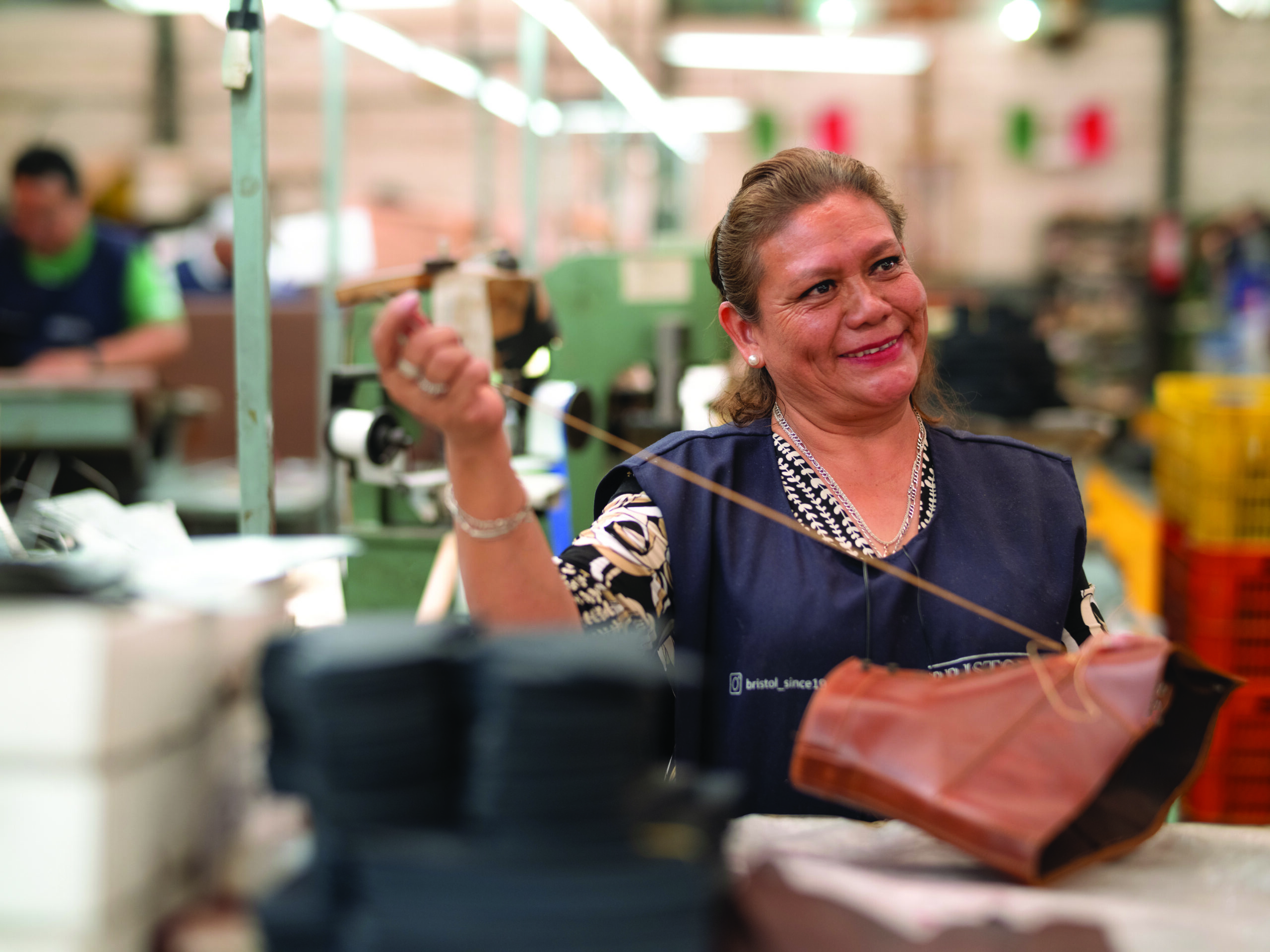
As an undergrad, I studied global economics and business and spent a fair amount of my time in developing countries learning how international business can have a very positive or very negative impact on the world. Shortly after graduating, I moved to Peru where I pursued an opportunity in microfinance with the goal of helping women grow small businesses. Little did I know, my job was in Peru’s shoemaking capital, and I was soon introduced to the centuries-old, fascinating art form of shoemaking. Blown away by the skill that abounded, I was frustrated to learn that the producers I met faced such horrible working conditions and unjust compensation.
I knew things could be different, and I saw massive potential to drive transformational change in this community by starting Nisolo. I’d soon learn what most consumers (blinded by the allure of cheap prices) remain completely unaware of today: The explosive growth of the global fashion industry has fared well for some yet has been violently unjust for most everyone else. The truth is that low wages and poor working conditions are rampant, with an estimated 95% of workers in the fashion industry today not paid a living wage that can cover their most basic needs.
Due to exorbitant water usage, the irresponsible disposal of waste, the exponential growth of manmade non-biodegradable fibers such as polyester, and filthy carbon emissions from coal-powered factories in the developing world, the planet isn’t faring too well either. In fact, the fashion industry is estimated to be one of the top five most pollutive industries in the world, emitting more carbon than the international aviation and shipping industries combined.
A Better Way
To flip the script, we created Nisolo as a brand that would care for the planet and the people within our supply chain just as much as the end consumer. Ultimately, our goal is to play our part in pushing the fashion industry in a more sustainable direction. And as a brand focused on sustainability, we know we’re far from perfect.
We recently raised the bar for transparency by launching the Nisolo Sustainability Facts Label to help hold ourselves more accountable in hopes the industry will begin to do the same. Leveraging the research of sustainability experts around the world, we created this to empower consumers to make better choices and to invite brands like us to strengthen their approaches to sustainability. From B Corp to Leather Working Group to Climate Neutral, Fair Trade USA, Higg Index, FLA, SA8000, Textile Exchange, Good On You, Re/Make to you name it, we took it all in to ensure our label accounted for what experts commonly deem most critical to a sustainable approach.
With 10 categories scored across people and planet backed by 200 public-facing data points, the Sustainability Facts Label is one of the most comprehensive yet digestible evaluation tools the fashion industry has seen to date. Each Nisolo product now carries this label as well as a QR code that links directly to the 200 data points evaluated across people and planet for that specific product.
Empowering the Future
Recalling that business can have a very negative or positive impact on the world, our motivation comes not only from how bad things have become in our industry but also from the opportunity ahead. This is an industry that employs hundreds of millions of the world’s poorest people. What would the world look like for future generations in these communities if rather than systematically holding people in a never-ending cycle of poverty, proper treatment and a fair opportunity were guaranteed for all producers? I’ve seen firsthand the impact this has had on our shoemakers and the future of their children. We hope to see this happen worldwide.
As consumers, we must remember the immense power we hold through the dollars we spend. We all want a better industry and a better world. And that’s why we encourage one another to dig deeper into our favorite brands’ supply chains. If they are not visibly demonstrating a move in the right direction, let’s ask for greater transparency where it’s lacking.
Ultimately, the sustainability journey is a marathon, not a sprint. By working together, we believe we can drive monumental transformation in the fashion industry within our lifetime.
The real estate industry has always faced many complex challenges.
Today, these include rising climate change risks, insurance risks, regulatory risks, uncertain interest rates, and shifts in resident behaviors and expectations.
When I founded Jonathan Rose Companies in 1989 with a mission to bring green, mixed-income, mixed-use urban regeneration to cities, the key challenges were the capital shortage caused by the recession and the pervasive disinvestment in cities. Holding to our mission and executing with excellence helped us grow capital access and build the organizational resilience to face these and other emerging challenges.
In 1989, the real estate industry was aggressively anti-urban, emphatically focused on the rapid growth of sprawling suburbs.
Our area of focus — to revitalize the walkable and transit-accessible areas of cities with green mixed-income communities — lay way outside of the mainstream investment and development trends of the time. In addition to a disinterest in cities, the real estate industry viewed the added cost and effort to make buildings greener as unnecessary. Affordable housing was considered something for the public sector to build. Why would a for-profit company want to work in a highly regulated environment? And yet, we could clearly see that cities were going to come back, that firms with urban regeneration capacities would be needed, and that affordable housing would be essential to a future thriving economy.
The United States was in the depths of a recession in the 1990s.
Funding was scarce. But there were tax credit equity and Community Reinvestment Act debt for the development of new affordable housing and private equity for acquisitions if we could deliver a 10% cash-on- cash return. And so, we learned early to focus on net cash flow for our private equity investors and on delivering transformative projects for our public partners. And working with the same budgets as our competitors, we figured out how to make our projects as green as possible. Our mission provided all this work coherence.
As a small company, we generated a larger reputation by creating highly visible, award- winning projects that were transformational and financially feasible. Because we had little competition for the kinds of projects that we were doing, we developed many firsts, such as the first green, mixed-use, mixed-income, transit- oriented historic preservation project — The Denver Dry Goods Building (pictured); the first green office retrofit — The Vance Building; the first LEED Gold Shopping center at Highlands Garden Village; the first real estate impact investing fund — The Rose Smart Growth Fund; and others. These won awards, attracted press, pleased lenders and city agencies, and gave the firm visibility.
Lessons from those early years included learning to select projects with care to fully express our mission, deliver on-time/on-budget completions, provide positive cash flow to our investors, demonstrate innovative solutions to our public sector partners, and work with industry organizations such as the Urban Land Institute to scale the solutions. For the company’s first 11 years, we were project- centered, focusing on building a body of financially successful work that reflected the company’s mission. In the following decades, we shifted our attention to be company-centered, building an organization that can carry out our mission.
To do this, we had to expand our sources of financing.
We had financed all our acquisitions by raising funds on a project-by-project basis from families and friends. We decided to create an investment fund management business. Our first fund, The Rose Smart Growth Fund, was launched in 2005 when most real estate investment funds were still suburban-focused. Our premise was that buying properties within walking distance of mass transit and renovating them to be greener would not only reduce their environmental impact but also generate higher occupancy rates, making them more economically resilient in times of stress. When the global financial crisis hit, this proved to be correct, and although our rents dropped a bit, our occupancies remained full, outperforming our competitors.
At the same time, we understood that there would likely not be enough public funding to develop all the affordable housing that was needed. In addition, the existing supply of affordable housing was declining due to owners opting out of affordable housing programs in gentrifying neighborhoods. In response, we developed a series of affordable housing preservation funds, raising private equity to match with debt from Fannie Mae, Freddie Mac, and the Federal Housing Administration.
We have used these funds to buy existing affordable and mixed-income housing, make it green, and bring social, health, and educational programs to residents. Although a goal from the early days of the company, the emphasis placed on social impact grew at this point and became an explicit part of our mission and vision. Safe, green, healthy housing became the platform for resident opportunity. Rich social programming, co-produced with residents, helps to ensure the stability of communities and plays a vital role in enabling residents to access health care, food, education, job training, and other economic opportunities. The delivery of resident services helps to drive social change, advancing equity and social and racial justice.
And as the organization grew, we grew our staff.
Having a clear mission and sharing our profits with all employees attracted and retained the best and brightest. The leaders of our development, investment, and acquisition-rehab business lines started with us as interns.
We were early participants in the exciting field of impact investment. As the field grew, investors sought proven investment models with authentic motivation, excellent execution, and reporting of impact. And so, the depth of our commitment to our mission was not only the right thing to do but has also been attractive to impact investors.
There will be many economic and political cycles to come. Having a clear mission as our center of gravity will be the foundation of our current and future leaders’ success.
In the world of mental health advocacy, I’m on a mission to foster social-emotional learning as core to the education system.
By navigating the complexities of addressing mental health challenges that often go unnoticed, I aim to help create a world where proactive identification and early intervention are the norm rather than the exception. I join the collective vision for a better, emotionally healthier world.
The genesis of my mission can be traced to a poignant chapter in my family’s narrative. Witnessing the emotional unraveling of my younger brother, Salil Chaudhry — due to relentless bullying at school and subsequent mental health challenges — became the catalyst for my unwavering resolve. The pain of missed early signs and interventions served as the crucible from which I founded TrustCircle, an entity dedicated to ensuring that no one else would suffer a similar fate.
TrustCircle’s purpose is to address the global mental health crisis for students.
I envisioned how integrating social-emotional learning as core to the education system would revolutionize how we approach mental well-being. My journey led to the creation of a unique, AI-based mental health and well-being platform designed to foster emotional resilience and preventative mental health care for students on a global scale.
Worldwide, students are increasingly grappling with mental health concerns exacerbated by factors like academic pressure, social dynamics, and the digital era’s challenges. TrustCircle’s AI-based well-being platform is a pivotal innovation in this landscape. By integrating social-emotional learning into the education system, TrustCircle is not only directly addressing students’ mental health needs but also promoting a culture of prevention and early intervention. This proactive approach is pivotal in changing how mental health is understood and managed in educational settings, offering students tools and resources to build resilience and well-being from an early age.
TrustCircle’s vision and commitment have attracted the attention and collaboration of several global organizations.
Partnerships have been instrumental in broadening the reach and deepening the impact of TrustCircle’s initiatives, such as those with UNICEF, the United Nations Development Programme, and the Healthy Brains Global Initiative — a unique endeavor of UNICEF, the World Health Organization (WHO), and the World Bank. Other key partnerships have included the Foundation for the Support of the United Nations, Ashoka, SOFINA, the King Baudouin Foundation, the Hawaii Department of Education, and Ministry of Youth Affairs and Sports — Government of India. These collaborations enable TrustCircle to leverage a wealth of expertise and resources, enhancing its ability to make a tangible difference in the lives of individuals across different cultures and communities.
I aim to inspire governments to prioritize mental health in their agenda.
Imagine how powerful it would be if educational systems worldwide require 2–3 minutes of self-reflection time in every classroom. Then, every school will start giving the much-needed space to students to self-reflect.
The impact of TrustCircle has been significant and far-reaching. The TrustCircle Well-Being Platform has been selected as one of the best and most replicable innovations across G20 countries for adolescent health and well-being, and the innovation was showcased at the G20 Summit in India in collaboration with UNICEF India and Yuwaah to international leaders including Honorable Minister of Health and Family Welfare Mansukh L. Mandaviya.
TrustCircle is on track to empower 1.3 million individuals across five countries with a goal to reach at least 10% of the global population by 2040.
By making social-emotional learning core to the education system, TrustCircle is not just addressing mental health issues but also transforming the way future generations will perceive and manage mental health. This transformational approach emphasizes early intervention and prevention, a crucial shift from the traditional reactive methods in mental health care.
Moreover, TrustCircle’s associations with the WHO Collaborating Center for Research and Training in Mental Health, the Schizophrenia Research Foundation, and the University of Warwick bring academic and research-based rigor to its approach, ensuring that our programs are not only empathetic and user-friendly but also scientifically sound and effective. Recognition by Ashoka, a global organization that identifies and supports leading social entrepreneurs, further validates our innovative approach and potential for systemic change.
TrustCircle’s journey grew from a passionate idea to a globally recognized platform for mental health prevention and emotional resilience, a testament to the power of vision, collaboration, and innovation in addressing some of the most pressing challenges of our times. With our holistic approach and global partnerships, I believe TrustCircle is well on its way to redefining mental health care and education, inspiring a systemic change toward a more emotionally resilient world.
The nerves, the rambling, the “umms,” the blanks — no wonder people are more afraid of speaking than dying (no joke!). I used to hate public speaking too, but it’s a skill that anyone can learn. Now, I speak in front of audiences of 5,000+ with no problem. Here are my most effective hacks for public speaking.
Know your audience.
Confident speakers know their audience.
Ask yourself:
Who is my audience?
How will I help them go from point A to point B?
Your talk becomes the map to get them there.
Define three major points.
There’s nothing worse than a rambling talk.
Write down the three most important points (in bullets).
Structure your talk around these three points just like chapters (1st, 2nd, 3rd).
This will help you move through your talk and not get lost.
Have a backup plan ready.
Your mind might go blank, but don’t freak out. Have a plan.
I pause to take a sip of water and think, “What chapter am I in?” I recover 100% of the time. Put down the water and continue.
Practice being natural (not perfect).
It doesn’t matter if you get every word right if you deliver poorly.
Focus on the essence of each “chapter.”
If you get something wrong, just keep going.
Read your notes, but practice without them.
Structure it like a story.
The best speakers don’t just talk, they tell stories.
If the chapters are the three main points, then outline the body of each chapter to reinforce your points. Add an intro that hooks and a clear summary at the end.
Create a room of one.
Make the room smaller by talking to one person at a time.
Prioritizing equity and empowerment for entrepreneurs and business owners is a winning formula.
By Dena Trujillo, CEO at Crisis Text Line
As CEO of Crisis Text Line, a 24/7, nationwide, text-based mental health and crisis support service, I regularly uncover interesting insights into our texter’s emotions and experiences. If there’s one key observation I’d like to share with you today, it would be this:
Right now, many people in the US are feeling stressed about their finances and jobs.
At Crisis Text Line, we have unique insight into mental health trends across the United States. Each year, we support over a million conversations with texters in need across the country, more than 3,500 daily. We provide mental health support and crisis intervention 24/7, and so we see mental health trends emerge almost in real time.
In a new report, we found that 2023 was a year of anxiety and stress for our texters. These were the top issues that they brought to us; over 1 in 3 texters mentioned these topics. The American Psychological Association also reports that Americans are anxious and stressed. Even though people in the U.S. have mostly returned to their routines, many are recovering from the collective trauma of the past few years.
While there were many stressful events in 2023, when our texters discussed anxiety and stress, they typically focused on issues related to their immediate circumstances: their relationships to their families, friends – and, importantly, stressors in their school and work lives.
Based on our analysis, many worried about their work, paying the bills, or being laid off last year.
2023 was a year of strikes and layoffs – and another year of paying for medical bills, child care, mortgages, and other financial pressure. Your employees, too, might be stressed – in general, or about their future at the company, their performance, their benefits, or their relationships to coworkers.
If you are leading a company, you are in a powerful position to mitigate stress for employees. Workplaces are a place of centralized policies and communication, which makes them well positioned to make an impact for better mental health. Unfortunately, although employers believe they foster a supportive workplace, US workers feel their companies are falling short of providing the right resources to support their mental health.
Take a moment this Mental Health Awareness Month to evaluate how you are supporting your employees’ mental health.
The Milken Institute provides guidance for employers to evaluate gaps and set priorities to make mental health for workers accessible and stigma-free. They suggest that employers focus on three priority areas: psychological safety, stigma, and performance and engagement. We have found that providing volunteer opportunities can contribute to better mental health outcomes. In a recent study of Crisis Text Line volunteers, we found that two thirds of our Crisis Counselors take better care of their mental health as a result of volunteering.
The expectation for people to simply “get over” their stress and mental health challenges is not only unrealistic but also detrimental to their well-being. By recognizing the importance of mental health, encouraging open dialogue in the workplace, and promoting the value of seeking help, we can create a more supportive and understanding society. Remember, it’s okay to ask for help, and everyone deserves the support they need to thrive.
Prioritizing equity and empowerment for entrepreneurs and business owners is a winning formula.
By Kathryn Deen
Since its founding in 1992, Advantage Capital has invested over $4.1 billion in over 900 companies, spanning a diverse array of industry sectors and covering the entire risk spectrum through a combination of public-private partnerships. In addition to growing small businesses, the company finances affordable housing and expands renewable energy solutions. Real Leaders connected with President Steven Stull to learn how Advantage Capital is helping lead the way in the impact investing space.
Real Leaders: Describe the problem Advantage Capital is trying to solve.
Steven Stull: Since the founding of our firm, we have worked to bring businesses, jobs, and technologies to communities that have historically lacked access to investment capital.
Those in underserved communities often face economic instability, a volatile housing market, limited opportunities for quality jobs, and various financial burdens. We leverage our investment acumen, legislative experience, and our emphasis on impact to funnel capital to growth-ready entrepreneurs, innovators, and industries in overlooked areas. We invest with intention in job-generating small businesses — along with affordable housing developments and renewable energy solutions — to grow economies and communities.
RL: What are the company’s most innovative ways of addressing lack of access to investment capital?
Stull: We uncover and implement innovative, flexible financing solutions often enabled and accelerated by public-private partnerships, and we meticulously measure the investment outcomes.
It is important to actively advocate for proven public policy that establishes partnerships with state and federal economic development organizations to turn incentives into investments into impact. For Advantage Capital, we have always worked to expand the scope and compliance of tax credit programs to, in turn, expand access to capital across the country beginning with one fund in one state — specifically for small businesses — to dozens of states and programs that include low-income housing and renewable energy investment.
RL: Can you share a couple of Advantage Capital’s success stories?
Stull: After being denied by more than eight banks, Carmen Tapio partnered with Advantage Capital and secured a $1.5-million small business loan in connection with the federal and state New Market Tax Credit (NMTC) programs. The loan allowed her to purchase North End Teleservices, a call center in the highly distressed community of North Omaha, Nebraska. Carmen has grown the company to over 500 employees, providing household-stabilizing benefits including health care, transportation, an apprentice program, micro-academics, performance bonuses, and tuition reimbursement.
Here’s another example: When Stirling Ultra Cold was at a pivotal point in its growth trajectory, it needed capital to continue. Advantage Capital’s investment, made in connection with the NMTC program, enabled the company to hire new employees, increase research and development, and support the rollout of a new product line. The company manufactures freezers that have become the sustainable choice for hospitals, research centers, universities, and corporate laboratories to store lab samples and other biomedical materials. It is a major employer helping to boost the local economy in rural Athens, Ohio.
RL: What have been some of the company’s biggest challenges, and how have you overcome them?
Stull: Our investment strategy is challenging. We go to communities and areas where traditional lenders are not necessarily active or interested, and we provide financing to the businesses and people who need it and are ready to seize it. We do that by being champions of small business — working hard to provide sophisticated and diverse options. And we ensure thoughtful fundraising and structuring are at the foundation of every fund and initiative — with a nationwide network of prominent investors who share our interest in positive impact. At the end of the day, we meet entrepreneurs and other innovators where they are and join them in their journey. It’s about sharing a common goal: growth.
RL: Why should other leaders in the field of investing follow suit?
Stull: We know capital changes lives. For many people, life is not getting any easier. Investing with intention and being motivated by meaningful impact can go together with successful investment outcomes and competitive returns. There is an opportunity — perhaps an obligation — to do both. Taking a double-bottom-line investment approach can lift people up, grow local economies, and have an enormous ripple effect across the country. Ensuring talented, experienced professionals are participating in that process is important.
RL: What does the future of impact investing look like, and what role does Advantage Capital hope to play in it?
Stull: The future of impact investing is poised for major growth. Impact investing is a trillion-dollar industry and isn’t going away anytime soon. I am optimistic and believe more businesses are going to establish and accelerate strategies that do good while doing well. We will continue to do what we do best — funnel flexible financing to the places and people who need it and are ready to seize it. And we hope to continue to expand our scope as we grow our affordable housing and renewable energy business lines.
William McDonough ranked among the highest in the category of values-aligned impact for the Real Leaders Top 50 Keynote Speakers awards.
His speech at the Global Sustainable Development Congress in May 2023 at King Abdullah University of Science and Technology in Saudi Arabia encourages “waging peace through commerce.” Here’s an excerpt.
By William McDonough
“So what I’ve seen in the last 40, 50 years now is this awareness of change. That is not always positive. And we hear about these certain changes like the Silent Spring announcements in the United States, DDT, or on various kinds of pollution, various kinds of desertification, and so on. And this buildup does not leave room for question — it’s really a climate crisis, as we’ve heard the words. It’s not just change. We’ve now reached the point where change has become a crisis. So I think that idea, and the urgency that it requires … it’s very important. This is a crisis that built up slowly, and there is no better time than the present to make positive change to ensure a future on planet earth for our children of all generations to come. …
When John Kennedy in 1960 said, ‘We are going to the moon,’ the people who did that — and I know because I designed NASA (International) Space Station on Earth — did it in nine years, not a decade. … And the average age of the NASA engineer who put Neil Armstrong on the moon was 28, which means when President Kennedy said, ‘We’re going to the moon,’ they were students. So how important is education and its leadership?
We have seen the business community take this up. It started with the leaders. It started with very senior business leaders, but it then morphed into sustainability becoming a normal statement with not a highly defined set of parameters, except the first one from the (United Nations) Brundtland Commission, which was: Meet the needs of the present generation while allowing future generations to meet their own needs.
But a sustainable, safe, then circular future is about more than just needs. It’s also wants. So we then saw companies setting up chief sustainability officers, and then the whole C-suite. We need leaders, and we need leaders in the academic institutions living it every day, and we need faculty, students who enjoy it and understand this is the future that we decide and make.
And so we’re at the point now of crisis, and everywhere we see people calling for ESG and getting confused or calling for sustainability without knowing what it means, and we see very strident regulations coming out of Europe even to this day, we see a lot of anxiety, or the concept of offsets and how to report our carbon footprints, and things like that. So it’s an amazing time, and we need clarity and the academic community and the business community to both come together to — I think of it as waging peace through commerce.”