Real Leaders UNITE 2024 – Day 2: Explosion

A Meeting of Giants

Day 2 exploded right off the bat. Real leaders gathered rejuvenated and ready for another day of collaboration with their peers. Yet who could really be ready for a panel that included Felecia Hatcher, CEO of Black Ambition; Allie Burns, CEO of Village Capital; and none other than “The Shark,” Daymond John. Julie VanNess, CEO of Real Leaders, opened with a speech discussing the journey of Real Leaders, and how her passion for impact business, in tandem with Real Leaders Founder Mark VanNess, ultimately culminated at UNITE. She then introduced moderator Kevin Edwards and the panel of these three industry giants, who discussed everything from how to pitch your company to what to look for in a capital partnership.
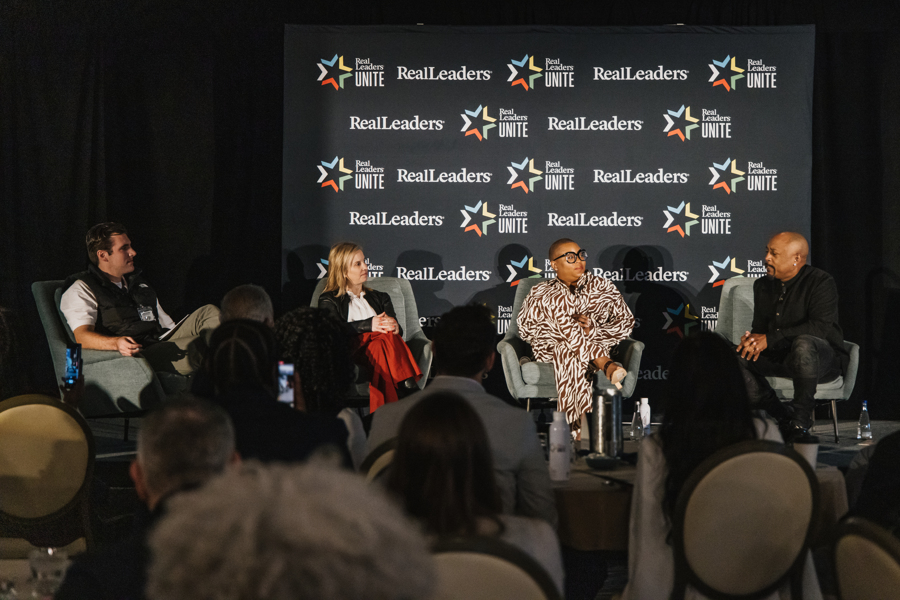
After taking questions from the rapt audience, Edwards introduced the next activity, the Real Leaders pitch competition. Two entrepreneurs, Elikem Tettey-Tamaklo, COO of Therapeutic Innovations, and Chloë Cheyenne, founder and CEO of COMMUNITYx, both had five minutes to make their pitch to the panel and to answer questions from them. We won’t tell you who won — you’ll have to wait for the video to release — but needless to say, it was an absolute whirlwind.

A Difficult Decision

After this, everyone was faced with a number of difficult choices. Multiple world-renowned speakers were giving unmissable talks, all of which you’ll be able to watch soon. Below are a list of the speakers and their topics.

Lisa Bodell, CEO of FutureThink — Killing Complexity

Stedman Graham, Chairman & CEO of S. Graham & Associates — Identity Leadership

Peggy Shell, Founder and CEO of Creative Alignments — Fueling the Energy that Runs our World: People

Michael Whelchel, Co-Founder and Managing Partner of Big Path Capital — Redefining Capital for CEOs: Impactful Transitions, Raises, and Exits

Keren Eldad, CEO of With Enthusiasm Coaching — How to Blast Past Impostor Syndrome and Truly Lead

Brad Stevens, Founder and CEO of Outsource Access — An Ironic Talent Solution: How to Retain and Attract Internal Talent by Outsourcing

Matthew Weatherly-White, Chief Investment Officer of Align Impact — Shaping the Future of Capitalism

Mackey McNeill, Founder of MACKEY — Essentials for a Regret-Free Exit

After these groundbreaking sessions, everyone had a chance to catch their breath and freshen up before the main event. People gathered for cocktail hour to mingle and take their turns being interviewed on the red carpet by Kathryn Deen, Real Leaders magazine’s managing editor. Under the bright lights and cameras, these stars shone bright.

UNITE Gala Dinner

As the gala dinner began, Edwards introduced one of the harder-hitting speeches by Geoff Davis, of Sorenson Impact. Davis told the story of the conception of Sorenson, how he overcame a life-threatening disease, and ultimately what it means to be dedicated to impact work. Yet nobody could be prepared for what came next.
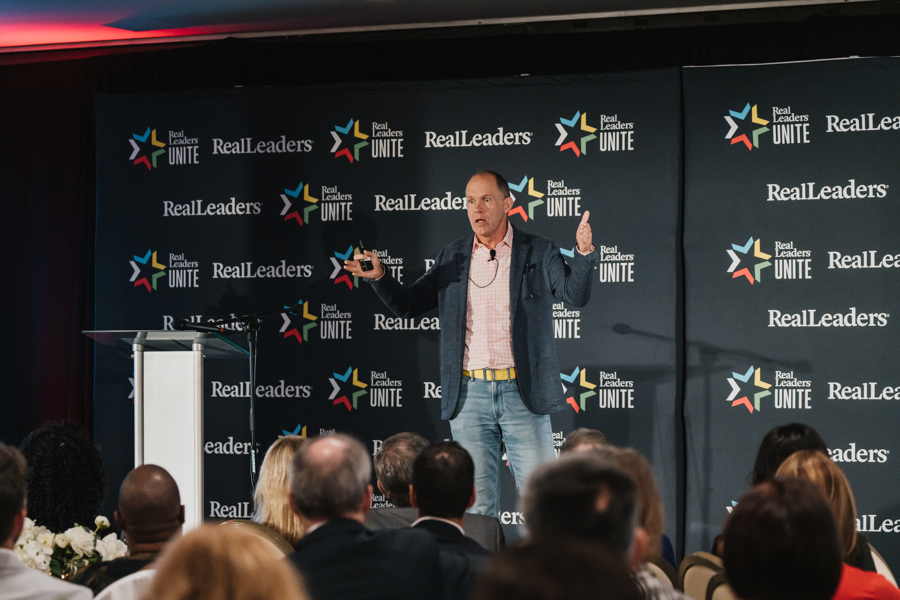
A video shot from the point of view of an astronaut marooned in space, on a mission to align the stars of the impact community. He hears that Real Leaders have gathered from across the globe to UNITE and spread their impact across the galaxy. He goes into hyper drive, crash lands in the San Diego bay and surfs to the shore all the while the winners of the 2024 Top Impact Companies are highlighted on screen. We watch as he dances his way all the way to Kona Kai resort with the final shot showing him enter through the very doors everyone came through from the cocktail reception. Suddenly an astronaut bursts through the actual doors in the back and runs up to the stage. He takes off his helmet. It’s none other than Kevin Edwards, president of Real Leaders. He congratulates all of the Top Impact Company winners and after his speech takes pictures on the red carpet with them. Cocktails, laughter, and bubbling conversation close out Day 2.

Add Yourself to the Short List

Thank you for taking the time to read about Day 2 of UNITE 2024. Please consider sharing it with one leader whom you think deserves to be at UNITE 2025. If you would like to be added to the short list to receive first dibs at pre-sale pricing, please add your email below. Thank you again to all of the people who made this community thrive at UNITE 2024. We can’t wait to deliver another incredible experience in 2025.
 

Real Leaders UNITE 2024 – Day 1: Fusion

The Big Bang

On Feb. 5, 2024, 100 CEOs, investors, coaches, and speakers started to trickle into the unusually rainy San Diego area. They made their way to Kona Kai resort, located on Shelter Island, a small neighborhood in Port Loma. Despite the rain, there was an unmistakable buzz of excitement in the air. Many of these people had been meeting virtually for years and were finally about to meet members of their forum in person. Not only that, they knew they were about to attend a first-of-its-kind event. Not entirely sure what to expect, they knew that these next few days would undeniably be something special.


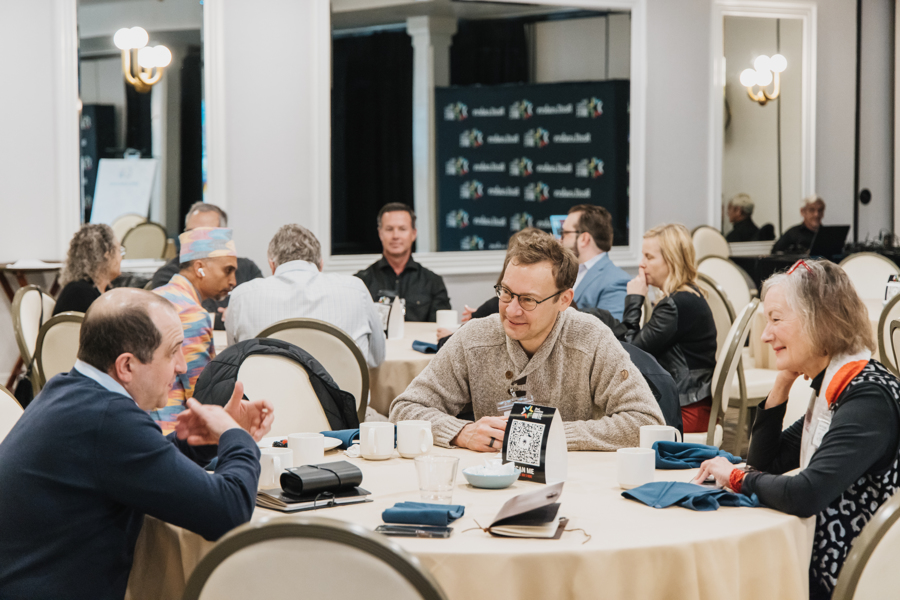
After checking in with the hotel, they were greeted by Real Leaders staff and led to registration. Gift bags, name tags, handshakes, and warm hugs were most definitely not in short supply. What seemed like a rather large empty ballroom just a few hours before was now brimming with excited conversation from a variety of groups who were coming together for the first time. The buzz of excitement was quickly turning into a full-on outpouring of laughs and an almost electric engagement. A few people noticed someone whom they recognized from his weekly LinkedIn livestreams for the Real Leaders Podcast make his way to the stage, some remarking that he was much taller in real life than he was on their screens. “Welcome to Real Leaders UNITE, everyone. Thank you for being here.” Real Leaders President Kevin Edwards was standing at center stage, microphone in hand. The din of voices became a whisper until the room of 100 was all looking at Edwards, poised and ready to deliver his opening remarks. Edwards spoke about how UNITE came to be. During the long planning sessions, the question asked again and again was, “What builds community?” The answer inevitably was, “coming together to build human connections that translate to the business world.”

As Edwards wrapped up his opening remarks, he introduced a new speaker to the stage. An author of multiple books, most recently, The Profiteers: How Business Privatizes Profits and Socializes Costs, Chris Marquis was greeted and given the spotlight. Marquis is the Sinyi professor of Chinese management at the University of Cambridge Judge Business School. Maqruis’ keynote address spoke to the need to embody a collective dedication to catalyzing change, fostering collaboration, and reshaping paradigms to usher in a more equitable and sustainable future. As the wrapped audience came to a thundering applause at the end of Marquis’ speech, Edwards came back on stage to direct everyone to the main course for the evening, forming the group forums.

Forums For All

This is where the magic really happened. People went in as acquaintances and came out as allies. Adlai Stevenson I said, “The first principle of a free society is an untrammeled flow of words in an open forum.” Although not a society, the beginnings of a real sense of community were beginning to form. The power of confidential forum is difficult to understand until you experience it, but in it’s simplest sense, it is a truly open and free setting to discuss business, life, and the unique role of being an impact CEO in a confidential, intimate setting.

Mapping The Impact Universe

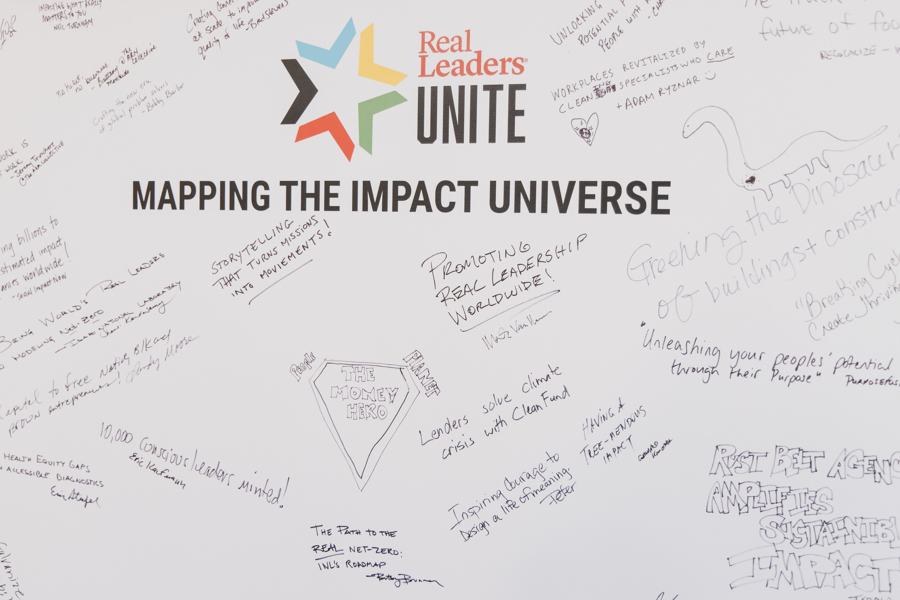
With forums wrapping up, these leaders made their way back to the main stage where Marquis’ words of transformative change were still fresh in their minds. A new face was on stage, someone who a few of these people had known as a member of their forum for the past year. Mike Brown, previously the CEO of Impact Grove and member of the Real Leaders community, recently decided to take his impact to the next level by joining Real Leaders as Chief Impact Officer. His easy smile and confident demeanor were still the same, but many noticed that Brown had an even deeper sense of meaning in his life. He spoke about this on the stage, acknowledging that this transition was something he took on because he knew that, as a part of Real Leaders, he could make an even greater impact than he could as a founder. He went on to explain that it was his goal to create an impact in each and every business that was present that night and that he wanted to start by mapping the impact universe. He held up a large poster board and asked every person there to put a quote on the board, a headline that might one day make its way to Real Leaders magazine. As you can see below, people were pretty excited to put their name on the map.

Day 1 was coming to a close, and people were still buzzing. Conversations continued long after the speeches were over. People just needed to talk about what they had experienced and explain how it was going to influence their business. Yet, UNITE was far from over. Everyone knew that Day 2 was going to be a big one and so, one by one, they made their way to their rooms to rest and prepare for another big day of impact.

Add Yourself to the Short List

Thank you for taking the time to read about Day 1 of UNITE. Please consider sharing it with one leader whom you think deserves to be at UNITE 2025. If you would like to be added to the short list to receive first dibs at pre-sale pricing, please add your email below. Thank you again to all of the people who made this community thrive at UNITE 2024. We can’t wait to deliver another incredible experience in 2025.
 

Technology for Pay Equity is Here

Syndio’s software platform exposes workplace inequities and offers solutions.

By Real Leaders

Companies and their management face immense pressure from employees, investors, and legislators demanding more transparency and progress toward diversity and pay equity goals. Yet many organizations lack the data to turn those promises into real results they can show.

Unmasking the Bias: Can Software Really Solve the Pay Equity Problem?

Syndio is a unique software as a service that offers companies a way to identify pay inequities based on race, gender, or other categories, fix those issues, and stay in compliance over time. Not only does it help close pay and opportunity gaps, but it also mitigates legal risk and turns diversity, equity, and inclusion (DEI) goals into tangible outcomes. 

“The purpose of our company is to close the wealth gap,” says Maria Colacurcio, Syndio CEO. “Right now, like it or not, there’s still a huge disparity, and while it’s not illegal to pay people differently, you have to have good reasons why you do that. Some companies say they pay for tenure, time, and role, or education, or a certain set of skills or particular experiences that really parlay themselves into high performance for a company.”


She continues, “All those things are just fine, but on the flip side, a lot of companies are still finding disparities that are because of something like gender or race. The pay gap is still very real, and what’s great is now there’s technology to solve that. That’s what our whole mission is about.”

From Data to Dollars: Syndio’s Measurable Impact on Workplace Pay Equity

Since its founding in 2006, Syndio has put over $160 million back in the pockets of people who weren’t getting it due to gender, race, or other factors. Syndio has experienced significant growth from 2019-22, including a 538% revenue hike and a 600% increase in employees. 

“The way leaders can meet their representation goals and begin to close the pay gap is by getting clear on how people move throughout the organization,” Colacurcio says. “Companies won’t solve the gap in one year or even five years. The important thing is to analyze it and create a plan to attack it.”

Over 300 companies utilize Syndio. Clients have included Elevance Health, University of California, Irvine, Sellen Construction, Databricks, Salesforce, Adobe, Hyatt, General Mills, Nordstrom, Slack, StitchFix, and Domino’s.

Syndio‘s Workplace Equity Platform has been a critical tool for us to focus our strategies and efforts in DEI,” says Molly Gellerman, Domino’s vice president of Inclusion and Diversity, HR Digital Transformation, and HR Operations. “I love being able to see how we measure up against qualified applicant pools for our jobs and narrow data for senior leaders to specific and actionable areas of improvement.”

Kate Harkess, Sellen Construction’s chief people officer, agrees. “On our DEI roadmap, we knew we wanted to establish pay equity, but what we didn’t know was that Syndio insights would benefit other dimensions of DEI,” she says. “With Syndio, we have become more intentional about building equity in other talent strategies, like development, promotions, and engagement.”

Syndio’s Workplace Equity Platform is a suite of products and services that help companies measure and improve a variety of facets of workplace equity — from bringing in talent fairly to compensating, retaining, and promoting them equitably. It includes the following:

  • PayEQ This always-on view of pay equity helps companies analyze, resolve, and prevent pay disparities due to gender, race, ethnicity, or other demographics. Pay Policy Analytics, an extension of PayEQ, allows companies to support fair compensation by going beyond pay equity analyses to examine the impact of pay policies on compensation, identify the root causes of inequity at the policy level, and build better compensation models.
  • Pay Finder It helps hiring teams set fair starting salaries and stop pay inequity before it starts, combining internal pay data with market-informed salary ranges to provide a holistic view of what’s fair and competitive for each individual candidate. 
  • OppEQ Companies can analyze representation and benchmark against internally and externally available talent so they can set data-backed goals for improvement and find the root causes of their diversity gaps overall and in leadership. OppEQ Promotions was launched in 2023 to help companies analyze promotions, uncover inequities, and drive accountability for equal access to opportunities.
  • Expert advisors A team of data scientists, technology experts, and legal professionals specialize in workplace equity and provide ongoing best practice advice — from global legal compliance and DEI goal setting to environmental, social, and governance, and human capital disclosures.

Syndio challenged the market to see pay equity as more than just a one-time analysis,” Colacurcio reflects. “We showed that with an always-on software solution, you can identify the cause of pay inequity and root it out to the benefit of employees and employers.” 

She continues, “But we knew that was simply table stakes for a larger platform that tackles workplace equity across the entire employee life cycle. In our next phase, we are bringing cutting-edge analytics to starting pay, promotions, movement, attrition, and performance. Companies look at much more than just pay when assessing their people, and they deserve an analytics platform to help them do that.” 

Hear Maria Colacurcio’s full conversation with us on Ep. 316 of the Real Leaders Podcast.

How Danish is Your Leadership

By Henrik Jespersen

If you’re a company leader grappling with getting more from your employees without compromising quality or increasing costs, look toward Denmark

Clothes are not trash. That’s the message Dan Green is working to spread because quite frankly, the United States is doing a bad job of recycling clothes, he says. Green is on a mission to keep clothes out of landfills by radically changing how unwanted clothing is collected and reused.

Green co-founded Helpsy, the only clothing collection company in the U.S. that has earned both Certified B Corp and Public Benefit Corporation distinctions.

Helpsy collects clothing, shoes, and accessories for reuse, recycling, and upcycling to help local communities, nonprofits, and the planet. The company keeps more than 30 million pounds of clothes out of the trash each year, diverting over 250 million pounds of carbon emissions annually.

More Than Recycling: Helpsy’s Impact on Jobs, Communities, and Carbon Emissions

“Together with our 1,200 East Coast partners, we convert discarded clothing into thousands of American jobs and millions in payments to businesses and community organizations,” Green says. “We prevent the emission of hundreds of millions of pounds of carbon dioxide and the use of billions of gallons of water while saving municipalities more than $1 million in waste disposal fees each year.”

A former portfolio manager on Wall Street, Green co-founded Helpsy with friends Alex Husted and Dave Milliner. Together they bought 11 companies primarily in clothing collection since 2017. They also invested in technology to modernize systems and utilize data to predict when and which collection points should be serviced to maximize the community’s satisfaction and minimize the economic and environmental costs of running trucks around.

“We exist to extend the life of clothing,” Green says. “We need to get out and let more people know that there are alternatives to the trash. It’s still unfortunately very normal for people to throw clothes in the trash — and we’re hoping to make that less and less socially acceptable.”

Beyond Goodwill: The Future of Clothing Reuse Starts with Helpsy

Helpsy collects unsold goods from a couple hundred thrift stores, does a few hundred drives each year with municipalities and charities, and in a newer initiative, it sells sorted, branded clothing to about 600 thrift stores.

“Clothing is the only major stream of waste that is growing on a per capita basis in a real way,” Green says. “We have to get over the mental hurdle that reuse does not destroy your brand and in fact enhances your brand.”

Green says the company has had big ups and downs. One stumbling block was when Helpsy tried to do direct-to-consumer e-commerce but did not get enough response to continue it. As for a bright spot, Helpsy realized its goal of providing benefits and stock options for all 145 of its employees. In another highlight, Helpsy expanded its reach with facilities in New York, Boston, and New Jersey, as well as trailers in Maryland and South Carolina.

“My family is very deeply rooted in social justice and making sure you leave the world a better place — that’s the point of your life,” he says. “We look forward to a future where used clothing is the first place people shop.”

How Danish is Your Leadership

By Henrik Jespersen

If you’re a company leader grappling with getting more from your employees without compromising quality or increasing costs, look toward Denmark

Clothes are not trash. That’s the message Dan Green is working to spread because quite frankly, the United States is doing a bad job of recycling clothes, he says. Green is on a mission to keep clothes out of landfills by radically changing how unwanted clothing is collected and reused.

Green co-founded Helpsy, the only clothing collection company in the U.S. that has earned both Certified B Corp and Public Benefit Corporation distinctions.

Helpsy collects clothing, shoes, and accessories for reuse, recycling, and upcycling to help local communities, nonprofits, and the planet. The company keeps more than 30 million pounds of clothes out of the trash each year, diverting over 250 million pounds of carbon emissions annually.

More Than Recycling: Helpsy’s Impact on Jobs, Communities, and Carbon Emissions

“Together with our 1,200 East Coast partners, we convert discarded clothing into thousands of American jobs and millions in payments to businesses and community organizations,” Green says. “We prevent the emission of hundreds of millions of pounds of carbon dioxide and the use of billions of gallons of water while saving municipalities more than $1 million in waste disposal fees each year.”

A former portfolio manager on Wall Street, Green co-founded Helpsy with friends Alex Husted and Dave Milliner. Together they bought 11 companies primarily in clothing collection since 2017. They also invested in technology to modernize systems and utilize data to predict when and which collection points should be serviced to maximize the community’s satisfaction and minimize the economic and environmental costs of running trucks around.

“We exist to extend the life of clothing,” Green says. “We need to get out and let more people know that there are alternatives to the trash. It’s still unfortunately very normal for people to throw clothes in the trash — and we’re hoping to make that less and less socially acceptable.”

Beyond Goodwill: The Future of Clothing Reuse Starts with Helpsy

Helpsy collects unsold goods from a couple hundred thrift stores, does a few hundred drives each year with municipalities and charities, and in a newer initiative, it sells sorted, branded clothing to about 600 thrift stores.

“Clothing is the only major stream of waste that is growing on a per capita basis in a real way,” Green says. “We have to get over the mental hurdle that reuse does not destroy your brand and in fact enhances your brand.”

Green says the company has had big ups and downs. One stumbling block was when Helpsy tried to do direct-to-consumer e-commerce but did not get enough response to continue it. As for a bright spot, Helpsy realized its goal of providing benefits and stock options for all 145 of its employees. In another highlight, Helpsy expanded its reach with facilities in New York, Boston, and New Jersey, as well as trailers in Maryland and South Carolina.

“My family is very deeply rooted in social justice and making sure you leave the world a better place — that’s the point of your life,” he says. “We look forward to a future where used clothing is the first place people shop.”

Technology for Pay Equity is Here

Syndio’s software platform exposes workplace inequities and offers solutions.

By Real Leaders

Companies and their management face immense pressure from employees, investors, and legislators demanding more transparency and progress toward diversity and pay equity goals. Yet many organizations lack the data to turn those promises into real results they can show.

Unmasking the Bias: Can Software Really Solve the Pay Equity Problem?

Syndio is a unique software as a service that offers companies a way to identify pay inequities based on race, gender, or other categories, fix those issues, and stay in compliance over time. Not only does it help close pay and opportunity gaps, but it also mitigates legal risk and turns diversity, equity, and inclusion (DEI) goals into tangible outcomes. 

“The purpose of our company is to close the wealth gap,” says Maria Colacurcio, Syndio CEO. “Right now, like it or not, there’s still a huge disparity, and while it’s not illegal to pay people differently, you have to have good reasons why you do that. Some companies say they pay for tenure, time, and role, or education, or a certain set of skills or particular experiences that really parlay themselves into high performance for a company.”


She continues, “All those things are just fine, but on the flip side, a lot of companies are still finding disparities that are because of something like gender or race. The pay gap is still very real, and what’s great is now there’s technology to solve that. That’s what our whole mission is about.”

From Data to Dollars: Syndio’s Measurable Impact on Workplace Pay Equity

Since its founding in 2006, Syndio has put over $160 million back in the pockets of people who weren’t getting it due to gender, race, or other factors. Syndio has experienced significant growth from 2019-22, including a 538% revenue hike and a 600% increase in employees. 

“The way leaders can meet their representation goals and begin to close the pay gap is by getting clear on how people move throughout the organization,” Colacurcio says. “Companies won’t solve the gap in one year or even five years. The important thing is to analyze it and create a plan to attack it.”

Over 300 companies utilize Syndio. Clients have included Elevance Health, University of California, Irvine, Sellen Construction, Databricks, Salesforce, Adobe, Hyatt, General Mills, Nordstrom, Slack, StitchFix, and Domino’s.

Syndio‘s Workplace Equity Platform has been a critical tool for us to focus our strategies and efforts in DEI,” says Molly Gellerman, Domino’s vice president of Inclusion and Diversity, HR Digital Transformation, and HR Operations. “I love being able to see how we measure up against qualified applicant pools for our jobs and narrow data for senior leaders to specific and actionable areas of improvement.”

Kate Harkess, Sellen Construction’s chief people officer, agrees. “On our DEI roadmap, we knew we wanted to establish pay equity, but what we didn’t know was that Syndio insights would benefit other dimensions of DEI,” she says. “With Syndio, we have become more intentional about building equity in other talent strategies, like development, promotions, and engagement.”

Syndio’s Workplace Equity Platform is a suite of products and services that help companies measure and improve a variety of facets of workplace equity — from bringing in talent fairly to compensating, retaining, and promoting them equitably. It includes the following:

  • PayEQ This always-on view of pay equity helps companies analyze, resolve, and prevent pay disparities due to gender, race, ethnicity, or other demographics. Pay Policy Analytics, an extension of PayEQ, allows companies to support fair compensation by going beyond pay equity analyses to examine the impact of pay policies on compensation, identify the root causes of inequity at the policy level, and build better compensation models.
  • Pay Finder It helps hiring teams set fair starting salaries and stop pay inequity before it starts, combining internal pay data with market-informed salary ranges to provide a holistic view of what’s fair and competitive for each individual candidate. 
  • OppEQ Companies can analyze representation and benchmark against internally and externally available talent so they can set data-backed goals for improvement and find the root causes of their diversity gaps overall and in leadership. OppEQ Promotions was launched in 2023 to help companies analyze promotions, uncover inequities, and drive accountability for equal access to opportunities.
  • Expert advisors A team of data scientists, technology experts, and legal professionals specialize in workplace equity and provide ongoing best practice advice — from global legal compliance and DEI goal setting to environmental, social, and governance, and human capital disclosures.

Syndio challenged the market to see pay equity as more than just a one-time analysis,” Colacurcio reflects. “We showed that with an always-on software solution, you can identify the cause of pay inequity and root it out to the benefit of employees and employers.” 

She continues, “But we knew that was simply table stakes for a larger platform that tackles workplace equity across the entire employee life cycle. In our next phase, we are bringing cutting-edge analytics to starting pay, promotions, movement, attrition, and performance. Companies look at much more than just pay when assessing their people, and they deserve an analytics platform to help them do that.” 

Hear Maria Colacurcio’s full conversation with us on Ep. 316 of the Real Leaders Podcast.

Clothed in Conviction

This CEO is calling for a radical waste reduction in the apparel industry.

By Kathryn Deen

Clothes are not trash. That’s the message Dan Green is working to spread because quite frankly, the United States is doing a bad job of recycling clothes, he says. Green is on a mission to keep clothes out of landfills by radically changing how unwanted clothing is collected and reused.

Green co-founded Helpsy, the only clothing collection company in the U.S. that has earned both Certified B Corp and Public Benefit Corporation distinctions.

Helpsy collects clothing, shoes, and accessories for reuse, recycling, and upcycling to help local communities, nonprofits, and the planet. The company keeps more than 30 million pounds of clothes out of the trash each year, diverting over 250 million pounds of carbon emissions annually.

More Than Recycling: Helpsy’s Impact on Jobs, Communities, and Carbon Emissions

“Together with our 1,200 East Coast partners, we convert discarded clothing into thousands of American jobs and millions in payments to businesses and community organizations,” Green says. “We prevent the emission of hundreds of millions of pounds of carbon dioxide and the use of billions of gallons of water while saving municipalities more than $1 million in waste disposal fees each year.”

A former portfolio manager on Wall Street, Green co-founded Helpsy with friends Alex Husted and Dave Milliner. Together they bought 11 companies primarily in clothing collection since 2017. They also invested in technology to modernize systems and utilize data to predict when and which collection points should be serviced to maximize the community’s satisfaction and minimize the economic and environmental costs of running trucks around.

“We exist to extend the life of clothing,” Green says. “We need to get out and let more people know that there are alternatives to the trash. It’s still unfortunately very normal for people to throw clothes in the trash — and we’re hoping to make that less and less socially acceptable.”

Beyond Goodwill: The Future of Clothing Reuse Starts with Helpsy

Helpsy collects unsold goods from a couple hundred thrift stores, does a few hundred drives each year with municipalities and charities, and in a newer initiative, it sells sorted, branded clothing to about 600 thrift stores.

“Clothing is the only major stream of waste that is growing on a per capita basis in a real way,” Green says. “We have to get over the mental hurdle that reuse does not destroy your brand and in fact enhances your brand.”

Green says the company has had big ups and downs. One stumbling block was when Helpsy tried to do direct-to-consumer e-commerce but did not get enough response to continue it. As for a bright spot, Helpsy realized its goal of providing benefits and stock options for all 145 of its employees. In another highlight, Helpsy expanded its reach with facilities in New York, Boston, and New Jersey, as well as trailers in Maryland and South Carolina.

“My family is very deeply rooted in social justice and making sure you leave the world a better place — that’s the point of your life,” he says. “We look forward to a future where used clothing is the first place people shop.”

Clothed in Conviction

This CEO is calling for a radical waste reduction in the apparel industry.

By Kathryn Deen

Clothes are not trash. That’s the message Dan Green is working to spread because quite frankly, the United States is doing a bad job of recycling clothes, he says. Green is on a mission to keep clothes out of landfills by radically changing how unwanted clothing is collected and reused.

Green co-founded Helpsy, the only clothing collection company in the U.S. that has earned both Certified B Corp and Public Benefit Corporation distinctions.

Helpsy collects clothing, shoes, and accessories for reuse, recycling, and upcycling to help local communities, nonprofits, and the planet. The company keeps more than 30 million pounds of clothes out of the trash each year, diverting over 250 million pounds of carbon emissions annually.

More Than Recycling: Helpsy’s Impact on Jobs, Communities, and Carbon Emissions

“Together with our 1,200 East Coast partners, we convert discarded clothing into thousands of American jobs and millions in payments to businesses and community organizations,” Green says. “We prevent the emission of hundreds of millions of pounds of carbon dioxide and the use of billions of gallons of water while saving municipalities more than $1 million in waste disposal fees each year.”

A former portfolio manager on Wall Street, Green co-founded Helpsy with friends Alex Husted and Dave Milliner. Together they bought 11 companies primarily in clothing collection since 2017. They also invested in technology to modernize systems and utilize data to predict when and which collection points should be serviced to maximize the community’s satisfaction and minimize the economic and environmental costs of running trucks around.

“We exist to extend the life of clothing,” Green says. “We need to get out and let more people know that there are alternatives to the trash. It’s still unfortunately very normal for people to throw clothes in the trash — and we’re hoping to make that less and less socially acceptable.”

Beyond Goodwill: The Future of Clothing Reuse Starts with Helpsy

Helpsy collects unsold goods from a couple hundred thrift stores, does a few hundred drives each year with municipalities and charities, and in a newer initiative, it sells sorted, branded clothing to about 600 thrift stores.

“Clothing is the only major stream of waste that is growing on a per capita basis in a real way,” Green says. “We have to get over the mental hurdle that reuse does not destroy your brand and in fact enhances your brand.”

Green says the company has had big ups and downs. One stumbling block was when Helpsy tried to do direct-to-consumer e-commerce but did not get enough response to continue it. As for a bright spot, Helpsy realized its goal of providing benefits and stock options for all 145 of its employees. In another highlight, Helpsy expanded its reach with facilities in New York, Boston, and New Jersey, as well as trailers in Maryland and South Carolina.

“My family is very deeply rooted in social justice and making sure you leave the world a better place — that’s the point of your life,” he says. “We look forward to a future where used clothing is the first place people shop.”

How Your Inner Circle Affects Your Wealth

Spend more time with people who will support your money-building path.

By Tom Wheelwright

Years ago, I lived in a solidly middle-class neighborhood. My family and I were happy there, but I started to notice something interesting on Sundays. When we went to church, I could see a big difference between the people who lived in my neighborhood and people who lived in a neighborhood about a mile and a half down the road: money. 

The difference wasn’t so much in the amount of money people had. Both neighborhoods were doing well by most standards. The difference had more to do with mindsets around money.

People in my neighborhood focused on money a lot but not always in a healthy way. Money was more a source of stress than joy. Meanwhile, people in the neighborhood down the road had a very different attitude. Money seemed to be less important to them, yet they had plenty. They also seemed to be having a lot more fun.

It made me think a lot about what kind of relationship I wanted to have with money and who I wanted to spend my time with. Ultimately, I sold my house and moved into the neighborhood down the road. That move made a huge difference in my life.

Surrounding Yourself with Success: How My Community Transformed My Financial Reality

The new address meant I started spending more time with people with an attitude toward money unlike any I had ever experienced. They viewed money as a tool to help them achieve their goals rather than just a source of stress or something to accumulate for its own sake. They understood how to build wealth through entrepreneurship and investments. They looked at the world with an abundance mindset and were curious about learning new things and giving back. 

Over time, I started to adopt this view. I became more comfortable asking questions about different kinds of investments and curious about how entrepreneurship works. I had people to talk with who encouraged these interests and introduced me to resources and people who could help me in these areas. Ultimately, it transformed my mindset around money.

Level Up: Make Change, Be Intentional

If you’re looking to build more wealth, it’s important to look at the people you spend the most time with. Do they model the kind of life you desire? If not, it may be time to make a change.

This isn’t some sort of woo-woo manifestation technique, and moving didn’t come with a membership to a secret wealth-building society. This is about creating an environment that will support you in your pursuit of specific goals. When you surround yourself with people who are successful with money and understand how to build wealth and impact through entrepreneurship and investments, you give yourself a different view of the world and what opportunities are available.

In today’s fast-paced world, the importance of having a supportive network of people around us cannot be overstated. The people we associate with can have a significant impact on our beliefs, actions, and ultimately, our results. While you may not need to move, you do need to be intentional with whom you spend your time and energy. When you do, you’ll begin to find yourself making more money and effecting more change. 

Building Your Support Team

How do you spend more time with people who will support your wealth-building impact path? Here are five time-tested options that don’t require hiring a real estate agent.

1 Expand your network.

Attend local networking events in your industry or niche and join professional associations that offer opportunities to spend time with people who have achieved financial and career success. 

2 Attend conferences, workshops, and seminars about entrepreneurship or investing.

You’ll learn from experts and connect with like-minded people who are serious about their wealth journey.

3 Volunteer to serve on the board of a charitable organization.

This is not only a great way to make a difference in your community, but it also is likely to connect you with people who share your values and goals.

4 Connect online.

If you can’t find the right groups locally, look for social media groups and other online communities where entrepreneurs and investors hang out. Join the discussion forums and start building relationships. 

5 Hire professional advisors.

A CPA, investment advisor, and attorney can provide strategic recommendations that more than pay for the cost of their services. They also will help you continue to expand your thinking when it comes to your wealth strategy.

Tom Wheelwright is a CPA, visionary, and best-selling author behind multiple companies that specialize in wealth and tax strategy. He is also an expert and published author on partnerships and corporation tax strategies, a platform speaker, and a wealth education innovator. You can find his book Tax Free Wealth here.

How Your Inner Circle Affects Your Wealth

Spend more time with people who will support your money-building path.

By Tom Wheelwright

Years ago, I lived in a solidly middle-class neighborhood. My family and I were happy there, but I started to notice something interesting on Sundays. When we went to church, I could see a big difference between the people who lived in my neighborhood and people who lived in a neighborhood about a mile and a half down the road: money. 

The difference wasn’t so much in the amount of money people had. Both neighborhoods were doing well by most standards. The difference had more to do with mindsets around money.

People in my neighborhood focused on money a lot but not always in a healthy way. Money was more a source of stress than joy. Meanwhile, people in the neighborhood down the road had a very different attitude. Money seemed to be less important to them, yet they had plenty. They also seemed to be having a lot more fun.

It made me think a lot about what kind of relationship I wanted to have with money and who I wanted to spend my time with. Ultimately, I sold my house and moved into the neighborhood down the road. That move made a huge difference in my life.

Surrounding Yourself with Success: How My Community Transformed My Financial Reality

The new address meant I started spending more time with people with an attitude toward money unlike any I had ever experienced. They viewed money as a tool to help them achieve their goals rather than just a source of stress or something to accumulate for its own sake. They understood how to build wealth through entrepreneurship and investments. They looked at the world with an abundance mindset and were curious about learning new things and giving back. 

Over time, I started to adopt this view. I became more comfortable asking questions about different kinds of investments and curious about how entrepreneurship works. I had people to talk with who encouraged these interests and introduced me to resources and people who could help me in these areas. Ultimately, it transformed my mindset around money.

Level Up: Make Change, Be Intentional

If you’re looking to build more wealth, it’s important to look at the people you spend the most time with. Do they model the kind of life you desire? If not, it may be time to make a change.

This isn’t some sort of woo-woo manifestation technique, and moving didn’t come with a membership to a secret wealth-building society. This is about creating an environment that will support you in your pursuit of specific goals. When you surround yourself with people who are successful with money and understand how to build wealth and impact through entrepreneurship and investments, you give yourself a different view of the world and what opportunities are available.

In today’s fast-paced world, the importance of having a supportive network of people around us cannot be overstated. The people we associate with can have a significant impact on our beliefs, actions, and ultimately, our results. While you may not need to move, you do need to be intentional with whom you spend your time and energy. When you do, you’ll begin to find yourself making more money and effecting more change. 

Building Your Support Team

How do you spend more time with people who will support your wealth-building impact path? Here are five time-tested options that don’t require hiring a real estate agent.

1 Expand your network.

Attend local networking events in your industry or niche and join professional associations that offer opportunities to spend time with people who have achieved financial and career success. 

2 Attend conferences, workshops, and seminars about entrepreneurship or investing.

You’ll learn from experts and connect with like-minded people who are serious about their wealth journey.

3 Volunteer to serve on the board of a charitable organization.

This is not only a great way to make a difference in your community, but it also is likely to connect you with people who share your values and goals.

4 Connect online.

If you can’t find the right groups locally, look for social media groups and other online communities where entrepreneurs and investors hang out. Join the discussion forums and start building relationships. 

5 Hire professional advisors.

A CPA, investment advisor, and attorney can provide strategic recommendations that more than pay for the cost of their services. They also will help you continue to expand your thinking when it comes to your wealth strategy.

Tom Wheelwright is a CPA, visionary, and best-selling author behind multiple companies that specialize in wealth and tax strategy. He is also an expert and published author on partnerships and corporation tax strategies, a platform speaker, and a wealth education innovator. You can find his book Tax Free Wealth here.

0