Learn how to sort linear from circular thinking — and choose the ideal one for every situation.
By Kim Hudson
Human thinking has a pattern, but how do we access it?
Many social scientists and neuroscientists agree that we have two ways of knowing — distinctly opposite mindsets built into the human condition. They give them names like the Master and the Emissary (Iain McGilchrist) — or right and left brain (Jill Bolte Taylor). Daniel Kahneman calls them fast and slow thinking, Jeremy Bentham and Antonio Damasio call them pleasure and pain states, and Daniel Siegel likes attachment and survival modes. Type A/Type B or S1/S2 — you get the idea. I call them linear (left-brain) and circular (right-brain) thinking.
Think Better, Lead Better: Mastering the Two Faces of Your Mind
We move between these mindsets through our language choices. It’s like having a low-tech version of the machine in the movie Avatar. Activate one of their operating principles, and you are taken into that world. Each mindset has its optimal moment. Being a mindful leader means pausing to sort linear from circular thinking and choosing the ideal one in any given situation. A good starting point is recognizing their unique sources of power.
Linear Poweris best for known situations where we need to do things like combat external, physical dangers, achieve goals, build material security, or win competitions. Weber’s definition for this kind of power is to assert your will, even against resistance. That probably sounds familiar, as it is synonymous with control.
Circular power is less familiar, making it our greatest growth area. Reaching back to ancient wisdom, I describe this power as coming from knowing yourself, being yourself, and supporting others in doing the same. This internally focused mindset is optimal for recognizing what is meaningful, building resilience, resolving conflict, being creative, developing talent, finding happiness, and fostering inclusive environments. It cares about connections, disconnections, and reconnections.
From Competition to Collaboration
Some situations need linear and circular thinking as tag teams. Terri Kelly, former CEO of W. L. Gore and Associates, has identified two kinds of people in its innovation-focused business — rainmakers and implementers. The former dreams up creative ideas, and the latter brings them to life. But control tends to gravitate to the implementers if the rainmakers aren’t protected. Kelly says she spends most of her time emphasizing the difference and preventing people from reverting to conventional wisdom.
Once we determine our optimal worldview, there is a triad of operating principles to help us navigate within and between worlds. Knowing the triad means we can ask some illuminating questions. The linear operating principles are to push back against what I don’t want to happen, focus on the external and objective aspects, and use an either/or filter.
With this mental framework, here are the kinds of questions we could ask:
Am I pushing back against what I don’t want to happen (as regulatory systems and budgets do)? Then, I am in linear thinking mode. Automatically, the other operating systems are also activated. I’m being objective and making either/or evaluations.
This is ideal when there is a heroic need to right a wrong, secure needed resources, and stop evil efforts from doing us harm. My motivation is to assert my will even against resistance. We should also know that all the benefits of circular thinking are now closed off to us. But if we know the operating principles of circular thinking, we can toggle with ease.
Circular thinking’s triad is: Pull in more of what I want, reflect on my internal/subjective states, and consider where I can say yes to something the other person is offering, how I can add to what they are saying, and where there is overlap between both of our perspectives.
The circular thinking questions would be: What do I want more of, and why do I want that (why questions get to what really matters to us)? What do they want more of, and how could I contribute to that? What do we both want more of? Circular thinking is relational and generative. We don’t know where it will take us, and we can be sure it will be collectively meaningful.
Imagine adding a circular feature to a regulatory process that generates new partnerships and supports innovative circular economies. And what if climate change was addressed by each person connecting to what is deeply meaningful to them before making a purchase? These outcomes become possible when we access our circular and linear potential. Another thing I learned about being human is we can read each other’s linear or circular state of mind, and we tend to follow. Leaders who consciously make these shifts will find the people around them spontaneously following them.
Top 4 Strategies for Bridging Linear and Circular Thinking
1 Recognize two ways of knowing — and don’t blend them. Toggle from one to the other with purpose.
2 Use linear power when you need to assert your will, even against resistance.
3 Cultivate circular power by knowing yourself, being yourself, and supporting others in doing the same.
4 Ask yourself questions based on linear and circular thinking operating principles. This curious inquiry develops the neutral platform from which we can enter and navigate our optimal mindset.
Kim Hundson, best-selling author, recently released “The Bridge,” a book about bridging linear and circular thinking. Her background includes 25 years as an exploration geologist, as well as consulting First Nation and Yukon governments.
How I’m helping reinvent the $59-billion supplement industry from the ground up.
By Katerina Schneider
I’m a mother of three — four if you count Ritual, the health and wellness company I founded in 2016. I was pregnant with my first daughter when I couldn’t find a prenatal multivitamin I trusted. The options recommended to me were high in heavy metals, contained artificial colorants, or were lacking in key nutrients we needed during that life stage.
The more I learned, the more I realized we need supplements, but it’s no surprise people have a hard time knowing which ones to trust. There was transparency in so many other industries, yet when it came to something people are putting in their bodies every day, there was none. That was the lightbulb moment. I knew we deserved better — not just for women’s health but for future generations.
Beyond Vitamins, Building Trust: Ritual’s Recipe for Success
I quit my job at four months pregnant, eager to bring an unprecedented level of transparency to the $59-billion supplement industry. But as I took meetings for Ritual’s first round of funding, a male investor told me I could start a company or start a family — but not both. This moment became ingrained in our founding story and immortalized as one of our company values: to embrace the nos. That no became fuel for me. It wasn’t the first no, and it certainly wasn’t the last. I was told there was no way we could earn the trust of women online. I was told no one would ever buy a prenatal multivitamin from an online company. I was told that no one would pay a premium for higher-quality ingredients. Every no made me more determined to reinvent the supplement industry from the ground up.
Informed Choices, Not Blind Faith: Ritual Empowers with Facts
We built the first visible supply chain of its kind, transparently sharing where our ingredients come from in the world and why they are there. We invested in scientific research and clinical studies to support the efficacy of our products, setting a goal to have clinical trials on all our products by 2030. We also pursued third-party certifications like USP Verification and Clean Label Project because we didn’t want our customers to just take our word for it.
None of this was required by the industry, but it was the right thing to do. We focused on not just creating transparent products but providing transparent information so our customers and community could make confident choices for their health. And it has paid off. Ritual is one of the most trusted brands in its category, one of few supplement companies to be a Certified B Corporation, and now we have one of the leading prenatal multivitamins.
Raising the Bar for All
But the reality is people are going to buy supplements for their specific needs outside the ones Ritual makes. My goal is that through strategic advocacy initiatives and urging Congress for stricter oversight, we can have a bigger impact beyond our products. We are advocating for a future where there are health protective measures on heavy metals, and terms like clinical study are clearly defined so that consumers don’t have to be their own advocates. That is the ultimate mission — to raise the bar not just for our products, but for the supplement industry at large, and to create a better future for my girls.
Katerina Schneider is the founder and CEO of the health technology company Ritual.
Here’s my best advice from 30 years of C-suite experience.
By Darin Anderson
As impact companies, we see the greater purpose of our work and are dedicated to making decisions with the best interest of team members, customers, investors, partners in mind, knowing financial success will follow. However, it’s not always an easy path. From my three decades of C-suite experience, here is what I have learned are the keys to being a successful impact CEO.
1. Be clear on your purpose and what success looks for you and your organization. Find the best people who can help you achieve that — people who share your values, vision, passion, and determination.
2. Execute your plan. Listen, adapt as necessary, and execute. Work diligently and always do the right thing for your team and clients. Be highly accountable for results and actions, and be transparent in all that you do and your reasons for doing it.
3. Share the rewards equitably. Help people feel like owners in the organization’s success by allowing them to be rewarded like owners. We make it a priority to compensate our team members well and relative to the contributions they make with salary, benefits, bonuses, and company shares. Everyone in our organization can be an employee-owner. We are also transparent about our performance. When people feel truly invested in the long-term success of your organization, they will show up, give the extra effort, and deliver the desired output.
4. Surround yourself with people and peers outside of your organization who will be honest with you in life and take an active interest in your well-being and that of the company. I have many CEO friends whom I meet with regularly or run or ride bikes with to review family, personal, and business progress. I have learned so much from them and their approach and viewpoints. These connections are invaluable and have helped me be a better leader.
5. Find great partners in life. I am blessed to have an amazing spouse whom I have tremendous respect for and who appreciates me. She makes me a better person. We support each other and champion each other in this beautiful life journey. Like my marriage, my leaders are also my partners in life. We are committed to each other’s success, and we all know it.
6. Consider your personal impact and legacy. Look in the mirror and regularly ask yourself: Am I doing all the right things to achieve this? I reflect on my own impact often. Personally, I believe that if you take care of the people around you, create the right environment for individual and team success, and share rewards equitably and thoughtfully, you’re going to leave a great legacy.
Darin Andersonhas served as chairman and CEO of Salas O’Brien since 2006, guiding the company to become one of North America’s leading engineering and technical services firms. He has led large engineering and construction organizations for 30 years as CEO, COO, and CFO.
Here’s how to take back control of your life in 2024.
By Tony Robbins
As we look ahead for 2024, one thing is clear: We are living in uncharted territory — a time when the economic, political, and social landscapes are changing at a record pace. We are all being touched by the events happening around the globe. No matter where you live or what you do for a living, what is happening is unlike anything we have ever experienced.
While this is a time of massive uncertainty and endless complexity — if you’re prepared — it’s also a time of exponential opportunity. The winter season offers us the unique opportunity to grow, become more, give more, and share more. It can be the greatest season for any leader if you can develop an unwavering confidence amidst the storm.
What Will Hold You Back
What will hold you back is only one thing: fear. Fear that you’re not enough or don’t know enough. Fear of failure, fear of rejection. Fear can hold you back in subtle and insidious ways. Fear can also outright paralyze you from taking action.
The truth is, there is a part of you that will always be fearful — but you can’t let it be in charge because it will rob you of the life you deserve. It will cause you to miss the call — the call to become more, to experience that incredible nectar of growth, expansion, and contribution, meaning, impact, and achievement. The call to rise up and feel fully alive.
As we move forward in 2024, to have the life you desire, you must feed the best part of yourself every single day, demand the best part of you, and not settle for less than you can be, do, share, create, or give.
Here are five keys to help you to rise and make 2024 the best year yet.
Feed your mind.
You need to feed your mind daily with substance — not social media or news. My original mentor, Jim Rohn, taught me that you must stand guard to the door of your mind. Bring something new to it; otherwise, you will keep operating off the same old beliefs, the same old thoughts, and the same old emotions that will not get you to the level you want.
Growing up as a kid, I didn’t have any role models, so I found them in books. I read history, biographies of great leaders, businesspeople, philanthropists. I learned what made them successful and extracted the principles and applied them to my own life.
Strengthen your body.
Strengthening your mind is crucial, but equally important is strengthening your body. The mind and body feed each other. Go on a sprint, lift some really heavy weights, go on a really long walk. The key is to push yourself.
Every single day, I begin my morning by plunging into a pool of 56-degree water. And if I’m not home, I’ll jump into a nearby river. I don’t do that because it’s fun; I don’t do that because I want to do it. I do it because I’m training my body so that when I say go, we go. I don’t negotiate with my mind.
Priming your physical body can set the stage for the change you want to drive in yourself mentally and emotionally.
Find a great role model.
If you want the best year of your life, you need to decide to find a great role model, someone who is already getting the results you want.
Why? Because success leaves clues.
One person that I identified in my own journey was Sir John Templeton, once called arguably one of the greatest investors of the 20th century by Money magazine. He started out with nothing, just like me, and became the first billionaire investor.
Whom can you model?
Surround yourself with high-level people.
Think about whom you spend time with. If you want to raise your game this year, you must get in proximity to someone who is playing the game at a higher level than you are. Proximity is power.
Say you’re playing a sport like tennis. If you’re always playing against someone worse than you, you’re never going to get better. Always surround yourself with people playing at a higher level.
Pay it forward by giving more than you expect to receive.
In 2024, you must also find a way to add value to others. I truly believe that the secret to living is giving, and it’s what truly makes us alive and live not just a successful life, but a fulfilled one.
For me, feeding people and making sure families are nourished has been my passion for nearly five decades. I was fed by a stranger on Thanksgiving when I was just 11 years old. As a result, I started to feed others. Even when I did not have a dime to spare in my younger years, I managed to find a way to provide a meal or two for struggling families.
You can find a way to give back too, no matter what your current situation is.
As we all look to rise out of fear in 2024, one gift I would like to give you is an opportunity to join me for my Time to Rise Summit. This is a completely free virtual event that I do every January as a way to give back. The goal is to help you create momentum in your life by arming you with the psychology, tools, and strategies to make 2024 the best year yet. Find details at https://timetorisesummit.com/join-now.
Looking forward to seeing you there!
Tony Robbins is one of the world’s leading life and business strategists and ranked No. 1 on the 2023 Real Leaders Top 50 Keynote Speakers list.
Retiring Soccer Megastar Megan Rapinoe kicks up her fight for equality in the world arena — and shares why businesses have no excuse but to close the gender pay gap now.
She has been cheered from the stands by pro soccer fans for 15-plus years. She has been called upon by Congress to testify in a historic fight for gender pay equality. And she has become synonymous with being a disruptor on both world stages. Megan Rapinoe may be hanging up her cleats this year, but her advocacy work is far from finished. In fact, she tells Real Leaders that she is just getting started.
Hanging Up Her Cleats: Rapinoe’s Transition to Full-Time Advocacy
Rapinoe will retire as one of the most influential athletes on the planet with two World Cup titles, an Olympic gold medal, and a Presidential Medal of Freedom, and one of the first soccer players to publicly come out as gay. Now, Rapinoe is taking the field for gender equality in full force and is kicking up her activism efforts for LGBTQIA+ rights and racial justice.
Known to passionately speak her mind, Rapinoe reflects with Real Leaders on her leadership lessons from the game, why businesses have no excuse but to close the gender pay gap now, the impact company she recently launched with her fiancée, WNBA legend Sue Bird, her desire to make politics “cool,” and a whole lot more. Rapinoe’s new chapter is shaping up to be her most impactful one yet, and in true Rapinoe fashion, she is embracing it with arms wide open.
Real Leaders: Congratulations on your upcoming retirement from pro soccer. How did preparing for and competing in four World Cups, including as co-captain in 2019, transfer into your leadership strategy in business?
Rapinoe: When you’re playing on a team that has been as successful as the U.S. Women’s National Team where you’re literally playing with and against the best players in the world all the time, you need to have a level of even aspirational confidence in yourself and your teammates. If you’ve made it to the World Cup on the Women’s National Team, you’ve run the gauntlet. You’ve been in a pressure cooker. You’re resilient.
I apply these same qualities — confidence, teamwork, performance under pressure — to leadership in business. For me, I was born with this amazing talent to be an athlete. Just as I grew into a leadership role on the team and tried to be the best player I could be, I’m trying to leverage these skills off the field as well.
Being a leader on a team or in a business means you have to be accountable to yourself and to your teammates. I’ve always been a team-first player, and that definitely carries over to my businesses outside of soccer. I want to be successful, of course, and I want everyone to be successful with me, and I want to be successful with them. I don’t think individual success actually exists, and the foundation of that belief came from playing on the biggest stage with my teammates. You need everyone to really win at anything.
RL: You helped lead the charge in the U.S. Women’s National Team’s class action gender discrimination lawsuit against the U.S. Soccer Federation, settled in 2022 with a promise for equal future pay with the men’s team. How is this affecting employee equity in business today? How would you characterize the progress that has been made, and what will it take to reach equal gender pay everywhere?
Rapinoe: We’re definitely experiencing a paradigm shift in how we understand the value and potential of women, which has been undervalued for so long. The Equal Pay Act became law six decades ago, and yet we still hear the statistics: Women make 82 cents for every dollar a man earns. For Black women and women of color, the gap is even greater. The wage gap has hardly moved in 15 years. It’s absurd. It’s not acceptable or sustainable, and finally it seems like enough people are starting to say “enough” — whether that’s U.S. women’s soccer, protesters, investors, or employees.
Our victory as a team was really momentous for women’s soccer and for all of women’s sports and the equal pay movement, but the average person doesn’t have the platform — much less the bandwidth or the ability or the freedom — to engage in a fight like we did. We need to ensure all working women and all marginalized groups are being paid equitably. As chief equality officer for Trusaic, my goal is to use my platform to bring awareness not only to the problem-because we all know by now that there’s a problem- but also to talk about the solutions.
And it’s not just about compensation, although obviously being paid fairly is important. For the team, it was also about equal investment and equal caring — that’s equal access to resources, investment in coaching, marketing, ticket sales, sponsorship, all of it. In a corporate setting, that looks like equal access to opportunity — who gets the new assignments, the great projects, who gets additional training and development, and who gets promoted.One thing I believe is that you have to create a space that signals to people that it’s safe before they even enter that environment. Maybe that’s diversity training, but it’s also: What are your hiring practices? How diverse is your workforce? Who do you do business with? What does your executive suite look like? Does everyone look exactly the same? Because that’s not going to signal to other people that there’s space for them there.
The pressure’s been turned up. We know investors are looking more closely at companies and their workplace practices, employees want to work for companies that pay fairly, and customers want to do business with companies that do the right thing. So the pressure is coming from a lot of places, and industries and companies should also put pressure on one another. There should be an element of holding their feet to the fire in this. Legislation and legal action are obviously part of that pressure too.
Companies hold the key to closing the wage gap. There are no longer any excuses. At this point, we have enough information and the tools, like Trusaic’s PayParity technology, for companies to get on the other side of this in a real, meaningful way.
Megan Rapinoe and her fiancée, WNBA legend Sue Bird, recently announced their retirements from sports and co-founded A Touch More production company to give a voice to underrepresented groups.
RL: As a mission-oriented leader, what are your personal and professional missions right now? Rapinoe: My professional mission while I am still playing is to be the best teammate and the best player I can be and to leave the game in a better place for the next generation of players.
My personal mission is to use my platform to fight for gender equality, LGBTQIA+ rights, racial justice, and equal pay. I hope to inspire others through my advocacy and actions to join the fight for equality and justice and help create a more fair and inclusive world.
I am very selective about who I work with, and value alignment is something I take seriously in business. I became chief equality officer last year for Trusaic, which I know your publication recognized earlier this year. (Trusaic was a 2023 Real Leaders Top Impact Company.) They are a workplace equity technology company focused on achieving pay equity, which is obviously very close to my heart. And, of course, I’m involved with my own businesses as co-founder of A Touch More, the production company my fiancée, Sue Bird, and I have formed together to really change what kind of stories are being told and who is telling them.
RL: Speaking of co-founding A Touch More with Sue Bird, what are you learning about yourself and each other in this process? Rapinoe: A Touch More was actually created early in the pandemic as an Instagram Live show really just for fun. We had games and different guests. Sue produced the show and it was a blast. It really became about creating community in new ways under unprecedented circumstances. There was so much heaviness, and we just wanted to be a light however we could, even if it was just for a few hours.
So we kept that title for the production company, and our goal now is to create content that centers on stories of revolutionaries who move culture forward. If we can get eyes on these stories, we can broaden the cultural understanding of what it means to move in the world and to be successful when you don’t look a certain way or fit a certain mold. We want to partner with people and organizations and brands who want to do the same kind of thing: uplift the culture through powerful narratives.
We’ve never had any qualms about working together professionally. This experience just reinforces that we’re really passionate about the same things. We probably appreciate each other’s unique strengths even more, and we can pick each other up in those areas where the other one might fall short. It’s really cool to work with someone you love to advance your shared vision for the world. I truly think Sue’s brilliance is one of her most underrated qualities publicly.
RL: Do you and Bird have any other projects in the works together? Rapinoe: In terms of future projects, activism is probably always going to be at the heart of what we want to do. It’s what we both have always believed in as individuals, so it makes sense. We’ve both had these really influential platforms as athletes, and we know the impact we can make on the world together. It’s not about our story and our personal success. Everyone’s heard our story. We want to get eyes on things that we feel are really important and not getting enough attention, and we have the resources between us to turn up that light.
Fueling Change for Future Generations
RL: What areas of your work and mission excite you the most? Rapinoe: I’m really fueled by the opportunity to make a difference for the young athletes who look up to me, for women in the workforce, for trans kids, for marginalized groups that deserve to be championed and to be seen and heard.
I’m excited about finding ways to get more people interested and invested in politics to make politics “cool,” not necessarily in the traditional sense, but actually getting people to understand that politics is engaging with you, whether you’re engaging with it or not. So those could be the decisions that your school system, city government, and insurance company are making. If people realize that when they participate in politics at whatever level, then policies will better reflect the needs and desires of their communities. We can impact our ability to live a better life by being a little bit more involved. If we take the time to understand all the issues we can have a say in, we can hold our elected officials accountable, so that’s a big mission of mine.
RL: How can you leverage your personal brand as an advocate for the businesses you align with? Rapinoe: Many of the brands that approach me do so because they feel a connection to what I’m doing on the field or what I’m doing and saying off the field, probably some of both. So that might be finding a way to win or to push yourself to the highest level or taking a stand for things that matter — justice, equality, fairness. I’m obviously not shy about putting myself out there, and so I imagine the brands that want to work with me and the brands I want to work with feel the same.
For me, it’s how can I leverage my personal “brand” — who I am — for good? How can I make a difference? I’m fortunate to have people who do pay attention to what I say, so I feel a responsibility that comes with that — a responsibility to do what I can with that influence and try to make the world better, whatever that might look like.
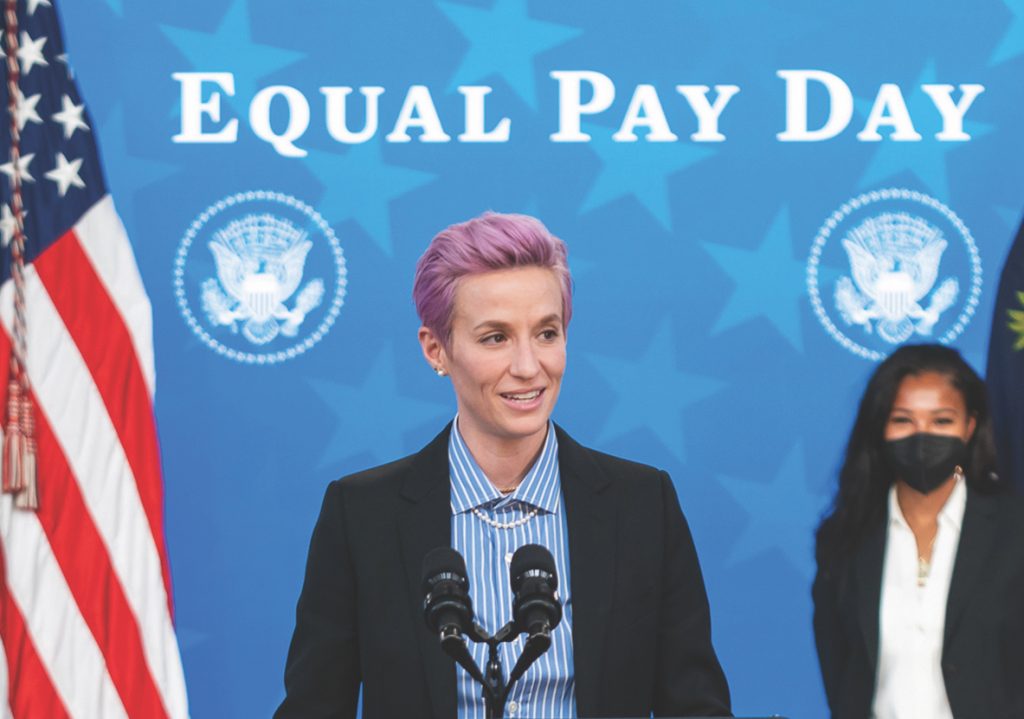
Megan Rapinoe delivers remarks during a virtual Equal Pay Day event Wednesday, March 24, 2021, in the South Court Auditorium in the Eisenhower Executive Office Building at the White House. (Official White House Photo by Adam Schultz)
RL: You’ve spoken publicly about impact investing. What led you to commit to it? Rapinoe: Values apply to every aspect of your life, not just some. My personal financial advisor and firm are really committed to impact investing. We definitely want to be successful and make money, but we also want to think about a new path forward. Doing the same things obviously isn’t working. I like to invest in companies that are disruptive and progressive and concerned with making a difference in people’s lives. My goal is to keep doing this. My portfolio includes Mendi, which is run by my sister, Rachael, and makes CBD products for athletes; Real, which is a mental health startup; and STATSports, which makes wearable technology for athletes. We are just getting started in this space. There will be more to come. I want to continue to carve out a path for women — who don’t acquire as much capital — to come together and build for everyone.
RL: Whose leadership has inspired you the most — in sports or otherwise? Rapinoe: My biggest influence on leadership is my mom, Denise Rapinoe. She has always been the leader of our family and like so many women, has worked tirelessly her entire life to provide for her family, herself, and anyone who needed her. My mother gave me the strength to be who I am today. She taught me how to stand up for what is right, fight for myself, and fight for others who need a helping hand. I absolutely would not be the person everyone knows today without her leadership.
RL: What is your definition of a real leader? Rapinoe: A real leader is someone who is confident and accountable and creates an environment where everyone feels seen and heard and like they have a place on the team. Being a leader is about being faced with the choice to make the right decision for the greater good and actually choosing it every time. A real leader is not afraid to challenge the status quo to make positive changes within their company, industry, or the world. I don’t think there’s one right leadership style. It’s about serving the person next to you and the people around you and giving them what they need. Real Leaders need to make a point of understanding the people they lead and then being intentional in their actions to support them and bring the very best out of them.
Rapinoe Embraces Her Next Chapter
RL: What’s next for you? Rapinoe: Knowing this year would be my last in soccer, I’ve just tried to really enjoy every moment and appreciate what a special opportunity I have had playing for so long. I’m so grateful for everything this game has given me and so honored to have represented my country for so many years, and it, of course, has opened up many other doors.
I definitely want to continue to use my platform to expand the conversation. It would be irresponsible of me not to. I want to push people and companies to re-imagine the status quo. We obviously need more women in leadership positions. We need more gay and trans people in leadership. We need a bigger commitment to pay equity and inclusion. It’s easy for everyone to say they agree with this until it comes time to actually invest in or hire or promote someone who doesn’t look like you. We’ve made some progress, but we certainly have a long way to go. I think a lot about how we can break down these barriers and open more doors for women, Black people and all people of color, gay people, and the people who live in intersecting spaces and have so much perspective to offer all of us.
I’d like to continue to be involved in more projects that get people energized about the civic process and more active in their communities. I don’t think enough people get involved when it’s not literally their skin in the game, but if you look at the intersectionality of everything, it is all of our skin in the game, so I hope to encourage people to speak up or to take positive action. The most important thing for anyone is to do something — and you don’t have to do it perfectly. You don’t have to have all of the answers, but don’t be scared into inaction because you don’t think you have it exactly right.
I feel strongly that the business of Megan Rapinoe can go in all kinds of different directions. I have a lot of irons in the fire. Soccer will always be that touchstone for me, but how can I use that foundation to enter other spaces? That might be fashion, technology, investing, or who knows? We’re just getting started.
Have you noticed the pace of change is getting faster and faster?
Would it surprise you that the ‘pre-historic’ part of our brain is struggling to cope?
Are you wondering why absenteeism caused by mental health illness is rising?
If the answer to all of these questions is ‘yes’ then read on.
I love Ruby Wax and in particular, I personally recommend her podcast appearance on ‘Happy Place’.During the podcast, Ruby talks about the brain and in particular a pesky part of it called the amygdala . In all seriousness, the amygdala does have an important function, if you are being chased by a bear. When the amygdala becomes stressed, it sends a distress signal via the hypothalamus to communicate a signal to the rest of the body that it needs energy to fight or flee. This is handy if you are in real danger. Due to the modern fast based and aggressively competitive modern day world however, our amygdala is mis-firing and giving out distress signal when there is no imminent danger. Ruby believes we can temper the amygdala in part by acknowledging that mindfulness based cognitive therapy – which she studied extensively at the university of Oxford-is a practice that teaches you to observe rather than react to your emotions. In essence you observe the mis-fire as if it is happening to someone else but you can catch it in progress and say ‘aha that is anxiety’. Labelling it is thought to lessen its effect.
How can we try however to avoid the amygdala mis-firing in the first place?
The sheer intensity and impact of the constant contact culture through social media and the ‘I want it now’ amazon culture means our brains are mis-firing faster than we can catch it. This is literally changing the brain for the worst as MRI scans show. Mindfulness helps beef up the amygdala to respond but the continuous hyper-vigilant state we end up surrendering to, causes anxiety to become chronic and mental health illness becomes more prevalent. ‘In a world of distraction’ as Ruby describes it, we need to dial down the impact on our amygdala and reduce its signaling. That way the toxic effects of too much cortisol can’t wreak havoc on the system and cause us to be ill.
Post pandemic, however what do you do though when everyone around you is burning out and we are on the tipping point of a mental health pandemic?
A lot of mental health training focuses on the ‘self’ which whilst effective at building resilience and helping others on the approach to crisis, does not tackle what you do if you are on a burning platform nonetheless, due to your organisational culture.
Compassionate Leadership is not a panacea per se, but the evidence of its success is pretty compelling. This leadership tool promotes going beyond empathising with each other to taking action by signposting, effective and attentive listening and calling out bad behaviour whilst offering support. The Harvard Business review undertook research as part of the potential project and found that of 350 CEX and CHROs across 15K leaders and 150K employees in 5K companies across 100 countries including involving some big players such as Netflix, Yahoo, Lego and KPMG and produced these key findings:
Those who exercised compassionate leadership were:
-Promoted faster
-Were double less likely to quit
-14% higher performance
-Greater job engagement
Hougaard, R; Carter J. (2022) Compassionate Leadership, How to do hard things in a Human Way.
With this evidence as my momentum, I set about understanding what it meant to be compassionate in a practical way that Middle and Senior management can use. This lead to the creation of the ELEVATE model. The model is predicated on the assumption that humans are naturally capable of compassion and therefore this is available to everyone as a bolt on to an existing leadership style.
Before anyone claims this is too time-consuming, think about how many pointless grievance processes or painful tribunals your organisation has attended and think again. In addition, for anyone who thinks it is too soft and fluffy- This does not avoid the tough stuff. To the contrary it is engaging with the challenging themes of organisational life in a human way. The beauty is, it can also be used to look at systemic leadership across the whole employee journey from attraction to exit. This can be a stress preventative strategy as revisiting policies that often are parental in their nature and re-designing them to focus on the 2% that may underperform rather than the 98% that perform just fine through culture building. Utilising this tool helps to create a culture of understanding which in turn builds psychological safety, inclusion and a sense of belonging. Working in environments of safety naturally lowers stress and drives performance so, why would you prefer to do anything else?
Before anyone gets excited though, this takes work. Fear and insecurity often breeds the reverse type of behaviour and that isn’t going to stop people behaving badly. Some persistent perpetrators may even fake it in public but covertly practice the opposite e.g. bullying. This is a very real issue in the UK press right now. Creating a compassionate culture however enables people to feel confident to call out this behaviour and therefore dilute its impact. This may diminish the use of soul-destroying processes like grievances and disciplinaries that are drainers of valuable time.
So where do you get started?
Compassionate leadership workshops are a really positive way of raising awareness of the need in the first place. Working through the ELEVATE model and providing business statistics to support its success can help gain the relevant buy in and trust to change culture for the better. This may give you the edge, rather than cost you time in a competitive and challenging environment as a healthy team is a happy team.
Connecting with people on a human level through content is the only way companies will win in the digital age.
In the digital era, it’s no longer enough to merely have the lowest prices or best products. Every business needs to create good content to remain relevant. Whether you’re selling shoes or software, capturing the attention of your target audience and keeping them engaged is crucial to achieving business goals and fulfilling your company’s mission.
Our initial concept for Goalcast was a goal-setting app to help individuals achieve their life goals. The idea was to connect users with similar aspirations, allowing them to hold each other accountable while also providing access to resources such as coaching and useful advice. The idea was rooted in research indicating that individuals who share their goals with others are more likely to achieve them. We launched with high expectations that users would flock to the app — but much to our surprise, they didn’t.
We quickly realized that a great concept alone would not reach the masses. We had limited resources and needed to make a decision most startup founders are familiar with: Continue to improve the product or focus on building a community. We shifted our strategy overnight and focused on creating and posting engaging videos and articles that would resonate with people who were looking to better themselves. Our objective was to create a community of 1 million engaged followers before relaunching the app to a more receptive audience.
Today (six years later), Goalcast has more than 60 million followers across our various channels, and our content is viewed by over 700 million people per month. We have yet to launch our app. In the process of building an audience, we discovered that stories are the most powerful change agent. By continuing to refine our approach to storytelling and investing in the creation of high-quality, empowering content, we kept the attention of our growing audience and were better positioned to help them achieve their aspirations and realize their potential.
Your Most Valuable Resource
Attention has become the most valuable resource in the digital age. People make the decision to buy a product from the comfort of their couch, often in a matter of minutes, if not seconds. That means capturing and leveraging audience attention is paramount. Only the companies that are engaging their audiences will win. The rest are already irrelevant.
A good example is Mr Beast, one of the world’s most popular Youtubers. He completely disrupted the fast-food industry by launching the fastest-growing burger chain in the world. How? By leveraging the popularity of his videos to launch and promote a delivery-first concept with Mr Beast Burger. After it instantly proved successful, he expanded the chain by launching 300 physical locations overnight, something that took McDonald’s six years to do. He’s going head-to-head with McDonald’s with a huge advantage: the hundreds of millions of people around the world eagerly waiting to watch his next video.
According to bloggingwizard (January 2023), the average person spends roughly 7 hours consuming content each day. Once your customer opens their device, every app and every piece of content is fighting for their attention. In the attention economy, you need to work harder than ever to create content that stands out and keeps your audience coming back for more.
How to Think — and Act — Like a Media Company
Whether or not you are part of a media company, you’ve got to think and act like one. These three principles can help take your content to the next level.
1. Authenticity can’t be faked.
Your audience can spot insincerity a mile away, and they have no patience for it. It’s not enough to seem authentic, you must actually be authentic. We learned this the hard way. We got our start editing long-form speeches into bite-sized snippets of motivation. We expanded into the production of original content and sought to recreate viral empowering speeches of our own.
To keep costs low, we put great speakers in front of an empty room with no audience. But this staged approach lacked authenticity, and our audience felt it. This resulted in underperforming videos and forced us to do things differently. We began to create experiences that included an actual audience, allowing authenticity to emerge organically. We’ve pulled this learning through to our documentary shows as well. Communicating with your audience authentically establishes interest, trust, and loyalty — the attention trifecta.
2. Don’t underestimate the power of simplicity.
The most viral content is simple and relatable, especially on social media. This concept has been woven into the DNA of all our shows. We offer simple, yet powerful, life lessons that people connect with and feel compelled to share.
The content people share and the brands they endorse are extensions of their identity. The clearer the message and the more it speaks to who they are and what they care about, the more they’ll engage with your company and encourage their friends to do the same.
3. Think like a storyteller.
The companies that retain their audience’s attention, and ultimately get them to convert, are the ones that make them feel something.
There are two main ways we elicit emotion from our audience and connect with them. The first is conflict. We usually start our videos with a high-stakes scene. This is especially effective to grab people’s attention on social media. Conflict is the driving force behind every story; conflict puts the tension and obstacles the protagonist must overcome front and center, enticing the audience to want to see where it will go. The second is ensuring there is a perspective shift for our audience. Great stories don’t just entertain — they get the audience to draw connections between the lives or circumstances of the characters and those of their own. This is why storytelling is such an effective change agent. When we witness others overcoming adversity, and we recognize parts of our stories in theirs, we begin to see how change is possible for us too. While conflict and perspective shifts may not be what best serves your brand, be intentional about immersing your audience in a story that will have them thinking about your content long after they’ve consumed it.
Market forecasts have a common denominator – it is the word “change.” There has been an increased focus on performance management, employee engagement, and development. Among these activities has been a war for talent. By 2030, the lack of qualified workers could leave 85 million jobs empty. It is now more important than ever to develop innovative solutions and attract the right talent to ensure success.
Why IQ is not enough?
It is said that the world has never changed so fast, and on the other hand, it will never change so slowly again. We are judged today somewhat differently than in the past, not only according to how smart we are and what kind of education or expertise we have but also from the perspective of how we manage ourselves and others. Finding the perfect balance between being in touch with your own emotions and recognizing the emotions of those around us may be key to success in the professional world. Gone are the days when qualifications and results came first, now employers are looking for a workforce with exceptional soft skills, including the ability to communicate, give feedback and make meaningful connections. Individuals with a high EQ have a head start when it comes to achieving their goals, as they are able to better connect with their colleagues, clients, and target audience. A computer may be able to outwit a grandmaster in chess, but it still lacks the ability to understand the query “Do you want to play?” as it cannot comprehend the game being proposed. Technology can be capable of making our work more efficient, but it can’t replace the human touch. The ability to ask the right questions of machines, as well as to collaborate as a team and with the customer, are dramatically needed skills. Therefore, a valued competency in employees is both the ability to discover meaning and create meaning, as well as unconventional and adaptive thinking.
An Employee Shouldn’t Be Seen as a Piggy Bank
People are an organization’s most valuable resource. Rather than viewing them as a financial burden, they should be recognized as an investment. According to the World Economic Forum, more than 1.3 billion people worldwide lack basic digital skills. Companies need to get with the times and equip all departments with tech-savvy employees. In fact, every area, not just IT, will need personnel well-versed in technology. Amidst a scarcity of talent, businesses that want to stay ahead of the competition must invest in upskilling their workforce. They should not only focus on what kind of employees they need but also understand those already employed. At the end of the day, they are all searching for something beyond a paycheck – a sense of purpose. Rather than feeling like a commodity, they crave to be recognized, heard, and valued.
Angry and dismayed Amazon employees are pushing back against the recently-announced return to office policy by the Amazon leadership. Amazon’s policy joins other high-profile companies such as Disney, Starbucks, Tesla, Google, and others that are forcing employees back to the office.
Some are claiming they need to do so for the sake of productivity. For example, Elon Musk, the CEO of Tesla, claimed that those working remotely only “pretend to work” and are “phoning it in.” Others say you need to be in the office to innovate: Disney’s CEO Bob Iger demanded the return to the office because “nothing can replace the ability to connect, observe, and create with peers that come from being physically together.”
So what explains the situation?
As a globally-known expert in the field of hybrid and remote work, I have seen firsthand how working remotely, whether part of the week or full-time, enables worker power by facilitating autonomy, decentralizing power, and preventing micromanagement. Unfortunately, too many old-school managers like Iger and Musk prefer a rigid, top-down power structure; indeed, Elon Musk is well-known as an extreme micromanager.
Such an authoritarian approach is well-suited to the assembly line model of the early 20th century, but not well-suited for a modern knowledge economy. That’s why we’re seeing employees use worker power to fight against these authoritarian mandates, resulting in empowered labor unions.
It’s important to recognize that this turn to worker power is happening in the context of massive layoffs by tech companies, which are becoming less willing to offer perks like remote work to their workforce. In fact, there’s evidence that some companies such as Twitter are using return to office mandates to get workers to quit voluntarily, to avoid paying severance. Employers are increasingly getting the upper hand, as workers who feel anxious about the economy are reluctant to make demands for more remote work. However, such strategies may well backfire against employers in the long term if they spur increases in labor union organizing; even though individual employees might be anxious about their jobs, together they can press their case, especially given an unemployment rate of 3.4%, the lowest in over 50 years. And even tech workers are finding new jobs in three months or so, pointing to the strength of the labor market despite some shift toward employer power.
Three Case Studies of Worker Power and the Return to Office
YouTube contractors in Texas went on strike in protest of rules requiring such workers to report to the office. The workers, who are technically employed by Cognizant, were notified of the Feb. 6 return-to-office date in November. The vast majority of the contractors were hired during the pandemic and have always worked remotely. Workers say their pay, which starts at around $19 per hour, isn’t enough to cover the costs of relocating to and living in Austin. The workers’ strike came after they filed a prior month for union recognition, leading some to conclude the move was being made in retaliation. The workers are also seeking to have Google and Cognizant recognized as joint employers.
The New Mexico State Personnel Office ordered state employees working remotely to return to in-person work at the start of the new year. Many voiced their frustrations against the order, citing issues with commute, health, poor in-person work conditions, lack of child care, and low pay, among other things. State workers rallied against the state’s return-to-office order at the roundhouse in Santa Fe. Dan Secrist, president of CWA Local 7076, said the state’s return-to-office mandate has worsened problems it was intended to solve while creating new ones.
Tensions Between Employers and Workers Over the Return to Office
These cases illustrate the increasing tension between employers and workers, particularly over the return to the office. The pandemic has accelerated the trend toward remote work, and workers are now resisting the idea of returning to the office. Many workers have become accustomed to the flexibility and freedom that come with remote work, and employers who refuse to allow it are facing backlash.
Employers are forcing their employees back to the office to impose control over workers, but they are failing to recognize that remote work enables worker power. In fact, remote work is empowering workers by giving them more control over their lives and work. With remote work, workers can choose where and when to work, which gives them more control over their schedules and their work-life balance.
Employers who are forcing their employees back to the office are trying to reassert control over their workers, but they are finding that it is backfiring. Workers are pushing back against these efforts, and many are joining unions to protect their rights and interests. Employers who refuse to recognize this trend risk alienating their workers and facing the consequences.
Cognitive Biases in the Return to Office Increases Worker Power
The drive to return employees to the office to regain control over employees is a prime example of how cognitive biases can lead to poor decision-making. Cognitive biases are mental shortcuts that we use to process information quickly and efficiently. They can lead us to make decisions that are not based on facts or rational thought, but on our personal beliefs, emotions, and past experiences. In the context of the return to the office, employers are making decisions that are based on cognitive biases that are leading them to overlook the dangers of their actions.
One of the most common cognitive biases at play in this context is confirmation bias. This is the tendency to seek out and interpret information in a way that confirms our pre-existing beliefs or biases. Employers who are determined to bring their employees back to the office are more likely to seek out information that supports this decision, while ignoring or downplaying information that contradicts it. This can lead them to make decisions that are not in the best interests of their organizations by harming relations with employees, leading both to challenges with retention and resistance by employees through worker power.
Another cognitive bias that is prevalent in this context is the status quo bias. This is the tendency to prefer things to stay the way they are, rather than change. Employers who are used to having their employees work in the office may be resistant to change, even if remote work has proven to be effective and beneficial for their employees. They may be more inclined to return to the office simply because it is the way things have always been done, rather than because it is the best decision for their employees or their organization.
The dangers of cognitive biases in this context are significant. By ignoring the benefits of remote work and forcing their employees back to the office, employers risk alienating their workers, and they may also be creating a situation where workers are more likely to unionize. This is because when employees feel that their needs are not being met, they are more likely to band together and form a union to protect their interests.
In Conclusion
It is time for employers to recognize the value of remote work and to work with their employees to create hybrid or remote work arrangements that meet the needs of both parties. Employers who do so will enjoy a happier and more productive workforce, while those who refuse to adapt risk falling behind in a rapidly changing world.
Remote work enables worker power, and employers who recognize this fact will be better positioned to succeed in the years ahead. As a manager, it is important to listen to your employees and to work with them to create the best possible work environment for all. By doing so, you can create a strong and vibrant workplace culture that will help you succeed in the long run.
The leaders of the next generation of business will have to be prepared to handle the accelerated pace of change, and the best skill these leaders can build is one of lifelong learning. The best career arc must have a strong foundation, and with three specific skills, emerging leaders will have a strong advantage in the uncertain future.
Current leaders know that the nature of leadership has evolved, especially over the last couple of decades. Between emerging technologies and global events such as the pandemic, the way your employees’ work has changed and will continue to do so. Naturally, this means leaders must also continue to evolve as the business world faces any number of challenges.
The future of business leadership will require emerging leaders who can quickly adapt and execute in the midst of changing technologies, cultures, and priorities. To keep up with the accelerated pace of change, staying aware of new developments and technologies that could disrupt the status quo are crucial, as is the ability to upskill quickly when necessary.
How can you, an existing or emerging leader, do that successfully?
Stay Educated and Adaptable to Lead Successfully in the Future
There is a strong connection between leadership and lifelong learning. The best way to stay nimble as a leader is to commit to continuing to educate yourself. Whether that means reading widely, talking to people outside of your industry, or staying connected across different sectors and geographic areas, practicing a learning mindset will help you see the latest best practices as they develop within the industry and potentially even spearhead the leadership trends in business.
Additionally, you should cultivate a desire for lifelong learning within your teams. By sponsoring your mid- and early-career pipeline talent in executive degree programs, you can ensure your employees are networking, staying involved with community organizations and professional associations, and remaining open to new information.
Being educated on what’s happening in the world also requires an interest in learning from others. Business leaders are incredibly busy, so it can be easy for you to narrow your focus to only tasks that have immediate ROI. But to remain in the know, you can and must create daily or weekly rituals where you consistently reach outside of your organization to listen to and internalize ideas and best practices.
This can be as simple as listening to podcasts on the commute, reading the paper each morning, joining a book club for professionals, or being active in a professional group with executives from other organizations. Staying connected to people outside of the organization will pay dividends in seeding new ideas and consistently testing the strength of existing beliefs.
What Skills Should Be Priorities for Emerging Leaders?
For emerging leaders, there’s a lot to focus on. Avoid getting overwhelmed by all of the potential options, which will only hinder your progress or lead to early burnout. Instead, focus on building and expanding on these three specific skills:
1. Accurately draw conclusions from data.
A tremendous amount of data is available to leaders. Next-generation leaders need to create systems—dashboards, automated reports, or live data pipelines—where they can instantly access meaningful, purposeful data and accurately draw conclusions. This kind of data goes beyond quick performance indicators. Instead, it allows the leader to study long-term trends and competitive strengths and weaknesses so that each can be handled appropriately.
2. Practice genuine empathy.
Thanks to technology, we know more about one another than ever, and we expect to get a sense of the humanity of one another. Likewise, we expect empathy in business leadership. Modern professionals want leaders who don’t see a binary split between running a business that is strong financially and respecting the diverse group of people who work there. They want both. The leaders we most admire achieve core business goals while also treating people well and building a culture that attracts and retains talent.
3. Master interpersonal communication.
Good leaders are strong communicators. People in leadership positions must be able to speak well on a public stage and communicate effectively with professionals at every level of their company—from the new hire right out of college to the senior executive they have worked with for a decade. The strongest leaders will specialize in strong interpersonal communication and will galvanize a culture behind their leadership style as a result.
How Can You Strategize and Prepare for the Complexities of Future Leadership?
Study how other leaders speak, act, and behave during and following crises. In this age of social media and fast-moving news cycles, leaders must prepare to be at the helm of decision-making and public speaking in times of crisis. This is why many of our students at Washington University’s Olin Business School choose our Strategic and Crisis Communication class as an elective in their graduate degree, giving them that extra preparation for leadership in the 21st century.
Remain curious about new technologies. I recall Professor Hank Feeser at Purdue University, my alma mater, who was near retirement and was more excited about new technologies than anyone I’ve ever met. He instilled that curiosity in our class and he consistently told us that technology would transform many of the processes in organizations. Scan the environment to see what competitors are using technology for.
This is not always because it is something that must be blindly adopted—there are many inopportune or not strategic ideas about technology too that are only adopted for a moment—but so you can assess the strength of a technology and make good decisions about when it’s time to act. Building that core strength and intuition around technology is difficult for non-digital natives, but staying curious is a great way to stay current. Remember that technology might change processes, but it doesn’t change the core principles of good business.
Develop a set of core values and visibly display them in several places in your daily life. You might consider listing them by hand. Olin Business School has a set of core values that guide our decision-making and courses; they act as our North Star. As a business leader, you should decide on your own core values. Hold true to these, no matter how the winds of change pass through. They will provide an anchor that you can rely on during times of severe change or difficulty. Alignment between core values and company vision gives both you and your organization a strong sense of purpose. And carrying that purpose through into action ensures that you will lead with authenticity.