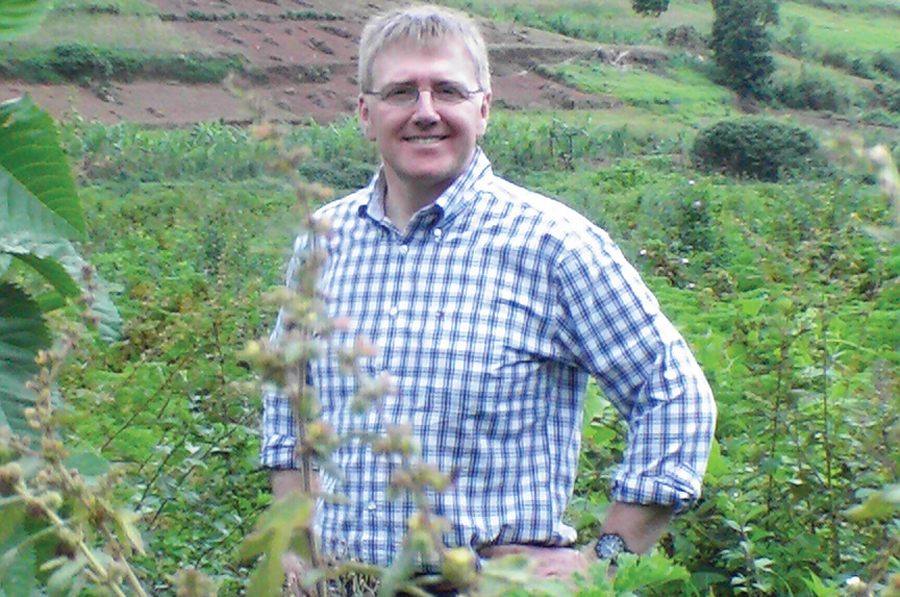
The Future is yours – Paul Polman, CEO of Unilever

Every day, when watching the news, we see pictures of famine and floods, droughts and demonstrations, confronting us with the effects of increasing resource scarcity, climate change, food security, civil unrest and poverty. We see the increasing numbers of people left behind. Many wonder how on earth we are going to address all these challenges. They feel overwhelming and not a little confusing.

We should not lose sight of the fact that there is also plenty of ‘good’ to write home about. We’ve succeeded in nearly halving child mortality rates since 1990, for example, and polio cases have decreased by more than 99 percent since 1988. But this is still a time of volatility, revolution, of uncertainty and ambiguity and increasing complexity.

The challenges are pressing and distressing, and it can be difficult to know where to begin to address them — there are no quick fixes for what ails us. What many people forget is that we have an emerging power to make fundamental shifts in the state of the world – the power of youth. And we also have an evolving and emerging tool called technology.

The masterful 20th century designer Charles Eames once said, “Beyond the age of information is the age of choices.” We’re racing through the information age — more than 95 percent of all information on the planet is now in digital form, and four out of every six people is using the Internet — which means it’s time to use the information we have to make some of the serious choices we need to make about our future on planet earth.

With this as a backdrop, Unilever, in partnership with the Cambridge Programme for Sustainable Leadership and Ashoka Changemakers, has launched a search for practical and tangible innovations created by young people that help make sustainable living commonplace: the Unilever Sustainable Living Entrepreneurs Awards [www.changemakers.com/SustLiving]

I am a firm believer in the power of youth (I have three boys myself, all in their twenties). The youth of today, by the way, are 50% of the population in emerging markets and 100% of its future population. Their imagination, their strength of purpose, their genuine concern are all things that attract me to young entrepreneurs. Yet we don’t always harness that power, and too often we exclude many of the young from the most important issues. We want to change that. I am also a believer in the power of technology.

The change in Egypt two years ago was organised by Facebook, with a running commentary on Twitter and illustrated on Youtube. There are, famously, more mobile phones in India, than toilets. And who better to utilize the power of technology than the youth for whom it is second-nature? And to utilise it to deliver social responsibility, not egocentricity, to the market, and to crowd out profiteering by creating more space for volunteering.

This is why I am optimistic that tackling the world’s pressing challenges is a real possibility. I would even go so far as to say that tackling them is a probability. The technology we now have at our fingertips allows for the spread of good ideas faster than ever before. It allows forward-thinking leaders to scale-up proven solutions to change the way the world does business—it’s not just about reducing negative impacts, but also about making positive contributions.

The young give us hope because young people are certain their best days still lie ahead – which explains why they’re absolutely convinced they can change the world for the better. As their parents, teachers, neighbours and friends, we want nothing more than to leave young people with a world of opportunity, which gives our work meaning. And meaning for us? Responsible, equitable growth that is decoupled from environmental impact and makes a positive contribution to society. This kind of meaning, this mission, will be the new normal in business. It must be.

Sustainability makes good business sense and we’re all on the same team at the end of the day. That’s the truth about the human condition. We have caused, directly and indirectly and over time, a great majority of the challenges our communities struggle with today. It’s up to us to properly address them.

Unilever is working on it, but we won’t succeed alone. If we all act together; business, governments, NGOs and citizens – and especially the young – just imagine the good we could create. We not only need the help the young can give us, but their enthusiasm, ambition, drive and ideas too. Today over half the world’s population is under 30. In some countries the figure is more like two-thirds. This gives me hope.

There is a new, more entrepreneurial spirit among today’s young people. Young people have the opportunity, the responsibility and duty to be that catalysts for change. They all have the potential to be leaders and change-makers. To paraphrase a line by the great British playwright George Bernard Shaw, and made famous by the US politician Robert F. Kennedy:

“Some people see the world as it is and ask: what can I do? Young people see the world as it could be and say: together we can.”

Will you join us?

Paul Polman, CEO Unilever
 

More Than 250,000 women Lean In

Leanin.Org today announced the Lean In community has grown to over 250,000 members with nearly 1 million unique visitors to leanin.org since the organization’s launch in March. Additionally, over 7,000 Lean In Circles – small peer groups focused on empowerment – have registered in all 50 states and at least 50 countries. In a keynote speech in Chicago at BlogHer ’13, the annual women’s blogging conference,

Sheryl Sandberg, author of Lean In: Women, Work, and the Will to Lead and founder of LeanIn.Org, commented on the steps women all over the world are taking to move toward gender equality. “While the number of people joining Lean In has exceeded all of our expectations, it’s the individual stories of people changing their lives that are truly inspiring,” said Sandberg. “From mothers fighting for better teachers for their children to companies hosting meetings to discuss gender biases openly, women and men around the globe are leaning in with gusto.”

Jesse Ellison of New York explained how Lean In gave her the confidence to ask for higher compensation for her work. “I’m a freelance writer, so every dollar counts. But it is nerve-wracking and awkward asking for more money when taking on assignments, and even harder to do it confidently at a time when media companies are struggling. But last month I asked, literally saying in my email, ‘I have to ask. I’m leaning in.’ It worked.”

Lieutenant Colonel Erika Cashin, of Minneapolis, knew men would outnumber her when she joined the Air Force in 1996 but never gave much thought to the lack of support she would encounter. She started a Lean In Circle to mentor other women in the military and provide mutual support on issues they face. “It’s not just about the mentorship we give through telling our stories, but also what we receive from listening to each other’s experiences,” Lt Col Cashin explained. “No matter what age, or stage of life and career, we’re all able to gain insight on something we weren’t aware of or didn’t know. There’s mutual benefit, and the Circle’s an open door to start discussion.”

In addition to a growing community, LeanIn.Org has forged partnerships with over 250 corporations and non-profits. These partners have committed to rolling out Lean In’s education content and Circle programs within their organizations and working toward equality in their leadership ranks.

“We wanted our employees to drive the Lean In movement internally and that’s exactly what they’ve done,” said Melinda Narciso, the director of human resources at Red Ventures, a South Carolina-based direct marketing company.

“The response has been incredible; nearly 200 employees have signed up to participate. Interns, members of the senior leadership team, sales professionals, men and women all stepped up to join a Lean In Circle – the diversity of employees is so rich. Discussions about women in the workplace are long overdue, and we’re so excited Sheryl and her team have given our employees the tools to begin the dialogue.” Over 60,000 people have also viewed the free expert lectures available at leanin.org, on topics ranging from overcoming gender bias to the body language of leadership. 

“I didn’t realize until reading this book and watching [the videos] that saying something like ‘I have no idea how she does it’ is actually rooted in stereotype,” said Johnny Brackett, a Senior Manager for Marketing & Communications at TaskRabbit who viewed the videos with his colleagues. “I would never look at a male COO who’s also a father and comment on how incredible it is that he juggles it all.

Why do I do this with a woman COO?” Sandberg released the latest Lean In numbers on Saturday during her keynote address at BlogHer. Following the address, conference attendees were invited to participate in a workshop to discuss the power of peer mentoring and Lean In Circles.  LeanIn.Org by the numbers:

  • Over 250,000 Lean In community members on Facebook
  • Nearly 1 million visitors to leanin.org
  • Over 7,000 registered Lean In Circles
  • Circles in all 50 states and at least 50 countries
  • Over 250 Lean In corporate and non-profit Partners
  • Over 60,000 views of Lean In’s Expert Lectures  

Lean In Circles in action:

  • Partners such as Tesco, Estee Lauder and American Express are organizing Lean In Circles for their employees.
  • We have heard from military Circles, Circles among college students, and even a father-daughter Circle.
  • In Massachusetts, 40 high school students hosted a Circle slumber party to help reach their goals.
  • In Berlin, over 100 women and men in the startup community have organized Circles to give each other the confidence they need to pursue their entrepreneurial dreams.
  • In Kenya and South Africa, women have formed Circles to encourage each other to reach the C-suite.

 Lean In by the numbers:

  • Over 1 million books sold
  • Currently published in 11 languages and will be published in at least 19 more by the end of 2014


Making Impact Investible

Download this free report by Dr. Maximilian Martin of Impact Economy, Switzerland which aims to strengthen the impact investing industry. A culmination of three years work, the report discusses how all parties involved — from foundations to angel investors to financial service institutions — can contribute to and benefit from the growing impact investing industry.

It includes a series of recommendations to strengthen the industry and highlights the need for increased transparency and better measurement systems. Download the report here: Impact Economy 2013

Financing the 2.6 billion who survive on less than $2 a day

Root Capital confronts global poverty by investing in agricultural businesses that grow long-term rural prosperity for small-scale farmers across Africa and Latin America.

Over the next five years, Root Capital plans to triple the volume of its lending activities to reach 600 businesses, more than 1.7 million small-scale farming households and 10 million people. They will train more than 300 agricultural businesses to enable early-stage businesses to access finance for the very first time and then they’ll stick around to support their subsequent growth.

The typical clients of Root Capital are small and growing businesses (SGBs) that aggregate products from hundreds, and often thousands, of farmers. These agricultural SGBs traditionally connect farmers to markets, pay higher and more stable prices, and enable entire communities to prosper. Yet, despite their enormous potential to drive job creation and economic growth, these rural SGBs are trapped in the gap between microfinance and commercial banks.

Rural businesses that require loans ranging from US$25,000 to US$2 million are too large to access credit from microfinance institutions and are considered too small, risky, and often too remote, to secure financing from commercial banks. Moreover, these SGBs typically lack the financial management capacity needed to access a loan.

Of the 2.6 billion people who survive on less than US$2 per day, 75 percent live deep in the countryside at the end of dirt roads. Too often, they are relegated to a subsistence living that stresses the natural environment and makes it difficult for them to support their families. They typically rely on agriculture as their primary source of income, but are excluded from formal markets and constrained by lack of access to inputs such as seeds and fertilizers, market information, equipment, transportation, and credit.

As a result, they often resort to survival measures, such as illegal logging or slash-and-burn agriculture that degrades the environment, contributing to global warming and generating a cycle of ecological and economic poverty.

Agricultural businesses that aggregate hundreds or even thousands of small-scale farmers can create the economies of scale needed to overcome these barriers and put farmers on the path to long-term prosperity. Such businesses can reduce the vulnerability and anxiety faced by farmers who cannot otherwise count on having a well-paying market for their product.

By linking farmers to formal markets in efficient, stable value chains that pay a higher share of the end price much of this stress is relieved. These businesses can also help them invest in climate-smart practices that increase productivity and their incomes. Overall, the farmer and ecosystem can both become more resilient to climate change.


Three Unconventional Lessons for Business School Students

It’s unusual when a successful entrepreneur opens a presentation to a room full of business school students with a photograph of her twin baby boys. But then Jessica Jackley isn’t a typical entrepreneur. As one of the speakers of a three-year series funded by the Pears Foundation at the Saïd Business School at Oxford, entrepreneur and investor, Jessica Jackley, had a rather unconventional set of recommendations for her audience.

Jackley cofounded Kiva.org, a nonprofit microlending platform that has facilitated nearly $440 million in loans since its inception in 2005. She went on to found ProFounder, a small/medium enteprrises fundraising platform, and is now an advisor to a Silicon Valley venture fund. She offered to her audience three pieces of advice, which she described as “reminders” to her crowd and to herself.

1. Know your mission(s)

During the early days of Kiva, the now-global microlender that Jessica cofounded in 2005, she and her team turned down a $10m offer of funding from a corporate social responsibility office of a large corporation. The funder didn’t want to connect to the borrowers on her platform, cutting against the grain of Kiva’s chief mission, which is to “connect people.”

Had she and Kiva not been crystal clear on their mission and the values from which it grew, turning down such an offer might have been difficult. Business students on the job market should similarly be clear on their mission and be willing to turn down great opportunities in favor of “the path that is true to who you are.”

2. Learn to Listen

Jackley cites as her role model and inspiration as Muhammad Yunus, the Nobel prize-winning economist credited with the creation of microfinance, in which tiny loans are typically provided to groups women with self-created income. “Yunus,” says Jackley, “arrived at his insight by listening intently to others. If we listen closely, we may hear something no one else has heard before.”

3. Iterate

In founding Kiva, Jackley didn’t wait until her product or website were perfect to begin collecting loans from her friends and family to distribute to the entrepreneurs she had met during a 2004 trip to East Africa. Such an approach demands transparency and patient supporters who are comfortable focusing on the “how might we” questions instead of the “but what about” questions.

These “what if” questions are the kinds of questions that Jackley’s twins wake up with every morning. If grownups were to approach the world with the same sense of wonder and opportunity, listen carefully to others and remaining true to who they are, how many more Kivas might we create?

By Mark Clayton Hand  www.markclaytonhand.wordpress.com Saïd Business School, University of Oxford www.sbs.ox.ac.uk


Lessons in Rwanda inspire innovation in Scotland

An encounter with a Rwandan fleeing the genocide in his country began the unlikely business partnership of a Scottish seafood business with a Rwandan farming community.

Dennis Overton’s business, Aquascot, revolves around the farming of fish in the North Atlantic and salmon processing in the Highlands of Scotland.

Nicholas Hitimana was studying a doctorate in agriculture at Edinburgh University and had knowledge of Rwandan oil plant production. The two befriended each other and compared thoughts on their respective agricultural worlds.

Overton at once saw some potential and realized that the farming of fish and the farming of plant oils were not that different. “Farming at sea or on land requires the same management and skills,” says Overton. Ikirezi Natural Products was established as a community-interest company in Rwanda in 2005 and specializes in the growing of oil-bearing plants such as geranium, lemongrass and eucalyptus, all of which have good selling potential on the international market.

The aim of Ikirezi is to become a leading supplier of essential oils and to maximize profits to the small farmers involved in the growing, leading to a transformation of these largely cashless communities. The company mobilizes and trains farmers, mainly widows and orphans, and then buys the harvested material to produce and market the oil. Through four farming associations and cooperatives, over 500 farmers are involved.

“We’re into year six now and almost at net profitability,” says Overton. “Not bad when you consider that we’re doing this in an emerging economy which rates in the bottom 30% on the global economic scale.” His biggest concern is how everyone can work together to save the earth’s biosphere and he considers a reliance on world governments to do this job as shaky at best. And there are plenty of challenges too in engaging a developing economy, as Overton discovered.

“In Rwanda subsistence farming is the norm with low education levels making the communication of farming skills difficult. A key to resolving this was to work with Rwandan locals to implement the training. We needed to grow the business in an inclusive manner while still recognizing the needs of the farmers.”

These needs included the need to eat, so the small farms of between one and two hectares are shared between food and oil crops. Despite these small plots and the diversification of crops, the farmers are earning up to three times more per hectare than if the land was used only for food crops. “Long-term business sustainability and a deeper understanding of true profits are key to this business model,” says Overton.

“These farmers now have more choices. Kids go to school and people are signing up for the government health insurance program for the first time. People are now earning more than the national average of US$270 a year and cash has been introduced into some communities for the first time. It’s amazing to see this happening and how it is changing lives.”

Overton’s scheme has seen the Ikirezi farmers develop a clear competitive advantage over other farmers and become innovators, yet ironically, he has benefitted too. “I’m better at what I do in Scotland because of my work in Africa,” he says.


Shedding iSight on Blindness

The value of intuitive design in products has become increasingly important among developers, from how a vehicle adjusts its seats to how the navigation works on a smartphone. Abhishek Syal of Arise India decided to include blind people in this revolution. Simplicity of design for a mass market is Abhishek Syal’s motto, and in developing a new device for the visually-impaired, which helps them navigate maps unaided, Syal is putting this idea to work.

In addition to keeping the complex workings of his device hidden from the user, he has also explored existing technology and how it can be put to new uses. The result of Syal’s tinkering has produced a remarkably simple, yet effective, device. “I deploy an ordinary webcam as a pointing device, linked to a computer. This is mounted on an ‘exploring’ board, on which a tactile diagram of the geographic area is placed.

This map or diagram has raised objects on it which the visually challenged user can explore and understand without any sighted assistance,” he explains. “While the user explores this diagram with his fingers, the webcam tracks their movement in real-time on the computer screen, with the cursor following the exact screen image of the 3-D diagram in front of the user. Pointing to an object sees it selected on the computer screen and information is spoken through the computers speech software.”

The impact in India is potentially huge, a country with 15 million of the world’s estimated 37 million blind people.

“Imagine a class of 15 students, where the teacher simply goes to every student’s desk, holding his or her hands and explaining the diagram. The  student then goes home, needing only to memorize the positions of the diagram. This is far simpler than many other complex systems that have been developed for the visually-challenged.” Most of these students don’t do science or math after eighth grade because of a lack of adequate tools for understanding the topic. “We want to make basic concepts of trigonometry, geometry and maps understandable. This will help people visualize the world,” says Syal. He realized he was onto a good thing when he saw his device transforming the perception of learning, resulting in a change of  attitude for the better.

Schools for the blind were initially apprehensive about adopting Syal’s approach, citing  fears around ongoing technical support and upgrades. Syal’s solution was to start Arise, a research-oriented non-profit, to develop and deliver these tools, including free support and maintenance. Plans to license the technology to other companies to generate research funding are in the works and Arise hopes to grow the organization into a social enterprise.

A broad thinker, Syal believes that technological advancement will be in three major areas: biotechnology, nanotechnology and energy technology, with disruptive interventions in these sectors resulting in radically changed business models. “It’s already clear what information technology has delivered –  access to information for the world’s citizens and help in bridging the divide between rich and poor.

The poor now have a better chance to understand how the world works and the richer countries have been encouraged to outsource routine tasks,  freeing them to develop ‘thinking economies,’ which capitalize on future trends. Technological advancement in biotech will enable access to healthcare and food security.

In nanotech, access to cheaper luxuries such as automobiles and gadgets and in energy technology, a shift from consumers to ‘prosumers,’” explains Syal. While the world explores these exciting new frontiers, the blind now have a chance to become a part of it.


0