How to Achieve Your “Why” With the S.P.E.A.R. Method

PODCAST PEOPLE: A Summary from the Real Leaders Podcast

Kuda Biza is an entrepreneur, building companies to deliver profit and value while empowering vulnerable people everywhere to become the best versions of themselves. He is also the author of The S.P.E.A.R. Method: 5 Simple Steps to Balanced Success and Fulfillment.

The following is a summary of Episode 158 of the Real Leaders Podcast, a conversation with author and entrepreneur Kuda Biza. Watch, read, or listen to the full conversation below.

The S.P.E.A.R. Method

Kuda shares how his career journey parallels the five steps of the S.P.E.A.R. Method, which offers insights on how to maximize success and impact while attaining personal fulfillment:

Seek Your Why

“The first step is seeking your purpose, seeking your why, your calling in life. Because if you’re living your life, but you’re living someone else’s calling, you’re never going to be fulfilled. The thing that will give you fulfillment is you pursuing your purpose.”

Plan

“We need to demystify the whole notion that plans are static. A lot of people feel that you just create a plan once, and then that’s it. No, plans are actually dynamic. There’s so many ways where you can create a plan, and some people might take the effort in understanding their purpose, but never take that step to actually sit down to say, okay, how am I going to achieve this?”

Listen to Episode 158 on Spotify, Anchor, Crowdcast, and Apple Podcasts

Execute

“Feed your faith and starve your fear. Whenever you embark on accomplishing something big, there is an element of fear that approaches anybody — we’re humans, right? In Africa, we like to say the way to eat an elephant is one bite at a time. So that’s the first key thing about execution: understand the big, hairy, audacious goal, but break it down into small milestones that get you there.”

Achieve

“Sometimes when you set out to achieve something, maybe you’re only going to achieve 20 percent. But does that mean that you give up, or do you continue pushing until you hit 100 percent? Do not be afraid to not only dream big, but to actually take the action to achieve those big dreams.” 

Repeat

“There are three important days in any life. The day you are born, the day you find out why, and each day you act on your why. So just make sure that every single day, you’re taking some action in achieving your why.”


Transcript

The Ultra Runner Bringing Attention to the Global Water Crisis

PODCAST PEOPLE: A Summary from the Real Leaders Podcast

“I knew that this was what I was going to do for the rest of my life. That I was going to dedicate my life to solving our water crisis. And at that point I knew that I would do whatever it takes to make that happen, because I don’t want this future for the next generation.

Mina Guli is a global leader, entrepreneur, water advocate, and ultra runner, dedicated to raising awareness about the global water crisis.  

The following is a summary of Episode 133 of the Real Leaders Podcast, a conversation with water advocate Mina Guli. Read or listen to the full conversation below.

Running for the Goals

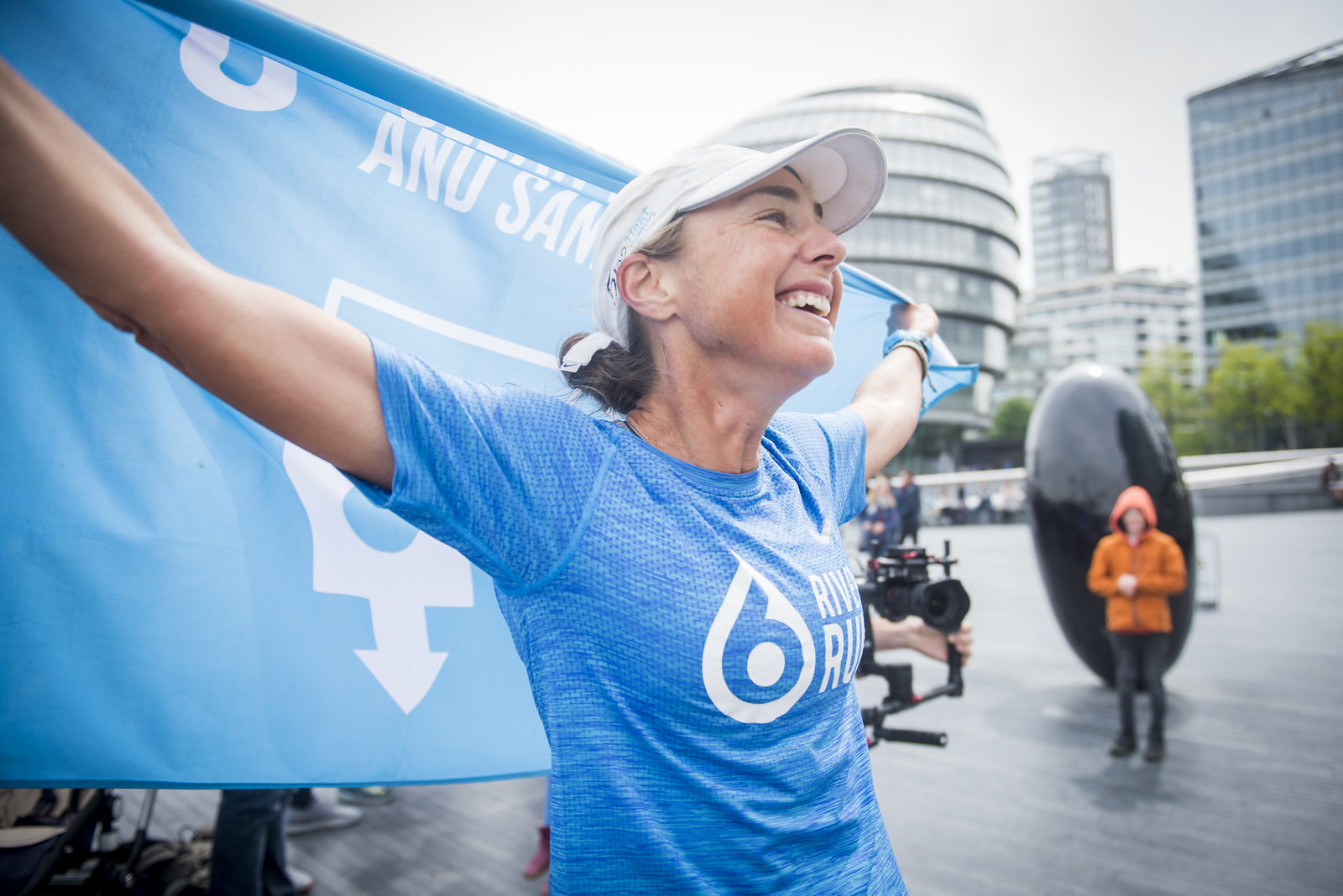
Though she wasn’t a runner to start with, after a life-changing accident decreed she may never be able to run again, Mina decided to prove that she would. She created another opportunity to push herself even further in order to highlight a bigger cause. In 2016, in order to bring attention to the global water crisis, Mina ran 40 marathons across 7 deserts on 7 continents in 7 weeks. Along the way, she interviewed locals and water experts. Her goal was to tell the stories of people affected by the crisis and those working to solve it.

Another of Mina’s running awareness projects was the #RunningDry movement — 100 marathons in 100 days. And another she recently completed was the 6 River Run, along the banks of 6 of the world’s greatest rivers, across 6 continents, in 6 weeks — inspired by the UN’s 6th Sustainable Development Goal, Clean Water & Sanitation.

“It’s so weird for me to be in this situation where running has become what I do. And I did it because we needed to have a way to create a hook for people to pay attention to water. I wanted to show that we had to go outside of our comfort zones to be able to do things that are meaningful. I wanted to show that every one of us is capable of things that we never dreamt of. And I wanted to show you don’t have to be anyone to be someone.”

Listen to Episode 133 on Spotify, Anchor, Crowdcast, and Apple Podcasts

Starting with the Next Generation

Mina emphasizes that water is the biggest risk facing society, and the ramifications of the global water crisis are great cause for concern. By 2030 there’s forecasted to be a 40% gap between the amount of water we need and the amount of water that’s available to use. Motivated by inaction, Mina is dedicating her life to this problem. Her non-profit, Thirst, focuses on raising awareness about the water crisis among the next generation. 

I don’t want the next generation to grow up and have their future limited by their ability to access water, they should only be limited by their ability to dream the dreams that they want to dream.” 

Tapping Into the Creator Mindset

PODCAST PEOPLE: A Summary from the Real Leaders Podcast

“When you think positively it’s almost impossible to have an egotistical thought at the same time. Because the nature of positivity enables you to see the world as it can be, not as it is. And when you can see the world as it can be, not as it is, you tend to do the right thing. You tend to do the better thing.” 

Nir Bashan is a world-renowned creativity expert. He teaches thousands around the globe how to harness the power of creativity to improve profitability and customer service, increase sales, and ultimately create more meaning. He is also the author of The Creator Mindset: 92 Tools to Unlock the Secrets to Innovation, Growth, and Sustainability.

The following is a summary of Episode 170 of the Real Leaders Podcast, a conversation with creativity expert, Nir Bashan. Read or listen to the full conversation below.

Embracing Creativity

“When we’re able to think creatively it’s a euphoric and natural state for us. And we’ve been beaten down and talked out of thinking in a natural state, which is where we operate the best.”

Nir shares that creativity is a fundamental human state — we all learn to draw before we learn to calculate. But many of us have lost touch with this creative aspect. He suggests that tapping into creativity in order to solve problems connects us to who we are. In terms of business, creativity connects us to what we’re doing in a product, service, or career. Nir affirms that embracing the creator mindset has become more essential than ever, because it’s what is needed in times of crisis in order to generate a solution. 

If we embrace creativity, as a people, as a society, we will uplift the standard of living around the world far more dramatically than what we have done now. And the result is just a way better life.”

Listen to Episode 170 on Spotify, Anchor, Crowdcast, and Apple Podcasts

The Power of Positivity

“When you look at things in a positive way and in a creative way, the world is really a limitless environment for you to practice your product or service. When you look at things in a negative way, you’ve limited your options.”

Nir iterates that negativity is something that has become too deeply ingrained in daily life and culture — in fact, most languages have more ways to describe negativity than positivity. Not only is negativity holding us back, it’s limiting our capacity to problem solve — simply shifting to a positive outlook could be the biggest step towards creative solutions.

“Framing a problem in the light of positivity will instantly give you creative solutions, because it taps into that creator mindset that all of us have deep within us and allows you to look at a problem as what it is, rather than adding all the self-doubt. The only thing that allows you to solve problems creatively is to think about a problem positively.”

Transcript

Tapping Into the Creator Mindset

PODCAST PEOPLE: A Summary from the Real Leaders Podcast

“When you think positively it’s almost impossible to have an egotistical thought at the same time. Because the nature of positivity enables you to see the world as it can be, not as it is. And when you can see the world as it can be, not as it is, you tend to do the right thing. You tend to do the better thing.” 

Nir Bashan is a world-renowned creativity expert. He teaches thousands around the globe how to harness the power of creativity to improve profitability and customer service, increase sales, and ultimately create more meaning. He is also the author of The Creator Mindset: 92 Tools to Unlock the Secrets to Innovation, Growth, and Sustainability.

The following is a summary of Episode 170 of the Real Leaders Podcast, a conversation with creativity expert, Nir Bashan. Read or listen to the full conversation below.

Embracing Creativity

“When we’re able to think creatively it’s a euphoric and natural state for us. And we’ve been beaten down and talked out of thinking in a natural state, which is where we operate the best.”

Nir shares that creativity is a fundamental human state — we all learn to draw before we learn to calculate. But many of us have lost touch with this creative aspect. He suggests that tapping into creativity in order to solve problems connects us to who we are. In terms of business, creativity connects us to what we’re doing in a product, service, or career. Nir affirms that embracing the creator mindset has become more essential than ever, because it’s what is needed in times of crisis in order to generate a solution. 

If we embrace creativity, as a people, as a society, we will uplift the standard of living around the world far more dramatically than what we have done now. And the result is just a way better life.”

Listen to Episode 170 on Spotify, Anchor, Crowdcast, and Apple Podcasts

The Power of Positivity

“When you look at things in a positive way and in a creative way, the world is really a limitless environment for you to practice your product or service. When you look at things in a negative way, you’ve limited your options.”

Nir iterates that negativity is something that has become too deeply ingrained in daily life and culture — in fact, most languages have more ways to describe negativity than positivity. Not only is negativity holding us back, it’s limiting our capacity to problem solve — simply shifting to a positive outlook could be the biggest step towards creative solutions.

“Framing a problem in the light of positivity will instantly give you creative solutions, because it taps into that creator mindset that all of us have deep within us and allows you to look at a problem as what it is, rather than adding all the self-doubt. The only thing that allows you to solve problems creatively is to think about a problem positively.”

Transcript

Become One With the Ocean While You Dine

The Lindesnes region in Southern Norway is one of the country’s certified sustainable destinations — awarded to places that are working to reduce the negative impact of tourism.

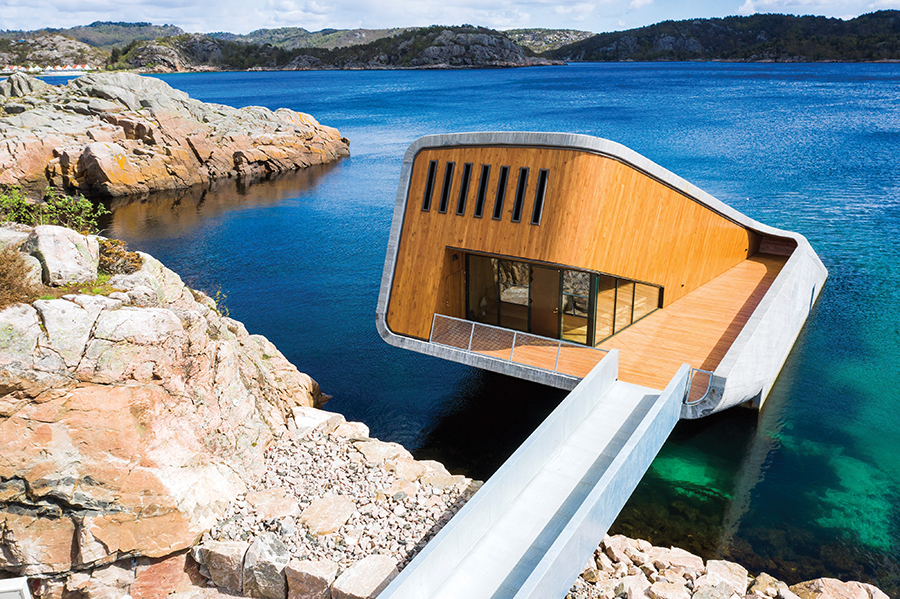
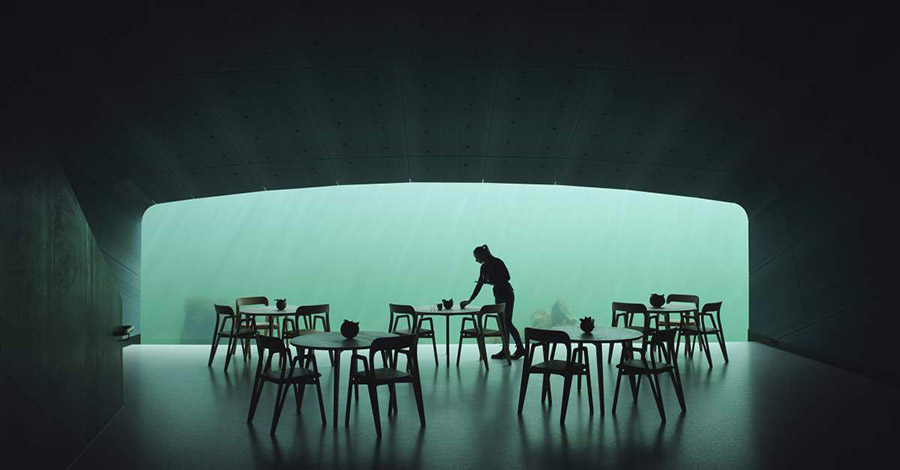
To become certified, a destination must preserve local nature and culture, strengthen social values, demonstrate political commitment, have effective management, and be economically viable. The semi-submerged restaurant Under is 18-feet below the surface of the ocean, exposing you to wonders beneath the sea while dining.

The structure is designed to fully integrate into its marine environment over time, as the roughness of the concrete shell will function as an artificial reef. You’ll need to book early; the restaurant has received more than 10,000 reservations since opening in March 2019.   

Become One With the Ocean While You Dine

The Lindesnes region in Southern Norway is one of the country’s certified sustainable destinations — awarded to places that are working to reduce the negative impact of tourism.

To become certified, a destination must preserve local nature and culture, strengthen social values, demonstrate political commitment, have effective management, and be economically viable. The semi-submerged restaurant Under is 18-feet below the surface of the ocean, exposing you to wonders beneath the sea while dining.

The structure is designed to fully integrate into its marine environment over time, as the roughness of the concrete shell will function as an artificial reef. You’ll need to book early; the restaurant has received more than 10,000 reservations since opening in March 2019.   

The Ocean-saving Art That Lies Beneath

Over the past few decades, we have lost over 40 percent of our natural coral reefs. Dying coral is a result of warming oceans, which in turn affects weather patterns, causing more powerful tropical storms.

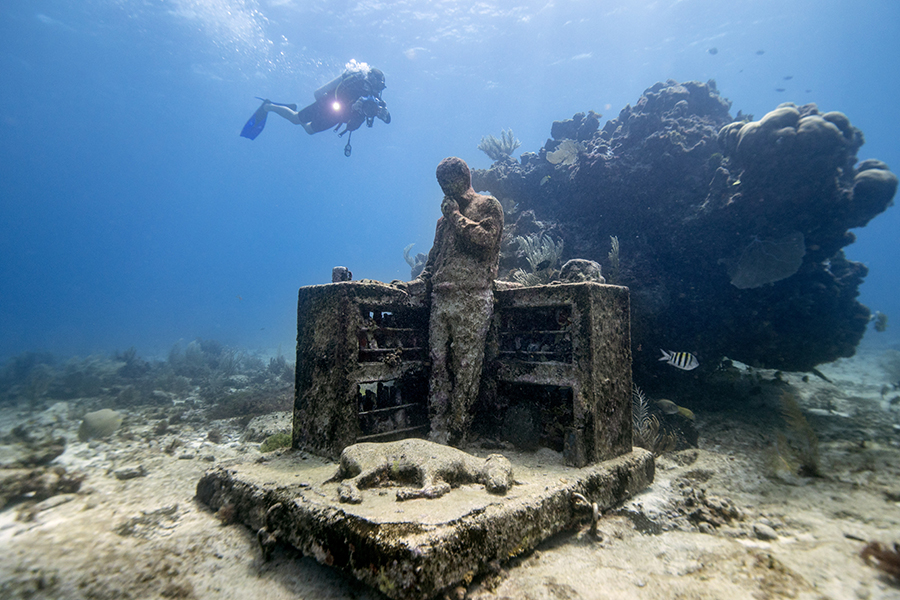
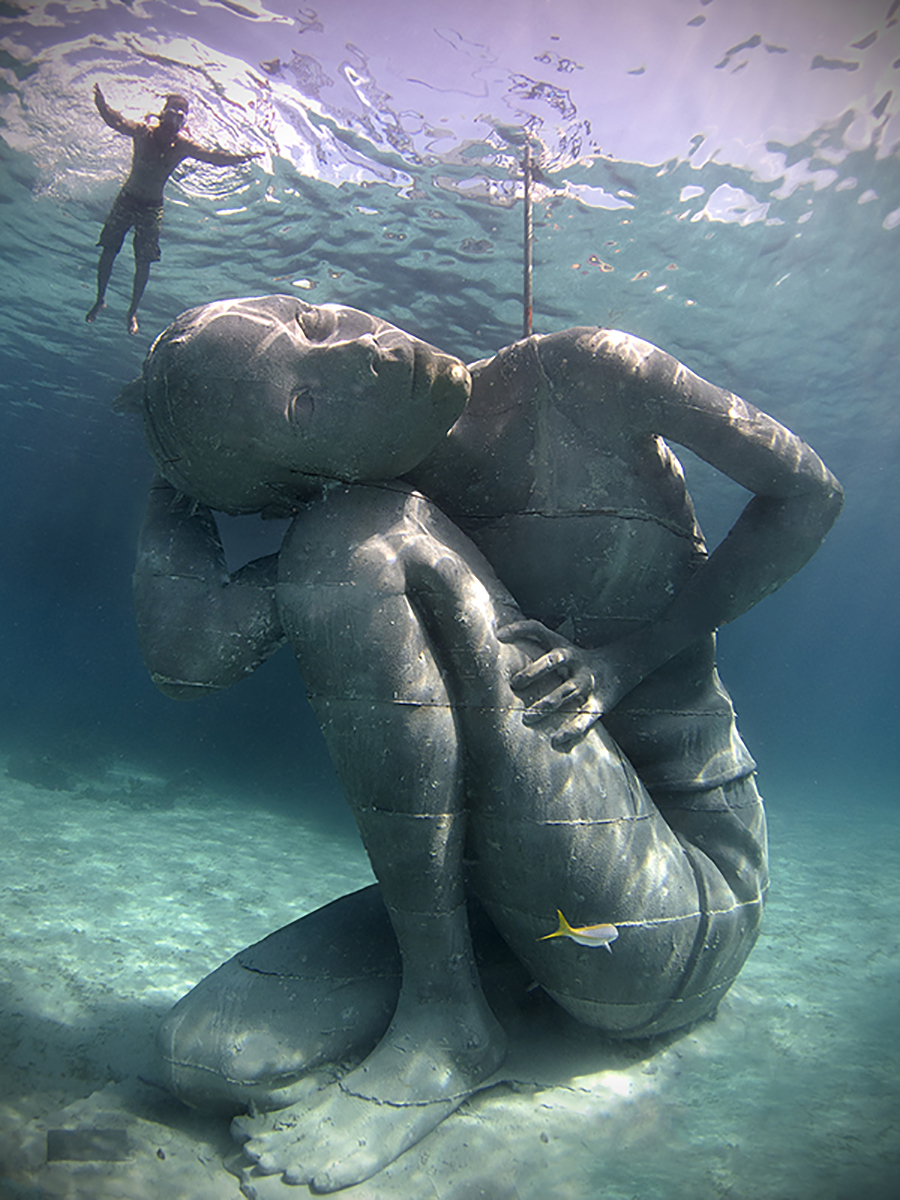
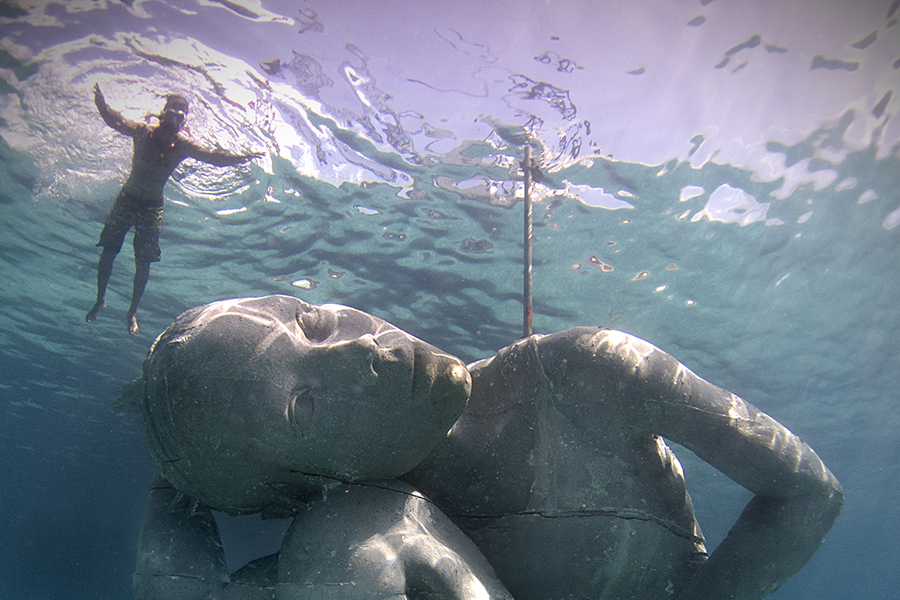
A tropical storm from the Gulf Of Mexico can sometimes reach Kansas, so even Midwest farmers should be concerned about dying coral, thousands of miles away. The World Resources Institute projects that 90 percent of coral reefs will be in danger by 2030, and all of them by 2050. Mexican-based artist Jason deCaires Taylor has created a series of underwater sculpture parks, that are recognized among the top 25 Wonders of the World by National Geographic.

Born in 1974 to an English father and Guyanese mother, Taylor grew up in Europe and Asia, where he spent much of his early childhood exploring the coral reefs of Malaysia. He graduated from the London Institute of Arts in 1998 and went on to become a fully qualified diving instructor and underwater naturalist. 

Taylor’s artworks are essentially artificial reefs, formed of carefully manufactured sculptures installed at various locations around the world. Each sculpture is created using non-toxic, pH-neutral marine-grade cement, free from harmful pollutants, that become an integral part of the local ecosystem. The cement is highly durable, with a rough texture that encourages coral larvae to attach and thrive. 

In this current, heightened atmosphere of global environmental awareness, Taylor’s art maintains aesthetics (in a traditional sense) but also adds a conceptual dimension — aiming to raise awareness around the health of the environment. The  underwater museums allow visitors to broaden their minds and educate themselves on fields outside of their daily lives. Visitors can experience unforgettable images of worlds
beyond their own, in a safe and non-destructive manner.

The Ocean-saving Art That Lies Beneath

Over the past few decades, we have lost over 40 percent of our natural coral reefs. Dying coral is a result of warming oceans, which in turn affects weather patterns, causing more powerful tropical storms.

A tropical storm from the Gulf Of Mexico can sometimes reach Kansas, so even Midwest farmers should be concerned about dying coral, thousands of miles away. The World Resources Institute projects that 90 percent of coral reefs will be in danger by 2030, and all of them by 2050. Mexican-based artist Jason deCaires Taylor has created a series of underwater sculpture parks, that are recognized among the top 25 Wonders of the World by National Geographic.

Born in 1974 to an English father and Guyanese mother, Taylor grew up in Europe and Asia, where he spent much of his early childhood exploring the coral reefs of Malaysia. He graduated from the London Institute of Arts in 1998 and went on to become a fully qualified diving instructor and underwater naturalist. 

Taylor’s artworks are essentially artificial reefs, formed of carefully manufactured sculptures installed at various locations around the world. Each sculpture is created using non-toxic, pH-neutral marine-grade cement, free from harmful pollutants, that become an integral part of the local ecosystem. The cement is highly durable, with a rough texture that encourages coral larvae to attach and thrive. 

In this current, heightened atmosphere of global environmental awareness, Taylor’s art maintains aesthetics (in a traditional sense) but also adds a conceptual dimension — aiming to raise awareness around the health of the environment. The  underwater museums allow visitors to broaden their minds and educate themselves on fields outside of their daily lives. Visitors can experience unforgettable images of worlds
beyond their own, in a safe and non-destructive manner.

Martin Luther King III: “Leadership Starts With You”

The son of Martin Luther King Jr. shares his insights on how your family can grow and sustain a mission-aligned leadership culture that transcends the next generation and beyond.

Martin Luther King III describes what family leadership looks like against a landscape of global problems:

Where to focus family leadership efforts. There are monumental world issues that we should focus on as a society. Climate change is among the most important because if our water and air are polluted, then everything else is for naught. If we don’t find ways to address it, we’re going to all be in trouble.

Second is the eradication of poverty in the world and certainly, within our own nation. Our nation has an inordinate amount of poverty based on the amount of resources that exist here. My parents used to talk about the eradication of poverty, racism, and I’d say violence – although my dad used to call it militarism. Those triple evils are where leadership-oriented families must focus. 

The King family’s leadership focus. Society has embraced a culture of violence. It’s in our cinemas and in the gaming industry targeting our children. It’s in our homes as domestic violence. Leaders have to think about how to create a culture of non-violence because non-violence is sustainable. Our culture cannot sustain itself if we continue to operate this way.

If we can live a day in peace, why can’t we live a week in peace? If we can live a week in peace, why can’t we live a month? If we can live a month, why not a year? And if we can achieve a year, why not a lifetime?

So many people look to the United States for leadership, but we are the most divided we’ve ever been. We can’t focus on one political interest — we have to look at what serves humanity. Leaders need to help communities get above the noise and think at a different level. 

As a family, we are focusing on peace, justice, and equity. While that’s furthering the legacy of my parents, it’s also the legacy of our family in general, and our 11-year-old daughter is working with us on it, too.

Role of individual leadership in moving the needle on world problems. Start by deciding what kind of society you seek for yourself and your family, and then identify where you can make a contribution. Some of us are concerned about the climate, so they should focus there. Some are concerned with police brutality, so they should focus there. Some are concerned with reproductive rights, so they need to engage and get involved there. All of us have a contribution we can make.

Importance of listening to young people. The truth is that young people are leading the rest of us. The Parkland students are a perfect example. They worked very hard to mobilize people around the country so that the needle can move on responsible gun legislation. These young people are totally engaged and leading us. I haven’t seen a movement like that since 1963 when 3,000 kids were arrested
in Birmingham attempting to desegregate the city.

Then we’ve got young people like Greta Thunberg leading us around climate issues. And even younger children like Little Miss Flint leading us around the water crisis in Flint, Michigan.

I go to schools and ask kids what they are worried about. Too often, they say they’re concerned someone will come into their school and shoot them. Think about that: Our children have to practice what to do if someone comes into the classroom shooting at them. Our society has accepted a culture of violence. Instead of focusing on eradicating violence, we are focused on teaching our children how to cope with it.

I’m inspired by children and how easily and naturally they take action. Unfortunately, adults don’t tend to get involved until they are affected by it directly. When there’s a catastrophe, we get engaged. But the kids are showing us that we can get engaged at any time. Adults just have to learn how to disagree without being disagreeable.

On encouraging a culture of leadership within families. I’m always telling my daughter, Yolanda, that she has to be authentic. She’s been around leaders in her family for generations — parents, grandparents, great-grandparents, aunts, and uncles — we’re all involved. But I tell her she has to find her own authenticity. You don’t have to be like us. Be your best self. You’ve got to find your way.

She got a chance to speak at the March for Our Lives, and she went way beyond what I would have said because I am regimented by the laws of our land. At the event, she said she had a vision, her own dream (see sidebar, “Yolanda Renee King: I Have a Dream, Too.”) We did not help her with this speech or give her any guidance. She said, “I know what I want to say.” 

Lessons learned from my daughter. From day one, she’s had an interest in homelessness and poverty. I never pushed her, but I’m thankful she has this interest. Families that lead let their child be who they want to be. And what if your kid is not focused on being their best self? Exposure is everything. Every kid has a gift, and when they find their gift, they are motivated to work on it because it’s what inspires them. 

Yolanda knows what’s happening and why there’s a need to focus on U.S. poverty. If a kid comes to school hungry, they won’t have the energy to do anything. Principals tell me they have many transient students. There are apartments out there where you get your first month’s rent free, so after that, they move. They are constantly moving because they can’t afford to stay, and the kids never get a chance to adjust. Many in our society are completely unaware that these kinds of things are going on. How do we inspire kids to be leaders until we fix these problems?

Some time ago, I visited a school in Sudan. The school was in a tent — in fact, the whole place was a tent village. Our sponsor provided us with a shiny black Mercedes to drive out there. We got out of the car, and the kids started running out and pointing at the car and then running back in and bringing out more children and pointing at the car. And I thought, “Wow, materialism has even made it out here to these kids in Sudan.” But then I realized that the car was so shiny they could see themselves reflected on it. They had never seen a mirror before and were seeing images of themselves for the first time.

You may think you know what’s going on, but it’s all a matter of perspective. American kids often don’t realize how bad other kids have it. Exposure helps them realize, and then from that comes the desire to help others. Parents want to protect their children’s innocence, and that is preeminent. But we still need to let them grow up. Leadership-oriented families expose their kids to things so the kids can embrace the problems and become part of the solution.

Hardest thing about living a consistent life of  leadership. Most challenging is staying authentic in a nation where everything is quickly changing. You have to maintain your values and not let society change who you are and who your family is. But you do have to compromise to stay relevant.

We are focused on creating partnerships to align people and families who can help us with what we want to achieve. That’s what it’s going to take. No one person, no one organization can do all this work. It’s going to take a collective.

That’s what leadership is about — building this collective of collaborators. My dad would have called it creating the beloved community. And that’s what my wife and I, and even Yolanda, are focused on right now: creating these collaborations to continue the legacy and unfinished work of my parents.

IvyConnect

Ranking: 118

Industry: Networking

Mission: An online social university for entrepreneurs, creatives, and innovative professionals who are passionate about making a lasting positive impact. Members learn how to best lead their teams, scale their organizations, navigate global trends, and bolster their personal well-being. Their community stretches across 50 global cities, with 10,000 hand-selected members in each location.

Back to the full list

0