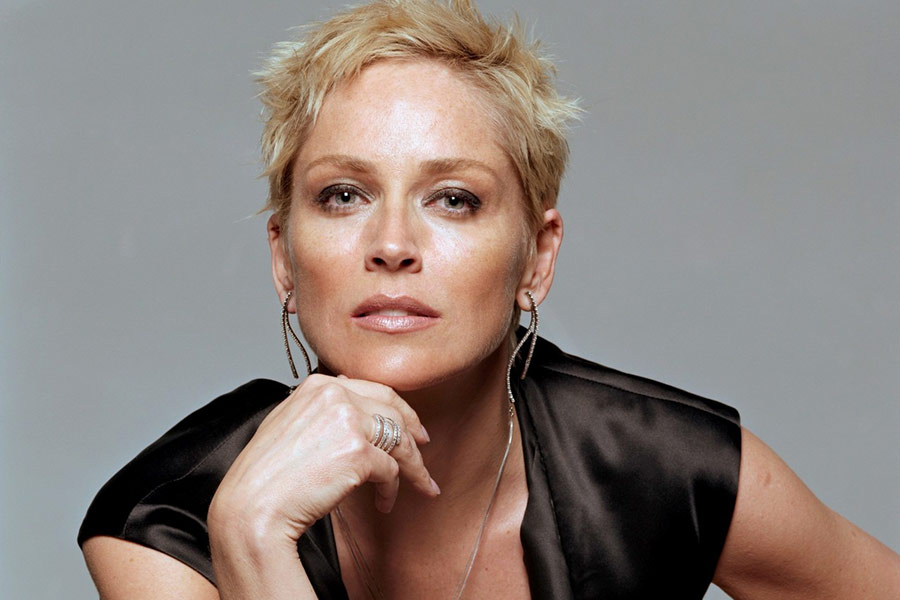
莎朗·斯通:变化不是损失,这是增益

  • 濒死体验提出的生命转化为莎朗·斯通的观点。她还击,并决定对世界的积极变化。
  • 目的有电源,而她相信每个人都可以使一个巨大的差异。
  • 和平是一些普通人会给我们,不穿西装的男人。
  • 我们今天看到的迁移危机无异于200年前,美国移民不同。

莎朗·斯通已经抵达米兰举办和平颁奖典礼。保镖和着迷客人成群结队环绕,组织者很难推回摄影师谁都是喊激增。“沙龙!沙龙!”,企图获得屡获殊荣的女演员的最佳击球。虽然每个人都认为她已被选为主办PILOSIO建设和平奖,因为她已经建立了一个闷热的职业生涯看起来 – 始终保证吸引观众 – 这个故事告诉她今天晚上是远离好莱坞精英的glamourized生活。一个故事,甚至可能是值得电影本身的。

死亡有将东西放入角度对许多人的奇特功效。有些人会忍受千钧一发后仍然受到创伤,而其他人将反弹比以前强。石属于后者。各地死亡两个显着的事件塑造了她的生活。第一次是在20年前,当她的邻居,伊丽莎白格拉泽,从输血得了艾滋病。二是更加个性化-幸存中风和大规模脑溢血。你以为在场景本能,由一个连环杀手在一个黑暗的地下室被猎杀,是可怕的?

如果你喜欢这个,订阅这里更多的故事,启迪未来。

斯通的脑溢血离开她没有短期记忆,无力无口吃说话,在她左腿的感觉,她的右耳听力损失的损失。她不能走在第一,它花了两年时间再次阅读。这是她职业生涯的结束,而是一些更深刻的开始 – 一个愿望,回馈世界,并帮助别人生存。

我已经在床上躺了一年左右,”斯通说。“当我蹒跚学步的儿子进了卧室,推过壁炉的工具,说:‘没有更多的妈妈!’ 这是我的大觉醒。我意识到,他需要他的母亲和他需要我去战斗更难。我做了“。

虽然最终失去儿子的监护权她的前夫,斯通继续采取两个儿子,并逐步回去工作。格拉泽在1994年去世,和石头已经倾注了她的时间与伊丽莎白格拉泽儿童艾滋病基金会和美国艾滋病研究基金会的工作。刚刚走出医疗照顾自己的,石使这个工作她的主要目的。

当被记者最近问她是否对艾滋病防治工作只是另一个宣传噱头,寻求关注,石回答说,“好了,20岁会是一个很长的宣传噱头。”

“目的有电,”斯通说:“我相信,每个人都可以使一个巨大的差异。有不有效果没有好的目的。如果你问宇宙是你最好的朋友,宇宙并不很难得到发挥,”她说。她回忆说,趴在神经重症监护2周911与人死亡围着她在病房后。在电视上,她看到飞机撞击世贸中心和世界各地展开后续的混乱。“我看着危机危机之后,但我的生活,”她说。“我没想到我以任何方式特别特别的,但我做出目的的承诺。”

该承诺的一部分已经共同举办诺贝尔和平奖音乐会,并帮助推动中东与诺贝尔和平奖获得者佩雷斯和平。她被授予和平峰会奖,2013年她与艾滋病毒/艾滋病患者的工作。“我相信,和平是知识产权,而不是一些无定形的概念,”她解释说。“和平不会从与红色领带在壁炉前聊天蓝色西装两个人来的。和平是一些普通人都会给我们。和平是我们创造的东西; 这是一个动作。”

斯通的行为都提出了数百万美元用于在全球各地的原因。她不避讳折他人精心策划会议到个人平台筹集资金。期间在达沃斯世界经济论坛非洲贫穷2005年面板,瑞士,她即席筹款蚊帐预防疟疾募集$ 1百万。今年上述PILOSIO建设和平奖在九月,石头突然从她在舞台上的讨论离开来挑战观众建立与她的学校在非洲。不到五分钟,她成功地说服了一群商人建立的28所学校。

由于是好莱坞女星,你成为一个全球公民。拍摄世界各地,成为一个全球性的图标给你独特的见解世界如何运作。

石已经被她的多元文化背景下是如何从各地的移民和难民当前的辩论没有不同的击打。

“当我们看到数百万流离失所者从叙利亚和中东地区转移到欧洲的一刻,是我们作为感谢我们自己的民族主义,因为我们可以吗?”她问。“我是美国的一个伟大的爱国者和热爱我的祖国,但我的家族传承是爱尔兰,斯堪的纳维亚和法国。我极其感激所有从我的遗产起源的国家。我们都是世界公民,我们每一个人。”

石奇观,她将是今天,如果历史已经不同了近200年前,判断她的祖先。“在19世纪40年代的爱尔兰饥荒,如果我的祖先被剥夺通道到美国,我就不会在这里今天我也不会提出数亿美元,以帮助阻止艾滋病危机,”她说。“到今天走转的人,在类似迁移的时间,就是否定我们自己的遗产。”

斯通喜欢在关于因果报应,宇宙命运的慷慨神秘的短语说话。这是由她自己的濒死体验,她设法存活并继续创造机会,并希望数百万的事实成型的世界观。对于我们这些谁包庇,我们应该与我们的生活做更多琐碎的感情,她有一些建议。“正如我们真的不希望参与,我们保持我们的生活和经历之外,因为他们太难受了所有的事情,他们将不可避免地最终在自己的后院。”最好的,我们都去找这些问题和处理这些问题,才找到我们。

如果你喜欢这个,订阅这里更多的故事,启迪未来。

Cecil the lion: Becoming One With Nature Doesn’t Mean Becoming An Animal Yourself

Dear Trophy Hunters,

It was with great shock last week that we were subjected to yet another photograph of smiling, grown men with their arms around each other, kneeling besides a dead lion that had been propped up for the camera. It’s a common photograph, that hunters worldwide will recognize – after all, what’s the use of killing something when you can’t show a matching trophy photo to your friends back home. ISIS in Iraq and Syria have a similar strategy.

Let’s get an obvious fact out of the way first – animals die each day. Most are killed for food, others as part of a controlled conservation cull and yet others for humane reasons. Complaining about trophy hunting and getting outraged is not about some hippy, green, pacifist, vegetarian, tree-hugging agenda. It’s about a lack of respect. A lack of respect for where the world is heading right now. Everywhere we turn, we’re being told by the media to conserve water, conserve endangered species, conserve energy, conserve trees and conserve the oceans. Then we’re expected to look at majestic, beautiful African creatures covered in blood, with grinning killers standing over them, and nod approvingly?

Yes, I know Alex the lion from Madagascar is not real, and that Disney has made us believe that we can walk up to a lion and cuddle it. The outrage is less about being an ignorant city-dweller and more about the wrong message we are giving to future generations.

The message of trophy hunting is the complete opposite to the principles of caring, conservation and heritage that many organizations are working so hard to install in our kids. The world has moved on from hunters, who are not hungry, who kill wildlife because a trophy photo and stuffed head give a pump-up-my-ego moment. Trophy hunting needs to be phased out to make way for alternatives – much like the replacement of fossil fuels and CO2 emissions. “But what alternatives are there?” wail the hunters. We’ll, there are startups around the world investing millions of dollars to find new solutions to old problems. Why not join the 21st century and think like them? It might even cost you less than the $50,000 you paid for the lion hunt. 

Ultimately, trophy hunting in Africa is an ethical issue. Many wealthy Western hunters arrive in Africa  thinking that the rules are somehow “different” in Africa than from home. Maybe it’s all the misguided advertising they see, of savage beasts that will awaken their primal instincts in an untamed land. Maybe they entertain fantasies of heroism from having seen old paintings that show brave colonialists standing their ground, rifle at the ready, while a tooth-and-claw ball of fury bears down upon them. The truth is usually less glamorous: a lion that has been bred in captivity since birth is shooed out of an enclosure for the first time to get shot. You might as well have stalked and killed a kitten. Trying to prove your virility and strength by killing wildlife is very 1980s anyway. We have Viagra for that now.

Last week Arnold Schwarzenegger posted an image of himself in his heyday on Instagram with two of his bodybuilding trophies, juxtaposed with a picture of a lion. “These are trophy. This is not,” he said, referring to the lion. Sharon Osbourne tweeted about dentist, Walter Palmer, who shot Cecil the lion, “…When he dies, I hope someone mounts his ugly ass head to the wall. #WalterPalmer is a COWARD.” The truth is, public opinion is against trophy hunting, and whether you like it or not, millions of people can now sway public opinion against you very quickly on social media. Consider too, that since last week, Delta, United and American Airlines have banned the shipment of game trophies on their flights. Who would have guessed that a single, dead lion in Africa could change the policies of multinational corporations?

Before assuming that the lawlessness in many parts of Africa means that you can do what you want, consider that trophy hunting is increasingly being seen alongside other pastimes that are frowned upon. It’s no longer excusable to go to Thailand for underage sex because, “that’s what they do there.” It’s not excusable to underpay foreign workers in Saudi Arabia because, “that’s what they do there.” It’s not cool to buy products from China made from endangered wildlife species because, “that’s what they do there.” It’s also not cool to pose with a dead lion in Africa because, “that’s what they do there.” Trying to get away with your dirty habits abroad, that are outlawed at home, is just pirate tourism. It’s time to take personal responsibility for some of the world’s pressing issues and realize when you’re part of the problem and not the solution.

Arguing that only old lions, who will die anyway, are used in trophy hunting is a lie. What hunter wants to tell his mates that he walked alongside a hobbling lion with arthritis for 20 minutes before shooting it and then hanging its mangy head with missing teeth above his home bar? That would look cowardly. Hunting, conservation and trophy hunting are three different things, with trophy hunting the rotten apple among the three. Trophy hunting has become an artificially inflated industry (yes, a business!) that exists solely to enrich a few. The conservation of biodiversity has taken a back seat to the quick profits that a few high-yielding animals can offer.

Subsequently, as the outrage on social media keeps on growing, we’ve had a few other hunters pop up on our Twitter and Facebook radar. One of them is Sabrina Corgatelli, the “Italian Huntress” from Idaho, who has wondered what all the fuss is about and continues to post pictures of herself online with dead trophies. One of them show her standing proudly alongside a dead giraffe that she’s just shot. On NBC’s Today Show she defended the hunt of this large, gangly beast by saying giraffes are “very dangerous animals” that could “hurt you seriously very quickly.” I guess if you’re taunting a wild animal in it’s own territory with a Savage MK II hunting rifle (yes, even the guns have appropriate names) then you should defend yourself by any means. Just don’t post it on Facebook.


Kids Are Best Suited To Power Because They Never Seek It

  • Marc Dullaert, a successful businessman from Europe, witnesses a death in Africa and decides that he can no longer be a spectator to the world’s suffering.
  • Moved by a 14-year-old’s campaign to stop child labor, he wonders why a child cannot win the Nobel Peace Prize.
  •  A meeting with Mikhail Gorbachev results in the establishment of a peace price for children.
  • Children make up half the world’s population, yet are seen as second class citizens. Dullaert has shown how winners of the Children’s Peace Prize can influence key adult change makers and global institutions of influence.

One morning on the border of Sierra Leone I was woken by an awful sound. It sounded like an animal in distress. I stepped outside and saw a mother from a nearby refugee camp holding her child that had passed away. I was filming documentaries for my television production company and our vehicle had broken down the day before, resulting in us sleeping on the passenger seats. It was an incident that was to change my life forever. Seeing that mother holding her dead child was like being struck by lightning and I knew that I had to do something. I phoned my wife as soon as I got a signal, she designed a logo and I came up with a name: KidsRights. We started with a small project to benefit Aids orphans in South Africa and then steadily added more. It resulted in me selling my business, a large production company that produced shows for 12 European countries, to enable me to focus entirely on building KidsRights.

In 2004 the Children’s Peace Prize was born. I watched the announcement of the new Nobel Peace Prize winner on the evening news one evening and shortly afterwards a documentary on an 11-year-old boy called Iqbal Masih from Pakistan. Masih had organised a protest rally with thousands of children to protest against working conditions within the tapestry industry, basically children working in sweat shops. I was so impressed that I asked myself, “Why can’t a child win the Nobel Peace Prize?” 

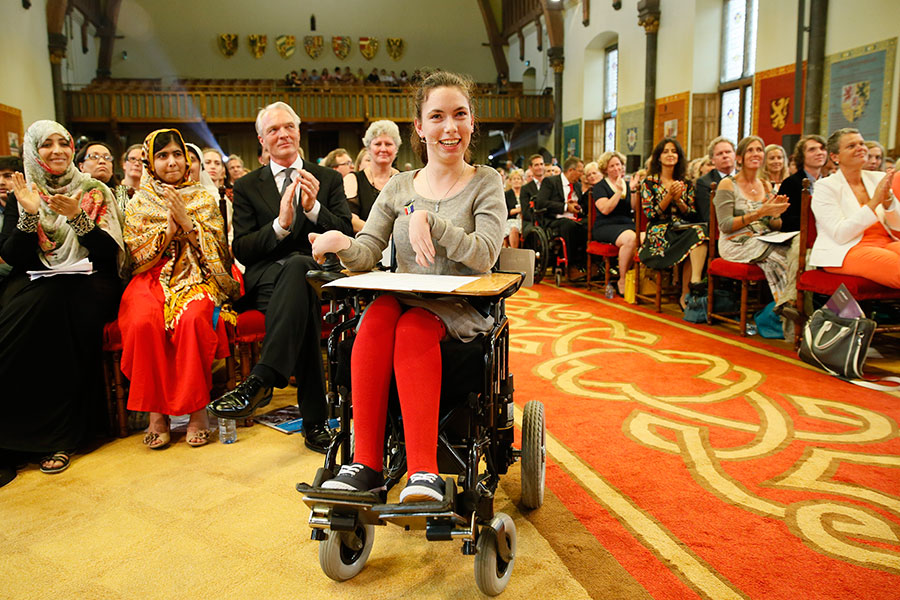
Chaeli Mycroft of South Africa won for her work to establish rights for children with disabilities.

Chaeli Mycroft of South Africa won for her work to establish rights for children with disabilities. Behind her is fellow winner Malala Yousafzai.


I made contact with the Oslo Nobel Peace Prize Committee, who were very kind but said, “Sorry Mr. Dullaert our statutes are more than 100 years old and we will not change them. The Nobel Peace Prize is not for children.”

Then I heard about the yearly gathering of Nobel Peace Prize winners, chaired by the former president of the USSR, Mikhail Gorbachev. I managed to secure a ten-minute meeting and met him at the Gorbachev Foundation offices in Moscow.

I tried to explain to him my idea of an international children’s peace prize, but despite being friendly, he didn’t speak English and the translator wasn’t helping much either. Gorbachev sat looking at me unblinking. I was getting nowhere. Suddenly, in desperation, I asked, “Mr. Gorbachev, do you have grandchildren and do you think you could learn something from them?” It was an icebreaker. He suddenly became emotional and started talking about his daughter and grandchildren. After my short interview, I was sent outside to wait for his answer – 45 minutes in a cold corridor, like a punished school child. I was eventually summoned back into his office and Gorbachev said, “Yes, let’s do this.”

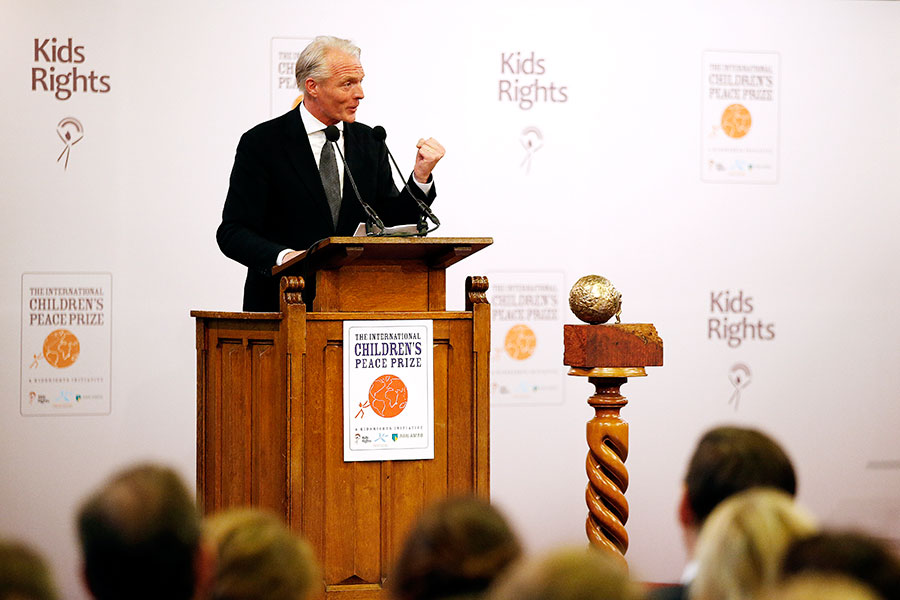
Marc Dullaert founded the first international peace prize for children.

Marc Dullaert founded the first international peace prize for children.


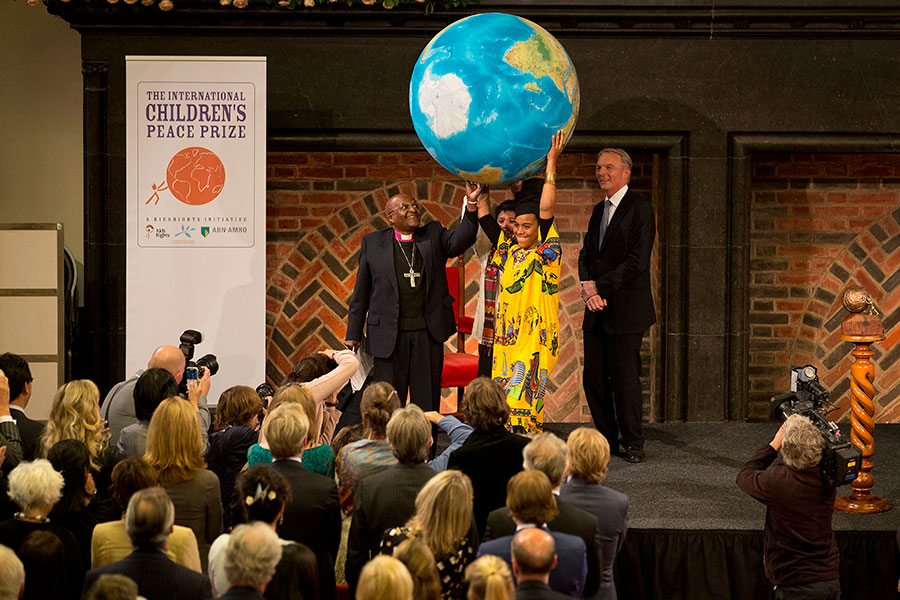
The first International Children’s Peace Prize was launched at the 2005 peace summit in Rome and the first winner was South African Nkosi Johnson for his fight for the rights of children with HIV/AIDS. It was awarded to him posthumously as he had died of HIV/AIDS himself four years earlier at the age of 12. Ten years later, we now reach more than 1 billion people around the world when we acknowledge a child with a peace prize. The statuette they receive literally depicts a child moving the world because I strongly believe that children can be change makers. Sure, children are vulnerable, but they also harbor enormous strengths.

bono kids rights

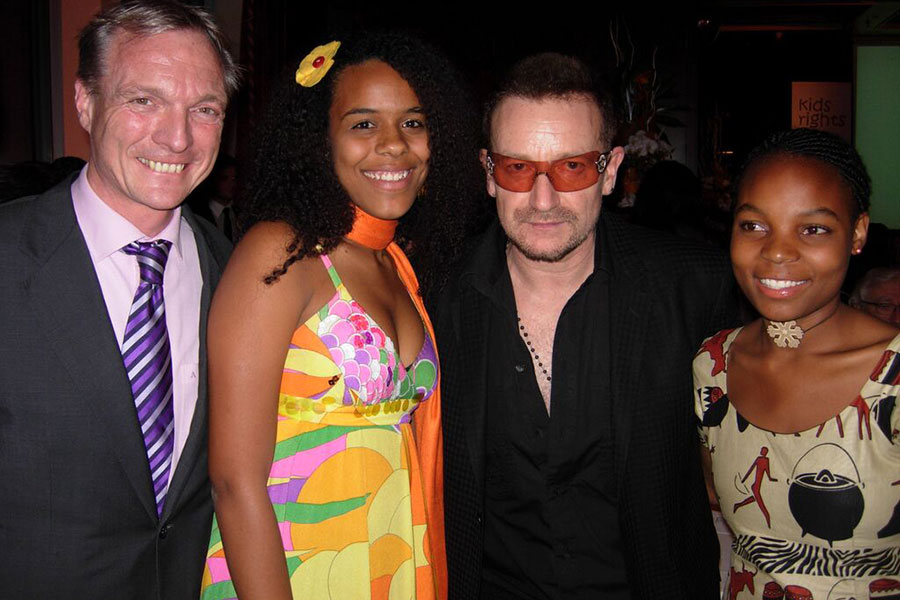
Winner Mayra Avellar Neves of Brazil, with founder Marc Dullaert (left) and Bono.


The Children’s Peace Prize provides a platform for children to voice their opinions and to inspire other children to bring about change. It can generate enormous impact. For example, Om Prakash Gurjar won his peace prize for freeing 500 children from slavery in India. He appeared on BBC news and when Gordon Brown, then U.K. minister of finance, visited India shortly after he requested a meeting. He was so impressed with Gurjar that he gave the Indian government £200 million to start eradicating child slavery and illiteracy. This demonstrates the power of a 14-year-old. After awarding the peace prize each year we can see the positive effects rippling out – it’s like throwing a stone into water.

However, exposure can also have a downside. In 2011 we got a handwritten letter from a schoolteacher in Pakistan, telling us about the remarkable story of a girl called Malala Yousafzai. She had stubbornly refused to stop her schooling, and despite being threatened by the Taliban, had continued advocating for girls education in a very public and courageous way. We wanted to award Malala the Children’s Peace Prize but were concerned for her safety, so we decided to nominate her instead – giving the prize that year to Chaeli Mycroft, a girl with a disability from South Africa.

The president of Pakistan was disappointed and he announced a few days later a National Peace Prize for Pakistan. It was awarded to Malala and she was thrust into the international limelight. The Taliban shot her a few months later. We could never have imagined that nominating her for a peace prize would trigger these series of events. The irony is that this tragic event led to her getting even wider exposure. She received the International Children’s Peace Prize in 2013 after all, and one year later received the renowned Nobel Peace Prize.

children-peace kids rights

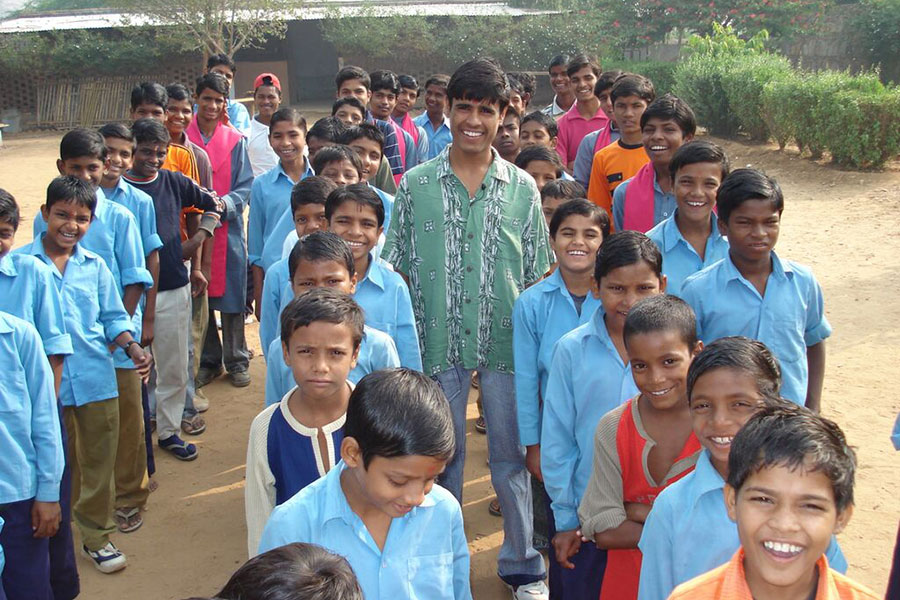
Om Prakash won the peace prize for combating child labor and liberating child slaves in India.


What’s become clear is that children who win the peace prize can positively influence key adult change-makers. In 2007, The Elders was formed – a group of international leaders working together for peace and human rights. We decided to create the youth equivalent – The Youngsters. One of our winners, Thandiwe Chama has addressed the United Nations on the upcoming Sustainable Development Goals. Baruani Ndume from Tanzania, has addressed world leaders on what it’s like to be a child refugee and victim of war. Our winners have become ambassadors for good.

fw-de-klerk kids rights

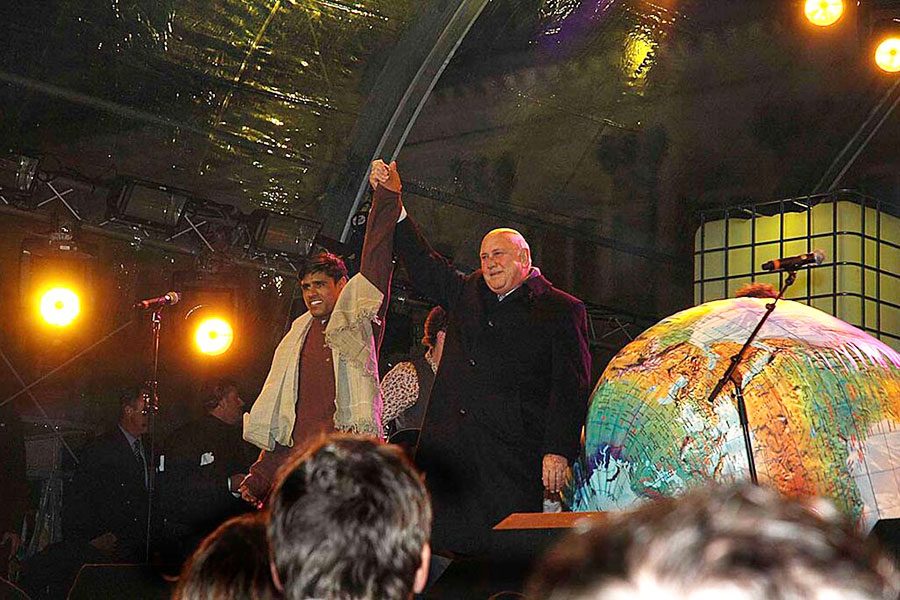
Om Prakash receives his International Children’s Peace Prize from Nobel Peace Laureate FW de Klerk.


Children make up more than half the world’s population and are citizens of countries, despite being treated like second-class citizens. Many leaders and politicians pay lip service to children and jump at opportunities to have pictures taken with them, but they don’t take the time to listen to them. I’m not saying that young people know more than adults, just that they have a different view of the world. The least we can do is consult them when making laws or policies that directly affect them. One of my biggest eye-openers has been to see this happening more in Asia and Africa than in Europe – where it’s still very difficult to find real participation by children.

But, while children are capable of tackling tough social challenges and showing adults new ways of seeing the world, we still need to nurture an important ingredient of childhood – love. At one of our projects in India I once spoke to a boy who’d been freed from slavery. The kids were given a daily cooked meal and I said he must be very happy with that. He looked at me and said: “Of course I’m happy with one warm meal, but it’s more important to know that somebody cares for me.”

World’s First Black Woman President: Weapons Don’t Kill, People do

  • Raised in one of the most troubled countries in Africa a woman rises to become the world’s first black woman president at age 67.
  • Personal struggles helped shape her attitude to war and violence, that she used to build a country torn apart by civil war.
  • An understanding of history and gender discrimination taught her that women must not be held back and insists they form part of any conflict resolution process.
  • In accepting a Nobel Peace Prize she emphasizes that weapons cannot kill by themselves – people do.

Born into poverty in Africa, getting married at 17 to an abusive husband, facing discrimination as a woman, imprisoned and being forced into exile, separated from your children – these things would test the will of the toughest leader. Yet this is what happened to Ellen Johnson Sirleaf, and despite insurmountable odds, she is now the world’s first elected black female president and Africa’s first elected female head of state. Elected in 2006, Sirleaf brought stability to Liberia, a volatile country that had seen two civil wars over a period of fourteen years. As if that wasn’t enough, she also added a Nobel Peace Prize to her long list of accolades in 2011.

Her popular title of the “Iron Lady” of Africa is a pleasant irony as her Nobel Peace Prize was awarded for her non-violent struggle to ensure the safety of women and for insisting that women have full participation in the peace-building process. Sirleaf shared her Nobel Prize with fellow Liberian Leymah Gbowee and Tawakkul Karman of Yemen for realising the great potential for democracy and peace that women can bring. War may traditionally be men’s work, but Sirleaf insists that women have a say in cleaning up the mess and ensuring that it won’t happen again. Her fight against corruption and violence could also be the reason she was voted back as president for a second term in 2011 and why the IMF and donor countries agreed to write off $4.6 billion of Liberia’s debt, based on her sound economic policies, freeing up funds to build new infrastructure.

Sirleaf was born with Americo-Liberian roots and German ancestry and she has qualifications and work experience from American institutions the World Bank, Citibank and the UN Development Programme. Her diverse cultural identity, exposure to global economic infrastructure and big picture thinking have all resulted in a leader who understands that diversity can actually keep things together, rather than tear things apart.

Sirleaf describes Liberia as, “A wonderful, beautiful, mixed-up country struggling to find itself.” The complications stretch back to 1847 when Liberia declared itself a nation, created by freed American slaves shipped back to Africa. They retained the cultures and traditions of the American South and even created a flag that mimics closely the American flag. “The settlers of modern-day Liberia decided they would plant their feet in Africa but keep their faces turned squarely toward the United States,” says Sirleaf. “This would trigger a profound alienation that led to a deeply cleaved society, and ultimately set the stage for the terror and bloodshed to come.”

The 1989-1996 Liberian civil war, one of Africa’s bloodiest, claimed the lives of more than 200,000 Liberians and further displaced a million others into refugee camps in neighboring countries. Entire villages were emptied as people fled. Child soldiers committed atrocities, raping and murdering people of all ages, including their parents. The war claimed the lives of one out of every 17 people in the country.

The seeds of the conflict can be traced back to leaders who either identified themselves with an Americo-Liberian identity or with ethnic, tribal sentiments. It’s a stark reminder of how political decisions and discrimination from generations ago can suddenly appear to haunt future generations at any time. 

One hundred and fifty eight years later it took a single woman to heal the wounds. Sirleaf refused to accept the limitations of her nation, or her gender, and refused to give up her beliefs despite being jailed and threatened by brutal dictators. She worked for, and ruffled the feathers, of every president she worked for in Liberia over a span of nearly 40 years, until she herself at age 67 became the first woman to be elected president of an African nation.

From left: Yemeni activist Tawakkul Karman, Liberian 'peace warrior' Leymah Gbowee and Liberian President Ellen Johnson Sirleaf jointly won the 2011 Nobel Peace Prize.

From left: Yemeni activist Tawakkul Karman, Liberian ‘peace warrior’ Leymah Gbowee and Liberian President Ellen Johnson Sirleaf jointly won the 2011 Nobel Peace Prize.


Many people are unaware that Alfred Nobel, after which the Peace Prize is named, was the inventor of dynamite. He was inspired to leaving his vast fortune to the prize that bears his name after a newspaper incorrectly reported his death with the headline: “Dr. Alfred Nobel, who became rich by finding ways to kill more people faster than ever before, died yesterday.” It was actually Nobel’s brother that had died, but from that moment he decided his legacy was going to be about peace and human advancement. Sirleaf accepted her Nobel Peace Prize by recounting this story and adding,” Alfred Nobel’s dynamite did not kill people. People kill people, whether it’s with a knife, machete, handgun, rifle, machine gun or explosive device packed with dynamite.”

She is also dismissive of those that assume military weapons are the only devices on which war can be blamed. “We must not forget that some of the most heinous crimes in war have been committed without explosives. Too often brute force has sufficed,” she says. “Rape remains one of the tested and most enduring weapons of war. But there have always been other men, and perhaps even more women, who have committed themselves to the cause of peace,” Sirleaf explains. “These are the people Alfred Nobel wanted to celebrate and have others emulate.”

In her inaugural speech Sirleaf said: “Our recent history teaches us that violence diminishes our nation and ourselves, not just within our borders, but more importantly in our dealings with other nations and people.” Conflict is never confined to a geographical area, especially in the age of globalization, and Sirleaf knows that a true leader sees themselves as a global citizen with a responsibility beyond their own citizens.

Sirleaf’s presidency firmly establishes the importance of women leaders on the world stage and her unique position as a woman with both African and Western roots – genealogically, geographically, and intellectually – signals a new kind of 21st century leadership that has broken gender stereotypes and challenged the idea that historical animosities cannot be healed.

She has also stressed that the tolerance of other viewpoints is crucial for the creation of peace, even when people disagree strongly with those around them. “Our shared values are more important than our individual interests,” she says, explaining how the bigger picture should always be kept in mind before pulling a trigger.

The Dalai Lama: The Spiritual CEO Of Happiness Says He Might be Back As A Woman


  • A global leader with billions of admirers has a simple message for the planet: be more compassionate.
  • The Dalai Lama considers himself an “engaged” Buddhist and is not shy of commenting on serious social problems, or that he might be reincarnated as a woman.
  • Call it Karma, destiny or just plain bad luck, most people have a sense that if they harm or destroy something it will rebound on them someday.
  • Isolation, exile and rejection are not necessarily a bad thing. If your message is pure people will know it and you’ll become more powerful than if you’d turned to violent means to achieve your goal.
  • The Dalai Lama says we are all selfish, but should be wise-selfish instead of foolish-selfish.
  • Times have changed and he believes that religious leaders, with their ability to take a long view on humanity, should participate in discussions of global business and economics.

Being ordained as a global leader of significance at age five with followers that number six percent of the world’s population, being made leader of a country at age 15 and being awarded a Nobel Peace Prize must make you an extraordinary leader with some pretty awesome powers, right? Yet, the 14th Dalai Lama, Tenzin Gyatso, has become an enduring symbol of human rights and peace by focusing on a simple concept throughout the 79 years of his life: compassion and non-violence. It doesn’t sound very proactive, but his outlook has struck a cord with more than 350 million Buddhists around the globe and endeared himself to billions more, regardless of their faith or worldview. He meets people from all walks of life who ask themselves the same question: “Can his message of peace and compassion be that simple?”

dalai-lama-3

The Dalai Lama could easily have rested on his reincarnated laurels and lived a life of relative privilege and fame, inherited from his predecessor, the 13th Dalai Lama, Thubten Gyatso. Instead, he has become a spiritual leader like no other, with a keen interest in the link between science and religion, and become outspoken on issues such as the environment, women’s rights, astronomy, physics and reproductive health. He is highly intelligent, determined and has a great sense of humor – all the great qualities of a spiritual leader. Or a good CEO.

He’s even written a book around the art of making business decisions, The Leaders Way, published in 2009. In it, he explains that every decision-making process should have values instilled in them. He calls these values dependent origination, interdependence and impermanence. Put another way, the intention behind every business decision must be beneficial to the greatest number of people. They must also be aware that nothing is permanent and that things change constantly. The Dalai Lama reckons a smart person will adapt and respond to changes in the world, in both their personal life and within the marketplace.

dalai-lama-4

Change has certainly been a feature of the Dalai Lama’s life, despite wearing the same outfit for almost eight decades and repeating the same mantra of compassion again and again.

Forced into exile from his Tibetan homeland by China in 1959, the Dalai Lama has travelled the world ever since, spreading a message that highlights the importance of compassion as the source of a happy life. It’s not an easy job. Many of the institutions that host him face pressure from China not to accept him. China refuses to acknowledge Tibet as an autonomous region, insisting instead that it forms part of the People’s Republic of China. The dispute has been at the heart of the Dalai Lama’s rejection and global wandering for the past 55 years, but which ironically has worked in his favor. He joins the ranks of other legendary leaders such as Nelson Mandela and Aung San Suu Kyi, both of whom experienced rejection, isolation and exile – which only made them stronger – resulting in their cause spreading to many more millions than if they had not been persecuted.

dalai-lama-2

The Dalai Lama considers himself an “engaged” Buddhist and does not shy away from controversy. He has even supported the possibility that his next incarnation might be a woman, or that he might not be back at all! His succession strategy is open to change, something a good CEO understands necessary for long-term sustainability.

He was awarded the Nobel Peace Prize in 1989 for his willingness to compromise and seek reconciliation with the Chinese, despite brutal violations and harassment. The Nobel Committee based its decision on the fact that he had a philosophy that showed reverence for all living things and that there existed a universal responsibility that embraced both man and nature. Call it Karma, destiny or just plain bad luck, most people have a sense that if they harm or destroy something it will rebound on them some day. The Dalai Lama has confirmed this small voice of conscience within all of us by stressing that we need to be more actively aware of our actions.

“Times have changed, and I believe that leaders of religious traditions – with their ability to take a long view of the human condition – should participate in discussions of global business and economics. Our world faces very serious problems, such as the negative impact of our ever-increasing population and the affect that rising standards of living are having on the environment,” says the Dalai Lama. “We are all selfish, but we should be wise-selfish instead of foolish-selfish.”

dalai-lama-prince-charles

The Dalai Lama’s leadership style might be based on a passive view of the world but he wants us to realize that expressing empathy and compassion in business is not a roadblock. As a global citizen who is not held back by any single organization, he is uniquely positioned to speak about the biggest problems we face as a planet. He is focused on what is good for humanity, and while many of us may put his advice into a box labeled “spirituality,” his insights can teach us that broadening our vision, and our limits, can be good for business too. He embraces new ideas and gets information from every level of society, allowing him to formulate opinions and solutions that help him understand situations in a very profound way. Imagine the business opportunities that might flow from thinking this way?

Compassion towards others builds trust and loyalty, something many good leaders strive for among employees, customers and even competitors. The seeds of the Dalai Lama’s compassion came from his mother, whom he still remembers carrying him around as a baby while working in the fields. “I never saw her with an angry face,” he recalls. “How is it that seven billion people on this planet also come from their mothers womb, received affection and drank their mother’s milk but never developed this same inner value?” It’s a question he leaves with each one of us to solve.

What do you think about the Dalai Lama saying that he might be reincarnated as a women one day, or maybe not at all? Comment below.

Nelson Mandela and Graça Machel: Building Love, Breaking Barriers

Nelson Mandela left us in 2013, but his wife, Graça Machel, remains an endearing symbol of his generous spirit and leadership. She’s still hard at work in Africa, promoting a vision she shared with Mandela – that we can achieve anything when we work collectively rather than individually. Graça Machel has played an historic role in two African nations, Mozambique and South Africa. After her marriage to former Mozambique president Samora Machel ended after a fatal plane crash in 1986 she married again in 1998. This time, to an iconic figure who possesed the same values and visionary leadership that she held dear – Nelson Mandela. An historic situation arose that made her the first woman in history to have been the First Lady of two different countries.

In true generous spirit, Mandela gave the world a gift on his 89th birthday when he announced the formation of The Elders – a group that includes Kofi Annan, Jimmy Carter, Desmond Tutu and nine other notable individuals.

In true generous spirit, Mandela gave the world a gift on his 89th birthday when he announced the formation of The Elders – a group that includes Kofi Annan, Jimmy Carter, Desmond Tutu and nine other notable individuals. The Elders work globally and describe themselves as “independent global leaders working together for peace and human rights.” The goal Mandela set for The Elders was to use their almost 1,000 years of collective experience to work on solutions for seemingly insurmountable problems, such as climate change, HIV/AIDS and poverty, as well as to use their political independence to help resolve some of the world’s most intractable conflicts. Machel has led The Elders’ work on child marriage, and was the founder of Girls Not Brides: The Global Partnership to End Child Marriage.

Not satisfied with settling on the title First Lady, Machel embarked on humanitarian work that took calculated risks to achieve results. She has challenged the staus quo business-as-usual mentality on many occassions while striving to deliver results for women and children. Mandela had always liked strong women and might be considered the ultimate male feminist. For him, democracy and gender equality were not separate issues.

His relationship with Machel created a formidable team that worked together on a global scale for the greater good, despite the onset of old age when many of their peers would have been seeking a more sedentary lifestyle. There was great respect and affection between them. Hillary Clinton recalled her fondest memory of the couple when she last saw them together: “What I like to remember is the way Madiba’s face would light up when he saw Graça come into a room or even heard her voice,” she says. “I think it is fair to say that Madiba had very good judgment and in Graça he found a partner worthy of his own incomparable soul.”

It was also a relationship forged on shared values and struggles. When Machel lost her first husband, Madiba wrote to her offering condolences and she replied, “From within your vast prison you have brought a ray of light into my hour of darkness.” A schoolteacher turned freedom fighter, she served as Mozambique’s Minister of Education for nearly 15 years. Under Machel’s leadership, primary school enrolment increased from only 40 percent in 1975 to more than 90 percent of boys and 70 percent of girls by 1989.

Under Machel’s leadership, primary school enrolment increased from only 40 percent in 1975 to more than 90 percent of boys and 70 percent of girls by 1989.

At the height of the recent financial crisis, she listened to talk of restructuring the financial system and analyzing what had gone wrong. She called a group of young people in the financial sector and said, “Look, moments of crisis are moments of opportunity.” From that sentiment, Machel started a powerful network of African women in finance that has already held three summits attended by ministers of finance, along with the CEOs of the largest financial banks and institutions on the continent. “We now have huge support from the African Development Bank and we engage with women in financial institutions who need to be encouraged to take up leadership positions,” says Machel.

“One of the things we’ve succeeded in doing with this network is creating new faces and voices within the financial sector; not only in Africa but within global institutions too. We’re not just trying to change the financial landscape but also to influence the thinking within financial institutions that will bring about more opportunities for women.” Many organizations talk about how critical health and education are for women, but access to credit, and being able to start and grow a business, is at the core of whether or not women and girls will have economic opportunities. It’s an area that is increasingly being recognized as critical to the development of emerging economies. Machel’s work with The Elders on child marriage and her studies on children in conflict may be highly  symbolic, but have an important role to play in changing a world where women and children are increasingly the victims of conflict – more than at any time in history.

“The Elders work with countries in conflict in a very subtle way,” says Machel.

“The Elders work with countries in conflict in a very subtle way,” says Machel. “We encourage people in an informal setting to look into each other’s minds and recognize that they belong to the same nation.” The issue of child marriage is a slightly more challenging one, ingrained, as it often is, among cultural and religious beliefs. Machel believes there are situations that allow much to be achieved in this area, but that you need to be strategic. Simple finger wagging won’t work.

“I like to use the phrase ‘sowing the seeds of social change’,” says Machel. “You need to give people incentives.” Rather than moral lectures, Machel believes that by presenting the economic benefits against child marriage, she will have a greater effect. “We talk about the importance of education and keeping children in school until they complete at least secondary level,” she says. “This is an age when you’re old enough to make a decision on whether you want to get married, to whom and whether you want to have a child. No child of 10 or 14 years old has a body that is ready for marriage and because they are then expected to have children themselves, we highlight the relationship between child marriage and maternal mortality and child mortality,” says Machel.

These facts help people see for themselves the economic short-sightedness of risking the lives of family members for social norms, rather than ensuring their longevity and reaping long-term benefits. “We need to change mindsets and allow the child to grow and have opportunities,” says Machel. “It’s a long and difficult process and we work with community and religious leaders. Organized religion in Africa has a huge network and through these institutions, we work to protect children from marriage.

We are building a new generation of women and also changing the mindset of people – that if a child is born a girl, she has the same rights as a boy.”

“Sport Has The Power to Change The World” – Nelson Mandela

A unique collaboration between luxury brands and the world’s greatest sporting legends has helped young people around the world overcome challenging social issues such as poverty, homelessness, war, violence, drug abuse, discrimination and AIDS.

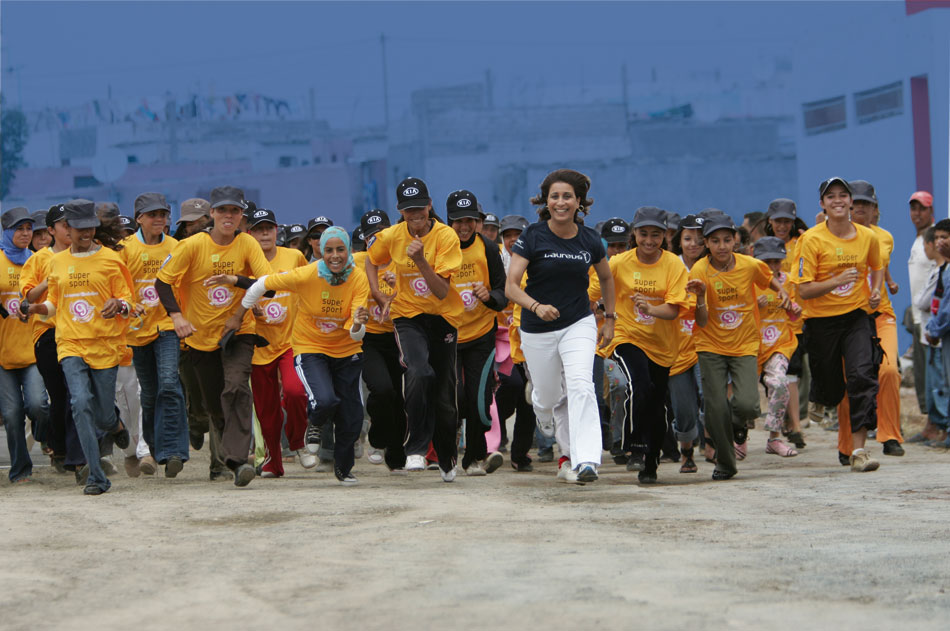
As Michael Johnson settled into the starting blocks at the Atlanta Olympics in 1996 to set a new world record for the 200 meters, he could never have imagined jogging playfully alongside kids in Kenya a few years later, helping raise self-esteem among young people in one of Africa’s largest slums. When Nawal El Moutawakel crossed the finish line at the 1984 Los Angeles Games and became the first Moroccan, African and Muslim woman to win an Olympic gold medal, she had no idea that she’d one day be leading 30,000 Muslim girls on an annual 10 km fun run around Casablanca, and pioneering sport among women in Moroccan society.

Britain’s greatest ever Paralympic athlete, Tani Grey-Thompson, six-time winner of the London Wheelchair marathon, despite a debilitating back disease that’s confined her to a wheelchair, could never have guessed that she’d find herself in the West Bank in Gaza one day, inspiring Israeli and Palestinian kids to work together through a basketball match. Johnson, El Moutawakel and Grey-Thompson form part of a unique association of 46 of the world’s greatest living sporting legends, The Laureus Academy, that embraces the principle of using sport to help bring positive change to disempowered communities.

They offer their time to support the work of the Laureus Foundation, by visiting over 140 projects around the world, all utilizing sport to turn kids away from the negative influences in society, and helping them realize their true potential. Other sporting greats who have aligned themselves with the Laureus include, Boris Becker, Jack Nicklaus, Hugo Porta, Kapil Dev, Sebastian Coe, Monica Seles, Tony Hawk and Dan Marino.
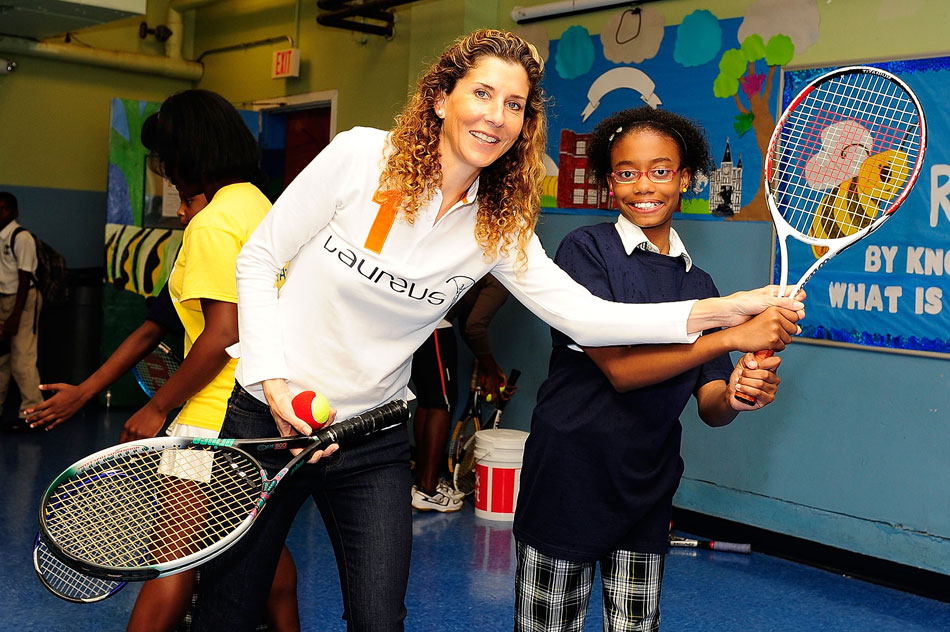
seles

This grassroots, life-changing work, is offset by a glittering sports awards ceremony, held each year in a different city, that sees the Academy members mingle with top sportspeople, presidents and royalty, to recognize sporting excellence. Commonly referred to as the “Oscars of sport,” the award ceremony was conceived as a way of bringing together the biggest names in sport and raising awareness around sport as a catalyst for change.

While big sporting celebrities walk away with solid gold and silver trophies produced by Cartier, after acceptance speeches for categories such as Breakthrough of The Year and Spirit of Sport Award, they are typically found a few months later in the slums of India or surveying the aftermath of a Tsunami in Indonesia, offering their expertise to rebuild communities. Significant global brands have come onboard as sponsors to ensure the work is maintained, and in return, their brand travels the world and associates itself with top sports personalities and events.

One of the global partners, luxury Swiss watch manufacturer IWC Schaffhausen, has even developed a special, limited edition watch for the benefit of the foundation, featuring the engraved artwork of a winner from one of the global Laureus projects. CEO of IWC Schaffhausen, Georges Kern, who has personally driven the Swiss watch manufacturer’s social responsibility program, says: “The privileged people on this planet – and we are among them – must do something to help those who are socially, physically or economically disadvantaged.

Through sport, Laureus gives people fresh hope and promotes social skills such as respect for opponents, recognition of rules, fair play and teamwork.” Other sponsors and patrons, such as Mercedes-Benz, Richemont, Daimler and the cities that play host to the yearly awards, benefit from huge global exposure by participating in A-list events and through their association with household names in sport.
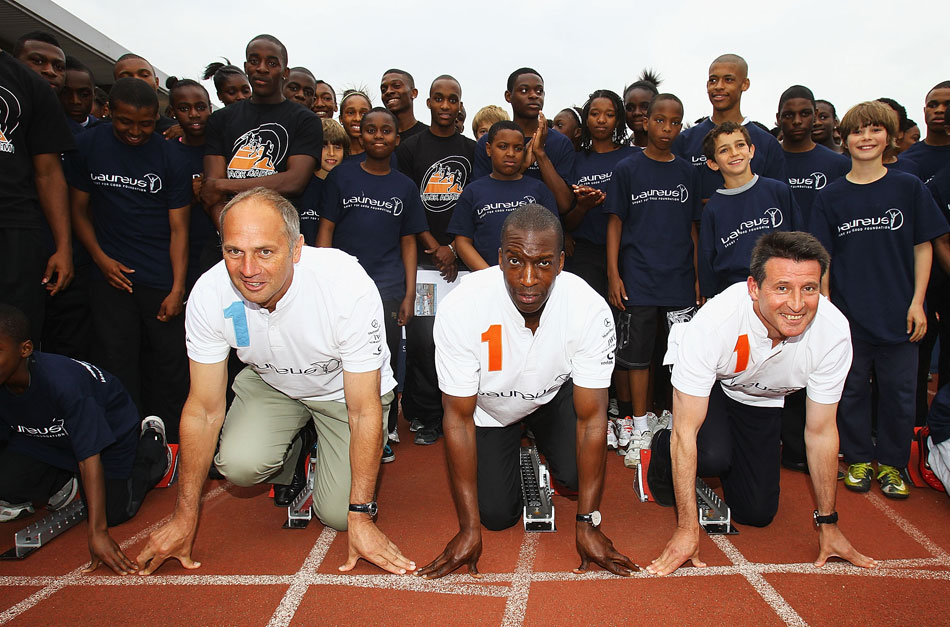
laureus2

From a logo on a T-shirt in Africa to major television coverage at a Formula One event, sponsors are perfectly positioned to do well by doing good. “Politicians love movie stars, and movie stars love sportspeople,” says Edwin Moses, Chairman of the Laureus World Sports Academy. “We’re at the top of the influence chain, and because our physical skills are not easily replicated, we command huge respect and can influence lives.”

Tennis legend Martina Navratilova, an active Academy member, has seen the benefits of this unique business model firsthand: “We have raised over $100 million since 2001 and now there are over 120 projects globally. Over 1.5 million kids have been helped in a positive way,” she says.

The Laureus story is a heady mix of corporate sponsorship, celebrity sport and the will to succeed in some of the most devastated and impoverished parts of the planet. Projects have saved kids from gangs in Sao Paulo, reformed child soldiers in Sierra Leone, given hope to special needs kids in Shanghai and helped clear mines in Cambodia. It embodies something every sportsperson who has ever achieved greatness can attest to – that winning comes through a combination of self discipline and teamwork – mirroring the same qualities needed to win in life. It was the lack of a formal platform to honor this greatness that sparked the idea for Laureus in the first place. The year 2000 dawned with a mixture of hope and expectation as the world prepared for the new Millennium.

The United Nations declared 2000 to be the International Year for the Culture of Peace, and global warming was something most people were hardly aware of. Indeed, Al Gore was a US Presidential candidate that year, and had yet to move on to become the maker of the award-winning ecological wake-up film An Inconvenient Truth. As ever, sport was full of promise. The Millennium Olympic Games were just around the corner in Sydney, and indeed proved to be one of the most successful ever. And something else significant was stirring: an idea which was to prove radical and innovative, and, once it became reality, a beacon of hope for disadvantaged young people.

The seed of the idea that grew to become Laureus was first planted several years before the Millennium by Johann Rupert, Executive Chairman of luxury goods company Richemont. A noted sports enthusiast, Rupert was at a dinner with friends one evening and mused over the fact that there was no Nobel Prize or Oscars-style awards for sport.

Rupert’s views on the power of sport were fundamentally influenced by the crucial role that the 1995 Rugby World Cup played in the reconciliation of the different communities in South Africa, and in 1998 he found a kindred spirit in Dieter Zetsche, Chairman of German automotive giant Daimler, like Richemont, another blue chip company with a long commitment to sport. Two years later, the Laureus World Sports Academy was created, with 30 of the greatest living sports legends named as founder members.

On May 25, 2000, the majority of the Academy members gathered in Monaco for the very first Laureus World Sports Awards. It was an impressive collection of sporting legends, but it is fair to say that the biggest name was a huge surprise all round, as the door to the Academy meeting room opened and in walked President Nelson Mandela. It was in Monaco that Mandela, who was to become the Patron of Laureus, made the visionary speech which has become the philosophy of Laureus and the driving force that has shaped its work for the last 13 years.

His speech has become the dictum not only for Laureus, but for the whole sport for good movement. He said: “Sport has the power to change the world. It has the power to inspire. It has the power to unite people in a way that little else does. It speaks to youth in a language they understand. Sport can create hope, where once there was only despair. It is more powerful than governments in breaking down racial barriers.

It laughs in the face of all types of discrimination.” With much conflict in the world based on ignorance or fear of other cultures, breaking down this discrimination could be seen as a crucial part of creating prosperity for future generations. Perhaps the power of sport can best be illustrated by an encounter Rupert once had with a friend of his.

“Some 30 years ago, while living in New York City, I had a black friend who was a true sports superstar,” says Rupert. “He was constantly mobbed for autographs. I noticed that he took extra care giving signed posters to white kids. I asked him about the apparent favoritism. His answer: “Johann, if a white kid has my poster in his bedroom, he can hardly discriminate against the black kid in his class.”

 

The Oprah Effect

Born into poverty in rural Mississippi to a teenage, single mother, Oprah Winfrey went on to become the first black woman billionaire in history. Arguably the world’s most powerful woman, she has overcome her adversities to become a benefactor to others. Now she’s producing movies.

In August this year The Hundred-Foot Journey produced by Steven Spielberg, Oprah Winfrey and Juliet Blake will hit our screens. Based on a novel by  Richard C. Morais, it explores the rivalry between an Indian and French restaurant, located one hundred feet apart. The plot might be one that Oprah typically explores on her shows: a clash of values and cultures, misunderstandings and strife, that resolves itself into a warm and passionate feel-good, where everyone wins.

The appeal of the storyline might be one reason Winfrey is helping produce this movie, but her association with Spielberg goes back to 1985 when she starred in The Color Purple as distraught housewife Sofia. The film went on to become a Broadway musical, with Winfrey credited as a producer too. In October 1998, she also produced and starred in the film Beloved, where to prepare for her role as Sethe, the protagonist and former slave, Winfrey experienced a 24-hour simulation of the experience of slavery,  including being tied up and blindfolded and left alone in the woods.

During filming, co-actor Thandie Newton described Winfrey as, “A very strong technical actress; because she’s so smart. She’s acute. She’s got a mind like a razor blade.” Winfrey has become an icon of compassion and empathy around the world, discovering early in her career that it had marketing potential. She was born into poverty in rural Mississippi, to a teenage, single mother, and later raised in an inner-city Milwaukee neighborhood. She experienced considerable hardship during her childhood, saying she was raped at age nine and became pregnant at 14; her son died in infancy.

Sent to live in Tennessee, Winfrey landed a job in radio while still in high school and began co-anchoring the local evening news at the age of 19. Her emotional ad-lib delivery eventually got her transferred to the daytime-talk-show arena, and after boosting a third-rated local Chicago talk show to first place, she launched her own production company, becoming internationally syndicated. Credited with creating a more intimate, confessional form of media communication, she is thought to have popularized and revolutionized the tabloid talk show genre, which a Yale study says broke 20th-century taboos, and allowed previously disenfranchised people to enter the mainstream.

By the mid-1990s, she had reinvented her show with a focus on literature, self-improvement and spirituality, and in 1986 The Oprah Winfrey Show began broadcasting across the United States. Time magazine wrote at the time: “Few people would have bet on Oprah Winfrey’s swift rise, to host the most popular talk show on TV.

In a field dominated by white males, she is a black female, and of ample bulk. What she lacks in journalistic toughness, she makes up for in plainspoken curiosity, robust humor and, above all, empathy.” In the mid-1990s, Winfrey adopted a less tabloid-oriented format, hosting shows on broader topics such as heart disease, geopolitics, spirituality and meditation, interviewing celebrities on social issues they were directly involved with, such as cancer, charity work, or substance abuse. Winfrey became the first black person to rank among the 50 most generous Americans and by 2012 she had given away about US$400 million to educational causes, including more than 400 scholarships to a college in Atlanta.

The following year, U.S. President Barack Obama awarded her the Presidential Medal of Freedom. In 1998, Winfrey created Oprah’s Angel Network, a charity that supported charitable projects and provided grants to nonprofit organizations around the world. The network raised more than US$80 million, with Winfrey personally covering all administrative costs so that 100 percent of all funds raised went to the charity programs.

Winfrey created the Oprah Winfrey Leadership Academy for Girls in South Africa in 2007, investing US$40 million in establishing the academy. A 21-day trip to the country, visiting schools and orphanages in poverty-stricken areas, struck a chord with Winfrey, who later described having maternal feelings toward the girls; perhaps wanting them to avoid the pitfalls of her own early years. She keeps in touch with them by teaching a class via satellite.

Nelson Mandela praised Winfrey for overcoming her own disadvantaged youth to become a benefactor for others, while others considered the school elitist and unnecessarily luxurious. Winfrey rejected these claims, saying: “If you are surrounded by beautiful things and wonderful teachers who inspire you, that beauty brings out the beauty in you.”

Now worth close to US$3 billion, according to Forbes, and the first black woman billionaire in world history, Winfrey is the richest self-made woman in North America. Yet, despite her fabulous wealth she continues to permeate world culture and help shape our lives in meaningful ways.

Royal Dutch Shell Endorses Shareholder Resolution on Climate Change

Supermajor’s Support for Resolution Co-Filed by As You Sow Sends Signal to Policymakers: It’s Time for Global Accord On Climate.

The Royal Dutch Shell Board of Directors has endorsed a shareholder resolution requiring the company to commit to reduce emissions and invest in renewable energy, to do away with bonus systems that promote climate harming activities, and to stress test its business model against the two degrees Celsius warming limit adopted by 141 governments in the UN’s Copenhagen Accord.

Nonprofit As You Sow co-filed the shareholder resolution at Royal Dutch Shell and a similar resolution at BP as part of the “Aiming for A” Coalition of investors, coordinated by ClientEarth and ShareAction. “It’s remarkable that a supermajor like Shell supports a shareholder resolution that boldly questions its own business model,” said Andrew Behar, CEO of As You Sow.

“This acknowledgement of the need for change will ripple through the entire industry, and not a second too soon, as we see reports of 2014 being the hottest year on record. We see this as a signal to policymakers that the business community supports a robust global climate accord in Paris in 2015.” Climate-related shareholder resolutions filed at Anadarko and CONSOL Energy by As You Sow in 2014 were supported by 30% and 18% of shareholders respectively.

A similar resolution at ExxonMobil was withdrawnwhen the company agreed to publish a report on stranded carbon asset risk, in which Exxon acknowledged the risk of climate change and noted that if regulations on carbon were to be adopted, carbon pricing would be the most business-friendly regulatory mechanism. “Shell’s statement provides evidence that business as usual is no longer working for shareholders or industry, either from a global warming or markets perspective,” said Danielle Fugere, President and Chief Counsel of As You Sow.

“Whether oil prices are high or low, producers are finding themselves between a rock and a hard place: when prices are low, they can’t earn enough to cover costs, and when prices are high consumers are driven to lower-price competitors like renewables. In the meantime, global warming is driving regulatory action that is likely to strand fossil fuel assets.”

Maya Angelou: A Caged Bird’s Song Of Freedom

The passing of Maya Angelou today reminds us all of the unlimited potential each one of us carries inside. The high school dropout who became a professor of American studies at Wake Forest University once stated, “I have created myself, I have taught myself so much.” In many ways she epitomized the American Dream.

She is best known for her debut novel, I Know Why the Caged Bird Sings (1969) a story about a coming-of-age that illustrates how strength of character and a love of literature can help overcome racism and trauma.

At the age of eight, while living with her mother, Angelou was sexually abused and raped by her mother’s boyfriend, a man named Freeman. She told her brother, who told the rest of their family. Freeman was found guilty but was jailed for only one day. Four days after his release, he was murdered, probably by Angelou’s uncles. Angelou became mute for almost five years, believing, as she stated, “I thought, my voice killed him; I killed that man, because I told his name. And then I thought I would never speak again, because my voice would kill anyone …” According to Marcia Ann Gillespie and her colleagues, who wrote a biography about Angelou, it was during this period of silence when Angelou developed her extraordinary memory, her love for books and literature, and her ability to listen and observe the world around her.

Angelou used her autobiography to explore subjects such as identity, rape, racism, and literacy. She also wrote in new ways about women’s lives in a male-dominated society. Her immense curiosity of the world saw her produce plays, poetry, cookbooks, children’s books and adaptions for television. She wrote a total of 36 books.

She published her seventh autobiography Mom & Me & Mom in 2013, at the age of 85.

In 1993, Angelou recited her poem “On the Pulse of Morning” at the inauguration of President Bill Clinton, becoming the first poet to make an inaugural recitation since Robert Frost at John F. Kennedy’s inauguration in 1961. Her recitation resulted in more fame and recognition for her previous works, and broadened her appeal “across racial, economic, and educational boundaries”

South African leader Nelson Mandela read aloud Angelou’s poem, Still I Rise, at his 1994 presidential inauguration.

On the news of her death, tributes were paid by Barack Obama, who called her “one of the brightest lights of our time” and “a brilliant writer, a fierce friend and a truly phenomenal woman” and Bill Clinton, who described her works as “gifts of wisdom and wit, courage and grace.” Harold Augenbraum, from the National Book Foundation, said that Angelou’s “legacy is one that all writers and readers across the world can admire and aspire to.”

Her life is encapsulated in her own words, “All my work, my life, everything I do is about survival, not just bare, awful, plodding survival, but survival with grace and faith. While one may encounter many defeats, one must not be defeated.”

0