DiCaprio: Climate Action is Biggest Economic Opportunity for US

Tackling climate change is the “biggest economic opportunity” in the history of the United States, no matter who holds political office, said Hollywood star and environmental activist Leonardo DiCaprio.

“There are a few, very prominent people that still deny the overwhelming conclusions of the world’s scientists that climate change is largely human-caused and needs immediate urgent attention,” he told a U.N. awards ceremony recently.

But “the truth” about climate change has spread like “wildfire”, he added.

DiCaprio’s comments, as he received a prize for his work as a global citizen, did not refer to U.S. President-elect Donald Trump by name but were a thinly-veiled reference to his views and climate-sceptic cabinet members with oil industry ties.

Earlier this month, 42-year-old DiCaprio and the head of his foundation met with Trump and his team, reportedly arguing that support for renewable energy could create millions of jobs.

Trump has suggested climate change is a hoax and raised the possibility of withdrawing U.S. support for a new global accord to reduce greenhouse gas emissions which most scientists believe are driving up sea-levels and more droughts and violent storms.

“In less than 100 years of our pollution-based prosperity, we humans have put our entire existence in jeopardy,” warned DiCaprio, who released his own documentary “Before the Flood” on the impacts of global warming two months ago.

DiCaprio, who won an Oscar this year for playing a fur trapper battling nature’s elements in “The Revenant”, said his documentary is the most viewed “in history … (showing) just how much the world cares about the issue of climate change”.

But he said the battle to address it is far from over, calling on the world to implement the Paris Agreement on climate change, which came into effect in November, and to “go further”.

‘ENVIRONMENTAL AWAKENING’

People everywhere are acting to curb the damage to humans, nature and wildlife from a warming planet, DiCaprio said – from putting a price on carbon emissions, to buying cleaner cars, eating less meat, and businesses vowing to be carbon-neutral.

“To those who may be discouraged by nay-sayers, let me remind you, the environmental awakening is all over the world and the progress we have made so far … has always been because of people, not governments,” DiCaprio told the United Nations Correspondents Association event in downtown New York.

DiCaprio, who has worked closely with outgoing U.N. Secretary-General Ban Ki-moon on climate action, congratulated the U.N. chief for “elevating the significance of climate change to one of fundamental global sustainability and peace”.

Without Ban Ki-moon’s persistence, the world would never have made so much progress on climate change, culminating in the Paris Agreement sealed in December 2015, DiCaprio said.

Earlier on Friday, Ban Ki-moon said acting on climate change meant “jobs, growth, cleaner air and better health”, adding that leaders of top companies, governors and mayors understand this.

The Paris Agreement is “a precious achievement that we must support and nurture”, he told his final press conference at the United Nations. “There is no ning back,” he added.


Can We Still Trust Our News?

During the 2014 Ferguson, Missouri riots in the U.S. after the fatal police shooting of Michael Brown, only one news presenter bothered to ask a protester why they were burning down their own buildings.

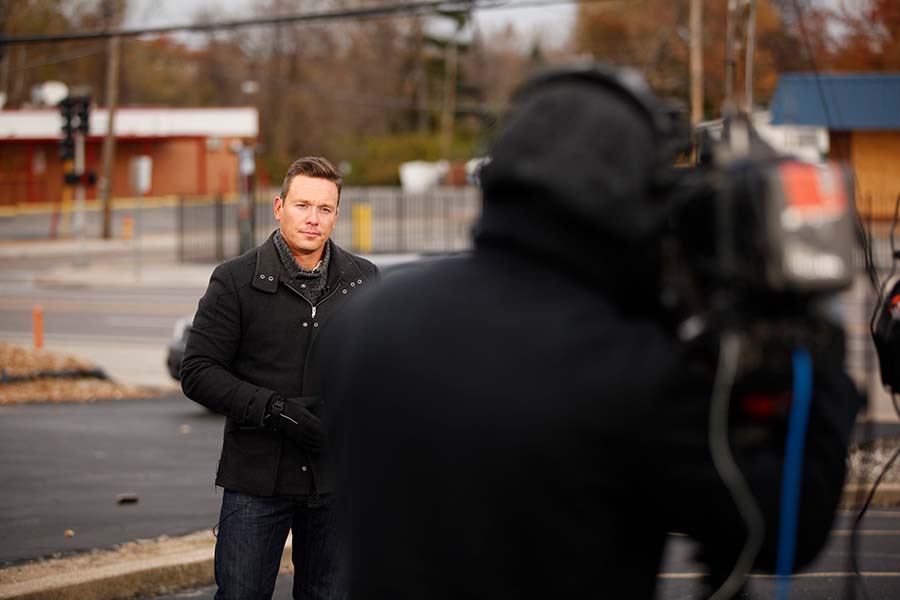
Benn Swann (pictured above), founder of the Truth In Media project, believes that many media outlets are not interested in telling the truth, and are too guided by business and political interests behind the scenes.

Picking on mostly controversial topics, the two-time Emmy Award winner believes in digging deep and asking uncomfortable questions. He believes that journalism in its purest form is a higher calling and at its worst is nothing more than propaganda and a distraction for the masses.

He’s been a reporter, photographer, bureau chief and anchor for KFOX-TV, Fox 19 News and RT. Now an independent news reporter, Swann has adopted social media and online video, including Netflix and Hulu, to get his message out. His 10 million views in 140 countries indicate there must be some truth in what he does. He spoke to us about what is wrong with the news and how it’s being reinvented.

Is Internet broadcasting the future of news?

Absolutely, I don’t think it’s the future of just news; it’s the future of all media. Eventually we’re going to see a convergence of television and cinema. I think most of the traditional TV broadcast news stations around the U.S. realize that’s happening as they’re watching their viewer numbers drop every year. Cable news knows it’s happening; they haven’t seen growth in around 12 years. No one’s really sure about what it will become over time, though.

Because of the acquisition of so many different media types and their bundling into just one or two corporations, I think there’s a danger of seeing online media becoming limited. We’re going to see some major shifts around who’s posting content and how viewers, listeners and readers are able to access that content. The future of the Internet is very unclear and might unfortunately become what the big media companies decide to do in this space.

Social media has a huge influence on how we receive our news. How are you approaching social media in a unique way?

In the past, media outlets essentially created content with a shotgun approach to try and hit as many people as possible that might be interested. With social media, you can target groups of people who have already expressed interest in certain subjects, and in very specific geographic areas.

To what extent should governments and large corporations dictate what we hear and see?

It’s more a question of what you do about the fact that they do control what we hear and see. I don’t have a problem with governments putting information out to people because governments also have a point of view and access to information that the rest of us don’t have. My issue is when there is collusion between governments and media organizations to frame or shape a story. Throughout history, governments have engaged in some form of propaganda but that doesn’t mean it’s always a bad thing. Unfortunately the term suggests that it’s all negative but it’s not always bad when a government expresses itself or tries to inform the public about something.

Are the people who foot the bill the people who dictate the agenda of the news we hear? What alternatives are there?

We have sponsors who pay for some of the work we do and I have no problem with that. Someone has to pay for all of it, whether it’s a government, corporation or advertiser who places its products on your channel. They obviously have a focused point of view that protects and builds their brand. For example, an apparel company is not going to pay to create content around sweatshops that may be associated with them, so the challenge for media outlets is how independent they’re prepared to be.

A solution is to have transparency about who owns news corporations, who is connected to these media entities and the influence they have.

When you do a story, how do you approach it in a way that is as open-minded and balanced as possible?

Many times you hear people use the word balance. Fox News is responsible for how many Americans use this word because they see “balanced” as getting someone from the left and someone from the right and hearing both sides of the story. Both sides of the story is a disingenuous phrase because it indicates that there are only two sides to a story when virtually every story has multiple sides.

We have a slogan “humanity is greater than politics” and with every story we do we look at how people are being affected. You can find 10 different individuals who are affected in 10 different ways and those are all truths. One is not more truthful than the other.

How do you choose your stories, what type of criteria do you use for that?

We don’t follow what other news channels are doing. We also look at bringing clarity to stories that we consider misrepresented because the story has become trapped in that left-right paradigm that I mentioned earlier. We believe strongly in activism but not necessarily for us to direct it, which some media platforms try and do. We’re not trying to control how people become activated; we just want them to become activated
in some way. 

ben_swann_2

What is your opinion on Julian Assange and the other whistleblowers that have exposed secure information? Is this treason or transparency?

I certainly don’t see it as treason. I believe that whistleblowers are some of the most important people in any society because their role should be to hold governments accountable. The problem is that there’s such a disconnect between the government and the citizenry and between the rights of the individual, media and government. This has resulted in most media treating whistleblowers as if they are terrible people or traitors. What Wikileaks did was open up an entire generation of people around the world to the idea that you don’t need gatekeepers in media to get information anymore.

How do you make this profitable? There’s so much free information available online – how do you turn this into a sustainable business model?

Part of the struggle is finding a foothold that becomes financially viable within the context of traditional channels of media. As much as we can micro-target and reach people easily online, one of the difficulties is finding advertisers who want to connect with it.

We’re connecting with some traditional media channels to raise our value online, because even though everything is shifting online, we’ve still got a long way to go before all the advertising dollars follow.

People have been trained to view traditional media as being more legitimate, even thought most people don’t watch or read it. If there’s a story that runs in The New York Times, it’s considered more legitimate than if it was found elsewhere. It’s a strange paradigm to try and break through.

Who inspires you?

U.S. lawyer, journalist and author Glenn Greenwald has done some great work on civil liberties. Despite hearing some negative personal things about Julian Assange of Wikileaks, I don’t think any of that matters. I think you need to look at the fact that he figured out a way that was bigger than himself to change the way people receive information. I’m very inspired by that.

Drug-inspired Fashion: It’s to die for

Terrorists move over. There’s a far worse terror in town that is targeting kids and adults, killing well over ten times more Americans this year than all terrorist attacks of the last 16 years combined.

That’s correct. While politicians have spent several trillion dollars on foreign wars, they’ve distracted us from the very real threat that can be found literally in our own homes, targeting our families. In 1997, the U.S. became one of only two developed countries on the planet that made it legal for pharmaceutical companies to advertise drug use directly to consumers, including children. Since then prescription drug addiction and prescription drug overdoses have skyrocketed – actually quadrupled.

We now have a generation of young adults who grew up with a drug dealer living in their homes 24/7 – the television and magazines pushing pills as a solution to every imaginable condition. Eighty percent of opioid addictions begin with a prescription for pain medication at your doctor’s office. It must be safe if a doctor prescribes it, right? According to the Centers for Disease Control and Prevention, in 2014 47,055 people died of an accidental drug overdose – 29,467 of those from opioid-related drugs, which includes prescription pain medication.

These facts have not stopped Nordstrom and Saks Fifth Avenue from promoting a new line of Italian-designer products that glamorize drug use. The Moschino collection features pill-shaped handbags, backpacks, and clothing emblazoned with pill designs starting at $650 for a pill-adorned black dress and rising to $1,095 for a pill-encrusted purse.

Many customers are outraged, declaring that they are boycotting Nordstrom and Saks for carrying these products after the U.S. Department of Health and Human Services declared that we are in the midst of a prescription opioid overdose epidemic.

Randy Anderson, an alcohol and drug counselor in Minneapolis, has seen firsthand the havoc that addiction has on individuals, families, communities, business, healthcare systems and the country, and he’s not impressed. He started a petition at change.org last week asking consumers to say no to Nordstrom and Saks Fifth Avenue. To save money and lives by shopping elsewhere.

“Do you have any idea of the message your company is sending to those who have suffered the loss of a loved one due to a drug overdose?” says Anderson in his letter to the retailers. “Have you not seen the countless number of media reports on overdose deaths from prescription pain medication?”

httpss://www.instagram.com/p/BLKPA8ZBSyH/?taken-by=moschino


Drug overdose is now the leading cause of accidental death in the United States. Four out of five people who become addicted to heroin start out with a legal prescription from a physician – a result of injury, post-operative care or a medical procedure.

At a time when most large companies are trying hard, in some way, to align themselves with social good and positive causes, these executives have trivialized the important issue of drug addiction. They seem oblivious to the harm it may cause others, by promoting pills as “cool”, or even the harm it may cause their brand if public outrage goes viral.

There are plenty of examples of how fashion norms have found themselves on the wrong side of public opinion and been forced to change. Anti-anorexia campaigns have resulted in the boycotting of fashion weeks, governments legislating to ban too-thin models and fashion magazines refusing to print undernourished models on their pages. Kids clothing with sexist messaging has been ridiculed and forced off the shelves around the world. Each brand has lost the battle against public opinion.

httpss://www.instagram.com/p/BK1UG-Vh6mq/?taken-by=moschino


In a written statement Nordstrom said: “We’ve heard from some customers about this collection, and we’re sorry to learn they’re disappointed. Every customer we serve has unique tastes, which is why we offer a wide range of products.”

Nordstrom faced a similar decision four years ago while promoting gun related jewelry following the New Town massacre and promptly responded to customer’s outrage by removing all of the product from the store. A reputation of being responsive to customers is what Nordstrom’s success was built on.

They appear to be taking a different approach today in defending their intention to serve customers with “unique tastes”. Even if these executives were old-school capitalists who believe business has no responsibility beyond creation of profits and shareholder value, the fact that there are far more customers impacted by addiction in their family than there are customers dying to buy overpriced pill-promoting backpacks, it’s likely that Saks or Nordstrom will decide that this product line is not good business. Whichever one announces first will win in the competition for customer loyalty.

httpss://www.instagram.com/p/BKuExJAh0Wd/?taken-by=moschino


To end on a positive note, the most respected leaders of business today are putting their customers and community first. In 2014 CVS Drug Stores made the bold decision to stop selling cigarettes in their stores, putting the well-being of their customers above their $2 billion a year in tobacco revenues. In 2016 they launched a $50 million anti-smoking campaign. That’s real leadership. The kind of leadership that is rewarded with employee and customer loyalty.

Sign the Change.org petition here

Update: The Star Tribune reported on Thursday 6 October that Nordstrom, via an email, has agreed to discontinue the Moschino Capsule clothing line in their stores. Saks has yet to respond to any correspondence or to comment on the issue.


How Have the U.N.’s Global Goals Fared One Year On?

World leaders one year ago agreed on an ambitious set of global goals designed to tackle the world’s most troubling problems such as extreme poverty and inequality by 2030 at the United Nations.

Described as a blueprint for the future, the 17 Sustainable Development Goals (SDGs) with 169 targets address such daunting challenges as climate change, hunger, education, gender equality, sanitation, jobs, justice and shared peace.

We asked some participants about the progress of the goals one year in and what has worked and what has not:

Helen Dennis, Acting Head of Advocacy at Christian Aid:

“To date, SDG implementation is patchy. Some have embraced them – Norway is integrating the goals into its budget process. But global politics often seem to pull the wrong way. More people than ever are forcibly displaced, yet we see inertia in response to refugees. There are 700 million people living on less than $1.90 a day, yet countries cut aid budgets. There have been small steps towards tax justice but much more is needed. We now have a decent climate agreement but trillions still flow into fossil fuels. A year on, there is a pressing need for courage and leadership.”

David Nabarro, U.N. special adviser on 2030 Agenda for Sustainable Development

“My aim is for 2 billion people around the world to be aware of the SDGs by the end of 2017 and for another million people to become activists — to be change-agents who press decision-makers and who hold them accountable until we have transformed our world and made it more sustainable. Children and youth have a particularly important role to play, as the face of social movements, the drivers of social change and the torchbearers of a more sustainable future for generations to come.”

Amit Bouri, Chief Executive, Global Impact Investing Network:

“What will help us realize the ambitious Sustainable Development Goals of the U.N. is to more fully tap the power of the world’s investment capital. If sufficient investment capital can be channeled to these goal areas through impact investing, the SDGs are achievable.”

Joanna Rubinstein, Chief Executive and President, The World Childhood Foundation USA:

“The sexual abuse of children is a hidden public health crisis. At least one in 10 children in the world, 223 million, are affected. But, with the inclusion of a target in the new SDGs to end all forms of violence against children by 2030, world leaders can no longer close their eyes to this universal problem. We need new approaches to raise awareness about the problem of sexual abuse and the ways to address it.”

Mark Malloch-Brown, Chairman, Business & Sustainable Development Commission (BSDC):

“The challenge of how to scale up global development efforts to meet this ambitious agenda is becoming clearer. The levels of investment, entrepreneurship and innovation require that business joins in. There has been an inspiring number of businesses coming forward to contribute to achieving these 17 ambitious objectives for ending hunger and poverty, reducing inequality and tackling climate change. But most have not yet internalized the risks of inaction and continue to tip-toe around implementation.”

Paul Bissonnette, Action Plan Executor, Merit360, an international group of young leaders:

“I believe that for the SDGs to be achieved there will need to be cooperation and collaboration between the highly interconnected SDGs and among all nations. My passion is in the air we all breathe, but the problem is that we don’t all breathe the same air; for millions of people the air they breathe kills them. I am working on a project called SPARTAN which aims to employ satellites to measure global air pollution.”

Sara Enright, manager, BSR (Business for Social Responsibility):

“It is exciting to see leading companies incorporate SDG targets into their core business. Through developing products and services that address sustainability challenges, companies can make a positive impact on global development. Yet, this kind of social business innovation is far from the norm. Greater ambition and ownership is needed from the private sector to achieve the global goals.”


Hollywood Rolls Out the Green Carpet

The next time you see a celebrity pulling up at an event in a hybrid car, there’s a good chance Debbie Levin is behind it. The CEO of the Environmental Media Association is continuing a novel social marketing strategy, begun in the late 1980s.

By weaving environmental messages into films and using celebrities for positive role modeling, the Environmental Media Association (EMA) has influenced how the public is educated on environmental issues. They assist creative teams, collaborate with environmental groups, encourage the use of hybrid cars and work closely with environmentally responsible corporations. The power of Hollywood is harnessed every year at the annual EMA Awards, which recognizes writers, producers, directors and actors who have included an environmental message in their entertainment work. CEO Debbie Levin has also created the Green Seal Award to recognize environmentally responsible production efforts. She gave us a glimpse of the influential work they do behind the cameras.

How did an organization using celebrities for good come about?

EMA was started 24 years ago by legendary television producer Norman Lear, now 94 years old, along with his wife Lyn, Alan Horn, and Alan’s wife Cindy. Horn also founded Castle Rock Entertainment, after which he went on to run Warner Brothers and then Disney. Before Lear, story lines were very benign and were just funny for the sake of being funny. He took it to a different level. Our mission has always been to use the entertainment industry to get environmental messages into film scripts and use the industry to educate and motivate people.

It seems Norman Lear was ahead of his time, before the topic had even become so popular.

In 1989 people were just starting to take notice of environmental issues and they realized that bringing children into this world meant they needed to think more about the future for the benefit of their kids and grandchildren. Both Lyn and Cindy also happened to be pregnant at the time, and this fact must have added to the couples’ decision to take action. Most other environmental organizations were working quietly, internally, on research or legislation, but nobody was really noticing. Nothing could get the message out on a scale like the entertainment industry could, and that is where the idea originated. What began as an organization that worked with scriptwriters has evolved into using celebrities to communicate through Twitter, Instagram and YouTube. These messages are seen globally, instantly, and can be shared.

Can the EMA Awards be compared to a “Green Oscars?”

What we do is honor television shows, feature films and writers for incorporating environmental issues into their content. We honored Matt Damon a few years ago for his work with Water.org, the organization that he cofounded, and we also honored author and environmentalist Bill McKibben for the work he has done over the last 30 years. Working closely with corporations is also important. We’ve been working with Toyota and Lexus and have a very successful relationship with them. This relationship started during my second year at EMA when we assisted them in launching the Prius. We were the ones who got all the celebrities to buy the Prius, and got them to make it sexy, giving consumers the idea that the car was a cool choice.

From left: EMA supporters Gwyneth Paltrow, Cameron Diaz, Jeff Skoll and Debbie Levin.

From left: EMA supporters Gwyneth Paltrow, Cameron Diaz, Jeff Skoll and Debbie Levin.

It sounds like a type of movie product placement, that instead, happens outside the movie?

It’s product placement in the sense that we’ll make sure that celebrities arrive at all the award shows in hybrids, and we’ll make sure they’re photographed in Beverly Hills, for instance. We really want people to stop using their big limos, the Hummers and big gas-guzzling cars and promote these energy-saving cars. We really work on making the brands of our partners the desirable choice, and because of our success we continue to have an incredible relationship with these companies.

How do you keep EMA sustainable? Where do you get your funding, is it mainly through sponsorship with corporations?

A lot of it is through sponsorship. We have been with Brita and Greenworks for six years and Tiffany & Co. for 16 years. I started a corporate advisory board, to tie them into our work more. I really nurture the corporate relationships. I realized early on that keeping these relationships is vital to our organization, so I’ve made them feel part of the family. Ultimately, it’s not just about companies giving us money once a year; we have structured various revenue streams, including the awards, to ensure we’re sustainable.

How easy is it for you to attract celebrities and actors into the work that EMA is doing. Is it getting easier?

It is actually getting easier, because if you’re an actor, why wouldn’t you want to have a healthy, wonderful, sustainable message out there. Some of our Young Hollywood Board members include Rosario Dawson, Nicole Richie, Emily VanCamp, Malin Akerman, Lance Bass, Adam Levine, Olivia Wilde and Amy Smart. With social media, celebrities are looking for good things that will give them something great to talk to their fans about. It’s not such a hard sell anymore, if you want to rally people around issues such as clean water and better fuel. It’s a way of explaining things to the public in a welcoming and attractive manner. Jeff Skoll has been brilliant in presenting social causes in action, thriller-type films.

Are you finding film writers more willing to change their scripts?

Definitely, as long as you’re specific with writers. If you simply say you’d like them to talk about climate change, they’ll look at you and glaze over, it’s too big a concept. If you tell them they can write a story about a character who is trying to get GMO labelled in their state, or a playground situated on toxic soil, then their eyes light up. You need to give specific examples. At our awards two years ago, four of the seven category winners had fracking story lines, which has never happened before.

Have you ever confronted any big movie production companies over their values?

We actually have some networks, like Fox News Channel, that are constantly challenging our message. Despite being very conservative, one of our board members, actress Daryl Hannah (pictured at top), is on air with them regularly. They like her for some reason and love to argue with her, but she has fun doing it. We have free speech and if they want to put forward an opinion, I think it’s also ok for us to criticize.

Most executives in Hollywood are leaning more towards environmental issues at the moment. They can’t push their personal opinions too much because they’re representatives of corporations, and it is not up to them to do that, but they are becoming more supportive.

I guess the tipping point for change will come about when people see there is money to be made in this?

There’s a lot of money to be made in this, and Toyota is proof of it. Brita and Greenworks are also creating great sustainable products, and the more we support those products the more they’ll keep manufacturing the right kind of products for a better future. Celebrities are highly visible and can make their voices heard to motivate fans. Lance Bass promotes things constantly to his million-plus followers. I consider him our secret weapon.

 

Capitalism Gets Reinvented – For a Mere $27


  • Muhammad Yunus solves a social problem by giving micro-loans to the poor – turning them into entrepreneurs.
  • The effects of his first loan, a total of $27 to 42 people, make him realize that people are not poor from being lazy, but because financial institutions do not help them.
  • He forms Grameen Bank, providing loans totalling $16 billion to 8.5 million families in Bangladesh, with almost every country in the world now copying his lending model.
  • In this exclusive interview, the Nobel Peace Laureate tells Real Leaders about the link between peace, jobs and money.

What is your idea of peace?

The lack of violence is a superficial peace. Feeling happy is not peace either. Peace is a balance of all the elements found within society: economic, political and social. When you achieve this you leave no room for confrontation because one segment of society is not enjoying special privilege over another.

Peace happens when one does not disrupt somebody else’s rights. It’s the constant acknowledgement of human rights for everyone. You should be allowed to lead your life according to your own desires and beliefs. This applies to people, entities and states alike.

How would you activate peace in the world?

We need to redesign the economic system. This is the only way, because the current system is unsustainable.

We need to work towards the creation of zero poverty, zero unemployment and zero net carbon emission by 2050 to close the widening gap between rich and poor. If we all create strong social businesses we can completely transform the world.

We all have the option of being an entrepreneur. Young people should be told that they should not start their lives as job seekers; they should start as job creators. More and more people should develop the potential to become job creators.

We should not live a life on this planet without caring for the future safety of it and should be careful how we use its resources. We should be aware that we have to ensure that future generations can enjoy their lives with the resources we leave behind. We shouldn’t use all the world’s resources and leave nothing for them. We must take good care of – not just for the next five or ten generations, but for all generations to come

The new world of business will have three elements, each equal in importance: people, planet and profit. A world that is only money seeking is not good, it has to come to an end. If not, it will put us to an irreversible path towards social, economic, and environmental disaster.

What is the biggest threat to world peace right now?

The unsustainable nature of world economics and social structures. A huge number of people in the world have nothing, and a handful of people – you can literally count them in the hundreds – own all the wealth of the world.

The vast majority on the planet control less than one percent of the world’s wealth while a few people and families control around 90 percent. That’s not sustainable. Then you have the environment – under threat from a carbon-based economy. Producing carbon is creating an unsustainable planet.

Do you think the planet can sustain a world that is all middle class? Are there enough natural resources?

No, you will need to undo the present system to achieve this. At present, wealth is like a magnet: if you have a small magnet you attract small amounts of additional wealth. If your magnet becomes bigger you attract more, sucking up resources for yourself while others remain empty-handed.

Under the present economic framework, human beings are imagined as being a selfish species, wanting simply to enhance personal wealth. This is a wrong perception of who we really are. Real human beings are not just moneymakers and selfish, they are equally caring, sharing and selfless beings. They are a combination of selfishness and selflessness.

Today selflessness is imagined to be a feature of some special people, the philanthropists, who make money first and then donate it to help others. They do wonderful work but philanthropy has a limitation – it’s not sustainable. Philanthropy money does not come back, it has a one-time use. Social business is a better solution as it has the goal of philanthropy and the sustainability of business.

I consider employment an artificial creation of our present system. From an early age we are told that we need to find a job. This is a wrong perception. Human beings are not made to work under someone else. Human are go-getters who can solve their own problems. We are all basically entrepreneurs, yet we are teaching our children that they need education to get a good job. This is absolutely the wrong message. Each child should grow up to become an entrepreneur, a creative person who believes they can do things on their own.

Is business more powerful in solving problems than governments?

Definitely not the businesses we see around us who are not concerned with the problems of the world. They are too busy making money for their shareholders. But social businesses, yes, they are built to solve people’s problems. There should be no conflict between a business and a social business. Governments should support them because they are in business to solve social problems. If you leave things to the present business model, I’m sorry to say we won’t have a good future.

What is the most valuable lesson you’ve learned on your journey as a leader?

That people are good and given an opportunity they will do the right thing. The political, economic and social systems we have created for ourselves have pushed good people to do wrong things. These systems have not created alternative options for us as human beings.

Was there anything that held you back when you started your business venture?

I didn’t have any doubts because I didn’t have any plans. When you have a plan, you have doubts. I was pushed by circumstances and was so desperate that I just jumped in.

Every day I saw people being financially exploited in cruel ways, with tiny loans from loan sharks. I reflected that this was a problem no one had ever solved before. It was a global problem and I knew that I was just one small guy. I decided that I couldn’t solve the whole world’s problems, but could solve the problems of a few.

I start giving loans with my own money, without any intention of making money for myself. People came to me for loans and I could help solve their problems. I took money from my own pocket and started lending to people. I wasn’t thinking of banking at that stage; simply trying to protect people from loan sharks. It kept growing and I eventually created Grameen Bank in 1983, based on the same values and principles as when I first started lending.

Some opposed me but I didn’t get upset. I thought it was part of the process that you have to go through. If you do something new, naturally some people who get affected will oppose you.

What is a real leader?

A leader enjoys the company of other people and has an ability to inspire them. It’s not about power and giving orders. You may not carry a title or hold a position, but people will admire you for what you say, what you do and how you live your life. People see consistency in words and work and you shouldn’t say one thing and do something else.

Leadership is about vision, if you see and think ahead, people follow you because they are convinced that you see more than they do. Others will believe in you because you have shown them a better way of doing things which they never believed possible.


The Luxury Watch Made From AK47s

Peter Thum, the man behind watch brand Fonderie 47 has a talent for supporting social causes he feels are important and a skill for applying his business acumen to them. His unique take on business has resulted in the creation of a watch made from recycled parts of universal symbol of conflict, the AK47 assault rifle.

While most will assume this type of idea results in a cheap gimmick, consider the price tag that accompanies each watch – $350,000.

Realizing that high-end quality was needed to raise capital for his social venture, Thum approached two master jewelers, Philip Crangi and James de Givenchy, to design the precision timepiece and ensure that it met the tastes of the most discerning watch aficionados. For every watch sold, Thum arranges the destruction of 1,000 AK47s in Africa.

“Our resolve began several years ago when we learned firsthand about the devastating impact that assault rifles have in Africa,” says Thum. “These military weapons – mostly old, cheap and illicit ­– threaten not only lives but the potential for social and economic development. We decided to create something compelling and substantial to change what people believed was possible.” In Africa, assault rifles cost around 70% less than anywhere else in the world.

While prices have risen elsewhere since 1990, they have actually fallen in Africa. By reducing the supply of older, cheaper weapons, they aim to reduce the overall supply. While they can never hope to stop the import of weapons, the cost of replacing weapons from outside Africa is several times higher and Thum hopes this simple economic fact will help decrease supply within some conflict zones. Fonderie 47 turns over the related amount of funding from the sale of its jewelry to the Nobel Prize winning NGO Mines Advisory Group, who in turn carries out the technical oversight and physical destruction of the weapons in conjunction with the governments of Burundi and the Democratic republic of Congo.

Thum’s journey began in 2001 while working for McKinsey in Africa. He saw firsthand the devastation caused by the lack of clean water –illness and death from waterborne diseases. He had the idea to found a water company, Ethos Water, as a way to finance water-related projects in Africa. It resulted in a win-win situation that was eventually acquired by Starbucks, following which Thum served three years as Vice President of the company and Director of the Starbucks Foundation.

Ethos water went on to generate more than $6.2 million for water programs around the world, helping 420,000 people get access to safe water, sanitation and hygiene education. Another issue that bothered Thum during his time in Africa was the widespread presence of small arms in strife-ridden areas, particularly the notorious AK47 assault rifle.

“Here was a problem that really prevented any donated development dollars from having any impact,” says Thum. “So I thought, ‘let’s destroy these guns and convert them into something inspiring that makes people interested in the problem, while tackling the issue at the same time.” And so Fonderie 47 was born, and as with Thum’s water project, which made money through water, to improve water conditions, he decided to use the steel of the AK47 to make jewelry.

However, unlike the water project, the aim is to raise money to eliminate the source material, not support it. The project has already helped collect and destroy more than 34,000 weapons throughout the war zones of Africa, especially the Congo. Fonderie 47 creates jewelry, watches and accessories, using steel from AK47s, crafting them into unique pieces, each becoming part of a themed collection. For example, a pair of cufflinks from the Crucible Collection will set you back $11,000 and destroy 30 assault rifles. A necklace of Fonderie 47 steel, diamonds, rose gold and platinum from the Phoenix Collection will cost you $240,000 and destroy 800 assault rifles in Africa. New York designer James de Givenchy has created the Phoenix Collection, with an objet d’art as its centerpiece – an egg crafted from AK47 steel and conflict free diamonds.

Each piece bears the serial number of the weapon used to create it. Not knowing much about watch production did not stop Thum either. He sought out Vallée-de-Joux-based watchmaker David Candaux and designer Adrian Glessing and together they came up with a vision: a watch with all the features a serious collector would aspire towards, including an in-house movement and a case made from pink or white gold.

Their masterpiece, the Inversion Principle was born, a 42mm case housing a manually wound timepiece and three-dimensional dial. The jumping hours at 12 o’clock and retrograde minutes on the lower half of the dial suggest the kind of motion produced when loading a rifle.

Thum did not want the watch to resemble a wearable AK47. After all, the original idea for the watch was to, ironically, eliminate the very object after which the watch was modeled. The design team have rather built in subtle design features that hint at its job beyond a timekeeper. “We wanted to take something industrial and mass-produced and crude and transform it into something that is rare and refined and that comes from the finest tradition of technical and creative work,” says Thum.

The frame on the dial could be read as a gun sight and through the transparent case at the back of the watch a piece of blackened gun metal caps the ratchet wheel. Thum hopes that the lucky few who own the limited edition Inversion Principle watch will be among only a handful of people, who when asked for the time, will be able to answer with conviction: “It’s time for change.”


Overlooked and Misunderstood: Older People Speak out About Conflict

Overlooked and misunderstood: older people speak about their experiences of conflict. A new HelpAge International survey of 300 older refugees fleeing from conflict in Syria, Ukraine and South Sudan has found evidence of neglect, poor health provision and feelings of isolation and fear.

The refugee crisis of the last few years has mainly focused on the lives of families torn apart by conflict, poverty and death. The focus of many of these stories, and the the heart-wrenching photographs that accompany them, has been on women and children – seen as the most vulnerable victims of crisis. Who can ever forget the image of 3-year-old Aylan Kurdi washed up on a Turkish beach, or women huddled in the freezing cold, clutching their hungry children in the heart of Europe?

Media outlets know that showing the most vulnerable victims of this crisis will strike a chord with their viewers and readers. Doing so plays an important role in raising awareness among those in more privileged situations, and hopefully inspires positive action. But what of elder victims? Are their lives and situations any less worthy of attention?

HelpAge International helps older people claim their rights, challenge discrimination and overcome poverty, so that they can lead dignified, secure, active and healthy lives. The results of their recent survey remind us that we should consider the elderly too, in any given crisis.

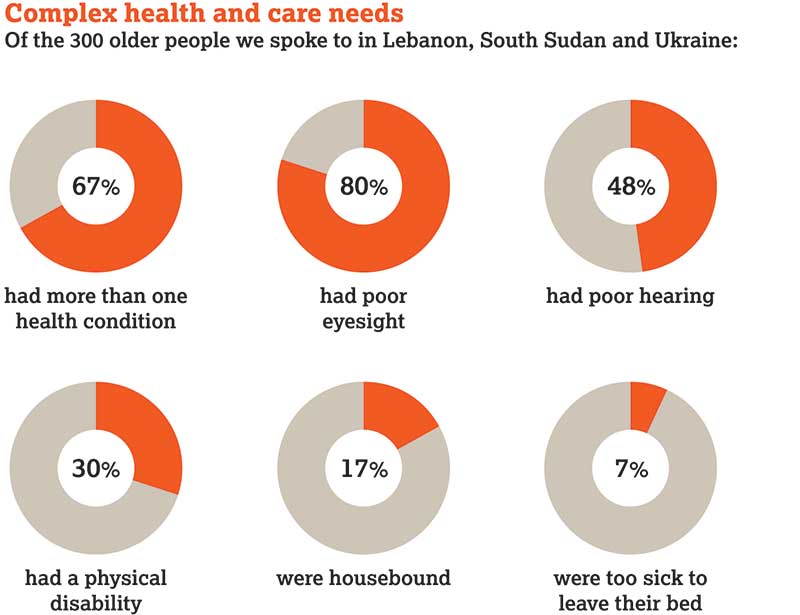
Almost every one of the older refugees in HelpAge’s report Older voices in humanitarian crises said they had not been consulted about their needs, more than two thirds said they did not have enough information about the humanitarian assistance available to them, almost half said health services did not provide care for their age-related conditions and close to half said they felt anxious, hopeless or depressed most or all of the time.

Older people are disproportionately affected when disaster strikes. In Hurricane Katrina, 75 per cent of those who died were over 60, despite making up only 16 per cent of the population. Similarly in the Japanese tsunami, 56 per cent of the victims were 65 and over, despite making up 23 per cent of the population.

The survey conducted at the end of last year offered older people the space to share their hopes and concerns and talk about the challenges affecting their daily lives in humanitarian crises.

Warda, 85-years-old, Syria.

Warda, 85 years old, Syria.

Warda, an 85-year-old Syrian woman living in Lebanon, spoke for many when she said: “I know that humanitarian aid might be helping, but only for those who can go and get it. How am I supposed to get this help if I can’t even leave the room?” 

Oboch, 86 years old, South Sudan.

Oboch, 86 years old, South Sudan.

Oboch, 86, living in a refugee camp in Juba, South Sudan said, “We’re always being filmed and photographed but nothing changes. We know humanitarian organisations can’t leave people to die of hunger but why is there not enough food?”

A shocking 95 per cent of older people spoken to in Lebanon, 93 per cent in South Sudan and 66 per cent in Ukraine said that no-one other than HelpAge had consulted them about their needs despite the fact that many older people are reliant on humanitarian assistance.

Anatoly, 89, (pictured at top of page) said humanitarian aid was a lifeline during the blockade in eastern Ukraine. “For nine months, we had no pension and many people simply starved. I don’t know how we would have survived without aid.”

Salwa, 60 years old, Lebanon.

Salwa, 60 years old, Lebanon.

Salwa, 60, a Syrian refugee living in Lebanon said, “We’re only able to live because of the blue card the UNHCR gave us. We used to receive US$120 per month but now we get US$40. It’s barely enough and medical help is impossible.

“My husband manages to provide us with US$4-5 a day from selling the cans he collects and my oldest daughter cleans stairs in the neighbourhood to make some money.” 

An 86-year-old Syrian refugee in Lebanon said: “I’m afraid all the time. I don’t sleep well. I get headaches and tremors. I used to be able to do everything by myself. I could clean the house, take out the garbage, do some repair work and now I can’t. Now I’m older it feels as though I’m a burden and people aren’t interested in me.”

An 85–year-old woman in South Sudan put it clearly: “No-one talks to me to find out what I’m going through.”

The survey findings contribute to a growing body of evidence illustrating the failure of the humanitarian system to protect older people’s rights or meet their needs, demonstrating the limited progress the humanitarian system has made to address the neglect of older people and other vulnerable groups.

Kuonyo, 79 years old, South Sudan.

Kuonyo, 79 years old, South Sudan.

The first-ever World Humanitarian Summit this May provides a chance to lay the foundations for a reformed humanitarian system – one that puts people at the centre of disaster response, builds resilience to crises and really does ensure that we ”leave no-one behind”.

Leading humanitarian agencies have drawn up an Inclusion Charter www.inclusioncharter.org setting out the pressing commitments needed to ensure humanitarian assistance reaches the most vulnerable people.

“To address the neglect faced by older people in conflicts and disasters, their opinions must be heard and changes made in the humanitarian system,” said Frances Stevenson, head of the humanitarian team at HelpAge International.

The commitments outlined in the Charter provide governments, donors and humanitarians agencies with a set of five key actions to ensure humanitarian assistance reaches the most vulnerable people in emergencies.

To sign up to the Charter go to: www.inclusioncharter.org

Health-and-care-needs-pie-jpg


Impact Investing Goes Mainstream

“You cannot separate people from the environment,” says Michael Van Patten, former Mission Markets CEO and current Founder of ethical investment tech company my4. His new company is a marketplace for investors within the impact and sustainability sector looking for a way to align their personal values with their investments. He shared his views on impact investing with us.

“We’re trying to create an infrastructure where  investment can more effectively access these type of opportunities and support the growing global movement of people looking for returns on investment, while also making sure their dollars are going to a tangible social benefit,” says Van Patten.

This way of thinking may not apply to every aspect of an investors portfolio, but clearly they are starting to identify a percentage of their portfolio for this. “We’re creating an infrastructure that integrates existing financial measurement tools that have started giving information on social enterprise or environmental projects. We’re also measuring the impacts above and beyond the financial benefits an investor might receive.”

“Most people look at  impact asset markets and treat them differently,” says Van Patten. “Yes, they are different, but you need to speak to traditional investors in their own language. The impact assets market is still small compared to traditional markets, and the world doesn’t really fully understand them yet.

To become effective worldwide, and to ultimately change the way we do business, we need to put this in a format that investment advisors, brokers and other gatekeepers of wealth understand.”

“From this sector you’re going to see the next generation of major corporations emerge, the future Fortune 500 companies.”

At the very least, these gatekeepers should be educated enough to be able to respond intelligently to the growing number of requests that are arising from investors wanting to enter these markets. Van Patten doesn’t treat impact investing as a niche market but as a mainstream one. “The obstacles we face are that many organizations seeking capital are small, not well-known and are still in their formative years.

Large established companies giving regular and predictable returns doesn’t exist yet. The benchmark tools an investor might use when reviewing a company’s performance, such as the risk and return over ten years, is not available yet, as this industry is still too young.

“One of the biggest obstacles is that investment-seeking companies tend to be private and in the U.S. you have to raise capital in a private placement that is only available to accredited investors. These types of investment opportunities are only available legally to someone who has a lot of money. Anyone who doesn’t qualify as an accredited investor cannot even begin to look at these opportunities. That’s a big roadblock, and we’re trying to change it.

“On returns, it really depends on how you view ‘return’. Historically, these investment opportunities have been in the form of debt or a form of debt and equity, and typically the returns were not as high as traditional markets. But now all that’s changing. 

“Whatever you call this sector, it can only grow. From this sector you’re going to see the next generation of major corporations emerge, the future Fortune 500 companies. Before this happens you’ll see a lot of them struggle because we’re still in infancy .”

In the future, Van Patten says that products and services seeking this kind of investment will have to be transparent in their social and environmental footprints. “The future of finance is going to have to incorporate these two externalities as part of the new way of doing business,” he says. “How this will be incorporated into a companies balance-sheet is yet to be seen, but the writing is on the wall.

Major corporations are now part of working groups, established to create transparency in the social and environmental footprint of companies. For example, companies such as Levi Strauss, Gap, Walmart, Patagonia and Timberland are now placing information on their clothing or food that allows you to rate the environmental footprint of that product.

As well as the obvious good this creates for the planet, it’s also clever marketing. They manage to distinguish themselves from competitors, but most importantly it creates an opportunity for those companies that aren’t onboard to start losing market share.” Whether companies reveal their responsible behavior in an investor report, annual report, product labels or as part of their service, this fact is going to drive consumer and investor demand in the future,” says Van Patten.

“Presently, the market is clearly not favoring a company that is sustainable, it is just not being priced into a company’s stock. Eventually these issues are going to become evident in company annual reports, and it will begin to affect that company. For example, a company that pollutes will be exposed, and its stock will be effected adversely – not only by consumers refusing to buy their goods, but also from giant corporations, with good governance, who might cut them from their supply chain.

Companies should not make the mistake of focusing solely on consumer sentiment, but also on business-to-business transactions. “If an investor knows that a company he’s invested in is already thinking ahead and initiating business models on how to become more sustainable and transparent, then that shows a management team that’s already on its toes and focusing on the next big thing.

If they’re not, then you need to question whether that company, and management, is actually seeing the change happening in the world right now. If you ‘get it’ as a company, then you acknowledge your actions have global implications and you implement that as a business process.

When this becomes more recognized, you’ll see the stock prices of these companies rise and carry a premium as it reflects on how innovative and forward-thinking management is. To do this you need vision and belief in what you’re doing.

Be bold, even when a market that may not yet ‘be there.’ Your ideas need to cater for where the market is right now, and at the same time, actively shift towards where you aim to be.”


17 Goals For Global Action

[et_pb_section admin_label=”section”][et_pb_row admin_label=”row”][et_pb_column type=”4_4″][et_pb_text admin_label=”Text” background_layout=”light” text_orientation=”left” use_border_color=”off” border_color=”#ffffff” border_style=”solid”]

Countries have started adopting a new sustainable development agenda, put forward by the United Nations, with targets to be achieved over the next 15 years. These 17 new Sustainable Development Goals build on the eight Millennium Development Goals that ended in 2015. While there have been some improvements, there are still many challenges. How can your business introduce measures to help these goals along? Real Leaders can help reposition and rebrand your company for the new sustainability economy. Attract a new breed of consumer and client and join the growing number of business owners who have put social impact at the center of their business – to generate greater profits. Contact Julie@Real-Leaders.com 

[/et_pb_text][/et_pb_column][/et_pb_row][et_pb_row admin_label=”Row”][et_pb_column type=”1_3″][et_pb_blurb admin_label=”Blurb” url_new_window=”off” use_icon=”off” icon_color=”#dd3333″ use_circle=”off” circle_color=”#dd3333″ use_circle_border=”off” circle_border_color=”#dd3333″ image=”https://real-leaders.com/wp-content/uploads/2016/04/Sustainable-Dev-1.jpg” icon_placement=”top” animation=”off” background_layout=”light” text_orientation=”left” use_icon_font_size=”off” use_border_color=”off” border_color=”#ffffff” border_style=”solid”]

836 million people still live in extreme poverty and one in five people in developing regions live on less than $1.25 per day.

[/et_pb_blurb][/et_pb_column][et_pb_column type=”1_3″][et_pb_blurb admin_label=”Blurb” url_new_window=”off” use_icon=”off” icon_color=”#dd3333″ use_circle=”off” circle_color=”#dd3333″ use_circle_border=”off” circle_border_color=”#dd3333″ image=”https://real-leaders.com/wp-content/uploads/2016/04/Sustainable-Dev-2.jpg” icon_placement=”top” animation=”off” background_layout=”light” text_orientation=”left” use_icon_font_size=”off” use_border_color=”off” border_color=”#ffffff” border_style=”solid”]

One in nine people in the world today (795 million) are undernourished. 66 million primary school children attend classes hungry.

[/et_pb_blurb][/et_pb_column][et_pb_column type=”1_3″][et_pb_blurb admin_label=”Blurb” url_new_window=”off” use_icon=”off” icon_color=”#dd3333″ use_circle=”off” circle_color=”#dd3333″ use_circle_border=”off” circle_border_color=”#dd3333″ image=”https://real-leaders.com/wp-content/uploads/2016/04/Sustainable-Dev-3.jpg” icon_placement=”top” animation=”off” background_layout=”light” text_orientation=”left” use_icon_font_size=”off” use_border_color=”off” border_color=”#ffffff” border_style=”solid”]

17,000 fewer children die each day than in 1990, but more than six million children still die before their fifth birthday each year.

[/et_pb_blurb][/et_pb_column][/et_pb_row][et_pb_row admin_label=”Row”][et_pb_column type=”1_3″][et_pb_blurb admin_label=”Blurb” url_new_window=”off” use_icon=”off” icon_color=”#dd3333″ use_circle=”off” circle_color=”#dd3333″ use_circle_border=”off” circle_border_color=”#dd3333″ image=”https://real-leaders.com/wp-content/uploads/2016/04/Sustainable-Dev-4.jpg” icon_placement=”top” animation=”off” background_layout=”light” text_orientation=”left” use_icon_font_size=”off” use_border_color=”off” border_color=”#ffffff” border_style=”solid”]

An estimated 50% of out-of-school children of primary school age live in conflict-affected areas.

[/et_pb_blurb][/et_pb_column][et_pb_column type=”1_3″][et_pb_blurb admin_label=”Blurb” url_new_window=”off” use_icon=”off” icon_color=”#dd3333″ use_circle=”off” circle_color=”#dd3333″ use_circle_border=”off” circle_border_color=”#dd3333″ image=”https://real-leaders.com/wp-content/uploads/2016/04/Sustainable-Dev-5.jpg” icon_placement=”top” animation=”off” background_layout=”light” text_orientation=”left” use_icon_font_size=”off” use_border_color=”off” border_color=”#ffffff” border_style=”solid”]

In 46 countries, women now hold more than 30% of seats in national parliament.

[/et_pb_blurb][/et_pb_column][et_pb_column type=”1_3″][et_pb_blurb admin_label=”Blurb” url_new_window=”off” use_icon=”off” icon_color=”#dd3333″ use_circle=”off” circle_color=”#dd3333″ use_circle_border=”off” circle_border_color=”#dd3333″ image=”https://real-leaders.com/wp-content/uploads/2016/04/Sustainable-Dev-6.jpg” icon_placement=”top” animation=”off” background_layout=”light” text_orientation=”left” use_icon_font_size=”off” use_border_color=”off” border_color=”#ffffff” border_style=”solid”]

At least 1.8 billion people globally use a source of drinking water that is fecally contaminated.

[/et_pb_blurb][/et_pb_column][/et_pb_row][et_pb_row admin_label=”Row”][et_pb_column type=”1_3″][et_pb_blurb admin_label=”Blurb” url_new_window=”off” use_icon=”off” icon_color=”#dd3333″ use_circle=”off” circle_color=”#dd3333″ use_circle_border=”off” circle_border_color=”#dd3333″ image=”https://real-leaders.com/wp-content/uploads/2016/04/Sustainable-Dev-7.jpg” icon_placement=”top” animation=”off” background_layout=”light” text_orientation=”left” use_icon_font_size=”off” use_border_color=”off” border_color=”#ffffff” border_style=”solid”]

One in five people lack access to electricity. Three billion people rely on wood, coal, charcoal or animal waste for cooking and heating.

[/et_pb_blurb][/et_pb_column][et_pb_column type=”1_3″][et_pb_blurb admin_label=”Blurb” url_new_window=”off” use_icon=”off” icon_color=”#dd3333″ use_circle=”off” circle_color=”#dd3333″ use_circle_border=”off” circle_border_color=”#dd3333″ image=”https://real-leaders.com/wp-content/uploads/2016/04/Sustainable-Dev-8.jpg” icon_placement=”top” animation=”off” background_layout=”light” text_orientation=”left” use_icon_font_size=”off” use_border_color=”off” border_color=”#ffffff” border_style=”solid”]

470 million jobs are needed globally for new entrants to the labour market between 2016 and 2030.

[/et_pb_blurb][/et_pb_column][et_pb_column type=”1_3″][et_pb_blurb admin_label=”Blurb” url_new_window=”off” use_icon=”off” icon_color=”#dd3333″ use_circle=”off” circle_color=”#dd3333″ use_circle_border=”off” circle_border_color=”#dd3333″ image=”https://real-leaders.com/wp-content/uploads/2016/04/Sustainable-Dev-9.jpg” icon_placement=”top” animation=”off” background_layout=”light” text_orientation=”left” use_icon_font_size=”off” use_border_color=”off” border_color=”#ffffff” border_style=”solid”]

In developing countries, 30% of agricultural production undergoes industrial processing. In high-income countries, 98% is processed.

[/et_pb_blurb][/et_pb_column][/et_pb_row][et_pb_row admin_label=”Row”][et_pb_column type=”1_3″][et_pb_blurb admin_label=”Blurb” url_new_window=”off” use_icon=”off” icon_color=”#dd3333″ use_circle=”off” circle_color=”#dd3333″ use_circle_border=”off” circle_border_color=”#dd3333″ image=”https://real-leaders.com/wp-content/uploads/2016/04/Sustainable-Dev-10.jpg” icon_placement=”top” animation=”off” background_layout=”light” text_orientation=”left” use_icon_font_size=”off” use_border_color=”off” border_color=”#ffffff” border_style=”solid”]

Income inequality increased by 11% in developing countries between 1990 and 2010. This is a threat to long-term social and economic development.

[/et_pb_blurb][/et_pb_column][et_pb_column type=”1_3″][et_pb_blurb admin_label=”Blurb” url_new_window=”off” use_icon=”off” icon_color=”#dd3333″ use_circle=”off” circle_color=”#dd3333″ use_circle_border=”off” circle_border_color=”#dd3333″ image=”https://real-leaders.com/wp-content/uploads/2016/04/Sustainable-Dev-11.jpg” icon_placement=”top” animation=”off” background_layout=”light” text_orientation=”left” use_icon_font_size=”off” use_border_color=”off” border_color=”#ffffff” border_style=”solid”]

Half of humanity – 3.5 billion people – live in cities today. By 2030, 60% of the world’s population will live in urban areas.

[/et_pb_blurb][/et_pb_column][et_pb_column type=”1_3″][et_pb_blurb admin_label=”Blurb” url_new_window=”off” use_icon=”off” icon_color=”#dd3333″ use_circle=”off” circle_color=”#dd3333″ use_circle_border=”off” circle_border_color=”#dd3333″ image=”https://real-leaders.com/wp-content/uploads/2016/04/Sustainable-Dev-12.jpg” icon_placement=”top” animation=”off” background_layout=”light” text_orientation=”left” use_icon_font_size=”off” use_border_color=”off” border_color=”#ffffff” border_style=”solid”]

Each year, an estimated one-third of all food produced – worth around $1 trillion – ends up rotting in bins.

[/et_pb_blurb][/et_pb_column][/et_pb_row][et_pb_row admin_label=”Row”][et_pb_column type=”1_3″][et_pb_blurb admin_label=”Blurb” url_new_window=”off” use_icon=”off” icon_color=”#dd3333″ use_circle=”off” circle_color=”#dd3333″ use_circle_border=”off” circle_border_color=”#dd3333″ image=”https://real-leaders.com/wp-content/uploads/2016/04/Sustainable-Dev-13.jpg” icon_placement=”top” animation=”off” background_layout=”light” text_orientation=”left” use_icon_font_size=”off” use_border_color=”off” border_color=”#ffffff” border_style=”solid”]

From 1880 to 2012, the average global temperature increased by 0.85°C. For each one degree of temperature increase, grain yields decline by about 5%.

[/et_pb_blurb][/et_pb_column][et_pb_column type=”1_3″][et_pb_blurb admin_label=”Blurb” url_new_window=”off” use_icon=”off” icon_color=”#dd3333″ use_circle=”off” circle_color=”#dd3333″ use_circle_border=”off” circle_border_color=”#dd3333″ image=”https://real-leaders.com/wp-content/uploads/2016/04/Sustainable-Dev-14.jpg” icon_placement=”top” animation=”off” background_layout=”light” text_orientation=”left” use_icon_font_size=”off” use_border_color=”off” border_color=”#ffffff” border_style=”solid”]

Over three billion people depend on marine and coastal biodiversity for their livelihoods. Oceans contain 97% of the Earth’s water

[/et_pb_blurb][/et_pb_column][et_pb_column type=”1_3″][et_pb_blurb admin_label=”Blurb” url_new_window=”off” use_icon=”off” icon_color=”#dd3333″ use_circle=”off” circle_color=”#dd3333″ use_circle_border=”off” circle_border_color=”#dd3333″ image=”https://real-leaders.com/wp-content/uploads/2016/04/Sustainable-Dev-15.jpg” icon_placement=”top” animation=”off” background_layout=”light” text_orientation=”left” use_icon_font_size=”off” use_border_color=”off” border_color=”#ffffff” border_style=”solid”]

23 hectares of arable land per minute are lost to drought and desertification – 12 million hectares per year – where 20 million tons of grain could have been grown.

[/et_pb_blurb][/et_pb_column][/et_pb_row][et_pb_row admin_label=”Row”][et_pb_column type=”1_3″][et_pb_blurb admin_label=”Blurb” url_new_window=”off” use_icon=”off” icon_color=”#dd3333″ use_circle=”off” circle_color=”#dd3333″ use_circle_border=”off” circle_border_color=”#dd3333″ image=”https://real-leaders.com/wp-content/uploads/2016/04/Sustainable-Dev-16.jpg” icon_placement=”top” animation=”off” background_layout=”light” text_orientation=”left” use_icon_font_size=”off” use_border_color=”off” border_color=”#ffffff” border_style=”solid”]

Among the institutions most affected by corruption are the judiciary and police. Corruption, bribery, theft and tax evasion cost US$1.26 trillion for developing countries per year.

[/et_pb_blurb][/et_pb_column][et_pb_column type=”1_3″][et_pb_blurb admin_label=”Blurb” url_new_window=”off” use_icon=”off” icon_color=”#dd3333″ use_circle=”off” circle_color=”#dd3333″ use_circle_border=”off” circle_border_color=”#dd3333″ image=”https://real-leaders.com/wp-content/uploads/2016/04/Sustainable-Dev-17.jpg” icon_placement=”top” animation=”off” background_layout=”light” text_orientation=”left” use_icon_font_size=”off” use_border_color=”off” border_color=”#ffffff” border_style=”solid”]

Over four billion people do not use the Internet, and 90% of them are from the developing world. 30% of the world’s youth are digital natives, active online for at least five years.

[/et_pb_blurb][/et_pb_column][et_pb_column type=”1_3″][/et_pb_column][/et_pb_row][/et_pb_section]

0