While Nuclear Energy Attracts Attention, Investors Should Not Lose Sight On The Promise Of Renewables


By Blaine Townsend


In 1979, the accident at Three Mile Island  Nuclear Generating Station in Pennsylvania changed the investment calculus and public  opinion about nuclear power. It was almost 40  years before another reactor was built in this  country. Subsequent international accidents at Chernobyl and Fukushima did not help matters. 

However, as climate change threatens the  natural world and the viability of the capital markets, the tone around nuclear energy has  started to change. It has even garnered  bipartisan and Wall Street support, shifting  investors’ attention towards this sector. So, does nuclear energy provide a low-emissions  solution to rapidly rising energy demands? Or  does it distract investors from the stronger  opportunities in renewables? 

The Case (and Frequent Setbacks) of  Nuclear Energy 


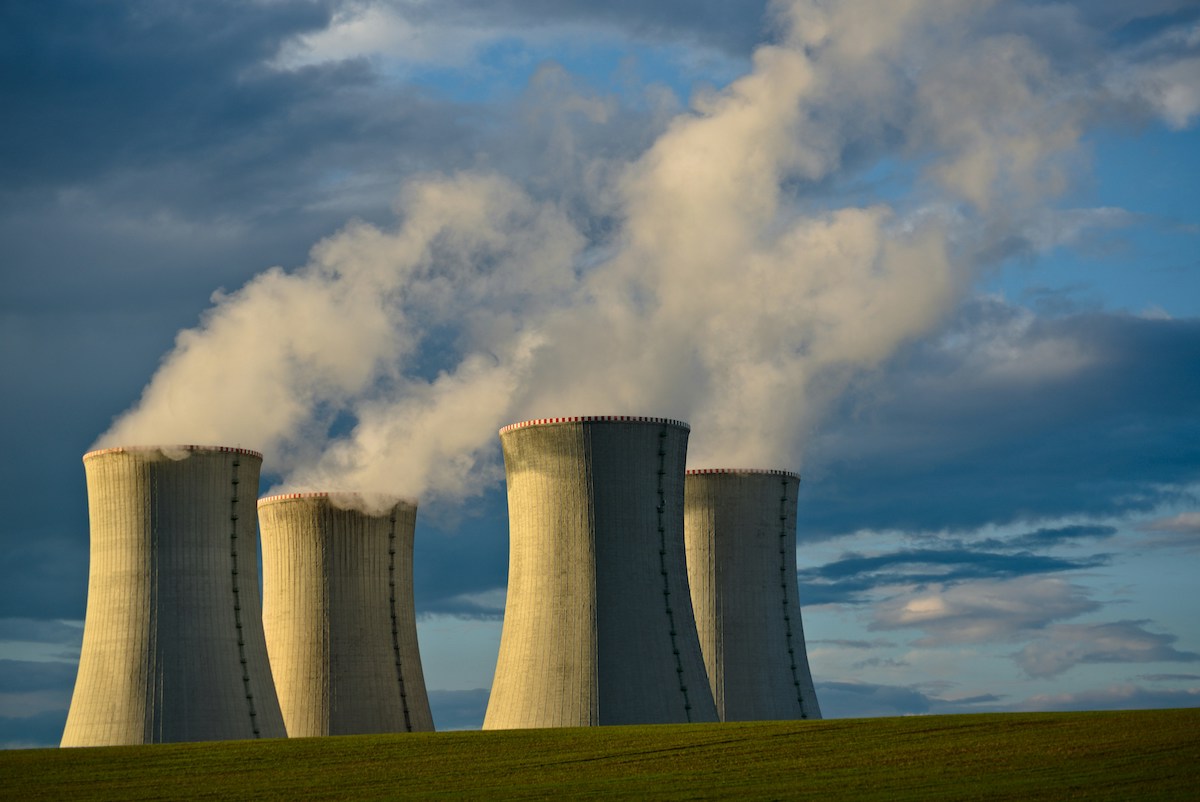
To be sure, nuclear energy is intoxicating.  Nuclear power is a proven technology that produces electricity with low emissions.  Currently, the US draws 19% of its electricity from nuclear power.1 When it comes to the  percentage of “clean” power (low emissions), the  number jumps to 48%. With energy demand set  to double by 2030 due to the insatiable thirst of  artificial intelligence,2 nuclear advocates insist  it is the safest, cleanest and cheapest solution to  the energy and climate crisis.3 

Of course, the power derived from wind, water  and solar (WWS) also provides safe, clean energy. But, as the proponents of nuclear like to  say, “the sun doesn’t shine all day, and the wind  is not constant.” Nuclear plants run 24 hours a  day, 7 days a week, offering a near-constant baseload of power. That sounds good on paper,  but growing nuclear capacity has not been that  easy. In part, this is because of nuclear energy’s  checkered history, liabilities from an investment standpoint and lack of public  support. In practice, it is just difficult to get  plants built.
 

When it comes to the percentage of  “clean” power (low emissions), the  number jumps to 48%. With energy  demand set to double by 2030 due to  the insatiable thirst of artificial  intelligence,2 nuclear advocates insist  it is the safest, cleanest, and cheapest  solution to the energy and climate  crisis.3
 

“On-time and under budget” is not a phrase  associated with nuclear plant construction. The new reactors at the Vogtle Electric Generating Plant in Georgia are a good example. Construction started in 2009 at a projected cost  of $12 billion, expected to be completed in 2017.  Instead, the second of the two additions entered commercial operations this year and ended up  costing almost $35 billion “for what may be the  most expensive power plant ever.”4 There is  hope that new technology and modular  construction could change that, but hope is not  a plan.
 

So nuclear is expensive and slow to build when  all goes well. When it doesn’t? Look no further  than the accident at the Fukushima Daiichi  Nuclear Plant in Japan. The cost for the cleanup  is in the hundreds of billions and still piling up.5 Even if there is no accident, disposing of spent  uranium is a treacherous undertaking. It  remains a threat to the environment for  centuries and requires great measures to  “dispose” of it safely. This includes keeping it  out of the hands of bad actors who can use it in  dirty bombs.


The Stronger Investor Case for  Renewables 


Nuclear advocates argue the high costs and long  construction time is due to political opposition  and the under-investment in nuclear over the past 50 years.6 Until recently, the same could be  said for renewables.7 Despite this, the results for  renewables have been very different. Subsidy  math is always fuzzy, but momentum to  subsidize renewables picked up steam in the  1990s. Since that time, the share of electricity in  the U.S. produced by WWS has gone up 150%.8 

The speed at which wind and solar installations  can be built is a big reason for this. Wind and  solar installations take from 6 months to 2 years  to build.9 By contrast, nuclear plant construction this century has averaged about 10  years once construction has started.10 Need  more evidence? In just 2020 and 2021 alone, the  world added 464 gigawatts of power-generating  capacity of wind and solar, more than the  capacity of all the nuclear plants ever built.11 

WWS is not a panacea. Like any industrial  energy source, there are challenges. It requires a  lot of land and energy storage is also a concern (“the sun doesn’t shine all day”). Despite this,  the capital markets are much more interested in  investing in renewables than nuclear. Even in  nuclear’s heyday, Congress had to pass the  Price-Anderson Nuclear Industries Indemnity  Act in 1957 to entice private investment in  nuclear. Investors recognize that renewables  come on more quickly, use much less water, and  have a much lower risk profile. In addition, the  Inflation Reduction Act (IRA) is set to  turbocharge energy storage and improve  distribution.12 

Wind and solar installations take from 6  months to 2 years to build.9 By contrast,  nuclear plant construction this century  has averaged about 10 years once  construction has started.10

Extending the operating life of the current  nuclear capacity makes perfect sense. As of April 30, 2024, there were 54 commercially  operating nuclear power plants with 94 nuclear power reactors in 28 states.13 There is already $6  billion set aside in the 2022 Bi-partisan  Infrastructure Law to do this, and just this week  Constellation Energy Corp. agreed to invest $1.6  billion to revive the shuttered Three Mile Island nuclear reactor and sell all the energy to Microsoft Corp. That makes sense. Building new  nuclear plants at the expense of renewables  does not. There is no time to waste.

DISCLOSURES 


This Issue Brief was produced by Bailard’s Social, Responsible and Impact Investing (“SRII”) team for informational purposes only  and is not a recommendation of, or a solicitation of an offer to buy any particular security, strategy or investment product. It does  not take into account the particular investment objectives, financial situations or needs of individual clients or investors. Specific  investments described herein may represent some but not all investment decisions made by Bailard. The reader should not assume  

that investment decisions identified and discussed were or will be profitable. Specific investment advice references provided  herein are for illustrative purposes only and are not necessarily representative of investments that will be made in the future.  Bailard, Inc. makes no recommendation to buy or sell securities discussed in this section. All investments have the risk of loss.  There is no guarantee that any investment strategy will achieve its objectives. The application of various environmental, social and  governance screens as part of a socially responsible investment strategy may result in the exclusion of securities that might  otherwise merit investment, potentially resulting in lower returns than a similar investment strategy without such screens. This  communication contains the current opinions of its author and such opinions are subject to change without notice. Information  contained herein has been obtained from sources believed to be reliable but is not guaranteed. The sources contain information  that has been created, published, maintained, or otherwise posted by institutions or organizations independent of Bailard, Inc.,  which does not approve or control those websites and which does not assume responsibility for the accuracy, completeness, or  timeliness of the information located there. Visitors to those websites should not use or rely on the information contained therein  until consulting with an independent finance professional. Bailard, Inc. does not necessarily endorse or recommend any  commercial product or service described at those websites. 

___________________________________________________ 

1 https://www.eia.gov/tools/faqs/faq.php?id=427&t=21 

2 https://www.forbes.com/sites/arielcohen/2024/05/23/ai-is-pushing-the-world-towards-an-energy-crisis/ 3 Why we must embrace nuclear energy to fight climate change | World Economic Forum (weforum.org) 4 https://www.gpb.org/news/2024/04/29/second-new-nuclear-reactor-completed-in-georgia-the-carbon-free-power-comes-at high#:~:text=The%20new%20Vogtle%20reactors%20are,the%20total%20nears%20%2435%20billion. 5 https://www.asahi.com/ajw/articles/14762193 

6 https://ca.rbcwealthmanagement.com/liutfieldwealth/blog/4188242-Nuclear-energy-sector-getting-the-push-it-needs 7 https://www.rff.org/publications/reports/beyond-subsidy-levels-the-effects-of-tax-credit-choice-for-solar-and-wind-power-in the-inflation-reduction-act/ 

8 https://www.eia.gov/energyexplained/electricity/electricity-in-the-us.php 

9 https://www.theguardian.com/news/ng-interactive/2024/may/24/nuclear-power-australia-liberal-coalition-peter-dutton-cost 10 https://web.stanford.edu/group/efmh/jacobson/Articles/I/24-01-MZJ-HRTestimony.pdf 

11 https://www.twincities.com/2022/09/18/farhad-manjoo-new-nuclear-power-no-longer-has-the-appeal-it-once-had/ 12 https://www.utilitydive.com/spons/the-inflation-reduction-act-will-turbocharge-energy-storage/633118/ 13 https://www.eia.gov/tools/faqs/faq.php?id=207&t=21


The Real New Deal: Spend Stimulus Money on Women and Girls

The United States government is about to borrow and spend an unprecedented amount of money to revitalize an economy staggered by a global pandemic, in the hopes of lifting a nation at odds with itself.  There is one sure path to increase the investment’s payoff: spend it on women and girls. 

While the Biden administration and Republicans in Congress wrangle over the stimulus’ scope and whether to spend it on bridges and tunnels or electric cars and eldercare, they should also focus on closing the gender pay gap and address America’s wealth inequality problem. When stimulus is viewed through this lens, massive growth will be balanced with environmental gains, a more vital small business community, better health care, enhanced public safety, and greater trust in public institutions. 

And you will create more jobs. Many, many more. Why? Helping women and girls improves every part of an economy and will do so faster than any other path. In fact, PwC Strategy Consulting’s annual Women in Work Index, which evaluates women in work in the Organization for Economic Co-operation and Development (OECD) member countries, estimates that raising women’s labor participation rate of all OECD countries to that of Sweden would add $6 trillion annually to the collective GDP of OECD countries. 

National wealth and creating more of it

According to a 2016 study by the McKinsey Global Institute (MGI) titled, “The power of parity: Advancing women’s equality in the United States,” the U.S. could boost GDP by $4.3 trillion by 2025 if women attain full gender equality in the workforce. Similarly, in a 2016 Harvard Business Review article, MGI concluded that from state to local economies, every municipality in the U.S. could add 5% to their GDP by advancing the economic potential of women. What’s more, half of the states could add more than 10%, and the 50 largest cities could increase GDP by 6% to 13%. Keep in mind, this study was completed prior to the pandemic; growth rates coming out of a massive recession would likely be even higher. 

Investing in Black women and girls could have the fastest impact

Investment in Black women and girls would likely generate a more immediate benefit to America’s economic growth. Black households own 90% less wealth than the median white household, according to Goldman Sachs 2021 paper “Black Womenomics”. This number is even worse when comparing single Black women to single white men.

These figures are the product of deep and troubling systemic racism in this country, which have resulted in Black families not being able to build wealth over the past several centuries. The Brookings Institute’s Hamilton project found that by 2016, the net worth of the average white family in America was 10 times that of the average Black family.

Economic stimulus provides an opportunity to redress this failure. The payoff will be huge: closing the massive wage gap for Black women could add up to 1.7 million jobs annually, and up to 2.1% in GDP, according to the 2021 Goldman Sachs study.

Partisan politics is an economic threat women can help resolve

A study by the NGO, U.S. Agency for International Development, found that any nation with women holding at least 30% of seats in public office is more inclusive, egalitarian, and democratic. Although rising in the U.S., the representation of women in Congress is still below the 30% threshold and far below that of the 51% female population. How do we make it possible for more women from underrepresented communities to serve in public office? Simple: spend stimulus money on access to education, childcare, and affordable housing.  

Women from underrepresented communities need the help. According to the Federal Reserve’s 2019 Survey of Consumer Finances, Black families’ median and mean wealth was less than 15% that of white families (at $24,100 and $142,500, respectively). Hispanic families’ median and mean wealth was $36,100 and $165,500 less, respectively. Further exacerbating this disparity, the Goldman Sachs study found that 80% of Black mothers are the breadwinners of their households – and recall that Black women make less. Black mothers are also 35% more likely to be in poor health, without access to good healthcare, and living in homes deemed to be “unhealthy.” 

A more diverse, less partisan political system may have real economic benefit. For example, ten years ago when the S&P 500 Index downgraded the United States sovereign debt for the first time, the former chair of the S&P sovereign rating committee said, “the congressional brinksmanship motivated the 2011 downgrade.” This year, Congress was stormed by rioters of the out-going President who spread false claims of election fraud, which was perpetuated by Republican members of both the House and Senate inside the building. By comparison, 2011 partisanship seems like child’s play. 

The cost of capital for the United States will rise if the country continues partisan disinformation and media-aided pandering to the political base. The current political system has delivered a widening wealth gap and persistently low growth. Further, according to a Pew Research poll last November, voters believed by a 90% margin that a win by the other party would create “lasting harm” to the country. That is a Mariana Trench-deep partisan divide in the United States that clearly transcends policy. If it is broke, fix it. Spend the money to increase women of color’s representation at the table for a more inclusive, egalitarian, and democratic United States of America. 

Small business: the lifeblood of the U.S. economy

Economists and politicians alike see small businesses as the U.S. economy’s lifeblood, and their impact on communities expands past the direct employment and revenue they provide. Since women-owned small businesses have been disproportionally impacted by COVID-19, they require more support now than ever.

Women are disproportionately likely to own businesses dependent on foot traffic—like salons and retail—and these are sectors have been hit hardest by the pandemic. The U.S. Chamber of Commerce uncovered that the number of female entrepreneurs who ranked their business’s health as “somewhat or very good” dropped 13% from January to July 2020.  Meanwhile, in this same period, male entrepreneurs only reported a 5% drop. The study found 36% of men-owned businesses expected to increase their staff in the next year, while women-owned reported only 24%. Supporting women-owned businesses will not only help narrow the wealth gap, but will also help improve employment in their communities.

COVID-19 has spurred what has proven to be a very gendered recession, as women have an undue burden to take on increased childcare, have been more likely to lose jobs, and are more likely to own businesses impacted by the pandemic – and these issues are further amplified for women of color. But these are not new problems and, instead, this past year has exposed national, systemic issues regarding our wealth gap, lack of women in public service, and lack of support for women-owned businesses. It is not only the best for our communities but also the best for our economy to focus national investment into women and girls.  

Big Tech And The Social Contract

The Age of Enlightenment gave us the notion of the “Social Contract” and governing mandates based on collective self-interest not divine right or brute force.

With large tech companies now standing shoulder to shoulder with government in terms of influence and power, we need a new social contract – one that can reconcile how powerful corporations and disruptive technologies fit into the model of collective self-interest. 

Corporate hegemony of American society wasn’t necessarily part of the plan. In fact, Thomas Jefferson expressed hope that America would “crush at its birth the aristocracy of our monied corporations.” It is a moot point now, given the level of co-dependence that exists between large companies, our government and society.  Over the years the players change, but the game remains the same. 

If you like this, subscribe here for more stories that Inspire The Future.

At the turn of the 20th century, the railroads and industrial companies wielded great power. By the 1960s and 1970s, there was great fear of the “military industrial complex”. In the 2000s, society faced the dilemma of a financial services sector that was “too big to fail”. Today, it is large tech companies that are playing an outsized role in everyday life and the intrusion is expanding at lighting speed. In fact, there is far more information on the average American imbedded in one private server farm today than any government has ever known about its citizenry in history.

In some ways, this was inevitable. Corporations have enjoyed many courtesies as a result of America’s legal system over the past century. Their influence has risen steadily since Santa Clara County v Southern Pacific Railroad Supreme Court decision in 1886 through the Citizens United v Federal Election Commission case in 2010. Computing power, smart phones, human nature and the internet did the rest. As a result, we have seen the weight of civic responsibility fall on corporate shoulders as personal information is gathered, synthesized, sold and stolen. Given limited liability laws, where does the protection of life, liberty and property fall in this technological world? Who is responsible? It is almost an existential crisis.

It is not always easy for the enlightened CEO to rise to the occasion. For one thing, Wall Street’s view of the future is roughly 90 days. What is legal and profitable over 3 months is very different than what is right and wrong over the long term. Nevertheless, bad or short-sighted behavior (even if profitable) may not end well for shareholders. 

For example, the broadband spectrum is a public asset owned by American tax payers. A reasonable tradeoff for being able to build massive commercial ventures on its back is not to create trap doors that weaken democratic institutions like a free press and a well-informed electorate. Or, embrace a mindset where the personal habits, interests and thoughts of individual Americans can be mined and exploited with abandon – in most cases with only tacit permission granted and few safeguards.

With politics having devolved into a tribal fracas, enlightened corporate leadership is not optional. Elected officials have only slightly longer attention spans than Wall Street and there motivations are much more political. America needs long-term planning and corporate leadership on a host of social, environmental and national security issues. Case in point: Russia has exploited technology platforms with cyber-attacks specifically designed to weaken American democracy and limit America’s influence in global politics and capital markets. It is highly unlikely the American government can protect democratic institutions against these attacks without the cooperation and leadership of large tech companies. 

We have only to look to the global financial crisis a decade ago to read the epitaphs of companies that failed to operate within the spirit of the social contract. A decade later, the country is still unpacking the mess. And although many would argue the regulatory efforts to align the financial services sector with the interests of society and government are at best a work in progress, there is no question that many profitable but questionable activities have been curtailed. The tech industry faces this same possibility, probably sooner rather than later in Europe where regulators are likely to be more aggressive. Why? In America, the tech sector provides hundreds of thousands of new jobs each year, a profitable sense of purpose for higher education, and as an industry is culturally powerful in major economic regions. In Europe, they have data breaches, cyber-attacks and the same risks without those positive associations.  

Some tech companies are getting out in front of the issue. In light of nation-state sponsored cyber-attacks, Microsoft Corporation president Brad Smith has even called for a “Digital Geneva Convention” to protect society. Microsoft now offers a free service to think-tanks and candidates at both the state and federal level to protect them against the types of targeted cyber-attacks that sought to disrupt the 2016 elections. These efforts are consistent with the Cybersecurity Tech Accord that Microsoft signed along with Facebook, Linkedin, SAP and other tech companies in April of 2018. The accord is a “public commitment among from 40 tech companies to protect and empower civilians online and to improve the security, stability and resilience of cyberspace.”

This makes perfect sense. A public/private partnership fighting to protect American democratic institutions is manifest to the mutual benefit implied in a social contract between citizens, the government and large corporations. It stands to reason that the large tech companies that lean into their responsibilities and get this right, will likely do right by shareholders in the end as well

There is also a movement at the state level that may make it much easier to see the evolution of the social contract between corporations and society happen. Thirty-four states have now embraced an alternative corporate charter called a “Benefit Corporation” that can help align the mutual self-interests of society and corporations. The model has been signed into law in 34 states by both Republican and Democratic governors. The Benefit Corporation charter makes it easier for companies to slot profits alongside the concerns and interests of communities, customers, suppliers and the environment – not high above them. Simply put, it provides legal protection for having a social conscience. Maximizing profits doesn’t have to be the sole mandate. Patagonia and Kickstarter are two successful companies operating under a Benefit Corporation charter. The concept is also supported by a cross section of business leaders and thinkers including Noble Laureate Economist Robert Shiller, and Larry Fink, the CEO of the world’s largest asset manager Blackrock.

Kings and queens no longer rule the world. Communism is no longer seen as a great threat to capitalism. Slavery (although still existent) is not state-sponsored. In large part, the success of the capitalist democratic system over its predecessors is because Age of Enlightenment concepts like the social contract took hold. The social contract served as guiderails to help curb the exploitation and injustice prevalent in human systems. The implicit sacrifice of some individual rights for the mutual self-interest of society, helped create the most lasting form of government on the planet today. Like all great ideas, the social contract needs to evolve to encompass the modern landscape. If ever there was a time to ensure that Big Tech embodies the basic tenets of the social contract, it is now. The system may have morphed over time, but the idea of enlightened self-interest is still the best way to preserve life, liberty and the pursuit of personal privacy – if not happiness.

If you like this, subscribe here for more stories that Inspire The Future.

The Economics of Pain: America’s Opioid Epidemic

Pain is one of nature’s strongest forces. Pain makes the hand recoil at the flame and provides the instinct to duck when a rock is heading your way. Pain is also one of the most bedeviling forces in nature.

Ancient people understood pain when they could see a gash or crooked finger. If pain was internal, they often assigned mythical or spiritual causes to explain it. They also went to great lengths to expunge it. Some even speculate the Incas went as far as drilling holes in the skull to relieve pain. Others used “pain pipes” or leeches to extract it, injected gold salts into the body to mute it or used agents to induce pain elsewhere in the body to offset it. Some just forced unconsciousness to deal with it.

In the fog of time, it is difficult to know with certainty which of the early remedies were most effective. Given that pre-modern surgeons were most valued for being fast and able to endure the screams of their patients, it is safe to say none were entirely effective.

However, before those early efforts to ease pain are dismissed as crude and primitive attempts by less advanced cultures, keep this in mind: None of the pain treatments employed by early humans led to a drain on the civilization’s coffers or caused over 60,000 collateral deaths a year. Neither were any tied to massive profits for some of the players involved, as well. This is where America comes in.

As America joined the atavistic quest to relieve pain, the nation veered down a path influenced by market forces as much as empathy. The pharmaceutical industry’s great technical prowess, backed by corporate lobbyists and naked capitalism, helped create an American modality to relieve pain: inexpensive, highly addictive pain pills. America found pain relief behind names like Vioxx, OxyContin and Percocet, among others. The side effects, however, were not just confined to the patient.

America itself is now in pain, economically and emotionally. The prescription opioid remedy for pain has led to a national opioid epidemic. How bad is it? President Donald Trump declared the opioid epidemic a public health emergency in October of 2017. By most estimates, the opioid epidemic costs the United States over $500 billion per year and leads to well over 90 deaths per day. The U.S. Department of Health and Human Services estimated by 2015, nearly 13 million Americans were abusing prescription opioids.

The Seeds of Destruction

Today’s opioid crisis has its roots—literally—in the soil of ancient history. Since the time of the Sumerians and Mesopotamians, compounds derived from the opium poppy have been used to manage pain or have been used for recreational and religious uses. Over the millennium, opium has left a trail of addiction from the Silk Road in the Far East to Main Street in the U.S., so America should not feel special. Opium has always had a major economic impact on society and has ensnared virtually all world powers one way or another. In fact, England smuggled so much opium into China to balance Britain’s tea trade during its Imperial apex that the subsequent epidemic of addiction in China led to the Opium Wars in the mid-1800s. More recently, the Taliban’s war against Soviet occupation in Afghanistan in the 1980s and now against America has been largely funded by the poppy-derived heroin trade. The United Nation estimates opium nets the Taliban $3 billion per year and pays the salaries of 25,000 to 30,000 soldiers.

The deadly American epidemic we are battling today, however, is home grown and rooted in changes in medical practices and the related response from insurers. Opioids like morphine, heroin and other synthetic opioids became commonplace for treating acute post-operative pain and terminally ill patients during most of the 20th century. Opioids then became a common tool in fighting chronic pain such as backaches and headaches in the 1990s. Prescriptions for opioids skyrocketed over this period. The number of prescriptions for opioids surged from 76 million in 1991 to well over 200 million by 2013. During this time the United States became the biggest consumer of opioids globally, using nearly 100% of the world’s total production for hydrocodone (e.g., Vicodin) and 81% for oxycodone (e.g., Percocet).

Opioid prescriptions peaked in 2012 with over 255 million nationwide, drifting down to 214 million by 2016. Despite the overall decline, the 2016 total was still three times as high as 1999, and today prescriptions remain high or rising in 23% of the country’s counties.

Anatomy of the Crisis: the “Fifth Vital Sign”

Pain “management” gained visibility within the medical community in the 1980s, as a handful of researchers and physicians argued pain was vastly undertreated. Pharmaceutical companies seized on this market opportunity to profit from opioid sales, marketing pain as the “fifth vital sign” while downplaying the addictive risk factors. Sales forces focused on primary care physicians, despite these doctors’ lack of training in pain management, while further promoting that only 1% of patients who used narcotics were at risk of addiction.

The marketing tactics paid off. OxyContin sales skyrocketed, rising from $45 million in 1996 to $1.5 billion by 2002 to $3.1 billion in 2010. The consequences of addiction and opioid abuse have been on the rise ever since. In 2015 alone, 33,000 Americans died from overdosing on opioids—more than double the number of homicides. To add insult to injury, despite the explosive growth in prescription opioid sales since the 1990s to treat chronic pain, studies indicate the incidence of pain in the U.S. has actually nominally increased.  

Although it is easy to point fingers at “Big Pharma” and doctors in fueling the opioid crisis, insurance companies and the pharmacy benefit managers (PBMs) both played critical roles. The insurers and PBMs systematically favored cheaper yet more addictive opioid medications at the expense of higher cost yet less addictive opioid options. Why? It was more profitable since less addictive options often came with a higher price tag.

Then there is the disparity of both prescription levels and deaths by region, which begs some very serious questions about the causes of the epidemic. Researchers have shown that the variance is due to different medical practices, not the actual health condition of the patient. The implication is that pharmaceutical companies were more successful selling opioid medication in places where physicians lacked formal pain management training and that pharmaceutical companies marketed opioid medication while understating the risks of addiction.

A recent study from Princeton University further elucidates the disparity in prescription practices among doctors, as researchers found that doctors from lower ranked schools prescribe 3 times more opioid prescriptions per year than doctors from the highest ranked schools. Some doctors also fueled the addiction frenzy by writing prescriptions for a standard 30-day supply, despite most post-operative acute pain requiring only 3-5 day prescriptions. Given the increased public outcry on addiction, some pharmacies have added policies to engage and challenge doctors who they believe over-prescribe pills. The over-prescription practices range from ill-informed doctors with outdated prescription practices to knowing pharmacy accomplices (often known as “pill mills”), looking to flood the market in the quest for profit.

Necessity is the Mother of Invention (for better or worse)

It stands to reason that the opioid epidemic would be worse in areas with higher levels of prescriptions for opioid medications. This created a volatile situation which quickly became a conflagration because of three additional elements: the selling of fraudulent prescriptions, modifying the ingestion methods of the medications to increase the potency and the availability of heroin.

As addiction spread, so did fraudulent prescriptions to meet the growing and lucrative demand of addicts. Once addiction took root, addicts then sought to deviate from the standard oral intake to increase the feelings of euphoria and the “high”. Addicts turned to alternative intake methods such as intravenous injection (“shooting up”), nasal ingestion and rectal delivery to ingest the drug as quickly as possible, maximize the dosage and increase the high. Unfortunately, deviating from the standard oral intake only made drugs more addictive. Standard oral intake was designed to make the drugs dissolve slowly in the system, lessening the high and the addictive qualities.

Another clear and present danger of the opioid epidemic is the rise in illegal drug use. Many addicts have responded to the crackdown on opioid prescriptions by turning to heroin—a black market opioid derivative. The United Nations Office on Drugs and Crime denotes heroin as the deadliest drug in the world and draws particular concern to its rise in the U.S., with nearly one million heroin users as of 2014—three times the number in 2003.

Economics of the Epidemic

The correlation between rising opioid prescriptions and decreased labor participation, particularly among men, continues to grow and garner headlines across the U.S. Not surprisingly, studies have found that labor force participation is not only lower in areas of the U.S. with higher volumes of opioid prescriptions but actually fell in the 2000s.

Princeton economics professor Alan Krueger suggests that the increase in opioid prescriptions from 1999 to 2015 could account for nearly 20% of the observed decline in men’s labor force participation during that same period. For women, who are more likely than men to get an opioid medication prescribed (though less likely to overdose), the observed decline in women’s labor force participation is slightly higher at 25%. Krueger further flushes out the regional economic impact of the epidemic. Over the last 15 years, the labor force participation rate fell more in counties where more opioids were prescribed. This may very well have contributed to the perspective of voters in those areas that the status quo in Washington was not focusing on policies that were benefiting their communities.

Goldman Sachs economists say this may explain something that has been puzzling since the Great Recession: why labor participation has gone down, despite an economy creating more jobs. However, some experts point to other factors for decreased labor participation such as an aging population or increased college enrollment.

Nonetheless, the epidemic continues to grow more expensive by the day given treatment needs, increased crime and lost earnings (the largest hit of all to the economy). Given the perpetuating cycle of addiction, areas already badly affected cannot stand a chance to recover without large scale intervention to assist with rehabilitation and treatment. It remains to be seen whether the $3.3 billion set aside to combat the epidemic in the U.S. Government’s most recent spending bill will have meaningful impact on curbing the crisis.  For context, this is a fraction of what is spent annually on HIV/A.I.D.S.  In the meantime, the national pain will continue.

Stacy Pearl and Annalise Durante also contributed to this story.

www. bailard.com

Heed The Ancient Mariner: Stop Dumping Plastic in The Ocean

In the “Rime of the Ancient Mariner”, the killing of an albatross was believed to have turned the fates against a ship in open water. “With my crossbow, I shot the Albatross,” confessed the ancient Mariner. Ruin, guilt, and pain followed. As we look across the oceans today, Samuel Taylor Coleridge’s epic poem looks prescient.

In 1966, 74 Laysan Albatross chicks became the first documented cases of sea life dying from ingesting plastics. Since that time, 250 million metric tons of plastic have been dumped into the ocean, thousands more albatross have been killed, and marine life hangs in the balance.

If you like this, subscribe here for more stories that Inspire The Future.

In the 1960s when the chicks were discovered, plastic use was one twentieth of what it is today. Since then, plastic use has doubled every eleven years, and we will soon produce more plastic in one year than all the plastic produced previously in history. The effects on marine life have been devastating. Today, 90% of the albatross chicks born in the Midway Atoll National Refuge have ingested plastic. By 2050, scientists believe there will be more plastic weight in the ocean than fish weight, and 99% of all seabirds will have ingested plastic.

Where does all this plastic come from? Most of it comes from consumers who use something once and throw it away. The majority of it is from poor countries. The U.N. estimates packaging accounts for half of the plastic waste in the world. In the

United States, for example, 500 million plastic straws are used once and thrown away each day. Worldwide, consumers use 500 billion single use plastic bags per year. In all, an estimated eight million metric tons of plastic are dumped into the ocean per year, inflicting an economic cost of $13 billion. This is on top of the 250 million metric tons already there.

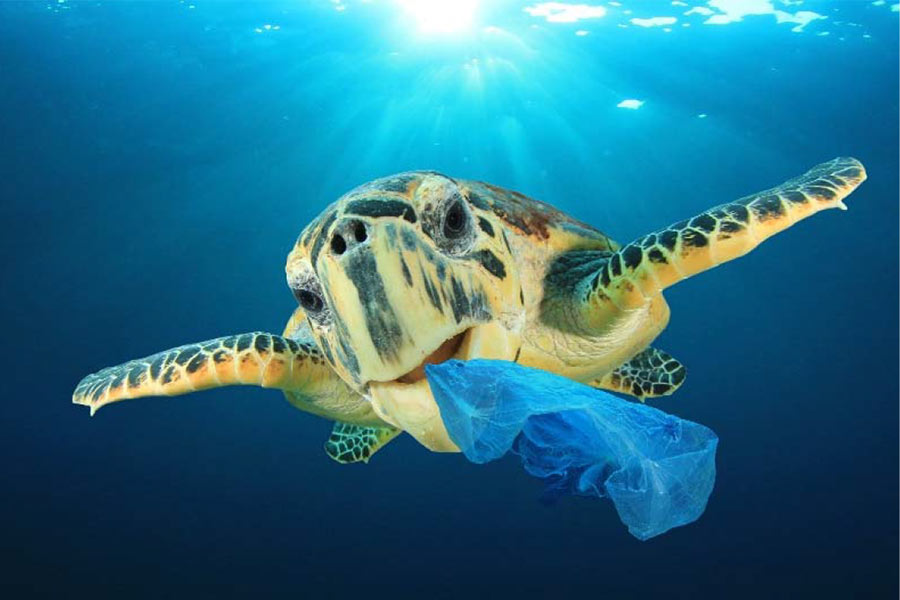
Turtles can mistake plastic bags for jelly fish.


The potential health, environmental, and economic costs are massive. An estimated 100,000 marine mammals and 1,000,000 seabirds die each year in the plastic killing fields. At the microscopic level, plastic is now a staple of the human diet, which gets 17% percent of its animal protein from the sea.

Fishing also contributes $1.5 trillion to the (legal) global economy, provide the livelihood to 12% of its population, and 17% of the animal protein consumed worldwide. In addition, illegal global fishing is estimated to be worth $25 billion per year.

Fortunately, unlike so many other man-made problems, continued dumping of plastic in the ocean can be solved. For one thing, the waste is actually valuable. Plastic packaging that is discarded is estimated to be worth over $100 billion a year. So, there is an economic incentive to monetize plastic trash. Doing so can help prevent plastic from being dumped in the ocean while simultaneously providing a source of income to the poor in developing countries.

There is also a tremendous potential market for any plant-based or a biodegradable plastic. For example, over 1,000,000 plastic water bottles are sold worldwide each minute, and 91% are not recycled. A bi-degradable plastic would have a huge market and likely government support. At the most recent G7 Summit in Charlevoix, Canada, five of the seven G7 members signed an Ocean’s Plastic Charter to encourage the reduction of plastic use, the development of alternative technologies, and the support of government roles in the recycling process (Japan and the U.S. did not sign).

Public awareness on the issue keeps building as well. For example, investors are starting to see heightened brand risk for companies who fail to reduce their plastic packaging. The environmental organization As You Sow recently brought together an alliance of investors representing $1 trillion in assets under management to engage companies on the necessity of reducing plastic in their packaging. The issue is not a hard sell because the environmental, economic, and moral arguments are manifest. When a garbage patch of plastic twice the size of Texas collects in the northern Pacific gyre, something is wrong. When developed countries recycle a fraction of what they can, something is wrong. When poor countries literally throw valuable trash in the ocean, something is wrong.

Given Coleridge’s poem, it is poignant that the albatross gave us our first glimpse into this problem, but it stands to reason. In the vastness of the Pacific, there is often only the albatross in sky. Some even say the albatross ferry the souls of sailors lost at sea. As it turns out, these timeless companions of the seafarer are very vulnerable to ingesting plastic. Albatross don’t dive deep; they skim the surface looking for squid and fish. Increasingly, they are ingesting all manner of plastic detritus in the process.

The albatross hung around the ancient Mariner’s neck as a reminder of what he had done. Hence the expression, “albatross around my neck.” The ancient Mariner’s lifelong penance was to tell his story so others would learn the tragic lesson:

He prayeth best, who loveth best All things both great and small; For the dear God who loveth us, He made and loveth all.

It is time to heed the ancient Mariner and stop the assault of plastic on the marine ecosystem. Anything less is tempting fate.

If you like this, subscribe here for more stories that Inspire The Future.

China’s Control of Cobalt May Leave Tech Investors Feeling Blue

Charles Marlow, the fictitious steamer captain from Joseph Conrad’s late 19th century novella Heart of Darkness was drawn to the vast “blank places” on the map that surrounded the Congo River. Today, the Democratic Republic of Congo (DRC) is no longer a blank place on the map, but it’s still a land gripped by instability. 

It is also where China has a choke hold on the world’s supply of cobalt. That poses a real risk for tech companies that rely on cobalt for lithium-based ion batteries. 

If you like this, subscribe here for more stories that Inspire The Future. 

Under the right circumstances, the combination of democracy and capitalism can lift humanity to a better version of itself. Those circumstances have never been present in the DRC. Since King Leopold II arrived from Belgium in the late 1800s, being born in the Congo has offered few blessings. In 2016, the United Nations ranked the DRC 177 out of 188 in their far reaching Human Development Index. 

Cobalt has been as much a curse as boon for the DRC. When state-run mining collapsed in the war-torn country, unregulated “artisanal” mines filled the void. These mines are often dug by hand in terrible conditions, far too often by children. By UNICEF’s estimates, 40,000 children work the cobalt supply chain. Amnesty International now considers cobalt a “conflict mineral” and title of the organization’s 92-page report on the mines evokes King Leopold’s ghost: “We die for this”.  Sadly, these are the “good jobs” in the DRC.

Although the Dodd-Frank Act does not yet list cobalt as a conflict mineral, U.S companies recognize the moral hazard. Earlier this year, Apple stopped sourcing hand-mined cobalt from the DRC and Tesla pledged to source its cobalt from North America. Unfortunately, finding a conflict-free supply is next to impossible. Cobalt sourced from artisanal mines is too easily mixed with large scale operations. The bigger problem for tech investors, however, may be Silicon Valley securing any supply at all.   

Last year China made the biggest private investment in the DRC’s history, when China Molybdenum announced it was buying U.S.-based Freeport McMoRan’s stake in the Tenke copper mine for $2.65 billion. Why is copper significant? Cobalt is produced primarily as a bi-product of nickel and copper mining, and the Tenke mine contains one of the world’s largest known deposits of copper and cobalt. In one stroke, China gained control of over 60% of the world’s cobalt supply.

This could be a problem for tech companies. Lithium-ion batteries already require 40% of the world’s cobalt.  For example, cobalt comprises around 15% of the Tesla/Panasonic electric vehicle (EV) battery. That means Tesla would require more than 6% of the current worldwide supply to both meet its pledge to source North American cobalt and meet its 2018 production targets. According to the United States Geological Survey, North America wouldn’t even produce enough for the Model 3 alone.

Keep in mind, Tesla is just one player in the growing demand for EV batteries. Morgan Stanley estimates EVs will represent 15% of the global car market by 2025. Much of that is driven by China which already represents 50% of the global market. By most estimates, China is growing at 200% per year (three to four times faster than the US and Europe). As is the case with most mass markets, China matters. 

For now, history is repeating itself in resource rich central Africa.The world is closing in like it once did on its elephant herds and rubber. For the people of the DRC, let’s hope this time, the results are different. And for investors, risk isn’t a blank place on the map. You just need to know where to look.

If you like this, subscribe here for more stories that Inspire The Future. 

0