We Need to Tell 2,000 People Before the World Finds Out


Tragically losing our CEO led us to build something that will outlast all of us. 

It was a sunny Saturday morning. My wife, Julie, and I had just finished breakfast at home. The windows were open, letting in that soft hum of summer — birds, a breeze, kids’ laughter as families rode by on their bikes. Then the phone rang.

Julie answered. I couldn’t hear the other end, just her voice — and the way it changed. “Oh my God. What happened?” Her tone told me everything before the words did. I felt it in my gut before she even said his name — Kevin. He died in his sleep on his boat at just 50 years old. I was in shock, disbelief, like the ground had disappeared from under me. We didn’t even get a moment to sit with it.

Our first thought was, “What can we do to help?” But almost instantly it became clear — we had to step in fast. Kevin was our CEO — a beloved 22-year veteran of the company — and now I had to figure out how to tell 2,000 people that the leader they knew, trusted, and followed was gone.

This wasn’t in any playbook. I’ve lost people — my sister, my brother, my parents — but I had never been the bearer of news like this. Never the one to hold the weight of so much collective grief. We called Sarah, Kevin’s closest executive confidant. His wife had just spoken with her. No one else knew, but that window wouldn’t last long. By Monday morning, the world would know, and we had less than 48 hours to get ready.

We prepared communications for the entire company, the advisory board, the public. It wasn’t just about messaging — it was about mourning. For some, Kevin was a mentor, a friend, a brother. For others, this was more about stability: “What happens now? Is my job safe? Is the company OK?” I had to somehow hold both the pain and the plan.

And the truth? I was grieving more than most of them. Kevin and I were close. After naming him my successor, I had stepped away from the day-to-day operations of the company and served as his mentor behind the scenes for over a decade. He was living the dream — guiding the company, spending weekends on his boat, fully in stride — and now he was gone.

I didn’t have experience leading through grief like this. I cracked time and time again, but I let people see it. I let them see me sad, and when I could, I offered comfort. I didn’t have all the answers, but I could offer my presence.

I relied heavily on others — internally and externally. Julie, whose background in crisis PR became a lifeline. Senior advisors, team leaders — I hadn’t been a visible face to many in the company for years, but there I was, showing up fragile and unsure, and even in that fragility, I had to become a lighthouse.

What kept me grounded was this: 2,000 people needed me to show them that we would find a way forward — and we did. That weekend and the months that followed taught me that leadership doesn’t mean knowing everything. It means being real. It means holding space for the mess, the hurt, the fear, and still saying, “There’s a way through.”

I learned to lean on others more than I ever had, and that changed everything. We transformed what had been a passive advisory board into an active leadership body. Together, we identified the top three priorities for the year — and we’ve done it every year since. That simple act aligned our organization like never before.

But perhaps the most powerful shift was what happened around succession. I used to think a succession plan was about picking the next CEO, but it’s so much bigger. Real succession is about building a structure that can survive anything — people coming and going, markets shifting, tragedies you never imagined.

Years earlier, we’d restructured into a franchise model, giving office leaders real equity and entrepreneurial control, but after Kevin’s death, we took it even further. We became an employee-owned public benefit corporation. From the CEO to the newest team member, everyone now has a stake. Everyone is building wealth from the value they create.

Here’s the hardest truth: This wouldn’t have happened without Kevin’s passing. If that tragedy hadn’t occurred, we likely would’ve followed the standard script — sold to private equity, disrupted the culture, maybe even lost what made us special.

Instead, we built something that will outlast all of us. My signature move — if I have one — is this: I love supporting entrepreneurs who are making a difference in their communities. Commercial real estate isn’t just about deals. It’s about the fabric of a community, a thriving main street, a place where people can live, work, and build something lasting.

What makes me proud isn’t that I founded this company. It’s that I’m leaving behind a structure where it can thrive without me, where leaders across the organization — not just one at the top — have real power and ownership. That’s a legacy I believe in.

To any CEO reading this, your moment will come, maybe more than once — a moment that upends your plans and cracks you wide open. When it does, let it. Let it change you. Let it show you what really matters. Let it invite you to build something not centered around you, but around us. It won’t be easy, but it will be worth it.


“I had to somehow hold both the pain and the plan.”


A Moment of Truth


I closed my successful PR firm of a decade to start over in the name of impact.

The novelist Chimamanda Adichie was the first to warn me about the danger of a single story. In her 2010 TED Talk, she says, “We are more than a single story… If we hear only a single story about another person or country, we risk a critical misunderstanding of the whole.” I do my best to live by her mantra. We are more than a single story — more than our worst thing and more than our best. Our lives are composed of so many overlapping stories. 

I can’t help but think back to one single story — one transformative experience — that changed everything about how I think, how I feel, and how I show up as a person, a business owner, a CEO, and a parent. Some might call it a Damascus moment — a biblical reference to Paul the Apostle, who had an experience that dramatically altered his life and beliefs. I call it my awakening.

It was Oct. 20, 2016, the night of the third presidential debate between candidates Hillary Clinton and Donald Trump. I had just put my 6- and 3-year-old girls to bed and sat down to take in this final debate before the November election. Chris Wallace was moderating, and the topic of the debate was the American economy. They were meant to be talking about the American people. They were meant to be talking about how they would support and center the American people through economic policies. Instead, they repeatedly focused on attacking each other and leaving the American people to fend for themselves.

This was more than egos at play. It was something far deeper, revealing a darker truth about the growing disconnect between our national leaders and the American people. Watching two of the most powerful people in the world attack each other on stage instead of addressing the questions of the people left me with a sensation I had never before experienced. I felt the future was about to get very, very bad — and I worried I had become part of the problem.

At the time, I was the founder and CEO of a PR firm that specialized in nonprofit communications. I had been running the agency successfully for more than a decade, guiding nonprofit leaders to tell their best stories in ways that could influence philanthropy, legislation, and communities to improve the human experience. I was doing my best to use communications as a force for good, and in many ways, I was — but that night sparked something deeper in me.

Had I been complicit in letting some of the storylines I heard that night take hold? Had I ignored the root causes of the clients’ stories we were telling? I had dedicated years of my life to supporting nonprofits whose mission was to break the cycle of poverty in America, but that cycle wasn’t breaking. Actually, poverty rates had barely budged. In 2004, the year I founded my company, 12.6% of the nation’s population lived below the poverty level. By that night in 2016, the percentage was 12.7%.

Over that 13-year period, I had helped direct millions of dollars to fighting poverty, but as I saw with fresh eyes that night, nothing was changing. It was time to stop lifting those in positions of power as the heroes and time to stop centering nonprofits as the single greatest solution-makers. If we were to actually move the needle on issues that affected Americans, we needed more people willing to speak the truth to power and more businesses to acknowledge their harms to society — and from my little corner of the world, I felt I could do something about it.

So that next week, I did something that many thought was ridiculous and short-sighted: I announced to my team that we were shutting down the firm, a financially successful business that at the time was thriving. We would take two months to wind down operations and start all over again. If I were to come to the work of storytelling from a place of truth, I would start from a different place — as a partner in the process, not a pawn in telling half-truths.

On Jan. 1, 2017, the doors to Mission Partners opened with a commitment to speak truth to power with love and a commitment to push just how far a business could go as a force for good. We were certified as a B Corp in 2018, and in holding firm to that commitment, we choose intentionally every day to challenge the standard norms of business. We distribute most of our profits back into the communities we serve. We challenge false urgency in our workplace and with our clients. We call out misinformation when we see it, and we check toxic power dynamics in our own company and in those we counsel — all in service of putting communities and people

back in the center of the stories we tell and in contributing to the type of society we believe America can be. In these times, our mission has never mattered more.

We all have moments that shape us, just as Oct. 16 shaped me. It’s what we do in those moments — and in every moment that follows — that ultimately defines us.


“I had helped direct millions of dollars to fighting poverty, but as I saw with fresh eyes that night, nothing was changing.”


My Advice on Starting Over

  • Dare to ask, “What if?” Consider where you can challenge and change a norm that might be holding you back from achieving greater impact in your business.
  • Use a wide lens. Consider your role as one within a movement, not of a moment. How can you use your business, your influence, and your actions to move people, organizations, and issues forward over time? Remember, a business doesn’t have to be big to effect big changes. Be clear, focused, and determined to use your resources wisely in service of long-term, lasting change.
  • Follow through. Showing up in service to others and the natural world around you requires continuous commitment and care. To build a business that operates as a force for good, commit to your values, align operations around your values, and consistently use those values to inform your business decisions.
  • Leave it better. In business, as in life, there will be wins and losses, triumphs and challenges, good days and bad ones. Every day can be an opportunity to do something positive.

No One Looked at Me

Here’s what being the only woman at the table taught me about respect.

I was in my early 30s when I became president of Syms Corp., a publicly traded company pioneering the off-price retail model. The term “glass ceiling” hadn’t even gone mainstream. I didn’t think of myself as a trailblazer. I thought of myself as a daughter continuing the legacy of a business my father started from the ground up. 

But very quickly I realized that I was not just taking over a company; I was stepping into rooms where no one looked like me — rooms full of older men, rooms where being underestimated was standard, rooms where speaking up meant being labeled “difficult” or “emotional.” I wasn’t just the youngest at the table — I was the only woman. That never stopped me, but it did shape me.

Early in my leadership, I learned something simple but defining: When people feel respected, they stay. They work harder. They trust. And when they don’t, they quietly disappear — emotionally first, physically later.

That’s a lesson I didn’t pick up from a consultant or an MBA case study. I learned it on the store floor. Retail is personal. Every day our employees showed up to help people find clothes for job interviews, weddings, funerals, and first dates. We weren’t just selling products — we were part of people’s lives. I saw firsthand how much better the work was when our teams felt valued. Our turnover stayed low. Our service stayed high. Our customers returned. Respect isn’t a “soft” skill. It’s a survival strategy, and it’s one too many leaders ignore — until it’s too late.

Of course, not every story ends in a win. There was a vendor deal — a big one, the kind that came with a national rollout and lots of upside. The team was excited, but something didn’t sit right with me. The financials felt overinflated. The pace felt rushed. I flagged my concerns in the room, but I didn’t push back hard enough. Everyone was eager, and I didn’t want to be the hold-up.

We signed. Six months later, it folded. We were left with unsellable inventory and some angry partners, but that wasn’t the worst part. The worst part was what it did to me. For weeks afterward, I questioned my instincts. I lost my footing. I started second-guessing my judgment in rooms where I had once spoken with confidence — and when that happens at the top, it trickles down.

Eventually, I found my voice again — but only after promising myself I’d never ignore it to make other people comfortable. That mistake taught me what experience often does: It’s not just about being right. It’s about being willing to stand alone, even when it’s unpopular.

In the decades since, I’ve seen every flavor of leadership — the command-and-control types, the absentee delegators, the charismatic heroes — but the leaders people remember, the ones they want to follow, share one common thread: They treat others with respect.

I often get asked what I’m proudest of. It’s not our IPO. It’s not how we scaled nationally. It’s not even that we were the first true off-price retailer in America. It’s this: People stayed. They stayed with us for 10, 15, even 20 years. They stayed through retail downturns and leadership changes. They stayed because they felt seen. As leaders, we’re measured in headlines and bottom lines, but the real legacy is how people feel after working with you. Did you make them braver? Did you make them better? Did you show them respect, even when no one was watching?

Being the only woman in the room taught me to notice who’s missing from the conversation, to make room for difference, to build bridges when others build walls. And that’s the challenge I leave you with — especially if you’re the one with power now. Don’t be impressive. Be impactful. Don’t just lead well. Lead in a way that makes others want to lead too. Respect is the quiet force behind loyalty, performance, and innovation. It’s not flashy. It doesn’t trend. But it works. And in the end, it’s what lasts.

“As leaders, we’re measured in headlines and bottom lines, but the real legacy is how people feel after working with you.”


What I Learned About Respectful Leadership

  •  Treat everyone like they matter. Not just the C-suite — everyone. Learn names. Ask about families. Show up when it’s inconvenient. People notice who notices them.
  • Protect quiet voices in loud rooms. I was interrupted constantly in my early years. I learned to pause meetings and say, “Let’s hear her out.” It sends a signal, and it shifts culture.
  • Give real feedback without tearing people down. You can challenge someone and still affirm their worth. Some of my most productive moments as a leader started with, “I believe in you, and I need more from you.”
  • Make space for invisible contributors. I built a habit of circling back to the person who didn’t speak up in meetings. Often, they had the best ideas — they just weren’t used to being asked.

Necessity: The Father of Invention


Sometimes the best ideas are born on the flipside of frustration.

It was 3 a.m. in 2017 when everything shifted. I was half-asleep, shuffling into the kitchen in a T-shirt and shorts, trying to mix formula for my hungry baby boy. He’d been waking often from casein intolerance, and I was beyond exhausted. In the dim light, I kept fumbling the measurements — too much water, then not enough, again and again wasting water and time.

That’s when the question hit me clearer than my baby’s cry: Why can’t my faucet just help me measure the exact amount I need? That moment of frustration cracked open an idea — a device that could connect water assets at the point of use. Droople was born in that haze of fatigue and fatherhood, and it changed me.

At the time, I was head of IT audit at a major bank. It was stable. It paid the mortgage. It supported my two eldest kids’ pensions. Leaving that security for a half-formed idea? Madness. But something inside me was stirring — a hunger for purpose. I wanted to wake up at night not just because a child cried, but because a mission called. Still, I was scared. I had four kids then, and I worried about investing too much in this “fifth child,” Droople. Would I fail them? Could I be a good father and a founder?

That’s when my wife, Aurélie — my everyday support in life — gave me the reassurance I needed. She reminded me that my role as a father wasn’t defined by hours clocked, but by presence and purpose, that I didn’t have to choose between the people I love and the change I wanted to make. Suddenly, the pieces started to align.

As a boy growing up in Constantine, Algeria, I knew what water scarcity meant. I watched my grandmother and mother fill tanks at night because the pressure couldn’t reach our 12th-floor apartment. Water was never just a utility — it was survival, dignity, memory. So when Droople emerged, I wasn’t just building a company; I was closing a loop, connecting my past to my future.

In that process, I discovered something else: I grow best in discomfort. Choosing to leap into the unknown showed me how far my commitment could carry me. It stretched me into roles I’d never imagined — founder, yes, but also more conscious father, more present husband, more grounded human.

I remembered that I’ve always transformed in pressure — from a schoolboy who struggled to make grades into a computer science engineer at EPFL, from a fisherman and cold-call salesman to a teacher, plumber, banker, and auditor. Every chapter taught me something.

But the biggest question? Whether I’m a dog or a wolf. The dog in me likes comfort, validation, and approval. But the wolf? The wolf is hungry, uncomfortable, and at peace with that — because out there in the wild is where growth lives.

Now, strangely, I find myself circling another turning point. Maybe my greatest test as a leader is yet to come — not by building, but by letting go. Maybe Droople needs someone new to take it further, someone with fresh hunger. Maybe my role is evolving. It’s hard to admit, but I’m not afraid — because this isn’t about clinging to control. It’s about listening deeply to what’s next and trusting the ones I’ve built with.

So to any CEO reading this — especially the ones secretly wondering if they’re enough: Dream big, but celebrate the small daily achievements along the way. We founders can be brutal on ourselves. We forget to look back, but it’s not about speed. It’s not even about growth. It’s about becoming the best version of yourself — slowly, steadily, and intentionally. If you pass that test, the terms of success become yours.

“Would I fail them? Could I be a good father and a founder?”


My Mantras for Innovating With Impact

  • You don’t need to have all the answers to get started. Don’t be afraid to dive in and learn as you go.

  • Scaling is a matter of patience. It took us seven years to reach our 4,000 units. Today, we add that many every month — but none of it would’ve lasted without those foundational years built slowly through trial, error, and lots of iteration.

  • Start structuring your team as soon as things begin to work. Going from 10 to 100 people isn’t linear growth — it’s a change of job skills. At Droople we put strong cultural foundations in place early on to stay on track as things got more complex. Culture is the intangible thing that holds the company together when everything speeds up.

  • Don’t just look for investors — look for peers. What helped me bounce back more than once were honest conversations with other founders, often outside official channels — not top-down advice, but real exchanges with people living the same realities.

  • What’s blocking you isn’t the strategy — it’s the execution. There’s never a shortage of ideas. What makes the difference is the ability to execute: hiring, launching, adjusting, deciding, and above all — delivering.

The (New) Heartbeat of Our Business

One defining moment led me to add purpose to every purchase.

It started in a conference room packed with entrepreneurs in Radio City Music Hall, New York. Blake Mycoskie, founder of TOMS, walked on stage. He talked about his one-for-one model: Buy a pair of shoes, and a child in need gets a pair too. It wasn’t flashy, it wasn’t complex — but something in me clicked. Eight of us from Shop LC were there. I turned to my team and said, “We’re doing this, but with food.” That was the spark, but the fire? That came later. 

A few weeks later, I sat with the president of Akshaya Patra. I’d been personally supporting the organization for years. They feed schoolchildren across India fresh, hot meals made daily in high-tech kitchens — but I’d never asked what they were missing. So I asked, and what he said hit me like a punch to the chest: “We have the kitchens, we have the trucks, but we don’t have enough money for food.” 

Then he added something that changed everything for me: “If a child doesn’t get a meal, their parents don’t send them to school. They send them to work — in kilns, quarries, factories. A meal is the difference between education and child labor.” That was it. I couldn’t unhear it, couldn’t unsee it. In that moment, Shop LC stopped being just a retail business. I walked away knowing every product we sell must feed a child. 

We launched Your Purchase Feeds the next quarter. Every item sold equals one meal for a child in need. We started in the United Kingdom, then expanded to the United States, then Germany. Today, we feed over 50,000 children every school day, supporting more than 300 schools. We’ve provided 53 million meals globally — and we’re not done yet. Our goal is 1 million meals a day by 2040. And that’s just Shop LC. Globally, the parent company VGL has crossed 100 million meals. 

Let me be clear: This isn’t a donation program. It’s not a checkbox on a corporate social responsibility report. It’s the heartbeat of our business, and it’s changed everything about how I lead. When you know that your success puts food on a child’s plate, that hitting your sales goals means that kid stays in school, you don’t cut corners. You don’t chase cheap wins. You lead with heart. You hold the team to a higher standard. You think about every missed shipment a little differently — because someone somewhere is counting on us. 

I didn’t build Shop LC to end hunger. I built it to sell beautiful things, but somewhere along the way, purpose walked in and refused to leave — and thank goodness it did because the company that feeds children, that’s the company I want to run. That’s the company I want to be remembered for — one meal, one child, one click at a time. 


“This isn’t a donation program. It’s not a checkbox on a corporate social responsibility report. It’s the heartbeat of our business, and it’s changed everything about how I lead.”

Written by: Sunil Agrawal, Founder & CEO of Shop LC


Guide to How I Lead With Purpose

Listen beyond financials. Numbers tell you what’s happening, but not always why. I walk the floor, speak to teams, and listen to what isn’t in the reports. That’s where you catch the signals early — morale shifts, process gaps, ideas waiting to be heard. For any CEO, some of the most valuable insights come from quiet conversations before dashboards.

Bake impact into your business model. At Shop LC, every item sold funds a meal through our Your Purchase Feeds program. It’s not a separate initiative; it’s built into how we work. The long-term goal is one million meals a day by 2040. For me, impact isn’t the add-on. It’s part of the purpose and the product. That makes it real for everyone involved.

Doing good is good for your business. When people believe in what you stand for, they stay longer and care more. Customers feel it. Employees feel it. At Shop LC, doing good has helped with retention, loyalty, and reputation. It’s not charity; it’s strategy with heart.

Hold yourself and your team to higher standards. I often say that high performance starts with high expectations. I set the tone by leading with clarity, consistency, and trust. When people know the bar is high and they’re supported to meet it, they rise to it. That’s how strong cultures are built.

Real Leaders UNITE 2024 – Day 3: Shine

At UNITE, a Star is Born

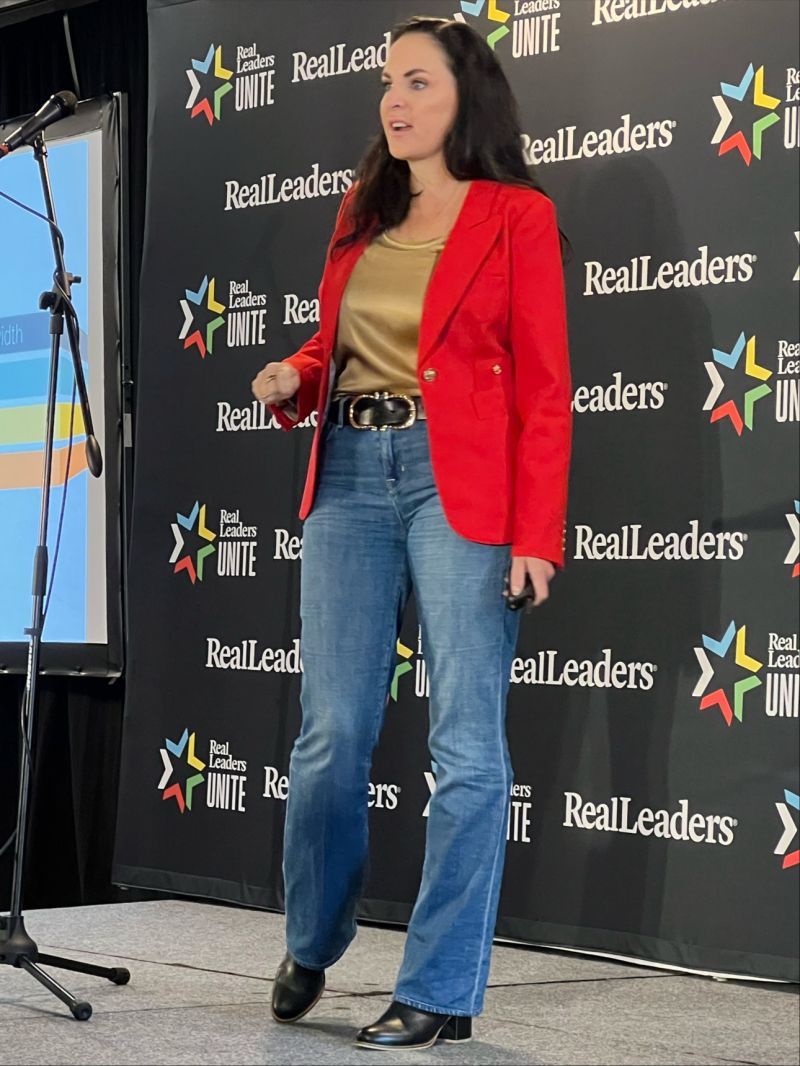
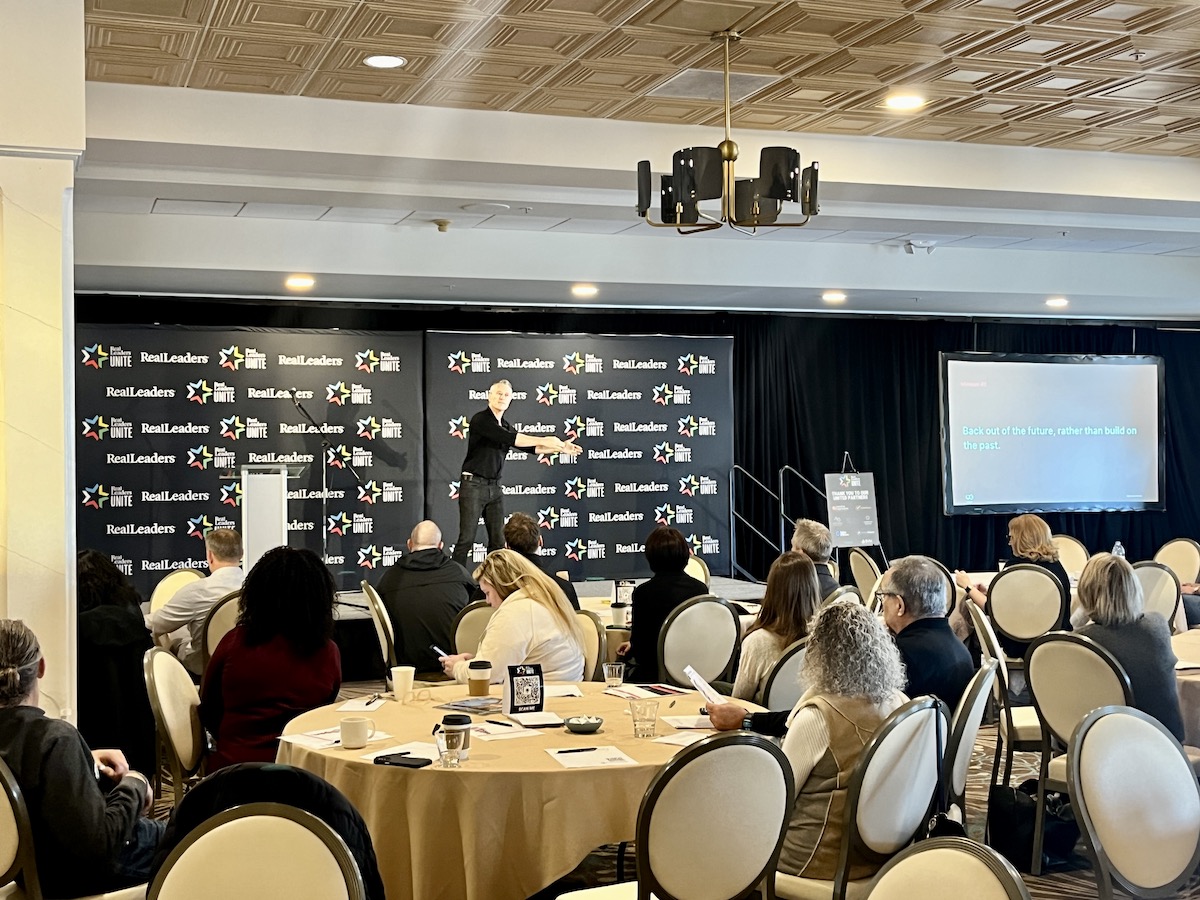
By Day 3, everyone had decided to stay at Kona Kai and form an independent nation of impact businesses. Just kidding, but what if, right? All jokes aside, Day 3 started with a surf session for the daring and a cacao ceremony for the contemplative. A cozy breakfast led to a phenomenal keynote by Tamara Loehr, co-founder of Beusail Academy and Concertina Team. Loehr delved into the strategy for fellow entrepreneurs and CEOs to scale and exit their companies through net-positive business models, scalable lead gen and sales processes, and digital transformation. She left everyone with a gem of a worksheet to work on during their plane rides home that helped them articulate their personal brand. Throughout Day 3, our world-class media team, Carla Kalogeridis and Kathryn Deen, were interviewing CEOs to get their stories into Real Leaders magazine.


Another Series of Difficult Decisions Ensued…

Real Leaders wanted to pack UNITE to the brim with world-class content. Unfortunately, for every speaker to be heard by every attendee, we would need to put on a 10-day conference. To any CEOs reading this, we would never ask you to leave your baby (or fur baby) for that long. Luckily, everything was recorded and will be released soon to be listened and re-listened to your heart’s content. Here’s who spoke during Day 3:

Richard Yelland, Founder and Director of Curtis Birch, Inc. — Turn Your Mission Into A Movement Through Storytelling

Simon Mainwaring, Founder and CEO of We First Inc. — Lead With Impact: How to Elevate Your Business Growth

Kevin Edwards, President of Real Leaders — Be Your Own Media Company

Those lucky enough to attend any of these talks were famished from the pure amount of knowledge consumption and promptly made their way to grab snacks before the final keynote. Shadi Bakour is the 31-year-old CEO of a company that is reimagining how we drink water. PATH Water has been around since 2015 and has seen massive growth over the past nine years. Bakour explained that his secret ingredient for this growth was simple: Collaborate with everyone. Bakour’s talk centered around the importance of co-branding and dispelled the common fear of brand purity in lieu of a cross pollination effect where in one brands customers are shared with the other through the simple act of putting them on their label.

Bakour answered a round of questions and was followed from the stage with resounding applause. Kevin Edwards and Tiffany Saunders, director of member impact of Real Leaders, closed out UNITE with a recap of the event for everyone in attendance, expressing gratitude to our sponsors, Creative Alignments, Sure Call, Salas O’ Brien, Priority Power, Big Path Capital, Central Reach, SVN, and Sunrise Banks, as well as every member of Real Leaders in attendance. With everyone starting to get up to head back to their home and their businesses, a voice called out, “Wait!” What transpired next is something many at a business conference would never expect. Christina Huang, associate principle at Green Dinosaur Inc, took the stage with a flute to perform an original Native American song inspired by UNITE. She serenaded the audience with extreme beauty and grace. What a way to end such a memorable conference.

Just like that, UNITE came to an end, and everyone better off for it happening. Social media posts followed expressing gratitude, joy, and a whole lot of love. We want to take this time to thank everyone who made UNITE 2024 possible and everyone who took valuable time away from their business to attend. We’ll see everyone again in 2025, and we can’t wait to welcome some new faces too.

Add Yourself to the Short List

Thank you for taking the time to read about Day 3 of UNITE 2024. Please consider sharing it with one leader whom you think deserves to be at UNITE 2025. If you would like to be added to the short list to receive first dibs at pre-sale pricing, please add your email below. Thank you again to all of the people who made this community thrive at UNITE 2024. We can’t wait to deliver another incredible experience in 2025.


Real Leaders UNITE 2024 – Day 1: Fusion

The Big Bang

On Feb. 5, 2024, 100 CEOs, investors, coaches, and speakers started to trickle into the unusually rainy San Diego area. They made their way to Kona Kai resort, located on Shelter Island, a small neighborhood in Port Loma. Despite the rain, there was an unmistakable buzz of excitement in the air. Many of these people had been meeting virtually for years and were finally about to meet members of their forum in person. Not only that, they knew they were about to attend a first-of-its-kind event. Not entirely sure what to expect, they knew that these next few days would undeniably be something special.


After checking in with the hotel, they were greeted by Real Leaders staff and led to registration. Gift bags, name tags, handshakes, and warm hugs were most definitely not in short supply. What seemed like a rather large empty ballroom just a few hours before was now brimming with excited conversation from a variety of groups who were coming together for the first time. The buzz of excitement was quickly turning into a full-on outpouring of laughs and an almost electric engagement. A few people noticed someone whom they recognized from his weekly LinkedIn livestreams for the Real Leaders Podcast make his way to the stage, some remarking that he was much taller in real life than he was on their screens. “Welcome to Real Leaders UNITE, everyone. Thank you for being here.” Real Leaders President Kevin Edwards was standing at center stage, microphone in hand. The din of voices became a whisper until the room of 100 was all looking at Edwards, poised and ready to deliver his opening remarks. Edwards spoke about how UNITE came to be. During the long planning sessions, the question asked again and again was, “What builds community?” The answer inevitably was, “coming together to build human connections that translate to the business world.”

As Edwards wrapped up his opening remarks, he introduced a new speaker to the stage. An author of multiple books, most recently, The Profiteers: How Business Privatizes Profits and Socializes Costs, Chris Marquis was greeted and given the spotlight. Marquis is the Sinyi professor of Chinese management at the University of Cambridge Judge Business School. Maqruis’ keynote address spoke to the need to embody a collective dedication to catalyzing change, fostering collaboration, and reshaping paradigms to usher in a more equitable and sustainable future. As the wrapped audience came to a thundering applause at the end of Marquis’ speech, Edwards came back on stage to direct everyone to the main course for the evening, forming the group forums.

Forums For All

This is where the magic really happened. People went in as acquaintances and came out as allies. Adlai Stevenson I said, “The first principle of a free society is an untrammeled flow of words in an open forum.” Although not a society, the beginnings of a real sense of community were beginning to form. The power of confidential forum is difficult to understand until you experience it, but in it’s simplest sense, it is a truly open and free setting to discuss business, life, and the unique role of being an impact CEO in a confidential, intimate setting.

Mapping The Impact Universe

With forums wrapping up, these leaders made their way back to the main stage where Marquis’ words of transformative change were still fresh in their minds. A new face was on stage, someone who a few of these people had known as a member of their forum for the past year. Mike Brown, previously the CEO of Impact Grove and member of the Real Leaders community, recently decided to take his impact to the next level by joining Real Leaders as Chief Impact Officer. His easy smile and confident demeanor were still the same, but many noticed that Brown had an even deeper sense of meaning in his life. He spoke about this on the stage, acknowledging that this transition was something he took on because he knew that, as a part of Real Leaders, he could make an even greater impact than he could as a founder. He went on to explain that it was his goal to create an impact in each and every business that was present that night and that he wanted to start by mapping the impact universe. He held up a large poster board and asked every person there to put a quote on the board, a headline that might one day make its way to Real Leaders magazine. As you can see below, people were pretty excited to put their name on the map.

Day 1 was coming to a close, and people were still buzzing. Conversations continued long after the speeches were over. People just needed to talk about what they had experienced and explain how it was going to influence their business. Yet, UNITE was far from over. Everyone knew that Day 2 was going to be a big one and so, one by one, they made their way to their rooms to rest and prepare for another big day of impact.

Add Yourself to the Short List

Thank you for taking the time to read about Day 1 of UNITE. Please consider sharing it with one leader whom you think deserves to be at UNITE 2025. If you would like to be added to the short list to receive first dibs at pre-sale pricing, please add your email below. Thank you again to all of the people who made this community thrive at UNITE 2024. We can’t wait to deliver another incredible experience in 2025.


Real Leaders UNITE 2024 – Day 2: Explosion

A Meeting of Giants

Day 2 exploded right off the bat. Real leaders gathered rejuvenated and ready for another day of collaboration with their peers. Yet who could really be ready for a panel that included Felecia Hatcher, CEO of Black Ambition; Allie Burns, CEO of Village Capital; and none other than “The Shark,” Daymond John. Julie VanNess, CEO of Real Leaders, opened with a speech discussing the journey of Real Leaders, and how her passion for impact business, in tandem with Real Leaders Founder Mark VanNess, ultimately culminated at UNITE. She then introduced moderator Kevin Edwards and the panel of these three industry giants, who discussed everything from how to pitch your company to what to look for in a capital partnership.

After taking questions from the rapt audience, Edwards introduced the next activity, the Real Leaders pitch competition. Two entrepreneurs, Elikem Tettey-Tamaklo, COO of Therapeutic Innovations, and Chloë Cheyenne, founder and CEO of COMMUNITYx, both had five minutes to make their pitch to the panel and to answer questions from them. We won’t tell you who won — you’ll have to wait for the video to release — but needless to say, it was an absolute whirlwind.

A Difficult Decision

After this, everyone was faced with a number of difficult choices. Multiple world-renowned speakers were giving unmissable talks, all of which you’ll be able to watch soon. Below are a list of the speakers and their topics.

Lisa Bodell, CEO of FutureThink — Killing Complexity

Stedman Graham, Chairman & CEO of S. Graham & Associates — Identity Leadership

Peggy Shell, Founder and CEO of Creative Alignments — Fueling the Energy that Runs our World: People

Michael Whelchel, Co-Founder and Managing Partner of Big Path Capital — Redefining Capital for CEOs: Impactful Transitions, Raises, and Exits

Keren Eldad, CEO of With Enthusiasm Coaching — How to Blast Past Impostor Syndrome and Truly Lead

Brad Stevens, Founder and CEO of Outsource Access — An Ironic Talent Solution: How to Retain and Attract Internal Talent by Outsourcing

Matthew Weatherly-White, Chief Investment Officer of Align Impact — Shaping the Future of Capitalism

Mackey McNeill, Founder of MACKEY — Essentials for a Regret-Free Exit

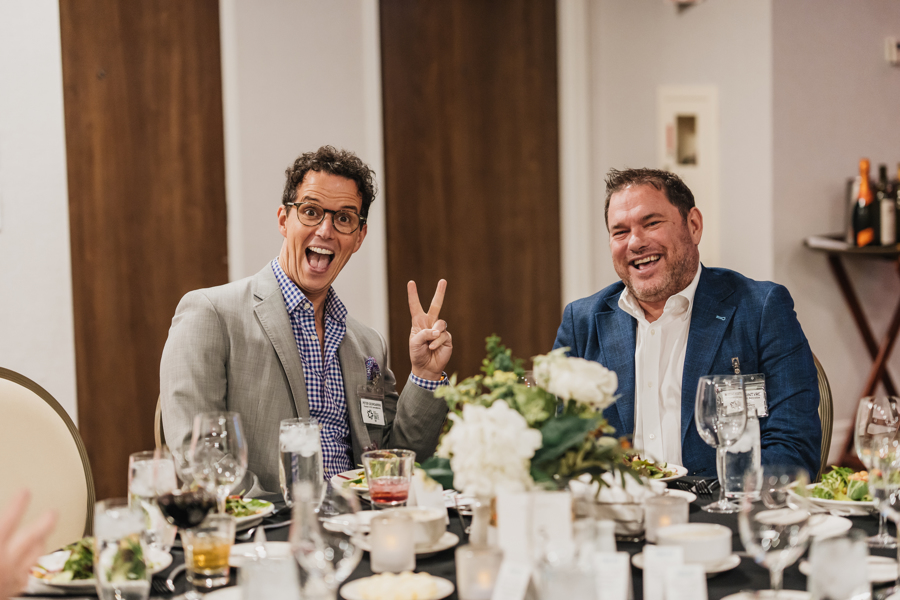
After these groundbreaking sessions, everyone had a chance to catch their breath and freshen up before the main event. People gathered for cocktail hour to mingle and take their turns being interviewed on the red carpet by Kathryn Deen, Real Leaders magazine’s managing editor. Under the bright lights and cameras, these stars shone bright.

UNITE Gala Dinner

As the gala dinner began, Edwards introduced one of the harder-hitting speeches by Geoff Davis, of Sorenson Impact. Davis told the story of the conception of Sorenson, how he overcame a life-threatening disease, and ultimately what it means to be dedicated to impact work. Yet nobody could be prepared for what came next.

A video shot from the point of view of an astronaut marooned in space, on a mission to align the stars of the impact community. He hears that Real Leaders have gathered from across the globe to UNITE and spread their impact across the galaxy. He goes into hyper drive, crash lands in the San Diego bay and surfs to the shore all the while the winners of the 2024 Top Impact Companies are highlighted on screen. We watch as he dances his way all the way to Kona Kai resort with the final shot showing him enter through the very doors everyone came through from the cocktail reception. Suddenly an astronaut bursts through the actual doors in the back and runs up to the stage. He takes off his helmet. It’s none other than Kevin Edwards, president of Real Leaders. He congratulates all of the Top Impact Company winners and after his speech takes pictures on the red carpet with them. Cocktails, laughter, and bubbling conversation close out Day 2.

Add Yourself to the Short List

Thank you for taking the time to read about Day 2 of UNITE 2024. Please consider sharing it with one leader whom you think deserves to be at UNITE 2025. If you would like to be added to the short list to receive first dibs at pre-sale pricing, please add your email below. Thank you again to all of the people who made this community thrive at UNITE 2024. We can’t wait to deliver another incredible experience in 2025.


Real Leaders UNITE 2024 – Day 3: Shine

At UNITE, a Star is Born

By Day 3, everyone had decided to stay at Kona Kai and form an independent nation of impact businesses. Just kidding, but what if, right? All jokes aside, Day 3 started with a surf session for the daring and a cacao ceremony for the contemplative. A cozy breakfast led to a phenomenal keynote by Tamara Loehr, co-founder of Beusail Academy and Concertina Team. Loehr delved into the strategy for fellow entrepreneurs and CEOs to scale and exit their companies through net-positive business models, scalable lead gen and sales processes, and digital transformation. She left everyone with a gem of a worksheet to work on during their plane rides home that helped them articulate their personal brand. Throughout Day 3, our world-class media team, Carla Kalogeridis and Kathryn Deen, were interviewing CEOs to get their stories into Real Leaders magazine.


Another Series of Difficult Decisions Ensued…

Real Leaders wanted to pack UNITE to the brim with world-class content. Unfortunately, for every speaker to be heard by every attendee, we would need to put on a 10-day conference. To any CEOs reading this, we would never ask you to leave your baby (or fur baby) for that long. Luckily, everything was recorded and will be released soon to be listened and re-listened to your heart’s content. Here’s who spoke during Day 3:

Richard Yelland, Founder and Director of Curtis Birch, Inc. — Turn Your Mission Into A Movement Through Storytelling

Simon Mainwaring, Founder and CEO of We First Inc. — Lead With Impact: How to Elevate Your Business Growth

Kevin Edwards, President of Real Leaders — Be Your Own Media Company

Those lucky enough to attend any of these talks were famished from the pure amount of knowledge consumption and promptly made their way to grab snacks before the final keynote. Shadi Bakour is the 31-year-old CEO of a company that is reimagining how we drink water. PATH Water has been around since 2015 and has seen massive growth over the past nine years. Bakour explained that his secret ingredient for this growth was simple: Collaborate with everyone. Bakour’s talk centered around the importance of co-branding and dispelled the common fear of brand purity in lieu of a cross pollination effect where in one brands customers are shared with the other through the simple act of putting them on their label.

Bakour answered a round of questions and was followed from the stage with resounding applause. Kevin Edwards and Tiffany Saunders, director of member impact of Real Leaders, closed out UNITE with a recap of the event for everyone in attendance, expressing gratitude to our sponsors, Creative Alignments, Sure Call, Salas O’ Brien, Priority Power, Big Path Capital, Central Reach, SVN, and Sunrise Banks, as well as every member of Real Leaders in attendance. With everyone starting to get up to head back to their home and their businesses, a voice called out, “Wait!” What transpired next is something many at a business conference would never expect. Christina Huang, associate principle at Green Dinosaur Inc, took the stage with a flute to perform an original Native American song inspired by UNITE. She serenaded the audience with extreme beauty and grace. What a way to end such a memorable conference.

Just like that, UNITE came to an end, and everyone better off for it happening. Social media posts followed expressing gratitude, joy, and a whole lot of love. We want to take this time to thank everyone who made UNITE 2024 possible and everyone who took valuable time away from their business to attend. We’ll see everyone again in 2025, and we can’t wait to welcome some new faces too.

Add Yourself to the Short List

Thank you for taking the time to read about Day 3 of UNITE 2024. Please consider sharing it with one leader whom you think deserves to be at UNITE 2025. If you would like to be added to the short list to receive first dibs at pre-sale pricing, please add your email below. Thank you again to all of the people who made this community thrive at UNITE 2024. We can’t wait to deliver another incredible experience in 2025.


Real Leaders UNITE 2024 – Day 1: Fusion

The Big Bang

On Feb. 5, 2024, 100 CEOs, investors, coaches, and speakers started to trickle into the unusually rainy San Diego area. They made their way to Kona Kai resort, located on Shelter Island, a small neighborhood in Port Loma. Despite the rain, there was an unmistakable buzz of excitement in the air. Many of these people had been meeting virtually for years and were finally about to meet members of their forum in person. Not only that, they knew they were about to attend a first-of-its-kind event. Not entirely sure what to expect, they knew that these next few days would undeniably be something special.


After checking in with the hotel, they were greeted by Real Leaders staff and led to registration. Gift bags, name tags, handshakes, and warm hugs were most definitely not in short supply. What seemed like a rather large empty ballroom just a few hours before was now brimming with excited conversation from a variety of groups who were coming together for the first time. The buzz of excitement was quickly turning into a full-on outpouring of laughs and an almost electric engagement. A few people noticed someone whom they recognized from his weekly LinkedIn livestreams for the Real Leaders Podcast make his way to the stage, some remarking that he was much taller in real life than he was on their screens. “Welcome to Real Leaders UNITE, everyone. Thank you for being here.” Real Leaders President Kevin Edwards was standing at center stage, microphone in hand. The din of voices became a whisper until the room of 100 was all looking at Edwards, poised and ready to deliver his opening remarks. Edwards spoke about how UNITE came to be. During the long planning sessions, the question asked again and again was, “What builds community?” The answer inevitably was, “coming together to build human connections that translate to the business world.”

As Edwards wrapped up his opening remarks, he introduced a new speaker to the stage. An author of multiple books, most recently, The Profiteers: How Business Privatizes Profits and Socializes Costs, Chris Marquis was greeted and given the spotlight. Marquis is the Sinyi professor of Chinese management at the University of Cambridge Judge Business School. Maqruis’ keynote address spoke to the need to embody a collective dedication to catalyzing change, fostering collaboration, and reshaping paradigms to usher in a more equitable and sustainable future. As the wrapped audience came to a thundering applause at the end of Marquis’ speech, Edwards came back on stage to direct everyone to the main course for the evening, forming the group forums.

Forums For All

This is where the magic really happened. People went in as acquaintances and came out as allies. Adlai Stevenson I said, “The first principle of a free society is an untrammeled flow of words in an open forum.” Although not a society, the beginnings of a real sense of community were beginning to form. The power of confidential forum is difficult to understand until you experience it, but in it’s simplest sense, it is a truly open and free setting to discuss business, life, and the unique role of being an impact CEO in a confidential, intimate setting.

Mapping The Impact Universe

With forums wrapping up, these leaders made their way back to the main stage where Marquis’ words of transformative change were still fresh in their minds. A new face was on stage, someone who a few of these people had known as a member of their forum for the past year. Mike Brown, previously the CEO of Impact Grove and member of the Real Leaders community, recently decided to take his impact to the next level by joining Real Leaders as Chief Impact Officer. His easy smile and confident demeanor were still the same, but many noticed that Brown had an even deeper sense of meaning in his life. He spoke about this on the stage, acknowledging that this transition was something he took on because he knew that, as a part of Real Leaders, he could make an even greater impact than he could as a founder. He went on to explain that it was his goal to create an impact in each and every business that was present that night and that he wanted to start by mapping the impact universe. He held up a large poster board and asked every person there to put a quote on the board, a headline that might one day make its way to Real Leaders magazine. As you can see below, people were pretty excited to put their name on the map.

Day 1 was coming to a close, and people were still buzzing. Conversations continued long after the speeches were over. People just needed to talk about what they had experienced and explain how it was going to influence their business. Yet, UNITE was far from over. Everyone knew that Day 2 was going to be a big one and so, one by one, they made their way to their rooms to rest and prepare for another big day of impact.

Add Yourself to the Short List

Thank you for taking the time to read about Day 1 of UNITE. Please consider sharing it with one leader whom you think deserves to be at UNITE 2025. If you would like to be added to the short list to receive first dibs at pre-sale pricing, please add your email below. Thank you again to all of the people who made this community thrive at UNITE 2024. We can’t wait to deliver another incredible experience in 2025.


0