Renewable Energy: Managing Investors’ Risks and Responsibilities

Renewable energy investments could be at risk from overlooking harms to local communities.

Managing these impacts is key to secure a fast and fair transition to a low-carbon economy, and safeguard financial returns, according to analysis by Business & Human Rights Resource Centre, Transform Finance and Sonen Capital. This briefing sets out why investors in renewable energy should take action to ensure projects respect local communities’ rights and provides tools to use in their investment relationships.

The Paris Climate Agreement and the UN Sustainable Development Goals have clearly signaled the future of energy is in renewables. This shift has opened up a host of opportunities for investors, but also serious risks. Business & Human Rights Resource Centre has received 115 concerns of harms to local communities linked to renewable projects since 2005 including on land grabs, displacement of indigenous peoples, violence and killings. 94 out of those concerns were raised since 2010.

“The time is now for investors to take steps and engage with renewable energy companies and projects in their portfolios to ensure respect for human rights. The majority of renewable energy companies do not yet have rigorous human rights safeguards in place – only 5 out of 50 of wind and hydropower companies refer to respecting indigenous peoples’ internationally recognised right to free, prior & informed consent,” said Phil Bloomer, Executive Director of Business & Human Rights Resource Centre.

The briefing shows that investors must be vigilant to the way in which renewable energy projects are implemented, as they can harm communities in which they operate. These harms can result in costly delays, legal costs, and reputational risks. Through case studies, examples and practical recommendations, the briefing helps investors shape a new energy system that considers human rights and community engagement as the cornerstone for sustainable energy development.

“As long-term investors, we believe that the analysis of human rights in the renewable energy context set forth in this briefing is fundamental. We need to foster more community engagement to ensure that the transition to renewable energy truly benefits communities and does not create undue risk for investors. This view of investment as management of financial, human and environmental capital underpins CalPERS’ beliefs,” said Anne Simpson, Investment Director, Sustainability, of the California Public Employees’ Retirement System (CalPERS), with $300 billion assets under management.

With input from over 30 experts and investors including Principles for Responsible Investment and UNEP Finance Initiative, the briefing demonstrates how integrating human rights considerations early on in the decision-making process, while prioritizing building strong and equitable relationships based on engagement with affected communities, can reduce the likelihood of conflicts that undermine a project’s success. These practices also help ensure that all stakeholders benefit from the investment, from financial, environmental and social perspectives.

The briefing is intended for any investor holding or considering investments in renewable energy projects, whether through direct or indirect ownership.

Written by: Evan Steiner

Original Article: Transform Finance


Renewable Energy: Managing Investors’ Risks and Responsibilities

Renewable energy investments could be at risk from overlooking harms to local communities.

Managing these impacts is key to secure a fast and fair transition to a low-carbon economy, and safeguard financial returns, according to analysis by Business & Human Rights Resource Centre, Transform Finance and Sonen Capital. This briefing sets out why investors in renewable energy should take action to ensure projects respect local communities’ rights and provides tools to use in their investment relationships.

The Paris Climate Agreement and the UN Sustainable Development Goals have clearly signaled the future of energy is in renewables. This shift has opened up a host of opportunities for investors, but also serious risks. Business & Human Rights Resource Centre has received 115 concerns of harms to local communities linked to renewable projects since 2005 including on land grabs, displacement of indigenous peoples, violence and killings. 94 out of those concerns were raised since 2010.

“The time is now for investors to take steps and engage with renewable energy companies and projects in their portfolios to ensure respect for human rights. The majority of renewable energy companies do not yet have rigorous human rights safeguards in place – only 5 out of 50 of wind and hydropower companies refer to respecting indigenous peoples’ internationally recognised right to free, prior & informed consent,” said Phil Bloomer, Executive Director of Business & Human Rights Resource Centre.

The briefing shows that investors must be vigilant to the way in which renewable energy projects are implemented, as they can harm communities in which they operate. These harms can result in costly delays, legal costs, and reputational risks. Through case studies, examples and practical recommendations, the briefing helps investors shape a new energy system that considers human rights and community engagement as the cornerstone for sustainable energy development.

“As long-term investors, we believe that the analysis of human rights in the renewable energy context set forth in this briefing is fundamental. We need to foster more community engagement to ensure that the transition to renewable energy truly benefits communities and does not create undue risk for investors. This view of investment as management of financial, human and environmental capital underpins CalPERS’ beliefs,” said Anne Simpson, Investment Director, Sustainability, of the California Public Employees’ Retirement System (CalPERS), with $300 billion assets under management.

With input from over 30 experts and investors including Principles for Responsible Investment and UNEP Finance Initiative, the briefing demonstrates how integrating human rights considerations early on in the decision-making process, while prioritizing building strong and equitable relationships based on engagement with affected communities, can reduce the likelihood of conflicts that undermine a project’s success. These practices also help ensure that all stakeholders benefit from the investment, from financial, environmental and social perspectives.

The briefing is intended for any investor holding or considering investments in renewable energy projects, whether through direct or indirect ownership.

Written by: Evan Steiner

Original Article: Transform Finance


Good Energy for Good Business

How eco-labelled renewable energy can power a sustainable economy.

For a growing number of companies, electricity is a prime resource in the value chain. However, several global corporations have come under fire from the general public, shareholders and major NGOs with regards to energy procurement. The failure to adequately manage corporate energy can leave a company vulnerable to risks, such as changing regulations and legal requirements. What is more, being seen as a big polluter carries detrimental effects for any brand.

More and more companies have set themselves a target of growing the share of renewable energy in their consumption. These commitments have been reflected in the global investments in sustainable energy: the past year witnessed an investment in renewables capacity that was roughly double that in fossil fuel generation. According to the latest report by the United Nations Environment Programme and Bloomberg New Energy Finance, the corresponding new capacity from renewables was equivalent to 55% of all new power, the highest to date.

Leading businesses and renewable energy experts have also joined forces to form RE100, a global initiative aimed at motivating and recruiting major companies to use 100% renewable power across their operations. Launched at the New York Climate Week back in 2014, the campaign has continued to gather momentum, drawing commitments from over 100 leading companies in just the span of three years. The initiative is also a reflection of the wider interest to disclose and communicate corporate performance in energy: calculating and, more importantly, reducing emissions from purchased or acquired electricity (“Scope 2 emissions”) is a prerequisite for inclusion in the CDP’s prestigious Carbon Disclosure Leadership Index.

Nonetheless, joining initiatives and disclosing data alone will not be enough to boost corporate brand image and ranking, nor to ensure the “greenness” of energy. A key challenge for today’s multinational companies is the difficulty, in certain jurisdictions, of tracing whether the electricity they consume was produced using renewables or fossil fuels and nuclear. For tracing the origin of power, renewable energy certificates (RECs) are key. RECs contain and disclose the renewable sources from which the electricity is consumed and are issued for every megawatt-hour (MWh) of electricity produced by a power station. Currently REC systems exist in the U.S., Canada, Europe (going by the name of ‘Guarantees of Origin’), Australia, and Japan, as well as in several developing countries under the International REC Standard.

However, not all RECs are the same in terms of impact. Only certain RECs with eco-labels ensure that the sources of energy are additional – or, in other words, that the purchased renewable energy certificates have had or will have an impact on the development of new renewable energy installations and yield added ecological value.

An example of an eco-label is EKOenergy: the supplier of EKOenergy labelled RECs contributes 0.10 Eur/MWh of to the Climate Fund, which in turn makes investments in new off-grid small scale renewable energy projects in developing countries. The fund contributed over 300’000 Euro so far in new solar installations in some of the world’s poorest countries.

Another eco-label is GoldPower: GoldPower labelled RECs stem only from recently built power plants that contribute to Sustainable Development Goals (SDGs) and have quantifiable, positive impacts on communities. Developed together with the WWF in 2009, GoldPower has recently been updated to include the Gold Standard Renewable Energy Label.

Major market influencers and RE100 signatories have purchased GoldPower in the past, including the likes of SAP, Microsoft, Novo Nordisk and Tetra Pak. In the words of Mario Abreu, VP Environment at Tetra Pak: “We want to support the transition to a low-carbon, sustainable economy so it is incredibly important to us that the renewable energy we buy comes from new or recently built installations that also provide broad sustainability benefits for local communities.”

So why should other brands care? There are a plethora of benefits gained from a pivot towards renewable energy, and especially if sourced from projects that additionally contribute in a substantiated manner to the SDGs. Companies not only reduce their carbon footprint, but also demonstrate their commitment to their employees, customers and investors. Equally importantly, smart corporates can hedge against risks: the move to a low-carbon future is inevitable, and as societies and economies unlock from fossil fuels, the transition to renewables makes long-term economic sense for businesses.

As in the case of Tetra Pak, companies are becoming more demanding about how exactly their green power is produced. And rightfully so: leading organisations are already leveraging renewable energy certificates to hedge against transitional risks, reach their sustainability targets, and reflect an essential character of their brand. The unique capacity of eco-labelled RECs to secure new renewable energy production, mitigate business risks, and engage local stakeholders in projects is an indispensable asset in the global pursuit for renewable energy and a greener economy.

By Natalia Gorina – Sales Director Carbon & Renewables at South Pole Group


Creating Value for Society and The Environment

For many years, people lived by the motto: “The bigger the better.” For many people, shopping for the latest trends equals having a good life.

Increasingly, the meaning of “the good life” is changing. Consumers want to know the impact of the goods they purchase on our planet and ourselves. Our conscious actions as consumers will make a difference and it’s growing each day.

With the launch of the UN Sustainable Development Goals (SDGs) in 2015 there has been an increased focus on how to achieve a better life for everyone. BASF is one such company that actively contributes to these goals. As Vice President of Sustainability at BASF, I help drive sustainable innovations that offer solutions to the SDGs.

We support the well-being of people through many projects around the world. For example, we started a food fortification program to tackle malnutrition in Africa, which ensures better access to healthy food. In Chile, we offer young unemployed men vocational training on automotive repainting to enhance employment opportunities. 

In 2050, nearly ten billion people will exist on earth. While the world’s population and its demands keep growing, the planet’s resources are finite. Population growth is associated with huge global challenges. Challenges that also offer opportunities for business – to contribute and grow. For the chemical industry, in particular, there are many new opportunities. Through research and innovation, we support our customers in many industries, helping them meet societal challenges today and in the future.

Many companies and brands are already committed to redefining, redesigning and delivering the good life. To do so, they need to be equipped with many important tools to successful achieve this. One of the cornerstones is assessing the impact of business and goods on society at large. To achieve this, we created the BASF Value-to-Society. This is a corporate-wide approach that measures the ‘real’ value our company is adding to society. It was driven by our strategy and purpose slogan: “We create chemistry for a sustainable future”.

The Value-to-Society approach helps us to assess the impact of our business activities throughout the value chain. For BASF, as a global company, this has been a major undertaking. We have a very complex value chain that includes 75,000 tier-one suppliers, 358 sites and more than 60,000 products in various markets and industries. However, the effort was worth it.

I’m convinced that by understanding the impact of business on society, developing informed decisions and continuously monitoring our progress, we can contribute towards a good life for our employees, customers and society at large.

In a few weeks, I’ll be speaking at this year’s SB Copenhagen about BASF’s value contribution to society and the environment. I’m looking forward to an inspiring exchange with the Sustainable Brands Community. Join me at SB’17 Copenhagen. Click here to register.

Twitter: Dirk Voeste  LinkedIn: Dirk Voeste


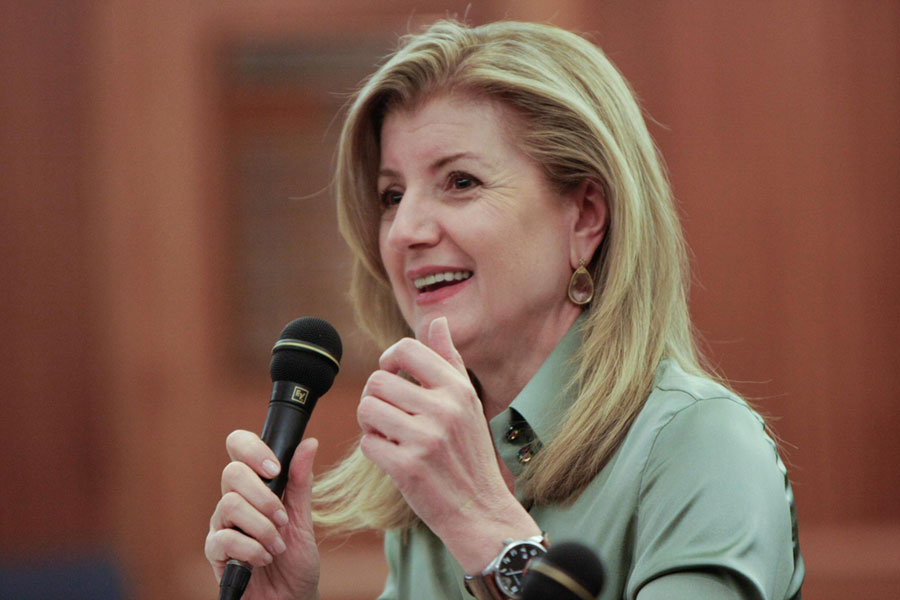
Arianna Huffington, Founder of The Huffington Post

Huffington was born in Athens, Greece and at the age of 16 moved to the United Kingdom to study economics at Girton College in Cambridge. Here, she became the first foreign, and third female President of the Cambridge Union.

Huffington began writing books in the 1970s, with editorial help from Benard Levin, the love of her life, mentor and role model. The two traveled to music festivals around the world for the BBC. In 1980 she moved to New York. 
Huffington rose to national U.S. prominence during the unsuccessful Senate bid in 1994 by her then husband, Michael Huffington, a Republican.

She became known as a reliable supporter of conservative causes such as Newt Gingrich’s “Republican Revolution” and Bob Dole’s 1996 candidacy for president. She teamed up with liberal comedian Al Franken as the conservative half of “Strange Bedfellows” during Comedy Central’s coverage of the 1996 U.S. presidential election. For her work, she and the writing team of Politically Incorrect were nominated for a 1997 Emmy for Outstanding Writing for a Variety or Music Program.
 
In 2009, Huffington was ranked number 12 in Forbes’s first-ever list of the Most Influential Women In Media and also ranked number 42 in The Guardian’s Top 100 in Media List. As of 2014, she was listed by Forbes as the 52nd Most Powerful Woman in the World. 

AOL acquired The Huffington Post in 2011 for US$315 million, and she became the President and Editor-in-chief of The Huffington Post Media Group, which included The Huffington Post and other AOL properties, including AOL Music, Engadget, Patch Media, and StyleList. 

In 2016, she announced that she was stepping down from her role at The Huffington Post to devote her time to her new startup, Thrive Global, that focuses on health and wellness.
 

5 Types of Sustainability Marketing Tactics Corporate Execs Need to Understand, and Utilize, Better

Sustainability marketing is a strange and special animal.

To be effective, it needs to catch on among sustainability teams, that tend to be based on rigorous systems thinking, carefully and scientifically considering the whole picture before suggesting ways to improve it. And of course, sustainability marketing also needs to be as sexy and appealing as successful mainstream marketing. Striking that kind of balance is not easy, and there certainly has been significant progress over the last few years. At the same time, there still are some important sustainability marketing tactics that are not understood and adopted well enough.

If you like this, subscribe here for more stories that Inspire The Future.

1. How to Make the Most of Partnerships with Celebrities and Other Influential Societal Voices
Brands have been partnering successfully with celebrities and other influential societal voices such as policy makers, athletes and NGOs, for a long time. However, successful spreading of sustainability-inspired messaging and behavior, in particular, has been rarely achieved through such partnerships to date. When will sustainable products, services, values or actions become as mainstream and culturally influential as Air Jordan, for example? I hope soon. In the meantime, a few recent campaigns have come quite close, in my observation, and need to be given credit for that.

Like it or not, Pope Francis may be the most influential sustainability advocate to date. I doubt that you missed his authoritative and compelling “encyclical” on the environment. It will surely remain as a significant milestone in the history of environmentalism and sustainability – maybe even a turning point in global discussions on climate change and other pressing issues.

Stand for Trees, a collaboration led by non-profit CodeREDD, is running a first-of-its kind consumer campaign that enables everyone (not just companies) to purchase verified carbon offsets. What’s most remarkable about this is the unprecedented success of the main engagement tool the campaign is relying on, a video by social media celebrity Prince Ea, entitled “Dear Future Generations: Sorry.” It broke the record for most viral environmental campaign to date with more than 20 million views in its first 24 hours and over 16,000 tonnes of CO2 offset in the first two days.

2. How to Source Innovation Outside the Confines of Tradition R&D Teams and Processes
There is a growing, though still quite short, list of brands encouraging social and environmental entrepreneurship through crowdsourcing campaigns, competitions and other types of acceleration. Typically, the ultimate goal of such initiatives would be to fold winning ideas into the sponsoring brand’s portfolio, incentivizing and rewarding a wide pool of innovators in the process in order to achieve transformative innovation faster than the brand’s internal R&D processes would.

One prominent example is Unilever’s Foundry IDEAS platform, which acts as a digital hub for consumers and entrepreneurs to work together on tackling global sustainability challenges. Another is H&M’s partnership with DoSomething.org to launch the Close the Loop College Cup competition, incentivizing U.S. college students and faculty to innovate means to higher recycling rates for clothing. Still another is LEGO’s Sustainable Materials Centre, a commitment to tapping all employees of the company in an effort to come up with alternative, non-fossil-based raw materials to manufacture LEGO toys and packaging.

3. How to Encourage Moderate Consumption Without Compromising The Bottom Line
Patagonia has done it, famously, with its “Don’t Buy This Jacket” campaign. Are there others out there trying (and succeeding) in pulling off this all-too-crucial balancing act? Again, too few, if you ask me. We have to make a point of thinking and acting more on this.

I’ve been very impressed with Heineken’s work on this. The Enjoy Heineken Responsibly (EHR) campaign, a multi-pronged effort that has featured a number of ads and some unique social experiments demonstrating the aspirational value of moderate consumption of alcohol, seems to be getting across effectively with many demographics and cultures. Already activated in more than 40 markets, 10 percent of the company’s media budget is explicitly dedicated to the campaign. The brand is pushing on, conceiving and fine-tuning local partnerships that are reinforcing the unifying global message.

Another way to approach this type of sustainability marketing tactic is through entirely new business models that reduce the impacts of consumption by design. Compelling examples of this include: Mud Jeans, which leases jeans instead of selling them, encouraging customers to swap or return them after use; Terracycle, which excels at ‘making garbage great’ by converting used packaging and other waste to various branded assets; and Rapanui, which set out to be a next-generation, materially lean sustainable enterprise in all it’s doing from the beginning, earning acknowledgement from big names including Sirs David Attenborough, Richard Branson and Ranulph Fiennes.

4. How to Quickly Employ New Data Analyses That Aren’t Yet Commonly Accepted or Performed
This is probably the most accessible type of tactic in this list, and yet it is quite fascinating, in a not-so-pleasing kind of way, to observe how slowly certain breakthrough applications of clearly useful new data are being adopted. Take Kering’s environmental profit and loss (E P&L) statement, for example — the first version was released by Kering’s brand Puma all the way back in 2011, it has proven so valuable (for a variety of purpose, including marketing and PR) that the parent company did it for all its brands and even released the methodology to the public domain to speed up wider adoption. But despite all of that, only a handful of other companies have added an E P&L to their arsenal of sustainability tools.

In a similar spirit, I’ve recently been introduced to the EMEA head of IBM’s Watson supercomputer and started learning about the vast potential Watson and similar technologies offer in terms of accessing real-time market intelligence and new modes of stakeholder engagement. Cognitive computing, and natural language processing in particular, can make sense of huge quantities of previously-untapped data, finding details and patterns that help explain complex stakeholder interactions and company performance. Retail, entertainment, hospitality, air travel and quite a number of other industries have been leveraging this new type of data analysis for years now, though not for any sustainability-related purposes.  

5. How to Build an Internal Company Culture that Screams both ‘Successful’ and ‘Sustainable’ Externally
If there is one thing that brands and individuals have in common, it is that sooner or later their identity, character and internal dialogue are inevitably projected externally, one way or another. Building an optimal company culture (for whatever purpose or set of purposes) is a challenging and often long process, and it is no wonder that embedding sustainability values throughout entire organizations has been achieved only by a select few to date. What’s striking to me, however, is that many brands are not even trying, or want to try but don’t seem to know what level of aspiration to set, how to begin and how to assess specific steps on a journey to company-wide culture change. There is a lot to learn from some of the leaders in this kind of exercise, including Unilever, Marks & Spencer, GSK and O2 Telefonica, among others.

As always, I’d be curious to hear what sustainability, brand and marketing professionals think about all of this — feel free to share your reaction in the comments section below. We at Sustainable Brands are strongly in favor of wider sustainability-related adoption of the five types of tactics described above, and we are doing our part to help. We’ll be tackling all of these topics at Sustainable Brands ’15 London in November, and some (the fourth and fifth) in just a few weeks at New Metrics ’15 in early October. 

Original Story: Sustainable Brands

If you like this, subscribe here for more stories that Inspire The Future.

 

Innovating Women: The Changing Face of Technology

Singularity University Applauds New Book Crowdsourcing the Paths to Success of Hundreds of Women in Science and Technology

Innovating Women, a new book co-authored by Singularity University (SU) distinguished fellow Vivek Wadhwa and award-winning author, journalist and professor Farai Chideya, holds no punches in challenging the old-boy networks in science and tech around the world to foretell that women are prime to lead the new era of innovation.

Created with the support ofSingularity UniversityandGoogle for Entrepreneurs, Innovating Womencrowdsources the personal journeys of hundreds of women from Tehran to Mumbai to Silicon Valley and shares first-hand accounts of these pioneers’ challenges, barriers, discriminations and roads to success. Contributors to the book include Prodea CEO and the first female private space explorerAnousheh Ansari; Google(x) VP and recently announced United States CTO Megan Smith; physicist, physician, founder and CEO of Nanobiosym Dr. Anita Goel; and venture capitalist Heidi Roizen.

Ursula Burns, Chairman and CEO, Xerox Corporation called Innovating Women “a must read for every woman looking to affect change and join today’s global innovation economy.”

“This powerful new book illustrates that there are women in tech doing amazing work, even though less than 15% of senior executives are women,” said Lajuanda Asemota, director, Strategic Relations for Diversity at SU. “I’m excited to help SU ensure the future is as inclusive and diverse as it should be.”

Ray Kurzweil, inventor, author, futurist, a director of engineering at Google and co-founder of SU remarked: “As someone whose family has been dedicated to advancing women’s careers for one and a half centuries, I am excited by Vivek and Farai’s compelling book which shines a light on the remarkable achievements of brilliant and pioneering women in technology.”

“We have the ability today to create the era of abundance, but not without the leadership of women.Innovating Women explains why and how women, at every level of business and research will transform society. Of particular note is contributor Megan Smith, appointed just last week by President Obama to serve as the US CTO. We applaud Megan and all the contributors of this inspiring book,” stated Dr. Peter H. Diamandis, executive chairman, SU; chairman, XPRIZE Foundation; author, Abundance: The Future is Better Than you Think.

Innovating Womenis availablein print andeBookeditions. A portion of the proceeds will be allocated to the Singularity University Fund at the Silicon Valley Community Foundation to support women applicants toSU’s Global Solutions Program.

Written by: Vivek Wadhwa is a distinguished fellow at SU | Farai Chideya has combined media, technology and socio-political analysis during her 20-year career as an award-winning author, journalist, professor and lecturer.

Original Story: Exponential Finance (SU)


Creating Shared Value Meets the SDGs

The Shared Value business model

Creating Shared Value (CSV) is the business model that will accelerate the achievement of the Sustainable Development Goals (SDGs). The trailblazing researchers and business strategists Michael Porter and Mark Kramer first introduced Shared Value in an article they wrote for the Harvard Business Review in 2006. They drew a distinction between the common activities related to the well-established model of Corporate Social Responsibility (CSR) and their new business concept of Creating Shared Value (CSV). They explained that “Shared Value is not social responsibility, philanthropy, or sustainability, but a new way for companies to achieve economic success.” Since its introduction in 2006, CSV has been adopted by a wide spectrum of companies and industries around the world and is currently a business-driven, sustainable model pervading global business and capital. The Shared Value model supports a positive impact for society, environment, finance, and for all parties involved. It is characterized by the principle: Doing well and doing good are not mutually exclusive. Meaning financial success does not need to come at the expense of society or the environment. And creating a positive impact on society and the environment does not need to come at the expense of profit. Financial, societal and environmental benefits can be achieved simultaneously. In fact, at the core of CSV are societal and environmental issues which serve as the drivers in propelling profitable Shared Value business cases. In this regard, Shared Value is the ideal business model to support the realization of the SDGs in solving the world’s societal and environmental problems.

Shared Value and the SDGs

Mark Kramer explains the link between the Shared Value model, and the SDGs as “a new revenue model for business.” And he sees potential in the guidance of the SDGs. In a recent interview with Devex at the Shared Value Leadership Summit, Kramer said: “We look at the SDGs and say, ‘There is a market here’. You can actually quantify the market potential of for-profit business to meet the needs of the SDGs. Getting business to understand that this is about new markets, new business opportunities, and new business models — instead of charity or the mandate of the development agencies, the government, and the NGOs is a fundamental shift that can be very empowering.” This shift is as much about mindset as it is about business and capital strategy. For a long time, positive societal or environmental impact and positive financial results have been considered two separate things. It has been generally accepted that you could have one or the other, but not both. CSV is all about having both. CSV is a synergy of positive social and environmental impact and positive financial results. It combines positive impact and profit by creating economic value and societal value at the same time. I believe, as Porter and Kramer do, that “Shared Value could reshape capitalism and its relationship to society. It could also drive the next wave of innovation and productivity growth in the global economy.” Since its introduction, companies have been adopting Shared Value as a guiding model.

Nestlé is one such company that has made shared value a priority in their business strategy and has embedded CSV principles across all parts of its business, listing an impressive 169 examples on their website of how they are creating Shared Value and thus helping to realize the SDGs. Their endeavors include: “pursuing innovative solutions to farmer welfare with the expansion of their ‘AAA Farmer Future Program’ through a retirement savings plan for farmers in Colombia” thus creating ‘Decent Work and Economic Growth’ (SDG 8); and ensuring Sustainable Consumption and Production patterns (SDG 12) by accelerating efforts and developing effective solutions to help reduce food loss and waste globally, which has resulted in significant yearly savings of $1.5 billion for the company. The company’s strong track record in innovation has supported volume growth, with 30 percent of sales coming from products introduced or renovated in the last three years. By creating efficiencies and reducing waste, for example, Nestlé factories employed new techniques that saved an estimated 144 million gallons of water annually starting in 2015. Nestlé Chairman Peter Brebeck-Letmathe and CEO Paul Bulcke have stated: “We have always believed that in order to prosper we need the communities we serve and in which we operate to prosper as well, and that over the long term, healthy populations, healthy economies and healthy business performance are mutually reinforcing.”

Creating and maintaining healthy populations is a leading sector in which CSV is highly relevant, with multiple examples of business success. The link between health and sustainable development is more relevant than ever and presents prime examples of Shared Value success. Both from a human and economic perspective, good health yields high returns on investment; good health reduces poverty and and supports economic development. Becton Dickinson (BD), for example, developed the world’s first needleless injection systems to protect millions of health workers from contracting and spreading HIV and other infections. This innovative technology is not only a $2 billion business for BD, accounting for 25 percent of the company’s revenue, it also created a shared health and safety value among the communities in which it operates. Pharmaceutical innovator Novo Nordisk is also ramping up its CSV approach. Working with local communities in China on diabetes prevention initiatives, the company has trained more than 55,000 physicians while also growing its insulin market share in the country from zero to 59 percent with revenues reaching USD 1.28 billion in 2013. Both of these examples work towards realizing ‘Good Health and Well-Being’ (SDG 3). They are achieving positive social benefits, financial profit, and SDG impact simultaneously.

Achieving success

Achieving the SDGs requires this shift in mindset and deed. As our world still revolves around money, achieving the positive goals set out in the SDGs, such as ending poverty and hunger and promoting good health, education and decent work conditions, will only happen if financial profit is recognized and achieved as well. For this reason, companies of all sizes throughout the world are beginning to embrace the Shared Value model. They are recognizing the benefits they can create for society and the environment while maintaining and growing their financial gain. They are also becoming ready to move forward from recent models of negative impact avoidance or reduction to positive impact creation.

Although the awareness and acceptance of CSV and its implementation into business has been growing, the Shared Value business model still needs to become common practice. To accomplish the Sustainable Development Goals by 2030, the adoption of the Shared Value model must scale-up and spread at a faster pace.

The incorporation of the CSV model is not only profitable for businesses and investors, it is also good business sense and at the same time helps save the world and meet the Sustainable Development Goals. Creating Shared Value and the Sustainable Development Goals are complementary ambitions. Both CSV and the SDGs are focused on solving the world’s problems and creating societal benefits and environmental stability. CSV is the sustainable business model which I am convinced is the future.

Original Story: The Huffington Post


Some Thoughts on the Challenges of Leadership in the Digital Age

Digitization brings about a new need for competent leadership. Today, we’ll take a look at the most dramatic changes.

Leadership in the digital age will be one of the defining themes of Global Female Leaders 2017. If you haven’t done so already, we invite you to take a look at our 2017 agenda in order to discover every highlight of this year’s event!

In the digital age, competent leadership may be the most important skill any company can cultivate. Because digitization changes companies. It changes working cultures and processes, customer behaviour and corporate communications. It also brings about a new need for, as well as new risks of corporate communications. Let’s just look at three of them!

Challenge 1: Digitization changes the working culture

It challenges employer-employee relationships.

This challenge has multiple facets. On the one hand, workers demand a digitized and modern work environment. In private, most of them use smartphones, social media and consumer electronics that fit their needs. Of course they want access to the most comfortable and hip devices at work, too. At the same time, employment changes too. We can see more and more freelancers, armed with laptops and Starbucks coffees, who will do project work and move on to the next job thereafter.

It challenges the way we communicate.

Digitization also changes the way we communicate. This goes especially for the younger generations who prefer text messages of meetings, but who also have new ideas on hierarchy and teamwork. This brings about a new potential for conflicts within an organization, since the expectations towards work can vary drastically between the members of the now four generations that work within most companies.

In essence, digitization diversifies the means of, expectations towards and ways to put into practice communications and work in general.

Challenge 2: Digitization changes customer behaviour and brings about the need to stay innovative

This is a big one! Similar to the expectations of employees, the expectations of customers are changing, too. Customers today are all about personalized products, about subscribing to platforms rather than buying commodities for good. They also want to talk their companies on Facebook and Twitter, read reviews on their products and chime in when they have ideas about product innovation.

This brings about the need for organisations to stay agile, innovative and fast. It brings about a new kind of competition, namely the race towards developing the most consumer-friendly business models and bringing them to market as fast as possible. Most of those are also data-driven and demand a high level of cooperation between the different units of organisation. Also, let’s not forget that many companies are forced to bring in new skills and know-how in order to branch out.

In essence, this puts pressure on old organizational structures, forces us to dissolve the boundaries between departments and change the way they work together.

Challenge 3: Digitization changes corporate communications

Employees as well as customers change how they interact with companies. And in turn, this changes corporate communications. It becomes more transparent and has to become more honest and open. Within this big shift leaders will have to adopt new strategies in order to guide their organizations towards a digital mindset.

Original Story: The Global Summit Series


Notes on Movement Building From a Convener

Movements happen when people who thought they were alone discover valuable strangers who become unlikely allies.

I am flying to Armenia tomorrow to keynote the Impact Investing for Development Summit (IID) convened by United Nations Development Programme (UNDP) and knowledge partner INSEAD Social Entrepreneurship Initiative. The Summit will bring together development agencies, sovereign funds from the Nordics, Eastern European and Middle Eastern impact investors so that development practitioners can figure out how to work seriously with impact investors. The reality of climate change and societal risk has led IID Summit participants to recognize that public funds and philanthropic funds are not enough to handle the task.

At the same time, we at SOCAP are convening a session in June in Manhattan to see what it will take to integrate impact investing with Wall Street at scale. That initiative, The Good Capital Project, (GCP) will be a two year online mapping project that will convene people from Wall Street, the financial sector, impact investing and the social capital market to catalyze collaboration and accelerate capital flows into purpose driven investments. After our first meeting in June, GCP participants will convene again at SOCAP in San Francisco in October, and on other event platforms as the participants require. These people may have never worked together before GPC, but SOCAP’s secret sauce is bringing the people out of their tents at the oasis; valuable strangers discovering they can be unlikely allies. Movement building, even among strangers, is right up our alley.

Written by: Kevin Jones

Original Story: SOCAP