The Time Value of Service

Professor J. Gregory Dees, “the Academic Father of Social Entrepreneurship,” passed away shortly before Christmas. He wrote the seminal definition of social entrepreneurship and launched Harvard’s social entrepreneurship program, Duke’s Center for the Advancement of Social Entrepreneurship, and Stanford’s Center for Social Innovation. Greg would have turned 64 this year. Had he followed a traditional career path, perhaps hoping to donate or volunteer after his retirement, it’s likely he would have accomplished far less.

We all understand the time value of money – an amount invested today, because of interest, is worth more than the same amount invested at a future date – but we are less familiar with the time value of service. Positive impacts also have a multiplier effect, accruing a type of social interest. For example, if we provide adequate nutrition to a growing child today, they will remain healthier, care for their future children better, and contribute more to society than if we wait years or decades to help.

The time value of service becomes even more striking when we consider premature mortality. Each year, 760,000 children around the world die from easily preventable and treatable diarrheal diseases. Waiting to help does them no good at all. Waiting doesn’t do us any good, either. The uncertainties inherent in all our lives may limit our ability to give time or money after retirement: service deferred is often service not rendered.

And that robs us of the personal renewal and enrichment that comes from helping others. Of course, there is an opportunity cost to such work, much like the choice between putting money away for retirement or spending it on a well-earned vacation. How can we do what we know is important, but still satisfy the obligations of our own wellbeing and that of our family? Fortunately, there is a spectrum of ways we can engage in service, from small charitable donations to devoting our careers to that pursuit, as Greg Dees did in his work expanding the field of social entrepreneurship.

We can involve our family in shared volunteering, starting a tradition of giving during the holidays, or convincing our friends to join us in pro bono consulting for a local nonprofit. Our time is valuable, though, and we may wish to choose those pursuits that render the greatest benefit (and joy) relative to our contributions.

There are many problems and many ways to address them, but some are larger than others, and some approaches will create a greater social return over time. If we hope to create a real impact, to ensure a positive legacy, to leave the world better than we found it, we must not wait. Greg recognized this, and in his characteristically understated and selfless way, set about creating impact and giving others wings to do the same.

Others far better known passed away this year, but few had the impact that Greg did. His parting gift to us is the knowledge that we, too, can all make a positive difference – but cannot know how much time we have been given to do so. Better to start now.


2014: Time to Pony Up

2014 is the Year of the Horse according to the Chinese Zodiac – a year characterized by people making unremitting efforts to improve themselves. Unremitting improvement. I like it; it sounds new, fresh, fierce. I love a good challenge. But, I have one problem. I despise New Year’s Resolutions. I appreciate the hope and optimism surrounding our resolutions. I love the creative process of concocting goals for the next year.

Here’s my gripe: New Year’s resolutions too often take the place of actually taking action. Only 8% of Americans keep their New Year’s resolutions – that’s the same portion of Americans that believe Congressional members are honest, or the same portion of your employees that eat lunch from a vending machine. Making a declaration to drop 10 pounds, limit Facebook use, or source meals from anywhere besides a vending machine can make us feel instantly better.

So much better, in fact, that our ambition is assuaged and the declaration of our dreams takes the place of actually doing anything to achieve them. If our resolutions were corporate initiatives we could allocate a budget, craft a strategic plan, build an entire team. But, New Year’s resolutions typically lack the type of resources we know are necessary for success and, even worse, are accompanied by the false assumption that if unsuccessful, we’re off the hook until next year. Well, you’re not off the hook and neither am I.

We, as a global community, have made notable progress in many areas including increasing access to healthcare, safe drinking water, and education, but tremendous challenges remain. The world’s largest generation of people is now entering reproductive years and they are inheriting a deficit of arable land and water, steadily rising food and fuel prices, shrinking rivers and lakes, increasing temperatures an era of extreme weather, and troubling biodiversity loss. The opportunity to markedly shape the world of 2050 is extraordinary, albeit laced with complexity and controversy. But, when has that stopped you before?

Former First Lady Rosalynn Carter once said, “A leader takes people to where they want to go. A great leader takes people where they don’t want to go but ought to be.” In 2014, we need more great leaders.

We need visionary leaders – champions who recognize that the status quo is unacceptable, and today’s best practices are just the best version of the status quo. We need people who know that (by definition) sustainability has no finish line and understand that means our knowledge, skills and abilities cannot either.

We need fearless leaders – pioneers that are comfortable exercising their nimble intelligence – acting, listening, and revising in flux – to drive creative leadership and chart a better course forward. We need tenacious leaders – people who realize that success is not attainable if you’re paralyzed by the fear of failure. We will all fail at some point. (From a recovering perfectionist) get over it.

The better world we imagine requires constant, mindful action and improvement. For 2014, let’s stop making resolutions and start taking action. Think big, Big, BIG! Be limitless. Be fearless. And, in the spirit of the Horse, seek unremitting improvement.

Ready to Create Your Future AND Save the World?

Are you sick of it? Sick of hearing the doomsday scenarios we are machine-gunned daily with by the media. Well, maybe I can do something about that. Over the weekend I was approached by a TV producer about hosting a show about how ordinary people are inventing extraordinary ways to make our future better. If you’ve seen Anthony Bourdain’s adventures around the world in search of a perfect meal on CNN, the show is the same thing except I would be in search of people doing amazing things that are helping to create a future we all want to live in. It will be a tough sell.

It’s long been known that our human brains are far more sensitive to fear than opportunity. So the easiest way to get our attention is to “horriblize” our future.

Seeing The Future

A famous study done in the 1880’s predicted the future of New York would be very… well to be perfectly descriptive… shitty. I’m not kidding. Experts projected the city would grown until it became totally unlivable because of the number of horses would create waist-deep rivers of manure filling the streets and fouling the air that made living and working there impossible. It is easy to see how their mistake about the future could be made.

The people making it lived day-t0-day with the reality of an ever-growing number of horses and their street waste. At the time of their study, they couldn’t even conceive of the advent of the automobile or the impact of mass transit. I am not sure how the dire predictions of the future New York City impacted the decisions of leaders of whether it affected the optimist of people in their daily lives. But one thing we should never underestimate the innovative ingenuity of people like you and me to change the future.

Never Too Young To Start A Business

I just met Jeff, a 30-year old entrepreneur who started a creative agency when he was 16. That’s right, still in high school. He volunteered to be student leader of an anti-smoking campaign that was being run by a traditional ad agency on behalf of the local government.

Although he was passionately anti-tobacco, he quickly saw how lame the campaign was. They had a big event that attracted hundreds of kids just like him, non-smokers and anti-smokers, you know… the non-rebels. So he got this bright idea of what it would take to influence the kids who were most likely to smoke. The kids who aren’t mainstream, preppy or jocks. His brainstorm was that if he could discover what the “other” kids valued that made them want to rebel or appear rebellious, maybe he could connect those values with not smoking.

He also knew that the place to create influence was not through TV ads, but rather where these kids hung out… at local events, parties and social websites.

How To Know What Others Are Thinking

It turns out it’s not very hard to find out what these kids are thinking or what they value… you just need to listen to their voices and their music, which is exactly what Jeff’s army of 20-s0mething employees does everyday. He was savvy enough to convince the local government to give his approach a shot. It worked. This was when he was in high school. It worked well enough to build an amazing creative agency focused only on driving positive behavior changes in youth. He was just awarded a $150 million contract from the FDA to create a national smoking cessation program. That’s not a typo. It turns out solving important problems can have a big payoff.

I also recently met Sarah. Until four years ago, she was an elementary school teacher who’d been laid off several times during California’s budget crisis. One of her trademark lessons was a banner she would hang in her classroom that simply said, “Whatever It Takes.”

Being a Survivor

When Sarah got thrown overboard the last time, she decided to follow her own advice . She founded a nonprofit called WIT (Whatever It Takes). This is a program for high school students to train them in social entrepreneurship and leadership. It earns them college credit.

She teaches them the secrets of how to create a sustainable enterprise whose primary value is helping others. Sarah and her young tribe of entrepreneurs just held a Pitch Competition at the University of California, San Diego. New Enterprises pitched by her high school entrepreneurs included such things as:

  • Prevent Loneliness – a business that connects teens and seniors who feel isolated and alone by doing acts of kindesss.
  • Motivated Parks – a business that builds stronger communities by bringing kids and families together to refurbish neighborhood parks.
  • Bites to Bites – a business that creates a link between local homeless and a sustainable source of otherise wasted food from neighboring restaurants.

These are not just feel good projects. They are real businesses that generate streams of sustainable income and are build quickly to scale to regional or national organizations. Based on her on-going work with high schoolers, Sarah is working on an additional business with a billion-dollar potential that could end up helping tens of millions of young people and disrupt an entire industry. (No, I can’t tell you what that is.)

Those are just two examples of people that might be profiled on this new TV show. The focus isn’t just on entrepreneur’s hero stories, but actually how to do it yourself.

I Do Have Hope 

Every show will also feature a new entrepreneurs’ pitch to the TV audience. Like Kickstarter…if audience members like your “Pro-purpose Business” you could raise hundreds of thousands of dollars to take it big. Sort of like Shark Tank for the rest of us…but only for businesses that are solving nontrivial problems. I have no idea if this TV show will become a reality. But, it will be pitched in some major cable networks in the new few weeks.

What turns me on about thinking this way is that it gives me lots of hope. I don’t really believe our world is going to end up like the prognosticators predicted New York City would in 1880. Yes, we have lots of stupid people with lots of big opinions and many, many inept leaders in all our institutions. Yet, we are resilient and creative at our core.

What’s The Best We Can Do?

The world that we have created is not the best we can do. Today we have more bright, educated and values-driven people thinking about how to create the future of sustainable abundance than ever before in history. And while it’s true we may have to wade through a lot of stinkin’… I believe we will get to higher ground.


Burst Your Bubble and FREE Yourself

As 2013 came to an end, I started thinking a lot about 2014. And, I reflected on it with gratitude. I had some truly amazing opportunities. I work with some great clients who are open to my ideas and my coaching. The leaders I work with are the most appreciative that I have ever worked with. And that just feels good. Moreover, I feel that I am learning, growing and experiencing insights at a faster rate than ever.

That’s a lot to be grateful for. And as far as my personal life… Well, let’s put it this way, no one in my family is in the hospital and no one is in jail, so that’s pretty good. Seriously, my family and friends are healthy, happy and acting responsibly so that’s a lot to be thankful for. My genuine hope is that you all feel about the same. And to the extent you don’t, or are facing uncommon challenges, that you have hope. Live has not always been easy for me. I have had years with nothing but hurricanes. I know what deep suffering is.

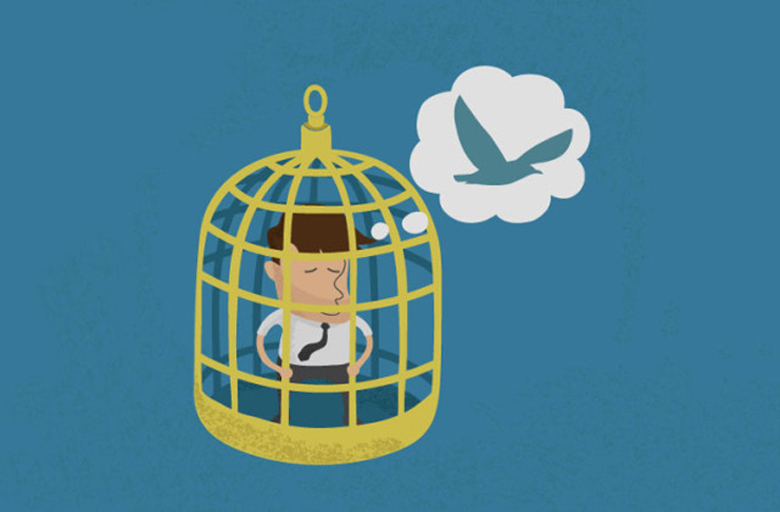
My advice to any of you whose life is less than you want to be is simply this… FREE yourself. 

We all live inside a bubble. The 21st century has created an outer life that is more like an amusement park than reality. It is driven by the powerful forces of constantly emerging technology and a culture based on consumption. We live in a strange time when originally small disagreements about how to create our best future are constantly exaggerated and made more horrible to raise our fears and close our minds.

This external noise is largely floating debris clogging the rivers of our own thoughts and flooding us with stressful emotions. 

This constant assault on our inner well-being is something we seem to have gotten used to. We think we are the fish swimming in the polluted bubble when actually we stand outside. That’s the give we have. The gift of being human. The gift of creating a new perspective that lets you see the swirling bubble without swimming in it.

The quickest way… the best way to become aware of your essentials self outside the bubble is to FREE yourself. 

There is more than one way to do this. But, this is my favorite: First, be clear that the purpose of life is to become your best self.

What you do is not as important as what you become by doing it. 

The human quest is to keep growing. Keep becoming. Whatever you consistently admire in others is a vision of what to invest your energy  and your strengths in what will fulfill your unique nature. Second, develop a conscious moral intention. We must transcend our culture that has come to glorify selfishness by mislabeling it as self-fulfillment. It has become natural for us to think of GAIN first. That is, “What do I have to gain from this relationship or this job or this opportunity?” And usually what we consider is how we might gain fame, fortune or power.

I promise you that a GAIN orientation to life will only lead to anxiety, emptiness and a stunted soul. 

What is moral intention? It’s nothing less than approaching life, work and love with “How much Good can I do?” By ‘GOOD’ I specifically mean “How much value can I create right here, right now?” Think of it this way, we all have unique assets. Your knowledge, expertise, expertise, wisdom, imagination, relationships and energy are an amazing force.

If you wisely invest it in a constant stream of creating value, imagine how that might change your life. It will also change your future circumstances and opportunities. Third, be more selective and more focused in what you’re willing to invest your life force into.

The happiest people I know are up to something more than just living their daily life. 

We seem hypnotized by the constant stream of information and entertainment on the Internet and social media. We spend our work lives achieving other people’s goals. There’s no time left for us. We must make the time. But, we won’t. Not unless we’re really clear on what we’re up to.

How much time and energy do you devote to what is most important in your life right now? 

And how do you want to live, work and love in the future? Are you investing your best in that? What I’m asking you to consider is simple. FREE yourself from the bubble, with all its distractions, anxieties and trivial pursuits. Create time each day to turn off your smartphone and television. Reclaim your own thoughts. Become acquainted with your deepest and most noble desires.

Don’t simply seek for self-awareness. Go for for soul-awareness.

Be strong. Be up to something that matters to you. Make your difference… because you can. Happy New Year!


Confessions Of A Recovering Capitalist

The emergence of a new business model, effect marketing, promises to blend the needs of people and planet into a new form of capitalism.

The feature-length documentary Koyaanisqatsi, released in 1983, became an iconic, cult movie that aimed to show the relationship between humans, nature and technology. The title, meaning “life out of balance” in the indigenous Hopi language of Northeastern Arizona, was also filmed without dialogue or narration and has many interpretations.

The overall effect was to raise awareness among viewers about the wider world in which we live, creating a consciousness around our shared plight on a planet that now houses over 7 billion people.

One of the seemingly out of place people in the audience was Mike Martin. Martin’s career started as a real estate investment banker at Citibank on Wall Street. “I was basically just doing deal structuring and engineering every day,” says Martin. One weekend his best friend put on a James Taylor concert for the benefit of a wildlife organization, focused on stopping the human extinction of species.

“I looked at the purity and long-term importance of that and compared it with how I was spending my days. I reflected on Koyaanisqatsi recall thinking just how out of balance I was. I left a very lucrative career to focus my business knowledge on how to convert capitalism into capitalism for good.”

Coming from an investment banking background that had rung hollow for him, Martin decided that he needed to turn on capitalism, and spent seven years working on big campaigns that rallied against it. After seven years he realized he was getting nowhere and that he was basically just creating negative energy. “ I thought there was no way to change the system, so I began working with small companies that seemed to offer an alternative. I worked with Organic Valley, CLIF Bar, Earthbound Farm and Ben & Jerry’s and helped them grow bigger.

Another seven years went by and I realized that these type of companies only accounted for 3-5 percent of GDP, too small to make the kind of difference I had imagined,” says Martin. Martin’s work eventually started getting the attention of notable industry leaders, such as Ben and Jerry, Steve Jobs, and Lisa Jackson, the head of the U.S. EPA, with other big companies also starting to take an interest in what he was doing.

He began to realize the only way to really move the needle on sustainability and impact on a large scale was by working with big, mainstream companies. Ironically, the very companies he had run from at the outset of his career. But this time, rather than continuing to contribute to the problem, he is partnering with these companies to help them drive profits through good corporate citizenry. “Effect Partners was built on the principle that sustainability is necessary for the future of our planet, as well as for business.

To be truly sustainable, businesses need to profit from sustainability or they will not do it,” asserts Martin. And while companies must be allowed to profit, so too must consumers become more aware and interested than ever before in the social changes initiated by the brands they interact with daily. The very nature of consumerism is changing and so is the process with which to engage consumers.

In the 1990s Martin helped revolutionize social change in the music industry as the Executive Director of Concerts for the Environment. He went on to build MusicMatters, a pioneer in the world of music and sustainability marketing, and now a division of his company, Effect. Martin has advised U2, The Black Eyed Peas, Dave Matthews, Jack Johnson, and dozens of other artists, on sustainability practices and green issues around concerts and tours.

In 1997, MusicMatters played a key role in launching green energy in the US with their work with Green Mountain Energy. Offering “Green Energy” options was new at the time, so they created a grassroots connection with consumers to educate them about such unheard of concepts such as: Global warming, carbon offsets, renewable energy, and biomass. A green touring and event “bible” developed by Martin, called the EnviroRider ™ has become a global industry standard for the music industry’s environmental footprint. Collaborating with major, established brands is a key strategy for Martin, who believes these companies already have the infrastructure and influence to start shifting consumer behavior.

On the Live Nation U2 360 Tour, from 2009 through 2011, Effect brought Brita water filters on tour. Brita provided hydration stations and compostable cups to keep fans hydrated without any bottled water waste. The partnership also highlighted Brita’s Filter for Good initiative, and helped educate fans on the impact they can have simply by using reusable water bottles. He has also structured some powerful and effective programs with major companies such as Green Giant, Toyota, Proctor and Gamble and Ben & Jerry’s, all designed to catch the consumers’ attention in novel ways, effect positive change, market the brands and develop an emotional connection with the consumer, resulting in improved ROI.

For example, the average football game produces 50 to 100 tons of waste and an initiative last year with waste and food bag company Glad, saw Effect collaborate with Glad and the University of Southern California (USC) to reduce game day waste within the stadium. Glad and Effect have even developed a One Bag toolkit that provides a how-to guide on planning a waste-conscious event which can be found at gladtowasteless.com.

While Martin goes all out on creating sustainability programs for big corporations, he feels some of the meaning and context of sustainability has become a box to check for most companies. Some just ensure there’s liability insurance for the corporate officers or have a recycling program set up in their offices and think that’s enough.

“What needs to happen next,” says Martin, “is to ask what the short term AND long term Return On Investments (ROI) is on sustainability work. This is what the leading companies in the world are starting to do. In other words, how do company sustainability efforts drive profits for the company and also how do they fold into the bigger picture of the economy?”

“ExxonMobil will make $45 billion of profit in a year, yet not one penny of profit is going towards CO2 remediation. Coal energy plants give a lifetime of asthma to 30 percent of kids within a 30 mile radius of their plant, yet not one penny goes towards helping with their lifelong health costs,” says Martin.  “You have these costs that are being socialized, yet the profits are being privatized.

The whole notion is something which is a fundamental flaw of capitalism.” Martin stresses that we’ve created a capitalistic system that requires quarterly growth, yet is overlaid on a planet that has finite resources. Something has to give at some point. He’s not against capitalism and embraces it, being excited about the conscious capitalism movement and working exclusively with companies who improve the health of the people and the planet, or who are working to achieve this in their business model. Martin has unique marketing expertise from his work in the corporate world and a good grasp of marketing.

He often uncovers amazing work that’s being done by a company around sustainability, that’s not being communicated because management don’t see it for what is, or don’t want to subject themselves to criticism. Sometimes the marketing officer will suggest doing a green campaign, which is completely disconnected from what’s happening from a sustainability perspective, and it all ends up as green washing because it wasn’t thought through properly.

“When companies start realizing the power of combining their marketing departments with their corporate social responsibility departments, we’ll see the emergence of a new business relationship that has proven to drive profits: effect marketing,” says Martin.


Greg Smith On How To Make Capitalism More Transparent

In March 2012 a Goldman Sachs vice-president, Greg Smith, set the media world alight, and caused much anguish among financial institutions, when he resigned from Goldman Sachs in the most public way possible: an explosive reveal in The New York Times, which claimed the Goldman culture to be “toxic and destructive.” In this exclusive interview, Real Leaders asks him to reflect on this time and share his vision for the future of big finance.

What made you take on one of the most powerful financial institutions in the world? What did you hope to achieve?

First of all, I wasn’t trying to take on one institution – I was trying to do what I thought was the right thing. My message is not just about Goldman Sachs, which is very similar to many of the other major banks that survived the financial crisis. Some of it has to do with my generation, versus my parent’s generation. I grew up being very idealistic. Parts of big finance have become a golden goose that many know has serious ethical problems, but no one’s willing to talk about it. This became increasingly uncomfortable for me. To a large extent I drank the Kool-Aid at Goldman Sachs.

I was one of the heads of the summer intern program, used to fly to Stanford twice a year and recruit new people. I was very proud of what I would call the “old culture” of banking, that was focused on the long term, and where you aspired to develop ten year relationships with people. In the early 2000’s, the majority of regulations that kept this old banking system in place, got overturned. Derivatives got deregulated and leverage limits disappeared, which was actually a symptom of a much larger problem – that the industries with the most money effectively controlled politicians, who changed the rules in order to get more campaign contributions.

With less rules, the old world model of, “Let’s first do right by the customer and the profits will follow,” turned into, “Let’s make five times more profit today, because we’re only in this business for another five or six years.” There was an attitude of not caring what happened next.

And it wasn’t illegal either, as long as they followed the letter of the law. It was a scenario of drawing a line between what’s legal and ethical, and what was being done beyond that line, that many know is unethical. It was usually justified because their bosses were doing it or they were getting paid a lot of money to do it and customers weren’t going to realize anything for a long time.

This became something I didn’t want to do anymore. Much has been made of the letter I wrote, that was published in the New York Times, but this came at the end of five months of writing my thoughts down and realizing that I could actually do something positive.  I thought that if companies were not willing to change this culture internally, maybe forcing the change would work, because frankly, the systems are far too complex for politicians or the public to fix. I came to believe that people within the finance industry could become a part of positive change.

It was almost like a calling, that it was the right thing to do. If I hadn’t done it I would have felt I’d done the wrong thing by not speaking up.

Where does your idealism come from?

I am not sure but possibly from my upbringing in South Africa. I come from a Jewish family where my mother set a good example for us growing up. I always tried to be one of the kids who spoke up when I saw something being done wrong, instead of keeping my mouth shut. My upbringing in South Africa also made us see a lot of injustice and terrible inequality which I have thought has had a strong impact on me and the way I look at the world

Can you give an example of the real world effects of casino style Wall Street speculation?

During the European sovereign debt crisis I saw the panic being used as a reason to confuse investors and drum up business. I saw the very direct and very real world effect on hundreds of thousands of citizens in Greece and all over Europe, who were protesting on the streets, while behind the scenes the major banks were helping the governments gerrymander the books and make things look rosier than they were.

This was not a game anymore and brought financial issues into the real world very clearly. Banking is a vital service in society but the industry lost sight of what banking was. Previously it was about giving loans and helping people invest, but by 2012, 75 percent of revenues were being generated in a casino-style trading environment, which did not have any societal benefits.

Is the secretive world of big finance finally opening up?

No, I don’t think so. I’ve devoted time to understanding how the process works between banks, politicians and the public and what I’ve concluded is that the opaque system as it is today has purposefully been created. At worst there are politicians and regulators taking campaign contributions to keep quiet or change the laws, and at best there is just not enough knowledge around the intricacies of finance.

It seems purposefully so, because the more murky things become, the more money banks can make, without people directly being able to accuse them of doing wrong. In 2010 President Obama passed a massive financial reform bill, yet most people don’t know that only two thirds of that bill has ever been implemented. All the major structural causes of the financial crisis, such as derivatives, proprietary trading and being too big to fail, are all still in existence.

They have not been fixed and close to $500 million of lobbying money has been spent trying to kill these bills. I have spent time trying to advise some politicians in Washington DC, as well as regulators like the Federal Reserve, the U.S. Securities and Exchange Commission and the Office of the Comptroller of the Currency. I have been trying to bring a “no spin” approach of what’s right and wrong in banking and ways in which it potentially risks bringing down the whole economy.

What opportunities have arisen as a result of your decision to expose Goldman Sachs and the world of finance?

I must stress that Goldman Sachs is just one bank among many doing very similar things. Everyone has seen the $13 billion JP Morgan settlement, the Libor fixing scandal, the FX trading scandals and countless others. People said I couldn’t say the things I said, that Wall Street wouldn’t be happy, but the truth is Wall Street is made up of both banks and investors.

Investors don’t want to have the wool pulled over their eyes or have hidden fees extracted out of their accounts. People forget that trillions of dollars of public investments are wrapped up in things like teachers pension funds, charities and endowments. These investors are a vital part of Wall Street too, and should be just as much a part of the dialogue as banks. What I’ve been trying to do, aside from helping with some of the regulations, is to help empower investors, who’ve been very receptive as they’re worried and befuddled by this opaque system.

The answers you get from investors with $100 million pension funds who still do business with these banks, is that they’re too scared to ask questions or that there’s no competition, or they have no other choices. The two classes of investor, considered the least sophisticated by large financial institutions, are public investors, such as pension funds and charities and surprisingly, ultra high net worth individuals.

This is not because Wall Street perceives them as not being smart, but because they know that these CEO’s and business leaders spend 99 percent of their time focusing on running their own businesses, not watching and understanding their investments. They’ll extract as much money from a high net worth investor as possible, up to a point that the person does not get suspicious.  In my mind, that’s not banking. Banking should be about trust and fiduciary duty.

There seems to be an ongoing trend of people exposing the secretive dealings of large corporations and institutions. Julian Assange and Edward Snowden come to mind. What is causing this? 

I wouldn’t associate myself in the same category as those two individuals, more in the category of the millennial generation. Some people will say that capitalism is about doing anything as long as you don’t go to jail and if the person on the other side of the transaction is foolish enough to fall for it. It’s a case of “buyers beware,” and they should have known better. Business needs to have more idealistic leadership, where you do things right by the customer and know that profits will follow. Over the long run you will do far better.

We live in a world where its all about the short-term, maximizing your personal bonus and exiting the industry leaving whatever mess is left behind for someone else to clean up. I’m hopefully part of a movement that is steering us back towards doing the right thing with customers, having a long-term mindset and having transparent earnings that your investors can understand. Ironically, openness will actually increase stock valuations.

If investors have greater transparency into where banks’ revenues are coming from, they will value the stocks at higher levels. Leaders who have a long-term mindset and an ethical framework of capitalism realize that brand is important, customer loyalty is important, and not only important for six months or the next quarter, but for ten or even a hundred years, to guarantee the future existence of your franchise.

The Silicon Valley mentality is a good example. They make a lot of money but they create a product that actually does something, it actually adds some kind of value that changes the world in a meaningful way. The financial industry at times moves money around in ways that people don’t understand, and extract a fee to do that, until they’ve got a $10 million bonus in their pockets. Young people have realized this and become disillusioned. They want to live their lives along a moral framework.

Some people think they can change the system slowly from the inside and others, like you, decide enough is enough and accelerate the process. How do you suggest people begin this change?

Our parent’s generation was about loyalty to a company, regardless of what the company was doing. Our generation has a loyalty to values. I saw someone in the Christian Science Monitor write about this. When the money is so great and people are caught up in a system, it’s very hard for people to voluntarily change the game en masse. To find a solution you’d think we might need to elect politicians, who’ll do the right thing, but I don’t have a lot of faith in politicians because of the powerful lobbys and big money that’s around to defeat new legislation.

Change must come from people within the industry, who have a long-term mindset and who are not trying to hurt their industries, but rather make them stronger, more stable and more sustainable. I think it’s people’s moral obligation to try to change their organization for the better. Most people, behind closed doors, will admit that the ingredients of our financial crisis still exist and there are many bubbles still being inflated. Another worrying fact, that most people don’t know, is that almost 80 percent of stock traded on the NYSE is done by computer.

This doesn’t create a stable environment for the average investor. Companies are making billions of dollars profit by placing computers on a stock exchange and effectively extracting money. Computers are able to buy stocks in a split second, long before any manual purchase by an investor, and they’re effectively making an immediate profit of one cent, millions of times over. At the end of the year they have billions of dollars profit.

Why is it fair that some wealthy hedge funds can place their computers closer to the stock exchange than others, to take advantage of latency times on networks? Unfortunately, as the economy gets better, the crisis recedes into memory and the public just wants to get on with their lives. One example of changing things would be to educate retirees on how financial markets work, who could then apply pressure to fund managers who control the hundreds of billions of dollars of retirement money.

If the public doesn’t understand these things, the problems can go on forever. We’re seeing more and more black swans, hard-to-predict and rare events in history. These are only supposed to happen once every few hundred years, but are now happening once every ten years. It’s not a healthy sign. We need to make finance simple again, make it transparent, regulate derivatives, get rid of proprietary trading, makes banks smaller and educate the public. Yet, banks have a vested interested in keeping things complex.

Are you planning to set up a new company to achieve this or would consulting as an individual be more effective?

I am already consulting to and advising some investors on how to invest their money efficiently at lowest possible cost and without hidden fees. Another goal of mine has been to talk about and promote the Dodd-Frank Act in the U.S., which is aimed at protecting consumers and improving accountability, in particular the Volcker rule, designed to eliminate casino-style betting and speculation that played a key role in the 2007-10 financial crisis.

I’m also trying to speak to as many students as I can around the world about finance. The students expect me to tell them not to go into finance, but I actually tell them finance is great. The reason I went into finance is because I was interested in speaking to the smartest investors in the world. Young people should go into finance, but with their ideals intact. When they see things happening that are not in line with what they believe, they can make a huge difference from the bottom up, by changing the ways things are done and speaking up.

Do you think that large amounts of money can still be made in an ethical manner? Profit is usually made at the expense of others, that’s the nature of capitalism, but do you think people have to adjust their expectations?

I’m absolutely a capitalist, and every one of your readers is a capitalist, but I think we need to define what free market capitalism really is. There are a few principles you have to have in place for capitalism to work: an even playing field where everyone has an equal shot at making money, no-one taking short cuts, and no-one with inside information. Everyone needs to understand the rules and it all needs to be played out openly where everyone can see it.

In finance two thirds of money is made behind closed doors, unregulated, no one sees these things publicly. That’s not capitalism anymore; it’s a rigged system. New kids, right out of college and university, start copying what their bosses are doing and the cycle continues. This doesn’t happen over a few days, but over many years, so leaders should check their business principles daily to ensure they’re not surprised to find how far the culture has strayed in ten years time.  

Entire civilizations and cultures have eroded from bad financial judgments. Are there any lessons from history from which we can learn?

If we could go back in time to the 1990s and ask people if Arthur Andersen would still be around in the future, or ask the same about Enron, people would have bet significant money that these were real brands, pillars of business that would be around for a very long time. We forget that it can disappear in a second.  Once you’ve lost hold of your culture, your ethos and what you’re in business to do, things can unravel quickly.

Look at the big banks that are incurring billion dollar settlements, you would think the financial media would be calling for the leaders’ heads, but instead they’re praising them by saying how well they’ve survived the crisis. Because they’re making huge profits, it’s assumed they must be the best in the business.

The real test would be whether customers trust them, this is more important for forecasting long-term success, not by measuring quarterly profits. You should be asking whether you have a strong enough ethos in place, with a strong enough customer base to ensure you’ll still be doing business in 50 or 100 years time. If you only see your customers as a tool for profit you’re getting into very dangerous territory.

How do we create a world that is both economically prosperous and has conquered our numerous challenges, such as runaway consumption and resource scarcity?

The more that businesses can move into products and services that are net positive to the world, the more there will be profits to be made in these new spaces. Look at the many new and innovative environmentally impactful businesses that have emerged. Look at Tesla (founded by South African Elon Musk) – a company that makes electronic cars, or any of the many businesses that are trying to look towards an energy and environmentally sustainable future.

It shows the public is hungry to do things the right way. Show people a great product that’s good for the world and you’ll make a lot of money. Things that people recognize are essential for our collective greater good get people excited. The first movers into that space will capture huge pieces of the pie and build mindshare with consumers.

What characteristics do you consider essential in a real leader?

I was once told about a leadership idea that I found very powerful called the “authenticity test” or “onstage/offstage test”. Does the leader act the same way and treat respectfully all employees of the company, from the post officer, janitor and first year out of college, through to the CEO or chairman of the board? Is the leader the same authentic person in his or her personal life as in professional life?

I have often found that leaders who pass this test are not only the most admired leaders up and down the chain of command, but they are often also the most successful and effective. Because they are real and show their true selves at all times. Seeing the CEO of the company devote five minutes of undivided attention to the newest member of the team seems like a simple idea, but it has a profound impact on the culture of a place and sets the right tone from the very top down.

 

Why the U.S. Should Grant Edward Snowden Amnesty

As we say goodbye to 2013 and look forward to all that is to come in the New Year, I would like to take a quick opportunity to look back at one particular globe-changing event that began this past June. The event – which is still ongoing – was the leaking of classified information regarding the extent of the United States’ surveillance programme, by former National Security Agency (NSA) contractor Edward Snowden.

Throughout 2013, the leak was greeted with mixed feelings by the public and received condemnation from some governments – but none more fervently than the United States. In the U.S., a leak like Mr Snowden’s (if not classified as the act of a whistleblower) can be considered treason and could carry immense penalties.

This reality forced him to flee the United States in the immediate aftermath of the leak. He fled to Hong Kong and then to Russia, where he was granted temporary asylum. It has been thought that should Mr Snowden attempt to return to the U.S., he would be arrested immediately and put on trial. Recently, however, new information was brought to light by senior officials within the American intelligence community that may change his fate.

Polarising figure

It seems that – at least in internal discussions – the United States may be open to granting him amnesty for his crimes. This brings about the question: should Edward Snowden receive amnesty? Like everything else related to the NSA leaks, the notion of giving him amnesty has received mixed reactions in the public and in the US government. In fact, it could be argued that he may be one of the most polarising figures in recent history. Across the globe, the wake of his revelations has been rocking nation after nation.

While it seems overly evident that the public is happy to have the information he provided, how those people actually feel about Mr Snowden himself is much more open for interpretation. In the minds of some US officials, he is a criminal and nothing more. In the eyes of some members of the public, he is a hero and everything in between. The reality, as I see it, however, is quite different and not nearly as black-and-white.

Whether you abhor or applaud the actions of Mr Snowden, what is clear is that, above all, this is a public relations battle. The battle is not between the United States government and Edward Snowden; rather, it is between the US government and world public opinion. At stake is the public’s overall trust that the US has the world’s citizens’ – and, at the very least, its own citizens’ – best interests at heart. The leaks have not only eroded government support among the public in the US, they have eroded public support for the United States’ global initiatives in nations across the world. Many of these initiatives – like the global war on terror – were relying on the NSA and its international cooperative network for overall success.

What is evident is that the US government is losing the war for public support – and losing it badly. Therefore, I believe they have one effective course of action: grant amnesty to Edward Snowden, with no conditions whatsoever. What the White House needs to realise right now is that Mr Snowden did not set out to ruin the government, or take down the NSA. Rather, he intended to do something much simpler: start a dialogue.

He himself recently was quoted as saying: “I didn’t want to change society. I wanted to give society a chance to determine if it should change itself.” This statement embodies why he deserves amnesty. He did not set out to destroy America; he set out to give Americans the chance to have a say in their own future through an open dialogue.

Immature teenagers

And start a dialogue he did. The entire world is still talking about the NSA leaks to this day, and it is the White House and the NSA – not Edward Snowden – who appear like immature teenagers unable to admit they were caught red-handed. To earn back the public’s trust, President Barack Obama has to show that he is ready to sit at the table and discuss government spying openly.

So far, his attempts to do so via commissions and press briefings have done little to quell the fury. So far, every word spoken by the Obama administration is tainted by the fact that many of those listening consider Mr Snowden a hero, yet those speaking still consider him a criminal. As long as Mr Snowden remains a criminal abroad, his support will grow stronger every day and public trust in the United States will wane.

By giving him amnesty, the Obama administration would be making a bold statement, admitting that they were wrong and being willing to open up and take steps to correct past mistakes. A move like this would not only bring some much needed humanity to the United States government but it will be taking a major leap in acting more like the mature arbiter of the public good that it has been in the past.


Why ‘WHY’ Is So Critical for Performance and Innovation

The second principle of 5-Star Leadership is answering the question, “Why?” Remember the first principle is setting a clear direction by answering the question “What?” What am I trying to accomplish… what’s the goal here? Most seasoned leaders have no problem telling people what to do. They are goal-setting machine guns.

However setting goals without establishing a good reason for the goals…without dealing with the ‘purpose’ question never really engages followers.

Sure they may act busy. But activity is not the same as performance and when leaders sense that their goals may not be achieved they tend to escalate pressure or even issue threats. Clueless leaders do this because creating stress in employees temporarily ignites their energy. But negative stress has only a short-term effect on people’s energy. If it continues, people begin to protect themselves usually by blaming others and checking out.

This poisons a working culture and creates a toxic cycle of failure.

These are common situations I come into when leaders reach out to me to help them with their organizations’ performance. Their usual complaint is there needs to be higher accountability. Yet crying for accountability is always a sign of leadership failure.  If people are unmotivated to take responsibility there is no amount of external accountability that will change performance.

I’ve never seen accountability systems that accomplished anything other than lower performance.

Unfortunately, these kinds of employee management systems are everywhere.

Decades of psychological research confirm that personal performance rises when people are inspired.

Yet years of global leadership surveys reveal that the rarest quality of a leader is the ability to inspire followers. That’s a shame. You see people become self-accountable when they are inspired. People go the extra mile when their motivated.

People create, innovate and find better, faster, cheaper ways when your mission becomes their mission.

The flame of purpose can only be ignited by answering the question …‘Why?’

What is so important about what we’re doing? What difference will it make?

Those are simple enough questions. Yet I cannot believe the dumb answers most leaders give. Usually leaders announced to their followers that they must succeed in order for the company to be profitable, or to grow, or to survive. While these reasons maybe accurate, research is clear they are not inspiring. Brain research is clear that people are motivated by emotions not logic or facts. Even more important people’s creative centers are activated by their values.

That’s pretty important since creativity is necessary to innovate new products, connect with customers or revolutionize new business models.

On the other hand, logic and fear at best temporarily motivates people to do more of what they’re already doing… so good luck with that. I’m not sure why the vast majority of leaders continue to act so stupidly. It should not be news to anyone that humans are purpose-seeking beings. Or that inspired people work harder and create more new, cool, life enriching things.

Only a fool would treat humans as carbon-based robots. Perhaps the root cause is that so many people go to business primarily to make money. That’s just ridiculous. It’s like saying the primary reason for living is to eat. Sure, without food we die but if we live to eat, over-eating will eventually kill us. Even the world’s most uninspiring famous leader, Jack Welch, finally agreed that:

“on the face of it, shareholder value is the dumbest idea in the world. Shareholder value is a result, not a strategy… your main constituencies are your employees, your customers and your products.”

This is from a guy who pioneered firing people while businesses were profitable just so we could make the share price would go up. I appreciate the deathbed repentance but holding yourself up as an iconic leader only to later reject the core of your value system is more than a little sad. Human beings have spent thousands and thousands of years trying to create a way of life so that every day was not simply a grind to survive.

The Industrial Revolution gave us a huge boost in productivity so that we could create surplus. This surplus gives us an opportunity to improve the quality of our lives not just the quantity we consume. The Industrial Revolution was a means to higher opportunity but we haven’t seized it. Instead we are acting like idiots at a cheap buffet.

Is building an economy on never-ending mass consumption really the best idea we can come up with? Really?

Does your business depend on people buying things they really don’t need or especially value that are produced just as well by many competitors? That’s another way of describing business strategies that focus on market share rather than growth. The primary reason employees are not self-motivated is not because they’re lazy. It’s because their work is not purposeful. Of course for short periods of time simply accomplishing ambitious goals can motivate high achievers.

Goal achievement is a brain narcotic for people who define themselves through accomplishments.

But in reflective moments even people who define themselves as goal-seeking missiles have to ask… “Why?” Most businesses today are simply playing a game of trivial pursuit. When a talented leader like Amazon’s Jeff Bezos invests time and money into figuring out how to get packages to people using flying drones I just shake my head. What difference does that really make? For the last 10 years Microsoft has to represent the biggest waste of employee intelligence in recent history. What difference are they making? Would anybody care if they went bankrupt? Just look around you. The same thing could be said of 90% of business enterprises in existence today.

As far as producing unique value that really improves the quality of human life in most cases we’d be better off without them. They are just consuming resources and wasting human energy. I’ll let me be clear, I am not a moralistic snob.

I just believe the proper use of capitalism is to create new and innovative ways to actually improve the quality of our lives now in the future.

Of course you have to be profitable because profit creates investment surplus and investment is needed to research and develop new and cooler ways to progress. I think most people would agree that the world is better off because of companies like Disney and Nike and the old Apple.

Yes, these companies are not perfect but at least they’re up to more than simply making money. At least their employees feel like they are a part of making people happier or more informed or more able.

What people want from their leaders are goals that really matter.

This takes more than an MBA. It takes moral imagination, grit and discipline. In my recent study of geniuses Thomas Edison stands out. He held over 1,000 patents. He invented the modern research and development lab. He pushed his people to their limits. Edison established whole new industries because he was able to commercialize the use of electric lights, power utilities, and sound recording in motion pictures.

His inventions were critical to mass communication. And they changed the lives of virtually every human being after he was finished. The days of great breakthroughs are not behind us. Today a hard-headed leader like Elon Musk is so serious about alternative energy and sustainability that he created the Tesla car company to accelerate automotive technology to create systemic change.

Yes, Google is a scary company because they are a vacuum cleaner of all of our online lives. But at least they’re using their wealth to pursue interesting big problems like driver-less cars or doubling the average life span.

My point is that you don’t have to become Mother Teresa to run a meaningful enterprise.

You just have to be committed to solving problems that matter. Give us something to wake up in the morning for. C’mon, why are there intelligent people spending their time dreaming up Dorito tacos? Is this really the best we can do? Great leaders have meaningful answers to the “Why” question.  We need more great leaders.


Why ‘WHY’ Is So Critical for Performance and Innovation

The second principle of 5-Star Leadership is answering the question, “Why?” Remember the first principle is setting a clear direction by answering the question “What?” What am I trying to accomplish… what’s the goal here? Most seasoned leaders have no problem telling people what to do. They are goal-setting machine guns.

However setting goals without establishing a good reason for the goals…without dealing with the ‘purpose’ question never really engages followers.

Sure they may act busy. But activity is not the same as performance and when leaders sense that their goals may not be achieved they tend to escalate pressure or even issue threats. Clueless leaders do this because creating stress in employees temporarily ignites their energy. But negative stress has only a short-term effect on people’s energy. If it continues, people begin to protect themselves usually by blaming others and checking out.

This poisons a working culture and creates a toxic cycle of failure.

These are common situations I come into when leaders reach out to me to help them with their organizations’ performance. Their usual complaint is there needs to be higher accountability. Yet crying for accountability is always a sign of leadership failure.  If people are unmotivated to take responsibility there is no amount of external accountability that will change performance.

I’ve never seen accountability systems that accomplished anything other than lower performance.

Unfortunately, these kinds of employee management systems are everywhere.

Decades of psychological research confirm that personal performance rises when people are inspired.

Yet years of global leadership surveys reveal that the rarest quality of a leader is the ability to inspire followers. That’s a shame. You see people become self-accountable when they are inspired. People go the extra mile when their motivated.

People create, innovate and find better, faster, cheaper ways when your mission becomes their mission.

The flame of purpose can only be ignited by answering the question …‘Why?’

What is so important about what we’re doing? What difference will it make?

Those are simple enough questions. Yet I cannot believe the dumb answers most leaders give. Usually leaders announced to their followers that they must succeed in order for the company to be profitable, or to grow, or to survive. While these reasons maybe accurate, research is clear they are not inspiring. Brain research is clear that people are motivated by emotions not logic or facts. Even more important people’s creative centers are activated by their values.

That’s pretty important since creativity is necessary to innovate new products, connect with customers or revolutionize new business models.

On the other hand, logic and fear at best temporarily motivates people to do more of what they’re already doing… so good luck with that. I’m not sure why the vast majority of leaders continue to act so stupidly. It should not be news to anyone that humans are purpose-seeking beings. Or that inspired people work harder and create more new, cool, life enriching things.

Only a fool would treat humans as carbon-based robots. Perhaps the root cause is that so many people go to business primarily to make money. That’s just ridiculous. It’s like saying the primary reason for living is to eat. Sure, without food we die but if we live to eat, over-eating will eventually kill us. Even the world’s most uninspiring famous leader, Jack Welch, finally agreed that:

“on the face of it, shareholder value is the dumbest idea in the world. Shareholder value is a result, not a strategy… your main constituencies are your employees, your customers and your products.”

This is from a guy who pioneered firing people while businesses were profitable just so we could make the share price would go up. I appreciate the deathbed repentance but holding yourself up as an iconic leader only to later reject the core of your value system is more than a little sad. Human beings have spent thousands and thousands of years trying to create a way of life so that every day was not simply a grind to survive.

The Industrial Revolution gave us a huge boost in productivity so that we could create surplus. This surplus gives us an opportunity to improve the quality of our lives not just the quantity we consume. The Industrial Revolution was a means to higher opportunity but we haven’t seized it. Instead we are acting like idiots at a cheap buffet.

Is building an economy on never-ending mass consumption really the best idea we can come up with? Really?

Does your business depend on people buying things they really don’t need or especially value that are produced just as well by many competitors? That’s another way of describing business strategies that focus on market share rather than growth. The primary reason employees are not self-motivated is not because they’re lazy. It’s because their work is not purposeful. Of course for short periods of time simply accomplishing ambitious goals can motivate high achievers.

Goal achievement is a brain narcotic for people who define themselves through accomplishments.

But in reflective moments even people who define themselves as goal-seeking missiles have to ask… “Why?” Most businesses today are simply playing a game of trivial pursuit. When a talented leader like Amazon’s Jeff Bezos invests time and money into figuring out how to get packages to people using flying drones I just shake my head. What difference does that really make? For the last 10 years Microsoft has to represent the biggest waste of employee intelligence in recent history. What difference are they making? Would anybody care if they went bankrupt? Just look around you. The same thing could be said of 90% of business enterprises in existence today.

As far as producing unique value that really improves the quality of human life in most cases we’d be better off without them. They are just consuming resources and wasting human energy. I’ll let me be clear, I am not a moralistic snob.

I just believe the proper use of capitalism is to create new and innovative ways to actually improve the quality of our lives now in the future.

Of course you have to be profitable because profit creates investment surplus and investment is needed to research and develop new and cooler ways to progress. I think most people would agree that the world is better off because of companies like Disney and Nike and the old Apple.

Yes, these companies are not perfect but at least they’re up to more than simply making money. At least their employees feel like they are a part of making people happier or more informed or more able.

What people want from their leaders are goals that really matter.

This takes more than an MBA. It takes moral imagination, grit and discipline. In my recent study of geniuses Thomas Edison stands out. He held over 1,000 patents. He invented the modern research and development lab. He pushed his people to their limits. Edison established whole new industries because he was able to commercialize the use of electric lights, power utilities, and sound recording in motion pictures.

His inventions were critical to mass communication. And they changed the lives of virtually every human being after he was finished. The days of great breakthroughs are not behind us. Today a hard-headed leader like Elon Musk is so serious about alternative energy and sustainability that he created the Tesla car company to accelerate automotive technology to create systemic change.

Yes, Google is a scary company because they are a vacuum cleaner of all of our online lives. But at least they’re using their wealth to pursue interesting big problems like driver-less cars or doubling the average life span.

My point is that you don’t have to become Mother Teresa to run a meaningful enterprise.

You just have to be committed to solving problems that matter. Give us something to wake up in the morning for. C’mon, why are there intelligent people spending their time dreaming up Dorito tacos? Is this really the best we can do? Great leaders have meaningful answers to the “Why” question.  We need more great leaders.


A Lesson of Mandela That No One is Talking About

Do you wonder who Nelson Mandela would have been to the world if he had not been imprisoned for 27 years? Do you believe he would have been one of the great leaders of our world had he avoided that hardship? Given the revolutionary path he was on, and the likelihood of escalating violence intended to overthrow an oppressive regime that was not yet willing to cede control, it is likely that few would remember who this man was.

It is almost as if he was sent away to mature and be groomed until just the right time when both he and the world would be ready. He is respected for who he became as a result of his hardship and incarceration. He described his 27 years in prison as a unique opportunity to work on himself, to become a better man. Everyone is likely to agree that being arrested and sent to prison for life feels like a bad thing.

Is it possible that it was the best thing that could have happened to Nelson Mandela, South Africa, and even the world? I have a friend that often says “It’s aaall goood” in his charming southern drawl, and for a long time he appeared to use it at the most inappropriate times. “How are you doing?” I’d ask, and he’d reply “Looks like I may need to go in for a root canal. It’s aaall goood.” How getting a root canal is “all good” was hard to understand.

But as the years have passed, have you noticed how the “bad” things that happened to you turned out to be what my mother used to call “a blessing in disguise”? When I was diagnosed with a painful, degenerative, incurable disease of the spine I was devastated. This was “bad”. Very bad. It was not until years later that I was able to see that this was one of the best things that had ever happened to me.

It forced me to completely rethink my lifestyle and my life. I quit my high stress job, launched a more fulfilling career, began taking care of myself, and found purpose and love in my life. Without that disease, I would not have changed and would still be unhappy, stressed, and unfulfilled. Finally it was clear that indeed, it is all good! It’s not always clear at the time how it’s good, and it often doesn’t feel good, but it always is.

This is not a recommendation that you go out and get arrested to spend time in prison or do anything to cause you to contract a disease. But if you do, or when anything “bad” happens to you, the lesson from Mandela is to look for the opportunity for good in it. The opportunity is always there if you seize it. However seizing the opportunity is optional.

Nelson Mandela could have spent 27 years in prison building justifiable hatred for his captors and plotting revenge instead of taking advantage of the opportunity to become a better man and a real leader. Some may look at these life challenges as random events, others may see the hand of God, Karma, or any number of things, but the fact remains that things that feel bad happen to all of us.

We can make them feel worse by resisting what is, or we can make it feel better by embracing it and looking for the opportunity created by this challenge. That is a lesson that every woman, child and man on the planet can learn from this great leader. Nelson Mandela would love to have his 27 years back, but given the choice of giving back the man that he had become as a result of that hardship, I think he’d say “No thanks. It’s aaall goood.”