How To Promote Peace 120 Years Beyond Your Death

  • Alfred Nobel spent a lifetime developing armaments only to have a change of heart on their effectiveness a few years before his death.
  • He leaves his vast fortune to establish a prize for those who achieve excellence in various fields, including peace.
  • A big thinker, and ahead of his time, Nobel insists the prize be given to anyone who qualifies, regardless of their nationality.
  • His social and peace-related views are seen as radical in his day, something we regard today as a desirable thing when creating new and innovative businesses.
  • Nobel’s ideas on leaving a positive legacy have been emulated by people such as Warren Buffett and Bill Gates.

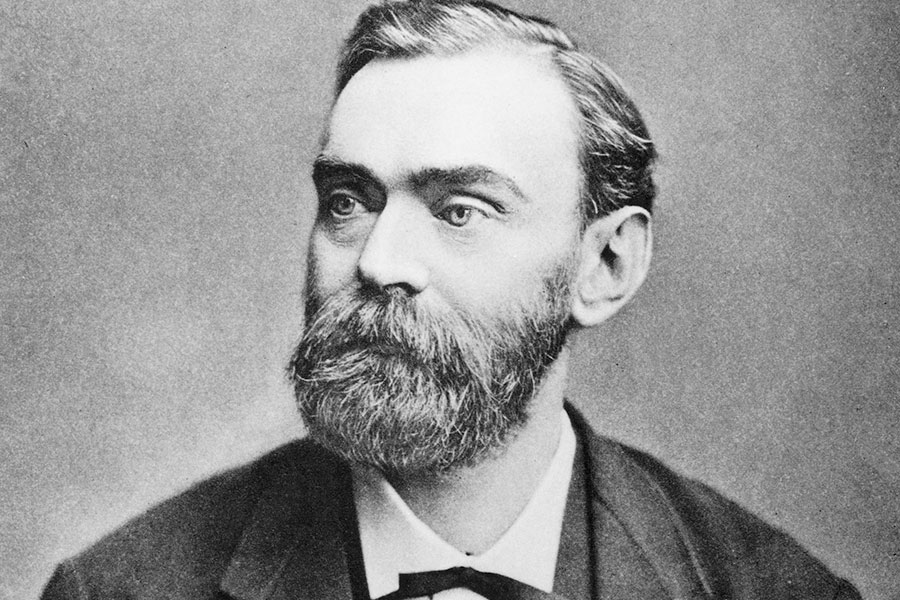
In December 1896, a group of people gathered in Paris to hear the reading of Alfred Nobel’s will, a renowned engineer, innovator and inventor. Best known as the inventor of dynamite, Nobel had amassed a fortune of nearly £2 million, around $500 million in today’s terms. After the reading of his will there was an uproar, Nobel had left 94 percent of his assets to the establishment of a prize.

His shocked family opposed the establishment of the Nobel Prize and the first prize awarders he named in the will refused to comply with his wishes. It took five years before the first Nobel Prize was awarded in 1901. It was a scandalous start, at the time, to what has now become one of the world’s most prestigious and recognized awards.

How does the inventor of dynamite end up being associated with peace, you may ask? The Nobel family had a history of weapons manufacturing, beginning with the family factory producing armaments for the 1853-56 Crimean War. When the war ended, they had difficulty returning to domestic production and they filed for bankruptcy. Nobel continued the family tradition by devoting himself to the study of explosives; especially the safe use and manufacture of nitroglycerine and with his skills eventually developed his most famous invention – dynamite. He patented it in the U.S. and U.K. and it soon became a staple of mining and transport-building sectors around the world.

During his lifetime Nobel issued 350 patents internationally and by his death had established 90 armaments factories, despite his belief in pacifism. His promotion of peace began one day when he opened a newspaper and was shocked to read a headline about his brother’s death. It read: “ The merchant of death is dead.” Many had mistakenly thought it was Nobel himself who had died.

Horrified that this was how he might be remembered one day, he began formulating a way of reversing this image. He decided to use his estate to endow, “prizes to those who, during the preceding year, shall have conferred the greatest benefit on mankind.” Being a businessman and entrepreneur, Nobel knew that nothing motivates more than money, prestige and accolades.

It’s a strategy still used today to encourage excellence and social good. Think of the XPRIZE, founded by Peter Diamandis, that offers millions of dollars to those who can solve problems for the benefit of humanity, or The Giving Pledge, started by Warren Buffett and Bill and Melinda Gates, that invites the world’s wealthiest individuals to commit more than half their wealth towards addressing society’s most pressing problems.

Nobel established five categories for his prize – physics, chemistry, medicine, literature and peace. In his will he worded a vision for how the peace prize should be awarded: “to the person who shall have done the most or the best work for fraternity between nations, for the abolition or reduction of standing armies and for the holding and promotion of peace congresses.”
nobel peace

In true visionary style, and in a time when diversity was more associated with zoology than culture or gender issues, Nobel added a final phrase to his last wishes: “It is my express wish that in awarding the prizes no consideration be given to the nationality of the candidates, but that the most worthy shall receive the prize.”

For those big thinkers who like the idea of having their wealth change lives for the better, a century after their death, there is a word of caution – interpretation is everything. Sometimes a great idea, expressed too broadly, can be misread by those you have been tasked to action it. In Nobel’s case, his formulation for the literary prize was a work “in an ideal direction” and he never properly distinguished between science and technology, leaving the door open for skewed nominations in the future. Trying to keep your original purpose clear without knowing what the world will look like in 100 years time, or even if your chosen field of interest will still exist, can be a challenge.

Nobel was interested in social and peace-related issues and held views that were considered radical during his time. It’s become evident throughout history that many ideas we now consider perfectly normal were once seen as outrageous or crazy when first made public. In fact, many would argue that if your idea is not labeled crazy, it’s not even worth pursuing.

To Nobel, having a wide interest in global affairs was important to his formulation of the peace prize. Many of his inventions and business activities were connected with the conditions of war and peace. A significant influence on his attitude towards peace came form Austrian countess Bertha von Suttner, with whom he maintained a 20-year correspondence. Von Suttner was a peace advocate and author of the famous anti-war novel Lay Down Your Arms. Many believe she had a major influence in Nobel’s decision to include a peace prize among the other prizes in his will.

Von Suttner was actively involved in the international peace movement, which formed in Europe at the end of the 18th century and tried to get Nobel more actively involved. He wrote to her: “Good wishes alone will not ensure peace,” and suggested a more pragmatic approach. Commenting on his dynamite factories he told her: “Perhaps my factories will put an end to war sooner than your congresses: on the day that two army corps can mutually annihilate each other in a second, all civilized nations will surely recoil with horror and disband their troops.”

Nobel’s solution was to create a weapon so terrifying that war would become impossible. While you can argue the merits of using weapons as a deterrent, one thing is sure – Nobel realized at some point that weapons of destruction don’t bring about lasting peace – only people can. Seven years before his death at age 63, and unknown to anyone, he drew up a plan to promote peace that has inspired millions since and saved the lives of countless people through the Nobel Peace Laureates his prize has honored. Truly a big thinker, he has ensured that his legacy of peace has lasted 120 years beyond his lifetime – 57 years longer than he himself was alive.


The Dalai Lama: The Spiritual CEO Of Happiness Says He Might be Back As A Woman


  • A global leader with billions of admirers has a simple message for the planet: be more compassionate.
  • The Dalai Lama considers himself an “engaged” Buddhist and is not shy of commenting on serious social problems, or that he might be reincarnated as a woman.
  • Call it Karma, destiny or just plain bad luck, most people have a sense that if they harm or destroy something it will rebound on them someday.
  • Isolation, exile and rejection are not necessarily a bad thing. If your message is pure people will know it and you’ll become more powerful than if you’d turned to violent means to achieve your goal.
  • The Dalai Lama says we are all selfish, but should be wise-selfish instead of foolish-selfish.
  • Times have changed and he believes that religious leaders, with their ability to take a long view on humanity, should participate in discussions of global business and economics.

Being ordained as a global leader of significance at age five with followers that number six percent of the world’s population, being made leader of a country at age 15 and being awarded a Nobel Peace Prize must make you an extraordinary leader with some pretty awesome powers, right? Yet, the 14th Dalai Lama, Tenzin Gyatso, has become an enduring symbol of human rights and peace by focusing on a simple concept throughout the 79 years of his life: compassion and non-violence. It doesn’t sound very proactive, but his outlook has struck a cord with more than 350 million Buddhists around the globe and endeared himself to billions more, regardless of their faith or worldview. He meets people from all walks of life who ask themselves the same question: “Can his message of peace and compassion be that simple?”

dalai-lama-3

The Dalai Lama could easily have rested on his reincarnated laurels and lived a life of relative privilege and fame, inherited from his predecessor, the 13th Dalai Lama, Thubten Gyatso. Instead, he has become a spiritual leader like no other, with a keen interest in the link between science and religion, and become outspoken on issues such as the environment, women’s rights, astronomy, physics and reproductive health. He is highly intelligent, determined and has a great sense of humor – all the great qualities of a spiritual leader. Or a good CEO.

He’s even written a book around the art of making business decisions, The Leaders Way, published in 2009. In it, he explains that every decision-making process should have values instilled in them. He calls these values dependent origination, interdependence and impermanence. Put another way, the intention behind every business decision must be beneficial to the greatest number of people. They must also be aware that nothing is permanent and that things change constantly. The Dalai Lama reckons a smart person will adapt and respond to changes in the world, in both their personal life and within the marketplace.

dalai-lama-4

Change has certainly been a feature of the Dalai Lama’s life, despite wearing the same outfit for almost eight decades and repeating the same mantra of compassion again and again.

Forced into exile from his Tibetan homeland by China in 1959, the Dalai Lama has travelled the world ever since, spreading a message that highlights the importance of compassion as the source of a happy life. It’s not an easy job. Many of the institutions that host him face pressure from China not to accept him. China refuses to acknowledge Tibet as an autonomous region, insisting instead that it forms part of the People’s Republic of China. The dispute has been at the heart of the Dalai Lama’s rejection and global wandering for the past 55 years, but which ironically has worked in his favor. He joins the ranks of other legendary leaders such as Nelson Mandela and Aung San Suu Kyi, both of whom experienced rejection, isolation and exile – which only made them stronger – resulting in their cause spreading to many more millions than if they had not been persecuted.

dalai-lama-2

The Dalai Lama considers himself an “engaged” Buddhist and does not shy away from controversy. He has even supported the possibility that his next incarnation might be a woman, or that he might not be back at all! His succession strategy is open to change, something a good CEO understands necessary for long-term sustainability.

He was awarded the Nobel Peace Prize in 1989 for his willingness to compromise and seek reconciliation with the Chinese, despite brutal violations and harassment. The Nobel Committee based its decision on the fact that he had a philosophy that showed reverence for all living things and that there existed a universal responsibility that embraced both man and nature. Call it Karma, destiny or just plain bad luck, most people have a sense that if they harm or destroy something it will rebound on them some day. The Dalai Lama has confirmed this small voice of conscience within all of us by stressing that we need to be more actively aware of our actions.

“Times have changed, and I believe that leaders of religious traditions – with their ability to take a long view of the human condition – should participate in discussions of global business and economics. Our world faces very serious problems, such as the negative impact of our ever-increasing population and the affect that rising standards of living are having on the environment,” says the Dalai Lama. “We are all selfish, but we should be wise-selfish instead of foolish-selfish.”

dalai-lama-prince-charles

The Dalai Lama’s leadership style might be based on a passive view of the world but he wants us to realize that expressing empathy and compassion in business is not a roadblock. As a global citizen who is not held back by any single organization, he is uniquely positioned to speak about the biggest problems we face as a planet. He is focused on what is good for humanity, and while many of us may put his advice into a box labeled “spirituality,” his insights can teach us that broadening our vision, and our limits, can be good for business too. He embraces new ideas and gets information from every level of society, allowing him to formulate opinions and solutions that help him understand situations in a very profound way. Imagine the business opportunities that might flow from thinking this way?

Compassion towards others builds trust and loyalty, something many good leaders strive for among employees, customers and even competitors. The seeds of the Dalai Lama’s compassion came from his mother, whom he still remembers carrying him around as a baby while working in the fields. “I never saw her with an angry face,” he recalls. “How is it that seven billion people on this planet also come from their mothers womb, received affection and drank their mother’s milk but never developed this same inner value?” It’s a question he leaves with each one of us to solve.

What do you think about the Dalai Lama saying that he might be reincarnated as a women one day, or maybe not at all? Comment below.

How to Coach Yourself to Greatness

I love to go surfing with my friend Jim. He is a great coach in the water. He always encourages me to ride the biggest and best waves even when the waves are a little scary big. He will frequently encourage me to paddle over to where he’s sitting and when his mystic vision spots a prime “outside” wave he points to where I should paddle and says “that’s your wave Will.” His encouragement literally en-courages me to take off on waves that I normally would be too chicken to paddle into. Jim has a greater confidence in my ability than I do and it makes all the difference. Jim is a superb informal surf coach.

Research on the effectiveness of coaching reveals several reasons it is proven to be the key to growth, stress resilience, performance, learning and mastery.

  1. Having a coach increases your confidence and your calm. A great coach sees your real potential and motivates you to act from your highest and best ability.
  2. Affirmation from a third person helps quash self-doubt and silences your inner critic.
  3. A great coach heals you from failure by being supportive in helping you learn important lessons when you are not performing well.
  4. A wise coach will increase your “grit”…the will to persist and keep trying when success is elusive.

Most parents are great coaches when it’s time to help their pre-toddlers to start toddling. It’s true. Learning to walk is a very difficult motor skill. We have to coordinate our eyesight, balance, agility and judgment simultaneously. It is common for new walkers to fall down 200 to 500 times before they become dependable performers. That’s pretty amazing. There are not too many things a human being will fail at hundreds of times and yet keep trying.

Developmental psychologists tell us that what helps children learn is highly supportive coaching from parents or other caring adults and a silent inner critic. Like most parents when my children learned to walk, a single step was met with a boisterous celebration declaring my child to be completely awesome.

What’s also helpful is that when most one-year-olds begin walking they don’t have a psychological voice doing a play-by-play of their life. Instead our brains are completely focused on the present moment without self-judgment. That enables us to notice that we are falling down without labeling ourselves as hopelessly clumsy. Just think about this…if we waited until we were teenagers before we tried to walk most of us would give up after falling down 10 or 20 times, label ourselves as a hopelessly uncoordinated loser and become permanently dependent on wheelchairs to get around.

Now the good news. Recent research from Dr. Ethan Kross at University of Michigan has uncovered the secret to self-coaching. It’s talking to yourself in the third person. I know we don’t like this when we hear it from others like LeBron James saying, “I’m moving back to Cleveland because that’s best for LeBron James.” It sounds a bit elitist. But actually Dr. Kross’s research reveals that that kind of third person self talk is much more likely to lead LeBron James to actually move back to Cleveland without regret. And that, I think you would agree, is a pretty big challenge.

Here is what the research says. When we use first person affirmations to encourage ourselves such as “I should go for it, I can ride this wave,” that message hit’s a power switch in our cerebral cortex which actually increases the emotional intensity of fear. This is a serious problem for most of us because it seems natural to encourage ourselves using the “I can do this” first person. But this is unwise. Brain scans reveal that addressing our inner doubts with “I” messages amplifies our stress and fears of failure. 

However making a simple change of calling yourself by your own name or using the pronoun ‘you’ switches you’re thinking like switching a train track. Your new ‘train of thought’ creates focus, clarity and confidence. So for me the difference between saying, “I should paddle into this wave” versus “you should take this wave” greatly increases my success. All I am doing is mimicking my friend Jim when he coaches me.

That’s simple enough. Just coach yourself as if you’re coaching advice was coming from someone else… “You can do this Will!”

As for your inner critic… you just have take charge of that fearful, whiny, judgmental voice. Here’s how. Harvard business school professor Alison Wood Brooks has conducted experiments with people who were told that they have to give a speech. This immediately creates anxiety. She told some members of the group to try self-relaxation and tell themselves “I am calm.” The problem was people who are effective at self-calming we’re judged by the audience as giving very boring speeches. So the stress reduction techniques had a negative impact on performance. She told others that it was natural to be “excited” before giving a speech. She simply re-labeled their stress as positive excitement. The result was performance excellence in terms of audience reaction. The speakers who saw themselves as excited we’re judged to be more persuasive, confident and competent. According to Dr. Kross’s research the best way to raise your positive excitement level would be to say to yourself, “you are excited” just like a good coach would say.

In another experiment with high stakes test-takers, people were told that feeling anxiety and stress can actually help test performance. They were coached that anytime they became aware of their anxiety it was an opportunity to remind themselves that their stress give them energy to excel.

Test results showed that students who embraced their stress as positive outperformed students who tried to calm themselves. Additional research confirmed that the test-takers who exceled maintained high levels of stress hormones throughout the testing but this did not negatively impact the results. This leads researchers to believe that it isn’t so much that stress kills performance as much as our story about our stress drives our results.

So here is how you become your own best coach.

  1. Talk to yourself like a Coach using your name or the pronoun “you” (instead of “I”) when you’re telling yourself to go for it.
  2. Tell yourself that stress is excitement. Turn the energy of stress into enthusiasm and focus (like my surf coach Jim) rather than let fear wipe you out.

The great thing about being your own best coach is that you are always available. So go for it. Go for the life you want and the work you want. Now, say it with me, “You can do it!”

Women In Power: Like Nothing You’ve Seen Before

A dear friend asked me rather timidly for feedback over the phone yesterday. She is a friend because we’ve known each other for years now, working together occasionally and attending similar events. But she is precious to me because there’s something about her that is very endearing. Born to bring peace to every team she joins, she seems to care so much for others that she sometimes forgets to care for herself. We women approach power in such a very different way to men.

This friend, who we will call Sara, was yanked from out of the blue to take over a team of women during a business crisis which had forced our previous leader to resign. So caring more for our team than for herself, Sara ran to our rescue. What she rushed into, however, will probably compose one of the toughest management experiences in her future memoirs. Because when women fight for power… well, everything you might have witnessed among men pales in comparison.

The underlying issue we were battling with was precisely the way power and influence should be built and shared in our organization. Though we may have argued about this process, or that problem, what was really at stake was a fundamental division in how we built leadership. On one side the traditional women wielded power as it has been done in the last few male-dominated centuries, while on our side we defended a newer, more honest approach, which younger generations, bred in multinational corporations with more equality, have come to prefer.

Underneath the clutter, drama and strategy of our conversations we were actually testing the new against the old, the transparent against the secretive, the open against the closeted.

Underneath the clutter, drama and strategy of our conversations we were actually testing the new against the old, the transparent against the secretive, the open against the closeted. If we had been men it might have looked more spectacular from the sidelines: there may have been more stormy arguments during meetings, or direct blows to the heart for all to watch. But being women, we kept the surface of the waters mostly contained. Verbal knives took place behind closed doors. Telephone bills sky-rocketed as some exchanged visions one-to-one or coordinated attack plans to implement at future team meetings, while yet others manipulated gossip at private reunions to slyly attack their enemy as if they were doing nothing more than innocently pouring tea.

I don’t think I will ever forget this experience. It’s the best ever lesson in power, influence and leadership I’ve received up to now. It’s proved to me how much more multidimensional women’s communication, negotiation and persuasion can be compared to men’s. It’s the most interesting and challenging business riddle I’ve ever tried to solve, and now that it is over I’m not quite sure whether I won or whether I lost. What I do know is that we achieved our purpose: the open, new and honest will live on in our organization, while the closeted, old and secretive has been brought to its knees.

What I do know is that we achieved our purpose: the open, new and honest will live on in our organization, while the closeted, old and secretive has been brought to its knees.

My friend Sara inevitably drowned in the complexity of facilitating this battle for hearts and minds, trying to placate both sides. Failing miserably, poor woman. Around the more central frontal players stood a number of less involved team members, also trying to understand what was going on, enduring direct pressure to side with them or with us. The old recurred to well-known manipulative methods of persuasion: pushing emotional buttons and fostering a supportive sisterhood, which, in turn, imposed high prices on belonging. We, the young, remained open, transparent, focused on our goals and clearly above what we considered to be lowly tactics.

The old recurred to well-known manipulative methods of persuasion: pushing emotional buttons and fostering a supportive sisterhood, which, in turn, imposed high prices on belonging. We, the young, remained open, transparent, focused on our goals and clearly above what we considered to be lowly tactics.

The young have been luckier, you see. Because we grew up in a different world from the one our senior foes have known. So many women in history were never given a real chance to succeed as men did. Daughters of powerful men were asked to take a second place in favor of their brothers or husbands. The good wives of business moguls were expected to smile silently behind them, to have no opinion of their own, to want only what their men did. How did these women survive? The only way they could! With secrecy, closeted tactics and manipulative games of gossip. Defensive sororities became their only refuge against the injustice in their lives.

Men play these games as well, of course. Machiavelli comes to mind. But women are much better at it. And while only a few among hundreds or thousands of men become truly refined in these arts, most women live to master such hidden dynamics in their families, groups of friends and companies. Trust me, every truly sophisticated female sorceress who reads this will viciously deny what I’m saying. Because it only works if nobody sees what she is doing!! Get it? ;-)!

Oh yes! Being a woman leader is fun, fun, fun. All the way until it hurts, hurts, hurts. Such is the nature of life, business and war.

I remained silent when Sara asked me for feedback. On one hand there was nothing Sara could have done. There was no peace to be reached. Just as in an old favorite movie of mine starring Christopher Lambert, The Highlander, “there could only be one”. On the other hand, Sara had been carefully seduced into our older adversaries’ sorority way before this battle ever began. She was already hooked on comforting chats and seemingly innocent sharing of confessions at sisterhood parties which only included those who were loyal. The sisterhood had been a crucial resource of compassion and nurturing to her when she had needed it in the past. She had been chosen to fill the power void in our team by our opposers precisely because she was incapable of going against them. Poor Sara never saw it coming. Even now she might deny it.

In a new era of equal opportunity, however, I’m convinced these old sisterhoods will slowly disappear because they unknowingly nurture weakness while killing strength. They thrive on sentimental licking of each other’s wounds and viciously protect their own against all outer obstacles or threats. Belonging entails agreeing, submitting and kneeling down, while rebelling, disagreeing or confronting leads almost certainly to cruel exclusion. Or maybe even public lynching. All through very subtle female cues.

Ironically these sororities rob their sisters of the chance to grow and become independent, autonomous and strong.

Ironically these sororities rob their sisters of the chance to grow and become independent, autonomous and strong. Sara needs her sisterhood in order to find herself. Sara can not stand on her own two feet in the face of danger for too long before running back to the safety of her so called friends.

However, I see so much strength in Sara. I know what she has been through professionally and personally. I have witnessed her grow in grief, mature in struggle, patiently refining her ability to bounce back up after each fall. All Sara needs to flourish as a woman leader is to believe in herself more than she believes in the sisterhood. To care for her own needs and wants more than she cares for those of her sisters. I see the strong female warrior hiding deep inside her eyes. I hope Sara will see her one day too.

It’s time for women to lose these shared weaknesses and bravely feed our own inner strengths.

It’s time for women to lose these shared weaknesses and bravely feed our own inner strengths. Secretive sisterhoods did us great service when we were deprived of opportunities to lead. We can now say goodbye to such sisters as we step on to new roads of autonomous, independent and transparent female wisdom. God knows the world needs women’s wisdom more than ever before.

How Mountains Teach Us To Lead

I am dizzy today. I just got back from a four-day trail in the mountains just outside of Madrid with a group of Dutch executives from the Foundation for Natural Leadership. It all seems like a dream in a far-off land now, but deep inside of me I know this trail impacted my growth as a person and as a leader on a whole new level.

Intuitively I knew what I was getting into. We’ve been working on bringing this unique leadership program to Spain for a few months now. I’ve done my share of seminars in all kinds of techniques and therapeutic approaches in the past. I know that when you leave your life to share who you are and reflect on where you’re going with a group of strangers, your perception of yourself, your leadership and your business inevitably takes a great leap forward.

The mountains seemed to multiply the effect of feedback, introspection and learning.

What I experienced, however, went way beyond what happens on a day of leadership mirroring with horses or a weekend of reflection, debate and exercises in a classroom somewhere. The mountains seemed to multiply the effect of feedback, introspection and learning with such intensity that coming back to the city has been like a brusque awakening from a faraway adventure dreamland. Each one of us left a part of ourselves up among the solitary mountain peaks of Ayllon, uncovering other deeper truths about our values, our motivations and our intentions as we strolled down one slope, crossed a stream or climbed another tree covered hill. At night we shared our secrets with the group under the intimate glow of our camp fire when grabbing the talking stick put down by somebody else.

No matter how sure you may have been of all the intellectual things you were going to say, once you had the stick in your hands a certain weight came over you, stripping all your mental mess down to simple, humble truths. “Nature does all the work”, one of the senior trainers from the Foundation told me, as we replenished water supplies in our fifteen kilogram rucksacks at a small village fountain. And indeed Nature did add a special intensity to the physical challenges we placed ourselves in each day. Awe inspiring views mixed with the smallest of symbolic clues about life, growth, survival and death: this leaf, that flower, the way those plants react to the wind or the lonely eagle swooping over our heads… each one of us found our own parallelisms to the problems we face as leaders, executives, parents, husbands or wives, sons or daughters.

My biggest learning was, ironically, my most frequent teaching: flexibility.

My biggest learning was, ironically, my most frequent teaching: flexibility. I learned that climbing up the mountain requires strength, of which I have as much as I need to have. But coming down again requires flexibility. While the large muscles that cover our limbs, arms, chest and abdomen enable strong powerful movements, it is the much smaller muscles underneath which render us pliable and light as deer. The small muscles that wrap around our key articulations: ankles, knees, hips and necks. The hardest part of the trail for me was always coming down steep slopes. It wasn’t until the last day of the trail that I clearly saw myself over-complicating my descent with fear. Each step down was heavily calculated in my mind before I carefully tried my forward foot on a pointy rock. Exhausting amounts of energy invested in my back leg, fearfully grabbing on to the mountain in case my forward move should fail.

As my colleagues easily hopped along from bush to slope to stone to log, I painfully lagged behind sweating snowballs and swearing in all the languages I speak. A good thing the mountains didn’t judge me for my terrible language and my new found Dutch soul mates found me charming in my insistence to outdo myself whatever it took. As I descended the tallest mountain peak of our trail on the last day I gradually increased my speed, if only to relieve my worn out knees in order to make it to our final destination. Until I was told I seemed to be “dancing with the stones” way in front of the rest of the group. I’ve never felt so proud of myself. And I know that it has taken many years of risk taking, falling and getting back up again in business to finalize my own very flat learning curve of performance in the face of great uncertainties.

Back at work I can recognize the change in my pace as I walk faster into risky decisions.

Back at work I can recognize the change in my pace as I walk faster into risky decisions and dance with piled up stones of future cash flows, shifting rates, project deadlines and client engagements. I can see how I used to think fifty times about all possible scenarios before choosing my next step, and how it feels better and more effective to worry less as I lunge swiftly forward. Just as I learned to give in to the pull of gravity on those mountains, I am now much more confident about adapting to political movements that could hurt me badly or just as easily strengthen my position. I’m not the only one who is good at climbing mountains with strength, effort and intelligence, but bad at flowing down with carefree flexibility. It seems to be a sign of our time.

It is so generalized among the elite of socioeconomic leadership society. We value will power and strong muscle tone above all else. Yet we show complete inability to give in to the pull of shrinking markets, falling prices or soon-to-be obsolete technologies. We’re all about youthful energy, so much so that we seem to be running backwards in time, trying to avoid old age, retirement or the unspeakable ‘D’ word. Both individually and organizationally. I have come to define leadership as perfect adaptation to every business context. I’ve learned that it’s all about fluidity, dancing with the stones of destiny and the cliffs of failure.

As I gradually improve my own reactions to become faster and more exquisite in my own battles with the swords of uncertain global economies, I see myself needing smaller resources, fewer hours of work, lower amounts of investment and way less clothes, outfits or adornments. The secret to reducing world trash is surely hidden behind our epidemic inability to give in to destiny.

The secret to reducing world trash is surely hidden behind our epidemic inability to give in to destiny.

You might like to think you are already a very flexible guy. But let me kindly disagree. Unless you grew up among wild animals or aboriginal tribes, my dear reader, you carry the chronic rigidity of civilized ideals in your muscles and your bones just as much as I do. Our increasingly littered mountains and oil-smeared oceans are begging us all to give in to the pull of our fears, our sorrows and angers… all those inner mirrors that hold us against the loving embrace of gravity, destiny and wilderness.


Shortcuts to Expressing Your Purpose Every Day

What if there was something you could do that was absolutely free that was proven to:

  • Give you a longer life
  • Protect you against heart attack or stroke
  • Ensure you are half as likely to get Alzheimer’s Disease
  • Protect you against depression, anxiety, obesity and insomnia
  • Cause you to be happier and healthier at all life stages
  • Feel more life satisfaction
  • Enjoy more satisfaction with work
  • Improve your sex life
  • Recover more quickly from serious setbacks
  • Be more tolerant open-minded
  • Handle pain better
  • Have better repair of chromosomes to keep you youthful and cancer resistant
  • Have more satisfying relationships with your family, loved ones, colleagues and neighbors.

So according to researcher Dr. Michael Steger there is one thing. It is indeed free. It is both simple and hard. It is to become conscious of your purpose in life and seek to fulfill it. As most of you know this is been a major theme of my life’s work… helping people uncover and express their purpose. Perhaps because I’ve been doing this for so long I figured out a few shortcuts that help people cut through the voices in their head, their early life-programming, their feelings of guilt and doubt to come up with a purpose so tangible that they can it express every day.

Human beings are designed to feel personally fulfilled by improving the quality of life for others.

First some principles: Your purpose does not have to be unique. In fact, it is unlikely that it is. Human beings are designed to feel personally fulfilled by improving the quality of life for others. While some people hold this as their conscious goal, most do not. Developmental psychologists tell us that most people do not consciously follow a purpose-driven path most of time. The reason is that life is very stressful. Our disappointments and our common fears of loneliness, poverty, illness and death drive us to be preoccupied by the pursuit of pleasure and the avoidance of pain. We need to decide to be bigger than our fears.

Achieving goals other people set will not make you feel fulfilled.

Achieving goals other people set will not make you feel fulfilled. Most of us are seduced into hyper-achievement by a common fallacy that if we achieve a difficult goal we will feel fulfilled. It is easy to make this mistake because achieving difficult goals make us feel more capable. But that’s not the same as feeling fulfilled. We also face the challenge of swimming in a world in which other people are constantly telling us what our goals must be. Yet, achieving goals that others set only results in feelings of relief, not personal fulfillment. Just think about the word fulfill. Its simple meaning is to fill up the empty space. The only thing that can fill up the empty space of our individual potential is the continual expression of our personal way of creating value. We can’t fill that space up with earning a bonus, awards, or even appreciation. Achievement may satisfy our needs for status and external validation but it won’t fill up that hole in our soul that only comes by making a positive difference for another human being.

Recent research confirms that GRIT is the single most important ingredient to the kind of success that fulfills us.

Pursuing your purpose is messy. Our most altruistic plans and noble efforts are often blown to smithereens by forces we cannot control and often seem unfair. I believe that is because our life’s ultimate purpose is to evolve into our best possible self and that can only happen in the face of nasty, undeserved adversity. Recent research confirms that GRIT is the single most important ingredient to the kind of success that fulfills us. If you are interested in fulfilling your purpose get serious about your creative persistence also known as grit. So are you still interested in pursuing your purpose? If you are, here is the way I help people think about it. First, get the idea that you have to change the world or the world will go to hell out of your thinking. The earth has been around for billions of years and human beings have survived for many thousands.

You don’t have to save the world. Instead turn your attention to the difference you can make right now, today, in the circumstances you’re in, with the people in your personal universe. As I said, I believe your purpose is to become the best person you can imagine. The means by which you achieve that is to create value for others. That doesn’t require you saving Western civilization. What it does require is that you become conscious of how you create extraordinary value and show up every day to do it.

You don’t have to save the world. Instead turn your attention to the difference you can make right now, today, in the circumstances you’re in, with the people in your personal universe.

The renowned psychologist Carl Jung laid the groundwork for a matrix of 12 principal ways people create value. He calls these common patterns archetypes. See if you relate to at least one or two of them. “I create value by…”

  • Explorer: Helping people find new solutions and opportunities.
  • Jester: Using fun and humor to create insights and enjoyment
  • Sage: Creating clarity when people are confused
  • Teammate: Inspiring groups and teams to achieve significant goals
  • Idealist: Using values to help others make better decisions
  • Magician: Reframing challenges into unique opportunities
  • Lover: Making people feel special and included
  • Caregiver: Providing exceptional levels of service
  • Hero: Doing whatever it takes to make worthwhile things happen
  • Ruler: Developing standards and processes that ensure safety and quality.
  • Creator: Creating useful innovations that make life easier
  • Revolutionary: Pushing beyond the status quo to create positive change.

Go ahead read this list over two or three times. Write down the statements that sound a lot like what you do that helps make life better for others. Test these statements out in your personal, family and friends and work life. Ask yourself…What do people compliment you on? What do they appreciate about you? Take some time and really reflect on these statements. Let your subconscious mind work with this list over and over this coming week and see if you get greater clarity.

Many people identify with two of these iconic archetypes.

Many people identify with two of these iconic archetypes. For instance, I am a Magician-Sage. The way I create value for individuals and organizations is by reframing challenges into opportunities by creating clarity in confusing circumstances. I do this all the time. I can’t help myself. I do it with my children’s friends who may be grappling with both simple and serious life decisions. I do it with CEOs and I do it at parties. The way this makes me a better person is that in order to do what I am intrinsically motivated to do, I have to listen carefully and be extremely empathetic so I don’t try to force my agenda on someone else’s life or business. It’s also made me deeply care about the success and happiness that other people are striving for.

Here are some more examples. My wife finally saw that her gift was to make people feel special and included. (Lover) She always goes out of her way to encourage anyone in her universe who’s discouraged. Let me tell you she is powerful at it. She can get any dog’s tail to wag and nearly any human to get up off the mat of temporary defeat and keep fighting for the things that matter to them. Once she understood her purpose is a personal gift she began to see a river of opportunities to give it every single day. She is a magnet of optimism for family and friends who find themselves struggling. She goes through every day offering sincere affirmations to anyone who she notices is just trying to do their best.

Her purposes made her a better person because she too has become much more empathetic, encouraging, and a fearless advocate for people who feel under appreciated or invisible. Not long ago I was helping a young artist, a painter, discovers she was a Creator–Magician. She began to see her gift as creating beauty every day in every way she could. Her personal identity expanded from just being a painter to creating beauty through order and cleanliness in her apartment. It positively impacted the way she presented meals, dressed, and affirms the beauty of others. She is becoming a better person by being more present so she can notice the beauty in every moment and help other people see the beauty that is already around them.

I believe the world needs everyone…even hard-asses if they invest their purpose to benefiting human beings.

I recently helped a hard-ass executive see that his purpose is as a Ruler-Sage. He has a ruthless and useful ability to create focus and efficiency on the few things that matter most to make businesses work. He literally rewrites the business rules so employees can succeed. His native instinct is to make strategy and priorities crystal-clear. People who work for him have no confusion about what’s important and what’s expected. If he sounds tough it’s because he is. Yet, I’ve seen him turn a huge organization around with such integrity that employees embraced and relied on his uncommon competence. I believe the world needs everyone…even hard-asses if they invest their purpose to benefiting human beings. This executive is evolving into a better person by learning to listen more deeply so that he can get to the root of problems and frustrations. He has become better at trusting others and thanking them for their efforts.

We don’t need to start a new business, found a nonprofit, or even change careers to start living a fulfilling and purposeful life.

This is my simple point. I believe each one of us is designed to improve humanity and in the process improve ourselves. We don’t need to start a new business, found a nonprofit, or even change careers to start living a fulfilling and purposeful life. Once you become aware of the difference you can make in the way you create value you will see opportunities every day to feel fulfilled. When you do, you will also begin to be flooded with the benefits stated at the beginning of this message. So go ahead and become the best person you can imagine.

International Medical Corps Responds to Nepal Earthquake

International Medical Corps is responding to the 7.8 magnitude earthquake that rocked Nepal less than 50 miles from the capital of Kathmandu at 11:41am local time. At least 1,800 people have died and the death toll is expected to climb much higher as rescue efforts are still in the early stages. Reports from the region show widespread damage. Aftershocks shook the region for several hours after the initial earthquake. Search and rescue operations are underway and hospitals in the capital have been inundated with patients. Medicines and supplies are expected to be depleted quickly. Communications with the region are limited.

International Medical Corps’ Emergency Response team leader Sean Casey is on the ground in Nepal and coordinating the organization’s emergency response. “The earthquake was incredibly powerful and the devastation in Kathmandu is considerable. Our team is gathering supplies and heading west towards the epicenter of the quake to provide support.”

The organization is also sending additional staff and resources to support relief efforts. They have extensive experience in the region and have responded to the Pakistan earthquake in 2005, the Haiti earthquake in 2010 and the Japan earthquake and tsunami in 2011.

About International Medical Corps: Since its inception 30 years ago, International Medical Corps’ mission has been consistent: relieve the suffering of those impacted by war, natural disaster and disease, by delivering vital health care services that focus on training. This approach of helping people help themselves is critical to returning devastated populations to self-reliance. Visit us on Facebook and follow us on Twitter.  nepal-earthquake International Medical Corps

7 Effective Things You Probably Don’t Get From Your Manager

We want to be empowered. Google’s internal research reveals that personal work empowerment is the second highest value that Google employees have. We want to be able to do our work when we want, where we want, and with whom we want. Psychologist Edward Deci confirmed that autonomy is one of the core motivators the drive us to do great work. This seems to be especially true in the U.S. where our culture values personal freedom above virtually anything else. This is not surprising when you consider the fact that our nation has been a magnet for people who want to live differently than they were being forced to live in the country of their birth. We relish our independence.

We work in an increasingly complicated, fast-changing, ambiguous world, which makes it difficult to know what you need to know to make good judgments and avoid causing unintended negative effects.

But making true working-autonomy effective is not easy. We work in an increasingly complicated, fast-changing, ambiguous world, which makes it difficult to know what you need to know to make good judgments and avoid causing unintended negative effects. In the workplaces where I train leaders I find that the tension between the desire for personal autonomy and the need for constant collaboration extremely problematic. On the one hand, if personal autonomy is strangled people quit taking initiative, and lose their imagination. If, on the other hand, personal autonomy is expressed recklessly, rivalries, blame and rework become the hallmarks of the culture.

The truth is today’s most successful organizations are ones in which leaders are masters of executive management.

Thankfully there is a way out of this dilemma. It is the lost art of management. Over the last 30 years management has gotten a bad name. Books have been written about the difference between leadership, which we are told is awesome, and management which we are told is boring. The truth is today’s most successful organizations are ones in which leaders are masters of executive management. The old idea that leaders can just paint a vision and hire smart people to find their own best way to success is the sure path to failure. It’s appealing because it’s easy. It’s a lot harder for leaders to stay engaged with the actual work being done but it’s absolutely necessary to avoid making stupid decisions and keeping organizations focused on what really matters every day.

The leadership secret for scaling success is to follow the disciplined process of empowerment.

I know…empowerment is a tired word that’s been so abused it causes eyes to roll and a gag response. But stay with me. If you want to experience the inner dignity of autonomy and avoid chaos caused by being in the dark as to what others are doing take a close look at the Seven Steps of Empowerment. One more thing before I start. It is very unlikely you will be led or managed in this way. You will have to manage yourself. You will need to seek the answers to these 7 questions and make yourself a pest if need be to get the answers. Otherwise you are being set up to fail. Work will be frustrating, draining and stressful. What you are seeking to become on the most important work you are doing is what Apple calls the Directly Responsible Individual (DRI).

This doesn’t mean you’re in charge or you can order people to follow your commands. Rather it means that you will take the responsibility to achieve the goals of your work no matter what. This will cause you to become more persuasive and influential. You will be motivated to engage more deeply in the work and your relationships with your colleagues. And it’s at the core of what makes work satisfying. Here are the Seven Steps to Empowerment. If you are the manager you are responsible for providing these.

If you are the person seeking empowerment it is up to you to make sure that you have each of these 7 elements clear. Clear goals: Your objectives should be strategic, specific and prioritized. Most of us feel bombarded with urgencies caused by internal failures or external threats. When everything is important nothing extraordinary gets done. To be empowered you must know what is most important every day. Clear reasons: Research from Zenger|Folkman (Extraordinary Leader) showed that most leaders and managers are very weak positive motivators.

This is sad. Many managers seem to use an authoritarian mindset that assumes that people just need to obey whatever commands are issued. This is fundamentally disrespectful. People work better, harder and smarter when they know how their work matters to the larger success of the enterprise. If you’re a manager, explain in detail how the work of your team helps important goals to be achieved that ultimately benefit your customer.If you’re a team member working in the dark, ask your manager why your work matters. (If they think you’re a dingbat for asking you probably need a new manager.)

Clear role: In order to be empowered you need to know what is specifically expected of you. Increasingly, roles have become very ambiguous leading to amazing levels of needless friction. Imagine an athletic team that was constantly being told that it was vital that they win while most of the players were confused about the position they were supposed to play. Pretty soon everyone would simply be at each other. Welcome to absolute chaos and guaranteed failure. Yet I see this all the time. Know your role and what is expected of you. Clear measures and milestones: Perhaps the most important element of being empowered is to know how to measure progress towards ultimate success.

I find this is relatively common for work team results. There are numerous software packages that track projects using green, yellow and red to show the state of the project. Yet I see virtually none of this for individuals. You cannot be truly empowered if you don’t know if you’re individual work is contributing to the success of your team or organization in the way that is needed. It may take some thoughtful analysis and imagination to come up with it personal dash board of success indicators.

It is worth it. Once you are clear on how to connect your daily effort with work success you will feel truly empowered to put as much effort, skill and energy as needed. Clear resources: We live in an age where the mantra “do more with less” has been forced on us by the Wall Street mindset that the surest way to productivity is to reduce payroll costs while insisting employees do more work. This dumbness has seeped into every part of our work-life. We are constantly asked to achieve “stretch” goals without clear agreement on how much time, money or talented people we need to make it happen. Too many organizations glorify heroes who make extraordinary sacrifices to achieve objectives of little strategic value.

To be empowered we really need to know what our resources are so they can be deployed in the most productive way. Clear Guidelines: Nearly all organizations work within constraints. Laws and regulations, company policies, business rules and processes are all important guidelines that should be spelled out so you don’t step in something you regret.

Clear feedback: There is a mountain of research that confirms that the fastest way to improve is to get clear and precise feedback, which is very rare in a business situation. If you want to be empowered you need to ask for feedback on an ongoing, even daily basis. The best teams and the best organizations produce a river of feedback that flows easily so that everyone can make corrections and improvements in real-time. It’s refreshing to work in environments where people are so committed to extraordinary success that they are willing to coach each other to make sure it happens.

So, as you look at this list of seven conditions of empowerment ask yourself… how often do I have clear goals, clear reasons, clear role, clear measures, clear resources, clear guidelines, and clear feedback? In my experience I simply don’t see this very often. Yet most of the problems that I get involved in trying to solve for business organizations would not arise if employees were truly empowered to achieve success. I don’t believe anyone wakes up in the morning with the goal to screw-up.

We want to be successful but few of us are well-managed. The answer, I believe, is to manage yourself by insisting that you know the answers to these seven conditions of empowerment. When you do you will be surprised by how competent you already are.