My good friend, George Heiring, is a connoisseur of fine foods. He has traveled the world, enjoying unique cuisine from Tanzania to Poland to New Guinea. His newest book, soon to be published, is entitled When Do the Lions Eat? Dinner with George and his wife not only includes a discussion of the recipes of unique entrées but usually a fascinating story to go with it. If you weren’t hungry before the maître de seated you, a taste of George’s colorful stories will likely have your taste buds eager for satiation.
George recently had surgery that left his sense of taste temporarily on vacation. He can detect a slight hint of something salty or perhaps an uncertain recognition of a sharp spice. But virtually everything that goes into his mouth is bland and functional. He only eats for fuel; he must eat to live. And, he wonders when and how his palate will wake up and make his meals enjoyable again. It is a lot like the taste of leadership.
Savoring the Taste of Leadership
Associates’ relationships with their leaders have always been a subject of extensive study. Styles are meticulously dissected, superstar leader role models are extolled, and leadership philosophies are carefully studied. New leaders do not miss the fact they are given their mantle to achieve results through people. Their metrics are typically grounded in the arithmetic of quantitative performance. They also know they are charged with ensuring employees under their supervision are engaged, and turnover is low.
At this juncture, the function of leadership diverges through the ways the “people or results” roles are performed. Some would say, “Take care of your people, and they will take care of the results.” Some would look at their scorecard and draw a different conclusion. Most organizations conduct a once-a-year “employee engagement” survey followed by a single discussion regarding “how are you going to change the numbers.” Meanwhile, the metrics of results are visited and discussed every single day. It is not just “what gets measured gets done,” it is “what is under the microscope of perpetual attention gets done.”
Where does the taste part come in? George loves to dine. George also loves to live. He delights in diverse and unique cuisine that makes his taste buds work overtime to savor every fantastic flavor. But, temporarily robbed of his capacity to taste, he still must shovel food into the furnace of his body. Leaders might like the taste of leading diverse and unique personalities, but the engine of enterprise is run on the fuel of results. It means they must lead from what they believe, not solely from what they can see on a graph. It is a bit like our current political quagmire jostling between “what is legal or illegal” and “what is just the right thing to do.”
The Search for New Metrics
The world of business is built on the logic of numbers, the foundation of economics. Examine how business leaders talk in finance-related language. We crunch the numbers, give someone a blank check, spend a fortune, look for a steal or a bang for our buck, hold the purse strings, avoid a rip-off, search for top dollar or a quick buck, scale back, and put our money where our mouth is. But, leading employees requires the logic of people. Yet we try to assess it using the same yardstick used to evaluate results. We measure morale with an engagement score; we gauge people’s success with high retention rates.
Marilyn Ferguson wrote in her book, The Aquarian Conspiracy, “In our cultural institutions we have been poking at qualities with tools designed to detect quantities. What does an intelligence test measure? Where in the medical armamentarium is the will to live? How big is the intention? How heavy is grief; how deep is love?”
I have a neighbor whose daughter works for a Fortune 100 company. A computer does her performance review. How logical! But, people are not rational beings; they are emotional beings. They look to their leaders as people serving people by cultivating the taste of work, not merely commanding the toil of work. The logic of numbers works for the results side of leadership; applying it similarly to the logic of people is like trying to drive a nail with a b flat. Nothing wrong with b flats, mind you; just the wrong tool for carpentry.
When a group asked CEO Bill Marriott of Marriott hotel managers whether the company’s associate satisfaction index scores kept him up at night, he answered, “No, but their comments surely do.” It spoke volumes about a leader who stops associates in the lobby to inquire about their work and solicit their ideas for improvement. You can’t put that on a graph.
George can look at his bathroom scales and determine if he is consuming the food he needs to stay healthy. But, no metric can quantitatively measure the return of George’s beloved taste buds. We have to take his word for it and pay close attention to the smile on his face at the dinner table. It is the same with your associates.
Whether you realize it or not, artificial intelligence is alive and well in your workplace and personal life.
That customer service agent who helped you book an oil change for your car? She was probably a chatbot. That email you received about hotels in New Orleans? It appeared because last night, you and your partner were chatting about always wanting to go there. That follow-up appointment with your doctor that just arrived on your smartphone? Artificial intelligence—not your doctor’s staff—was responsible for getting it there.
Artificial intelligence (AI) has stepped in to assist the business world, and, as a result, it’s stolen jobs. Fooling yourself into thinking this won’t happen to you is an excellent way to find yourself unemployed and potentially unemployable. Not only are you in danger of losing your job, but you may also be in danger of not finding another one because your skills have become redundant.
The good news? AI isn’t all doom and gloom. There are things you can do to get ahead of the AI curve. What you shouldn’t do is pretend it won’t happen to you.
That’s what happened to Hazel when the computer revolution took hold in the early 1990s. I was a corporate instructor, and I was training the staff on how to use a computer (back in the IBM DOS days). Hazel refused to learn. She rolled her eyes and insisted the company was wasting money on computers, they’d never be good secretaries, and that the whole “computer thing” was a fad. She refused to adapt, and she lost her job.
I hear the same thing about artificial intelligence. Not only is it not a fad, but it also requires us to get ahead of it the same way we needed to get ahead of computers. If, before the printing press, you were a calligrapher, you lost your job. If, before cell phones, you were a camera company, you had to adjust what you offered, or you would lose customers.
We need to do the same.
Here are some tips to get ahead of artificial intelligence:
1. Ask: “Can my job be computerized?” Artificial intelligence can “learn” what you do. If there’s a chance your job can be computerized, you need to be honest with yourself. Have a look at this list, prepared by Oxford University economist Dr. Carl Benedikt Frey and Oxford University Professor of Machine Learning Michael Osborne, to see the likelihood of your job changing soon.
For instance, let’s assume you’re a payroll professional. According to this chart, you have a 97 percent likelihood of having your job computerized. Look at your responsibilities and ask yourself, “What tasks could be performed by a computer or AI?” Identify (honestly) what a computer can’t do, and make sure you maximize your skills in that area.
Right now, companies turn to payroll professionals to ensure everyone gets paid on time. But I’m sure you can imagine a future where AI will know if Susan wasn’t at her workstation on Monday and wasn’t working remotely. In many companies, this information is already available, but your company may not be utilizing it yet. Payroll that’s powered by AI will know exactly what hours we’ve worked and what the pay should be. AI will start the check run and ensure that payments are accurately deposited into each employee’s bank account. Which means we all need to start considering, “What can AI do, and what can only I do?”
2. Evaluate what’s changed with your job. Ask yourself, “How has your job changed over the past 20 to 30 years?” Get into specifics. How have computers impacted your role? What about cell phones, pagers, and Skype? Are you able to work from home or anywhere in the world? Are you now more international vs. domestic? Do you need more or fewer people to help you do your job than was required 20 to 30 years ago? Don’t take a positive or negative view of your answers; list them factually.
Imagine you experienced an unexplained “Sleeping Beauty state,” which caused you to fall asleep back in 1990, and you’ve just woken up now. What would be different about the job you had back then? What would you need to know to perform your job today? List the things you’d have to learn, what’s disappeared, and what you wouldn’t have any idea how to do. Think about the educational requirements for your job. Which courses would you have to take? What skills would you need to develop?
3. Rethink company loyalty. Times have changed when it comes to company loyalty. My grandfather worked for the postal system for his entire life. He never knew another paying job. One employer, one job, for 40-plus years.
Don’t do that. If you tie your star to a company that doesn’t adjust to AI, you’ll go down with them and find yourself looking for a job with skills that aren’t worth much.
Of the Fortune 500 companies that existed in 1955, only 54 remain. Ninety-three percent of them have not withstood the test of time. There are a variety of reasons for this, but a refusal to see the future or adapt to changing consumer needs were significant factors in rendering them nonexistent.
Think about how much your life has changed in the past 20 years, never mind in the last 60. To stay employed and employable, we’ve all had to learn new skills. Imagine what your life would look like if you didn’t learn, refused to look into the future, or had no desire to stay relevant. By turning our backs on AI at this point, we are doing the same thing that some of the nonexistent Fortune 500 companies did.
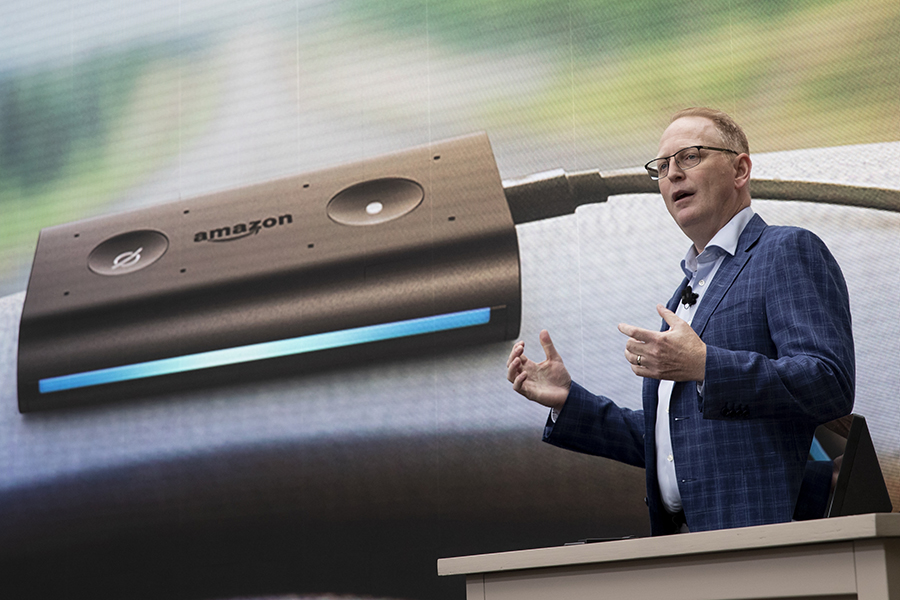
Artificial intelligence won’t take everyone’s job. But it will hurt those who refuse to acknowledge or prepare for their future. Don’t let Alexa steal your job. Instead, stay educated and ahead of the AI curve.
Research shows that managers matter. They can have a significant impact on business outcomes and employee engagement. But many organizations do not adequately select or develop their managers, and miss a great opportunity for business advancement.
Google set out to determine what makes a manager great at Google. But first, a research team tried to prove the opposite: that managers actually don’t matter, that the quality of a manager didn’t impact a team’s performance. This hypothesis was based on an early belief held by some of Google’s leaders and engineers that managers are, at best, a necessary evil, and at worst, a layer of bureaucracy.
The team defined manager quality based on two quantitative measures: manager performance ratings and manager feedback from Google’s annual employee survey. This data quickly revealed that managers did matter: teams with great managers were happier and more productive.
But knowing that managers mattered didn’t explain what made managers great. So the team asked employees about their managers. By going through the comments from the annual employee survey and performance evaluations, the team found ten common behaviors across high-scoring managers. The researchers also conducted double blind interviews with a group of the best and worst managers to find illustrative examples of what these two groups were doing differently. Here are the ten traits they found that made a Google manager an effective leader:
They are a good coach
Empowers the team and does not micromanage
Creates an inclusive team environment, showing concern for success and well-being
Is productive and results-oriented
Is a good communicator — listens and shares information
Supports career development and discusses performance
Has a clear vision and strategy for the team
Has key technical skills to help advise the team
Collaborates across the company
Is a strong decision maker.
The People Operations team uncovered what makes a great manager at Google, but that doesn’t mean what works for Google managers will work for any organization.
To determine what makes managers great in your organization, consider these questions:
Do managers matter at your organization? Explore external research (e.g., Gallup research highlights five important manager talents) and internal input like surveys or interviews to find out if people managers matter to your team members’ performance and happiness.
If managers matter, whom do you need to convince and how? Google used internal data to convince engineers and leaders that managers matter. How will you convince your organization?
What makes a great manager at your organization? Google found ten behaviors of successful managers – you might find you have two, three, or twelve. Internal data, like employee survey results and interviews, can help uncover the elements of good management at your organization.
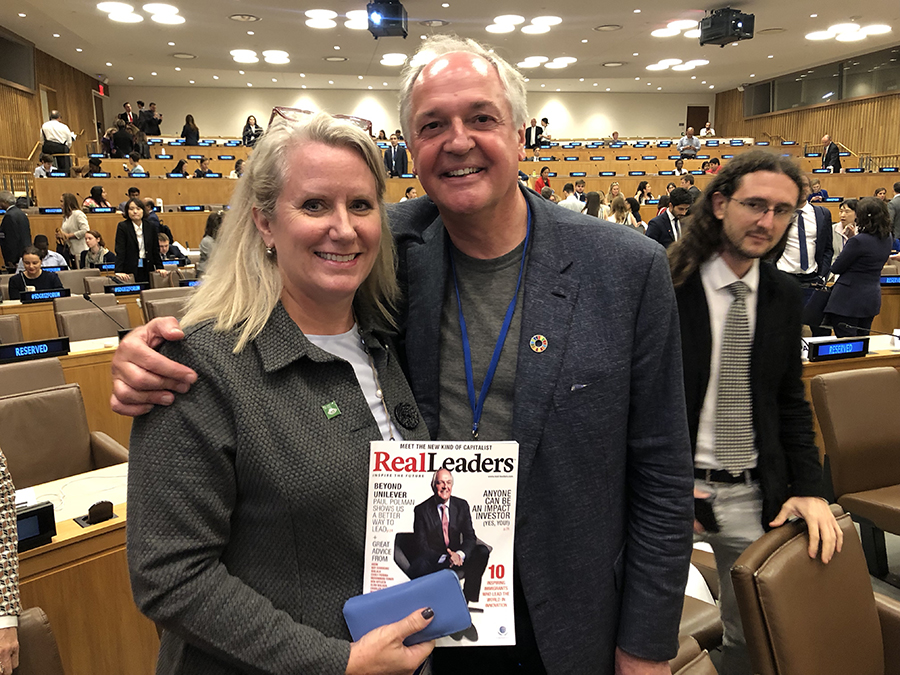
Paul Polman, SDG Advocate and Co-Vice Chair of the UN Global Compact Board, made a passionate call-to-action to the compannies everywhere at the 2019 SDG Business Forum, held in New York in September. Real Leaders was there.
Co-hosted by the International Chamber of Commerce (ICC), the United Nations Department of Economic and Social Affairs (UN DESA), and the United Nations Global Compact, the SDG Business Forum — now in its fourth year — gathered nearly 600 stakeholders to dive deep into sustainable financing, the future of business and scaling ambition for a sustainable world.
To read our exclusive interview with Paul Polman and to learn more about becoming a real leader yourself, subscribe here.
In today’s high velocity, always-on business environment, business leaders are expected to make rapid decisions, work at breakneck pace and achieve exceptional results — all without losing a beat. Decisiveness is an essential leadership trait. But hasty decision-making while moving too quickly is bound to lead to mistakes. Repeated mistakes. Costly mistakes. Preventable mistakes.
Business leaders make in the vicinity of 3,500 decisions a day. Every one of these decisions, large and small, takes up mental energy. The more decisions you need to make, the more depleted you become and the less adept at making good decisions.
Rushing to decisions without fully considering the pros, cons and implications means you’re more likely to choose poorly. Sometimes these poorly made decisions will only amount to modest mistakes. Ideally, you’ll learn from them and move on. But if you’re in the habit of continually going too fast, you’re likely to make the kind of mistakes that put you, the company, your customers and investors at risk. These mistakes may require millions of dollars to remedy. They could cost you clients, employees and industry repute.
There’s a solution to all this going-too-fast, and it’s right at your fingertips. It involves simply learning how to pause and reflect before acting. Even building in a modest few minutes’ pause into your daily schedule can do wonders for seeing the bigger picture and gaining a competitive edge.
Starting now, train yourself to take your foot off the accelerator and fully assess the situation before acting or deciding.
Use these decision-making strategies when you slow down to make your plan of action:
1. Employ the “CIA” approach
The next time you’re faced with an important decision, stop and ask yourself:
Control: “Is this a situation or decision over which I have direct control? If so, what outcome do I want to achieve?”
Influence: If you don’t have direct control, can you influence the decision or outcome? If so, how can you most effectively exert that influence?
Accept/Adapt: If you have neither control nor influence, can you accept the situation? What can you do to make it more palatable and positive? What must you do to adapt?
2. Find ways to delegate
A thriving leader can’t allow herself to continually get pulled into the details or become bogged down by day-to-day execution. Some things simply must be delegated. Before diving in yourself, ask the following:
Capacity/Interest: Who has the capacity for the work or has an interest in taking on the opportunity?
Promising potential: Is a direct report ready for the opportunity to stretch and learn?
Suited for another team: Is this task best directed to a different department or team? (Be careful here: you don’t want to be viewed as someone who passes the buck.)
3. Prioritize stakeholders
With a finite amount of time to attend to everyone’s demands, create a Stakeholder Priority Plan.” Think of all the stakeholders relevant to your success and assign each to one of three tiers:
Tier I: These are your most important stakeholders. Their support will help you rapidly progress. Conversely, their opposition will create major headaches. They are the people with whom you must closely align to move your agenda forward. Tier I stakeholders may include your manager, his or her manager and peers, your closest colleagues and leadership team. If you are the CEO, tier one includes members of the board. Important customers and clients are tier one.
Tier II: Tier II stakeholders are a moderately lower priority, but still important. They’re the people you must influence and with whom you must have a trusting relationship — but the urgency to do so is less intense. Tier II stakeholders may include the people who work for your direct reports. They may be colleagues in other areas with whom you need to collaborate. Some of your customers and clients will fall into this category, too.
Tier III: This tier consists of everyone else. Tier I and II get first dibs on your attention, but Tier III shouldn’t be ignored or dismissed. After all, you need to inspire and engage the entire organization. And, you never know when a small client account may turn into something big, so don’t neglect your Tier III customers.
Better decision-making begins with refusing to be pulled into fire-fighting mode. Adjust your focus from near-term activities to the longer-term, strategic view. This will allow you to become far more proactive than reactive. Deliberately pausing to determine where you want to exert influence, where you can delegate, and where you need to focus attention will make it much easier to move forward while preventing mistakes.
While starting any new role can be daunting, starting or reinventing an entire company can feel equal parts exhilarating and downright terrifying. Lined with countless decisions, each which will directly impact the fate of your company, the winding path of an entrepreneur is one of thrilling wins, sleepless worry-filled nights, and unexpected detours.
Over the past 25 years, I have scaled three organizations, reinventing my current company over the past decade into the leading player in the educational technology market with 10-fold growth. Over the years, (and from more high highs and low lows than I care to revisit!), I have learned a tremendous amount about leadership and the habits that support personal happiness and fulfillment. The nuggets below are a few I’ve held onto over the years and are shared to help other entrepreneurs and leaders on their paths.
Rob Waldron, Chief Executive Officer, Curriculum Associates
1. Swallow your pride
Early in my career, I was assigned to manage a test prep center and had no idea where to start to improve margins. A freshly-minted MBA, I quickly realized my “training” had nothing on the experience of the folks who knew the climate best, so I went to the source and asked the employees about the areas they saw that needed improvement. By swallowing my pride and merely implementing their suggestions, we doubled sales.
Your ideas aren’t always going to be the best in the room, and that’s a good thing. Surround yourself with the most driven, talented team possible, and open yourself to their different strategies and ideas. Nobody knows everything, and there is always an opportunity to learn from others or to find different paths to reach the same conclusion. Taking the time to be open-minded and seek guidance will make a massive difference in your business, and the lessons you learn from listening will serve you well down the road.
2. Deepen your phone-a-friend bullpen
As CEO you’re called upon as final arbiter, and it can be easy to default to believe your way is always the best. While confidence and decisiveness are essential, so is humility. All humans need help and support, and I have found enormous personal and professional benefit in being part of a strong peer network, (for me, it’s been YPO), which provides a sounding board and valuable outside industry perspective.
3. Play the long game
Fight the (often powerful) urge to focus solely on near-future goals such as next quarter’s earnings. While this focus is understandable in the scrappy, “are-we-gonna-make it to next month” environment of a new venture, this myopic approach can be disastrous in the event of an unforeseen challenge, such as a recession. Taking a long-term approach requires sustainable planning, a heck of a lot more work and, in many cases, less immediate monetary gratification. But investment in long-term talent and thoughtful R&D spending can make your company uniquely prepared to weather disasters that topple short-sighted companies. The downturns don’t look quite as bad if you’re able to put things into perspective and focus on success in the long run.
4. Be thankful for negative feedback
Who doesn’t love a negative performance review?! I’m kidding, but only somewhat. The best way to grow and improve is to regularly seek out feedback, digest it without defense, and seek meaningful ways to incorporate it. What does this look like? In my organization, I invite all 1000+ of my employees to rate my job performance in an anonymous, company-wide annual survey.
In the spirit of transparency and to demonstrate my commitment to self-improvement, I report the scores and unfiltered comments out to the entire company. As a result of this process, I’ve had my eyes opened many times to blind spots I’d been missing, and this feedback has helped ensure we’re doing everything we can to make our culture as inclusive as possible. In publishing and implementing this thoughtful feedback, I’ve seen positive changes in workplace culture and my effectiveness and as a leader.
5. Value people over profit
As backward as this may sound, I’ve found that an all-consuming focus on profit can cripple your for-profit company. In reflecting on the factors driving outsize growth for my current for-profit company, I attribute much of that success to the values and principles that guided me in my previous role as CEO of a nonprofit. Similar to a nonprofit, the culture at my company is heavily mission-focused, and our employees are committed to a shared vision of improving the world of education for teachers and students. With every decision we make, our first consideration is the impact on the people we serve. Ensuring we are living our values and doing right by our stakeholders is a win-win, helping us recruit and retain employees aligned to and fulfilled by our mission and strengthening trust with our customers.
6. Prioritize hiring and happiness
I cannot stress this enough – your employees are the backbone of your company and will make or break it. A talented individual can elevate an entire team, champion a game-changing new technology, or have a conversation with a customer that puts your company on the map. When I say I am talent-obsessed, I mean it, and I allocate my time accordingly. As CEO, I spend more than 50 percent of my time focused on bringing the top talent to our organization, and I interview every final candidate – no small commitment when you consider we’ve already welcomed nearly 300 new team members this year! Invest the time to find the candidates who match not only for skills, but more importantly, culture and mission, and you will stack your organization with a team committed for the long-haul.
Once you’ve hired the best employees, you want to make sure that they are happy, supported, and motivated to do their jobs. For example, I believe companies must recognize the fundamental importance of paying employees fairly, so we decided to voluntarily raise Curriculum Associates’ minimum wage to $15 / hour in 2015.
Inclusive workplace culture is key to employee happiness, and with nearly two-thirds of our employees working remotely, we recognize how important it is to create cohesion when there isn’t a physical location to connect. As a result of our employees’ insightful feedback, we’ve launched some excellent practices to foster inclusion, such as formal meet-ups to create a sense of community for remote workers and a virtual map to make it easier for team members to connect, among other things. Considering the lived experiences of your employees – from their first interview to their benefits to their physical workspace – will help you build a talented, loyal, and well-supported workforce and happy employees stick around.
This list is by no means exhaustive. Like all of you, I continue to add leadership lessons to my toolkit every day. My hope in sharing the foundational habits that have served me well helps you curate a playbook to prepare for the exciting challenges and opportunities ahead.
Leadership in the 21st century continues to evolve to meet the demands of dramatically changing organizational structures — one that is being transformed to include decision making at all levels.
Leadership capabilities are needed throughout organizational structures, not merely within the top tier. Leaderships role has now expanded to include team members, remote staff members, independent contractors, and stakeholders.
However, there are specific leadership characteristics that make an individual more or less likely to succeed. Research on leadership continues to reveal which characteristics are more necessary and how are they best utilized. It’s essential to keep in mind that each person has their own unique leadership style — based on a unique blend of experiences they bring to any situation. They also bring competencies and personalities.
Effective leadership does not come exclusively from contextual knowledge and competencies, but rather, from well-honed people skills. Most people value competencies to get a job done, but are equally drawn to leaders who demonstrate authenticity and are friendly and respectful toward others.
Leadership characteristics can be divided into two categories — those of strength and those of warmth. The characteristics of strength are sought-after in job interviews and highlighted on resumes, but the characteristics of warmth become increasingly important as you move into the upper echelons of leadership.
How do we define strength characteristics?
Traits that are associated with leadership strength include individual intelligence, problem-solving, strategic perspective, technical and professional expertise, goal setting, time management, and analytical capabilities. When considering which areas of professional development to improve, people often want to improve their strength. There’s a sense that boosting one’s expertise can lead to promotions and higher leadership positions. However, this set of attributes, used alone, has limitations.
How do we define warmth characteristics?
Traits that are associated with leadership warmth include an individual’s trustfulness, empathy, respect for others, social support, honesty, approachability, collaboration, ability to inspire, and effective communication. People notice warmth characteristics first when forming an initial impression of someone. When defining the effectiveness of a leader, individuals often cite warmth characteristics as the most important. This characteristic can only be learned through situational application — not in a formal classroom setting. It’s how an individual performs — the tone of their voice, an authentic smile, validation of another’s feelings.
How will the digital age affect leadership?
Leaders will soon be navigating a dynamic, fast-paced digital age. Working in this environment will cause leaders to make decisions in a shorter time-frame and across virtual landscapes. The global community will continue to shrink, and reliance on collaborative teams will increase. With this quickened pace, innovation will be vital to keeping one step ahead, and living with ambiguity will become the norm. Leaders who rely on concrete evidence for decision-making will find themselves falling behind. Learning to work with your intuition will become a necessary skill.
In this new era of business, there is a growing expectation of conscious capitalism. No longer are companies solely focused on profit, there is the expectation that businesses will also focus on improving communities, while building their businesses. The new generation entering our workforce today, wants to make a positive impact on society and pursue work that has a meaningful purpose. Leaders will be expected to incorporate purpose into their business plans and effectively communicate this purpose as part of their vision.
There continues to be growing importance in teaching skills
Effective leaders need to keep learning. To maintain a competitive advantage, they must have an ability to learn and adapt to change as it occurs. Most importantly, leaders must hone their teaching skills because the talent pool is shrinking, and the need to retain quality talent will become more urgent. One way to retain talent is to build an organization with continual learning and personal growth opportunities built-in.
Leadership etiquette will rise in importance
Have you noticed that our daily pace seems to have accelerated as information continues to bombard us — more emails, internet, text messages, and telephone calls? If we are not mindful, personal connections can be lost in the fray. In this fast-paced lifestyle, etiquette takes on a greater importance. Answering emails in a timely fashion is a must. If someone asks a question via text messaging, the internet, or email, they deserve an answer. Proper etiquette translates to being courteous, and leaders need such a trait if they want to build trust and camaraderie. Proper etiquette sends an important message that you respect those with whom you interact.
Leadership in the 21st century will continue to evolve as organizations shift the way they interact with society. Embracing change, enjoying the journey, and savoring the opportunities along the way — and working in collaboration — will make the learning process more rewarding.
How overachievers can stop sabotaging their own success or level of satisfaction after attaining superstar status.
In today’s fast-paced business climate where nothing is certain but rapid-fire change, the masses within business and work-life have surrendered themselves to “overachievement” in the pursuit of career success. Not just ordinary success, but rather the kind that exceeds expectations — courtesy of an excessive “above and beyond” mentality. Some relent to a life of overachievement willingly and enthusiastically as they yearn to earn, while others grievously succumb to a multitude of pressures (both external and self-inflicted) and work themselves to extremes in order to achieve and maintain an enviable stature and lifestyle.
Indeed, overachievement is a concept that has become a gold standard on how to become a “superstar” in business, career goals and life. Just Google “how to overachieve” and the web will dutifully deliver over 355,000 resources to help your prosperity.
While overachievement certainly has it’s tremendous share of virtues — having brought about profound innovation, breakthroughs, productivity and abundance, there’s often a dark side to this extreme approach to advancement. For some, dreams come true, but throngs of others miss the mark despite their best efforts. “This often happens because they’re aiming for achievements instead of at a deeper understanding of themselves and what they want,” asserts Keren Eldad, a certified business coach and keynote speaker, who is a trusted advisor to industry-leading executives, acclaimed entrepreneurs and premier organizations such as Beyond Capital, Luxxotica, Van Cleef & Arpels, YPO, LVMH and IWC.
“It’s a silent story shared by many who present a happy, accomplished and enviable image: one of putting on pretenses and internally writhing with angst and anxiety, of never having enough, of insecurity, doubt and dissatisfaction — a state I have coined the ‘Superstar Paradox,’” says Eldad. “The paradox occurs when pursuing illusory things we think we want, but actually produces undesirable results such as strain in avoiding low self-worth and general unhappiness — consequences that actually impede our ability to attain what we want. It can become an exhausting and hugely debilitating vicious circle.”
According to Eldad, the Superstar Paradox is a tough condition to solve because there’s one major, difficult hurdle to get past: admitting there’s a problem. “This requires relinquishing our main armor: that we know everything; that we have things ‘figured out,’” she says. “The key lies in accepting that ‘we don’t know what we don’t know’ and developing the courage and means to swap illusory happiness for a bona fide pursuit of wisdom that can bring true fulfillment, power and possibility.”
That’s easier said than done, of course, and as daunting and even enigmatic as it might seem, taking that proactive first step is critical. So, in the spirit of “starting somewhere,” Eldad offers the five foundational insights below to help ensure that some of your overachievement behaviors and mindsets won’t undermine your success — or your level of life satisfaction after realizing superstar status.
Reframe your success story. Overachievers often believe that success only comes from power, money or status. Yes, those things are important benchmarks for career measurement, but being successful in life overall should be the true Holy Grail. So, if you’re a C-suite executive, or aspire to be, but are riddled with anxiety, stress, pain and dissatisfaction (with relationships suffering as a result) it’s evident that money and status isn’t proving as worthwhile as it can be. To initiate change, be brave enough to reframe your personal story, from cover to cover. Life isn’t meant to be one-dimensional or even work-centered, so sit down and map out what you’d like each aspect of your life to look like if it were a true success. Start with career goals to get the juices flowing, as that might come easily, but then do separate exercises for as many other areas of your life that you can think of. This can include marriage, children, extended family, friendships, professional networks, social media/networking, investments, travel, physical fitness, self-care/beauty, fashion and style, transportation, entertainment, hobbies and passions and so on. Life is abundant. You’ll soon see that life fulfillment means — and needs — so much more than what happens at work. It can be a means to an end, but there’s so much more in between. Once you start mapping it out, you might come to the realization that you’ve been missing out on quite a lot in your quest for career glory. Reframe your success story with a more holistic approach—know what success “looks” like for each facet of your one and only life and commit (for real) to get there on all fronts.
Get out of your own way. Even superstars create self-imposed limitations based on what they originally perceived their goal or benchmark of success to be. Once achieved, it’s instinctive to want to bask in that “place,” both emotionally and physically. After all, you worked hard to get there. But, overachievers inevitably will want more, and then other kinds of self-imposed limitations kick in that are often founded on what we perceive our own capabilities and opportunities — or lack thereof — to be. Even the most confident overachievers suffer the “I can’t” internal rant. Take heed that “can’t” usually is not a real thing. From “I can’t afford to do what I really want” to “I can’t start over,” this word usually really means “I won’t”… I won’t try, I won’t make it, I won’t have good ideas. Yes, you worked darn hard to earn your current accolades and are pleased with yourself and where you are, but sometimes a hard pivot is needed to get you where you really want to go. The truth is never that you cannot, you just have to get yourself past the “will not.” Resources such as talent, money, conditions, time, etc. are often not a genuine end game, but rather merely obstacles and challenges that CAN be overcome with the right amount of ingenuity and chutzpah.
Classify and conquer your “fatal flaw.” One definition of a “fatal flaw” is that which causes an otherwise noble or exceptional individual to bring about their own downfall, which can be their own death — figuratively or literally. The idea that any particular fatal flaw is holding us back is a primary reason why so many overachievers become hooked on their achievements and come to rely on fake confidence and aggrandizement versus operating from a place of vulnerability and authenticity. This in an effort to hide or cover up that flaw — consciously or unconsciously. Sometimes the phrase “character flaw” reveals that the flaw is about the person and not the circumstance around them. One report cites that: “Heroes have a fatal flaw which they wrestle with consistently. This may open them up for specific conflicts later.” It underscores that this sinister type of flaw can hurt you now, and also well into the future. So, to achieve true superstar status fostering genuine, lasting happiness, it’s imperative to discern if you have a fatal flaw and, once identified, work wholeheartedly to resolve it — or learn how to effectively function at a high-level with it (if that’s even possible). One piece of research identified “ Ten Fatal Flaws That Derail Leaders” that includes things such as “don’t collaborate,” “resist new ideas,” and “accept your own mediocre performance.” It contains one particularly eye-opening point: that these flaws “sound like obvious flaws that any leader would try to fix. But the ineffective leaders we studied were often unaware that they exhibited these behaviors. In fact, those who were rated most negatively, rated themselves substantially more positively. Leaders should take a very hard look at themselves and ask for candid feedback on performance in these specific areas. Their jobs may depend on it.”
Course-correct crippling self-constructs. A common obstacle to a “superstar” realizing genuine happiness is their own reliance on self-esteem, which is different from self-acceptance. Self-esteem is defined as “a positive or negative orientation toward oneself; an overall evaluation of one’s worth or value” and, for overachievers, depends on external conditions being met (i.e., what they are achieving) and how they “rank” against others in society. Self-acceptance, which is a critical factor in genuine happiness and authenticity, is founded on other key self-constructs like self-compassion — a person’s ability to forgive themselves for essentially being human and, thus, imperfect. Overachievers and accomplished superstars are susceptible to being heavily dependent upon the opinions of others and their corresponding status. In many cases, this feeling of unworthiness is what coaches like myself consider a fatal flaw for the overachiever. It’s that “something” about themselves they feel makes them “less than.” A secret they think that if others knew, would cause them to be disrespected or rejected. For overachievers, what becomes a fatal flaw is often a common imperfection, such as body weight, assets, health, children, relationships and even their homes. Anything can be regarded as a flaw needing to be perfected. It can become a never-ending, and sometimes futile, battle. This persistent effort fosters stress, and the fallout can be similar to those with a penchant for perfectionism, though not quite as extreme. Ultimately, this tendency can cause “superstars” to make tradeoffs, preferring “safe” and “lucrative” jobs and titles over pursuing their true passions, resigning themselves to a life in “golden handcuffs” or a job that’s “good enough.” It also causes them to settle for mere connection over true bonding, real friendship and even true love (like marrying the “right” person on paper versus the person you actually love deeply).
Resolution can be found when an overachiever consciously fights back against the urge and instinct to beat themselves up for not being exactly “done” or for other self-assessed shortcomings, and replace those notions with ideas that promote high self-esteem. According to reports, this can include “being open to criticism, acknowledging mistakes and being comfortable with giving and receiving compliments,” while also knowing what your values are and living life accordingly. This may sound easy, but given that these insecurities have forged a well-honed path in an overachiever’s mind over time, it’ll take deliberate and sustained effort to course-correct. Truly happy superstars are steadfast with the practice of being kind to themselves; unequivocal in their belief that self-criticism is self-defeating.
Pray for a sh*tstorm! If you didn’t buy all the above points and think (as many superstars do) “nah, I got this,” then brace yourself because a curve ball is bound to appear and throw you off your game. But, this unimagined disruption can be a GOOD thing! So many overachievers spend most of their lives working to avoid the pain of uncertainty or problems, assuring themselves with zealous over-confidence that “it’s all going to work out” based on the current approach or way of thinking — and ignoring that nagging dissatisfaction and angst. However, I’ve found that when superstars are at their most comfortable or when stress finally boils over, they not only find themselves immersed in a major “issue,” but often a major storm. When this happens, embrace it and open yourself to the series of new possibilities it presents. Yes, it will be uncomfortable and tremendously unsettling, but it can also present an exciting opportunity: the wake-up call to finally recognize where you are and what got you there, what weaknesses and threats have gotten the best of you. Work on thoughtfully-strategized resolutions that’ll make you emotionally stronger and your circumstances better than before.
“There’s been a common starting point with every single C-level superstar, multi-millionaire and general overachiever I’ve ever worked with,” Eldad notes. “They all think they know ‘what to do’ and ‘where they want to be’ in the world but get tripped up because these things aren’t necessarily what will bring them genuine fulfillment.”
Statistics seem to confirm Eldad’s contention across the board, including mental health issues, divorce, suicide, anxiety, escalated workplace stress and dissatisfaction, anti-depressant use, narcissism and panic disorders… the list goes on.
“It’s time to stop living life for achievements, money, accolades and the validation of other people,” Eldad urges. “It’s my hope that those locked in patterns that cause anxiety and misery — and a life devoid of meaning, purpose, self-love and happy relationships — seek a way to question themselves and find out who they really are and what their authentic path is — leading to genuine answers and clarity. First, you must admit and even embrace the notion that ‘you don’t know what you don’t know,’ which is to say that you have a few things left to learn, and then actively aspire to attain that knowledge and wisdom. In doing so, you may find profound happiness — the truest measure of success.”
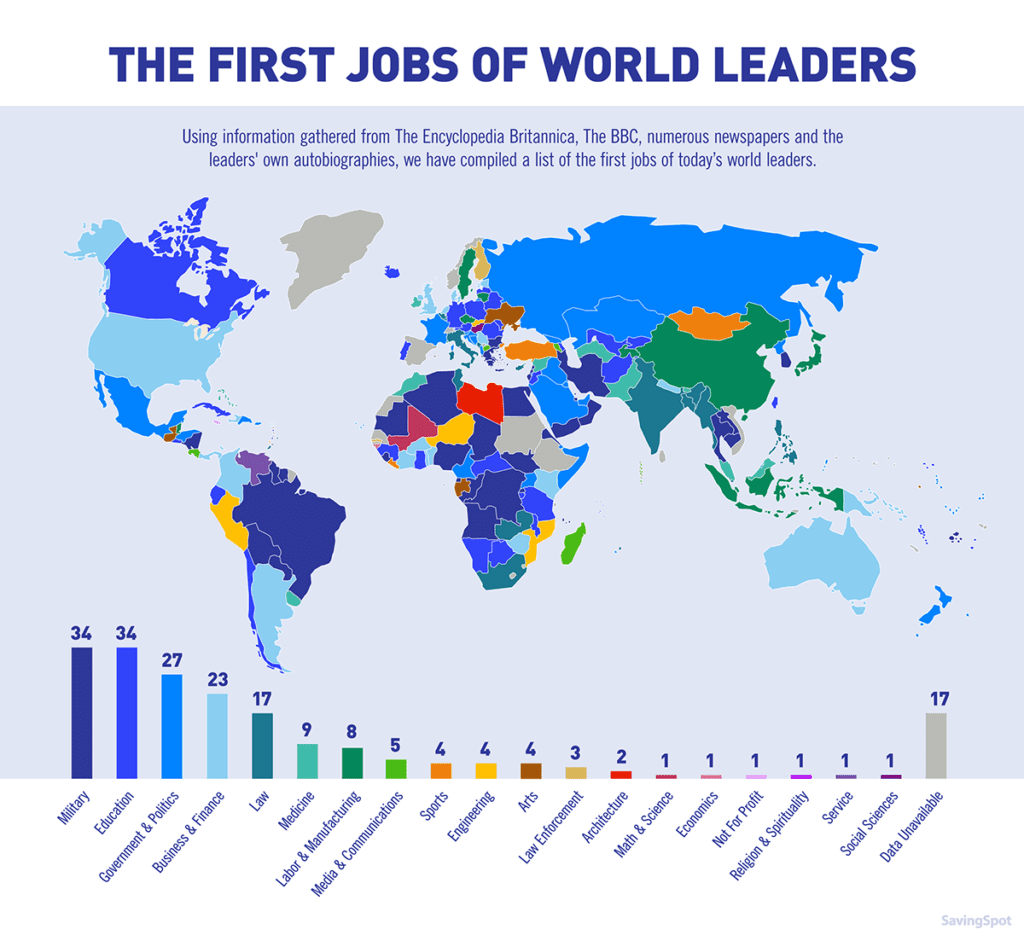
World leaders, like everyone else, should not just be understood by the job they have now or the money they claim to have made along the way. Like everyone else, our leaders are shaped by where they started: their first job. Here are the roles they had to fight for, and the ones they had to take to make ends meet.
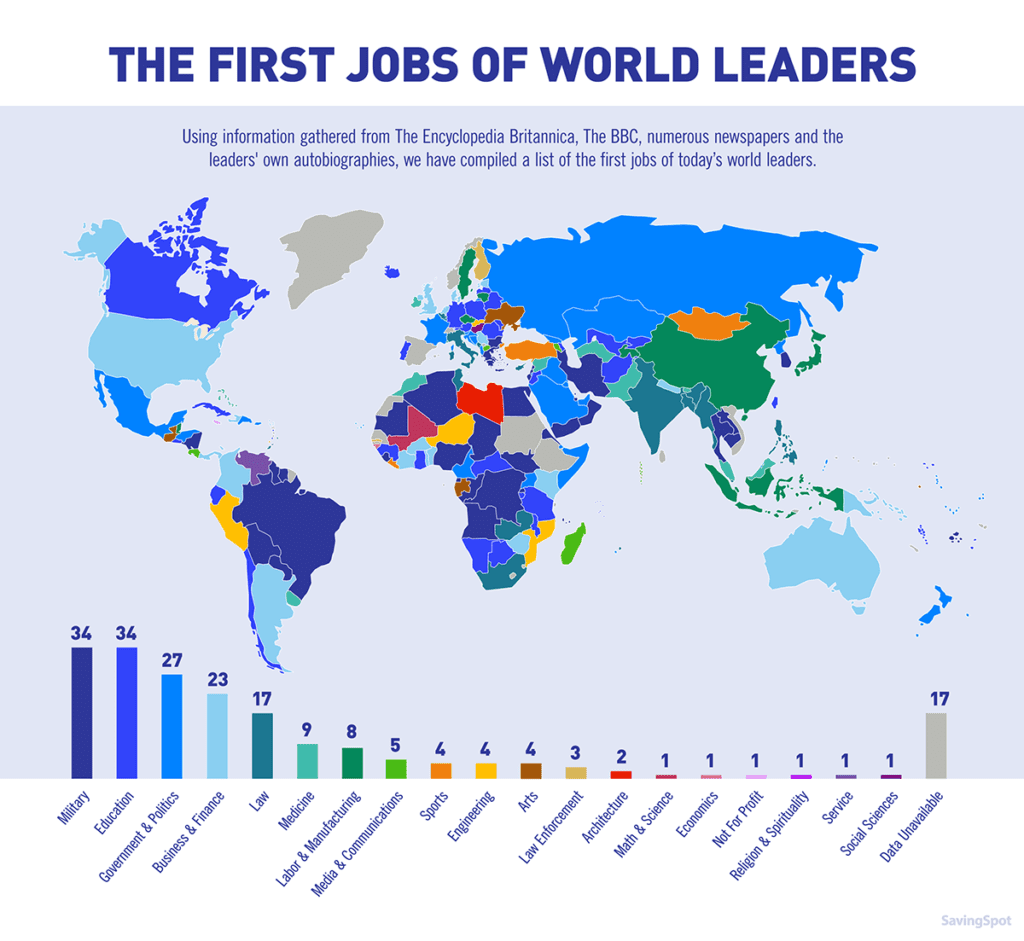
A few months ago, we looked at what today’s world leaders studied at college. But their first jobs can say just as much about the people they were and who they would become. Using information gathered from The Encyclopedia Britannica, The BBC, numerous newspapers and the leaders’ own autobiographies, we compiled a list of the fist jobs of today’s world leaders. Some started in the military, some were teachers, some even played sports professionally. Surprisingly few started in customer service – a shame, since customer-facing jobs help you learn to love the people who yell at you!
The map below shows the various industries that world leaders first jobs were in. Read on to see each country’s leader and what they did in their first full-time position.
The United States, of course, is run by America’s most famous real estate agent. Although Donald Trump made his first pocket money by collecting bottles from his father’s construction sites and later got experience rent-collecting from tenants, he was assured a job in real estate from the outset, thanks to a family fortune in the hotel business.
Further north, Canada’s Prime Minister Justin Trudeau was also helped along the way by family connections: his father was Prime Minister for 16 years from the end of the ‘60s. But Trudeau Jr. kept things real, working as a nightclub bouncer, snowboard instructor and radio host along the way. His first full time job was as a “highly valued, spirited and enthusiastic teacher” of math, according to his boss at West Point Grey Academy.
Antigua and Barbuda Gaston Browne Banker Bahamas Hubert Minnis Doctor Barbados Mia Mottley Lawyer Belize Dean Barrow Lawyer Canada Justin Trudeau Teacher Costa Rica Carlos Alvarado Quesada Journalist Cuba Miguel Díaz-Canel Engineering professor Dominica Charles Savarin Teacher Dominican Republic Danilo Medina Deputy of National Congress El Salvador Salvador Sánchez Cerén Teacher Grenada Keith Mitchell Cricket player Guatemala Jimmy Morales Comedian Haiti Jovenel Moïse Business owner (auto part store) Honduras Juan Orlando Hernández Executive assistant Jamaica Andrew Holness Executive Director of a children’s organization Mexico Andrés Manuel López Obrador Variousgovernment positions within the government of Tabasco Panama Juan Carlos Varela Executive Vice-President of Varela Hermanos S.A. Saint Kitts and Nevis Timothy Harris Business Manager Saint Lucia Allen Chastanet Unknown Saint Vincentand the Grenadines Ralph Gonsalves Lecturer Trinidad and Tobago Paula-Mae Weekes Lawyer United States of America Donald Trump Real estate professional
South America
It’s in Venezuela that we find the world’s only customer service-oriented world leader: Nicolás Maduro, who worked as a bus driver in Caracas, the country’s capital. While he no doubt learned a lot about life and the wants and needs of people in this job, he supplemented his development as a future world leader with extracurricular activities. Both at school, and during life as a driver, he was involved in leadership roles within the unions. He also played to adoring rock concert audiences as a musician.
Brazil, Bolivia and Paraguay are run by former soldiers, but Uruguay has the world’s only oncologist-president, Tabaré Vázquez. The respected cancer physician is the nation’s first left-wing premier and is currently enjoying his second term at the top.
Argentina Mauricio Macri Junior analyst at Holding Company (Economics / stocks) Bolivia Evo Morales Soldier Brazil Jair Bolsonaro Soldier Chile Sebastián Piñera Economics professor Colombia Iván Duque Banking consultant Ecuador Lenín Moreno Director of the Continental Professional Training Center Guyana David A. Granger Cadet Officer / Soldier Paraguay Mario Abdo Benítez Lieutenant – Armed forces Peru Martín Vizcarra Civil engineer Suriname Dési Bouterse Soldier Uruguay Tabaré Vázquez Oncologist Venezuela Nicolás Maduro Bus driver
Europe
Ukraine’s new president, Volodymyr Zelensky, famously rose to power after portraying a fictional president in a TV sitcom. His predecessor, Petro Poroshenko, was a Willy Wonka-style candy billionaire known as the “Chocolate King.” Like his teacher-turned-president character before him, it was Zelensky’s inexperience and no-nonsense (and no-corruption) approach that voters found alluring. While Zelensky does have a law degree, he was originally a comedian, transforming the comic troupe he established at age 17 into a production company and becoming a millionaire in the process.
You might imagine that Lithuania’s “Iron Lady,” Dalia Grybauskaitė, earned her nickname for her industrial past: she worked in a factory while studying political economics. In fact, the country’s first female president (elected with record-breaking numbers) earned the title through a combination of her black belt in karate and no-nonsense speechmaking. To complete the jigsaw puzzle of her odd political development, she cites the disparate characters of original Iron Lady, Margaret Thatcher and Mahatma Gandhi as her biggest influences.
Albania Ilir Meta Deputy Chairman of Albanian Euro-socialist Youth Movement (FRESSH) Andorra Antoni Martí Architect Armenia Nikol Pashinyan Journalist Austria Alexander van der Bellen Economics professor Belarus Alexander Lukashenko Political instructor Belgium Charles Michel Lawyer Bosnia and Herzegovina Valentin Inzko Diplomat Bulgaria Rumen Radev Air Force pilot Croatia Kolinda Grabar-Kitarović Advisor to the International Cooperation Department of Croatia Cyprus Nicos Anastasiades Lawyer Czech Republic Miloš Zeman Engineering plant worker Denmark Lars Løkke Rasmussen Consultant Estonia Kersti Kaljulaid Sales manager Finland Sauli Niinistö Police chief France Emmanuel Macron Inspector – French Finance Ministry Germany Angela Merkel Academic faculty (teacher) Greece Prokopis Pavlopoulos Soldier Vatican City Giuseppe Bertello Priest Hungary János Áder Researcher Iceland Guðni Th. Jóhannesson Lecturer Ireland Leo Varadkar Doctor Italy Sergio Mattarella Lawyer Kosovo Hashim Thaçi Unknown Latvia Raimonds Vējonis Biology Teacher Liechtenstein Adrian Hasler Head of Controlling at Balzers AG Lithuania Dalia Grybauskaitė Factory worker Luxembourg Xavier Bettel Lawyer Macedonia Gjorge Ivanov Journalist Malta Marie-Louise Coleiro Preca Unknown Moldova Igor Dodon Assistant professor Monaco Pavel Filip Factory worker Montenegro Milo Đêukanović Legal aid Netherlands Mark Rutte HR Manager Norway Erna Solberg Unknown Poland Andrzej Duda Teacher Portugal Marcelo Rebelo de Sousa Law professor Romania Klaus Iohannis Physics Teacher San Marino Mirko Tomassoni Civil Police officer Serbia Aleksandar Vučić Merchant Slovakia Andrej Kiska Design engineer Slovenia Borut Pahor Delegate, Assembly of the Republic of Slovenia Spain Pedro Sánchez Unknown Sweden Stefan Löfven Welder Switzerland Ueli Maurer Unknown Turkey Recep Tayyip Erdoƒüan Professional Football player Ukraine Petro Poroshenko Soldier United Kingdom Boris Johnson Management Consultant
Africa
Many of Africa’s leaders started out in military or political positions, which seems indicative of the troubled recent past of states such as Congo and Chad. But the continent’s most internationally famous ‘president with a past’ has to be Liberia’s George Weah.
The former A.C. Milan footballer, who won three Series A titles, three African Player of the Year awards, and a FIFA player of the year trophy, defeated his opponents (by 13 states to two) to take the presidency and was sworn in at the beginning of 2018. “I have spent many years of my life in stadiums,” Weah told the crowds, “but today is a feeling like no other.”Algeria Abdelaziz Bouteflika Soldier (Officer, National Liberation Army)
Angola João Lourenço Soldier Benin Patrice Talon Business owner Botswana Mokgweetsi Masisi Teacher Burkina Faso Roch Marc Christian Kaboré Banker Burundi Pierre Nkurunziza Sports professor Cameroon Paul Biya Head of Department of Foreign Development Aid Cape Verde Jorge Carlos Fonseca Director General of Immigration Central Africa Republic Faustin-Archange Touadéra Assistant lecturer Chad Idriss Déby Soldier Comoros Azali Assoumani Parchutist Congo Félix Tshisekedi UDPS national secretary for external relations Congo (Republic of the: Brazzaville) Denis Sassou Nguesso Soldier Ivory Coast Alassane Ouattara Economist Djibouti Ismaïl Omar Guelleh Civil servant Egypt Abdel Fattah el-Sisi Military officer EquatorialGuinea Teodoro Obiang Nguema Mbasogo Soldier Eritrea Isaias Afwerki Soldier Ethiopia Sahle-Work Zewde Unknown Gabon Ali Bongo Ondimba Musician Ghana Nana Akufo-Addo Teacher Guinea Alpha Condé Teacher Guinea-Bissau José Mário Vaz Economist Kenya Uhuru Kenyatta Business owner Lesotho Tom Thabane Unknown Liberia George Weah Football player Libya Fayez al-Sarraj Architect Madagascar Andry Rajoelina Media entrepreneur Malawi Peter Mutharika Law professor Mali Ibrahim Boubacar Keïta Researcher (at French National Center for Scientific Research) Mauritania Mohamed Ould Abdel Aziz Soldier Mauritius Barlen Vyapoory Barrister-at-law / lawyer Morocco Saadeddine Othmani Psychiatrist Mozambique Filipe Nyusi Mechanical engineer Namibia Hage Geingob Teacher Niger Mahamadou Issoufou Mining engineer Nigeria Muhammadu Buhari Soldier Rwanda Paul Kagame Chief of Intelligence Sao Tome and Principe Evaristo Carvalho Unknown Senegal Macky Sall Unknown Seychelles Danny Faure Assistant curriculum officer Sierra Leone Julius Maada Bio Soldier Somalia Mohamed Abdullahi Mohamed Secretary in the Somali embassy in Washington DC South Africa Cyril Ramaphosa Law clerk South Sudan Salva Kiir Mayardit Soldier Swaziland Ambrose Mandvulo Dlamini Unknown Tanzania John Magufuli Teacher The Gambia Adama Barrow Security guard Togo Faure Gnassingbé Financial advisor Tunisia Beji Caid Essebsi Lawyer Uganda Yoweri Museveni Leader – political resistance movements Zambia Edgar Lungu Lawyer Zimbabwe Emmerson Mnangagwa Business owner (construction company)
Asia
Like Weah, Mongolia’s President Battulga Khaltmaa started out in sports; and like Dalia Grybauskaitė, you wouldn’t want to get into a fight with him either. This judo master is also a former Sambo wrestling champion. He first tasted power as chairman of the Mongolian Judo Federation, and during his reign the Mongolian judo team became Olympic Champions.
North Korea’s ‘supreme leader’ Kim Jong-Un kept a low profile before succeeding his father as head of the government and military. It’s believed that he worked either for the Korean Workers’ Party or the army’s General Political Bureau, possibly in surveillance. He took further roles in defense and state security over the years, gaining the enviable title “Brilliant Comrade” in 2009.
Afghanistan Ashraf Ghani Anthropology professor Azerbaijan Ilham Aliyev Lecturer Bahrain Hamad bin Isa Al Khalifa Soldier (Commander in Chief of the Bahrain Defense Force) Bangladesh Abdul Hamid Lawyer Bhutan Lotay Tshering Urologist Brunei Hassanal Bolkiah Sultan Cambodia Hun Sen Soldier China Xi Jinping Manual laborer Georgia Salome Zourabichvili Diplomat India Ram Nath Kovind Lawyer Indonesia Joko Widodo Pulp mill worker Iran Hassan Rouhani Soldier Iraq Barham Salih Foreign relations with the Patriotic Union of Kurdistan Israel Benjamin Netanyahu Soldier Japan Abe Shinzo Manufacturing professional Jordan Omar Razzaz Assistant professor Kazakhstan Kassym-Jomart Tokayev Diplomat Kuwait Jaber Al-Ahmad Al-Jaber Al-Sabah Director of Public Security for the Ahmadi region Kyrgyzstan Sooronbay Jeenbekov Teacher Laos Bounnhang Vorachith Military service Lebanon Michel Aoun Military service – artillery officer Malaysia Mahathir Mohamad Doctor Maldives Ibrahim Mohamed Solih Journalist Mongolia Khaltmaagiin Battulga Professional wrestler Myanmar (Burma) Win Myint Lawyer Nepal Bidhya Devi Bhandari Union Representative NorthKorea Kim Jong-un Surveillance of Government Officials Oman Qaboos bin Said al Said Soldier Pakistan Arif Alvi Doctor Palestine Mahmoud Abbas Civil servant Philippines Rodrigo Duterte Lawyer Qatar Abdullah bin Nasser bin Khalifa Al Thani Military officer Russia Vladimir Putin Foreign Intelligence Officer Saudi Arabia King Salman bin Abdulaziz Al Saud Governor of Riyadh Singapore Halimah Yacob Lawyer South Korea Moon Jae-in Soldier Sri Lanka Maithripala Sirisena Unknown Syria Bashar al-Assad Army doctor Taiwan (Republic of China) Tsai Ing-wen Law professor Tajikistan Emomali Rahmon Electrician Thailand Prayut Chan-o-cha Soldier (Queen’s Guard) East Timor Francisco Guterres Unknown Turkmenistan Gurbanguly Berdimuhamedow Dentist United Arab Emirates Khalifa bin Zayed Al Nahyan Ruler’s Representative in the Eastern Region of Abu Dhabi Uzbekistan Shavkat Mirziyoyev Junior Research Fellow Vietnam Nguyễn Phú Unknown Yemen Abdrabbuh Mansur Hadi Soldier
Oceania
New Zealand’s inspiring prime minister Jacinda Ardern has been in politics from the start, working as a researcher for the Labour Party straight out of college. But she had ample chance to develop empathy and a social conscience growing up in a poor and gang-infested area among “children without shoes on their feet or anything to eat for lunch.”
Baron Waqa, 14th President of the island country of Nauru, is the only leader on our map to have started out as a composer. Today, his son has taken over the family business – updating some of the president’s traditional-sounding songs with modern pop beats.
Australia Scott Morrison Policy head at the Property Council of Australia Fiji Jioji Konrote Soldier Kiribati Taneti Mamau Civil Servant (Planning Officer with the Ministry of Finance) Marshall Islands Hilda Heine Teacher Micronesia, Federated States of Peter Christian Unknown Nauru Baron Waqa Composer New Zealand Jacinda Ardern Researcher with the Labour Party Palau Thomas Remengesau Jr. Senator Papua New Guinea Peter O’Neill Accountant Samoa Tuilaepa Aiono Sailele Malielegaoi Unknown Solomon Islands Rick Houenipwela Banker Tonga Akilisi Pōhiva Teacher Tuvalu Enele Sopoaga Education Administrator within the Ministry of Social Services Vanuatu Tallis Obed Moses Teacher
Methodology
To create these maps, we scoured articles, interviews and biographies of 197 leaders from all over the world. We then made sure all of our leaders were current leaders, as several countries have recently had elections. What we were looking for were the first jobs of our political leaders – not their first governmental job or their first gig for pocket-money – but their first real job as a young adult.
From there, we gathered all of the information – the country, the world leader’s name, their first job and the source used to find their job – and organized it in a spreadsheet. After fact-checking all of our information, we moved on to sort these jobs into broader categories; things like “Politics & Government,” “Military,” and “Medicine.”
Finally, we collected various maps online, first of the continents specifically, and then of the world at large. These were then modified and color-coded to illustrate the various job categories.
Great middle leaders motivate not only their team but others around them too. They do this by communicating purpose, thinking broadly to escape the organizational silos, and behave inclusively. Hiring for middle leadership is a smart strategy and motivates others. Great companies, however, deliberately build a culture of middle leaders.
A company wins the hearts and minds of its employees and customers based on the middle of the organization. A company drives the day to day of everything — from products, customers, support and sales and middle leadership deals with challenges, mistakes, and the surprises in the trenches.
As you think about building a world-class organization, it’s essential to understand, focus on, and measure, the concept of “middle leadership.” It’s a well-accepted fact that culture always trumps strategy when it comes to building a world-class global company and that becoming tangled in bureaucratic duties will slow a company down and erode the culture. To help avoid the ill-fate of a stale and slow-moving company, it’s vital to forward-hire and invest in the middle layer of your organization — as it will ultimately determine the fate of your business.
So how do you know when to hire for management skills versus hiring for leadership? All companies need a mixture of both. Understanding how these skills are different and when the middle of your organization needs more leadership, rather than just management, is one of the keys to growth. We commonly use the phrase “middle management” but have you ever heard of “middle leadership”? Nope. In part, because we tend to reserve the leadership label for senior executive hires. We argue that a consistent culture of middle leadership is essential to sustain corporate growth.
An organization may have great executive leadership, but ultimately, it rests on the abilities of the broader organization. Having leadership at every level is critical to breaking down the organizational silos in day to day challenges. Without this, corporate growth is slower, with more internal friction; often oblivious to market opportunities.
To fill the missing link between your company top leadership and the middle layer of the organization, you must reassess the hiring practices at your company. Evaluate what policies are in place when it comes to the intake of new employees and start to think about it in a specific, measurable way.
Ask yourself what types of interview questions should be added to HR recruiting strategies. Consider incorporating leadership aptitude tests to help ensure that new hires have the potential to help bridge the gap between management and leadership — to break down the silos. A bureaucratic, slow-moving culture is one of the most crippling afflictions a company can face. Middle leadership has the opportunity to spot failed communications between teams, missed hand-offs within the customer experience, and suggest new products. Identifying the attributes and skills of middle management, that will be used to pivot leadership-minded problem-solving, is a crucial component of building a company culture that thrives and is future proof.
One of the critical roles of the board is to set the “tone at the top” and to look at how company culture is affecting the organization. One of the things a board can look at specifically, as part of an ESG (Environmental, Social and Governance) framework, is to examine their organizational development. How are they forward building middle management? What programs are available to grow middle managers from doers to leaders? It’s well worth committing time and resources toward creating a dedicated set of programs that teach leadership skills. This creates a robust middle layer vs. one that is bureaucratic and unresponsive.
Great middle leaders see opportunities in friction and initiate action to fix it. Middle managers work the plan, report, and explain. This is valuable, but it won’t carry your culture and company forward. It’s vital to align your middle leadership with the company’s overall purpose and mission, to be sure that your vision is being implemented across all levels.
Leaders deal with the unknown, and are willing to admit they don’t have all the answers. They seek input from others to understand the important, yet not-so-obvious trends. These skills are needed at the top of an organization and also within the everyday interactions across an entire organization.
Great middle leaders motivate their team and others around them, too. This is accomplished by communicating purpose, thinking broadly to escape organizational silos, and behaving inclusively. Hiring for middle leadership is smart and motivates others, in part, because leaders invest in people. Good companies might have both managers and leaders by chance, but great companies deliberately build a culture of middle leaders.
Betsy Atkins is CEO and founder
of Baja Corporation and author of Be Board Ready. She currently sits on the boards of Wynn Resorts, SL Green
Realty, Schneider Electric, and Volvo Cars.
Lisa Dallmer is an
experienced Chief Operating Officer in financial services and technology.
Currently SVP of Business operations at Delphix, previously she was COO
of BlackRock’s Global Technology & Operations and COO for NYSE Euronext.