6 Ways to Harness the Power of Engagement

How engagement can power up your leadership, success, and prosperity in 2025.

By Tony Robbins

When you think about what truly drives extraordinary results in any field, the answer is always engagement. Engagement isn’t just about showing up; it’s about bringing your full self to every moment, every interaction, and every challenge. This is where true power lies — both for individuals and for businesses. In 2025, the opportunity to harness the transformative power of engagement has never been greater.

Over my four-and-a-half decades of coaching and personal experiences, I’ve seen firsthand how engagement can elevate leaders and foster unparalleled results and success. What’s also true is that far too many people are disengaged or engaged in ways that don’t contribute to their personal or professional success. 

Unfortunately, most people major in minor things. They know more about a social media personality’s “life” than they do their own dreams, desires, goals, and how to get there. 

And disengagement comes with a hefty price tag. Gallup estimates that the lack of engagement is costing the global economy an astounding $8.9 trillion in productivity losses, which translates to about 9 percent of the world’s GDP. This isn’t just a financial issue — it’s a fundamental human one. People who are not engaged experience heightened levels of stress, sadness, loneliness, and frustration. They are less productive and less likely to contribute positively to their communities and organizations.

What does this mean for businesses? According to a recent Gallup poll, engagement of employees is at record lows. Most companies have on average only 31% of employees who are actively engaged, 51% not engaged, and 18% so massively disengaged that they cause issues across the organization. 

When you compare companies in the top and bottom quartiles of engagement, companies in the top 25% had:

  • 22% higher profitability
  • 10% higher customer rating
  • 28% less theft
  • 48% fewer safety incidents

This is all in addition to:

  • A sense of meaning/mission 
  • Appreciation across the organization
  • 2x greater job satisfaction
  • 3x more likely to stay long-term

Let’s be clear: Engagement isn’t just a feel-good concept — it’s a powerful driver of performance and profitability. Companies that actively engage their employees are the ones setting records and leading industries. Look at top-performing companies like Google, Salesforce, Apple, and Facebook. These organizations aren’t just successful; they are engaged. 

So what creates engagement? How can we turn this around? How can we move from a state of disconnection to one of profound engagement? The answer lies in the understanding that engagement is a powerful catalyst for leadership and personal growth. 

Here’s how you can harness this power:

Engage actively with content. When you engage with information — whether through asking questions, taking notes, or participating in discussions — you transform passive learning into active involvement. This not only enhances your understanding but also reinforces your commitment to applying what you’ve learned.

Increase engagement personally and professionally. Start by reflecting on how you engage with your work and relationships. Are you fully present? Are you contributing in ways that energize you and others? Seek out ways to deepen your involvement, whether through setting new goals, taking on challenges, or fostering stronger connections with those around you.

Address disengagement head-on. Disengaged employees can be detrimental to an organization, while actively disengaged employees can actively work against it. As a leader, it’s your responsibility to address disengagement with empathy and action. Create an environment where people feel valued, listened to, and motivated.

Harness engagement for leadership. True leadership is grounded in engagement. When you are genuinely engaged, you inspire others to do the same. You set a powerful example and create a culture of enthusiasm and commitment. Remember, leaders who fake engagement may temporarily fool others, but only authentic engagement leads to lasting influence and extraordinary leadership.

Mastery through repetition and emotion. Engagement isn’t just a strategy; it’s a state of being. The more you immerse yourself in what you’re passionate about, the more skilled and effective you’ll become. This requires repetition and connecting emotionally with your tasks and goals. Engage with your work and relationships on a deeper level and watch how mastery and success follow.

Create a state of excellence. The difference between dreamers and doers is the state they operate from. To achieve new results, you must shift your behaviors and mindset. This means moving from mere desire to proactive, engaged action. The state you’re in determines the results you get.

This principle isn’t confined to the corporate world. The same applies to your personal life. When you become more engaged, you inspire and elevate those around you. Engagement is infectious. If you want to ignite passion and drive in others, you must first be fully engaged yourself. You can’t expect to move others if you aren’t moved. You can’t touch others if you aren’t touched.

As a leader, your role is to maximize resources — whether they are people, technology, or finances. But here’s the kicker: You can’t maximize resources without full engagement. Your ability to get the most out of what you have depends entirely on your level of engagement. If you approach your role with genuine enthusiasm and commitment, you’ll not only enhance your own effectiveness but also elevate the performance of those around you.

Every room you walk into, every team you lead, every challenge you face — your engagement sets the tone. Good is the enemy of great. Mediocre engagement yields mediocre results. To be extraordinary, you must lead with exceptional engagement. When you engage fully, you don’t just perform well — you transform yourself into an extraordinary leader.

For 2025 the call to action is clear: Embrace the power of engagement in every aspect of your life. Whether you’re leading a team, running a business, or pursuing personal goals, your engagement will be the key driver of your success and prosperity. By fully engaging with your work, relationships, and personal growth, you unlock the potential for extraordinary results and transformation. Remember, engagement is not a passive state but a dynamic force that propels you toward greatness. Embrace it, live it, and let it guide you to new heights.


Tony Robbins: Lead Yourself to an Extraordinary Life

Take these seven steps on The Path to growth and fulfillment.


By Tony Robbins


One of the most frequent questions I get asked as a coach by achievers I work with is, “Am I on the right path?”


It is a question I have received over many decades from societal leaders of all kinds, including four U.S. presidents, global business titans, celebrities, moms, and teachers.

It all starts with progress. Are you making it in your life, career, relationships, and finances? Are you growing? One of many truisms of life is that if you are not growing, you are stagnant or decaying. All achievers must grow to be fulfilled.

To grow, you must be willing to go on an endless journey to the unknown and yet unseen. You must be OK with opening yourself up to a level of uncertainty. Only by confronting fear of the unknown can you grow personally and professionally in ways that will let you achieve the extraordinary life leaders demand for themselves. 

How do you manage to continuously make progress in all areas of your life — your relationships, career, health, and finances?

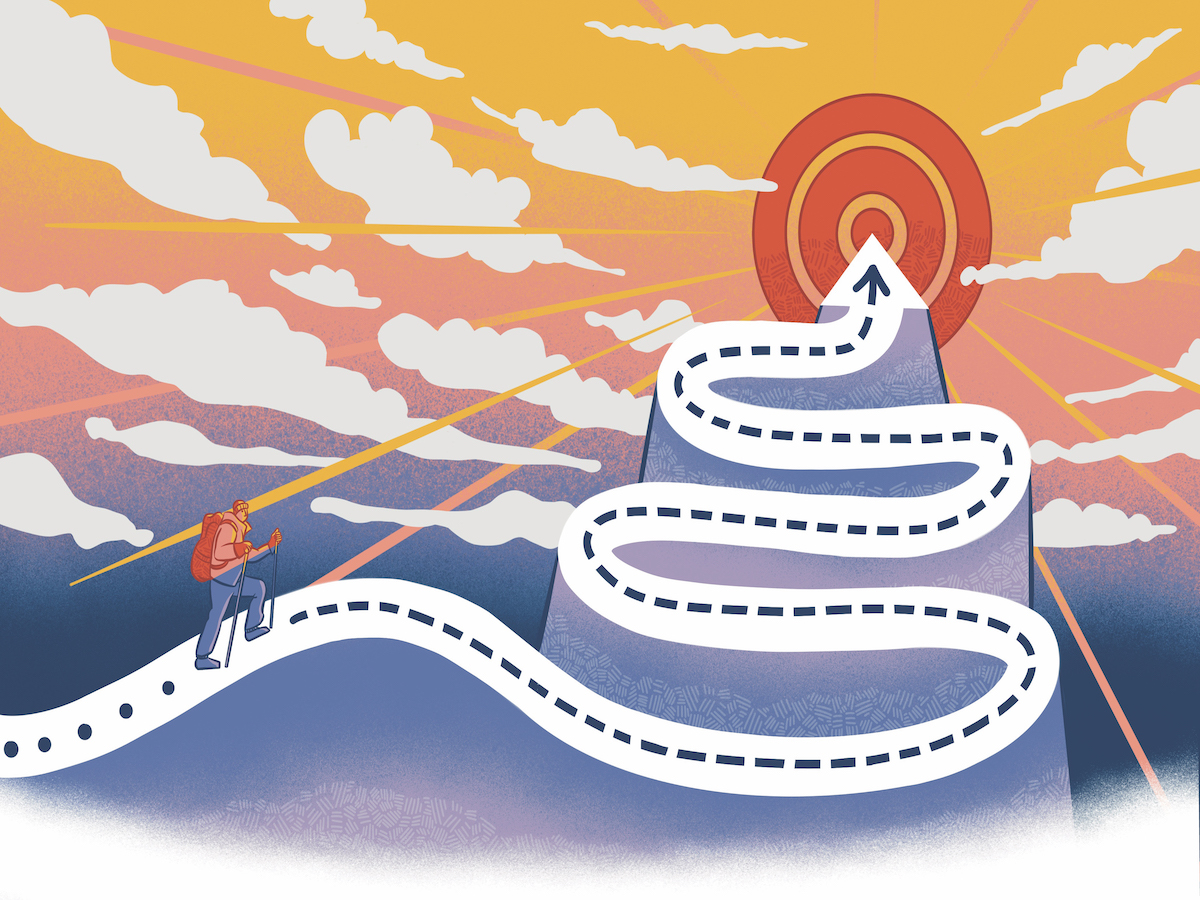
The winding road to growth, fulfillment, and the extraordinary life you seek as an achiever demands massive and relentless action. But on that journey, if you’re going to make consistent progress in the long term, you must also be able to see The Path and the key steps you must follow to reach your personal promised land.

How I Coach Myself

I want to help get you started by sharing the seven key steps on The Path to growth and fulfillment that I use with those I coach — including myself.

Along the way, remind yourself that no matter how many mistakes you make or how slow you progress on the journey, you are still way ahead of everyone who isn’t trying. Success isn’t a place at which we arrive; it is an ongoing process, and we must embrace every stage of the journey — not just the peaks.

So what are we waiting for? Let’s get going!

Step 1: What Do You Really Want? 

Activate and awaken your hunger. 

When people ask me what sets people apart, my response isn’t what they think it will be. 

The most important ingredient when it comes to success in life is hunger — the desire to do more, be more, give more, share more, create more. The most successful people that I know in any area never lose this. If you can figure out what you desire most in life, you can begin to write the story of your life. 

Take a moment to think about what you desire most. And just as important as what you want is why you want it. Your why is what will act as your North Star when the road gets rough. And with identifying what you truly want, you’re on The Path. 

Step 2: Find and Face the Truth 

The truth will set you free! 

This is about getting clear and honest about where you are right now. Visualize where you want to be. Be honest: What’s the gap between where you are now and where you want to be? And what’s prevented you from closing it in the past? 

Once you identify the truths around where you are and what’s holding you back, you can go on to the next step. 

Step 3: Resolve and Create a MAP

Make a plan that will take you from where you are to where you want to be.

This is what I like to call creating a massive action plan (MAP). You know you’re on The Path when you have a great plan. It doesn’t have to be perfect, but it will act as a guide. 

What actions need to be taken today for you to begin closing the gap? Identify them and write them out as your MAP. 

Step 4: You Have to Do What’s Hard 

This is where you slay your dragons. 

This is what most people won’t do, my friend. Successful people do what others won’t. 

This is where you make the change. This is where you get the skill. This is where you drop the old story. Drop the excuses. 

This is where the sword of truth slices through any obstacle between you and the life of your dreams.  

Step 5: Develop a Daily Practice 

You must condition the change — make it a habit.

This means coming back to the basics each day. It creates a sense of renewal. A daily rebirth. A reset. 

Write down what you’re grateful for. Reconnect to your heart. Write down what you desire. Reconnect to your why. 

Reinvigorate the inner world so you can crush your goals in the external world. 

Step 6: Raise Your Standards and Measure More Often 

Proximity is power. 

It’s human nature to let motivation subside and to let things eventually plateau — to become comfortable. Eventually, some of your musts start sliding into shoulds. 

That’s why it’s necessary to continually raise your standards. Evaluate where you are. Measure it. What’s working? What’s not? Then adjust. 

And don’t make the mistake of trying to do it all on your own. The greatest business and financial minds and champion athletes have mentors, someone who has walked The Path before. 

Get connected with the right kind of people (people you look up to, want to emulate, and admire). Surround yourself with humans who will hold you accountable for your goals and lift you up. Don’t have mentors in your life at the moment? Get a coach. (See the 2024 Real Leaders Top Executive Coaches list.) Accountability creates accelerated growth. 

Step 7: Life Is a Gift

Celebrate, appreciate, and give back.

This is my favorite step on The Path because it calls us back to what it’s really all about. 

Life is a gift, and it’s meant to be shared. 

Any goal, any greatness we achieve in life is really our opportunity to give back. To do something for others, to contribute to something larger than ourselves. To leave a mark on this world for the better. 

It’s our greatest honor to use our skills and passions to make the world a better place. 

Take a look at these seven steps again. Know that they are not linear in that you will complete one through seven and be done. This checklist is something to come back to throughout your week, month, year, and lifetime to help yourself along The Path to the life you demand for yourself.

Additional Resources

Join Tony Robbins at a live Unleash the Power Within event; the next scheduled one is Nov. 14-17 in the New York/New Jersey region. Learn more at tonyrobbins.com. Interested in getting connected with a Tony Robbins Results Coach? Visit tonyrobbins.com/coaching.

Tony Robbins is one of the world’s leading life and business strategists and is ranked No. 1 on the 2024 Real Leaders Top 50 Keynote Speakers list.

Tony Robbins: Why a Crisis Is Your Greatest Opportunity

Turn the eight triggers of a business challenge to your benefit.


By Tony Robbins


If there’s one lesson I’ve learned from operating dozens of companies, it’s this: Leaders anticipate change while the losers are left reacting to it.

Businesses today feel the pressure of the narrowing window between seismic changes in any industry and across cultures. That’s because the lifecycle of ideas and products has shrunk — as the timespan between the moment you come up with a breakthrough concept and the instant somebody else comes up with a better one has gone from decades to years, down to months. Artificial intelligence tools are only expected to speed this cycle even more. 

How do you gain control and turn crises into opportunities? You must discover the power of anticipation and how to master it, so you and your business are prepared for anything. And that begins by understanding that there are known triggers of crises. Eight to be exact.


Business Trigger #1: A Change in Technology


Remember when nobody took Amazon seriously? In business, the psychology of a leader who resists a coming trend in technology can destroy a $4-billion company — or in the case of Amazon, multiple ones. Conversely, if you become a leader who figures out how to use technology to fulfill needs and add value, you become the disrupter, not the disrupted.

AI represents both a crisis and an opportunity for businesses, depending on how leaders approach it. As a crisis, AI can disrupt traditional business models, leading to job displacement and ethical concerns regarding privacy, bias, and control. Those who fail to adapt to AI advancements may find themselves struggling to compete or even facing obsolescence.

At the same time, AI presents significant opportunities for businesses that embrace it. It can enhance efficiency, productivity, and decision-making processes, leading to cost savings and improved customer experiences. AI-powered technologies may unlock new revenue streams and facilitate innovation across various sectors.

Take a moment now to think: Are you stuck in your head and making yourself a potential target to the emerging competition relying on new AI and other cutting-edge technology? Ask yourself: How can AI change my business? What technology can we be the first in our industry to employ? How can I be the creator of change? 

Business Trigger #2: A Change in Your Competition


The next business trigger to be on the lookout for is competition by a would-be challenger who seeks to provide customers more value than you do. No one wants to become the Blockbuster video of their industry. What many people fail to remember is that Blockbuster thought they had the video rental market cornered. 

In 2023, Netflix brought in over $33.7 billion in global revenue. It’s easily one of the biggest streaming platforms in the world and paved the way for dozens of others. But in 2000, the young Netflix tried to sell itself to Blockbuster for a mere $50 million when the video rental company’s revenues were $4 billion annually. Netflix practically begged to become Blockbuster’s streaming service, but the company effectively scoffed and said, “What do we need this for?” They failed to recognize their competition as a business trigger and paid the price.

Blockbuster launched its streaming subscription service four years later, but it was too late, as Netflix already had 4.2 million subscribers. Sure, the stubborn storefront boasted 50 million members in its 2007 heyday, but Netflix announced its billionth DVD delivery that year. In 2010 when Blockbuster finally filed for bankruptcy, Netflix had achieved a worth of around $13 billion.

So note this lesson: Whether you’re a leader of a small business or a part of a billion-dollar behemoth, competition will create a crisis.

Business Trigger #3: A Change in the Economy


Were you in business in 2008–09? How did that economy during the global financial crisis affect your company? Did you anticipate or react to that crisis? Would you have done better, perhaps even thrived, if you anticipated how this financial crisis economy would impact your business and its operations?

How are you applying it to future economic winters? Now is the time to anticipate and implement what you need to be more efficient and effective and to get yourself ahead of the ever-ebbing and flowing economic tide. Winter is always around the corner. This means you need to be prepared.

Business Trigger #4: A Change in Government/Regulations


Your business could be out of business with one new law or regulation — literally overnight. Go back to early March 2020. At that time, most of the world, including business leaders, were trying to understand what COVID-19 was and how it was going to impact them. Boy, did we all learn. Arena events I planned for months were suddenly a no-go when federal, state, and local governments passed regulations that prohibited large gatherings.

If not arenas, why not smaller gatherings in movie theaters? Then the movie theaters were closed by regulation. Then why not use church spaces? Then the churches closed. I sensed a level of growing frustration in people who were on constant lockdown. I wanted to give people some answers, but how? I ate my own cooking and focused hard to find an innovative solution to this crisis.

Weeks after COVID-19 upended life as we knew it, I spoke with some of the brightest communications minds in the world, including Zoom founder and CEO Eric Yuan, the man behind the pandemic-era Zoom revolution. I needed to figure out how to get more than the allowed 1,000 people on Zoom all at once and make it have the emotion, energy, and real-time feedback of my live events.

By June 2020, my team and I were ready for a live virtual event with hundreds of thousands of participants from around the world. They were the first to experience a virtual 360-degree interactive experience in a new Florida studio, complete with 30-foot-high ceilings and 16-foot-high retina screens stretching 50 feet wide and wrapping around the room 180 degrees in front and back.

We continue to use the live virtual experience. Often more than 1 million people sign up and log in for these virtual events — that’s multiple times the number of attendees who got into our in-person arena events. 

Business Trigger #5: A Change in Your Customers’ Lives


The global pandemic changed the way we carried out our day-to-day lives. Circumstances and time play a part in triggering widespread customer behavioral change. Since the dawn of time, as people change, have children, and age, they make decisions differently, which applies to you, your customers, and your employees.

When large swaths of the economy are controlled by one or two demographic groups like Baby Boomers or Millennials — and they go into a different stage of life — it can affect your business, particularly if you have a targeted ideal customer base.

Always remember, the lives and needs of people are in constant motion depending on the moment. Are you prepared for this business crisis trigger? Have you anticipated what may happen, and how you will respond as a leader?

Business Trigger #6: A Change in Your Life Stage


There is no doubt that your own life looks drastically different today than it did 10 or 15 years ago. Don’t forget to look in the mirror and consider also what might trigger a business crisis: you. 

I’ve realized that many of the life changes we all go through are more predictable than we think. Maybe you need to be more present for your family. Perhaps you realize you’re a business operator, not a true owner. Or you hit a threshold and just had to do something that made you happy. Maybe there was a period when you burned out, fell in love, beat cancer, got married, had a baby, or went through some other event that upended your business. Many people also experienced a big life-stage shift during the pandemic when they reevaluated their priorities.

Business Trigger #7: A Change in Culture


How many people still visit a record store on a regular basis anymore? Not many. In 1999, the brick-and-mortar music business made $38.6 billion in sales. That same year, the illegal music file-sharing platform Napster arrived. From the peak of about $40 billion in 1999, the music industry plummeted 58% to $16 billion the following year. Think about that. That’s nearly a 60% drop in revenue practically overnight. 

All it took was a shift in consumer culture. However, as with any business trigger, you can make this one work for you instead of against you. 

Consider how Apple harnessed that changed culture. Apple founder Steve Jobs reasoned that while our culture balks at paying $15 for a new CD, people also don’t want to poke around the internet for hours and steal entire libraries on Napster. He had a crazy idea: Short attention spans might appreciate the simplicity of 99 cents per song. By 2007, the sale of those cheap little digital singles overtook CDs in a landslide, generating $819 million in sales.

When the culture demanded a cheap, easy, fast way to get music, Apple had the ingenuity to address this business trigger and become the No. 1 music retailer in the world — all because it monitored critical shifts in cultural behavior and added more value faster than anyone else.

Less than 10 years after Apple deployed its iTunes Music Store, it surpassed 25 billion songs sold. Apple triggered an industry crisis and changed how the world consumes music, books, and in-pocket entertainment. 

To stay ahead of this business crisis trigger, ask yourself: What behaviors are trending? What cultural shifts are afoot? What belief systems apply to those trends, and how can they affect our business? What cultural shifts can we use to our advantage today?

Business Trigger #8: A Change in Employees’ Lives


Many business owners have experienced a top employee or salesperson going through a life stage like the birth of a child or a divorce, and they ask for some time away. Suddenly, they aren’t around as much, and if they are, they’re less productive, which can be a real hit on your business.

Business Leaders Embrace Crises and Change


After more than four decades of studying the highest achievers in business and life, I know one thing for certain: People who succeed at the highest level are not lucky — they’re doing something differently than everyone else.

Don’t wait to react to a business crisis. You don’t need to operate in fear if you anticipate change and embrace the opportunity it brings. Analyze the landscape. Ask questions. Challenge yourself to anticipate how a business crisis might emerge. Examine how you and your team can attack potential challenges. Create a pre-crisis plan that takes advantage of crisis opportunities when they open up to you.

There is no time better than the present to be a leader, my friends.

Additional Resources


Subscribe to Robbins’ newsletter at core.tonyrobbins.com/event-calendar, and check out his new book in his financial freedom series: The Holy Grail of Investing: The World’s Greatest Investors Reveal Their Ultimate Strategies for Financial Freedom. The Tony Robbins 

Business Accelerator Program’s next virtual Business Mastery event is Aug. 14–18, 2024. Learn more at tonyrobbins.com.

Tony Robbins on How to Make Tough Decisions

By Tony Robbins

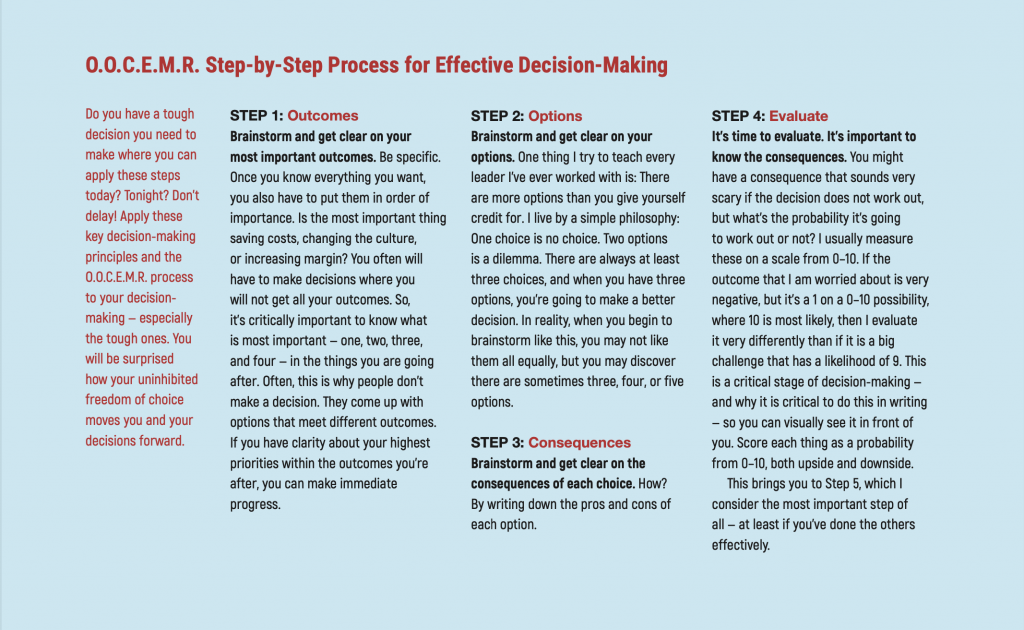
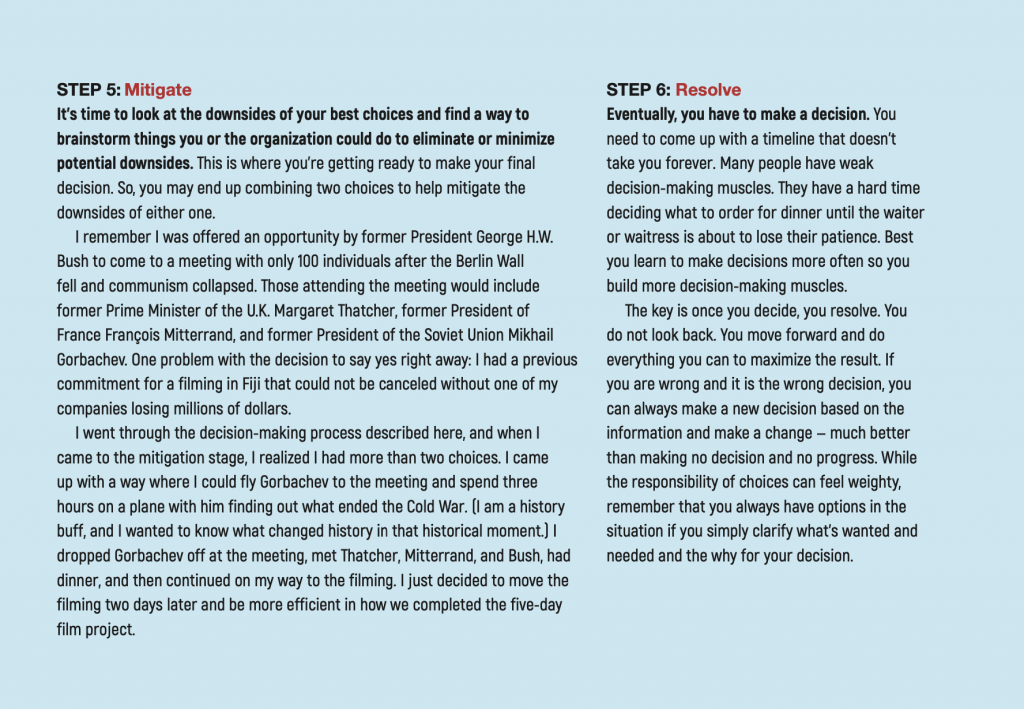
Great leaders are great decision-makers. Anyone can make easy decisions with obvious outcomes, but what makes somebody a really effective leader is their capacity to make tough decisions. You know what I’m talking about. The decisions where there is tremendous uncertainty; where you are trying to make the right choice, but you can’t know for sure what it is. Sometimes, it’s about making a choice so you can move the ball forward, find out whether it is the right choice or not, and adapt accordingly.


Life is filled with choices. Real leaders understand that to move things forward, they must make tough decisions. At times, the fear of making the wrong decisions grips us so tightly we opt for indecision, allowing the fear of failure to immobilize us and impede our progress. To break the cycle, leaders can adopt simple principles and processes that I — and many of the executives I coach — rely on. These tools are simple, but practical steps for making those necessary tough decisions. Let’s explore four of the simple principles I adhere to when making challenging decisions.

All decision-making should be done in writing.


If you attempt to do everything in your head, your brain will often end up looping over the same conflicting thoughts. Instead of getting resolved, every possible new idea can create more stress because your mind keeps comparing it back to the first thought. What can break this pattern is the use of a visual element. Remember the idea that a picture is worth a thousand words.

Take a moment to jot down your thoughts about the decision you are grappling with, your desires, and your concerns. Frequently, what seems intricate in our minds becomes remarkably clear and more straightforward when on paper.

Be clear about what you want and/or what the organization wants and needs.


The foundation of exceptional decision-making lies in clarity. To make effective choices, you must first gain crystal-clear clarity about your and your organization’s goals, values, and priorities. Ask yourself: What is the ultimate outcome that I am after through this decision?

This will provide clarity. Clarity is power. When you know what you want (your outcome) and your why (your purpose), decision-making becomes simplified.

Decisions are made on probability.


No one has a crystal ball to tell them with 100% certainty they’ve made the right decisions. It’s about taking inventory of the information available and making the best choice possible. Again, leaders are decision-makers, and they will often have to step into their decisions without total certainty that it’s going to work out. This is what sets them apart from everyone else. They’re willing to take action when everyone else is paralyzed by uncertainty.

Often, tough decisions are less about making the “right” choice and more about making a choice that can move the ball forward and discovering if it’s right or not. With indecision, we will never know what is right. If you wait to have all the information necessary to make a decision, the opportunity that the decision offered is usually gone, and you are living life like the average person versus the leader you’re meant to be. If you make a decision that turns out to be wrong or not the best choice, you can change things. The important part is making a decision to start with.

All decision-making is a clarification of what you and your organization value most.


Each decision we make should point to our values. It can be a tough choice you’re making, but if it aligns with what matters most to you and the organization, you are propelling yourself in the right direction.

There’s nothing worse than making a decision based on fear rather than what feels right in your heart. When faced with tough decisions, don’t let your limiting beliefs trap you into fear-based decision-making. My core belief is that a decision made from fear is almost always the wrong decision. Thoughts like “I’m worried this won’t work out because …” or “I don’t want to try this because …” need to be confronted. The easiest way is by expanding your options and exploring alternative choices or paths.

Seek out diverse perspectives, gather information quickly, and challenge your assumptions. By doing this, you can open the door to innovative solutions and unforeseen opportunities. Once you have your mind in the right place and all the information gathered, you need a logical and repeatable process to get those decisions made and you need a deadline. Otherwise, you’ll get lost in paralysis by analysis.

Tony Robbins: Time to Rise

Here’s how to take back control of your life in 2024. 

By Tony Robbins

As we look ahead for 2024, one thing is clear: We are living in uncharted territory — a time when the economic, political, and social landscapes are changing at a record pace. We are all being touched by the events happening around the globe. No matter where you live or what you do for a living, what is happening is unlike anything we have ever experienced. 

While this is a time of massive uncertainty and endless complexity — if you’re prepared — it’s also a time of exponential opportunity. The winter season offers us the unique opportunity to grow, become more, give more, and share more. It can be the greatest season for any leader if you can develop an unwavering confidence amidst the storm. 

What Will Hold You Back

What will hold you back is only one thing: fear. Fear that you’re not enough or don’t know enough. Fear of failure, fear of rejection. Fear can hold you back in subtle and insidious ways. Fear can also outright paralyze you from taking action. 

The truth is, there is a part of you that will always be fearful — but you can’t let it be in charge because it will rob you of the life you deserve. It will cause you to miss the call — the call to become more, to experience that incredible nectar of growth, expansion, and contribution, meaning, impact, and achievement. The call to rise up and feel fully alive. 

As we move forward in 2024, to have the life you desire, you must feed the best part of yourself every single day, demand the best part of you, and not settle for less than you can be, do, share, create, or give. 

Here are five keys to help you to rise and make 2024 the best year yet. 


Feed your mind.

You need to feed your mind daily with substance — not social media or news. My original mentor, Jim Rohn, taught me that you must stand guard to the door of your mind. Bring something new to it; otherwise, you will keep operating off the same old beliefs, the same old thoughts, and the same old emotions that will not get you to the level you want. 

Growing up as a kid, I didn’t have any role models, so I found them in books. I read history, biographies of great leaders, businesspeople, philanthropists. I learned what made them successful and extracted the principles and applied them to my own life. 


Strengthen your body.

Strengthening your mind is crucial, but equally important is strengthening your body. The mind and body feed each other. Go on a sprint, lift some really heavy weights, go on a really long walk. The key is to push yourself. 

Every single day, I begin my morning by plunging into a pool of 56-degree water. And if I’m not home, I’ll jump into a nearby river. I don’t do that because it’s fun; I don’t do that because I want to do it. I do it because I’m training my body so that when I say go, we go. I don’t negotiate with my mind. 

Priming your physical body can set the stage for the change you want to drive in yourself mentally and emotionally.


Find a great role model.

If you want the best year of your life, you need to decide to find a great role model, someone who is already getting the results you want. 

Why? Because success leaves clues. 

One person that I identified in my own journey was Sir John Templeton, once called arguably one of the greatest investors of the 20th century by Money magazine. He started out with nothing, just like me, and became the first billionaire investor. 

Whom can you model? 


Surround yourself with high-level people.

Think about whom you spend time with. If you want to raise your game this year, you must get in proximity to someone who is playing the game at a higher level than you are. Proximity is power.

Say you’re playing a sport like tennis. If you’re always playing against someone worse than you, you’re never going to get better. Always surround yourself with people playing at a higher level. 


Pay it forward by giving more than you expect to receive.

In 2024, you must also find a way to add value to others. I truly believe that the secret to living is giving, and it’s what truly makes us alive and live not just a successful life, but a fulfilled one.

For me, feeding people and making sure families are nourished has been my passion for nearly five decades. I was fed by a stranger on Thanksgiving when I was just 11 years old. As a result, I started to feed others. Even when I did not have a dime to spare in my younger years, I managed to find a way to provide a meal or two for struggling families.  

You can find a way to give back too, no matter what your current situation is.

As we all look to rise out of fear in 2024, one gift I would like to give you is an opportunity to join me for my Time to Rise Summit. This is a completely free virtual event that I do every January as a way to give back. The goal is to help you create momentum in your life by arming you with the psychology, tools, and strategies to make 2024 the best year yet. Find details at https://timetorisesummit.com/join-now.

Looking forward to seeing you there!  

Tony Robbins is one of the world’s leading life and business strategists and ranked No. 1 on the 2023 Real Leaders Top 50 Keynote Speakers list.

Tony Robbins: What’s Holding You Back From Massive Success?

For 40 years I’ve been obsessed with learning the answer to what makes a difference in the quality of people’s lives: Why is it that some people who are given every advantage so often fail to achieve what they desire and deserve.

In contrast, we all know people who have lived incredibly difficult lives – lives filled with unimaginable challenges, and often injustice – who still seem to find a way to breakthrough and get results, not only for themselves, but also to serve others in a very deep and meaningful way.

I’ve had the honor of working in 100 countries with more than 50 million people from every walk of life: from incredible leaders to the most challenged individuals you can imagine. We’ve had four million people in my live seminars, so at this point I’d have to be an idiot if I didn’t see that there are certain patterns that cause people to succeed and other patterns that cause people to fail – patterns that cause people to be overwhelmed and stressed out and other patterns that allow people to find deep meaning and success in virtually every aspect of their lives.

Part of my understanding has come from the fact that for decades I’ve been a leader called upon by leaders. I get the call when the fire starts. When the President of the United States has to address the nation. When an athlete is burning down on national television and I’m required to intervene and create measurable change on a moment’s notice.

The one thing that I’ve found that separates the quality of people’s lives – the single largest difference — is the capacity to lead. Leadership skills are not just a gift. Leadership skills are something anyone can learn.

Who is a leader? You and I both know it’s not always the person who controls things by position. How many times have we been in a meeting when the person at the lowest position was influencing the direction of a decision or a project? We all know that leadership —whether you are the CEO, or the manager, or the mom — is about the ability to influence the thoughts, emotions, and actions of other human beings.

But here’s the key: there’s an energy to leadership. There’s a passion. There’s a level of connectedness that leaders have with others. It’s their ability to get things done and make progress that sets them apart.

All leaders have different styles. But leadership, in its essence, comes from the same core qualities. It’s not just great oratory. The spirit of great leadership is the capacity to take visions and to influence others to do more than they would ever have done on their own. Great leaders help people raise their own standards so that regardless of whether or not the leader is present, the organization or individual still performs at a higher level than ever before. At its essence, leadership is the ability to inspire people. It’s the ability to ignite the human spirit and execute consistently.

Leadership is not luck, nor is it haphazard. Anyone who has been successful in any one area consistently is not lucky. They are doing something unique. Remember, success leaves clues!