When you think about what truly drives extraordinary results in any field, the answer is always engagement. Engagement isn’t just about showing up; it’s about bringing your full self to every moment, every interaction, and every challenge. This is where true power lies — both for individuals and for businesses. In 2025, the opportunity to harness the transformative power of engagement has never been greater.
Over my four-and-a-half decades of coaching and personal experiences, I’ve seen firsthand how engagement can elevate leaders and foster unparalleled results and success. What’s also true is that far too many people are disengaged or engaged in ways that don’t contribute to their personal or professional success.
Unfortunately, most people major in minor things. They know more about a social media personality’s “life” than they do their own dreams, desires, goals, and how to get there.
And disengagement comes with a hefty price tag. Gallup estimates that the lack of engagement is costing the global economy an astounding $8.9 trillion in productivity losses, which translates to about 9 percent of the world’s GDP. This isn’t just a financial issue — it’s a fundamental human one. People who are not engaged experience heightened levels of stress, sadness, loneliness, and frustration. They are less productive and less likely to contribute positively to their communities and organizations.
What does this mean for businesses? According to a recent Gallup poll, engagement of employees is at record lows. Most companies have on average only 31% of employees who are actively engaged, 51% not engaged, and 18% so massively disengaged that they cause issues across the organization.
When you compare companies in the top and bottom quartiles of engagement, companies in the top 25% had:
22% higher profitability
10% higher customer rating
28% less theft
48% fewer safety incidents
This is all in addition to:
A sense of meaning/mission
Appreciation across the organization
2x greater job satisfaction
3x more likely to stay long-term
Let’s be clear: Engagement isn’t just a feel-good concept — it’s a powerful driver of performance and profitability. Companies that actively engage their employees are the ones setting records and leading industries. Look at top-performing companies like Google, Salesforce, Apple, and Facebook. These organizations aren’t just successful; they are engaged.
So what creates engagement? How can we turn this around? How can we move from a state of disconnection to one of profound engagement? The answer lies in the understanding that engagement is a powerful catalyst for leadership and personal growth.
Here’s how you can harness this power:
Engage actively with content. When you engage with information — whether through asking questions, taking notes, or participating in discussions — you transform passive learning into active involvement. This not only enhances your understanding but also reinforces your commitment to applying what you’ve learned.
Increase engagement personally and professionally. Start by reflecting on how you engage with your work and relationships. Are you fully present? Are you contributing in ways that energize you and others? Seek out ways to deepen your involvement, whether through setting new goals, taking on challenges, or fostering stronger connections with those around you.
Address disengagement head-on. Disengaged employees can be detrimental to an organization, while actively disengaged employees can actively work against it. As a leader, it’s your responsibility to address disengagement with empathy and action. Create an environment where people feel valued, listened to, and motivated.
Harness engagement for leadership. True leadership is grounded in engagement. When you are genuinely engaged, you inspire others to do the same. You set a powerful example and create a culture of enthusiasm and commitment. Remember, leaders who fake engagement may temporarily fool others, but only authentic engagement leads to lasting influence and extraordinary leadership.
Mastery through repetition and emotion. Engagement isn’t just a strategy; it’s a state of being. The more you immerse yourself in what you’re passionate about, the more skilled and effective you’ll become. This requires repetition and connecting emotionally with your tasks and goals. Engage with your work and relationships on a deeper level and watch how mastery and success follow.
Create a state of excellence. The difference between dreamers and doers is the state they operate from. To achieve new results, you must shift your behaviors and mindset. This means moving from mere desire to proactive, engaged action. The state you’re in determines the results you get.
This principle isn’t confined to the corporate world. The same applies to your personal life. When you become more engaged, you inspire and elevate those around you. Engagement is infectious. If you want to ignite passion and drive in others, you must first be fully engaged yourself. You can’t expect to move others if you aren’t moved. You can’t touch others if you aren’t touched.
As a leader, your role is to maximize resources — whether they are people, technology, or finances. But here’s the kicker: You can’t maximize resources without full engagement. Your ability to get the most out of what you have depends entirely on your level of engagement. If you approach your role with genuine enthusiasm and commitment, you’ll not only enhance your own effectiveness but also elevate the performance of those around you.
Every room you walk into, every team you lead, every challenge you face — your engagement sets the tone. Good is the enemy of great. Mediocre engagement yields mediocre results. To be extraordinary, you must lead with exceptional engagement. When you engage fully, you don’t just perform well — you transform yourself into an extraordinary leader.
For 2025 the call to action is clear: Embrace the power of engagement in every aspect of your life. Whether you’re leading a team, running a business, or pursuing personal goals, your engagement will be the key driver of your success and prosperity. By fully engaging with your work, relationships, and personal growth, you unlock the potential for extraordinary results and transformation. Remember, engagement is not a passive state but a dynamic force that propels you toward greatness. Embrace it, live it, and let it guide you to new heights.
The unshakable optimist, the why guy — whatever comes to mind when you think of Simon Sinek — our exclusive interview provides fresh insight from this wildly popular leadership author, speaker, and founder.
Real Leaders: You had a milestone birthday last year. How did you feel about turning 50, and was this one hard for you?
Photo Credit: Jake Rosenberg
Simon Sinek: I’m not a big birthday person. I don’t like being the center of attention and wasn’t planning on doing anything, but my friends said I had to, so I threw them a party. I knew there were six other guests who also had milestone birthdays that year, and so when it was cake time, I had six additional cakes with their names and ages on them because why should I be the only person who celebrates my milestone?
RL: We have a special section in this edition about executive coaches. Have you ever had a coach?
Photo Credit: Jake Rosenberg
Sinek: I have had a coach. I’m a great believer in having a coach. Finding a coach is like finding a partner. It’s got to be somebody who gets you, and there’s got to be a good personality match. You might need a couple sessions to figure that out, and it can be hard. I don’t understand how people in senior positions think they don’t need it. Professional athletes think they need it — how are we the exception?
Maybe because we can’t see our swing. We have blind spots, and sometimes it’s good to talk through a problem with a dispassionate person who’s not involved. Most of the conversations we have are with coworkers who are quite passionate about the decisions we make.
RL: What leadership blind spots are you noticing these days?
Photo Credit: Jake Rosenberg
Sinek: Most leaders think they’re good listeners. It’s hilarious. Also, people get promoted, and they forget that a whisper becomes a shout. A little offhanded “way to go” could make someone’s week, but an offhanded “that wasn’t very good work” could destroy someone’s confidence. Learning how to manage that is very, very difficult for leaders.
I’ll tell you one funny story. I was having a photo shoot, and we started pretty early. I asked what time lunch was, and they said 1 o’clock. I said, “Can we get the food in here at noon? I’m kind of hungry.” So they got it in at noon, no big deal. Then we had another shoot and we started pretty late, like 10 a.m., and the food came at noon. I was like, “Why is the food here so early?” And I found out in the background that when they were making the schedule, someone said, “Simon insists on having the food at noon,” which, of course, is nonsense.
Self-awareness is one of the biggest blind spots. Actually, self-awareness is a misnomer — self-awareness is situational awareness. When you’re sitting in a meeting, do you know that you’re talking too much? Well, you won’t know that unless you see people in the room trying to speak but you keep interrupting them. You learn self-awareness by honing the skill of situational awareness — in other words, paying attention to the room.
Another leadership blind spot is asking for people’s advice after you’ve already given your opinion. That’s a big one. I would classify that under listening skills.
RL: You do quite a bit of keynote speaking and ranked No. 2 on the Real Leaders Top Keynote Speakers list for the last two years. How does speaking relate to your why?
Sinek: My why is to inspire people to do the things that inspire them, so together, each of us can change our world for the better. I’m agnostic as to how I deliver that message. It happened by accident that I became a speaker, but clearly, it fulfills the why. For many years, I thought of myself spreading my message as a preacher. I was spreading a gospel of the way business should work. It made perfect sense. It’s not the only way I can spread my message, but it certainly has been a good one for me.
RL: How do you give your audience goosebumps?
Photo Credit: Jake Rosenberg
Sinek: That’s an underappreciated skill, which is the art of storytelling. When most people speak, they make it about themselves. “Let me tell you how great I am. Let me tell you about all my accomplishments.” There’s some ulterior motive — buy my book, buy my product, subscribe.
The way you connect with an audience is you have no ulterior motive other than to serve. I don’t ever think I’m right. I think I have a point of view, and I’m there to share it. I’m not looking for people to agree with me. I’m looking to offer an invitation. One of the reasons I connect with an audience is because I’m genuinely there as an act of service. I’m there for them. I’ve always had that mindset. Before I go on stage, I’ll mutter out loud to myself under my breath, “You’re here to give,” just to remind myself. It’s wonderful.
RL: Would impact company leaders benefit from seeing themselves as preachers of their cause?
Sinek: The simple answer is of course, but frequently saying that you’re an impact company is preaching to the converted, and it can potentially alienate the unconverted. Don’t talk about it so much — just do it. Just be impact, right?
To constantly say you’re an impact company is about self-aggrandizing. It’s virtue signaling for the people who are already in the club. If you’re truly an impact person, your responsibility is to invite people who are not already in the club and to find the language, methods, and systems that are an invite rather than an attempt to convince or shame. Just do the good work, and then you’ll reach the cause that you’re preaching. Find the language that invites as many people as possible.
I don’t use the words vision or mission or cause or purpose. I use the term why. I found new language that reinforced those who already believed but that invited people who weren’t sure to take a look. The only way a movement can move is with new people.
RL: After the murder of George Floyd, you started a nonprofit called The Curve to support better leadership in policing. Why did that particular incident resonate with you so deeply?
Sinek: Multiple reasons. It’s a profoundly human problem caused by humans, and the impact is on humans. It is largely a leadership and culture problem. Yes, policing has issues in training and hiring, and those are symptomatic of the leadership and culture problems that policing suffers from. If you look at the advances in leadership theory, the military is way ahead of most corporations when it comes to embracing new ideas, but policing is about 20 years behind. Though often well-intentioned, outside pressures and legislative fixes either flat out won’t work or will have a short-term or minor impact without completely changing the culture of policing, which is what’s needed.
The only way to do it is from the inside out. I was drawn to it because it’s an unbelievably complex human problem, which interests me. I like very difficult things. And there’s already plenty of people looking for the cure for cancer. There weren’t enough people who were doing this except as outsiders looking in.
RL: You are known for being unshakably optimistic, but is a little pessimism helpful for leaders?
Photo Credit: Jake Rosenberg
Sinek: Let’s first define optimism, which is not blind, nor is it naive positivity where you’re saying everything’s fine, everything’s good — that’s dangerous. Optimism is the undying belief that the future is bright. It allows for darkness, it allows for difficulty, it allows for frustration, it allows for anger, it allows for pessimism. But fundamentally, it is the undying belief that even if it’s a difficult time now, if we work together, we will get through this and come out stronger.
I’m cynical very often. I can be grumpy, I can be judgy, but that doesn’t affect the fact that I fundamentally believe the future is bright.
RL: Leaders are often deeply devoted to their causes. Talk a little about your concept of cause blindness and how they can avoid that pitfall.
Sinek: We are living in leaderless times. There seems to be a distinct lack of idealism in the world. Our presidents don’t talk of world peace anymore. Go back a few years and world leaders like Ronald Reagan and John F. Kennedy literally talked about peace on earth in their inaugurations. Being driven by a higher calling is very important to inspire people and instill trust, loyalty, and innovation.
We’re very short-termist these days. We’re driven by short-term growth or short-term impact investor pressures, and a large part of it is because of the loss of idealism.
One of the things that prevents and insulates you from cause blindness is idealism because you’re looking so far ahead to advancing a cause that is for all practical purposes unrealizable. World peace is not realistic, but it is inspiring, and we can take steps toward it. Cause blindness tends to be when we become sheltered and looking down and can’t see the forest for the trees. When you look up at the grand vision, it actually makes you more awake.
RL: What about your term ethical fading? How can leaders make sure that ethical fading doesn’t creep in to their businesses?
Sinek: We’re all susceptible to ethical fading, and this is where strong leadership and strong culture inoculate you — if you have a truly just cause and are not simply driven by short-term financial gains. You must also spend the time to build strong teams where there’s psychological safety, and if you do these things, you are inoculated from ethical fading.
In any company, people will have stupid, unethical ideas. We all do. But in a good company, someone will go, “We’re not going to do that.” It’s not the generation of the idea; it’s whether the idea gets implemented or not. Ethical fading happens with poor leadership and an incentive structure that rewards short-termism. Good leadership and good incentive structures are the antidote.
RL: You talk about the importance of having worthy rivals, not competitors. What have you learned from making that mindset shift?
Sinek: This is one of the most magical mindset changes that somebody can make, and it’s so easy to do.
You’re going to learn so much by being grateful for those who do things better than you rather than trying to undermine or compete or put them down. You become more like, “Damn. They’re good.” And it makes you better because they become pacers that push you harder, right? You’ll find solutions to problems that you’ve been struggling with from a worthy rival. It makes you much more self-confident and relaxed and better at what you do. You are less distracted by the silliness of creating fake competitions where there are no finish lines.
RL: How have you implemented this mindset in your organization?
Sinek: It’s become a practice that when we’re working on something, someone will ask, “Who’s the worthy rival on this?” and we’ll go find the best of breed, the people who are more experienced, way better, and really innovative.
RL: How does your concept of infinite-mindedness impact leadership?
Sinek: It depends where in the pecking order you are. If you’re at the top of the pecking order, you know that having just causes is really where it starts, and then adjusting the incentive structures to ensure that you and your people are building an infinite-minded company.
If you’re just in the organization, you have no say over the incentive structures or setting the vision. But you can come to work every day to be the leader you wish you had and to ensure that the people with whom you work go home every day feeling inspired, safe, and fulfilled. Infinite-mindedness is: “How do I help the people around me rise?” They’ll become better versions of themselves because I worked with them and because they worked with me.
That mindset has a massive impact on someone because you find yourself in service, which is ultimately what an infinite mindset is.
RL: As a trained ethnographer, you’ve discovered patterns about how the best leaders and organizations thrive. What are the prominent patterns you’re seeing today?
Photo Credit: Jake Rosenberg
Sinek: The big one — and I don’t say it explicitly, but all my work touches on it — is this idea of human skills. Cats don’t have to work very hard to be good at being a cat, but it turns out that people have to work pretty hard to be good at being human. We are not good listeners. We are not good at giving or receiving feedback. We’re not good at having difficult conversations, and the list goes on. The biggest pattern I’ve seen is that to be human takes work, and those who do the work become better human beings, better leaders, better friends, better spouses, better sons, better daughters, better parents.
It doesn’t matter where we learn it. If you learn to be a better listener because your relationship is struggling, you’ll bring that skill set to work. At work, we can teach people how to be better listeners because we want them to cooperate better. And then, you’ll bring that skill set home to your relationships and to your parenting because the skills are the skills. They don’t teach human skills in business school, and I think companies have the opportunity to pick up the slack.
Companies that teach human skills tend to outperform the companies that don’t. And though it’s hard to measure, I would venture a guess that companies that double down on teaching those things, I bet the people who work for them have lower divorce rates, their kids do better at school, and they have lower rates of cancer and diabetes and things like that, which are all stress-related disorders.
There are a lot of good reasons to hone our human skills. All my work is in some way, shape, or form talking about human skills. Notice I don’t use the term soft skills. I hate the term soft skills. Hard and soft are opposites, and these are not opposite skills. Hard skills I need to do my job. Human skills I need to be a better human. And I need both those things to excel in life and at work.
RL: You implemented an agreement with your friends during the COVID pandemic that none of you would cry alone. When it comes to leadership, is there anything that just has to be done alone?
Sinek: Accountability. Ultimately, if you’re the leader, the buck stops somewhere, and if a decision is made and it goes wrong, you can’t cast blame if someone on your team made the decision and you trusted that they could. You have to support them in the difficulty of repairing whatever that bad decision was. We’re not talking about negligence here. We’re talking about someone just made a bad call. Accountability is a solo affair. Everything else can be shared. Joy and congratulations can always be shared. I would never do that alone.
We see lack of accountability a lot. When people say, “The lawyer said we can’t do that,” what they’re really saying is, “I won’t take accountability for the decision that needs to be made because of the risk associated with it.” Lawyers don’t make decisions. Lawyers advise on risk. My lawyers tell me that I can’t do things all the time, and I say, “Tell me what the risks are,” and then I’ll either do it or not because I think it’s worth the risk or not. But ultimately, it’s my decision. Anybody who pushes that off is becoming a refugee from accountability.
RL: Your last book came out in 2019, and it’s 2024…
Photo Credit: Jake Rosenberg
Sinek: You sound like my publisher.
RL: When are we going to see your next book? What will it be about?
Sinek: I’m working on a book about friendship. There’s an entire industry to help us be better leaders. There’s an entire industry to help us be better parents. There’s an entire industry to help us eat better, work out better, sleep better. Yet there’s precious little to help us be better friends.
If you look at all the challenges we face in the world today, and with anxiety and depression and suicide on the rise — even our obsession with longevity — friendship is the ultimate biohack. If you learn to be a good friend, you live longer, you’re healthier, you’re less susceptible to addiction. It is the greatest thing in the world, and yet there’s so little that teaches us how to be good friends. I’ve really become quite obsessed with what it means to be a friend.
The number of us who prioritize work over friendship because our friends will understand when we cancel on them is really gross. Your work will never be there for you in hard times. Your work’s not going to save you, but your friends will. Nobody calls their work ride or die.
So many of us think we’re a good friend, but if you really peel the onion back a little bit, are you sooner to cancel on a friend for a meeting, or would you postpone a meeting for a friend? Do you know how to be there for someone when they’re struggling, or do you just try and fix their problems? Do you know how to listen to someone so that they feel heard? If a friend’s depressed, do you tell them to buck up, or do you go to their house, get into bed with them, eat ice cream, watch movies all day, and be depressed with them so that they don’t feel alone in that space?
We all have a lot to learn about how to be a better friend, so I’m writing that book with my friend Will Guidara, who wrote Unreasonable Hospitality.
RL: Can you expand on how being a better friend makes you a better leader?
Sinek: Friendship is scalable, right? Being a better leader doesn’t necessarily make you a better friend, but being a better friend definitely makes you a better leader. It is the only truly scalable skill. Being a better dad doesn’t necessarily make you a better friend, but being a better friend makes you a better dad.
RL: Are you good at friendship? Or is it a self-identified weakness that led you down this journey?
Sinek: Like everybody, I thought I was a good friend, but I still have some stuff that I’m learning. I’ll give you an example. I thought I was a great listener — until I took a listening class. I learned that I am an absolutely fantastic listener with people I will never see again for the rest of my life, but with my friends, I was appalling. When my friends would say, “You’re such a bad listener,” I’d be like, “Do you know what I do for a living?” Turns out I was crap. I was useless. And so I called my friend and said, “Remember when you told me I’m a bad listener? Turns out you were right.”
There’s a lot to learn. I’m definitely a better friend now than I have been in the past because I am learning more about human skills. Managing a friendship is difficult and requires a lot of intentionality.
RL: Circling back to that big birthday, how would you characterize your first 50 years? How do you envision your next 50?
Sinek: It’s all a magical journey. I’m in life for the fun of it. Some of it is easy, some of it is hard, some of it is clear, some of it is foggy. But all of it goes better when I do it with others. “Remember that time…” is a much more fun conversation than, “Let me tell you what I did.”
And any kind of stress is endurable with others around us. It’s a journey with others. We all make the mistake sometimes of forgetting that we are surrounded by people who love us. They’re there to help us if we just ask. So the first 50 years has been learning those lessons, quite frankly, that I’m not alone. It’s OK to ask for help. It’s OK to accept it. It doesn’t make me dumb or weak. In fact, it makes me stronger. It makes me more confident. It makes me more grateful, more humble.
The next part of my life, however long it is, is the joy of getting to live with purpose, to take all those lessons and actually do it all.
RL: What’s your message for the Real Leaders community?
Sinek: The best thing that this audience has is each other. I hope they spend time in this community without their phones, without their computers, without their emails. I hope they talk to each other about what works and doesn’t work.
I cannot emphasize enough the value of community when doing something difficult and bucking the system of how capitalism has worked for the past 30–40 years. It’s the status quo that is working against us. And even though it’s trendy for every company now to have a purpose on their website, go compare the decisions they make to the statements on their websites, and in many cases it’s just marketing. How are you treating your employees? You can’t call yourself an impact company and not practice good leadership or learn good leadership or teach your people good leadership.
Just go do the good work. Do the work that demonstrates the impact that you’re having because the people who want to come work for you in this new generation of employees, they care about that stuff.
RL: What companies are your gold standard when it comes to leadership and impact?
Photo Credit: Jake Rosenberg
Sinek: I love Patagonia. They demonstrate it in their bottom line. They demonstrate it in the way they treat people. They demonstrate it in the way they talk about the impact they’re having on the communities in which they operate. They don’t use any euphemisms — they just do it. They just get it done, and they’re open, and they’re accountable. They still do damage, and they don’t recycle everything, and they’re super honest about it. We should copy their model.
Airbnb is also pretty good, and Brian Chesky is open about being an infinite-minded company. All of them have work to do. None of them are perfect. They all have blind spots. They all have pressures. But the way that Airbnb treated its people during COVID when they had to have layoffs was a model of how to do it. They were so generous. They set up a page on their website and uploaded everybody’s resume who lost their job, and the day they got laid off, you could hire them. That’s so much more than just saying, “We care about our people.” This is a company that even cared about them after they let them go. They didn’t just let them go — they helped them land on their feet. That, to me, is impact.
Level Up Your Human Skills
Interested in Simon Sinek’s’ online courses? Visit simonsinek.com and use code REAL LEADERS for 15% off all e-learning (not to be combined with other promotions).
At a recent two-day conference I taught to over 50 leaders in Amsterdam, we began with participants reading the ground rules. They expressed surprise at the fourth and most controversial rule of our collective engagement:
“Your phone, laptop, tablet, or other digital device must be switched off during the sessions. A phone ringing during a session will be considered disruptive, and we will ask you to put it away if you are using it during a session. There will be time during breaks for you to answer messages. All digital devices must be turned off, as they are disruptive to the learning of others. Please bring a paper and pen to take notes.”
This is guided by my belief that there are two types of thinking: flashlight thinking, which our screens pull us into, and floodlight thinking, where our transformational potential lies.
A Controversial Rule
I reassured participants that if they need to use their phone at any time, they can step outside the room.
“No judgment,” I shared. “I know that there is more to your life than this program. You may have a sick child, elderly parent, or struggling coworker who needs to reach you.”
Based on over 10 years of research I reviewed for my book Screened In: The Art of Living Free in the Digital Age, I cite studies that the mere presence of a phone or laptop in a learning environment obstructs genuine learning for three primary reasons.
A 2010 Stanford University study discovered that seeing a phone or laptop causes stress, as it’s a reminder of everything you still need to do.
It reduces your learning by damaging your cognitive capacity — even if it’s turned off.
Screens affect everyone present. Using your device — even if it’s just for taking notes — decreases the learning of the people around you. Hence, allowing screens into a learning environment should not be a collective decision.
You’ve Got to Be Kidding
After the usual incredulous glances around the room, the participants grudgingly settled in. Over the next two days, we engaged in countless screen-free discussions about leadership including how to manage anxiety and loneliness in oneself and one’s team members, work-life balance, and the role of gender in leadership.
Following the conference, I received many appreciative messages from participants. They especially emphasized the fourth ground rule. It was the “first step to rehab,” shared one leader.
“What a gift the past two days were,” another expressed. “A break from the everyday madness (and our devices) with inspiring sessions and encounters.”
From Flashlight to Floodlight
As an educator grappling with these issues every day, I must add another reason. An idea I derived from Alan Watts’ interpretation of Zen Buddhism, I consider there to be two types of thinking.
The first is what I call flashlight thinking. If you turn off all the lights in a room and shine a flashlight on the wall, you will see a small disk of light. This disk is your next email, text, meeting, phone call.
The other type of thinking I call floodlight thinking. If you again turn off the lights and this time place a floodlight on the floor, it will illuminate the entire wall. It is through this type of thinking that we see the entire picture, our holistic vision of whatever issue we are grappling with.
Our screens constantly pull us out of floodlight thinking and into flashlight thinking, yet it is floodlight thinking where our transformational potential lies. It enables us to access our deepest creativity and to view the same issue we’ve been looking at for months, perhaps even years, from a new angle — and maybe even make a breakthrough.
Just Presence
For educators and facilitators in our current age of distraction, just as important as having knowledge to share may be the ability to be fully present with their students, clients, or participants. Creating such an environment is virtually impossible (pun intended) unless it’s screen-free.
Educators are not the only ones tasked with staying present in the collective search for truth, which is crucial to a high-quality learning encounter. So is each and every student. Why?
A 2012 university study asked participants to pass people on the street while refusing to make eye contact or acknowledge them so they feel what is referred to in Germany as “wie Luft behandeln,” which means “to be looked at as though air.” The people they passed expressed a few minutes later that they felt more disconnected from society.
Each time we bring people together for a shared learning experience, it is incumbent on leaders to create a non-judgmental, accepting environment conducive to everyone being fully present and comfortable with the prospect of sharing professional and life challenges, dreams, and experiences.
If we are going to ask people to leave their phones at the door in the third millennium in exchange for learning, we can offer no less.
When hope seemed lost, the right person helped reinvent this vitamin company into a top brand.
ByKatie Gray
Garden of Life helps people achieve healthier lives with a focus on sourcing clean ingredients.
The vitamin and supplement company and Real Leaders Top Impact Company offers a variety of products such as probiotics that supply the gut and microbiome with healthy bacteria. Its plant- and dairy-based protein powders cater to special diets. Vitamins and minerals are offered for not just adults but children and babies as well.
Natural health expert Jordan Rubin’s personal journey with nutrition led him to found Garden of Life in 2000 in West Palm Beach, Florida. However, the business got into hot water with regulators for making unsubstantiated claims. Enter Jeff Brams in 2007.
“When I came, the goal was either turn it around or sell it for parts, so we obviously did a turnaround, and we became a very successful business,” says Brams, head of research and development at Garden of Life.
Brams applied his experiences from law school, the mission field, and the food industry to help Garden of Life rise to a top brand now carried in major health food and specialty stores, as well as Whole Foods, Walmart, and Target.
“I had a vision for organic, non-GMO nutrition,” he says. “That vision wasn’t really existing in the marketplace at the time, and that was the reinvention point. I created raw materials supply chains and built new products.”
The company sold in 2009 to a group owned by a pension fund, then to a private equity, and in 2017 to Nestlé Health Science. “At every step along the way, everyone bought into the vision,” Brams says. “We can have more power than we recognize if we stay dogmatically, passionately committed to our message.”
Garden of Life’s mission revolves around traceability. It is transparent about where its ingredients come from and prides itself on being connected at the source, ensuring the food being grown is free of harsh chemicals. Products have no artificial colorings, dyes, synthetic ingredients, or fillers. Its mykind Organics line’s products are certified by the USDA Organic standards and are non-GMO verified, among additional certifications.
At one point Brams identified the need for cleaner turmeric, a spice grown primarily in India that has been shown to help with joint health. He discovered that it was being sprayed with harsh chemicals and extracted with ethanol or other petroleum byproducts.
“You’re creating a product that’s meant for good, but you’re doing no good in the creation process,” Brams notes. “The first mission was to work with partners who knew organic farming in India.” Brams spent much of the last two decades forging relationships to help local farmers, suppliers, and Garden of Life profit.
He has had his share of product failures — e.g., butter powder, and chocolate and vanilla salmon protein — but he believes in failing forward and says each failure taught him lessons that helped him achieve his next success.
Brams also finds opportunities to humanize the company image to connect to customers. “Garden of Life is a friend that you want to be like,” he says. “It’s not preachy. It’s slightly aspirational.”
As the world moves increasingly into the Information Age, knowledge and skills are needed — but these alone will not prepare people for true success in life.
When an individual has no clear understanding of their own purpose, information has no relevance.
Identity Leadership begins at the beginning — with the self. It recognizes that each person is unique. No two people have identical interests, talents, skills, or approaches. It is by defining, leading, and mastering yourself that it is possible to accomplish your highest vision.
Identity Leadership begins with recognizing that, “Until I take the leading role in constructing my life, all my potential cannot be realized.”
Identity Leadership follows the Nine-Step Success Process. Over several decades, this process has been shared with a vast spectrum of people, from school students to military leaders, from corporate executives to rural communities, from tech giants to developing nation policymakers. In each venue, the Nine-Step Success Process has infused new awareness and imparted new life skills.
Identity Leadership is a powerful adjunct to all forms of learning. Not only does it energize the learning process, but it allows people to naturally self-differentiate and to incorporate their interests, increasing relevance.
Why it Works
Empowering humans is key to better outcomes. Even with the highest capabilities in a society, an apathetic and disengaged population will self-destruct. Identity Leadership works on the core question for every person: Who am I?
How does this affect learning? The typical educational system is heavy on abstract theories and memorization with little relevance to a student’s dreams. Grades alone don’t motivate. Something more is needed.
Identity Leadership works on the front end of the educational process. It enables the learner to self-discover and to find purpose. This awareness leads to a passion for mastering the information and skills that will support their personal goal.
People want to have an enjoyable life, and Identity Leadership makes learning exciting and fun. It puts the individual in the driver’s seat of the educational journey. They become self-directed learners. They learn how to learn, and they become adept at managing time and resources.
Identity Leadership is like a learning DNA. It is a clear matrix that orders and clarifies your priorities. Potential is the starting point; the dream is the endpoint. Learning becomes personally relevant. Difficult tasks become exciting challenges. Proficiency and mastery bring pride.
Neuroscientists now describe the plasticity of the brain and how new thinking and habits can rewire the brain for amazing results. When someone’s passion and imagination are engaged, their interest and excitement come into play. Finding the solution to a problem becomes highly rewarding. The brain prioritizes learning because it is associated with the sense of satisfaction that comes with advancing toward your goal.
Not only does this supercharge learning, but it counters negative and undesirable thinking. Depression, anxiety, learning blocks, and circular thinking can be eliminated when you become a self-directed individual. Highly engaged and self-managed individuals rapidly discern between what does — or doesn’t — bring them closer to their goals.
Exerting pressure on the student to learn (through discipline or classroom management) consumes much time and energy. Apathetic, disengaged learners who see no value in the instruction can discourage even the most dedicated educators.
In business, disengaged employees do mediocre work, affecting the products and services the customer receives — and eroding the company’s reputation.
In fact, throughout society such lack of self-direction generates loss. Without self-mastery, people can’t build strong relationships. Society is paying the price — in the breakdown of social structures that emerges from ignoring this primary step in human development.
Identity Leadership provides a clear process to self-discover, self-realize, self-direct, and self-actualize to build a life that is optimal, sustainable, and rewarding. According to Abraham Maslow’s Hierarchy of Needs, self-actualization is the highest form of human development. Identity Leadership is quite simply a process for becoming a self-actualized person.
Real-World Application
Incorporating Identity Leadership into any environment optimizes growth. Armed with purpose, aware of the value of the information, and incentivized by gaining a personal and relevant set of goals, the Identity Leader becomes a proactive, self-directed learner. It transforms the classroom into a collaborative learning environment. Instructors can focus on igniting students’ interests and facilitating their exploration instead of recordkeeping and enforcement.
Identity Leadership transforms business environments. With a strong sense of purpose, team members take initiative, perform at their best, seek to improve, and deliver better products and service. They push the envelope, raising the standard in ways that add value to the customer experience — and the company’s profitability.
In personal relationships— and the civic arena — Identity Leadership transforms social interactions. Individuals of integrity and self-worth treat others with the same dignity and respect that they feel toward themselves. They encourage others’ dreams and development. They model desirable words, thoughts, and actions — influencing every life they touch. They self-manage and self-correct, becoming desirable participants in any social situation. Most of all, Identity Leaders live out their core values and principles in their daily activities, setting a standard of accountability and respect. A culture of value develops around each Identity Leader and spreads naturally. Identity Leaders enjoy natural authority because their words are matched by their actions, bringing positive results.
Identity Leaders naturally seek the triple bottom line of Profit, People, and Planet:
They prioritize people — self-value and others’ value.
By managing resources and time well, they maximize profit.
They seek lasting, sustainable solutions and operate as good stewards of the natural world.
Identity Leadership develops merit, not entitlement. Excellence and continuous improvement become contagious, developing a success ethos. External barriers cannot withstand the power of the self-directed, self-motivated, and self-actualized person.
Freedom thrives where merit and diversity are both embraced. Identity Leadership celebrates the diversity of our human family, asserting that each and every person has the power to envision — and substantiate — a life of great impact.
Society benefits when each person is both a contributor and a beneficiary. A thriving family, community, or country emerges when every person takes responsibility and receives benefit. Passive, alienated, discouraged, or excluded people cannot give — and don’t benefit — from the gifts available.
Building from the Core
Identity Leaders build from their core values using the tools, resources, and time at their disposal. These are the outstanding performers in any field.
Social evils result from failing to build social good. Self-actualized people of solid character who enjoy their work, have fulfilling relationships, and are financially rewarded are not likely to fall prey to destructive choices.
Identity Leadership works in all strata of society. It points the clearest pathway for the young and helps remedy missteps for those who may have floundered.
Further, Identity Leadership enables real-world financial and economic skills, leading to self-sufficiency and freedom.
Outcomes soar when human potential is released. Identity Leadership provides a new paradigm for each person’s self-defined and self-driven development. It maximizes human accomplishment and human relationships.
New Identity Leadership Course
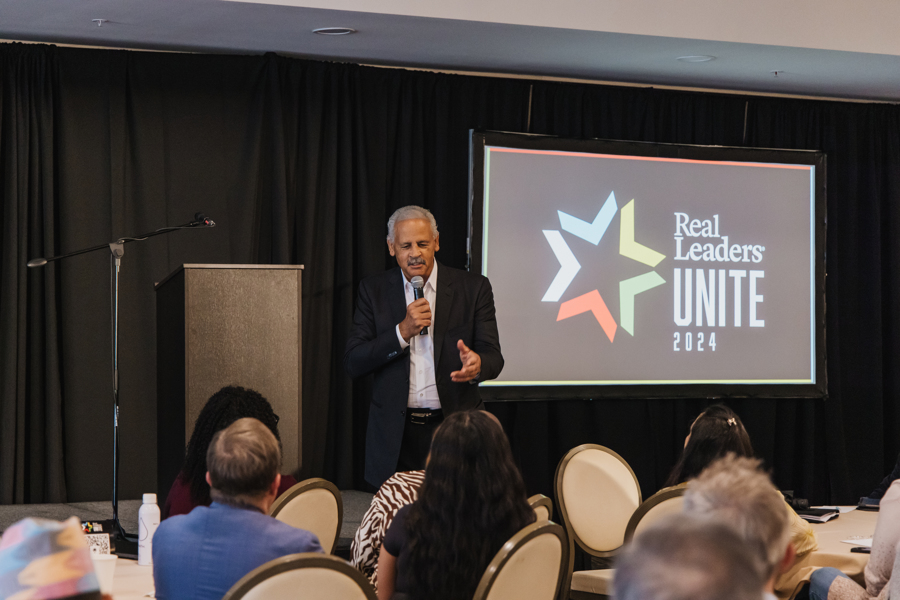
Learn the importance of self-leadership and how to tap into your true identity to improve leadership skills, develop an authentic life vision, and master the tools and self-leadership process. For more about Stedman Graham’s nine-week, self-paced online course, visit stedmangraham.com/course-section.
Can you answer the question, where are we going as a company?
It sounds simple, but in my experience, most team members either have no idea or give wildly different responses. A traditional vision statement misses the mark in so many ways, but after 20 years of trial and error, I found a format that nails it.
What Is a Company Vision?
A vision statement is how you see the future for the company and its customers. Vision equals the company outcomes you want to see in 3, 5, 10, and 20 years. This can act as directional guidance for the team. It’s the journey to your North Star.
Does Mission Equal Vision?
A mission statement answers the question, why do we exist? It’s the guiding light for the business. Forever pursued but likely never achieved, it should be relevant in 100 years.
Your company vision answers the question, where are we going? It maps the steps or milestones you must achieve to get closer to your mission.
Your mission statement is the North Star, and the vision is your star chart — mapping out your points along the way.
How to Create Your Inspiring Vision
Use the 1-4 Method: one slide, four sentences. This method gives you a powerful slide that’ll help your team know where they’re headed, what comes next, and how to spend their time. The 1-4 Method has a sequence to it and communicates an overarching strategy. You’ll create 4 power sentences describing your vision in 3, 5, 10, and 20 years, where each sentence builds off the next. Remember, keep it simple, stupid!
Create the Template
Create a 1-slide presentation and label it: [Company name]’s Strategic Vision Plan.
Write Your 3-Year Vision
Write your first sentence: 3-Year: [Your vision for the company] (80%). 3-Year is the time frame, and 80% is the resource allocation dedicated to this particular line.
Examples:
Build the best [X product] for [Y target audience].
Become the No. [X] company in the [Y target market].
Become the most customer-loved company in the [Y target market].
Write 3 Other Vision Statements
Look ahead and add your 5-, 10-, and 20-year vision sentences: 5-Year: [Your vision for the company] (10%); 10-Year: [Your vision for the company] (7%); 20-Year: [Your vision for the company] 3%.
Dream bigger with bigger outcomes the further out you get. Here’s an example of what your final slide might look like (from one of my companies):
[Company name]’s Strategic Vision Plan
3-Year: Build the most beloved retail experience in Montana. (80%)
5-Year: Use knowledge from our stores to build a massive online audience. (10%)
10-Year: Use momentum to open 10 new stores in synergetic markets. (7%)
20-Year: Become a top 10 e-tailer in the health and wellness space. (3%)
The % resource allocations help your team better understand how to spend their time and give them permission to dedicate some time to the bigger-picture, long-range vision.
Update the Slide Each Year
At the end of 3 years, roughly 75% of your slide should roll over, but you’ve outgrown your initial 3-Year statement. This is a great time for a major launch within the company.
Remember, your company vision isn’t a prediction of where you’re going. Your vision should resonate across your team, creating a shared understanding of where you’re going and how you’ll get there.
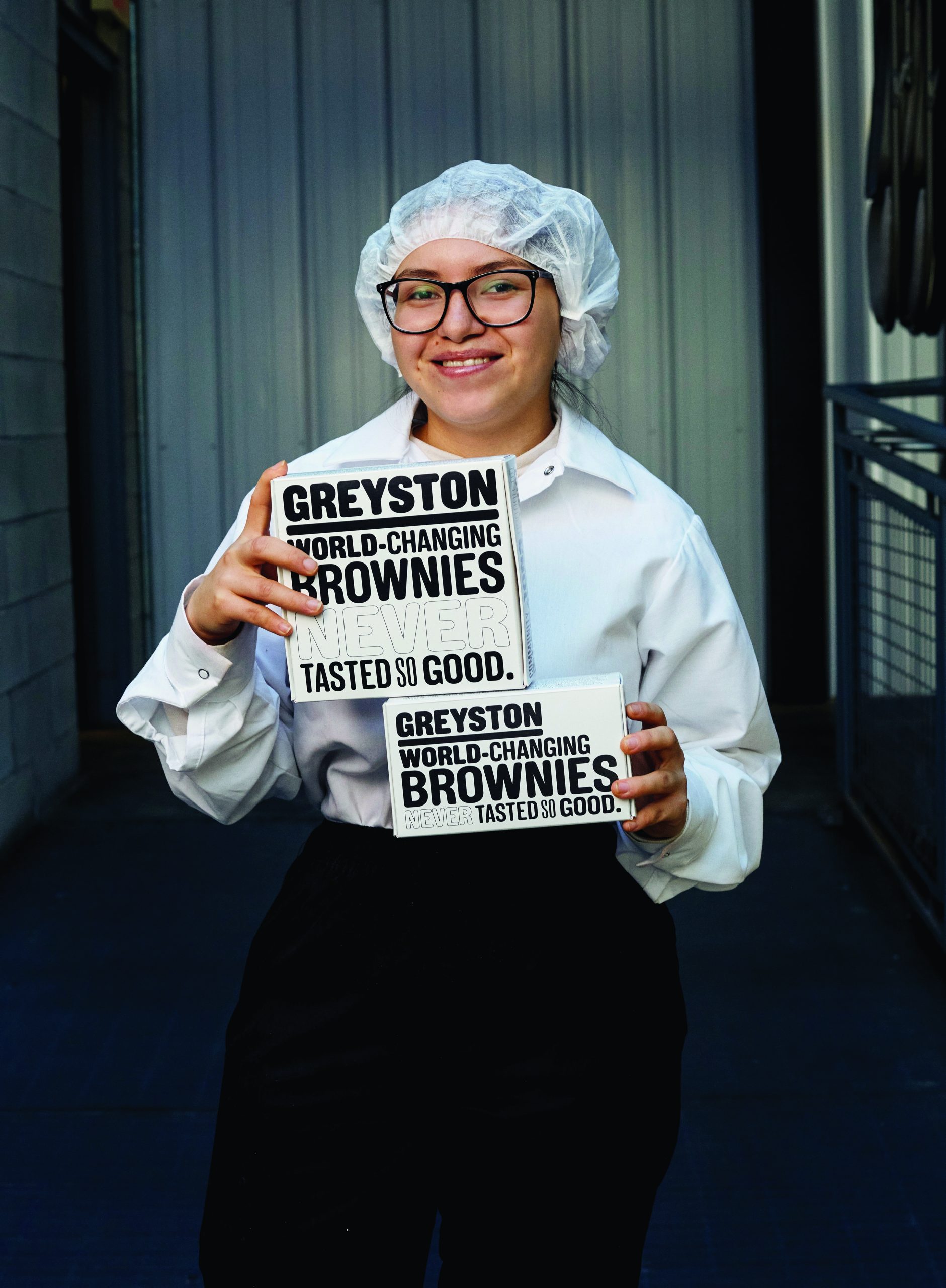
Greyston Bakery — the maker of gourmet brownies, cookies, and those chunky bits in Ben & Jerry’s ice cream — has recruited employees through open hiring for nearly 40 years. Its program helps break the cycle of poverty by hiring nearly anyone who wants to work — minorities, dropouts, refugees, the formerly incarcerated — without requiring resumes, interviews, or background checks.
Shawna Swanson, a Black single mother of five in Yonkers, New York, says the company gave her the chance she needed, as her financial situation became so dire that she considered putting some of her children up for adoption.
While Swanson’s story may seem extreme, it is all too common in the United States today, where marginalized groups have disproportionately high unemployment rates, financial instability, and food and housing insecurity. Black and Hispanic communities have continued to experience the highest poverty rate for the past three decades, reveals 2021 data released by the U.S. Census Bureau and the U.S. Department of Agriculture.
To address the systemic nature of the underlying issues, it is important to start with companies.
Corporate hiring processes that disproportionately screen out candidates based on race, gender, ethnicity, and other factors are pervasive. For example, studies have found that when HR managers screen resumes, Black first names receive much lower call-back rates, indicating an unconscious bias. A 2019 World Economic Forum study calculated that because of the low rate of change in recent decades in women’s participation in the economy, we would need 257 years to achieve gender parity on economic factors like income and workforce participation.
But through Greyston’s opening hiring, people who face situations like Swanson’s can be offered employment opportunities and community support. Instead of conventional vetting processes, open-hiring positions are filled on a first-come, first-served basis, giving opportunities to those who might otherwise face significant obstacles in finding employment. Open hiring ensures that candidates are judged solely on their willingness to work rather than on potentially discriminatory criteria.
When individuals often excluded from the workforce gain employment, the positive effects ripple through their communities.
Families become more stable, local economies strengthen, and social services face less strain. The practice encourages companies to rethink their hiring criteria and actively works against the systemic discrimination embedded in traditional hiring processes.
Greyston president and CEO Joe Kenner shares, “It’s opportunity. It’s access. We’ve been bringing folks into the mainstream for decades by investing in their potential with no judgment.” The bakery’s demographics reflect its community. Since 2017, approximately 95% of its open-hire employees are people of color, and a third are women. Latinx representation has risen steadily, consistent with the growth of the Latinx population in Yonkers, the company’s location. There has also been a significant increase in non-white employees in management positions.
Kenner explains that the company’s founder, Bernie Glassman, was overwhelmed by the myriad of unemployed and homeless people he saw daily in the Bronx. “The genesis was Bernie’s belief that we lose as a society when folks are not realizing their full potential,” Kenner states. “Open hiring isn’t charity; it’s a talent management strategy. We offer jobs to people, no questions asked. But at the end of the day, we still need to run a business that needs to make a profit, that needs to supply a product for Ben & Jerry’s. There’s accountability there.”
Glassman started open hiring by pulling unemployed people off the streets, saying, “Do you want to work? Do you want to learn a new skill? The skills are manual, and you can learn them on the job.” Greyston provides resources to help with childcare, mental health, housing, and other obstacles perpetuating poverty and inequity.
“We want to invest in bringing you in and keeping you here, as opposed to expending resources on keeping you out through, for example, interviews and background checks,” Kenner notes. With about 100 bakery employees, including 70 or so from open hiring, Greyston operates with an eye on employees’ long-term success.
The Greyston Employment Opportunity Center shares its hiring model with businesses large and small around the world. “We want to educate as many people as we can on the possibility of open hiring,” Kenner states. “If a business is skeptical about open hiring, we tell them to open up just one job. It is low risk. It can be whatever position you think works for your organization.”
Ten million Americans face a barrier to employment such as homelessness, substance abuse, or a criminal record — yet, there are roughly eight million jobs available, the Bureau of Labor Statistics reports in 2024. This hurts all of us.
Data show that open hiring is working. In 2022, Greyston filled over 2,000 new jobs through open hiring, with 95% of open hires being people of color and over one-third being women. Its board of directors has almost equal representation of men and women. Kenner concludes that the practice is “good for business, it’s good for the economy, and there are some societal implications. It’s good for the hire; it’s good for their family; it’s good for the community the family lives in.”
An important element of Greyston’s model is changing the broader employment system across the globe, and it recently began scaling the open-hiring model internationally. Kenner says, “If we fill 40,000 jobs through inclusive hiring and open hiring by 2030, that computes to about $3 billion of economic impact — and that’s before you consider the savings from corrections, people getting off public assistance, and the tax revenue that they generate from their wages. That is a huge opportunity.”
This article was adapted from Christopher Marquis’ book The Profiteers: How Business Privatizes Profit and Socializes Cost.
One of the most frequent questions I get asked as a coach by achievers I work with is, “Am I on the right path?”
It is a question I have received over many decades from societal leaders of all kinds, including four U.S. presidents, global business titans, celebrities, moms, and teachers.
It all starts with progress. Are you making it in your life, career, relationships, and finances? Are you growing? One of many truisms of life is that if you are not growing, you are stagnant or decaying. All achievers must grow to be fulfilled.
To grow, you must be willing to go on an endless journey to the unknown and yet unseen. You must be OK with opening yourself up to a level of uncertainty. Only by confronting fear of the unknown can you grow personally and professionally in ways that will let you achieve the extraordinary life leaders demand for themselves.
How do you manage to continuously make progress in all areas of your life — your relationships, career, health, and finances?
The winding road to growth, fulfillment, and the extraordinary life you seek as an achiever demands massive and relentless action. But on that journey, if you’re going to make consistent progress in the long term, you must also be able to see The Path and the key steps you must follow to reach your personal promised land.
How I Coach Myself
I want to help get you started by sharing the seven key steps on The Path to growth and fulfillment that I use with those I coach — including myself.
Along the way, remind yourself that no matter how many mistakes you make or how slow you progress on the journey, you are still way ahead of everyone who isn’t trying. Success isn’t a place at which we arrive; it is an ongoing process, and we must embrace every stage of the journey — not just the peaks.
So what are we waiting for? Let’s get going!
Step 1: What Do You Really Want?
Activate and awaken your hunger.
When people ask me what sets people apart, my response isn’t what they think it will be.
The most important ingredient when it comes to success in life is hunger — the desire to do more, be more, give more, share more, create more. The most successful people that I know in any area never lose this. If you can figure out what you desire most in life, you can begin to write the story of your life.
Take a moment to think about what you desire most. And just as important as what you want is why you want it. Your why is what will act as your North Star when the road gets rough. And with identifying what you truly want, you’re on The Path.
Step 2: Find and Face the Truth
The truth will set you free!
This is about getting clear and honest about where you are right now. Visualize where you want to be. Be honest: What’s the gap between where you are now and where you want to be? And what’s prevented you from closing it in the past?
Once you identify the truths around where you are and what’s holding you back, you can go on to the next step.
Step 3: Resolve and Create a MAP
Make a plan that will take you from where you are to where you want to be.
This is what I like to call creating a massive action plan (MAP). You know you’re on The Path when you have a great plan. It doesn’t have to be perfect, but it will act as a guide.
What actions need to be taken today for you to begin closing the gap? Identify them and write them out as your MAP.
Step 4: You Have to Do What’s Hard
This is where you slay your dragons.
This is what most people won’t do, my friend. Successful people do what others won’t.
This is where you make the change. This is where you get the skill. This is where you drop the old story. Drop the excuses.
This is where the sword of truth slices through any obstacle between you and the life of your dreams.
Step 5: Develop a Daily Practice
You must condition the change — make it a habit.
This means coming back to the basics each day. It creates a sense of renewal. A daily rebirth. A reset.
Write down what you’re grateful for. Reconnect to your heart. Write down what you desire. Reconnect to your why.
Reinvigorate the inner world so you can crush your goals in the external world.
Step 6: Raise Your Standards and Measure More Often
Proximity is power.
It’s human nature to let motivation subside and to let things eventually plateau — to become comfortable. Eventually, some of your musts start sliding into shoulds.
That’s why it’s necessary to continually raise your standards. Evaluate where you are. Measure it. What’s working? What’s not? Then adjust.
And don’t make the mistake of trying to do it all on your own. The greatest business and financial minds and champion athletes have mentors, someone who has walked The Path before.
Get connected with the right kind of people (people you look up to, want to emulate, and admire). Surround yourself with humans who will hold you accountable for your goals and lift you up. Don’t have mentors in your life at the moment? Get a coach. (See the 2024 Real Leaders Top Executive Coaches list.) Accountability creates accelerated growth.
Step 7: Life Is a Gift
Celebrate, appreciate, and give back.
This is my favorite step on The Path because it calls us back to what it’s really all about.
Life is a gift, and it’s meant to be shared.
Any goal, any greatness we achieve in life is really our opportunity to give back. To do something for others, to contribute to something larger than ourselves. To leave a mark on this world for the better.
It’s our greatest honor to use our skills and passions to make the world a better place.
Take a look at these seven steps again. Know that they are not linear in that you will complete one through seven and be done. This checklist is something to come back to throughout your week, month, year, and lifetime to help yourself along The Path to the life you demand for yourself.
Additional Resources
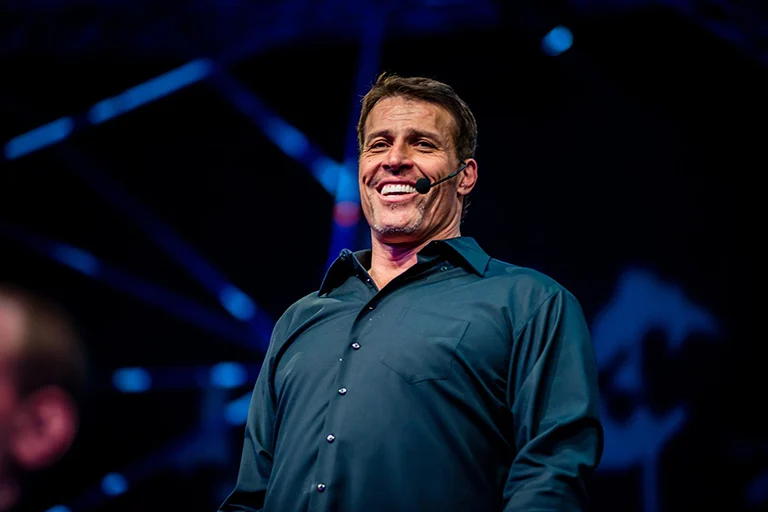
Join Tony Robbins at a live Unleash the Power Within event; the next scheduled one is Nov. 14-17 in the New York/New Jersey region. Learn more at tonyrobbins.com. Interested in getting connected with a Tony Robbins Results Coach? Visit tonyrobbins.com/coaching.
Tony Robbins is one of the world’s leading life and business strategists and is ranked No. 1 on the 2024 Real Leaders Top 50 Keynote Speakers list.
HBO’s runaway hit series Succession follows a media company as it grapples with challenges replacing its founder, Logan Roy. In the series, Roy’s three children compete with long-tenured employees to become the next CEO. Roy constantly tests the candidates in unorthodox ways — sometimes using tactics that blur the lines of integrity and society. Like the proverbial train wreck that we can’t stop watching, the drama captivated audiences until the final reveal (no spoilers here!).
In the real world, identifying and naming a new C-level candidate can also feel like a TV drama and is often followed with the same fascination by others at the company.
Most of the time, the candidates aren’t perfect or ready, but getting the decision right is critical for the business. The root of the challenge is the hiring process; it’s difficult to find a candidate with the vision and capabilities to meet the present and future needs of the organization. In fact, between 50% and 70% of executives, both internal and external candidates, fail within the first 18 months of their promotions, according to research from the Corporate Executive Board. Why is that? And how can other company leaders set them up for success?
Let’s break down the five biggest challenges in succession planning and how you can overcome them.
1. Agreeing on the Profile
The first challenge many companies face is getting the board and C-suite to build and agree on the profile of this new leader. The breakdown occurs for one of two reasons: They don’t agree on who owns the process, or they don’t agree on what they need.
In most succession scenarios, the board chair and seated CEO agree on an approach and strategy for succession planning that will be refreshed at least twice a year and raised consistently on the executive committee agenda. Succession candidates must be deeply immersed in the current business strategy, the future direction of the organization, and all the nuances within. In many organizations, decision-makers have familiarity bias and look for leaders similar to those exiting their roles.
2. Building a Process
You’ll want to build an identification and evaluation process to select suitable candidates. Why is this difficult? Because companies often rely on business metrics, career accomplishments, and sector experience as the driving criteria for a role. These elements are important but are table stakes for any C-level position. What’s missing is evaluating a potential executive’s leadership style, character, and culture fit. Given the criticality of the position and its impact on the organization, it is important you ensure two things:
Multidimensional input. Multiple sources of information provide a more holistic picture of the candidate. These sources could be 360-degree evaluations, structured interviews, psychometric tests, etc., to build transparency around how the leader operates, interacts, manages ambiguity and conflict, and inspires a shared vision.
Complex and simulated future situation assessment. The candidate should be observed performing the future role by experiencing problems, situations, and presentations as they would on the job. This type of virtual simulation allows organizations to see the candidate in action and provides insights into how they weigh strategic decisions; manage the business, people, and situations; and approach stakeholder management.
3. Creating Readiness
No internal candidate will likely be ready at first, and therefore, any selection is a leap of faith that the candidate can hit the ground running. The success of your succession process requires preparing the candidate with a foundation for communicating, making critical decisions, aligning their team, and marshaling the action of the organization. You must provide training, coaching, or special projects that create moments for them to experiment, learn, and grow.
4. Being Transparent
In the case of HBO’s Succession, the drama in all four seasons is caused by secrecy and suspicion — from wars between candidates and confusion in the organization to loss of value when no one is focused on the business. Even in the best scenarios, transparency can be difficult to achieve due to confidentiality issues; however, when processes are better planned, there are also fewer problems.
The single most common question clients ask us is, “How much should we share?” Like any significant set of decisions with broad organizational impacts, the answer is to share the process but protect the people. If you start early and provide good transparency about the role’s criteria, opportunities for development, timelines, and the succession process itself, you build trust and confidence in the process.
5. Onboarding
This addresses the issue of how to incorporate the candidate into the position so they can be successful. The first few years in the new role are critical for a CEO to build trust and credibility and create a shared strategic vision for the team. During this time, the CEO’s objectives should be to reduce risk by creating a safe environment, evaluate challenges, generate discourse among diverse audiences, establish and manage relationship dynamics, develop the executive team, and make proposals and decisions. On many occasions, the onboarding process can be reinforced by the presence of the previous CEO, a close relationship with the board chair, or the support of an experienced executive coach specializing in CEO transitions.
To preserve your organization’s culture and prepare for any type of transition, succession planning must be a fundamental part of your business strategy. By leveraging a holistic, transparent process anchored in a profile that reflects what success looks like now and in the future, it’s possible to ensure a smooth C-level transition and a lasting future for the organization.
As Burt’s Bees marks 40 years, co-founder Roxanne Quimby shares her keys to growing the planet-focused personal care product company from a roadside startup into a billion-dollar household name.
Burt’s Bees. It’s a household name and a billion-dollar personal care product company with 40 years of exponential growth and success.
But its beginnings could hardly be humbler. Behind Burt Shavitz — the late straggly-bearded beekeeper whose face became synonymous with the brand — was lesser-known co-founder Roxanne Quimby, a fiercely determined woman with a continuous drive to expand the company from its roadside roots all while keeping the planet an unwavering priority.
“Burt’s Bees was an unexpected success,” Quimby says. The queen bee sat down with Real Leaders to share her raw, unfiltered lessons on their path to building a colony — err, company — of epic proportions.
1. Start Anywhere
Some might say they had no business starting a business, but isn’t that the beauty of the wild, wild west of entrepreneurship? Shavitz, a photojournalist from Manhattan, and Quimby, an artist from San Francisco, separately traded their congested city lives for the off-grid backwoods of Maine, forgoing running water and electricity. In what turned out to be arguably the best hitchhiking outcome of all time, Shavitz picked up a thumbing Quimby in his truck and they hit it off — certainly not the typical start to a business partnership or romance, but there they were beginning both.
When they met in 1983, a solo Shavitz was beekeeping and selling honey roadside to get by, while a newly single Quimby, a mother of twins and ever the artist yearning to create, also needed work. “We were living hand to mouth,” Quimby recalls. “I really wanted to stop waitressing.” She moved in with Shavitz and started making beeswax candles and lip balm to supplement his wholesale honey and beeswax sales. “He sold the honey and beeswax as commodities, and my feeling was that we could enhance value with smaller, more aesthetically pleasing packaging, making them into a souvenir of one’s trip to Maine,” she says. “I saw really quickly that that worked, and we were able to get more revenue.”
2. Learn from Consumers
Initially, Quimby set up shop at local craft fairs and allowed observation to guide their product development. “I let the consumers teach me about what they wanted, how they gathered information about a product,” she recalls. “It was a practical, on-the-street way of understanding the relationship between a product and a person who would purchase it or not. It was fundamentally important to my ability to put together a formula to create and grow the business.”
The candles phased out and the skincare line expanded, with free samples hooking people in. “We did tons of sampling,” Quimby says. “That was really important because we felt that the product was the thing that was going to sell people — because it worked, and it felt so good, and it smelled so good. We wanted people to try it. We really believe in our products.”
3. Face the Giants
Quimby also took inspiration from businesses she admired, with Ben & Jerry’s chief among them. “They were so creative, and they broke all the rules,” she notes. “They were very countercultural and yet accepted by everybody because they have a great product that everybody loves.”
She cites Ben & Jerry’s 1984 national campaign “What’s the Doughboy Afraid Of?” as formative to her journey. The Pillsbury Corporation, known for its Doughboy mascot, owned Häagen-Dazs at the time and threatened to stop selling its ice cream to a mutual distributor if it continued to sell Ben & Jerry’s to grocery stores, essentially blocking it from shelves. The distributor couldn’t afford to lose such a lucrative client, so it obliged.
Ben & Jerry’s wanted to fight but was still small and didn’t think it stood a chance in a lawsuit against such a giant. Instead, it created a campaign encouraging customers to push back, sending hundreds of people each week to flood Pillsbury’s hotline and write letters. Eventually, Pillsbury backed down and allowed the distributor to supply Ben & Jerry’s to its stores.
“Ben & Jerry’s gave me permission to exist in a marketplace where we were the alternative when we were very unknown and tiny,” she reflects. “I felt like we could take on gigantic companies and appeal to a customer base that was not interested in the large mega-brands.”
4. Build Your Brand
Quimby set out to create a loyal customer base for Burt’s Bees, applying the lessons she read in Building Strong Brands by David A. Aaker. “Selling a consumer product is more than just about the product,” Quimby shares. “It’s about a story. It’s about aspiration. And it’s about a connection to the consumer. Once you create this very strong attachment between a brand and a consumer, you don’t have to keep selling to them. They love and buy your brand without you having to pitch it to them every single time. We put a lot of energy into creating a brand.”
Not only did Burt’s Bees hone in on Shavitz as its small-town beekeeper mascot, but it also emphasized its values of authenticity, purity, and cleanliness. “People were ready for that story,” Quimby says.
The company’s countercultural message resonated with its audience. “Beauty and personal care products always feature beautiful women and an aspirational look of flawlessness, so we just did the opposite,” Quimby notes. “We put this bearded beekeeper on the packaging, and what we were saying was that you should be more interested in the performance of the product. It’s not going to make you look like a supermodel, but it is going to be satisfying on a very healthy and soul level. That was a story we told through the brand.”
5. Stay Authentic to Your Cause
Deeply appreciative of what nature provided them, Quimby and Shavitz respected and preserved the planet from the get-go with Burt’s Bees, from process to packaging. Rejecting consumerism and living off the grid in Maine were formative to that.
“It really changed my point of view,” she says. “I was much more careful about the way I used resources and on very, very limited resources financially. The way bees live — the way bees make a living, the way they organize the workflow to create their products — that was sort of one and the same with my way of living. It wasn’t like I could start a company that contradicted those values that were completely baked into the way I lived and looked at things. It never occurred to me to do anything contrary to the way I lived and looked at the world. So that was all part of the DNA of Burt’s Bees.”
The company committed to botanical ingredients sourced from the Earth, as opposed to chemicals made in a lab. However, keeping packaging environmentally friendly presented hurdles. “It was definitely challenging because at that time, things were packaged in plastic, metal, or glass — and you don’t want children’s products or products used in the bathroom or shower to be in glass. Metal has its limitations. So plastic was the alternative, and it was very hard to get around,” Quimby reflects. “But we just didn’t make a product until we figured out how to do it without a damaging environmental impact. There were a lot of products that we couldn’t make, like shampoo and lotion. I couldn’t see us adding to the waste stream with a virgin plastic bottle that gets thrown out after you use the contents.”
Burt’s Bees’ first lip balms were packaged in terracotta pots, then metal tins. Only once Quimby learned about postconsumer recycled plastic did Burt’s Bees start making shampoo and lotion, significantly boosting sales while giving plastic a second life and helping increase recycled plastic’s industry demand.
Today, the company continues to use postconsumer recycled materials in its packaging and responsibly sourced ingredients from nature under landfill-free operations.
6. Navigate Your Partnership
Shavitz and Quimby navigated highs and lows in their personal and business relationships. Eventually, the end of the former relationship would lead to the end of the latter. “Having a partner is a double-edged sword, but I still recommend it,” Quimby says. “I would feel very lonely without having somebody by my side for better or for worse.”
Among the benefits of working with a trusted partner, she lists loyalty, a different viewpoint, and a safe space to vent. “Partnerships can be incredibly beneficial,” she states. “I could go to Burt and tell him every bad thing that happened that day, and he was there for me. As Burt would say, ‘If it was easy, Roxy, everybody would do it.’”
Quimby also valued his photography experience, which came in handy while working with their catalog photographer. “Partners should bring expertise complementary to yours,” she notes. “Those differences can also cause conflict, but struggles are what make for a better person, a better product, a better company because the resolutions can make you stronger. Burt and I were partners in that sense.”
7. Know When to Exit
As the company grew, operations outgrew Shavitz’s kitchen to a one-room schoolhouse, then a bowling alley, and eventually headquarters relocated to Raleigh, North Carolina. After a brief stint in Raleigh, Shavitz returned to Maine to live on a piece of property Quimby gave him in exchange for his third of the company, bringing her to full ownership of Burt’s Bees in 1999. Along the way, Shavitz and Quimby’s romantic relationship went south.
“We did separate for personal reasons that had nothing to do with the company,” Quimby shares. “It was a personal situation that we were not able to resolve, and so we went our separate ways, and he still maintained his ownership share of the company for a few years.”
After the breakup, Quimby’s heart was no longer in Burt’s Bees, and she recognized it was time to plan her exit. “Burt’s Bees was our child, and we put everything into it,” she reflects. “When he and I split up as romantic partners, it was very difficult for me to still stay buoyant and happy and inspired by the company, and that led us to want to sell it.”
Quimby and a business broker met with 40-plus potential acquiring companies over the span of a year. “We had a pretty hot property to sell,” Quimby notes. In 2003, she sold 80% of her stake in Burt’s Bees to private equity firm AEA Investors, who valued the company at $177 million. She stepped down as CEO soon after. “I wanted to go with people whom I really cared about and whom I thought really cared about us and our values,” she shares. “I love that we went with a private equity company, and they never lost respect for what we created.”
8. Find Fulfillment Post-Exit
In 2007 Clorox bought the entire company for over $900 million, with Quimby selling the rest of her stake. “I didn’t really need all that money,” she admits. “I wasn’t going to change my lifestyle, start getting fancy cars, and make mansions. It seemed logical to put a great deal of the proceeds into some kind of environmental enterprise.”
Quimby ramped up her focus on wilderness preservation, starting a philanthropic foundation, giving $90 million to charities, and acquiring 87,500 acres of untouched Maine woodlands through lip balm profits, which she donated to the National Park Service to become Katahdin Woods and Waters National Monument in 2016.
“You feel connected to something bigger than yourself,” Quimby says. “I can think of no better thing to do with Burt’s Bees profits than to return them to the Earth. We want people to enjoy the land in a non-consumptive way.”
In 2019 she purchased a company that combines her passions for art and environmental consciousness — Eco-Kids, which sells sustainable art and craft supplies for children. “I felt a real affinity to the beeswax crayons,” she says.
In 2020–21 Burt’s Bees invested $3 million to help build her national monument’s Tekakapimak Visitor Contact Station scheduled to open summer 2024. It’s a tribute to the native Wabanaki people in partnership with the Roxanne Quimby Foundation, Elliotsville Foundation (led by her son), a Wabanaki advisory board, and the National Park Service. For its 40th anniversary in 2024, Burt’s Bees also honored Quimby with a limited-edition lip balm that celebrates her legacy and the brand’s investment in the monument.
“We’re thankful for the blueprint of kindness toward people and planet that Roxanne built into the brand,” says Paula Alexander, director of sustainability and responsible sourcing at Burt’s Bees. “Our team is proud to continue her legacy of reinvesting in nature and our communities.”