The Case for DEI: A Pathway to Innovation 

A journey from advocacy to action, and the imperative of building inclusive leadership in a changing world.

By Artika Tyner

Where My DEI Journey Started

When I started my career in DEI nearly twenty years ago, I remember pleading with my boss and other business leaders to invest in DEI through time, resources, and talent. I hoped that they would recognize the transformative power it holds for organizational success and societal impact. As an attorney, I stood ready to advance my case for the importance of inclusion. My opening statement focused on the necessity of evolving from diversity being viewed as a moral imperative of being well-intentioned to a business imperative of strategic action. 

I asked them to imagine the results outlined by research from A Great Place to Work for All.

  • Greater Profitability: Inclusion could increase your company’s revenue by more than 24%. 
  • Greater Productivity and Improved Employee Recruitment and Retention: Becoming more ethnically diverse increases the likelihood of outperforming your competitors by 35%.

I built the momentum for an unassailable closing argument by reiterating the data on the benefits of inclusion. My case was met with a passive shrug and dismissive nod. I was undeterred and committed to becoming an expert in advancing DEI.  

Fast forward to today, I am now in key leadership roles and reaping the benefits of my fervent commitment to mentoring young professionals from marginalized groups and unwavering faith in building inclusive workplaces. I have built teams where belongingness is a core value that drives strong performance, fuels innovation, and activates collaboration. 

What will you do to tap into the power of inclusion?

The rich diversity of the United States is one of our greatest strengths. We are the very essence of: E pluribus unum (“out of many, one”). 

Did you know today we have the most diverse communities in this Nation’s history? 

As we near the 2040s in the United States no racial group will represent the majority of the population (according to U.S. Census). Meaning the United States has evolved into a rich multicultural tapestry where not one single group will be the majority (over 50%). This also reflects that diversity coupled with equity and inclusion will help to strengthen our community as talented people of all colors, experiences, and backgrounds work to build a more perfect union and sustainable economy. 

Diversity tends to be mischaracterized as a conglomeration of people from different backgrounds. Or it is a declaration manifested by stating “all are welcome” through policy statements and colorful posters. For many organizations, diversity and inclusion may begin simply with representation, by bringing a woman’s or maybe a person of color’s perspective to the table. Often, this is seen as the first step in creating a melting-pot recipe of ideas, thoughts, and perspectives. Cultural assimilation is the broth and diverse individuals are the ingredients. Simmer on low for two or three years, and diversity will miraculously emerge. The challenge with cooking stews, however, is that the flavors are all absorbed into the broth, which means each employee is not valued for his or her unique contributions and individual attributes. Is this diversity? Another metaphor is the mixed salad, with each person representing a distinct vegetable, be it a crisp carrot, a vibrant beet, or lush romaine lettuce. Then the magic occurs when the salad is doused with dressing and all flavors become one—ranch, french, or a light balsamic vinaigrette. Once again, the dressing of choice masks the complexity and the very essence of diversity and inclusion. This still leaves us begging the question: Is this diversity? And where is the equity and inclusion? Inclusive leaders, like you, help to ensure that we move beyond words to deeds. You not only steer the ship by setting your organizational goals, but you also chart the course across the difficult tides of modern business practice.  

What will you do to serve as an inclusive leader?

Your commitment to serve as an inclusive leader is needed now more than ever as the future of diversity initiatives may feel uncertain as mounting legal cases emerge challenging DEI education, alleging discrimination by venture capital firms focused on serving minority business owners, and eliminating contract programming for minority-owned companies. CEOs are quietly disinvesting in DEI commitments and removing DEI positions. Yet, challenging times can serve as an invitation for you to lean into change and redefine the path forward. 

Inclusive leaders embark on a lifelong learning journey in these four key areas:

Intrapersonal: Engage in self-discovery by exploring your leadership story which is shaped by your cultural values, socialization, and beliefs. This self-reflection will aid you in gaining the insights needed to connect your leadership story to building an organizational culture of inclusion.

Interpersonal: Build and strengthen effective teams by challenging organizational barriers like stereotype threat, cultural taxation, and microaggressions. 

Organizational: Align your equity goals with strategic impact. Help your team define how inclusion advances business priorities, productivity, and engagement. 

Societal: Promote the values of our shared humanity and common destiny by addressing some of the most pressing social justice challenges of our time.

Diversity is needed to bring together the brightest minds to create solutions to business, economic, and social challenges of the 21st century and beyond. Diversity creates an atmosphere where inclusion can be unveiled as people come together and exchange ideas from diverse perspectives, life experiences, and cultural backgrounds. It empowers teams to see through the eyes of ingenuity and creativeness. This lays the foundation for future business success through the transformative power of innovation.
DYPER is Lightening the Load

DYPER is revolutionizing the disposable diaper industry with environmental ingenuity.

By Real Leaders

Diapers are the third-leading contributor to U.S. landfills by mass, taking up to 500 years to break down. The average child uses around 3,700 disposable diapers, and more than 27 billion of them end up in U.S. landfills each year.

A Sustainable Solution for Happy Bottoms and a Healthy Planet

That’s where DYPER founder and CEO Sergio Radovcic saw an opportunity to help reduce the negative impact of these baby basics on the planet. The Certified B Corp has been working since 2018 toward its goal of making a fully plant-based diaper that reduces fossil-fuel use and avoids landfills. Along the way, the company has grown its employee base over sixfold from 2019–22. 

Radovcic, a father of three, started DYPER as an alternative to mainstream options made with chemicals and plastic. The vast majority of disposable diapers are constructed with two water bottles worth of plastic and sold in single packs with new plastic packaging. 

“While there are no silver bullets to solving the plastic diaper dilemma, we feel it is our obligation to continuously look for solutions,” Radovcic says. 

DYPER makes diapers and wipes with plant-based materials and avoids harmful chemicals and irritants such as chlorine, latex, alcohol, perfumes, PVC, lotions, TBT, and phthalates. Wood pulp from responsibly managed bamboo and eucalyptus forests is converted using closed-loop systems in accordance with OEKO-TEX STeP standards, and DYPER’s supply chain is independently audited. 

Plants are renewable and more sustainable than using conventional plastic, which is made from chemicals sourced from fossil fuels. The company’s diapers were rated a Certified USDA BioPreferred 55% Product and degraded more than 70% in 180 days when tested. Plus, they come in eco-friendly packaging. The products have already made their way to major distributors, including Walmart, Target, and Amazon.

“Parents shouldn’t have to choose between their baby’s well-being and the environment,” Radovcic says. “By using materials such as paper, natural wax, and clay in our packaging and plant-based materials in our diapers, we hope to set an industrywide example that we can all reduce our reliance on plastics as a society.”

Breaking Free from Plastic: Embracing Plant-Based Power

A challenge remains, as 100% plant-based superabsorbent polymers, elastics, glues, and fastening systems are currently not available at scale or at the performance needed for daily use. Thus, the evolution of DYPER continues. 

In addition to its main diaper packs, DYPER also makes charcoal-enhanced diapers, cloth diapers, and training pants. It introduced its first Impact Box in 2023, benefitting Hope for the Warriors, a nonprofit that supports service members, veterans, and families. 

Thinking even bigger than diapers and wipes, DYPER has created additional programs centered around holistic care for babies and the planet:

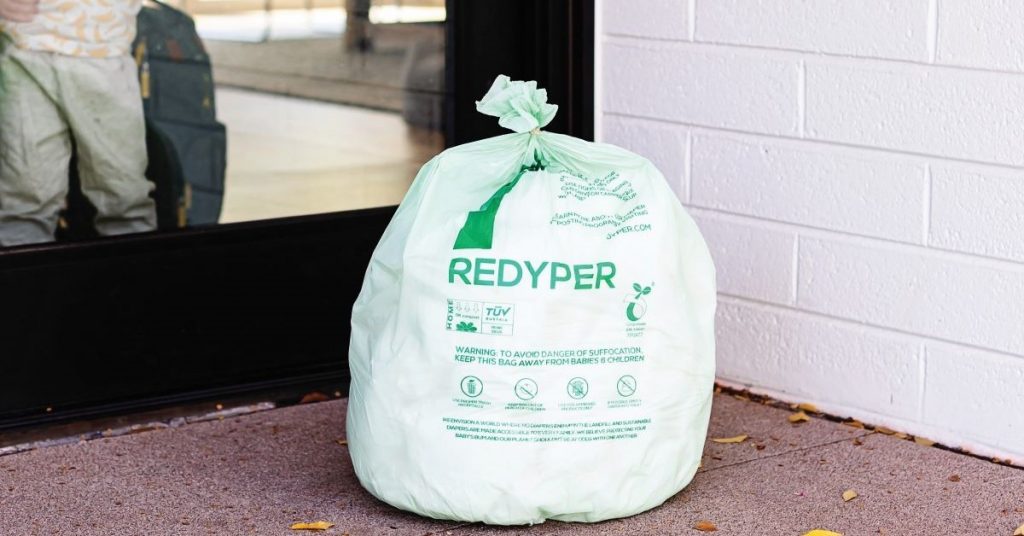
  • REDYPER: An opt-in program offers curbside pickup of soiled products in 22+ cities and growing, or they can ship them back for responsible disposal. To date, over 11.5 million pounds of dirty diapers have been diverted from landfills and converted into topsoil. Introduced in 2023 to select markets, Byochar technology also helps reduce landfill waste by converting soiled diapers and wipes into usable biochar at scale, ultimately transforming an environmental hazard into a carbon-neutral footprint without the use of offsets. Biochar is a carbon-rich product created through a heating process called pyrolysis, which allows for waste to be transformed into a reusable commodity that can improve soil, assist in air and water purification, and be an additive to paints and inks for improved pigment.  
  • DYPER Health: At-home testing provides science-based insights, including a Baby Gut Health Kit, Children’s Advanced DNA Kit, Breast Milk Test Kit, and Adult Vaginal Microbiome Test Kit, with other tests in the works.
  • DYPER Card: A credit card offers qualified customers the ability to earn free diapers or a cash back investment into an EarlyBird savings account. When children are no longer in diapers, EarlyBird will allow a percentage of spending to be transferred into a minor custodial account for tax-optimized growth.

“We strive to be at the forefront of innovation and cater to the needs of modern parents,” Radovcic says.

Is Your Operation Future-Friendly? 

Follow these 4 steps to become a future friendly purposeful business that will last.

By Desirée Bombenon

Incorporating purpose and sustainability into a business operation are key components to acquiring and retaining talent as well as securing partnerships. As recently as 10 years ago, we would not have been highlighting this as a major strategic move for a company — but the shift has happened. 

We see the world differently, and only organizations that can adapt to the changing conditions and adopt the definition of future-friendly will be relevant, not because of their product or service, but because of how they operate. 

Here’s how to start the road to a purposeful and sustainable business.

1 Leadership Acceptance

You cannot have team buy-in without authentic leadership acceptance for the shift in how your business will operate. Commitments of time, energy, and thoughtfulness must go into re-imagining a different business model, and leadership is key to execution.

2 A Guiding Coalition

People will follow other people whom they have a deep respect and trust for. Develop a team of influencers who can carry the message and create excitement in all divisions of the company. When the purpose and mission are articulated by a trusted peer, they are more likely to be accepted and supported by the team.

3 Sustainability as a Strategy

When developing your company strategy, sustainable practices should be part of the blueprint. Companies normally review or revamp their strategy every three years — or fewer if working with sprint strategies. When planning the next few years, build in a budget and program for sustainability. Whether it is digitization or a recycling program, it doesn’t need to have a huge cost. Some companies have implemented roles like chief sustainability officer or sustainability champion. 

4 Measurable Impact

There is nothing more powerful than seeing the outcomes of your work. The same goes for sustainable practices. There are many ways to start measuring impact. Once you see the results and difference you are making not only in your company but with the community, share that information with your team and customers. These meaningful practices tie back into your overall corporate social responsibility and the values and beliefs by which your organization operates. 

In addition, there are many support systems and models out there. Becoming a Certified B Corporation is one way to start the process. Other steps forward include setting targets for measurable environmental, social, and governance impact and focusing on outcomes, no matter how small. 

The United Nations Global Compact (UNGC) also has a multitude of resources and supports to help businesses start the process of sustainable practices. The UNGC 10 Principles provide a checklist focused on four pillars: human rights, labor, environment, and anti-corruption. 

Whatever you’re considering doing to become purposeful and sustainable, start now. Your business’s future depends on it. 

Desirée Bombenon is CEO and chief disruption officer of SureCall and a diversity board council member for the Women’s Executive Network. She has over 30 years of business operational experience.

DYPER is Lightening the Load

DYPER is revolutionizing the disposable diaper industry with environmental ingenuity.

By Real Leaders

Diapers are the third-leading contributor to U.S. landfills by mass, taking up to 500 years to break down. The average child uses around 3,700 disposable diapers, and more than 27 billion of them end up in U.S. landfills each year.

A Sustainable Solution for Happy Bottoms and a Healthy Planet

That’s where DYPER founder and CEO Sergio Radovcic saw an opportunity to help reduce the negative impact of these baby basics on the planet. The Certified B Corp has been working since 2018 toward its goal of making a fully plant-based diaper that reduces fossil-fuel use and avoids landfills. Along the way, the company has grown its employee base over sixfold from 2019–22. 

Radovcic, a father of three, started DYPER as an alternative to mainstream options made with chemicals and plastic. The vast majority of disposable diapers are constructed with two water bottles worth of plastic and sold in single packs with new plastic packaging. 

“While there are no silver bullets to solving the plastic diaper dilemma, we feel it is our obligation to continuously look for solutions,” Radovcic says. 

DYPER makes diapers and wipes with plant-based materials and avoids harmful chemicals and irritants such as chlorine, latex, alcohol, perfumes, PVC, lotions, TBT, and phthalates. Wood pulp from responsibly managed bamboo and eucalyptus forests is converted using closed-loop systems in accordance with OEKO-TEX STeP standards, and DYPER’s supply chain is independently audited. 

Plants are renewable and more sustainable than using conventional plastic, which is made from chemicals sourced from fossil fuels. The company’s diapers were rated a Certified USDA BioPreferred 55% Product and degraded more than 70% in 180 days when tested. Plus, they come in eco-friendly packaging. The products have already made their way to major distributors, including Walmart, Target, and Amazon.

“Parents shouldn’t have to choose between their baby’s well-being and the environment,” Radovcic says. “By using materials such as paper, natural wax, and clay in our packaging and plant-based materials in our diapers, we hope to set an industrywide example that we can all reduce our reliance on plastics as a society.”

Breaking Free from Plastic: Embracing Plant-Based Power

A challenge remains, as 100% plant-based superabsorbent polymers, elastics, glues, and fastening systems are currently not available at scale or at the performance needed for daily use. Thus, the evolution of DYPER continues. 

In addition to its main diaper packs, DYPER also makes charcoal-enhanced diapers, cloth diapers, and training pants. It introduced its first Impact Box in 2023, benefitting Hope for the Warriors, a nonprofit that supports service members, veterans, and families. 

Thinking even bigger than diapers and wipes, DYPER has created additional programs centered around holistic care for babies and the planet:

  • REDYPER: An opt-in program offers curbside pickup of soiled products in 22+ cities and growing, or they can ship them back for responsible disposal. To date, over 11.5 million pounds of dirty diapers have been diverted from landfills and converted into topsoil. Introduced in 2023 to select markets, Byochar technology also helps reduce landfill waste by converting soiled diapers and wipes into usable biochar at scale, ultimately transforming an environmental hazard into a carbon-neutral footprint without the use of offsets. Biochar is a carbon-rich product created through a heating process called pyrolysis, which allows for waste to be transformed into a reusable commodity that can improve soil, assist in air and water purification, and be an additive to paints and inks for improved pigment.  
  • DYPER Health: At-home testing provides science-based insights, including a Baby Gut Health Kit, Children’s Advanced DNA Kit, Breast Milk Test Kit, and Adult Vaginal Microbiome Test Kit, with other tests in the works.
  • DYPER Card: A credit card offers qualified customers the ability to earn free diapers or a cash back investment into an EarlyBird savings account. When children are no longer in diapers, EarlyBird will allow a percentage of spending to be transferred into a minor custodial account for tax-optimized growth.

“We strive to be at the forefront of innovation and cater to the needs of modern parents,” Radovcic says.

Is Your Operation Future-Friendly? 

Follow these 4 steps to become a future friendly purposeful business that will last.

By Desirée Bombenon

Incorporating purpose and sustainability into a business operation are key components to acquiring and retaining talent as well as securing partnerships. As recently as 10 years ago, we would not have been highlighting this as a major strategic move for a company — but the shift has happened. 

We see the world differently, and only organizations that can adapt to the changing conditions and adopt the definition of future-friendly will be relevant, not because of their product or service, but because of how they operate. 

Here’s how to start the road to a purposeful and sustainable business.

1 Leadership Acceptance

You cannot have team buy-in without authentic leadership acceptance for the shift in how your business will operate. Commitments of time, energy, and thoughtfulness must go into re-imagining a different business model, and leadership is key to execution.

2 A Guiding Coalition

People will follow other people whom they have a deep respect and trust for. Develop a team of influencers who can carry the message and create excitement in all divisions of the company. When the purpose and mission are articulated by a trusted peer, they are more likely to be accepted and supported by the team.

3 Sustainability as a Strategy

When developing your company strategy, sustainable practices should be part of the blueprint. Companies normally review or revamp their strategy every three years — or fewer if working with sprint strategies. When planning the next few years, build in a budget and program for sustainability. Whether it is digitization or a recycling program, it doesn’t need to have a huge cost. Some companies have implemented roles like chief sustainability officer or sustainability champion. 

4 Measurable Impact

There is nothing more powerful than seeing the outcomes of your work. The same goes for sustainable practices. There are many ways to start measuring impact. Once you see the results and difference you are making not only in your company but with the community, share that information with your team and customers. These meaningful practices tie back into your overall corporate social responsibility and the values and beliefs by which your organization operates. 

In addition, there are many support systems and models out there. Becoming a Certified B Corporation is one way to start the process. Other steps forward include setting targets for measurable environmental, social, and governance impact and focusing on outcomes, no matter how small. 

The United Nations Global Compact (UNGC) also has a multitude of resources and supports to help businesses start the process of sustainable practices. The UNGC 10 Principles provide a checklist focused on four pillars: human rights, labor, environment, and anti-corruption. 

Whatever you’re considering doing to become purposeful and sustainable, start now. Your business’s future depends on it. 

Desirée Bombenon is CEO and chief disruption officer of SureCall and a diversity board council member for the Women’s Executive Network. She has over 30 years of business operational experience.

Sustainable American Adventures

By Real Leaders

Legacy Vacation Resorts offers affordable, sustainable vacation experiences and is the first multi-state resort hospitality company in the U.S. to achieve B Corp Certification. It partners with environmental organizations to highlight important initiatives and encourages guests to support other B Corps. 

Green Getaways: Legacy Vacation Resorts Show How to Have Fun Sustainably

“We do this in a variety of approachable ways including an informational, yet comedic in-room video, signage across each property highlighting environmental impact projects like our renewable energy use and water reduction initiatives, as well as information in-room at different touch points to encourage things like recycling and avoidance of single-use items,” says Jared Meyers, CEO of Legacy Vacation Resorts

The company reached carbon neutrality by offsetting 100% of guest stays and activities. Here’s a look at four of its eco-focused properties across the U.S.

Steamboat Springs, Colorado

Just moments from the gondola and within walking distance of shops and restaurants, these suites are steps from world-class skiing in the winter and exhilarating mountain recreation the remainder of the year. Escape on a mountain biking trek, navigate whitewater rapids, fish for river trout, or explore the mountain trails on horseback. Return to the warmth of a dog-friendly condominium for Rocky Mountain-style rest in the hot tub or sauna, a barbecue at the grilling area, or more fun at nine-hole miniature golf onsite.

Indian Shores, Florida

Stunning Gulf Intracoastal Waterway views and the beauty of Florida’s West Coast beaches set a spectacular backdrop for an escape to this tranquil resort near Clearwater Beach and Tampa Bay. With fully equipped studio, one-, and two-bedrooms and elite units, its accommodations also include access to a swimming pool, hot tub, game room, grilling area, and an outdoor deck with magnificent views, beach access, a dock, and boat slips.

Reno, Nevada

A vibrant, diverse destination of sky’s-the-limit casino gaming, world-class outdoor recreation, and thrilling nightlife, Reno, Nevada, is an anything-goes town in the shadow of the Sierra Nevada mountains. Explore whitewater rapids at the Truckee River, the Reno Aces baseball team, and annual events like the Reno River Festival and Great Balloon Race. Beautifully appointed hotel accommodations and amenities include an indoor pool, saunas, and a sundeck.

Brigantine Beach, New Jersey

Perhaps New Jersey’s best-kept secret, this timeless seaside town is a pristine hideaway from the larger New Jersey beaches. Directly on the white sandy shores of Brigantine Island, this historic beachfront resort is close to the action. Spend the day on the beach, cast a line into the surf, or book a deep-sea fishing charter. Stroll the boardwalk, tee off on a championship golf course, or take a short trip over to Atlantic City. Enjoy spacious, dog-friendly suites, along with a heated indoor pool and a seasonal ocean-view restaurant. The resort achieved 100% renewable electricity through Renewable Energy Certificates.

Sustainable American Adventures

By Real Leaders

Legacy Vacation Resorts offers affordable, sustainable vacation experiences and is the first multi-state resort hospitality company in the U.S. to achieve B Corp Certification. It partners with environmental organizations to highlight important initiatives and encourages guests to support other B Corps. 

Green Getaways: Legacy Vacation Resorts Show How to Have Fun Sustainably

“We do this in a variety of approachable ways including an informational, yet comedic in-room video, signage across each property highlighting environmental impact projects like our renewable energy use and water reduction initiatives, as well as information in-room at different touch points to encourage things like recycling and avoidance of single-use items,” says Jared Meyers, CEO of Legacy Vacation Resorts

The company reached carbon neutrality by offsetting 100% of guest stays and activities. Here’s a look at four of its eco-focused properties across the U.S.

Steamboat Springs, Colorado

Just moments from the gondola and within walking distance of shops and restaurants, these suites are steps from world-class skiing in the winter and exhilarating mountain recreation the remainder of the year. Escape on a mountain biking trek, navigate whitewater rapids, fish for river trout, or explore the mountain trails on horseback. Return to the warmth of a dog-friendly condominium for Rocky Mountain-style rest in the hot tub or sauna, a barbecue at the grilling area, or more fun at nine-hole miniature golf onsite.

Indian Shores, Florida

Stunning Gulf Intracoastal Waterway views and the beauty of Florida’s West Coast beaches set a spectacular backdrop for an escape to this tranquil resort near Clearwater Beach and Tampa Bay. With fully equipped studio, one-, and two-bedrooms and elite units, its accommodations also include access to a swimming pool, hot tub, game room, grilling area, and an outdoor deck with magnificent views, beach access, a dock, and boat slips.

Reno, Nevada

A vibrant, diverse destination of sky’s-the-limit casino gaming, world-class outdoor recreation, and thrilling nightlife, Reno, Nevada, is an anything-goes town in the shadow of the Sierra Nevada mountains. Explore whitewater rapids at the Truckee River, the Reno Aces baseball team, and annual events like the Reno River Festival and Great Balloon Race. Beautifully appointed hotel accommodations and amenities include an indoor pool, saunas, and a sundeck.

Brigantine Beach, New Jersey

Perhaps New Jersey’s best-kept secret, this timeless seaside town is a pristine hideaway from the larger New Jersey beaches. Directly on the white sandy shores of Brigantine Island, this historic beachfront resort is close to the action. Spend the day on the beach, cast a line into the surf, or book a deep-sea fishing charter. Stroll the boardwalk, tee off on a championship golf course, or take a short trip over to Atlantic City. Enjoy spacious, dog-friendly suites, along with a heated indoor pool and a seasonal ocean-view restaurant. The resort achieved 100% renewable electricity through Renewable Energy Certificates.

Inspiring Purpose-Driven Teams

Accelerate your impact and your bottom line by attracting and building a people-first culture.

Imagine a world where work is additive to people’s lives. They take home a sense of inspiration and belonging to their families, friends, and communities, setting off a positive ripple effect.

Leaders have the power to perpetuate this cycle of good — and it’s not fluffy stuff. It’s good for business.

Companies that effectively deliver on their employee value proposition can decrease annual employee turnover by nearly 70% and increase new hire commitment by about 30%.

In a recent study, happiness led to a 12% spike in productivity, while unhappy workers proved 10% less productive.

Companies with engaged employees outperform those without them by 202%.

About 75% of Americans would not take a job with a company that has a bad reputation, even if they were unemployed.

Define Your Employee Value Proposition (aka What’s In It For Them?)

The standard hiring process starts with employers vetting candidates. But candidates are also deciding if they want to invest their professional talent and time into a specific employer. As such, the exchange needs to be two-directional. Ask, “Why would a candidate want to work here?”

 What can you define and share with candidates to help them understand what their experience will be at your company? This includes tangible things like pay, benefits, and work expectations, as well as intangible things, like the ecosystem of support, recognition, values, culture, purpose, learning opportunities, etc. Collectively, this is your employee value proposition, of which company culture is one component. 

10 Ways to Strengthen Company Culture

Build trust. Hire great people, equip them well, then trust them to do their jobs. No need for lots of extra rules when implicit trust (not subservience) is foundational to your culture.

Lead with empathy. Take time to understand where people are coming from.

Vulnerability can be a superpower. Be open and transparent so that your employees know you are human too.

The best leaders don’t have all the answers. Regularly invite in ideas, solutions, and collaboration from your team.

Live your company values. When you show up this way, you attract employees who naturally and authentically live similar values.

People need to feel heard. Create an environment where they feel comfortable sharing what’s working, what’s not, and what they need or can contribute.

Create an environment where mistakes are OK. Build opportunities for learning.

Personalized outreach really matters. Show that you see people as individuals by checking in and voicing your appreciation.

Show up to work as your authentic self. Buck the old way of authoritative leadership in favor of inspiring leadership.

Little things make a big difference. You don’t need to do it perfectly. Everything you choose to do will add up to something much larger.

Peggy Shell is the founder and CEO of Creative Alignments, a Time-Based Recruiting® company that partners with companies creating a great place to work. Creative Alignments is a Real Leaders Top Impact Company Award winner and sponsor of Real Leaders UNITE. Click here to see her post about her experience there.

Inspiring Purpose-Driven Teams

Accelerate your impact and your bottom line by attracting and building a people-first culture.

Imagine a world where work is additive to people’s lives. They take home a sense of inspiration and belonging to their families, friends, and communities, setting off a positive ripple effect.

Leaders have the power to perpetuate this cycle of good — and it’s not fluffy stuff. It’s good for business.

Companies that effectively deliver on their employee value proposition can decrease annual employee turnover by nearly 70% and increase new hire commitment by about 30%.

In a recent study, happiness led to a 12% spike in productivity, while unhappy workers proved 10% less productive.

Companies with engaged employees outperform those without them by 202%.

About 75% of Americans would not take a job with a company that has a bad reputation, even if they were unemployed.

Define Your Employee Value Proposition (aka What’s In It For Them?)

The standard hiring process starts with employers vetting candidates. But candidates are also deciding if they want to invest their professional talent and time into a specific employer. As such, the exchange needs to be two-directional. Ask, “Why would a candidate want to work here?”

 What can you define and share with candidates to help them understand what their experience will be at your company? This includes tangible things like pay, benefits, and work expectations, as well as intangible things, like the ecosystem of support, recognition, values, culture, purpose, learning opportunities, etc. Collectively, this is your employee value proposition, of which company culture is one component. 

10 Ways to Strengthen Company Culture

Build trust. Hire great people, equip them well, then trust them to do their jobs. No need for lots of extra rules when implicit trust (not subservience) is foundational to your culture.

Lead with empathy. Take time to understand where people are coming from.

Vulnerability can be a superpower. Be open and transparent so that your employees know you are human too.

The best leaders don’t have all the answers. Regularly invite in ideas, solutions, and collaboration from your team.

Live your company values. When you show up this way, you attract employees who naturally and authentically live similar values.

People need to feel heard. Create an environment where they feel comfortable sharing what’s working, what’s not, and what they need or can contribute.

Create an environment where mistakes are OK. Build opportunities for learning.

Personalized outreach really matters. Show that you see people as individuals by checking in and voicing your appreciation.

Show up to work as your authentic self. Buck the old way of authoritative leadership in favor of inspiring leadership.

Little things make a big difference. You don’t need to do it perfectly. Everything you choose to do will add up to something much larger.

Peggy Shell is the founder and CEO of Creative Alignments, a Time-Based Recruiting® company that partners with companies creating a great place to work. Creative Alignments is a Real Leaders Top Impact Company Award winner and sponsor of Real Leaders UNITE. Click here to see her post about her experience there.

Real Leaders UNITE 2024 – Day 1: Fusion

The Big Bang

On Feb. 5, 2024, 100 CEOs, investors, coaches, and speakers started to trickle into the unusually rainy San Diego area. They made their way to Kona Kai resort, located on Shelter Island, a small neighborhood in Port Loma. Despite the rain, there was an unmistakable buzz of excitement in the air. Many of these people had been meeting virtually for years and were finally about to meet members of their forum in person. Not only that, they knew they were about to attend a first-of-its-kind event. Not entirely sure what to expect, they knew that these next few days would undeniably be something special.


After checking in with the hotel, they were greeted by Real Leaders staff and led to registration. Gift bags, name tags, handshakes, and warm hugs were most definitely not in short supply. What seemed like a rather large empty ballroom just a few hours before was now brimming with excited conversation from a variety of groups who were coming together for the first time. The buzz of excitement was quickly turning into a full-on outpouring of laughs and an almost electric engagement. A few people noticed someone whom they recognized from his weekly LinkedIn livestreams for the Real Leaders Podcast make his way to the stage, some remarking that he was much taller in real life than he was on their screens. “Welcome to Real Leaders UNITE, everyone. Thank you for being here.” Real Leaders President Kevin Edwards was standing at center stage, microphone in hand. The din of voices became a whisper until the room of 100 was all looking at Edwards, poised and ready to deliver his opening remarks. Edwards spoke about how UNITE came to be. During the long planning sessions, the question asked again and again was, “What builds community?” The answer inevitably was, “coming together to build human connections that translate to the business world.”

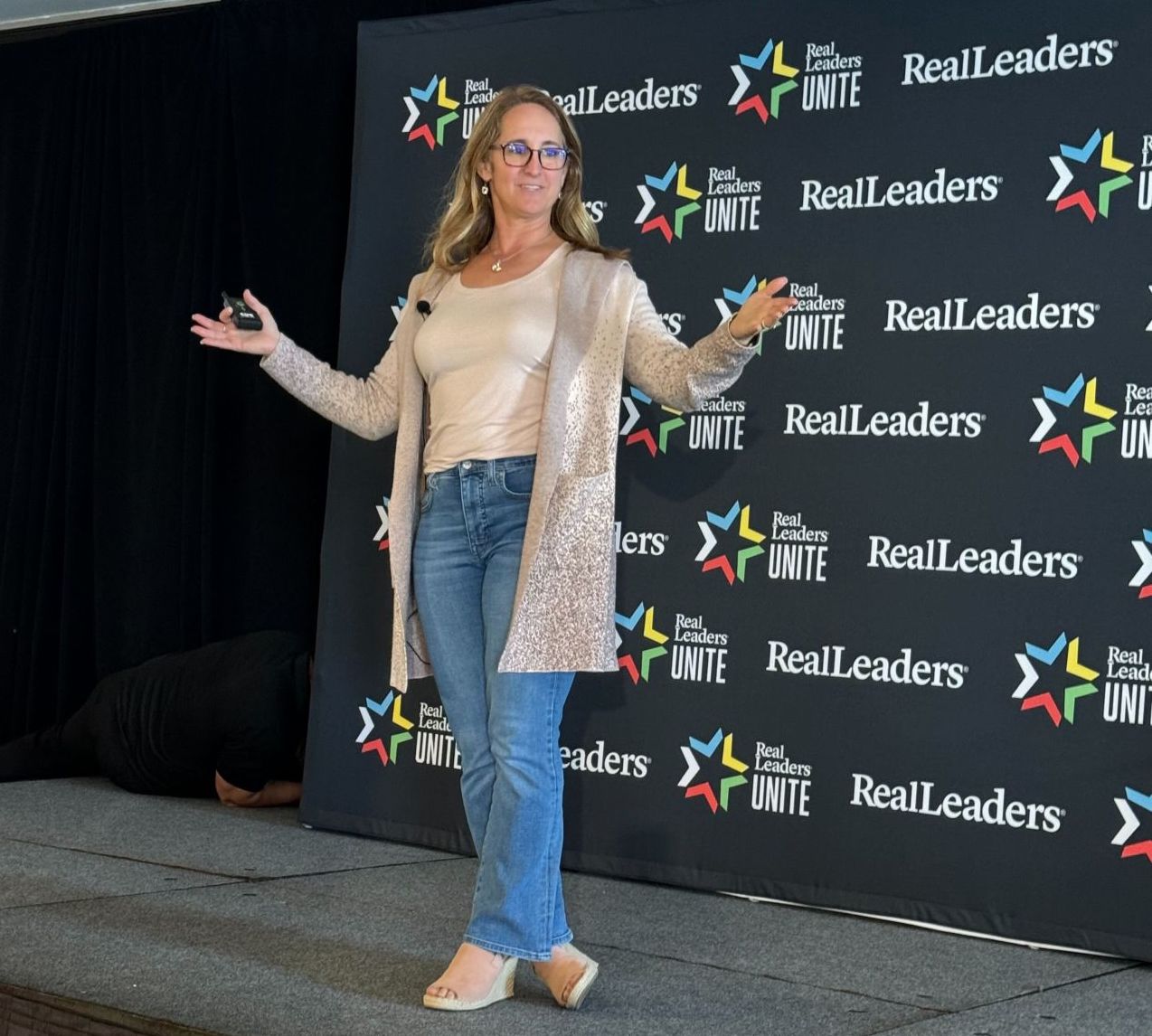
As Edwards wrapped up his opening remarks, he introduced a new speaker to the stage. An author of multiple books, most recently, The Profiteers: How Business Privatizes Profits and Socializes Costs, Chris Marquis was greeted and given the spotlight. Marquis is the Sinyi professor of Chinese management at the University of Cambridge Judge Business School. Maqruis’ keynote address spoke to the need to embody a collective dedication to catalyzing change, fostering collaboration, and reshaping paradigms to usher in a more equitable and sustainable future. As the wrapped audience came to a thundering applause at the end of Marquis’ speech, Edwards came back on stage to direct everyone to the main course for the evening, forming the group forums.

Forums For All

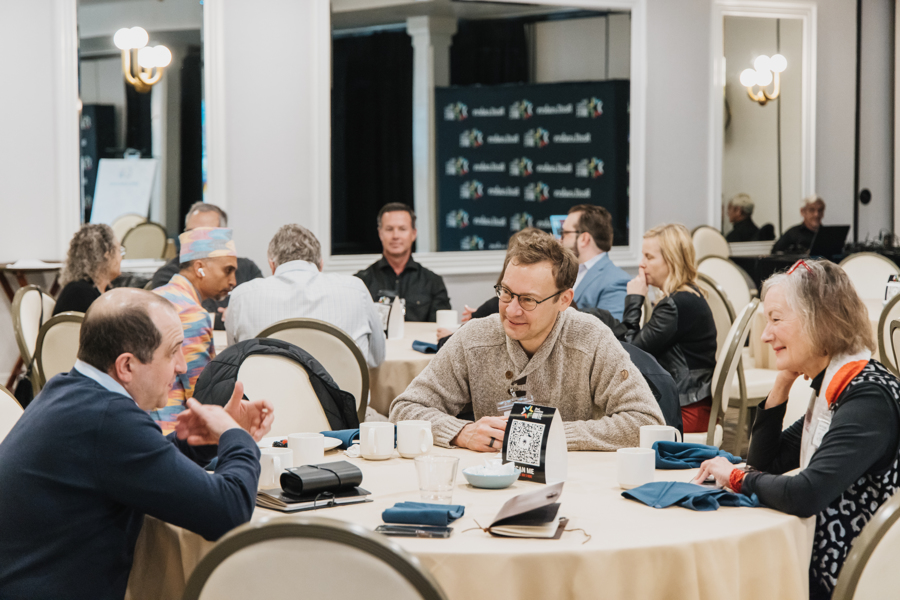
This is where the magic really happened. People went in as acquaintances and came out as allies. Adlai Stevenson I said, “The first principle of a free society is an untrammeled flow of words in an open forum.” Although not a society, the beginnings of a real sense of community were beginning to form. The power of confidential forum is difficult to understand until you experience it, but in it’s simplest sense, it is a truly open and free setting to discuss business, life, and the unique role of being an impact CEO in a confidential, intimate setting.

Mapping The Impact Universe

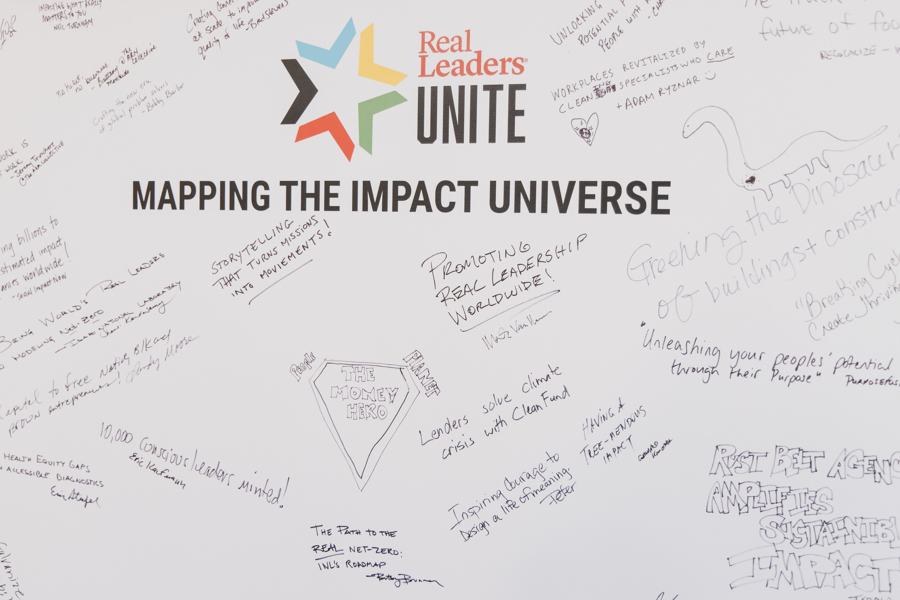
With forums wrapping up, these leaders made their way back to the main stage where Marquis’ words of transformative change were still fresh in their minds. A new face was on stage, someone who a few of these people had known as a member of their forum for the past year. Mike Brown, previously the CEO of Impact Grove and member of the Real Leaders community, recently decided to take his impact to the next level by joining Real Leaders as Chief Impact Officer. His easy smile and confident demeanor were still the same, but many noticed that Brown had an even deeper sense of meaning in his life. He spoke about this on the stage, acknowledging that this transition was something he took on because he knew that, as a part of Real Leaders, he could make an even greater impact than he could as a founder. He went on to explain that it was his goal to create an impact in each and every business that was present that night and that he wanted to start by mapping the impact universe. He held up a large poster board and asked every person there to put a quote on the board, a headline that might one day make its way to Real Leaders magazine. As you can see below, people were pretty excited to put their name on the map.

Day 1 was coming to a close, and people were still buzzing. Conversations continued long after the speeches were over. People just needed to talk about what they had experienced and explain how it was going to influence their business. Yet, UNITE was far from over. Everyone knew that Day 2 was going to be a big one and so, one by one, they made their way to their rooms to rest and prepare for another big day of impact.

Add Yourself to the Short List

Thank you for taking the time to read about Day 1 of UNITE. Please consider sharing it with one leader whom you think deserves to be at UNITE 2025. If you would like to be added to the short list to receive first dibs at pre-sale pricing, please add your email below. Thank you again to all of the people who made this community thrive at UNITE 2024. We can’t wait to deliver another incredible experience in 2025.


0