Businesses Fighting for Justice – this Nonprofit Shows How

When employers and investors speak up, lawmakers pay attention. The Responsible Business Initiative for Justice (RBIJ) was founded in 2017, and the award-winning nonprofit has partnered with hundreds of companies across the world to advance fairness and quality in systems of punishment and incarceration.

By engaging businesses to use their voices, resources, and working practices, the organization has worked to change criminal justice narratives, support legislation, and create real opportunities for deserving individuals. 

Founder and CEO Celia Ouellette (pictured above with Richard Branson) spent a decade practicing as a defense attorney, primarily on capital cases across the United States. As a lawyer, she found herself constantly fighting a criminal justice system that was cruel, expensive, racist, and broken. Despite working to save people from execution, she could only help individuals one at a time. “It’s not enough to pull people from the river one by one,” she often reminds conference audiences. “We have to go upstream and change the system — so they don’t fall in the river in the first place.” 

When it came to delivering systemic change, Ouellette recognized that businesses could make a difference. No constituency is as important to lawmakers, and it was clear that business support would be decisive in driving policy campaigns over the line. So RBIJ was set up to rally and strategically deploy that support. 

Across the United States, there is an established and growing need for companies to speak out. Six in ten Americans feel that it’s no longer acceptable for companies to remain silent on social issues. The same number says they will reward businesses that actively address these issues. The past two years have been a reckoning for the American justice system, and its flaws are now recognized as some of the most glaring social problems facing the United States today. 

An excellent example is Business Leaders Against the Death Penalty, which RBIJ launched at the South by Southwest Festival in 2021. Spearheaded by Virgin Group founder Sir Richard Branson, the campaign brought together more than 250 international business leaders to back an end to capital punishment around the globe. Supporters include Meta COO Sheryl Sandberg, Salesforce CEO Marc Benioff, Unilever CEO Alan Jope, and author and entrepreneur Arianna Huffington. Their support has already been deployed in campaigns from Utah to Singapore through op-eds, interviews, joint statements, and private advocacy. In addition, the campaign has been covered by over 250 media outlets in more than 10 countries. By amplifying business support for change, we have helped shift narratives around criminal justice issues and given campaigners invaluable ammunition for advancing reform. 

We’ve also convinced businesses that criminal justice reform isn’t just a moral or a reputational imperative for companies – it’s an economic one. Take The Clean Slate Initiative as another example; it closes certain types of criminal records after a specific time. The group’s motto is: A criminal record shouldn’t be a life sentence to poverty. The United States loses more than $80 billion each year from the underemployment of people with criminal records. One in three American adults now has a record and faces substantial and often wholly unnecessary work, education, and housing barriers. Removing these restrictions for deserving individuals who have done their time will automatically allow employers access to a vast, diverse, underutilized talent pool. With over 11 million vacant jobs to fill in the Great Resignation, it’s a strategy that could benefit businesses greatly. 

This demonstrates another critical aspect of criminal justice reform — marshaling key business voices to support specific local policy campaigns. Last year, for example, RBIJ brought together companies to help end juvenile life-without-parole sentencing in Ohio. It was an essential step forward; no other country sentences children to die in prison. We worked closely with state campaign partners on the ground to end this cruel practice. 

We also work with employers to create change within their operations, most notably through hiring. In March 2022, again at South by Southwest, we launched Unlock Potential with the support of the Walmart.org Center for Racial Equity. The program is a groundbreaking intentional employment initiative to keep young people away from encounters with the justice system. By providing meaningful, long-term career opportunities for individuals aged 16 to 24 (who are most at risk), Unlock Potential aims to break cycles of poverty and incarceration while at the same time advancing economic mobility and racial equity.

Our work at RBIJ has never been more critical. While the United States makes up just 4% of the global population, it accounts for 21% of its prisoners. The country’s justice system is rightly decried as inefficient, wasteful, cruel, and racist. Internationally, lack of access to stable and accountable justice systems remains “a great threat to sustainable development,” according to the United Nations. There is an existential need for corporations to “walk their talk” on issues like systemic racism and embrace their responsibility as a force for good. We work with them to do precisely that. 
How to Fix Your Business Intelligence Blindspot

Most leaders know it’s a problem, but few have found a solution.

Ever since the Iceberg of Ignorance floated into our collective consciousness back in the late 1980s, leaders who were paying attention became increasingly aware of a dangerous disconnect between the information known by the people in their organizations and the information that made it to them. 

The famous Iceberg of Ignorance study, produced by Sidney Yoshida, posited that frontline workers were aware of 100% of the floor problems an organization faces, supervisors were aware of only 74%, middle managers 9%, and senior executives were aware of only 4%.

Since 1989, this information flow has gotten worse, not better. The sheer amount of information now being collected is mind-spinning. 

The scale and speed of digital transformation (DX) has left no industry unturned. According to Statista, in 2022, spending on DX is projected to reach $1.8 trillion. By 2025, it’s forecast to reach $2.8 trillion. This mass shift toward the digitization of every kind of business, from manufacturing to mango production, has led to a tsunami of data. We’ve become collectively fixated on building and deploying artificial intelligence to track and analyze every data point on which we can get our digital hands. Every mouse click, written word, and action taken by a person or machine is logged. The goal? To tap this data treasure trove and run smarter businesses, cut waste, preempt breakages, increase output, refine processes, build better relationships with our customers, and master all manner of other operational aspirations.

But while we’ve insatiably invested in artificial intelligence to analyze every data point, what we’ve blindly disregarded is arguably our most valuable one: our people. Our human intelligence — those on our organizational frontlines — understands problems and solutions not through complex analysis but by earned personal experience. We need to get better at asking our people what they think.

Listening Differently

One of the most effective, successive waves of business transformation should be about finding ways to tap the intelligence of our people, building channels for human information to flow unencumbered from bottom to top and side to side.

Here are a couple of practical applications and ways leaders can drive positive business outcomes by leaning on team intelligence over the artificial kind. I’ll start with one I use myself. 

Strategic Alignment. In my current position, I have built an annual strategy process based on a series of company-wide conversations to strengthen our cultural and strategic alignment. Over a year, we run a strategy-informing conversation, tapping into the collective intelligence of our remote workforce by asking what single important thing we should consider when building our strategic plan. Then, using the insight gathered to help inform decisions, the senior leadership creates the annual strategy. When it’s launched, we ensure that it is well understood and potential hurdles identified through a second company-wide conversation. Halfway through the year, we involve the entire company in a third conversation about our plan to see where we are being successful and where we are falling short. The results? An annual strategic plan that has the insights of those at the frontline baked directly into the heart of it, and, as a result, has buy-in from all corners of the organization. This, augmented with data points that we capture through other channels, has significantly reduced our risk of blindspots. 

New Leadership Integration. The Harvard Business Review estimates that between one-third and one-half of all new chief executives fail in their first 18 months. Succession is a complicated business. Even when robust leadership onboarding programs are in place, these tend to focus on relaying corporate and operational dynamics, providing detail on ongoing projects and financial projections, etc. They don’t attempt to recognize the myriad of more complex political, personal, and cultural dynamics that exist within a company by way of its people. These are far more likely to impede the progress of a new leader — at best being a distraction, at worst being destructive.

Going directly to a new team as part of the onboarding process and allowing them to share honest opinions, questions, and concerns anonymously, an incoming leader can immediately understand the field they’re stepping on to. The honest feedback received from a process like this might not be all sunshine and rainbows, but understanding where real problems lie and how to address them will better ensure a new leader can be confident that they’re informed as they take over the reins. Following that pre-boarding conversation, I would recommend tapping into the collective intelligence as part of the traditional 30-60-90-day plan and making sure that a leader communicates any actions that have been taken because of the insights they were provided with. 

Going directly to the people in an organization before taking over and asking for their opinions will  allay fears, build early team trust, and lead to far more healthy working relationships. With their opinions and concerns aired and addressed, team members are far more likely to adapt, abandon old habits and behaviors, and get behind a leader who has demonstrated genuine curiosity and empathy as they transition the company.

Valuing Intelligence. Accurate business intelligence shouldn’t always be defined by the amount of data we can collect, but by the value it can deliver. By electing to tap the human intelligence present at every touchpoint of our organizations, we might just find that the person closest to the problem is the one with the best solution.

Leveraging the Power of Uncertainty to Build Long-term Resilience

“Nothing is either good or bad, but thinking makes it so.”  —   William Shakespeare, Hamlet 

One of the biggest lessons I had to learn as a leader was the value of redundancy. For your people to know what you want, you’re gonna have to keep saying it over and over again. Every time I sent a memo or gave a speech, I was worried that my employees would roll their eyes and say, “Here he goes again.” I thought, “No one wants to listen to a broken record.” I was more concerned with being interesting. 

So what I did was constantly refresh and renew my message. Without my realizing it, what happened was that my desire to be interesting was getting in the way of me being clear. Clarity is what we’re after. That’s what redundant messaging gives us. It gives us the ability to be clear. Once you find out who you are, you have to make sure that everyone who crosses the doorway of your business knows who you are. They shouldn’t have to guess. They’re not mind readers. Redundancy is the key to your mindset. How many of you know for certain that if you wake up in the middle of the night, the hamster of your thoughts will jump on the wheel of your mind and whirl from worry to anxiety to panic as you run disaster scenarios through your head? We run through all the bad things that have happened in our past, and when we’re not doing that, we’re thinking of all the bad things that might happen in the future. It’s our personal version of “doom scrolling.” 

For many of us on our resilience journeys, our misfortunes become like landmarks we visit on the cross-country journey that is our lives. When I was a kid, our family would take a yearly trip through New England, stopping in places like Hyannis, Bethel, and Stockbridge. Thanks to my mother’s gift for being a travel agent, we stayed in beautiful places and created lifelong memories. We forgot about the endless hours in a hot and crowded car. 

And later, as we all got older and we told the story of those same trips, even when we blew out an alternator or something that left us stranded on the side of the road for hours in the middle of the night, we laughed about it. After all, we made it through. We were forged a bit in those moments of trouble together. 

Those are the stories we tell because they make us who we are. It’s the things you never planned for, the times when things went wrong, and the ways in which the trip was just one darn thing after another. The darn things. Those are what we remember and mostly laugh at years later. The darn things don’t appear on Trip Advisor or Kayak. 

But as I get older, I realize that my entire life is a collection of memories that include some darn things despite my best intentions to the contrary. We’re all striving to do good in the world, to be our best in our professional lives and our personal lives. We have plans on top of plans, all created in good faith. Sometimes those plans go to hell in a flaming handcart. 

Many of you have lost your business, your job, or a loved one to the pandemic. The business you planned to give to your children. The job you expected to retire from. The partner you were going to grow old with. There’s no way to assuage the grief of that loss. All the books in all the libraries of the world will not make it different because the painful and unavoidable truth is that it will never be different. It will never be the way you thought it was going to be. 

Our work is about finding your way out of the darkness of darn things and into the light. Out of the valley and back up to the heights. To not just survive the darn things that happen around you, but to alchemize them into the stuff of real growth. The key to mental resilience is realizing that all we can control in life is how we respond to events. We have that choice. We have that power. Mentally we can stop worry and anxiety dead in their tracks. 

Change is guaranteed. How we respond to change is not. That is our task. There’s a quote from renowned acting teacher Sanford Meisner that goes like this: “That which hinders your task is your task.” 

You’re obsessed with something you want, but there’s an obstacle in your way. It’s that thing between you and what you want; that is what you really need. The thing that’s stopping you from accomplishing the things you desire? That’s your genuine desire. You think what you can’t control or don’t know keeps you from performing at your best. You think, “Once everything settles down, then I’ll be better.” 

But that’s not how it works. All over the world, in every culture, those leveraging uncertainty are the people and businesses who don’t resist change when it happens. They develop new relationships. They ride the new situations instead of panicking. You don’t fight the current; you ride the current. Surfers don’t mourn a wave they miss or even when they wipe out (which is often). They just get on the next one. 

You can do this by taking the courageous decision to throw out the old mental maps and make new ones. Mental resilience isn’t a life free from the twin wolves of worry and anxiety. It’s about harnessing our energy in creative ways so we can domesticate them and let them pull our sled. We make friends with change, so we don’t have to worry about it.

The Climate Spiral and the Power of Sharing Creative Ideas

Effectively communicating climate change is an enormous challenge, especially as there is a need to reach broad audiences across the planet.

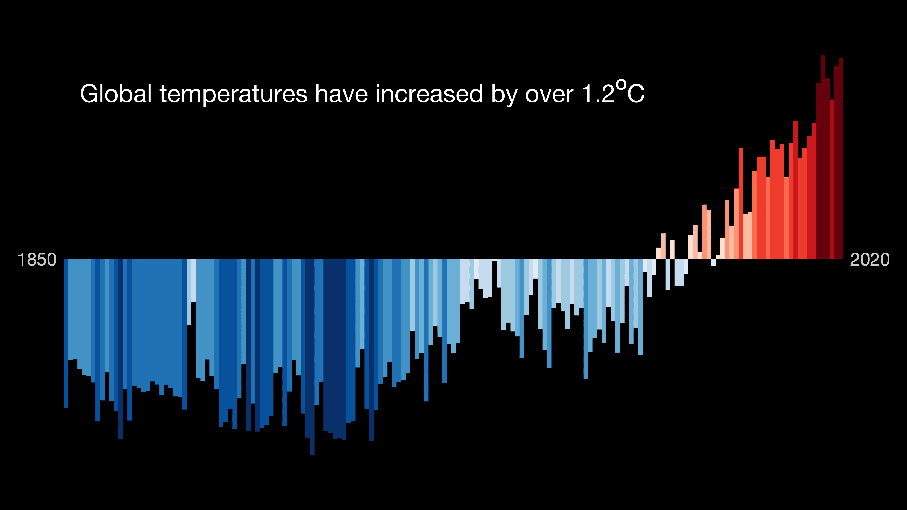
In 2016, an animated spiral graphic showing the familiar rise of global temperatures in an unfamiliar way was published on Twitter and subsequently went viral. The original tweet has been viewed more than 3.7 million times, but the reach is substantially larger when considering other media channels. For example, the animation was viewed several million times on various Facebook pages and through many online stories. Prominent people known to have used or shared the graphic include Elon Musk, Bernie Sanders, the artist Banksy, and senior policymakers in the United Kingdom and Australia. It was even shortlisted for a design award and translated into several different languages by the U.S. Department of State for its online web pages.

The most high-profile appearance of the visualization was during the opening ceremony of the 2016 Rio Olympics, which included a section about climate change — probably the most-watched broadcast about the climate ever. The animated climate spiral emphasized how global temperatures have already increased and was viewed by more than a billion people, many of whom may not have been previously exposed to climate science so directly. In addition, the story highlights the power of creativity, social media, open data, sharing of ideas, and collaboration between scientists who never met in person until two years later.

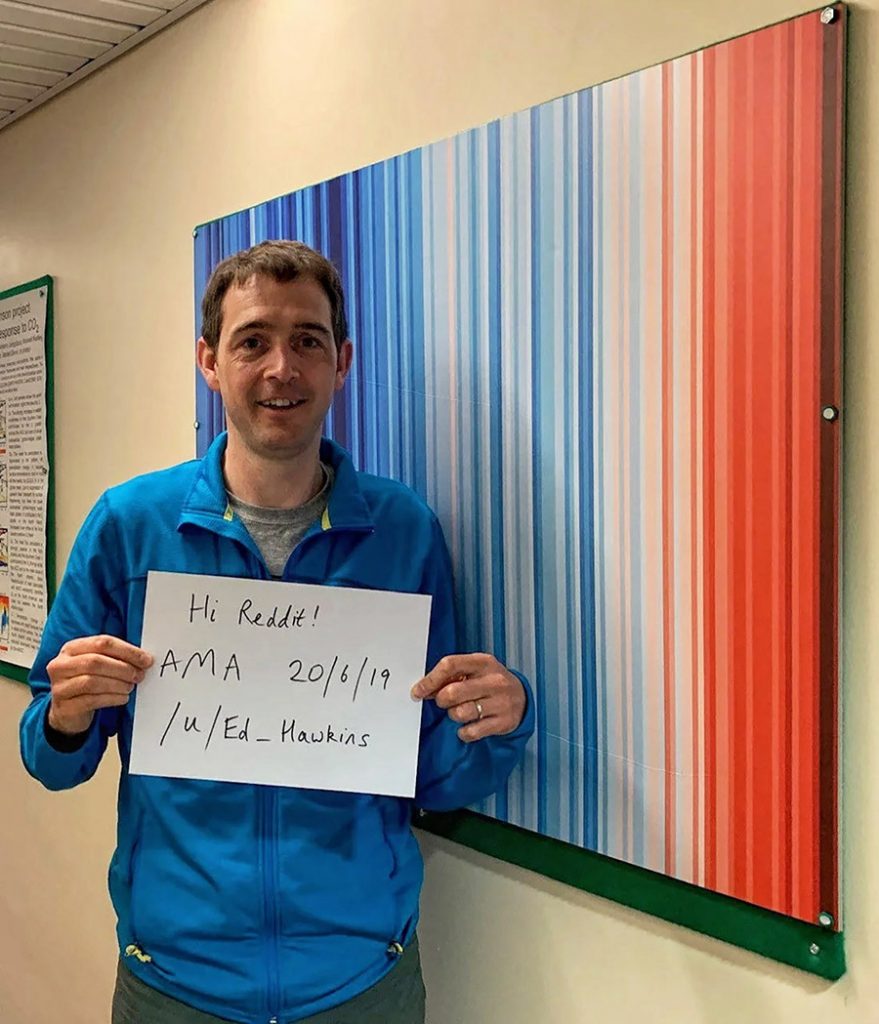
The original idea for creating a spiral graphic came when Jan Fuglestvedt showed Taren Faehn some earlier graphics produced by Ed Hawkins, which had used stacked horizontal lines to represent global temperatures from January to December each year since 1850. Hawkins suggested that connecting December to the following January to create a spiral would show the evolution of temperatures in a more dynamic way. Fuglestvedt thought this was a great idea and sent an email to Hawkins, whom he had never met, including the phrase “this is just a (crazy) thought.” Hawkins found this hard to ignore and further developed the idea and produced the graphic.

Effective communication about how and why our climate is changing is challenging. The primary culprit — carbon dioxide — is invisible, and the worst effects can appear remote in both space and time. As climate researchers, we have access to bewildering amounts of data, but how do we best distill this complex information to make the risks of climate change easily understandable to the public? Susanne C. Moser, a senior research fellow at the Aspen Global Change Institute, has highlighted the important role of the messenger, imagery, emotion, consistent messaging, and keeping the audience’s attention.

In hindsight, many of the design and communication aspects of the spiral resonate with the factors emphasized by Moser. First, the choice to use temperature — a variable that the public is very familiar with — makes it feel instantly relevant and understandable. In addition, the graphic was produced by scientists, who tend to be trusted messengers. Notably, the visualization does not look like a traditional boring scientific graph or require any complex interpretation; it is intuitive and eye-catching. Our impression is that the similarity with a clock — something that is usually regular and predictable but that gradually changes to be irregular — is compelling imagery for communicating the temperature changes.

The animated nature of the graphic is fundamental: It tells a story to the viewer about how temperatures are changing. The animation is not too long, ensuring attention is maintained, and as the temperatures rise substantially, it influences emotions by providing a visual surprise at the end. Many viewers reported watching the animation over and over again for these reasons.

The year counter was placed in the center of the graphic to ensure visibility, and the colors were chosen to aid interpretation and add to the message. The internationally adopted temperature limits are shown in red, which emotionally signifies “danger.” The spiral starts using dark blue and ends with yellow to emphasize that we have not yet reached dangerous levels. Although it may be tempting to use the analogy that temperatures are “spiraling out of control,” as some media stories did, an alternative (and more positive) message is that decision-makers and society can still take control and choose to avoid danger.

But even well-designed and compelling visualizations may not be widely seen or shared. Social media provides a new way of enabling many-to-many communication and is an effective tool for raising the profile of climate science. In particular, Twitter is now actively used by several thousand climate scientists to discuss, engage, collaborate, and communicate, thus raising their profile among peers and the public. Importantly, such online platforms allow a story to be consumed within the social media bubble rather than requiring a journey to another website and provide a relatively easy way of presenting information that can be subsequently amplified by journalists, the media, and highly popular social media accounts.

These factors facilitated the spiral’s spread to over a billion people. In addition, the timing of the publication was favorable, though perhaps fortuitous. It came a few months after the 1.5°C target had been adopted as part of the Paris Agreement and during a significant El Niño event that pushed global temperatures slightly higher in 2016.

We believe that the reason why the spiral went viral is the combination of a creative idea, collaboration, design, timing, and, importantly, openness and possibility for sharing on social media, both within and beyond the research community. This has facilitated the diffusion of the spiral in various forms, and its message is communicated at various forums and to diverse stakeholders. The spiral has stimulated collaborations, and its success has helped inspire other climate scientists to produce a range of visualizations of climatic changes, which have also been widely shared. These are all examples of how unrestricted sharing of data and creative ideas are beneficial. We are delighted that our small contribution has led to a spiraling of creativity, and we encourage others to experiment and continue sharing ideas.

Does Your Business Matter? And Can It Matter More?

This is the second of a 4-part series exploring businesses that matter. Read series one here

Business is sacred.

I recognize that’s not a widely-held view as most employees of most businesses, unfortunately,
don’t experience their work this way. But if one allows sacredness into the conversation about
business, different possibilities start opening up.

And so, the provocation of whether your business matters – or can matter more. At the outset, the nature of what ‘matters’ is entirely neutral. One business that I know of figured out that what mattered to them was to be a launching pad for young, ambitious people in the advertising industry. In their case, they put their efforts into providing a dynamic growth experience for their people that lasted about 3-4 years, after which they were comfortable letting these well-developed professionals make their mark in ad agencies elsewhere.

Costo, an entirely different illustration of what matters, believes in community engagement and
fostering symbiotic relationships with the suburbs surrounding their stores. Southwest Airlines believes in understated, selfless effort as a way of serving their customers and maintaining low running expenses.

These three businesses couldn’t be more different, but the net effect is the same: their people have a singular rallying cry around which to rotate their collective efforts. Something that is known, and which matters to everyone in the business. Once employees have something to lock onto that is authentic, well-considered, and meaningful; generally, they will. It’s the human condition to want to be part of something and to feel energized about an idea. And once they do, it releases a groundswell of energy, generosity, and commitment that underpins their choice to devote their discretionary effort to the business they’re a part of.

What’s more, ‘mattering’ is strategically enabling. It’s not about saving the world or doing good. That nuance is extremely important in that business, as an institution, is oriented toward high performance and excellence. The ‘gift’ of business to the world is to set high bars, to move fast, to innovate ingeniously, and to create value. Never must those values be lost in the search for what matters to a business. Performance and ‘mattering’ are part of the same idea. So, how does a business unearth that matter to it?

It’s obviously a highly personal journey, but these pointers might be helpful

  • A particular form of ambition sits at the core of this journey – not only to grow
    bigger and to succeed but to be more significant. This needs to be activated as a
    catalyzer of this journey: a question; a gathering; and an exploration.
  • What matters doesn’t need to be overly profound – it just needs to be energizing
    and compelling.
  • What could matter to a business is likely already there but in an un-named and
    un-formed state. It’s an unearthing, rather than a seeking out.
  • Early adopters will reveal themselves. Engage these people and include them in the
    exploration.
  • Locate the strategic importance of mattering: How will employees benefit? How will
    customers benefit? How could your product/service become enhanced due to
    mattering more as a business? How could your brand be enlivened by mattering
    more?

    This is a very particular worldview to link sacredness to business, and it might sound foreign to many readers. This is the essence of the Hero’s Journey: to seek out something greater and more profound and to be able to walk the whole journey in service of this goal, including the defeats that generally accompany the victories. Without this mindset, ‘mattering’ will be a struggle as there’s simply not enough energy and excitement to power the journey. For business people of today, this is the essential question: do you see your life’s efforts as being something that matters? Or are you satisfied with the mundane?

Coming in Series 3: “Sculpting a Business That Matters.” We will explore how businesses that matter
operate and what rituals and customs are practiced within such organizations.

How to Use Engagement as a Driver of Collaboration

Many leaders think about engaging their colleagues. Thinking is good, but thoughts need to result in specific actions.

Our most effective leaders embody the specific leadership behaviors that result in the engagement of colleagues. These leaders develop, recognize, inspire, value, engage, respect, and supervise their colleagues. And in doing so, they nurture an environment that heightens well-being and increases work performance. They increase each colleague’s commitment and passion for their work. What follows is a description of specific behaviors to amplify leadership effectiveness — the drivers of engagement: develop, recognize, inform, value, engage, respect, and supervise.

I coach many leaders who believe that their colleagues — their direct reports — should “just know what to do” and that they, the leader, should not have to guide them. These leaders are often hard-driving, task-oriented, and self-sufficient individuals who climbed the leadership ladder based on brute grit and an ability to independently get things done. They think others should simply do the same. These leaders say they don’t have the time to develop their colleagues. There is too much work to be done. Their direct reports need to keep up and predict what they, the leader, want. Otherwise, the leader will re-assign the task to someone else or simply do it themselves. The downfall of these leaders arises, predictably enough, when their high-pressure, hands-off, finger-pointing approach leaves behind a wake of disenfranchised and burned-out colleagues who feel stifled and alone. The leader’s colleagues want to understand what is being asked of them, and they want to be effective, but their leader’s demands are vague.

I also coach leaders who smother their colleagues with advice and mentorship. They are the “helicopter leaders” who hover over each colleague’s every move. With their hyper-present coddling, they recommend each step and provide guidance through each obstacle. These leaders stifle the personal growth of colleagues. And when they move on — retiring, relocating, or leaving the organization — their colleagues are left ill-prepared without their guide. Their colleagues haven’t learned to navigate the complex work environment alone. Here are some leadership tactics you can use.

Schedule regular one-to-one conversations. Meet one-to-one with your colleagues to identify areas in which they would like to achieve professional growth. Gain an understanding of how your colleagues see their role evolving within the organization. Discuss each colleague’s progress with goals and their behaviors and help them reflect on the obstacles they encounter. Address each colleague’s experience and opportunities for development in real-time, while their behaviors are top of mind and relevant, rather than as a distant and out-of-touch review of what happened months prior.

Track your interactions with colleagues. Keep track of your interactions with colleagues. Take brief notes on points of discussion and create triggers or reminders for when to next reach out. I use a tablet and a stylus to take electronic notes during conversations with colleagues. Each note resides in the electronic folder that I set up for each colleague. I can access these notes from my mobile phone, tablet, or computer. Before I meet with a colleague, I glance through my notes to catch up. This helps me remember the milestones, relationships, achievements, and aspirations of colleagues. It keeps me from repeatedly asking questions like, “Tell me again, what you were working on?” or “How many kids do you have?”

Promote group learning. Bring forward articles, books, and tutorials to share with colleagues. Nurture an environment in which colleagues learn from each other. Physicians frequently use case reviews, journal clubs, and situational simulation to learn how to best apply new information and skills. During case reviews, we discuss interesting patient care scenarios in which things went right, went wrong, or an interesting question arose. During journal clubs, we read articles and books and then discuss our perspectives. During simulations, we replicate challenging scenarios and role-play how we would respond to situations as they unfold. Many healthcare organizations create simulation centers, where they employ actors, create 3D models of the environment, and use other technologies to make the simulation experience as real as possible.

How I Aligned Personal Values with my Staff and my Competitors for Greater Success

For many years, I had been searching for feedback and insight from a group of impact leaders.

Other CEO support groups I had joined had a completely different set of motivations and perspectives on leadership and success. Being an impact leader comes with its own unique set of challenges. It’s hard to manage a company with both profit and purpose embedded at its center because there’s a natural friction between them, almost by design.

One of the highlights within my Real Leaders Impact Collaborative group has been the discussion around culture and people. Many of my peers have young, mission-driven staff that desire better, flourishing communities and a healthier planet. Likewise, as a CEO, these priorities are things I aspire toward too. It’s one thing to advertise that you’re a B Corporation and are mission-driven, but the big challenge is always how to balance that with your business priorities. Collaborating with CEOs who find themselves in the same situation can help unlock solutions that may otherwise seem impossible. These suggestions don’t always offer an instant fix but sometimes show a path toward a future solution that you can begin working on now.

One example is a recent discussion we had on financing and capital and voting with your dollars to create positive social change. In theory, this idea is a no-brainer, but in practice, it’s tough.

I had come away from a staff meeting the week before where I’d expressed my dissatisfaction that our company 401ks might be better positioned in support of social impact investing opportunities and, in so doing, become better aligned with our company and staff values. Up to that point, our 401k policies had been done through a single company, with a very generic approach that recommended only one fund for us. By seeking social impact-aligned 401k funds, we furthered our mission as an impact company, but more importantly, we had the opportunity to educate our staff about the social power of their dollars.

The word “collaboration” was used freely many years ago to signal a new way of doing business, where like-minded companies and individuals would combine forces to magnify their social impact. It was a new idea that broke previous business rules focused solely on competition. There’s a risk that as collaboration becomes the norm, competition between impact companies again becomes the dominant factor in a crowded market of those vying for social impact consumer spending. There will always be some level of healthy competition between similar brands, but what I see at every event I attend is a sea of nodding heads when the speaker on stage talks about the importance and opportunities of embedding social impact in your business. This tells me that a common, unifying idea has the potential to create more cooperation and joint agendas rather than competition. People are ready to listen and entertain ideas like never before. We should find strength in that because working together can help open up the emerging social impact market to new opportunities for all of us.

Why Did Adidas Wait So Long to Drop Kanye West?

“Adidas does not tolerate antisemitism and any other sort of hate speech… the company has taken the decision to terminate the partnership with Ye immediately,” according to its October 25 news release.

That statement conveys a principled and admirable stance against the antisemitism shown by the rapper formerly known as Kanye West after his antisemitic tweet on October 10 that he would go “death con 3 on JEWISH PEOPLE.” 

Yet Adidas waited much, much longer than other companies that cut ties with Ye. Even Ye’s own talent agency dropped him before Adidas. In fact, Adidas delayed so long that Ye taunted them on his October 16 appearance on the Drink Champs podcast, saying “I can say antisemitic things, and Adidas can’t drop me. Now what? Now what?”

Adidas faced particular pressure to drop Ye due to its dark past. A German company founded by a former member of the Nazi party, Adidas had an especially strong reason to drop Ye earlier than other companies. Adidas faced mounting pressure from the Anti-Defamation League and other organizations to drop Ye given its Nazi past. A Change.org petition set up by the Campaign Against Antisemitism urging Adidas to sever ties with Ye had gathered 169,100 signatures by October 25.

Yet Adidas refused to drop Ye until all the other companies dropped him. Instead of getting ahead of the problem and dropping Ye immediately after his October 10 anti-semitic tweet, or even his October 16 taunting of Adidas, the company had to be shamed and pressured into cutting its ties with Ye. As a result, Adidas seriously damaged its brand, harming its reputation among anyone opposed to antisemitism. After all, it appeared Adidas dropped Ye due to the pressure, rather than Ye’s antisemitism and other bad behaviors.

What explains the poor decision-making by the Adidas leadership? It’s a classic case of the ostrich effect: a dangerous judgment error where our minds refuse to acknowledge negative information about reality. It’s named after the mythical notion that ostriches bury their heads in the sand at a sign of danger. The ostrich effect is a type of cognitive bias, one of many mental blindspots impact decision making in all life areas, ranging from the future of work to mental fitness

The Adidas leadership buried its head in the sand. It refused to acknowledge the growing damage to its brand from Ye’s antisemitism, as well as his prior bad behavior, such as having models wear “White Lives Matter” T-shirts in early October. 

Such denialism in professional settings happens more often than you might think. A four-year study of 286 organizations that had forced out their CEOs found that 23 percent were fired for denying reality, meaning refusing to recognize negative facts about their organization. Other research shows that professionals at all levels suffer from the tendency to deny uncomfortable facts.

Adidas’ denialism likely stems from the cognitive bias known as the sunk costs fallacy. According to Adidas’ statement, the termination of the contract is expected to “have a short-term negative impact of up to €250 million on the company’s net income in 2022 given the high seasonality of the fourth quarter.” Presumably, the impact will be much higher in 2023, over half a billion at least. 

The partnership with Ye had a long history since 2013, when the company signed his brand away from rival Nike. In 2016, Adidas further expanded its relationship with the rapper, calling it “the most significant partnership ever created between a non-athlete and an athletic brand.”

In other words, Adidas invested a great deal of money and reputation into its relationship with Ye. That kind of investment causes our minds to feel strongly attached to whatever we put those resources into, and throw good money after bad. 

You’ll see this happen often in major projects that are working out poorly, such as Meta’s Metaverse project. Several high-profile industry figures recently criticized Mark Zuckerberg’s efforts. That includes Palmer Luckey, the founder of VR headset startup Oculus, which Meta acquired in 2014 for $2 billion. Luckey said “I don’t think it’s a good product” about Horizon Worlds, Meta’s core metaverse product. He called it a “project car,” a fancy automobile that the owner spends a lot of money on as a hobby. So far, Facebook’s shift to building the metaverse has been costly, with the company last year losing $10 billion on it, and Wall Street analysts expect it to lose more than $10 billion again this year.

Similarly, you’ll see sunken costs in major relationships. That can range from marriages that lasted much longer than they should have to brand partnerships like the one between Adidas and Ye.

The final cognitive bias relevant here is called hyperbolic discounting. This term describes our brain’s focus on short-term, highly visible outcomes over much more important and less visible long-term ones. Adidas didn’t want to take the short-term financial hit to its bottom line from cutting ties with Ye. However, Adidas failed to give sufficient weight to the long-term damage to its brand from failing to do so. 

Short-term financial damage is highly visible and painful, while the long-term brand damage is much less visible and less painful. Yet realistically, such brand damage is much more important to the long-term success of Adidas.

In my consulting, I’ve seen many executives struggling with the same three mental blindspots when they face top performers engaging in bad behaviors, ranging from incivility to sexual harassment and discrimination. Leaders deny it happened because they have so much invested in the top performer, whether a star salesperson or top data scientist, and they don’t consider the long-term consequences to the organization’s culture and employee morale. 

In fact, it’s easy for anyone to fall for these three cognitive biases when someone whom you value behaves badly. Fortunately, forewarned is forearmed: knowing about these three mental blindspots means you can watch out for these problems in your own professional and personal life.

A Few Uncomfortable Questions Every CEO Should Ask Themselves

Before strategy, before innovation, before profitability, before talent management, before acquisitions, and before revenue growth, there are two questions a CEO answers (mostly implicitly, unfortunately — my hope is that this piece encourages you to answer them explicitly):

1. What is my ambition for my business?

2. How hard will I strive to achieve ‘optimal’?

These questions shape every choice a CEO makes. They determine what you want for yourself and what you want for your business — a trajectory of sorts. And once this trajectory has been established, your choices follow suit.

A mildly motivated CEO will produce a middling strategy. A highly motivated CEO will produce a remarkable talent plan. A CEO of low motivation won’t care about innovation and the journey to producing a stand-out product or service.

Most CEOs I work with initially are fairly flat regarding these choices, until they become awake to the possibilities in front of them. Once this awakening takes place, the CEO role looks different — more compelling, more interesting, more alive, more enticing — and  true, sustainable business performance follows shortly thereafter.

Observing CEOs undergo this transformation is a beautiful thing for me — a privilege that never loses its luster and which deeply sustains my work and the energy I have for what I do. It’s a change in course that brings about a wide array of changes in their lives: more energy, more optimism, more curiosity, more purpose, more creativity. Even the quality of their marriage seems to benefit, as one example of many unforeseen upsides. Health, too. Financial well-being, obviously. More inspired parenting.

Being a CEO is an opportunity to turbo-charge an entire existence — this is the extent of the opportunity. Check your ambition. Explore what’s possible. A better way likely awaits you.

Face Up to Your Truth

I’ve heard the phrase “… this year has been a lot harder than I expected …” from more than a few CEOs of late.

As such, it might be worth taking a few minutes to ask some sound questions at this point in 2022. Remember that your businesses are alive, evolving, fluid things. As much as we’d like to see them as walking a linear path that we, as CEOs, have full control over, that is not the case. So, as your business continues its (hopefully) merry way, consider these questions and see what emerges. They are not soft-ball questions, but rather ones that sometimes we might prefer to avoid. As ever, despite their sharpish nature, they are shared in the spirit of care, support, and enablement:

  • What did not play out as you expected it to, and where did your hypothesis go wrong?
  • What is the true, holistic health of your business right now?
  • What truth about your business, or about yourself, might you be avoiding?
  • What bias is in play that might be skewing your objectivity when it comes to big decisions?· 
  • What is your business calling on you to become as the CEO? (changes, growth, what to let go of, what to mitigate about yourself)

None of the above questions will likely have ready answers. And, in fact, one or two might not even be relevant right now. But at least one will have meat on its bones that warrants inquiry. I hope they are helpful.

Why I Buy Dirty Businesses and Clean Them Up

I am asked all the time, “what do you do?” to which my most authentic response is, “I buy dirty businesses and clean them up.”

This all started in the early 2000s when I bought a local same-day courier company, which forever changed how I do business. 

When I acquired Novex Delivery Solutions, the local same-day industry was full of contractors using old “beater” cars. The annual turnover of drivers averaged 40%. This was when the first hybrid vehicles were being produced, reducing pollution by 50%, and harmful particulate matter by 99%. With these vehicles becoming available, I had to find a way for our drivers to afford to upgrade their vehicles while continuing to make a profit for themselves and the company. And so began the quest to operate as a triple-bottom-line business.

“How” was the big question, and it demanded that we and our customers change how we do business. We even asked ourselves if we would be a green company that delivered packages or a courier company that didn’t pollute the air and lungs of the people in our community.

Fortunately, I was joined by an incredible team who, after learning about the effects of climate change, was enthusiastic about making a difference and having an impact — from sustainability strategies to culture, to define the purpose behind why our staff came to work. 

This work is both practical and aspirational. Of course, we had to help offset costs for our drivers so they could upgrade to hybrid vehicles. We solved this by selling full wrap advertising on the cars to like-minded and forward-thinking companies such as Vancity and passed the advertising revenue to the drivers. This achieved one known benefit, another hoped-for benefit, and one unanticipated benefit:

  1. Less pollution. This was known and led to benefits number two and three below. We were (and still are) the change. 
  1. Increased business! Doing good work and doing the right thing gave us the hoped-for advantage over our competition. More companies started deliberately choosing to work with Novex because we were focused on sustainability and positively impacting our shared community and environment. 
  1. Increased morale of our drivers. They were proud to be using hybrids and minimizing pollution. This resulted in significantly less turnover, and fewer costs in hiring and training, resulting in increased profit. Today we have less than 15% driver turnover, and the increased profit goes toward our environmental and social work. 

Of course, we had milestones to achieve, but we also discovered many unanticipated benefits of making these changes. Due to the combination of setting targets plus having a passionate team with the same vision and values of people, planet, and profit, we managed to keep hitting (if not surpassing) our milestones. 

I’ll take a moment to brag about the team and their achievements: 

  • 2004: Introduced 20 hybrids to our fleet of 100 vehicles
  • 2007: Novex became the first carbon-neutral courier company in North America and set a goal to reduce GHG emissions by 33% by 2020
  • 2009: Introduced the first 2 Smith electric trucks in Canada for delivery
  • 2013: Became B Corp Certified
  • 2017: First fully electric cars added to the fleet 
  • 2018: Novex joins the United Way Social Purpose Innovators program
  • 2020: Achieved 59% emission reduction, surpassing the goal of 33%
  • 2022: Announced the plan to become a zero-emission company by 2030
  • 2022: Launched a podcast called “CEOs & Self Driving Cars,” adding visibility and fun into the green space

The lesson and my takeaway from this experience are that as a triple-bottom-line company—this is just a proxy for better management. If you are ready to make the change, willing to get creative and buy-in from your team, then business can be the solution

0