How To Inspire Young Social Entrepreneurs

Besides a lot of creative energy, young people bring valuable skills to the table – particularly digital and social networking capabilities. This can be great boon to any growing enterprise. But only a small proportion of high school students around the world have access to entrepreneurship education, let alone education in social entrepreneurship. When young people finish school, they should be more aware of entrepreneurship as a career opportunity and they should know what steps to take if they want to start a business.

Private-public partnerships that provide for interaction between schools and the business community may be instrumental in closing the gap between a traditional academic curriculum and the skillset necessary to launch a successful start-up. Social Innovation Relay (SIR), a global initiative run by international educational organization Junior Achievement, challenges high school students to develop innovative business concepts that address social needs. Student teams from all over the world are paired with corporate volunteers from Hewlett Packard who act as mentors and help teams turn their concepts into viable business projects.

A jury selects the three best concepts – those that stand a real chance of becoming profitable ventures in their respective communities. In 2014 a group of four secondary school students from Kenya developed the winning concept, an affordable mosquito trap to reduce the incidence of malaria in the country. Such mentorship programs have a proven positive impact on participants and their motivation to start real social enterprises in the future.

According to Warwick University’s Centre for Education and Industry, which evaluated the impact of the Social Innovation Relay in 2013, 78 percent of participating students are now more confident of their ability to start a social enterprise, 86 percent are more aware of what social issues exist in their own community and 84 percent are more aware that social and business objectives can be complementary. At least ninety percent improved their communication, motivation, critical thinking and teamwork skills.

Drawing on the four-year experience of running the Social Innovation Relay, we have identified the most important factors that maximize the impact of this kind of initiative:

  • Draw young people’s attention to real problems in their communities, because these are things they know and care about. This motivates them to learn and apply their skills.
  • Ensure access to corporate mentors from large companies who are knowledgeable about business, management and marketing techniques necessary to get a social enterprise off the ground.
  • Maximize the wow factor for young people by using IT in interesting ways.
  • Most of young people participating in the program are social media and IT savvy, but they need more coaching to help them apply those social media skills to their business projects.

It is not enough just to help young people identify unmet needs in their communities and develop business plans. Access to funding is a crucial issue for all entrepreneurs, and an even greater issue for social entrepreneurs from developing countries. To address this problem, Junior Achievement partnered with the Singapore-based Pwee Foundation, which connects private investors and social entrepreneurs.

The Foundation is evaluating the best business ideas put forward by this year’s students to determine whether they will be able to attract investors and receive necessary funding. In the meantime, the shortlisted social innovation teams continue receiving mentorship and business coaching from the Pwee Foundation during the evaluation stage.

The working model of the SIR can be duplicated. The biggest challenges are scaling up the initiative and attracting more corporate volunteers to maximize its reach. These challenges can best be addressed by raising awareness of the positive impact of such programs on young people’s entrepreneurial potential, and their relatively low implementation costs. Programs such as SIR do not require educational system reforms or additional government spending.

Yet they are proven tools to spur social innovation among youth and equip them with a skillset that can help them make a difference in their communities.

Caroline Jenner is CEO of Junior Achievement – Young Enterprise Europe
The “Distant Here” And The “Future Now” Of The Climate Crisis

It has been a sobering month of news about climate change.  A few weeks ago the National Climate Assessment was released, which documented the increasing impacts of the changing climate across the U.S.  The take away of the Assessment report was climate change is happening now and it is affecting all Americans. Meanwhile, new research reported in Science Magazine this month indicated we have already committed the world to over three meters of sea level rise, as a result of the irreversible disintegration of the West Antarctic Ice sheet – and now there is nothing we can do to avoid this level of  rise in the sea. Together these stories are contributing to an ever clearer picture that the ‘here and now’ of the climate crisis is inextricably intertwined with the ‘distant and future.’

For many Americans increasingly focused on the hyper-local and hyper-now, these sorts of reports are difficult to process, and the risks of our changing climate are often imperceptible. Occasionally, a big climate-related event crashes down on American communities and acts as a temporary wake-up call to the risks posed by climate change. For example, nine years ago, Hurricane Katrina swept through New Orleans killing nearly 2,000 people and resulting in $81 billion of damage. Katrina shook the nation. Americans watched the devastation in disbelief as it seemed more reminiscent of the disasters that take place in the developing world, not in the United States of America.

Then came Superstorm Sandy, the wildfires and ‘biblical floods’ in Colorado, and the prolonged drought throughout the much of the nation. All of these events led to a temporary upsurge of interest in global warming by news media and the American public.

Do these moments provide opportunities to build a culture that looks beyond the hyper local and hyper now – to the distant here and the future now so critical for building a global society resilient to global environmental changes?

The immediate question that arises after mega-weather related disasters is: Are these extreme events the result of the changing climate? While scientists cannot say that any specific extreme weather event was caused by human-induced climate change,one thing we can say with certainty is that most of the devastation from both Katrina and Sandy was the direct result of human activities. Poorly planned coastal development exposed populations and economic assets to storm damage. Much of New Orleans sits several feet below sea level.

Despite an extensive levee system city officials knew that they faced considerable riskof flooding from coastal storm surge – it was not a question of if, it was a question of when. The same can be said about Sandy. New York had been given warnings of its vulnerabilities. William S. Nechamen, New York State’s floodplain chief, warned in 2006that New York could face “higher than necessary flood damages” if efforts were not made to upgrade the city’s flood maps. Yet despite Nechamen’s warning, FEMA decided to save money in New York City by digitizing old flood maps rather than updating the maps using the newest available science and technology. These decisions reflect the deep-rooted reluctance to think and plan beyond the here and now, and ultimately one of society’s biggest hurdles in addressing climate change.

Another huge hurdle that Americans need to overcome if we want out children to live in a society of peace and prosperity, is the recognition that community disaster risk management is no longer just a local issue; it has now become an issue of global security and economic stability. This is because local economies, ecologies and human health are now all connected by the continuous ebb and flow of goods and services as well as the ebbs and flows of the ‘bads and disservices.’

The shock of Hurricane Sandy was felt well beyond the US eastern shorelines as the resulting two day shutdown of the New York Stock Exchange had ripple effects across global economies. Similarly, the 2011 floods in Thailand and the 2013 typhoon in the Philippines were a reminder of the vulnerability of global supply chains to local weather disasters. And consider an event like the 2010 floods in Pakistan which destroyed 1.8 million homes and killed over 1,700 people. These floods impacted the poorest parts of Pakistan where extremists and separatist movements thrive. As a result this devastation created not only a humanitarian crisis but also a national security crisis for Pakistan, and a potential regional and international security threat for the world.

The international community must begin to approach the risks of local climate and weather-related disasters as a global threat.  American must begin to recognize that reducing vulnerability to climate risks in any community is ultimately contributing to the economic and human security for the world.

We have to be smarter about preparing for climate change—both at home and abroad: if we’re not, climate disasters abroad will increasingly mean problems for us here at home.

Article by Amy Luers, Director of Climate Change, Skoll Global Threats Fund

Why Welcoming Immigrants Advances Social Progress And Prosperity

With the recent launch of the Social Progress Index, the Skoll Foundation and other leading institutions have introduced a fresh lens through which to measure our advancement as a society and as nations. The Index provides a snapshot of countries’ progress across nearly 60 indicators, going beyond traditional measures like GDP to look at measures like access to knowledge and inclusion. It might come as a surprise to some that “tolerance of immigrants” was among these leading indicators of social progress.

After all, with so many portrayals of immigrants in the media as dangerous threats, why would Skoll and others have chosen to prioritize their receptivity and welcome? The answer lies in a simple metaphor that speaks to why migration is increasingly being recognized as a force for positive development by the UN and other global institutions.

Imagine if your favorite sports team had a terrific player who was constantly placed on the bench. Wouldn’t that frustrate you? From Einstein to Sergei Brin of Google, immigrants have always been important players in American History. They are particularly likely to start a business, file a patent, take risks, and think outside the box.

When communities fail to create a welcoming environment for their immigrant populations, they are in essence benching one of their most valuable players. But increasingly, communities across the country are realizing the benefits that immigrants can bring, and they are stepping up to the plate to welcome their immigrant residents.

Earlier this year, Michigan Governor Snyder made waves with his announcement of a new visa program to lure immigrants to Detroit, prompting a healthy discussion on the role of municipal government in attracting and retaining immigrants.  The extraordinary population loss experienced by cities like Detroit and others throughout the American rustbelt have made these cities the epicenter of discussions on how immigrants can play a healthy role in community revitalization.

While Snyder’s specific proposal may be a newer approach here in the US, the broader idea that an immigrant welcome strategy should be an essential component of economic development has already taken hold in cities across the U.S., bolstered by growing evidence that such strategies create a competitive advantage for communities and lead to positive growth and prosperity for all residents.

The efforts among these early adopters to capitalize on their diversity advantage and welcome newcomers is just the tip of the iceberg.  In fact, communities across the U.S. and around the world are already competing in a “race to the top” to attract the human capital – at all levels of the skills spectrum – that they need to thrive in a globalized economy.

As a resulttoday nearly one in ten Americans live in a community whose local government has committed to advancing an immigrant-friendly agenda.  Last year, my organization, Welcoming America, launched an initiative calledWelcoming Cities and Counties that offers local governments the opportunity to commit publicly to advancing a welcoming culture and policy agenda. 30 municipal governments representing regions with a total population of over 28 million have already joined, and range from cities with a long tradition of welcoming newcomers – such as the cities of San Francisco and New York – to newer gateways, like Boise, Idaho and Charlotte, North Carolina.

Consider St. Louis, Missouri.  After a local economic impact study found that St. Louis was missing out on a key ingredient for economic development – immigrants – the business, public and nonprofit sectors came together to work to make St. Louis the fast growing U.S. metropolitan area for immigrants by 2020.

Likewise, Dayton, Ohio developed a comprehensive welcoming plan that includes a range of program and policy recommendations that support more inclusive institutions and also strengthen ties between newcomers and more established U.S. born communities. In these communities and in others, plans have been created – and are being implemented – with the active participation of leaders from virtually every sector of the community.

African American leaders in particular have been important partners in Dayton and other communities, recognizing the opportunity to increase the tax base, expand economic opportunity, and start a community-wide conversation about how their cities can become more welcoming and inclusive to all of their residents.

As Baltimore’s African American mayor, Mayor Stephanie Rawlings-Blake, discussed on National Public Radio, “We’ve actively recruited Latino immigrants to Baltimore, and when they come here, they’re thriving. Many have opened businesses, employed individuals… People who understand a growth strategy understand that I’m not choosing immigrants over native-born Americans or that I’m choosing new residents over current residents. It’s about all of us growing and getting better and being successful together, it’s not an either-or proposition.

Cities like Nashville, Tennessee are among those that have already seen the competitive advantage of a more proactive strategy to ensure immigrants are fully welcomed.  Six years ago, after a dramatic demographic shift in which many longtime residents felt unsettled by the growing immigrant population, local backlash spread and the city was poised to become the largest in the country to pass an English-only ordinance that would have not only devastated its immigrant population, but also would have hurt Nashville’s national reputation as a welcoming city for tourists, and driven out new entrepreneurs and homeowners, costing taxpayers millions.

Fortunately, local leaders – including myself – worked to build bridges between U.S. born residents and newcomers and ultimately persuaded Nashvillians to reject the referendum and embrace a more welcoming ethos. This effort proved to be a turning point, followed by a range of new welcoming policies and programs, shepherded by Mayor Karl Dean.

Set on a new course, Nashville was able to position itself as a global city, attract and retain international investment and talent, and create a flourishing cultural scene that celebrates both the old and the new. Thanks in large part to its “global positioning,” Nashville led the country in job growth in 2012 and attracted significant corporate investment and entrepreneurial startups. The city’s growing economic strength illustrates how a welcoming culture creates benefits that are enjoyed by the community as a whole.

Just a few years ago, cities in Alabama and Arizona were racing to the bottom with policies that sought to drive out their immigrant populations – with disastrous consequences.  Today, cities across the country are racing to the top, to welcome newer immigrants while also ensuring that U.S. born residents are part of the conversation around their changing communities and the shared opportunities that demographic change can bring.

As the debate over comprehensive immigration reform continues, leaders in Washington should pay heed to this growing movement of innovative municipal efforts and the growing recognition of the economic imperatives for welcoming and inclusive policy.  The challenge is out to all cities – and we hope many more will continue to win in this race and to position themselves for success and positive development.

David Lubell is the founder of Welcoming America and has been Executive Director since October of 2009. David is former Executive Director and founder of the Tennessee Immigrant and Refugee Rights Coalition (TIRRC). TIRRC is now considered a model for emerging immigrant’s rights coalitions forming across the U.S., and was named “Advocacy Affiliate of the Year” in 2008 by the National Council of La Raza (NCLR), the largest Latino civil rights organization in the U.S. While at TIRRC, David helped found Welcoming Tennessee, the model for all subsequent Welcoming projects. Before TIRRC, David was Advocacy and Organizing Director of Latino Memphis, a non-profit in Memphis, where he helped lead a successful organizing campaign to increase access to healthcare for Memphis’ growing LEP (Limited English Proficient) population.

The CEO of Coca-Cola On Using The Company’s Scale For Good

Recent research shows spending money on corporate social responsibility is no longer seen as a detriment to a company’s profitability. Stock analysts now view such expenditures as essential to a company’s long-term brand and value. Coca-Cola is one of the many companies that are making efforts to tackle the world’s greatest societal challenges — water scarcity, climate change, and even the rights of women and girls in the developing world. Muhtar Kent, (pictured above) the Chairman of the Board and CEO of Coca-Cola since 2009, talks about how the beverage company is imbedding sustainability into its business.

Over the past several years, corporate social responsibility (CSR) has evolved from simply being an isolated “do good” arm of a company to something more profound that’s changing the way organizations do business every day. How has Coca-Cola integrated these CSR principles into your operations?

Kent: Sustainability isn’t new to us but we’ve been intensifying our focus on it. We’re prioritizing programs centered on water, women and well-being—all three of which are essential to our business. For example, we’re working to achieve water neutrality by 2020. So far, we’ve replaced 52% of the water we use in making our beverages and reducing water usage across our 800-plus bottling plants helps reduce the overall cost of production. We have also committed to economically empowering 5 million women by 2020. This is the largest such program ever undertaken by a commercial organization. Our micro distribution centers (MDCs) in Africa, many of which are run by women, help our beverages reach small shops and kiosks that can’t be served by more trucks and vans and create value for our business, our retail and restaurant customers, and the broader communities.

Restructuring a company to focus on sustainability doesn’t happen overnight, so how long did it take to get everyone on board and how did you deal with any resistance to change?

Sustainability can no longer be a compliance measure or a “nice-to-do”; it’s now a business planning imperative with measures, goals, and explicit value connected to our programs. Because of this importance, we didn’t really experience any resistance. There were certainly people who challenged our approach and provided candid feedback on how we could improve but overall there was collective agreement that this was necessary.

If the ultimate goal is to create both economic value and social value, how do you strike that balance?

There may be an initial financial investment that doesn’t create an immediate and direct financial return—that’s OK. We know that by investing today, we will ultimately be a stronger, more sustainable business down the line. For example, developing our PlantBottle innovation — a fully recyclable packaging made of up to 30% renewable plant material — took significant upfront investment but we felt it made good sense, especially with oil prices fluctuating. And it’s helping contribute to our goal of reducing the carbon footprint of the drink in a consumer’s hand by 25% by 2020. It has also been a tremendous boost to our Dasani water brand, helping us win new customers and consumers.

Have you faced any specific challenges in measuring the social value you’re creating?

Coca-Cola operates in more than 200 countries and the needs of each market depend on a variety of factors. While some markets face economic issues, others may face resource scarcity and gender inequality, and some face all of these issues and more. It can be difficult to measure and compare. Thus, we operate a value creation model that is globally driven but locally focused.

Can you explain what you mean by a “value creation model”?

I mean one that creates value for all the stakeholders touched by our business. Consider PlantBottle. We’re able to put a package in consumers’ hands that reduces demand for oil. If consumers love our beverage more, that benefits our customers. And when the packaging is less expensive and we’re less dependent on petroleum-based plastic, this creates value for our shareowners and our bottling partners.

What is Coca-Cola doing that’s different from what other companies are doing?

There are a lot of companies and organizations out there doing great work but our scale allows us to think big and execute. It’s not just our size as a company or a brand, but the fact that we have operations in more than 200 countries. This footprint enables us to set up partnerships with organizations large and small to make the greatest local or global impact. We can fund projects at levels that make a real difference. And often times, we can use the size and nature of our operating model to address a need in a significant way.

We also have our distribution network, which connects us directly to the 24 million retail customers we visit every week. As the world strives to bridge the gap of the last mile between the virtual world and the real world, we have an opportunity to help make this connection. We’re continuously working to make the most of our distribution network as well as our virtual and physical assets.

How much of your company’s move in this direction is customer-driven vs. conscience-driven?

Today’s consumers expect companies to be socially responsible — not just on the surface either. Our brand is in our consumers’ hands but that’s not the primary reason for our sustainability efforts. Our efforts are primarily fueled by our business needs — we can only be as sustainable as the communities we serve so we’ve initiated a host of programs and partnerships to help strengthen those communities while continuing to build our business.

We also have ethical drivers for our sustainability work. Across Coca-Cola, we are parents, partners, siblings, friends, concerned citizens — and we live in the communities where we operate. We have a responsibility to help others.

How has your organization gone about partnering both at the local level and at the national level to ensure that the social value you’re creating on the ground is recognized and supported with policies and governance?

We work with governments, civil society organizations, and other companies. It’s essential to invite the groups that influence policy and governance to be part of the initial conversations so they share ownership from the start. Plus these organizations often have valuable local intelligence and experience

Consider our work in Tanzania with the Bill & Melinda Gates Foundation and The Global Fund to Fight AIDS, Tuberculosis and Malaria. In 2010 we joined forces to improve access to critical medicines. Working with the Tanzania’s Medical Stores Department and others, we were able to share our supply chain expertise, reduce medicine bottlenecks, and improve distribution as a whole.  We try to use our expertise and know-how to make a positive difference in the communities we serve.

Looking at businesses and consumers of the future—10, 20, 30 years from now—what will happen to organizations that fail to integrate social and environmental concerns into the core of their daily operations?

In my opinion, the importance of balancing social and economic value will only grow over time and organizations that don’t do this will fail. They’ll lack the resiliency to address ever-changing consumer attitudes and shifts in geopolitics, economics, and demographics.

For Coca-Cola, many of the most exciting opportunities are likely to come from the intersection of sustainability and our supply chain, giving us new ways to reduce our packaging, energy, and water footprints and improve the well-being of the communities we serve. While we’ve gained some good momentum with initiatives like 5by20EKOCENTER and PlantBottle, we know we’re just getting started. Sustainability is an ongoing journey, one that we hope and trust will build forward momentum as we remain “constructively discontent.”

What do you mean by “constructively discontent”?

It’s my way of recognizing achievement but also understanding that we can never be satisfied with it. We must refuse to accept the status quo and continue to challenge ourselves. We have to keep setting higher goals and expectations and then meet or exceed them. And at the end of the day, we need to operate with a lens of optimism, but temper it with a lens of reality.

This is part of an ongoing series from Harvard Business Review and the Skoll World Forum on how mega-corporations are integrating innovative ways to solve social and environmental problems into their core operations.

GameChangers 500: The World’s Top Purpose-Driven Organizations

Social enterprises, benefit corporations, blended value organizations, conscious capitalism; there are no shortage of buzzwords describing this monumental movement to create a new model of business.

But if you want to build one of these “force-for-good” businesses, is there a model to follow? How do you measure your success or failure? And if you want to work at one of these purpose-driven orgs, how do you find and differentiate the performers from the pretenders?

For the past three years I’ve been on a quest to answer these questions. I had watched one too many friends grow numb in profit-at-all-cost corporations, and couldn’t sit on the sidelines any longer.  Why is it that we spotlight the Fortune 500, a list that benchmarks success based on revenue alone? What if we created a new list that showcased the growing movement of organizations maximizing their positive impact rather than just maximizing their profit?  My “Aha” moment had arrived and the idea to create a GameChangers 500 (GC500) list was birthed—a list that would help emerging graduates find meaningful careers and plug their potential into powering a better world.

Equipped with blind ambition, I gave myself the title of social entrepreneur and then proceeded to spend three full months deliberating between a non-profit, for-profit or hybrid legal structure. It felt like choosing between broccoli, spinach or broccoli-spinach casserole—all of which were overcooked and a week old.  Further, figuring out a unique profit-sharing model took so much time that I nearly went out of business in the process! Where was the playbook of best practices on how to build a business that helps people and the planet thrive?  And how could I possibly create a database of the best “force for good” businesses if the rules of this new game weren’t defined?

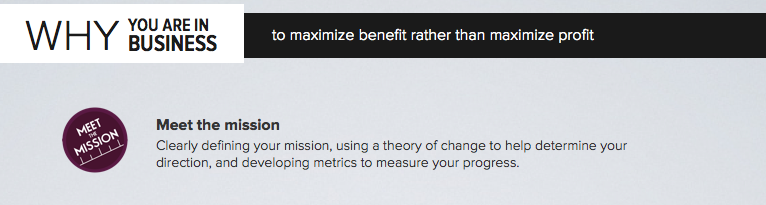
Before the performers could be praised, the objectives, rules and point system of this new game needed to be determined.  It was clear that the objective wasn’t to maximize profit but rather to maximize benefit to people and the planet. What wasn’t clear, however, was how to keep score.

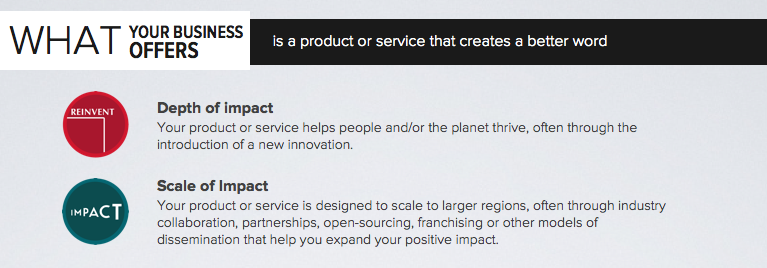
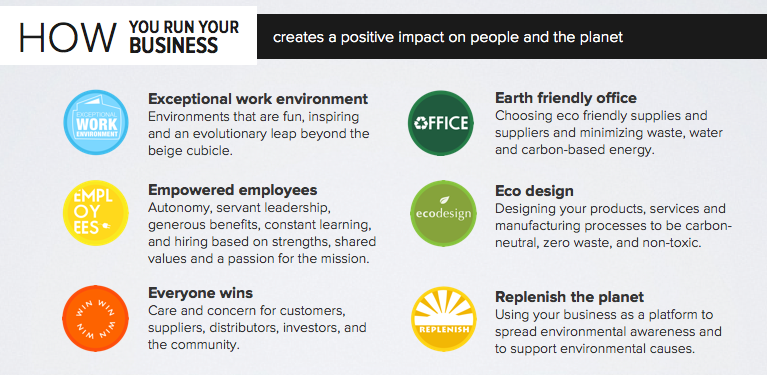
After receiving valuable input from experts in the field, we assembled a research team to comb the globe, reviewing thousands of organizations. Our team arrived at nine categories of best practices that these “force for good” businesses followed.

We then turned these nine categories into badges that organizations could earn as symbols of success in this new game. To further simplify the framework, we organized these badges into the following three sections:

A-new-model-of-business_WHY

A-new-model-of-business_WHAT

A-new-model-of-business_HOW

The Players: It was clear that this movement could not be defined by existing legal models.  Non-profits, For-profits and new legal breeds were all players, united by a common worldview that business as usual needed to change.  Together they were stretching the traditional paradigm to innovate a new model. Here’s how: Non-profits: There is a clear trend to use a non-profit entity in an enterprising way which moves beyond the limitations of grants and donations by earning income through the sale of a product or service.

These organizations benefit from having a purpose embedded in their ethos, while enjoying the flexibility and scalability of earning revenue. Overcoming the pressure to minimize operational overhead, these non-profits can more easily invest in things like empowering their employees and minimizing their environmental footprint.  As Dan Pallotta says, “Our generation does not want its epitaph to read, ‘We kept charity overhead low.’

We want it to read that we changed the world.” New legal breeds: The birth of new legal entities such as Benefit Corporations in the USA, Community Interest Companies in the UK, and Community Contribution Companies in Canada are paving the way for a new category of organization. Although it will take time for these models to build credibility and scale internationally, the hope is that one day the For-benefit structure will be an equal choice with For-profit and Non-profit. For-profits: Whole Foods, IDEO, Google, and Zappos are great examples of major corporations that have used traditional for-profit structures to scale their growth while implementing many untraditional practices that aren’t profit motivated. For example:

  • Whole Foods created Community Giving Days where 5% of that day’s net sales are given to local non-profits.
  • Google invested in creating an exceptional work environment with themed work spaces, slides between floors, free gourmet food, and radical amounts of employee autonomy.
  • Zappos innovated ways to “deliver happiness”—their mission—through untraditional benefits like surprising 80% of customers with free overnight shipping.
  • IDEO created IDEO.org to solve poverty related challenges by offering their talented designers to communities who need them the most.

Although they are unlikely to switch to a new legal entity, like a Benefit Corporation, these organizations are clearly part of this movement and are constantly innovating best practices that go beyond making a buck. As doing good continues to prove to be good business, it can be expected that more major corporations will join this “new game”.

Studies show that their ability to retain talent and market share rely on it. Considering the budget some large organizations spend on coffee filters alone is equal to the total revenue produced by many social enterprises, a small shift in this sector equates to an enormous positive impact. Thanks to great progress being made by law makers around the world, and organizations, like B Lab, we can expect this new model of business to continue taking shape.

Until then, we will define organizations by their best practices, not by their legal model and celebrate the GameChangers in business that don’t let rules or outdated paradigms define them. Although it took a lot longer than expected, I’m proud to say that the GameChangers 500 list (GC500) was announced on November 9th 2013 at Harvard’s Igniting Innovation Summit. Joining me in this announcement were executives from three exceptional organizations that qualified for the GC500—Warby Parker (benefit corporation), Life is Good (non-profit/for-profit hybrid) and New Balance (for-profit corporation).

Although each organization represents a different legal structure, they share a commitment to use business to create a better world.  In this presentation they brought the audience on a tour of their best practices across the 9 badge categories. I’m thrilled to showcase the GameChangers with the next generation of leaders, and offer an alternative to the profit-first organizations that have been heavily recruiting on campuses for decades. Game on!

Andrew Hewitt is the creator of the GameChangers 500 list (GC500) that profiles the world’s top purpose-driven organizations using business as force for good. He has been recognized as one of Canada’s top young entrepreneurs, is a bestselling author, and a guest lecturer on Social Entrepreneurship at the United Nations University of Peace.


The 21st Century City: Future Opportunity Or Future Threat?

International affairs columnist Doug Saunders notes that slums give rise to much of the conflict and social unrest we see around the world. Even in those slums where conditions seem impossible, a simple and cruel logic keep hopefuls walking in: the belief that life in the slum is still a sliver better than life in the village, says Michael Keith, Director of the COMPAS center at Oxford. He suggests that slums should not be seen as a problem in and of themselves. Rather they represent stunted progression in the journey of those hoping to make a better life in the city.

The fact that they stay in the slum is the real failure. This means that their progression is halted and that ways onwards, into work, education and toward a proper roof overhead— are blocked. For this reason, Michael suggests, the slums should not principally be targeted for infrastructural and social programs that risk institutionalizing them. Rather, interventions should focus on keeping the migrants moving, into work and education toward the goal of social and economic integration. We would do well to avoid repeating the mistakes of Europeans and North American towns of regarding slums as an uncomfortable but unavoidable and permanent necessity. The slum is a symptom, not the disease.

Most urbanization is happening in towns of 500,000 or less, with very little institutional or infrastructural capability, says Joel Bolnick, coordinator of Slum Dwellers International. Nevertheless, slum dwellers feel excluded from the societies they seek to enter. This is because they are in fact excluded, their voices drowned out by experts. He adds that the level of democratic maturity does not matter, governments pro and anti poverty management both result in exclusionary and status quo policies.

Melanie Edwards, CEO of Mobile Metrix, illustrates the disengagement of governments who report prevalence of slum dwelling in the low single percentages whereas the real numbers, even those reported by on-the-ground government officials, are closer to 40% in Rio for example. Ossama Hassanein, Chairman of TechWadi concurs and adds that the Egyptian government reports 300,000 living in Cairo’s slums, the figure estimated by non-governmental organizations being closer to 1.2 million slum dwellers.

Stanford just had a conference on the topic where McKinsey & Co, a consultancy, projected that 22% of the world’s population will soon live in the informal economy. That is one in five humans globally living in an economic environment that eschews tax, public service, basic social and private security—an environment that fuels crime and cements social inequality and conflict.

As I listen to the discussion, I think of the post financial crisis narrative around the “new normal”; a world filled with stark and pressing risks and opportunities, interdependence versus systemic contagion, rapid economic growth versus rising inequality, the rise of new global middle classes versus concentrating accumulation of wealth, increasing globalization versus geo-politicization and securitization of resources from the Internet to drinking water.

More than 100,000 people move into slums every day. That does sound like a sizeable number. One out of five people will soon live in slums. That does make food for thought. But what if this is just the new normal. The new reality as it has been creeping up on our doorsteps for some time. Economies are moving, resources are moving and people are moving. If we call them migrants, does that make them less like us?

Aren’t we all on the move in one way or another? The seminars most poignant remark is offered by Michael Keith. Migration is people moving, it is not a question of us and them, “it’s a question of human progression, journeys that are either enabled or halted, human progress stunted”, stunted by our inability to make space and opportunity for the venturesome.

“Give me your tired, your poor, Your huddled masses yearning to breathe free; The wretched refuse of your teeming shore, Send these, the homeless, Tempest-tossed to me I lift my lamp beside the golden door!”

I think that the “lamp” is not a border fence on the Mexican or Moroccan border. The lamp is not unfortunate but permanent slums. I suggest the lamp might be something more like a social impact metric. A metric for how migrant journeys, wherever they take place, cross borders, into and out of slums—progress or get stunted. Such metrics might give us data to describe the limits to human progress and suggest remedies rather than separating us from them.

Henrik Storm Dyrssen is the CEO of Leksell Social Ventures (LSV), a private impact investment company based in Sweden initiated by billionaire Laurent Leksell, founder of Elekta AB, inventor of non-invasive cancer therapy radiation knives. He is a Goldman Sachs Global Leader Scholar and McKinsey & Co Awardee that has worked an lived in Saudi Arabia, Iran, USA, UK, France and Sweden.

How (and why) Africa Should Solve Its Own Problems

Mo Ibrahim, Founder and Chair of the  Mo Ibrahim Foundation, awards the largest annual prize in the world for excellence in African leadership. He looks at the importance of good leadership in resolving Africa’s problems.

Africa is the second largest continent on earth and has immense resources, yet African people are poor. The question is “why are we poor” if we have all this wonderful land, sea, shores? We are poor because of misrule, because we are badly governed. I don’t subscribe to the narrative that Africa is backward because of colonialism. Africa has been independent for 50 years now. Let’s forget the past, we need to get up and dust-off ourselves and get on with life.

What actually happened in the last 50 to 60 years is that we missed a lot of opportunities. At the moment of independence, many African countries like Ghana and Egypt had higher income per capita than China, India or Singapore. Where are we now? And where are those guys? I think the blame should rest squarely on the way we have governed ourselves. Not any amount of aid is going to move Africa forward. The only way for us to move forward is to ensure good governance – the way we manage our economy, our social life, our legal structures and institutions – that is the basis for development. We cannot rely on people to come and feed our poor or treat our sick.

This is the responsibility of our governments. Governance is not just about corruption or transparency or human rights or democracy or roads etc., it is about all of this. There is no compromise. All this is a basket of deliverables which governments must deliver to their citizens. If it is about deliverables then it is measureable. What we need to do is look at numbers and not wonderful leaders’ speeches. I want to know what leaders did in the last 12 months.

We need to measure this every year and we need to produce a scorecard. This is how the Ibrahim Index of African Governance came about. Leadership is also important. It became obvious to us that we need leaders that understand that they are running their country for the benefit of every single individual. Every child in this country is his responsibility; we need people who really believe in that, who cannot go to sleep because some people cannot eat or cannot find medicine. This is the kind of leadership that we need in Africa – an enlightened and dedicated sort of leadership.

With this in mind, we came to the decision that we really need to go out searching for these heroes. We need role models that are important. This is why the Ibrahim Prize for Achievement is in African Leadership. These were the two main issues we really cared about: the issue of leadership and the role of the leadership in transforming the society and how they started building the institutions. Societies are not sustainable without institutions.

Right now, the most important challenge, in my view, is African youth. We have a huge bulge of youngsters coming forward but where do the jobs come from, and what will happen to those people? The other day someone in our research team worked out that the average age of an African president is about 63 years old when the average age of the citizen is 19 years old. So you can really see the gap between our leadership and our people.

One major problem we have is the education system which, unfortunately, is not doing very well. If you are African, the more educated you are, the less chances you have of getting a job. This says something – education is too serious to be left to the few bureaucrats in ministries of education who have no connection to the real world.

This is an area where you really need a national debate between business people, education specialists, and young people to know exactly what kind of work force we need to build in Africa. China is already running out of labour, moving production houses out of China. We all know about the one child policy and that is one of the outcomes. Who is going to be the next factory of the world, is it going to be Africa?

We have a lot of attractions – geographic locations, cheap labour, etc. but we are not ready because we need to build the infrastructure and we need to train our young people and give them the right skills. We need people who can really build and do things. This is a big challenge for us.

“The other day someone in our research team worked out that the average age of an African president is about 63 years old when the average age of the citizen is 19 years old. So you can really see the gap between our leadership and our people.”

That challenge is immediately linked to the question of regional integration. People talk about Africa as if it is one country. Africa is not one country, Africa is 54 countries, which are not necessarily trading or communicating among themselves. It is more difficult to pass goods from East Africa to West Africa than taking it from China to West Africa and is more expensive.

If you are an African, and you decide to visit every other African country and you are unfortunate enough to have an African passport, you are going to spend a year trying to get visas for all those 53 countries. I have to travel to the country with my British passport, not my Sudanese passport because it takes me a month to get a visa with it. We need to lay down the basis for the free trade area across Africa. We have been talking about regional integration for ages and its progress is proving very slow. Many African countries will not be viable without regional integration, full stop.

We have to accept that, we need each other; we really need to open-up our borders to have free movement of goods, people and capital across our borders. Everywhere I go in Africa, I raise the question of why the Germans need the European Union and keep bailing people out? The answer is simple: they need it because they want to move their goods around. We have almost 600 million mobile users in Africa, which is much more than European users.

We have much more users than the United States but are we really proud of that? How many mobile phones were manufactured in Africa? None. If we don’t have the economies of scale, we are unable to force the trade required; we are unable to get a good deal for our manufacturers. Can Siemens sell a single mobile phone in China without building a factory there or transferring know-how? No way.

We are not able to force our demands on any of these companies or businesses because we are 54 failed voices; we need one big voice. And we cannot have that unless we force ahead with this integration. Good governance in the public sector is a prerequisite for development but it is not enough. We cannot have it without also having good governance in the private sector; people need to understand that. If we have a go at corruption we really need to deal with it in the private sector, there is no question about that.

Political leaders don’t corrupt themselves; they have partners in the private sector. The illicit transfer of funds is another important issue. The illicit transfer of funds out of Africa is at least double the amount of aid that Africa receives every year. This speaks for itself. We need multinational companies to pay their taxes. Small African countries have very weak tax collection systems. We don’t have fantastic lawyers and forensic accountants who can really challenge these companies.

Britain has also discovered that it has the same problem; everybody has the same problem, even the United States. It is interesting that this issue – which we have been screaming out about for decades – suddenly, came to be in the forefront of the political debate in the UK and many European countries. We hope that, at last, people in the developed countries are going to move forward now to stop all this nonsense. It is not acceptable anymore.

Where is your leadership, where is good governance in your institutions? The light of transparency is shining over all of us now. It is impossible to keep secrets now because everything is leaked. We can find out everything about everybody. So if we are all naked, why don’t we behave and act in a decent way? We are really seeking transparency everywhere.

And we need to insist on transparency in the private sector because, believe me, we cannot have good governance in the public sector unless we also have good governance in the private sector. These two must really go hand-in-hand.