Cape Town Looks to Apartheid’s Legacy to Curb Climate Change

The outgoing mayor of Cape Town, known for averting a near catastrophic water shortage, said she hopes to leave office on the heels of another victory in the fight against climate change – slashing greenhouse emissions from transportation.

Patricia de Lille said South Africa’s second-largest city could reduce its greenhouse gas footprint by building homes for low-income residents on land left undeveloped as a legacy from apartheid.

It is a unique solution tied to the country’s cruel history.

If you like this, subscribe here for more stories that Inspire The Future.

The parcels of land were used to buffet the white-minority from members of the majority black population who were oppressed and segregated under the system of apartheid, which was imposed by white-governments from 1948 until the early 1990s.

“It’s valuable land, close to transport,” she told the Thomson Reuters Foundation on the sidelines of a climate change summit in San Francisco on Wednesday.

Under her plan, de Lille said, erecting low-cost housing on five city-owned plots will allow people to live closer to their jobs in the city center, thereby cutting car transportation and reducing carbon dioxide emissions.

“We’re using those pieces of land that belong to the city to bring about transport-oriented development,” she said, adding that transportation accounts for about 70 percent of carbon emissions in Cape Town.

“To reduce carbon emissions, you have to deal with the spatial planning of your city,” said de Lille.

Her plan was adopted by Cape Town’s government in 2016, but has not yet been put into action.

De Lille, a former anti-apartheid militant who quit as mayor of Cape Town last month after a bitter dispute within her political party, said it “must be implemented.”

“If it does not happen, I will be the first person to protest and I will mobilize the masses,” she said.

“This is an opportunity for me to drive integration of the city, by bringing people of color closer to the city.”

De Lille, whose resignation is effective Oct. 31, has been a mayor of Cape Town since 2011, and has a large support base among her fellow mixed-race residents of the city.

Under her tenure, the port city, a tourist hub with a population of about 4 million, avoided a feared “Day Zero” when its taps would have run dry due to severe drought after three years of low rainfall.

De Lille was speaking at the Global Climate Action Summit, a three day event that has drawn about 4,500 delegates from city and regional governments from around the world.

By Sebastien Malo @sebastienmalo, Editing by Jared Ferrie

If you like this, subscribe here for more stories that Inspire The Future.

Michael Bloomberg: Straight Talk From a “C” Student Turned Billionaire

Former New York mayor and founder of global financial services company Bloomberg L.P., Michael Bloomberg shows that  no one sails through life without encountering some rough waters. The billionaire believes that if you love what you do, you’ll thrive on the inevitable challenges and have the stamina to achieve your full potential.

In college I had a straight C average. I think I was just lazy, or maybe I was just too busy chasing the girls. But then, first semester senior year, I figured that if I wanted to go to graduate school I’d better do something about my grades.

So for that one semester I took a double course load and got all A’s. I applied to business school and I got in, much to everybody’s amazement, particularly mine. Then I went right back to getting C’s for my last semester. 

After graduation, I thought I was going to serve in Vietnam. In those days everybody was going to Vietnam. But they wouldn’t take me at the last minute because I have flat feet. Why it bothered them, I don’t know. So I needed to find a job all of a sudden. I went to work on Wall Street only because a friend of mine said, “Call these two firms – Goldman Sachs & Co. and Salomon Brothers & Hutzler (as it was called back then) – and tell them you want to be a trader or a salesman.”

Fortunately for me, securities trading and sales were considered second-class occupations in those days, so I got interviews at both firms. At Goldman I was introduced to the managing partner like this: “Mr. Levy, this is Mike Bloomberg.” At Salomon Brothers I was introduced to some guy named Billy. We had a discussion, and afterward somebody came up to me and said, “What’d Billy Salomon have to say?” I had just been introduced to the managing partner on a first-name basis! I felt that Salomon Brothers was the place for me. To say I fit in there and loved what I was doing is an understatement. I reveled in it every minute of the day. But the thing is, fifteen years later, they fired me. 

I was fired around the time the company was sold. They assembled an executive committee of seven people that decided who stayed and who went. One of the committee members did not like me – my crime being that I had been the assistant to his nemesis – and he convinced everyone else to vote against me. He was later killed in a plane crash, and the other six members of the executive committee became paying customers of mine.

As somebody once said, “Living well is the best revenge.” 

I don’t remember being too pissed or feeling that bad about being fired. I think I have the same insecurities that everybody else has. The difference is that I don’t let them get in my way. There’s a great scene in the movie The Sting between Paul Newman’s and Robert Redford’s characters. They rob a bank and in the midst of doing this somebody points a gun at Newman. Afterward, Redford asks him if he was scared. Newman replies, “Right down to my boots.”

As long as you can admit things to yourself, you can deal with them and then move on. I don’t lie to myself, but I don’t harp on things and I never, ever look back. If your mind starts to wander to past events, the only advice I can give you is don’t go. Just stop it! Think about something else. If you divert your attention, your mind won’t immediately go back to the unpleasant occurrence, and when it eventually does, simply stop thinking about it again.

That’s how you quit smoking. You don’t have to stop for the rest of your life, just stop for five minutes. Five minutes from now you probably won’t want a cigarette. If you do, force yourself to stop for another five. Eventually, one of these fives will end in not wanting a cigarette. And then one day you’ll think, I’ve come so far  and I don’t want go back.

Had a place like Goldman Sachs called me after I was fired from Salomon and wanted to make me a partner, I would’ve done it. But nobody offered me a job. Thank God for that! I started my own company instead. I like that old Woody Allen quote: “Eighty percent of success is just showing up.” You create your own lot in life, and to be successful in business you’ve got to work hard. The more you work, the better you do. It’s that simple. Some people say, “I can’t go into work today.” I’ve never missed a day of work in my life! After I was fired from Salomon, I still had about two months left before I was actually going to leave the firm, but I still never missed a day. In fact, I made sure that I worked six days a week from as early in the morning until as late as I could. I was searching for new office space for myself during that period, but I called the broker and said I could only look on weekends because I didn’t want to take time off during the week. I didn’t want anyone to ever say that I didn’t work 110 percent. I had an ego problem with that.

Be the first one in and the last one out. If you are there early and stay late, you get a chance to talk to people who would not otherwise take your call. I built many relationships by being early. You can call the chairman of the board of almost any company early in the morning. If he’s a good chairman, he’s there. The secretary’s not, so he’ll actually answer the phone. The best time to strike is when gatekeepers aren’t there! When I started developing Bloomberg, I wanted feedback. So every morning I’d arrive at the deli across the street from Merrill Lynch’s headquarters at six a.m. and buy coffee (with and without milk) and tea (with and without milk), plus a few sugars on the side. I’d go up and roam the halls looking to see if there happened to be somebody sitting in their office alone reading a newspaper. I’d walk in and say, “Hi, I’m Mike Bloomberg. I bought you a cup of coffee. I’d just like to bend your ear.” Nobody is going to say, “Get outta here” if you just bought him or her a cup of coffee. When someone would occasionally say, “I don’t drink coffee,” I would say, “Well, then have a tea.”

Over the years, people have come to me and said, “You can’t do everything.” That is total bullshit. You certainly can do everything. The people who do some things can do more. If you need to get something tough done, give it to the most overworked person in your organization. There’s a reason why they’re overworked; they get things done. I have an employee named Patti Harris; she should be written about instead of me. She runs my foundation, she runs the city, she has a husband, they have a great marriage, she’s got a great family (the kids turned out spectacularly), they go on vacations, they ski, they scuba dive. If you go up to her with doubts that something can be accomplished because of this obstacle or that obstacle, she’ll look at you, smile, and say, “That’s nice, just do it,” and walk away.

My parents were my role models. My father was a bookkeeper for a little dairy company. He worked seven days a week until he checked himself into the hospital to die. At that point my mother knew that she would have to start driving. She went to the library, checked out a book on driving, took the car onto our little street, and taught herself how to drive. She got a friend to take her to the DMV, took the test, and got her license. That was it. She just did it. After running Bloomberg for twenty years, I decided it was time to do something different. Time to fire myself. I wanted to turn over the company to others without anyone thinking I was walking away from it. Well, public service is a good excuse, and it’s of great interest to me. People say that government can’t be made to work efficiently and truly serve the people. My response? “Bullshit!” Telling me something’s impossible is like waving a red flag in front of a bull. Might as well go for it. So that’s what I’m working toward now.

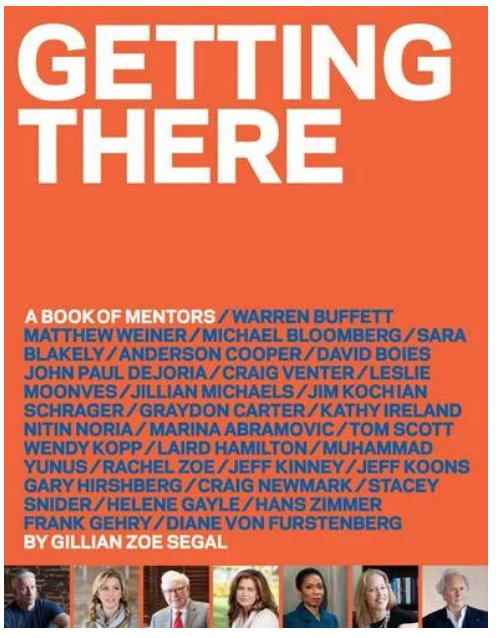
This is an excerpt from “Getting There: A Book of Mentors” by Gillian Zoe Segal. Find the book here.

As World Cup Kicks Off, FIFA Urged to Fight Iran’s Ban on Women in Stadiums

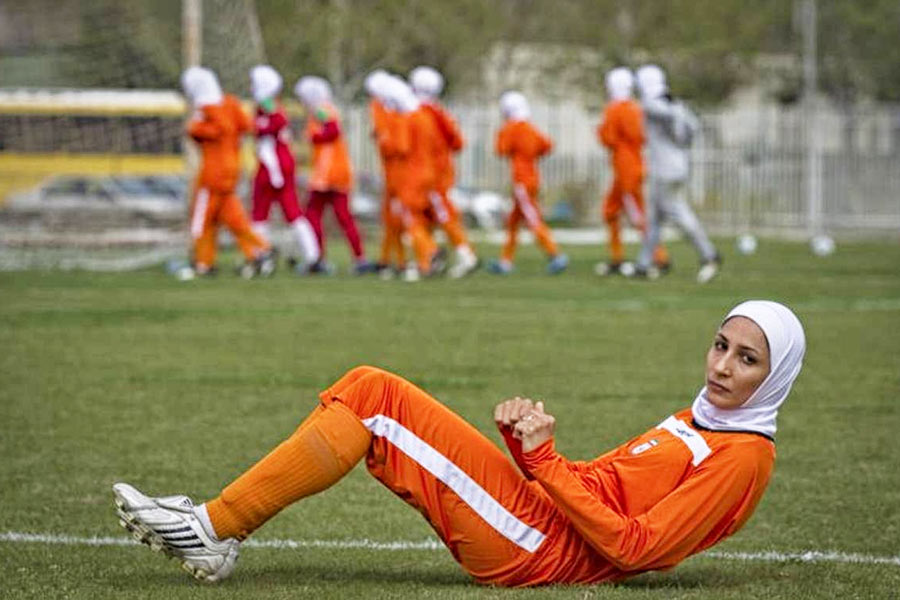
An Iranian football fan demanded that FIFA’s president put pressure on her home country to overturn a ban on women attending stadium matches as the World Cup kicks off in Russia.

Maryam Qashqaei hopes the world’s biggest single-event sporting competition will galvanise support for an online petition she plans to present to FIFA President Gianni Infantino.

If you like this, subscribe here for more stories that Inspire The Future.

The Islamic Republic has long barred women from attending male soccer matches and other sports fixtures, partly to protect them from hearing fans swear.

“This is a very basic right – how embarrassing is this for our nation and society,” Qashqaei told the Thomson Reuters Foundation by phone from Moscow, where she is cheering on her country’s team.

“As an Iranian woman, I’ve never seen a single game played in my home country. Women are passionate sports fans just like men, and deserve to cheer on their teams in the stadiums.”

Infantino said in May Iranian President Hassan Rouhani had told him there were plans to allow women to attend football matches in the country soon.

Qashqaei’s petition has so far attracted more than half the target of 100,000 signatures – the number of seats in Tehran’s Azadi stadium.

“I hope FIFA can put pressure and create this change. Iranian women inside Iran just want to go and watch football – they risk everything to do it,” said Qashqaei, who is using a pseudonym to protect her identity for fear of reprisals.

In April, female football fans donned fake beards and wigs to attend a major match in the Azadi stadium.

The Iranian group OpenStadiums, which is campaigning for the right of women to attend sports fixtures in the Islamic Republic, said some women were arrested near the stadium in March during the Esteghlal-Persepolis match.

Qashqaei said she had seen many Iranian women in Russia for the World Cup, which left her feeing very proud but also frustrated.

She said Iran was the only country in the tournament that barred women from stadiums.

Saudi Arabia last year overturned a ban on women watching sporting events, one of a series of reforms in the deeply conservative Sunni Muslim kingdom.

By Heba Kanso @hebakanso, Editing by Emma Batha and Claire Cozens.

If you like this, subscribe here for more stories that Inspire The Future.

Sundance Wants Women to Swap Casting Couch For Director’s Chair

Women must get off the casting couch and into the director’s chair if Hollywood is to move on from the #MeToo sexual harassment scandal, filmmakers said at the British opening of the Sundance Film Festival.

Most films showcased at the British offshoot of the U.S. festival are directed by women, in a selection that champions female voices at a time of deep industry disquiet.

But the big message at the opening event was all about jobs – more directors, more critics, more financiers must be female – if Hollywood is to emerge truly reformed.

If you like this, subscribe here for more stories that Inspire The Future.

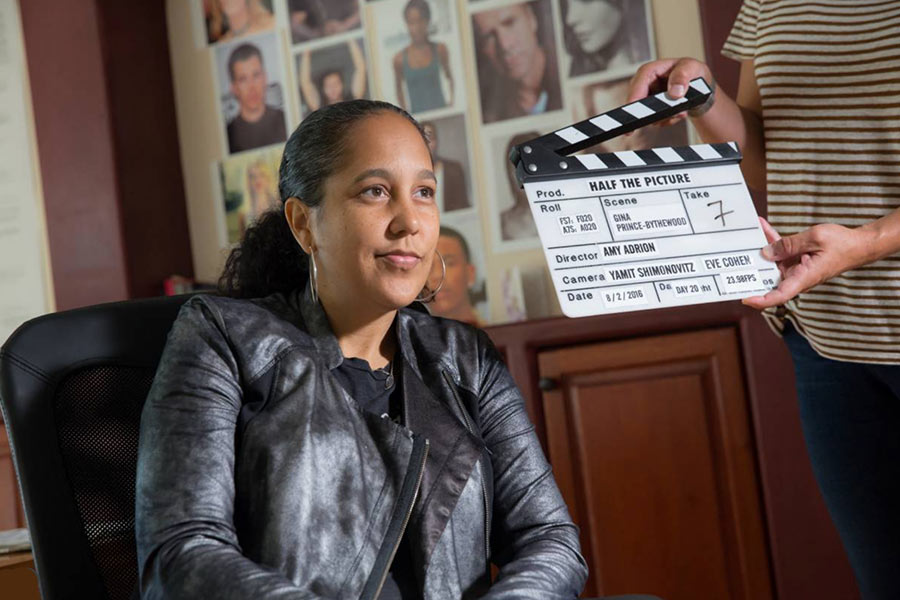
“There is talent all around us and you can’t just look at a small sliver of the population to tell everyone’s story,” director Amy Adrion told the Thomson Reuters Foundation

Adrion, who directed a timely documentary about the dearth of female directors in Hollywood, said the #MeToo scandal had stoked discussion about equality but the number of women behind the camera was yet to increase.

Women directed only 8 percent of the top 100 grossing films in the United States in 2017, according to the California-based Center for the Study of Women in Television and Film.

Employing more women at the top would have a knock-on effect on the rest of the industry, said Adrion, whose “Half the Picture” documentary has its European premiere at the festival.

“When women are hired as directors, they tend to hire more women in key crew positions,” she said.

SKATEBOARD TO SEX ABUSE

Crystal Moselle, director of “Skate Kitchen” – which tells the story of a female teenage skateboarding crew in New York – said more women should work as film critics, too.

“We need more diversity … at a different level to make the decisions of who is going to see these films,” she said.

Stories like hers featuring teenage girls talking about tampons might not interest older men so reviewers need to come from a wider pool, she said.

Hollywood was rocked last year by allegations of sexual misconduct against movie mogul Harvey Weinstein, in a scandal that has implicated other leading industry figures.

On Wednesday, Weinstein was indicted on charges of rape and a criminal sexual act in New York in the first case to emerge from a slew of sexual misconduct allegations against him.

His legal team said he would plead not guilty.

The Weinstein scandal has prompted women from all walks of life to share their experiences of sexual harassment and abuse in a global campaign under the hashtag #MeToo.

Jennifer Fox director of “The Tale”, a semi-autobiographical movie about child sexual abuse, had thought her story was “private and personal” then realised:

“Here I am, admitting in my 40s, that I belong to a larger world in which bad things happen to women, a lot of women.”

WOMEN AT THE TOP

Festival organisers said the #MeToo campaign had only amplified Sundance’s long-running support of women in film.

“We’ve been doing this for a long time, we have a legacy for showing many films by women and diverse voices,” said John Cooper, director of the Sundance Film festival.

Kate Kinninmont, who heads Women in Film & Television UK, which groups women working in the creative media, said the sector was changing, even if female directors remained an “endangered species”.

“Ultimately, fundamental change will only happen when there are more women making the decisions at the top of the industry. But I’m hopeful… Finally, when we speak people are listening.”

By Umberto Bacchi and Adela Suliman; editing by Lyndsay Griffiths.

If you like this, subscribe here for more stories that Inspire The Future.

10 Things I Learned From Sheryl Sandberg’s New Class About Resiliency

Sheryl Sandberg’s life changed forever the moment she found her husband, successful Silicon Valley entrepreneur and SurveyMonkey CEO Dave Goldberg, dead in a hotel gym during their 2015 family vacation in Punta Mita, Mexico. Goldberg, 43 at the time of his death, had suffered heart complications and is survived by Sandberg and their two children.

Coping with Goldberg’s death was, and still isn’t, an easy feat for the Facebook COO — and she’s written about her grieving experiences in her New York Times best-selling book Option B: Facing Adversity, Building Resilience, and Finding Joy, which she co-wrote with Wharton psychologist Adam Grant. She wrote about how to make the most of Option B when Option A is no longer in the cards in the face of adversity. 

If you like this, subscribe here for more stories that Inspire The Future.

Recently, Sandberg shared a course that highlights some of the most powerful topics in their book on LinkedIn— it includes how to talk to friends and colleagues who are hurting when you’re not sure what to say, how to fight the idea that the hurt you’re feeling is permanent and how to give yourself permission to experience happiness again. The book is a resource for those trying to resume normalcy in their lives, possibly get back to work and carry on, but are struggling.

“Dodging adversity is often not a choice,” reads the description of the course, “The Importance of Resilience.” “Encountering a devastating event — the gut-wrenching kind that zaps away joy — is an inevitability of life.”

In the course, resilience is described as the strength and speed of our response to adversity. It’s “when something bad happens, big or small, how much are we able to overcome it — or how well do we persevere in the face of it,” Grant explains.

I’ve experienced adversity in my own life, when I suddenly lost my dad also from heart complications in 2015. So I took Sandberg’s course on resilience, and here are 10 lessons I learned about overcoming any kind of traumatic experience (and helping friends and colleagues to do the same) — albeit loss or something else entirely.

1. Trauma can have a cascade effect.

We need to understand that trauma isn’t always just one big fiasco. Trauma like loss can affect someone’s confidence in other domains of their life — many people will experience survivor’s guilt or feel like their depression is a nuisance to those around them. It could really put a damper in their confidence. So a primary loss can lead to a cascade effect of secondary losses, Grant explains, which have a negative impact on different parts of our lives.

After losing my dad, for example, I gained 40 pounds, lost fistfuls of hair, had very little faith, and became increasingly irritable and alarmingly apathetic. Work felt like a dreaded chore, when it used to feel like something I loved. So that primary loss led me to a myriad of secondary losses that ultimately turned me into someone I no longer recognized. For a while, “resilience” felt like a foreign concept — I thought I had none of it.

2. Resilience is not something we have; it’s something we build.

When Sandberg lost her husband, she began asking Grant how much resilience she had, she says. But he told her that she was asking the wrong question; what she should have been asking was how she could build resilience. And, according to Grant, it’s something we can build long before we face any tragedy or difficulty. 

I’d also realized that I’ve been building resilience my entire life — we’ve all had to face adversity to some capacity throughout our lives, and we can take those lessons we’ve learned from doing so to help ourselves and others overcome extreme trauma, too. Over time, resilience builds. We just need to recognize that.

3. Resilience can be strengthened by expressing gratitude.

Grant says that we can build resilience by changing how we process negative events. When we recognize and appreciate the good we do still have in our lives, and realize that our lives could theoretically be worse, we can find the strength to carry on.

Sandberg says that she’s grateful for her own health, her children’s health, every birthday, every dinner, every minute. She also feels fortunate that she at least still has her children in her life. I’m, too, grateful for my health, my family, my work and the many priviledges in life.

4. Adversity isn’t permanent, but unhappiness can become a self-fulfilling prophecy.

“I learned that one of the best ways to build resilience is to fight permanence; you have to believe that it won’t be this bad forever,” Sandberg says.

Grant says that, while many people think that their feelings of overbearing depression and anxiety will last forever — as I did the day I learned the news of my father’s death, and even in the months thereafter — evidence suggests that it probably won’t. Affective forecasting, he explains, is a prediction of how we will feel in the future, and most of us overestimate just the intensity and duration of our misery. He remembers when Sandberg told him that she’d never feel joy again, but he advised her that, if she genuinely believes that, she’ll never do anything that brings her joy again — and then it’ll become a self-fulfilling prophecy.

5. We all deserve to feel joy, and we can again.

Sandberg tells a story of finding just a moment of happiness while dancing with her friends, but she explains how she immediately felt guilty for feeling happy without her husband. 

Grant explains that we have to take back and reclaim our joy, and we can do so by starting up the things we love again. “Happiness is really the frequency of positive experiences,” he explains. “Not the intensity.” 

Dance more. For me, that meant realizing that life is too short so I started a new job doing what I love: writing. I revamped my blog. I took up kickboxing again, promising myself at least two days a week. I kept myself busy with the things I knew would make me feel even an inkling of happiness or, at the very least, not depression.

6. We can grow from trauma.

A lot of people who experience trauma expend their energy trying to bounce back, but psychologists have discovered that it’s possible for people to actually bounce forward, too. We can find meaning in the loss or traumatic event that’s happened to us, and grow from it. 

For Sandberg, this means helping other women in the same way that her husband helped so many people — all of whom raised their hands at his wake to admit that he’d helped them each in some way.

Many of us choose to volunteer or to try to help others overcome the same suffering that we’ve been through; doing so gives our life and our suffering meaning.

7. We should treat others as they would want to be treated.

How we cope may not necessarily be how other people cope, so how we want to be treated might not necessarily be how someone else wants to be treated.

That said, asking someone what you could do to help them places the burden on them — and asking for help isn’t always easy for someone, especially if they may already be feeling survivor’s guilt or like their depression is encumbering those around them. Sandberg says that doing anything at all to be there for someone is better than asking what you could do — maybe they don’t know what they need, but if they know that someone is there for them regardless, it helps them to not feel so isolated.

8. Sometimes, people just don’t know what to say.

I know this firsthand, because no one knew what to say to me, and I still don’t know what to say to people when they go through the same thing — I don’t actually think that there is any “right” thing to say. The Mum Effect is when people avoid talking about upsetting topics, Grant explains, sometimes because they don’t want to be that person and other times because they don’t want to remind someone of a bad experience. 

But we need to talk about these things so we don’t bottle them up. And, for me, it wasn’t always easy to bring up first. So we can all be more sensitive in how we ask people about how they’re facing adversity.

Sandberg explains that she felt very alone after losing her husband and when people would ask her how she is doing, even though it was always asked with the best intentions, it felt insensitive. She just lost her husband — how did anyone think she was doing? But when someone would ask her, “How are you today?” she felt like they’d acknowledged that she was suffering while asking how she was handling it that day. And that made all the difference. Plus, it’s a lot easier for the mind to explain what you did that day than to attempt to articulate the total roller coaster of emotions one’s had since their trauma.

9. Mattering matters.

Mattering is “knowing that others notice you, care about you and rely on you,” according to the course. Sandberg explains that, despite how hard it is for a young boy, her son was able to ask friends to step out of school with him to be with him while he had cry breaks. As she told her children, sadness will come overcome them when they don’t want it to. Her son realized that his friends did care about him and actually wanted to be there for him during those cry breaks, and that helped him cope with his father’s loss. 

I remember approaching the first anniversary of my dad’s death. My biggest fear was that my sulking time was over — I could no longer burden my friends and family with sob stories because it’s been a whole year, right? The first few days after a tragedy like mine, everyone is there for you — people fly in from all over to console you (and mostly feed you). But then it’s over; everyone goes home and carries on with their lives, and you’re still stuck living a nightmare, seemingly alone. After a few months, I felt like crying about it was still warranted, but I thought I had to give myself a cut-off time so I was neither walking around like “woe is me” nor being “weak” by my own unfounded definition of the word.

On the anniversary of my dad’s death, knowing about my fear, my best friends threw me a legitimate “pity party.” They went so far as to hang streamers in my apartment, put out my favorite foods and wrote me the most beautiful card to let me know that I can always cry to them — for eternity. Friends called me up or showed up at my apartment periodically, and still do, to share memories with me or check in. My coworkers mailed me flowers and took care of my workload as best they could. I’ll never forget those gestures that made me feel like I matter. We can all make others feel like they matter just by being there or lending an ear, too.

10. Being open helps the community.

When we’re all open about the hardships we each face, at least with one other person, we help each other to open up. Everybody is going through something, but it’s not always easy to talk about unless we feel safe, cared about and not alone. Community is key.

By AnnaMarie Houlis – a multimedia journalist and an adventure aficionado with a keen cultural curiosity and an affinity for solo travel. She’s an editor by day and a travel blogger at HerReport.org by night.

If you like this, subscribe here for more stories that Inspire The Future.

Jawed Karim, Co-founder of Youtube

Jawed Karim was born in Merseburg, East Germany in 1979. His father, Naimul Karim, is a Muslim Bangladeshi who works as a researcher at 3M and his mother, Christine, is a German scientist of biochemistry at the University of Minnesota.

He crossed the old East-West German border with his family in 1981 and grew up in Neuss, West Germany, after which he moved with his family to Saint Paul, Minnesota in 1992. While studying at the University of Illinois, Department of Computer Science, he decided to leave before graduation to become an early employee of PayPal.

While working at PayPal, he met Chad Hurley and Steve Chen. The three later founded the YouTube video sharing website in 2005 and YouTube’s first-ever video “Me at the zoo” was uploaded by Karim on 23 April 2005.

After co-founding YouTube Karim enrolled as a graduate in computer science at Stanford, while still acting as an adviser to YouTube. When the site was eventually launched, Karim decided not to be an employee, but rather an informal adviser because he wanted to focus on his studies. As a result, he took a much lower share in the company compared to Hurley and Chen and subsequently became a mostly unknown, third founder of YouTube.

Despite his lower share in the company, the purchase of YouTube by Google in 2006 was still large enough for him to aquire stock worth about $64 million.

In March 2008, Karim launched a venture fund called Youniversity Ventures, with the goal of helping current and former university students to develop and launch their business ideas.

U.S. Entrepreneur Wins Award For Making Government ‘Less Insulting’

Jennifer Pahlka believes that coding can help deliver a better U.S. government that works to help reformed felons earn an honest living and public servants frustrated by poor technology.

After seeing the challenges working in child welfare, she founded San Francisco-based non profit Code for America in 2009 to create user-friendly websites that make it easier to navigate systems to access state benefits or services.

If you like this, subscribe here for more stories that Inspire The Future.

“People need help for a very wide range of reasons and they’ve hit a rough spot and they just need a little bit of help,” she told the Thomson Reuters Foundation at the Skoll World Forum, an annual gathering of 1,200 social entrepreneurs.

“We need to help these people in a much less burdensome, and frankly, less insulting way. We can give them that help in a way that is dignified and respects their time.”
Pahlka was in Oxford – where Ebay billionaire Jeff Skoll established a centre for social entrepreneurship in 2003 – to collect an award, one of six Skoll winners this year.

The Skoll Centre at Oxford University aims to increase the impact of social entrepreneurs by helping them to set up new ventures, training leaders and carrying out research, from health to climate change to education.

Britain is seen as a global leader in the growing social enterprise sector, home to about 70,000 businesses set up to address social and environmental issues that employ nearly 1 million people, according to industry body Social Enterprise UK.

Pahlka said her organisation is unusual. “Most social enterprises work around government,” she said. “They are essentially trying to supplement where government is failing. We take the approach of strengthening government itself to get these social outcomes.”

Code for America’s websites reduce the time-consuming bureaucracy of form filling that might deter applicants to about 10 minutes, she said, and they are designed for smartphone users to cater to the millions who do not have a computer at home.
One innovation is Clear My Record, which allows users to get rid of criminal offences on their data record that might prevent them accessing employment, benefits or credit.
Pahlka was inspired by the election of U.S. President Barack Obama, whose online campaign mobilised masses of young voters as well as donations.

“The thinking was, if the Internet can help get a president elected, can it help him govern better?” Pahlka asked. “The application of modern tech and modern approaches to problem solving can’t be limited to politics. It has to help us do a better job, using tax dollars to get the outcomes that we intend.”

Pahlka went on to work for Obama as his deputy chief technology officer in 2013 and helped found the United States Digital Service, which helps federal agencies improve their websites and simplify digital services.

“Public servants who help people get food assistance or take care of a kid who needs to be in a foster home – those people need tools to do their jobs,” she said. “We weren’t – and still in many case aren’t – helping those people do those jobs.”

Code for America aims to help more than 500,000 people in need with more effective government services in more than 70 cities, states and counties in 2018.

By Lee Mannion; Editing by Katy Migiro. 

If you like this, subscribe here for more stories that Inspire The Future.

The Male Feminists Inside Uganda’s Police Force

“We want to put ourselves in the shoes of women”

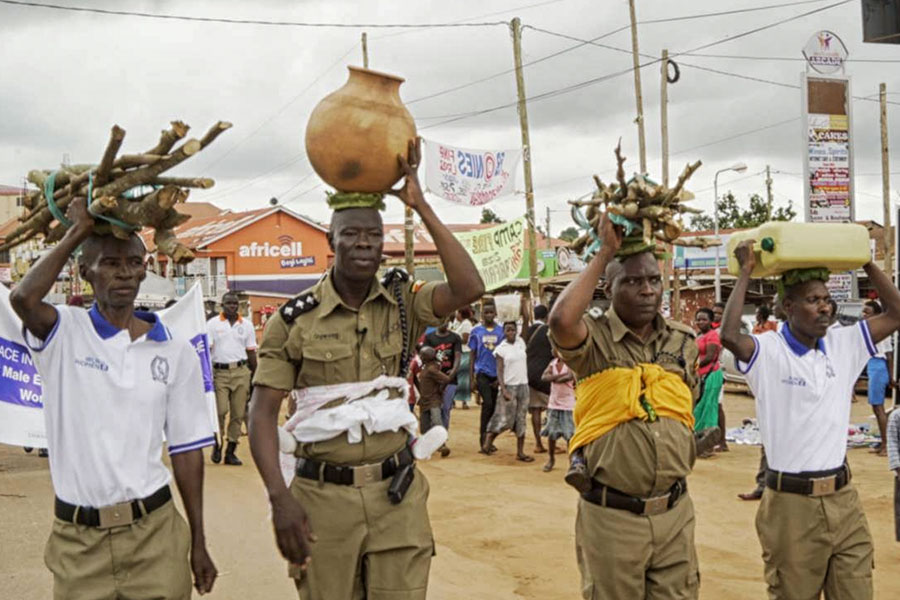
Balancing a heavy clay pot on his head with a baby tied to his back, policeman Francis Ogweng caused a scene as he marched down the busy highway towards Uganda’s capital, Kampala.

With traffic backed up to the horizon, crowds of men stared and laughed as the baby girl swaddled in white cloth slipped precariously down Ogweng’s back, pulling his khaki uniform into disarray.

If you like this, subscribe here for more stories that Inspire The Future.

“We want to put ourselves in the shoes of women,” Ogweng, an assistant superintendent in the Uganda Police Force (UPF), told the Thomson Reuters Foundation. “Is it difficult to carry water? Is it difficult to carry a baby?”

Judging by the sweat dripping down his face, it is.

Onlookers were surprised to see a senior officer marching to stop violence against women, in a force that opponents of Uganda’s long-serving President Yoweri Museveni accuse of spending more time suppressing dissent than tackling crime. Police often break up opposition rallies in the east African nation with teargas and beatings, rights groups say they torture suspects to illicit confessions, and surveys often rank the force as Uganda’s most corrupt institution.

“Their image has been tainted,” said Regina Bafaki, head of Action for Development, a local women’s rights group.

“They have actually been more violators than protectors of citizen’s rights.”

But a spate of unsolved murders of young women, with more than 20 corpses found beside roadsides south of the capital since May, is putting rare public pressure on the police.

They have charged more than a dozen suspects with the women’s murders, listing possible motives range from domestic rows through sexual abuse to ritual murder linked to human sacrifice.

Ogweng was not alone, flanked by three policemen carrying bundles of firewood, a 50-strong police brass brand and other officers carrying placards that read: “Peace in the home. Peace in the nation. Prevent Gender Based Violence”.

“Men can also carry water, men can carry babies … it does no harm at all, it doesn’t make a man less of a man,” said Ogweng, who describes himself as a feminist – a rarity in a country where women often kneel to show deference to men.

About half of Ugandans believe that domestic violence is justified under certain circumstances, such as when women neglect children or burn food, government data shows.

“There are those who still believe that battering of women, beating of women, is something normal,” said Asan Kasingye, assistant inspector general, another unlikely ally in Uganda’s fight for gender equality.

“We must invest our resources, our training, our recruitment … into fighting against gender based violence,” he said, seated in his top floor office at the police headquarters.

“It must percolate, it must be known by everybody. So it preoccupies us.”

The police demonstration calling for an end of violence against women went down well with locals around Entebbe, where about 20 women were raped and murdered in 2017.

“This government prides itself for bringing security … but at the same time when these ladies were being murdered, the government didn’t even talk about it,” said Anatoli Ndyabagyera, whose fiancee Rose Nakimuli was killed in July.

The murders illustrate a broader problem in Uganda, where government data shows more than one in three women suffer physical or sexual violence from an intimate partner, although few report it to the police.

“We have in our society a dangerous attitude of men thinking they can dispense with women and they can get away with it,” said Ndyabagyera. “They look at women and tend to think of them as items of ownership.”

Four in 10 girls wed before they turn 18, even though Uganda has banned child marriage, according to the United Nations children’s fund (UNICEF), and few go beyond primary school.

Efforts to pass a bill seeking to ban traditional practices, like dowry and the inheritance of widows by their husbands’ male relatives, and to grant rights to women in divorce have floundered for years.

Women wearing miniskirts were stripped by mobs of men following the 2014 Anti Pornography Act that banned “indecent” dressing and the police in 2015 stripped female opposition leader Zaina Fatuma naked in the street.

“There are (officers) who are badly behaved,” said Ogweng, who works in the child and family protection department.

“But there are those who are good, and there are many.”

Given the influential role of the police in Ugandan society, Ogweng believes he can help to change people’s perceptions about what it means to be a man.

“People are so rooted in the culture where some things are only done by women and some things are done by men,” he said.

“If a man, a police officer, can carry a baby, can carry a pot, then other men can do it … Men even called me afterwards and said: ‘You have opened my eyes’ … So I think people are beginning to understand.” By

By Thomas Lewton. Editing by Katy Migiro.

If you like this, subscribe here for more stories that Inspire The Future.

Nude Foods: Cape Town’s First Plastic-Free Grocery Store

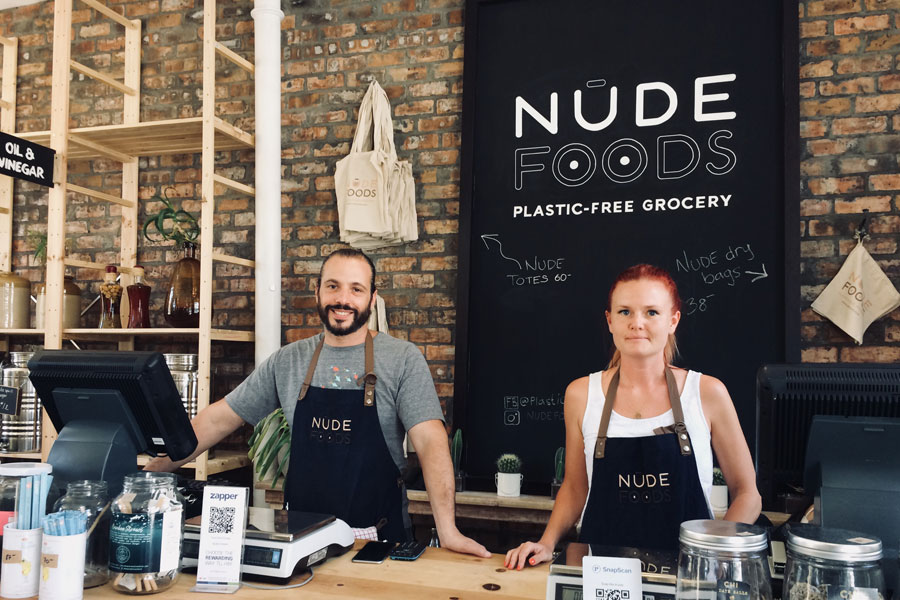
While walking the streets of Cape Town recently, I discovered South Africa’s very first plastic-free grocery store: Nude Foods. It has an old-school ambience with a simple, modern-twist.

Founder Paul Rubin has created an environmentally friendly shopping experience for those who care about their food and how it’s packaged. Launched in December 2017 the store helps care for our environment and the health of others, offering a variety of organic and earth-friendly foods – all of which are GMO free.

If you like this, subscribe here for more stories that Inspire The Future.

Stepping into the store was rejuvenating, I had a look around and asked Paul a few questions:

What was the motivation behind creating this plastic-free store?

The ethos of my store is to eliminate single-use plastic and unnecessary packaging. We encourage our customers to bring their own containers where we weigh them in a jar at a pre-weigh station. Customers can fill the jar with their purchase and we then deduct the weight of the container from the amount owing. If you don’t have your own container, we sell glass jars and bottles, pure cotton, reusable dry goods bags, mesh bags for fresh produce and free brown paper bags.


How do you intend growing Nude Foods?

We like to engage with our customers, educating them on the reason behind our mission and purpose. We also ask for feedback because we want to establish the types of products people want (and don’t want) so we can fine-tune our food to cater to residents in the area. We want to appeal to people with an environmental conscience and hope this becomes a growing movement.

In addition to being plastic free we support quality food brands, which have eliminated preservatives and fillers. We get our fresh produce from a local farm called Naturally Organic, an EU certified 100% organic farm in Phillipi, an agricultural area near Cape Town. We try and source everything locally, and by doing so, we support local business.


Are you looking to create partnerships with existing businesses?

Not yet, but we are open to collaborating with small local businesses. We recently collaborated with a nearby coffee store called Kamili. They created a pop-up coffee stand in our store that offered customers free coffee. Although we have no formal partnerships, we seek suppliers that work with the same ethos, and are happy to help support other startups and entrepreneurs.

How will you scale your idea?

We plan on opening another store within a few months in Cape Town. It will be a smaller version of our first store, which will offer only our most popular goods. My longterm plan is to open a few more stores, maybe six, around the Western Cape province, but we first want to learn to walk before we can run.

What feedback have you received from regular customers?

Many of our customers love shopping this way as they feel more connected to their food. It allows them to be precise in how much they need to buy, as opposed to buying pre-packaged goods that might sit on shelves for weeks, spoil, and go uneaten.

After visiting this innovative store I came to the realization that a plastic-free grocery store can play an important role in showing how to take action around environmental issues. It tackles three important goals of the 17 Sustainable Development Goals, laid out by the United Nations: Goal no.3: Good Health & Well-being, Goal no.12: Responsible Consumption & Production and Goal no.13: Climate Action. Consumers have a choice in where they choose to spend their money, and shopping at stores that promote a healthier, cleaner planet can help achieve these goals. 

If you like this, subscribe here for more stories that Inspire The Future.
Emma Watson Partners With National Geographic on #InternationalWomensDay

A new partnership aims to accelerate gender parity by highlighting women photographers with outstanding photographic contributions. Work from eight female National Geographic photographers will be featured throughout Women’s Day, curated by Watson.

The National Geographic account is the most followed brand on Instagram worldwide, with Watson and National Geographic having a combined total of over 129 million followers.

The actor, activist and UN Women Global Goodwill Ambassador has partnered with National Geographic to become the first guest editor of the National Geographic Instagram account (@NatGeo) to mark International Women’s Day 2018.

If you like this, subscribe here for more stories that Inspire The Future.
Working with the editorial team at National Geographic, Watson will curate the account, highlighting the work of eight National Geographic female photographers. The photographers, from Saudi Arabia, Iran, Azerbaijan, Australia, the United States and the Philippines, cover a wide range of important and relevant topics including male guardianship and the longstanding ban on women driving in Saudi Arabia, the effects of displacement on women and girls running from Boko Haram in Nigeria, unequal pay in India for women day laborers in the brick industry, the bond between mothers and their babies evident even in nature, advancements in women’s rights and the importance of self-identity and the power of hope for a better tomorrow among our world’s young girls.

The National Geographic Instagram account is the most followed brand on Instagram and one of the top 15 most followed accounts on the platform.Both Watson and National Geographic have a combined total following of 129 million followers and this experience will be amplified via Facebook Stories on the National Geographic magazine Facebook page, extending the reach by another 22 million followers.

https://www.instagram.com/p/BgD7Oj9johH/?taken-by=natgeo


Watson says, “Women photographers are often under-represented and under-celebrated. I’m thrilled to mark this day by profiling the talented female story-tellers and image-makers that are working hard to build empathy across borders.”

Susan Goldberg, Editorial Director of National Geographic Partners and Editor-in-Chief of National Geographic magazine says, “We are honored to be partnering with Emma to recognize the contributions of these eight incredible women photographers, who are shedding light on important stories that make a difference in people’s lives. We are eager to use our storytelling platforms and our power as a global media brand to highlight women by calling attention to their work, their stories and their causes.”

“Women photographers are often under-represented and under-celebrated. I’m thrilled to mark this day by profiling the talented female story-tellers and image-makers that are working hard to build empathy across borders.”

In addition, in an effort to encourage conversations online and through social communities on March 8, National Geographic will also be publishing articles tied to International Women’s Day at NationalGeographic.com. This will include stories of inspirational women from around the world, portraits of powerful women throughout history, discussion around some of the greatest barriers women are facing today and highlights of some of National Geographic’s most notable female explorers, including Dr. Jane Goodall. 

https://www.instagram.com/p/BgEEpVBDRrZ/?taken-by=natgeo

National Geographic’s acclaimed documentary JANE will make its broadcast premiere on Monday, March 12. Directed by Brett Morgen and featuring an original score from legendary composer Philip Glass, JANE has won Best Documentary Awards from the National Board of Review of Motion Pictures, Producers Guild of America, Writer’s Guild of America, The American Cinema Editors Guild and the Motion Pictures Sound Editors Guild, as well as The Critics’ Choice Documentary Awards.

A number of other National Geographic Instagram accounts will also be featuring photos of and by inspiring women, including 2018 National Geographic Adventurer of the Year Hilaree Nelson O’Neil on @natgeoadventure and Dr. Jane Goodall on @natgeowild.

If you like this, subscribe here for more stories that Inspire The Future.