Surprise, Surprise: Mercedes to Replace Robots With… Humans

According to the head of production at Mercedes-Benz, the robots cannot cope with the high degree of customization and the many variants the carmaker has today.

Mercedes-Benz plans to abolish a number of assembly-line robot in its largest plant in Sindelfingen, Germany and compensate it by getting more work done by people.

Even more surprising, or perhaps not, is the justification given: to cope with the extensive customization options of the vehicles.

According to the head of production at Mercedes-Benz, the robots cannot cope with the high degree of customization and the many variants the carmaker has today, which conveyed the new very timely and smart message “We save money and secure our future while employing more people.”

So what about the tsunami warning from the World Economic Forum in Davos, where specialists from around the globe predicted that the 4th industrial revolution robots would cost five million jobs by 2020?

Well, maybe predicting the future is not that simple after all… but still, I would like to add two predictions of my own:

1. ROBOTS AND HUMANS WILL WORK SIDE-BY-SIDE FOR A VERY LONG TIME

In the same article, the head of productions mentions that are areas which would not work without robots, mainly painting and welding. He also says the vision is that humans will work side-by-side with small robots that can continually perform repetitive tasks. This implies the creation of mixing zones, where the robots no longer work in separately enclosed areas, requiring completely new security measures.

Well, it doesn’t take a genius to predict that. The degree of customization, heading steadily towards product uniqueness, will require, in many cases, a flexibility that only a special type of factory resources has: humans.

Yes, all the repetitive work will be performed by robots. And with time, the scope of these activities will be enlarged. Still, the most value-added activities, the ones where completely new and unforeseen situations happen, will only be dealt with by humans. With the advent of artificial intelligence these will be fewer than before, but will be critically important.

2. THIS DECISION IS DEFINITELY… TEMPORARY

I hold out that this decision is temporary. Although temporary in this context could mean several years, or even decades.

The different customization options will continue to evolve towards unique products. The same article refers that Daimler is planning to bring in ten new models to the market over the next four years, which can be ordered in several variations and with many extras.

The days of mass customization, where only small variations could please consumers, seem to be over. So manufacturing companies need to be prepared for this reality.

What is clear is that the automation and robotics necessary to cope with this paradigm shift will be very different from the ones used today.

The industry 4.0 working group actually predicted this: the shop-floor will be composed by intelligent products or materials (cyber-physical systems) and intelligent manufacturing equipment (cyber-physical production systems). These will have their own communication, sensors and actuators, computing power and intelligence and will become autonomous decision entities.

The consequence is that the shop-floor operations will no longer be centrally controlled, but will rather become a decentralized marketplace with demand and supply. Until this happens, the best is to use the most flexible resources available today: humans.

 by Francisco Almada Lobo, CEO of Critical Manufacturing

 

The Smartwatch That Protects you From Environmental Threats

German company GNS GmbH, a leading developer of embedded location and mobile electronics technology, has announced the launch of a Kickstarter campaign for Fitti Guard, a new generation of fitness and environmental tracker that will warn wearers about poor air quality and even radiation threats.

Fitti Guard is the first environmental sensing and protection device that you can wear on your wrist.
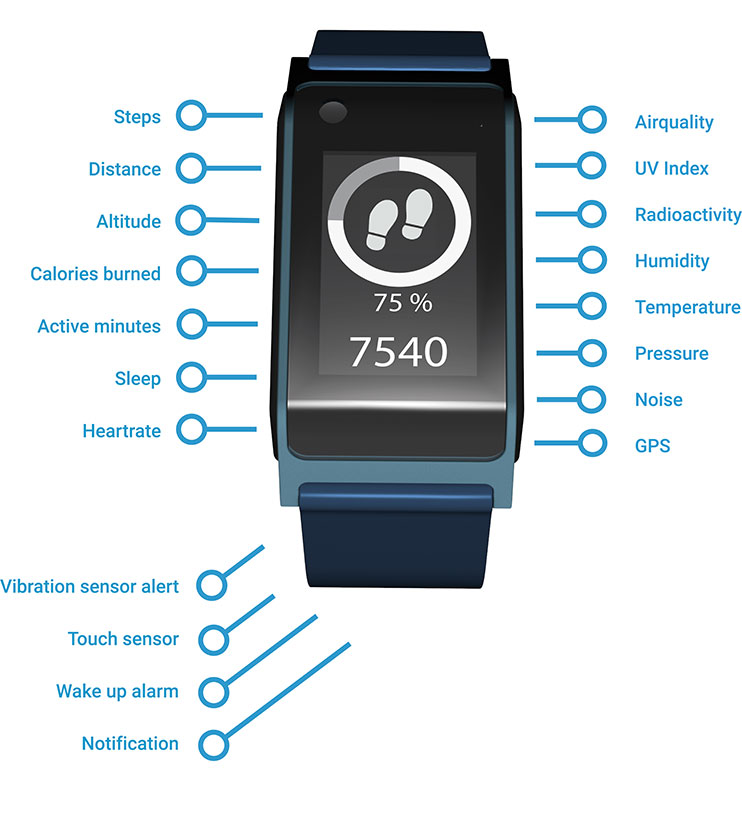
It comprises ten sensors that help identifying and avoiding unhealthy situations such as ultraviolet light exposure, poor indoor air quality, radioactivity and noise nuisance. A vibration alarm and warning icons inform the user as soon as a threshold of exposure has been exceeded. The watch is aimed at improving health and well-being in people’s daily lives.

Advanced fitness functions count your steps and calculate distance and calories, much like many other smartwatches. But Fitti Guard goes one step further with an activity recognition algorithm, based on a neural network, that detects the kind of activity you’re performing. Tracks are recorded with an integrated GPS and a barometric level sensor measures the covered elevation. A sleep tracking function helps support a healthy and conscious lifestyle with wearers only needing to charge the battery every 21 days.

fitti_functions

“This unique activity GPS watch combines fitness and additional health functionality in a single stylish device offering protection from daily environmental influences,” says Bernd Bierwisch, CEO and founder of GNS GmbH.

“We are very proud that our engineers were able to integrate reliable UV and air quality sensors in such a small device. Fitti Guard will even give a warning if sun protection is required, or to open a window if the indoor air quality is bad – based on WHO recommendations.”

Fitti Guard was available for pre-order from the end of March on Kickstarter and shipment is planned for the end of 2016.


Millennials and Leadership: What They Really Think

Millennials will form half of the global workforce by 2020 and employee well-being is what they most value in the workplace. The personality traits that Millennials look for in their leaders are strategic thinking at 39%, being inspirational at 37% and strong interpersonal skills at 34% respectively. 59% of Millennial men hope to become the leader of the company they currently work compared to 47% of Millennial women. Check out the infographic below from the Brighton School of Business and Management for more interesting facts:

millennials

Ten Steps to Build the Cities of the Future

The World Economic Forum has released a new report, Inspiring Future Cities & Urban Services in which it highlights the emerging technologies and business models that are changing the way urban services are delivered. It proposes a 10-step action plan to enable cities to navigate the journey of urban transformation.

The “business of running cities” is changing rapidly due to the emergence of new business models and technologies, which cover a wide range of urban services, such as mobility, infrastructure, energy, water, waste management, health, safety, security, welfare, the environment, knowledge, skills and culture. It also requires the involvement of a large number of stakeholders in the planning and administrative process, including governments, citizens, the private sector and NGOs.

The World Economic Forum’s new report, Inspiring Future Cities & Urban Services, identifies the way in which emerging technologies and new business models are transforming how cities plan and operate. The report, written in collaboration with PwC, identifies how innovative business models – such as the sharing and circular economy, digital integration of services, public asset revitalization, innovative outsourcing – will unleash excess capacities in the urban realm and enable cities to do more with less. The report chronicles technology innovations such as the internet of things, mobile-based sensing, location and condition sensing, data analytics and open data, which will enable cities to tackle a myriad of urban challenges.

As cities try to embrace innovation in an effort to address major urban challenges, they are overwhelmed with issues such as budget constraints, flawed governance structure, lack of leadership commitment and talent, lack of trust among stakeholders (citizens, government and private sector), and external issues such as migration and demographic changes. The World Economic Forum recommends that city governments:

  • Usher in regulatory reforms to attract capital and human resources in an increasingly competitive landscape
  • Develop agile, transparent and city-scale governments to rapidly respond to an ever-changing global environment
  • Develop institutional capacity by investing in people and processes
  • Empower city leaders to change the default position of being risk-averse and take calculated risks
  • Involve citizens, NGOs, the private sector and academics in decision-making to improve legitimacy and build trust
  • Achieve the right balance to allow for organic growth while adhering to master plans
  • Leverage standards and promote reuse to reduce cost and promote interoperability

Gregory Hodkinson, Chairman, Arup Group, said: “Today, 54% of our global population live in cities and by 2050 it is estimated to reach 66%, which is an increase of 2.5 billion in the urban population. While our cities face many challenges, such as climate change, social segregation, economic development and resource constraints, new business models and emerging technologies have disrupted the way urban services are being delivered and resulted in excess capacity within cities being efficiently utilized. However, technology does not provide a silver-bullet solution to urban problems and instead a holistic approach is required that will transform planning, governance and regulatory aspects.”

“In the Fourth Industrial Revolution we are likely to see the biggest industrial shifts in a generation, changing the way we work and live in the urban environment.

Innovations such as 3D printing, artificial intelligence and next-generation robotics will shift models of work and production in ways that are impossible to predict. Cities and businesses need to be adaptive. Public-private collaboration will be required to enable cities to navigate the path of this urban transformation,” said Alice Charles, Lead, Urban Development, World Economic Forum.

The report recommends that the private sector should be made an equal stakeholder across the entire urban development value chain, with the public sector driving phases such as policy-making, planning and monitoring, and the private sector taking a lead in design, implementation, operations and management, and financing. The risks associated with entering into public-private partnerships are different across the developing world (risks are more fundamental pertaining to business environment and apply to most project phases) and the developed world (risks are centred around project phases such as planning, construction and termination). The report recommends that government initiate actions, such as creating a stable regulatory environment, introducing administrative reforms and developing reliable dispute resolution mechanisms to address the risks. It also recommends that the private sector further engage with government and the local population to develop trust.

Hazem Galal, Global Leader, Cities and Local Government Network, PwC, added: “Cities will have to ensure that their DNA (fundamental social and economic characteristics) is retained while they make the journey towards urban transformation. Cities should be willing to experiment and at the same time learn from other cities while they develop unique city-specific solutions that leverage an accepted standard. Cities will have to create a balanced strategy which gives due considerations to social, economic, environmental dimensions.”

The report provides a framework for cities to classify various urban dimensions across levels of maturity ranging from rudimentary (for example, a city which is addressing demand supply gaps across various urban services) to scalable (for example, a city that can adapt to changing needs), and suggests a 10-step action plan for cities planning to navigate the urban transformation journey.

In 2016, the World Economic Forum’s infrastructure and urban development industry partners will identify ways in which the private sector can enable cities to meet the new global priorities and targets, as set out in the Sendai Framework, Sustainable Development Goals and COP21, as well as implement the new 20-year urban agenda being set out in Habitat III. The Forum will also undertake a deep dive on migration and cities, exploring the types, causes and patterns of migration to cities and identify ways to enhance public-private cooperation to respond to this growing challenge, and assess how cities can leverage the opportunity presented by the circular and sharing economy to do more with less.

The World Economic Forum’s Shaping Future of Urban Development and Services Initiative serves as a partner in transformation to cities around the world as they seek to address major urban challenges and transition towards smarter, more sustainable cities in this rapidly urbanizing world. Directed by a Steering Board and guided by an Advisory Board, the Future of Urban Development and Services Initiative works in collaboration with local partners.


Behind The Headlines and Rhetoric In Iran

The first group of American business leaders to step inside the former U.S Embassy in Tehran in more than 35 years discover a very different world to what we’ve heard about.

“Where are you from?” asked the shopkeeper, pointing quizzically at American Dick Simon, who was on his first trip to Iran. Simon swallowed hard and replied, “I’m from the United States.”

“America!” said the shopkeeper, giving him a huge bear hug, “We’ve been waiting for you for 30 years!” It was typical of the attitude from all ages and walks of life that Dick and his party encountered. They experienced almost no anti-American or anti-Western sentiment from the people they met, even the Iranian Revolutionary Guards who were tasked with showing them around.

The 2012 film “Argo,” starring Ben Affleck and George Clooney, dealt with the American hostage crisis that began on 4 November 1979, when Iranian activists stormed the U.S. embassy in Tehran in retaliation for President Jimmy Carter giving the Shah asylum in the U.S. during the Iranian Revolution. More than 50 of the embassy staff were taken hostage and the entire movie is a nail-biting quest to smuggle them out at any cost.

But now, the Americans are back.

Curious about the portrayal of Iran in Western media and not discouraged by the endless images of crowds burning American flags and chanting for the fall of “The Great Satan,” a group of 24 members of the Young President’s Organization (YPO) traveled to the country to see for themselves. Simon is one of the founders of the Peace Action Network within YPO; an example of a growing trend among business leaders wanting to help promote global peace.

“We are all fed information through media news outlets and stereotypic characterization in TV shows and movies about what the rest of the world is like and what we should think about it,” says Simon. “Dehumanizing the ‘other,’ THEMification, is a widespread and dangerous human trait.”

Anti-American murals are still evident on the streets.

Anti-American murals are still evident on the streets. Top photo: Some parts of the former U.S. embassy in Tehran still require triple authorization to enter. Photographs: Dick Simon

Governments can sometimes be their own worst enemy, by reinforcing myths and beliefs around different societies. “One of the big lies that people believe is that conflict between certain groups will never end,” says Simon. “Northern Ireland was once a war zone. Rwanda recovered from a genocide of over a million people. South Africa could easily have descended into retributory bloodshed after democracy, but didn’t.”

“The most dangerous four-letter word in the English language is THEM,” says Simon. “It creates the ‘other’ and creates a situation where you’re unable to hear them. Part of our brain actually cuts off rational thought in order to ‘protect’ us.” Entrepreneurs who dissect problems into manageable pieces can play an important role in building peace. “Business leaders have the expertise to resolve problems,” says Simon. “It’s called making a deal – and business is very good at this.”

In Iran, Simon’s group met with high-ranking Iranian officials, the first group of American business leaders to do so since the 1979 Islamic Revolution. They met a Grand Ayatollah at his personal residence in the holy city of Qom and interacted freely with ordinary Iranians – free of media filters, Hollywood hype and western rhetoric. Seventy percent of the population is under 35 and 60 percent of all university graduates are women. “We will never look at Iran, the Middle East or the world the same way again,” he says.

“War is a very expensive business. Witness the horrific Syrian death toll and refugee crisis happening right now,” says Simon.  “We should get involved with other cultures out of a desire to make a difference in the world and enlighten ourselves.”

Perhaps the most telling detail of Simon’s trip was when he departed Tehran Imam Khomeini International Airport. A Revolutionary Guard saw his American passport, approached him and said, “God Bless You.” Bestowing a blessing on another, despite cultural, religious and geopolitical  differences, might be the best sign yet that we can all find common ground.


L’Oréal Foundation and UNESCO Defend the Role of Women in Science

Five leading women scientists and 15 promising young researchers were honoured on 25 March at the Sorbonne University in Paris where the launch of the For Women in Science Manifesto was held. Already signed by each guest present at the Ceremony, this Manifesto aims to tackle the under-representation of women in the sciences. 

For the past 18 years, the LOréal-UNESCO For Women in Science program has encouraged, promoted and honoured women scientists all over the world. This year, the L’Oréal Foundation and UNESCO are taking the next step towards change: the launch of the For Women in Science Manifesto to raise awareness and mobilize the public’s active support for the cause of women in science.

Jean-Paul AgonIrina Bokova, and this year’s President of the Jury, former Laureate and Nobel Prize winner Elizabeth Blackburn, all signed the Manifesto, along with the Laureates, International Rising Talents and 800 guests in attendance to ensure the visibility and public support necessary, so that everyone involved can work together towards gender equality in the sciences.

Collective strength is what we want to see emerge tonight from our Manifesto. Beyond the scientific and institutional communities, we want to give everyone the chance to sign the For Women in Science Manifesto and join the cause, stated Jean-Paul Agon.

Since its creation in 1945, the United Nations Educational Scientific and Cultural Organisation (UNESCO) supports international scientific cooperation as a catalyst for sustainable development and for peace between people.

Accompany. Value. Communicate. Support. Move boundaries. These are the core values which drive the L’Oréal Foundation’s commitment to women everyday. A commitment divided into two main areas – science and beauty.

The six commitments of the #ForWomeninScience Manifesto

1/ Encourage girls to explore scientific career paths

2/ Break down the barriers that prevent women scientists from pursuing long term careers in research

3/ Prioritise womens access to senior positions and leadership positions in the sciences

4/ Celebrate with the general public the contribution that women scientists make to scientific progress and to society

5/ Ensure gender equality through participation and leadership in symposiums and scientific commissions, such as conferences, committees and board meetings

6/ Promote mentoring and networking for young scientists to enable them to plan and develop careers that meet their expectations


Why Goodness Should be a Core Value in Every Business

I grew up steeped in the idealism of the 60s. I and many of my generation envisioned a world that was good, where people were treated humanely, where war was rejected as inhumane and inherently bad, where human and personal rights were regarded as sacred. Implied in so many of the movements of that era, and still today, was the notion that doing good in the world was needed for our survival, and that doing good was its own reward.

How far have we come? “Goodness” is found in many products today. Just think of the common advertising slogans that go like this: “the natural ‘goodness’ of whole grains” when in fact the product being advertised is filled with GMO ingredients or high sugar additives masquerading as wholesome nutrition. (Pardon my cynicism. I’m actually still an optimist in spite of plenty of evidence that could have knocked the wind out of my progressive sails.)

Goodness is the radiant human virtue that binds relationships together, that brings hope in the midst of despair, that is at the core of the human spirit. We admire people who we describe with words like, “she’s a really good person.” We may even aspire to be like them, while secretly doubting that we want to.

“Goodness is the only investment that never fails.” — Henry David Thoreau

Many entrepreneurs start with a genuine a vision to do good in the world, to make people’s lives easier, or to solve a problem that previously was unsolvable. For millennia goodness has been one of the noblest of human qualities. So how has it become a second class citizen in today’s frenetic, ADD world? Most companies value masculine qualities such as strength, ambition, competitiveness, power, domination, and charisma, but I would suggest that goodness is the very nourishment desperately needed in our organizations today so these other qualities don’t become the cause of our self-destruction. The heart is the missing factor in our mindset and in our culture that could allow us to create the life of our dreams. Goodness is the crystal pure gift from our heart to ourselves, to our customers, to our organizations, and to the world. What customers wouldn’t be loyal to an organization they felt was truly doing good in the world, and backing it up by treating its people and its customers in ways that felt good.

How does goodness relate to your professional life? Could a mantra of, “let’s do good today” produce a good ROI? Businesses are complex organisms in which competing interests and priorities must be weighed out before proper decisions can be made. Asking ourselves, “is this a good decision?” may not be the only question to ask; not at all. But are we asking this often enough? Are we investing in goodness? Probably not.

Bruce Cryer is a renaissance man, whose passions include being a business mentor, writer, speaker, keynote performer, photographer and co-founder of the project “What Makes Your Heart Sing?” to awaken inspiration in people and organizations. A former actor/singer/dancer on Broadway, he is the co-author of “From Chaos to Coherence: The Power to Change Performance,” and the Harvard Business Review article, “Pull the Plug on Stress”. He is also a cancer and staph infection survivor, happily singing and dancing again on two titanium hips. BruceCryer.com


Who’s the Banker of the Future?

Digital disruption will make tomorrow’s banking workforce unrecognizable from today’s. Banks must build a culture that nurtures diversity of thought and ensure bankers have the new skills they need to succeed.

The brain drain is a very real outcome of the low Canadian dollar. US companies can now offer more for high-demand talent in compliance and risk. It’s a worrying development for banks, but also an opportunity for them to re-think their long-term strategy and ask, who’s the banker of the future?

“Since the financial crisis of 2008, banks have been focusing on their core businesses, redesigning their structures and reshaping themselves through the use of technology,” says Andre de Haan, EY’s Financial Services Leader. “But to take their financial performance further, they also need to focus on their people, who will help them win in the future.”

de Haan says in the face of continuously declining ROE, increasing regulation and pressure to reduce workforce, Canadian banks need to identify which employees really create value and what they need to do to attract and retain those individuals.

Understanding the expectations of a new generation of bankers 

Millennials (those born between 1981 and 2000) will constitute 72% of the global workforce by 2025. Yet banks have little brand appeal to young employees. Globally, among IT and engineering graduates, banks are absent from the top 25 most-attractive companies to work for. Banks will need these graduates in the future as they will require highly educated talent. They need to make sure they understand this generation and their expectations of:

  • Greater labour mobility
  • Greater technological capabilities
  • More entrepreneurial mindset
  • Greater sense of entitlement

In addition, millennials are more likely to value flexibility, learning opportunities and mentorship more than monetary compensation. In choosing a place to work, they also consider whether a company’s values align with theirs. Purpose matters to millennials and banks must emphasize it.

Assessing technology’s impact on the workforce

“In the coming decade, all things digital will revolutionize the banking workforce,” says de Haan. “There will be fewer bankers in traditional roles, and the roles of those who remain will be fundamentally different.”

As the role of technology transforms from adding value in efficiency, cost, speed and accuracy and towards managing more complex tasks, banks will have to determine appropriate controls. In addition they’ll have to ensure that employees with the right skills monitor the correct and safe use of technology.

Equally important is understanding, even if automation is possible, where it may not be desirable. This will help reallocate investment across the business and develop plans to retrain and redeploy staff to other parts of the business.

Changing culture to encourage diversity of thought

The key to creating a culture of innovation is encouraging diversity of thought. An adaptable, ‘intrapreneurial’, diverse workforce promotes innovation and there’s evidence that it leads to improved financial performance. To overcome traditional homogeneity, banks must draw talent from a broader pool and build a culture that supports and retains people from different backgrounds, with different views and experiences. For example, EY research across a number of industries shows that the highest-performing companies invest more in the advancement of women than their peers.

“If banks want to attract and retain valuable, innovative talent, they need to transform their HR approach,” says de Haan. “Starting from recruitment all the way to performance reviews, banks should reconsider their employee propositions. Especially for millennials, who are set to become a significant portion of the workforce very soon, the salary alone isn’t an enticing enough offer. They’re looking for much more than that, and more often than not, they’re finding it somewhere else.”

EY are committed to building a better working world.


Why Companies are Adopting Sustainable Printing

For many businesses, office printing represents one of the largest expense categories, and yet few business leaders give it much thought. Some companies attempt to create a paperless office, and then they face all of the practical challenges and security uncertainties that accompany making that shift. Others ride a status quo that tacitly allows printing of any kind.

But for executive leaders who are constantly looking for ways to remain competitive and improve how they do business, the answer typically lies between those two extremes.

By switching to secure print solutions and fostering more mindful printing habits around the workplace, businesses can not only save millions of dollars, but they can also slash their carbon footprints significantly. The transition doesn’t happen overnight, but it soon leads to a more cost-efficient, secure, and healthy business.

The Simple Beauty of Mindful Printing

Today, some of the most effective business leaders have legacy-driven mindsets; they focus on taking actions that produce lasting results and have sustained positive impacts on their companies and their people. Initiating change in the way people print may not sound particularly exciting or revolutionary at first, but the mindful habits that a sustainable print strategy instills in employees will have a beneficial, evergreen influence for years to come.

Simply put, mindful printing reduces the amount of resources your company consumes.

When people understand the impact of each decision to print, they typically become more conscientious of their roles in meeting the company’s cost-savings and sustainability goals. This isn’t to suggest that employees should never print something that isn’t part of a required business process or workflow — it’s about fostering awareness and mindful habits.

A company comprised of people who understand the costs associated with printing and how mindful printing habits align with company goals will inevitably consume fewer resources and spend less money. Beyond the paper, ink and toner, and all of the resources that go into creating those consumables, you have to factor in total energy costs and the labor costs of IT resources tasked with managing print.

When demand for print is mindful across the enterprise, you also need fewer printing devices to meet that reduced demand. Fewer devices means less time and money spent to maintain a printer fleet. In our experience at Pharos, this factor alone has resulted in significant savings for many companies. We’ve found that on average, a company with 10,000 employees can save upward of $1.5 million every year by implementing the right print strategy.

Mindful print solutions improve a company’s security as well. Employees print to a secure, encrypted network queue and then use their identification or access cards to authenticate at whichever device is most convenient for them. This simple, flexible workflow encourages employees to think before they print, ensures document confidentiality, and practically eliminates “tray trash” — those uncollected, forgotten documents you often see in or around a printer, waiting for the wrong hands to them pick up.

It also enables the company to monitor who’s printing what and at how much cost. These insights reveal ongoing opportunities for improvement toward meeting cost-savings and sustainability goals.

Fostering Mindful Print Practices in the Workplace

Obtaining the right technology for secure printing is fairly straightforward. That solution alone goes a long way toward making people think about their printing choices. But to get the most out of any print management solution, you have to establish more mindful printing habits across the organization to reduce the overall demand for print.

Here are three ways you can encourage staff to be more mindful with their printing choices:

1. Establish printing policies, and make employees aware of them.

Print management software will help you figure out where the most waste is occurring. But even before that, there are some obvious places to start policing, such as personal printing. Printing from email clients and web browsers is rarely essential for business, and with the exception of marketing or presentation materials, who really needs to print in color? It’s often eight times more expensive than black and white, sometimes more.

You don’t have to set absolute rules or create the impression that the company is “cracking down” on print. The occasional personal document isn’t going to tank your budget on its own. But policies designed to inform employees about the cost of printing and that encourage people to think more critically about whether something really needs to be printed — that’s how you reach the tipping point.

2. Be a role model.

Modeling desired behavior is an underappreciated form of business leadership. Leading by example is an extremely effective way to encourage employees to embrace change.

In other words, clean up your own house before asking others to do likewise. Be a steward of print by illustrating through action the positive effects that reducing print volumes can have on your company.

3. Communicate, communicate, communicate.

Help employees understand the rationale behind your new printing policies, and explain how they can be proactive agents of change. Presenting the shift to a more sustainable workplace as a strategic cause will engage their minds and hearts, and it will make the job of managing the change far easier.

Look at it as an internal marketing campaign for your employees. Sell them on the value of mindful printing — whether it’s the money the company will save or its positive impact on the environment. Whatever the angle, make sure your employees can understand and internalize it as more than just a directive from the top, but as an important goal they should be eager to help the company to reach.

Breaking out of old habits is never easy — at Pharos we know this firsthand. Having guided a variety of organizations through the transition to more mindful printing, we understand just how difficult managing change can be for business leaders.

Clear communication increases cooperation. When employees are able to understand why the changes are being made, as well as their own roles in carrying them out, your company can move forward as a unified front — with each person committed to creating a better future.

Dale McIntyre serves as a vice president at Pharos Systems International, an enterprise print solutions provider based in Rochester, New York. Dale provides strategic leadership in the areas of sustainability, brand, and customer engagement. He regularly shares his unique sustainability perspective on print strategy through blogs, webinars, and appearances.

Earth Hour is this weekend, but energy conservation is important all year

The organisers of Earth Hour are encouraging you to switch on your social power and switch off your power sockets to shine a light on climate action on Saturday, March 19 between 8:30 p.m. and 9:30 p.m. 

To show support for Earth Hour, customers can safely go “off the grid” by turning off all non-essential lighting, appliances and devices. If using candles as a light source, do not leave them unattended. The event is held worldwide annually encouraging individuals, communities, households and businesses to turn off their non-essential electrical appliances and lights for one hour as a symbol for their commitment to the planet.

It was famously started as a lights-off event in Sydney, Australia in 2007. Since then it has grown to engage more than 7,000 cities and towns worldwide. Today, Earth Hour engages a massive mainstream community on a broad range of environmental issues.

Earth Hour is a global environmental initiative in partnership with World Wildlife Fund (WWF). Last year, electricity usage during Earth Hour dropped by 3.5%.

CONSERVATION TIPS 

  • In the winter months keep curtains open to heat your home naturally; in summer, close them to keep your home cool 
  • Shift your laundry and set your dishwasher to start after 7 p.m. when off-peak prices begin 
  • Turn down your thermostat. For every degree lower, you’ll save up to 3% on heating costs 
  • Unplug appliances and devices that aren’t being used to avoid phantom power 

httpss://www.youtube.com/watch?v=wxhHhyjcTmo


0