

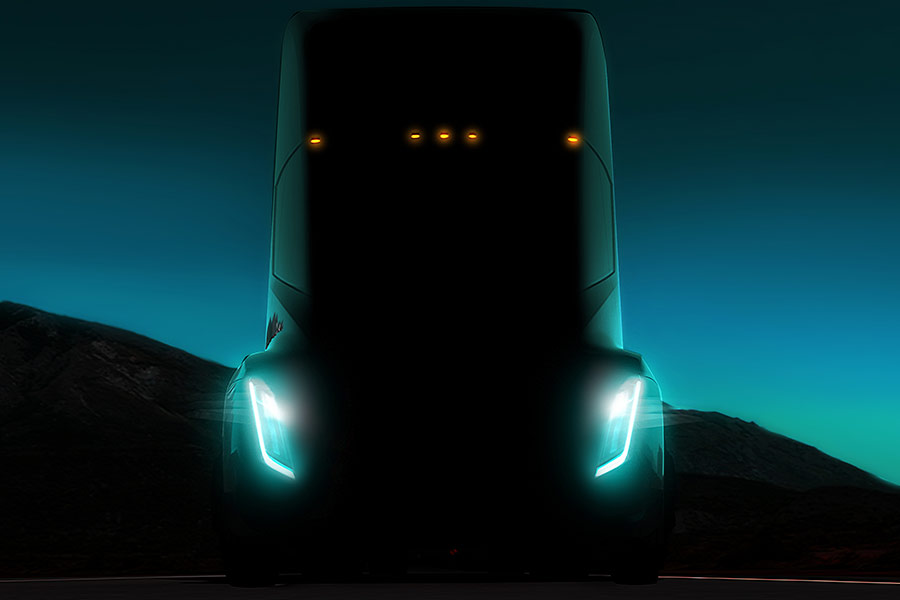
New Truck Can Transform Into a Robot, Fight Aliens and Make One Hell of a Latte

The Tesla Semi, launched by Elon Musk, will deliver a far better experience for truck drivers, while increasing safety and significantly reducing the cost of cargo transport. 

Musk has described Tesla’s new battery-powered cargo vehicle as an “unreal beast” and is set to revolutionize the transport supply chain. Electric power is cheaper than conventional, fossil fuel and could include self-driving technology that would do away with drivers.

It’s so full of groundbreaking features and forward-thinking ideas that Musk joked on Twitter: “It can Transform Into a robot, fight aliens and make one hell of a latte.” The way Musk is going with space exploration, reinventing the battery, underground high speed travel and automated driving, this may not be much of a joke after all.

If you like this, subscribe here for more stories that Inspire The Future.

Already a pioneer in electric-powered cars and innovative self-driving software, Musk is on record as saying that developing electric vehicles was “not some silly hippy thing, it matters for everyone.” Redefining mobility is not just about replacing cars and trucks with new models, but looking at the entire infrastructure.
 

Megachargers, a new high-speed DC charging solution, will add about 400 miles in 30 minutes and can be installed at origin or destination points and along heavily trafficked routes, enabling recharging during loading, unloading, and the perfect opportunity for drivers to grab coffee and a doughnut during breaks.

Without a trailer, the Tesla Semi achieves 0-60 mph in five seconds, compared to 15 seconds in a comparable diesel truck. It does 0-60 mph in 20 seconds with a full 80,000-pound load, a task that takes a diesel truck about a minute. Most notably for truck drivers and other travelers on the road, it climbs 5% grades at a steady 65 mph, whereas a diesel truck maxes out at 45 mph on a 5% grade.

The Tesla Semi has been designed to drive in convoy with other Semi’s – multiple trucks driving in close proximity one behind the other. Musk reckons this “freight train of the roads” concept will be cheaper than shipping goods via cargo train. The lead vehicle would control the trucks behind it and also help cut congestion.
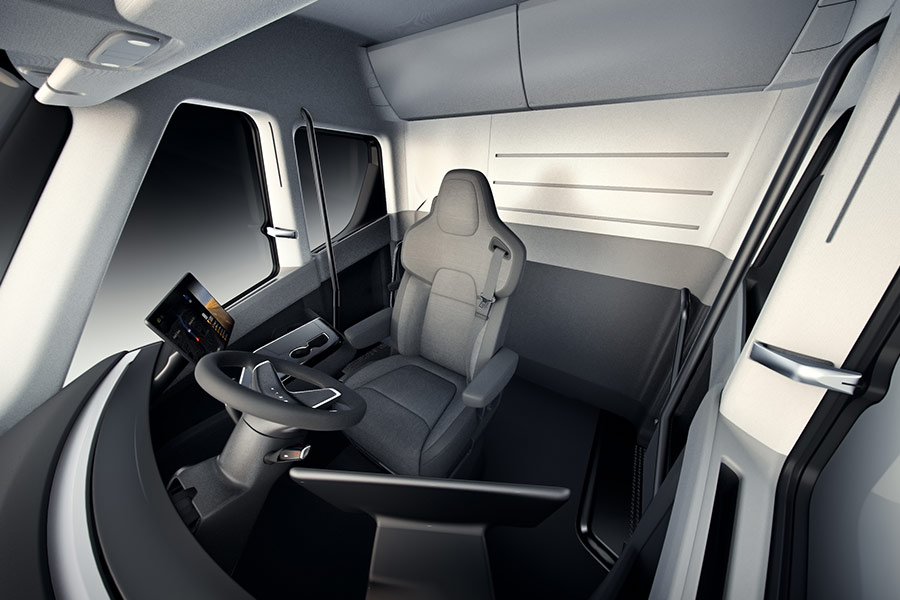
 

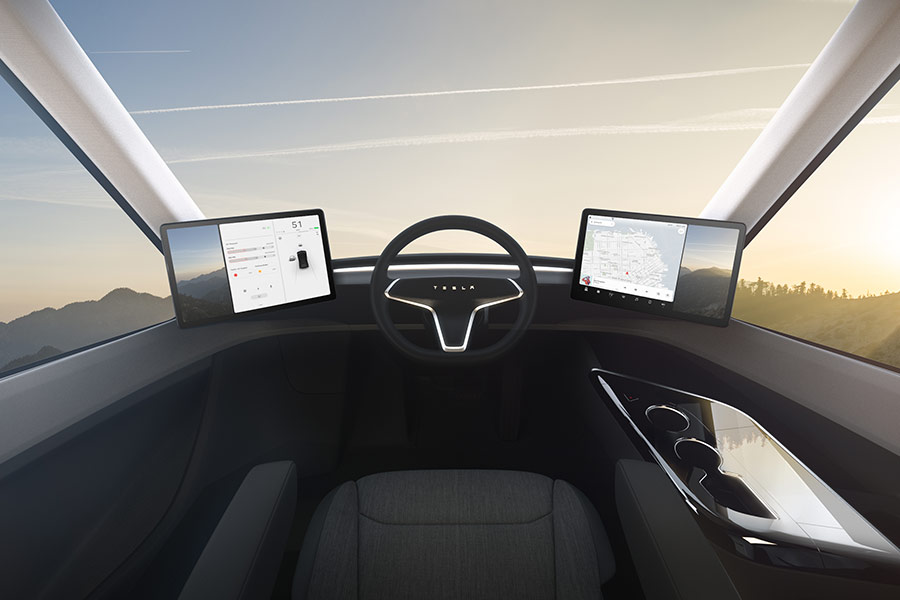
Unlike other trucks, the Semi’s cabin is designed specifically around the driver, featuring unobstructed stairs for easier entry and exit, full standing room inside, and a centered driver position for optimal visibility. Two touchscreen displays positioned symmetrically on both sides of the driver provide easy access to navigation, blind spot monitoring and electronic data logging. Built-in connectivity integrates directly with a fleet’s management system to support routing and scheduling, and remote monitoring. Diesel trucks today currently require several third party devices for similar functionality.

With far fewer moving parts than a diesel truck – no engine, transmission, after-treatment system or differentials to upkeep – the Tesla Semi requires significantly less maintenance. Its battery is similar in composition to the batteries of Tesla energy products and is designed to support repeated charging cycles for over a million miles, while its motors are derived from the motors used in Model 3 and have been validated to last more than one million miles under the most demanding conditions.
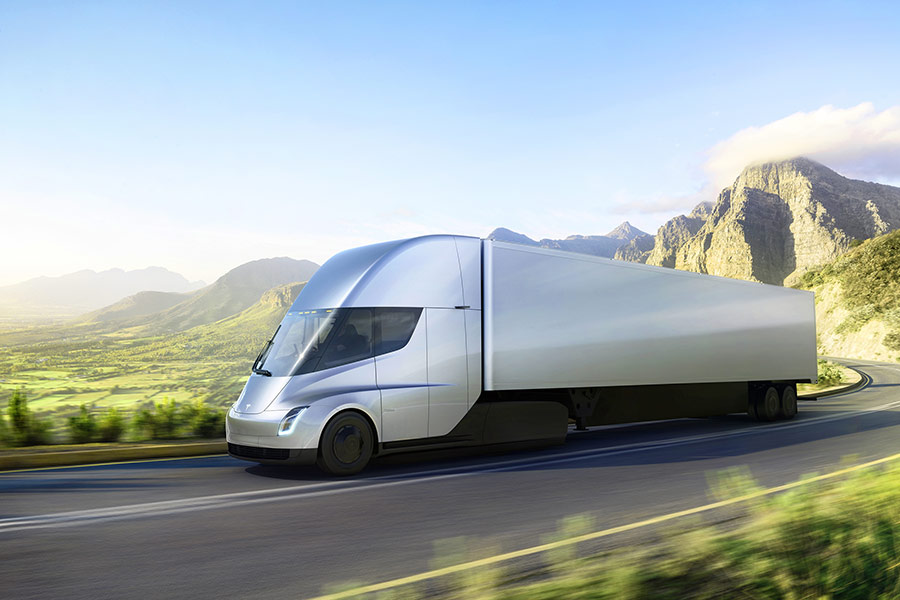
 

The biggest immediate cost-advantage comes from savings in energy costs: fully loaded, the Tesla Semi consumes less than two kilowatt-hours of energy per mile and is capable of 500 miles of range at highway speed. While this distance might sound like a limitation, consider that nearly 80% of freight in the U.S. is moved less than 250 miles.

If you’re still not convinced, maybe the cost saving will help change your mind. With the low and stable nature of electricity prices – which average $0.12/kWh in the U.S.  – owners can expect to gain $200,000 or more in savings over a million miles based on fuel costs alone.

Production of the Tesla Semi is due in 2019.

If you like this, subscribe here for more stories that Inspire The Future.
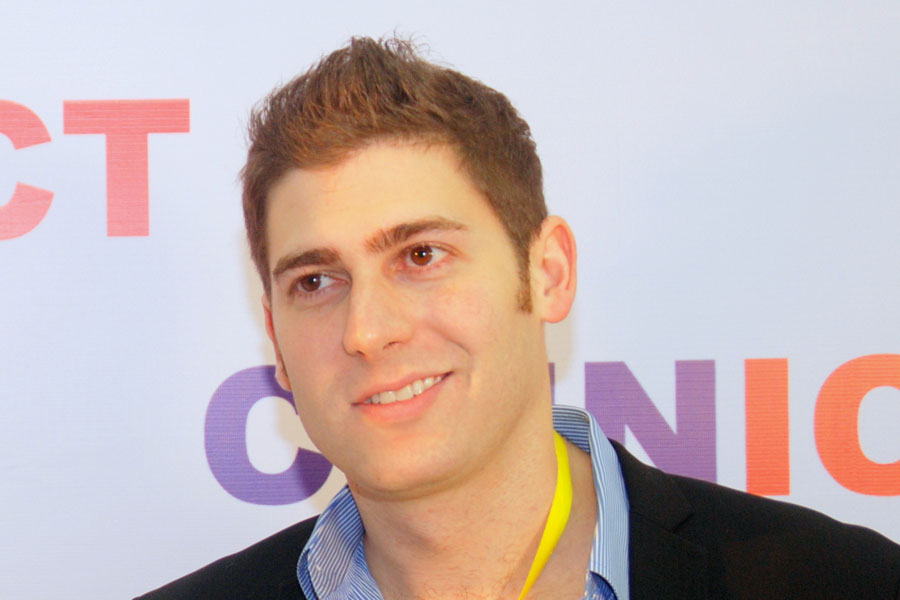
 

Eduardo Saverin, Facebook Cofounder

Eduardo Luiz Saverin was born in São Paulo, Brazil, to a wealthy Jewish Brazilian family. In 1993, the family immigrated to the U.S., settling in Miami.

Saverin attended Harvard University, where he graduated with a bachelor’s degree in economics. During his junior year at Harvard, Saverin met fellow Harvard undergraduate, Mark Zuckerberg. Noting the lack of a dedicated social networking website for Harvard students, the two worked together to launch The Facebook in 2004. As co-founder, Saverin held the role of chief financial officer and business manager.

In 2012, Business Insider obtained and released an exclusive email from Zuckerberg detailing how he cut Saverin from Facebook and diluted his stake. A lawsuit was filed by Facebook against Saverin, that was eventually resolved. Terms of the settlement were not disclosed and the company affirmed Saverin’s title as co-founder of Facebook. Saverin signed a non-disclosure contract after the settlement.

As of 2015, he owns 53 million Facebook shares (approximately 0.4% of all outstanding shares) and has a net worth of $8.7 billion, according to Forbes. He has also invested in early-stage startups such as Qwiki and Jumio.


Jeff Koons Partners With Kiehl’s For Missing & Exploited Children

Earlier this year Jeff Koons’s Seated Ballerina, a large-scale public art installation, rose into the air outside the Rockefeller Center in New York. The inflatable nylon sculpture stood 45 feet high and aimed to raise funds and awareness around missing children.

Often referencing historical imagery and found objects, Koons based Seated Ballerina on a small porcelain figurine. The sculpture acts as a contemporary iteration of the goddess Venus, and symbolizes notions of beauty and connectivity. Its reflective surface mirrors its immediate environment and engages with each viewer. The work aims to bring awareness to National Missing Children’s Month in May, in an effort to support organizations like the International Centre for Missing & Exploited Children (ICMEC) that work tirelessly to create a safer world for children.

If you like this, subscribe here for more stories that Inspire The Future.

“We’re thrilled to continue what’s become a Kiehl’s tradition of partnering with Jeff Koons,” says Chris Salgardo, President, Kiehl’s USA.”With more than 465,000 reports of missing children last year in the United States alone, it’s gratifying to know that via this fourth partnership with Koons and the International Centre for Missing & Exploited Children, we are able to make a difference in the lives of our children.”

“We are honored to work with Jeff Koons, Kiehl’s and Tishman Speyer to present Seated Ballerina at Rockefeller Center,” said Casey Fremont, Executive Director of Art Production Fund. “We believe in the power of collaboration, and we are thrilled to present a public art project that raises awareness of the urgent need to protect children worldwide.”

Seated Ballerina, 2017 © Jeff Koons / Photo: Tom Powel Imaging


In honor of National Missing Children’s Month, Koons has also created a limited edition Seated Ballerina tin for the Midnight Recovery Collection. Kiehl’s will donate 100% of its net profits from the collection, up to $100,000, to directly benefit ICMEC. A fervent advocate for protecting children, Koons worked with ICMEC to co-found The Koons Family Institute on International Law & Policy in 2007 to combat child abduction and exploitation. He also serves on ICMEC’s Board of Directors. The installation highlights the longstanding relationship Kiehl’s has forged with Jeff Koons and ICMEC since 2011. Art Production Fund has also worked on a number of projects with Koons since 2009, donating a portion of sales from its Works on Whatever Collection to ICMEC.

If you like this, subscribe here for more stories that Inspire The Future.
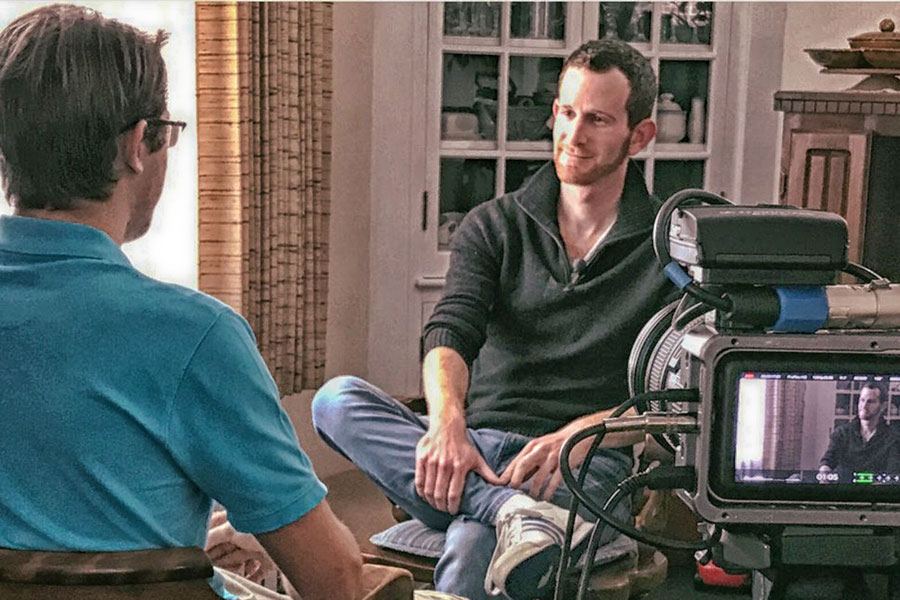
 

The American Question: Rethinking Values in Order to Survive as a Superpower

A year after the historically divisive 2016 elections, a new documentary is challenging Americans to stop blaming others and question how their own decisions and actions shape the contours of our society and our country.

By asking questions about family, money, religion, civics and more, the film gets viewers to question whether the divisions in our society truly stem from group dynamics, or if we’re all part of the problem as individuals.

If you like this, subscribe here for more stories that Inspire The Future.
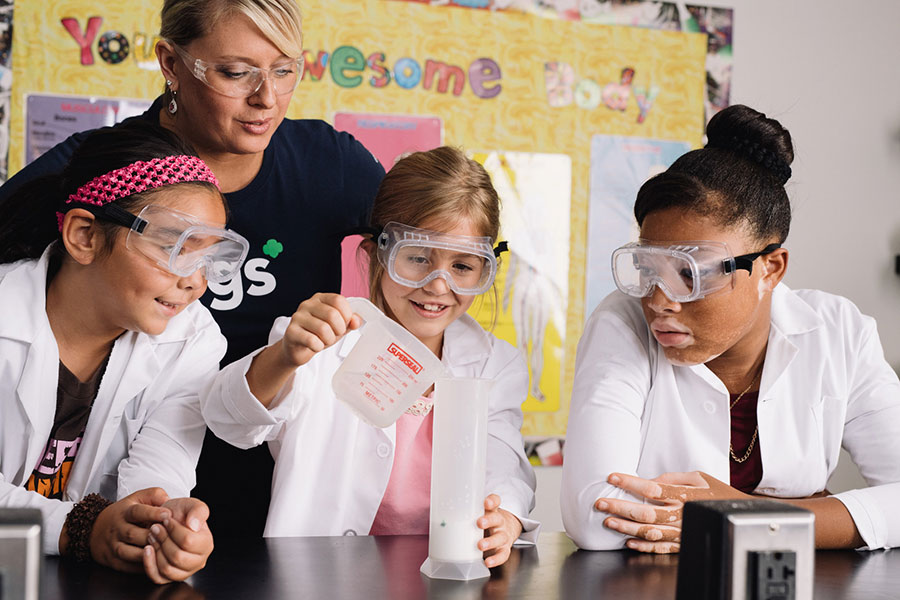
“The American Question,” produced by Guy Seemann (pictured above) – a political veteran and entrepreneur who’s lived all over the world and directed by James Kicklighter – a Hollywood filmmaker raised in rural Georgia, profiles dozens of Americans from across the political, economic and social spectrum in search of these answers, going far deeper than just getting people together to find some superficial common ground.

The film explores this question through the lens of history, deteriorating civic education and evolving culture rather than rehashing the 2016 election. After conducting dozens of interviews of people from different walks of life all across the country, the creators believe something much bigger is at work, and that it has the potential to threaten the status of America as a superpower.

“We found that our divides had nothing to do with the election,” Seemann said.

“Fights spring up over core values which are supposed to unite us as a nation. Religion, speech, equality, opportunity – these concepts kept coming up over and over again.”

“This is a unique period in time, but the identity crisis we’re feeling is part of a cyclical pattern in this country. After our nation unites to defeat a common enemy – the imperial British, slavery and secession or the Nazis, we tend to lose our cohesiveness. This time, though, we have to address this issue or our status as a cohesive entity – let alone a superpower –is under threat,” he added.

Kicklighter continued, “there’s a set of values that define what it means to be an American. I heard people from all corners of the country saying the other side did not have their interests in mind. A fascinating pattern unfolded about the broader culture here, and we are trying to figure out what’s causing it and what it means.”

“What’s dangerous is when someone comes to a different set of conclusions based on their ideological perspective and pegs the other as an enemy simply because the other doesn’t agree with their individualized ideology,” Kicklighter said. “I hope The American Question helps people recognize that their neighbor is as American as they are. That’s the starting point we need to get to,” he said.

With entire communities in crisis due to this breakdown over America’s core values, the filmmakers are looking to spark a national conversation to encourage viewers to rethink how they themselves approach their own life decisions as well as their perceived differences with their neighbors. Seemann, Kicklighter and their national team want to enable them to reconcile over the shared values laid out in the founding documents which have helped the country overcome adversity since its founding.

For more on the film visit www.theamericanquestion.com

If you like this, subscribe here for more stories that Inspire The Future.

 

Girl Scouts To Bring 2.5 Million Girls Into STEM Pipeline By 2025

The organization is working to raise $70 million toward developing the next generation of female leaders in science, technology, engineering, and math (STEM) fields.

Girl Scouts of the USA (GSUSA) has announced a groundbreaking national initiative to reduce the gender gap in STEM fields by bringing millions of girls into the STEM pipeline over the next eight years. Building on GSUSA’s existing efforts, the Girl Scout STEM Pledge seeks to raise $70 million, impacting 2.5 million girls by 2025. GSUSA CEO Sylvia Acevedo broke the news in front of thousands of business leaders during her keynote interview with Salesforce CEO Marc Benioff at Dreamforce, Salesforce’s annual gathering and the largest software conference in the world.

If you like this, subscribe here for more stories that Inspire The Future.

Acevedo’s participation is part of Girl Scouts of the USA’s selection as a “Trailblazer” and nonprofit of choice at this year’s conference. By selecting the organization, Salesforce acknowledged Girl Scouts’ work in STEM and its ability to transform the lives of millions of girls across the country, in virtually every residential zip code, preparing the next generation of female leaders.

GSUSA is 2.6 million strong – 1.8 million girls and 800,000 adults – who believe in the power of every G.I.R.L. (Go-getter, Innovator, Risk-taker, Leader)™ to change the world. 

“Girl Scouts has the largest pipeline of future female leaders available, and no place is this more important than in STEM fields,” said Acevedo. “By working with individuals and companies that understand the importance of investing in all girls, we can fundamentally change the STEM pipeline and the future of its workforce. Girl Scouts is the only organization for girls with the expertise and reach to help pave the way for any young girl—no matter if she lives in Middle America or a major city—to break barriers and achieve any dream she may imagine. For millions of girls, this means excelling in STEM—and I’m incredibly proud that the Girl Scout STEM Pledge will make that dream a reality and change the dynamics of women in these exciting fields.”

The organization’s commitment to encouraging girls to discover and excel in STEM fields has yielded real results: Girl Scouts are almost twice as likely as non–Girl Scouts to participate in STEM activities (60 percent versus 35 percent), and 77 percent of girls say that because of Girl Scouts, they are considering a career in technology.

The announcement follows GSUSA’s extensive work to expand opportunities for girls in STEM. Earlier this year, the organization launched new programming that includes 23 new STEM and Outdoor badges. Over the next two years, GSUSA will launch 18 Cybersecurity badges and a series of Space Science badges. The new Girl Scout programming builds girls’ skills and encourages their interest in STEM and environmental conservation from an early age—areas girls are not typically encouraged to explore outside Girl Scouting.

If you like this, subscribe here for more stories that Inspire The Future.

 

What Lessons Can we Learn From Fictional Businesses?

A business can have huge success, which people will remember, or they can experience even more significant failures that people will find hard to forget. We often look to business leaders and entrepreneurs for good leadership styles, to understand their success stories and learn from their mistakes.

But it’s not only real-life businesses of which we should take note. As a fun exercise, employee benefits provider Unum, has taken a look at some fictional business from television and film and picked the 12 biggest business lessons. It may surprise you just how relevant and applicable they are to the real world.

If you like this, subscribe here for more stories that Inspire The Future.
As an example, the Batman series is home to one of the biggest fictional companies, Wayne Enterprises. When the workload becomes too much for Bruce Wayne, he appoints Lucius Fox as his business partner. It’s a risky decision, but it works out for the best because Bruce knows he can trust Lucius due to their friendship. Other companies, however, don’t have the same success.

In The Simpsons, Mr. Burns’ nuclear power plant leaks radioactive waste and dumps waste in a playground. This obviously breaks many safety violations – but the main lesson here is to ensure that all employees are fully equipped and trained for the job to avoid such disasters. Other fictional companies simply show true leadership by adapting and changing their business operations.

In the popular Pixar film Monsters Inc, Sully and Mike prove that there are other ways to generate the city’s electricity by finding out that laughter works even better than screams! This scene demonstrates why companies shouldn’t become stuck in their ways. Tave a look below for some more business lessons from fictional businesses – that you might apply to your own business.

If you like this, subscribe here for more stories that Inspire The Future.

 

Is Your Business Prepared For a Cyberattack?

Massive cybersecurity breaches have become almost commonplace, regularly grabbing headlines that alarm consumers and leaders. But for all of the attention such incidents have attracted in recent years, many organisations worldwide still struggle to comprehend and manage emerging cyber risks in an increasingly complex digital society.
 
PwC has launched its 2018 Global State of Information Security Survey (GSISS), based on responses of more than 9,500 senior business and technology executives from 122 countries.
Executives worldwide acknowledge the increasingly high stakes of cyber insecurity. Forty percent of survey respondents cite the disruption of operations as the biggest consequence of a cyberattack, 39% cite the compromise of sensitive data, 32% cite harm to product quality, and 22% cite harm to human life.
 
Yet despite this awareness, many companies at risk of cyberattacks remain unprepared to deal with them. Forty-four percent say they do not have an overall information security strategy. Forty-eight percent say they do not have an employee security awareness training programme, and 54% say they do not have an incident-response process.
 
Some of the key findings in the report found that:
 
  • Forty percent of survey respondents cite the disruption of operations as the biggest consequence of a cyberattack, followed by the compromise of sensitive data (39%), harm to product quality (32%), and harm to human life (22%).
  • Forty-four percent of the 9,500 executives in 122 countries surveyed say they do not have an overall information security strategy.
  • Forty-eight percent do not have an employee security awareness training programme, and 54% don’t have an incident-response process.
  • When cyberattacks occur, most victimised companies say they cannot clearly identify the culprits. Only 39% of survey respondents say they are very confident in their attribution capabilities.
 
How cyber interdependence drives global risk
 
Case studies of non-cyber disasters have shown that cascading events often begin with the loss of power—and many systems are impacted instantaneously or within one day, meaning there is generally precious little time to address the initial problem before it cascades. Interdependencies between critical and non-critical networks often go unnoticed until trouble strikes. Many people worldwide—particularly in Japan, the United States, Germany, the United Kingdom and South Korea—are concerned about cyberattacks from other countries. Tools for conducting cyberattacks are proliferating worldwide. Smaller nations are aiming to develop capabilities like those used by larger countries. And the leaking of US National Security Agency (NSA) hacking tools has made highly sophisticated capabilities available to malicious hackers.
 
The soaring production of insecure internet-of-things (IoT) devices is creating widespread cybersecurity vulnerabilities. Rising threats to data integrity could undermine trusted systems and cause physical harm by damaging critical infrastructure.
 
Meanwhile, there is a wide disparity in cybersecurity preparedness among countries around the world. In the 2018 GSISS, the frequency of organisations possessing an overall cybersecurity strategy is particularly high in Japan (72%), where cyberattacks are seen as the leading national security threat, and Malaysia (74%).
 
In May 2017, G-7 leaders pledged to work together and with other partners to tackle cyberattacks and mitigate their impact on critical infrastructure and society. Two months later, G-20 leaders reiterated the need for cybersecurity and trust in digital technologies. The task ahead is huge.
 
Next steps for business leaders
 
So what can business leaders do to prepare effectively for cyberattacks? PwC recommends three key areas of focus:
 
C-suites must lead the charge and boards must be engaged: Senior leaders driving the business must take ownership of building cyber resilience. Setting a top-down strategy to manage cyber and privacy risks across the enterprise is essential.
 
Pursue resilience as a path to rewards—not merely to avoid risk: Achieving greater risk resilience is a pathway to stronger, long-term economic performance.
 
Purposefully collaborate and leverage lessons learned: Industry and government leaders must work across organisational, sectoral and national borders to identify, map, and test cyber-dependency and interconnectivity risks as well as surge resilience and risk-management.
“Few business issues permeate almost every aspect of business and commerce like cybersecurity does today,” said David Burg, Global Cybersecurity Leader at PwC. “Public-private coordination is critical to effectively addressing cybersecurity.”


Sailing on an Ocean of Trash: Caribbean to Norway And Back

Three people journeyed across the globe to discover the health of our seas. The Zing Ocean Conservancy team members have an incredible passion for the ocean; the beauty of it, the diverse life, the roughness of the seas and what is yet to be explored. Unfortunately, what they found is that how we live today is not very sustainable for our oceans.

Every year, at least eight million tons of plastic enters the ocean. That’s the equivalent weight of three million Honda Civics per year, or 5.8 Honda Civics per minute.

If you like this, subscribe here for more stories that Inspire The Future.

What’s so bad about plastic in the ocean, you may ask? Plastic takes about 400 years to biodegrade. Almost all plastic that has ever been produced still exits. The plastic that enters the oceans are broken into microscopic pieces from weather, sun and saltwater. These pieces are often mistaken for food and enter the food chain. Millions of marine animals are killed from eating plastic annually. Plastic chemicals can also be absorbed in our bodies and can cause serious health problems. Today, 94% of U.S. tap water is contaminated by plastic.

Zing Ocean Conservancy’s Co-Founders, Michele Donihe and Jonas Legernes decided to raise awareness around it. They embarked on a journey across the globe in a 30-foot sailboat to discover just how bad it is. Along the way, they documented it and cleaned some up.

The journey started in the U.S. Virgin Islands mid-May 2017 and ended in Spain late July 2017. In almost every port and country, they cleaned up beaches and spread their passion to save the ocean. The expedition included an Atlantic crossing and visits to three different continents.

What did they discover? An even bigger passion for the ocean within themselves. And that the health of our oceans is seriously threatened.

“We feel like we have to give back to the ocean, and encourage others to do so as well,” says Donihe. “Pick up trash for 10 minutes every time you go to the beach. Use less plastic. The average plastic bag is used for only 15 minutes; use reusable non-plastic bags. Anything and everything helps. Be cool and recycle.”

www.zingoceanconservancy.org

If you like this, subscribe here for more stories that Inspire The Future.


Be Strong Documentary Tackles Bullying

Be Strong, a national, student-led youth empowerment organization dedicated to ending bullying in schools, is leading the charge to assure that no child lives with the isolation and fear of being bullied.

In an effort to spread awareness in schools and the community, the organization will begin broadcasting its bullying prevention documentary online, reaching millions of school officials, as well as students and their parents or guardians throughout the United States.

If you like this, subscribe here for more stories that Inspire The Future.

“Be Strong strives to inspire kids to act empowered and encourage change in their peers,” said Ashleigh Cromer, executive director of Be Strong. “This documentary is our attempt to meet students where they are and provide sustainable education and resources for change, in a digestible, actionable and entertaining way. Our youth are smart, open, inspiring and our most precious resource – I’m motivated by their resiliency and ability to connect in a way that’s comfortable for them.”

The 45-minute documentary will feature remarks and best practices for preventing and recovering from bullying by best-selling author, Broadway performer and motivational speaker Jessie Funk, and recording artists Linkin’ Bridge and Breaking Heights, along with Be Strong student leaders and several bullying victims whose inspirational stories of strength and perseverance have made national headlines.

“Every child should be able to attend school in a safe environment and feel comfortable and appreciated for who they are,” said Colin Brown, chairman and CEO of JM Family. “Empowering families and nurturing children are at the core of our philanthropy, which is why we are proud to partner with and support Be Strong.”

The Be Strong Documentary will generate much-needed awareness of the issue, including how to identify, prevent and end bullying, and identify support options available to help from a position of victory not victimization. Viewers will be encouraged to change the way bullying prevention is perceived, initiating hope and resilience to create long-term change.

“When schools take the time to implement research-based programming in this area, not only does it decrease bullying and cyberbullying – it also accomplishes the goals that educators care most about,” says Dr. Sameer Hinduja, co-director of the Cyberbullying Research Center and Be Strong board member. “Specifically, these efforts lead to a positive school climate, which then increases academic achievement, lowers absenteeism and truancy, reduces other problem behaviors on campus, and raises morale among both students and staff. I fully support the mission and impact of the Be Strong movement.”

If you like this, subscribe here for more stories that Inspire The Future.


‘Aqua Kale’ Being Grown in Middle East Desert

Global Food Industries (GFI) aims to produce around 24 tons of ‘Aqua Kale’ each year on water in the middle of the United Arab Emirates (UAE) desert. 

The farm uses 100% recycled water, helping produce up to 25% more food with the same water source compared with conventional methods.

According to a Frost and Sullivan report, the value of the regional organic farming segment is expected to reach USD 1.5 billion by 2018 – attributing the growth to the increasing demand coming from major retailers. GFI is introducing the idea of organic farming to the UAE market in light of the growing popularity of organics across the rest of the Gulf region. 

If you like this, subscribe here for more stories that Inspire The Future.

“Without a doubt, ‘Aqua Kale’ is the right product to help address several serious health and dietary concerns in the UAE and the Middle East, including diabetes and obesity. Higher health awareness among UAE citizens and residents as a result of intensive government campaigns and initiatives is driving the demand for healthy food choices,” says Jacek Plewa, GM, Global Food Industries.

The zero-fat superfood kale, which is part of the cabbage family, is high in protein, vitamins, omega-3 fatty acids, fibre and antioxidants, among others. One cup of this green leafy vegetable contains 36 calories and 5 grams of fiber. Kale contains nearly twice the amount of vitamin K as most of its fellow cruciferous vegetables. Proportionate servings of ‘Aqua Kale’ have more iron than beef, more calcium than milk, and more vitamin C than spinach. Among the most nutrient-dense superfoods on earth, kale is a popular ingredient of salads, juices and snacks in many Western countries but it remains relatively unknown in the region. Global Food Industries recently also won best food innovation award at Gulfood recently for ‘Aqua Kale.’

“We are currently supplying to local restaurants and cafeterias and we are training the staff to make sugar-free juices and smoothies by adding kale,” says Plewa.

“Juices with kale are equally tasty. We are regularly monitoring our more than 400 partner cafés to make sure that they offer healthy alternatives only. Moreover, ‘Aqua Kale’ is the ideal alternative to sugar-rich snacks popular among residents. We are fully committed in promoting and making people more aware of this healthier source of nutrition—not just for people today but also for future generations.”

If you like this, subscribe here for more stories that Inspire The Future.


0