10 Reasons Why Pope Francis is a Real Leader

The first non-European pope in more than 1,200 years, and someone with an outspoken style and radically different leadership style has made Pope Francis one of the most controversial pope’s ever.

His views on church reform, poverty, climate change and divorce have shaken up world opinion and placed him firmly in the media spotlight. His visits to Israel and Cuba, the welcoming of Palestine president, Mahmoud Abbas to the Vatican, his address to the U.S. Congress and willingness to meet world leaders demonstrate that he is a pope unafraid of international diplomacy. A real leader does not shy away from crisis and debate, but embraces them as part of finding a solution. Here are his views on ten key issues, in his own words:

If you like this, subscribe here for more stories that Inspire The Future.

1. Human Rights

“Human rights are not only violated by terrorism, repression or assassination, but also by unfair economic structures that creates huge inequalities.”

2. Equality

“We must restore hope to young people, help the old, be open to the future, spread love. Be poor among the poor. We need to include the excluded and preach peace.”

3. Peace

“Each of us has a vision of good and of evil. We have to encourage people to move towards what they think is good… Everyone has his own idea of good and evil and must choose to follow the good and fight evil as he conceives them. That would be enough to make the world a better place.”

4. Finance

“There is a need for financial reform along ethical lines that would produce in its turn an economic reform to benefit everyone. This would nevertheless require a courageous change of attitude on the part of political leaders.”

5. Work

“Together with a culture of work, there must be a culture of leisure as gratification. To put it another way: people who work must take the time to relax, to be with their families, to enjoy themselves, read, listen to music, play a sport.”

6. The Environment

“May the relationship between man and nature not be driven by greed, to manipulate and exploit, but may the divine harmony between beings and creation be conserved in the logic of respect and care.”

7. Sustainability

“Never have we so hurt and mistreated our common home as we have in the last 200 years.”

8. World Economy

“The idea of infinite or unlimited growth, which proves so attractive to economists, financiers and experts in technology … is based on the lie that there is an infinite supply of the earth’s goods, and this leads to the planet being squeezed dry at every limit.”

9. Government

“Every man, every woman who has to take up the service of government, must ask themselves two questions: ‘Do I love my people in order to serve them better? Am I humble and do I listen to everybody, to diverse opinions in order to choose the best path?’ If you don’t ask those questions, your governance will not be good.”

10. Power

“You cannot be in a position of power and destroy the life of another person.”

If you like this, subscribe here for more stories that Inspire The Future.

UPS Deploys First Electric Trucks to Rival Fuel Vehicles

UPS has announced that it plans to deploy 50 plug-in electric delivery trucks that will be comparable in acquisition cost to conventional-fueled trucks without any subsidies – an industry first that is breaking a key barrier to large scale fleet adoption.

The company is collaborating with Workhorse Group, Inc.(NASDAQ:WKHS) to design the vehicles from the ground up, with zero tailpipe emissions.

“Electric vehicle technology is rapidly improving with battery, charging and smart grid advances that allow us to specify our delivery vehicles to eliminate emissions, noise and dependence on diesel and gasoline,” said Carlton Rose, President, Global Fleet Maintenance and Engineering for UPS. “With our scale and real-world duty cycles, these new electric trucks will be a quantum leap forward for the purpose-built UPS delivery fleet. The all electric trucks will deliver by day and re-charge overnight. We are uniquely positioned to work with our partners, communities and customers to transform freight transportation.” 

If you like this, subscribe here for more stories that Inspire The Future. 

Workhorse claims these vehicles  provide nearly 400% fuel efficiency improvement as well as optimum energy efficiency, vehicle performance and a better driver experience. Each truck will have a range of approximately 100 miles between charges, ideal for delivery routes in and around cities. The class 5, zero emission delivery trucks will rely on a cab forward design, which optimizes the driver compartment and cargo area, increasing efficiency and reducing vehicle weight. The new trucks will join the company’s Rolling Lab, a growing fleet of more than 9,000 alternative fuel and advanced technology vehicles.   

“This innovation is the result of Workhorse working closely with UPS over the last 4 years refining our electric vehicles with hard fought lessons from millions of road miles and thousands of packages delivered,” said Steve Burns, CEO of Workhorse Group. “Our goal is to make it easy for UPS and others to go electric by removing prior roadblocks to large scale acceptance such as cost.”

UPS will test the vehicles primarily on urban routes across the country, including Atlanta, Dallas and Los Angeles. With zero emissions and lower noise, the electric delivery trucks will help UPS make its fleet cleaner and quieter, a  significant benefit in urban areas.

Following real-world test deployments, UPS and Workhorse will fine-tune the design in time to deploy a larger fleet in 2019 and beyond. Since most of the maintenance costs of a vehicle are associated with the engine and related components, UPS expects the operating cost of the new plug-in electric vehicle to be less than a similarly equipped diesel or gasoline vehicle. UPS’s goal is to make the new electric vehicles a standard selection, where appropriate, in its fleet of the future. UPS has approximately 35,000 diesel or gasoline trucks in its fleet that are comparable in size and are used in routes with duty cycles, or daily miles traveled similar to the new electric vehicles.

UPS has more than 300 electric vehicles deployed in Europe and the U.S., and nearly 700 hybrid electric vehicles. The company recently ordered 125 new fully-electric Semi tractors to be built by Tesla in 2019, the largest pre-order to date. Additionally, last September, UPS announced it will become the first commercial customer in the U.S. to start using three medium-duty electric trucks from Daimler Trucks Fuso brand, called the eCanter.

The initiative will help UPS attain its goal of one in four new vehicles purchased by 2020 being an alternative fuel or advanced technology vehicle. The company also has pledged to obtain 25 percent of the electricity it consumes from renewable energy sources by 2025 and replace 40 percent of all ground fuel with sources other than conventional gasoline and diesel, an increase from 19.6 percent in 2016.

UPS operates one of the largest private alternative fuel and advanced technology fleets in the U.S. This includes all-electric, hybrid electric, hydraulic hybrid, ethanol, compressed natural gas (CNG), liquefied natural gas (LNG) and propane.

If you like this, subscribe here for more stories that Inspire The Future. 

David Yurman Joins Executive Producing Team For ‘Gender In Hollywood’

A new film will examine Hollywood’s gender bias through personal stories, leading research, and celebrity accounts. David Yurman is joining executive producer and Academy Award- winning actor and advocate Geena Davis in the upcoming feature-length documentary ‘Gender In Hollywood’ (working title).

The film examines Hollywood’s gender bias through first-hand accounts from some of Hollywood’s leading industry professionals both in front of and behind the camera, shining a spotlight on the broader effects of bias on consumers of entertainment around the globe.

If you like this, subscribe here for more stories that Inspire The Future.

“David Yurman (pictured with his wife Sybil, above) is committed to helping raise awareness about the need for gender parity, and is honored to be a part of the documentary, which is a powerful platform to spread this message,” said David Yurman. “It is a natural fit.”

The David Yurman brand has long been a proponent of female empowerment. 75 percent of the David Yurman executive committee are women, and the company is almost 70 percent female.

“We are a company of women, led by women and co-founded by a woman,” said Sybil Yurman, co-founder David Yurman. “Since 1980 we have strived to elevate and celebrate women throughout all levels of the company.”

Through the candid testimony of high-profile actors, directors and studio executives, the film connects the dots between the disparity onscreen and the lack of opportunity women face behind the scenes, telling the story of systemic discrimination throughout Hollywood’s history. Interviewees include Geena Davis, Shonda Rhimes, Jessica ChastainZoe SaldanaJudd ApatowYara ShahidiPaul FeigChloe Grace MoretzGillian AndersonJackie CruzSharon StoneAlan Alda, and Lena Dunham.

Cutting-edge data from The Geena Davis Institute on Gender in Media is used to support the narrative of the film. The institute is the only research-based organization working behind the scenes in the media and entertainment industry to influence the need to dramatically improve gender balance, reduce stereotyping and create diverse female characters in entertainment targeting children.

“Unconscious gender bias directly correlates to the way women are represented on screen,” said Geena Davis. “When we look at how this documentary will add to the discussion about gender inequality, we hope one of the key takeaways is that a solution is only possible if both women and men in this industry work together to create change.”

Ku-Ling Yurman, independent filmmaker and daughter-in-law of David and Sybil, will act as an executive producer on the film. An alum of the American Film Institute, Ku-Ling has taken on many roles in the television/film industry.

“I first experienced institutionalized inequality when I was in film school, and quickly realized it spans all industries,” said Ku-Ling Yurman. “Our objective with this documentary is to bring about actual change. We have a collective responsibility to take ownership of this issue and activate a higher standard for gender equality.”

The film is directed by Tom Donahue (Casting By, Thank You for Your Service) and produced by CreativeChaos vmg and New Plot Films in association with the Geena Davis Institute on Gender in Media and Artemis Rising Foundation. Filming began in 2016.

In addition to Geena Davis and Ku-Ling YurmanRegina K. ScullyMadeline Di NonnoSteve EdwardsPatty Casby, and Jennie Peters are executive producers on the film. Ilan Arboleda and Kerianne Flynn are set to produce.

“Since we started the film a year and a half ago, we have conducted more than 100 interviews with some of the leading voices on the issue both inside and outside of Hollywood. Their candid testimony has not only detailed the systemic roadblocks that women face as storytellers and artists in Hollywood, but also has illuminated possible pathways toward lasting parity, “said director Tom Donahue.

If you like this, subscribe here for more stories that Inspire The Future.

Costa Rican Pineapple Buyers Can Now Guarantee They’re Deforestation-Free

As consumers become increasingly concerned about the environmental impact of agro-commodity production, with the click of a button, companies buying pineapples from Costa Rica – one of the world’s largest producers of the fruit – can now see if their suppliers are engaged in deforestation or not, with help from the United Nations’ Green Commodities Programme.

The Land Use Change Monitoring System within Production Landscapes (MOCUPP), developed with support from the United Nations Development Programme’s (UNDP) Green Commodities Programme, is the world’s first to overlay satellite images with land registry records on an annual basis for an entire national territory. Now, every year, the system will produce images showing forest loss and gain from pineapple production in Costa Rica, with more agro-commodities soon to be added to the system.

If you like this, subscribe here for more stories that Inspire The Future.

This new tool is free for commodity buyers to use. Buyers can easily check if their producers are engaged in illegal deforestation, or if they are increasing deforestation cover. The system allows buyers to check this using their own internal records. This avoids any risk related to commercial confidentiality agreements, as there is no need to provide geo-positioning data to any government entity.

Pineapple farmers producing for export who are doing the right thing also stand to benefit. The new tool allows them to show that their farms are deforestation-free, enabling them to benefit from incentive schemes such as the Payment of Ecosystem Services by the National Forestry Financing Fund.

Costa Rica is one of the world’s biggest pineapple-producing countries. MOCUPP is part of a wider national effort to tackle serious social and environmental concerns in this critical sector, worth US$800 million to the national economy.

Already, MOCUPP has developed imagery showing the rapid spread of pineapple cultivation in Costa Rica between 2000 and 2015. It reveals that over the past 15 years, the country has lost more than 5,000 hectares of forest cover, the size of over 3,000 football pitches, due to the expansion of pineapple farming.

The system is also currently developing baselines and annual monitoring for other agro-commodities, including pasture and palm oil plantations. The aim is that by 2020, all of Costa Rica’s major commodity exports will be monitored on an annual basis for deforestation activity. An annual set of images generated by MOCUPP will be published through the National Territorial Information System web tool, accessible by the public. Meanwhile, property records where forest loss or gain has occurred will be made available to authorities and private sector buyers.

The Ministry of Environment, the National Registry, the National Geographical Institute and the Center of High Technology of Costa Rica, with support from the UNDP Green Commodities Programme, UNDP REDD and the Global Environment Facility developed the system.

It has generated keen interest from the governments of ParaguayMadagascarMorocco and Côte d’Ivoire, who are also facing the challenge of reducing deforestation from valuable commodity supply chains. The UNDP Green Commodities Programme is now working with these countries to replicate this system.

If you like this, subscribe here for more stories that Inspire The Future.

Is Porn at Work Fueling the #MeToo Movement?

Who could have predicted that when the New York Times broke the story in early October about Harvey Weinstein’s sexually abusive behavior, it would unleash a tsunami of complaints against some of the world’s most powerful men, many of whom have since been forced to resign?

The list reads like a Who’s Who of Hollywood moguls, journalists, artists, celebrity chefs, and sports stars. And it continues to grow, in large part thanks to the #MeToo movement, which has encouraged women, from all classes and races, to lodge official complaints against employers who have ignored or tolerated sexually abusive behavior in the workplace. 

If you like this, subscribe here for more stories that Inspire The Future.

The focus dramatically shifted to Wall Street in the last few weeks when Lauren Bonner, an associate director at Point72, the investment firm run by the billionaire Steven Cohen, filed a gender discrimination lawsuit against Cohen and the company.  According to the New Yorker,  “the lawsuit begins with an allegation that the word “pussy” was written on a whiteboard inside the office of Point72’s president, Douglas Haynes, and remained there for several weeks in 2017.”  Female employees claim they felt ashamed and humiliated in meetings, “as the PUSSY Board drifted above them, taunting them with repulsive references to their own bodies.”

#MeToo has forced a warp-speed reckoning of gender relations in the workplace unlike anything we have experienced before. This has left many companies scrambling to consider how to respond – whether to discipline or fire employees, implement regular trainings on sexual harassment, set up more robust codes of conduct and channels for complaints, and, more profoundly, to reassess what constitutes a sexually hostile workplace in a time when sexist jokes, lewd behavior, and inappropriate touching will no longer be tolerated.

For all the thousands of articles being written about these shifts, only the Financial Times of London dedicated a whole article to a key issue: the connection between workplace harassment and the use of pornography at work. The FT article focused on the statistic from Pornhub, the largest free porn website in the world, that almost half of their viewers visit the site between 9am-6pm. It really doesn’t need pointing out that these are typically the hours spent at work, but to make the case, the FT quotes a man who works in ‘the city’, London’s financial center, as saying “I don’t know a single guy who hasn’t looked at porn at work.”

For employers, this finding should be taken very seriously. Not only does viewing porn take time away from work, but it also facilitates a corporate culture that tolerates harassment and abuse of female employees. Most directly, it leaves companies extremely vulnerable to lawsuits. It is also likely to have severe consequences in terms of lower morale and productivity,  reputational risks, impaired recruitment, and higher turnover.  As the FT makes clear, in the age of #MeToo, a discussion has opened up “about the weaponized use of porn as a deliberate tool for creating a hostile work environment, and to harass and degrade employees — predominantly women — at work”.

Anyone who has spent time on Pornhub will know that the term “weaponized” is not an exaggeration. The porn images that predominate the site look nothing like your father’s Playboy. The most cited and respected study on the content of the mainstream porn sites such as Pornhub, found that the majority of scenes contained both physical and verbal abuse targeted against the female performers. Physical aggression, which included spanking, open-hand slapping, and gagging, occurred in over 88% of scenes, while expressions of verbal aggression—calling the woman names such as “bitch” or “slut”—were found in 48% of the scenes. The researchers concluded that 90% of scenes contained at least one aggressive act if both physical and verbal aggression were combined.

We have over forty years of research that shows that the more porn that men consume, the more likely they are to internalize these violent sexual scripts. A recent meta-analysis of 22 studies between 1978 and 2014 from seven different countries concluded that pornography consumption is associated with an increased likelihood of committing acts of verbal or physical sexual aggression, regardless of age. A 2010 meta-analysis of several studies found “an overall significant positive association between pornography use and attitudes supporting violence against women.”

Porn has also been found to have more insidious effects on both men and women that are likely to spill over to the workplace. Studies show that men who use porn are more likely to suffer a number of adverse effects, including depression, anxiety, low self-esteem, and marital disruption. Women whose partners view porn suffer similar consequences.

Employers should not only be concerned about being sued for inappropriate behavior that constitutes sexual harassment or discrimination; the very presence, viewing, or sharing of pornography in the workplace can also be construed as creating a hostile work environment and  unlawful sexual harassment, if it interferes with an employee’s work or creates an uncomfortable atmosphere. Two examples of sexual harassment given by The Balance are the “sharing of sexually inappropriate images or videos, such as pornography or salacious gifs, with co-workers” and “displaying inappropriate sexual images or posters in the workplace.” Moreover, once an employee has raised objections about porn in the workplace, it is against the law for a company to ignore the problem.

Because most of the trainings about workplace sexual harassment fail to mention the role of porn in exposing businesses to expensive lawsuits and other negative consequences, Culture Reframed has developed a full-day workshop that not only explains the legal ramifications, but also helps employers and employees understand the multiple harms of viewing porn. Additionally, our workshops are aimed at building healthier, more respectful workplace cultures, with positive outcomes for employers, employees, and the bottom line.

Corporations have a unique role to play in limiting the harms of porn on individuals, families, business and society. Courageous and pioneering corporations can be change agents in creating a positive work environment that normalizes gender equality and respect, the two key components that porn use undermines. Not only will companies benefit from a more egalitarian and collaborative work culture, they will also protect themselves from being on the wrong side of the #MeToo movement – and the law.

Dr. Gail Dines is Professor Emerita of Sociology at Wheelock College, and President and CEO of Culture Reframed, a non-profit organization that builds programs to prevent the harms of pornography. She can be contacted at gdines@culturereframed.org

Dr. David L. Levy is Professor of Management in the Business School at University of Massachusetts, and specializes in Business and Ethics. He is also the treasurer of Culture Reframed. He can be contacted at David.levy@umb.edu

If you like this, subscribe here for more stories that Inspire The Future.

Mothers of Children Lost to Addiction Deluge Trump With Their Message

MaryBeth Cichocki doesn’t want her son to be forgotten – especially by the president of the United States.

Like many moms nationwide, she fears that the focus of the opioid epidemic has shifted from treating addiction like a disease to an indictment of drug dealers and sellers. But those most at fault, Cichocki said, are the large pharmaceutical companies legally allowed to operate here.

In response, she joined the rally cries of mothers throughout America who flooded Trump’s mailbox with handwritten letters, stories and photos of the thousands of children and loved ones who have died from addiction.

If you like this, subscribe here for more stories that Inspire The Future.

“It breaks my heart that my son died of a treatable disease that the system has made a terminal disease,” Cichocki said. “I don’t know how that’s allowed to happen in our country.”

This mother – who started a support group soon after the accidental fatal overdose of her 37-year-old son, Matt – called upon other mothers to do the same. She posted it on Facebook and started the movement in Delaware, knowing far too well how many parents go without children here in the First State.

The goal was for Valentine’s Day cards to flood Trump’s office just in time for the holiday meant to honor loved ones. These cards obviously carry a different meaning than traditional love notes stamped with hearts, Cichocki said.

In 2016, 308 people died from drug-related overdoses. Last year’s numbers aren’t in yet for the state, but the Centers for Disease Control and Prevention estimated more than 64,000 Americans died in 2016. That number – partially due to the increased use of the synthetic painkiller fentanyl – is expected to rise with 2017’s statistics. 

The time to take action is now, said Paula Mattson, a mother from Prices Corner who lost her 26-year-old son, Michael, to addiction. 

She has two grandchildren and fears for what they may encounter if educators and society don’t start treating addiction like a disease. Mattson has already lost far too much, including a son and other family members, to the pull of addiction.

“Just saying, ‘Don’t do it’ — my kids all had the ‘just say no.’ That doesn’t work,” she said. “There needs to be more education for parents.”

Already, Mattson said, a counselor informed her to speak with her grandchildren when they can begin to understand that some kids may be able to try things that they can’t themselves. Their brains may be different due to the inherited nature of addiction, she stressed.

Treatment also has to be more accessible, Mattson said. Not all families have health insurance that will cover 30 days, and even then, 30 days is too little time to reverse ingrained addiction, she said. It’s what she wants Trump to take from her letter.

“You don’t get over addiction in 30 days,” she said. 

Nor do you forget what it’s like to attend a funeral, especially when they haven’t stopped. Mattson recalled burying her son and her friend’s son – and now, years later, saying goodbye to more and more kids.

Anything, at this point, is better than nothing, she stressed.

The state Department of Health and Social Services announced last week that it plans to treat 900 new patients struggling with addiction in the next year through “Centers of Excellence” community hubs that will further the addiction care system. They plan to use peer recovery coaches – people who have experienced the throes of addiction themselves – to help those struggling now.

In Cichocki’s letter, she similarly encouraged Trump to talk to parents of children who have gone through this tragedy. Cichocki, who formerly worked as a nurse, said those who have been in the trenches fighting through insurance barriers and other obstacles know what it’s like and what must be done. 

“You really need to talk to us who are on the front lives of saving our children’s lives,” she said of Trump.

Until then, she plans to keep spreading Matt’s story.

“To not fight back would mean that it’s OK,” she said, “that it’s OK that this happened to him. … I have to try to get our president’s attention.”

By Brittany Horn: bhorn@delawareonline.com. @brittanyhorn

If you like this, subscribe here for more stories that Inspire The Future.

Facebook Makes it Easier to Help During a Crisis

Starting today, organizations and businesses can post in Facebook’s Community Help, so that they can provide critical information and services for people to get the help they need in a crisis.

This announcement comes hot on the heels of Facebook’s decision in January to tackle fake news and promote articles and sources that are “trustworthy, informative and local.” According to CEO Mark Zuckerberg, “There’s too much sensationalism, misinformation and polarization in the world today.” While many media outlets, publications and brands are struggling to understand how the new Facebook rules will affect the visibility of their content on the world’s largest social media network, it’s clear that Zuckerberg is not just censoring – he’s also proactively adding new features to boost this new direction.

If you like this, subscribe here for more stories that Inspire The Future.

This past year people came to Facebook around some of the worst crises across the world to let their friends and family know they’re safe, learn and share more about what’s happening and help communities recover. In particular, many used Community Help to ask for and give help in times of crisis — everything from providing shelter, to rescuing people from flood waters and gathering and distributing clothing, food and water.


How to create a Community Help post

  1. Go to Crisis Response on Facebook
  2. Select the Crisis page you’re interested in, then click the “Community” tab to go to Community Help
  3. Find Help or Give Help by creating a post and commenting on other people’s posts. You can also message people directly from within their posts.

Since launching this feature a year ago, people have posted over 750,000 comments and messages in Community Help for more than 500 different crises. During Hurricane Harvey in the US in August last year, brothers Austin and Nathan grabbed their boat after seeing Community Help posts from people who were trapped and rescued 20 people from the rising waters. 

After the attack in Barcelona in August, Javier took to Community Help to seek psychological support for his friend who witnessed the attack. Lina, a psychotherapist, responded and the next day she met up with Javier’s friend in-person.

People from more than 450 different cities across India took to Community Help to offer help to those affected by the flooding in Mumbai in August last year and after the earthquake in Central Mexico in September, volunteers arrived within an hour to help prepare food for victims.

On average, for every post requesting help, there are five posts offering help. 

But people helping people is only part of the solution. Organizations and businesses also play an integral role in responding to crises and helping communities rebuild. Organizations and businesses can now get involved by posting in Community Help, opening up new possibilities for getting help to those in crisis.

Facebook is beginning to roll out the feature to Pages for organizations and businesses like Direct Relief, Lyft, Chase, Feeding America, International Medical Corps, The California Department of Forestry and Fire and Save the Children and will make the feature available to more in the coming weeks.

Allowing organizations and businesses to post in Community Help will give them new ways to reach communities impacted by crises and provide resources to help them recover. For example, they might post about helping people find everything from free transportation to supplies and connecting volunteers with organizations that need help.

“Facebook’s priority is to build tools that help keep people safe and, when crisis does strike, make it easier for them to get the help they need to recover and rebuild,” said Aften Meltzer of Facebook.

If you like this, subscribe here for more stories that Inspire The Future.

World’s Most Sustainable Home Will be Around in 200 Years

Tom and Marti Burbeck – in search of truly sustainable living – brought together an architect, builder, green building project consultant and multiple building science engineers to design and build their new home, Burh Becc at Beacon Springs.

They have succeeded in creating a home that will still be standing 200 years from now and will still be regenerative to the surrounding ecosystem. In late 2017, their home at Beacon Springs Farm, Michigan, became the second house in the world to achieve a Living Certified ruling via the Living Building Challenge™ certification by the International Living Future Institute. The Burbeck’s hope their truly restorative farmhouse inspires others to reimagine common building techniques.

If you like this, subscribe here for more stories that Inspire The Future.

Tom Burbeck describes the Living Building Challenge (LBC) as a green building certification program that “establishes the highest possible standards for residential building sustainability.” He and Marti learned about the LBC certification while seeking to design their farmhouse to have minimal environmental impact.

The 2,200 square foot (main floor living space) home borrows from the characteristics of 200-year-old Tuscan farmhouses, with a 2,400 square foot barn and workshop. The buildings sit at the center of 15 acres of depleted farm land. A 20-person design/build team, led by the Burbecks, spent five years executing the project.

Marti Burbeck said creating a sustainable living environment was just the next challenge on the list for her and her husband to tackle in life. “As we looked at the criteria for LBC certification we thought, why not go for it?” she said. “If our goals include helping to change peoples’ relationship with the environment and to change building philosophies, we should start with our own project, and then become advocates.” 

“Since the 1960s, the number of U.S. households has grown from 53 million to about 126 million last year,” said Michael Klement, one of the members of the design team. “We have to rethink the relationship between humans, buildings and the environment. Our current model is too destructive. We’re depleting our resources and creating an unacceptable amount of economic disparity. The Living Building Challenge forced us to recalibrate how we design a home and build like nature intended. This is our ‘moon shot’ in the building industry,” Klement added.

“The LBC certification comprises seven performance categories – site, water, energy, health, materials, equity and beauty,” explained Eric Doyle, the senior project manager of Catalyst Partners. “These are subdivided into a total of 20 imperatives, each of which focuses on a specific sphere of influence, such as urban agriculture, net positive water, net positive energy and responsible industry.” For example, to receive full “Living” certification a building cannot use any materials such as formaldehyde, halogenated flame-retardants, lead, mercury, phthalates or PVC/vinyl.

“The materials imperative was the most challenging project component I’ve come across in my 21 years in the green building industry,” said Bob Burnside, CEO of Fireside Home Construction. “Multi-component mechanical, electrical and appliance products were the toughest. 

Below are more examples of how the home earned the international credential.

Urban Agriculture

  • Uses permaculture farming methods to reverse the harsh impact commodity farming has had on land immediately surrounding the farmhouse. Permaculture uses an integrated system of design encompassing agriculture, horticulture and ecology.

  • Restores the oak-hickory savanna once common to the area.

  • Provides healthy food for the local community, especially for those with limited access to fresh produce.


Water Conservation

  • Achieves net-positive water through a rainwater and snow harvesting system, capturing runoff from the roofs to supply 7,500 gallons of in-ground cisterns, currently for non-potable water. A new well provides potable water to comply with Michigan building codes, with a future-ready potable rainwater filtration system.

  • Waste water is returned to the aquafer. Black water from low-flush toilets and the kitchen sink, and graywater drains to a traditional septic system and drain field. A future-ready greywater system for reclaiming water from baths, sinks and washing machines will enable drainage to a shallow leach field and rain gardens.


Net-Positive Energy

  • A passive solar house design, with a very tight thermal envelope and a tall cooling tower, minimizes house loads required for heating and cooling.

  • A 16.8-kilowatt photovoltaic system provides electricity to the house and the grid using 60 solar panels covering the south plane of the barn roof.

  • A closed-loop geothermal system provides radiant floor heating during winter, forced air heating during shoulder seasons and potable water pre-heating.

  • During the required 12-month LBC audit period, the house generated 20,270 kWh of electricity, and used 15,987 kWh, producing 26 percent more energy than it used. In total 4,283 kWh were pushed back to the electric utility grid, moving the home past net-zero into net-positive.


The Burbecks now plan to focus on hosting educational workshops and house tours with Architecture Resource, Fireside Home Construction, and Catalyst Partners to educate the community, building industry, government officials and NGOs about sustainable living and the Living Building Challenge. 

In 200 years, who knows what the landscape in this small Michigan community will look like, but the Burbecks do know one thing: this home will still stand as a beacon of sustainability for all interested in playing a part.

If you like this, subscribe here for more stories that Inspire The Future.

Dressing Vegan: Birkenstock Voted Most Animal-Friendly Shoe

The PETA USA youth organization has honored Germany’s largest shoe manufacturer for its commitment to producing fashion without animal components.

Birkenstock has received the peta2 Libby Award “Most Vegan-Friendly Shoe Company 2017,” an award highly regarded throughout the global vegan community. The youth organization honored Germany’s largest shoe manufacturer for its commitment to producing fashion without animal products.

If you like this, subscribe here for more stories that Inspire The Future.

For the 12th time, the peta2 Libby Awards recognized companies and celebrities for their efforts – in  categories such as Heroes, Food, and Lifestyle. In an innovative move, the organizers invited young people from around the world to vote online. The response was huge. In the history of the award participation had never been higher – the number of voters more than doubled compared with the previous year.

This was the second time Birkenstock has been awarded by the world’s largest animal rights organization. In September 2016, PETA Deutschland presented Birkenstock with the “Vegan Fashion Award” for a vegan model of the iconic “Madrid” sandal.

The Libby Award was created by peta2 to honor companies and people for their exemplary behavior. peta2 is the youth organization of PETA USA, the world’s largest animal rights organization with more than 6.5 million supporters worldwide. It’s aimed at young people aged 13 to 21 and the word  “Libby” is short for “liberation” – which reminds people of the movement’s key objective. The idea behind the awards is to motivate manufacturers of food and clothing to take a stand for the vegan lifestyle and thus also strengthen animal rights. Eating solely plant-based foods is becoming increasingly widespread today, especially among young people. With it, the demand for fashion without any animal components is also growing.

“We are delighted to receive this award because it comes from the people we make our products for – our customers,” said Birkenstock CEO Oliver Reichert. “Especially among younger customers, there is a growing percentage who choose the vegan way of life. We offer many vegan products for these customers and the peta2 Libby Award has motivated us to continue on this path.”

Vegan fashion still faces the prejudice of being unfashionable, but Reichert adds: “We prove exactly the opposite with our vegan collection and show that vegan fashion can be animal friendly and also stylish and trendy. If the demand for vegan shoes continues to grow, so will our range of vegan products.”

“As everyday consumers learn more about the importance of wearing vegan, companies such as Birkenstock continue to add more animal-friendly options to its collection,” says Anne Brainard, Director of Corporate Affairs at PETA. “This makes it easier to have fun with our wardrobes while taking steps toward a kinder world for all beings.”

One-fifth of Birkenstock sandals are made without animal components. Remarkably, the percentage of cork sandals within the vegan collection has more than doubled three years in a row. The company  sells around 25 million pairs of shoes globally each year.

If you like this, subscribe here for more stories that Inspire The Future.

The Fashion Brand Made From Ocean Trash

If you want the best quality nylon in the world, stop by your local harbor and pick up an old fishing net.

This is the finding of Spanish fashion entrepreneur Javier Goyeneche (pictured above), who in 2009 decided to ditch his mainstream fashion brand and look for inspiration in the trash floating around our oceans. The entrepreneur had become frustrated with designing collections made from polyester fabrics, production of which relied on digging deeper and deeper for oil, and realized there was already a wealth of polyester freely available – the fishing nets discarded by the fishing industry. Goveneche started the ECOALF Foundation and has formed alliances with companies around the world looking to develop breakthrough technologies that allow fabrics to be manufactured from recycled materials.

“The concept of a sustainable fashion brand arose from my frustration with the excessive use of the world’s natural resources and the amount of waste produced by industrialized countries,” says Goveneche. “We currently use five times more natural resources than the planet is able to generate.”

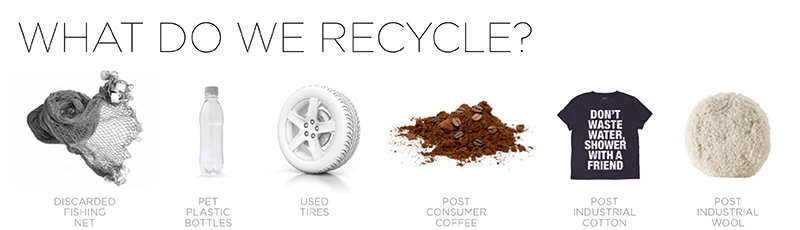
His new venture had nothing to do with fashion at first. He spent three years traveling the world, meeting with inventors, looking for technical knowledge and the chemical processes needed to start his business. Goveneche reviewed dozens of recycling techniques for plastic bottles, discarded fishing nets, used coffee grounds, and even car tires – all potential materials that might deliver a new generation of fabrics that were more Earth-friendly.

recycled fashion

“Fishing nets are a huge problem because they need to be replaced every four to six years,” says Goveneche. The problem, however, is less about the replacement cost and more about having to pay the ports to mothball two-mile long nets in warehouses. It’s much cheaper to let them quietly slip into the oceans in the dead of night, when no one is watching.

Goveneche was horrified to learn that there’s a permanent stash of around 65,000 tons of fishing nets on the bottom of our oceans. In the North Sea alone, 40,000 nets choke up the waters and strangle sea life to death.

On the east coast of Spain, Goveneche started an initiative called Up Cycling The Ocean, involving 11 ports and 162 fishing boats. In addition to catching fish, the boats also “catch” between 3 and 6 kilograms of old fishing nets when they haul their nets up. He’s has convinced them to put this into special onboard containers, and at last count, he’d collected 18 tons of old netting.

Last year in Florence, Italy, the first collection of products made with yarn from the bottom of the ocean was presented to the public. “Basically, our fashion brand is a huge research and development program, as the quality of our thread depends on the quality of the trash coming out of the ocean,” says Goveneche.

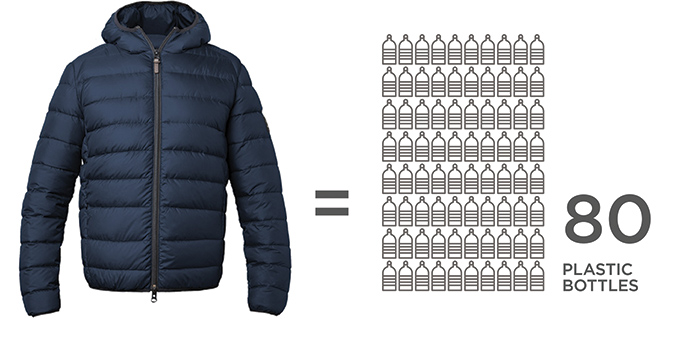
As each garment in the collection gets designed, it initiates another recycling program. “Our sneaker laces are made from plastic bottles, our fabric from fishing nets. When we added belts and shoes to the range, we needed to start a rubber recycling program. One thing has led to another,” says Goveneche, laughing.

bottles-top

“To make fabrics from discarded fishing nets takes seven chemical steps,” he explains. “Traditional fabric-making methods using raw, virgin materials require 17 steps. There’s a lot of water savings and fewer emissions too, of course.”

Cutting-edge, technical experiments are all very well, but ultimately customers must be attracted to buy cool-looking clothing. While the ECOALF story scores full marks on the enviro-meter, Goveneche is  under no illusions that this will be enough to become a profitable business.

“After our chemical engineers are done with the fabrics, our designers make the final products,” says Goveneche. “There’s a misconception that people buy our products because they love nature. But who will buy a jacket that doesn’t fit well or choose a color that isn’t in vogue?”

ecoalf fashion

“Consumers may like your story, but in the end it’s about the fashion. As a business, our price must be right, we need to be in the right stores, and quality must be good,” says Goveneche.

The company has broken-even after three years and Goveneche is looking optimistically at the future. He senses a new generation of brands that are showing that things can be done differently. “Consumers are seeking brands that represent certain values, and that’s our direction,” he says.

“At first, we had to dispel the idea that recycling is something hippie -– where you’d take your grandmother’s old blanket and turn it into a backpack. But that’s not us. We’re about technology and R&D; about plugging into the growing world of ecologically-minded products, such as electrical cars and organic food.”


0