When the co-founders of Big Path Capital, Shawn Lesser and Michael Whelchel, decided to launch an investment bank in the teeth of the brutal 2008 financial crisis, their friends and families thought they had lost their minds. “My father was really concerned. He said, ‘Are you sure that’s a good idea? It’s one thing to start a company in the best of times, but to start a financial services company in a financial recession?’” recounted Whelchel.
Yet it was the meltdown of the global economy that actually forced Lesser and Whelchel to find a better way to do business. During the Great Recession, Big Path Capital was formed to work with impact-minded companies and funds. “We knew incredible companies with great business models for simultaneously creating significant social and environmental impact,” recalls Whelchel. “We knew it didn’t have to be a trade-off. We thought: Let’s help these companies scale.”
In the beginning, they wondered if they might have been too early. “When we spoke about impact investing, making money, and making a difference, investors quipped ‘How much money am I going to lose?’” says Lesser. “While traditional investors didn’t get it, we were convinced it was a better way to invest.”
Like all scrappy start-ups, Big Path wasn’t too proud to cold-call. Whelchel and Lesser began by reaching out to companies in the Inc. 5000 list of fast-growing businesses that also demonstrated a positive impact focus.
One call in particular stood out. Whelchel phoned Matt O’Hayer, founder and CEO of Vital Farms, the pasture-raised egg company ranked as the fastest-growing food and beverage company in the Inc. 5000.
O’Hayer remembers getting the voicemail. “I would get several calls per week from investment bankers given Inc.’s coverage of us. When I got Whelchel’s voicemail about an investment bank dedicated to positive impact, I was intrigued, if a bit suspicious. Investment bankers wanting to do good?”
O’Hayer engaged Big Path to secure impact investors that shared his values. “Everybody says get the highest. I have a different view. I wanted impact investors who get Vital Farm’s mission, as I believe that creates the most long-term value,” says O’Hayer. Big Path helped raise $50 million in transactions over several years, with escalating valuations, as Vital Farms needed the growth capital and as early investors were looking for partial liquidity. O’Hayer said, “I never thought I would say that I liked an investment banker.”
Big Path has come a long way from its cold-calling days. Today, Big Path Capital is described by the media as “impact investing’s investment bank.” The company, a Certified B Corporation, has worked with over 180 leading impact companies and funds — more than any other investment bank in the impact economy. Big Path’s clients have jointly raised billions of dollars and are examples of what Lesser and Whelchel call, “smarter money.” “We work with companies and funds that maximize return and impact — no trade-offs,” explains Whelchel. Mainstream financial giants such as Blackstone, BlackRock, KKR, TPG, and Apollo have entered the impacting-investing arena. And these large financial firms are now looking to deploy capital in Big Path’s clients.”
“It’s encouraging to see established financial firms recognize this as a growth opportunity,” adds Lesser.
A clear sign of the changing times: BlackRock CEO Larry Fink’s recent annual investor letter, in which he writes, “A company cannot achieve long-term profits without embracing purpose and considering the needs of a broad range of stakeholders… Ultimately, purpose is the engine of long-term profitability.” The winners of the Real Leaders Impact Awards — co-founded by Big Path and Real Leaders — represent companies around the world that embody the sentiment that profit and purpose are synergistic, not at odds.
“My dad was worried about me in 2008,” notes Whelchel. “Now he asks me why it took so long.” Some things don’t change.
But what is changing is that businesses are using the engine of capitalism to achieve greater profits for the greater good. Big Path aims to put more sustainable fuel — and capital — in that engine.
Coronavirus, or COVID-19, is still affecting mostly people in China with some outbreaks in other countries. Most people who become infected experience mild illness and recover, but it can be more severe for others. Take care of your health and protect others by doing the following, as advised by the World Health Organization (WHO):
Wash your hands frequently
Regularly and thoroughly clean your hands with an alcohol-based hand rub or wash them with soap and water.
Why? Washing your hands with soap and water or using alcohol-based hand rub kills viruses that may be on your hands.
Maintain social distancing
Maintain at least 1 metre (3 feet) distance between yourself and anyone who is coughing or sneezing.
Why? When someone coughs or sneezes they spray small liquid droplets from their nose or mouth which may contain virus. If you are too close, you can breathe in the droplets, including the COVID-19 virus if the person coughing has the disease.
Avoid touching eyes, nose and mouth
Why? Hands touch many surfaces and can pick up viruses. Once contaminated, hands can transfer the virus to your eyes, nose or mouth. From there, the virus can enter your body and can make you sick.
Practice respiratory hygiene
Make sure you, and the people around you, follow good respiratory hygiene. This means covering your mouth and nose with your bent elbow or tissue when you cough or sneeze. Then dispose of the used tissue immediately.
Why? Droplets spread virus. By following good respiratory hygiene you protect the people around you from viruses such as cold, flu and COVID-19.
If you have fever, cough and difficulty breathing, seek medical care early
Stay home if you feel unwell. If you have a fever, cough and difficulty breathing, seek medical attention and call in advance. Follow the directions of your local health authority.
Why? National and local authorities will have the most up to date information on the coronavirus situation in your area. Calling in advance will allow your health care provider to quickly direct you to the right health facility. This will also protect you and help prevent spread of viruses and other infections.
Stay informed and follow advice given by your healthcare provider
Stay informed on the latest developments about COVID-19. Follow advice given by your healthcare provider, your national and local public health authority or your employer on how to protect yourself and others from COVID-19. If self isolating at home , read up on positive mental health issues that surround the pandemic.
Why? National and local authorities will have the most up to date information on whether COVID-19 is spreading in your area. They are best placed to advise on what people in your area should be doing to protect themselves.
Protection measures for persons who are in or have recently visited (past 14 days) areas where COVID-19 is spreading
Follow the guidance outlined above.
Stay at home if you begin to feel unwell, even with mild symptoms of coronavirus such as headache and slight runny nose, until you recover. Why? Avoiding contact with others and visits to medical facilities will allow these facilities to operate more effectively and help protect you and others from possible COVID-19 and other viruses.
If you develop fever, cough and difficulty breathing, seek medical advice promptly as this may be due to a respiratory infection or other serious condition. Call in advance and tell your provider of any recent travel or contact with travelers. Why? Calling in advance will allow your health care provider to quickly direct you to the right health facility. This will also help to prevent possible spread of COVID-19 and other viruses.
International Women’s Day has had a long history, with women worldwide fighting for their rights — from as early as 1911. A lot has changed since then but much still remains to be done, especially in the workplace.
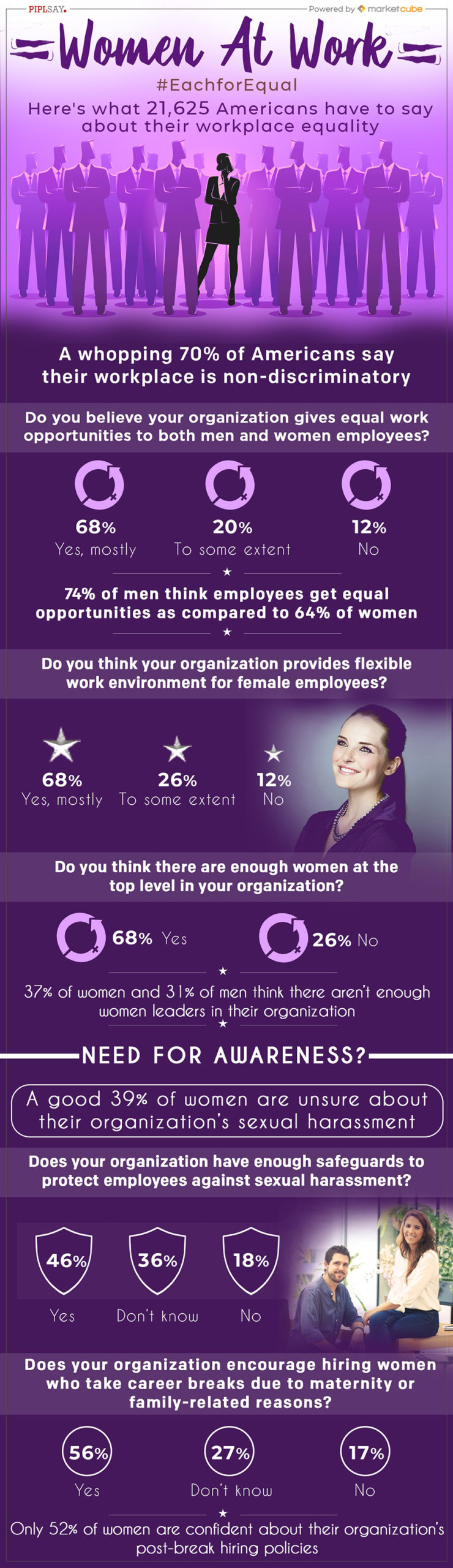
Consumer survey company Piplsay conducted a nationwide survey to find out if workplaces have changed for the better for women employees. Corporates, as well as policymakers, can leverage this data in their decision making.
International Women’s Day, or International Working Women’s Day, as it was initially called, was first celebrated on March 19, 1911. Even in the earlier days, Women’s Day was connected with working women’s rights and equality. No doubt we have made significant progress since then, but gender equality continues to remain an unfinished business even today. How have American workplaces adapted themselves to the changing times? To find out, Piplsay polled 21,625 working Americans, both men and women, to reveal the true picture. Here’s a summary of what they found:
Survey Methodology: This Piplsay survey (powered by Market Cube) was conducted nationwide in the US in the month of January 2020. They received 21,625 online responses from individuals aged 18 years and older.
The year was 1943 and Joseph Carpenter had just received orders to report to Camp Montford Point in Jacksonville, North Carolina, from his home in Washington.
“I was proud to be a Marine because they had so much history,” said Carpenter, now 95. But in 1943, Carpenter was about to make history as one of America’s first Black recruits for the U.S. Marine Corps.
More than 20,000 Blacks trained at Montford Point (and thus were called Montford Pointers) because the military then, like much of America, was racially segregated.
The military would change in 1948, when President Harry S. Truman signed an executive order ending segregation in its ranks. But during World War II, Carpenter would train in a Black unit.
Joseph Carpenter at Montford Point in 1944. (Courtesy photo)
Whether fighting in segregated or integrated units, Black soldiers have participated in every major American war since before the country’s founding.
Montford Pointers aren’t as well known as the Tuskegee Airmen, the African-American squadron of the U.S. Army Air Corps that flew and maintained combat aircraft in Alabama before becoming known as a respected fighting unit during World War II.
But Montford Pointers also served with distinction. About 13,000 of them decamped abroad during World War II. Nearly 2,000 of them helped Allied forces seize the island of Okinawa in the largest amphibious landing in the Pacific theater of the war.
Breaking barriers
Montford Pointers faced segregation when they ventured off of their base and into Jacksonville. A set of laws known as Jim Crow in the South required schools and businesses to keep Whites and Blacks separate.
Former Sergeant Edwin Fizer, 94, who enlisted in the Marines in 1942, remembers that some of the original White officers and drill instructors doubted the Black recruits’ abilities, which only strengthened his resolve to succeed.
“We had to get past that to be sure that we were able to stay in the Corps and do well at it,” Fizer said from Illinois in a telephone interview.
While Fizer saw combat in the battle to retake Guam from the Japanese, Carpenter remained at Montford Point as chief clerk and helped unload European prisoners of war from ships. He retired as a lieutenant colonel in the 1980s. Many of the Montford Pointers extended their service into the Korean and Vietnam wars.
A legacy continues
Retired Lieutenant Colonel Joseph Carpenter, 95, cradles the Congressional Gold Medal he received in 2012 that honored his service as a Montford Point Marine. (State Dept./D.A. Peterson)
In recognition of their service and sacrifices during World War II, Montford Point Marines received the Congressional Gold Medal in 2012, the highest civilian honor the U.S. Congress gives.
In 1974, Camp Montford Point was renamed Camp Gilbert H. Johnson in honor of the African American sergeant major who served as a drill instructor there. It’s the only Marine installation named after an African American, said John Lyles, an archivist at the Library of the Marine Corps. (A U.S. Navy ship bears the camp’s name.)
About 400 of America’s first black Marines are still alive, according to the National Montford Point Marine Association.
For a new generation
Fizer wants the next generation to know Montford Pointers’ struggles and to recognize times have changed for the better. “I want them to be able to appreciate how we overcame adversity,” Fizer said. “This is a foundation that we have built, and they stand on the shoulders of us. And go from there.”
Lenore T. Adkins is a public diplomacy writer for the US Department of State.
We live in a time when long-established companies all around the world are finding that keeping up with the rapid pace of change is too much to handle. Retail giants are collapsing because we all shop online, airlines and travel businesses are finding that our evolving lifestyles have left them behind and the leaders of almost every other type of company you can think of is desperately playing catch-up with tech upstarts that are changing the ball game on a weekly basis.
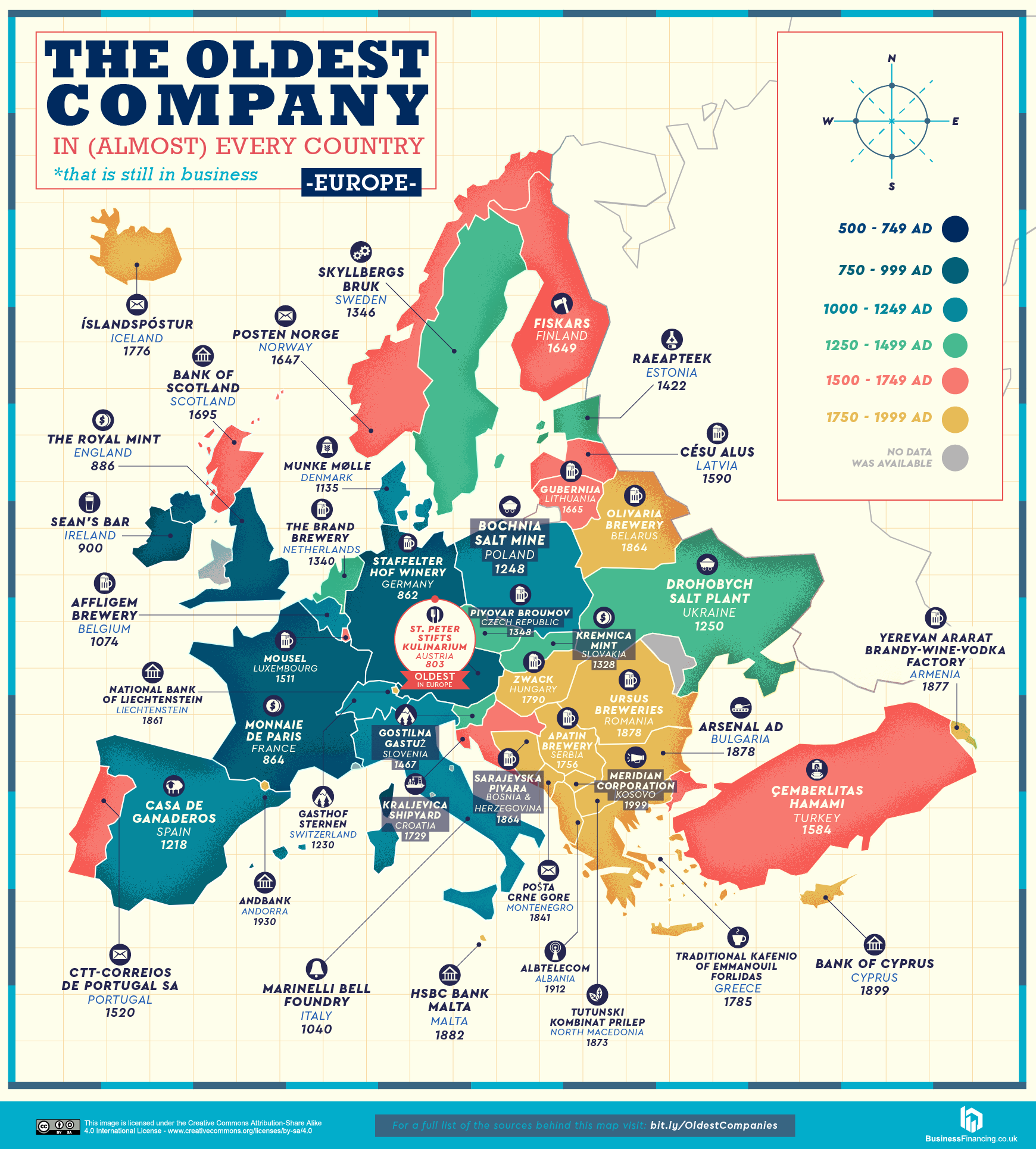
All of this is why it is so remarkable that there are businesses out there that date back well over a hundred years. Think Coca-Cola, which has been around 130 years and remains a market-leading soft drink all over the globe. But the reality is that Coke is still a relative baby compared to some of the world’s oldest countries. So which are the oldest companies from (almost) every country on the planet?
Here are the 10 top oldest companies in the world that are still open for business:
YEAR
COUNTRY
COMPANY NAME
INDUSTRY
578
Japan
Kongō Gumi
Construction company
803
Austria
St. Peter Stifts Kulinarium
Restaurant
862
Germany
Staffelter Hof
Winery
864
France
Monnaie de Paris
Mint
886
England
The Royal Mint
Mint
900
Ireland
Sean’s Bar
Pub
1040
Italy
Pontificia Fonderia Marinelli
Bell foundry
1074
Belgium
Affligem Brewery
Brewery
1135
Denmark
Munke Mølle
Mill
1153
China
Ma Yu Ching’s Bucket Chicken House
Restaurant
1. Oldest companies in Europe
Compared to America, European societies have a lot of history, so it’s no surprise that there are some seriously old businesses to be found there and sometimes found in the most unlikely places. St Peter’s Abbey in Salzburg, Austria is the home of Europe’s oldest business that’s still going – St. Peter Stifts Kulinarium, an inn that first opened way back in 803, making it the oldest restaurant in the continent that still serves customers today, just like it did when the likes of Christopher Columbus and Wolfgang Amadeus Mozart ate there in centuries long past.
Having longevity in your business means being able to adapt to circumstances, even if your business is only a few decades old. For Monnaie de Paris, founded in 864 as France’s mint, there have been many changes to adapt to even in the last 100 years, which have seen it producing Francs and now Euros but also German currency during the occupation in World War II.
2. Oldest companies in North America
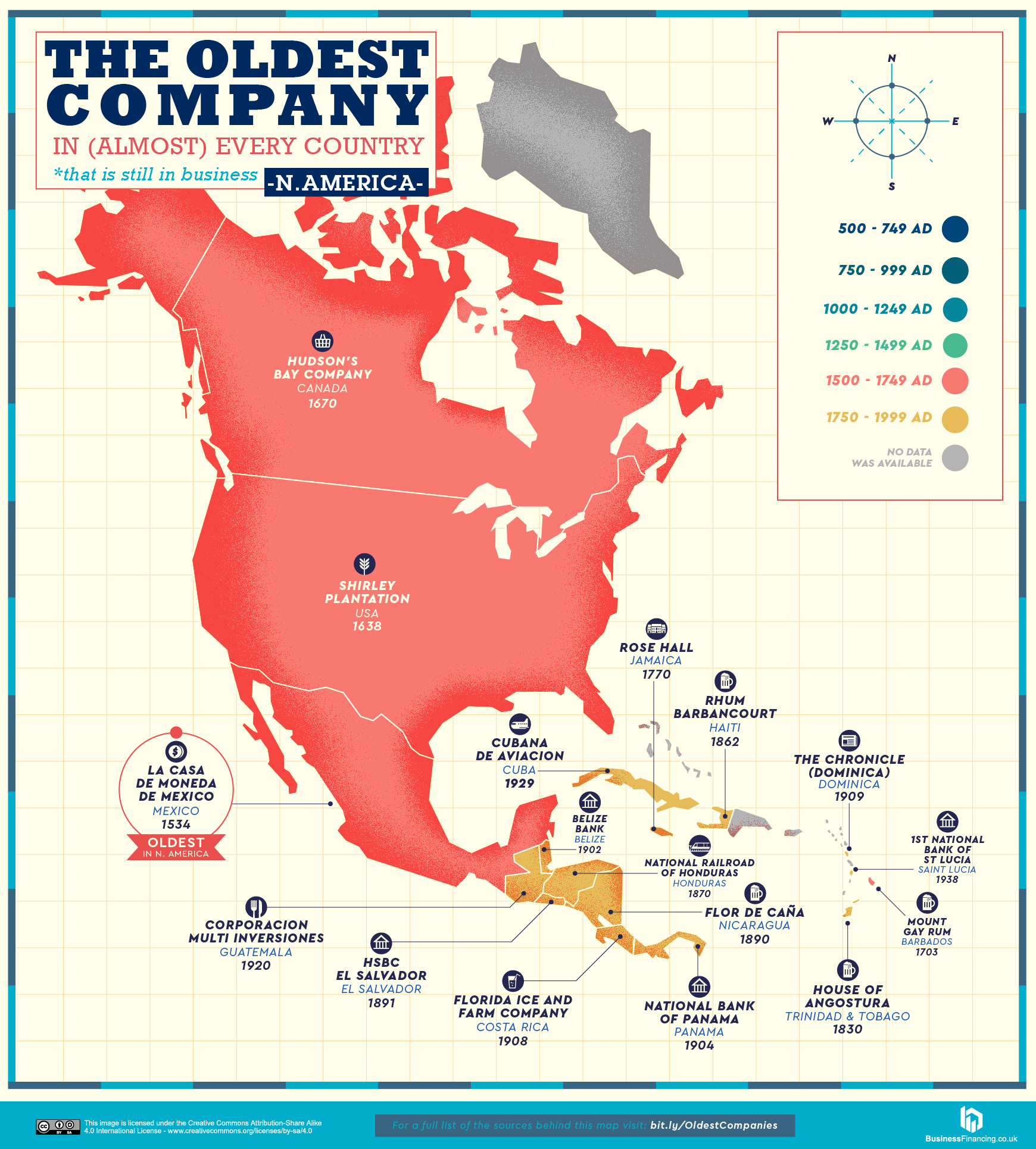
We may think of North America as a relatively young continent, but its oldest companies still date back to the 16th and 17th centuries. In Mexico it’s another mint, the La Casa de Moneda de México, which is still producing currency today having been founded in 1534. It’s a highly influential mint too, with its original coins having inspired not only the US dollar, but also currencies as geographically distant as the Japanese yen and Chinese yuan.
Up in the USA, the oldest company still going today is the Shirley Plantation, started in 1638 by Edward Hill, which is not only still a working plantation today – as well as a tourist attraction of course – but is also managed by his descendents all these centuries later. Every business founder dreams of their children following in their footsteps, but who could imagine that kind of legacy?
3. Oldest Companies in South America
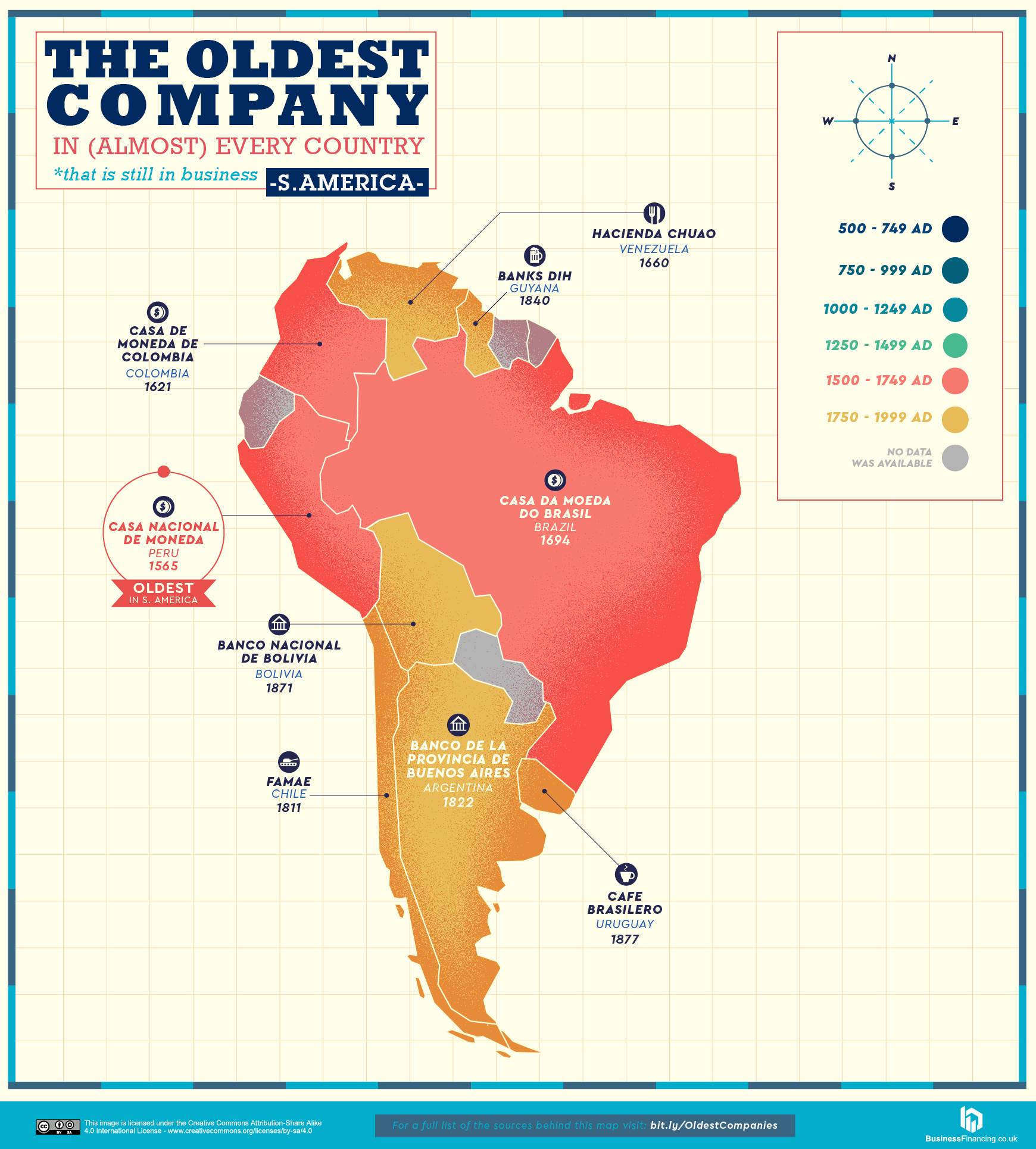
As in North America, South America’s oldest company that’s still going today is a mint. There’s clearly a lesson there in terms of future-proofing your business. While we may be moving towards a contactless payment future, cash remains an important part of our daily lives all around the world, so finding a niche that is going to keep your business relevant for centuries rather than as a passing fad has to be the goal of any prospective business leader.
4. Oldest Companies in Asia
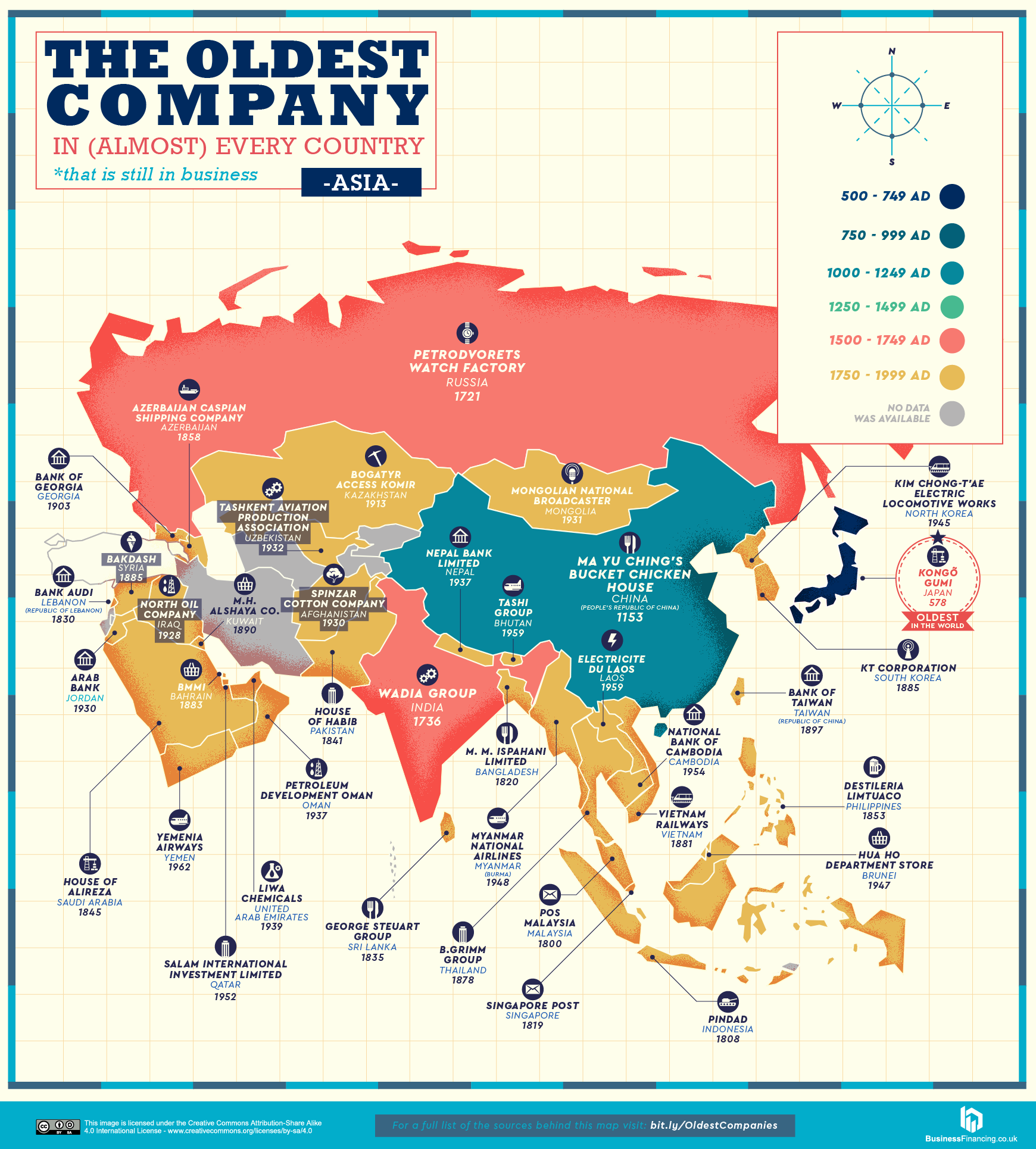
All of these companies mentioned so far may be very, very old, but still don’t come close to Asia’s oldest business. Kongo Gumi was founded in 578 by a Korean temple builder invited to Japan by the royal family to help build Buddhist temples. It was very much a niche skill at the time in that country and helped establish a family business that stayed in the family all the way up to the 21st Century when it was finally bought by a construction conglomerate.
Established almost five centuries later but still older than most of the companies around today is Ma Yu Ching’s Bucket Chicken House, a chicken takeaway restaurant in Kaifeng China, which dates back to 1153. Hopefully the chickens it serves today haven’t been around for nine centuries.
5. Oldest Companies in Africa
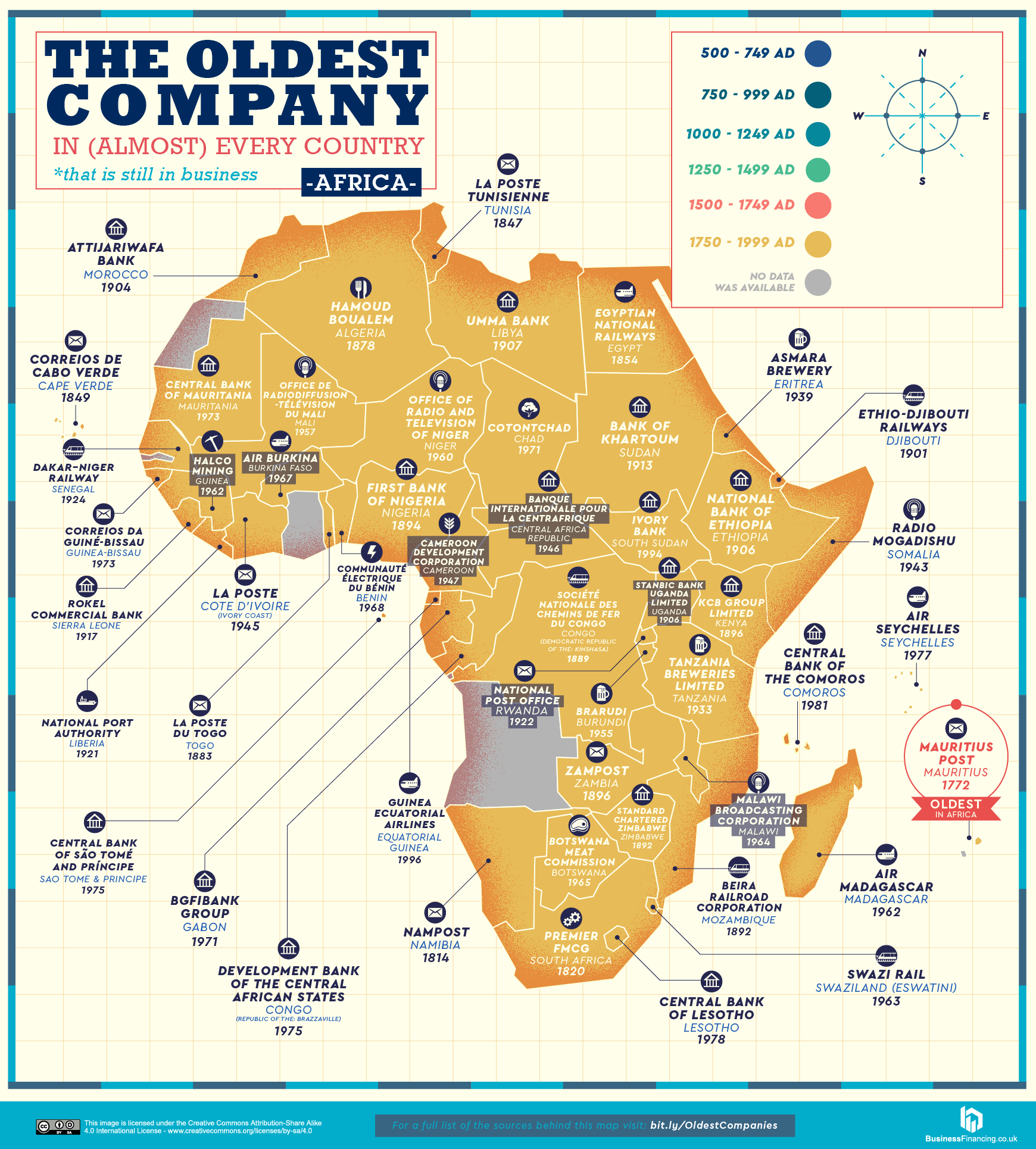
Civilization apparently dates back to Africa, but its oldest businesses still operating today aren’t quite so old as that. The oldest is the Mauritius Post, which opened in 1772 to deliver mail around what was a French colony at the time. NamPost in Namibia is another early postal service on the continent, having been founded in 1814 to help people across the country keep in touch.
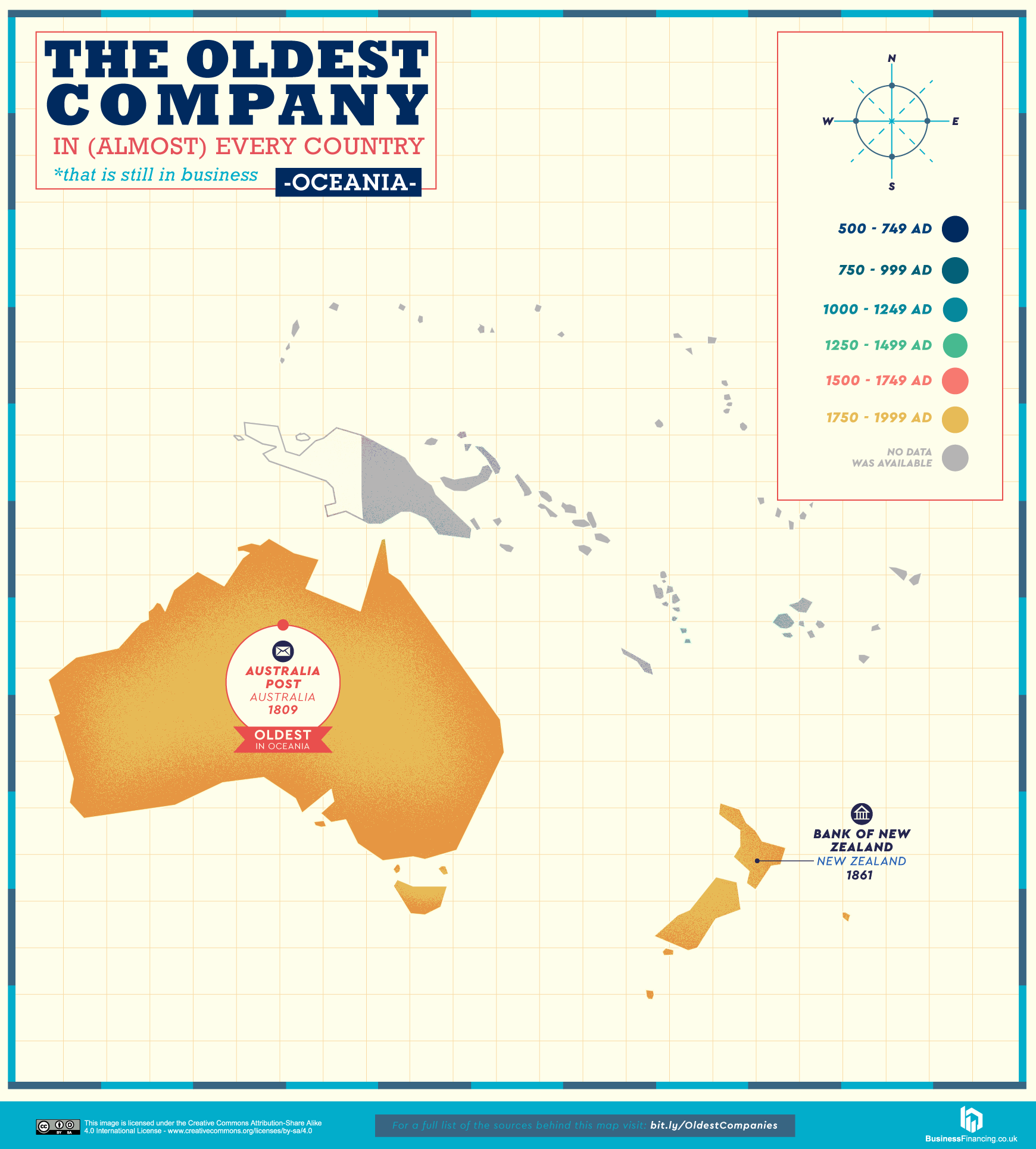
6. Oldest Companies in Oceania
Speaking of post offices, the oldest company in Oceania is also one set up to deal with mail. Now known as AusPost after the merger of several smaller services, it dates back to 1809 when a former convict Isaas Nichols was put in charge of New South Wales’ post, which mostly meant stopping people from stealing it when it arrived at port. Now that is leading by example.Which of the companies set up today by inspirational leaders do you think might one day have lasted as long as some of these businesses
METHODOLOGY & SOURCES
To create these maps, we started by reviewing various sources on the internet to locate the oldest company in each country. Once we had a list of business for each country we began researching each individual company to discover if they are still operational. If we were unsure about a company or could not discern if it was still open, we did not include it in the maps. We included both independent and state-run businesses in this list. This includes national mints, which produced coins for merchants and international customers as well as the state.
Those countries where it wasn’t possible to identify the oldest business have been greyed-out on the map. Additionally, some countries have changed names or didn‘t exist at the time the oldest company opened. In all cases we have used the current country names.
We created broad industry categorisations that grouped similar businesses together. Every step has been taken to ensure that the information contained within our research is as accurate as possible. However, it is possible that there are businesses still operating that predate the ones listed here.
“Disruptive leaders like Jeff Bezos and Elon Musk have transformed companies, industries and entire societies while generating incredible wealth for themselves, their investors, their employees, as well as millions of other people,” says business disruption author John Furth.
Furth takes the lessons these and other great disruptors have learned and turns them into practical exercises, tools and techniques to help senior executives develop their own disruptive skill sets in his book, “Owning Tomorrow: The Unstoppable Force of Disruptive Leadership”
For over 25 years, John Furth worked with CEOs and their C-suite executives at some of the largest corporations of the world such as Sony, Deutsche Bank, Pfizer and Discovery Communications, helping them develop and implement disruptive and innovative businesses, leadership teams and organizations.
He has found that most successful disruptive business leaders have eight basic traits in common:
1. They are “brainiacs.” While some well-known business disruptors never finished college, many received PhDs from the highest-ranked universities in the world. But they all have the same commitment to lifelong learning.
2. They often push accepted behavioral, cultural, legal, and ethical boundaries to the limit. Unfortunately, if some of their more extreme tendencies aren’t reined in properly, they can quickly destroy everything they and their team worked hard to build.
3. They’ve learned how to disrupt their own frames of reference and unproductive mindsets. This helps them increase their focus, ability to innovate, and to stay one step ahead of would-be competitors. Disruptive leaders expect and often demand their teams to think and act in the same way.
4. They look for information, insights, and inspiration in unexpected places. They recognize that the usual or “traditional” sources of data are by nature backward-looking and hence of limited value in a world that is being re-created. Great disruptors ask excellent questions and listen carefully to the answers because they never know when someone else might have an insight that could be useful to them and the business.
5. Their businesses – regardless of whether they are B2C or B2B – deliver on at least one of three fundamental value propositions:
Provide goods, services and experiences that were previously only available to the most privileged members of society to a much larger percentage of the population more easily and affordably.
Give customers what they want, when they want it and how they want it.
Eliminate or reduce the things in people’s everyday lives they don’t want, from everyday annoyances like wasted time, boredom, complexity or unhappiness as well as life-threatening situations like poverty and disease.
6. They understand that disrupting an existing eco-system or process on a regional or even global scale can cause significant short-term negative consequences. Entrenched and inflexible companies are driven out of business, and many individual careers are adversely affected. However, the value created for billions of people far outweighs such negative incidents.
7. At some point they learn the ultimate paradox of disruption: “more stays the same than changes.” Like all successful companies, disruptive enterprises have to have the funding necessary to execute their plans, the right people doing the right jobs and the wherewithal and commitment to push through many breakdowns and hurdles.
8. They generate unimaginable wealth for themselves, their investors, their employees, and others connected to their companies.
You’d assume a teenagers life is just studying, video games and hanging out with friends — but not for these teenage tycoons. We took a look at some of the world’s top entrepreneurs born in the 2000s.
Thinking of starting a business? Feel like you need more experience? Meet the 13 children below who will leave you inspired with their business stories. Across Britain, America, and Australia, young CEOs are signing deals for their products, some worth up to $11 million! Their innovative companies include a trainer reselling website, a braille printer for the visually impaired and a childcare agency. UK company Comparethemarket.com has compiled profiles for 13 of the most successful entrepreneurs born in the 2000s. Children are naturally creative, but these entrepreneurs capitalized on their ideas and created huge businesses from scratch. Their companies often started while still living with their parents and attending school.
1. Braigo
Created by Shubham Banerjee when he was just 12 years old, this company creates Braille printers to help the visually impaired access expensive technology. His invention uses LEGO and robotics to design a product and sell it at less than half the price of others on the market. Banerjee is the youngest entrepreneur to receive Venture Capital funding.
2. Sneaker Don
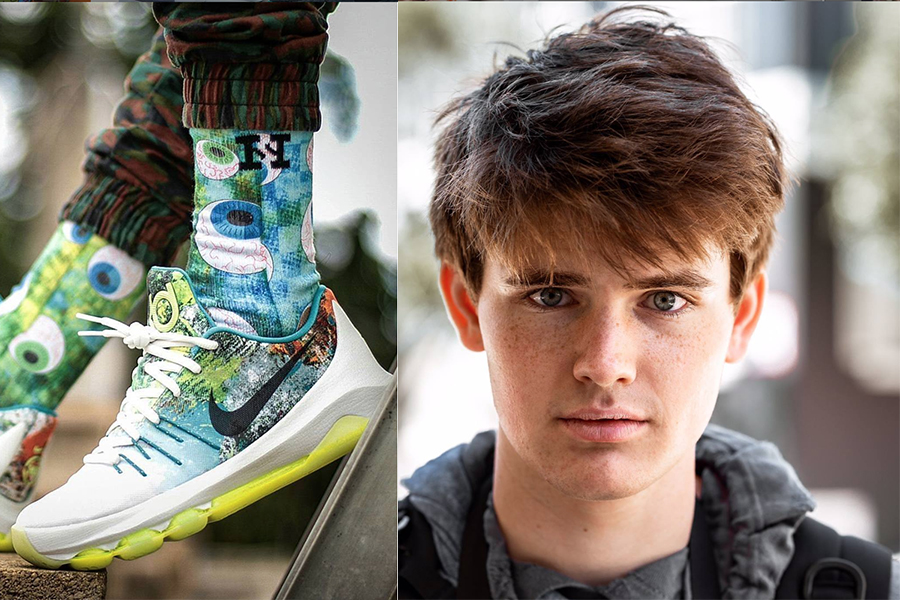
At only 16 years old, American Benjamin “Kickz” Kapelushnik created a rare trainer reselling website as a hobby. As his business grew, he began to gain celebrity clients including DJ Khaled and Odell Beckham alongside an ever-growing customer list. As he made more contacts, he was able to bulk buy sought-after items. His sales are now worth over $1 million.
3. Nannies by Noa
While growing up in New York, Noa Mintz discovered a gap in the market for an easy way to locate the best nannies available in the area. She used her first-hand experience of being a child in the city and founded Nannies by Noa when she was just 12 years old. The agency provides services that include thorough background screening, workshops for nannies and ongoing support for customers.
4. Mr. Cory’s Cookies
Founded by six-year-old Cory after he sold hot chocolate on the streets of New Jersey to help his mother buy a new car. Now aged 15, Cory is the CEO of Mr. Cory’s Cookies. His delicious all-natural cookies have landed him collaborations with huge department stores including Bloomingdales, Macy’s, Viacom and Whole Foods. Investor and businessman Marcus Lemonis, invested $100,000 in the company when Cory featured on CNBCs The Profit in 2017.
5. Me & The Bees Lemonade
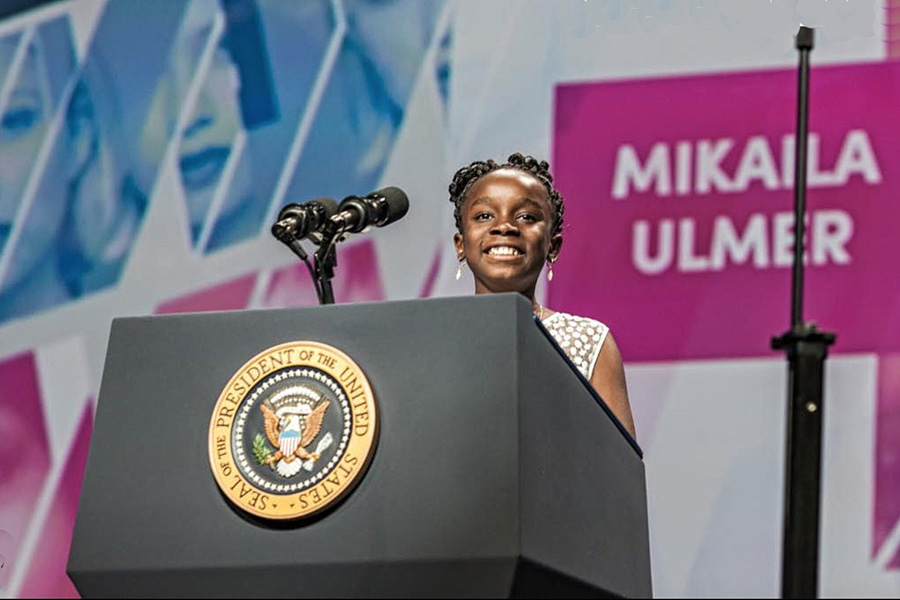
When Mikaila Ulmer was four years old, she entered a children’s business competition. Fascinated by bees, she decided to sweeten her great grandmother’s flaxseed lemonade recipe with honey. She began selling her Me & The Bees Lemonade at youth entrepreneurial events and was an instant success. At the age of 11, she negotiated a $11 million distribution deal with Whole Foods. She donates a percentage of her profits to Texas Beekeepers Associations, hence her slogan ‘Buy a Bottle… Save a Bee’.
6. Mo’s Bows
Seventeen-year-old Moziah Bridges is the president and creative director of Mo’s Bows, based in Memphis, Tennessee. He’s been featured in Fortune’s ’18 Under 18′ and with aspirations to be a fashion mogul, he’s certainly on his way, after signing a seven-figure deal to make bow ties for the NBA.
7. Kidzcationz
Tired of receiving lousy treatment while on vacation, Bella Tipping decided to create Kidzcationz, a website which allows users to rate and review locations based on their child-friendly options. Also featured in Fortune’s ’18 Under 18′ list, she has a goal to help make the world a better place.
8. Pura Cosmetics
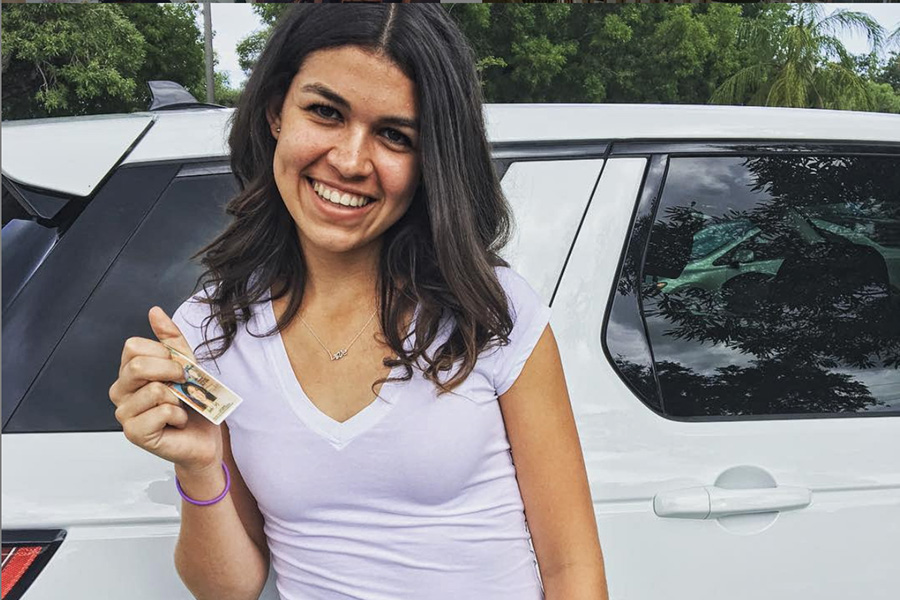
At 15, Rose Dyson was studying for her GCSEs when she decided to enter a competition. She created Pura Cosmetics, a cruelty-free, vegan-friendly lip balm business. Now 19-years-old, she still makes all her products by hand, which are stocked in shops and department stores across the United Kingdom. She started her business with $33.
9. iCoolKid.com
At age 14, Jenk Oz is the youngest CEO in Britain. When he was 8-years-old, he decided to create iCookKid, a website that covers everything from art, tech and science for children. Not only is Jenk an entrepreneur with $63,000 in revenue, but he also acts in West End theatre productions and records his own music.
10. HoopSwag
Brennan Agranoff has been a budding entrepreneur since age 7. Now 19-years-old, his first business, HoopSwagg, is a customizable sports apparel company which launched in 2013. With his business growing each year, and current revenue of $1 million, he hopes to focus on HoopSwagg full-time when he finishes college.
11. Gladiator Lacrosse
At 13-years-old, Rachel Zietz created Gladiator Lacrosse after being disappointed by the range of products available for lacrosse players. Her business was projected to make more than $2 million after she landed a deal with one of the largest sporting brands in the United States.
12. Luv Ur Skin
Australian Isabella Dymalovski started her business, Luv Ur Skin at age 8. At age 13, she appeared on Shark Tank and landed herself and investment deal worth $65,000 to start a natural skincare range. Now 17, the entrepreneur has launched her range in the United States and has her sights set on the European and Asian markets, too.
13. Not Before Tea
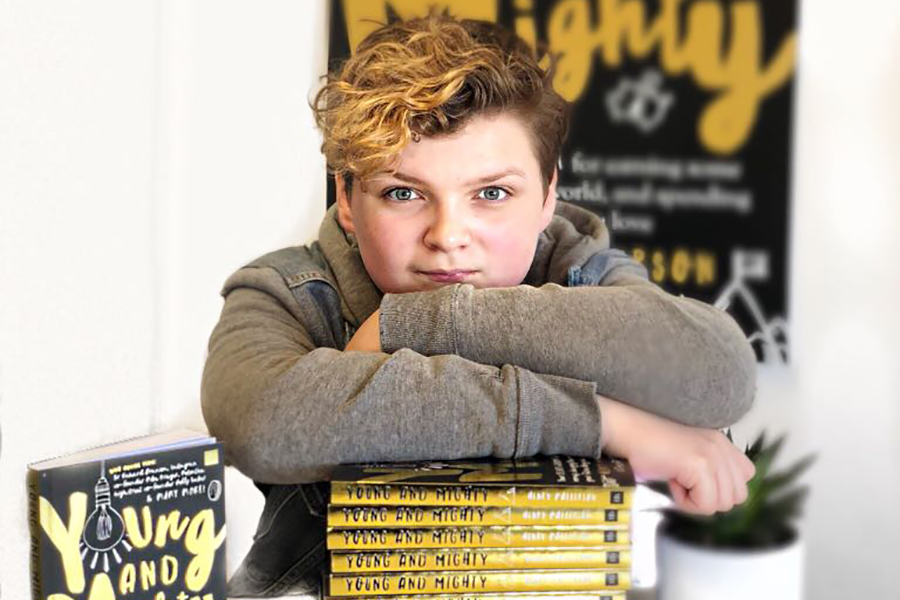
At age ten, British teenager Henry Patterson wrote The Adventures of Sherb and Pip. Now 15, he has turned his venture into a lifestyle brand called Not Before Tea. Named ‘One to Watch’ by The Independent, he’s also been featured in Forbes and was the youngest person to appear on CNBCs Breakfast Show.
Davos, Switzerland — At the World Economic Forum 2020, Jakob Trollbäck, the architect of the U.N. Sustainable Development Goals framework, has unveiled a new initiative to foster Climate Leadership across corporate, investor, donor and NGO institutions.
Trollbäck advances the core principles of opportunity in a published booklet released in Davos called The Climate Leadership Playbook, and through a two-wall exhibit at the Global 17 Partners space in the heart of Davos.
“Everybody knows that we have to be more environmental and work urgently to fulfill the Global Goals,” Trollbäck noted. “We know what to do: but how do we make it happen, and how do we make sure our enterprises are relevant to the challenge?”
This is the subject of a discussion panel on the same subject hosted at the Global 17 Partners space, which features Sam Goldman, co-founder and President of d.light, and Sonia Lo, CEO of FreshBox Farms, along with Trollbäck , Ezgi Barcenas OF AB InBev, and others.
d.light, a leading innovator in financed solar energy and sustainable products, and FreshBox Farms, a leading innovator in hydroponic farming and environmental sustainability, provided sponsorship for the initial run of the Climate Leadership Playbook for World Economic Forum 2020 attendees.
“We’re here in part to celebrate the milestone of reaching 100 million customers with our sustainable energy solutions, and we’re pivoting toward a billion,” Goldman said. It’s in no small part because of our adherence to the principles that Jakob highlights.”
“We think that those organizations that commit to climate leadership have a clear marketplace advantage,” said Lo. “This framework is important, and we’re delighted to be the first signatory to it.”
In coming weeks, the Climate Leadership Playbook and related resources will be available online and supported by a variety of services for enterprise leaders who adopt it.
The initiative is created by Trollbäck’s company, The New Division, and The ForeSight Group. Impact management company 5th Element Group PBC along with Gitterman Wealth Management will help market the campaign and related resources in the coming months.
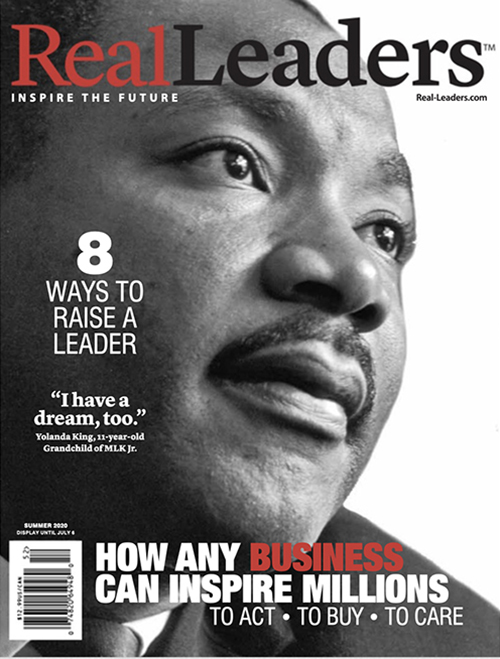
It’s been almost 52 years since Dr. Martin Luther King Jr. was assassinated. As people once again take to the streets to highlight social injustice and atrocities across the country and the world, we ask: is his dream still relevant today?
Dr. Martin Luther King Jr. was assassinated in Memphis, Tennessee (U.S.), almost 52 years ago, on April 4, 1968, an event that sent shock waves reverberating around the world. It was, as described at that year’s Nobel Ceremony in Oslo, a “bitter year for human rights” and “one of the most grievous losses ever suffered by the world’s champions of peace and goodwill.”
Dr. King, had been awarded the Nobel Peace Prize in 1964 for his nonviolent campaign for equal rights. The 1968 Nobel Peace Prize was presented to René Cassin for his work on drafting the Universal Declaration of Human Rights adopted by the United Nations General Assembly on December 10, 1948. Eleanor Roosevelt, who oversaw the writing of this milestone document had died a few years earlier and therefore could not share in the prize. The declaration presents 30 articles, each of which explains what rights we have as human beings regardless of “race, color, sex, language, religion, political or other opinion, national or social origin, property, birth or other status.” Importantly, Article 1 states that “all human beings are born free and equal in dignity and rights”.
On April 16, 1963, 100 years after the Emancipation Act, as violence unfolded on the streets of Birmingham, Martin Luther King, Jr. composed a letter from his jail cell.
It was Dr. King’s dream that his children would one day “live in a nation where they will not be judged by the color of their skin but by the content of their character.” That dream was rooted in his own experiences as a child growing up under “Jim Crow Laws”: a system of racial apartheid that dominated the American South for three quarters of a century, beginning in the 1890s. The laws affected almost every aspect of daily life, mandating segregation of schools, parks, libraries, drinking fountains, restrooms, buses, trains, and restaurants. “Whites Only” and “Colored” signs were constant reminders of the enforced racial order. Those who refused to abide by these laws were arrested, or worse, ‘lynched’ by white extremist groups such as the Ku Klux Klan.
Martin Luther King, Jr., was born Michael King,Jr. on January 29, 1929, in Atlanta, Georgia (U.S.) and grew up in an area of the city reserved for people of color. His father, Michael King, Sr. (later Martin Luther King, Sr.) was a respected Baptist minister and community leader. His mother Alberta Williams King made it a point, early on in Martin’s life, to explain how young, healthy Africans were brought to the United States as slaves, and the ongoing realities of discrimination and segregation.
Dr. Martin Luther King, Jr. hugs his wife Coretta during a news conference following the announcement that he had been awarded the Nobel Peace Prize.
“You are as good as anyone,” his mother Alberta said, but Martin didn’t really understand until the day he went to school at age six. His best friend, a white boy that he had known and played with since age three, was told by his father to no longer play with him. “How could I love a race of people who hated me and who had been responsible for breaking me up with one of my best childhood friends?” Martin asked himself for a long time.
At fourteen years old Martin participated in, and won, an oratorical contest with an essay entitled The Negro and the Constitution in which he said, “If freedom is good for any it is good for all.” After receiving the prize, Martin took a bus home and unconsciously sat at the front, which was normally reserved for white people. The bus driver quickly reprimanded him. Martin recalls this incident as the angriest moment of his life!
King giving his “I Have a Dream” speech to a huge crowd gathered in Washington D.C. during the ‘March on Washington for Jobs & Freedom’ (aka the Freedom March). Photo by Francis Miller.
At age 15 Martin entered Morehouse College, a historically all-male African American college established in 1867. It was during his time as a student at Morehouse that Martin would have his “first frank discussion on race” and where he would discover Henry David Thoreau’s essay on Civil Disobedience published in 1849, which tells the story of the author’s willingness to go to jail, rather than pay taxes to a government that supported slavery.
“I became convinced that non-cooperation with evil is as much a moral obligation as is cooperation with good,” said Dr. King.
King plays with his son Dexter. Photo by Flip Schulke.
Someone else who had an indelible impact on Dr. King’s beliefs and actions was the Indian activist Mahatma Gandhi, who, using nonviolent civil disobedience led India to independence from British rule in 1947. He was particularly moved by Gandhi’s 240 mile march from his ashram (religious retreat) to the coastal town of Dandi on the Arabian Sea. There, Gandhi and his supporters made salt from seawater, thereby breaking the British law that had established a monopoly on salt manufacturing.
“There is no way to peace, peace is the only way,” said Mohandas K. Gandhi (1869-1948).
King giving his “I Have a Dream” speech to a huge crowd gathered in Washington D.C. during the ‘March on Washington for Jobs & Freedom’ (aka the Freedom March). Photo by Francis Miller.
Dr. King would put Gandhi’s technique of non-violence to good use in America’s own civil rights struggle. Starting in 1955 in Montgomery, Alabama he successfully led a massive bus boycott after civil rights activist Rosa Parks had refused to give up her bus seat reserved for whites. Later on in Birmingham, a place he described as “where human rights had been trampled on for so long and fear and oppression were as thick in its atmosphere as the smog from its factories,” Dr. King was arrested and put into solitary confinement for leading a protest. From his cell he wrote a letter outlining that: “Injustice anywhere is a threat to justice everywhere.”
While many nations in Africa, including Ghana (1957), had achieved independence from their former European colonial masters, the time had come for African Americans to be given full and equal rights – not only to sit at the front of a bus and attend integrated schools – but also the right to voice their opinions politically.
“As children we didn’t know we were “Negroes,” or if we did, we didn’t know exactly what that meant. We didn’t realize that we lived in “segregation”…We were children, and children are more than human; we were blessed, but sooner than later we grow up and have to face this prison of segregation, unless Daddy won his struggle.” Excerpt from Dexter King’s book Growing Up King. Photo by Flip Schulke.
“Something within has reminded the Negro of his birthright of freedom, and something without has reminded him that it can be gained. Consciously or unconsciously, he has been caught up by the Zeitgeist, and his black brothers of Africa and his brown and yellow brother of Asia, South America and the Caribbean. The United States Negro is moving with a sense of urgency toward the promised land of racial justice,” he said.
An officer accosts an unconscious woman as mounted police officers attack civil rights marchers in Selma, Alabama who were attempting to begin a 50-mile march to Montgomery to protest race discrimination in voter registration. The mounted policeman in the background are part of Sheriff Jim Clark’s Dallas County posse. Police used tear gas, clubs, whips and ropes to turn back the demonstrators as they crossed a bridge over the Alabama River at the city limits. Photo by Bettmann.
And so the moment had come; a century after the abolition of slavery, marches were organized throughout the South, in Selma and Mississippi, and notably to Washington D.C., whereupon hundreds of thousands of men and women, black and white, rich and poor, marched on the United States capital demanding economic justice. Youth from all over America traveled South to join the ranks as Freedom Riders and to participate in more provoked, but still nonviolent, actions of civil disobedience.
A black protester at an anti-Vietnam War rally holds up a pro-Vietnamese sign against American racism. “No Vietnamese ever called me a Nigger” came from Mohammad Ali, who said that “No Viet Cong ever called me a Nigger.” Photo by Leif Skoogfors.
Thanks to mass mobilization, enough pressure was brought on the United States government to bring about significant changes to federal law, notably the 1964 Civil Rights Act that ended segregation in public places and banned employment discrimination on the basis of race, color, religion, sex or national origin. The 1965 Voting Rights Act was described as, “one of the most monumental laws in the history of American freedom”.
It was at this time, that Dr. King would travel to Oslo, Norway, to receive the Nobel Peace Prize on December 10, 1964. During his Nobel lecture on December 11, he said:
“The Nobel Prize is the second greatest honor given to me in my lifetime. The honor of the first importance was the response of the millions of Negroes to the doctrine of nonviolence, and their heroic employment of it to achieve equality and freedom. In a sense they earned the Nobel Prize when they stood against guns, dynamite, snarling dogs and prison without flinching, until their steadfastness muzzled the weapons of their oppressors.”
A protester holds a young boy on his shoulders during the Memphis March demonstration, backing the demands of striking garbage workers, Memphis Tennessee, April 8, 1968. The march which was to be led by Dr. King was instead led by his widow Coretta Scott King. Photo by Santi Visalli.
Following the Nobel Prize, Dr. King turned his attention to fighting other injustices: poverty and war. At the time, the United States was, in his opinion, wasting enormous economic resources fighting a war in Vietnam that he felt would be better spent on helping the poor.
“If we assume that life is worth living and man has a right to survive, then we must find an alternative to war,” he said. Dr. King was 39 years old at the time of his death, which occurred as he was planning a massive ‘Poor People’s Campaign,’ involving the wider participation of American Indians, Mexican Americans and other racial and ethnic minority groups.
Given the present global challenges to Human Rights, Dr. King’s message of nonviolent social and economic justice is as important today as ever before.
Students Playing Outside Martin Luther King Elementary School, Los Angeles. Young Hispanic American schoolchildren, who make up over 70% of the students, play and jump rope near a large mural of Dr. King at an elementary school named in his honor. Photo by David Butow
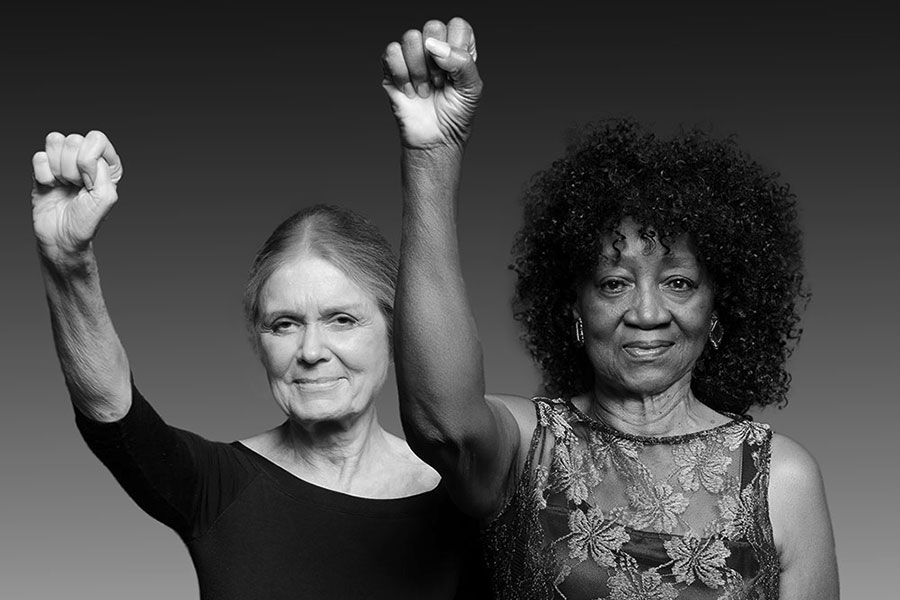
A re-enacted photographic portrait of Gloria Steinem and Dorothy Pitman Hughes in their iconic 1971 “raised fists” stance taken by St. Augustine photographer Daniel Bagan, has been added to the Smithsonian National Portrait Gallery collection. It gives new life to the significance and power of their historic statement of equal rights for women and blacks.
More than 48 years since the original Dan Wynn image appeared in Esquire magazine, their message has not dimmed with age. The image of women, now in their 70s, side-by-side with fists raised in message of equal rights, resonates with power for a new generation.
For Pitman Hughes and Steinem, the new portrait featuring the defiant black power salute again helps open up a dialogue on sexism and racism that is still vitally needed today, while demonstrating their continued hope for positive change.
The original 1971 portrait of Gloria Steinem and Dorothy Pitman taken by photographer Daniel Bagan.
“We must have difficult conversations, and it’s also important to talk about the learning, growing, friendship and joy that come from having them,” said Steinem. “So it’s important to say that in real life, neither Dorothy nor I would give up — or be the same without — our near half-century of shared hopes, differences, laughter, and friendship.”
The partnership between Steinem and Pitman Hughes began in the early 1970s as the pair took to the podium to discuss the importance of intersectional feminism. Together they founded Ms. Magazine and the Women’s Action Alliance. Decades later, the impact of their partnership has not waned. Steinem and Pitman Hughes remain an inspiration to activists across the country as they continue to push for racial and gender equality.
“The symbolism of a black and white woman standing together, demonstrating the black power salute is as important now as it was in the 70s,” said Pitman Hughes. “A hundred years of the suffrage movement has not eliminated racism, classism and sexism. Black women and white women can make this change together, but not until we acknowledge and resolve the racism problem that stands between us.”
They have struck their side-by-side, raised fists pose many times over the years. But this new portrait’s photographer, Daniel Bagan said the moment was right to re-capture their symbolism.
“The women were dynamically engaged in their iconic stance, and the result was inspiring,” said Bagan. “Even decades later, their power and beauty show no sign of age, just wisdom reflected in their soft smiles.”
Bagan, based in St. Augustine, Florida, has also launched the “Age of Beauty Project” creating portraits of women between the ages of 50-100. The Steinem-Pitman Hughes portrait inspired the project, and he shares the proceeds from the sale of their image in support of Pitman Hughes’ continued activism. The project resulted in a book titled “Age Of Beauty,” a social commentary on beauty and age. Bagan speaks with women over 50 almost every day, and many say they feel invisible, that they no longer see themselves as beautiful. Bagan hopes that his portraits shows that real beauty transcends Madison Avenue’s definition of thin, smooth and young.