4 Destinations That Will Transform Your Fear into Love

In psychology, there’s a term called “transfer of exaltation.” Roughly explained, it’s about a person’s ability to transform an experience of fear into an experience of love.

It’s ingrained in all of us to avoid feeling afraid; our brains sometimes change this emotion of fear into something more pleasant. Afterward, you can feel much more alive. We’ve chosen four destinations that might be hair-raising for some but will leave you exhilarated and with a renewed sense of respect for our natural world. Here are some places where you can experience nature as nature does. 

A Natural Adrenaline Boost

Have you ever wanted to sleep in a condor’s nest? Here is the next best thing! A transparent luxury capsule that hangs from the top of a mountain in the Sacred Valley of Peru. The exclusive Skylodge Adventure Suites offers you the chance to sleep inside a completely transparent hanging bedroom that allows you to appreciate the impressive view of this magic and mystic valley. If you want to experience nature like the protected and endangered Andean condor, then this experience will give you a new perspective on the importance of preserving our natural heritage. To sleep at Skylodge, you must climb 1,300 feet or hike a less daunting trail that includes zip lines. The hanging capsule suites offer 300-degree views of the majestic Sacred Valley. Hand crafted out of aerospace aluminum and weather-resistant polycarbonate, each suite comes complete with four beds, a dining area, and a private bathroom. Naturavive.com

Sleep with the Fishes

Utter Inn, or translated to English, Otter Inn, is an art project by Swedish artist and entrepreneur Mikael Genberg that offers underwater accommodation to the public in a lake near Stockholm. The unique lodging is entered through a small, traditionally looking Swedish house on the surface of the water, but below, you’ll find a single underwater room. Spend your nights 10 feet underwater with panoramic views of the fish and natural beauty in all directions. It’s the opposite of an aquarium — a place for fish to stare at you instead. VisitVasteras.se/hotell-utter-inn
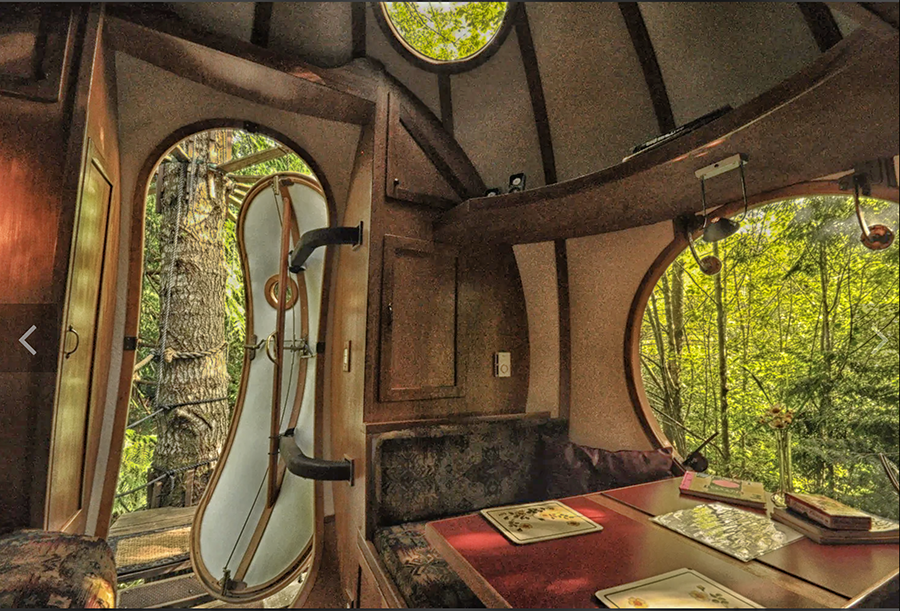
Swing into the trees

Canadian company Free Spirit Spheres builds spherical tree houses as works of art — functional, tasteful, simple, and elegant — and invites people to spend a night at their unique and magical forest hotel. Much of the design and build is informed by the principle and practice of Biomimicry. According to the Biomimicry Institute: “Biomimicry is an approach to innovation that seeks sustainable solutions to human challenges by emulating nature’s time-tested patterns and strategies. The goal is to create products, processes, and policies — new ways of living — that are well-adapted to life on earth over the long haul.”

“We envision a truly world-class resort — one that allows people to experience nature in relative luxury while showcasing the majesty and true value of the west coast rainforest,” says Tom Chudleigh, a master craftsman and creative director of the project. “We hope to cultivate partnerships focused on extending this vision as a model for conserving forests and supporting healthy communities around the world.” FreeSpiritSpheres.com

Live in a Water Volcano in the Jungle

Huilo-Huilo Biological Reserve in Chile is an area under private protection that encompasses 100,000 hectares of temperate rainforest. The area has great biological diversity, with one of the highest densities of unique fauna species in the world. It features glacier lakes and countless watercourses and eternal snow. One of the ten accommodations on the reserve is Montaña Magica, a mountain-shaped lodge that features nine fairytale-inspired rooms. The hotel is a gigantic man-made volcano that spews water over its rocky sides instead of lava. Windows peak from the sides like giant eyes with green, mossy eyelashes. The hotel and reserve is located within 232 square miles of living, breathing rainforest 400 miles South of Santiago.  HuiloHuilo.com

Imagine Simplifying Your Product for Greater Impact

Archbishop Desmond Tutu was known for many things, but developing a school desk is not one that instantly comes to mind. Yet the “Arch” championed a campaign for many years that provides a simple writing surface for school children across Africa who have no desks.

Known as the Tutudesk, it’s proof that simplicity can sometimes be the mother of invention. While industrial designers, product developers, and impact leaders sweat over developing high-tech innovations, this simple piece of polystyrene offers children their very own workstation, creating immediate, high-impact, and positive change in an instant, under any learning conditions. The thin board is easy to carry, slides under a bed for storage, offers protection against the sun and rain, and is even used for board games and eating.

“South Africa has 12 million children in school,” says Thandeka Tutu-Gxash, the archbishop’s daughter who now runs the campaign. “Three million of those go to school without desks and as bad as that sounds for South Africa, in the rest of Africa, it’s worse. In Mozambique, they have nine million children who go to school, and out of those, seven million go to school without desks.” Tutudesks are manufactured in South Africa from recycled high-impact polystyrene, and schools are recruited into environmental campaigns that collect yogurt containers and plastic eating utensils used in producing the lap desks. Designed to last each student a minimum of five years, they are recycled at the end of their useful lives.

Imagine Simplifying Your Product for Greater Impact

Archbishop Desmond Tutu was known for many things, but developing a school desk is not one that instantly comes to mind. Yet the “Arch” championed a campaign for many years that provides a simple writing surface for school children across Africa who have no desks.

Known as the Tutudesk, it’s proof that simplicity can sometimes be the mother of invention. While industrial designers, product developers, and impact leaders sweat over developing high-tech innovations, this simple piece of polystyrene offers children their very own workstation, creating immediate, high-impact, and positive change in an instant, under any learning conditions. The thin board is easy to carry, slides under a bed for storage, offers protection against the sun and rain, and is even used for board games and eating.

“South Africa has 12 million children in school,” says Thandeka Tutu-Gxash, the archbishop’s daughter who now runs the campaign. “Three million of those go to school without desks and as bad as that sounds for South Africa, in the rest of Africa, it’s worse. In Mozambique, they have nine million children who go to school, and out of those, seven million go to school without desks.” Tutudesks are manufactured in South Africa from recycled high-impact polystyrene, and schools are recruited into environmental campaigns that collect yogurt containers and plastic eating utensils used in producing the lap desks. Designed to last each student a minimum of five years, they are recycled at the end of their useful lives.

3 Luxury Sustainable Destinations We’d Love to Visit

It can be easy to get caught up trying to cram as much as possible into a trip. After all, this may be the only time you visit the destination.

Though a packed itinerary may seem ideal on paper, you’ll likely spend most of your vacation rushing from one place to another. So while you may tick off many bucket-list sights, you’ll miss out on getting to know the destination. This fast-paced hit-and-run style of tourism is a surefire recipe for stress. Instead, give yourself more time to explore the destination. Instead of taking multiple shorter trips each year, opt for just one, longer vacation.

Life’s too Short to Stay at Home

If you’re looking for tourism that truly has a positive impact but unsure where to go, Earth Changers connects you to the most sustainable tourism worldwide, engaging with the people behind places to reveal their true passions and purpose. Instead of sending a check to charity in a far-flung destination, go there yourself and show your support. London-based Earth Changers’ unique destination and human stories demonstrate commitment to community and conservation for sustainable development through tourism. On the same day, her oldest friend’s partner was hospitalized with a terminal illness and another friend was in a car accident, left in a coma, founder Victoria Smith decided in her 20s that she had to have something serious on her resume. “Life is too short not to explore, pioneer, and follow your heart and adventure with passion,” she says. “We should experience the world, extraordinary people, and awe-inspiring places.” Many people think of tourism just as lovely holidays instead of a complex and extensive sector of an economy, but tourism supports 10% of the world’s jobs and GDP. Help plant trees at the Lapa Rios Ecolodge in Costa Rica; work alongside communities in Madagascar on their sustainable solutions for health, conservation, education, and livelihoods; or see firsthand how high seas research, coastal conservation, education, and marine filming is done on a marine conservation yacht.
Earth-Changers.com

Your Childhood Treehouse in the City of London

Retreat into the reclaimed wood walls of Treehouse Hotel in London, a cloud-brushing escape where you’ll encounter a green paradise. Rooms are a portal back to childhood —silver birch tree trunks pierce through bathroom tiling, endearing sloth toys sit on organic bedding, and cushioned window nooks are perfect for sipping tea while gazing at views of cinematic city landmarks. Treehouse Hotel was founded on the ideas that inspire a child to build a treehouse. Adventure, independence, cozy spaces, and repurposing crafty things are what make a place warm and special. The hotel celebrates found objects, nostalgic tunes, handmade details, and locally sourced treats. The owners have minimized single-use plastics, committed to a recycling and composting scheme, and placed locally sourced products around the rooms. TreeHouseHotels.com

A Luxury Vacation that Gives Back

After setting up Cambodia’s first private marine sanctuary, Song Saa Private Island founded its own nonprofit organization, the Song Saa Foundation, which works to protect the natural habitats of the Koh Rong Archipelago and improve the welfare of people who live there. The resort has been pioneering luxury tourism in Cambodia for many years and has always done so with sustainability in mind. To date, the foundation has provided 3,000 locals with vital healthcare; distributed stationery, vitamins, and clothing to 6,000 schools; distributed water filters throughout the archipelago; and protected more than 10,000 hectares of mangrove forest. “We have a 700-foot marine reserve around Song Saa where the underwater wildlife is thriving like never before,” says general manager Donald Wong. The resort is proof that luxury can be done responsibly, bringing benefits to both visitors and locals. SongSaa-PrivateIsland.com

The Make or Break Qualities of a Real Leader

Universal truths are arduous – if not impossible – to identify and articulate when it comes to leadership philosophy and effectiveness. Those seeking the secrets to success are typically well read on the topic (with an impressive bookshelf dedicated to the discussion) and passionate about their perceived thematic threads between Winston Churchill and Warren Buffett.

We have all seen it … the list that outlines the key characteristics of dynamic, driven leaders. Titans of industry and popular politicians. While there is ample information and inspiration to pull from and apply to one’s personal approach, the number of observations and recommendations can be overwhelming.

With decades of on-the-ground (though not always written down) leadership experience – within industries with acute emphasis on inspiring and influencing others – I have my own simplified perspective on what it takes to lead a talented team and act with influence. These are consistent characteristics that come from someone who has navigated a substantial and uphill hike to the upper echelon of meaningful management positions.

Sure, there are no shortage of lists about leadership and many authors are incredibly qualified to comment about this topic, but for me, there are three qualities that make-or-break a real leader.

1. Understand Your Business. 

Somewhat self-explanatory? Maybe. Non-negotiable for effective leadership? Most definitely. A great leader knows the nooks and crannies of their organization. In addition to maniacal management of the numbers and understanding of the market, they see beyond the steady drumbeat of the business and recognize the nuances. 

The most effective leaders I’ve had the opportunity to meet know their smallest customer, as well as their largest. Priorities must be in order, but the ins and outs of the procurement department performance – and the people within the department – get a real leader equally energized as an impressive earnings report. The leader shares their understanding – the team needs to know you know – but as a way of thinking and learning with the team, not lauding over them.

2. Put an Emphasis on Interpersonal Communication. 

The best leaders understand how to manage and maneuver through office politics and are steadfast in their statements. They understand the interpersonal dynamics of their team and adapt their approach to meet individuals’ expectations and inclinations. Emotional IQ is included, but it extends well beyond empathy and the ability to read a room. 

Real leaders put an emphasis on expression. They pay equal attention to what they say (or write), how they say it and to whom they are speaking. Each interaction is an opportunity to motivate an employee to move the mission forward. And, contrary to conventional wisdom, interpersonal communication isn’t a hereditary character trait. It’s a skill that can be learned and strengthened with concerted effort and a rightsized spot on a leader’s priority list. An anonymous quote I regularly reference sums it up: “The true essence of a leader is revealed by a person who cares about the opinions and needs of others in ways that transcend position or title.” 

3. Define Your Vision and Empower Others to Execute.

Strong leaders look toward the future and are able to articulate a clear vision that their staff can understand and be energized by. This is especially important for the impact industry where people are mission-driven. Leaders instill confidence by demonstrating competence. And a core competency for any impactful leader should include the capacity to rally a team around a shared strategy, and a strong sense of purpose for the work. 

Once the destination is set, give the talented team you’ve worked so hard to build, the tools and autonomy to map the course. I’ve learned that being in the weeds is being in the way when it comes to effective leadership. A leader must ensure everyone understands and is aligned with the objective, and then empower the team to execute. 

As a leader in the impact industry who thinks regularly about the future we will leave behind, I am motivated to help high-potential, high-performers prepare for prominent leadership positions that will ensure we continue pursuing and securing our intended outcomes. We are striving to strengthen communities. We need strong leaders to recognize the weight of this work and help expand the scope of what is possible. www.advantagecap.com

Sandra M. Moore is managing director and chief impact officer at Advantage Capital, a growth equity firm founded in 1992 with more than $3.8 billion AUM. The firm focuses on high-growth and high-wage businesses investing in communities where access to investment capital has historically been hard to find. 

The Make or Break Qualities of a Real Leader

Universal truths are arduous – if not impossible – to identify and articulate when it comes to leadership philosophy and effectiveness. Those seeking the secrets to success are typically well read on the topic (with an impressive bookshelf dedicated to the discussion) and passionate about their perceived thematic threads between Winston Churchill and Warren Buffett.

We have all seen it … the list that outlines the key characteristics of dynamic, driven leaders. Titans of industry and popular politicians. While there is ample information and inspiration to pull from and apply to one’s personal approach, the number of observations and recommendations can be overwhelming.

With decades of on-the-ground (though not always written down) leadership experience – within industries with acute emphasis on inspiring and influencing others – I have my own simplified perspective on what it takes to lead a talented team and act with influence. These are consistent characteristics that come from someone who has navigated a substantial and uphill hike to the upper echelon of meaningful management positions.

Sure, there are no shortage of lists about leadership and many authors are incredibly qualified to comment about this topic, but for me, there are three qualities that make-or-break a real leader.

1. Understand Your Business. 

Somewhat self-explanatory? Maybe. Non-negotiable for effective leadership? Most definitely. A great leader knows the nooks and crannies of their organization. In addition to maniacal management of the numbers and understanding of the market, they see beyond the steady drumbeat of the business and recognize the nuances. 

The most effective leaders I’ve had the opportunity to meet know their smallest customer, as well as their largest. Priorities must be in order, but the ins and outs of the procurement department performance – and the people within the department – get a real leader equally energized as an impressive earnings report. The leader shares their understanding – the team needs to know you know – but as a way of thinking and learning with the team, not lauding over them.

2. Put an Emphasis on Interpersonal Communication. 

The best leaders understand how to manage and maneuver through office politics and are steadfast in their statements. They understand the interpersonal dynamics of their team and adapt their approach to meet individuals’ expectations and inclinations. Emotional IQ is included, but it extends well beyond empathy and the ability to read a room. 

Real leaders put an emphasis on expression. They pay equal attention to what they say (or write), how they say it and to whom they are speaking. Each interaction is an opportunity to motivate an employee to move the mission forward. And, contrary to conventional wisdom, interpersonal communication isn’t a hereditary character trait. It’s a skill that can be learned and strengthened with concerted effort and a rightsized spot on a leader’s priority list. An anonymous quote I regularly reference sums it up: “The true essence of a leader is revealed by a person who cares about the opinions and needs of others in ways that transcend position or title.” 

3. Define Your Vision and Empower Others to Execute.

Strong leaders look toward the future and are able to articulate a clear vision that their staff can understand and be energized by. This is especially important for the impact industry where people are mission-driven. Leaders instill confidence by demonstrating competence. And a core competency for any impactful leader should include the capacity to rally a team around a shared strategy, and a strong sense of purpose for the work. 

Once the destination is set, give the talented team you’ve worked so hard to build, the tools and autonomy to map the course. I’ve learned that being in the weeds is being in the way when it comes to effective leadership. A leader must ensure everyone understands and is aligned with the objective, and then empower the team to execute. 

As a leader in the impact industry who thinks regularly about the future we will leave behind, I am motivated to help high-potential, high-performers prepare for prominent leadership positions that will ensure we continue pursuing and securing our intended outcomes. We are striving to strengthen communities. We need strong leaders to recognize the weight of this work and help expand the scope of what is possible. www.advantagecap.com

Sandra M. Moore is managing director and chief impact officer at Advantage Capital, a growth equity firm founded in 1992 with more than $3.8 billion AUM. The firm focuses on high-growth and high-wage businesses investing in communities where access to investment capital has historically been hard to find. 

Your Purpose Will Enable Your Profit

Robert Sheen is CEO and founder of Trusaic.

What does being an impact leader mean to you? 

Driving a positive impact in the world and leading with purpose. Being a leader of impact goes beyond taking care of those within your own company, it expands to caring for society at large and ensuring you uphold and promote the values ingrained in your company’s DNA. At Trusaic, we strive to advance social good in the workplace, to create a better working world for future generations.

What was your biggest leadership barrier and how did you over come it?

Driving social impact while maintaining profitability can be a huge barrier for leaders. To overcome this barrier, leaders must understand that purpose enables profit. Weaving purpose into the fabric of your organization is essential to being a successful leader and promotes growth alongside social good.

What does collaborative leadership look like? 

Creating an environment without judgment and fostering inclusivity is the core of collaborative leadership. An environment without judgment allows individuals to feel safe to share their opinions openly, and in turn, fosters diversity of opinion. It’s only within this environment that productive collaboration can occur at all levels.

www.Trusaic.com

Robert Sheen, founder and CEO of Trusaic, is a serial entrepreneur and a philanthropist.


Robert founded First Capitol Consulting, Inc. in 1999, serving over 5,000 global, national, and
regional companies. In 2003, he founded, organized, and chartered US Metro Bank with an
initial $19.6 million capital raise. US Metro Bank is currently valued at over $1 billion. In 2006,
Robert developed TaxAdvantage® in partnership with Intuit, providing tax-centric data solutions
for Intuit Employee Management Service’s 1.4 million customers. In 2019, First Capitol
Consulting became Trusaic, and today is a leading software company focused on pay equity,
DEI, and healthcare. Trusaic helps organizations build a better workforce so they can build a
better business.


Robert has served on the boards of MTV’s “Rock the Vote,” University of Southern California
Pacific Asia Museum, Asian American Justice Center, and the Korean American Democratic
Committee. He is a former President of the Korean American Bar Association. Robert was
honored in the “Men of L.A.” by The Women’s Foundation.


Your Purpose Will Enable Your Profit

Robert Sheen is CEO and founder of Trusaic.

What does being an impact leader mean to you? 

Driving a positive impact in the world and leading with purpose. Being a leader of impact goes beyond taking care of those within your own company, it expands to caring for society at large and ensuring you uphold and promote the values ingrained in your company’s DNA. At Trusaic, we strive to advance social good in the workplace, to create a better working world for future generations.

What was your biggest leadership barrier and how did you over come it?

Driving social impact while maintaining profitability can be a huge barrier for leaders. To overcome this barrier, leaders must understand that purpose enables profit. Weaving purpose into the fabric of your organization is essential to being a successful leader and promotes growth alongside social good.

What does collaborative leadership look like? 

Creating an environment without judgment and fostering inclusivity is the core of collaborative leadership. An environment without judgment allows individuals to feel safe to share their opinions openly, and in turn, fosters diversity of opinion. It’s only within this environment that productive collaboration can occur at all levels.

www.Trusaic.com

Robert Sheen, founder and CEO of Trusaic, is a serial entrepreneur and a philanthropist.


Robert founded First Capitol Consulting, Inc. in 1999, serving over 5,000 global, national, and
regional companies. In 2003, he founded, organized, and chartered US Metro Bank with an
initial $19.6 million capital raise. US Metro Bank is currently valued at over $1 billion. In 2006,
Robert developed TaxAdvantage® in partnership with Intuit, providing tax-centric data solutions
for Intuit Employee Management Service’s 1.4 million customers. In 2019, First Capitol
Consulting became Trusaic, and today is a leading software company focused on pay equity,
DEI, and healthcare. Trusaic helps organizations build a better workforce so they can build a
better business.


Robert has served on the boards of MTV’s “Rock the Vote,” University of Southern California
Pacific Asia Museum, Asian American Justice Center, and the Korean American Democratic
Committee. He is a former President of the Korean American Bar Association. Robert was
honored in the “Men of L.A.” by The Women’s Foundation.


I Have the Best Job in the World as an Impact Leader

Desirée Bombenon is the CEO of SureCall.

What does being an impact leader mean to you? 

Being an impact leader means making a transformational difference in the areas of social, environmental, and governance, that you are passionate about changing for the better. Impact can be done and felt in many ways. Leading impact means that you are looking beyond the work you are creating to the outcomes that are produced and seeing a measurable difference in the overall effect it has. It’s taking the words in your vision and mission statements, and making them actionable, accountable, and meaningful, while bringing your team along with you.

What was your biggest leadership barrier and how did you over come it?

I cannot qualify the biggest barrier because there were just constant barriers, none bigger than the other. There were barriers of race, gender, age, education, and stakeholder blinders. Upton Sinclair once said: “It’s difficult to get a man to understand something when his salary depends on not understanding it.” Being an impact leader has many barriers, and being a female POC impact leader has additional challenges. These were overcome by continuing to bump relentlessly against traditional norms and then proving that stakeholder capitalism doesn’t mean giving up profits for purpose. You can do well by doing good, and it’s in the numbers. Once you can demonstrate that doing good is good for business, the buy-in happens, at every level.

What does collaborative leadership look like? 

It looks really great! Collaborative leadership means every perspective has insight, that no one viewpoint is the only way forward. It’s understanding that all the people in the room have the right intentions. It’s moving forward with an idea even if it’s not yours, it’s challenging tradition and expecting the entire team to contribute; its avoiding group think. Collaborative leadership is inclusive, not just the top executives, but all stakeholders — creating cross functional integrated thought leadership.

www.SureCallcc.com

Desirée Bombenon has over 30 years of business operational experience and strategic leadership. Awarded RBC’s Women’s Entrepreneur for 2020, Ernst & Young 2019 Entrepreneur of the year for the Prairies in Communication Technology, she is a bold innovator, futurist, and purpose-driven leader. 

I Have the Best Job in the World as an Impact Leader

Desirée Bombenon is the CEO of SureCall.

What does being an impact leader mean to you? 

Being an impact leader means making a transformational difference in the areas of social, environmental, and governance, that you are passionate about changing for the better. Impact can be done and felt in many ways. Leading impact means that you are looking beyond the work you are creating to the outcomes that are produced and seeing a measurable difference in the overall effect it has. It’s taking the words in your vision and mission statements, and making them actionable, accountable, and meaningful, while bringing your team along with you.

What was your biggest leadership barrier and how did you over come it?

I cannot qualify the biggest barrier because there were just constant barriers, none bigger than the other. There were barriers of race, gender, age, education, and stakeholder blinders. Upton Sinclair once said: “It’s difficult to get a man to understand something when his salary depends on not understanding it.” Being an impact leader has many barriers, and being a female POC impact leader has additional challenges. These were overcome by continuing to bump relentlessly against traditional norms and then proving that stakeholder capitalism doesn’t mean giving up profits for purpose. You can do well by doing good, and it’s in the numbers. Once you can demonstrate that doing good is good for business, the buy-in happens, at every level.

What does collaborative leadership look like? 

It looks really great! Collaborative leadership means every perspective has insight, that no one viewpoint is the only way forward. It’s understanding that all the people in the room have the right intentions. It’s moving forward with an idea even if it’s not yours, it’s challenging tradition and expecting the entire team to contribute; its avoiding group think. Collaborative leadership is inclusive, not just the top executives, but all stakeholders — creating cross functional integrated thought leadership.

www.SureCallcc.com

Desirée Bombenon has over 30 years of business operational experience and strategic leadership. Awarded RBC’s Women’s Entrepreneur for 2020, Ernst & Young 2019 Entrepreneur of the year for the Prairies in Communication Technology, she is a bold innovator, futurist, and purpose-driven leader. 

0