How Balfegó Tuna Can Help Executives Grow as Leaders

A few years ago, I began developing team-building and coaching programs around nature. I learned how animals and nature had a way of cutting through the masquerades of executives to allow more in-depth, more honest conversations. I’ve taken teams to mountains and horse ranches, but never to swim with 550 lbs tuna.

Early this year, a client called and asked me to design a program for a tuna tour. He asked, “can you do that?” and I said “Of course!” before I even knew what we were talking about. A few months later, our driver fetched my client’s team at the Tarragona train station, a port city in northeastern Spain’s Catalonia region. We turned off our cellphones and began to leave our problems and “to do” lists far behind, as the quiet rumble of the bus took us to a holiday home we had rented for a few days.

Once settled in, we walked to a small “Cala” – a small, rocky beach enclosed on both sides – and did some stretching to help ground our bodies and quiet our minds. The wind blew all around us, as if playfully whisking away our worries and evoking deeper feelings about who we were, why we were there, and what we wanted to improve in ourselves.

One thing I love about working in nature is the sheer power she holds over every single one of us. It’s only a matter of time before we each melt into a softer, more humane and more sensitive version of ourselves. “Nature does all the work,” as a fellow trainer once told me. I also love that I never know what’s going to happen next, and what happens seems to always be precisely what we needed to grow as a team.

My client has an excellent sense of humor. He’s from the North of Spain; the Basque country. Basque men are strong, no-nonsense lads, yet sensitive at the same time. More often than not, they’ve lived with a fair deal of emotional pain around them, since forever. Like the Northern Irish, they’ve also learned to laugh in the face of adversity, and laugh we did, throughout our program in Tarragona.

Twenty-four hours later, we were ready to embark on our tuna tour. We’d already shared much personal information between us through several exercises, and practiced mindfulness routines to help us unwind. All this was in preparation for the main attraction: swimming with massive tuna fish in the ocean.

Balfegó Tuna started their business eight years ago. They created a 50-meter wide pool surrounded by a vast net, 20 minutes off the coast. They now have 17 different pools, like this one, where tuna are fed varying amounts of fat to satisfy different consumer preferences.

Once a year, they go out to hunt for tuna the Mediterranean with an official inspector on board to ensure they don’t catch more than their yearly allocation. They find tuna in areas they go to mate, and two boats work together to entrap the fish in a huge net and transport them slowly back to the Balfegó offshore pools. Tuna fish lose up to 30 percent of their body mass on the long journey back to mating spots, so Balfegó feed them for months, until each fish is sold. Until then, the animals continue to swim around in their natural habitat, getting free food and even getting on with mating while still in season!

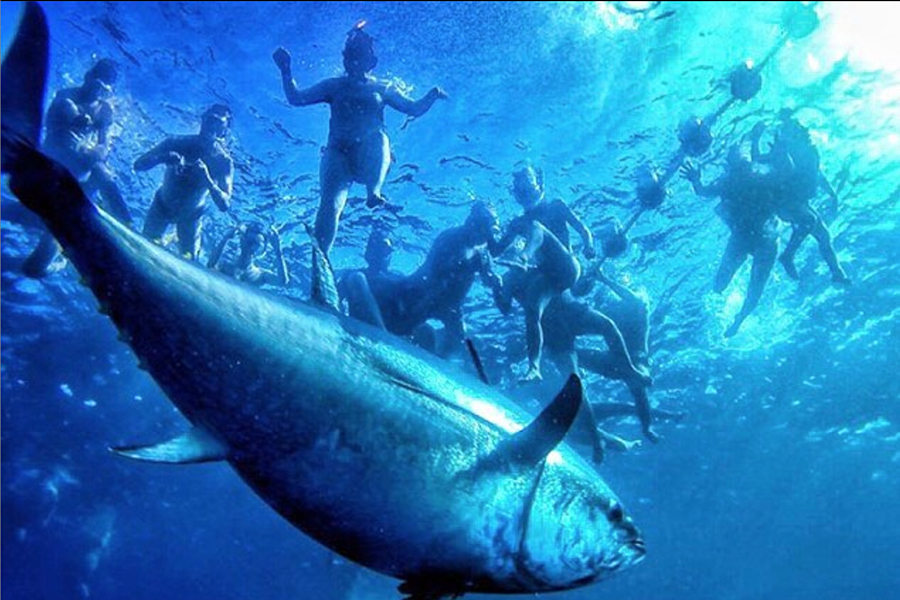
It’s in one such pool that our boat drops us — to swim and observe the spectacle of 550 lbs fish swimming peacefully around. Food was thrown into the water to give them a reason to come up to where we were, as they typically live 50 feet under the surface. We wore neoprene suits and masks to resist the chilly water and sunk into the water to blend into this amazing spectacle.

To be honest, I didn’t expect to learn much or grow from this tuna experience. I had already designed many other team building activities for that week to ensure a successful result for my client. But this experience moved us in a new way. It changed our opinions and opened us up to the spectacle of life and death.

It inspired us to see how some entrepreneurs had found more humane ways to treat animals. We arrived at the conclusion that Balfegó tuna taste better because the fish don’t suffer a stressful or painful death. Once a fish is sold, a diver goes down to kill it painlessly with a water pistol. Because mating continues, fertilized eggs can easily drift through the nets and out into the open sea, allowing Mediterranean tuna populations to be sustained.

Several team members experienced a profound shift in themselves. Some learned to manage their own stress when faced with an unknown situation. Others activated old, very primal emotional patterns which affected the way they protect their personal space and interests at work. There were plenty more personal revelations among the group, each revealing new sensitivities.

The Balfegó’s tuna tour did something to us all. I was amazed by the mood afterward: The honesty and the sharing of feelings. There were realizations among sophisticated bankers who had never before talked in this way to anyone. There was an undeniable sense of us all being connected to the ocean and the life it nurtures on our behalf. For a couple hours, we were all one, in the circle of life.

Imagine what we might become as a species if executives and decision makers experienced this example of real leadership from time to time.


How to Solve the Climate Crisis: Take Responsibility for Your Hidden Violence

If we were little green men from Mars (or Venus for that matter) looking down on planet Earth, we would rapidly conclude that humans were killing the planet. While it’s obvious to an outsider, we seem unable to acknowledge our own endemic violence. We hide, deny and run from our deepest, most global truth.

Extinction Rebellion took to the streets of London recently, resulting in 900 protesters landing in jail. When London mayor Sadiq Khan urged them on twitter to “Let London return to business as usual”, George Monbiot – journalist at The Guardian – retorted “business as usual is destroying our life support systems.”

He’s not wrong.

While we continue blindly with our unconscious killing spree, or as we call it, “business as usual”, our hidden violence is quite apparent to someone like Greta Thurnberg, the sixteen-year-old Swedish girl with Aspergers disease who talks in unapologetic black and white terms about our climate crisis — against the tones of gray that politicians and world leaders seem to excel at when making a speech. 

Solving our climate problem is clearly not just a matter of recycling, it’s way bigger. It’s now about our entire way of life. We live and consume like planet-harassing bullies. The structure of our global economy, the pillars of capitalism and democracy, the very way we interact and negotiate with each other need to be radically redefined in order to stop this massacre.

But if we want to change the world, as any ancient wisdom, spiritual theology or decent life coach would tell us, we must start by changing ourselves. We need to face, accept and heal the hidden bullies we have unknowingly become.

I’ve been going through a harsh exercise of self-change for a while now, resulting in articles around my personal and painful revelations, which you’ll find on Real Leaders. I have shared with some friends and colleagues my tough quest to build self-awareness around the hidden violence that I have suffered for decades, from those I loved the most. It wasn’t easy.

On one hand, confessing to everyone I cared about that I’d been bullied since childhood meant that I had to confront the hidden violence in my life on a new level. I felt stupid, worthless, weak and unworthy all over again, now that it wasn’t hidden anymore.

On the other hand, I realized how much I’d been playing along with it, before making the facts publicly known. I had a dream about this life change the night the article was published. I saw myself engaging in a superficial, happy conversation with Javier, my romantic bully, hoping to reduce the risks of a possible ambush. I woke up suddenly, startled, with a terrible heartache pulsating slowly through my body, waves of grief and anguish growing. Luckily, I have taught myself to process and relieve emotional pain effectively.

The dream taught me that the pattern of violence between the two of us, was as much mine, as it was his. Maybe I wasn’t doing the insulting, but I was playing along with it. I was reactively taking it in my stride as a means of avoiding more violence. In doing so, however, I was unknowingly negating, suppressing and ignoring the wounded victim in me.

Years ago, someone told me that attending therapy was about taking responsibility for things that are not your responsibility. Growing as a person and as a leader is no different. The only way we solve, and end a pattern of violence, is by acknowledging  our part in it. It’s a tricky concept in our current culture, that is full of moral judgment and blame — both essentially acts of hidden violence themselves.

Just for fun, let’s ask the little green men once more to give us their opinion on human history: Do they see violence in it? Do they see us as taking responsibility for that violence and gradually reducing it over generations? Or, do they see us coming up with increasingly sophisticated methods and excuses to continue inflicting hidden, morally-superior, and easy-to-deny violence on past and present enemies? Even far-away, innocent bystanders.

Such are the tough questions we all need to come to terms with. Despite our ignorance – and innocence or lack of responsibility in the making of it – the fact is we are all part of this cycle of hidden violence. We play along with it to avoid unforeseen consequences down the road: We hoard money, power, Instagram likes, and all kinds of single-use stuff, just in case it all runs out, or there isn’t enough to go around. In doing so we negate, suppress and ignore the wounds such behavior inflicts on the planet, on the two-hundred species that disappear each day, on the distant, unseen  villages that are most vulnerable to climate change. We suppress this in ourselves too.

I have to agree with the little green men on one thing — the fact that hidden violence is significantly more destructive and far-reaching than obvious, physical violence. There is a refinement and cold dissociation to be found in a financial venture that  leaves thousands of people without jobs or homes, in contrast to the football hooligan who thumps an opponent in a drunken haze. A hooligan is a lot likelier to admit his faults and change than the slick, rich, carefully-crafted executive who plays carelessly with numbers in his excel sheet. The first crime is punishable by law, while the second is “business as usual.”

When I look at my family and romantic life, I know we didn’t choose our roles. We never intended to become helpless receivers of violence, less so the bad guys. Just as I had not fully grasped that I was a victim, Javier doesn’t even know he is a bully. He works himself to the absolute limit every day in an effort to hide it, deny it and run from his deepest truth.

In a way we were meant for each other. Both his family and mine inherited patterns of violence from earlier generations. No one ever spoke of it. It was hidden in plain sight between our jokes and our mean laughter, inside our inconsequential daily gossip, beneath the addiction we each chose to help us cope with our assigned roles.

Where there is violence there is an old wound. The only animals in nature who inflict pain on others, beyond their instinct to survive, are ones that have been previously traumatized. Recuperating violent horses, for example, is all about retraining their responses, rebuilding their trust, and letting them express anger in safe spaces until it’s gone.

Recuperating the violent, planet-killing species that the human race has become is no different. It starts with acknowledging and admitting our role in the violence. It continues through many sessions of rebuilding broken trust, and expressing our anger, fear and grief in safe spaces. Until it’s gone.

Only then can we build a new life and global economy for ourselves which inflicts no violence on anyone or anything.

Why I Endured Bullying for Years

If you had asked me fifteen years ago whether I had ever been bullied or mobbed, I would have said no. Now, I’m not so sure.

The first time I went to see a therapist I was thirty. I talked for the entire hour of this first session about all the times I had found myself alone in front an angry crowd that was criticizing me, insulting me, teasing me or making me cry. When I finished, five minutes before the hour was over, my shrink asked, “Where were your parents in all of this?” to which I unthinkingly replied, “I don’t know.”

Fifteen years later it’s clear to me what he meant. Now I understand that it was strange that I described all these incidents of childhood bullying without ever thinking of reaching out for help. For a long time I associated this bullying with the seven years our family spent in Mexico, believing them to be no more than an anecdote of my distant past.

However, these early years weren’t so distant after all — later in life, several jobs, projects, collaborations and even my own startup ended badly for me. I endured collective abuse – unkind gossip, unfair deals, isolation and exclusion, even sophisticated power plays against me. Eventually, one of two things would happen: either I snapped and retaliated, which always led to a public trial and expulsion from the group, or I abandoned the whole thing voluntarily before my opponents had the chance to publicly humiliate me again.

Over the years, I came to see a pattern in how I consistently put myself in vulnerable positions by standing up for people who weren’t brave enough to stand behind me. I made myself vulnerable to opposing (often ruthless) parties who invariably played the group until I was out. I was a sucker for the truth, I must confess. The Irish joker in me described it this way: “Before I was forty I was very worried that there was something seriously wrong with me. But then I realized that it’s all been part of some type of witch’s initiation!”

Indeed, I did learn to protect myself after much practice, although the key issue turned out to be the way I felt about myself before anybody even targeted me. Eight years ago I fell madly in love with the type of man I’d never wanted to be in love with. Terribly handsome, he had four nobility titles and women competed for this attention all the time. What I had interpreted to be (platonic) love at first sight, suddenly became a nightmare when he informed me in an email that he was “happily married.”

I believed him and blamed myself for having “got it all wrong” during our several months of intimate, deeply bonding conversations over his rapidly failing fashion business. I walked away in a shambles. The following year we reconnected over the publishing of a book that I had interviewed him for. We repeated the same game all over, but this time I fought back when he tried to shake the whole thing off again. I demanded a face-to-face conversation to understand what he felt for me, and would be done with him if he expressed no romantic feelings. He insisted he had no time, and that I was “Una tarada traumada” — which translates in Spanish to “a traumatized person with a defect.”

A year later he again asked me for professional advice. To my horrified disbelief, I watched as we repeated the whole game for a third time. I told him, “Maybe I am crazy, but anybody who hears that you’ve walked into the same cave, with the same woman three times in a row, would assume that either you’re crazy, or you like the woman and cave more than you admit.”

It took me several years of this awful, gut-wrenching to realize that while Javier was telling everybody how crazy I was, I was too terrified that he was right and told nobody. He once texted to tell me that he and all his employees were in China on business and had all agreed I was Glenn Close (in the movie “Fatal Attraction”).

It was humiliating and embarrassing to a point I can’t describe. I was terrified of what he might do and what he was telling people. At the same time, I had a gut instinct that what I was asking for – a face-to-face conversation to understand what was going on between us – was not an unreasonable demand. If he didn’t love me, then why didn’t he just tell me to my face?

Only now can I take a step back and ask myself: Exactly who was harassing who? Instead of showing up to discuss the issue in private, and end this disagreement, he kept recruiting supporters and turning them into Pino-haters at every party or gathering he attended. It was a long, awful night the first time I realized that I had never been in love with the seemingly perfect, trophy lion I had written about once in an article. To my deepest despair, I had to admit that I was in love with a bully.

I was the perfect victim. I believed him more than I believed myself. What’s more, I kept going back to that same cave, and the same man, over and over again. I agonized over his every insult, thinking it was true. I questioned my own behavior way more than I ever questioned his.

Once, he threatened to sue me. I sniggered, pointing out how there was absolutely nothing to base it on, yet I shivered inside. Despite putting up a fight with words and smart retorts to his cruel texts, I dared not disclose who he was to anybody. Yes, I talked an angry game, but in a primal, deep part of me, I agreed with what Javier and his mob said about me.

I had been bullied in romance, in business, and also at home with my family. It was what I grew up with. It was a type of discomfort that I became comfortable with. It has taken me all these years to stop believing in what others told me, and begin believing in myself. Thanks to this, I have become an expert at managing verbal violence and bringing conflict back to a constructive conversation in certain situations.

What about Javier, you may ask? Well, I’m still in love with him, believe it or not. We’ve shown the worst parts of ourselves to each other, which has allowed us to identify it and resolve it. We turned something ugly into a kind of beauty. But whether he will ever find the time, or (between you and me) the courage to face up to what he feels toward me, is a question I ask myself every day.

Falling in love is not about conquest, as Javier’s mob of female suitors and fans would argue, but about surrender. It took me eight years to give in to this strange definition of love, accept it for what it is, and become the certifiable “witch” that I’m now proud to be. At last!

And what does Javier really feel? Well, you’ll have to call him up and ask. I stopped asking a long time ago, I honestly don’t want to get sued!


Our Secrets are Being Revealed: Are you Happy or Fearful?

Have you noticed something huge is happening? Can you feel how secrets are being revealed around us this very moment? And more importantly, do you feel relief and joy at the new justice and freedom such revelations bring to life, or are you scared that you might lose something you cherish?

By the looks of the Julien Assange news footage yesterday, in which a number of men drag him from the Ecuadorian embassy in London, it’s probably safe to say that a lot of people in high places are very nervous about what might be lost or destroyed by the revelations Assange and Wikileaks continue to spill onto the internet. Leaving aside the important political questions for now, such as “why now?” and “Who stands to gain?” the ongoing Assange saga is relevant to all of us in some way — as a culture of transparency continues to bring secrets into the light.

Two stories attracted my interest this week. Because I’m half Irish, half Spanish, one of them is in English, and one of them is in Spanish, but bear with me, “all will be revealed.”

It’s funny, but it’s also very serious. The first story was published by Caitlin Flanagan in The Atlantic. What most struck me was how very well she described the parents’ whatever-it-takes attitude in the college admissions scandal. She was so funny and smart with her words that it also hurt inside to realize how extensive this attitude has become on a global level. Friends who work in excellent private schools tell me how intensely competitive life has become for children.

The second story is a journalistic bombshell dropped by the ex-editor of El Mundo, one of Spain’s leading newspapers. David Jimenez was a news correspondent who had managed to keep a distance between himself and the secretive, politically-tainted newspaper to which he contributed — until he rose to the position of editor. It was then that he encountered hypocrisy, cowardice and back-stabbing from his colleagues, driven by secretive agendas that aimed to paint certain political and corporate favorites in a good light.

“Power had stopped fearing the media and now it was the media who feared power,” he says in his book.

In the interview and video published about his new book, he confessed that it was much harder to confront pressure from the establishment around falling in line with their secretive agendas than it was “being pursued by the Taliban in Afghanistan!”

Dirty secrets are being revealed on a scale I’ve never seen before. People are coming out with secrets that many knew about for decades, but did nothing about. Each individual was trapped by the secrecy of power. Fear was the glue that held these secrets together. Fear kept the light out and shutters closed because, for a long time, anyone who dared to confront the status quo was viciously attacked by ignorant mobs. Ironically such mobs were managed by elites in power and the establishment that ate from the hand of power.

One more thing touched me deeply this week. I was invited to attend St. John’s Passion by Bach in the National Auditorium in Madrid. It’s a lengthy concert of baroque music. Many executives abandoned the hall during the interval because it’s a tough exercise in concentration, especially after a long day’s work. At the outset I was handed a transcript of the entire rendition, in German and Spanish, so that I could follow the narrative throughout the concert.

I was reading along as I listened to the beautiful music and cried the whole way through. What religion I subscribe to is beside the point here. St. John’s Passion is a story of somebody who dared defy the establishment — to tell the truth as he perceived it. The beauty of Bach’s music underscores many situations we have all witnessed or even survived in our professional lives: angry mobs acting viciously, helpless whistleblowers sticking to their stories while asking why: “Why am I being put through such a terrible test?”

St. John’s Passion is a religious text, and it’s full of efforts to understand and explain the meaning of grief and pain. Every gruesome scene of torture and humiliation is followed by a heavenly explosion of joyful voices that sing of hope, truth, and worthiness. Although we have become a highly-educated and fact-based society on a global level, we still desire a reason or explanation to help us live through the injustices that we see around us every day.

In my job as an executive coach, I spend many hours explaining to people why they’ve paid the price they did as children, and later as adults, to get where they did in life. Why a headhunter is killing herself at work while a mediocre male gets the promotions she deserves. Why an expert negotiator in a German multinational is torn to pieces by his loyalty to the previous owner and his duty to follow the new CEO’s orders. There is a reason for all the pain and drama, and it’s got to do with dignity. It always has been. I know this from my own life story and I see it every day in others.  

So, if you feel fear at all the things being uncovered — be it sexual abuse, exploitation of children or all the other types of abuse that exists to try and win that stupid rat race we all play among ourselves — you are probably right to feel this way. Chances are, you are about to lose control over things you thought you were entitled to own forever.

But being brave is not about the absence of fear. It’s about acting, despite the cold sweat running down your back. It’s about knowing that if you don’t step up, you will never forgive yourself for not doing so. It’s a magical opportunity to overcome your own small needs to serve something bigger than yourself. Once you find yourself walking this path of helpless, frightening courage, you will develop a new feeling of dignity, worthiness, and peace in your heart — that others only dream of.

And it’s contagious. You inspire others, and you feel inspired by them when they do what you have done. Here we are, riding this wonderful, dangerous wave of global revelation, where ugly secrets of injustice will hopefully dissolve. Where many will pay a terrible price for others to have a fairer chance at this game of life.

Keep breathing. Let it move you. It’s going to become awful before it becomes fun. Until, it becomes the most exciting, worthwhile adventure of human growth you could have dreamed of. That, my friend, is a story worth telling! 


Why we Threw Eve Under the Bus

Everybody knows the story. Adam and Eve were blissfully enjoying paradise when dumb, ignorant Eve went and screwed it all up. She had to talk to that evil snake. She had to trust it and take its advice about that stupid apple. She had to get poor, innocent, perfect Adam into trouble. They were both expelled from paradise.

Clearly, the trouble with the world always was — and still is — Eve!

Having recently made very personal revelations about myself that nobody wants to talk about, I’ve been feeling a little like Eve myself. My apple, my snake and I are walking listlessly through the city wondering why it ever occurred to us, to tell the truth. Why couldn’t we just have played along with beautiful, successful, above-all-sin Adam and his Instagram-perfect friends?

Some people look down on us. Some look away. Some pat us on the back and say “Wow! You’ve been so brave!” Before disappearing back into their busy lives again. My apple, my snake and I know that many people do the best they can. It’s pointless to expect more. Maybe we just don’t deserve it. Or perhaps what we bring to the table is too overwhelming.

In ancient mythology snakes often symbolized sexual energy. Now you understand why the snake became the evil, disgusting creature depicted in the Bible. A myth written, by the way, by the first patriarchal societies who had conquered innocent and generous matriarchal cities. These cities, ruled mostly by women and female deities, hadn’t thought of building protecting walls or surrounding themselves with strategic obstacles like rivers, mountains or dragon pits.

These powerful women were generous and mostly selfless. They used power to serve their people and nature. But what really made the new warriors uncomfortable was how sexy these women were. They held too much control over men because their sexual energy made every man lose his marbles sooner or later.

I guess we might call the Adam and Eve myth the first case of fake news! Warriors were idealized as fair, excellent leaders. They needed to cleanse their reputations after all the bloodshed and carnage necessary to acquire power. In the newly-written history books they become beautiful, smart, worthy, God-fearing Adams. All the ugliness, the blame, the guilt was assigned to filthy, sexy Eve. And her damned snake.

It’s pretty laughable when told this way, isn’t it? Giggles turn to tears, however, when you realize how Eve was betrayed by Adam, whom she loved deeply. Her lover turned against her, blamed her for everything wrong in his life, and let the world believe that she was the very definition of what sin.

Several thousand years later, we are still terrified and disgusted but totally fascinated with that snake. Of course! Sexuality is the root energy that mobilizes us towards life, towards reproduction, and the survival of our species. Sex drives money and power. We continue to admire Eve while we condemn her, exclude her and punish her: “Women, women, women! What are we to do with them?”

So much so, in fact, that for many women it’s easier to become more like Adam, or what Adam likes: hard-working, never complaining, deserving of Adam’s validation. Not that sexy anymore, but hey, safe and comfortable. As long as these women remain girly, Adam feels safe.

Here’s the really tough question to ask a woman today. It’s such a personal question that nobody has the right to ask others. It’s a question only you can ask yourself: “Am I a woman like Eve, or am I more like Adam’s preferred image of her?”

If you’re a man, the question is equally upsetting: “Do I want Eve by my side? Or do I prefer to have a more submissive, more manageable and complacent model in my life?”

I hope you’re grasping all the subtle implications these questions entail, both within our private lives and in business. The Alpha female stereotype we’ve admired these past few decades seems uncomfortably closer to a warrior than to a selfless, generous and – very sexy – Eve, don’t you think? Personally, her “perfectly toned arms” – and how she proudly displays them on every occasion, reminds me more of Adam than of Eve!

For some reason, I’ve always been Eve. It’s been tough as hell, I must admit. I will not boast of amazing sexual magnetism because that would be an Adam-warrior-show-off kind of quality.

Yes, Adam betrays me daily. Adam still believes having the most competitive woman in his life is safer and easier than having to deal with me and my unpredictable mood changes. Adam seeks the world-winner of all possible female competitions — beauty, intelligence, discipline, executive success, power mongering, Instagram yoga poses, mother of the year, you name it! She’s in his life because she makes him look good. And besides, she does everything he wants her to do.

But, Adam baby, aren’t you bored? Don’t you want to be a better man? Don’t you dream of endless passion driving every adventure you embark on in business and in life? Wouldn’t you prefer to risk it all for the opportunity to become a hero every single time?

That, my dear readers, is why Eve is sinful and dangerous. And why life without her is never going to be remotely close to paradise. It just gets grayer and grayer as you go.

My apple, my snake and I salute your choice with a playful smile. When you’re ready to jump, you know where to find us.

How My Executive Career Survived Sexual Abuse

When I was eight years old an Irish man named Brendan showed up at my family home in Mexico. Three weeks later he was asked to leave. We never spoke of him again. Thirty years passed. One night in May 2010 I had a series of dreams that helped me understand I had been a victim of sexual abuse.

In the nine years that followed those first elusive dreams of sexual impropriety, I’ve studied, read, listened and watched many, many stories on child sexual abuse. A slowly growing stream of testimonies, until this huge dam collapsed, releasing tons of stagnant, dirty water across the globe. It’s everywhere. In every country, in schools, in sports, in churches of different faiths. It’s always been there, but nobody wanted to see.

For me, HBO’s documentary “Leaving Neverland” broke the final seal. I have felt strangely soothed by this upsetting 4 hour-long account of abuse because somebody like me was telling a story like mine, and this time millions of people were listening. It made me realize that on top of the burden of the actual abuse, and how it broke me in very delicate, very private and very profound ways, there is another burden that we survivors carry – it’s made of silence, secrecy, guilt and the desire to spare everybody else from the disgusting and disturbing details of what we once endured.

In my healing process I have learned that every case of sexual abuse is different: It consists of varying degrees of sexual content, it involves varying degrees of violence, it receives varying degrees of family support, and it repeats itself at specific lengths of time. It affects victims’ lives in different patterns and rhythms.

Still, a lot of things are similar: A child’s inability to handle adult love or sexual desire, children’s total inferiority when facing an adult’s manipulative games, and the often overlooked fact that the entire family is robbed by these events. No matter how aware, or willing each family member was in doing something to stop it, the sexual abuse of that child rapes the future of every family member. It will haunt their dreams and freeze their interactions for decades. Shame, anger, and grief will darken their eyes when they look at each other from that moment on.

I wanted to write this article for “Real Leaders” because I think everybody should watch this series. Every adult should learn how sexual abuse can take place under their very noses. You need to hear how the mothers’ naiveté, and their own dreams and needs, were used against them to hide what was really going on. Every child should be told that sometimes adults lie about what love really is. In the movie, Watch how Wade and James describe how confusing it was – for many, many years – to love someone, while being robbed of something so significant and so meaningful.

As an executive coach and business executive, I’ve always protected my reputation from the “disgusting and disturbing details of what I once endured.” I’ve also fought to heal myself without having to involve my family in the horror of it all. These past few years, since I began to remember what my mind had so successfully suppressed, I of course, felt very alone in the uniqueness of my challenge. I felt a little envious of other public speakers like me, going on stage to wow their audiences with life stories of courageous victory over insurmountable obstacles. I knew that no one in those business forums would ever want to hear about the kind of obstacles I’d overcome. Not even me.

Did my abuse impact my business performance, you may ask? It affected everything. Performing at work while hiding a secret of that magnitude was itself a daily miracle. It made my entire career about moving on, forgetting who I once was, and trying to build a new me that could erase my ugly secrets. It propelled me relentlessly towards the future every minute of every hour of every day. It was exhausting and unrewarding for decades. I didn’t even know why, though I’d begun looking for answers and professional help in my personal life early on.

Imagine how many things I may have got wrong, misunderstood or miscalculated while trying to do my daily job. I never underperformed – I over-performed so intensely I drove a few of my bosses around the bend. I brought all of that hidden anger, frustration, grief and self-loathing to work without even knowing they were there. No amount of success could make me happy. Nothing ever felt genuinely joyful. It took me many years of channeling all those broken feelings towards the right places. Learning to do so made me the executive coach that I am today.

The year before I began to understand what was really going on, I consulted pro bono for an Ashoka social entrepreneur organization, the Vicki Bernadet Foundation in Spain. Vicky was very grateful I had not pulled out once I learned their purpose was to support victims of sexual abuse. Most companies shied away from sponsorship deals because they didn’t want to associate their brand to all that “disgusting and disturbing” stuff.

Statistics I’ve read say that one in four girls and one in seven boys will suffer some form of sexual abuse before they reach the age of sixteen. That sounds like a lot. That can’t be right, can it? How many of those go on to become top executives or admired entrepreneurs? How many prominent CEOs build empires simply to stay busy, to escape unthinkable secrets?

I don’t really know. What I do know is that sexual abuse continues at every level of society because we can’t bring ourselves to talk about it. I’d like to thank the director of “Leaving Neverland,” Dan Reed, and the entire team that put this documentary together. It’s sparking a long overdue conversation in a way that doesn’t seek vengeance or incite anger. 

Sexual abuse exists in the same places it always has, although nobody wanted to see it. It impacts everything, including business. It derails careers and sabotages projects because as a culture we prefer to lose ourselves in the games of Excel spreadsheets, corporate branded theme parks, pretty TED talks of success, and other forms of executive and intellectual distractions. Just like Neverland was.

There is no easy way to stop this torrent. It’s going to keep destroying lives for a while. But if we don’t stop looking away, and start to make it ok to talk about the “disgusting and disturbing” details, then secrecy dies and light can start to cleanse. One day, I hope, we’ll no longer need to go back to Neverland. Ever again.


Don’t Run After Leadership. Let It Find You Instead

Did you know the Tarahumara tribe in Mexico are the fastest and most athletic runners on Earth? They are rumored to run marathons effortlessly well into their sixties.

Such is their ability that the animals they pursue literally run out of energy, succumbing to Tarahumara hunters out of sheer exhaustion. Could their wisdom help us achieve true sustainable leadership? It seems that more and more executives are becoming addicted to running.

After endless work days at the office they drive back home to dress up in ultimate technology running gear, and race out to trot around posh city areas as fast as their limbs – and ultra-sensitive chip implanted clothing – will carry them. But while Tarahumara indians run for pleasure without getting a single injury, however, big city executives run to win. So much so that injuries are considered necessary consequence of sports. The fact is we live in a culture of pursuit.

We are primed into it by our entire education system and social structure since childhood. It’s all about how to be successful. How to achieve this, how to fulfill that. Goals, races, competitions. We pursue good grades at school. Then we pursue ideal family photos and spotless career records. When we’ve kind of done all this we become bored and restless. So we do an MBA, where we are reminded once more that there are many higher mountains we haven’t climbed before.

We’re fooled into believing it’s about getting to the top. But it’s really all about pursuit. Once we’ve achieved our goals or fulfill our desires we become restless again. Sadly, we live to run. In stark contrast, Tarahumara indians, like so many other indigenous cultures who still live like a small component of their Natural surroundings, run to live. Athletic experts by and large have turned to this mysterious population of no more than 70,000 people living on the Mexican Sierra Madre mountain range to relearn what running is about. Despite using no shoes, or the simplest skinny-soled sandals, our tribal friends can run several hundred kilometers over hostile rocky terrain.

Fatigue, ankle sprains and knee problems are not something they worry about. Obviously they grow up this way. Conditioning our body muscles to run since childhood would certainly help us avoid rooky mistakes as adults. But there’s something else I find fascinating. They use their feet, ankles and knees exactly the way they are supposed to be used. They don’t exert their bodies in pursuit of idealistic goals like other people’s respect, higher social status or economic success. They don’t force movement out of their limbs that doesn’t happen spontaneously and pleasurably.

This is something we only do in the world of competitive civilization. I define leadership as perfect adaptation to the context. Millions of years of Evolutionary design shaped our human bodies to respond instantly with the exact amount of aggression, or empathy, or any given leadership quality, we need to overcome any challenge. Before we even need to think about it, our body is already calculating how it should respond to the Natural environment and potential dangers it is facing. It knows exactly how much to bend this muscle and how little to tense that tendon.

Our body is equipped to overcome more complex challenges than any other species on the planet. And apparently, it is also equipped to run effortlessly to the farthest horizons our gaze can set upon. Our problem is, we don’t let it do what it does best anymore. All this running to fulfill future leadership ideals is crippling our species’ true potential worldwide. As time marches on we invent new technologies to increase our collective speed.

We run around all day fighting against time. We’re so concentrated on the race to close this deal or finalize that market launch that we rarely stop to notice how our bodies are doing. We’re so completely estranged from our own body’s sensations we literally run it into injury, depression, unbearable stress or inevitable illness. The only thing that stops us from running is a full-blown, body driven retaliation in the form of severe injury or acute illness. Isn’t it ironic that our entire education system actually sets us up for failure? It’s all about cultivating our minds. We analyze situations, we deconstruct variables and design formulas to optimize our concepts of success, happiness or fulfillment. We abstract every reality into a black and white plan in our heads, and then we try to interact with the distant, more colorful materiality by applying grey logical methods we’ve only visualized in our mind’s eye. We forget that reality interacts with our bodies, not with our minds.

Approaching life from a bodiless mind is the best possible way to miss out on all those hints felt by our silenced bodies that completely change the scenario we’re playing in. The Tarahumaras have been secretly running to their hearts’ desire for centuries. Everything they do is fully optimized to their body’s perfect technological design.

They wrestle with gravity every second of the day through games that slowly teach them to hunt, to expect the unexpected and to enjoy the challenge of reacting to Nature’s many surprises. There is no competition to be on top. There is no judgment. There is no unrealistic goal to cruelly discipline their body towards. The goal is the body: understanding what it can do, how fast it can move, how much it can flex, and what fuels its desire to run wild, without limit. Tarahumara runners still hold on to a pearl of wisdom we, sophisticated, mind-centric executives, lost long ago. They know that life is a reflection of the body we own.

That loving and nurturing that body exactly the way it is builds our adaptability to any and every challenge we may face in the future. Judging our body as inferior and wishing it to be different, or willing it to do more than it is built to do, only leads to injury and physical deterioration in the long run. Above all, Tarahumara runners remember that every homo sapiens body is designed to lead the fantastic kingdom of Nature entrusted to us all. We are all designed to be leaders.

If we dare. And all we need to do is stop running. Stop pursuing those concepts our minds idealize, and let true leadership find us in every aspect of our lives. Stop living to run and start running to live. Get to know your body’s limits. Discover your heart’s passions. And before you know it, leadership will come looking for you.

How to Lead Without Needing Plan B

Have you ever considered that letting down your guard may be the best way to improve your leadership? Like most pearls of wisdom it’s counter-intuitive. But that’s precisely why only the brave dare try it!

I learned the value of letting down my guard recently. I started a new club in Spain for business leaders committed to promoting personal growth and invited important friends, clients and business partners from over the years to join me. It felt great: We were going to change the world and solve the problems we all face as a species. Yippee!

If you like this, subscribe here for more stories that Inspire The Future.
 
And then it suddenly stopped feeling great and felt downright awful. Doubts arose, and I wondered whether I would pull it off or whether it was all a really bad idea – the result of moving too fast.

Questions arose from members of the club: Where were we going? What kind of people would be interested in joining? What was my vision?

Then I remembered all the times over the past few years when I was about to get on my horse to ride, and I suddenly froze with panic. I remembered that fear was momentary. I remembered it was an old, automatic reaction that only appeared in that moment – a blind repetition of past habits.

So, like I learned to do when riding my horse, I focused my mind on remaining calm, breathing in big, deep lungfuls of air. I checked there were no signs of danger around me. Then I dismissed my bad feelings and aimed at slowly reducing them as I swung my leg over the horse’s back and cued him to walk forward. After a few minutes, I was back to my confident self and ready to take on new challenges. It felt amazing to find my “greatness” again, after having momentarily lost it!

I’m not kidding. The innumerable times I’ve lost my mojo on my horse have taught me how to find it again, and more importantly, these times have shown me that losing my mojo is no more than a temporary setback from which I can work my way back. It’s the main reason I no longer need armor, a shield or a plan B. I’ve learned to trust my instincts and carefully trained talents fully.

As for my new and exciting business club? I’ve come to see the enormous value of allowing myself to go through these internal pirouettes around the center of my safety and confidence. I can also see a distinct difference in how I conducted myself 15 years ago, as opposed to now; when I would go into business challenges with bullet-proof confidence. While it felt great at the time, it blinded me. I was armored up. I was tough and indestructible. I was confident beyond the limitations of reality and didn’t consider any limitations. I was so focused on keeping up my perfect shield of: “Yes! I feel great! I can do this!” that I was unable to foresee potential risks or detect emerging problems until it was too late.

Nobody ever taught me that becoming vulnerable could make me a better reader of reality. Feeling a lack of confidence improves our perception of subtle non-verbal cues in other people, while fear is a sophisticated evolutionary tool of survival designed to keep ourselves, and our interests, safe at all times. No MBA professor ever warned me that bravery is not the absence of fear, but about managing your fear.

Letting down your guard is essential for refining your perception around a business situation. Removing our shield will train your ability to manage risk, ground deep-seated fears and hush doubts – in yourself and those who follow you.

Letting down our guards gives you back the flexibility, playfulness and perfect adaptability that we have developed as a species over millions of years. Although it doesn’t always feel great, it does turn business and life into an exhilarating adventure that you’ll never forget.

If you like this, subscribe here for more stories that Inspire The Future.
 

I’m Done With “Leadership.” Here’s a Better Idea

I’ve been talking about leadership for the past 15 years. I’ve thought about it, analyzed it, read about it, played its games, taught it and written loads about it. Now I’m done. I’ve started talking about personal growth instead. But why?

Basically, the science of leadership is one huge, global, mumbo-jumbo of obvious facts and myths that nobody lives up to. There are too many examples of leaders in todays society who are incomplete, partial, and all too often, shamelessly corrupt. It seems as if the qualities and habits we coaches and professors speak about escape many of our today’s leaders.

If you like this, subscribe here for more stories that Inspire The Future.

The problem with the quest for leadership is that it has a defined goal: getting to the top. It’s become tempting to skip over some of the steps or avoid the many curves in the road on the way. It’s easy to be blinded by the drive to win. In a world full of frontiers and competitive barriers, where access to critical resources is blatantly unfair – let’s not forget that one percent of the world’s population holds over half the world’s wealth. It’s faster to trick your way to the top. Where’s the fun in this race if it’s rigged?

You can become a leader through a few convenient shortcuts: You could be born into a large family business and inherit the CEO’s position and control thousands of employees. You could marry into an aristocratic family or invest your entire childhood socializing with the big fish in your pond to gain an elite social position, without having any leadership instincts. You could make a ton of money overnight with new technology, or conquer million dollar magazine covers with saucy curves and pouty lips (inherited from your family). You could top the influence charts just because you found oil in your backyard. And of course, there’s also the all shady routes we could discuss too.

Personal growth, on the other hand, has no explicit target or result. There is no mark to achieve and brag about, and hardly any peer recognition on which to feed. Growing as a person isn’t a race against anyone. It’s a struggle against yourself. It’s never about winning. If anything, it’s about the courage it takes to lose, and stay lost while others look down on you.

Ironically, those who invest in their personal growth end up displaying all the traits we admire in ideal leaders: generosity, integrity, self-sacrifice, an absence of selfish or egotistic behavior, simplicity, wisdom, inspirational speech and great emotional grounding in the face of adversity. To these few individuals, leadership is an act of love and sacrifice for the well-being of others, rather than a chance to shine on the podium of popularity.

Is it still enough to merely be a leader? Is it more about being the best person you can be? Is it enough to make lots of money? Or is it more about serving a more significant purpose that transcends your little self?

But, who cares what I think? It’s ultimately your choice. What do you want your life to be about – leadership only, or about the personal growth you inspired in others by growing yourself?

If you like this, subscribe here for more stories that Inspire The Future.

Crying in Movies Can Improve Your Leadership

I know you feel guilty or unproductive when watching a movie or TV series. We’re all hounded by the moral imperative to work, produce and earn our place in the world. But the truth is, movies help us grow on a personal level, and in so doing, make us better leaders.

Some say storytelling was a crucial factor in human evolution, particularly during the so-called Great Leap, 60,000 to 70,000 years ago, when our tools and hunting techniques became more sophisticated. Art and design emerged in everything we made. Passing along knowledge and know-how through myths and storytelling helped us learn from each other, copying and improving within a tribe, and eventually, as a species.

If you like this, subscribe here for more stories that Inspire The Future.

Once we began telling stories, we never stopped. In the digital era, we stream magnificent movies across the globe. New releases go viral instantly. Every journal and blog picks up on the same scenes and characters to share in the excitement and revel in the viral emotion across millions of screens. More than ever before, we pulse together to the rhythm of the same suspense, joy, fear and triumph.

What’s interesting about screen-enabled stories is that we can all react freely to them without being watched by anybody else. It’s like coaching over Skype versus face to face. When a client is alone in their office or home, and I’m no more than a talking head on their screen, another level of depth, intimacy and emotion takes place. At some instinctive level, my client’s body feels more alone and less threatened by a physical presence. It lets go of things you would typically keep close to your heart. This is what movies do for us so well.

Most executives have no clue what their bodies feel. They can’t remember the last time they cried. When asked how they feel their response is usually “fine” or “great.” They have become top executives in large companies or daring business owners precisely because their deeper feelings stay contained and hidden. No matter what danger or peril surround these men and women, they always feel “fine” or “great.” Until a scene in a film catches them by surprise!

It’s always the stories and situations that resonate with our unresolved emotions which pull a tear or jerk a shiver from us. Individual characters, challenges or twists in storylines resonate with our most profound, wild selves, with personal issues that most hinder our response to personal and professional situations. They move us in ways we will remember and refer back to for months; even years.

In watching stories about fathers and sons, daughters and mothers, lovers, friends or partners in crime, we awaken from our obliviousness to emotion. We resonate in surprising ways. We melt on some level to become more vulnerable and sensitive. And we grow into better people and better leaders.

If you like this, subscribe here for more stories that Inspire The Future.

0