Why Employers Forcing a Return to Office is Leading to More Worker Power and Unionization

Angry and dismayed Amazon employees are pushing back against the recently-announced return to office policy by the Amazon leadership. Amazon’s policy joins other high-profile companies such as Disney, Starbucks, Tesla, Google, and others that are forcing employees back to the office.

Some are claiming they need to do so for the sake of productivity. For example, Elon Musk, the CEO of Tesla, claimed that those working remotely only “pretend to work” and are “phoning it in.” Others say you need to be in the office to innovate: Disney’s CEO Bob Iger demanded the return to the office because “nothing can replace the ability to connect, observe, and create with peers that come from being physically together.”

So what explains the situation?

As a globally-known expert in the field of hybrid and remote work, I have seen firsthand how working remotely, whether part of the week or full-time, enables worker power by facilitating autonomy, decentralizing power, and preventing micromanagement. Unfortunately, too many old-school managers like Iger and Musk prefer a rigid, top-down power structure; indeed, Elon Musk is well-known as an extreme micromanager.

Such an authoritarian approach is well-suited to the assembly line model of the early 20th century, but not well-suited for a modern knowledge economy. That’s why we’re seeing employees use worker power to fight against these authoritarian mandates, resulting in empowered labor unions.

It’s important to recognize that this turn to worker power is happening in the context of massive layoffs by tech companies, which are becoming less willing to offer perks like remote work to their workforce. In fact, there’s evidence that some companies such as Twitter are using return to office mandates to get workers to quit voluntarily, to avoid paying severance. Employers are increasingly getting the upper hand, as workers who feel anxious about the economy are reluctant to make demands for more remote work. However, such strategies may well backfire against employers in the long term if they spur increases in labor union organizing; even though individual employees might be anxious about their jobs, together they can press their case, especially given an unemployment rate of 3.4%, the lowest in over 50 years. And even tech workers are finding new jobs in three months or so, pointing to the strength of the labor market despite some shift toward employer power.

Three Case Studies of Worker Power and the Return to Office

YouTube contractors in Texas went on strike in protest of rules requiring such workers to report to the office. The workers, who are technically employed by Cognizant, were notified of the Feb. 6 return-to-office date in November. The vast majority of the contractors were hired during the pandemic and have always worked remotely. Workers say their pay, which starts at around $19 per hour, isn’t enough to cover the costs of relocating to and living in Austin. The workers’ strike came after they filed a prior month for union recognition, leading some to conclude the move was being made in retaliation. The workers are also seeking to have Google and Cognizant recognized as joint employers.

The New Mexico State Personnel Office ordered state employees working remotely to return to in-person work at the start of the new year. Many voiced their frustrations against the order, citing issues with commute, health, poor in-person work conditions, lack of child care, and low pay, among other things. State workers rallied against the state’s return-to-office order at the roundhouse in Santa Fe. Dan Secrist, president of CWA Local 7076, said the state’s return-to-office mandate has worsened problems it was intended to solve while creating new ones.

Tensions Between Employers and Workers Over the Return to Office

These cases illustrate the increasing tension between employers and workers, particularly over the return to the office. The pandemic has accelerated the trend toward remote work, and workers are now resisting the idea of returning to the office. Many workers have become accustomed to the flexibility and freedom that come with remote work, and employers who refuse to allow it are facing backlash.

Employers are forcing their employees back to the office to impose control over workers, but they are failing to recognize that remote work enables worker power. In fact, remote work is empowering workers by giving them more control over their lives and work. With remote work, workers can choose where and when to work, which gives them more control over their schedules and their work-life balance.

Employers who are forcing their employees back to the office are trying to reassert control over their workers, but they are finding that it is backfiring. Workers are pushing back against these efforts, and many are joining unions to protect their rights and interests. Employers who refuse to recognize this trend risk alienating their workers and facing the consequences.

Cognitive Biases in the Return to Office Increases Worker Power

The drive to return employees to the office to regain control over employees is a prime example of how cognitive biases can lead to poor decision-making. Cognitive biases are mental shortcuts that we use to process information quickly and efficiently. They can lead us to make decisions that are not based on facts or rational thought, but on our personal beliefs, emotions, and past experiences. In the context of the return to the office, employers are making decisions that are based on cognitive biases that are leading them to overlook the dangers of their actions.

One of the most common cognitive biases at play in this context is confirmation bias. This is the tendency to seek out and interpret information in a way that confirms our pre-existing beliefs or biases. Employers who are determined to bring their employees back to the office are more likely to seek out information that supports this decision, while ignoring or downplaying information that contradicts it. This can lead them to make decisions that are not in the best interests of their organizations by harming relations with employees, leading both to challenges with retention and resistance by employees through worker power.

Another cognitive bias that is prevalent in this context is the status quo bias. This is the tendency to prefer things to stay the way they are, rather than change. Employers who are used to having their employees work in the office may be resistant to change, even if remote work has proven to be effective and beneficial for their employees. They may be more inclined to return to the office simply because it is the way things have always been done, rather than because it is the best decision for their employees or their organization.

The dangers of cognitive biases in this context are significant. By ignoring the benefits of remote work and forcing their employees back to the office, employers risk alienating their workers, and they may also be creating a situation where workers are more likely to unionize. This is because when employees feel that their needs are not being met, they are more likely to band together and form a union to protect their interests.

In Conclusion

It is time for employers to recognize the value of remote work and to work with their employees to create hybrid or remote work arrangements that meet the needs of both parties. Employers who do so will enjoy a happier and more productive workforce, while those who refuse to adapt risk falling behind in a rapidly changing world.

Remote work enables worker power, and employers who recognize this fact will be better positioned to succeed in the years ahead. As a manager, it is important to listen to your employees and to work with them to create the best possible work environment for all. By doing so, you can create a strong and vibrant workplace culture that will help you succeed in the long run.

How to Innovate in Hybrid and Remote Work

Some major companies have implemented return-to-work policies, but at what cost? Disney CEO Bob Iger demanded in January that all employees come to the office at least four days a week because, “In a creative business like ours, nothing can replace the ability to connect, observe, and create with peers that comes from being physically together.” Apple CEO Tim Cook expressed similar sentiments when he mandated that employees show up at least three days per week since, “Innovation isn’t always a planned activity. It’s bumping into each other over the course of the day and advancing an idea that you just had. And you really need to be together to do that.”

Yet is this true? On the one hand, research at MIT found that remote work weakens the cross-functional, inter-team “weak ties” that form the basis for the exchange of new ideas that tend to foster innovation. Along the same vein, a study by Microsoft concluded that remote work weakens innovation since workers communicate less with those outside their own teams.

On the other hand, McKinsey & Company research pointed to a different verdict. It determined that during the two-plus years of the COVID-19 pandemic, a record number of new patents was filed across 150 global patent filing authorities. Moreover, in 2021 global venture capital more than doubled from 2020, rising 111 percent. McKinsey suggests that this is because more innovative companies developed new ways of connecting remote workers together to build and sustain the cross-functional, inter-team ties necessary for innovation, thus widening the pools of minds that could generate new ideas. Deloitte similarly highlighted how adapting the process of innovation to remote settings offers the key to boost innovation for hybrid and remote teams.

My experience helping 21 organizations transition to hybrid and remote work demonstrates that innovation is eminently achievable. But it requires adopting best practices that address the weakening of cross-functional connections and the lack of natural, spontaneous interactions that breed innovation.

An excellent technique to replace those hallway chats involves collaboration software like Slack or Microsoft Teams. I suggest that you set up a specific channel in that software to facilitate the creativity and collaboration behind serendipitous innovation, and incentivize employees to use that channel.

For example, at a late-stage SaaS start-up that used Microsoft Teams, each small team of six to eight people set up a team-specific channel for members to share innovative ideas relevant to the team’s work. Likewise, larger business units established channels for ideas applicable to the whole unit. Then, when anyone had an idea, they were encouraged to share that idea in the pertinent channel.

We encouraged everyone to pay attention to notifications in that channel. Seeing a new post, if they found the idea relevant, they would respond with additional thoughts building on the initial idea. Responses would snowball, and strong ideas would then lead to next steps, often a brainstorming session.

This approach combines a native virtual format with people’s natural motivations to contribute, collaborate, and claim credit. The initial idea poster and the subsequent contributors aren’t motivated simply by the goal of advancing the team or business unit, even though that’s, of course, part of their goal set. The initial poster is motivated by the possibility of sharing an idea that might be recognized as innovative, practical, and useful to implement, with some revisions. The contributors, in turn, are motivated by the natural desire to give advice, especially since it is visible to and useful for others in their team, business unit, or even the whole organization.

This dynamic also fits well with the different personalities of optimists and pessimists. You’ll find that the former will generally be the ones to post initial ideas. Their strength is innovative and entrepreneurial thinking, but their flaw is being risk-blind to the potential problems in the idea. In turn, pessimists will overwhelmingly serve to build on and improve the idea, pointing out its potential pitfalls and helping address them. 

Remember to avoid undervaluing the contributions of pessimists. It’s too common to pay excessive attention to the initial ideas and overly reward optimists – and I say this as an inveterate optimist myself who has 20 ideas before breakfast and thinks they’re all brilliant. Through the combination of personal bitter experiences and research on optimism and pessimism, I have learned the necessity of letting pessimistic colleagues vet and improve my ideas. My clients have found a significant deal of benefit in highly valuing such devil’s advocate perspectives as well. 

That’s why you should praise and reward not only the generators of innovative ideas but also the two or three people who most contributed to improving and finalizing the idea. And that’s what the late-stage start-up company did. The team or business unit leaders made sure that they publicly recognized the contributions of the initial idea creators and the improvers of the idea, and also gave them a bonus proportionate to the value of their contributions. Indeed, several of these ideas ended up prompting patent applications.

While this technique helps address the problem of missing spontaneous interactions, what about the weakening of cross-functional ties? To help tackle that challenge, while also improving the integration of recently hired staff, we had the SaaS company set up a hybrid and remote mentoring program. 

The program involved several mentors. One came from the recently hired staff’s own team. That mentor assisted the mentee with understanding group dynamics, on-the-job learning, and professional growth.

However, we also included two mentors from other teams. One was in the same business unit as the junior staff, while another came from a separate unit. The role of these mentors involved getting the new employee integrated into the broader company culture, facilitating inter-team collaboration, and strengthening the “weak ties” among company staff to help foster collaboration.

Six months after these interventions, the SaaS company reported a notable boost in innovation across the board. The channels devoted to innovation helped breed a number of novel projects. The mentor-mentee relationships resulted in mentees providing a fresh, creative perspective on the company’s existing work, while the mentors from outside the team helped spur productive conversations within teams that bred further innovation and collaboration. 

If a late-stage start-up with 400 employees could adopt these techniques, so too can major companies like Disney and Apple. Certainly, some tasks may best be done in person, such as sensitive personnel conversations, intense collaborative discussions, key decision-making and strategic conversations, and fun team-building events. But otherwise, the more tasks you can do remotely, the better. 
Unfortunately, Disney and Apple have adopted a traditionalist perspective on how to innovate, which ironically hinders innovation, as they are already losing talented people due to such return-to-work mandates. The future belongs to companies that best make use of the most creative people around the globe – those who have options about where to work – while minimizing their time wasted in rush hour commutes. Doing so requires adopting best practices for hybrid and remote work instead of being stuck in the past.

Are Productivity Paranoia and Lack of Trust the Real Obstacles to Hybrid and Remote Work?

Do bosses trust employees to be productive when working out of the office? 

Microsoft released a new study, where it found that 85% of leaders say that the “shift to hybrid work has made it challenging to have confidence that employees are being productive.” More concretely, 49% of managers of hybrid workers “struggle to trust their employees to do their best work.” This lack of trust in worker productivity has led to what Microsoft researchers termed productivity paranoia: “where leaders fear that lost productivity is due to employees not working, even though hours worked, number of meetings, and other activity metrics have increased.”

That data aligns with a new report by Citrix based on a global survey of 900 business leaders and 1,800 knowledge workers – those who can do their job remotely. Half of all business leaders believe that when employees are working “out of sight,” they don’t work as hard. And 48% of the business leaders installed monitoring software on the computers of their employees to check on their work. No wonder only 49% of employees say that they trust their employer.

The perspective of this traditionalist half of business leaders align with Elon Musk’s demand that all Tesla and SpaceX employees be “visible” in the office and work full-time in-person – including knowledge workers. That’s based on Musk’s belief that remote workers are “phoning it in” and only “pretend to work.” 

Musk’s demand for improving productivity via full-time in-office work for knowledge workers is something to which other traditionalist leaders aspire. Indeed, a survey done by Microsoft shows that 50% of the bosses of knowledge workers intend to force them into the office by Spring 2023. According to a Future Forum survey, this skepticism toward work from home tends to come from older leaders in their 50s and 60s. Leaders under 50 are much more accepting of hybrid and remote work and focus on how to do it well.

Is the belief of this traditionalist, older half of the business leadership that workers are more productive in the office based on the facts? Not at all.

Already before COVID, we had peer-reviewed research demonstrating that remote work improved productivity. A NASDAQ-listed company randomly assigned call center employees to work from home or the office for 9 months. Work from home resulted in a 13% performance increase, due to a combination of fewer sick days, and a quieter and more convenient work environment. Those working from home had improved work satisfaction and a 50% lower attrition rate. A more recent study with random assignment of programmers, marketing, and finance staff found that hybrid work, similarly to remote work, reduces attrition by 35% and resulted in 8% more code written.

COVID resulted in the proliferation of studies of remote work productivity. For example, a survey by Mercer of 800 HR leaders in August 2020 reported that 94% found that the staff at their companies were more or equally productive working remotely compared to working in the office prior to the pandemic shutdowns. A two-year survey by Great Place to Work of more than 800,000 employees showed that the shift to working remotely in the pandemic boosted worker productivity by 6% on average. 

A study using employee monitoring software confirmed that the shift to remote work during COVID improved productivity by 5%. In a University of Chicago research paper, scientists found that nearly six in ten of their survey respondents reported higher productivity when working remotely, while only 14% proved less productive. On average, remote work productivity was over 7% higher than in-office productivity. 

That shouldn’t be surprising. A major benefit from remote work comes from doing away with the daily commute. Workers on average devote approximately 35% of their saved time from not commuting to their primary job, according to research at the University of Chicago. Given that people spend an average of nearly an hour per day on commute travel alone, and additional time on other commute-related tasks, this adds up to substantial additional time worked.

Indeed, a research study from Harvard University published in the National Bureau of Economic Research finds a large increase in the amount of time worked by remote workers compared to in-office workers. Evaluating the impact of the lockdowns in 16 large cities in North America, Europe, and the Middle East on knowledge workers, the researchers found an increase in the average workday of 8.2%, or 48.5 minutes.

Another benefit stems from greater flexibility to do work tasks at times that work for us. We know from research that all of us have different levels of energy throughout the day when we are best suited for various activities that don’t necessarily match the typical rhythms of a 9-5 schedule. By doing specific work tasks at various times, we can get more done.

And more recent research showed that remote work productivity actually increased throughout the pandemic. Stanford University researchers doing a longitudinal study comparing productivity at different time periods found that remote workers were 5% more efficient than office-based ones in the summer of 2020. But this number improved to 9% by summer 2022. Why? Because all of us learned how to be better at remote work.

And really, are workers all that productive in the office? Studies show that in-office employees only work between 36% and 39% of the time. What about the rest of their time in the office? They’re shopping on Amazon, checking social media, and may even be searching for new positions, especially if their bosses are forcing them to come to the office full-time.

This extensive evidence is widely available to anyone who Googles remote work productivity and looks at all the results on the first page. Leaders are taught to make data-driven decisions

So why do so many leaders continue to ignore the data and stubbornly deny the facts? The key lies in how leaders evaluate performance: based on what they can see. 

As the Harvard Business Review points out, leaders are trained to evaluate employees based on “facetime.” Those who come early and leave late are perceived and assessed as more productive. 

According to the MIT Sloan Management Review, even before the pandemic, the focus on presence in the office undermined effective remote work arrangements. Thus, researchers found that remote employees who work just as hard and just as long as those in the office in similar jobs end up getting lower performance evaluations, decreased raises, and less promotions.

This tendency did not change much in the pandemic for the older managers who learned how to lead long before the era of remote work. That’s because of the anchoring bias, a dangerous mental blindspot – a cognitive bias – that comes from our tendency to be anchored to our initial information about a topic. 

Thus, if leaders are taught to evaluate productivity based on simple presence in the office, they will tend to stick to that information. They’ll do so even when presented with new evidence about higher productivity among remote workers. 

A related mental blindspot, the confirmation bias, caused these traditionalist leaders to ignore information that goes against the beliefs to which they’re anchored, and seek information that confirms their anchors. For example, they’ll seek out evidence that in-office workers are more productive, even when there’s much stronger evidence that remote workers exhibit higher productivity. In other words, these leaders trust their own gut reactions, internal impressions, and intuitions over the facts, thus failing to develop self-awareness of how their mental processes might steer them to make bad decisions.

The consequence of this trust in false impressions of which type of work is more productive is leading to the unnecessary drama of forcing workers back to the office. And those older, traditionalist bosses who do so will continue to lose workers as part of the Great Resignation. A Society for Human Resources survey in June 2022 found that 48% of respondents will “definitely” seek a full-time remote position for their next job. To get them to stay at a hybrid job with a 30-minute commute, employers would have to give a 10% pay raise, and for a full-time job with the same commute, a 20% pay raise. Given the significant likelihood of a recession in the near future, which will limit the ability of employers to offer pay raises and lead to a focus on actual productivity over false gut-based intuitions, we can expect a greater shift to more hybrid and remote work going forward.

Another problem of this false belief is proximity bias. That term describes how managers have an unfair preference for and higher ratings of employees who come to the office, compared to those who work remotely, even if the remote workers show higher productivity. The face-to-face interactions between managers and employees lead to managers having more positive impressions of these employees due to cognitive biases such as the mere-exposure effect. This mental blindspot describes our predilection to have more favorable attitudes toward whatever we see more often, whether people or things, without any basis for this favorable attitude other than mere exposure.

To succeed in our increasingly hybrid and remote future will require retraining managers in evaluating performance and addressing proximity bias. Companies will have to teach them to trust the data over their own gut reactions. They’ll also have to learn a new approach to performance evaluations, one customized to hybrid and remote work.

Instead of observing presence in the office and giving an annual performance evaluation informed by proximity bias, leaders will have to measure deliverables at much more frequent intervals. Ironically, even before the pandemic, we had extensive research that demonstrated the importance of transitioning away from large-scale annual performance reviews. Now, leaders who want to successfully navigate the disruption caused by hybrid and remote work will need to provide brief performance evaluations at their regular weekly one-on-one meetings with their team members.

What will that involve? Leaders would ask each of their team members to determine three to five SMART (Specific, Measurable, Achievable, Relevant, Time-Bound) goals for each week. 

Prior to the upcoming one-on-one each week, the employee would send a brief report of a paragraph or two on how they did on the goals for that week, what kind of problems they had and how they solved them, and a brief self-evaluation. Then, at the one-on-one meeting, the leader and team member discuss the report and determine goals for next week. The leader also coaches the team member on solving problems and approves or revises the self-evaluation, which gets fed into a continuous performance evaluation system.

This approach helps leaders accept and appreciate the reality of which of their team members is more productive while addressing the pitfalls of proximity bias. It also helps team members know where they stand and addresses their fears around lack of career mobility due to proximity bias from their supervisor. And most importantly, it builds up trust between leaders and their employees. A Gallup survey showed that 75% of employees leave to a significant extent due to a poor relationship with their boss.

In short, by aligning performance evaluations with best practices for hybrid and remote work, companies will boost productivity, improve retention, and address proximity bias, while building trust between bosses and staff. My clients have already reaped substantial benefits from doing so. 

For example, the Fortune 200 high-tech manufacturer Applied Materials has developed a culture of “Excellence from Anywhere” to address proximity bias and focus on the outcomes rather than where work is done. Another client is the University of Southern California’s Information Sciences Institute, which carries out basic and applied research in machine learning and artificial intelligence, networks and cybersecurity, high-performance computing, microelectronics, and quantum information systems. It has taken a leadership position in hybrid and remote work by offering flexibility and focusing on building trust through a transparent and collaborative process of determining the future of work. 

In both organizations, leaders had to overcome their personal discomfort and push back against their intuitions to help themselves grow as leaders well-positioned to lead their teams in hybrid and remote settings. Any leaders who want to survive and thrive in the post-pandemic environment will need to do the same, or they will be outcompeted by more fit competitors in the future of work.

Why Did Adidas Wait So Long to Drop Kanye West?

“Adidas does not tolerate antisemitism and any other sort of hate speech… the company has taken the decision to terminate the partnership with Ye immediately,” according to its October 25 news release.

That statement conveys a principled and admirable stance against the antisemitism shown by the rapper formerly known as Kanye West after his antisemitic tweet on October 10 that he would go “death con 3 on JEWISH PEOPLE.” 

Yet Adidas waited much, much longer than other companies that cut ties with Ye. Even Ye’s own talent agency dropped him before Adidas. In fact, Adidas delayed so long that Ye taunted them on his October 16 appearance on the Drink Champs podcast, saying “I can say antisemitic things, and Adidas can’t drop me. Now what? Now what?”

Adidas faced particular pressure to drop Ye due to its dark past. A German company founded by a former member of the Nazi party, Adidas had an especially strong reason to drop Ye earlier than other companies. Adidas faced mounting pressure from the Anti-Defamation League and other organizations to drop Ye given its Nazi past. A Change.org petition set up by the Campaign Against Antisemitism urging Adidas to sever ties with Ye had gathered 169,100 signatures by October 25.

Yet Adidas refused to drop Ye until all the other companies dropped him. Instead of getting ahead of the problem and dropping Ye immediately after his October 10 anti-semitic tweet, or even his October 16 taunting of Adidas, the company had to be shamed and pressured into cutting its ties with Ye. As a result, Adidas seriously damaged its brand, harming its reputation among anyone opposed to antisemitism. After all, it appeared Adidas dropped Ye due to the pressure, rather than Ye’s antisemitism and other bad behaviors.

What explains the poor decision-making by the Adidas leadership? It’s a classic case of the ostrich effect: a dangerous judgment error where our minds refuse to acknowledge negative information about reality. It’s named after the mythical notion that ostriches bury their heads in the sand at a sign of danger. The ostrich effect is a type of cognitive bias, one of many mental blindspots impact decision making in all life areas, ranging from the future of work to mental fitness

The Adidas leadership buried its head in the sand. It refused to acknowledge the growing damage to its brand from Ye’s antisemitism, as well as his prior bad behavior, such as having models wear “White Lives Matter” T-shirts in early October. 

Such denialism in professional settings happens more often than you might think. A four-year study of 286 organizations that had forced out their CEOs found that 23 percent were fired for denying reality, meaning refusing to recognize negative facts about their organization. Other research shows that professionals at all levels suffer from the tendency to deny uncomfortable facts.

Adidas’ denialism likely stems from the cognitive bias known as the sunk costs fallacy. According to Adidas’ statement, the termination of the contract is expected to “have a short-term negative impact of up to €250 million on the company’s net income in 2022 given the high seasonality of the fourth quarter.” Presumably, the impact will be much higher in 2023, over half a billion at least. 

The partnership with Ye had a long history since 2013, when the company signed his brand away from rival Nike. In 2016, Adidas further expanded its relationship with the rapper, calling it “the most significant partnership ever created between a non-athlete and an athletic brand.”

In other words, Adidas invested a great deal of money and reputation into its relationship with Ye. That kind of investment causes our minds to feel strongly attached to whatever we put those resources into, and throw good money after bad. 

You’ll see this happen often in major projects that are working out poorly, such as Meta’s Metaverse project. Several high-profile industry figures recently criticized Mark Zuckerberg’s efforts. That includes Palmer Luckey, the founder of VR headset startup Oculus, which Meta acquired in 2014 for $2 billion. Luckey said “I don’t think it’s a good product” about Horizon Worlds, Meta’s core metaverse product. He called it a “project car,” a fancy automobile that the owner spends a lot of money on as a hobby. So far, Facebook’s shift to building the metaverse has been costly, with the company last year losing $10 billion on it, and Wall Street analysts expect it to lose more than $10 billion again this year.

Similarly, you’ll see sunken costs in major relationships. That can range from marriages that lasted much longer than they should have to brand partnerships like the one between Adidas and Ye.

The final cognitive bias relevant here is called hyperbolic discounting. This term describes our brain’s focus on short-term, highly visible outcomes over much more important and less visible long-term ones. Adidas didn’t want to take the short-term financial hit to its bottom line from cutting ties with Ye. However, Adidas failed to give sufficient weight to the long-term damage to its brand from failing to do so. 

Short-term financial damage is highly visible and painful, while the long-term brand damage is much less visible and less painful. Yet realistically, such brand damage is much more important to the long-term success of Adidas.

In my consulting, I’ve seen many executives struggling with the same three mental blindspots when they face top performers engaging in bad behaviors, ranging from incivility to sexual harassment and discrimination. Leaders deny it happened because they have so much invested in the top performer, whether a star salesperson or top data scientist, and they don’t consider the long-term consequences to the organization’s culture and employee morale. 

In fact, it’s easy for anyone to fall for these three cognitive biases when someone whom you value behaves badly. Fortunately, forewarned is forearmed: knowing about these three mental blindspots means you can watch out for these problems in your own professional and personal life.

Will a Return to the Office Harm Diversity or Improve it?

JPMorgan CEO Jamie Dimon recently claimed that returning to the office will help improve diversity. And if he’s right, that’s an important argument for office-centric work. After all, extensive research shows that improving diversity boosts both decision-making and financial performance

Yet does office-centric work really improve diversity? Meta Platforms – the owner of Facebook and Instagram – decided to offer permanent fully-remote work options to its current employees and new job applicants as part of adapting to the post-pandemic environment. If Dimon is right, this shift should have undermined Meta’s diversity. 

In fact, Meta found the opposite to be true. According to Meta Chief Diversity Officer Maxine Williams, the candidates who accepted job offers for remote positions were “substantially more likely” to come from diverse communities: Black, Hispanic, Alaskan Native, Native American, people with disabilities, veterans, and women. Sandra Altiné, Meta’s VP of Workforce Diversity and Inclusion, said “embracing remote work and being distributed-first has allowed Meta to become a more diverse company.”

The numbers bear out these claims. In 2019, so before the pandemic, Meta committed to a five-year goal of doubling the number of Black and Hispanic workers in the US and the number of women in its global workforce. Frankly speaking, large companies usually tend to make bold promises, but underperform in executing on these commitments.

However – thanks to remote work – Meta’s 2022 Diversity Report shows that it attained and even outperformed its 2019 five-year goals for diversity two years ahead of its original plans. It substantially improved on other diversity metrics to which it didn’t commit in 2019: for instance, people with disabilities increased from 4.7% to 6.2% of Meta’s employees. 

Is Meta special in some way? Not at all. 

Do you think minority groups, such as African Americans, want more or less time in the office compared to white people? A Future Forum survey on this topic among knowledge workers – who can work fully remotely – found that 21% of all White knowledge workers wanted a return to full-time in-office work. 

What would be your guess as to how many Black knowledge workers wanted a return to full-time in-office work? The answer: only 3% of all Black knowledge workers would want to return to full-time work in the office. That’s a huge difference!

Another survey found that 38% of Black men and 33% of Black women wanted a fully flexible schedule. The comparable numbers for white men is 26% and white women is 25%. 

Plenty of other surveys show similar findings. For example, the Society for Human Resource Management last September found that half of all Black office workers wanted to work from home permanently, while only 39% of white workers did so.

What explains this enormous disparity? Well, unfortunately, Black professionals are still subject to discrimination and microaggressions in the office. They are less vulnerable to such issues when they work remotely much or all of the time.

In addition, Black professionals have to expend more effort to fit into the dominant cultural modality in the workplace, which is determined by traditional White culture. They have to do what is called code-switching: adjusting their style of speech, appearance, and behavior. That code-switching takes energy that could be spent better doing actual productive work.

Similar findings apply to other underprivileged groups. That includes not only ethnic and racial minorities or people with disabilities, but also women.

Since this data is widely available, why did Dimon make the false claim about returning to the office improving diversity? He might have fallen for the belief bias, a mental blindspot that causes us to evaluate truth claims based on how much we want to believe them, rather than the data. Another problem might be the confirmation bias, our mind’s tendency to reject information that goes against our beliefs.

While Dimon is absolutely wrong about diversity and remote work, that doesn’t mean it’s a panacea for underprivileged groups. Research shows minorities deal with bullying on video calls and harassment via chat and email, as well as other online settings. Another problem: surveys demonstrate that men frequently interrupt or ignore women in virtual meetings, even more so than at in-person ones.

How do you address such problems? Companies need to train staff – and especially managers – to conduct remote and hybrid meetings in a way that’s sensitive to diversity concerns. This will help your team build skills in avoiding such problems and especially help minorities feel supported as you build a more collaborative atmosphere.

For example, when bullying and interruptions happen in virtual meetings, managers need to learn how to address it in the moment. They can say something like, “Please let them complete their point before asking questions. Use the raised hand function so that we can come back to your suggestion afterward.” Similarly, managers also need to check with underrepresented staff about bullying in private team member communications, making it clear that any such behavior should be brought to their attention. In both cases, the manager needs to be trained to talk to the offender, explain why it’s inappropriate, and request that they change that pattern of behavior.

Stopping online harassment of minorities is not enough. One of the biggest challenges in remote work is decreasing connections among workers. 

For instance, research indicates that the number of connections made by new hires in the workplace decreased by 17% during the pandemic, compared to the period before the pandemic. Since the successful accomplishment of company goals often requires cross-functional collaboration, such loss of connections is worrisome. Fortunately, scholars found that connecting junior staff working remotely to senior staff during the pandemic worked very effectively to expand the network of junior staff. 

Research shows that one of the primary reasons minorities fail to advance stems from the lack of connections to senior staff in the form of informal mentoring and sponsorship. To address this program requires creating a formal hybrid and remote mentoring program, with a special focus on underprivileged staff. 

As an example, consider one of my clients, the University of Southern California’s Information Sciences Institute, which carries out basic and applied research in machine learning and artificial intelligence, networks and cybersecurity, high-performance computing, microelectronics, and quantum information systems. At ISI, we are implementing a formal mentoring program that will provide special support to minority groups. That means providing minority staff with two mentors, one from the same minority group and one representing the majority population. Doing so offers the minority mentee a diverse network of connections and experiences to draw on among both minority and majority staff. It provides mentees with the implicit knowledge and relationships they will need to advance, while the fact that each mentee has two mentors lightens the load on each mentor and makes the workload manageable. To help uplift the importance of the mentoring program, mentoring is included as part of the performance evaluation of each mentor. 

Creating a diverse, inclusive, and equitable culture in remote and hybrid settings requires recognizing problems and taking action to remedy them. An easy way to start advocating is to conduct internal surveys to determine those issues.

The best surveys will ask minority staff about their experiences with the problems outlined above and other diversity-related challenges. They’ll also request feedback about what the staff believe might be the most effective ways of solving these problems. Then, they’ll integrate the best solutions into plans to address the situation.

You have probably heard the famous phrase, “what gets measured gets managed.” Once you know the nature and extent of the problems, you can work to change them systematically, rather than only in one-off, ad-hoc situations. Measure the problem, create a plan to fix it, then measure how well you are improving it.

By following this path, and adopting best practices for diversity in hybrid and remote work, you’ll avoid Dimon’s failure to look at the data and patently false statements. Instead, like Meta, you’ll outperform your diversity goals and thus improve your company’s financial performance.

Effective Strategies to Gain Constructive Feedback

Organizations need to incorporate constructive feedback from stakeholders to survive pandemic-related disruptions amid today’s turbulent economy.

To meet the expectations of their stakeholders, leaders must ensure that they obtain regular feedback from them, since these people make decisions that determine the success of the organization.

Securing constructive feedback is critical in helping you find out which decisions are working and which ones are not. Yet, many organizations fail in engaging effectively their stakeholders due to reluctance to incorporate and act on feedback. This results in communication gaps between executives and their stakeholders.

To address these problems, leaders need to adopt best practices of getting constructive feedback from stakeholders. These practices are a product of insight obtained from both external research, and my interactions with senior organizational leaders.

Why You Should Seek Stakeholder Constructive Feedback

Learning to incorporate constructive feedback is vital for building a trusting relationship with stakeholders. It provides you valuable insight into how they view and make decisions.

Recently, I met Alisha, my consulting firm’s client, who is the head of membership engagement at a professional manufacturing association. Alisha shared how communication gaps between the organization’s executives and its key stakeholders had strained their mutual relationship. Realizing the seriousness of the situation, the association requested an in-depth, neutral, third party investigation into the opinions of its members and the quality of outreach to them.

Alisha approached me for advice. She realized that to work effectively as head of membership engagement, she needed to learn the best ways to infer the truth about the stakeholders, their opinions, and the quality of the organization’s outreach.

Mental Blindspots Thwart Progress

Obtaining accurate feedback is key to stakeholder engagement. It ensures that you have an accurate picture of what’s working and what’s not.

Unfortunately, we often believe that we know our stakeholders well enough to fully understand their requirements and thus fail to seek their input about essential matters.

This dangerous judgment error, termed the false consensus effect, causes us to mistakenly believe that others share our beliefs. It is one of many dangerous judgment errors called cognitive biases. These mental blindspots impact decision making in all life areas, ranging from business to relationships. Fortunately, recent research has shown effective and pragmatic strategies to defeat these dangerous judgment errors, such as by constraining our choices by focusing on the top available options, for example by using this comparison website. By doing so, we can improve our stakeholder engagement.

Members often suggest changes that make executives highly uncomfortable.Therefore some leaders fall for the status quo bias, a desire to maintain what they see as the right way of doing things.

We have a natural tendency to avoid accepting information that counters our beliefs. This is another dangerous cognitive bias called the confirmation bias.

Learn to Love Constructive Feedback

When I met Alisha, I told her that it’s vital that she work to inculcate a new workplace culture fit for the future of work. The culture needs to encourage all organizational leaders to appreciate and obtain constructive feedback. This approach also allows them to utilize such feedback to engage with stakeholders effectively.

Our inclination to avoid information that opposes our beliefs due to confirmation bias is very dangerous for our modern-day organizations. This behavior stems from our evolutionary history, when it was more important to align our perceptions of reality with our tribe than to determine the truth. 

Constructive feedback allows leaders to identify the perceptions of the stakeholder accurately, rather than what we would want it to be. I explained to Alisha that perceptions and reality matter equally in stakeholder engagement. Thus, leaders must learn about these filters to effectively engage stakeholders. Naturally, getting constructive feedback is a great way to achieve this goal.

How to Gain Effective, Constructive Stakeholder Feedback

There are several ways to obtain constructive feedback from stakeholders. The easiest is active feedback. This means asking targeted questions to yield precise answers.

We can also apply social intelligence to get passive feedback from the stakeholders by analyzing their behavior, words and actions. Social intelligence refers to the strategic capacity to evaluate and influence other people’s emotions and relationships.

Research in cognitive neuroscience shows that it is our emotions, not thoughts which determine the majority of our behavior.

I shared the following methods with Alisha to help her receive quality stakeholder feedback from during their outreach assessment meeting.

1. Getting Active Feedback

  1. Ask how they feel about what you’re saying to explore their emotions on the topic.
  2. Ask them what they think about what you’re saying.This gives you an insight into their beliefs about the topic.
  3. Ask how well their experience aligns with what you’re saying. Learning about their personal experiences provides insight into the influences behind their perceptions.
  4. Formulate other topic specific questions. Each kind of question about feedback will help you understand their filters.

Alisha decided to arrange a meeting with the stakeholders. The meeting atmosphere was initially tense. However, the mood lifted as members were actively asked questions and they realized that she was sincere about understanding them.

Eventually, the members started to express their opinions on recent decisions. Alisha was able to address their reservations by offering reasonable explanations for each point. 

2. Getting Passive Feedback

You can also learn about stakeholders indirectly through passive feedback.

  1. Give them time to absorb what you’re saying. Offering sufficient room for response allows them to express themselves comfortably, giving you an understanding of their filters.
  2. Observe their communication with others about what you’re saying. This intercommunication is an insight into their perceptions.
  3. Observe comments on social media, blogs, and other public interactions.This offers you an unguarded understanding of their personal filters.
  1. Depending on your topic, there can be other passive feedback methods.

You should acknowledge feedback and adjust your actions accordingly. Gradually, this feedback will help you understand your stakeholders and improve your stakeholder engagement.

Three months after her consultation, Alisha shared great news. She told me how the association implemented my suggestions and noticed a significant improvement in their stakeholder engagement. By bridging the communication gaps, the C-suite found it much easier to reach amicable compromises on points of contention.

Conclusion 

Leaders often fall prey to cognitive biases that prevent them from incorporating feedback from stakeholders. The best way to ensure that you stay on the same page as your stakeholders is to obtain regular constructive feedback. You can achieve this by proactively applying best practices for seeking active and passive feedback. By doing so, you will be able to bridge communication gaps and improve stakeholder engagement.

Why Remote Work Will Win This Fall

The monumental battle over remote work is heating up this summer as more traditionalist business leaders demand that their employees come to the office much or all of the time.

Google Maps workers, asked to come back to the office full-time recently, fought back with a petition and threats of a strike and won a reprieve of 90 days. Elon Musk demanded that all Tesla staff come to the office full-time despite insufficient spaces at Tesla offices, resulting in Tesla staff getting recruited by other companies. Apple employees are pushing back publicly against the leadership’s demand for three days in the office, with a recent letter saying, “stop treating us like school kids who need to be told when to be where and what homework to do.”

The same struggles are happening at smaller US companies and across the globe. Yet these traditionalist executives fail to realize that the drama, stress, and tensions caused by their demands won’t matter. Remote work will win this fall.

That’s because the new COVID variants, which the Biden administration predicts, may lead to 100 million infections in the fall. The most dangerous is BA.5, which is much more resistant than prior variants to protection from COVID caused by vaccinations or previous infections. Its capacity to escape immunity combines with what appears to be increased transmissibility and the ability to induce a worse disease. Thus, it increased hospitalizations in Portugal, Israel, and other countries where it became dominant. We expect the same in the US as BA.5 becomes increasingly prevalent later this summer.

Perhaps you think COVID vaccines might protect us from this problem? Think again. A Kaiser Permanente study on the original Omicron strain, BA.1, found that after two doses of Pfizer, vaccine effectiveness against hospital admission was 41% after nine months. A booster shot increased effectiveness against hospitalization to 85% for a couple of months, but it wore off quickly to 55% after three or more months.

Note that this is vaccine effectiveness against hospitalization, not infection: the vaccine is much weaker against disease. And it’s for the original Omicron strain BA.1, not BA.5, which is much more capable of immune escape, more transmissible, and causes more severe disease. Let’s not forget that less than three-quarters of eligible Americans are vaccinated, less than half of all vaccinated Americans received a booster shot, and less than a quarter of those over 50 received a second booster.

Moreover, a new study shows that after initial COVID infection, each subsequent infection with COVID results in higher risks of hospitalization and death. In other words, after the initial infection, you end up with long-term or permanent damage that is exacerbated by subsequent infections. Thus, it’s essential to minimize the number of times we get infected with COVID.

Unfortunately, the government is not taking the steps needed to address this situation. Despite multiple requests by the White House, Congress refuses COVID vaccines and boosters, treatments such as Paxlovid, and research and production of next-generation vaccines. Election year politics at their worst.

The implication is clear: this fall will see a significant COVID surge. Moreover, we’ll be more vulnerable than before, given the lack of government funding for vaccines and treatments and the vaccine escape of BA.5. 

During both the Delta surge and the Omicron surge, traditionalist companies that tried to force their employees back to the office, and experienced extensive drama and stress over this coercive approach, had to roll back their plans, with all that effort wasted. Besides, the yo-yoing of going back and forth from home to the office and back home seriously undermined productivity, harmed engagement and morale, and impaired retention and recruitment.

In a few months, we’ll see the same yo-yoing at Tesla, Apple, Google, and other companies led by traditionalist executives. So why do they pursue this doomed effort to push their staff into the office? After all, these executives have the same information I do, and the implication is clear.

The key lies in what makes these executives feel successful and feeds their identity as leaders. One leader wrote an op-ed piece about this topic, saying, “There’s a deeply personal reason why I want to go back to the office. It’s selfish, but I don’t care. I feel like I lost a piece of my identity in the pandemic… I’m worried I won’t truly find myself again if I have to work from home for the rest of my life.” By honestly saying the quiet part out loud, this op-ed reveals how other leaders use false claims about remote work undermining productivityinnovation, and social capital to try to cover up their genuine concerns. This personal, selfish orientation speaks to a mental blindspot called the egocentric bias, a direction toward prioritizing one’s perspective and worldview over others.

It’s important to empathize with and understand where such leaders are coming from, but following their personal and selfish predispositions will hurt their companies’ bottom lines. What works much better is a hybrid-first, team-led model: a flexible approach where individual team leads consult with their team members to decide what works best for them.

That goes for large companies, such as Applied Materials, a Fortune 200 high-tech manufacturer. It adopted an “Excellence from Anywhere” modality that focuses on deliverables rather than where someone works. That also goes for middle-size organizations, including the Information Sciences Institute, a 400-staff data science, and a machine learning research center at the University of Southern California. ISI used this approach to gain leadership in hybrid and remote work.

Team members at Applied and ISI come to the office when they want to socialize or need to collaborate more intensely since, for most people, intense collaboration works best in person. Otherwise, team members stay at home since workers are substantially more productive working remotely. And as COVID cases increase in their area, the teams flexibly adapt their approach to collaborate and socialize remotely. 

This team-led, hybrid-first approach provides the best of all worlds. It fits the desires of most employees, whose biggest non-salary demand is flexibility. It also maximizes profits for companies since it boosts retention, recruitment, collaboration, innovation, and productivity. And finally, it addresses the risks associated with COVID variants, as well as other emergencies. The only obstacle is the personal, selfish orientation of traditionalist leaders, who need to recognize the danger they are posing to the success of their companies if they pursue their backward-looking coercive efforts to get their staff to return to the office.

Is Elon Musk’s Illusion of Control Undermining Tesla’s Future?

Elon Musk recently demanded that all Tesla staff return to the office full-time, according to an email sent to executive staff and leaked on social media. Musk said those who don’t want to come to office should “pretend to work somewhere else.”

This authoritarian, top-down approach rooted in mistrust and false assumptions goes against best practices. It speaks to an illusion of control that will undermine employee productivity, engagement, innovation, retention, and recruitment at Tesla.

One of Musk’s false assumptions involves the idea that employees “pretend” to work from home. In fact, research using both surveys and behavior tracking from the early days of the pandemic has shown that remote work resulted in higher productivity. More recently, academics demonstrated a further increase in productivity in remote work, from 5 percent in the summer of 2020 to 9 percent in May 2022. That’s because companies and employees grew better at working from home. 

Yet despite this easily-available evidence, Musk wrote in another leaked email that those who work remotely are “phoning it in.” He highlights the importance of being visible and cites his own notoriously long working hours as an example.

Such a focus on visibility in the office speaks to a highly traditionalist leadership mindset underpinned by the illusion of control. This cognitive bias describes our mind’s tendency to overestimate the extent to which we control external events. 

It’s especially prevalent in authoritarian executives who want to control their employees. They believe that having employees present in the office guarantees productivity.

In reality, research shows that in-office employees work much less than the full eight-hour day. They actually spend anywhere from 36 to 39 percent of their time working. The rest, according to these studies, is spent on other activities: checking social media, reading news websites, chit-chatting with colleagues about non-work topics, making non-work calls, and even looking for other jobs.

Musk’s desire for control is not simply emphatically unrealistic. It also goes directly against what we know is critical for productivity, engagement, and innovation for office-based workers: the desire for autonomy.

Studies show that we do our best work through intrinsic motivation, which involves autonomy and control over our work as a fundamental driver of effectiveness. Employees are most engaged, happy, and productive when they have autonomy. A key component of autonomy in the post-pandemic environment involves giving workers flexibility and self-control of where and when they work, rather than trying to shoehorn them into the pre-pandemic “normal.” And though Musk claims that forcing employees to come to the office under the threat of firing will help Tesla develop and make “the most exciting and meaningful products of any company on Earth,” a study of 307 companies finds that greater worker autonomy results in more innovation.

Musk’s obvious lack of trust in his employees contrasts with the much more flexible work policies of other organizations. That includes manufacturing and tech companies where Tesla’s employees might go. Consider the manufacturing company 3M’s approach, which the company explicitly calls “trust-based.” The company allows employees to “create a schedule that helps them work when and where they can most effectively.”

As another example of a potential place to work for Tesla staff, Applied Materials, a high-tech manufacturer, developed an “Excellence from Anywhere” modality. Rather than a top-down approach, Applied has a team-led model, where team leaders work with team members to figure out what works best for each team and employee. Applied is adopting best practices to facilitate innovation in remote and hybrid work such as virtual asynchronous brainstormingto sustain a competitive advantage.

Tesla’s research and development staff might also consider working in more research-focused tech environments, such as the Information Sciences Institute at the University of Southern California. By adopting research-driven approaches, ISI put itself in “a leadership position in terms of figuring out how to do hybrid work” through maximizing flexibility and autonomy for its staff.

Study after study after study shows that anywhere from 40 to 60% of employees would look for another job if forced to come to work against their wishes. And I would gladly eat my hat if we don’t see increased quit rates at Tesla as a consequence of a forced office return. After all, there’s a reason why a member of the executive staff leakedMusk’s emails on returning to the office.

Indeed, we immediately witnessed pushback against Musk’s demands for an office return by employee representatives in Germany, which has the first worker’s union across the whole of Tesla. Those without union representation will vote with their feet. My information indicates that recruiters are already using Musk’s words to target desirable Tesla employees. Musk’s illusion of control and false assumptions will result in serious losses to Tesla and a gain for companies that are innovating about the future of work.

5 Ways to Protect Your Career in Post-COVID Recovery

COVID-19 has disrupted many areas of our lives, including our careers. Fortunately, you can take steps to strengthen and secure your career during these uncertain times. 

Due to the devastating impact of the COVID-19 pandemic on the restaurant industry, one of my coaching clients, Alex, who served as the Chief Operating Officer (COO) in a regional chain of 24 diners in the Northeast US, wanted to explore switching her career to a different industry. 

Alex turned to me as her executive coach and asked for my guidance. I recommended a 5-step decision-making process to her that addresses the dangerous judgment errors we make called. I coached her through the process to help her make the wisest and most profitable decision

Step 1

Identify the need to launch a decision-making process and gather relevant information from various informed perspectives on the issue at hand.

Alex had already decided to evaluate the decision to switch to another role and industry, so we were able to proceed with this step immediately. I asked her to gather information from various people with relevant perspectives. 

Step 2

With the data gathered, decide the goals you want to reach and develop a transparent decision-making process criteria to weigh the various options of how you’d like to get to your vision. Rank the importance of each criterion on a scale of 1 (low) to 10 (high).

With the data she had on hand, I asked Alex to come up with a list of critical goals, which should also address underlying issues. 

Among the goals identified were: 

  • To make sure that within a year, she had a role that would pay her at least 75% of the salary that she was getting as COO of the restaurant chain, whether by staying at the chain or switching to another industry, per her accountant’s guidance.
  • To ensure that she had substantial room for career growth if she did make the switch.
  • Alex wanted to step into a role that was conducive to innovation. 

Alex then came up with several criteria relevant for the switch and ranked them on 

her priorities, with one at the low end and ten at the high end:

  • Salary in a year (8)
  • Innovation opportunity (5)
  • Room for growth (6)
  • Stability for the industry and the company in the foreseeable medium and long-term future (7)
  • Ease of transition (5)

Step 3

Generate several options that can achieve your decision-making process goals. Go for five options as the minimum. Weigh these options, picking the best of the bunch. When weighing options, beware of going with your initial preferences.

Initially, Alex listed just one option for switching: it was obvious that she was already leaning towards the food delivery industry. However, I convinced her to add three more options to have five at the minimum. She took a bit more time deliberating and finally came up with five options: 

  • Stay in her current position
  • Food delivery industry
  • Meal kit industry
  • Food processing industry
  • Grocery store industry

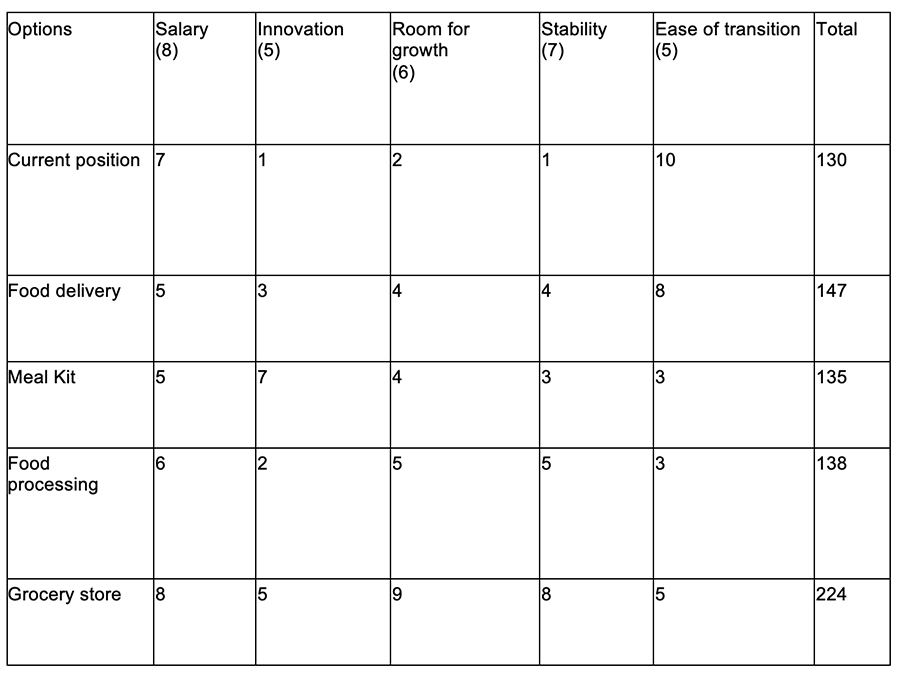
At this point, Alex was still leaning towards her favored option, which was to shift to the food delivery industry. However, I cautioned her to consider each one carefully. We went together through each option, and she ranked each option on each criteria variable. We made a table with options on the left and variables on the top to do so. Then, after ranking each option on the relevant criteria, we multiplied the ranking by the weight of the criteria.

Alex was surprised that the grocery store option was the best option. That’s because grocery stores boomed due to the pandemic and were hiring both workers and executives left and right, and the post-pandemic recovery looked like a good time to be in that industry. 

Step 4

Implement the option you chose. First, imagine the decision completely fails and brainstorm the reasons for the failure.

Next, consider how you might solve these problems and integrate the solutions into your implementation plan. 

Then, imagine the decision succeeded. Brainstorm all the reasons for success and integrate these into the plan. 

Alex imagined that the switch to the grocery store industry failed because of her lack of a proper network to source for job opportunities and her unwillingness to step down to a lower-ranking role. 

To address these, she decided to spend a month growing her network so that she could make new contacts. Alex also decided to get in touch with former colleagues and mentors who had stepped down from top leadership roles to gain insight into what they learned from the experience.

Finally, when she imagined that the decision to shift to a new role and industry was a success, she determined that this was mainly due to her efforts to efficiently transition to her new role and industry by building new core skills.  

Step 5

Evaluate the implementation of the decision. Develop clear metrics of success that you can measure throughout the implementation process. Check-in regularly and revise as needed. 

Alex was able to shift industries successfully. Within six weeks, she was able to get into a large grocery chain as Senior Vice President of Prepared Foods. While it was a step down from her role as COO, she was able to get a compensation package that was 85% of what she received as COO in her former company because she had joined a much larger organization in a booming industry.

She decided on the following as her metrics of success:  

  • Expand her network by adding six contacts/month specifically from the grocery store industry 
  • Identify and work on four core skills that she needs in order to thrive in her new role and industry
  • Develop mentors within this new industry

Conclusion

Changing jobs or even industries during this post-pandemic recovery might be critically important for achieving your career potential. Use the best decision-making steps so that you and your career can thrive, not just survive.

5 Ways to Protect Your Career in Post-COVID Recovery

COVID-19 has disrupted many areas of our lives, including our careers. Fortunately, you can take steps to strengthen and secure your career during these uncertain times. 

Due to the devastating impact of the COVID-19 pandemic on the restaurant industry, one of my coaching clients, Alex, who served as the Chief Operating Officer (COO) in a regional chain of 24 diners in the Northeast US, wanted to explore switching her career to a different industry. 

Alex turned to me as her executive coach and asked for my guidance. I recommended a 5-step decision-making process to her that addresses the dangerous judgment errors we make called. I coached her through the process to help her make the wisest and most profitable decision

Step 1

Identify the need to launch a decision-making process and gather relevant information from various informed perspectives on the issue at hand.

Alex had already decided to evaluate the decision to switch to another role and industry, so we were able to proceed with this step immediately. I asked her to gather information from various people with relevant perspectives. 

Step 2

With the data gathered, decide the goals you want to reach and develop a transparent decision-making process criteria to weigh the various options of how you’d like to get to your vision. Rank the importance of each criterion on a scale of 1 (low) to 10 (high).

With the data she had on hand, I asked Alex to come up with a list of critical goals, which should also address underlying issues. 

Among the goals identified were: 

  • To make sure that within a year, she had a role that would pay her at least 75% of the salary that she was getting as COO of the restaurant chain, whether by staying at the chain or switching to another industry, per her accountant’s guidance.
  • To ensure that she had substantial room for career growth if she did make the switch.
  • Alex wanted to step into a role that was conducive to innovation. 

Alex then came up with several criteria relevant for the switch and ranked them on 

her priorities, with one at the low end and ten at the high end:

  • Salary in a year (8)
  • Innovation opportunity (5)
  • Room for growth (6)
  • Stability for the industry and the company in the foreseeable medium and long-term future (7)
  • Ease of transition (5)

Step 3

Generate several options that can achieve your decision-making process goals. Go for five options as the minimum. Weigh these options, picking the best of the bunch. When weighing options, beware of going with your initial preferences.

Initially, Alex listed just one option for switching: it was obvious that she was already leaning towards the food delivery industry. However, I convinced her to add three more options to have five at the minimum. She took a bit more time deliberating and finally came up with five options: 

  • Stay in her current position
  • Food delivery industry
  • Meal kit industry
  • Food processing industry
  • Grocery store industry

At this point, Alex was still leaning towards her favored option, which was to shift to the food delivery industry. However, I cautioned her to consider each one carefully. We went together through each option, and she ranked each option on each criteria variable. We made a table with options on the left and variables on the top to do so. Then, after ranking each option on the relevant criteria, we multiplied the ranking by the weight of the criteria.

Alex was surprised that the grocery store option was the best option. That’s because grocery stores boomed due to the pandemic and were hiring both workers and executives left and right, and the post-pandemic recovery looked like a good time to be in that industry. 

Step 4

Implement the option you chose. First, imagine the decision completely fails and brainstorm the reasons for the failure.

Next, consider how you might solve these problems and integrate the solutions into your implementation plan. 

Then, imagine the decision succeeded. Brainstorm all the reasons for success and integrate these into the plan. 

Alex imagined that the switch to the grocery store industry failed because of her lack of a proper network to source for job opportunities and her unwillingness to step down to a lower-ranking role. 

To address these, she decided to spend a month growing her network so that she could make new contacts. Alex also decided to get in touch with former colleagues and mentors who had stepped down from top leadership roles to gain insight into what they learned from the experience.

Finally, when she imagined that the decision to shift to a new role and industry was a success, she determined that this was mainly due to her efforts to efficiently transition to her new role and industry by building new core skills.  

Step 5

Evaluate the implementation of the decision. Develop clear metrics of success that you can measure throughout the implementation process. Check-in regularly and revise as needed. 

Alex was able to shift industries successfully. Within six weeks, she was able to get into a large grocery chain as Senior Vice President of Prepared Foods. While it was a step down from her role as COO, she was able to get a compensation package that was 85% of what she received as COO in her former company because she had joined a much larger organization in a booming industry.

She decided on the following as her metrics of success:  

  • Expand her network by adding six contacts/month specifically from the grocery store industry 
  • Identify and work on four core skills that she needs in order to thrive in her new role and industry
  • Develop mentors within this new industry

Conclusion

Changing jobs or even industries during this post-pandemic recovery might be critically important for achieving your career potential. Use the best decision-making steps so that you and your career can thrive, not just survive.

0