Does Your Business Matter? And Can It Matter More?

This is the second of a 4-part series exploring businesses that matter. Read series one here

Business is sacred.

I recognize that’s not a widely-held view as most employees of most businesses, unfortunately,
don’t experience their work this way. But if one allows sacredness into the conversation about
business, different possibilities start opening up.

And so, the provocation of whether your business matters – or can matter more. At the outset, the nature of what ‘matters’ is entirely neutral. One business that I know of figured out that what mattered to them was to be a launching pad for young, ambitious people in the advertising industry. In their case, they put their efforts into providing a dynamic growth experience for their people that lasted about 3-4 years, after which they were comfortable letting these well-developed professionals make their mark in ad agencies elsewhere.

Costo, an entirely different illustration of what matters, believes in community engagement and
fostering symbiotic relationships with the suburbs surrounding their stores. Southwest Airlines believes in understated, selfless effort as a way of serving their customers and maintaining low running expenses.

These three businesses couldn’t be more different, but the net effect is the same: their people have a singular rallying cry around which to rotate their collective efforts. Something that is known, and which matters to everyone in the business. Once employees have something to lock onto that is authentic, well-considered, and meaningful; generally, they will. It’s the human condition to want to be part of something and to feel energized about an idea. And once they do, it releases a groundswell of energy, generosity, and commitment that underpins their choice to devote their discretionary effort to the business they’re a part of.

What’s more, ‘mattering’ is strategically enabling. It’s not about saving the world or doing good. That nuance is extremely important in that business, as an institution, is oriented toward high performance and excellence. The ‘gift’ of business to the world is to set high bars, to move fast, to innovate ingeniously, and to create value. Never must those values be lost in the search for what matters to a business. Performance and ‘mattering’ are part of the same idea. So, how does a business unearth that matter to it?

It’s obviously a highly personal journey, but these pointers might be helpful

  • A particular form of ambition sits at the core of this journey – not only to grow
    bigger and to succeed but to be more significant. This needs to be activated as a
    catalyzer of this journey: a question; a gathering; and an exploration.
  • What matters doesn’t need to be overly profound – it just needs to be energizing
    and compelling.
  • What could matter to a business is likely already there but in an un-named and
    un-formed state. It’s an unearthing, rather than a seeking out.
  • Early adopters will reveal themselves. Engage these people and include them in the
    exploration.
  • Locate the strategic importance of mattering: How will employees benefit? How will
    customers benefit? How could your product/service become enhanced due to
    mattering more as a business? How could your brand be enlivened by mattering
    more?

    This is a very particular worldview to link sacredness to business, and it might sound foreign to many readers. This is the essence of the Hero’s Journey: to seek out something greater and more profound and to be able to walk the whole journey in service of this goal, including the defeats that generally accompany the victories. Without this mindset, ‘mattering’ will be a struggle as there’s simply not enough energy and excitement to power the journey. For business people of today, this is the essential question: do you see your life’s efforts as being something that matters? Or are you satisfied with the mundane?

Coming in Series 3: “Sculpting a Business That Matters.” We will explore how businesses that matter
operate and what rituals and customs are practiced within such organizations.


A Few Uncomfortable Questions Every CEO Should Ask Themselves

Before strategy, before innovation, before profitability, before talent management, before acquisitions, and before revenue growth, there are two questions a CEO answers (mostly implicitly, unfortunately — my hope is that this piece encourages you to answer them explicitly):

1. What is my ambition for my business?

2. How hard will I strive to achieve ‘optimal’?

These questions shape every choice a CEO makes. They determine what you want for yourself and what you want for your business — a trajectory of sorts. And once this trajectory has been established, your choices follow suit.

A mildly motivated CEO will produce a middling strategy. A highly motivated CEO will produce a remarkable talent plan. A CEO of low motivation won’t care about innovation and the journey to producing a stand-out product or service.

Most CEOs I work with initially are fairly flat regarding these choices, until they become awake to the possibilities in front of them. Once this awakening takes place, the CEO role looks different — more compelling, more interesting, more alive, more enticing — and  true, sustainable business performance follows shortly thereafter.

Observing CEOs undergo this transformation is a beautiful thing for me — a privilege that never loses its luster and which deeply sustains my work and the energy I have for what I do. It’s a change in course that brings about a wide array of changes in their lives: more energy, more optimism, more curiosity, more purpose, more creativity. Even the quality of their marriage seems to benefit, as one example of many unforeseen upsides. Health, too. Financial well-being, obviously. More inspired parenting.

Being a CEO is an opportunity to turbo-charge an entire existence — this is the extent of the opportunity. Check your ambition. Explore what’s possible. A better way likely awaits you.

Face Up to Your Truth

I’ve heard the phrase “… this year has been a lot harder than I expected …” from more than a few CEOs of late.

As such, it might be worth taking a few minutes to ask some sound questions at this point in 2022. Remember that your businesses are alive, evolving, fluid things. As much as we’d like to see them as walking a linear path that we, as CEOs, have full control over, that is not the case. So, as your business continues its (hopefully) merry way, consider these questions and see what emerges. They are not soft-ball questions, but rather ones that sometimes we might prefer to avoid. As ever, despite their sharpish nature, they are shared in the spirit of care, support, and enablement:

  • What did not play out as you expected it to, and where did your hypothesis go wrong?
  • What is the true, holistic health of your business right now?
  • What truth about your business, or about yourself, might you be avoiding?
  • What bias is in play that might be skewing your objectivity when it comes to big decisions?· 
  • What is your business calling on you to become as the CEO? (changes, growth, what to let go of, what to mitigate about yourself)

None of the above questions will likely have ready answers. And, in fact, one or two might not even be relevant right now. But at least one will have meat on its bones that warrants inquiry. I hope they are helpful.

The Choice to Become a Business That Matters

This is the first of a 4-part series exploring businesses that matter.

This is about ambition.

Not the kind of ambition that has traditionally shaped businesses (growth at all costs, profit over everything) but a wiser, more profound ambition that reconsiders the very nature of business.
 
Compare the Ford Motor Corporation in 1903 to Zappos in 1999. Ford changed our society by building a product that transformed human mobility. Zappos sold shoes online – hardly in the same category in terms of size and scale, but arguably as influential in terms of its impact on society.
 
Zappos wrote its own rules. Out with accepted norms of what a business should be and in with its own interpretation. Zappos thought differently about culture, customers, strategy, growth, and talent and disrupted the blueprint set by Ford and other traditional manufacturing businesses, clearing the way for modern businesses to dream up new ways of architecting themselves.
 
Many businesses followed suit, creating a new and fresher business landscape and catalyzing two decades of rapid change in organizational design. The table was cleared, the mirror
de-misted, and the launchpad businesspeople currently stand upon was built. Where does business go now? A personal perspective, if I may indulge myself…

I’ve long held the view that business has underplayed its hand in shaping society. As traditional institutions like universities, governments, churches and armies play a lessening role in the fluid society of today, business is ascending. The voice of the global business community is getting louder, the resources that businesses command are at their peak, and the deployable talent residing inside businesses is more capable than ever. Business is primed to take the next step in its evolution and meet its fullest potential.

 But will it? That lies in our hands: the business leaders of the world.

If we, as a community, ask more of ourselves and seek more from our work, the Zappos-inspired trajectory will soar and our collective influence will be profound.

But our evolution relies on reassessing our impact. Not because business hasn’t done enough, but because business can be more significant than just numbly churning out profits in a
never-ending route-march of toil. The ‘gift’ of business to society is our performance mindset: innovation, expansion, disruption, seeking, and striving. This is a powerful elixir that can generate a broad impact.
 
At the heart of my provocation lies the question of ‘what matters?’ to the businesses we run. Our highest potential lies in the asking and answering of these questions:

  • Is it important for a business to matter?
  • What is a business that matters?
  • Does your business matter?
  • What potential does your business have to matter?

In this 4-part series, I hope to take you on a journey that gives you an opportunity to evolve, raise your bar, and challenge yourself. It is a provocation, but one that holds no prescriptive answer. If you take up this challenge, you will open up new possibilities and unlock greater potential: the lifeblood of any business. You will absolutely yield results.

But the path to those results is different now. Becoming a business that matters is a rich and meaningful experience. A Zappos journey as opposed to Ford journey. Technicolour illuminating gray. Inspiration over effort.
 
A few points of clarification:

  • This is not about becoming an NGO. It’s about performance.
  • This is not about obligation. It’s about seeking more.
  • This is not about going back to the drawing board. It’s about advancing what you already have.
  • This is not about trying harder. It’s about creating more energy.

Fast-forward 10 years. You’re sitting with your young children or grandchildren, and you are asked the question: “What does your business do?” Imagine answering this question with conviction: clarity of purpose, full of meaning, unwavering in your intent. Imagine their eyes lighting up with pride. Imagine the swell of satisfaction in your chest.
 
For this moment to happen, your business must matter.

Series 1 provocations:

  • What does the word ‘matter’ mean to you?
  • What is the unique ‘gift’ that your business currently/potentially offers to society?

Look out for the next installments of the ‘Becoming a Business That Matters’ series:
Series 2: “Unearthing What Matters to Your Business”
Series 3: “Sculpting a Business That Matters”
Series 4:  “Being a Leader of a Business That Matters”
 

Interrogating the Validity of Your Business

Over the past two years, the business landscape has changed in a material way.

  • The question of people/talent is very fluid at the moment (flexible work, high resignation rate, shortage of skills)
  • Supply chains have been disrupted globally
  • Inflation is on the rise, affecting margins
  • Global access through online channels is fully accepted, which has opened up new possibilities
  • Geopolitics is shifting fast

In my experience, there is a (natural) reluctance on the part of CEOs to question the validity of their business. The fallout of a negative answer is probably just too much to bear. So, often the response is to ‘hit and hope’, not rock the boat and hope things turn out alright.

The problem with this approach is that it represses legitimate anxiety, which festers and compounds over time. The results are predictable: loss of sleep, scratichness, tentative leadership, lowering of confidence to make important moves. No one can ask or answer this question for a CEO. Maybe a board will raise the topic, but the ultimate responsibility — at least for a CEO who wants to lead with conviction – lies with the CEO. The experts from the complexity school of thought recommend ‘nudging’: small, micro-steps as opposed to over-brave leaps forward.

The micro-step here is to simply raise the question publicly, ideally with your Exco.

Two Ways to Evolve as a CEO: Ambition or Obligation

In my CEO coaching practice, I have observed that there are two ways to change: Either the CEO is sufficiently ambitious to chase that change, or the CEO eventually feels enough pain to become obligated to make that change.

For obvious reasons, the former is preferred as the latter usually involves an accumulation of pain or collateral damage that forces the change, which ideally is avoided.

Interestingly, probably 75% of CEO-related situations I work within have pain as the provocation. Maybe that’s just human nature? I don’t know.

The nuance here is that, generally, the CEO is aware of the need for change, so recognizing the need to change isn’t the problem. Acting on it, however, seems to be.

‘Staying in the pain’ is a term I often use with CEOs: sitting in the discomfort and dealing with it all the way through. The reasons not to are pretty evident — and we’d all rather be doing things that we’re naturally drawn to, and find fun.

Unfortunately, that isn’t the world that you, as a CEO, lives in. External stimuli will only increase given the unpredictability of the world around us, so there will inevitably be parts of your business that you will have to intervene in, regardless of your appetite to do so.

My wish for you is to get ahead of the game, recognize what needs your attention, and dive energetically into changing what needs to be changed – driven by ambition rather than obligation.

There’s something that’s really enjoyable (and relieving) about getting a source of the strain off your desk.

Don’t Put People First. Put ‘Roles’ First.

The excellent book CEO Excellence shares some research about which roles generated the most value. Their findings were revealing in one instance: 37 people (out of a company of 12,000) generated 80% of that business value. 

One role singlehandedly was responsible for 10% of that value.

The takeaway is this: hierarchy and value creation often don’t go hand-in-hand.

This gets to the point of organizational design: how you shape your organization, so it’s set up to perform.

Conventional wisdom is that it’s about people. And it is to a considerable degree. But another lens needs to come into play beyond just getting your people to be the best versions of themselves. 

And that lens is about recognizing where your business’ ‘horse-power’ comes from and ensuring the conditions are appropriately in place for those horse-power generating individuals to thrive. 

Do they have the right reporting lines (hopefully directly into you)

Do they have the right resources?

Are they getting the proper development?

Do they have the appropriate support?

Are their communication channels set up for them to have the right conversations with the right people at the right time?

This isn’t about making wholesale changes to your set-up. Instead, it’s about ensuring you’re not missing a trick by unintentionally hiding your most important value-creators under a rock just because that’s been the historical arrangement of your business. 

Take a fresh look at your organizational design by throwing the organogram out of the window. The organigram is a false construct that has minimal bearing on performance. It’s just an arrangement on a page. 

If you seek performance, the underrated art of organizational design must come into play as a CEO. It might not be what you’re drawn to as it might seem to be an overly complex topic. But it’s not. It’s a real thing that needs to come into your arsenal. 

Today’s CEO vs. Tomorrow’s CEO

In coaching processes, the coach – either implicitly or explicitly – works

With the idea of ‘old way v. new way’. It’s a way of aggregating the total behaviors of what is not working, and transitioning them to a newly aggregated set of behaviors that is fit for purpose.

For example, choosing to be more high-performance orientated by being more disciplined, keeping purposefulness in mind, and communicating more effectively. As opposed to the opposite – the ‘old’ way. The same applies to CEOs, but it’s more layered. The CEO role isn’t just about actions, it’s about an entire worldview:

● Who you are

● What you believe in

● Your views on business performance

● Your attitude to self-development

These are all big questions and ones that won’t be answered overnight. They take time to craft, shape, refine and become used to, eventually turning them into a coherent and tight CEO package. My experience working with CEOs is that this sort of thinking is not top-of-mind due to the operational pressures of driving successful results. Which is fine – it’s understandable and it’s not a dynamic that is ever going to change. There will always be busyness. However, holding the question of old way v. new way should not be something that is equated to being a task and thus shouldn’t take up operational bandwidth. If it’s seen or experienced this way, it’s a sub-optimal way to go about it.

Rather, the contemplation of your ‘new’ way of being a CEO should be something you warm to, are compelled by, and are attracted to. If it’s not, there is probably work to be done about how you’ve set up your CEO role. Is it one that allows for thriving, or are you condemning yourself to the drudgery that can easily accompany the CEO role? If you do nothing more, on the back of this missive, than contemplate whether a new way could exist for you, that’s sufficient. It will likely catalyze something that will bear fruit in its own way, according to its own timeline. But, get it started, at least.

The Different Ways of Being a CEO

“When I look back on my life nowadays, which I sometimes do, what strikes me most forcibly about it is that what seemed at the time most significant and seductive seems now most futile and absurd. For instance, success in all of its various guises; being known and being praised; ostensible pleasures, like acquiring money or seducing women, or traveling, going to and fro in the world and up and down in it like Satan, explaining and experiencing whatever Vanity Fair has to offer. In retrospect, all these exercises in self-gratification seem pure fantasy, what Pascal called “licking the earth.” — Stephen Covey

There are different ways of being a CEO.

‘Licking the earth’ is one of them: a relentless, depleting pursuit of avoiding risk, getting by, and surviving.

There are other ways, but an entirely different orientation is required.

To who you are. To what matters to you. To how your vocation shapes your broader life. To what you aspire to. To how you show up to the people around you.

Interestingly, that change in orientation is not hard-won. It’s right in front of you with clear best practices and easy-to-apply tools shaped by new and fresh ways of thinking.

But the change of direction is all on you. It’s a choice. These changes will happen naturally, organically, and joyfully if you become open to them.

A great CEO balances performance and humanity. Many CEOs neglect the latter, particularly their own humanity.

What Would it Take to Fall in Love With Your Business?

Those who know me, know that I’m the expressive type. I like language, phraseology, and metaphors and I believe that life can be lived in technicolor.

I believe the same to be true of a business. I am relatively alone in this thinking. In fact, sometimes my views are considered to be ‘light’ or esoteric because of it.

I think that trends are on my side, however. Go back as little as 20 years. You won’t see much evidence of path-blazing CEOs, of different ways of doing culture, of unorthodox organizational designs, of new ways of business learning.

As recently as two decades ago, most businesses were relatively similar and the range of difference from one business to another was fairly narrow. Not so anymore. Businesses now are highly elastic and there is no single template of how a business is constructed.

Given all this new richness, this might be an opportunity to ask yourself a (beautifully) challenging question:

As a CEO, are you capable of loving your business?

Not ‘like’ or ‘respect’ or ‘believe in’.

Loving.

Whether you can or can’t is for your contemplation. But what I’d like to draw attention to is what might be blocking you from doing so:

  • A dulled spirit after to years of toil?
  • Not fundamentally believing in what you’re doing?
  • Not feeling that what you’re doing is going to succeed?
  • Not being around people who believe in greatness?

It’s not for me to persuade you that loving your business is possible. But what I would offer is that the possibility of loving a business is now on the table. It’s doable and I’ve seen many examples of CEOs who are in love with their business and who can get to a place of having such intense feelings about what their business is, or does:

  • Cultures so authentically conceived that bring about profound collaboration
  • Leadership that moves people to great acts
  • Transformational training programs that fundamentally change someone’s trajectory in life
  • Innovation initiatives that unearth fantastical new ideas
  • Community outreach programs that truly move the societal needle

I could go on for ages, such is the diversity of love-worthy forms of business currently in existence. This article is not about content, however. It’s about a question. Are you open to seeing your business as love-worthy?

If you are – or if you can become this way – can you imagine the impact it would unlock? Can you imagine the energy levels you’d unleash? Can you imagine the loyalty you would earn? Can you imagine the knock-on effects your inspiration would have on your spouses and children?

There are two paths: leading in technicolor or leading in grey. Light yourself up.

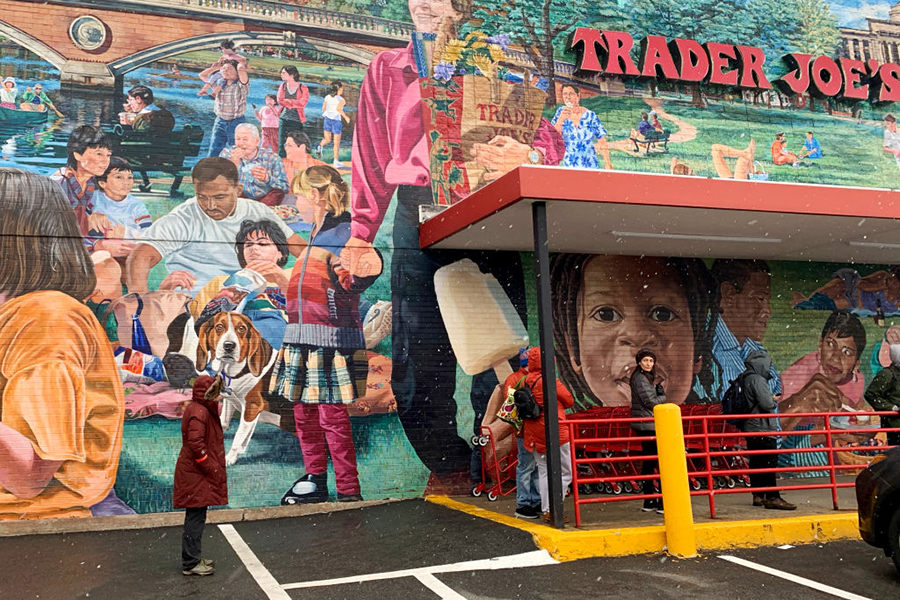
Cracking the Leadership Code: Trader Joe’s – a Remarkable Retail Business

‘Business intimacy’.

These two words aren’t often used in the same sentence. Many might argue that it’s not even plausible to use emotive words such as ‘intimacy’ in a business context.
My contention is that it’s highly performance-enhancing to develop such a degree of closeness with your business because it enables you to intervene in a far more nuanced and accurate way.
To illustrate this, every so often I am going to share a story about a business that has honed its success formula to an unusually intimate degree. This week, Trader Joe’s is my example.

For those of you who might not be familiar with this business, Trader Joe’s is a stand-out American retail operation. Not only are they very successful (their sales per square meter performance is 2x that of any of their competitors) but they are also highly unique in their approach. In fact, they defy norms and often do things that might seem counter-intuitive to other businesses.

As an illustration of this, consider their core values:

  • We are a product-driven company
  • We create WOW customer experiences every day
  • No bureaucracy
  • KAIZEN!
  • The store is the brand
  • Integrity
  • We are a national chain of neighborhood grocery stores

What impresses me is less about the content, but more about the clarity with which Trader Joe’s knows what it is – and isn’t.
And it’s written down, codified, honed over time, and publicly known. The challenge for you, the CEO, is to get to a similar place of intimacy with your success formula.

Specifically:

  • Have you ‘officially’ codified your business and interrogated that thinking to a point of high accuracy?
  • Have you written it down in order to create an artifact that can live within the business, known by many?
  • Have you made it public, understood, and well-known within your business?

The value of doing so is broad:

  • The more people who understand this codification, the better they can execute it.
  • The better your success formula is known, so better choices and decisions can be made that honor it.
  • The better you, the CEO, understand your business and what makes it ‘tick’ the more accurately you can lead the business.

I am fascinated by this codification process as it’s truly a higher-order form of CEOship that has profound implications across your business. At the same time, I recognize that the higher-order nature of this thinking can feel nebulous or a nice-to-have (which I’m utterly convinced it’s not).