6 Things You Can Do for Gender Equality in 2016

Think you can’t do anything about gender inequality in the workplace? Stop thinking and take action! Here are 6 things (some easier than others) we can all do either individually or as an organization to support gender equality in the workplace in 2016.

  1. Talk about the gender gap in terms of expected behavior. Sheryl Sandberg and Adam Grant wrote about how bias awareness may actually cause more discrimination. Studies have shown that reminding leaders that companies still institutionalize gender gaps could backfire and reinforce that it remains standard behavior. In 2016, we need to discuss the gender gap in terms of expected behavior, i.e. “smart companies like XYZ Corp. profit from gender diversity,” and not just reprimand for past or existing behavior.
  2. Create accountability for diversity. In Harvard Business Review, Deborah Ashton, Chief Diversity Officer for Novant Health, recommends determining pay by value to the organization and not by past salaries. Why? Because women may have been “gender gapped” at a previous job. Ashton also suggests that HR departments create more transparency in their criteria for raises and bonuses; perform annual pay equity analyses; and assign individuals responsibility for pay equity.
  3. Apply the 20% rule. The 2020 Women on Boards campaign goal is to increase the percentage of women on Boards of Directors to 20% by the year 2020. Why 20%? Stephanie Sonnabend, founder of 2020 WOB, defines diversity as having at least 20% women in the boardroom. “This creates diversity of thinking which is critical for good decision making, and better represents a company’s shareholders, employees and customers,” says Sonnabend. If you visit the 2020 WOB site and sign up as a supporter, you will receive monthly emails with links for you to send a pre-written email to a company that does not have 20% diversity on their board. Just one click and you can educate them as to why diversity is a profitable endeavor.
  4. Apply the 20% rule everywhere. While we should definitely seek to increase women in leadership positions, we can also look around us to see if there is at least 20% diversity in our departments, in our meetings, on our committees, and even on our vendor lists. It’s easy mental math to do, and a good habit to form. If you don’t see at least 20%, point it out and suggest women who could be included. Learn more about inclusive capitalism from Sallie Krawcheck, chair of Ellevate Network.
  5. Give women the benefit of the doubt. Women rarely get the benefit of the doubt in business situations and that leads to subconscious gender discrimination. Outdated stereotypes continue to be a huge detriment to company performance and often stems from our own internal biases. We need to get over it and stop creating performance obstacles that exist only in our heads and not in reality. I recently wrote about this issue in 5 things women can do to overcome the doubt.
  6. Stay informed. There are a number of resources to keep you informed on gender issues in the workplace. Follow sites like https://www.leanin.org (@leanInOrg); https://5050×2020.org (@5050×2020), https://www.2020wob.com/ (@2020WOB) and Emma Watson’s https://www.heforshe.org (@heforshe) on Facebook, twitter and/or Instagram. Sign up for Caroline Fairchild’s The Broadsheet – a daily email that keeps you up to date on some of the most powerful women in business as well as sharing interesting gender-related stories from around the Internet. (Caroline’s twitter = @cfair1). You should also follow Sallie Krawcheck, chair of Ellevate Network (@EllevateNtwk) on LinkedIn.

If everyone does at least one of the above actions and/or shares this article with their networks, we can collectively make a difference and help prevent women from being left out and gender gapped. Have other ideas for 2016? Please add them to the comments below.

 

Do Female CEOs Outperform Men? There Aren’t Enough To Say

The television segment was less than 60 seconds but it was enough to capture my full attention and interesting enough that it prompted many of my extended family to alert me to its existence.

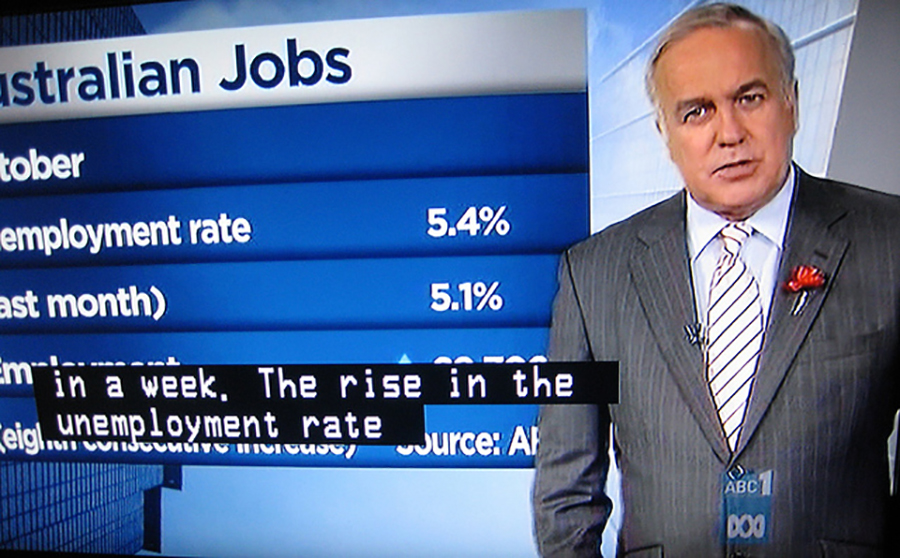
At the end of Alan Kohler’s regular Finance Report, broadcast during the ABC 7pm News, last night he showed a remarkable graph.

“Here’s a graph to get Australian boards and directors thinking. It shows the performance of US companies with female CEOs versus the general market index S&P 500,” Kohler told viewers.
And guess what it shows?

“Companies run by women do better than those run by men.”

His next line, however, was the real kicker.

“I can’t do that graph in Australia because the sample is too small here.”

Occasionally it is the little details that tell the bigger story best. The day before Kohler’s enlightening segment the Workplace Gender Equality Agency released research showing that the pay gap in management in Australia is as high as 45%.

It’s astounding and poses many questions. Why are women at the pointy end of corporate Australia paid considerably less than their male peers? It is because they are actually worth less? Is it because their male peers are actually paid more than they’re worth? Both? What is it that causes the pay gap to perpetuate and even widen at this level?

The pay gap that exists between fulltime earnings of men and women in Australia is 18.6%. It is a considerable gap and it reflects a number of factors including the different industries and roles that men and women tend to occupy.

When the research is refined to a single segment like management, for example, those differences are less informative. It is certainly more complex than one single factor but given the chasm between male and female managers is up to 45% in management, it’s hard to dismiss structural sexism as an influence.
Is this explained because corporate Australia still treats women as an anomaly? It seems possible because, in truth, they still are. Female managers are not the norm, any more than female-led publicly listed companies are.

The fact female-led companies out-performed the industry average in America doesn’t mean that every single female CEO will always outperform a male CEO. It’s obviously more complicated than that but the data is persuasive that female-led companies do better than average.

How ludicrous is it that here in Australia where women do not lack for educational opportunities or “merit”, there aren’t enough women running companies to even form a statistically-significant sample to prove it?

It indicates just how far Australia hasn’t progressed. We can’t demonstrate that Australian women are better or worse than men at running companies but we can prove that the women who eventually might are, in some cases, earning almost half their male peers are. Is this because they aren’t as good?
The research from America suggests not. Unless, of course, the results simply show that managers in the US are better able to train and develop female talent than we are?

Whatever the explanation it’s absurd that we can only guess rather than form a conclusion based on evidence.

I am inclined, once again, to ask whether our Minister for Women caught Alan Kohler’s report last night? If so can we expect a response? Are you there Tony?

This article originally featured on womensagenda.com.au


Beauties and the Beasts – Why I Advocate for Women

A lot of people ask me why am I such an advocate for women in leadership. My answer is “science.”  For over 30 years I have worked with inspiring mentors and partners like Stephen Covey attempting to convert the world’s leadership class to becoming conscious capitalists. It didn’t work.

Oh, I know that efforts such as B Corporations, and social enterprises are popular ideas among micro-entrepreneurs. But that’s not where the real power is.

The morals that run the big money centers in New York and London set the rules for virtually all our institutions – business and government. And the number one rule is to do anything you can get away with to maximize personal wealth. It is so simple.

Sacrifice the goose to get as many golden eggs as you can right now. We are the goose. And our future and our children’s future are being cooked right before our eyes.

As I looked more deeply at the reasons why many privately decent leaders succumb to the rules of Wall Street what I see is simply “men at work.” Neuroscience and gender expert Dr. Larry Cahill recently stated that the “long-standing belief that men’s and women’s brains fundamentally operate the same is wrong. The last 20 years have been historic due to an explosion of data that reveal fundamental differences.” He is quick to point out that although men and women’s brains look the same from a biological distance, the way they process stimulus is different.

One key difference in the way most men’s and women’s brains differ is that women tend to process what’s happening in the outside world through memory, values and judgment and men tend to interpret the world through a lens of immediate self-interest and emotion. This all happens through a sorting process in our prefrontal cortex that sends messages to different areas of our amygdala decision center. This is likely to be the reason why impulse control is such a problem for males and why men commit 97% of violent crimes. It is also the likely reason that our own country has been at war or armed conflict for 219 years out of our 240 years of existence. In 93% of these cases our country initiated the armed violence. (How is that for a shocker? source: Danios)

So my first reason for being a strong and unwavering advocate for women in leadership is because I believe they actually have an advantage in the way they think.

When capitalism philosopher, Adam Smith was alive there were approximately one billion people on earth.  We had seemingly endless resources. So the mad pursuit of self-interest had a big cushion against its excesses. Today we have 7½ billion people and crazy powerful technology that make the suffering that one person can cause absolutely frightening. This new set of facts makes the widely accepted idea that scaling selfishness will lead to the best possible future fatally flawed.

Nuclear proliferation, climate change and yes, modern-day slavery are all indicators that a more collaborative approach to human life ought to produce more positive innovations then a competitive one.

There is compelling leadership research from both McKinsey and Bain & Co that women consistently demonstrate stronger systems thinking than men. Women more carefully consider unintended consequences and the human impact of decisions up-and-down the value chain of any complex organization. Women also more carefully consider impacts on the community and society from developing new products and policies than most men. In study after study we find that the women’s strengths of customer and employee empathy, collaboration and design thinking are superior capabilities in today’s volatile marketplace.

When I have the opportunity to work directly with women I focus on two things:

  • Take the wheel. Women are so used to helping other people achieve their goals they often don’t devote their energy to developing a clear vision that they can define and promote. This is a huge problem.  Creating a compelling vision is the first rule of leadership.  Much of what I do is give women the permission to develop their own goals and put them on the leadership agenda.
  • Make a compelling case. Women need to increase their influence. Trying to get a word in edge-wise is not enough. I encourage women to insert themselves early in meeting agendas, teach them the body and voice language of confidence and show them how to use data and evidence to contrast the cost of failure to the financial rewards of investing in their ideas. This influence cocktail usually motivates the most stubborn, status quo hugging leadership teams.

My goal is simple.  I want a better world for my nine grandchildren.  I want a world with less suffering and more opportunity for all. I want a beautiful world in which nature thrives. I want a world that is a psychologically and physically healthy place to live. I want a world with more tolerance, compassion and kindness. What I really want is a world of sustainable abundance because if we don’t have a world that works for everyone, in time we will have a world that works for no one.

In all my decades of direct experience with senior leaders of major corporations only the rarest of men have had these goals impact their decisions. Conversely, these noble ideals are the inner voice that guide the minds of virtually every woman I have ever coached or trained. Thus my drive to make women’s voice is louder.

We are running out of time.  We need more women in senior positions of every institution in our world. And in time we will have more men who think more like women.

So why am I such an advocate for women leadership? It’s simple… because it is our best hope for a better future. . . maybe our only one.


The Executive-education Experience of a Coca-Cola Executive

It’s been a winding road from anthropology undergraduate studies to leading a sales and marketing team for one of the world’s most recognized brands. Yet it’s a journey that Lourdes (“Lou”) Ebra Grill has savoured every step of the way. Grill, Vice President for Strategic Partnership Marketing at The Coca-Cola Company, has invested the past 20 years building a career that weaves together her expertise in anthropology, marketing and finance.

Educational roots

While pursuing an undergraduate degree in anthropology at Duke University, Grill also had an opportunity to take a graduate marketing course through the Fuqua School of Business, and it was there that a second passion was ignited: Grill pursued her MBA in Marketing and Finance from the University of Georgia.

Career path

After graduation, Grill’s journey led to Federal Express where she spent eight years, ultimately climbing to the position of Financial Advisor. Opportunities were better for her in the finance field at the time, but Grill calls marketing her “first love”. She had a dream of working in marketing for Coca-Cola in their Atlanta headquarters. So when the opportunity to join the company in a finance role came, she seized it. Over the next 10 years, Grill enjoyed a series of ever-increasing responsibilities in a variety of roles: financial, legal, marketing and sales. In 2008 she moved into the role of Director of Business Affairs, which Grill calls a combination of “finance and legal in support of brands” that reconnected her back to marketing.

In 2012, Grill became the Vice President of Strategic Partnership Marketing. In her current role, she leads a team of sales and marketing professionals who have strategic partnerships with organizations in realms such as cinema, lodging, theme park and airline business. The move was a perfect next step on her journey. Her current role, says Grill, is “where I saw a place at Coke that would let me combine my love of marketing, team leadership, customer relationships, and have this foundation of financial acumen that I worked on all of these years of my career.”

Pursuing executive education as a leader

Now her journey of leadership growth continues. Coca-Cola has a long history of providing professional development both internally through training programmes and job rotation assignments, as well as encouraging executives to seek education outside of the company walls. Last December, Grill attended Notre Dame’s Executive Integral Leadership programme through the University’s Mendoza College of Business. She chose the programme because of its emphasis on providing education for the “whole” leader—with topics that range from creating vision, leading authentically, developing business acumen and promoting a healthy mind, body and spirit. “If I am going to deliver value to Coca‑Cola and our customers,” says Grill, “then I have to bring my whole self to this role.” She believes that is precisely what the EIL executive-education programme delivered.

Grill found the week-long programme rewarding and counts herself as a “resounding advocate” of the wide variety of teaching methods used, listing a detailed 360-degree feedback process and private feedback session with an executive coach as highlights. In-depth discussion with fellow participants was another plus. As part of the course pre-work, participants were asked to bring a business challenge with them for discussion. These conversations gave Grill “a yardstick for how I was looking at my own leadership and my own business challenge. It was very powerful.” The course facilitators gave participants “a framework that allowed us to safely challenge each other on underlying issues or fundamentals of our business challenges.”

Grill came away from her off-site executive-education experience with a renewed focus on how to tackle the challenges of her current role. She also credits the programme with helping her articulate her leadership vision—with her team, peers and customers. And what’s the payoff for Coca-Cola as an organization? Grill sees definite benefits for her employer. “Coca-Cola has a clear mission and vision. It’s critical that we [as leaders] have an ability to bring our team along on that vision and have clarity of purpose.” Even more important, says Grill, is to do so with authenticity, “because that’s what resonates with teams and with the people you interact with.” Moreover, the Executive Integrated Leader programme prepared Grill for the next step on her journey. “Spending time [away from work] helped me think about how I can uniquely help bring the vision to fruition for Coke in roles of increasing responsibility and accountability. In that way, [the EIL programme] has prepared me to lead at a more strategic level.”

Jennifer V. Miller is a freelance writer covering leadership in the workplace. She writes the award-winning blog The People Equation.


If You Could Change the World What Would You Do?

You are changing the world. One way or the other what you do matters. That’s what I remind every member of every audience I speak to, every person I coach and frankly every person who will listen.

We are all connected… this is not some cosmic, New Age drivel but rather the evidence of brain science. Our brains are all wired together in a network of social neurons scientists call  ‘fields of consciousness.’ It’s true.

Even our unspoken opinions, our secret aspirations, our inner moral convictions are all being broadcast every waking moment. When social opinion changes and societies become more effective at enriching the lives of everyone it is because the critical mass of people value doing positive things that matter. It’s exciting that we’re coming to know the nuero-mechanisms that create culture change.

What is actually going on is that groups of people begin to adopt mental models that are like a new pair of eyeglasses. Through these lenses we begin to see clearly what was previously fuzzy. We see root causes of beliefs and practices that cause failure, frustration and suffering. And we see new solutions to persistent problems that open up opportunities we never thought possible.

We are living at a time of titanic struggle.

It’s a battle of ideals. On one side are the powerful forces of the status quo that believe we’ve created the best of all possible worlds. That’s right, they believe for all the inequities of opportunity, all the unsustainable practices that traumatize and degrade our environment, all the new business practices that create high stress work environments… that in spite of all this… it is the best we can do. Leaders who believe this swim in an ocean of self-justification.

On the other side are people who believe in massive, positive innovation.

These are people like Andrew Hewitt who created Game Changers 500 (above), which is a list of for-benefit companies, who integrate social and environmental goals into their legal bylaws and practical strategies. Companies on Andrew’s list include Patagonia which is famous for trying to minimize the harm they do to the environment and maximize the health and work-life balance of their employees.

But I am most interested in businesses that go far beyond minimizing harm. What inspires me are enterprises whose primary source of revenue comes from solving problems that matter. For instance, Bridget Hilton ‘stood up’ her new company, Jack’s Soap, in just 90 days. For every bar of luxurious, organic soap she sells she donates both bars of soap as well as education to the poor in developing nations so that they can stop the unnecessary deaths of 5,000 children a day who die from diseases that could be prevented by washing with soap. All this is very cool yet I am still frustrated. The pace of change is far too slow.

I believe this is true because we don’t have enough women leading our businesses and political institutions. Most people who attain high levels of leadership are hard power leaders. These hard power leaders are typically driven by competitiveness and self-interest. These are very powerful motives, which drive leaders to set very aggressive goals, drive employees to the limit and hold their feet to the fire. This kind of leadership is very effective at achieving short-term profits, which is why these kinds of leaders are so generously rewarded. It’s also exactly why the age of hard power has created an unsustainable future.

The male brain is geared for selfish aggressiveness. Perhaps that’s why over 99% of violent criminals are men. On the other hand, women’s brains are designed to think of ways of solving problems that are causing suffering, including others, and looking at the long-term consequences of today’s decisions. Women are actually naturally designed to innovate through collaboration.

Their pro-social brains are seeking long-term, holistic solutions rather than continuous personal advantage. The skills women use to drive success are called soft power. Competitive males rarely respect them.

Yet, the evidence is now very clear that the best run organizations that produce the best results are led by teams of men and women (at least 33% women) at the very top.

Women need to be engaged in senior positions involving both strategy and execution not just HR.  This blend of men and women create a synthesis of hard and soft power called Smart power.This is very rare.  In most organizations today women are being taught that if they want to reach the highest levels of leadership they need to act like men. This is completely crazy.

It is exactly the wrong thing to do. Heaven knows we don’t need more women leaders like Susan Cameron the CEO of the tobacco giant Reynolds American.  She is busy trying to increase the number of young women smokers in emerging nations as a sign of female empowerment. This is so immorally manipulative it is beyond my comprehension how she looks at herself in the mirror. We also need Sheryl Sandberg to shut the hell up about ‘leaning in.’ Those stupid words are simply code for ‘work like a man.’

I can’t seem to understand why she thinks the male pattern of leadership is the goal. I feel like she’s leading millions of young women straight off a cliff. As I told several hundred Qualcomm women leaders at their QWISE conference this past week… “You can either work 100% of the time or you can be happy. But you will never be happy working 100% of the time.”

What Sandberg is missing is that men do not experience the deep inner conflicts among work achievement, family responsibility and personal well-being. Oh I’m not saying that all men easily dismiss their families for the sake of work.

I’m only saying that the clear neurological evidence is that women experience much more high levels of stress over work-life balance issues then most men do.

The biological reason for this is obvious. For thousands of years women have been the nurturers while men have been hunters. Women who try to deny that impulse are usually plagued by constant inner gremlins of unresolved stress. So getting back to changing the world.

We need to change the mental model that we all hold about the goals of successful enterprises and how we lead employees to reach them.

This will not happen without more “real” women leaders.  Women who bring their strengths of customer and employee empathy, collaboration and inclusion in the longer-term view that include the greater good rather than just personal power. What my years of coaching women leaders has taught me is that although the boys club of business leadership creates a lot of invisible but powerful obstacles.


This work is the culmination of my 35 years of leadership development that I started with Stephen Covey in the Seven Habits of Highly Effective People.

I’ve teamed up with a remarkable group of women leaders, including former clients, that have co-designed the experience and will co-teach it to produce focused, individual transformation. This is only possible by addressing the totality of your mind, body and spirit to become the most effective leader you are designed to be as well as attain a sustained level of work-life harmony.


L’Oréal Foundation and UNESCO Defend the Role of Women in Science

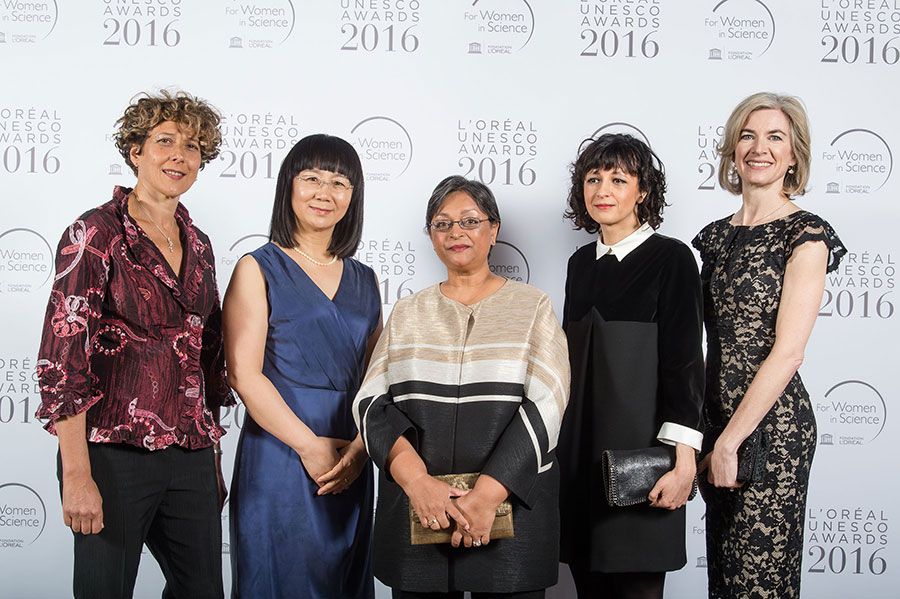
Five leading women scientists and 15 promising young researchers were honoured on 25 March at the Sorbonne University in Paris where the launch of the For Women in Science Manifesto was held. Already signed by each guest present at the Ceremony, this Manifesto aims to tackle the under-representation of women in the sciences. 

For the past 18 years, the LOréal-UNESCO For Women in Science program has encouraged, promoted and honoured women scientists all over the world. This year, the L’Oréal Foundation and UNESCO are taking the next step towards change: the launch of the For Women in Science Manifesto to raise awareness and mobilize the public’s active support for the cause of women in science.

Jean-Paul AgonIrina Bokova, and this year’s President of the Jury, former Laureate and Nobel Prize winner Elizabeth Blackburn, all signed the Manifesto, along with the Laureates, International Rising Talents and 800 guests in attendance to ensure the visibility and public support necessary, so that everyone involved can work together towards gender equality in the sciences.

Collective strength is what we want to see emerge tonight from our Manifesto. Beyond the scientific and institutional communities, we want to give everyone the chance to sign the For Women in Science Manifesto and join the cause, stated Jean-Paul Agon.

Since its creation in 1945, the United Nations Educational Scientific and Cultural Organisation (UNESCO) supports international scientific cooperation as a catalyst for sustainable development and for peace between people.

Accompany. Value. Communicate. Support. Move boundaries. These are the core values which drive the L’Oréal Foundation’s commitment to women everyday. A commitment divided into two main areas – science and beauty.

The six commitments of the #ForWomeninScience Manifesto

1/ Encourage girls to explore scientific career paths

2/ Break down the barriers that prevent women scientists from pursuing long term careers in research

3/ Prioritise womens access to senior positions and leadership positions in the sciences

4/ Celebrate with the general public the contribution that women scientists make to scientific progress and to society

5/ Ensure gender equality through participation and leadership in symposiums and scientific commissions, such as conferences, committees and board meetings

6/ Promote mentoring and networking for young scientists to enable them to plan and develop careers that meet their expectations


L’Oréal Foundation and UNESCO Defend the Role of Women in Science

Five leading women scientists and 15 promising young researchers were honoured on 25 March at the Sorbonne University in Paris where the launch of the For Women in Science Manifesto was held. Already signed by each guest present at the Ceremony, this Manifesto aims to tackle the under-representation of women in the sciences. 

For the past 18 years, the LOréal-UNESCO For Women in Science program has encouraged, promoted and honoured women scientists all over the world. This year, the L’Oréal Foundation and UNESCO are taking the next step towards change: the launch of the For Women in Science Manifesto to raise awareness and mobilize the public’s active support for the cause of women in science.

Jean-Paul AgonIrina Bokova, and this year’s President of the Jury, former Laureate and Nobel Prize winner Elizabeth Blackburn, all signed the Manifesto, along with the Laureates, International Rising Talents and 800 guests in attendance to ensure the visibility and public support necessary, so that everyone involved can work together towards gender equality in the sciences.

Collective strength is what we want to see emerge tonight from our Manifesto. Beyond the scientific and institutional communities, we want to give everyone the chance to sign the For Women in Science Manifesto and join the cause, stated Jean-Paul Agon.

Since its creation in 1945, the United Nations Educational Scientific and Cultural Organisation (UNESCO) supports international scientific cooperation as a catalyst for sustainable development and for peace between people.

Accompany. Value. Communicate. Support. Move boundaries. These are the core values which drive the L’Oréal Foundation’s commitment to women everyday. A commitment divided into two main areas – science and beauty.

The six commitments of the #ForWomeninScience Manifesto

1/ Encourage girls to explore scientific career paths

2/ Break down the barriers that prevent women scientists from pursuing long term careers in research

3/ Prioritise womens access to senior positions and leadership positions in the sciences

4/ Celebrate with the general public the contribution that women scientists make to scientific progress and to society

5/ Ensure gender equality through participation and leadership in symposiums and scientific commissions, such as conferences, committees and board meetings

6/ Promote mentoring and networking for young scientists to enable them to plan and develop careers that meet their expectations


Why are so Many Women Leaving Their Jobs?

It’s a man’s world. That’s not just a song, it’s a reality. And it makes it tough on women who excel in most workplaces. That’s why record numbers of younger women abandon the workplace between ages 30 to 40. It’s true. Research from the McKinsey Global Instituteconfirms that 30% of female employees who have worked for seven years are seriously considering quitting within the next 12 months. This is a massive talent drain at a time when talent is increasingly scarce.

There appears to be many reasons for the female exodus but perhaps the deepest reason is that business cultures are so masculine.  Gender expert Dr. Melanie Polkosky and I were talking about this a few days ago.  She pointed out that our entire culture is drenched in the myth of the Hero’s Journey. Joseph Campbell famously wrote about this epic myth that one man can save the world.  This myth inspired George Lucas to write Star Wars as Luke Skywalker’s Journey that concludes with him single-handedly (well, with R2-D2) flying into the Death Star and blowing it up. This is also Frodo’s journey in the Lord of the Rings as he throws the ring into the volcano to save mankind and all Hobbits. It is also the narrative of Steve Jobs, Henry Ford, and Abraham Lincoln. In leadership is often called the Great Man theory.

The Great Man theory promotes the idea that great achievement and great advances come through great men. These are men of courage who overcome fantastic obstacles to single-handedly save the day. Men love these myths because they are so grandly narcissistic.

Let me be clear. I believe there are great leaders who have done great things.  One researcher at the University of Virginia estimates that there have been about 3,300 individuals who have had ‘change the world’ impacts.  The problem is about 70 billion people have lived and died on the planet. The fact that .000004% have made heroic contributions for all the world to see leaves virtually 100% of us to simply become heroes of our own lives. And the way men and women pursue their best lives is very different because our sources of self-worth and the obstacles we face are very different.

For most men our personal hero’s journey is fairly simple. Psychologically we seek to first win our fathers’ approval and then surpass his accomplishments. The male culture is steeped in competitiveness. This causes us to focus on achievement, status, money, ‘desirable’ women, and fathering capable offspring.  Male lives are mostly linear. Childhood and adolescence is followed by education, work and retirement while integrating marriage and family.  In the male hero’s journey overcoming personal tests and achieving our destiny takes precedence over family and friends unless there are crises that interrupt our journey.  But the male journey is simple.  Work, achieve, gain status and peer respect.  Those are the ideals and rules that dominate most work cultures today.  Our work mindset is distinctly heroic and masculine. And it isn’t working very well.

About 53% of our workforce is female.  And the heroine’s journey is very different than the hero’s journey. It is much more complicated.   Female lives are driven by competing commitments and a constellation of competing values that make a work-centered life stressful.  And it is not only women who are questioning the hero’s paradigm. As male millennial’s flood into the workplace they are also questioning the value of living work-centered lives.

I will be talking about the 10 stages of the heroine’s journey in my webinar on March 23. It is based on the research of Dr. Polkosky and her book about the women-crushing cultures commonly found in technology and science technology companies. You see, technology companies are steeped in the myth of the hero’s journey. Research titled Athena Factor 2.0found that technology companies are the most “toxic to women’s self-esteem, health and career opportunities.”  The underlying common reasons are that technology company cultures are commonly driven by status-building commitments to overwork, 24/7 availability and work-focused lives. That’s what it means to be a hero.

Technology companies are extra frustrating to women because women with the same experience and ability are twice as likely to be passed over for career promotions than males. Very often women are told they are not given more responsibilities because they have children or probably don’t “want to work that hard.” But the Athena 2.0 research reveals that is not true.  Women’s career ambitions are virtually identical to men’s when they work in environments where their contributions are recognized and rewarded.

The key to women’s success in any working culture is clarity and calm. Be clear on what you want and clearly communicate it. Women don’t need to rant, nor do they achieve anything through silence.

Here are some ideas that may help you understand the heroine’s journey.

In Greek mythology there are strong goddesses and warm goddesses.
Finding the balance between these two yin and yang type forces is the challenge of the 21st-century woman.  In the past, role expectations for all women made it easy to choose whether to align yourself or rebel. Most women aligned themselves with the required roles of wife and mother in order to get security from a male breadwinner.

This has been true for tens of thousands of years. The requirements for female success were to be a nurturing, care giving, helper. The warm goddess Hera is best known for these qualities.  All this is awesome, except when it’s not. Warm behaviors at work are the collaborative glue that keeps teams together working in an organizational symphony that is so vital to today’s organizations. But it often goes unrewarded.

You see collaborators and helpers are not viewed as heroes. Strategic collaboration is rarely measured or recognized.  Research from the Wharton Business School reveals that 50% of the names of an organization’s most strategic, high-impact collaborators are unknown to senior management. So the risk of maintaining the role of a helpful, warm goddess leaves women vulnerable to being exploited, overlooked and passed over.

Mythology also has strong goddesses. Athena is the most famous one.
These goddesses are achievers and warriors.  They serve as both leaders and coaches. They’re willing to be on the front lines wielding swords. Their weakness is that they tend to be overly self-sacrificing.  They may accept blame when they are blameless in an effort to demonstrate responsibility. Strong goddesses often feel emotionally isolated and overworked. Athenas are candidates for burnout.

Meanwhile male leaders continue to sustain work cultures where they expect women to serve as warm goddesses helping to implement the goals and priorities of the mostly male heroes at the top. As for women who see their path to promotion as becoming an Athena, they will likely experience disillusionment with the hero’s journey because it denies the richness of their full feminine values.

I coach women to be intently mindful about when to be Hera and when to be Athena. True leadership effectiveness requires you to be both warm and strong.

I believe most business cultures are in a talent crisis. Bight people are leaving organizations that make them sick. I talk to them almost every day. Women also tend to be dysfunctionally loyal.  So, I also ask them if they are working for an enlightened leader. My key question is “If nothing changes, what will your work life be in two years?” I always encourage great women to work for great companies.

In an age where both the information and relationships needed to succeed are widely dispersed, we need cultures that are both warm and strong.  We need men and women working together in a new synergy of respect and collaboration. It’s called SMART Power.  As I speak about this to male-dominated leadership groups I find most of them curious but unconvinced that deep change is really necessary. It just seems too complicated to them.

On the other hand, I rarely speak to a woman leader who doesn’t immediately understand what’s at risk and why change is necessary. As the revolution unfolds it is being led by a force of strong and warm women and a few enlightened men.

May that force be with us!


LGBT Advertising: How Brands are Taking a Stance on Issues

Marketing entails more than reaching the right consumer with the right message at the right time. New data from Google and YouTube shows that messages about diversity and equality for the LGBT community have widespread impact, and brands such as Burger King and Honey Maid are leading the way.

Nothing is simple when it comes to the court of public opinion. This can make promoting a brand’s message, well, tricky (to say the least). Brands are held accountable not only for the quality of their products and services but, increasingly, for their stance on the political and social issues that today’s consumers face. This is especially true when it comes to LGBT (lesbian, gay, bisexual, and transgender) advertising.

As more and more attention is focused on equal rights for the LGBT community—specifically, marriage equality and diversity in the workplace—it’s influencing how consumers make decisions. This is especially true among the young; over 45% of consumers under 34 years old say they’re more likely to do repeat business with an LGBT-friendly company, according to a Google Consumer Survey from August of 2014. Of them, more than 54% also say they’d choose an equality-focused brand over a competitor.

Brands are responding with campaigns that espouse messages of inclusion, equality, and diversity. This “pride advertising” is having widespread impact online, according to YouTube and Google data. Here we take a closer look at two brands, Burger King and Honey Maid, that are leading the way.

Burger King’s pride advertising speaks to equality

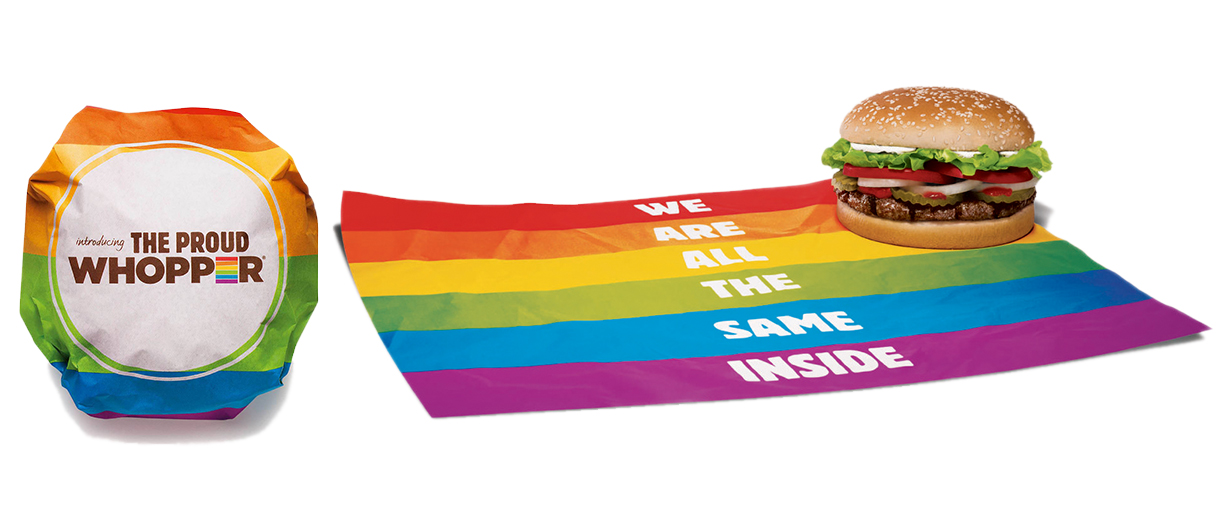
Burger King (BK) is committed to diversity and its values (“being bold, empowered, accountable, meritocratic, and fun”) are rooted in equality and inclusion. Last year, to coincide with the San Francisco Pride events, BK introduced new pride advertising in support of the LGBT community. As part of BK’s “Be Your Way” campaign, a spin on its 40-year-old “Have It Your Way” brand positioning, the Proud Whopper was introduced.

This limited-edition burger was added to the menu of its Market Street franchise in San Francisco for Pride week. The Whopper was actually the same flame-grilled sandwich customers had enjoyed since 1957. So, what made it different? Its rainbow-colored wrapper held a special message for BK customers: “We are all the same inside.”

Cameras rolled to capture reactions to the burger’s release the day of the 2014 Pride Parade. Not surprisingly, BK’s pride campaign, the Proud Whopper, and its unique messaging elicited some strong responses—poignant and powerful moments for the brand and its customers. Reaction from its younger customers (the target audience was 18- to 24-year-olds ) was overwhelmingly positive, strong, and emotional. “Burger King restaurants have always been places to eat great-tasting food, let your guard down, and just be yourself without any judgment,” Burger King’s Fernando Machado said in AdWeek.

proud-whopper

The video of the audience’s reactions, which BK posted online, received 7M views across all social platforms. The YouTube video alone has received more than 5.3M to date. The Proud Whopper ad reached 20% of the U.S. population, and young millennials over-indexed by 4.8X (Burger King data). The campaign was also praised by multiple media outlets, including The Wall Street Journal and Bloomberg. The impact of BK’s message of inclusion was felt beyond the billion media impressions it received over earned media (Burger King data). Proceeds from the franchise’s sales benefited the Burger King McLamore Foundation, which provides scholarships for LGBT high-school students.

Not only did Burger King take a stand on an important social issue, but it also delivered messaging that resonated with its target audience of 18- to 24-year-olds. In fact, today’s young millennials—47% of consumers under 24-years-old—are more likely to support a brand after seeing an equality-themed ad (compared with 30% of all age groups combined), as the Google Consumer Survey showed. And that’s a win for everyone involved.

Honey Maid highlights diversity in its advertising

Honey Maid launched its This Is Wholesomecampaign in 2014 with one simple notion in mind: While the typical American family has changed over time, it remains wholesome at its core. In celebrating the diversity of the modern family, Honey Maid saw an opportunity to connect with its customers while reminding them of its long history and dedication to inclusiveness.

The brand’s target audience tuned in. The 30-second spot has over 8M views to date on YouTube. Using age and gender targeting, Honey Maid was able to see that 97% of the ad’s video views came from 25- to 54-year-olds, according to YouTube data. Of those views, women were responsible for 98%.

While the overwhelming response to the video was positive, Honey Maid’s message of inclusion didn’t resonate with everyone. This was something the company expected, given that the diversity campaign featured all kinds of families, including one with same-sex parents. Indeed, there was some backlash—negative feedback on social media and over email as well as a boycott by one group—but Honey Maid was prepared to stand by its message.

Instead of a PR problem, Honey Maid saw an opportunity. Partnering with creative agency Droga5, it delivered a creative and ingenious response to the negativity: “Love.” The video showed two artists using printouts of all the negative tweets and emails about the first spot to build the word “Love.” It was simple and powerful, allowing Honey Maid to, again, show its commitment to the issues of diversity and equality, as well as its support for the LGBT community.

Honey Maid’s message touched the hearts of people across demographics. Over 4M have watched “Love.” YouTube data shows that views over the first 90 days were evenly split among men and women, and nearly a quarter of those who watched were millennials under age 24.

And that lovin’ continued online. Searches for “Honey Maid” increased 10X during the last week in March, with sustained interest into May. In support of the campaign launch, Honey Maid drove penetration growth among millennial households +1 point, according to Gary P. Osifchin, the brand’s senior marketing director.

Marketing objectives aside, Honey Maid’s messaging about the wholesomeness of all families resonated with its customers. The brand stood up for diversity and equality and was rewarded not only with positivity among its fans but with their dollars as well. In the months following Honey Maid’s diversity campaign, the company says that June/July sales for its products increased 7% YoY.

Pride advertising is a win for consumers and brands

Pride advertising isn’t just about acknowledging and embracing the LGBT community. It’s an opportunity for brands to speak their own truth and take a stand. And when they do, consumers, especially millennials, appreciate it and respond in kind. They tune in and watch, participate in the conversation, and spend their dollars. Burger King and Honey Maid are just two of the brands making an impact by telling stories of diversity and equality in their advertising.

By Brendan Snyder. This story originally appeared at thinkwithgoogle.com


0