

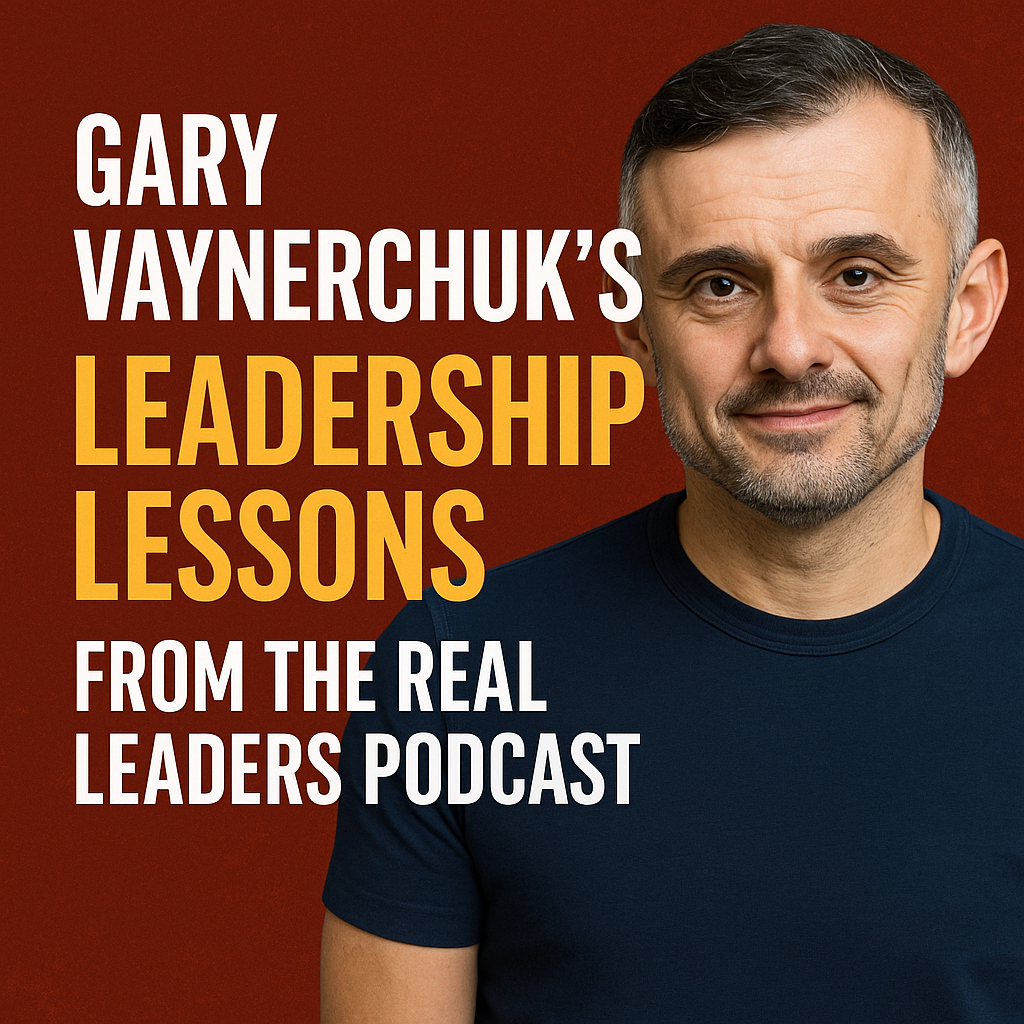
Gary Vaynerchuk’s 5 Tips on AI Marketing

Gary Vee to Real Leaders: “We’re All Playing the Same Game Now”

What if you had the same shot at going viral as Gary Vaynerchuk—today? According to Gary, you do.

In a candid conversation with Real Leaders, Gary Vee pulls back the curtain on what actually works in leadership, branding, and business growth today. It’s not hype. It’s not smoke and mirrors. It’s creative merit. And for the first time in history, that matters more than followers, legacy, or budget.


Listen or watch the exclusive interview with Gary Vaynerchuk.

Here’s what he had to say:


1. The New Branding Era: Merit Wins

Forget waiting for permission. Gary made it clear: today’s content economy is built on “interest media,” not follower counts. You could be on your fourth LinkedIn post, and if it hits, it’ll outperform his.

“We are now in the era of interest media… You have six followers. It’s your fourth day. But if your stuff is better than mine? It gets more views. That’s never existed before.”

Translation? Stop overthinking. Start creating.


2. Impact Without the Ego

Gary didn’t shy away from talking about doing business with meaning. He emphasized that how you make money matters more than how much—and not for PR reasons, but for personal peace.

“Between 40 and 90, the dollars don’t bring happiness. If you want to be joyful, align your business with your values.”

The impact space, he said, has matured. Snake-oil altruism is fading. And thoughtful entrepreneurship is finally mainstream.


3. Live Shopping is the Next Big Wave

Gary lit up when asked about live shopping. If you sell anything—product, service, even SaaS—his message was clear: get in now.

“Stop reading this article and spend 25 hours researching live social shopping. I’m not kidding. This is big.”

From TikTok Shop to Whatnot, the platforms are in place. The attention is there. And if Amazon misplays this? It could dethrone them.


4. Day Trading Attention

Gary coined the phrase “day trading attention” to describe the speed and skill required in today’s marketing. The old model—set it and forget it—is dead.

“Don’t get romantic about how you got here. Be obsessed with where it’s going.”

His advice? Watch where attention shifts. Move fast. And experiment often.


5. Choosing Between Your Personal Brand or Company Brand?

One of the most common questions CEOs ask: Should I post from my own account or my company’s?

Gary’s answer? Both.

“Humans over-index humans. But if you’re doing both, you can push traffic between them. And collab posts make that easier than ever.”

If you’re overwhelmed, he adds, just start somewhere. The algorithm doesn’t care how famous you are—it cares how relevant you are.


Closing Words: Real Leadership Starts With You

If you’re waiting for permission to lead online—you’ve already lost. But if you’re willing to hit “publish,” you’ve never had a better shot.

“It’s not about how you got here. It’s about what you do now.”

Whether you’re building your brand, growing your business, or leading with purpose, Gary Vee’s insights are a must-hear for today’s impact-driven CEOs. To dive deeper, listen to the full conversation on the Real Leaders Podcast.

Trust Comes On a Bicycle and Leaves On a Ferrari

PODCAST PEOPLE: A Summary from the Real Leaders Podcast

“We used to have a saying when I was at Shell: Trust comes to you on a bicycle, trust leaves you on a Ferrari. It’s so difficult to build trust but it’s so easy to lose trust. And trust is earned, really. You have to earn it, you can’t demand it.” 

Babs Omotowa is an expert in strategy, commercial, technical, operations, governance, energy transition, stakeholder, change, and supply chain management, built though an expansive career at Shell International. He shares a message of resilience in his book, From Storeroom to Boardroom: How Integrity and Courage Shape Global Business. 

The following is a summary of Episode 188 of the Real Leaders Podcast, a conversation with Chairman of Montserrado, Babs Omotowa. Watch or listen to the full conversation below.

Building Trust in Your Community

Babs outlines the things required of a leader in order to earn the trust of their organization. He declares that a trustworthy leader must be consistent, authentic, and able to follow-through. People need to hear exactly what you plan to do, and be confident that you will do exactly what you say. Your vision also needs to be beyond self-actualization. 

Babs also emphasizes that in order to maintain trust, a leader needs to admit and be transparent about failure. If you don’t acknowledge your mistakes, your staff will never trust you. 

“A leader must make clear that you are indeed a human being as well. Sometimes leaders try to show a persona that sometimes can feel larger than life. But people connect to you more when you make mistakes as well, when you admit your mistakes, and you learn, you move forward and you correct those mistakes. It’s very important that people see you as that, that you are human.”

Listen to Episode 188 on Spotify, Anchor, Crowdcast, and Apple Podcasts

Mature Leadership

Babs outlines that the organizations with the greatest success function under mature leadership, and his experience sees mature leaders as those who are willing to listen, who understand that they don’t have all the answers, who really understand where they want to go, but are open to consulting other resources and talents. He emphasizes that a good leader should be comfortable having individuals on their team more intelligent than they are. 

“As a leader you should not be the most intelligent in the room. You should have the good vision, the clarity on where you are going, the strength to be able to help your team overcome hurdles, but you should have in your team those who are able to have different perspectives, but even those who will have new creativity, new ideas.” 

Babs offers three traits of successful leadership: 

  1. A vision of where they need to get to, because people want to know where they are going, and they want to know that where they’re going is going to be better than where they are. 
  2. The ability to inspire the team, to motivate them to want to get on that journey, to coach them, and make sure they have the tools and techniques to get to that next level. 
  3. The ability to support and help the people, the staff, to go on that journey. Because workers will go through challenges as they go on that journey, and they will need help to overcome these challenges.

The Future of Education: Personalization

PODCAST PEOPLE: A Summary from the Real Leaders Podcast

“The pandemic has really given us a sense of urgency because now all of our lines are blurred. You’re not either at work or at home. You’re not either a mother or a boss or a daughter. Many of us are everything at the same time, even because of such a practical thing as working from home.”

Sahra-Josephine Hjorth is CEO and Co-Founder of CanopyLAB,  an educational technology company that has built an AI-powered social learning platform for corporate training. Through personalization this platform enables all learners to realize their potential in a way that is fast, fun and future-proof. 

The following is a summary of Episode 183 of the Real Leaders Podcast, a conversation with CanopyLAB CEO and co-founder Sahra-Josephine Hjorth. Listen to the full conversation below.

AI and Education

Sahra explains that educational systems are hesitant to incorporate AI into the learning process. But the pandemic has made it apparent that AI could greatly benefit students and educators. When the entire world went online, this became an open invitation to change how we’re working, and to start learning in a smarter way. 

“Education has to learn that we are influenced by trends that transcend industry.”

While many are afraid to embrace AI in education for fear of it replacing teachers and limiting possibilities for feedback, Sahra emphasizes that its purpose is to supplement and in many ways enhance education. If aspects like quizzes (and even lectures) could be done online at home, the classroom could be reserved for a more interactive learning experience. This would afford more time for discussion and debate. 

Listen to Episode 183 on Spotify, Anchor, Crowdcast, and Apple Podcasts

The Future is Personalization 

Sahra describes how the future of learning will be the personalization of learning. We have all come to expect curation in our tastes for music and entertainment, so why not enable algorithms for education, too? 

“People are increasingly hacking their own education. Whether it’s just taking one class at a university in Denmark, one class at Yale, subscribing to a Youtube channel, people are curating it’s more learner-centered.” 

Sahra explains that with CanopyLAB, from the moment people log onto the platform, their goal is to get to know their students, why they’re there, and how they prefer to learn. The most difficult aspect of curation is thus not knowing what people know and don’t know, but rather knowing how they prefer to learn and what their competencies are. Curating the approach to each individual learner offers a more comprehensive learning experience, one Sahra predicts institutions will have to adopt in order to catch up.

“The big universities are resisting it, because this means the dismantling of their existing business model. But they won’t be able to do it much longer, especially because companies have said they no longer require you to have a bachelor’s degree to work there. For a long time we bought into the model because it was necessary for our career advancement. Soon it won’t be.”

Think Like a Quantum Leader and Turn Your Company into a Living Organization

PODCAST PEOPLE: A Summary from the Real Leaders Podcast

“The core binding energy is what people are calling purpose. And I don’t mean purpose statements I mean purpose stories. Energetic stories — myths, if you will. About why we exist, who we serve, and what we want to accomplish in serving them. How can we best connect with those we serve, understand their deepest needs, not just the surface needs, treat them as relationships, not as transactions?” 

Norman Wolfe is the founder of Quantum Leaders, Inc. and is viewed as an expert in the areas of leadership, strategy, change adoption, process improvement, organization design. He sees an organization through a different lens and uncovers new possibilities for growth.

The following is a summary of Episode 186 of the Real Leaders Podcast, a conversation with founder of Quantum Leaders, Norman Wolfe. Watch, read, or listen to the full conversation below.

Quantum Leadership

Quantum leaders, Norman explains, are leaders who can think about their organizations in a more robust and nuanced way. They see their organization as a collective of individuals coming to achieve a common purpose. Thus, their primary concern is with collective success, which they can nurture by operating from a place of service — serving clients, customers, and the collective itself. 

“A quantum leader is somebody who’s reached the stage where their focus is not about their success as a leader, but the collective success. And they’re willing to do whatever is necessary to facilitate that, and to get everybody lined up to having that same orientation.” 

Listen to Episode 186 on Spotify, Anchor, Crowdcast, and Apple Podcasts

Creating a Living Organization

Norman explains that an organization is just like a living being, which means change is like death — but with death also comes rebirth. He suggests that members of an organization should be allowed to mourn and move on from change in order to truly embrace it. This holistic view is what will keep an organization alive, and allow the community and culture within to thrive. 

He offers some key nutrients to create and nurture a living organization:

  • A sense of contribution that we’re making as a collective
  • Creating an environment where people feel they can grow and mature (that’s not only desirable, but expected).
  • Shifting our focus from what you can make to who you are as a human being. (How are you growing as a healthy cell in the organic nature of this collective?)
  • Profit — it gives us the resources that allow us to grow — the food that feeds the collective 

The Entrepreneur Eating His Way to Positive Change

PODCAST PEOPLE: A Summary from the Real Leaders Podcast

“If we can change the way people eat, that feels like the biggest, direct way for people to take action against climate change.”

Seth Goldman is an activist entrepreneur: Co-Founder of Honest Tea, Chair of the Board at Beyond Meat, and now Founder of Eat the Change, a platform that combines marketplace solutions with education and activism to empower consumers to make dietary choices aligned with their concerns around climate and health.

The following is a summary of Episode 179 of the Real Leaders Podcast, a conversation with entrepreneur Seth Goldman. Read or listen to the full conversation below.

A Global Movement to Restore the Planet

Seth is committed to democratizing plant-based and planet-healthy foods. He assures us that a worldwide shift in diet is not only better for people, but essential for the planet. Current agricultural systems are a major contributor to rising emissions, which means eating habits directly impact climate change. The race to solve these problems, however, has not put a spotlight on diet, which, because it is personal and not political, could be one of the most effective solutions. Through Honest Tea, Beyond Meat, and Eat the Change, Seth has emphasized that if we only changed our dietary habits, we could very well change the world. 

He offers an example from the positive impact of Beyond Meat:

“We knew that every time we sold a Beyond Burger, we were helping somebody who very likely was going to choose an animal based product. And so the best way to measure that was to understand the environmental footprint of one burger. And we learned it uses 99% less water and 93% less land a lot of positive aspects. So then just sell millions of burgers ideally, billions of burgers and your impact magnifies with it.”

Listen to Episode 179 on Spotify, Anchor, Crowdcast, and Apple Podcasts

Planet-Friendly Means Palate-Friendly 

Seth emphasizes that the best way to measure a company’s impact is to ingrain its mission into its product. But when it comes to healthful, environmentally conscious foods, a company mission, no matter how powerful, isn’t enough. The thing about starting a global dietary habit is that plant friendly options need to taste good, and perhaps even taste better than their traditional counterparts. 

“I can tell them all about our environmental commitments, and the fact that there’s no soy, wheat, corn, rice, sugar, potatoes. But how does it taste? So it’s got to taste good. And if it tastes good, and if it’s well packaged and priced competitively, then the mission can be an advantage.”

Transcript

https://vimeo.com/526700495

The Long Win: A New Approach to Sustainable Success

PODCAST PEOPLE: A Summary from the Real Leaders Podcast

“If we work together, then we can both be part of something that’s much bigger, that’s much more sustainable. How we frame success has a big impact on whether we’re able to explore our potential or not.”

Dr. Cath Bishop is a former olympic athlete and diplomat, and current business coach and author. Her mission is to reimagine the winner-take-all approach that still dominates everywhere from classrooms to boardrooms. In her book The Long Win, she proposes a new approach to achieve more meaningful, sustained success.  

The following is a summary of Episode 177 of the Real Leaders Podcast, a conversation with former olympic athlete and diplomat Dr. Cath Bishop. Watch, read, or listen to the full conversation below.

The Art of Negotiation

Cath shares how her athletic career as an Olympic rower helped her to uniquely understand teamwork and the pursuit of a common goal. Rowing with a team requires self-awareness and awareness of others in equal parts. As a result, all team members must all be in perfect agreement in order to move forward, let alone make it to the finish line. 

“You can never completely focus on yourself because you have to be in time as much as possible with those around you. So you’re always pushing yourself. But in the same frame you’re thinking, how can I do it in a way that enables us all to go as fast as we can together?”

Understanding the pursuit of a common goal prepared Cath for a career in conflict negotiation. She shares her insights on how to effectively negotiate, and suggests that listening is actually the most influential tool. She emphasizes the importance of connecting with whomever is on the other side of the conversation, especially if you don’t initially get along. While building upon something in common, it’s also important to embrace fundamental differences.  

“We all face complex issues, whether its business, politics, the world is complex. We need multiple perspectives. And the more we can get used to that and get comfortable with different ways of seeing the world, the more we learn, the more we grow. It’s a very learning mindset to think like that. How can I learn about your perspective of the world and through that grow my own?”

Listen to Episode 177 on Spotify, Anchor, Crowdcast, and Apple Podcasts

The Long Win

As both a professional athlete and senior diplomat, Cath recognized that a global culture of (and obsession with) winning has actually created behaviors that hold us back. In business just as much as sports, a focus on external rewards actually hinders motivation a gold medal or a bonus are only superficial goals. It is focusing on intrinsic motivations, such as purpose and autonomy, that inspire people to be more motivated, creative, and resilient. 

Cath explores this idea of shifting our winning mindset to in her book, The Long Win: The Search for a Better Way to Succeed. She suggests we could all benefit from reframing success away from the narrow, short-term, win-at-all-costs approach. In contrast, she emphasizes a more meaningful, sustainable approach, which she calls “The Long Win.”

“It’s about creating more meaningful metrics that are longer term, that are much more qualitative than quantitative. These are about stories, about diversity, about exploring possibilities. Our very tight metric system breeds compliance and conformity, and that’s why it’s not very successful, because those things don’t help us in this complex, uncertain world.” 


Transcript

Leading with Emotional Intelligence in a World of Artificial Intelligence

PODCAST PEOPLE: A Summary from the Real Leaders Podcast

“Emotional intelligence, the way I look at it, is self awareness, knowing what you’re feeling and why you’re feeling it, how it affects what you do. Managing your emotions, using that awareness to handle your destructive emotions and keep your goal in mind. Staying positive, tuning into other people, empathy. And then putting that all together to have effective relationships.”

Daniel Goleman is an internationally known psychologist and bestselling author, known for his works discussing emotional and social intelligence, leadership, and education. 

The following is a summary of Episode 174 of the Real Leaders Podcast, a conversation with psychologist and author Daniel Goleman. Watch, read, or listen to the full conversation below.

Evolution of Emotional Intelligence

According to Daniel, emotional intelligence (also known as EI or EQ) does not plateau like IQ once the brain is fully developed. Lucky for us, EI can always improve and, when managed effectively, makes for better communication, understanding, and leadership. 

“Our brain was designed for the jungle, for an earlier time. We don’t have brain 2.3, we have brain 1.0.” 

Daniel explains that uncontrolled emotions are due to primitive survival instincts hardwired within our brains. Reactions brought about by anger and fear are responses similar to the fight or flight survival that has kept us alive since primal days. While we may no longer be in danger of being eaten, our brains operate in a symbolic reality. This triggers emotional circuitry to take over the more rational part of our reasoning. 

Listen to Episode 174 on Spotify, Anchor, Crowdcast, and Apple Podcasts

Tribal Hardwiring

Because we still rely on webs of circuitry in the brain that evolved from living in tribes, the modern technological world operates against our internal wiring. Consequently, this limits our ability to properly connect with others more than we may have realized. AI hinders EI, and virtual living has affected the social part of our brains that was designed to function optimally in the presence of others. 

“We have to make more effort to tune into the people around us, because the brain wasn’t designed for the reality we’re living right now. Emotion channels are really important for the brain, and they’re maximal when we’re face to face.”

Leading with Emotional Intelligence

Daniel emphasizes that emotional intelligence is an important attribute for good leadership, especially in the workplace. He equates leadership with influence and suggests that telling people what to do will never be as effective as listening first. 

“The big challenge is to be fully present, which means you want to know what the other person is thinking and feeling, and then you want to respond to that. Then the person feels felt, feels heard, and you get more information. So from a leadership point of view I think it’s an essential skill.” 

Titles Mentioned

Daniel mentions a few of his publications that discuss these topics in greater detail. Find more about them here:

  •  Altered Traits: Science Reveals How Meditation Changes Your Mind, Brain, and Body.
  • Emotional Intelligence: Why It Can Matter More Than IQ
  • A Force for Good: The Dalai Lama’s Vision for Our World

Transcript

How to Achieve Your “Why” With the S.P.E.A.R. Method

PODCAST PEOPLE: A Summary from the Real Leaders Podcast

Kuda Biza is an entrepreneur, building companies to deliver profit and value while empowering vulnerable people everywhere to become the best versions of themselves. He is also the author of The S.P.E.A.R. Method: 5 Simple Steps to Balanced Success and Fulfillment.

The following is a summary of Episode 158 of the Real Leaders Podcast, a conversation with author and entrepreneur Kuda Biza. Watch, read, or listen to the full conversation below.

The S.P.E.A.R. Method

Kuda shares how his career journey parallels the five steps of the S.P.E.A.R. Method, which offers insights on how to maximize success and impact while attaining personal fulfillment:

Seek Your Why

“The first step is seeking your purpose, seeking your why, your calling in life. Because if you’re living your life, but you’re living someone else’s calling, you’re never going to be fulfilled. The thing that will give you fulfillment is you pursuing your purpose.”

Plan

“We need to demystify the whole notion that plans are static. A lot of people feel that you just create a plan once, and then that’s it. No, plans are actually dynamic. There’s so many ways where you can create a plan, and some people might take the effort in understanding their purpose, but never take that step to actually sit down to say, okay, how am I going to achieve this?”

Listen to Episode 158 on Spotify, Anchor, Crowdcast, and Apple Podcasts

Execute

“Feed your faith and starve your fear. Whenever you embark on accomplishing something big, there is an element of fear that approaches anybody — we’re humans, right? In Africa, we like to say the way to eat an elephant is one bite at a time. So that’s the first key thing about execution: understand the big, hairy, audacious goal, but break it down into small milestones that get you there.”

Achieve

“Sometimes when you set out to achieve something, maybe you’re only going to achieve 20 percent. But does that mean that you give up, or do you continue pushing until you hit 100 percent? Do not be afraid to not only dream big, but to actually take the action to achieve those big dreams.” 

Repeat

“There are three important days in any life. The day you are born, the day you find out why, and each day you act on your why. So just make sure that every single day, you’re taking some action in achieving your why.”


Transcript

The Ultra Runner Bringing Attention to the Global Water Crisis

PODCAST PEOPLE: A Summary from the Real Leaders Podcast

“I knew that this was what I was going to do for the rest of my life. That I was going to dedicate my life to solving our water crisis. And at that point I knew that I would do whatever it takes to make that happen, because I don’t want this future for the next generation.

Mina Guli is a global leader, entrepreneur, water advocate, and ultra runner, dedicated to raising awareness about the global water crisis.  

The following is a summary of Episode 133 of the Real Leaders Podcast, a conversation with water advocate Mina Guli. Read or listen to the full conversation below.

Running for the Goals

Though she wasn’t a runner to start with, after a life-changing accident decreed she may never be able to run again, Mina decided to prove that she would. She created another opportunity to push herself even further in order to highlight a bigger cause. In 2016, in order to bring attention to the global water crisis, Mina ran 40 marathons across 7 deserts on 7 continents in 7 weeks. Along the way, she interviewed locals and water experts. Her goal was to tell the stories of people affected by the crisis and those working to solve it.

Another of Mina’s running awareness projects was the #RunningDry movement — 100 marathons in 100 days. And another she recently completed was the 6 River Run, along the banks of 6 of the world’s greatest rivers, across 6 continents, in 6 weeks — inspired by the UN’s 6th Sustainable Development Goal, Clean Water & Sanitation.

“It’s so weird for me to be in this situation where running has become what I do. And I did it because we needed to have a way to create a hook for people to pay attention to water. I wanted to show that we had to go outside of our comfort zones to be able to do things that are meaningful. I wanted to show that every one of us is capable of things that we never dreamt of. And I wanted to show you don’t have to be anyone to be someone.”

Listen to Episode 133 on Spotify, Anchor, Crowdcast, and Apple Podcasts

Starting with the Next Generation

Mina emphasizes that water is the biggest risk facing society, and the ramifications of the global water crisis are great cause for concern. By 2030 there’s forecasted to be a 40% gap between the amount of water we need and the amount of water that’s available to use. Motivated by inaction, Mina is dedicating her life to this problem. Her non-profit, Thirst, focuses on raising awareness about the water crisis among the next generation. 

I don’t want the next generation to grow up and have their future limited by their ability to access water, they should only be limited by their ability to dream the dreams that they want to dream.” 

Tapping Into the Creator Mindset

PODCAST PEOPLE: A Summary from the Real Leaders Podcast

“When you think positively it’s almost impossible to have an egotistical thought at the same time. Because the nature of positivity enables you to see the world as it can be, not as it is. And when you can see the world as it can be, not as it is, you tend to do the right thing. You tend to do the better thing.” 

Nir Bashan is a world-renowned creativity expert. He teaches thousands around the globe how to harness the power of creativity to improve profitability and customer service, increase sales, and ultimately create more meaning. He is also the author of The Creator Mindset: 92 Tools to Unlock the Secrets to Innovation, Growth, and Sustainability.

The following is a summary of Episode 170 of the Real Leaders Podcast, a conversation with creativity expert, Nir Bashan. Read or listen to the full conversation below.

Embracing Creativity

“When we’re able to think creatively it’s a euphoric and natural state for us. And we’ve been beaten down and talked out of thinking in a natural state, which is where we operate the best.”

Nir shares that creativity is a fundamental human state — we all learn to draw before we learn to calculate. But many of us have lost touch with this creative aspect. He suggests that tapping into creativity in order to solve problems connects us to who we are. In terms of business, creativity connects us to what we’re doing in a product, service, or career. Nir affirms that embracing the creator mindset has become more essential than ever, because it’s what is needed in times of crisis in order to generate a solution. 

If we embrace creativity, as a people, as a society, we will uplift the standard of living around the world far more dramatically than what we have done now. And the result is just a way better life.”

Listen to Episode 170 on Spotify, Anchor, Crowdcast, and Apple Podcasts

The Power of Positivity

“When you look at things in a positive way and in a creative way, the world is really a limitless environment for you to practice your product or service. When you look at things in a negative way, you’ve limited your options.”

Nir iterates that negativity is something that has become too deeply ingrained in daily life and culture — in fact, most languages have more ways to describe negativity than positivity. Not only is negativity holding us back, it’s limiting our capacity to problem solve — simply shifting to a positive outlook could be the biggest step towards creative solutions.

“Framing a problem in the light of positivity will instantly give you creative solutions, because it taps into that creator mindset that all of us have deep within us and allows you to look at a problem as what it is, rather than adding all the self-doubt. The only thing that allows you to solve problems creatively is to think about a problem positively.”

Transcript

0