Women–Three Strategies to Build Your Confidence and Inner Power

I recently received an e-mail from Barry Crane of Yahoo with a link to an article written by a pretty ticked off woman who is sick and tired of being told that women have less confidence than men. She even quoted some social researcher claims that there is no hard evidence that women have low self-confidence as compared to men. It is perhaps a little murky. Yet when you combine the studies of social research, leadership research, and gender differences revealed by brain science a pretty clear picture comes into view as to why women are likely to appear less confident than men.

Harvard researchers John Neffinger and Matthew Kohut have a compelling evidence-based argument that women are emotionally and mentally designed for empathy and seeking consensus. Women have also been socialized to avoid conflict with physically stronger males by acting less assertive. Those are not criticisms, only scientific observation. And there is nothing wrong with being less assertive except when it makes you less influential. Unfortunately most organizations are designed to favor highly assertive behavior as a path to power.

And there is nothing wrong with being less assertive except when it makes you less influential.

So let’s clear something up right now. My years of leadership consulting lead me to the conclusion that women are NOT less confident than men… not at all. In fact in many cases I find women’s inner confidence to be higher and more grounded in reality than men. However most women behave less confidently. I experience it this way. Men generally exhibit higher behavioral self-confidence. Yet, women more often possess something I call “soul-confidence.” I’ve come to this conclusion because when I fully excavate the inner story of most women I consult with I find a solid core of intrinsic self-worth.

It’s true. When I peel away all the self-doubt and calm the screaming inner voice of self-criticism what I find in women is an intrinsic knowing that they are valuable. What derails women is a chronic feeling of under appreciation. This is one reason women are more susceptible to depression than men. Feeling powerless and invisible will do that to you.

Men on the other hand feel much freer to push confidence into arrogance.

Men on the other hand feel much freer to push confidence into arrogance. Arrogance is the dysfunctional expression of a lack of inner confidence. When people are arrogant they are unreachable with facts, reason, values or empathy. That’s because arrogance is driven by the fear of losing control. And studies reveal that men’s brains are designed to feel most secure when they feel the most control. The result seems to explain why men are much more likely to define their worth through their status and achievements rather than through their values and character. c76c9bdb-959c-4413-8bb1-445044dec1b3 As you can see from this continuum, confidence is the balance point between insecurity and arrogance. The truly confident person is still open-minded, persuadable, and interested in evidence and different points of view. An arrogant person is only interested in getting their way and solidifying their power.

The truly confident person is still open-minded, persuadable, and interested in evidence and different points of view.

Our challenge is this. If we are going to create a better world…a world with sustainable abundance we need far fewer arrogant leaders and far more intrinsically confident ones. Fortunately research tells us how people can contain their inner demons and release their genuine inner self worth so that we authentically act more confident. (This is necessary if want good people to take over the world.) Here are the three internal habits proven to do the most to translate out intrinsic worth into external self-confidence. They tap into the strength of your mind, body and spirit…of course they do.

Invest your flow of attention on your success story.

Mind: Invest your flow of attention on your success story. There’s plenty of evidence that most people experience similar levels of success and failure. Insecure people tend to focus on their failures, which create an inner story that you are not destined for success. This “negative attention” will eventually hijack your your true identity dragged down by a litany of beliefs that you are not capable enough, smart enough, educated enough, or lucky enough. If you allow the “victim identity” to take over your attention you will simply stop looking for opportunities and look for ways to escape your pain.

The solution to this problem is simple. I have helped many leaders who suffer from the “imposter syndrome” which is the belief that if other people discovered who you really were, people would neither respect nor follow you. To break the cycle of negative self-thinking I ask clients to do two things: First, every evening before bed right down three things you did that day that you did well and that you enjoyed. Then go to sleep with a smile on your face and let your subconscious mind marinate in your successes. Second, re-frame all of your life’s failures as essential learning experiences.

Although it may sound corny it is also true that failure is never final until you stop trying. I am not aware of a single success story of remarkable people whose life was not littered with big failures. Steve Jobs was fired from his own company. Abraham Lincoln failed at business and lost elections. Eleanor Roosevelt had a philandering husband the world adored while she was ridiculed for being uppity and unpretty.

If you’re still breathing you have not failed.

Winning your life’s journey takes guts and resilience. If you’re still breathing you have not failed. Capitalize on what you have learned and keep climbing.

Other people respond to your energy.

Body: In order to project and sustain confidence you must carefully build and manage your energy. Other people respond to your energy. We can actually measure the response through brain scans. People with low or negative energy tend to be avoided. People with high, positive energy tend to be sought out. We each have five kinds of energy­–mental, emotional, social, spiritual, and physical. The boiler room of your energy is your body. The most confident, high-energy people have all the power of a deflated balloon when they are tired and hungry. You build your biological energy by getting at least seven hours of restful sleep. Eat light, healthy and often to keep your blood sugar level even.

You need to stand up, stretch and move for at least 3 minutes out of every 60. Walk 10,000 steps a day, Take a full hour break at lunch to rest your brain by doing something you enjoy. Affirm others whenever you have a positive thought about them. Promote and maintain relationships of mutual advocacy. (We all need people in our lives who root for us and whom we root for.) These simple habits will enable you to be happier, healthier and yes, more confident. Spirit: If you haven’t heard of loving kindness meditation, stop what you’re doing, go on the Internet and search the topic. (A good book to get started is Lovingkindness: The Revolutionary Art of Happiness by Sharon Salzberg.)

It is also called compassion meditation. I am teaching it in many of my business training sessions because it is proven to loosen the knots of our unconscious thinking traps so we can be more creative and collaborative. It is so simple and yet so powerful that all I can suggest is that you try it faithfully for three weeks and see if it begins to change your self-confidence at the root. First let me make a distinction.

The practice of self-compassion meditation is not the new age concept of positive affirmations. Two decades of psychological research on positive affirmations… you know the Stuart Smalley stuff…“I am smart enough, I am good enough and people like me”…actually works but only under one specific condition. You have to already believe the substance of your affirmation is true. In other words, positive affirmations work to amplify positive beliefs you already hold. But if I was to tell myself that I was tall, young and beautiful one look in the mirror would unleash my inner critic to simply yell, “you’re a liar!”

Compassion meditation is different. It has been practiced for thousands of years and builds soul-deep self-confidence by embracing the truth about you.

Compassion meditation is different. It has been practiced for thousands of years and builds soul-deep self-confidence by embracing the truth about you. It detaches the common thinking fallacy that we must be perfect to be valuable. The process begins by putting your self in a meditative state usually attained by sitting comfortably, both feet on the ground, back erect, hands relaxed with your attention focused on your deep rhythmic breathing.

Take 5 to 10 deep breath cycles and then, using one breath cycle for each statement, simply say “may I be wise today, may I be creative today, may I be collaborative today, may I be reliable today, may I be happy today.” Then repeat at least 3 times. That’s probably enough for one session. I usually try to pick 3 to 5 behaviors or feelings that I want to express and repeat them for about 5 to 10 minutes as I stay in meditation. Now I know you might be thinking this is ridiculous. How could this work at all? It’s way too simple. Well consider this, brain scans show that several weeks of consistent meditation begin to calm the parts of our brain that emotionally agitate us. 0adf1a0e-1cc6-4985-9286-9289a01d9eb3 These are the parts of the brain that go wild when we feel unsure, insecure or attacked. Our response is to either be quiet or be aggressive. These are two of the principal ways we dissipate our confidence and lose our power. This is especially true for women and soft power men. We project our confidence and increase our power when we are clear and calm.
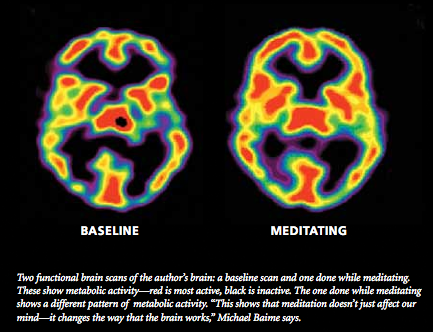
We project our confidence and increase our power when we are clear and calm.

To make this a little more vivid let me quote from Sharon Salzberg’s book. She was in a hurry to leave one morning when she dropped a jar and it shattered all over the floor. In the past when something like that happened she would always unleash a barrage of inner criticism but after weeks of compassionate meditation something changed. She writes that her inner your voice cried out “you are really a klutz, but I love you.” It’s so simple. We retain our confidence in the face of mistakes and failures by staying in mindful contact with our souls, our capacities, our values and positive intentions. We are not our behaviors, we are not our pasts, we are not our inadequacies. Rather we are in a constant act of self-creation. As long as we put full attention on that truth our confidence will clear our path forward.

We retain our confidence in the face of mistakes and failures by staying in mindful contact with our souls, our capacities, our values and positive intentions.

So try it. Try these three strategies: Focus your attention on your successes and reframe your setbacks as learning. Increase your physical energy by investing in your health and vitality. Practice compassionate meditation to become so calm and so clear that the arrogance of others is no longer a threat and your true confidence blazes your path forward.


Is Your Leadership Economic?

The more I spend time with animals and Nature, the more I admire the sublime perfection of Evolution’s optimized economy. Nature never wastes a single impulse of energy. Every Natural phenomenon we take for granted is actually a masterful blow of targeted movement to keep pushing life forward. All animals enact this principle of optimized economy through apparently random instincts and impulses, except human beings. We seem to be the most uneconomic animals on the Planet. How so?

We seem to be the most uneconomic animals on the Planet.

Take CEOs, founders and business owners, for example. These people are supposed to be the smartest, most efficient specimens among us. I can affirm that in many ways they are. I watch them at work every day. There’s a dangerously generalized habit, however, that betrays humanity’s current misconceptions about leadership: paternal and maternal tendencies.

There’s a dangerously generalized habit, however, that betrays humanity’s current misconceptions about leadership: paternal and maternal tendencies.

Let’s get closer and look at Tim, who I’m going to make up for obvious reasons…executive coaches who betray their clients’ secrets don’t do well and shouldn’t be trusted with any actually interesting or useful details! So Tim is an invented CEO who has done very well in business. He started his own company twenty years ago and has successfully grown it to employ a large number of employees, expand into several countries and build an enviable and non-contested reputation in his industry.

I’m sure you know lots of Tims. Oh, yes. Of course. He is also handsome and proud to display pictures of a vomitively perfect family. Ha,ha,ha!! Anyway. Tim always looks like a million dollars. He is full of interesting ideas, actually implementing several of them through his own company and other non-profit entities or cross-industry teams. Like I said, Tim makes you want to vomit with his level of total multi-purpose efficiency. The only thing that stops you from dropping dead with envy, in fact, is that he keeps fidgeting with his cell phone and he has to get up several times during your meeting to go respond to an urgency.

Tim is far too necessary to be as perfect as he sounds because he is another paternal CEO. So in reality, Tim is kidding himself and everybody else in a society that no longer thinks economically. At least in Natural and animal terms. If we sat Tim in front of a horse, a dog, a dolphin or any ancient tribal leader, they would all react exactly the same way: laughing profusely at Tim’s simple but deadly mistake. It wouldn’t be a mean laugh. It would be the generous good humor of a savvy parent training his young apprentice to become as efficient and economic as survival in the wild demands. How so?

Our notions of economy are so completely off they are deadly

Very simple. Very economic, again. Tim’s mistake is to run after his teams like an insecure father or overprotective mother. Have you seen lots of human CEOs do this? Yes. It’s incredible. No wonder we’re wrecking the planet at super-effective speed. Our notions of economy are so completely off they are deadly: wasting the most important and expensive resource of the pack, its leader’s precious attention, on every little thing every moment of the day, makes the pack mortally vulnerable in every way. Plus Tim is chronically exhausted and out of breath, no matter how energetically he acts and how much he loves pleasing all his followers.

He has to jump and respond every time one of his very numerous crybaby or rebellious employees needs him to. Tim doesn’t move his pack members. His pack members move him. Tim can’t sit back and relax or think straight, and frankly, Tim’s strategic vision must be about as sound as that of any other scatter brain you cross on the street. Tim, like so many other high-level executives, does his thinking only when his main activity allows for it: cab rides, air planes, showers, babysitting at the park or beach, and other unspeakable moments like these.

He would only move when the entire pack, herd or company, was in serious danger or dire need of direction.

What would a horse do? What would Tim be like if he was truly economic in his leadership? He would only move when the entire pack, herd or company, was in serious danger or dire need of direction. And he would only apply the minimum amount of energy needed to communicate what he wanted from them. Tim really needs to see Lorca at play! Lorca is the mare in charge of the herd of horses at my ranch. These days she is easily found grazing on the field with other mares and their foals.

As I approach the fence to greet her and her year-old foal, they both come over to check me out. The foal is playful and full of beans. Lorca is slow, uninterested, but still acknowledging my presence. Another mare moves towards us to join in the fun and Lorca, gradually and with minimal energy, looks back and bites her neck. The mare retreats out of reach. Every horse on the field is looking at Lorca’s movements, in fact. Even if they look like they are only grazing or minding their own business. All eyes are on the leader. A little while later the same mare takes a small step in our direction from about four or five meters away.

Lorca doesn’t look up. She doesn’t stop lazily grazing. All she does is lift her back leg about three centimeters from the floor. To a gravely distracted and economically ignorant person like Tim, this leg movement is random and means nothing. But to all the very wise horses around us, it is clear that Lorca is being frightfully direct about what she wants from us all. With a minuscule shift in posture she lets everybody know what they have to do, where they are expected to move to, and how they need to behave in order to guarantee the herds’ safety and fun. This, my friends, is economic leadership at play. This is the wisdom of the Wild I so admire.

Every team member looks at you more than you look at them, and they all move according to you instead of you moving to follow or mobilize them.

The key is, once again, amazingly simple to understand with your head, and incredibly hard to materialize with your body: every team member looks at you more than you look at them, and they all move according to you instead of you moving to follow or mobilize them. Lorca’s human version is the kind of graceful, wise leader who makes you feel like nothing and nobody is more important to her than you, right here, right now. Because she knows that her entire pack is under control.

She knows that all her employees and partners are looking at her, waiting for her instructions, and informing her of things only as needed. They too learn from her the importance of being economic with emails, phone calls, whatspp messages and other communication channels. Can you do this? If you can, the world is at your feet and you are a walking example of economic, mindful and charismatic leadership. But if you can’t, don’t despair. Take a deep breath. Laugh at how you betrayed yourself again in an excessive response or an insufficient gesture, and analyze what still makes your body disobey your mind’s intention. And then try again.

Like a loving mother, Nature is ready to die at our hands if her last breath of air is spent to make us learn our lesson: the economy of life.

Horses, dogs, dolphins, and ancient tribal ancestors are watching you and I try and try again with a loving smile on their faces. Nature in all its mesmerizing shapes and forms is patiently teaching us humans to stop wasting energy and other precious resources. Like a loving mother, Nature is ready to die at our hands if her last breath of air is spent to make us learn our lesson: the economy of life.

How Your 401K Can Help Build a Clean Energy Future

Much like the apartheid movement that preceded it, the fossil fuel divestment campaign started several years ago on college campuses and has quickly spread to foundations, faith groups, and institutional investors. The focus of Divest-Invest is to influence people, groups and institutions to sell their fossil fuel stocks and bonds and invest in renewable energies and other climate solutions.

Focusing on the top 200 oil, gas and coal companies, the Divest-Invest movement has already seen impressive results, with over 180 institutions and 600 leaders pledging to divest more than $50 billion in assets from fossil fuel companies. It’s only a matter of time before others follow the lead of Divest-Invest early advocates. SVN member Tom Van Dyck, founder of As You Sow Foundation, has been actively involved in Divest-Invest since its launch.

His passion for the movement goes back to the 80s when he leveraged his financial acumen to fight apartheid. “We believe in using the capital markets to create social change and gain return for clients simultaneously,” Tom says. “90 companies are responsible for 65% of carbon dioxide in the air today,” he explains, adding that politicians should be placing regulations and a price on carbon. But this isn’t just an environmental issue.

As Divest-Invest signatory Desmond Tutu explains, “Climate change has thus become the human rights challenge of our time.” It is responsible for many of the challenges that the impoverished face, including loss of life, lack of fresh water, the spread of disease and rising food prices. Divest-Invest signatories are joining from all walks of life, including foundations, business leaders, academic institutions and faith groups.

Individual pledge-makers are asked to take three steps: Make no new investments in the top 200 oil, gas and coal companies; sell existing assets tied to those oil, gas, and coal investments within five years; and invest in a sustainable, equitable and renewable energy economy.

It’s about small steps and doing what you can with what you have. Just ask SVN members Timothy and Rose Yee of Green Retirement, which focuses on the 401k market. Helping clients create socially responsible retirement plans is the couple’s primary concern so when they heard about Divest-Invest, they immediately got involved.

Ensuring retirement plans align with client values and avoid fossil fuels is a moral imperative, they say. And it’s a financial necessity, too. For those who wonder if a fossil-fuel free portfolio is less competitive without it, Rose says, “We have five times more inventory of oil, coal and gas than the earth can burn and still survive,” explaining that holding onto stocks that are overvalued can result in stranded asset risk.

How to Make Your Idea Change the World

Just last week I was sitting in a meeting at the Gap building overlooking San Francisco Bay. I was in the spirited conversation with Eric Severson the senior co-leader of human resources for Gap globally. Since they have over 130,000 employees it is a very big job. What we were talking about is how he could change the future of work. His vision is to transform work so that it is a primary source of growth, health and well-being instead of a life draining stress pool. He wants work to be a positive source of personal evolution.

He wants work to be a positive source of personal evolution.

This morning I had breakfast with Kristin Carroll, the new CEO of an amazing marketing agency that earned a huge multi-year federal contract to dramatically reduce smoking for at-risk youth. The company is the brainchild of Jeff Jordan, an expert at creating behavioral change based on changing the values of dominant subcultures.

For youth these would be subcultures such as hipsters, alternative, hip-hop and other peer groups that have strong behavioral norms. All of their work is science-based and is now proven to be far and away the most effective method to promote positive behavior change. The company is unlike any other I have seen. Except for the PhDs that do the science the average employee age is 26. They create witty social media campaigns, ironic websites, organic art contests and scores of other unconventional tactics to reach youth who are unreachable by conventional media and resolutely resistant to threats or preaching.

All of their work is science-based and is now proven to be far and away the most effective method to promote positive behavior change.

Saturday I spent time coach a fifty-something, multitalented artist, businesswoman who has designed a retreat center for young girls to become grounded in their own self-worth so they can be emotionally empowered to achieve their deepest goals. Yes I know that I am lucky. I spend most of my professional time being inspired by the people I am trying to help. In many ways they all have the same question… How can I make my difference? How can I change the world? What a great question! It says a lot about the soul of a person and the mindset they bring to their daily life to be tormented by a desire to make things better for others.

It says a lot about the soul of a person and the mindset they bring to their daily life to be tormented by a desire to make things better for others.

Since meeting Stephen Covey over 30 years ago so I could help bring his 7 Habits message to the world, I have felt that my life’s work has been to help other people fulfill their purpose. By now I am pretty clear on the formula whereby people make the impact they are meant to make. Here it is.

Clarify your intention.

Clarify your intention. Your inner motives construct an inner story about why you want to change the world. Sometimes it’s hard to separate our worthy desires from our egos which are voraciously hungry for validation. This is not all bad, however. I’ve come to believe there is something real called ‘healthy ego strength.’ It shows up as an inner story of confidence and commitment that drives people to keep working against long odds and difficult setbacks.

This kind of ego strength has to be guided by genuine moral ambition and not just shallow pride. I think Gandhi, Mother Teresa and Martin Luther King Jr. had this kind of competitive ego strength. Too many people who have brilliant ideas about how to improve the world believe that the purity of their idealism will be enough. Unfortunately, they usually quit at the first signs of failure. My experience is that the most powerful intention comes from having both high moral motives and something to prove. There is something powerful about thrusting your chin out when the going gets tough.

In other words, what you are truly good at is a clue as to how you are designed to change the world.

Self-knowledge. After years of helping people identify their true work using conventional methods like writing mission statements or doing personal values inventories I had a whopping Aha! While most life-coaching approaches start with deep inner reflection on what you would most passionately like to change in the world followed by a personal inventory of skills and abilities, my insight turned that process upside down.

After surveying the life satisfaction of over 26,000 people in the American Dream Project I found that the happiest most successful people came to the realization that they were designed perfectly to fulfill the deepest desires of their higher selves. In other words, what you are truly good at is a clue as to how you are designed to change the world.

What many people explained to me is that when they came to understand what their motivated talents were they became clear about what they should pursue. The most important self-knowledge is to understand clearly what you do well that you intrinsically enjoy doing.You have to be self-inspired to learn what you need to learn, and do what you need to do that will make the difference only you can make.

If you can envision how someone’s life might be better then you have a gift.

Empathetic vision. If you can envision how someone’s life might be better then you have a gift. Many people spend their whole life in a stupor of self-interest. They believe that everyone is living the life they deserve. Fortunately many others can envision creating conditions that enable people to lift themselves up, build healthy communities, and improve the quality of life of others. If you are going to intentionally improve the world empathetic vision is necessary.

The most powerful visions are stories based on emotional logic. TOMS shoes got off the ground by inspiring a Vogue magazine editor that individual American consumers could put shoes on shoeless children by buying shoes for themselves. The logic is simple… buy one, give one. That editor was so inspired she decided to put pictures of TOMS first shoes in a photo spread. Today 20 million poor rural children have enjoyed the health benefits of wearing shoes because one entrepreneur cared about them.

The most powerful visions are stories based on emotional logic.

Just start. The world is moving faster than any business plan you can develop. Venture capitalist will tell you that over 90% of successful new companies change their strategy after they have been launched to become successful. Google is an obvious example. The best way to develop your idea is to simply start building the product or providing the service you envision.

When I first met 27 year old Kate Atwood she had recently started a nonprofit dedicated to help young children of a deceased parent. She wasn’t a social worker or psychologist but rather just a young woman who at the age of 12 had lost her mother to cancer. She started providing counseling in a coffee shop, then quickly moved into donated office space at a law firm and within a few years had built a large regional non-profit with a six-figure budget and a permanent staff. Nobody gave her permission to do this. Want to do something? You don’t need permission…just start.

The best way to develop your idea is to simply start building the product or providing the service you envision.

Form alliances. If you want to change the world in a big way don’t try to do it yourself. Almost all organizations scale up by building relationships with other institutions that already have the members, audiences, or customers that need or want the solution that you’re providing. The people you want to impact have already been aggregated by other organizations and the last thing you need to do is try to attract customers or donors one by one.

Alliances only work if you are fully committed to invest the time to build strong and enduring relationships. An alliance is like a garden… if you leave it untended weeds will kill the flowers in short order. In my experience there is simply no other way to scale up to solve big problems or to make a big impact. You need big powerful friends who believe in you and your mission.

You need big powerful friends who believe in you and your mission.

Creative Grit. If you read most success stories you will find that overnight success takes 8 to 10 years. Oh, there are a few exceptions but you can ignore them. Plan on success being difficult. Plan on your best initial ideas being wrong. Expect the things you cannot control to be unfavorable. Expect employees to let you down. None of it matters. None of it. For a variety of frustrating reasons it took nearly 6 years to get the 7 Habits of Highly Effective People book written.

It was published first in hardback and the sales were surprisingly meager. My disappointment stimulated an inner rage for success. When the book came out in paperback I risked the financial future of our company by overinvesting in a massive national book tour that required renting out large concert halls and filling them with employees from local businesses. It was a crazy risk but I believed so much in the message that I would’ve much rather failed than to not try.

Today, 25 years after it was published the 7 Habits book is still a top 20 business book and has sold over 25 million copies. And nearly every week someone new tells me how that book made a difference for them. Creative grit is more than simple persistence. It’s a willingness to continuously try new ways to make your difference when your current efforts seem fruitless. For me the purpose of life is to make the difference you are designed to make.

For me the purpose of life is to make the difference you are designed to make.

And please don’t be overwhelmed by that. Remember scale, size and fame ultimately do not matter. When you change your world, the world changes.

The Birth That Delivers True Leaders

Birth is the first process we experience in life. It’s the first door we open to the rest of our days on this Earth, and as it turns out, it’s a pattern of growth we will find ourselves repeating till the very end. Whether you know it or not, your leadership depends entirely on whether your dare to give birth to yourself. As many times as it takes.

Whether you know it or not, your leadership depends entirely on whether your dare to give birth to yourself.

It’s one of the pieces of advice I find myself offering most often to clients and students from all walks of life. Especially those who are in the midst of perfect storms. I explain how all the problems and difficulties and sleepless nights are no more than birth contractions, and I recommend they breathe through them the best they can. Soon they will be born to a new way of thinking, feeling and reacting to events around them. Soon they will have leapt forward into a new level of leadership performance. But yes. Until then, the pain will most probably be unbearable.

Soon they will be born to a new way of thinking, feeling and reacting to events around them.

I don’t know why the process of personal growth follows this critical pattern of life and death. The timeless beauty of it simply grabs me every time I witness it. As you may already know, a pregnancy often starts with a period of happy and content enjoyment. As the months roll forward, the mother feels growing discomfort with the growth of a new baby inside the same space previously occupied by her own organs.

Moving around and even finding resting positions becomes increasingly uncomfortable as the evolving size and shape of her body imposes new challenges on everyday tasks she used to complete without blinking. Then one day her water breaks and a truly painful ordeal begins. Once the pain ceases, several long hours later, however, the best possible prize is handed to her: a new baby full of life, hope and new beginnings.

The human body follows this very same cycle relentlessly throughout its whole life in order to heal old wounds and correct unwanted behavior patterns

The human body follows this very same cycle relentlessly throughout its whole life in order to heal old wounds and correct unwanted behavior patterns: happy new phase begins, pressure gradually builds, until contractions break out, and then finish just as suddenly, giving way to another new phase of relaxed performance and contentment. New jobs or promotions are perfect examples. At the beginning you love the job, your boss is smart and inspiring, your colleagues seem to appreciate what you bring to the table, and your main daily challenges are about adapting your work space to reflect your personality and values.

A few weeks or months down the road you begin to realize that your boss isn’t as smart as you thought, and that your projects are encountering unforeseen barriers in the form of budgets, territories or invisible office politics. As you push on, things tend to get more and more complicated. You run into unexpected conflicts with colleagues, promises are broken, and plans are mercilessly thrown in the bin. You feel your motivation waver, you go through all kinds of negative emotions, and the number of hours you spend convincing yourself that you’re doing your best, and that things just have to get better, gradually increases. Sound familiar?

Then one day you get up and your water breaks: Something truly terrible happens. A huge fight with your boss, or even worse, your boss’s boss! An incredible financial setback, or an untimely marriage crisis, or an urgency with the children or – could you believe it! – the dog gets lost. Maybe even a health scare. Or you just get fired out of nowhere. Whatever you imagine it to be, there is no arguing: Contractions have been served. And you are in hell.

 You find yourself getting through the days the best you can, though you feel pushed to your very limit every minute of every hour.

You find yourself getting through the days the best you can, though you feel pushed to your very limit every minute of every hour. Sometimes you think you’re really not going to make it. You scream for help, hopefully finding an innocent hand to squash with your desperate iron grip of pain. But even if you are blessed with a generous soul whose inner strength can see you through your own excruciating delivery, the truth is you are still the one experiencing each blood curling contraction.

All anybody else can do is hold your hand. Until the pain stops. It just suddenly stops exactly the same way it began. You no longer feel terribly wronged, and you kind of forget why you were so angry at this guy or felt so guilty about this other person. You look at yourself with wonder because now it all seems a long distant memory or a nightmare you might have only imagined. You recognize how wrong you were in your interpretations about every single person involved in the situation, and you feel a little embarrassed.

Life seems exciting and full of opportunity once again. You might even find yourself shelling out lessons of gratitude and positive thinking to others. And guess what, you look younger. Your eyes are clearer, your skin is softer, your laughter is more open and engaging. You are reborn. You are a much better leader than before.

You are reborn. You are a much better leader than before.

If you don’t understand a word I’m saying, you are probably in for big surprises in the future. Maybe you’re still too young to have gotten into any real trouble yet. Or maybe you’re just stuck in one of the earlier phases, trying to avoid the awful delivery room so many people seem to be trapped in. You’re dancing around the cafeterias and bars of this imaginary hospital, trying to ignore the screams of horror coming out of the maternity corridors, telling yourself you’ll be smarter than them. You’ll find a way to skip the bad parts. Why not hope?

The beauty of the birth pattern in leadership growth is that the hardest one is always the first. 

The beauty of the birth pattern in leadership growth is that the hardest one is always the first. You are completely lost about what is happening to you, and you tend to distrust anybody else’s experience or advice, because only you can go through it. Nobody can do it for you. And you feel an overwhelming, irrational fear of getting stuck in one of those emotional contractions, or simply dying of exhaustion in the middle of the delivery. It’s an instinctive fear of the unknown.

But once you do go through it for the first time, you realize that there really is an end to the tunnel of despair. 

It might take you months or even years of running around the issue before you finally get up the courage to stop losing yourself in excuses and get right to it. But once you do go through it for the first time, you realize that there really is an end to the tunnel of despair. You and your irrational body confirm that it is doable. So doable, in fact, that the next challenging birth you’ll get into will be much bigger, harder and scarier than this one.

You will have forgotten the pain, just as women used to forget how much it hurt to have their first child when they became pregnant of the second. I will tell you this: the day you are born again you feel honored. Honored to have been chosen for such a difficult task. Proud of your own resilience, your effort, the inner strength you didn’t know you had in you. And humbled by the amazing opportunity of life handed to you at a whole other level of understanding, a whole new meaning to the word human.

Just breathe. 

So if you don’t know what I’m talking about, don’t worry. You soon will. If you can feel the pressure kicking against your insides, or if the contractions of incomprehensible horror have already begun, trust the process. Breathe through it. Just breathe. Soon you will be born again. The planet awaits this new you with joy and lots of hope – and awaits more brave leaders like you.

How to Lead When You Have No Power

Last week I was sitting in conference room with three women managers of one of the largest technology companies in the world. They were very frustrated. Two of them have been with the company for over a decade. All had engineering degrees and one had topped off her education with a MBA. But none had any real power. It’s not surprising.

Technology companies have become notorious wastelands for female careers.

Technology companies have become notorious wastelands for female careers.While educators are busy trying to lure more girls into science and engineering, research confirms that tech careers have a nasty history of disappointing most women. Researcher Tracey Lien recently reported that a Harvard Business Review study confirms that 50% of women who work in science, engineering and technology will leave their jobs because of hostile work environments.

Most of the time the hostility is not overt. Rather, sexism is so baked into the structure and culture that it’s difficult to address head on. The women that I am training in leadership report that they are frequently not invited to important meetings, passed over for project leadership, or are just plain ignored when they surface concerns about execution or ideas for innovation.

And of course one of their most frequent frustrations occurs in meetings when they propose a course of action that is ignored, while moments later a male makes the same suggestion and it is acknowledged and adopted. It’s hard to feel invisible and also feel self-respect.

It’s hard to feel invisible and also feel self-respect

What’s the result? Google’s engineering workforce is only 17% female. Apple’s is 20%. And Facebook’s is only 15%. This is a much bigger problem than the political correctness of gender equality. Research from the emotional intelligence expert Daniel Goleman clearly confirms that women think differently than men and that they’re thinking is proven to be more accurate as complexity increases. In other words, when the path forward is uncertain or the situation ambiguous or when the reaction to a decision is critical, a woman’s brain is much more likely to make a smart decision that a man’s brain.

This is not hard to understand. Throughout history men have generally been the makers of messes and women the cleanup crew. It’s not surprising that an avalanche of research shows that our workplaces minimize the positive impact of women…but what can be done about it? How can women managers actually get senior management to ask women to lead new initiatives that matter? New research from University of Michigan gives us a proven set of success behaviors.

I warn you these won’t work all the time. There are no magic answers. But this will increase your influence and odds of success. Let me start with what not to do. The most hilariously awful finding by the researchers who study business decision-making is a doozy. The very worst and least effective argument you can make to senior executives is one based on morality. You know…we ought to do the right thing because not doing the right thing is causing people to suffer.

The very worst and least effective argument you can make to senior executives is one based on morality.

For instance, arguments that companies who use foreign contractors to manufacture their goods ought to ensure that their impoverished supply-chain workers work in safe and fair conditions because allowing powerless young girls to work in rat infested, firetrap factories violates the Golden Rule of basic morality fell flat.

It was only when sweatshop working conditions began to affect the company’s brand that action was taken. Likewise, according to consultants I know Wal-Mart’s leaders had absolutely zero interest in environmental sustainability until shown they could save millions by doing it. Show me the money.

Hard power leaders have separated business from morality for centuries.

I am sure this doesn’t surprise you. Hard power leaders have separated business from morality for centuries. Maybe since men could talk. I just found it quite startling to see in black-and-white research that the least valued reason to do something in business is a moral one. Hard power celebrates the seductively attractive psychology of greed is good.

And hard power rules business as well as the world. So please don’t sell your idea by saying it’s the “right thing to do.” As for what works… Make your pitch strategically relevant. I am working with a client right now whose CEO is obsessed with improving their dismal customer service scores. The only action that is getting any traction has to directly improve customer delight.

Transform your request for a budget from an expense to an investment.

Make a business case. Most senior leaders are only interested in activities that will make money or save money. Growth or profits. Transform your request for a budget from an expense to an investment. And be bold when estimating the payoff. Men tend to inflate positive outcomes while women send to understate. Frame yourself as the perfect leader to lead the initiative.

You do this by making an evidence-based case on your expertise, experience and commitment. (If your track record is short, focus on your understanding of the solution you are presenting.) One more thing…never let your work speak for itself because it doesn’t. Balance both threats and opportunities as motives. People are moved to act when fear of loss is balanced with the feeling of confidence from the problem solver. So take a deep breath, quiet your self-doubts, stand up and present your action plan.

People are moved to act when fear of loss is balanced with the feeling of confidence from the problem solver.

Create allies. If you are a lone women presenting to a group of male decision makers you need a strong male sponsor who will be your champion. Be sure to directly ask him for his verbal support in the meeting as well as consistent support afterwards. Strong sponsorship is often the make or break factor in getting your project approved with you as the leader.

Strong sponsorship is often the make or break factor in getting your project approved with you as the leader.

Don’t be discouraged by initial failure. Show some grit. We are in a period of major transition in which women’s leadership is ascending. I believe this because I see it. More women in senior leadership is becoming a competitive advantage not because it is the right thing to do but because it is a smart thing to do.

Two Million in Jail in the US. If You Were in Charge, What Would You Do?

As a leadership consultant I cannot help but look at the leaders of our institutions and wonder, “is this really the best we can do?”

It appears to me that we have reached a level called systems failure.

It appears to me that we have reached a level called systems failure. That’s simply a way of saying what got us here won’t take us there. “There” being a future of sustainable abundance based on Nobel prize-winning John Nash’s proof that the greatest good for everyone will create the greatest good for each individual. That mindset is at odds with Hard Power systems because Hard Power is inherently fueled by self-interest and blame.

The alternative to this system is not socialism, which is based on sharing scarcity. Rather it is based on what some business people call conscious capitalism. In civics it’s called the common good. It is nothing less than moral intelligence. It the synergy of SMART Power where the sum of the parts is much greater than each part. That’s how you produce sustainable abundance.

Hard power assumes the best world is only created by relentless competition.

Let’s tackle a difficult problem. Suppose you begin with the wild proposition that the best society is one in which everyone had the best chance to live a productive life. This is not a hard power point of view. Hard power assumes the best world is only created by relentless competition. That way everyone gets what they deserve. So if your life is hard it’s your own damn fault. The problem is that simply is not true. Not really. Not at all.

Today there are over 2 million Americans locked up in jail.

Today there are over 2 million Americans locked up in jail. Most are African American. The vast majority of inmates have done bad things, often very bad things. I know, I used to be a counselor to inmates in a maximum security prison so I know what evil is. Yet I also know that for the vast majority of these prisoners their childhood was nothing like yours or mine. They were not told that they could become anything. In fact they were not told that they were good or capable.

Their early childhood programming was that they were stupid, ignorant losers with nothing to offer. Their modeling in most cases was that if you want something you need to take it, and violence is a legitimate source of power. For the most part young African American males in 21st-century America are programmed to be criminals. While it’s true that everyone has free will, our free will is constrained by the choices we can imagine. Thus some people’s will is much freer than others.

While it’s true that everyone has free will, our free will is constrained by the choices we can imagine.

Psychologists have learned that the biggest influence on our behavior is our personal story of our identity. If your identity was that you were destined for a meaningless grinding life or worse, jail, who do you think you might become? I am very lucky. I have a family story where my great-grandfather came to San Francisco when he was 16 with nothing. He was raised by loving parents who sent him to America to escape being drafted into the tragic army of Napoleon III.

When he reached California he was taken in by fellow Italian immigrants and given a job, hope and enthusiasm. He lived a remarkable life and became a successful cattle rancher and community builder in central California. That was a story I grew up with. It helped me believe that anything was possible. The inmates I counseled in prison had quite a different story. Their ancestors were slaves who were told that God had created them to be slaves.

They were told they were incapable of living independent lives. They were told they couldn’t learn. Most of them came from abusive homes where fathers were not a source of inspiration but only a threat of violence and a voice of ridicule. Many had mothers who were teenage junkies. So let me ask you. If this was your family story… if your mother was a junkie… who might you be?

If this was your family story… if your mother was a junkie… who might you be?

I have spent deep time with fellow human beings whose hope was stolen from them before they could even talk. I get exasperated when some self-righteous idiot politician points to a few who have somehow escaped an awful personal history to become a remarkable self-sufficient human being. These people amaze us because they are so exceptional.

But old white demagogues in $3000 suits don’t have a clue about what causes this infinitesimal few to transcend their conditions. And to point to them as an excuse for us to do nothing while millions of lives are flushed down the toilet of hopeless despair is simply immoral. At least it seems so to me. So let’s try a Smart Power mindset…one that includes moral empathy that seeks to remove avoidable suffering and create sustainable abundance.

Suppose for an instance we actually believed that young African American males could become well-educated, responsible husbands and fathers and yes, even leaders. Suppose they could also become scientists, inventors and innovators. Suppose we believed they could become anything that young white males could become? If we really believed that would we, as a society, continue to under invest in inner-city schools? Would we allow law enforcement to abandon major parts of our big cities to become gang run ghettos?

They need a balance of nurture and discipline, encouragement and feedback.

Smart Power leadership says no. We actually do know what works to give the most children the greatest chance of fulfilling their potential. Children without responsible parents need loving and capable early childhood teachers, a safe environment, nourishing food, healthy exercise, and opportunities to set goals and achieve them. They need a balance of nurture and discipline, encouragement and feedback.

As they get older they need opportunities to succeed and mentors who will support them. All of this has been proven to work… not with every single person… but with a vast majority. Now if we know this is true and continue to do nothing is that okay? If you’re objection is that this sounds like another massive government program, think more creatively.

A Smart Power approach to social problems begins with a new form of institutions called a Citizen Enterprise. (I have written about this in Save the World and still be Home for Dinner.) It uses the innovations and disciplines of business and universal morality of the Golden Rule to produce new standards of measurable value.

The greatest waste we make is wasting human life. This is not the best we can do. But things will only change when enough of us become unwilling to support old ways of thinking and leading, and the fears that fuel hard power. If you were in charge, what would you do? Speak up for that.

“Sport Has The Power to Change The World” – Nelson Mandela

A unique collaboration between luxury brands and the world’s greatest sporting legends has helped young people around the world overcome challenging social issues such as poverty, homelessness, war, violence, drug abuse, discrimination and AIDS.

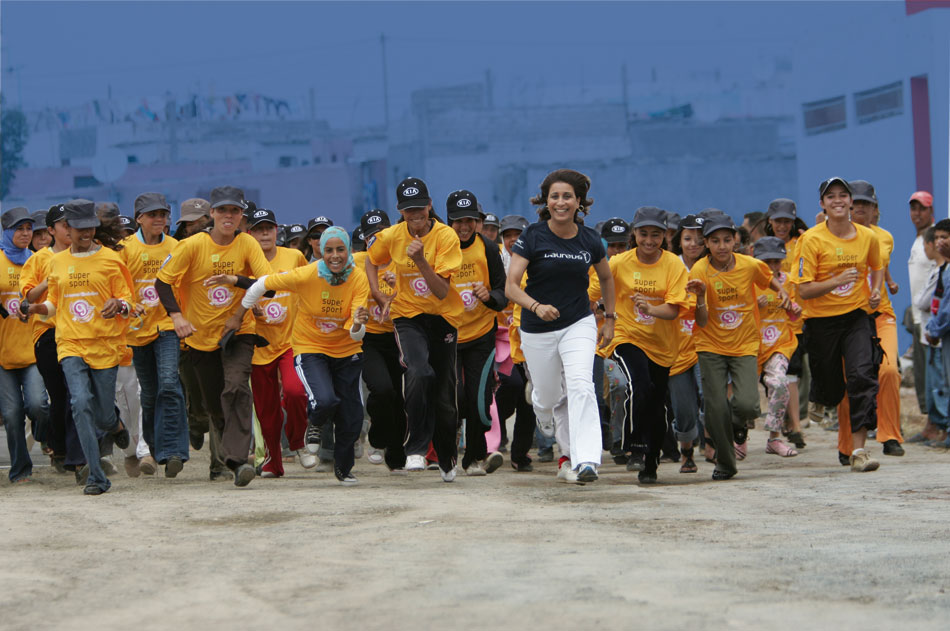
As Michael Johnson settled into the starting blocks at the Atlanta Olympics in 1996 to set a new world record for the 200 meters, he could never have imagined jogging playfully alongside kids in Kenya a few years later, helping raise self-esteem among young people in one of Africa’s largest slums. When Nawal El Moutawakel crossed the finish line at the 1984 Los Angeles Games and became the first Moroccan, African and Muslim woman to win an Olympic gold medal, she had no idea that she’d one day be leading 30,000 Muslim girls on an annual 10 km fun run around Casablanca, and pioneering sport among women in Moroccan society.

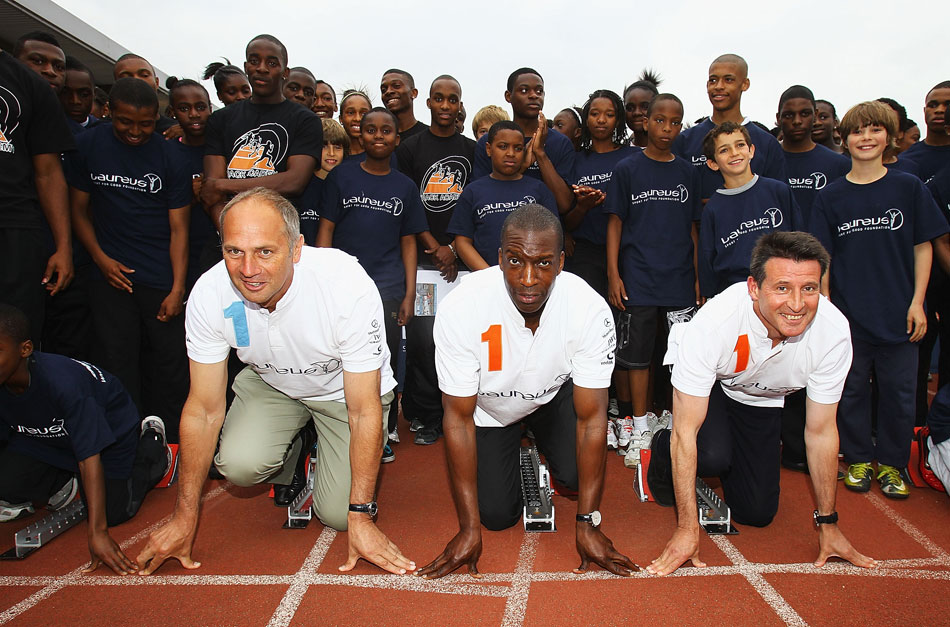
Britain’s greatest ever Paralympic athlete, Tani Grey-Thompson, six-time winner of the London Wheelchair marathon, despite a debilitating back disease that’s confined her to a wheelchair, could never have guessed that she’d find herself in the West Bank in Gaza one day, inspiring Israeli and Palestinian kids to work together through a basketball match. Johnson, El Moutawakel and Grey-Thompson form part of a unique association of 46 of the world’s greatest living sporting legends, The Laureus Academy, that embraces the principle of using sport to help bring positive change to disempowered communities.

They offer their time to support the work of the Laureus Foundation, by visiting over 140 projects around the world, all utilizing sport to turn kids away from the negative influences in society, and helping them realize their true potential. Other sporting greats who have aligned themselves with the Laureus include, Boris Becker, Jack Nicklaus, Hugo Porta, Kapil Dev, Sebastian Coe, Monica Seles, Tony Hawk and Dan Marino.

seles

This grassroots, life-changing work, is offset by a glittering sports awards ceremony, held each year in a different city, that sees the Academy members mingle with top sportspeople, presidents and royalty, to recognize sporting excellence. Commonly referred to as the “Oscars of sport,” the award ceremony was conceived as a way of bringing together the biggest names in sport and raising awareness around sport as a catalyst for change.

While big sporting celebrities walk away with solid gold and silver trophies produced by Cartier, after acceptance speeches for categories such as Breakthrough of The Year and Spirit of Sport Award, they are typically found a few months later in the slums of India or surveying the aftermath of a Tsunami in Indonesia, offering their expertise to rebuild communities. Significant global brands have come onboard as sponsors to ensure the work is maintained, and in return, their brand travels the world and associates itself with top sports personalities and events.

One of the global partners, luxury Swiss watch manufacturer IWC Schaffhausen, has even developed a special, limited edition watch for the benefit of the foundation, featuring the engraved artwork of a winner from one of the global Laureus projects. CEO of IWC Schaffhausen, Georges Kern, who has personally driven the Swiss watch manufacturer’s social responsibility program, says: “The privileged people on this planet – and we are among them – must do something to help those who are socially, physically or economically disadvantaged.

Through sport, Laureus gives people fresh hope and promotes social skills such as respect for opponents, recognition of rules, fair play and teamwork.” Other sponsors and patrons, such as Mercedes-Benz, Richemont, Daimler and the cities that play host to the yearly awards, benefit from huge global exposure by participating in A-list events and through their association with household names in sport.

laureus2

From a logo on a T-shirt in Africa to major television coverage at a Formula One event, sponsors are perfectly positioned to do well by doing good. “Politicians love movie stars, and movie stars love sportspeople,” says Edwin Moses, Chairman of the Laureus World Sports Academy. “We’re at the top of the influence chain, and because our physical skills are not easily replicated, we command huge respect and can influence lives.”

Tennis legend Martina Navratilova, an active Academy member, has seen the benefits of this unique business model firsthand: “We have raised over $100 million since 2001 and now there are over 120 projects globally. Over 1.5 million kids have been helped in a positive way,” she says.

The Laureus story is a heady mix of corporate sponsorship, celebrity sport and the will to succeed in some of the most devastated and impoverished parts of the planet. Projects have saved kids from gangs in Sao Paulo, reformed child soldiers in Sierra Leone, given hope to special needs kids in Shanghai and helped clear mines in Cambodia. It embodies something every sportsperson who has ever achieved greatness can attest to – that winning comes through a combination of self discipline and teamwork – mirroring the same qualities needed to win in life. It was the lack of a formal platform to honor this greatness that sparked the idea for Laureus in the first place. The year 2000 dawned with a mixture of hope and expectation as the world prepared for the new Millennium.

The United Nations declared 2000 to be the International Year for the Culture of Peace, and global warming was something most people were hardly aware of. Indeed, Al Gore was a US Presidential candidate that year, and had yet to move on to become the maker of the award-winning ecological wake-up film An Inconvenient Truth. As ever, sport was full of promise. The Millennium Olympic Games were just around the corner in Sydney, and indeed proved to be one of the most successful ever. And something else significant was stirring: an idea which was to prove radical and innovative, and, once it became reality, a beacon of hope for disadvantaged young people.

The seed of the idea that grew to become Laureus was first planted several years before the Millennium by Johann Rupert, Executive Chairman of luxury goods company Richemont. A noted sports enthusiast, Rupert was at a dinner with friends one evening and mused over the fact that there was no Nobel Prize or Oscars-style awards for sport.

Rupert’s views on the power of sport were fundamentally influenced by the crucial role that the 1995 Rugby World Cup played in the reconciliation of the different communities in South Africa, and in 1998 he found a kindred spirit in Dieter Zetsche, Chairman of German automotive giant Daimler, like Richemont, another blue chip company with a long commitment to sport. Two years later, the Laureus World Sports Academy was created, with 30 of the greatest living sports legends named as founder members.

On May 25, 2000, the majority of the Academy members gathered in Monaco for the very first Laureus World Sports Awards. It was an impressive collection of sporting legends, but it is fair to say that the biggest name was a huge surprise all round, as the door to the Academy meeting room opened and in walked President Nelson Mandela. It was in Monaco that Mandela, who was to become the Patron of Laureus, made the visionary speech which has become the philosophy of Laureus and the driving force that has shaped its work for the last 13 years.

His speech has become the dictum not only for Laureus, but for the whole sport for good movement. He said: “Sport has the power to change the world. It has the power to inspire. It has the power to unite people in a way that little else does. It speaks to youth in a language they understand. Sport can create hope, where once there was only despair. It is more powerful than governments in breaking down racial barriers.

It laughs in the face of all types of discrimination.” With much conflict in the world based on ignorance or fear of other cultures, breaking down this discrimination could be seen as a crucial part of creating prosperity for future generations. Perhaps the power of sport can best be illustrated by an encounter Rupert once had with a friend of his.

“Some 30 years ago, while living in New York City, I had a black friend who was a true sports superstar,” says Rupert. “He was constantly mobbed for autographs. I noticed that he took extra care giving signed posters to white kids. I asked him about the apparent favoritism. His answer: “Johann, if a white kid has my poster in his bedroom, he can hardly discriminate against the black kid in his class.”


How To Stand Up To The Strong And Wrong

Male leaders are very often both strong and wrong. And they get away with it. Research from the University of Pennsylvania confirms that men love making decisions. Male brains are wired for action. Male thinking is linear and simplistic. Men are motivated to act with confidence. It establishes dominance and that’s a big drive because men are primarily motivated by power and status. Developmental psychologists tell us that watching boys at play is a pretty accurate reflection of how their brains are developing. Boys generally like combat that establishes hierarchies.

Toughness and physical prowess are highly valued. Many anthropologists believe sports were invented to prevent young men from killing each other. And today, video games also provide ways to compete and establish hierarchical status for boys who are less successful at establishing physical dominance. Of course neuro-research confirming what we generally observe watching boys grow up is no surprise. What’s foolish is that we do not talk enough about the limitations of male thinking in a dangerous world.

It’s striking that we have many members of the U.S. Congress express admiration for Vladimir Putin as a decisive leader. The fact that he is a narcissistic bully with nuclear weapons doesn’t seem to deter their fascination. When senators openly admire the un-hinged audacity of Putin you see the limitations of male thinking.

But should we admire strength in a leader for its own sake. Strength without morality?

For thousands of years the gender that is physically strongest has asserted its dominance. Men primarily lead virtually all institutions. And not just any men. As I have written, competitiveness, confidence and decisiveness are the path to power in any hierarchical organization. So the people at the top are in many ways the most aggressive and simple-minded. In fact research published last year revealed that CEOs have the lowest amount of emotional intelligence than any other category of employee. Now I know what you might be thinking. Daniel Goleman, who is the researcher that made emotional intelligence a field of study, has said that emotional intelligence is more important than IQ in achieving success.

But it turns out to be a lot more complicated than that. It seems emotional intelligence is a driver for success in modern corporations only up to a point. It’s true that people who move into middle-management and even attain the level of vice president generally have higher emotional intelligence than workers who are not given management responsibility. However, the people that break out of the pack to achieve the highest levels of senior leadership turn out to be people with lower emotional intelligence than the people they lead. It may not appear that way because research shows CEOs are also the greatest concentration of narcissists in business organizations. Narcissist’s biggest advantage is something called negative empathy.

This means they understand how you feel and use that knowledge to manipulate you. No, I’m not saying that all CEOs are narcissist, but rather that modern organizations are designed to reward people who are highly competitive manipulators. I have found that they are often simple-minded, meaning they have a hard time dealing with uncertainty and complexity in a world that is increasingly uncertain and complex.

What they love to do is make decisions. Good luck with that… according to research from Ohio State University at least 50% of business decisions are mistakes. So how do all these simple minded CEO’s keep their jobs? They seduce their Boards of Directors. Very recent research confirms that confidence positively arouses our brains. People who assert themselves and their ideas forcefully actually stimulate adrenaline in our body, and dopamine and serotonin in our brain.

This is a powerful cocktail that tells us everything is going to work out fine. The strategy will succeed, the tribe will prosper and we will be victorious over our enemies. Male brains, which have high-powered amygdalae, are especially susceptible to unsupported strategies of dominance. The technical term for this is “susceptibility to bullshit”…or STB. (Ha!)

Male brains, which have high-powered amygdalae, are especially susceptible to unsupported strategies of dominance. The technical term for this is “susceptibility to bullshit”…or STB. (Ha!)

Well, what can we learn from this? Virtually every week I talk to frustrated women leaders who feel they spend most of their time cleaning up messes caused by the avoidable mistakes of overly confident, usually male, superiors. And frankly they are sick of it. But like nurturing mothers or dutiful wives they show up, clean up and calm everyone down.

Yet this is not a solution. The core problem is human beings are wired to give confident-acting people power. That is not going to change any time soon and that’s a problem because women generally act less confident than men. Their humility is triggered by their neuro-networks that cause women to think holistically. They see the complexity of serious problems and tend to weigh decisions more carefully. They worry about unintended effects. They resist impulsiveness. They are generally less assertive and more collaborative.

These are called wisdom traits and are exceptionally well suited to lead in our age of increasing ambiguity and constant surprise. But most of this female leadership power is lost because the very qualities that make them potentially extraordinary 21st Century leaders mute the confidence and courage required to be given the reins of leadership. The solution? Well maybe it sounds too simple but this is what I have found works. When I develop women leaders I start with 3 principles:

Don’t wait to lead for a future time when you feel more confident. Confidence is gained by acting confidently.

Don’t wait to lead for a future time when you feel more confident. Confidence is gained by acting confidently. You will probably never feel as confident inside as you must act on the outside. Your brain is wired for self- doubt and you will probably never silence your inner voice that is telling you to sit down and be quiet. So “woman up!” You will need to communicate like a confident women leader. You always have a strategic agenda. Men will assume you are a tactical thinker and problem solver.

They are conditioned to see you as an aide to the general, never the general. So you must tie every goal you champion to a winning strategy that will result in market dominance. (Remember our brains are wired to support leaders who promise dominance over competitors. You don’t have to be strong and cold like Margaret Thatcher, but keep in mind it was her resolute promise to restore England’s economy and military strength that got her the Prime Minister’s job. You can be both strong and warm.) So, no matter what your position always state your current goals in the context of the big picture.

Always state and restate your reasons as to why your goals and priorities are vital to success. Men tend to state their objectives and assume others will just buy in and start working on them. This is a foolish assumption for men and a huge mistake for women. You have to market your goals like a product. What are the compelling benefits to your goals that make them worthy of money and resources you need?

You may think you already do these things but I have found women’s self-awareness of how they project power to be quite weak. Ask some men you trust how others perceive your leadership power. You maybe surprised. There is a lot more to the success principles of women leaders but these first three are foundational. Here they are in shorthand:

  • You are well equipped to lead in today’s world. You will always feel inner doubt. Dismiss that doubt and decide to lead.
  • Develop and express clear, strategically relevant goals. Goals that will help your team and your enterprise win.
  • Constantly campaign for your goals and agenda. Express clear reasons why your goals deserve attention and investment. Make waves.

I implore you to do this. Without the wisdom of holistic, smart thinking our future will be determined by men who actually admire bully-leaders like Putin and that is just plain pathetic. So please rise up!

Do We Accept Circumstances Or Fight Them?

There once stood a tree. It had stood for longer than the oldest person had lived in that area, and almost longer than America had been a country. It reached higher than our necks allow us to see – a skyscraper of the Amazon, some may say. It’s home to our friends with wings, plants and crawling critters, playing children and the air we breathe. Yet for outsiders it’s simply a tree. It may just be one tree, but for 25 communities living along a river in the Ecuadorian Amazon, there are only three other living trees like this in existence.

In spite of this, in the eyes of some outsiders, this tree is replaceable by the plentiful other trees around it. Foreigners might ask – within a territory covered in greens of all shades and barks of all textures – “what’s the value of just one more tree?” Well, through a local viewpoint, no other oxygen-omitting being would begin to suffice.

An endangered species, they protested. Spiritual symbolism, they claimed. Historical significance, they explained. In a place in which nature and culture are commonly intertwined it felt as if the possible destruction of nature was equally a possible destruction of their society. The intruders, as a few Amazonian’s framed it, began to propose a scheme of deforestation. They cleverly assembled a proposition stuffed with linear logic of growth and capitalistic gain – gain for themselves of course, not the locals. $20 for a 200-year-old tree that could still grow for a further one hundred years.

Perhaps they fell asleep during that part of their environmental science class that explained that, for a tree of that size, at least 200 years more years should pass. They do say time is money, but the locals struggled to accept that $20 equates to 200 years of time. I think they were even further puzzled when the constructors attempted to rationalise the offer by saying it would only take four hours of their time. Four hours pass and the construction site would be a hidden site.

Or on the other hand, four hours pass and the construction site would be a graveyard site to the natural, spiritual, social and cultural elements that stemmed from that tree. Fortunately, a few activists were not willing to put up a tombstone. It takes one thought, one person, one group, one action to change the course of what some believe may be fate. In this case it was one proposal. An outside group stepped into the negotiations and raised the offer by $80.

Rather than $20 to cut the tree down, how about $100 to leave the tree untouched? The team of constructors were not swayed by the three-digit offer. At this point, while some lost hope, others transformed their lost hope into confidence – for saving the tree. Workers from a local social enterprise joined the movement and they made a commitment to each other to protect this historical, spiritual, playful being of a tree.

As I mentioned before, to change the course of the future begins with us.

As I mentioned before, to change the course of the future begins with us. From an idea to initiative to execution of our vision, we are able to achieve our mission. Even when the first attempt fails that does not mean that the second or third shot should also disappoint. The local’s story follows this pathway. Although the foreigners thought they were rather clever, the locals accessed some indigenous genius. They expressed that the tree the outsiders were hoping to kill resided within indigenous territory. These foreigners did not just stumble upon land with the right to claim or destroy any element of it.

There was no equivalent phenomenon to Columbus discovering America “by accident.” For this reason, the foreigners consequently had to play by indigenous rules. It only took some creative, innovative thinking to completely switch the situation around. Now, those wearing the power shoes were the locals, with land, rather than the foreigners with money. If you want any more nights with your families, the locals warned, you’d better hustle out of our terrain.

Of course this was an intimidation tactic rather than one they would straightforwardly follow. Nonetheless, they provide the proof that with dedication to a particular belief, no obstacle stands in the way as a barrier. Although less politically significant or economically established, their drive to lead and achieve was more powerful than imagined. After clearly outlining the importance of the tree and exposing the ignorance of the outsiders, a deal was closed.

With a voice willing to speak up for what they believed in, they not only saved the tree, but also initiated a continual benefit from the tree; each month $100 is dispersed throughout the community which helps to support the families of the village. In what seemed an unfortunate event, fortune was actually found.

Much of our life and what we aspire to achieve is dependent on how we choose to go about living; whether we accept circumstances or take circumstances into our own context.

Much of our life, and what we aspire to achieve, is dependent on how we choose to go about living; whether we accept circumstances or take circumstances into our own context. As these Amazonian’s taught me, there is power in “one.” In the same way a match has the ability to light a candlelight, a bonfire, a devastating house fire or forest fire, our beliefs and goals can also leave an impact of any size. After all, an obstacle is only an obstacle if we perceive it to be.

So, when presented with what seems bad, reconsider how this “unfortunate” event may actually result in fortune.