Forget The Movie, Here’s The Real Bucket List


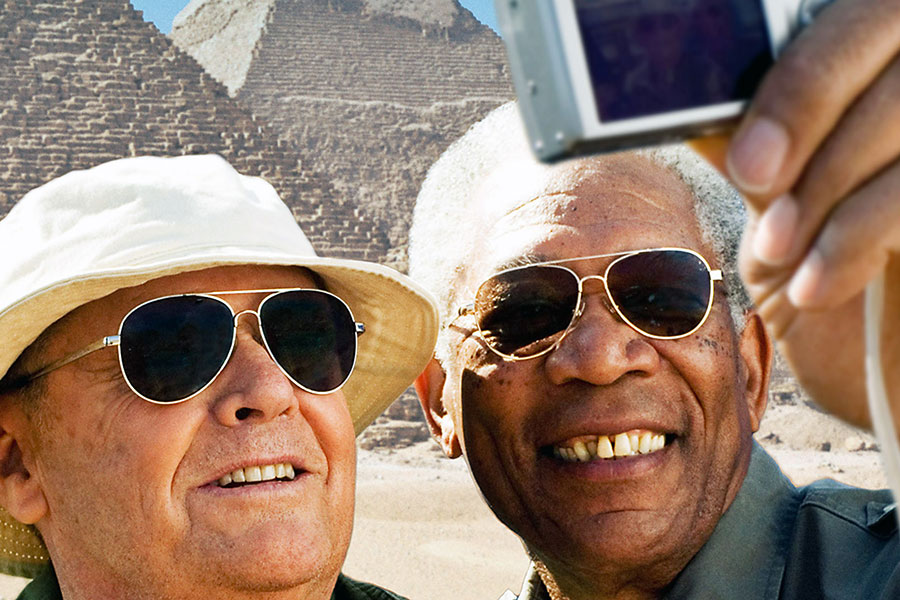
A few years ago, Jack Nicolson and Morgan Freeman made us aware of the bucket list. Since the movie, thousands of people have created their bucket list of things to do before the end of their lives. From the whimsical to the serious to social responsibility, these lists reflect what it is that people want to experience or how they want to give back. However, the Real Bucket List includes the opportunity to focus each day on developing the top 10 distinguishers which will serve you and allow you to serve others.

These items capture the perspective, skills, characteristics and insight needed to distinguish yourself. Master these, and you are masterful. As we carry out our roles, we can cultivate our abilities and potential within each, garner the attention or appreciation of others, and move to a new level of internal and external success.

The top 10 distinguishers are as follows:

  • Perception Management – your ability to perceive what is real vs. a figment of your imagination or judgment. Managing your perceptions allows you to stay in the present rather than anticipate what could come next. It minimizes anxiety and stress.
  • Emotional Intelligence – your ability to manage your reactions and responses, especially in pressure situations or when your anger is piqued. How you react and respond has consequences.
  • Initiative – your ability to take action and think about what is next without having to be told to do so. Knowing how to and choosing to take initiative will help you to stand out as a leader. It distinguishes you from the masses who sit back and wait.
  • Compassion – your care and concern for others’ circumstances. Everyone in life is experiencing or will experience something that is not easy. It’s an expression of shared humanity and, moreover, it is an expression of your humanity
  • Humor – your ability to laugh at yourself and make others laugh. Poking fun at yourself is a great method for making it through a tough time or a mistake, while demonstrating you realize it is so and you are learning from it.
  • Humility – your sense of doing the right thing without needing the credit. Sometimes acknowledging that you did something well or accomplished a good deed does not require words or exposure.
  • Ownership – your decision to accept responsibility for your actions, words, deeds, and opportunities. No more of the ‘not mine’ syndrome!
  • Service – your call to serve and give to others with your time, money or resources. Service comes in many forms.   It can be as simple as smile or an occasional volunteer role.
  • Consistency – your commitment to do what you say and say what you do without interruption. One action, behavior, or decision does not typically create sustainable impact or change.
  • Knowledge – your capacity to apply and share what you continuously learn. Perceive yourself as a vessel for capturing information and skills, and then share your knowledge and its fruits generously.

The items in the Real Bucket List are all inter-related. When you become more adept at one, you also contribute to the development in another. Developing your abilities, thoughts, and choices pertaining to each item will distinguish your life from one that passes by and one that is deemed exceptionally well-lived. Tuning in to your skills and applications resulting from filling your Real Bucket will ensure that you function as a whole person making a significant contribution to your life, the lives of others, your family, your community, and even your country.

Forget The Movie, Here’s The Real Bucket List


A few years ago, Jack Nicolson and Morgan Freeman made us aware of the bucket list. Since the movie, thousands of people have created their bucket list of things to do before the end of their lives. From the whimsical to the serious to social responsibility, these lists reflect what it is that people want to experience or how they want to give back. However, the Real Bucket List includes the opportunity to focus each day on developing the top 10 distinguishers which will serve you and allow you to serve others.

These items capture the perspective, skills, characteristics and insight needed to distinguish yourself. Master these, and you are masterful. As we carry out our roles, we can cultivate our abilities and potential within each, garner the attention or appreciation of others, and move to a new level of internal and external success.

The top 10 distinguishers are as follows:

  • Perception Management – your ability to perceive what is real vs. a figment of your imagination or judgment. Managing your perceptions allows you to stay in the present rather than anticipate what could come next. It minimizes anxiety and stress.
  • Emotional Intelligence – your ability to manage your reactions and responses, especially in pressure situations or when your anger is piqued. How you react and respond has consequences.
  • Initiative – your ability to take action and think about what is next without having to be told to do so. Knowing how to and choosing to take initiative will help you to stand out as a leader. It distinguishes you from the masses who sit back and wait.
  • Compassion – your care and concern for others’ circumstances. Everyone in life is experiencing or will experience something that is not easy. It’s an expression of shared humanity and, moreover, it is an expression of your humanity
  • Humor – your ability to laugh at yourself and make others laugh. Poking fun at yourself is a great method for making it through a tough time or a mistake, while demonstrating you realize it is so and you are learning from it.
  • Humility – your sense of doing the right thing without needing the credit. Sometimes acknowledging that you did something well or accomplished a good deed does not require words or exposure.
  • Ownership – your decision to accept responsibility for your actions, words, deeds, and opportunities. No more of the ‘not mine’ syndrome!
  • Service – your call to serve and give to others with your time, money or resources. Service comes in many forms.   It can be as simple as smile or an occasional volunteer role.
  • Consistency – your commitment to do what you say and say what you do without interruption. One action, behavior, or decision does not typically create sustainable impact or change.
  • Knowledge – your capacity to apply and share what you continuously learn. Perceive yourself as a vessel for capturing information and skills, and then share your knowledge and its fruits generously.

The items in the Real Bucket List are all inter-related. When you become more adept at one, you also contribute to the development in another. Developing your abilities, thoughts, and choices pertaining to each item will distinguish your life from one that passes by and one that is deemed exceptionally well-lived. Tuning in to your skills and applications resulting from filling your Real Bucket will ensure that you function as a whole person making a significant contribution to your life, the lives of others, your family, your community, and even your country.

World’s First Black Woman President: Weapons Don’t Kill, People do

  • Raised in one of the most troubled countries in Africa a woman rises to become the world’s first black woman president at age 67.
  • Personal struggles helped shape her attitude to war and violence, that she used to build a country torn apart by civil war.
  • An understanding of history and gender discrimination taught her that women must not be held back and insists they form part of any conflict resolution process.
  • In accepting a Nobel Peace Prize she emphasizes that weapons cannot kill by themselves – people do.

Born into poverty in Africa, getting married at 17 to an abusive husband, facing discrimination as a woman, imprisoned and being forced into exile, separated from your children – these things would test the will of the toughest leader. Yet this is what happened to Ellen Johnson Sirleaf, and despite insurmountable odds, she is now the world’s first elected black female president and Africa’s first elected female head of state. Elected in 2006, Sirleaf brought stability to Liberia, a volatile country that had seen two civil wars over a period of fourteen years. As if that wasn’t enough, she also added a Nobel Peace Prize to her long list of accolades in 2011.

Her popular title of the “Iron Lady” of Africa is a pleasant irony as her Nobel Peace Prize was awarded for her non-violent struggle to ensure the safety of women and for insisting that women have full participation in the peace-building process. Sirleaf shared her Nobel Prize with fellow Liberian Leymah Gbowee and Tawakkul Karman of Yemen for realising the great potential for democracy and peace that women can bring. War may traditionally be men’s work, but Sirleaf insists that women have a say in cleaning up the mess and ensuring that it won’t happen again. Her fight against corruption and violence could also be the reason she was voted back as president for a second term in 2011 and why the IMF and donor countries agreed to write off $4.6 billion of Liberia’s debt, based on her sound economic policies, freeing up funds to build new infrastructure.

Sirleaf was born with Americo-Liberian roots and German ancestry and she has qualifications and work experience from American institutions the World Bank, Citibank and the UN Development Programme. Her diverse cultural identity, exposure to global economic infrastructure and big picture thinking have all resulted in a leader who understands that diversity can actually keep things together, rather than tear things apart.

Sirleaf describes Liberia as, “A wonderful, beautiful, mixed-up country struggling to find itself.” The complications stretch back to 1847 when Liberia declared itself a nation, created by freed American slaves shipped back to Africa. They retained the cultures and traditions of the American South and even created a flag that mimics closely the American flag. “The settlers of modern-day Liberia decided they would plant their feet in Africa but keep their faces turned squarely toward the United States,” says Sirleaf. “This would trigger a profound alienation that led to a deeply cleaved society, and ultimately set the stage for the terror and bloodshed to come.”

The 1989-1996 Liberian civil war, one of Africa’s bloodiest, claimed the lives of more than 200,000 Liberians and further displaced a million others into refugee camps in neighboring countries. Entire villages were emptied as people fled. Child soldiers committed atrocities, raping and murdering people of all ages, including their parents. The war claimed the lives of one out of every 17 people in the country.

The seeds of the conflict can be traced back to leaders who either identified themselves with an Americo-Liberian identity or with ethnic, tribal sentiments. It’s a stark reminder of how political decisions and discrimination from generations ago can suddenly appear to haunt future generations at any time. 

One hundred and fifty eight years later it took a single woman to heal the wounds. Sirleaf refused to accept the limitations of her nation, or her gender, and refused to give up her beliefs despite being jailed and threatened by brutal dictators. She worked for, and ruffled the feathers, of every president she worked for in Liberia over a span of nearly 40 years, until she herself at age 67 became the first woman to be elected president of an African nation.

From left: Yemeni activist Tawakkul Karman, Liberian 'peace warrior' Leymah Gbowee and Liberian President Ellen Johnson Sirleaf jointly won the 2011 Nobel Peace Prize.

From left: Yemeni activist Tawakkul Karman, Liberian ‘peace warrior’ Leymah Gbowee and Liberian President Ellen Johnson Sirleaf jointly won the 2011 Nobel Peace Prize.


Many people are unaware that Alfred Nobel, after which the Peace Prize is named, was the inventor of dynamite. He was inspired to leaving his vast fortune to the prize that bears his name after a newspaper incorrectly reported his death with the headline: “Dr. Alfred Nobel, who became rich by finding ways to kill more people faster than ever before, died yesterday.” It was actually Nobel’s brother that had died, but from that moment he decided his legacy was going to be about peace and human advancement. Sirleaf accepted her Nobel Peace Prize by recounting this story and adding,” Alfred Nobel’s dynamite did not kill people. People kill people, whether it’s with a knife, machete, handgun, rifle, machine gun or explosive device packed with dynamite.”

She is also dismissive of those that assume military weapons are the only devices on which war can be blamed. “We must not forget that some of the most heinous crimes in war have been committed without explosives. Too often brute force has sufficed,” she says. “Rape remains one of the tested and most enduring weapons of war. But there have always been other men, and perhaps even more women, who have committed themselves to the cause of peace,” Sirleaf explains. “These are the people Alfred Nobel wanted to celebrate and have others emulate.”

In her inaugural speech Sirleaf said: “Our recent history teaches us that violence diminishes our nation and ourselves, not just within our borders, but more importantly in our dealings with other nations and people.” Conflict is never confined to a geographical area, especially in the age of globalization, and Sirleaf knows that a true leader sees themselves as a global citizen with a responsibility beyond their own citizens.

Sirleaf’s presidency firmly establishes the importance of women leaders on the world stage and her unique position as a woman with both African and Western roots – genealogically, geographically, and intellectually – signals a new kind of 21st century leadership that has broken gender stereotypes and challenged the idea that historical animosities cannot be healed.

She has also stressed that the tolerance of other viewpoints is crucial for the creation of peace, even when people disagree strongly with those around them. “Our shared values are more important than our individual interests,” she says, explaining how the bigger picture should always be kept in mind before pulling a trigger.

How To Lead Without Words

How important do you think words are to get your point across in business? Let me surprise you: a lot less than you would imagine. Leadership happens under our words, around them, between them. Leadership is what happens while we’re planning what to say.

The reason is simple: leadership is instinctive to survival. Knowing who is in charge, who is bigger or more powerful in each and every situation you encounter in life is the key to stay alive across the entire animal kingdom. The fact that we modern humans have created a safe everyday habitat for ourselves, in which immediate death threats are mostly postponed, doesn’t change the way our bodies are designed to operate. Our bodies are still mammal animals who need to be included in a pack in order to survive.

This morning I took yet another bright brainy executive out to get feedback from my horses. A prominent lawyer working out of Shanghai for a large American tech company, Irene walks and moves quickly. Determination and focus seem to drive her through most challenges in life. Horses, however, were not impressed by her law degrees, MBAs and varied achievements. They walked all over her in less than a minute.

She spoke of “having a revelation” when we finished the exercise, as she realized how subtle and powerful body language can be. This is what puzzles us today: leadership doesn’t actually happen in our words, but rather somewhere else, in a place where words, numbers and logic are irrelevant. In the part of the brain that continues beneath our neck down to the very tip of our toes. In the feelings, sensations and involuntary contractions that constantly take place inside us.

As Irene approached the horse she felt most comfortable with, he welcomed her attention nudging her arms and happily breathing in her scent. And as soon as he had her where he wanted her, he ignored her and started flirting with me. I proposed Irene go inside the box with this savvy horse, find a space where she was comfortable, and perform a certain massage on his neck. From outside the box we could clearly see the horse invaded her space, ignored her requests to back off, and dominantly stared over her shoulder at what we were doing. Then Irene looked over to me and said “my boss often oversteps, messes around with my teams, creating problems for me”.

Irene’s boss does exactly what our horse did to her. He senses he can intimidate her easily, invading her territory without a second thought, as he looks out only for himself. I helped Irene focus her attention on the physical sensation of intimidation in her own body. Then she breathed deeply to ground and dissolve it, and practiced ways to protect her space with her arms, or her voice, or a look of authority. “But my leadership philosophy is about service”, she said to me. “There’s nothing wrong with that”, I replied, “you still need to be in charge of your teams in order to guide them through danger. You can’t do that if they invade your space and ignore your instructions all the time.”

Of course Irene reasons in such a way that justifies what is happening around her. We all do. And while we’re right, we’re also being manipulated by the brain beneath our neck to play along with a dynamic in which we are not in charge anymore. It’s that wordless brain in our hearts, guts and rest of our bodies who reacts to situations like a mammal animal. Spontaneously and immediately. Our complex network of nerve cells speaks directly to other mammal bodies around us without words and without asking for our permission. Several exercises with another horse showed the exact instant in which Irene doubted herself, a couple steps before reaching an obstacle, because the horse nudged her elbow playfully, or nipped her but! (I really hope her boss doesn’t go this far!)

I bet your sitting there thinking “Oh, this wouldn’t have happened to me. It’s so obvious!” And you’re right. You would have had another different challenge. Your body would have contracted or over reacted at a different instant, in other ways. Irene’s personal history would probably help explain why her body tends to adopt a submissive role to feel safe. Improving her leadership, therefore, depends on her awareness of how this reaction takes place inside her, and her ability to soothe and dissolve the ancient body-driven emotional response which hinders her performance today.

Working with horses and dolphins provides a very powerful mirror to experience what happens in our own bodies as we issue an instruction or guide others in business. They don’t need any words to let us know we’re not convincing. Their bodies react to ours spontaneously and immediately, instinctively choosing to follow us, or rather step above us in hierarchy, for the best reason in the world: survival.

Lead without words. Stop talking endlessly to yourself about what others are doing wrong and start focusing on the sensations, emotions and movements taking place inside your body. Focus your attention, breathe deep and regain fluid flexibility. When you ground your body, you will know what to do. Everybody will follow. Surprise yourself!

10 Opportunities for Viral Engagement in the Workplace

Companies are not getting the best returns possible. They are leaving money on the table. But the problem is not with returns on financial capital—it’s human capital that’s left behind.

Estimates go as high as $370 million in lost profits annually in the United States.

Specifically, the lack of employee engagement is resulting in huge productivity losses for businesses. Estimates go as high as $370 million in lost profits annually in the United States. While many companies are relying primarily on annual employee engagement surveys to address the problem, results show more action is needed.

In my experience, a more comprehensive approach can deliver huge returns. Research supports what I have experienced personally—the key is to create the conditions for what I call viral engagement. It starts with the understanding that any employee can impact the engagement of every employee in a group.

Research has found that positive emotions spread from person to person in a work environment.

Research has found that positive emotions spread from person to person in a work environment. One study by Yale researcher Sigal Barsage found that this spread of emotion is associated with improved cooperation, decreased conflict, and increased task performance in the workplace. Another study by James Fowler and Nicholas Christakis out of the University of California and Harvard, respectively, found that cooperation also spreads, even among people who are not acquainted. These researchers found that cooperation spreads not only from person to person, but from person to person to person to person—up to three degrees of separation. That’s an impressive cascade. I call that viral engagement.

Engaged employees feel great about giving their all at work. They are disciplined and creative in their chosen craft and team well with others. Their high level of satisfaction comes from working in an environment where they can connect what they do to who they are. I refer to these individuals as Chiefs.

Engagement is contagious and can start from anyone, anywhere in an organization.

Consider these 10 opportunities to create the conditions for improving employee engagement with the understanding that engagement is contagious and can start from anyone, anywhere in an organization.

Selection: Do you hire good team players and hold an expectation that every addition to your team can have an immediate impact on the engagement of current employees?

Education: Does your company invest in the soft skills that will enable your employees to be more effective in engaging others?

Communication: Do you reinforce verbal and written communication as equally important in engaging others?

Compensation: Could you pay a small team bonus for improving engagement scores?

Recognition: How could you recognize individuals and teams when new practices are adopted that are generated “bottoms up?”

Promotion: Do team members know that engagement success is part of the path to promotion?

Retention: When people do leave, do you look ask about engagement in exit interviews?

Performance management: Is engagement a part of performance management discussions?

Values: Could engagement language be added to define your organizations values?

Assessment: Do you assess for engagement skill sets?

When you understand that viral engagement is possible, you have the power to unleash a whole new paradigm in your organization. Are you ready for next-level growth? The opportunities discussed here will help you get there.

Are McDonald’s Arches Turning From Gold To Green?

Can McDonald’s become a global leader in the sustainability movement? Let’s see what Keith Kenny, Senior Director, Supply Chain for McDonald’s Europe, has to say. He’s responsible for sustainability across the company and also has strategic sourcing responsibility for poultry, fish, vegetables and beverages. What challenges lie behind the world’s most standardized meal?

You’ve had problems with negative publicity in the past, from soy production in Brazilian rainforests to people dressed as chickens chaining themselves to your stores. Have things changed?

Brazil was a turning point for us. We thought we were doing the right thing by sourcing non-genetically modified soy, so we went to Brazil. Thanks to a new variety of soybean developed by Brazilian scientists to flourish in the rainforest climate, soybean production has boomed in the region over the last 10 years as firms have converted extensive areas of rainforest and cerrado, a savanna-like ecosystem, into industrial soybean farms.

What happened in Brazil was that genetically modified (GM) processes became legal within the soy industry. This started in the south, so we went north to chase the non-GM soy, and before we knew it, we were encroaching on rainforest-grown soy. We worked to pull a coalition of buyers together to put a moratorium in place on this soy.
We’re in a different situation from other large European retailers such as Sainsbury’s. They have 50,000 stock items in their inventory and we have only a handful. But where we do buy, we buy in huge volumes. This is equally as challenging, as we need to drill down into each of these supply chains and see exactly what’s happening there.

We’re one of the world’s largest buyers of beef, accounting for 2.5 percent of European beef production, and we consume about 10 percent of all mince produced in Europe. The biggest impact of our supply chain is at the farm, and we’re talking about half a million beef farms throughout Europe here. We have a set of requirements that we’ve implemented as we can’t afford to pay auditors to go to this many farms. There are a number of farm assurance schemes across Europe that deal with sustainability issues and we use them to build up a database of what’s going on in the industry.

We want to have agreement within the industry about the principles of sustainable beef production and we published a compilation of our findings in November 2014. Our aim is to get alignment within the system so that all producers don’t start contradicting each other. This will be rolled out at a global level in a multi-stakeholder initiative for sustainable beef. Our challenge is that people have different requirements, depending on the region, all wanting to talk about different things.

Did McDonald’s learn anything from the bestselling book Fast Food Nation and how did this affect you?

All our beef is from the European Union, and not from the U.S. It gets audited for food safety requirements and all other health requirements. We have a very tight control over what’s happening there, which is why we weren’t affected by the horse-meat scandal as much as other food retailers.

Beef is an inherently unsustainable product. What is your view on this?

Beef production can be sustainable. Our biggest challenge in the world is to feed a growing population. Remember that increasing incomes = increasing consumption. More than half of agricultural land in the U.K. is unsuitable for crop production and the only way to make it sustainable for food is to graze animals on it.
We’ve also done a lot of work studying emissions from farms. There is a 250 percent improvement in farms that are efficient vs. non-efficient around carbon emissions. We also use former dairy cows in our meat chain.
On the menu side, we’re continually looking at them and making them more nutritional. We have salads and wraps and all sorts of different items – that don’t always necessarily sell well.

Looking at land degradation around the world, how can you justify soy being fed to animals instead of to people?

Greenpeace has actually said that soy is no longer the driver of deforestation in the Amazon. Our tofu burger in the U.K. was met with mixed success. We try and keep our farms as sustainable and energy efficient as possible. For example, we use the manure from our cows to make methane gas, which is used as an energy source instead of electricity.

Not many people know about one of our websites, flagshipfarms.eu, which was developed by McDonald’s Europe in conjunction with the Food Animal Alliance to encourage the sharing of sustainable agricultural practices. We’re encouraging a dialogue between farmers to demonstrate the benefits of sustainable farming practices. An example is what some of our lettuce farms are doing. It’s highly targeted and results in massive water reductions, while increasing productivity. We’re assisting potato farmers in Norway to maximize their short growing season and assisting with innovative ways to reduce ammonia emissions from cows in Holland.

How do you share knowledge and ensure these lessons are learned?

Through the development of global corporate social responsibility schemes. We work with the World Wildlife Fund at a global level to create a sustainable forest policy and also focus on supply chain issues. We also rely on global strategies that can be externally verified. This might include certification that ensures that no child labor has been used during production, using Rainforest Alliance Certified Coffee that conserves biodiversity and forests in sensitive areas with high agricultural activity, and moving to Forest Stewards Council certified sources for our cardboard packaging.

Why Rituals Are Critical To Your Leadership

Rituals are as old as mankind. As we grow up we are slowly brought into them by families, friends, religious communities and teachers. But we don’t really get them until we are much more seasoned in life’s perils and thrills. In today’s obsessively rational society many people don’t get them at all. Why are rituals so critical to leadership?

Quite simply, rituals are vehicles of emotion, and leadership mostly takes place in our hearts: we follow those who make us feel safe, worthy and belonging to something bigger than ourselves. Rituals concentrate our attention on certain emotions, adding each individual contribution together to create a shared sensation of significance, which seems to magically multiply exponentially sometimes: “Whoa!! Did you feel that?”

In just a few of such “Whoa!” occasions I have fallen in love with the ritual of the talking stick. Several facilitators at the prestigious Foundation for Natural Leadership in the Netherlands carry a wooden stick adorned by several colors to symbolize awakening, wisdom, inner shadows and sharing. They are made with special care by native Indians in Canada on a chosen day of the year. A quick search on Google shows there are many variations to talking sticks, and many tribal traditions that use them in their gatherings and councils. The talking stick, I kid you not, would seem to have a life of its own.

A ritual only works if everybody involved agrees to take it seriously, performing each task and symbolic gesture with reverence. In the case of the talking stick, the ritual consists of leaving the stick in the center of the circle formed by participants, and picking it up if you want to speak out loud. Nobody can talk without the talking stick. The leader or facilitator of such an exercise, of course, is responsible for setting the tone, creating the mindset and walking his or her own talk when performing the ritual.

You might sit there thinking “what am I doing here with all these strangers and what on Earth am I going to say when it’s my turn?” Or you might start playing your thoughts around in your mind to prepare your own speech instead of listening to the guy talking at the moment, holding the stick in his hand. It doesn’t really matter. The collective energy of the people assembled around you will pull you in to the ritual sooner or later. This is the enchantment of the stick: it harnesses the energy of all those involved, sweeping over you gradually like an ancient aboriginal drum rhythm, seeping into your bones and mobilizing your limbs before you know what’s happening.

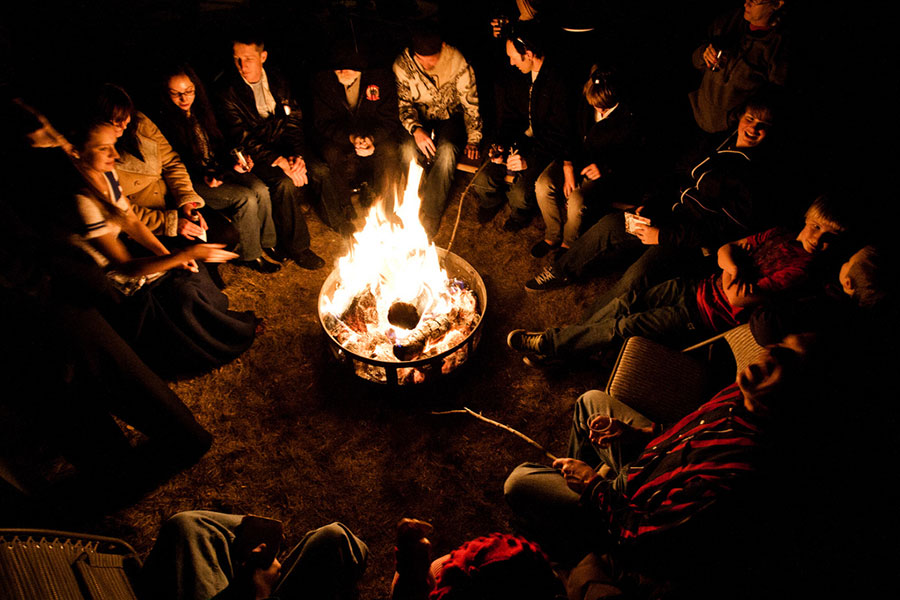
No matter what you might have thought about before the stick fell in your hands, everything can change when you grab it. As we sat in a circle around a fire at night last week, one man blurted out how it was five years since his mother had died and he felt he needed to get to understand the historic awkwardness between them a little better. Somebody else shared how much he had feared losing his wife during the birth of this third child, and how he realized he wanted to spend more time with his family. We were all strangers to each other. Investment bankers, hot-shot executives, elite business school researchers and no-nonsense business owners. We hadn’t planned to share such intimate details with each other. We were conquered by the power of an age-old ritual, which brought us together on a level of sharing we could easily relate to. It’s like we bridged all our differences –gender, age, country, profession, religion, you name it!—in a single chat around a mesmerizing camp fire.

In my case the stick seemed to sew together a heavy storm of thoughts, doubts and worries which had been circling over my head all day. To the point that I was quite hesitant about taking up the dammed stick to share my unruly and very scary insides. It worked wonders on me. I picked it up and breathed heavily a few times. Words came to me in such clarity and simplicity that I almost wondered if anybody had cast a spell on me. The mental chaos which had bothered me all day dissolved as I felt supported by a bunch of strangers who had promised to respect each other’s secrecy, speak from their hearts and perform this simple but powerful ritual.

Was it the stick? Was it the fire? Was it the facilitator or was there some scientifically provable substance mixed in with our supper? I don’t know. And frankly, I don’t care.

What I do care about is how that ritual melted resistance in such intellectually sophisticated people. How softly and respectfully each executive found his moment and pace to let go of armors and share his insides. How very significant and beautiful it felt to all of us. How human we felt together. How together we felt with all humans: before us, beside us, after us.

Rituals harness our feelings, emotions and sensations to create a sense of community without which we can not solve the challenges we face today. The Dalai Lama tweeted this week that “since climate change and global economy now affect us all, we have to develop a sense of the oneness of humanity”.

Yes. Our destinies are truly joined together more than ever before in human history. Yet our differences keep us busy arguing, fighting, debating and doing our own thing. Maybe it’s time to recycle our earliest ancestors’ tribal rituals, symbols and beliefs…those through which they risked their own lives if it meant saving their tribes.

I tell you this: without ritual there can be no leadership. You may only lead your teams if they feel they are part of something bigger than themselves. If they want to sacrifice their own wellbeing to build something better for all. If they drive you to be the best possible leader you could ever be every single day, just for the honor of making their sacrifices worthwhile. If you feed on their joyful success as if it were your own.

Bring rituals back into your business. Invest time and effort into finding the ones your people respond to. Repeat them again and again until you all stop giggling nervously and finally give in to the shared vibe of belonging. Then your destinies will have linked together to do something more beautiful and significant than you ever thought you would even try. Then you will feel humane on a whole new level.

Elon Musk, Tesla, and Investing in Love

Elon Musk is a true, Thomas Edison type genius. After years of skepticism critics are acknowledging that he is re-shaping the automobile (Tesla), the space rocket (Space X), and solar energy (Solar City) industries all at the same time. I just started reading his new biography and it is a fascinating story of a highly unusual human. The combination of sheer intellectual genius, business savvy and thrill-seeking-risk-taking is yielding astonishing results. One thing is clear… when he gets a vision he is willing to go all in. He nearly lost all of his billion dollar-plus fortune he made off PayPal in these new change-the-future ventures. A big brain and iron guts are a potent combination.

Yet for all his success he laments that one part of his life continually teeters on the edge of “personal” bankruptcy. He has two divorces and five children. He asked the author of his biography if he thought allocating 10 hours a week to a relationship with a woman would be enough to keep her happy. That’s not a silly question. Recent research reveals that one full hour every day in which you invest your undivided and non-judgmental attention in your partner will create both trust and intimacy. The problem is very, very few people consistently devote that one hour of undivided, non-judgmental attention. In most cases it’s the quality of attention that is the bigger problem than the time. In Elon Musk’s case his hyperactive business life and overly busy super-bright brain are probably his biggest impediment to intimacy. I find the same is true with many of the senior executives I coach.

I often ask “what if science had proven that there was one, absolutely key activity, in your life that would enable you to be both happy on a day-to-day basis and deeply satisfied at the end of your life… would you be interested in knowing what that is?”

I am sure you already know where I’m going with this. Since the dawn of recorded history humans have understood that sustained happiness is just not possible without sustained love in our lives. It sounds simple but it’s not. There are many kinds of love. We often confuse family or friendship loyalty with love. Some people even confuse the twisted bonds of an abusive relationship with love. But we know through extensive psychological research combined with brain scans that the kind of love that generates continuous waves of inner warmth and happiness is reciprocal advocacy. I know those are awkward words so let me explain.

Reciprocal advocacy is the mutual, active support of another person’s healthy quest for their own happiness and fulfillment. In simple terms when two people are each other’s biggest fans…love continuously expands. The qualities of reciprocal advocacy are these:

1. There is constant non-judgmental, non-critical engagement. This happens when two people are in a relationship that is characterized by continuous conversation about the substance of their individual and joint life together. The crucial relationship-changing element is non-judgmental support. It’s difficult not to have an agenda for the people closest to us. We want them to pursue happiness in a way that is convenient to us or matches our ideals. But loving advocacy requires that we actively support the ways our loved ones choose to pursue their happiness as long as it is not self-destructive. Relationships are the happiest when people are interested in the details of each other’s lives and there is a constant blurring of what is trivial and what is significant. This requires time, attention and patience.

2. There are high levels of expressed empathy. This means that when something good happens to a loved one (your partner or friend) you ask them to recount their positive experience of success in detail while you invest your full attention. This creates deep bonds because the positive neuro-hormones that were released when your loved one experienced their success are re-released in the retelling. When you give them your full attention you also experience the same positive hormonal changes which deepen bonds and create mutual joy. Likewise, when a loved one suffers a disappointment your patient listening to the retelling of their frustrating tale and gentle encouragement that their loss is temporary creates powerful bonds of support.

3. There is consistent co-creativity. Recent brain research confirms that creativity releases dopamine in our brains. That’s why most people who get involved in creative endeavors lose track of time and experience high levels of confidence and personal power. It’s why creative hobbies are so addictive. In personal relationships co-creativity is intensely satisfying and deeply bonding. Perhaps you’ve worked on a team that creatively solved a difficult problem, or created a new product or service solution that had a lot of ‘wow factor.’ If you did I’m sure you felt the deep bonds of mutual advocacy and appreciation for your teammates. Well, an even richer feeling is possible with your loved ones. Life throws up constant challenges and opportunities that beg for creative solutions. Relying on each other’s strengths to plan amazing vacations, or unusual yet delicious dinners are obvious examples of opportunities for co-creation. Co-creation generates the deepest bonds when it is focused on creating positive outcomes or new experiences. It deepens feelings of partnership and mutual respect. (My wife Debbie and I recently discovered chalk painting and are a repainting many pieces of our furniture in colors I had never considered and we love it. It gives us a chance to discuss and visualize what’s possible and work together to create simple things that we both enjoy.)

You’ll notice something about these three strategies that create high functioning love. It takes an investment of time and devoted attention. It is surely worth it. It turns out that reciprocal advocacy is a peak human experience and a deep source of meaning. End-of-life interviews consistently reveal that healthy love relationships are the greatest source of life satisfaction and near-death contentment.

As a person who’s been married several times and raised six teenagers I have gone through the heart-aches of emotional devastation. After my second exploded marriage I realized that I had succeeded at everything I’ve valued in life except the most important thing. That caused me to do a lot of research on this topic of high functioning love. I made it the transcendent goal of my life to do whatever it took to create the best love relationship I could imagine. Like any goal, I realized that this would require trade-offs since I have limited time and limited attention.

I can report that my investment of time and attention in the three, science-based love strategies listed above over the past 15 years of marriage continues to pay off with huge daily dividends of contentment, satisfaction and yes, zing. And please, I am not boasting. This only occurred after over 20 years of marital mud wrestling and crazy levels of daily anxiety.

So now I want you to do an experiment, right now, right this minute.

When I teach my session called Live Smart and Work Like a Genius, which is based on the latest science of how to live each day to produce both success and happiness, I ask people to write down the names of the most important people in their lives. Then I have them look over the list and identify anyone who might not feel how much they are loved by them. (While you may have loved ones that know you love them they may not be feeling it.) Next, I asked them to take out their cell phones and send a text to the person they identified expressing both their love and at least one thing they admire about their loved one. This nearly always generates a fast response from the recipient. Often they want to know if the sender is in an emergency room. And while that’s funny I think nearly all of us are in an emergency room regarding someone we love who is just not feeling our love right now.

So what I’m asking you to consider is nothing less than your priorities. Succeeding at anything takes a consistent over-investment of quality time and quality effort. Is there anything you are currently working on that is literally more important than the quality of your love life?

It is human nature to want the things we don’t have. Elon Musk evidently wants sustaining love. I think it’s possible for him to enjoy that kind of love if he’s willing to invest some of his his genius energy in the emotional bank account of someone who understands him.

It won’t be easy. In many ways it’s easier to succeed in our work than it is with our loved ones. We have bosses or investors who hold us accountable. We have projects and deadlines. We have coworkers and resources to help us succeed. But in our personal life we’re largely on our own. We have to take the consistent initiative to literally make love. All on our own.

So make some love right now… please send out a loving text and begin a conversation that needs to happen.

Great Leadership Broken Down Into 6 Vital Steps

Great leaders, just like great entrepreneurs, are made, not born. In today’s society, leadership and entrepreneurship both have lost their meaning in a sea of bad information coupled with poor portrayal of great leaders by the media. This makes many believe that leaders are defined by how well a company does or how much money they make. Essentially, true leadership is not about either of those things but rather about one person’s ability to take the front seat in a journey less traveled, and take an oath that everyone following him/her will reach their destination.

Leadership is about people, and people are all you can lead. Someone who says they lead numbers of a business simply doesn’t understand what the term even stands for, and is probably not the best person to follow. The one and only question a leader should be able to answer when questioning his own leadership is:

“Why should anyone follow me?”

Easier asked than answered, yet there are plenty of incredible leaders out there leading people to better places, even when faced with adversity.

Here are 6 things you should know if you want to become a great leader:

1. Leadership is about people.

As I said earlier you can only lead people, not things; understanding that people are your only asset as a leader enables you to become very resourceful. It also allows you to take a vested interest in looking out for each and every one of those you lead.

2. You can’t lead everyone, so don’t try.

When you answer the question why should anyone follow you, you have to understand that people are drawn to others who share common sets of values and beliefs and therefore everyone will not be drawn to you and that’s okay. One of the most significant qualities of a great leader is their ability to know who should be following them based on the value they understand they can provide their followers.

3. You don’t have to know the way, only promise you won’t leave anyone behind.

Every leader has not ventured down every path, and it is very likely that if you are in a leadership position you find yourself challenged in ways you have never been before and gone down paths you never imagined. You don’t have to know all the answers or the way, but you have to ensure you’ll always be the first through the door and that you’ll see the journey through to the end. The commitment you make is not to be right on the first attempt but that you won’t give up until you figure it out.

4. You have to leverage those you lead.

Resourcefulness comes from people, not resources. Great leaders know how to leverage those they lead for the common good of the group. Utilizing your assets does not make you a manipulator, but rather it allows you to move forward faster, and since those following you share a common vision, it will ultimately allow everyone to get there faster.

5. Leadership isn’t about being nice, it’s about being fair.

Nice guys finish last, while fair leaders finish strong. The idea behind being fair allows you to keep the balance between friendship, family, and the goal at hand. While we always want to be considerate of others and understanding of their needs, we must still exercise balance to ensure everyone you lead, including yourself, moves forward. Great leadership is about balance, not friendship.

6. Your title holds no relevance, your actions do.

Leadership is not given by an institution or business based on a title. It is earned through those who you are leading. Their earned respect and belief in you is what dictates if you are a leader or not. Don’t confuse your title with your leadership status. You become a leader when those following you declare you as such, not because you were given a job.

Those are 6 must-know aspects of being a great leader. At the end of the day, great leaders are those who can confidently answer the question of why others should follow them, but can also help convince those who don’t know it yet that their leadership can help them reach new heights and growth both on a personal and business level. So ask yourself… why should anyone follow you?

Want Your Work to Be More Rewarding? Millennials Have the Answer

I am sick and tired of seeing so many good, hard working people that are sick and tired. In case you haven’t noticed, times have changed. If you work for a large employer the chances are you’re working very, very hard.

According to Gallup, American workers, on average, are now logging 47 hours of work every week. If you compare that to the old eight-hours-a day-five-days-a-week work schedule, we are working almost 6 days a week. And 40% of us work more than 50 hours a week!

That may seem like a lot but experts say the amount of time we’re working or thinking about work is only going in one direction…up. As you think about your own work consider how much time you spend checking your e-mail or responding to it when you’re away from your workplace…in the evenings and on weekends. I know some of you are able to shutdown. When you leave work you really leave it. But that’s not the trend. The trend is called ‘work-life integration’ which means you really never completely turn work off. Work-life integration sounds almost high-techie. Something cool. But it’s not.

The trend is called ‘work-life integration’ which means you really never completely turn work off.

The Human Performance Institute’s research is very clear that if you resist taking a complete strategic break from your work you will get less and less productive. In fact, two university studies proved that if you give one work team 40 hours to do their work and mandate that another work team, who does the same kind of work, spend 50 hours working, the 50-hour team will be producing no more than the 40-hour team within six weeks.

Americans pride themselves on being productive. But, according to the OCED, we are less productive in output per hour than eight other major nations including France! It turns out we only have so many productive hours each day so working more doesn’t produce more.

It turns out we only have so many productive hours each day so working more doesn’t produce more.

You’ve may have read that Americans are vacationing less than they did in the 1970s. In fact, according to Google Consumer Surveys 42% of Americans didn’t take any vacation last year. We are the only ‘advanced’ nation in the world that doesn’t provide for mandated paid time off. (After all you know how regulations can get in the way of making money.)

The primary reason reported by people who don’t take vacations or who do work while on vacation is that they simply have too much work to do and they don’t want it to pile up. The second reason is that they’re afraid that they may be viewed as uncommitted or disposable employees to be put on the list to be terminated during the next reorganization. (Why would you willingly work for an organization that created a culture steeped in that kind of fear?)

The reasons people are working so hard and afraid to take vacations are very rational. Two decades of business process reengineering culminating in the great recession has led to chronic understaffing, less training, fewer resources and more pressure to get more done in less time. The reason is simple. Getting more work done without having to pay for it is the easiest way to increase earnings. It’s not that businesses don’t have the money to hire more people and let people go home at night or take a vacation.

According to his analysis there has been a 75% drop in the amount of profits reinvested in hiring to support growth and innovation since 1980.

According to research by an economist J.W. Mason it’s simply because businesses have learned they can make more money by making fewer employees do more. According to his analysis there has been a 75% drop in the amount of profits reinvested in hiring to support growth and innovation since 1980. That’s not a misprint. 75%!

The business reason we are working so hard is that capitalism has been ruined. Start-ups are virtually the only companies that are serious about investing in and hiring smart talent for every job. As soon as a company gets to be big enough to become a target of a private equity firm or investment banker’s dream IPO, management shifts it’s focus to squeezing profits out of the business. Instead of growing the topline, executives focus on building the bottom line by reducing costs, cutting staff and skimping on quality wherever they can get away it. And managing this way really pays off. Since 1980 the average CEO’s pay has jumped from 40 times to 342 times the average salary of the people they employee.

Since 1980 the average CEO’s pay has jumped from 40 times to 342 times the average salary of the people they employee.

One group that has noticed that hard work does not result in reliable rewards is Millennials. This group of 35-year-olds and younger have seen their parents work their guts out only to be outsourced, downsized, marginalized or laid off. They realize that there is no payoff in ‘working for the man.’ So mentally they’re working for themselves.

They want flexibility, interesting work, a stimulating work environment and lots of autonomy. Gray-haired leaders shake their heads at this generation of “indulged slackers.” Personally I don’t. I think they are smart. Asking to be empowered to do meaningful work is a sign of intelligence not laziness. And my personal experience is that younger workers will work ferociously hard when they understand why their work is important and what is clearly expected of them. That’s just good management practice which is far too uncommon.

Asking to be empowered to do meaningful work is a sign of intelligence not laziness.

Perhaps the most impressive thing about Millennial’s is that they put such a high-value on having a fulfilling lifestyle. This drives exploitative employers crazy. I know several very smart young professionals that have asked for three months off or even quit their jobs to pursue exotic travel while they are young enough to enjoy it. As a group I find them to be savers. It’s true that many of them are already hampered by student debt so they are nervous about digging that hole deeper. They often live together in small tribes to minimize rent. Many don’t own cars. They may have expensive smart phones and ear buds but they don’t pay for cable TV.

They carefully build their consumption around the lifestyle they value so they don’t get hung in the same bloated mortgage and debt noose that stressed out their parents for 30 years.

If you think Millennials’ values are just a copout to avoid hard work consider Dan Buettner’s famous Blue Zone research. He has spent years investigating the lifestyles and habits of people who live the longest, experience the most daily happiness, and maintain a zest for life. They have a lot more in common with the mindset of Millennials than Baby Boomers.

Here’s what I think we can learn from the millennial mindset.

Have a vision for your best life. Be clear on where you want to live and how you want to live. Then move there and start living. Every beautiful and amazing place I have ever travelled has residents living and working with every level of education and income. If you’re beating your brains out spending over an hour every day commuting consider that there are hundreds of thousands of people who commute to work by walking or biking.

When you invest the energy into your intrinsic values with your unique ability, every day will be purposeful.

Look at your life purpose as a gift you give to someone else each day. You have some unique ability. You have a hierarchy of values that matter deeply to you. When you invest the energy into your intrinsic values with your unique ability, every day will be purposeful. You don’t have to work for a nonprofit or become a scientist. You simply have to become aware of your giftedness and pay attention to the needs of others. Then you will see how to make your difference. If you use your daily work as a vehicle to express your purpose, your work will have great dignity. But always remember…DO NOT WORK FOR A JERK… it will wreck your life.
Form healthy and enjoyable habits that increase your mental, emotional and physical vitality. People who make gardening, cooking, forms of exercise and games, or art their hobbies are happier and more content than those who just watch TV.

Hope is optimism with a vision.

My final thought is this. Research studies conclude that hope is more powerful than plain vanilla optimism. Hope is optimism with a vision. It is more than simply having a sunny outlook on life. With hope you can ‘see’ the future you most want and believe you can create it. Please don’t be seduced into pursuing a life that others expect of you. Please don’t be trapped by the giant economic machine run by people who don’t care at all about you.

Instead, envision the best life you can imagine and do one thing today to bring it into reality. Repeat tomorrow.