Rhino Horn is Cheaper From a Lab Than From The Wild

Controversy awaits those who challenge the status quo – 23andMe, Airbnb, Uber – each has its supporters and detractors. My company, Pembient, is no different. In this post, I wish to address some of the concerns raised in the media about Pembient’s operations.

What is Pembient?

Pembient is a startup. In the words of serial-entrepreneur Steve Blank, that’s an organization in search of “a repeatable and scalable business model.” The space we’re exploring is the biofabrication of wildlife products. Such products have enormous cultural, practical, and artistic importance. Thus, there is tremendous value in making them available to the world in a legal and sustainable manner.

Presently, our work focuses on rhinoceros horn. Rhino horn has a long history as a folk medicine and carving material. We’ve experimented with addressing its medicinal uses through the creation of beverages and lotions containing biofabricated rhino horn. We’re now pivoting away from consumables due to the numerous requests we’ve received for solid horn. These requests come from carvers, artisans, and designers who want to produce durable goods, including traditional bracelets, ornamental combs, housewares, horn-rimmed glasses, smartphone cases, and chess pieces.

Implicit in our evolving business model is a social mission. Rhino horn currently sells for upwards of $65,000 per kilogram. We seek to biofabricate it at a fraction of this price. Our goal is to reduce the incentive for poachers, middlemen, and corrupt government officials to harm rhinos. This is frequently expressed by journalists as “flooding the market” with horn. What we’re actually doing is invoking a variant of an economic principle known as Gresham’s Law. Simply put, if some biofabricated horns can be passed off as wild horns, then consumers won’t be able to reliably determine any horn’s real value and the price of rhino horn will fall. It is in the context of this statement that our efforts should be evaluated.

What policies does Pembient support?

In order for us to achieve our social mission, the existing ban on the international trade in rhino horn must remain in place. If the ban is lifted and wild horn begins to trade on a regulated market, it will trade at a premium to biofabricated horn. This premium would not be due to any substantive differences between the two products. Rather, it would stem from the government-issued certificates attesting to the provenance of wild horn. A similar distinction exists in the diamond market, where certified natural diamonds trade at a premium to synthetic diamonds. Biofabricated horn cannot impact the market price of rhino horn if the trade in wild horn is legally sanctioned. Further, if the price stays high, an incentive to poach rhinos and launder their horns into the legal system will remain.

Another important policy we support is demand reduction. Demand reduction for rhino horn typically takes the form of media campaigns designed to discourage its use. We’re supportive of messages highlighting the health and safety dangers of consuming rhino horn. An exemplary message would be one that informs potential users that some rhino horns are sourced from taxidermists and may contain arsenic. We’re also interested in messages designed to dispel the many latter-day myths that have emerged regarding rhino horn. These include the notion that it can cure cancer.

Will Pembient counteract demand reduction efforts?

While we support demand reduction, we don’t do so unconditionally. We’re wary of messages that disparage traditional knowledge or communicate a double standard. Celebrity declarations that rhino horn is the same as fingernails because they’re both composed of keratin fall into this category. Doubly so when the celebrities themselves consume cosmetics and apparel made with keratin obtained from livestock. The danger of ill-conceived demand reduction messages is that they can trigger a “boomerang effect.” This effect, first documented by social psychologists, refers to a situation in which a message provokes the opposite of what is intended. Since rhino poaching in South Africa has gone from 13 animals in 2007 to 1,175 in 2015, we cannot assume demand reduction, as it is currently practiced, is working, let alone doing no harm.

Given the problematic nature of demand reduction efforts, our strategy is surprisingly safer. That is, if we satisfy the hypothesis of Gresham’s Law and biofabricated horn is passable as wild horn, demand reduction becomes irrelevant. On the other hand, if we biofabricate unpassable horn, we’re analogous to an abattoir producing ox or water buffalo horn. We would have the same effect on rhino horn demand as an abattoir too, which is to say none at all. Additionally, we would need to improve our product or face bankruptcy. Demand reductionists who fail to reduce, or accidentally increase, demand for rhino horn are not similarly punished.

Will Pembient complicate law enforcement efforts?

Besides being subject to feedback, we have the added potential of driving positive change in wildlife forensics. The forensic testing of suspected illegal wildlife products is a best practice. Unfortunately, it is not always done. A lack of testing means a lack of evidence, and a lack of evidence means that convictions for wildlife crimes are rare. We’re working with various regulatory agencies on ways to preserve and enhance forensic testing methods. One technique we’re particularly interested in is DNA watermarking. This technique embeds secret patterns in DNA. If our products contain DNA watermarks that are exclusively detectable by law enforcement during the normal course of an investigation, then we won’t complicate law enforcement efforts. Rather, we’ll necessitate the spread of a best practice.

Is the commercialization of wildlife products protective of wildlife?

The last issue we would like to address is the track record of wildlife product commercialization. For wildlife products with international appeal, such as vicuña wool sweaters or crocodile handbags, commercialization is the go-to conservation strategy. Luxury brands increasingly play a role in this process. For instance, Loro Piana, an Italian clothing company, has established reserves for vicuña in South America. The benefits from these reserves are shared with local communities. In turn, these communities shepherd the animals on the reserves.

Commercializing wildlife products isn’t always protective. Take tiger skins for example. It turns out that it is cheaper to kill a wild tiger than raise one to maturity in captivity. Similar economics haunt the bear bile industry. It is too expensive to grow a bear just to harvest its gallbladder. Bear farmers try to circumvent this fact by continually milking bile from their bears. Even though farmed bile is cheap, there is a market preference for intact gallbladders. This means that wild bears remain under threat.

The economics of our commercialization strategy for rhino horn tend toward being protective of rhinos. More specifically, it is known that only 14 rhinos were poached in South Africa in 1993 when the price of horn was an inflation-adjusted $7,720 per kilogram. Biotechnology can be adapted to produce rhino horn at this price point. Furthermore, the Carlson Curve, a biotechnological equivalent to Moore’s Law for computers, predicts rapid price-for-performance gains across a range of scientific tools. These advances will further reduce the price of rhino horn.

The day is coming when it will be cheaper to obtain a rhino horn from a lab than to farm or poach a rhino.

By Matthew Markus, Co-founder & CEO at Pembient.
What Happens When Robots Take Our jobs?

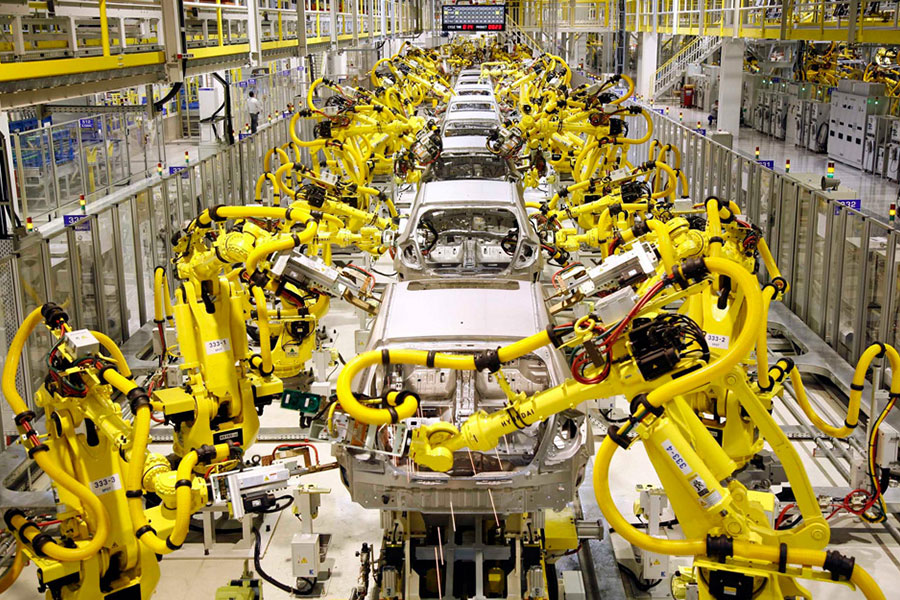
Technologies such as big data, advanced analytics, the internet of things, wearables, advanced robotics, learning machines and 3D printing are finding their way into factories.

Despite the sluggishness of change on today’s factory floors, this digital wave is slowly but surely revolutionizing manufacturing, contributing to major productivity enhancements and the emergence of innovative production paradigms that deliver more tailored and efficient solutions.

Needless to say, this transformation has profound implications for manufacturing employment, affecting everything from the size of the workforce, to the skillsets required and the locations of factories. Will this Fourth Industrial Revolution lead to a jobless future for manufacturing or will the “traditional” response of education and training allow workers to remain employable?

A factory with no employees?

According to Autodesk CEO Carl Bass, “The factory of the future will have only two employees: a man and a dog. The man will be there to feed the dog. The dog will be there to keep the man from touching the equipment.”

Indeed, from Jeremy Rifkin in the End of Work to Martin Ford in the Rise of the Robots, economists have been predicting that automation will make human jobs – at least as we know them today – obsolete in the not-too-distant future. In the United States alone, manufacturing jobs have fallen from 25% of the total in 1970 to approximately 10% today, as James H. Lee reminds us in his blog on the World Future Society website. Productivity and employment, which rose and fell in tandem until the early 2000s, now show an increasing gap, reflecting the fact that humans are being displaced by machines for many jobs.

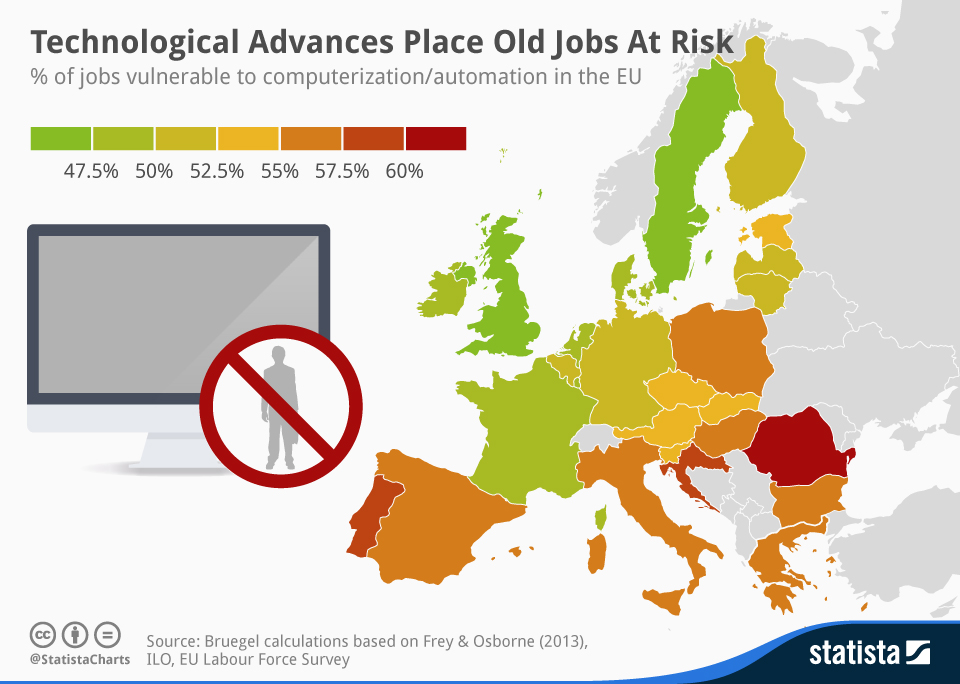
Carl Benedikt Frey and Michael A. Osborne estimate that 47% of US jobs are at risk due to “computerization”. This trend is not just a Western-centric phenomenon; according to David Rotman, “fewer people work in manufacturing today than in 1997, thanks at least in part to automation.” In fact, Foxconn announced in August 2012 that they would introduce one million of robots within three years to replace human labour.

So will this trajectory lead to a jobless future for manufacturing? Not quite – or at least not immediately. But there is no doubt that Industry 4.0 will fundamentally change the nature of manufacturing jobs.

robot jobs

A different type of manufacturing worker

Some human manufacturing tasks, such as heavy lifting, precision positioning and visual quality control, will most certainly be transferred to or supported by robots, which are not only more efficient and effective than humans, but can communicate seamlessly with one another. Human workers will have to learn to work side-by-side and in conjunction with robots. Advanced automation will increase workers’ acceptance of safe and collaborative machines with human-like physiognomies working close to them.

This, along with wearables, augmented reality and other technologies, will change the nature of traditional blue-collar work, which will become both more complex and sophisticated, but also increasingly supported by technology. It is hard to predict whether Industry 4.0 will call for more- or less-skilled workers, but it is clear that the requirements will be very different, with a greater focus on flexibility and adaptability, and potentially less on expertise and craftsmanship.

Nevertheless, robots are still imperfect, and their capabilities are not yet sufficient to fully displace humans. Furthermore, and despite constant progress, the ROI for fully automated manufacturing is still unproven, raising doubts about the speed with which Industry 4.0 is gaining traction. But the revolution is most certainly under way.

A challenging Schumpeterian transition

Throughout previous industrial revolutions, overall job creation has always been positive, but there are serious doubts that this will hold true for this fourth industrial revolution. There does seem to be a consensus that it will change all professions in ways perhaps we are yet to understand.

The other problem with looking at the future of manufacturing employment through the lens of history is that it does not take into account the exponential nature of digital technologies. The ubiquitous connectivity of people and machines, and the real-time data that define the Fourth Industrial Revolution, are governed by Moore’s law (doubling of the performance/cost ratio every 12 to 18 months), while we tend to think and react in a linear mode. In addition, this transformation is not limited to manufacturing. It potentially touches all knowledge and service jobs, thereby raising a much bigger question for society.

The risk we are facing in the near future is mass unemployment for some categories of workers, combined with lack of skills in other categories – and the political and social implications of such imbalances. Will companies, individual governments and society at large (including educational systems and social safety nets) be able to adapt quickly enough to this new paradigm and create an environment in which all can contribute? For this to happen, all parties will need to collaborate in order to invent a systemic, social and sustainable model for a better future of work.

Xavier Mesnard is a partner with A.T. Kearney where he leads the global Strategic Operations Practice. He is also a frequent commentator on Industry 4.0, sustainability, and food topics. 

Is Africa Hiding the Next Mark Zuckerberg?

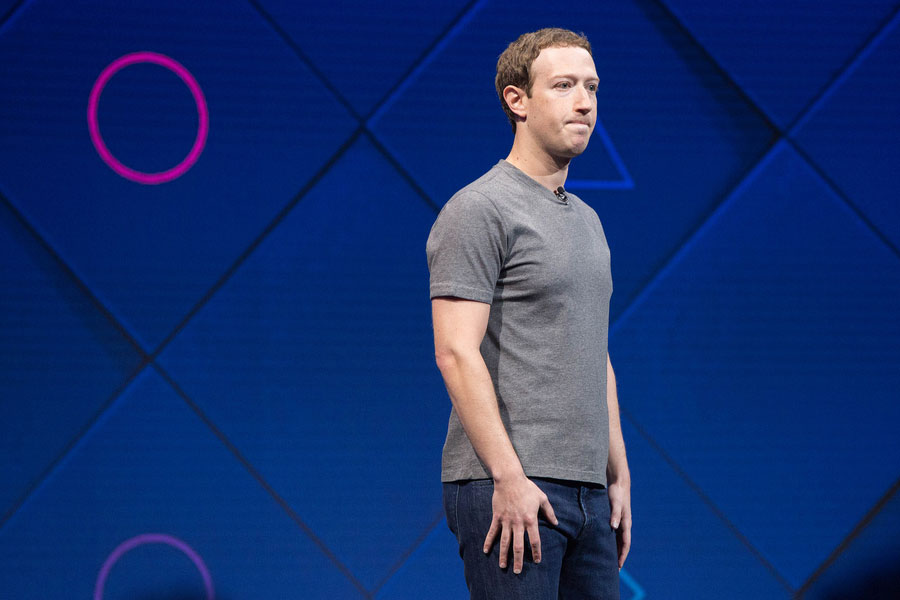
On May 14th, 1984, Mark Zuckerberg was born in Westchester County, N.Y., to a dentist and a psychiatrist. Twenty years later, he launched the initial version of “Thefacebook” out of his Harvard dorm room. In August, a decade after opening to its first members, Facebook had one billion users in a single day. Zuckerberg is undoubtedly brilliant. But what if he had been born into a working-class family in Nigeria or Kenya? Would Facebook exist? Would the social-media revolution have unfolded in the same way? It’s impossible to know. But for too long, much of the world’s talent has been shut out of the global economy. In the future, raw ability will be more important than the circumstances of one’s birth, reinforcing this fundamental truth: Brilliance and talent are evenly distributed, opportunity is not.

The starkest example of the disconnect between innate ability and opportunity can be found in Africa. With more than one billion people, approximately 60% of them under age 25, and more than 25% of young people out of work in many places, Africa is home to the world’s largest pool of untapped brainpower and talent. In the past, there was no scalable, cost-effective way to leverage and empower this human capital. But technology is quickly upending this paradigm, especially when it comes to identifying technical and quantitative aptitude.

Facebook-africa

We founded Andela to find and train the top 1% of tech talent across the continent. After six months in our software-development program, young men and women work remotely for Fortune 500 companies and startups around the world while receiving continuing training and support. Clients such as Microsoft are leveraging us to tap into Africa’s talent, integrating the continent’s best and brightest into their workforces in new ways.

‘If the digital revolution began in dorm rooms and Silicon Valley, its future will be written in Lagos, Nairobi and Johannesburg.’

As other companies adopt similar approaches, this new, meritocratic model of workforce development will expand across the world, accelerated by massive demographic shifts already under way. Indeed, while the populations of rich countries shrink and age, Africa’s overall population is expected to double by 2050. Nigeria is projected to have more than 750 million people by 2100. It’s time to stop viewing this as simply a youth bulge—it is a talent bulge. If the digital revolution began in dorm rooms and Silicon Valley, its future will be written in Lagos, Nairobi and Johannesburg. And when the next Mark Zuckerberg is born in Africa, he (or she) will have far greater access to the opportunities that enabled Mark to reach a billion people in a single day.

By Jeremy Johnson and Iyinoluwa Aboyeji. Andela.com

Davos Message from Pope: Don’t Forget the Poor at Dawn of Fourth Industrial Revolution


  • Holy Father sees “precious opportunity to build inclusive societies based on respect for human dignity, tolerance, compassion and mercy.” 
  • Also warns the dawn of the Fourth Industrial Revolution brings with it a growing sense that large-scale job loss is inevitable.

In a message read by Cardinal Peter Turkson, President of the Pontifical Council for Justice and Peace, to participants gathered at the World Economic Forum Annual Meeting, the Pontiff urged leaders “not to forget the poor” and to see the creation of jobs as an essential part of business leaders’ service to the common good alongside producing wealth and improving the world.

“The present moment offers the world a precious opportunity to guide and govern the transformations associated with the Fourth Industrial Revolution in a way that builds inclusive societies. However, it brings diminished opportunities for employment that also brings with it a responsibility among leaders to create jobs, tackle inequality and help solve society’s complex crisis,” said Pope Francis in his message.

On the risk that the Fourth Industrial revolution poses to labour markets, Pope Francis said: “Clearly there is a need to create new models of doing business that, while promoting the development of advanced technologies, are also capable of using them to create dignified work for all.”

The Pope encouraged leaders to seize the opportunities that the Fourth Industrial Revolution presents:

“The World Economic Forum can become a platform for the defence and protection of creation and for the achievement of a progress which is healthier, more human, more social and more integral.”

By Fon Mathuros WeForum.org

Real Meditation: Don’t Rise Above Your Thoughts and Emotions

Television reflects us in so many ways. The new series “Billions” starts off with a big, bad, reckless hedge-fund investor and his natural enemy, a ruthless US attorney, both meditating in their offices about how best to cheat each other. Nice use of meditation, right?

Yes sir! Meditation is here to stay. When two power-hungry TV characters, both of whom will probably cheat, lie, manipulate and even kill before the first season is over, sit silently waiting for their flashy phone alarms to go off, you gasp at how we’ve managed to corrupt yet another tool for leadership growth and illumination. Now it turns out we can use meditation to do evil unto our enemies too. Very nice indeed.

As a prospective client told me yesterday, “I know all the theory already, I just can’t get my mind to stop for a second!” The eldest of five talented brothers and founder of their rather impressive family business, he can’t rest for a second without a sibling challenging his lifelong leadership. Thus, he leads them like a tired father, too young to be so bored with parenting at only 45. Let’s call him Jerry.

In the meantime, I’m also exchanging insights on WhatsApp with the male leader of another important family office. I will call him Tom. He found meditation and spirituality a few years ago, boasting daily ritual and a very virtuous lifestyle. No alcohol, careful diet, strict discipline and lots of happiness. He tells me that, “when I feel a negative emotion I simply acknowledge it, let it go, and go back to being my very happy self without a second thought. I don’t let anger or pain hold on to me!”

Well, I beg to differ. I find something terribly amiss in this shared meditational philosophy about “rising above thoughts and emotions.” What for? Why do we need to pull ourselves up into heavenly bliss while we’re still walking our challenging lives down here in hellish civilization? Won’t we have plenty of time for delicious and obligated happiness when we die?

We seem to be stuck in this chronic inability to face, accept and actually feel our emotions. Some of us are so terrified of feeling anything that we are ready to work ourselves to our graves if it saves us from facing the demons inside our hearts. Others have invented magnificently complex intellectual beliefs to create a vertical, disdainful distance high above all that is fuzzy, wuzzy, icky and rooarrrrry inside our bodies. Meditation becomes a tool to avoid emotion rather than the vehicle to help us connect with it. And I, for one, believe it’s a huge mistake.

Tom and Jerry seem to live in the same endless world of chasing of each other, that we saw in cartoons when we were kids. Tom tries to catch Jerry and trap him inside an unwanted meditation seminar while Jerry thinks that Tom is too simple, making him run round the entire kitchen in circles. Their deeper animal selves witness this cerebral orchestration in resignation… instincts, impulses, feelings, sensations and emotions must keep silent or hide appropriately until the chase is over. But when it finally ends it will be too late, won’t it?

The road to Nirvana runs through the body, with all its stressful instincts and uncomfortable realities. Those who try to fly directly to an illumination without their bodies are fooling themselves. Proof is quite visible when you listen to Tom’s routines and logic: they’re simply too much hard work. Too strict, too self-judging, too elevated above those messy tears, greasy pizza or sex. It sounds like sad, old nuns and skinny monks renouncing their lives to hide away in a convent of ascetical self-denial. It amazes me how frequently this interpretation of spirituality is repeated around the world, in many cultures and religions – an idea that in order to find God you need to flee all pleasures in life, and rise above weakness or want in every form. Jerry can’t imagine how to achieve it. Tom spends too much energy justifying it.

If only they both stopped running, thinking, doing, or chasing long enough to let their own feelings come up into consciousness. This is, in fact, the true path to the spirit (or to God) or to deep leadership wisdom: doing nothing. Pursuing nothing. Trying nothing. Letting thoughts and emotions run around wild until you begin to see a pattern in them. And just as you identify this pattern it gently dissolves and disappears, releasing you to sink down into greater levels of simplicity, fluidity, intensity of feeling.

This is what transcending negative emotions is all about. Jerry can’t stop thinking because he is scared of feeling them. Tom can’t stop forcing ritual and discipline on himself because he too is scared of being drowned by them.

Yet when you’ve recognized and understood the patterns of emotion and sensation that tug at your body’s tissues and your mind’s neurons, you slide into a state of zero effort and total passion. Total presence in this moment is all about not having to ward off anything. No hiding away in the corner of your mind with some repetitive chant. It’s this effortless quiet that brings on deep insights about life, business, love and spirituality. The quiet that invites feelings to come as often as they need to, stay as long as they want to, grow as intense as they must.

Emotion, sensation and impulse are precisely the path to inner wisdom and total presence:  Pulsations, vibrations, tears, growls, kicks and screams that kidnap your entire body like an overpowering wave of energy. Like when you were a baby or a toddler without any notion of ridicule or judgment of yourself. Like any animal. Like everything that pushes life forward in the wild, willful overpowering passion that we call Nature.

This is meditation. All else is pure fiction. Embrace the Wild within you!

Why We Select Lousy Leaders

About this time in most political campaigns a majority of voters begin to look at who is running and say, “Is this the best we can do?”  Seriously, out of 335 million citizens, are the people up on stage really the most qualified candidates to lead the most powerful nation in the world? Are you kidding me?

There are many reasons why the most qualified people don’t ever end up running for President or even leading major business organizations. But I believe the root cause is our collective judgment falling under the hypnotic trance of leadership stereotypes.

Harvard Research reported that the book Compelling People confirms that our “fast brains” prefer leaders who are assertive, competitive, decisive and tough.  Our superficial thinking is that these leaders will protect us.  The problem is our “fast brains” are quite stupid. Our quick judgments are primarily ruled by primitive emotions and ingrained prejudices that lead us to foolish opinions. Our smart brain needs to take time to analyze facts, test claims and exercise wisdom. However, using our smart brain takes a lot of time and energy that we mostly exhaust getting through our daily lives leaving us vulnerable to bad judgment and emotional bias when it comes to choosing leaders. This is a problem. A big one.

Our bias for mistaking confidence and competitiveness for leadership starts at a very early age. A brand new research report from Harvard graduate school of education, “Leaning Out,” confirms that by high school 40% of boys and even 23% of girls believe that male political leaders are more effective than females. Both male and female teenagers prefer males on the student council. Even a majority of moms of teenage girls  believe that boys are more effective student body officers.  What?

The root of our problem is that most of us don’t understand the science of leadership. In fact most people may not know that effective leadership has become testable science. It has. For instance if we agree that excellent business leaders should be able to:

  1. create and produce profitable products and services that improve the quality of life of customers;
  2. inspire and motivate employees to consistently perform their jobs extraordinarily well;
  3. consistently produce profits (once the company is beyond the startup phase) and;
  4. conduct business in a socially responsible manner that produces benefits to communities and minimizes or eliminates harm to the environment;

then we can identify leadership factors that actually produce those results. And we have.

Our problem is that neither our business schools nor Wall Street fully agree that these four worthwhile goals of business leadership really matter. Instead they focus on things like competitive dominance and financial results. This leads companies like Volkswagen to pay their engineers to fool regulators instead of coming up with brilliant technology. It’s what led GE’s Jack Welch to spend two decades paying fines to the EPA rather than cleaning their toxic waste out of the Hudson River. It’s what enables the financial pirates known as investment bankers, who caused the needless suffering of the last recession, to pay fines but escape jail.

Likewise in politics, too many of us seem to like puffed-up roosters bellowing about going to war, building walls and solving complex problems through the shear force of their will. It is natural for us to wish the world be simpler than it is. But this wish makes it easy for really strong sounding leaders to promise to deliver what we emotionally wish were true. It’s simple. When we feel overwhelmed we are easily suckered.

Strong but stupid leadership has created the world we currently live in. In the 1990s we thought all war was over and perpetual prosperity could be engineered by Alan Greenspan. Instead we have begun to recycle the geopolitical problems of the last thousand years and the ugliness of the unrestrained self-interest of the Gilded Age of 100 years ago. And we will continue to recycle our problems at even more extreme levels unless we understand the leadership qualities that will produce a world that works for everyone.

The actual science of leadership is based on a meta-analysis of what creates sustainable abundance confirms this:

  • Hard power, which is characterized by competitiveness, aggressiveness, decisiveness, single-mindedness and self-interest, is primarily effective at achieving short-term, easy-to-measure goals.  This isn’t to say it’s useless, only to say it is an inadequate way to run a complex organization or the most powerful country on earth.
  • Soft power, which is characterized by collaboration, teamwork, empathy and systems thinking, works well in complex environments where knowledge and information is widely distributed.  However, organizations led only by soft power tend to be indecisive, slow and uncompetitive.

The answer of course is the synthesis between hard and soft power. It is the third way. It capitalizes on the goal-focus of hard power and social intelligence of soft power. Is the basis for something I called gender synergy. It’s no secret that most males favor hard power and most females exhibit soft power strengths. We need both.

The challenge we face is that we need to raise the new generation of SMART Power leaders pronto. The world economy continues to shake, new kinds of wars and medieval violence assault our peace, and businesses exhaust their employees, exploit the environment and fail all too quickly in the face of agile competitors.

Of course both men and women can learn the skills of SMART Power. I am focusing on developing women leaders because women are listening. Brand-new research reported in the book Broad Influence confirms that when any leadership group, whether it’s top executives, Boards of Directors or the U.S. Senate, reaches a critical mass of between 20% and 30% women, the group becomes much more effective in achieving its goals. This phenomenon is being repeated all over the world. I believe more women in leadership is the most powerful trend that will revolutionize our future and get us out of the spin cycle created by the leaders who are currently in charge.

We need to celebrate it and accelerate it. You can help by calling out bad leadership. You can put the name “hard power” on shortsighted, blindly aggressive leaders. You can support socially intelligent, soft power leaders by helping them become SMART using the tools of goal setting and accountability. You can change the future right now, right where you are.

5 Tips For Leaders Who Are Nursing On The Go

For many new moms, the end of maternity leave induces anxiety. I know this from experience, having returned to work twice in the past three years after maternity leave.

But the challenges of returning from maternity leave are compounded when a nursing mother is sent on a business trip and has to leave her child not only for the day, but also one or more nights.

As a business leader, you’re required by law to support nursing employees, but advocating for them should go beyond compliance. It’s about valuing your employees so they enjoy coming to work every day. And as important as that support is in the office, it’s even more important for nursing women who have the added stress of being on the road.

Fortunately, there are several simple things employers can do to support new nursing mothers — and retain their top talent.

Support Starts at the Top

I recently got the chance to sit down with Sheila Janakos. She’s a highly trained certified lactation consultant and the owner of Healthy Horizons, a breastfeeding center and corporate lactation service provider. She’s seen firsthand the end result of supporting breastfeeding moms in the workplace.

“One of the largest corporate accounts I work with, a leader in the tech industry, stated that he never imagined what an impact it was that his company offered new moms prenatal and postpartum education, pump rooms, and support on working and breastfeeding,” said Janakos. “His employees were more likely to return to the workforce, and employee satisfaction hit an all-time high.”

The result was something her client hadn’t banked on. “He just thought he was doing the right thing by helping his employees combine working and breastfeeding,” she said. “Never did he imagine it was giving the company a competitive edge on talent retention.”

Here are five simple ways your company can support working mothers and retain top talent when they’re out in the field:

1. Build in Time for Pumping

New moms need to pump as often as every three hours, and on the road, it can be hard to find a spot that’s clean and private. Missing a pumping session can lead to decreased supply, engorgement, leaking, and even mastitis, a breast infection with flu-like symptoms.

Business trips are often jam-packed with conference sessions, meetings, and networking events. Of course, you want to get as much out of the trip as possible — and that’s understandable. It is, however, unreasonable to ask a nursing mom to block off every minute of the day for client meetings.

If you’re scheduling travel for a nursing mom, build breaks into her schedule so she has time to pump.

2. Be Cognizant of Lodging Needs

It’s easier for nursing mothers to stay at a hotel near the event they’re attending or — if at all possible — in the same hotel. This gives working moms easy access to the privacy of their hotel room, where they can easily pump and store the milk during the event. In addition, it’s important to make sure the room has a minifridge so the milk doesn’t spoil.

3. Get the Milk Home to Baby

If it’s a short trip, your nursing employee can likely take the milk home with her when she leaves — as long as she has enough milk stored at home to cover the baby’s needs for the duration of her trip. For longer trips or for moms who don’t have adequate reserves at home, it’s a good idea to arrange and pay to ship the milk home. Give your employee your FedEx number, a cooler, and dry ice, which will be used to ship the milk.

Also, be flexible on the length of the trip. If the employee requests to go for a shorter period of time, try to accommodate.

4. Book Direct Flights

Breast milk needs to be stored at specific temperatures, and keeping it cold while traveling can be challenging. One way to support your nursing employees is to book direct flights whenever possible. While this may seem like something small, the benefits are great to the mother: You’re providing her with a better chance to get her milk home safely, possibly reducing the number of times she needs to pump on the road and allowing her to see her little one sooner. If you can’t book direct flights, get her a day pass or membership to an airport lounge such as the Admirals Club. This will at least give her a nice place to pump and get additional ice for her cooler.

5. Offer Resources

It’s your job to understand the value of breastfeeding and support your employees when they leave to pump. Keep in mind how challenging it must be to leave your little one on a business trip. Now, image having to do so without any support from your team.

Providing informational resources from experts such as the U.S. Department of Health & Human Services, the Centers for Disease Control and Prevention, or the International Lactation Consultant Association when a new mom comes back from maternity leave lets her know that she’s supported.

The simple act of caring speaks volumes, but to go above and beyond, you can offer tangible resources, too. Create a “welcome back” kit for employees with a soft cooler to store milk, and fill it with snacks, water bottles, and leak pads she can use on their business trips. You can even brand the items to make them more personal from the company.

Going the extra mile to support nursing employees in the field will make a big difference for not only them, but also your company. “The moms I work with sing the praises of these supportive and generous companies and feel a loyalty that is priceless,” said Janakos. “Who wouldn’t want to be a part of a company that cares about you and your baby’s health and well-being?”

As a nursing mom who has had more than 70 work-related flights while nursing two children over the past three years, I can say that having American Airlines support me as a nursing mom has kept me with the company. The returns are tangible. Having team support while staffing booths at conferences, staying in the event hotel, keeping trips to four days or less so I could carry the milk home with me on a direct flight, and having the support of the company behind me has made the difference.

Had a pleasant or nasty experience trying to nurse on the go? Let us know in the comments below.

Aleda Schaffer is a strategic partnerships manager at American Airlines. Her team is focused on helping businesses through Business Extra, a complimentary business travel rewards and incentives program designed to help small and mid-sized companies reduce their travel costs.


Real Meditation: Don’t Rise Above Your Thoughts and Emotions

Television reflects us in so many ways. The new series “Billions” starts off with a big, bad, reckless hedge-fund investor and his natural enemy, a ruthless US attorney, both meditating in their offices about how best to cheat each other. Nice use of meditation, right?

Yes sir! Meditation is here to stay. When two power-hungry TV characters, both of whom will probably cheat, lie, manipulate and even kill before the first season is over, sit silently waiting for their flashy phone alarms to go off, you gasp at how we’ve managed to corrupt yet another tool for leadership growth and illumination. Now it turns out we can use meditation to do evil unto our enemies too. Very nice indeed.

As a prospective client told me yesterday, “I know all the theory already, I just can’t get my mind to stop for a second!” The eldest of five talented brothers and founder of their rather impressive family business, he can’t rest for a second without a sibling challenging his lifelong leadership. Thus, he leads them like a tired father, too young to be so bored with parenting at only 45. Let’s call him Jerry.

In the meantime, I’m also exchanging insights on WhatsApp with the male leader of another important family office. I will call him Tom. He found meditation and spirituality a few years ago, boasting daily ritual and a very virtuous lifestyle. No alcohol, careful diet, strict discipline and lots of happiness. He tells me that, “when I feel a negative emotion I simply acknowledge it, let it go, and go back to being my very happy self without a second thought. I don’t let anger or pain hold on to me!”

Well, I beg to differ. I find something terribly amiss in this shared meditational philosophy about “rising above thoughts and emotions.” What for? Why do we need to pull ourselves up into heavenly bliss while we’re still walking our challenging lives down here in hellish civilization? Won’t we have plenty of time for delicious and obligated happiness when we die?

We seem to be stuck in this chronic inability to face, accept and actually feel our emotions. Some of us are so terrified of feeling anything that we are ready to work ourselves to our graves if it saves us from facing the demons inside our hearts. Others have invented magnificently complex intellectual beliefs to create a vertical, disdainful distance high above all that is fuzzy, wuzzy, icky and rooarrrrry inside our bodies. Meditation becomes a tool to avoid emotion rather than the vehicle to help us connect with it. And I, for one, believe it’s a huge mistake.

Tom and Jerry seem to live in the same endless world of chasing of each other, that we saw in cartoons when we were kids. Tom tries to catch Jerry and trap him inside an unwanted meditation seminar while Jerry thinks that Tom is too simple, making him run round the entire kitchen in circles. Their deeper animal selves witness this cerebral orchestration in resignation… instincts, impulses, feelings, sensations and emotions must keep silent or hide appropriately until the chase is over. But when it finally ends it will be too late, won’t it?

The road to Nirvana runs through the body, with all its stressful instincts and uncomfortable realities. Those who try to fly directly to an illumination without their bodies are fooling themselves. Proof is quite visible when you listen to Tom’s routines and logic: they’re simply too much hard work. Too strict, too self-judging, too elevated above those messy tears, greasy pizza or sex. It sounds like sad, old nuns and skinny monks renouncing their lives to hide away in a convent of ascetical self-denial. It amazes me how frequently this interpretation of spirituality is repeated around the world, in many cultures and religions – an idea that in order to find God you need to flee all pleasures in life, and rise above weakness or want in every form. Jerry can’t imagine how to achieve it. Tom spends too much energy justifying it.

If only they both stopped running, thinking, doing, or chasing long enough to let their own feelings come up into consciousness. This is, in fact, the true path to the spirit (or to God) or to deep leadership wisdom: doing nothing. Pursuing nothing. Trying nothing. Letting thoughts and emotions run around wild until you begin to see a pattern in them. And just as you identify this pattern it gently dissolves and disappears, releasing you to sink down into greater levels of simplicity, fluidity, intensity of feeling.

This is what transcending negative emotions is all about. Jerry can’t stop thinking because he is scared of feeling them. Tom can’t stop forcing ritual and discipline on himself because he too is scared of being drowned by them.

Yet when you’ve recognized and understood the patterns of emotion and sensation that tug at your body’s tissues and your mind’s neurons, you slide into a state of zero effort and total passion. Total presence in this moment is all about not having to ward off anything. No hiding away in the corner of your mind with some repetitive chant. It’s this effortless quiet that brings on deep insights about life, business, love and spirituality. The quiet that invites feelings to come as often as they need to, stay as long as they want to, grow as intense as they must.

Emotion, sensation and impulse are precisely the path to inner wisdom and total presence:  Pulsations, vibrations, tears, growls, kicks and screams that kidnap your entire body like an overpowering wave of energy. Like when you were a baby or a toddler without any notion of ridicule or judgment of yourself. Like any animal. Like everything that pushes life forward in the wild, willful overpowering passion that we call Nature.

This is meditation. All else is pure fiction. Embrace the Wild within you!

Martin Luther King: During Tough Times Your Response Can be Awesome

Martin Luther King, Jr. had a dream. He wanted to change things, and he did. He kept dreaming and sharing his dream. Not just his dream, but the dreams of others too. A great leader will capture the mood and sentiment of a time and make it vocal, explaining a simple concept again and again until it becomes a reality. King had the perseverance to keep going through tough times, yet he didn’t lose sight of his goal of a non-racial society. Instead of spreading the hate he saw around him, he spread the love. As leaders, we all have a choice in how we respond to tough situations. Your response can be awesome too.

King was an American Baptist minister, activist, humanitarian, and leader in the African-American Civil Rights Movement, best known for his role in the advancement of civil rights using nonviolent civil disobedience based on his Christian beliefs.

King saw his father’s proud and unafraid protests in relation to segregation, such as Martin, Sr., refusing to listen to a traffic policeman after being referred to as “boy” or stalking out of a store with his son when being told by a shoe clerk that they would have to move to the rear to be served.

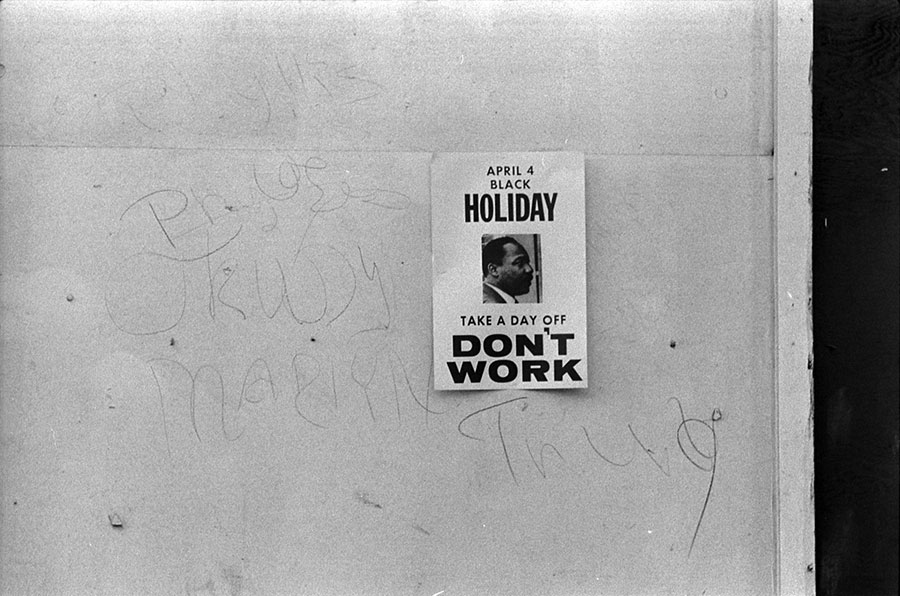
Sign from 1969 promoting a holiday to honor the anniversary of the assassination of Martin Luther King, Jr.

Sign from 1969 promoting a holiday to honor the anniversary of the assassination of Martin Luther King.


When King was a child, he befriended a white boy whose father owned a business near his family’s home. When the boys were 6, they attended different schools, with King attending a segregated school for African-Americans. King then lost his friend because the child’s father no longer wanted them to play together.

He became a civil rights activist early in his career. He led the 1955 Montgomery Bus Boycott and helped found the Southern Christian Leadership Conference (SCLC) in 1957, serving as its first president. With the SCLC, King led an unsuccessful 1962 struggle against segregation in Albany, Georgia (the Albany Movement), and helped organize the 1963 nonviolent protests in Birmingham, Alabama. King also helped to organize the 1963 March on Washington, where he delivered his famous “I Have a Dream” speech. There, he established his reputation as one of the greatest orators in American history.

Inspired by Mahatma Gandhi’s success with nonviolent activism, King had “for a long time … wanted to take a trip to India”. With assistance from Harris Wofford, the American Friends Service Committee, and other supporters, he was able to fund the journey in April 1959. The trip to India affected King, deepening his understanding of nonviolent resistance and his commitment to America’s struggle for civil rights. In a radio address made during his final evening in India, King reflected, “Since being in India, I am more convinced than ever before that the method of nonviolent resistance is the most potent weapon available to oppressed people in their struggle for justice and human dignity”.

The civil rights march from Selma to Montgomery, Alabama in 1965.

The civil rights march from Selma to Montgomery, Alabama in 1965.


On October 14, 1964, King received the Nobel Peace Prize for combating racial inequality through nonviolence. In 1965, he helped to organize the Selma to Montgomery marches, and the following year he took the movement north to Chicago to work on segregated housing. In the final years of his life, King expanded his focus to include poverty and speak against the Vietnam War, alienating many of his liberal allies with a 1967 speech titled “Beyond Vietnam”.

In 1968, King was planning a national occupation of Washington, D.C., to be called the Poor People’s Campaign, when he was assassinated on April 4 in Memphis, Tennessee. His death was followed by riots in many U.S. cities. Martin Luther King Jr. Day is celebrated each year on the third Monday of January to mark his birthday on January 15th.

Ronald Reagan and Coretta Scott King at the Martin Luther King, Jr. Day signing ceremony.

Ronald Reagan and Coretta Scott King at the Martin Luther King, Jr. Day signing ceremony.


Emotional Intelligence is the New IQ

Emotional intelligence helps us manage stress, it is vital for enhanced co-operation and teamwork, and it helps us to learn in relationships. Studies have found that 67% of all competencies deemed essential for high performance are related to emotional intelligence and leaders who score higher in emotional intelligence are more likely to be highly profitable in business. The Brighton School of Business and Management recently compiled the following infographic on why emotional intelligence is the new IQ.

Emotional-Intelligence