Why Instinct is Important for Leadership

What do you feel right now? Where do you feel it in your body? Can you score your body tension between one and ten? These are questions I ask clients every day. At first, they answer in monosyllables, like “fine” or “uh?” Today’s CEOs think they are good leaders. But if they are caught off guard by questions like these, it means their leadership is more theoretical than real.

We know that instincts are important to leadership. It’s an intuitive truth that we’ve read about forever, but how can we follow our instincts if we don’t know how our body feels? And how could we, in a society that does nothing to teach us the importance of looking inside ourselves from time to time?

Instincts are felt as bodily sensations. Your gut tightens up with a contraction against a certain person or situation. Your skin may crawl, as the expression goes, or it may constrict in a way that makes your hair go up in spikes. Our breath is also quick to change in the face of unexpected events, and our heart may miss a beat or beat faster than usual. All of these cues tell us that our body is reacting to something right here, right now – something that is critical to our present survival or our future progress. In a culture that medicates us to subdue every inkling of discomfort or pain, body reactions can go unnoticed.

I’m presently thinking about this because we separated a two year old foal from his brother last Sunday. Both horses had been separated from their mothers about six months ago, and after a couple of very stressed days, had settled into the new routine of sharing a big box like flatmates. As a new baby came to the moment of separation from its mother, my foal was taken to an adult horse box to live alone for the first time in his life.

Suddenly alone in this new space, he is acutely sensitive to every little noise or sound happening around him. If an airplane goes by, he pricks his ears up and tenses his eyes until the engines stop disturbing the quiet of the fields. If his caretakers wheel a barrow across the lawn, he again reacts nervously. His entire body posture and his breathing immediately betray his level of tension. It rises and falls with the smallest change in the environment. So my question is: shouldn’t we be doing the same?

Nothing is happening to this horse that wasn’t going on before. The difference now is that he is not distracted, or comforted, by the company of another horse. And while their is no real danger to his survival, his most feral instincts are completely alert, just in case. Watching him I realized how humans should be paying a lot more attention to the sounds, changes and tiny cues triggering around them in order to survive and thrive. Nobody’s survival is more threatened than that of a CEO.

But our CEOs are busy analyzing market trends, or looking at multiple screens with data, or focusing on complex negotiations all the time. Rarely are they simply noticing how their own body is reacting underneath all those intelligent and strategic words.

A client of mine, Ryan, for example, came out to get some feedback from our horses last week. He went to the stable door to pet one of the younger mares. His right hand was held up front, petting her on the head, while his left shoulder kept yanking back every time she moved her head. If the mare had been his boss, or a client, or even his team, Ryan would have been forcing himself to keep up a strategy that his body was very uncomfortable with. Ryan’s focus on the content of his own words, the words he was getting back and the mental plans he was trying to materialize was making him blind to his body’s instincts.

When I pointed out the yanking shoulder, I helped Ryan step back to a distance where his body stopped shrinking away. Then I asked him to think of how he could advance in a way that felt comfortable, and I suggested protecting his space with his left hand at all times. A few minutes later he was hugging the mare over the fence. Ryan was forgetting to protect his own position while advancing, with the mare.

His negotiating position was unstable and thus his rivals could take advantage of him. His attempts at making his own team feel safe were not successful because his team sensed his own yanking back in small details: a dumb comment here, a bad joke there, a tricky email, a way of phrasing instructions that betrayed a feeling of discomfort.

Horses and all mammals in general help us focus back on our instincts, body feelings or reflexes. There is an age-old wisdom to them that protects us even if we are distracted thinking of something else. Being mindful of all these little warning signs and alerts is critical to incarnate strong leadership.

So ask yourself these questions every few hours or every time you remember to: what do you feel? Where do you feel it in your body? What level is your tension now? By turning your attention to your body a few times a day you may begin to notice your yanking shoulder, tightening guts and crawling skin. What’s more, you’ll begin to realize there is a connection between what your body expresses and the business challenges you’re facing

This is what meditation is all about. And it’s way more useful than forcing yourself to sit in silence for twenty minutes in the morning. Trust me. Effective leadership is about “right here right now”… all day long!


 

Engaging the Quiet Chiefs

When I took over Lucent’s Government Operations, I was confident in our ability to turn around the unit in part based on many great suggestions made by a group of strong, vocal employees in Washington, DC and Greensboro, NC. By and large, these employees were visible and forceful in sharing their views of what it would take to regain customer trust.

But it was also a third group of employees located in Whippany, NJ who quietly played a big role in our comeback. This team worked for Bell Labs.

Today, people marvel at the innovation coming out of Silicon Valley from firms like Google and Apple, companies that top the most admired lists. Not long ago, the hallmark for innovation resided on the opposite coast, in Murray Hill, NJ at the headquarters of Bell Laboratories. Born out of the original American Telephone & Telegraph (AT&T) company in 1925, researchers working at Bell Labs are credited with the development of the transistor, the laser, the UNIX operating system, and information theory itself. Eight Nobel Prizes have been awarded for work completed at Bell Labs.

The good news for me was Bell Labs had a long history, and a dedicated unit, focused on providing advanced technology to the US government.

Walking into my new assignment, I had clear ideas about how to increase the productivity of my sales force. Having “grown up” in a sales environment I was accustomed to working with a gregarious peer group of people who made a living by talking. For example, I was an early adopter of an “open office” approach years earlier at AT&T that was highlighted in the Harvard Business Review. Creating space that increased conversations was one of the goals. It worked well.

But the first time I walked into Bell Labs, I knew I was in a different space. This was a place optimized for introverts.

I immediately noticed the large number of small offices lined up off the main corridors. And I noticed the silence. I learned about the many different ways Bell Labs employees created and reinforced viral engagement, helping these brilliant thinkers bring out their very best. I saw that big team meetings were few and far between and that email was often the preferred communication tool, even between colleagues in adjoining offices. Many chose to enjoy lunch breaks without leaving their offices, or when the weather permitted, by taking walks around the building grounds, alone. Perhaps my biggest lesson was that viral engagement among introverts is more subtle, but just as impactful, as viral engagement among extroverts.

How can you bring out the very best from the third to half of your team who are introverts?
Here are my top takeaways:

Lead time – can create better quality
Small groups – can enable more contribution than large groups
Written communication – allows for thoughtful responses
Directed questions – clearly identify expectations
Team building – needs to be structured so it works for everyone
Office space – can be configured to support creativity
Technology –improves communication, via social media and on-line chat tools
Diversity – of approach can be important
Individual challenges – sometimes work best
Anonymity – can be a good thing

Chiefs at all levels in Bell Labs connected what they did to who they were, and management understood what it took to support a primarily introverted culture. The results were amazing. Our government unit’s dramatic growth was fueled by Bell Labs innovations.

Subsequent to my government assignment, I came to read Quiet: The Power of Introverts in a World That Can’t Stop Talking by Susan Cain. It is a must-read for anyone committed to engaging any team.

In addition to a deep dive into the world of introverts, Susan offers the following central insight “[We] would be better off if we appreciated that not everyone aspires to be a leader in the conventional sense of the word—that some people wish to fit harmoniously into the group, and others to be independent of it. Often the most highly creative people are in the latter category.”

With introvert estimates as high as 50% of some groups, it’s high time we all learn how to better engage the quiet Chiefs. Sustainable growth depends on it.


Are You Becoming Obsolete?

Almost everything you have ever been taught about business leadership has changed. The ridiculous belief that the primary purpose of business is to make money has become a catastrophic mindset.

Ironically, it’s not only catastrophic for the planet but also for business success. That’s because profit-centric leadership actually kills creativity, innovation and employee effort.

Think about it…all the companies we admire are up to more than making money. Don’t get me wrong, making money is essential to having a thriving business. But making money is a means to a greater end of doing things that improve the quality of life for customers, employees and our communities. And the only people who don’t understand that are the idiot dinosaurs that run Wall Street and the world financial markets.

Recently I led a panel discussion for the Agents of Change conference. The panelists were senior executives from three companies. Omada Health, Imperfect Produce, and Active Networks. The conference which was organized by one of my all-time favorite CEOs, Kristin Carroll, and was focused on creating innovative ways of vastly improving public health. All three of these companies are either public or investor-owned. They have harnessed the disciplines of capitalism and the financial rewards that go with it to come up with disruptively innovative solutions to serious public health problems. People used to call these kinds of businesses social enterprise. But that is an obsolete way of thinking.

Even the term social enterprise engenders an image of well-intended 20-something’s experimenting with soft business ideas trying to make a little money by doing a little good.
But that’s not what this new generation of innovative, life–improving businesses is about.

Solving the biggest problems of our age is our greatest economic opportunity.

These problems stimulate game changing innovation. And the disciplines of capitalism create sources of funding that enable these companies to scale up and do more good for more people.

Let’s start with Kristin. She is CEO of Rescue. The are a fast growing for-profit marketing agency that makes money by using the science of behavior change to motivate youth to quit smoking or eating junk food by making healthy habits cool. It’s kind of magical. They work with street teams, create gnarly websites and “fake/ironic brands’’ to create social energy for healthy choices. It works and the deal is this…it is fun to go to work each morning at Rescue.

Omada Health uses the science of human behavioral change to help diabetics make lifestyle and diet changes necessary to reverse the disease. They combine live expert coaches, with education, training and incentives to get measurable results that are saving lives. Big companies and health plans gladly pay for the their proven solution. They raised $48 million in venture funding a few months ago.

Imperfect Produce improves the diets of subscribers and the undernourished by buying nutritiously perfect but visibly ugly fruits and vegetables at 50% off from the growers and then sells them for a tidy profit. Their business model ensures that the nearly 40% of imperfect produce does not go to waste, but rather elevates the public health of the communities they are serving. They have both a retail business and a grant-based revenue stream to bring delicious but unfortunate looking produce to the poor. They even teach the ‘burger & fries eating population’ how to prepare and cook real food. Will it work? It already is. After launching eight months ago they have built a trickle of cash into a rising river of profits. (That’s more than you can say for Twitter!)

Active Networks is a technology company that generates about $500 million in revenue by helping people get active. They do this by having a turnkey solution for anyone who wants to create a 5K run, a tennis tournament, a surf contest, start of biking club, youth soccer league or any other “active” event that requires registration, collecting money and many other organizational needs. The founder of Active discovered that one reason that prevented people from organizing sports and exercise related activities and leagues was simply the tedium of all the “back room” work that needs to be done when you organize people. Active Networks makes it easy to have fun and get healthy. That’s their mission.

I don’t call companies like these social enterprises. Rather, they are Purpose-Driven companies. They make money on purpose!

I know, that sounds a little cute but it’s more than that. When Stephen Covey and I started the Covey Leadership Center there was no demand for leadership training mixed with personal development. But our purpose was to help people live and work so that their lives were meaningful, successful and enjoyable. Our purpose is what drove our prosperity.

Purpose-driven enterprise is no longer the exception. Just last week I helped a CEO make the business case to his 400 top leaders for full-on strategic focus and rebranding of his global enterprise to be purpose driven. What is impressive is that he is sincere, smart, and totally committed to drive growth by turning human values into value. The announcement was a huge success. It is what everybody wants to be a part of and it is driven by an overwhelming megatrend toward communitarian values. Consider this…

Women, Millennial’s and Minorities are changing everything. The rising power of women both in terms of economic decision-making and business and institutional leadership is changing business decision making and the locus of economic power.

The rapid rise of women in government and nonprofit leadership is accelerating momentum in the elevation of women in every size of business. (see: Broad Influence, Jay Newton–Small) For the first time in history more new businesses are being formed by women than men. Large financial institutions, such as Goldman Sachs, have created investment divisions focused on financing women-led enterprises. This is not a fad. Forty percent of the students at the top 12 MBA schools are women. The rising influence of women in leadership is being accompanied by a mass influx of millennial’s into the workforce. According to research from University of North Carolina, millennial’s will make up 46% of the US workforce within four years. Additionally, there is a rising tide of ethnic minorities who, in the coming decades, will likely become ethnic majorities. Research shows that women, millennial’s and ethnic minorities all share stronger community values and concerns than the traditional individualism so prominent among baby boomers.
This new mindset that embraces cognitive diversity and a shared responsibility to build prosperous and sustainable communities will have big impacts on what businesses need to do to be successful. Neither the marketplace nor the workplace will ever be the same.

As for me, I am pretty much out of my mind with joy. I’ve been waiting for decades for business leaders who were SMART enough to see the economic value in solving problems that really matter to people.

As I have said to many students who were just starting their career…“To do something truly great for humanity you don’t need to take a vow of poverty but simply a vow of purpose.”

So how about you? Are you investing your brains and energy into meaningful work? If not, what enterprise do you most admire? What would it take for you to take your talent to the next level?
What would it take to put a thoughtful plan together so you can work with the people you want to work with, doing work that brings you joy and meaning?

And please remember this doesn’t have to be earth shattering. Brent, a young purpose-driven surfer entrepreneur has a tiny surf shop about five minutes from my home. The main way he makes money is running surf camps for kids. In surf lingo they are called ‘groms.’ Of course he teaches these 5 to 10 year olds how to surf. And he does so much more. He intentionally teaches them, courage, self-discipline, good manners, supporting others, optimism and determination. He is really running a character camp. Some of his kids have gone on to be professionally sponsored surfers. High-performance and high character really does go together.

The old mindset is dying. It will not work in a world of 7½ billion people. The new mindset is already taking over and it’s great. Join the future!


Timberland Just Planted its two-Millionth Tree

Ethical Corporation recently had the chance to ask Timberland President, Stewart Whitney about his role at Timberland, the upcoming Responsible Business Summit USA 2016, and his ideas on the Sustainable Development Goals.

Ethical Corporation: What’s your current role and what are your responsibilities?

As president of Timberland, my role really boils down to being a steward for the brand. That means setting and delivering on aggressive growth strategies for the brand – we’re targeting $3.1B in global revenues by 2019. It means ensuring that we connect with consumers, meeting and exceeding their expectations for great products and great brand experiences. And perhaps most relevant for this audience, it means always living up to our values as a responsible corporate citizen. That has long been in our DNA, and is non-negotiable for Timberland. It’s how we’ve built into the brand we are today, and is critical to driving continued growth in the future.

What projects are you most proud of in your current role?

What makes me most proud is that we’ve be able to maintain our focus on “doing well and doing by VF Corporation, many of us wondered, “will Timberland still be Timberland?” I’m proud to say the answer has been a resounding yes – a testament to the true passion for CSR that lies within the Timberland community, as well as VF’s own commitment to sustainability.

In terms of specific examples, there are many, but a few really stand out for me. In our efforts to protect and enhance the outdoors, one key area of focus for Timberland is tree planting. This past year we planted our two millionth tree in China’s Horqin Desert. I headed up Timberland Asia for six years prior to taking over as brand president, so I’ve been very closely involved in those efforts and was extremely proud to hit that milestone. It has really had a huge, positive impact in that region. Aside from tree planting, we’ve made major strides in our commitment to making products responsibly, steadily increasing our use of recycled, organic and renewable (ROR) materials over time.

In fact, in 2014 79 percent of Timberland footwear incorporated ROR materials. And finally, I’d point to our ethic of service. Every year, Timberland employees are given up to 40 hours of paid time to volunteer in their communities – whether it’s through company-sponsored events like our signature Serv-a-palooza, or on their own. We’ve served more than one million hours to date, and I’m incredibly proud to be part of a community where service is so central to who we are, as employees and as engaged citizens.

The broad umbrella of sustainability has changed a lot over the years, how do you see corporate sustainability evolving over the next 5 years?

Over the past few years here at Timberland, we’ve made great strides in sustainability not being an “add-on” function, but rather something that is truly embedded in our business model. Literally every department, every employee, has sustainability objectives woven into their performance plan. It’s not just the CSR department; everyone is accountable. I see more and more companies evolving toward this model, and I believe it will be critical for driving meaningful progress in the future.

Another key area I see is collaboration. There are so many opportunities for us to partner with like-minded organizations to arrive at innovative solutions to the challenges we face. Not only within our own industries, but across industries, public and private sectors, etc.

Earlier this year we partnered with a tire manufacturer named Omni United to introduce Timberland Tires. While this was surprising to many at first blush – Timberland in the tire business? – when you pull back the layers it makes perfect sense.

We’re constantly looking for recycled rubber that meets our environmental and performance standards, while Omni seeks new after-life uses for its tires. Timberland Tires are purposely designed for a second life; when their road life is complete, they’re recycled into the outsoles of Timberland shoes. In essence, two companies collaborating across industries to create a more sustainable lifecycle for rubber. I see lots more collaboration like this happening over the next five years.

And finally, there’s the consumer. Consumers are savvier than ever – they have information at their fingertips 24/7, they’re engaged in the world around them and they want to do business with brands and companies they can feel good about. Because of this, I believe consumers will play an increasingly important role in driving sustainability in the coming years.

There are 17 Sustainable Development Goals (SDGs), how are you embedding the Goals into your strategy? How was this decided?

Timberland has had CSR strategies and goals in place for decades, and those strategies continue to serve as our beacon for progress as it relates to sustainability. That said, when the SDGs were published last year, we took a close look to ensure that our efforts are aligned with what others are focusing on. I’m pleased to report that every one of our sustainability goals maps to at least one SDG goal, so we’re all working toward the same results when it comes to creating a more sustainable world.

You are participating in the Responsible Business Summit USA next April, could you tell us why these types of gatherings are so important for the sustainability community?

There is so much exciting progress being made in the world of sustainability, but many of us also face the realities of running large-scale global businesses. Events like these provide the opportunity to take a day or two to really focus on sustainability as a key pillar of our businesses, to learn from others and make important connections with like-minded companies and leaders. As I mentioned before, I believe collaboration, across industries and the public/private sector, will be key to driving innovation in sustainability over the next several years. Events like this play a crucial role in that.

And finally, what are you most looking forward to at next year’s Responsible Business Summit USA?

I spend a lot of time meeting with customers, suppliers and other business partners. I’m looking forward to the opportunity to connect with other leaders in sustainability, to hear what others are doing, share some of what we’re doing and hopefully walk away with some new insights we can apply as we continue on our path to being the largest, most sustainable outdoor lifestyle brand on Earth.

This story first appeared on Ethical Corporation 

How to Perfect the art of Passive Conflict

There is one fundamental fact of leadership that we modern, performance-obsessed executives struggle with: repetition of ‘wrongful’ patterns. However, the path to perfection runs through every instance of imperfection.

2016 has begun with an explosion of political controversy in Spain. The Catalan region finally appointed its new governor, who swears they will become an independent nation from Spain in 18 months time. Meanwhile, the entire country has agonized as several ruling parties fight about putting together the needed majority of votes to choose a new president, or repeat the elections. Social networks and newspapers sizzle with anger, indignation, disgust and all kinds of violent, though strictly verbal, confrontations.

You could say we are repeating the same sanguinary conflicts that drove us to our civil war in 1936. Only we’ve brought it down a notch: from gunshots to verbal insults, from bomb explosions to economic manipulations, from exiles and murders to political humiliations. It feels just as horrible, but people aren’t dying.

As I turned in my last article to Grant, the editor of Real Leaders, he shared how uncertain and painful the current situation in South Africa is these days. Racism seems to be peaking again. On the other side of the world the United States has recently experienced several episodes of outrage at police brutality with Afro-Americans. And circling back to Europe, we’ve seen Germans and Dutch citizens coming out on the street to express their opposition to immigration policies concerning war refugees. It feels like every region of the planet is repeating their worse and most gruesome historic episodes. And this scares us. As it should.

Maybe the world is going to hell. And maybe we’re only repeating what happened in the past in order to finally resolve it.

We release old, trapped emotions on all sides of conflicts, wars, persecutions, genocides and all those truly awful things we humans have been doing to each other for the last seven thousand years. My hopeful guess is that all this verbal violence will not go further than a few isolated incidents of physical brutality. By reliving it we may appreciate how much our parents and grandparents paid to help us grow into more sophisticated people, understanding and supportive of the subtle differences found in others.

Because having gone through two world wars and hundreds, if not thousands, of awfully destructive conflicts on local levels. We have grown as a species. We have understood that there are two sides to every story. We have heard our families cry for those who died finding food or safety for their loved ones. We have written books and made films that interpreted what was going on. We attributed evil motivations to enemies who were just as scared and lost as we were at the time. We’ve read articles and watched documentaries about how very much it hurt them too.

Around the globe in many, many families, we have carried the victims’ angry impotence and the conquerors’ awful guilt.

Now we know what happens when you resort to violence. Now we know that nobody wins and everybody loses. Even if we forget from time to time.

Grant and I attended the World Summit of Nobel Peace Laureates here in Barcelona on the exact day of the terrorist attack in Paris last November. I remember sitting in the beautiful halls of a centric historical building that Friday, listening to wise, articulate people demand peace. “But peace can’t come without a lot of painful emotional release… a lot of hard work on all sides!” I thought to myself. It’s so easy to act peaceful. It’s so hard to actually be at peace.

It’s like a marriage. Both parties want the marriage to work. They both want to find the sexy closeness they once enjoyed. They both want the fighting to stop. And yet, many end in divorce. Some even go as far as having one last baby in a desperate effort to save and restart a mutual feeling that simply won’t come back. It’s not until many years later, once they’ve rebuilt their lives with new spouses, that they find the original peace and intimate friendship they once lost. Once they’ve worked through all their anger, frustration, fear and negativity about each other, they may come out the other side as allies, sharing the upbringing of their kids, listening to each other’s marital problems, and remembering why they once loved each other. More importantly, they will have recognized, accepted and owned their own roles in the destruction of the marriage.

This is the price of peace. Of real peace. We can stop a war, dress up, have a huge party and announce to the world we’re done fighting.

But until we surface all our pain, until we clean out all our wounds… Until we can truly look at our enemy in the eye with deep authentic gratitude for how much he or she helped us grow personally and spiritually, we will only be trying.

Looking at the world today it becomes apparent we’re on our way to finding that deeper, authentic state of true, grateful peace. We’re not there yet. And that’s why we need to repeat our conflicts. We need to vent that ancient anger we’ve been holding onto – on a personal, family and national level. It has to come out. There is no other way of resolving the past. As somebody once said, “the only way forward is through.”

Let us all become aware of what we’re feeling and experiencing. Let us all find safe spaces to express our anger, resolver our pain, release our fear. I send many clients to do kickboxing or other sports which involve kicking, screaming, hitting and growling. It allows them to release anger without hurting anybody. It helps them come to terms with the fact that they do feel terribly, horribly angry. And that there are plenty of good reasons for that anger when they look back at the history of their families. It’s only after kicking and growling that they can start talking about it.

Let us all repeat our ugly rants against historic enemies in situations which minimize the pain we inflict on others.

If we are wronged by those who blindly repeat their own destructive patterns, let us repeat the pattern of victims with acute self-awareness. Because every tear we cry will bring us closer to those who were wronged before us in our families. Every spasm of pain we surrender to will release the patterns of injustice… for ourselves, and also for our children.

I have no crystal ball. I know not where this climate of verbal violence will carry us. What I do know is this: no death is meaningless. Every tear and every loss is deeply significant, honorable and worthy. Physical destruction builds and enlarges future consciousness just as death creates new life. Let us honor and respect every price paid by humanity in order to give us, here and now, the chance to live in truly deep, conscious and effortless peace.


Marc Benioff of Salesforce: We’re One Step Closer To Equal Pay

One day last year, two female executives in my company came to me and said we might be paying women less than men. 

This was a complete surprise to me. It didn’t occur to me that inequality could creep into our company culture at Salesforce. We then looked at the salary of every employee in the company, and it turned out we did have a pay gap.

Now, we are spending $3 million on closing the gap so that women and men are paid equally at Salesforce, and we’ve instilled equality as one of the core values of our company.

The President has said that a world in which women are treated as equal to men is safer, more stable, and more prosperous — and I wholeheartedly agree. I believe that businesses are more successful when equality is built into the fabric of the company.

But we will never solve the issue of pay inequality if CEOs and business leaders continue to turn a blind eye to what’s happening right in their own organizations.

Businesses are the greatest platforms for change in the world — and business leaders, as well as government leaders, must set an example when it comes to equal pay for equal work.
Today, the government is taking a big step toward building a better world where every woman is paid the same as her male counterpart. Under the Equal Employment Opportunity Commission’s proposal, many businesses would be required to report their pay data by gender and race so that we can know when and how wage discrimination is happening.

It’s time for every leader to make equal pay for equal work a top priority. Going forward, we will be judged on whether we made the world a more equitable place for all.
I applaud the President and his team for continuing to look for ways to close the pay gap and bring more attention to this important issue.

Thanks, Marc Benioff
Chairman and CEO, Salesforce


Marc Benioff of Salesforce: We’re One Step Closer To Equal Pay

One day last year, two female executives in my company came to me and said we might be paying women less than men. 

This was a complete surprise to me. It didn’t occur to me that inequality could creep into our company culture at Salesforce. We then looked at the salary of every employee in the company, and it turned out we did have a pay gap.

Now, we are spending $3 million on closing the gap so that women and men are paid equally at Salesforce, and we’ve instilled equality as one of the core values of our company.

The President has said that a world in which women are treated as equal to men is safer, more stable, and more prosperous — and I wholeheartedly agree. I believe that businesses are more successful when equality is built into the fabric of the company.

But we will never solve the issue of pay inequality if CEOs and business leaders continue to turn a blind eye to what’s happening right in their own organizations.

Businesses are the greatest platforms for change in the world — and business leaders, as well as government leaders, must set an example when it comes to equal pay for equal work.
Today, the government is taking a big step toward building a better world where every woman is paid the same as her male counterpart. Under the Equal Employment Opportunity Commission’s proposal, many businesses would be required to report their pay data by gender and race so that we can know when and how wage discrimination is happening.

It’s time for every leader to make equal pay for equal work a top priority. Going forward, we will be judged on whether we made the world a more equitable place for all.
I applaud the President and his team for continuing to look for ways to close the pay gap and bring more attention to this important issue.

Thanks, Marc Benioff
Chairman and CEO, Salesforce


New Report Identifies Business Opportunities Within Global Risk

From all corners of the world, business leaders echo the same message: societal risks need urgent action. However, some of the most pressing risks – such as youth unemployment and the global food crisis – are also where leaders see the greatest business opportunities. Business also increasingly sees itself as a key global activist and is calling on governments to increase political will to address world risks. These findings and more are revealed in the 2016 Global Opportunity Report, released today by DNV GL, the United Nations Global Compact and Monday Morning Global Institute.

Five global risks turned into 15 opportunities. That is the essence of the Global Opportunity Report, which stems from a survey of 5,567 business, governmental and social leaders across five continents.
The key findings include:

  • 42% of the leaders consulted rate youth unemployment as today’s most pressing global risk.
  • Corporate leaders see greatest business potential in getting youth in to work.
  • Business leaders have faith in the technology and the economy to address societal risks, but want politicians to do more.
  • Leaders see potential for new business in the Sustainable Development Goals (SDGs) adopted by the United Nations last year.

The Global Opportunity Report aims to inspire and encourage leaders to grasp the kinds of business opportunities that can help eliminate the world’s biggest risks. It complements the World Economic Forum’s Global Risk Report by showing the opportunity landscape beyond risks. This year, risks such as ‘loss of ocean biodiversity’, ‘accelerating transport emissions’, ‘resistance to life-saving medicine’, ‘youth unemployment’ and ‘global food crisis’ were transformed into 15 opportunities.

Who’s ready to act?


The report finds that business is a key activist, ready to join forces with civil society to tackle widespread change. It furthermore reveals that business leaders are calling on politicians to step up efforts to drive systemic change and are increasingly taking action themselves. CEO and founder of Monday Morning Global Institute Erik Rasmussen explains:
“We cannot solve the problems of today with the tools of yesterday. New opportunities are urgently needed to tackle complex issues such as youth unemployment in a world marked by jobless growth and the rise of robots”.

Where are the opportunities?


Leaders from both the public and private sector see ‘smart farming’ as the number one opportunity, followed by possibilities in the digital labour market. Both of the top two opportunities use digital technology as a force for good.
DNV GL Group President and CEO, Remi Eriksen, says the report highlights the key role of innovative technology in many of the opportunities.

“These are not future technologies – these are technologies already available to us, right now – but scaling is needed. A good example is one of this year’s opportunities, ‘Smart Ocean’. By the use of existing sensor technology and ocean traffic monitoring systems, we can observe the state of the world ocean to learn more about the marine ecosystems and utilise the opportunities it offers in a sustainable manner. With proper implementation and scaling this solution could have massive impact.”
“Many of these opportunities cannot be fully realized by the scope and knowledge within one industry alone, so I strongly believe in cross-industry collaboration to combine expertise to develop future-fit solutions.”

In addition, business leaders – who make up 83% of respondents – see the greatest business potential in the opportunity concerning youth job creation.

A political wake-up call


All surveyed leaders see potential for new business in the 17 Sustainable Development Goals (SDGs) adopted by world leaders at the United Nations last year.
Lise Kingo, Executive Director of the United Nations Global Compact notes:

“The new Sustainable Development Goals provide a clear and compelling direction for the future. For business, these new global goals are set to be a major driver of the markets of tomorrow and can unleash a wave ofsustainable products, services and business innovations. All companies can play a role by doing business responsibly and finding opportunities for growth and innovation.”

The road to the report

In addition to the 5,567 leaders surveyed, over 200 experts from eight countries have shared insights and contributed to creating the Global Opportunity Report. The report identifies and ranks 15 sustainability opportunities according to public and private sector interest and potential impact on societies and business. With the new report, the partners aim to demonstrate how global sustainability challenges and risks can be seen as opportunities. The work provides an open innovation platform where stakeholders worldwide can explore and capture sustainability opportunities and solutions across risk domains and regions. Additionally, the report identifies more than 120 readily available solutions.

The Global Opportunity Report and the global survey will be conducted annually.

Why Being Bright, Bold, and Real Will Set You Free

Yesterday I met with Melissa, a female CEO of a large California health plan. Business is good. It turns out people really do want health insurance if it’s well-designed, fairly priced and enables you to get high quality medical care when you need it.

Melissa is a force of nature. I have known her for over 15 years. Before she became CEO she had been a Chief Marketing Officer and startup founder. She’s had impressive successes and daunting challenges. Yet, no matter what, I have always found her to be radically consistent. She is creative, caring, enthusiastic and downright brilliant. When I say brilliant it’s not just that she’s smart. She’s actually BRIGHT. She literally lights up a room with her positive–constructive personality. This is all highly valued when things are going well but her brightness makes the most difference when she is a lighthouse in a storm.

As I was thinking about the impact of Melissa’s powerful persona I recalled a marketing campaign that Gap brand launched while I was consulting with them. It was called Bright, Bold and Real. Gap hadn’t done much advertising and it’s clothes we’re pretty boring. The new leader of the brand was committed to brighten up and freshen up Gap’s products. Their marketing people spent a lot of time getting to the core of qualities that attract human beings. Their campaign worked as long as they stayed with the Bright, Bold and Real mantra. In time they left that behind and now they are struggling for relevance again.

But I don’t want to talk about jeans and t-shirts. I want to talk about Melissa’s SMART leadership power. What Melissa does is consistently inspire people to give the best parts of themselves to achieve their common goals. Of course she holds people accountable. But she has built a culture of self-accountability.  People really want to do their best all the time. The reason they do is because she is a hyper-potent combination of competence and authenticity that is motivational Redbull.

Here’s what I mean:

BRIGHT: Leaders must be competent at articulating an inspiring vision that will make life better for both customers and employees if they are going to be followed. Someone who is BRIGHT has a natural enthusiasm for doing something much better than others are doing. Lots of entrepreneurs are dim rather than bright. That’s because they’re always thinking of how much money they’re going to make or their exit plan. BRIGHT leaders are inspiring because they want to make things better, not just themselves, richer. You don’t have to be a formal leader to be BRIGHT. If your prime motive is to help others live better lives; be happier, healthier and truly enriched by your attention and your strengths…then you are BRIGHT.  You are a faucet in a world of drains.

BOLD: Great leaders are bold. They promote original ideas and aren’t limited by the expectations or demands of small-thinking critics. All the people we most admire are bold. Not just the great inventors like Edison, or the great dreamers like Disney or the great entrepreneurs like Steve Jobs. We also admire our friends when they are bold.  We admire our children when they are bold. We admire anybody who wants to make a positive difference and won’t take “No” for an answer. We admire people who proclaim their commitment and persist through setbacks. We certainly don’t admire the critics or the people standing on the sidelines shouting “I told you so.” We love to follow bold and courageous leaders who have great ideas to make the future better.  Maybe it’s time for each of us to look at our lives and ask ourselves “What should we be boldly standing for right now?” What is the difficulty or opportunity that is before you that is whispering for your sustained commitment? Sometimes the boldest thing you can do is to keep on keeping on. Other times it is to stand up and announce the change that’s necessary and thrust yourself forward in a new direction… in spite of your doubts.

REAL: The leaders we trust are REAL. It’s what got Abraham Lincoln elected President when we were facing Civil War. His primary qualification was his bone-deep integrity. He was first and always, Honest Abe. Today, more than ever we are longing for leaders that are real and relationships that are real. Authenticity maybe an overused word but it’s what we long for. No one expects you to be flawless. So you don’t have to be fake to be valued or approved of. What makes our imperfections irrelevant is not trying to hide them but to own them. Not in a proud way. Not in a “deal with it” way. But rather with humility and a desire to improve. As long as we remain humble about our flaws they actually become the force that binds us together in the intimacy of mutual vulnerability.

Even as I write this, my thoughts go back to my CEO friend Melissa. I stand by my description of her. She is Bright, Bold and Real. I believe that these are the qualities of personal emotional liberation. It’s when you are finally free to be who you are and to turn up your volume.  I believe that’s what you have been born for.


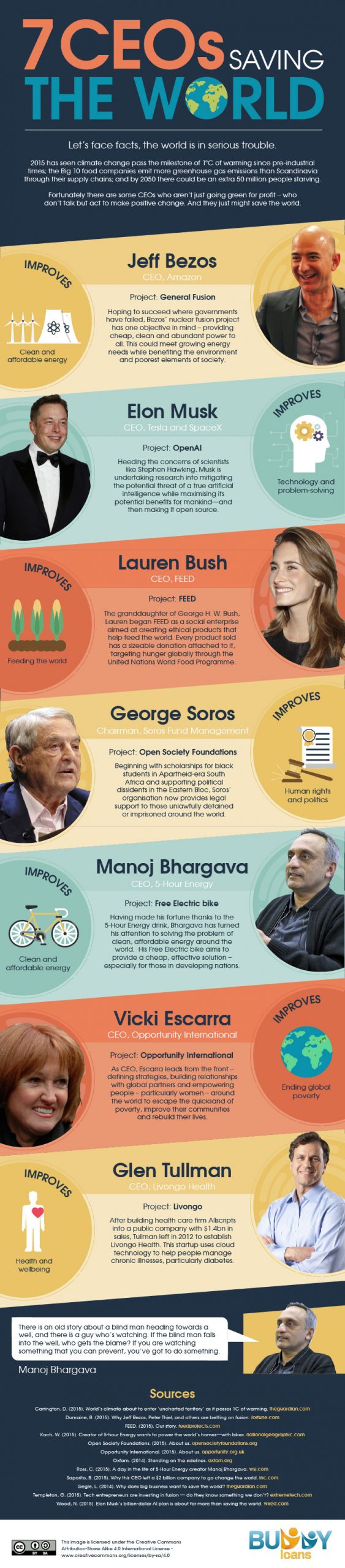
7 CEOs Saving The World

Let’s face it, the world is in serious trouble. 2015 has seen climate change pass the milestone 1 degree celsius of warming since pre-industrial times; the Big 10 food companies emit more greenhouse gas emissions than Scandinavia through their supply chains; and by 2050 there could be an extra 50 million people starving. Fortunately there are some CEOs who aren’t just going green for profit –who don’t talk but act to make positive change. And they just might save the world.7 CEOs

The original story appeared at Buddy Loans