Woody Harrelson Has a Message for the World

Woody Harrelson is no stranger to controversy, and he doesn’t shy away from it either. An outspoken environmental activist, Harrelson has attended environmental events around the world and is known to join protests that demonstrate alternative viewpoints.

He once traveled to the west coast in the U.S. on a bike and a domino caravan with a hemp oil-fueled biodiesel bus. Harrelson is also an ethical vegan and eats raw foods. Along with not eating meat or dairy, he also doesn’t eat sugar or flour. In Zombieland, in which he plays a character with an affinity for Twinkies, he did not eat the confectionery, replacing them with vegan faux-twinkles instead, made from cornmeal. He appeared on a postage stamp in 2011 as one of PETA’s 20 famous vegetarians, and he was named PETA’s Sexiest Vegetarian in 2012.

Here, Harrelson tells us how our spending has the power to influence harmful practices and help change policies at companies that are doing damage to our planet.


https://www.youtube.com/watch?v=jwJMy9PleXg


Homeless Guy’s Response to my Random Act of Kindness

“Be good.” Most of us have heard our mother say this at some point in our lives. Goodness is a core value that might be drilled into us when we are under the rules of parents or elders. 

Some of us, however, may embrace it because it is the heart of who we choose to be and how we decide to take a stand for ourselves and each other.

I used to ride the train into Chicago quite a bit. At the local station from which I departed, I met a man. He was homeless and it was cold – subzero cold. He entered the station looking the part…worn clothes, dirty, unshaven, his belongings in a plastic bag. What I noticed when he sat across from me, is that his eyelashes, eyebrows and long gray beard were full of ice and snow. I also noticed others moved away after having a good stare, and some seemingly in fear. And, this man merely came in to sit quietly, go unnoticed by the station manager, and allow himself to literally melt.

I was in a business suit, with an expensive briefcase, warm boots, and an agenda for my day that had me originally pre-occupied and stressed. The man did not raise his eyes from the floor until my train arrived the station and the announcement woke him from what may have been a very short nap while sitting on the wooden bench.  His eyes met mine.  They were so blue, so weary, and they were also kind eyes. They revealed part of his story. We smiled at each other in acknowledgment.

I gathered my belongings to leave, and before I reached the platform, I knew I needed to give pause.  I reached in my wallet and I returned to him. I put my hand on his shoulder and he was startled. I took his cool fingers in mine and pressed a twenty-dollar bill into his palm. His only comment was, “I did not ask you for this.” My response was, “No you did not.” And, I departed.

I have never forgotten that man or that experience. It is ingrained into my memory. Often I wonder if he is still living, if he is okay, why he was in the situation he was in. Mostly, I wish I would have done more. He was only trying to get warm. He asked me for nothing. A kind word would have been plenty. Giving him money was all I knew to do in that moment.

I sat idle on that 3-hour train ride to Chicago. I just thought. I hoped he bought soup or a sandwich, but I really did not care how he used money. I cared that he felt cared for, and I realized his gift to me was so very much more. I realized my privileges and I was sorely reminded that it is so simple to take good for granted.

People have many layers, and often we exercise judgment or we criticize. However, we do not know the real story behind what we think we see. We do co-exist with people who may be quite different from us and instead of passing them by, what if we truly see them? What if we are just good for goodness sake? It is harder to be ‘bad’. It doesn’t attract relationships, business or the respect of family members, and it certainly does not make us feel good about ourselves.

Goodness is easy. It comes in the form of positivity, compliments, being pleasant, asking questions, random acts of kindness or even a phone call. This is true at all levels – whether you are in kindergarten or the highest level executive.

Take stock of where you are. Notice another. Obtain perspective. Serve someone.

Go home to those you love and love them, and when you see an opportunity to be good, just be good.

Good begets good. Give it a whirl.


Homeless Guy’s Response to my Random Act of Kindness

“Be good.” Most of us have heard our mother say this at some point in our lives. Goodness is a core value that might be drilled into us when we are under the rules of parents or elders. 

Some of us, however, may embrace it because it is the heart of who we choose to be and how we decide to take a stand for ourselves and each other.

I used to ride the train into Chicago quite a bit. At the local station from which I departed, I met a man. He was homeless and it was cold – subzero cold. He entered the station looking the part…worn clothes, dirty, unshaven, his belongings in a plastic bag. What I noticed when he sat across from me, is that his eyelashes, eyebrows and long gray beard were full of ice and snow. I also noticed others moved away after having a good stare, and some seemingly in fear. And, this man merely came in to sit quietly, go unnoticed by the station manager, and allow himself to literally melt.

I was in a business suit, with an expensive briefcase, warm boots, and an agenda for my day that had me originally pre-occupied and stressed. The man did not raise his eyes from the floor until my train arrived the station and the announcement woke him from what may have been a very short nap while sitting on the wooden bench.  His eyes met mine.  They were so blue, so weary, and they were also kind eyes. They revealed part of his story. We smiled at each other in acknowledgment.

I gathered my belongings to leave, and before I reached the platform, I knew I needed to give pause.  I reached in my wallet and I returned to him. I put my hand on his shoulder and he was startled. I took his cool fingers in mine and pressed a twenty-dollar bill into his palm. His only comment was, “I did not ask you for this.” My response was, “No you did not.” And, I departed.

I have never forgotten that man or that experience. It is ingrained into my memory. Often I wonder if he is still living, if he is okay, why he was in the situation he was in. Mostly, I wish I would have done more. He was only trying to get warm. He asked me for nothing. A kind word would have been plenty. Giving him money was all I knew to do in that moment.

I sat idle on that 3-hour train ride to Chicago. I just thought. I hoped he bought soup or a sandwich, but I really did not care how he used money. I cared that he felt cared for, and I realized his gift to me was so very much more. I realized my privileges and I was sorely reminded that it is so simple to take good for granted.

People have many layers, and often we exercise judgment or we criticize. However, we do not know the real story behind what we think we see. We do co-exist with people who may be quite different from us and instead of passing them by, what if we truly see them? What if we are just good for goodness sake? It is harder to be ‘bad’. It doesn’t attract relationships, business or the respect of family members, and it certainly does not make us feel good about ourselves.

Goodness is easy. It comes in the form of positivity, compliments, being pleasant, asking questions, random acts of kindness or even a phone call. This is true at all levels – whether you are in kindergarten or the highest level executive.

Take stock of where you are. Notice another. Obtain perspective. Serve someone.

Go home to those you love and love them, and when you see an opportunity to be good, just be good.

Good begets good. Give it a whirl.


One More Thing Men Have Stolen from Women

As I continue to crusade for women’s voices to be heard in some of our largest businesses I nearly always come across the common complaint that women feel unheard and undervalued. This isn’t a new problem. 

You find it in the earliest writings by women beginning around 1000 BC.  The first novel written by a woman dating from that period, The Tale of Genji complained about being an invisible wife to a polygamist husband.  So yes, feeling undervalued has a long and rich history.

Just last week a Ph.D. woman engineer told me about a recent conversation she had with a male engineer in which she suggested a solution to a problem that was driving a key customer crazy.  She said, “Within two minutes the guy I was talking to said, wait a minute what if we try…and it was my damn solution.  No one else was on the call. But he couldn’t help himself.  He just acted like he was the smart guy who came up with it. He didn’t even bother to rephrase my solution…he just claimed it as his own as if I had said nothing!”

Sound familiar? Well, consider this.

Design thinking is a red-hot, seemingly new problem-solving process being adopted throughout major corporations.  My clients are in love with design thinking. What no one seems to realize is that design thinking is the same process women have been using to trying to create better lives for themselves and their loved ones from the time of clans and war lords to today’s corporations. Yet once again men are taking credit for a process that women have already been using for thousands of years.

Here’s what the process basically looks like.

  1. Design thinking starts with empathizing with the users of whatever you are producing.  Empathetic thinking is fundamentally visual.  That means you can visualize how your product or service might have both positive and negative impacts on your users or customers.  Of course the idea is to come up with ways in which your customers can get more value without more effort.  The most valued outcome of customer empathy is to identify unseen needs so you can visualize unexpected solutions. This first step of design thinking is often difficult for analytical thinkers.(According to psychology research at the University of Wisconsin at Madison, empathetic thinking is most often developed when the motivation to help others is present. This motivation has been proven to be highly correlated with brains charged by estrogen.  This is not to say that men cannot be empathetic, however, it seems to be harder for testosterone-charged brains to stay focused on empathetic considerations. A brain designed for empathy thinks win-win.  A brain design for dominance simply thinks…I win.)
  1. Define the ideal state for the customer.  This is often called the target state. When you contrast the target state with the present state you have defined the opportunity. Most often the target state is quite ambiguous, especially if you’re trying to solve a chronic or complex problem. Most problems worth solving have many causes and influences.  It takes powerful contextual intelligence to really understand the nature of complex problems. (Research at the University of Pennsylvania has shown that male brains tend to try to simplify complexity in order to get into action.  Oversimplification leads to being surprised by unintended consequences of quick decisions. Because female brains tend to be wired for high contextual intelligence they tend to be better at evaluating risks and minimizing them.)
  1. Ideate many options.  This is where cognitive diversity comes in. The best decisions are usually the result of considering the largest number of different options.  This requires seeking collaborators who may disagree with you or have data and knowledge you don’t. This collaborative process is called universal inclusion in which every collaborator is directly asked for their best ideas and concerns.  This process is a key finding of the Aristotle Project conducted by Google on their most high-performing teams. (Research from Bain and Company reveals that women tend to have higher levels of Relational Intelligence, which simply means they more easily understand what’s going on with team members and are more likely to keep them engaged.)
  1. Synthesize best ideas.  This requires moving from divergent thinking to convergent thinking to gain alignment so action can be taken. (This again is a skill powered by Relational Intelligence.)
  1. Prototyping and testing solutions.  To discover whether your ideas are any good you have to test them in a spirit of learning.  Prototyping is like playing horseshoes.  Getting close to a solution matters because improvement will be constant. Encouragement of thoughtful and honest effort is critical to keep the team motivated through the ups and downs of iterating solutions. (This takes a lot of Relational Intelligence.)
  1. Commercializing the solution.  This requires figuring out how to move out of prototyping and into something you can actually sell that customers can use and love. (This requires Operational Intelligence, another female strength identified by Bain and Company.  Operational Intelligence is the ability to develop an entire process of engineering and implementing a new product or solution without losing the value the creators intended.)

What I find kind of amazing about design thinking is that its major proponent, Tim Brown of IDEO, a famous design firm, acts like it’s a new revolutionary way of thinking.  When actually every woman who’s been a mother or wife has to use design thinking every day to just get through dinner.  Every family vacation is the result of design thinking.  In fact when it comes to coming up with new solutions to solve highly complex problems women have been using design thinking since the first female novelist wrote about solving the challenges of family life in a polygamist, patriarchal society.

Maybe we should change the name of design thinking to FVC… Female Value Creation.

Actually, I love the fact that the power of the feminine brain is being harnessed by both men and women to design new solutions to the problems that plague us and the opportunities before us. SMART Power training is design thinking applied to leadership.  I just want to point out it’s not a new way of thinking or creating–It’s as old as Eve.


The Enormous Truth Buried Inside Every Ancient Society

We live in a world that punishes truth and praises lies. Our deepest truths come from the heart in unwritten feelings and sensations which may remain dormant or out of reach for decades. Our minds, however, are experts at fabricating words to fill in the gaps. Whatever it takes. Is it any wonder that the meaning of leadership itself has become so corrupt?

My lifelong study of leadership has brought me to nature. As I brushed away the dirt that I came across in so many books and studies, I found an enormous truth buried deep inside every ancient human society. Animals and nature follow the rules of leadership way better than we do. The logic of this original, true leadership permeates the entire animal kingdom, and is most visible among the largest, most complex of creatures: our mammal friends.

Through working with dolphins and horses, I began to discover a fundamental fact that seems to have disappeared beneath the worlds’ pyramids and buried temples. Leadership is an act of love. Not an impulse to get rich or famous. It’s not about getting respect or being remembered. It’s not about Forbes rankings. It’s not about the ideas we read about daily in magazines, books or elite university research papers. It’s about love. Deep, beautiful, selfless, complex, life-thirsty love.

In Ireland the Hill of Tara bears witness to very sexual ceremonies in which 142 High Kings of Tara were selected and crowned by Celtic kings. The ancient Egyptian Turin Erotic Papyrus graphically shows how sexual energy was closely tied to the Gods and to the afterlife for the Egyptians. Cave paintings and less sophisticated representations from primitive tribes also remind us that before we became so intellectually smart we knew that business was not too far away from erotic pleasure and love.

I used to be a very brainy industrial engineer with huge ambitions. I was a product of our times. I was told to study hard and reach for the stars. I believed it. Thirty years into this game, however, my heart started beating a different tune. Confused and bewildered, I needed more than a decade to figure out what it was trying to tell me, without any words. Now that I get it, none of the business gibberish we all talk makes any sense to me. It seems like a huge lie at the service of the few… the few willing to break every rule of life in order to get to the top.

In many mammal species the leader of the pack is female. The first human Gods were female, as so many ancient figurines symbolise – without words. This female style of leadership is about having everybody’s back. And I mean everybody: Fast hunters, young studs, innocent teenage girls, child-bearing women, wise old men. Wild animal leadership is about being last, behind everyone, the first one to be discovered by a chasing predator.

This heart-driven leadership serves life at any cost. It follows a logic of economy in which no one is killed for any reason other than promoting life itself.

No conflict is sparked for dumb reasons like money, power, conceptual beliefs or ego. A clean worthy heart is venerated above every other possible trait. Beauty, charisma, intelligence, business savvy and physical strength fall short, way below this intrinsic ability to love your people so much that you will give yourself over in order to promote their wellbeing.

If we look at human history, and evolution itself, we see that the Homo Sapien species appeared two million years ago. The oldest Goddess figurines found, the Tan Tan Venus in Morocco and the Berejat Ram Venus of the Golan Heights, could be as old as three to 500,000 years old. Homo Sapiens, our own species, is only 200,000 years old.

War, violence, degradation of women and chieftain-based leadership, in contrast, are no more than 7,000 years old. A mere hiccup in our Evolution! It’s true that without war, human societies would not have developed as miraculously as they did. We have to admit that the dynamics set in motion by those first Indo-European invaders about 4500 B.C.E. in Europe, replicated in Middle-East and America, did push humanity to overcome gigantic challenges. Business strategy still praises Sun Tzu’s “Art of War” treaty, and many of our daily comforts and technology applications come from inventions developed by the military.

But for some reason we have let this hunger for domination and supremacy blind us to the invisible cost of war and violence.

Recent Jihadist attacks come as a painful reminder to modern societies. Violence destroys life. It kills many lives in one fatal blow and alienates future generations with unbearable doses of shock, fear, vengeful anger and guilt. Guilt-ridden successors of great historic conquerors have always been weak, depressed, addicted and perverted. The cost of war is multi-generational. It takes many, many, lives to overcome the incomprehensible wounds left by meaningless death.

To our essentially mammal hearts it makes absolutely no sense to kill anyone for a reason that is not life or death. Like any other animal on our planet, it would choose first to avoid or escape the conflict, and it would only attack if it had no other choice. What’s more, if it had no chance at all, it wouldn’t even fight. It would go straight into shock to minimize pain, once again eliminating meaningless violence.

The heart is female and the mind is male. Yin and Yang. Moon and Sun. Love and Sex. Creation and destruction. In nature there is an intrinsic balance between the male and female principles that pushes life forward. But we humans have become so strategic, so brainy, so blinded by the delusional lies of our very own grey matter, that we have broken that balance. We are slowly killing nature. Animals are becoming extinct, resources are running out, trash is polluting everything.

Who will remind us that loving hearts must again rule over fearful minds? Heart’s follow mind when mind serves heart’s purpose.

Men and women who ignore their heart plant death and grow destruction around them because their minds lose all sense of purpose. They become blind to the logic of life – that nature and animals will obey at any cost.  They become leaders of hatred and worshippers of meaningless rankings. And so they become slaves to a Godless, robotic system of endless competition with each other.

It’s frustrating to fall out of the profit-making machinery of corporations. It’s alienating to choose projects that make sense, rather than money. It’s very lonely to speak from the heart in a society that can’t remember what it feels below  the neckline. As I’ve shared often on Real Leaders, it’s scary to see myself invest year after year of my career into “bringing love to the darkest, most loveless of places.”

For a very long time I was scared that I might be wrong. I seemed to be the only one talking this way. Punished once and again by people who were blind to their own hearts’ logic of life, I’ve become surprisingly strong. I’ve come to see that when you serve truth you don’t need violence. Truth is irresistible. True love is untamable. True leadership loves so deeply and effortlessly that violence and punishment melt in her presence. And a woman who rules from a heart full of love is a force of nature – a fair, wild, strong leader, a chaos of emotion full of wisdom. A woman who fully trusts her heart becomes a Goddess.

 

Do This to Feel Fulfilled Every Day

When I train leaders at the SMART Power Academy we get into some very deep stuff. One of the major sources of leadership power is confidence. Many leaders mistake arrogance for confidence. This is not good. Once an arrogant leader makes a mistake he or she loses support.

You can only get away with arrogance if you’re a mistake free genius, and I haven’t met any yet. So if arrogance isn’t the answer what is?

The foundation of leadership power is intrinsic confidence. This is a feeling of capability and resilience that comes from our deepest selves. It’s intrinsic to us.

Intrinsic confidence is something we build through achievement and service. Once you’re on the path to building intrinsic confidence you will feel fulfilled. And feeling fulfilled is a deep human longing.

We all want to feel fulfilled. This isn’t the desire of our modern age. It is found in the earliest writings of Greeks, Egyptians, Persians, Romans and Chinese. Just about every civilization has philosophers that have ideas on the well-lived life…a fulfilling life.

In our age Abraham Maslow gave us the term ‘self-actualization,’ which roughly translates into an abiding, inner feeling that you are fulfilling your true potential.

That seems like a very high bar. It seems like a feeling of contentment that is difficult to maintain. But it’s really not. Both brain science and cognitive psychology now reveal that neuro-transmitters and hormones give us the actual feelings of satisfied contentment and self-respect that triggers the inner piece of feeling fulfilled.

Here is how it works: Being fulfilled arises from feeling capable and feeling connected to others. And it’s not only being capable and connected, it’s feeling those things that are the juice of fulfillment.

#1: We get a sense of our capability by achieving self-selected goals or solving challenging problems. Goal achievement and problem-solving are the prime ways our intellect and emotions confirm that we can have an impact on our world. The goals and problems we solve do not have to be world changing. They just have to be important to you. When you achieve someone else’s goal the primary emotion you’re most likely to feel is relief rather than fulfillment.So it’s vital to be pursuing goals are important to you.

#2: The second source of fulfillment comes through meaningful connection with other human beings. It’s most powerful when those connections are in person. Having 1 million followers on the Internet will not have as powerful a positive psychological impact as helping a close friend get through a tough time. (If you question that she might want to check out the new book called The Village Effect. The research is clear that human fulfillment is directly tied to the quality of personal relationships that you enjoy. The two things that improve relationships the most are mutual help and giving and receiving recognition.

Now here’s what I want you to pay attention to. Many people struggle to feel fulfilled by living a life of great purpose. Often this is true with the people I coach and train. But science says they are overshooting the mark and missing the point. In fact, it may be that our ego is what’s driving our need to be of great purpose. If it is, were likely to miss the many daily opportunities to feel fulfilled.

Consider this. What if you are already fulfilled but you just don’t feel it?

Every time you achieve a personal goal such as finishing a project or even solving a problem as trivial as finding a movie your family might enjoy watching together it is an opportunity to feel fulfilled. Every time you say a kind word or help a customer or a colleague at work it is an opportunity to feel fulfilled. Have you ever wondered how someone might work as a waiter or waitress in a coffee shop year after year and not go crazy with the tedium? Well, I have a woman neighbor who has been a server in a local Chart House restaurant for 40 years. She was among the first people hired when the restaurant opened. She just retired from work and is moving to Maui. When I asked how she stayed in the same job so long without going crazy she said just the opposite of what I expected. She told me she loved her job, because every day was different. She met many new people and always did something to make the experience special for them. She said that just paying attention to what makes people happy and trying to provide it for them was completely fulfilling. She was so great at her job that she had the opportunity to train many people over the years to look at the job of being a waitress in a completely elevated way.

#3: What my neighbor was expressing was the third element of feeling fulfilled; grateful awareness. Research indicates that most of us live our lives in a state of partial attention. We are like deaf people attending a great concert. We are missing the most important part of a well-lived life which is feeling the actual experience of life’s genuine joys.This evidence-based understanding of the causes of personal fulfillment and intrinsic confidence are so important that I have added a final moment of mindfulness to the daily schedule of Work Like a Genius that I teach at the SMART Power Academy.

I call it Grateful Awareness. It is so simple. I just ask people to take a few moments before they turn out the lights to go to sleep to write down a few sentences about the moments you experienced today in which you felt the feeling of the power of your capability. I want you to feel the difference you made today through your effort. I also ask people to recall and write down those moments where they helped another, maybe just with a small gesture of kindness or a smile. I asked them to recall any compliment they may have received or recognition they have offered to others. This can all happen in three minutes of mindfulness. When you do it you will feel the feelings of fulfillment. These are the feelings that can stay with you day in and day out and are the source of inner peace and intrinsic self-confidence.
Please try it for yourself…you deserve to feel fulfilled.


Promoting Peace and Development On and Off the Playing Field

Sports have a universal appeal that connects people across cultures, nationalities, and languages. Around the world, sports are an important part of daily life for countless women and men; they are a source of exercise, entertainment, and joy.

But sports can have an even deeper impact, too. They have the potential to be a powerful instrument for peace and development that can start dialogues, forge acceptance, and even end conflicts.

When two people connect on the playing field, they learn valuable lessons about themselves, each other, and the world around them. Sports teach us the virtues of fair play, how to respect our opponents, how to work together, and the importance of tolerance and inclusion. In many fragile and developing countries—especially those where conflict has forced children and youth out of the classroom—these lessons are sometimes not learned in any other contexts.

Indeed, the United Nations recently recognized the unique role that sports can play in global peacebuilding. The Declaration of the 2030 Agenda for Sustainable Development—which outlines 17 new global goals for the international community—acknowledges sports’ “promotion of tolerance and respect and the contributions [sports] make to the empowerment of women and of young people, individuals and communities as well as to health, education and social inclusion objectives.”

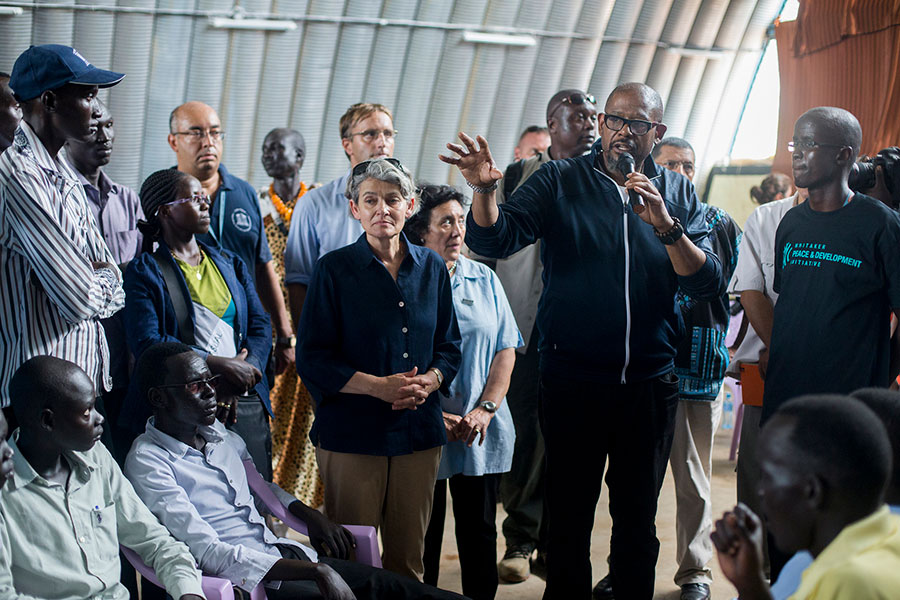
It is in this spirit of promoting tolerance and inclusion that WPDI created Peace Through Sports, a program that seeks to connect young women and men through their love of sports and instill in them values of mutual respect and fair play. Peace Through Sports originated at a UN protection-of-civilian (POC) site in Juba, South Sudan. Following the outbreak of violence in South Sudan in late 2013, the UN established a series of these POC sites throughout the nation to give refuge to the nearly 2 million South Sudanese citizens who had been internally displaced by the fighting. When I had the opportunity to visit some of these sites a few years ago, I saw that there were not enough resources to provide young people with emotional support for the trauma they had suffered. Feelings of hate and revenge were taking hold, and many youth were acting out on these negative emotions.

forest whitaker sports

We conceived of Peace Through Sports as a productive activity that would bring youth together across ethnicities and lay the foundation for understanding and forgiveness. The response among the young people at the POC site was more overwhelming than we could have imagined. Over a thousand children and youth—boys and girls alike—signed up in the first month of the program for Peace Through Sports’ soccer, basketball, and volleyball teams. Daily matches began on newly constructed athletic facilities at the POC camp.

Peace Through Sports offers young people a fun, constructive outlet for their energy—but the impacts of program go far beyond the playing field. Before or after every match, the participants join together in a discussion about teamwork, respect, and non-violence. WPDI’s staff and outside experts hold frequent peace education sessions that provide vulnerable youth with psychosocial support as well as lessons on tolerance and reconciliation.

The program is also providing many of its participants with viable economic opportunities for advancement. The South Sudan Football Association works with us at the POC site, conducting hundreds of hours worth of trainings for players, coaches, and referees. Several months ago, 35 youth became certified coaches who will now have the chance to turn what they’ve learned in the program into meaningful careers.

The popularity of the program has revealed a greater truth about forging peace and fostering reconciliation: that people are more open to engage with these difficult concepts when they are active participants and not passive bystanders. Sports remind us that peace and development do not have to originate from inherently political or business-oriented processes. Anything that connects people to each other and allows them to work together toward a common goal can be a powerful source of peace and social growth.


Does Your Work Make You a Better Person?

Over many decades I’ve helped, directly or indirectly, thousands of people discover their purpose in life.  One night long ago I was awakened by a voice that said, “Your purpose is to help others find theirs.” 

That’s pretty clear and it’s made for a very interesting career. I have worked with, and spoken with many, many of the “Live Your Life On Purpose” experts from Stephen Covey to Anthony Robbins to Deepak Chopra.  I have also read most of the popular books, social research, and philosophical and religious texts that address the purpose of life.  I’m just giving you this background so you understand that my conclusion about life’s central question is not superficial but rather the result of decades of study and teaching.  Here’s what I have concluded.

  1. Answering the question, “What is your life’s purpose?” is vital. When you are clear on your purpose you will make both big and small decisions that will fulfill you. Without that conscious knowledge you will most likely struggle with dealing with the constant demands of others who are trying to recruit you to meet their needs.
  2. Your purpose has two dimensions.  The first is universal.  The second is individual.  The universal purpose of everyone is to learn to live in a conscious state of inner compassion for yourself and every other living thing.  This is not optional if you desire inner peace. The default alternative to inner peace is chronic anxiety.
  3. The individual dimension of your life’s purpose has been popularized by the writer Matthew Kelly who said the point of our lives is to become the “best version of ourselves.”  I love that expression because it captures the unique human capacity to imagine ourselves being better than we currently are.  Our  vision of our ideal future self is a gift!

It turns out human beings have been fascinated by the power of our ability to imagine our best future self for thousands of years. The Greeks call it Arête.  It was their ideal that the highest virtue of work is that it enabled you the become the “best person you can be.”

So now we come to this very interesting question that few of us consider. “Does your work make you a better person?” I have found this is a very unusual question that few people actively consider.  But remember that the universal purpose of life as defined by virtually all spiritual/wisdom traditions is to live in an inner state of compassion.

Compassion has been defined as “loving empathy.”  This doesn’t mean compassion is weak or sentimental.  Mother Teresa was filled with courageous compassion.  Walt Disney created Disneyland to create positive experiences for families because his childhood was so unhappy. So compassion can be very powerful.  Being motivated by compassion is like switching on a self-cleaning oven for your soul.

So my question is “Does your work make you more courageously compassionate for your colleagues and your customers?”

I have found that for most people the answer is “It doesn’t but it could.”

The most basic examination of work that makes you a better person is that the outcome of your work does not harm others.  Buddhists are encouraged to seek a “Right Livelihood.” It is based on the belief that you will never be truly happy by making other people unhappy. There are many businesses that take advantage of human weakness.  These businesses thrive when people do things in excess that cause them to be unhealthy or unhappy.  Giant fast food companies called their meals comfort food but that’s just a code for delicious poison.  Casinos make money by you losing money.  You can call it ‘entertainment’ but it’s based on a human weakness that is wired into our brains.  Do you think there’s been more suffering caused by gambling than joy?

The point is that there are many good people working for companies with bad business models. Humans are great at self-justification and making bad things appear to be good, or blaming the weaknesses of individuals as the cause of their own suffering.  However neither self-justification nor blame develop compassion.

So what is the path to work that makes you a better person.  Three things:

  1. The work you do improves the quality of life for your customers and/or coworkers. If your present work doesn’t, how might it?
  2. You are learning valued skills and gaining abilities that make you more capable of improving the lives of others.
  3. The quantity and pace of work that you do enable you to live a healthy, enjoyable life and be in harmony with your loved ones.

All three conditions for work that makes you a better person are important.  The one that seems to be the rarest today is number three. The average full-time American worker works 47 hours a week.
That’s too much.  Productivity research is very conclusive that human beings operate a high productivity a little over six hours a day. Several studies have shown that people doing identical work accomplished no more in 50 hours than those who did the same amount of work in 40 hours.  In fact overwork is a leading cause of mistakes that create rework. That’s right, overwork causes more work. So burn this into your brain.  Working more does not make you more effective.  It does not make you more successful.  It’s certainly does not make you more happy, loving or lovable.

What I see in most corporations is that they are understaffed and their talent is poorly deployed. They are also poorly managed and poorly led.
Research confirms that only about 20% of senior management is good at managing.  About 33% are terrible.  They actually hurt the success of the business.  The result of all this poor management is that it is unnecessarily hard to succeed.  The best leader I ever coached had one goal…to make the success of his employees easy.

My career advice is simple. Your goal is to become the best person you can imagine. Your work should offer you great opportunities to develop into a better person. The goal of work is not status, or self-definition. You are not your work.

You need to work for organizations whose primary business model drives prosperity by improving the genuine quality of life of it’s customers.

You need to invest all of your capability in doing great work eight hours a day five days a week and no more. If your work routinely demands more than that, it is not healthy.  Science is clear that overwork causes chronic stress and dramatically increases your risk for depression and heart disease.

Overwork is as big a health risk as diabetes. So you may need to go on a work diet.  Stop your binge working.  Stop doing non-nutritious work – work that doesn’t matter or that will have to be redone. If there is too much work and constant fire drills I guarantee you are doing work that is caused by poor organizational and work design, a lack of prioritization and poor management and leadership. Refuse to be a “workabetic.”

If your current job is not enabling you to become a better and happier person either change it or move on. If you stay in a rut too long it will become a grave.  So please do not sacrifice your life to help other people achieve their goals at your expense.

You have a purpose. The world will become a better place as you fulfill your true self. Follow your imagination.


Behind The Headlines and Rhetoric In Iran

The first group of American business leaders to step inside the former U.S Embassy in Tehran in more than 35 years discover a very different world to what we’ve heard about.

“Where are you from?” asked the shopkeeper, pointing quizzically at American Dick Simon, who was on his first trip to Iran. Simon swallowed hard and replied, “I’m from the United States.”

“America!” said the shopkeeper, giving him a huge bear hug, “We’ve been waiting for you for 30 years!” It was typical of the attitude from all ages and walks of life that Dick and his party encountered. They experienced almost no anti-American or anti-Western sentiment from the people they met, even the Iranian Revolutionary Guards who were tasked with showing them around.

The 2012 film “Argo,” starring Ben Affleck and George Clooney, dealt with the American hostage crisis that began on 4 November 1979, when Iranian activists stormed the U.S. embassy in Tehran in retaliation for President Jimmy Carter giving the Shah asylum in the U.S. during the Iranian Revolution. More than 50 of the embassy staff were taken hostage and the entire movie is a nail-biting quest to smuggle them out at any cost.

But now, the Americans are back.

Curious about the portrayal of Iran in Western media and not discouraged by the endless images of crowds burning American flags and chanting for the fall of “The Great Satan,” a group of 24 members of the Young President’s Organization (YPO) traveled to the country to see for themselves. Simon is one of the founders of the Peace Action Network within YPO; an example of a growing trend among business leaders wanting to help promote global peace.

“We are all fed information through media news outlets and stereotypic characterization in TV shows and movies about what the rest of the world is like and what we should think about it,” says Simon. “Dehumanizing the ‘other,’ THEMification, is a widespread and dangerous human trait.”

Anti-American murals are still evident on the streets.

Anti-American murals are still evident on the streets. Top photo: Some parts of the former U.S. embassy in Tehran still require triple authorization to enter. Photographs: Dick Simon

Governments can sometimes be their own worst enemy, by reinforcing myths and beliefs around different societies. “One of the big lies that people believe is that conflict between certain groups will never end,” says Simon. “Northern Ireland was once a war zone. Rwanda recovered from a genocide of over a million people. South Africa could easily have descended into retributory bloodshed after democracy, but didn’t.”

“The most dangerous four-letter word in the English language is THEM,” says Simon. “It creates the ‘other’ and creates a situation where you’re unable to hear them. Part of our brain actually cuts off rational thought in order to ‘protect’ us.” Entrepreneurs who dissect problems into manageable pieces can play an important role in building peace. “Business leaders have the expertise to resolve problems,” says Simon. “It’s called making a deal – and business is very good at this.”

In Iran, Simon’s group met with high-ranking Iranian officials, the first group of American business leaders to do so since the 1979 Islamic Revolution. They met a Grand Ayatollah at his personal residence in the holy city of Qom and interacted freely with ordinary Iranians – free of media filters, Hollywood hype and western rhetoric. Seventy percent of the population is under 35 and 60 percent of all university graduates are women. “We will never look at Iran, the Middle East or the world the same way again,” he says.

“War is a very expensive business. Witness the horrific Syrian death toll and refugee crisis happening right now,” says Simon.  “We should get involved with other cultures out of a desire to make a difference in the world and enlighten ourselves.”

Perhaps the most telling detail of Simon’s trip was when he departed Tehran Imam Khomeini International Airport. A Revolutionary Guard saw his American passport, approached him and said, “God Bless You.” Bestowing a blessing on another, despite cultural, religious and geopolitical  differences, might be the best sign yet that we can all find common ground.


Why Goodness Should be a Core Value in Every Business

I grew up steeped in the idealism of the 60s. I and many of my generation envisioned a world that was good, where people were treated humanely, where war was rejected as inhumane and inherently bad, where human and personal rights were regarded as sacred. Implied in so many of the movements of that era, and still today, was the notion that doing good in the world was needed for our survival, and that doing good was its own reward.

How far have we come? “Goodness” is found in many products today. Just think of the common advertising slogans that go like this: “the natural ‘goodness’ of whole grains” when in fact the product being advertised is filled with GMO ingredients or high sugar additives masquerading as wholesome nutrition. (Pardon my cynicism. I’m actually still an optimist in spite of plenty of evidence that could have knocked the wind out of my progressive sails.)

Goodness is the radiant human virtue that binds relationships together, that brings hope in the midst of despair, that is at the core of the human spirit. We admire people who we describe with words like, “she’s a really good person.” We may even aspire to be like them, while secretly doubting that we want to.

“Goodness is the only investment that never fails.” — Henry David Thoreau

Many entrepreneurs start with a genuine a vision to do good in the world, to make people’s lives easier, or to solve a problem that previously was unsolvable. For millennia goodness has been one of the noblest of human qualities. So how has it become a second class citizen in today’s frenetic, ADD world? Most companies value masculine qualities such as strength, ambition, competitiveness, power, domination, and charisma, but I would suggest that goodness is the very nourishment desperately needed in our organizations today so these other qualities don’t become the cause of our self-destruction. The heart is the missing factor in our mindset and in our culture that could allow us to create the life of our dreams. Goodness is the crystal pure gift from our heart to ourselves, to our customers, to our organizations, and to the world. What customers wouldn’t be loyal to an organization they felt was truly doing good in the world, and backing it up by treating its people and its customers in ways that felt good.

How does goodness relate to your professional life? Could a mantra of, “let’s do good today” produce a good ROI? Businesses are complex organisms in which competing interests and priorities must be weighed out before proper decisions can be made. Asking ourselves, “is this a good decision?” may not be the only question to ask; not at all. But are we asking this often enough? Are we investing in goodness? Probably not.

Bruce Cryer is a renaissance man, whose passions include being a business mentor, writer, speaker, keynote performer, photographer and co-founder of the project “What Makes Your Heart Sing?” to awaken inspiration in people and organizations. A former actor/singer/dancer on Broadway, he is the co-author of “From Chaos to Coherence: The Power to Change Performance,” and the Harvard Business Review article, “Pull the Plug on Stress”. He is also a cancer and staph infection survivor, happily singing and dancing again on two titanium hips. BruceCryer.com