How to Liberate Your Leadership Talent

We have cracked the code on healthy, fulfilling work. Sociologist Jeanne Nakamura’s research on the conditions that create “vital engagement” are crystal clear. Work that energizes our minds and inspires our hearts is work that engages our talent to benefit other human beings. 

If you like this, subscribe here for more stories that Inspire The Future.

This makes us feel that we are making a positive difference. Unfortunately her research also reveals that only a small fraction of us feel our work is consistently fulfilling. I believe the reason for this is lousy leadership. Authoritarian leadership. It’s time for all of us to do a more thoughtful job of leading our lives and committing to our “vital work.”

Just look at this chart. It comes from the research of Dr. Jonathan Haidt of New York University. His research reveals that human brains wire themselves to define leadership through two possible lenses. The most common paradigm of leadership is authoritarianism. We experienced this as the myth of “ strong-man hero.” From the chart you can see that authoritarian leadership is a high control style seeking to maintain their advantage through maintaining the status quo or conquest. They resist change, install bureaucracies, squash creativity and attempt to drive success through efficiency and compliant employees. They most often believe that people want to be told what to do.
 
Authoritarian leaders act on the premise that they know more and are more capable than the collective talent of their employees. Their mindset is dominance. The most common business strategy of an authoritarian leader is to achieve a dominant market position through mergers and acquisitions, consolidate to economic power and drive efficiencies. The consulting firm PwC recently found that the authoritarian model leadership is most admired by other authoritarian leaders. A leadership literature review covering 5,000 years of leadership biographies dating back to Alexander the Great powerfully reinforce our cultural assumptions about effective leadership.  We hero-worship authoritarian leaders who are competitive, decisive and confident to the point of arrogance. The result is the world we have.

The question to consider is whether or not the dominant leadership style that got us here will create a world with the best possible future?

The second major style of leadership is one that is grounded in promoting individual autonomy.  This is empowering leadership that is primarily human-opportunity oriented. It is optimistic and solution focused. Its goals are focused on creating valued benefits that improve the quality of life of organizational members and customers. These leaders promote creative collaboration to generate streams of valued innovations.
 
Leaders who are motivated to empower employees are known as transformational leaders.  This is descriptive because the mindset of these leaders is to transform the capabilities of employees into actions that benefit customers and thus drive growth. Empowering leaders believe in fostering group intelligence and achieving goals through teamwork. They foster cultures of universal inclusion and respect for individual viewpoints, talents and experience. The distinct advantage of empowering leaders is that success comes by adapting to changing circumstances rather than resisting them. New research from McKinsey and Company clearly reveals the companies with empowering leaders are highly agile are much more able to thrive and grow in our modern economy.
 
So, what kind of leader do you aspire to be?
 
Since you’re reading this, I assume you want to be an empowering leader. I certainly hope so.  I want you to be. But I also know from my decades of experience that you may be reluctant to express your leadership if you work in an authoritarian culture. Remember authoritarianism creates cultures of compliance. That means discouraging you from thinking on your own. If  “going along to get along” is leaving you exhausted here’s what I’d like you to consider…
 
I want you to imagine that you have a powerful leadership voice inside longing to express itself. I want you to imagine that the prison door that has prevented you from doing what you really desire to do has been unlocked and all you have to do is swing the door open, walk into the sunlight and start enrolling people in your vision.
 
I realize that your vision may be quite blurry right now.  If you haven’t really invested yourself in doing the inner work to become clear on the difference you want to make, you may mistakenly believe that you have no leadership vision.

You may even believe that you’re not really a leader. But I don’t believe that. Both my years of experience and all the recent research on the science of leadership confirms that effective leadership is a small group of learned habits.
 
They are:

  1. Set direction – envision a better future and campaign for it.
  2. Motivate commitment – create compelling business cases for change and address the inspirational and practical reasons to support your goals
  3. Actively collaborate – engage all your stakeholders in creating the best action plans to achieve your vision.
  4. Results focus – empower your team members with clear goals, clear roles, clear decision authority and clear rewards.
  5. Transform you and your team’s performance capability through river of respectful feedback that leads to continuous improvement.

 
SMART Leadership. You will notice that none of these five behaviors require an authoritarian personality. In fact, the three most common attributes of authoritarianism – competitiveness, decisiveness and arrogance, are not factors related to leadership success. My point is that if you dream of a better future you can be a transformational leader to help re-design our collective strategies to achieve something better than where we are currently heading. The science of leadership research reveals that you don’t have to be perfect at a huge set of difficult behaviors.  In fact, no two great leaders have identical leadership styles. But what effective leaders have in common is that they consistently address these 5 simple habits. So can you.

So, if leadership is that simple why don’t we have more empowering leaders? The problem is you may be unsure of habit number one, Setting Direction.
 

Authoritarian leaders have no problem voicing a vision that improves their personal status, power, wealth or fame. Empowering leaders tend to overthink how they might help other people achieve their goals rather than develop a clear vision of their own goals. But your vision for a better future is alive and it burns deep within you. You just need to put more focused attention on your highest and best
desires. You need to honor them. You need to liberate them.They are a gift of your moral imagination.
 
Here is how:
 
Know who are and who you are not. All of us listen to a constant inner dialogue between our inspirational voice and our critical voice. Our critical voice is the loudmouth that takes up most of our headspace. Our critical voice nags has to be cautious rather than be bold. It focuses on all of things that could go wrong rather than the opportunities that could go right. Our critical voice is constantly telling us we are smaller and more limited than we truly are. One of the most powerful ways to quiet the critical voice is to negate its power to define our identity.

  • You are not your job.
  • You are not your achievements.
  • You are not your failures.
  • You are not your role (mother, father, daughter, son, manager, student etc.)
  • You are not your education.
  • You are not your economic status.
  • You are not your thoughts.
  • You are not your emotions or your feelings.
  • You are not your possessions.
  • You are not your weight.
  • You are not your current beliefs.

The reason I am sure you were none of these things is that all these things change over the course of your life.
 
Now, start asking yourself who am I, really? 

I am serious about asking yourself this question.Try this. Over the next five days set aside 10 minutes in the early morning, or lunch time or on a quiet walk in the evening and simply ask yourself “who am I?” Then patiently wait for your inspirational voice to whisper the answer.
 
I believe the answer you will discover is that you are the values you choose to be. You literally become the values that you value. That is liberation!

It is liberating because you have just been freed from thinking that you were only your current strengths. What? That’s right the strengths movement has actually become a limitation to many people. Millions of people have taken “strength finders” or some other analysis of how you habitually achieve success. But knowing your current strengths is only the beginning. What limits us are our weaknesses. Our strengths give us opportunities but our weaknesses cause our failures. It doesn’t have to be that way.
 
In earlier times, moral education promoted the idea that you could become a more virtuous person through practice. Famously, Benjamin Franklin pursued excellence in 13 virtues by practicing with great focus one week at a time.
 
Let give you some simple examples. When I was younger I was always late. Often, very late. It lead to a catastrophic loss of an opportunity I really wanted. I vowed that I would never be late again.  And for the most part, over the past 30 years, I’ve been extremely punctual. I am frequently complimented on my punctuality. It was a weakness I turned into a strength.
 
My wife is an energizer bunny. She is always in action. She wanted to appreciate beauty more than her fast paced allowed her to do. So she got serious about photography. With practice it made her notice the beauties of nature much more frequently and much more deeply than before.
 
I have a very demanding client who demands to be the number one priority of everyone in his life.  As you can imagine this weakness has led to a lot of problems and unhappiness. For the past year, he has used his impatient feelings as a positive trigger to be more thoughtful and patient in the moment. It’s been transformative.
 
When you liberate yourself from your habitual self and begin a serious journey to self-actualization to the best person you can imagine you unlock the key to empowering leadership. This will ignite your leadership courage. You will begin to have a more clear vision of the difference you want to make and how to engage the help of others to create a world that works for everyone. Once you have a vision and a direction just follow the other four habits. You will liberate the leader within you.
 
If you could change the world, what would you do?

Do that!

If you like this, subscribe here for more stories that Inspire The Future.

Four Investments You Can Make Today to Increase Your Love Life

You can’t do a good job, if your job is all you do. The aspiration for work-life balance is dead. It was killed by technology. If you want to be happy in life and happy in your primary love relationship…

Over the past two years with almost every Executive I coach and every audience I speak to, I hear that the aspiration for work-life balance is dead. It was killed by technology. What’s weird is that this fact is often presented with some chest beating… as if to say… work-life balance was for wimps all along… people with a serious work ethic never worry about work life balance.

Really?

I guess so. Sheryl Sandberg the guru of Leaning In writes, “The days of unplugging for a weekend or vacation are long gone.” Way to go Sheryl… sounds awesome.

Yet, sadly I find she is not kidding. Ten years ago, even the CEOs I coached had most weekends and evenings free of direct work, such as conference calls and decision-making meetings. That’s certainly not true today.  Today leaders are lucky to get a half of a Saturday or a half of a Sunday free of stressful meetings or real-time e-mails where decisions are being made.

And free evenings… yeah that’s a relic from an earlier age. Today most people go home and spend at least two more hours on the computer working. This new work routine is not confined to leaders. The combination of technology and massive projects is increasingly engaging managers and individual contributors in a trail of work that slithers through our lives like a hungry python night and day.

Is this it? Is this the best we can do? Is this the crowning achievement of our economy… that we all live work-centered lives?

If so, what is the cost?

Well, according to marriage experts at the University of Washington and the University of Virginia what we are sacrificing is our love lives. The biggest toll a work-centered life is having on us is increased feelings of social isolation and a lack of intrinsic connection with our loved ones. When we get too busy, love devolves into a concept rather than a feeling.

In this state of mind, we recognize that we love our romantic partners and children but we just don’t feel that love. We could write down on a yellow pad all the reasons we love our loved ones but we just don’t feel it. All words but no music.

Having the emotions of love evaporate from our lives is a ridiculous price to pay for work. A recent survey of 1,500 people over the age of 78 asking them what their biggest life regret was overwhelmingly confirmed it was one thing… staying too long in a job that was unfulfilling.

We also know that the happiest and healthiest people on earth are actively in love. In the hundreds of studies done on the causes of human happiness we know there is no greater mood elevator than being “crazy in love.”

We all know how goony people get when people fall in love. The thrill of emotional intimacy with someone you find fascinating, attractive and admirable sets off a brain circus of dopamine, oxytocin and serotonin that gives you a feeling of optimism, well-being and invincible confidence that is simply the best brain buzz ever.

The problem is this love fog does not last without continuous investment in the relationship similar to the investment you were willing to make when you were falling in love

So, just what are the investments you can make to increase the love in your life?

First of all, you have to have an IPO! Stay with me.  A few days ago I was talking to one of my favorite clients, Brad and Sheryl, who own a very successful high-tech consultancy. I have known them for nearly two decades. They’re married with three daughters and have always been crazy in love.  What I mean by that is that they have an Irrational Positive Opinion (IPO) about each other. When I talk to them separately they’re constantly bombarding me with how great the other one is. They refer to each other as brilliant and amazing. They brag about each other’s accomplishments. Hell, it’s like being married to a cheerleader.

So, are they really that great? Well no. They’re like all the rest of us… full of good stuff and not such good stuff. But they’re living proof of the research by John Gottman at the University of Washington that confirms that the happiest couples are those who hold and an irrational positive opinion of each other.  It turns out that when it comes to personal self-worth and interpersonal trust we don’t much value realists who point out our flaws and want us to change. That’s something a coach can do. What we want from our romantic partner is for them to be “crazy” about us… literally irrational about our wonderfulness.

If you want to be happy in life and happy in your primary love relationship launch an IPO. And keep investing so the stock of your relationship continuously rises.

Here are four critical investments that research confirms will keep the flames and the feelings of love burning.

1. Celebrate each other’s successes. Research tells us that making a big deal of small successes creates more trust and intimacy than comforting people when they’re struggling. The reason we think this is true is that amplifying good feelings has a bigger positive payoff than trying to reduce bad feelings.Here is a silly but true example. I am an old dude surfer and like all surfers we want to be admired for our surfing. I am quite sure that I am average for my age and experience, yet sometimes I get a good ride and some other surfer will give a hoot or say “nice wave.” When I get home, I never fail to tell Debbie of my small success. She insists that I then tell her about the details of the wave, gives me a hug and a kiss and makes me feel like I’m the greatest surfer on earth. She clearly holds an irrational positive opinion about my surfing that jacks me up with enough dopamine and oxytocin that it makes me want to actually move the furniture around so she can see how the room would look with a new arrangement.The key to celebrating each other’s success is to ask for the details of what your partner actually did. That’s what creates positive intimacy.

2. Help when it’s inconvenient. Talk is cheap, even love talk. A willingness to drop whatever you’re doing to help your loved one communicates how important their agenda is to you. You don’t have to do this one hundred percent of the time because sometimes what you were doing may greatly suffer from an interruption. However, if you’re willing to instantly respond most of the time your love stock will certainly rise. (It’s also important to help with routine tasks to avoid causing simmering resentments.  Only 20% of men are willing to do laundry and vacuuming regularly. So, if you want to be in the top 20% of male partners you know what to do!)

3. Plan positive experiences. Dating is all about planning positive experiences. We make careful choices about where we eat or what movies we see to make sure that our dating partner will be happy. We take great care in what we wear, how we smell and what we say. However, when our relationship ripens we often approach going out together with a question… “So, what do you want to do?” This means you did very little thinking about your time together… not good.

Planned positive experiences are critical to fanning the flames of love. That’s because we associate the positive feelings we get from the experience, like going to a sensational concert, or visiting a breath-taking National Park or exotic tropical island with the person we are with. New experiences also make us more interesting to each other. These experiences also create shared memories, which are strong positive bonds that sustain loving feelings when things get a little stale, dull or frustrating.

4. Love with your full presence every day. We know that the happiest couples spend at least 30 to 60 minutes a day in focused conversation with each other. I know…. that may seem like an impossibly high bar. But consider its possibilities. The greatest longing of the human heart is to be fully accepted by another. The most powerful way that we communicate this is to listen to a loved one without an agenda for them. This is difficult. When I am talking to Debbie I often have to remind myself that I just want her to be happy in the way she experiences happiness. It’s unnatural to listen without judgment. We justify having agendas for the people we love because we think we know how to help them… and sometimes we do. But remember our loved ones long for someone more than a coach. We all want to feel loved intrinsically. We want others to see our good and positive motives not just our less-than-perfect behavior.

The only way we can access the feelings of unconditional positive regard is to drop our agenda and just be present. Just listen with loving intention. All of this will be impossible unless you’re willing to unplug from both your job and the torrent of mostly irrelevant media that bombards us daily. (New research validates that peoples’ optimism and happiness rise when they quit Facebook or other Social Media Apps.) The primary reason seems to be that Facebook incites envy and social comparison causing an epidemic of inner emotional drama among Facebook users. If you think this doesn’t apply to you try a week-long Facebook fast and ask yourself if you’re less stressed and a little more happy.)

The bottom line is that love and intimacy take a daily investment of personal time. I’m convinced the good life is a combination of meaningful work performed at a reasonable rhythm that makes plenty of room for love-drenched relationships. No work success can substitute for love.


Trump Relishing World’s Attention at U.N.

With other major leaders absent, the U.S. president enjoys being the main attraction.

For better or for worse, Donald Trump is dominating the United Nations this week. And he seems to be loving it.

While every U.S. president looms large at the annual mosh pit of world leaders known as the U.N. General Assembly, Trump may be a uniquely dominant presence thanks to his brash style and controversial views, and to an unusual lack of competition: Global titans like Russian President Vladimir Putin, Chinese President Xi Jinping and German Chancellor Angela Merkel are all absent this year.

Trump’s Tuesday address here annoyed allies and adversaries with bellicose rhetoric, like his threat to “totally destroy” North Korea. But Trump seemed to relish telling off rival nations whose diplomats were seated within a stone’s throw of him.

And despite the verbal bombshells from the podium, Trump has been playing diplomat behind the scenes with a gusto that might surprise his critics, White House aides say.

“People want to meet him because he’s got star power,” one White House official said. “And he is sort of warm in a more intimate setting. He still says the same things, but he tries to be everyone’s friend. He wants everyone to like him.”

Rather than take Twitter potshots at an institution he denounced while he was a candidate, Trump has shown signs of enthusiasm and even awe about the week’s diplomatic bustle.

“Big meetings today at the United Nations. So many interesting leaders,” Trump tweeted Wednesday morning.

He then began a series of meetings with African and Arab leaders, the latter including Jordan’s King Abdullah, who assured him that “Jordan will always stand beside your country,” and Palestinian leader Mahmoud Abbas.

Trump’s aides say the Republican president is staying largely on script and on schedule and that he seems honored that his home city of New York is hosting world leaders.

The absence of Putin, Xi and Merkel has meant less direct, on-the-scene pushback from those powerful leaders against Trump’s Tuesday address, in which he extolled the virtues of national sovereignty, trumpeted his America First philosophy, and slammed “rogue” regimes like North Korea’s.

“He refused to mouth the usual U.N. platitudes and to dilute his message, and why should he?” said Elliott Abrams, a conservative foreign policy thinker who worked in the George W. Bush administration. “Would Utopian visions and sweet talk have made the slightest impact on the way China or Russia or Iran or North Korea conduct themselves?”

To be sure, Trump’s Tuesday remarks drew plenty of backlash.

Iran’s foreign minister called Trump’s words “ignorant hate speech.” North Korea’s ambassador reportedly left the room just before Trump spoke. Venezuela’s representatives sat looking sour with their arms crossed; Venezuelan President Nicolás Maduro, an increasingly isolated figure internationally, didn’t come to New York but called Trump “the new Hitler.”

Even some allies were wary. The Swedish foreign minister, reflecting the views of many on the left, told the BBC that Trump delivered “the wrong speech, at the wrong time, to the wrong audience.”

But at the same time, Israel’s Benjamin Netanyahu, a major supporter of Trump, lauded the U.S. president’s speech as “brave and clear.”

And Trump aides note that the president earned praise from fellow Republicans, including some longtime skeptics, for his unapologetic nationalist themes before the international audience.

If anything, Trump’s U.N. appearance supports the idea that the only predictable thing about him is that he’s unpredictable.

On Monday, for instance, he charmed world leaders with a short, gracious speech about the need for U.N. reform. But Tuesday’s speech was all about bombast.

Richard Gowan, a U.N. expert with the European Council on Foreign Relations, said the danger of trying to explain Trump is that it’s easy to be distracted by his more outrageous comments and miss the subtleties.

For instance, Trump was relatively kind to Russia and China, making only fleeting references to their actions in Ukraine and the South China Sea.

And for all his talk of the importance of national sovereignty, Trump is learning he needs international help.

“It’s important to distinguish between Trump’s targeted bluster and the realities of U.N. diplomacy,” Gowan said. “Trump can keep calling North Korean leader Kim Jong Un silly names, but he still needs the U.N. Security Council to back him up on dealing with North Korea.” 

Trump Relishing World’s Attention at U.N.

With other major leaders absent, the U.S. president enjoys being the main attraction.

For better or for worse, Donald Trump is dominating the United Nations this week. And he seems to be loving it.

While every U.S. president looms large at the annual mosh pit of world leaders known as the U.N. General Assembly, Trump may be a uniquely dominant presence thanks to his brash style and controversial views, and to an unusual lack of competition: Global titans like Russian President Vladimir Putin, Chinese President Xi Jinping and German Chancellor Angela Merkel are all absent this year.

Trump’s Tuesday address here annoyed allies and adversaries with bellicose rhetoric, like his threat to “totally destroy” North Korea. But Trump seemed to relish telling off rival nations whose diplomats were seated within a stone’s throw of him.

And despite the verbal bombshells from the podium, Trump has been playing diplomat behind the scenes with a gusto that might surprise his critics, White House aides say.

“People want to meet him because he’s got star power,” one White House official said. “And he is sort of warm in a more intimate setting. He still says the same things, but he tries to be everyone’s friend. He wants everyone to like him.”

Rather than take Twitter potshots at an institution he denounced while he was a candidate, Trump has shown signs of enthusiasm and even awe about the week’s diplomatic bustle.

“Big meetings today at the United Nations. So many interesting leaders,” Trump tweeted Wednesday morning.

He then began a series of meetings with African and Arab leaders, the latter including Jordan’s King Abdullah, who assured him that “Jordan will always stand beside your country,” and Palestinian leader Mahmoud Abbas.

Trump’s aides say the Republican president is staying largely on script and on schedule and that he seems honored that his home city of New York is hosting world leaders.

The absence of Putin, Xi and Merkel has meant less direct, on-the-scene pushback from those powerful leaders against Trump’s Tuesday address, in which he extolled the virtues of national sovereignty, trumpeted his America First philosophy, and slammed “rogue” regimes like North Korea’s.

“He refused to mouth the usual U.N. platitudes and to dilute his message, and why should he?” said Elliott Abrams, a conservative foreign policy thinker who worked in the George W. Bush administration. “Would Utopian visions and sweet talk have made the slightest impact on the way China or Russia or Iran or North Korea conduct themselves?”

To be sure, Trump’s Tuesday remarks drew plenty of backlash.

Iran’s foreign minister called Trump’s words “ignorant hate speech.” North Korea’s ambassador reportedly left the room just before Trump spoke. Venezuela’s representatives sat looking sour with their arms crossed; Venezuelan President Nicolás Maduro, an increasingly isolated figure internationally, didn’t come to New York but called Trump “the new Hitler.”

Even some allies were wary. The Swedish foreign minister, reflecting the views of many on the left, told the BBC that Trump delivered “the wrong speech, at the wrong time, to the wrong audience.”

But at the same time, Israel’s Benjamin Netanyahu, a major supporter of Trump, lauded the U.S. president’s speech as “brave and clear.”

And Trump aides note that the president earned praise from fellow Republicans, including some longtime skeptics, for his unapologetic nationalist themes before the international audience.

If anything, Trump’s U.N. appearance supports the idea that the only predictable thing about him is that he’s unpredictable.

On Monday, for instance, he charmed world leaders with a short, gracious speech about the need for U.N. reform. But Tuesday’s speech was all about bombast.

Richard Gowan, a U.N. expert with the European Council on Foreign Relations, said the danger of trying to explain Trump is that it’s easy to be distracted by his more outrageous comments and miss the subtleties.

For instance, Trump was relatively kind to Russia and China, making only fleeting references to their actions in Ukraine and the South China Sea.

And for all his talk of the importance of national sovereignty, Trump is learning he needs international help.

“It’s important to distinguish between Trump’s targeted bluster and the realities of U.N. diplomacy,” Gowan said. “Trump can keep calling North Korean leader Kim Jong Un silly names, but he still needs the U.N. Security Council to back him up on dealing with North Korea.” 

Why Love is Important in Business

Samantha Thomas (above), founder of The Love Summit, explains why love is a viable factor for improving the triple bottom line of business, and for solving the most pressing social, environmental and economic issues of our time.

What is your first memory that made you want to make a positive difference in the world?

My experience in school as a child. I remember being puzzled by the fact that some children were treated better by teachers than others. I also recall being troubled by the lack of acceptance and inclusion for others by my peers. I always felt the urge to include and notice people, especially when they weren’t being included or seen by others. I wanted everyone to be seen and appreciated—to know that they mattered.

Who has been the greatest inspiration for the work you do today, and why?

My extraordinary mother. She has taught me about the importance of living the acts of love and compassion for as long as I can remember. I consider her wisdom to be the most useful education of my life so far, as I’ve learned that exercising the qualities of love and compassion not only enables others to realize their full potential—it also allows me to understand people better, which I consider one of the greatest assets in life.

“A leader is best when people barely know he exists, when his work is done, his aim fulfilled, they will say: we did it ourselves.” – Lao Tzu

When we let go of our pre-conceived notions about the way we think a person should be, we set them (and ourselves) free from the falsehood of limits, boundaries and restrictions. By acting with compassion, we open the door for everyone around us to be fully seen and understood, to be recognized as important and meaningful in this world—something that is so very crucial to each human’s happiness and wellbeing.

What is the one thing you want everyone to know about the Love Summit?

The Love Summit addresses the underlying cause of the most pressing social, environmental and economic problems we face in the world today. When we look at inequity in society, the degradation of our environment, or the lack of stability in our global economy—these issues can all be traced back to an absence of love and compassion for people and the planet.

As we continue to invest in renewable energy and advance technology, it’s critical to remember that a truly evolved, sustainable world is only possible if we can start treating people and the planet from a place of love.

What role does love play in business?

Love doesn’t just play a role in business, it’s the key to business. Business is simply about relationships—the relationships with all the people we work with, buy from and sell to. All healthy relationships are, in one way or another, based on love.

If that sounds fluffy to you, consider the fact that employees who feel love perform better. This performance results in higher engagement. Higher engagement means increased productivity, and that leads to higher productivity and increased profits. It’s very simple. Humans are smart, but we have this self-inflicting tendency to over-complicate things. Business is simple. Life is simple. Be a good person. Treat each other with kindness, love and compassion. And take a little patience with you along the way, because being kind, loving and compassionate is not always easy—it requires lots of strength and courage.

What is your definition of a Real Leader?

A real leader always does the right thing, even when it isn’t easy. She acts from a place of compassion, inclusiveness and integrity. A real leader works to create more leaders, not more followers.

When is the next Love Summit, and how do we get tickets?

The Love Summit is coming up next month, on October 12-13 at LPK Brand Innovation Center in Cincinnati, Ohio. Tickets can be purchased here.


A Failed Deal Was (Partially) Responsible for My Success

Yes, you read that headline correctly. A failed deal was, partially, responsible for my success.

When I launched Avant Global nearly 20 years ago, I was introduced to someone I thought would become a long-term partner. After months of collaborating and getting close to a deal (so I thought), I learned that he wasn’t entirely truthful throughout the process. After several key revelations came to light about his dishonesty, lack of integrity, and actual valuation of the company, the deal collapsed and, at the time, it was a major setback for my business and me.

After licking my wounds for a few weeks, I was able to get back to the hard work, and the company began to grow and flourish. To date, we’ve helped fuel more than $10 billion in added value for our clients, which include one of the wealthiest business magnates in Mexico, the founding family of a well-known retail giant, and one of the largest holding companies in the world.

Looking back years later on this failed deal, I realize that mistakes are part of the journey. If I’m not making mistakes – and learning from them – then I’m not expanding my knowledge and abilities. I’ve realized that what I thought of as a “failure” at the time was a pivotal moment that inspired me to work smarter.

The first action we took was to create a thorough and thoughtful due diligence list. This list has evolved into a standard document that we use internally before investing in a company. By having our own internal checklist, and crossing off many questions before the initial partner meeting, we’ve already taken a lot of the guess work out of the deal.

Next, we reevaluated how we structured the terms and timing of the deal. We approached the process more gradually, with a longer timetable, which gave us a chance to know our partners better. And we established milestones along the way, which required our partners to perform at frequent intervals and establish their credibility.

After this one failed deal, I was extremely upset. This lead to clouded judgment and morale issues amongst my team. But from this experience and with age, I learned to always react more mindfully. There is no mistake too big to fix – everything is a learning experience. By maintaining your cool under a stressful situation, you not only think more clearly but also show those working with you the best way to handle a situation.

Never lose your enthusiasm. I felt very skeptical about other deals moving forward – I wondered how many other dishonest people I may encounter. But if I lose my enthusiasm for my work it becomes just that – work. If I remember every deal is a new opportunity, and I recognize the value of learning from each one, I’m able to see the greater meaning in what I do, and it never feels like ‘work.’

The road to success isn’t always a straight line. Bumps, curves, and detours arise along the way. That’s the nature of taking calculated risks. But if we realize that our perceived setbacks are gifts for learning, we can move forward enthusiastically to create great value in this world.


12 Ways All-In Leadership Increases the Value of Team Meetings

The biggest opportunity for growth in any organization is to harness the power in its people.

Here are 12 tips that any leader (I call leaders ‘Chiefs’) can use to increase the value of any team meeting. All team members are Chiefs, and when they are treated as such, the potential within the team is amplified. Here’s how to concentrate that power:

Diversify – Chiefs with different backgrounds, experiences, and perspectives working together deliver the most value. Could your teams be more diverse?

Balance – Gender-balance increases the chances that a group will produce optimal decisions. Where is the balance in your organization?

Decentralize – Empowering teams that are closer to the issues to actually make decisions, as opposed to recommendations, will increase the energy in a meeting. Who makes decisions in your organization?

Organize – Establishing clear objectives with adequate time for thoughtful input from all participants will produce expansive and productive discussions. How organized are your strategies? Do all participants have time to give input?

Educate – Make sure new employees and extended team members (customers, vendors, strategic partners, and other guests) understand expectations about how your organization conducts meetings when they are asked to participate. Do you make it easy for newcomers to fit in?

Communicate – Acknowledge that a transfer of knowledge requires active participation from both the speaker and the listeners. Does everyone both listen and speak in your organization?

Accommodate – Group chats alone may inhibit great input from introverts. Do you get one-on-one input from introverted team members?

Integrate – Assimilating different perspectives to find common ground can move a group forward in their work together.

Mediate – Recognize when tensions arise and deal with them directly. Do tensions ever get ignored among your team members?

Document – Capture and distribute the action items and agreements from a session to ensure accuracy. How well do you document your plans and intentions?

Recognize – Bring attention to, and show appreciation for, individuals who go above and beyond in their support for and contribution to the team. Who do you recognize, why do you recognize them, and how?

Evaluate – Regularly assess not only the quality of the output of a meeting but also whether or not improvements can be made in the governance of the meeting. How can your meetings get better for all involved?

In my experience working in different industries with groups of different sizes, these simple habits contribute greatly to unlocking the potential for All-In teams and creating a powerful organization.


Success Guide 2018. Four Things to do Now

Don’t plan for success, act for success. We don’t need to be “doing” more things later, but “being” more things now.

Lose weight. Wake up earlier. Eat healthier. Save more. Spend more time with family. Travel. Do these sound familiar? You’ve probably thought about one, maybe planned for one or two, and possibly subscribed to something that may help you achieve some of the above. I know I have. The number one resolution we all make to ourselves is self-improvement and education (44.3%), weight related (32.4%), money (42.15%) and relationships (22.8%). Studies show that of the 41% who make new year’s resolutions, only 9.2% feel they have achieved their resolution. Where do we go wrong?

Is it even worth setting goals in the first place? Statistic Brain Research found that people who explicitly make resolutions are ten times more likely to achieve their goals than people who don’t make resolutions. Here are my tips on how to plan for success in 2018. Gandhi said: “Happiness is when what you think, what you say, and what you do are in harmony.” These four points will help you find that alignment.

https://www.youtube.com/watch?v=ZZ4-4RKx8r4

01 Reimagine Success. The happiness of pursuit

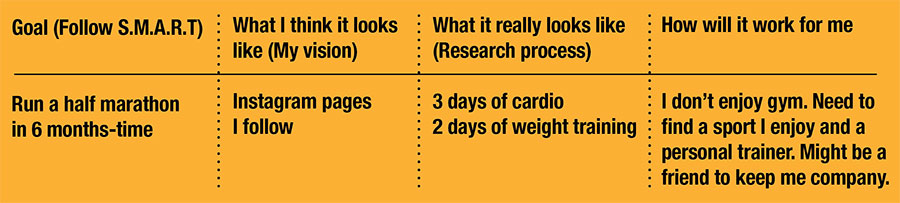
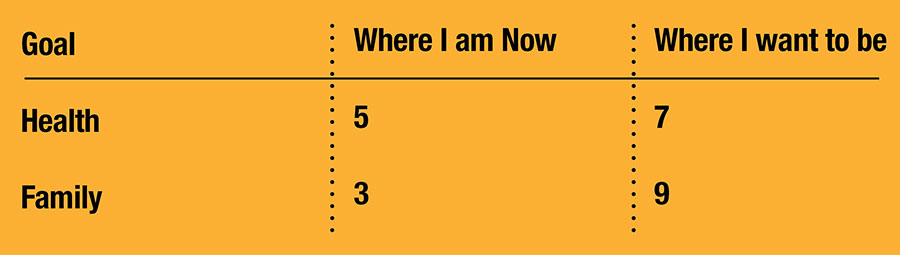
Success doesn’t look anything like you imagine it to be. It’s because we usually imagine the end. You’re likely to have already experienced success in some areas of your life. Success is not a linear trajectory at all. It has ups and downs, spirals, resets and multiple restarts. When we set goals so much of our focus is on the destination. The phrase “pursuit of happiness” comes to mind. Reimagine this to become the “happiness of pursuit.” Instead of imagining what it looks like to achieve the goal, envision the process it will take to get you there. Research the stories of the people you admire and observe what they have endured to achieve the same goal. A vision of success can be very alluring, whereas a focus on the process allows us to step back into reality. From this place we can easily see what will go wrong, or right, and find practical substitutes and solutions. You can use the below framework as an example.


02 Redefine success. Is your goal really yours?

We’re navigating a noisy world. Everyone has good ideas, and most annoyingly, everyone has a good idea for us! The modern-day challenge is deciding on what to focus, prioritize and invest. The main reason we don’t achieve goals is because we lack attention. Bruce Lee said, “I fear not the man who has practiced 10,000 kicks once, but I fear the man who has practiced one kick 10,000 times.” This is because of two things. First of all, daily distractions – such as phones, Netflix and the people we surround ourselves with. Secondly, we’re not focusing on what we care about.

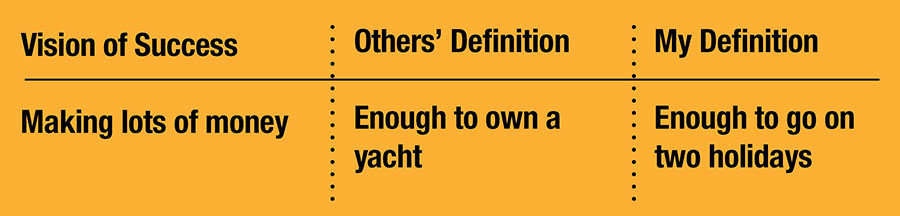
To give something our attention requires it to have meaning, purpose and a deeper reason for doing so. Often, in the process of chasing our goals, we start chasing goals that we’ve adopted and borrowed from those to whom we’ve spoken, listened or read about. Our vision of success has become clouded by the visions of others. A simple exercise is to get specific about the parts of your vision you identify with, and those that you don’t. Lack of attention to detail means we disregard things that are meaningful and prioritize that which is not.


03 Rewrite Success. Balance is a myth

In a speech given by Coca-Cola’s former CEO Bryan Dyson, at the 172nd commencement of the Georgia Tech Institute in 1991, he asked the audience to imagine life as a game in which you juggle five balls in the air. He named the balls ‘work,’ ‘family,’ ‘health,’ ‘friends’ and ‘spirit.’ Just the thought can seem daunting. If you’ve ever tried juggling you’ll know how difficult it can be to juggle three balls, let alone five. Life often feels like this too. When trying to balance everything, we seem to accomplish nothing. You can have it all, but not at the same time. Life consists of phases and it’s important to consider which phase you’re in. Different phases have different priorities.


04 Redo. Fail like a scientist

If you want to plan a successful 2018 you need to starting testing and experimenting now. October through December is the perfect time to try out new ideas, new routines, find the right partners and create new habits. This will ensure that by the time 2018 arrives, you’ll be as effective as possible. If you’re able to overcome known obstacles, unearth unknown challenges and still resolve them this year, then 2018 has the potential to be a hugely different experience.


The Four Things That Will Make You Matter

For years I wondered why some ordinary people consistently had extraordinary opportunity and why many extraordinary people languished in a kind of invisible frustration.

I was recently doing a private review of clients and projects I’ve been involved with over the past three decades. I was trying to identify what people consistently thought and did who achieved the amazing versus many talented people and organizations that underachieved.

I used a personal filter measuring winning not only in the public sense of growing a healthy enterprise or distinguished successes in art and science, but I also looked at private success. Success with family, relationships and a capacity for joy and contentment. Once I got my list I examined the most recent research on personality and habits correlated with high and admirable achievement. It looks like my life experience and recent research agree on the most important drivers of admirable success. Let me boil it down to four things.

1. People I most admire are… Optimistic realists.

I’ve worked with my share of dreamers and so-called visionaries. They constantly leap from one big idea to the next while positive realists nearly always see the opportunity of sustaining their efforts through setbacks and boredom. Creative persistence is the key. It requires neither doing the same thing over and over nor jumping ship before the sails unfurl. Instead, it is a constant energetic process of evolution that enables you to become great over time.

2. People I most admire practice… Practical Empathy.

There are four ways of seeing others, and I have seen all these ways up close, causing either disappointment or success. At one extreme is the self-interested bully. They just demand what they want. Right next to them is the charming narcissist. These people act like they care but only to manipulate you. Lots of powerful people are bullies or charming narcissists, just none I admire.

At the other end are people who are emotionally empathetic. They literally feel what others feel. They make good friends, but it’s hard for them to build enterprises. They often mistake a person’s potential for their performance. They wait too long to make hard decisions. They are usually bound in a web of competing commitments and they hate to say no. I know this type very well because it’s most like me. The most effective place to be on the empathy scale is the mid-range. I call it practical empathy. Walt Disney had it. Howard Schultz has it. So do most other big scale leaders that we have good reason to admire.

Practical empathy enables you to understand the needs, desires, and problems of others without letting emotion cloud your judgment or prevent you from making tough choices. Practical empathy is very rare, I found. Most of us either don’t really care or care too much. Practical empathy is what enables a person to take a small opportunity and grow it into something big.

3. The people I most admire have… Hungry Humility.

By hungry humility I mean a desire to learn that overwhelms any need to be right. Rare?… you bet. Power and success annihilate humility in most of us.

4. Finally, the people I most admire are driven by one guiding principle… Moral Ambition.

This is the persistent desire to create honest-to-goodness value for other human beings. I find of course, no one is perfect, but there are some that are striving to be better at doing better. I know a great CEO-owner of a large scale imprinted t-shirt and sports uniform business who brims with moral ambition. It shows up in how he treats, pays, and educates his hourly workforce. It also shows in his commitment to sustainability and the environment.

I see persistent moral ambition at Nike to create a “Better World” by inventing sustainable materials and manufacturing and most especially by training thousands of young women athletes in emerging countries to build their confidence. I see moral ambition at Clif Bar that bakes genuinely healthy energy bars and believes employee’s lives’ are as important as their work. I could go on.

I know many successful leaders with moral ambition because I seek them out. Creating value for humanity is not an afterthought. It is their core business strategy. Yes, moral ambition is at the root of the greatest people I know. Not just leaders but of all the people I’ve come to admire.

When moral ambition is channeled and released through optimistic realism, practical empathy, and hungry humility it becomes a force. A powerful, unstoppable force. It all begins with asking yourself “what am I trying to accomplish… is this the best I can do?” So the question I ask of people that want to achieve something great is this…

“When you get up in the morning do you look in a mirror or through a window?”


31 Ways to Become a Real Leader

The term Commanding Officer (CO) has long been associated with military hierarchy. At the top of the military ladder is the position of Commander in Chief. Commanders at each level are often referred to as the “superior” of levels below.

In my experience dealing with the best and the brightest who serve our country, very few commanders see themselves as superior.

In fact, effective COs celebrate the equality of those in their charge. They know success comes when everyone feels empowered to lead and take their share of responsibility. Further, they believe in humility, respect, empathy, and integrity every bit as much as discipline. The same is true in business.

A Chief Operating Officer (COO) could be viewed as the business equivalent of the military CO. In some companies, the COO is the individual in charge. But the best COOs (and CEOs) also know they need to create a culture where everyone shares the attributes of a strong COO.

If you don’t have a Chief or a commander title, you can choose to act like a COO or a CO no matter where you are on the ladder. Here is what great COOs and COs do, according to four Chiefs, Alexander TuffRyan CaldbeckJeremy Bromberg, and Mark Hamade.

  1. Ask good questions
  2. Be transparent and open
  3. Strive for alignment with effective communication
  4. Be a life-long learner
  5. Surround yourself with life-long learners
  6. Plan the work and work the plan
  7. Improve everything you touch
  8. Focus on details
  9. Control your ego
  10. Be data driven
  11. Lead by supporting
  12. Keep your cool
  13. Prioritize
  14. Be resourceful
  15. Be practical
  16. Be unassuming
  17. Be a great listener
  18. Be a free thinker
  19. Be a clear communicator
  20. Be strong with numbers (analysis, metrics) and letters (writing)
  21. Have an appropriate sense of urgency
  22. Develop a great eye for detail
  23. Be passionate about company success, and know that personal success is an outcome of company success, not the other way around
  24. Advocate for employees at all levels
  25. Advocate for good ideas, regardless of where they come from
  26. Be energetic, even if quietly
  27. Be a master integrator
  28. Champion continuous improvement in everything
  29. Don’t let allow perfect to get in the way of progress
  30. Be a team player
  31. Build trust

Their advice is spot on, and in line with everything I know and teach about being Chief. Who needs the title anyway?