In 1968, then Stanford professor Paul Ehrlich and his wife, Anne, published The Population Bomb. The book sounded the alarm about the growing population of humans around the globe and the impact rising population numbers would have on our planet.
The book predicted mass starvation in the 1970s, a subsequent breakdown of society, and the degradation of the natural world. Paul and Anne Ehrlich offered a singular prescription – to save the planet and humanity people should stop having children.
Although The Population Bomb galvanized activists and policy makers, the widespread famine that was predicted never materialized and Ehrlich’s claims have largely been debunked. In my view Ehrlich was only partly wrong, a growing population does indeed stress the natural world. The typical middle school study of food webs and habitats makes this quite clear. However, the idea that there is a single solution to creating a sustainable world was and is still erroneous. The climate movement has since been plagued by one-hit-wonder solutions for government and large industries.
We are in a critical phase of a climate crisis that threatens the future of civilization and the survival of the human species. As is the case with most big problems, there are multiple solutions. As impact business leaders, even if we don’t lead traditionally “green” businesses, we all have an important role to play. Sustainability is everybody’s business.
But it’s easy to understand why many business leaders are just waking up to this idea. Instead of helping us to think of the earth as a system with interconnected organs of which humans and human run business are one part, climate communicators have tried to simplify climate response into ONE BIG ACTION that everyone should focus on. But in fact, there is a kaleidoscope of climate solutions that intersect with each other and the way we all do business. And to better understand those intersections, we all need to communicate more effectively about the complex problem and the both expected and unexpected solutions.
According to Project Drawdown’s research, reducing food waste (10.3-18.8 gigatons of carbon dioxide emissions avoided) and educating girls (as much as 85.4 gigatons of carbon dioxide emissions avoided),are just as impactful as driving electric vehicles 11.9-15.7 gigatons of carbon dioxide emissions avoided). The choice to use smart thermostats can have 50% of the impact created by restoring tropical forests. And it is increasingly clear that these choices aren’t just good for the planet. Sustainable business is good for the bottom line, with Drawdown estimating the potential for the business sector to save trillions of dollars.
An incredibly exciting finding is that equity and sustainability are mutually reinforcing. Making sure that girls and women have full access to education and can obtain healthcare that allows them to plan the size and timing of their families can have an outsized impact on our collective future. Project Drawdown estimates that related reductions in carbon dioxide emissions could reach 85.4 gigatons. And what’s more, investments in health and education for girls and women compound over time. It is a gift that keeps on giving. As impact business leaders we know that often it’s not what we do, but how we do it. Building a sustainable business will benefit the planet and our pockets, but can also have enormously positive impacts on the lives of people. At PCI Media we’re proud to partner with organizations like UNEP to bring greater visibility to programs like Switch Africa Green that support eco entrepreneurism.
Our Livable Planet portfolio is dedicated to educating and inspiring audiences about how they can develop a sustainable solution set that makes sense for them, their communities, and businesses.
With every seemingly small decision we make from meal plans, to office maintenance, to employee health and education funds, we have the power to create a more sustainable and equitable world.
In a world reeling from the impact of COVID-19, investing in public transport could create 4.6 million jobs by 2030 and cut transport emissions, mayors in some 100 cities have said.
A “green and just recovery” with investment in buses and trains, particularly electric vehicles, would also reduce car use and air pollution, and protect vulnerable residents, said C40, a network of cities pushing for climate action.
“The road to recovery is paved with investments in our infrastructure,” said C40’s Cities Climate Leadership Group chairman and Los Angeles Mayor Eric Garcetti, in a statement.
“Public transportation is more than just a way to move people around. It’s a vehicle for opportunity, equity, and a better quality of life.”
Several major public transport systems were decimated by the new coronavirus pandemic as cities ground to a halt, with New York predicting a $6 billion deficit in 2021 and Paris losing nearly $4 billion in revenue in 2020, the C40 report said.
Home to 60% of the world’s population, cities have borne the brunt of the crisis, with nearly 100 million people – mostly women and ethnic minorities – at risk of poverty due to the economic fallout, the report said.
Every $1 invested in public transport could generate $5 in economic returns, while every $1 billion invested could create 50,000 jobs, the C40 report said.
Cities are key to combating climate change because they generate three-quarters of carbon emissions, earlier studies have found, with urgent action needed to meet a 2015 goal to avoid catastrophic warming.
C40 said a green recovery would also support low-income workers who rely on public transport to get to work, especially women and young people – who the United Nations says have been hit hardest by job losses during the pandemic.
“This is the time to invest in strong local public services, including in public transport infrastructure to ensure a just, prosperous and green future for all,” said Rosa Pavanelli, head of Public Services International, a trade union.
“Without strong public transport systems, workers – especially women, migrant, young, precarious and informal workers — face greater barriers to access employment,” said Pavanelli, whose union is backing C40’s investment call.
By Lin Taylor @linnytayls, Editing by Katy Migiro.
All life on Earth, and human civilization, are sustained by vital biogeochemical systems, which are in delicate balance. However, our species — due largely to rapid population growth and explosive consumption — is destabilizing these Earth processes, endangering the stability of the “safe operating space for humanity.”
Advanced human societies emerged during an unprecedented period of stability on Earth. During the 12,000 years prior to the Industrial Revolution, our planet’s surface temperature varied by less than 1° Celsius (1.8° Fahrenheit) above or below the average for that entire period. As a result, life — both human and wild — thrived.
But over the past two centuries, humanity has dramatically increased greenhouse gas concentrations in the atmosphere, pushing us outside this “safe” climate zone; outside the conditions for which civilization has been designed.
Unfortunately for us, climate change represents just one of nine critical planetary boundaries, which the imprudent actions of our species risk dangerously destabilizing and overshooting.
The Nine Planetary Boundaries
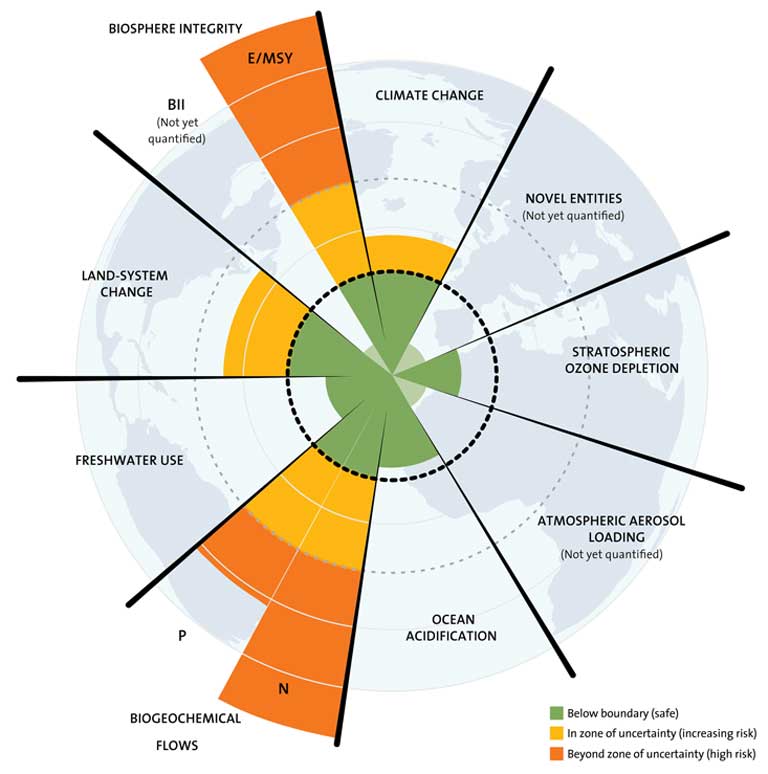
The Planetary Boundaries Framework (last updated in 2015) defines nine key Earth System processes and sets safe boundaries for human activities. They are:
1. Climate change: Rising concentrations of greenhouse gases in the atmosphere are leading to increasing global temperatures. We passed the safe boundary of 350 parts per million of CO2 in 1988. By 2020, levels were 417ppm.
2. Novel entities: One of the more elusive planetary boundaries, novel entities refers to harmful chemicals, materials, and other new substances (such as plastics), as well as naturally-occurring substances such as heavy metals and radioactive materials released by human activities. We release tens of thousands of synthetic substances into the environment every day, often with unknown effects. These risks are exemplified by the danger posed by CFCs to the ozone layer, or of DDT to biodiversity.
3. Stratospheric ozone depletion: The depletion of O3 in the stratosphere as a result of chemical pollutants was first discovered in the 1980s and led to the 1987 Montreal Protocol on Substances that Deplete the Ozone Layer. The ozone layer is now showing signs of recovery.
4. Atmospheric aerosols: Atmospheric aerosol pollution is a bane to human health and can also influence air and ocean circulation systems that affect the climate. For example, severe aerosol pollution over the Indian subcontinent may cause the monsoon system to abruptly switch to a drier state.
5. Ocean acidification: Rising atmospheric CO2 levels are increasing the acidity of the world’s oceans, posing a severe risk to marine biodiversity and particularly invertebrates whose shells dissolve in acidic waters.
6. Biogeochemical flows: We have profoundly altered the planet’s natural nitrogen and phosphorus cycles by applying these vital nutrients in large quantities to agricultural land, leading to runoff into neighboring ecosystems.
7. Freshwater use: Agriculture, industry and a growing global population are putting ever greater strain on the freshwater cycle, while climate change is altering weather patterns, causing drought in some regions and flooding in others.
8. Land-system change: Changes in land-use, particularly the conversion of tropical forests to farmland, have a major effect on climate because of the impact on atmospheric carbon dioxide concentrations, on biodiversity, freshwater, and the reflectivity of the Earth’s surface.
9. Biosphere Integrity: The functional integrity of ecosystems is a core planetary boundary because of the many ecoservices they provide, from pollination to clean air and water. Scientists are concerned about rapid declines in plant and animal populations, the degradation of ecosystems, and the loss of genetic diversity which could disrupt essential biosphere services.
The nine planetary boundaries, counterclockwise from top: climate change, biosphere integrity (functional and genetic), land-system change, freshwater use, biogeochemical flows (nitrogen and phosphorus), ocean acidification, atmospheric aerosol pollution, stratospheric ozone depletion, and release of novel chemicals (including heavy metals, radioactive materials, plastics, and more). Image courtesy of J. Lokrantz/Azote based on Steffen et al. 2015 (via Stockholm Resilience Centre).
A safe operating space for humanity
In the mid-2000s, Johan Rockström, founding director of Sweden’s Stockholm Resilience Centre, gathered an international, interdisciplinary team of scientists to unite behind a single goal: define the boundaries for a “safe operating space for humanity” on Earth. They asked themselves: what are the safe operating limits of our planet, and what changes can we force on it before we trigger rapid, catastrophic environmental harm?
In 2009, the center published the Planetary Boundaries Framework, which outlined nine key processes, influenced by humanity, that threaten the stability of the entire Earth System. These are: climate change, biodiversity integrity (functional and genetic), ocean acidification, depletion of the ozone layer, atmospheric aerosol pollution, biogeochemical flows of nitrogen and phosphorus, freshwater use, land-system change, and release of novel chemicals (including heavy metals, radioactive materials, plastics, and more).
Omulyakhskaya and Khromskaya bays, northern Siberia, an Arctic region where permafrost melt and methane release to the atmosphere is rapidly escalating, contributing to climate change. Image by NASA Goddard Space Flight Center.
Together, the stability of these nine processes is essential to maintaining the Earth’s atmosphere, oceans and ecosystems in the delicate balance that has allowed human civilizations to flourish. However, these are also the processes that human activities have impacted most profoundly.
The researchers then estimated a limit of just how much human activities could exploit and alter each of these processes before the global system would pass a tipping point — a threshold beyond which we risk sending the Earth spiraling into a state that hasn’t been experienced for the entirety of human existence, bringing extreme change that could crash civilization and endanger humanity.
“Systems — from the oceans and ice sheets and climate system and ecosystems — can have multiple stable states separated by tipping points,” explained Rockström, now the director of the Potsdam Institute for Climate Impact Research. If those “stable” systems are pushed too far, he said, they lose resilience and can transition, abruptly and irreversibly, into a new self-reinforcing state — one that might not support humanity.
The original 2009 Planetary Boundaries report, and its update in 2015, revealed a stark assessment: researchers found that humanity is already existing outside the safe operating space for at least four of the nine planetary boundaries: climate change, biodiversity, land-system change, and biogeochemical flows (Earth’s nitrogen and phosphorous cycles, which are being heavily impacted by global agribusiness and industry).
However, the experts warn, these limits are estimates: what we don’t know is how long we can keep pushing these key planetary boundaries before combined pressures lead to irreversible change and harm. Think of humanity, blindfolded, simultaneously walking toward nine cliff edges, and you gain some sense of the seriousness and urgency of our situation.
However, the experts warn, these limits are estimates: what we don’t know is how long we can keep pushing these key planetary boundaries before combined pressures lead to irreversible change and harm. Think of humanity, blindfolded, simultaneously walking toward nine cliff edges, and you gain some sense of the seriousness and urgency of our situation.
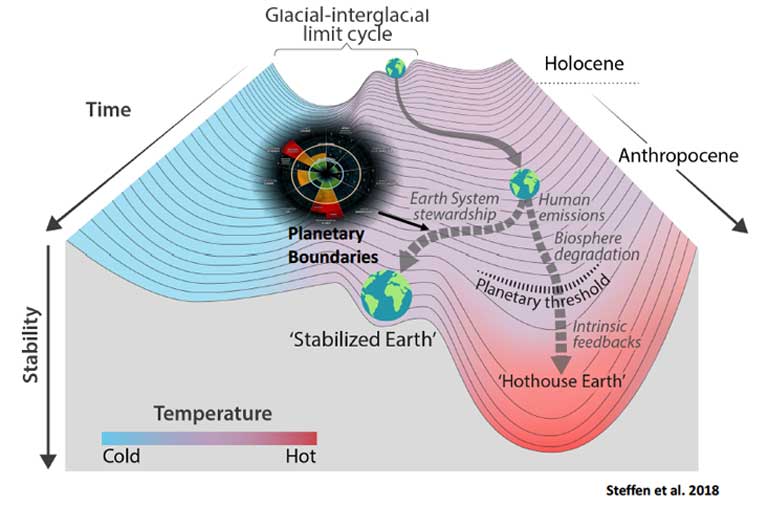
Earth Trajectories: Think of the Earth’s climate taking different trajectories through time — pathways weaving between different climate states. Different paths through all the possible climates can be influenced by distinct tipping points. Self-reinforcing feedback processes can lock the planet into a particular trajectory for centuries or millennia. There is no evidence that modern societies can exist, let alone thrive, in conditions substantially different from the Holocene. Image courtesy of Steffen et al. (2018).
Earth Trajectories: Think of the Earth’s climate taking different trajectories through time — pathways weaving between different climate states. Different paths through all the possible climates can be influenced by distinct tipping points. Self-reinforcing feedback processes can lock the planet into a particular trajectory for centuries or millennia. There is no evidence that modern societies can exist, let alone thrive, in conditions substantially different from the Holocene. Image courtesy of Steffen et al. (2018).
Dawn of the Anthropocene
The dynamics of large, complex and interconnected biogeochemical systems like those operating on Planet Earth can be thought of in terms of pathways or trajectories, weaving between different steady states. The Earth’s trajectory can be altered by tipping points, which shift us from one steady state to another (something like a car changing gears). A number of complex feedback processes can either reinforce the current steady state, or weaken it, and send the planet spiraling toward a completely new state, like a bowling ball with too much spin careening toward the gutter.
Climate change, the best known of the nine planetary boundaries on which we’re encroaching, offers a good example of how this equilibrium process works.
Today, “We are at risk of triggering tipping elements in the Earth System towards a ‘Hothouse Earth’ from which it would be very difficult to recover to pre-industrial climate,” explained Steven Lade, a Stockholm Resilience Centre researcher specializing in social-ecological system modeling.
However, “with rapid decarbonization we could possibly reach a ‘Stabilized Earth,’” he added, maintaining our climate within the safe window of conditions to which humanity has adapted over the last 12,000 years.
The period of Earth climate stability in which our societies have thrived is known as the Holocene epoch. Beginning some 12,000 years ago, it marked the end of more than 100,000 years of alternating glacial and interglacial periods that saw the planet’s temperature fluctuate by as much as 6°C (10.8°F).
Modern humans have existed for about 200,000 years, but it was “only in the last 10,000 years that we were able to develop civilization as we know it,” Rockström said. “The very origins of modern civilization, namely domestication of animals and plants and the establishment of agriculture, happened in the Holocene.”
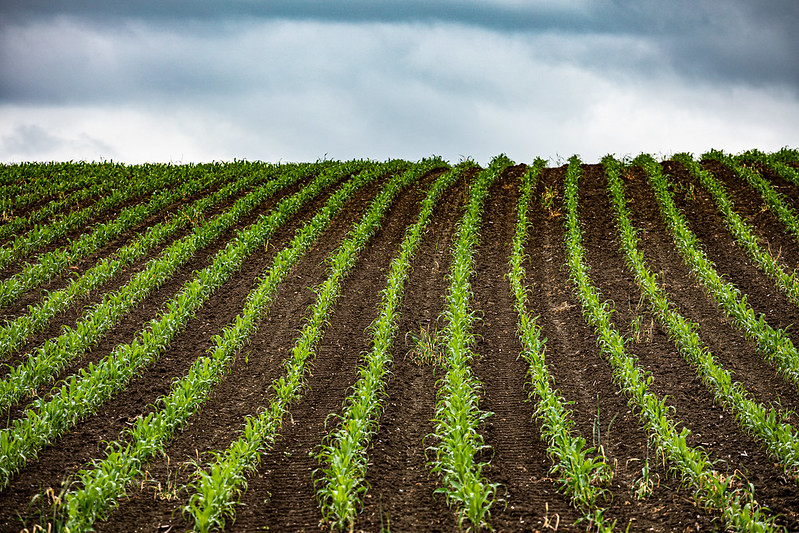
The world’s crops will need to feed 8 billion people by 2023, putting incredible pressure on Earth Systems. Image by Albert Aschl.
Yet these very same hallmarks of our extraordinary success — agriculture, sedentary living, industrial manufacturing — are today fundamentally altering many Earth System processes responsible for keeping conditions on Earth stable.
In fact, our transgressions of the nine planetary boundaries have been so severe that geologists believe we have entered a new epoch in the Earth’s history. The start of the Anthropocene — a human-influenced period that scientists say was initiated somewhere between 10,000 and 70 years ago — has been marked by rapid, human-triggered increases in greenhouse gas emissions, large-scale land-use change, extreme biodiversity loss, and massive global consumption and pollution brought on by rapidly advancing technology and a booming Homo sapiens population.
The dawn of the Anthropocene, a new epoch, needs to serve as a warning, Rockström said, that “we’re starting to hit the ceiling of the biophysical coping capacity of the whole Earth System.”
On a path to climate and biodiversity overshoot
Six years on from the last Stockholm Resilience Centre update (another is due this year), Rockström noted there is little evidence we’ve reversed course to avoid looming tipping points. “If anything, we are even deeper into the transgression of climate, on biodiversity, on land-use, and on nitrogen and phosphorus. So we have not turned around the [2015] trends.”
Of the four boundaries that researchers say we have already exceeded, climate change and biosphere integrity are considered “core” planetary boundaries because either one, on its own, could change the course of Earth’s trajectory and endanger humanity.
“There’s enough science today to say that [human-induced climate change] on its own can knock the planet away from the Holocene state,” Rockström said. “Similarly, if we just continue our mass extinction, losing more and more species, from phytoplankton to top predators, you will come to a point where the whole planet [system] collapses.”
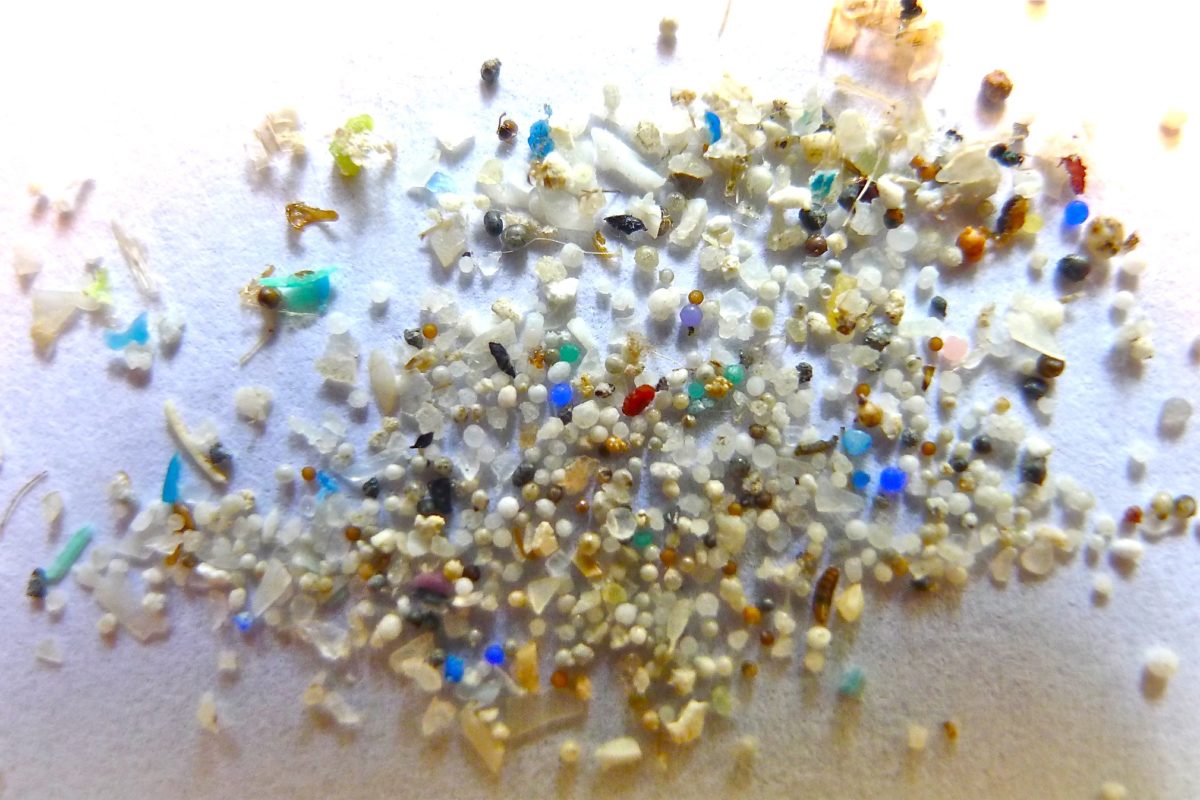
What we can’t see can hurt us: Microplastics like these are an example of novel entities — materials, chemicals, nanotech particles, even new life forms, created by humans and released into the environment, often with unknown effects. Novel entities may represent a third core boundary, in addition to climate and biodiversity, because of the potential for a global disaster resulting from a human-made substance that, for example, influenced animal and human fertility. Image by Oregon State University.
There is strong evidence we’re already in the midst of a global mass extinction. A 2019 assessment by the Intergovernmental Science-Policy Platform on Biodiversity and Ecosystem Services (IPBES) reported that 25% of plants and animals assessed — totaling 1 million species worldwide — are threatened with extinction. A separate study found that more than 500 vertebrate species are on the brink, each with fewer than a thousand individuals remaining in the wild.
Importantly, researchers say we are flying blind when it comes to both the quantity or quality of biodiversity loss that can be tolerated by ecosystems before triggering irreversible change.
“IPBES made it clear that we have really high extinction rates right now and they’re getting higher,” said Rebecca Shaw, chief scientist and senior vice president of WWF. However, data not on extinctions, but on total population declines, are actually more informative for assessing biosphere health, she said, noting, “By the time species are moving to extinction there’s very little you can do.”
“We should really be looking at population [abundance] declines around the world, and nest that with ecosystem integrity measures, and nest that in [measures of] the way ecosystems are functioning to deliver services to humans,” Shaw explained.
According to WWF and the Zoological Society of London’s (ZSL) 2020 Living Planet Report, population sizes of mammals, birds, amphibians, reptiles and fish declined by 68% on average between 1970 and 2016 — a strong alarm call.
Early warnings
Scientists are now detecting the first flashing warning lights on the Earth System dashboard, telling us humanity is already pushing beyond our world’s safe operating space for multiple planetary boundaries and approaching tipping points.
“We have changed the planet so much that it is very likely that there will be significant impacts, and we’re seeing those impacts in the last five years,” Shaw said.
An example: melting of the Greenland and West Antarctic ice sheets has accelerated since the early 1990s, suggesting these colossal ice deposits may have now entered a new state of sustained and escalating retreat, after many centuries of stability. Contained within these now vulnerable ice sheets is enough water to raise the global sea level by more than 65 meters (213 feet).
Similarly, Arctic sea ice is retreating and scientists predict the region could be mostly ice-free in the summer as early as 2035 — with no certainty of what extreme changes this might bring.
Other early warning signs that we are approaching a climate change tipping point include increasingly frequent and severe droughts, heat waves, storms, and tropical cyclones.
“The number of climate-related natural disasters is climbing at an alarming rate, with significant economic and health impacts, especially for the most vulnerable,” said Ana María Loboguerrero Rodríguez, head of Global Policy Research for the CGIAR Research Program on Climate Change, Agriculture and Food Security (CCAFS).
No one knows how much stress civilization can withstand before it starts to collapse.
Feedback loops upon feedback loops
These early changes are signs of an impending shift from once stable Holocene conditions, say scientists. More concerning: many of these changes are expected to create positive feedback loops that further accelerate change.
For example, the continued melting of the Greenland ice sheet will not only cause major sea level rise, but also could alter ocean surface temperature and salinity, potentially triggering a transition in ocean circulation systems like the Atlantic Meridional Ocean Circulation (AMOC), which in turn could drastically alter global climate, and even accelerate the loss of the East Antarctic Ice Sheet.
However, it’s not all likely to be bad news: some feedback loops may have a balancing effect on the climate and on other planetary boundaries. “Which of these feedback loops wins, and when, is one of the big questions about our future climate,” Lade said.
Still, these reinforcing loops could trigger more complicated cascades of change. “The whole Earth System is a complex self-regulating system,” Rockström said, “if you push one [planetary boundary] too far it can cascade like a domino and impact the others.”
For example, land-use change due to agriculture is the leading cause of deforestation worldwide; it reduces the amount of water released to the air from plant leaves. In the Amazon Basin, this transpiration is a major source of rainfall. But signs are strong that rapid Amazon deforestation — combined with global climate change — may be triggering more extreme drought, leading to an abrupt shift from rainforest to degraded savanna, with profound implications for the entire planet. That biome-wide shift would release a vast store of ancient sequestered carbon, exacerbating climate change, leading to more drought and more tree die-off — a vicious, self-multiplying cycle.
“There is growing concern that, with the recent increase in deforestation rates under Brazil’s [Jair] Bolsonaro government, we may be approaching a tipping point for the Amazon rainforest,” said Will Steffen, emeritus professor at the Australian National University, Canberra, who was part of the team that developed the original planetary boundaries framework. “The three [Earth System tipping points] of greatest concern in my view are the Amazon rainforest, the Greenland ice sheet, and Siberian permafrost.”
The Amazon Rainforest example shows how disruptions to regional processes — such as the cycling of water by trees — can add up and push us toward planet-wide tipping points.
Another tipping point example: the devastating wildfires striking Australia and California in 2019 and 2020. They arose from multiple factors — intensifying drought due to climate change, accumulated leaf litter, unusual wind patterns — that built up slowly. Then, a small human intervention, such as a spark from a utility company power transformer as happened in California, was enough to “change a forest to a shrubland overnight because of climate change,” potentially altering biodiversity, Shaw said. “Climate change really manifests itself in these bursts of catastrophes.”
Regional interactions between planetary boundaries may already be accelerating our trajectory away from a safe Earth operating space. “At a planet scale, you don’t [yet clearly] see these types of things; [but] at the regional scale, it’s really phenomenal how [the interaction between] climate change and biodiversity loss [for example] is manifesting itself,” Shaw noted. “We never thought we’d see [biodiversity] collapse like we’re seeing at the regional scale this early.”
As regional and global change intensifies, scientists warn that it’s what we don’t know about the vast complexity of interactions between Earth System processes — only a fraction of which have been well studied — that concerns them most.
“It is quite frustrating to have to admit that we don’t yet fully understand the fundamental interactions between planetary boundaries,” Rockström said. Even if we are able to bring the climate system back into a safe operating space, he added, “we may by that time have triggered so much forest dieback and so much permafrost thawing and so much ice melt … that the planet has already chosen another route” — another trajectory and steady state not conducive to human civilization.
Food systems key to conserving a habitable Earth
If we are to steer our planet away from a devastating new trajectory, phasing out fossil fuels to reach a net-zero greenhouse gas emissions world economy is a key priority. But even more pressing, experts say, is a change to our food systems.
Food production accounts for nearly 25% of climate-changing greenhouse gas emissions, is the biggest driver of biodiversity loss, the primary cause of land-use change, one of the largest sources of nitrogen and phosphorus pollution, and it generates huge freshwater demand. Because food production generates big carbon emissions, it adds to ocean acidification too. That covers six of the nine planetary boundaries.
Together, “a food-system transformation and an energy transformation would take us a long way back into the safe space,” Rockström said.
“Nothing short of a systemic transformation of food systems is required to feed the world’s current and future population sustainably under climate change,” said CGIAR’s Loboguerrero. Making that sweeping change would not only reduce emissions, but improve health and food security, “providing multiple incentives for behavior change.”
Setting ambitious policy priorities
The next 12 months offer golden opportunities for the global community to come together and agree on policy priorities to set Earth on a trajectory for long-term stability.
Three major international meetings are scheduled for 2021: the Convention on Biological Diversity’s (CBD) 15th meeting of the Conference of the Parties in Kunming, China, from Oct. 11-24; the U.N. Climate Change Conference (COP26) in Glasgow, U.K., from Nov. 1-12; and the U.N. Food Systems Summit in Rome from July 19-21. Measurable, implementable, verifiable, time sensitive, and most importantly, binding targets and agreements are vital.
“It’s a big year for outcomes and for commitments for the next 10 years that will determine whether or not we stay within these planetary boundaries,” Shaw said. At WWF, she added, “we’re looking to work with other stakeholders through those three meetings to get actions to stay within the safe operating zone at both the regional scale and planetary scale.”
Experts are calling for a transformative, holistic approach to avoid risky tipping points, seeing the entire Earth System as a shared global commons, with humans as stewards. “The intertwisted nature of this framework calls for the development of a novel governance approach at global, regional, and local scales,” Loboguerrero said.
One such framework is the Global Commons Alliance, which brings together more than 50 international NGOs, multinational corporations, and city policymakers to promote the adoption of science-based targets to operate within planetary boundaries. But that partnership will need to grow geometrically if we are to act effectively.
Cause for hope
That’s a daunting global goal. But there is one planetary boundary — the first we ever realized we were in danger of crossing — that offers hope: the depletion of the ozone layer. In 1987, the world’s nations recognized the urgency and validity of the science, and embraced the politically binding requirements of the Montreal Protocol. We stepped back from the brink, shrinking the ozone hole, which could now be healed by 2050.
If nations can come together to address climate change, biodiversity loss, and pollution, as they did to address the threat to the ozone layer, then there is a chance we can reverse current trends and steer Earth’s trajectory back toward a stable Holocene state. That chance is growing dimmer — but it is an effort we absolutely need to make.
This story originally appeared in Monga Bay and is republished here as part of Covering Climate Now, a global journalism collaboration strengthening coverage of the climate story, of which Real Leaders is a partner.
We are seeing a confluence of forces directing humankind to consider ecosystems, sustainability, carbon reduction, climate change, soil degradation, water scarcity, and deforestation. But perhaps one of the biggest reasons that a circular economy is gaining momentum is because it is just good business.
In a circular economy, we regenerate products and materials and design out waste and pollution. Today, many companies are searching for — and finding — profitable ways to move from a throwaway economy to a circular economy.
A convergence of factors has led us to this very moment. For one, corporate leaders including Amazon, BP, Shell, Dell, Trane, Google, Cargill, and others feel a responsibility and pressure from customers, employees, and investors to change their wasteful ways.
The take-make-waste model was successful for many decades as highly productive manufacturing factories prospered. But now, we’re witnessing a greater push for circularity, which significantly impacts business, economics, and governments.
The Circularity Gap Report for 2021 shows that we need to double global circularity from 8.6 percent to 17 percent to keep our world livable and thriving. And with the right goals, companies will not only reduce waste but will also make money — if done correctly. A restorative and regenerative economy could potentially generate as much as $4.5 trillion by 2030.
How can businesses tap into this? Here are three key strategies for conducting business in a way that’s both profitable and sustainable.
1. Set Objectives
Establishing the right goals is critical to make money while creating a more circular business model. This can help promote clarity in your business, ultimately leading to better results. Ensure you focus on targets that align with your corporate mission while also meeting your customer and employee needs and expectations.
Here are a few examples:
Amazon is on a path to powering its operations with 100 percent renewable energy by 2025 as part of its goal to reach net-zero carbon by 2040.
Dell will reduce Scopes 1 and 2 greenhouse gas emissions by 50 percent by 2030 and source 75 percent of electricity from renewable sources across all Dell facilities by 2030 — and 100 percent by 2040.
Microsoft commits to being carbon negative, water positive, and zero waste, all by 2030.
By 2030, Google aims to be carbon-free.
These are just a few examples, but the big takeaway is that objectives are specific, measurable, achievable, realistic, and timely. Once the targets are set, create a solid roadmap for your business to meet its goals. Make sure your objectives are intertwined with your company processes and that you have the right systems in place to reach those goals.
2. Learn from Others
One of the best ways we can become more profitable is by learning from others in a similar situation. Many companies — from construction to agriculture — have successfully made a move to a more prosperous and sustainable business model.
Case in point: TK Elevator’s (formerly ThyssenKrupp Elevator) traction elevator systems are equipped with an energy recovery function that allows for energy generated by braking to be put back into the building’s power grid. The company has also proven that refurbishing older elevators can lower its energy consumption by up to 70 percent and extend an elevator’s use phase by an additional 25 years. Talk about value for a business!
3. Leverage Intelligence
For anything to be successful, we need to have people, processes, and technology. Quite simply, we can’t change what we can’t measure. It’s critical to make sure you have the right objectives upfront and ensure you implement the right processes, so your workers have the best chance at being successful. After that’s established, you also need to make sure you have the right technology to make intelligent decisions. This can include the IoT (Internet of Things), AI (artificial intelligence), digital twins, digital transformation — you name it.
Sam George, vice president of IoT Azure, Microsoft, says the first thing he always counsels a customer on is examining what’s really at the core of the business and whether the organization has the ability to know something — faster or in realtime. Even more, how would the organization leverage that data? This is a question to consider as you continue on your circular and sustainability journey.
Technology, along with circularity and sustainability, isn’t a destination. It’s a journey. Set a target, put the processes and technologies in place to meet that target, and then continue to the next objective. We need to continue to move forward, and this is how to do that. The good news is that we can reach for sustainability while also being profitable.
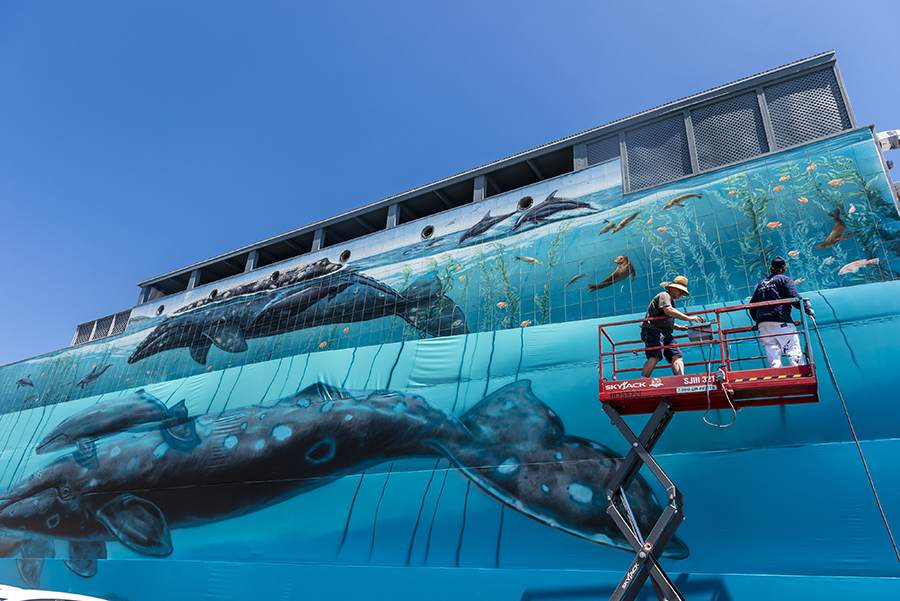
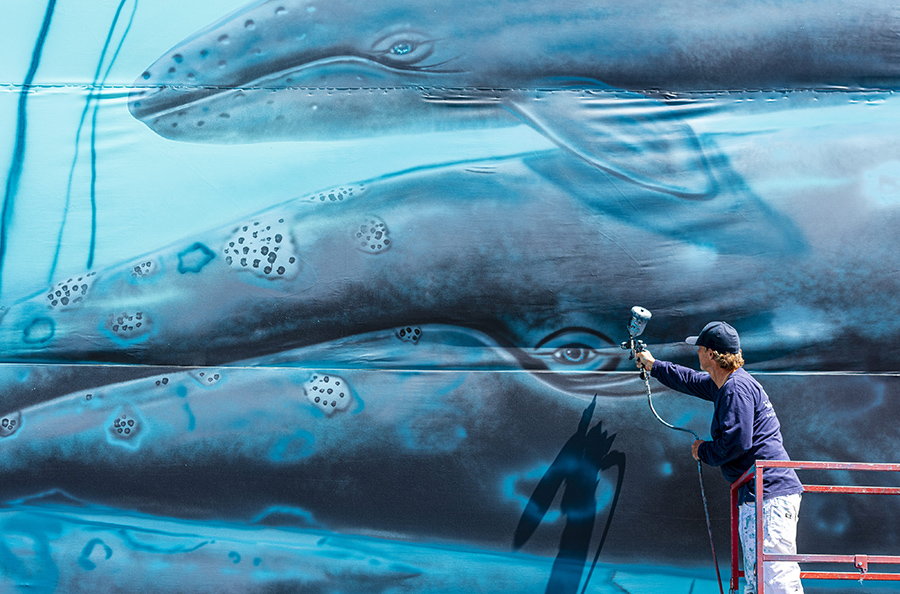
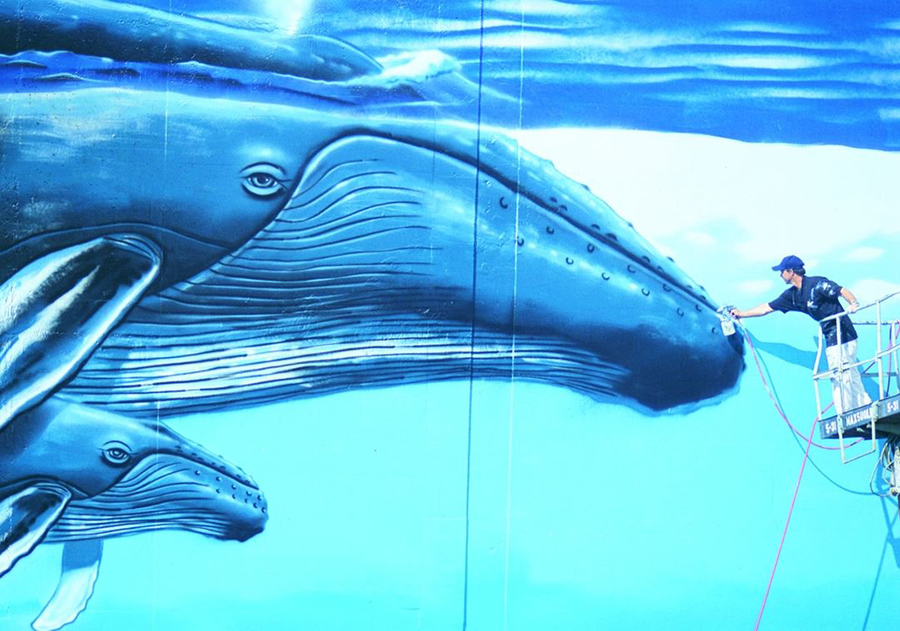
Internationally renowned marine life artist, Wyland, has painted a new building mural to celebrate Earth Month. The new piece will be added to Wyland’s repertoire of over 100 building murals around the globe.
In 1993 Wyland founded the Wyland Foundation — dedicated to promoting, protecting, and preserving the world’s ocean, waterways, and marine life and encourages environmental awareness through community events, education programs, and public art projects.
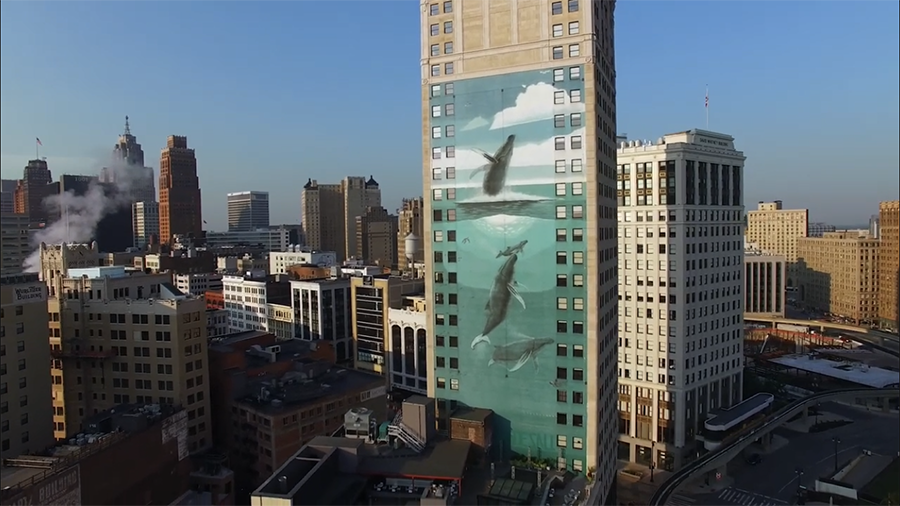
An innovative painter, sculpture, writer, photographer, philanthropist, and filmmaker, Wyland has captured the imagination of people everywhere by completing over 100 monumental marine life murals around the world from 1981-2008. The project, known as the Whaling Walls, remains one of the largest public arts projects to date and continues to be seen by an estimated one billion people each year.
To mark its 10th anniversary, the National Mayor’s Challenge for Water Conservation is calling on people across the U.S. to take small, daily actions to reduce water waste and promote the sustainability of our nation’s water ecosystems. The challenge, presented by the Wyland Foundation and Toyota, kicked off with a live mural painting at Tuttle Elementary in Sarasota, Florida.
The mayor’s challenge started ten years ago in Florida by a handful of mayors who contacted the Wyland Foundation to work together on positive ways to more creatively engage and inspire their residents about water issues. Participants in the winning cities are eligible to win hundreds of prizes and last year, the challenge awarded more than $50,000 in prizes to nearly 300 residents in U.S. cities.
“In the last ten years, we’ve seen climate change and shifting weather patterns affect the distribution of water, pollution impacting the quality of water, and fresh water sources that are being used at a quicker rate than they are bring refilled,” said Wyland Foundation President Steve Creech. “That’s why it’s so important to have programs like this where people can learn what they can do to help.”
Last year, mayors from 39 states encouraged residents to make over 300,000 pledges to promote drought resiliency, protect watersheds, and, ultimately, reduce stress on aging water infrastructure. Events planned for the 10th anniversary include a multi-city Florida tour of the Wyland Foundation’s clean water mobile learning center, a 1,000-square-foot science center on wheels devoted to teaching communities about current issues ranging from water pollution, biodiversity, algae blooms, water as a shared resource, and best practices to protect marine habitats. A new digital engagement tool will provide additional opportunities for people who participate in the challenge to turn their pledges into specific localized actions that can have a positive impact.
Companies big and small are undertaking a green rethink, as awareness grows of the need for businesses that take better care of the planet
Chile’s climate action champion Gonzalo Muñoz has the tough task of teaming businesses with governments to help meet the global warming limits set in the 2015 Paris accord. As an entrepreneur who runs a winery and a recycling firm, he knows the challenge.
Muñoz co-founded circular economy company TriCiclos in 2009 after a decade of managing food businesses, where he noticed “how much garbage I was putting into the market” with unsustainable packaging.
Unable to convince executives to shift to a greener model, he and his partners started producing mobile recycling stations, which can handle 90% of household solid waste and are now deployed in about 10 Latin American countries.
“We identified the problem (of) waste as an error of design,” he said. And to deal with that environmental problem, “we have to correct every single design”, including how a product is disposed of and its materials reused, he added.
Today, a growing cohort of companies – big and small – are undertaking a similar rethink, as awareness grows of the need for goods and services that take better care of the planet.
Many are rushing to sign up to responsibility initiatives such as B Corp, which legally requires its more than 3,500 certified companies to consider how their decisions impact workers, customers, suppliers, community and the environment.
Almost 800 B Corp firms, and 200 other companies, have also pledged to more rapidly cut their planet-heating emissions to net zero by 2030, aiming to keep global warming to 1.5 degrees Celsius, the lowest goal in the Paris Agreement, Muñoz said.
Ahead of this year’s postponed COP26 U.N. climate summit, one key aim is to bring smaller businesses, including startups, together with multinationals under a new “Race to Zero” alliance launched by the U.N. climate secretariat in June, he added.
“This (climate challenge) is something that none of us can solve alone,” Muñoz told the Thomson Reuters Foundation. “A fundamental part of this is that we have to solve it together.”
Unilever announced recently that it would allocate 1 billion euros ($1.2 billion) for a “Clean Future” program to help it remove fossil fuels from its cleaning products and replace them with renewable and recycled ingredients by 2030.
The household products giant invited those with “an idea for an innovation, solution or opportunity” to contact it about becoming a partner.
Huge corporations are increasingly looking to work with smaller, nimbler companies with cutting-edge technology and ideas that could help fix the damage done by global capitalism, those working to foster such partnerships said.
Genecis Bioindustries, a Canada-based clean-teach startup that converts food waste into biodegradable plastics, for instance, aims to help big brands turn to eco-friendly packaging for everything from food to textiles, according to its website.
Its twin aim is to cut plastic pollution and greenhouse gas emissions from landfills.
Genecis’s growth and partnerships lead Robert Celik said the company was already working with French food services multinational Sodexo to take waste from its clients’ cafeterias and transform it into biopolymers to use in new products.
It also has a collaboration with Danish pharmaceuticals manufacturer Novo Nordisk to re-purpose medical waste.
Such deals are important because “they provide us with the resources we really need to implement the solution at scale”, said Celik.
For big firms, the advantages of such hook-ups lie in being able to tap into disruptive technology and business models without assuming all the risk — and then scaling up fast if something works, he and others said.
“If big companies want to make a difference they really should be engaging startups,” Celik said.
“It actually might make it easier for them to achieve very ambitious targets” — whether on climate change or other sustainable development goals, he added.
Genecis hopes to launch commercial bioplastic products in two to three years, Celik said. But working with larger corporations could speed up that process, and is helping it make products that meet real needs in the market, he added.
Meeting market demand is just as important for success as bring driven by a green, ethical mission, said Frans Nauta, founder of ClimateLaunchpad, an annual competition that selects and trains startups tackling climate change around the world.
“Even if your personal motivation might be to help the problem of the polar bear – it is not your customer,” Nauta said. “You can’t talk too much about your obsession for the climate. You should be obsessed with your customer.”
Celik said Genecis aims to make convenient, sustainable replacements for conventional plastics rather than simply target the small percentage of consumers with a green conscience.
“That is a huge game changer,” he said.
Genecis last year won a competition for startups working towards a net-zero emissions future run by global technology conference Web Summit.
Summit organisers put together a new group of green startups that were showcased and introduced to big investors at its virtual gathering in December last year, under a tie-up with the U.N.-backed “Race to Zero” campaign.
Peter Gilmer, Web Summit’s chief impact officer, told the Thomson Reuters Foundation that the profit potential for clean tech startups had “notably increased” in the past decade as more businesses began to sew sustainability “into their DNA”.
But many startups still need to reduce their costs before their low or zero-carbon products can compete on price, he said.
“It’s not that hard an issue to solve… once you get to a certain scale,” said Gilmer, adding that Web Summit aims to help the small firms it curates reach that point more quickly.
Start-ups featured at the summit included Australia-based Soil Carbon Co., which applies a microbial fungi to crops to increase natural carbon deposits in soil.
Another sign-up, Sweden-based Volta Greentech, has developed a red-seaweed cattle feed supplement that can cut an animal’s emissions of methane — a potent greenhouse gas — by up to 80%.
Climate Launchpad’s Nauta said climate action would require changes across a wide range of businesses, involving myriad solutions — from electric transport in cities to biodegradable packaging for food delivery and green aviation fuel.
“Climate change is a thousand problems, so… you need tens of thousands of people trying to fix it in all these different areas,” he said.
By Megan Rowling @meganrowling; editing by Laurie Goering.
Together, we will make choices as though the future of the Earth depends on them. Because it does.
As we are rapidly discovering, the choices we make in our grocery carts affect our entire planet. One of the cheapest, most efficient crops on the market, palm oil, is in roughly 50% of the products we consume—biofuels, shampoo, pizza dough, shampoo and, yes, even some plant-based dairy products. And it’s having a catastrophic effect on our planet.
I founded my nut-based milk company milkadamia, as a way of raising awareness around palm oil, and as a major part of our It’s R Choice campaign, which showcases how we as consumers can make decisions with our wallets that will directly benefit the health of the planet.
As we approach Earth Month we think that the devastation to the planet and to the inhabitants, both human and animal, of Southeast Asia is something that needs to be widely publicized. Consider the following facts on palm oil:
The farming of palm oil is directly responsible for one soccer field of rainforest being lost every second
Malaysia, where palm oil deforestation is rampant, haslost roughly 90% of its original rainforest lands, most of which have been lost in the 30 years since we began consuming palm oil in so many products
Big Food is trying to sell the fallacy that there is such a thing as“Sustainable Palm Oil”
Palm oil is efficient and cheap, meaning it’s not going anywhere unless we act
In our home — a planet where chaos and beauty, so achingly, co-exist — our hope resides in the common-sense of ordinary folk. Nothing is achieved by directing blame-thirsty fingers outward, toward others and away from ourselves – we got into this together, we will experience it, or we will mitigate it, together.
Why be non-dairy? Why promote Regenerative farming? Why reject palm oil when 50% of grocery products use it?
Because even in this increasingly fraught era for our, slightly hand-me-down, yet fantastic planet, we believe steadfastly in the collective ability of people to bring their combined superpowers of meaning, purpose, and community to the fight. We will save that which we love.
Collectively, consumers can speak to the food industry in the language they listen most attentively to – their sales and market share. What we purchase to nourish and support our families – also feeds and supports the companies that produced it. Make them do it right! We, the consumers, have the most powerful and compelling voice. How will you use it?
Change often comes on a macro international level but often times the genesis of this change begins on a local micro one. You might have seen the recent story about one Girl Scout troop outside of New York boycotting the sale of their cookies after they learned they were made using child labor in Indonesia and Malaysia.
Can a group of young girls bring this issue to light in a way that governments can’t? We wouldn’t bet against them.
The planet had already warmed by around 1.2℃ since pre-industrial times when the World Health Organization officially declared a pandemic on March 11 2020. This began a sudden and unprecedented drop in human activity, as much of the world went into lockdown and factories stopped operating, cars kept their engines off and planes were grounded.
There have been many monumental changes since then, but for those of us who work as climate scientists this period has also brought some entirely new and sometimes unexpected insights.
Here are three things we have learned:
1. Climate science can operate in real time
The pandemic made us think on our feet about how to get around some of the difficulties of monitoring greenhouse gas emissions, and CO₂ in particular, in real time. When many lockdowns were beginning in March 2020, the next comprehensive Global Carbon Budget setting out the year’s emissions trends was not due until the end of the year. So climate scientists set about looking for other data that might indicate how CO₂ was changing.
We used information on lockdown as a mirror for global emissions. In other words, if we knew what the emissions were from various economic sectors or countries pre-pandemic, and we knew by how much activity had fallen, we could assume that their emissions had fallen by the same amount.
By May 2020, a landmark study combined government lockdown policies and activity data from around the world to predict a 7% fall in CO₂ emissions by the end of the year, a figure later confirmed by the Global Carbon Project. This was soon followed by research by my own team, which used Google and Apple mobility data to reflect changes in ten different pollutants, while a third study again tracked CO₂ emissions using data on fossil fuel combustion and cement production.
The latest Google mobility data shows that although daily activity hasn’t yet returned to pre-pandemic levels, it has recovered to some extent. This is reflected in our latest emissions estimate, which shows, following a limited bounce back after the first lockdown, a fairly steady growth in global emissions during the second half of 2020. This was followed by a second and smaller dip representing the second wave in late 2020/early 2021.
Meanwhile, as the pandemic progressed, the Carbon Monitor project established methods for tracking CO₂ emissions in close to real time, giving us a valuable new way to do this kind of science.
2. No dramatic effect on climate change
In both the short and long term, the pandemic will have less effect on efforts to tackle climate change than many people had hoped.
Despite the clear and quiet skies, research I was involved in found that lockdown actually had a slight warming effect in spring 2020: as industry ground to a halt, air pollution dropped and so did the ability of aerosols, tiny particles produced by the burning of fossil fuels, to cool the planet by reflecting sunlight away from the Earth. The impact on global temperatures was short-lived and very small (just 0.03°C), but it was still bigger than anything caused by lockdown-related changes in ozone, CO₂ or aviation.
Looking further ahead to 2030, simple climate models have estimated that global temperatures will only be around 0.01°C lower as a result of COVID-19 than if countries followed the emissions pledges they already had in place at the height of the pandemic. These findings were later backed up by more complex model simulations.
Many of these national pledges have been updated and strengthened over the past year, but they still aren’t enough to avoid dangerous climate change, and as long as emissions continue we will be eating into the remaining carbon budget. The longer we delay action, the steeper the emissions cuts will need to be.
3. This isn’t a plan for climate action
The temporary halt to normal life we have now seen with successive lockdowns is not only not enough to stop climate change, it is also not sustainable: like climate change, COVID-19 has hit the most vulnerable the hardest. We need to find ways to reduce emissions without the economic and social impacts of lockdowns, and find solutions that also promote health, welfare and equity. Widespread climate ambition and action by individuals, institutions and businesses is still vital, but it must be underpinned and supported by structural economic change.
Colleagues and I have estimated that investing just 1.2% of global GDP in economic recovery packages could mean the difference between keeping global temperature rise below 1.5°C, and a future where we are facing much more severe impacts – and higher costs.
Unfortunately, green investment is not being made at anything like the level needed. However, many more investments will be made over the next few months. It’s essential that strong climate action is integrated into future investments. The stakes may seem high, but the potential rewards are far higher.
This story originally appeared in The Conversation and is republished here as part of Covering Climate Now, a global journalism collaboration strengthening coverage of the climate story.
Costa Rica’s goal of net-zero carbon emissions by 2050 will net $41 billion in economic benefits over the next three decades and set an example of the “right road to follow” for other nations, its president and environment minister has said.
The fiscal payoff of decarbonising the Central American nation, cited in a new report by the Inter-American Development Bank (IADB), is “an extraordinary figure,” President Carlos Alvarado said in an online webinar with the media.
Costa Rica is a pioneer in global efforts to reduce planet-heating emissions, and its net-zero goal is part of a long-term national development plan, according to the IADB.
Under its 2019 decarbonisation plan, the small nation of five million people aims to reach net-zero emissions by 2050, meaning it would produce no more carbon emissions than it can offset.
According to the IADB, pushing toward decarbonisation involves Costa Rica preserving and expanding its tropical rainforests and promoting sustainable farming and eco-tourism.
It also entails making buildings energy efficient, recycling waste water, switching to electric cars and public transport and employing renewable energy sources like wind and solar.
“It also leads to benefits in health, minimizing the effects of air pollution which is one of the main causes of hospitalizations in the country for children and the elderly,” Alvarado said.
“This is the right road to follow,” the president said.
Carbon emission cuts, which other countries are aiming for as well, are key to holding increases in global temperature to well under 2 degrees Celsius (3.6 degrees Fahrenheit), the goal of the 2015 Paris Agreement on climate change.
“We see decarbonisation not just about achieving the Paris goals – it’s a model for development,” said Andrea Meza, Costa Rica’s environment minister.
Meza welcomed a decision made on Monday by U.S. President-elect Joe Biden to appoint former Secretary of State John Kerry as special climate envoy, saying it would help the world to “advance in that road towards net-zero emissions.”
Across the region, Latin America and the Caribbean could save $621 billion by 2050 by decarbonising their energy and transport sectors and create 7.7 million new permanent jobs, according to United Nations estimates.
Cutting global warming emissions and tackling climate change is more urgent than ever following back-to-back Hurricanes Eta and Iota that battered parts of Central America, Mexico and Colombia this month, Meza said.
“What we are living through in Central America is clear evidence of what will continue to happen if we don’t change our consumption and production patterns,” Meza said.
A U.N. climate science panel has said global emissions need to be slashed by 45% by 2030 and to net-zero by mid-century to have a 50% chance of keeping global warming to 1.5 degrees Celsius above pre-industrial times.
“We are thinking of the future, of our children and our grandchildren,” said Alvarado.
Two centuries after the first coal-powered steamships crossed the Atlantic Ocean, a Swedish company is designing a futuristic throwback: a huge, wind-driven cargo ship that could help end the fossil fuel era and limit climate change.
Shipping accounted for 2.9% of man-made greenhouse gas in 2018, and the industry’s share of planet-heating emissions has been rising in recent years, according to the U.N.’s International Maritime Organization.
One solution may be to turn the clock back to pre-industrial times and again hoist sails to carry cargo around the world.
Sweden’s Wallenius Marine AB, which designs and builds ships, is currently testing a sleek white model of an “Oceanbird” automobile carrier in a bay in the Baltic Sea.
Per Tunell, Wallenius’ chief operating officer, said results from the seven-metre model were encouraging and that he was “very confident” the full-scale Oceanbird will be ready to order by the end of next year.
The sail-driven ship could be in service in 2024 on Atlantic routes, he said.
The Oceanbird will be 200 metres long with capacity to carry 7,000 cars. It may be the tallest sailing ship ever built, equipped with wing sails reaching 105 metres above the water.
The sails, however, look little like traditional billowing fabric sails, instead more closely resembling aircraft wings rising vertically from the deck.
The vessel will have engines as a backup, but aims to save 90% of carbon emissions compared to a conventional ship run on polluting bunker fuel.
A view of a 7-metre-long model of the planned Oceanbird wind-powered carbon ship. Credit: Oceanbird/Wallenius Marine
It will take Oceanbird about 12 days to cross the Atlantic, compared to eight for a fuel-powered ship.
The design “could also be applied as a cruise vessel, a bulk carrier, a tanker,” Tunell said. “One of the key conditions is that it shall be commercially feasible.”
Oceanbird would probably cost a bit more than a conventional car carrier, he said, declining to estimate the exact price.
But operating costs would be lower, especially if governments trying to curb climate-changing emissions impose a price on carbon emissions from using fuel.
The Oceanbird is not the only emerging contender in the low-carbon shipping race.
Neoline in France is seeking orders for a smaller, 136-metre vessel, also suitable for transporting cars or farm machinery.
Like Oceanbird, it reckons its carrier could cut emissions by 90%.
HIGH TECH, LOW EMISSIONS
Such cargo ships would mark a maritime revolution. Until now most companies trying to cut emissions have viewed sails as an add-on to curb fuel consumption, not as the main source of propulsion.
But new technologies, such as wing sails and tougher, lighter materials inspired by racing yachts in the America’s Cup, may enable a fuller shift to wind.
More reliable long-term weather forecasts also allow better route planning to avoid storms or doldrums.
“It makes sense to use this historic wind power, but also new technology,” said Jean Zanuttini, chief executive officer of Neoline.
He said negotiations were underway on possible contracts and shipyard deals, with the first “Neoliner” vessel likely to be in service by July 2023, at a cost of about 45 to 50 million euros ($54-60 million).
Partners in designing and using the ship include carmaker Renault, he said.
A “NO BRAINER”
Among early ocean-going steamships, the SS Savannah took 29 days to cross the Atlantic from the U.S. state of Georgia to Liverpool in England in 1819. Paddle wheels on its sides to supplement sails were its main power source.
Later the SS Royal William crossed the Atlantic from Pictou in Canada to London in 1833, relying almost entirely on steam power from coal.
Many shipping companies trying to cut emissions are seeking a boost from sails, kites or Flettner rotors – tall spinning tubes that help push a ship forward in much the same way as wings on a plane provide lift.
A view of a 7-metre-long model of the planned Oceanbird wind-powered carbon ship. Credit: Oceanbird/Wallenius Marine
Helsinki-based Norsepower, which has installed such rotors on cargo ships and cruise ships, says they can typically cut fuel use by 5% to 20%.
Diane Gilpin, head of the Smart Green Shipping Alliance in Britain, said wind-powered ships were alluring on the drawing board and sails were a “no brainer” for fighting climate change.
Nearly a decade ago, she led a company that designed a “100%renewable-powered cargo ship” with sails and an engine using biogas from municipal waste. Tests of a model were successful, but it has not been built.
“The biggest challenge is getting market uptake. Everybody loves the pictures, everybody loves the story. But nobody puts the money into it,” she said.
Still, the International Maritime Organization has said it wants to cut climate-changing emissions from shipping by half by 2050, from 2008 levels, she said.
That means that any ships ordered today, with an expected lifetime of 30 years, will have to be far less polluting.
With more than half of the journey costs for a ship coming from fuel, Gilpin said governments could spur a green shift by imposing a carbon emissions price of perhaps $50 a tonne on shipping.
Among the drawbacks for wind-powered vessels are that ports operate on strict deadlines, meaning an unexpected extra day at sea can mean missing a slot for unloading cargo in port and long, costly delays.
Both Oceanbird and Neoliner plan to use engines, powered by fossil fuels or biofuels, to stick to schedules if the winds they depend on calm en route. But Tunell said the engines and fuel tanks would be smaller than on a comparable vessel.
“Most of the other companies are focused on wind assistance. We are focusing on wind power. This is a sailing vessel,” Tunell said. Jakob Kuttenkeuler, a professor at the Swedish KTH Centre of Naval Architecture who is running tests for Oceanbird, said one research puzzle is what wind changes will be like as sails reach new highs above the sea surface.
Oceanbird’s wing sails, likely to be built from aluminium, steel and composite materials, will rise from a deck 35 metres above the water, reaching 105 metres (345 feet) above sea level.
Most mariners have learned how to manage winds closer to the water line, where waves causes air turbulence. “Not too many people have utilised this part of the atmosphere in the open ocean. Planes go higher and ships go lower,” he said.