Corporate Impact Venturing: Building a Sustainable Future for All

Next to delivering profits to their shareholders, companies are also increasingly expected to contribute to development needs, and pay taxes in the locations where they create added value. But at a time when the expectations of corporate stakeholders around the world are rising, corporate social responsibility (CSR), the bolt-on approach that is compliance driven, costs money, and produces limited reputational benefits is gradually losing its utility.

In South Africa, for example, many companies are legally mandated to comply with the Broad-Based Black Economic Empowerment Act 53 (2003) that seeks to reverse economic and social inequalities inherited from the Apartheid period by requiring that all stakeholders are appropriately considered in the internal operations and external stakeholder interactions of a company. This translates into preferential procurement policies to empower groups that had been previously disadvantaged, resulting e.g. in the active involvement of such groups in economic value creation via CSR initiatives.

Many firms, moreover, need to comply with the King Reports on Corporate Governance. The third report, published in 2010, brought the issues of sustainability and risk management to the fore, and requires all companies to adopt an “apply or explain” approach. Compliance with King III is mandatory for companies listed on the Johannesburg Stock Exchange, which typically translates to a firm dedicating one percent of post-tax profits to CSR projects. For example, Standard Bank (JSE: SBK), a South African financial institution with global revenues of ZAR 66 billion and ZAR 8.3 billion net income in fiscal year 2013, funds its Corporate Social Investment expenditure via an annual allocation of no less than one percent of the previous year’s after-tax income from its South African operations.

Raising impact and competitiveness by leveraging four megatrends

When they take citizenship commitments seriously, corporations find they are up against a seemingly endless ocean of need. For example, in the recently published World Economic Forum’s Global Information Technology Report, which assesses a countries’ readiness to benefit from emerging opportunities in information and communications technology, South Africa ranked 146th for its overall quality of education, before Yemen and Libya; it ranked at the bottom (148th) in terms of the quality of its math and science education.

When companies regard the right balance between corporate responsibility and corporate opportunity, the overall transformation of the corporate value chain can help them deliver on both dimensions. Next to secular trends such as globalization and technical progress, four megatrends are creating new opportunities for profit and impact: (1) Growing demand for affordable products and services at the Base of the Pyramid (BoP), which is a 5 trillion dollar market opportunity; (2) People increasingly looking to gain meaning from their consumption, creating a virtuous consumer segment estimated at USD 546 billion globally; (3) The advent of green growth and the goal of a circular economy, which is creating, as just one example, a USD 700 billion cost-savings opportunity in fast moving consumer goods industries; and (4) A welfare state increasingly at odds with fiscal and demographic realities—with insufficient delivery of goods and services to cover fundamental basic needs being a particularly well-known challenge in South Africa.

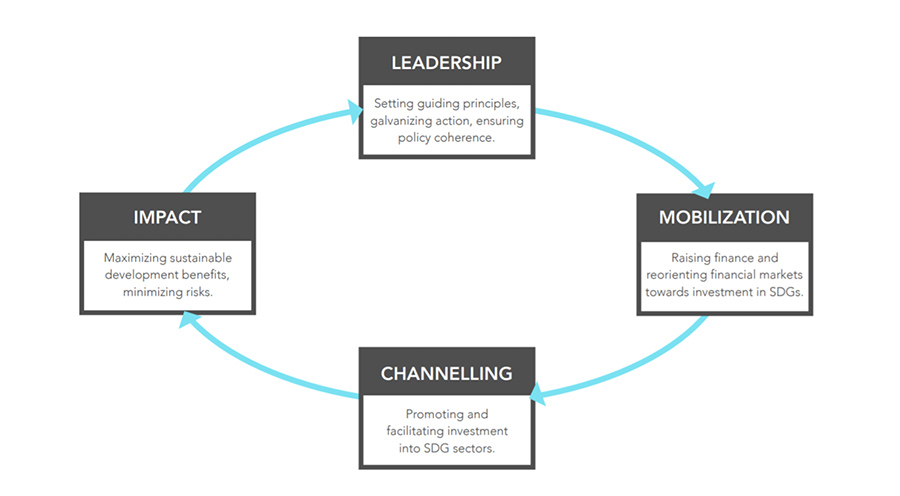
Together, these trends are driving a reconsideration of the role of business in achieving financial, social and environmental goals (see graph below).

graph

The way forward: marry corporate venture capital and impact

To future-proof profits and stay in business for the long haul, companies need to now find ways to derive economic value from the megatrends reshaping the economy and society in ways that are compatible with stakeholder expectations about corporate responsibility. Acting on the opportunity, however, has proven challenging for many. At a time when sustainability considerations loom ever larger for global CEOs, and in the minds of consumers and regulators, many executives report that they are stuck on their climb: the path to transformation is not yet readily discernable.

Impact Economy—the global impact investment and strategy firm—recently released “Driving Innovation through Corporate Impact Venturing: A Primer on Business Transformation” to help address this issue. Corporations invest in research and development; corporate venture capital has helped them over the past fifty years to capitalize on their profound industry expertise, moving from early insights into emerging trends to actual investments that yield the new products and services that can power core business.

The pursuit of impact is now being added to this formula: sustainability is increasingly driving value creation, and assessing joint opportunities for financial and social returns is gradually becoming the way forward. This new modus operandi, Corporate Impact Venturing (CIV), builds on the proven channel of corporate venture capital in order to source the innovations now needed. The advent of Corporate Impact Venturing is especially relevant for BoP consumers. The ranks of the disadvantaged will not diminish considerably anytime soon if we expect governments and development agencies to do the job alone. Novel affordable products and services, and jobs are also needed. Companies from emerging markets are in prime position to serve new customer segments due to proximity.

Anyone who wants to be successful needs to understand what matters to their customers, the business models that work in practice, how to make distribution happen, and how to become a trusted product and service provider—at the Base of the Pyramid and elsewhere. This typically requires the identification of pioneering business models and taking time to learn from implementation before attempting to scale.

Seeding the next generation of transformative business models

Leveraging core business competences can offer a powerful pathway to systematically engage in corporate opportunity without neglecting corporate responsibility. Consider, for example, Standard Bank’s AccessPoint model, which includes 3,900 AccessPoints across South Africa, with 37 percent owned by women. The AccessPoint model operates via installed facilities at local traders and spaza shops and takes banking to customers in the community, enabling them to do basic banking operations in a store and avoid the costs of traveling to a branch or ATM; the model processes around ZAR 5.3 million in transactions through small businesses partners (2013).

Globally, corporate venture capital invested USD 29.4 billion into 3,995 deals in 2013. Now imagine what would happen if companies diligently applied the corporate venture capital logic with impact considerations, strategically made investments in start-ups and spin-offs that were economically viable and created social impact, and if emerging market companies leveraged their locational advantage. As the pathways for sourcing business innovation are being updated, the pendulum is swinging to a new approach that reconciles corporate responsibility to include opportunity.

The time has come to welcome Corporate Impact Venturing, and get serious about building a promising sustainable future for everyone.

Maximilian Martin, Ph.D. is the founder and global managing director of Impact Economy, an impact investment and strategy firm based in Lausanne, Switzerland, and the author of the report Driving Innovation through Corporate Impact Venturing.”


The “Distant Here” And The “Future Now” Of The Climate Crisis

It has been a sobering month of news about climate change.  A few weeks ago the National Climate Assessment was released, which documented the increasing impacts of the changing climate across the U.S.  The take away of the Assessment report was climate change is happening now and it is affecting all Americans. Meanwhile, new research reported in Science Magazine this month indicated we have already committed the world to over three meters of sea level rise, as a result of the irreversible disintegration of the West Antarctic Ice sheet – and now there is nothing we can do to avoid this level of  rise in the sea. Together these stories are contributing to an ever clearer picture that the ‘here and now’ of the climate crisis is inextricably intertwined with the ‘distant and future.’

For many Americans increasingly focused on the hyper-local and hyper-now, these sorts of reports are difficult to process, and the risks of our changing climate are often imperceptible. Occasionally, a big climate-related event crashes down on American communities and acts as a temporary wake-up call to the risks posed by climate change. For example, nine years ago, Hurricane Katrina swept through New Orleans killing nearly 2,000 people and resulting in $81 billion of damage. Katrina shook the nation. Americans watched the devastation in disbelief as it seemed more reminiscent of the disasters that take place in the developing world, not in the United States of America.

Then came Superstorm Sandy, the wildfires and ‘biblical floods’ in Colorado, and the prolonged drought throughout the much of the nation. All of these events led to a temporary upsurge of interest in global warming by news media and the American public.

Do these moments provide opportunities to build a culture that looks beyond the hyper local and hyper now – to the distant here and the future now so critical for building a global society resilient to global environmental changes?

The immediate question that arises after mega-weather related disasters is: Are these extreme events the result of the changing climate? While scientists cannot say that any specific extreme weather event was caused by human-induced climate change,one thing we can say with certainty is that most of the devastation from both Katrina and Sandy was the direct result of human activities. Poorly planned coastal development exposed populations and economic assets to storm damage. Much of New Orleans sits several feet below sea level.

Despite an extensive levee system city officials knew that they faced considerable riskof flooding from coastal storm surge – it was not a question of if, it was a question of when. The same can be said about Sandy. New York had been given warnings of its vulnerabilities. William S. Nechamen, New York State’s floodplain chief, warned in 2006that New York could face “higher than necessary flood damages” if efforts were not made to upgrade the city’s flood maps. Yet despite Nechamen’s warning, FEMA decided to save money in New York City by digitizing old flood maps rather than updating the maps using the newest available science and technology. These decisions reflect the deep-rooted reluctance to think and plan beyond the here and now, and ultimately one of society’s biggest hurdles in addressing climate change.

Another huge hurdle that Americans need to overcome if we want out children to live in a society of peace and prosperity, is the recognition that community disaster risk management is no longer just a local issue; it has now become an issue of global security and economic stability. This is because local economies, ecologies and human health are now all connected by the continuous ebb and flow of goods and services as well as the ebbs and flows of the ‘bads and disservices.’

The shock of Hurricane Sandy was felt well beyond the US eastern shorelines as the resulting two day shutdown of the New York Stock Exchange had ripple effects across global economies. Similarly, the 2011 floods in Thailand and the 2013 typhoon in the Philippines were a reminder of the vulnerability of global supply chains to local weather disasters. And consider an event like the 2010 floods in Pakistan which destroyed 1.8 million homes and killed over 1,700 people. These floods impacted the poorest parts of Pakistan where extremists and separatist movements thrive. As a result this devastation created not only a humanitarian crisis but also a national security crisis for Pakistan, and a potential regional and international security threat for the world.

The international community must begin to approach the risks of local climate and weather-related disasters as a global threat.  American must begin to recognize that reducing vulnerability to climate risks in any community is ultimately contributing to the economic and human security for the world.

We have to be smarter about preparing for climate change—both at home and abroad: if we’re not, climate disasters abroad will increasingly mean problems for us here at home.

Article by Amy Luers, Director of Climate Change, Skoll Global Threats Fund
The “Distant Here” And The “Future Now” Of The Climate Crisis

It has been a sobering month of news about climate change.  A few weeks ago the National Climate Assessment was released, which documented the increasing impacts of the changing climate across the U.S.  The take away of the Assessment report was climate change is happening now and it is affecting all Americans. Meanwhile, new research reported in Science Magazine this month indicated we have already committed the world to over three meters of sea level rise, as a result of the irreversible disintegration of the West Antarctic Ice sheet – and now there is nothing we can do to avoid this level of  rise in the sea. Together these stories are contributing to an ever clearer picture that the ‘here and now’ of the climate crisis is inextricably intertwined with the ‘distant and future.’

For many Americans increasingly focused on the hyper-local and hyper-now, these sorts of reports are difficult to process, and the risks of our changing climate are often imperceptible. Occasionally, a big climate-related event crashes down on American communities and acts as a temporary wake-up call to the risks posed by climate change. For example, nine years ago, Hurricane Katrina swept through New Orleans killing nearly 2,000 people and resulting in $81 billion of damage. Katrina shook the nation. Americans watched the devastation in disbelief as it seemed more reminiscent of the disasters that take place in the developing world, not in the United States of America.

Then came Superstorm Sandy, the wildfires and ‘biblical floods’ in Colorado, and the prolonged drought throughout the much of the nation. All of these events led to a temporary upsurge of interest in global warming by news media and the American public.

Do these moments provide opportunities to build a culture that looks beyond the hyper local and hyper now – to the distant here and the future now so critical for building a global society resilient to global environmental changes?

The immediate question that arises after mega-weather related disasters is: Are these extreme events the result of the changing climate? While scientists cannot say that any specific extreme weather event was caused by human-induced climate change,one thing we can say with certainty is that most of the devastation from both Katrina and Sandy was the direct result of human activities. Poorly planned coastal development exposed populations and economic assets to storm damage. Much of New Orleans sits several feet below sea level.

Despite an extensive levee system city officials knew that they faced considerable riskof flooding from coastal storm surge – it was not a question of if, it was a question of when. The same can be said about Sandy. New York had been given warnings of its vulnerabilities. William S. Nechamen, New York State’s floodplain chief, warned in 2006that New York could face “higher than necessary flood damages” if efforts were not made to upgrade the city’s flood maps. Yet despite Nechamen’s warning, FEMA decided to save money in New York City by digitizing old flood maps rather than updating the maps using the newest available science and technology. These decisions reflect the deep-rooted reluctance to think and plan beyond the here and now, and ultimately one of society’s biggest hurdles in addressing climate change.

Another huge hurdle that Americans need to overcome if we want out children to live in a society of peace and prosperity, is the recognition that community disaster risk management is no longer just a local issue; it has now become an issue of global security and economic stability. This is because local economies, ecologies and human health are now all connected by the continuous ebb and flow of goods and services as well as the ebbs and flows of the ‘bads and disservices.’

The shock of Hurricane Sandy was felt well beyond the US eastern shorelines as the resulting two day shutdown of the New York Stock Exchange had ripple effects across global economies. Similarly, the 2011 floods in Thailand and the 2013 typhoon in the Philippines were a reminder of the vulnerability of global supply chains to local weather disasters. And consider an event like the 2010 floods in Pakistan which destroyed 1.8 million homes and killed over 1,700 people. These floods impacted the poorest parts of Pakistan where extremists and separatist movements thrive. As a result this devastation created not only a humanitarian crisis but also a national security crisis for Pakistan, and a potential regional and international security threat for the world.

The international community must begin to approach the risks of local climate and weather-related disasters as a global threat.  American must begin to recognize that reducing vulnerability to climate risks in any community is ultimately contributing to the economic and human security for the world.

We have to be smarter about preparing for climate change—both at home and abroad: if we’re not, climate disasters abroad will increasingly mean problems for us here at home.

Article by Amy Luers, Director of Climate Change, Skoll Global Threats Fund
The Internet of Everything: Where Technology And Innovation Meet

What will the future be like? As depicted in today’s popular movies and books, the future is either one of bright promise—where the world’s greatest problems have been solved by technology and greater human enlightenment—or it’s a dystopian world where today’s problems have only gotten worse, technology has gone bad, and the very survival of humanity is at risk.

As Cisco’s chief futurist, it’s my job to think about what the world will look like in a few years, and how our actions today will impact that future. And while I’m not ready to put on my rose-colored glasses just yet, I do have an optimistic view of what the future may bring, enabled by the Internet of Everything (IoE). Within 10 years, there will be 50 billion connected things in the world, with trillions of connections among them. These connections will change the world for the better in ways we can’t even imagine today. But here are just a few things I can imagine:

Better supply of food: Sensors all along the food supply chain, together with Big Data analytics and the intelligence of the cloud, will help us optimize the delivery of food from “farm to fork.” Sensors in the field will be combined with weather forecasts and other data to trigger irrigation and harvest times for each crop. And sensors on the food itself will alert merchants and consumers about when the “sell by” and “use by” dates are approaching to prevent spoilage. All of this will significantly reduce food waste—which today amounts to about one-third of total world food production.

Better supply of water: Similarly, about 30 percent of our water supply is lost due to leaks and waste. Just one faucet or leaky pipe dripping three times a minute will waste more than 100 gallons of water a year. “Smart” pipes can reduce this waste significantly by sensing and pinpointing the location of leaks that would otherwise go undetected for months or years.

Better access to education: Affordable access to education is one of the most important ways to lift people out of poverty. Soon, time and distance will no longer limit access to an engaging, affordable, high-quality education. With connection speeds going up, and equipment costs going down, distance learning is going beyond traditional online classes to create widely accessible immersive, interactive, real-time learning experiences.

Better access to healthcare: Urbanization and population growth are putting a strain on healthcare resources—especially in rural areas. After the devastating 2008 earthquake in Sichuan Province, China, Cisco was a strategic partner in creating a networked medical delivery system, including four telehealth networks that allow doctors to meet with and examine patients remotely. But those capabilities are just the beginning of what IoE will make possible. Soon, women with high-risk pregnancies will be able to wear a tiny, always-on fetal monitoring electronic “tattoo,” which will communicate to the cloud whenever the woman is within range of a wireless network. The analytics capabilities in the cloud will alert doctors at the first sign of trouble, and even tell the mother-to-be when she needs to drink more water, or get more rest.

While sensors and machine-to-machine communication are important parts of these solutions, it’s not just the “Internet of Things” that is making all of this possible—it’s the Internet ofEverything—the networked connection of people, process, data, and things. And Big Data analytics is what brings the intelligence to all of these connections, enabling new kinds of processes, and helping us make smarter decisions.

I’ve highlighted just four areas where IoE will change the world for the better. But there is not a single part of life that will not be impacted in some way—whether that means improving your drive to work, speeding you through the checkout line at the grocery store, saving energy through smart lighting, or minimizing your wait at a traffic light. The Internet of Everything is not a silver bullet that can solve all the world’s woes, but with the spark of human innovation, IoE can be the engine for a better future.

Dave Evans is Cisco’s chief futurist—an evangelist who shares his vision of technology’s evolution in anticipation of the coming decades. In his role, Evans assesses technology’s future impact on Cisco customers, businesses, and industries, with the goal of evoking inspiration when it comes to the practical application of technological advances.

Which Countries are Greenwashing and Why?

New research into firms’ symbolic and substantive CSR practices has shed light on differing expectations of the role of business in society. The extent to which companies meet their CSR promises depends on national attitudes to competition and individualism says Oxford academic Thomas Roulet.

The assumption that corporations say one thing and do another when it comes to Corporate Social Responsibility (CSR) is not far from the truth, but just how much they follow through on their promises depends on cultural interpretations of the principles of liberal economics and the perceived role and strength of the government, says Thomas Roulet, Research Fellow at Saïd Business School, University of Oxford. In a paper for the Journal of Business Ethics, “The Intentions with Which the Road is Paved: Attitudes to Liberalism as Determinants of Greenwashing”, Thomas Roulet and his co-author, Samuel Touboul, IPAG Business School, explored the ambiguities surrounding firms’ commitments to social and environmental initiatives.

They discovered that in countries where people believed strongly in the virtues of competition, firms were more likely to practise “greenwashing” – that is, to make a lot of noise about their CSR but to do very little. In countries where liberalism was interpreted as predominantly about individual responsibility, firms were more likely to focus on concrete actions. “Our research suggested a highly complex relationship between beliefs in particular virtues of economic liberalism and the socially responsible behaviours of organisations,” said Dr Roulet.

“It also raises a number of subtle questions relating to the respective roles of business and the state. When a small state is favoured, for example, it seems more likely that companies will step in to ‘fill the gap’. Indeed, some businesses end up having more power than the state and, through becoming involved in developing infrastructures, even substitute for it. However, the business people we interviewed were keen to make a distinction between socially responsible things that businesses should be doing, such as reducing the harmful emissions that they generate themselves, and activities that they engage in that are not really part of their remit, but may enhance their reputations.”

Even when firms act responsibly, they can be doing so with a certain amount of cynicism.

Using qualitative and quantitative methods, the researchers calculated average country-level beliefs when it came to two central tenets of economic liberalism: a belief in the virtues of competition and a belief in the importance of individual responsibility. They found that developed market economies such as Switzerland, the United States, New Zealand and Canada tended to have higher cultural beliefs in favour of individual responsibility. While those countries also score highly in terms of cultural beliefs in favour of competition, it appears that countries with higher scores on this variable are fast developing countries such as India, China, and Morocco.

Mapping these country-level beliefs against the CSR actions of firms in those countries confirmed that firms are more likely to greenwash when populations’ beliefs in the virtue of competition are predominant, and when their beliefs in individual responsibility are less prominent. Therefore, in a country like Morocco, where beliefs in the virtue of individual responsibility are low, but in the virtue of competition are high, firms are more likely to greenwash. Conversely, in a country like France, where the population believes in the virtue of individual responsibility but prefers an absence of competition, firms are less likely to greenwash as they tend to implement socially and environmentally responsible actions without specifically signalling those actions.

“We tend to assume that firms are inherently selfish and more likely to indulge in symbolic CSR practices that look good, such as getting green accreditation, than actively trying to improve stakeholders’ welfare by, for example, reducing CO₂ emissions,” said Dr Roulet. “In fact, our research has shown that what a firm does in the context of CSR is influenced by the shared cultural expectations in its country of origin, which either unconsciously encourage greenwashing or demand substantive action.

Subtle distinctions between different countries’ interpretations of what a liberal economy is all about can lead to very different attitudes and actions when it comes to how businesses operate in relation to society.”


The 21st Century City: Future Opportunity Or Future Threat?

International affairs columnist Doug Saunders notes that slums give rise to much of the conflict and social unrest we see around the world. Even in those slums where conditions seem impossible, a simple and cruel logic keep hopefuls walking in: the belief that life in the slum is still a sliver better than life in the village, says Michael Keith, Director of the COMPAS center at Oxford. He suggests that slums should not be seen as a problem in and of themselves. Rather they represent stunted progression in the journey of those hoping to make a better life in the city.

The fact that they stay in the slum is the real failure. This means that their progression is halted and that ways onwards, into work, education and toward a proper roof overhead— are blocked. For this reason, Michael suggests, the slums should not principally be targeted for infrastructural and social programs that risk institutionalizing them. Rather, interventions should focus on keeping the migrants moving, into work and education toward the goal of social and economic integration. We would do well to avoid repeating the mistakes of Europeans and North American towns of regarding slums as an uncomfortable but unavoidable and permanent necessity. The slum is a symptom, not the disease.

Most urbanization is happening in towns of 500,000 or less, with very little institutional or infrastructural capability, says Joel Bolnick, coordinator of Slum Dwellers International. Nevertheless, slum dwellers feel excluded from the societies they seek to enter. This is because they are in fact excluded, their voices drowned out by experts. He adds that the level of democratic maturity does not matter, governments pro and anti poverty management both result in exclusionary and status quo policies.

Melanie Edwards, CEO of Mobile Metrix, illustrates the disengagement of governments who report prevalence of slum dwelling in the low single percentages whereas the real numbers, even those reported by on-the-ground government officials, are closer to 40% in Rio for example. Ossama Hassanein, Chairman of TechWadi concurs and adds that the Egyptian government reports 300,000 living in Cairo’s slums, the figure estimated by non-governmental organizations being closer to 1.2 million slum dwellers.

Stanford just had a conference on the topic where McKinsey & Co, a consultancy, projected that 22% of the world’s population will soon live in the informal economy. That is one in five humans globally living in an economic environment that eschews tax, public service, basic social and private security—an environment that fuels crime and cements social inequality and conflict.

As I listen to the discussion, I think of the post financial crisis narrative around the “new normal”; a world filled with stark and pressing risks and opportunities, interdependence versus systemic contagion, rapid economic growth versus rising inequality, the rise of new global middle classes versus concentrating accumulation of wealth, increasing globalization versus geo-politicization and securitization of resources from the Internet to drinking water.

More than 100,000 people move into slums every day. That does sound like a sizeable number. One out of five people will soon live in slums. That does make food for thought. But what if this is just the new normal. The new reality as it has been creeping up on our doorsteps for some time. Economies are moving, resources are moving and people are moving. If we call them migrants, does that make them less like us?

Aren’t we all on the move in one way or another? The seminars most poignant remark is offered by Michael Keith. Migration is people moving, it is not a question of us and them, “it’s a question of human progression, journeys that are either enabled or halted, human progress stunted”, stunted by our inability to make space and opportunity for the venturesome.

“Give me your tired, your poor, Your huddled masses yearning to breathe free; The wretched refuse of your teeming shore, Send these, the homeless, Tempest-tossed to me I lift my lamp beside the golden door!”

I think that the “lamp” is not a border fence on the Mexican or Moroccan border. The lamp is not unfortunate but permanent slums. I suggest the lamp might be something more like a social impact metric. A metric for how migrant journeys, wherever they take place, cross borders, into and out of slums—progress or get stunted. Such metrics might give us data to describe the limits to human progress and suggest remedies rather than separating us from them.

Henrik Storm Dyrssen is the CEO of Leksell Social Ventures (LSV), a private impact investment company based in Sweden initiated by billionaire Laurent Leksell, founder of Elekta AB, inventor of non-invasive cancer therapy radiation knives. He is a Goldman Sachs Global Leader Scholar and McKinsey & Co Awardee that has worked an lived in Saudi Arabia, Iran, USA, UK, France and Sweden.

Time to Wake up and Smell the CO2

The Intergovernmental Panel on Climate Change has just released its 2013 report on the state of our global environmental health. Compiled by 259 authors in 39 countries the report paints a sobering picture of our current situation and the consequences that await us in the future should we fail to act. These are not sensationalized facts by an author or alarmist marketing noises from organisations with hidden commercial agendas, but rather a compilation of scientific observations from hundreds of people across the globe.

We’ve been hearing these warnings for years, yet fail to realize that it will take decades, or longer, before we can undo the damage. This issue should not be seen as the responsibility of governments only, but rather as a global business plan that we can all subscribe to in whatever way we can. Seven billion people on the planet all saying, “My small contribution to climate change won’t make a difference anyway,” is exactly the problem – it allows seven billion people to stay locked into the very habits that are destroying our ecosystems.

Many consequences of climate change remain unknown, but can we afford to be surprised one day? You wouldn’t run your business like that would you? Below is a summary of the main findings from the Climate Change 2013 report:

Graphic by Boris Rasin

Graphic by Boris Rasin

Observed Changes in the Climate System

Each of the last three decades has been successively warmer at the Earth’s surface than any preceding decade since 1850. In the Northern Hemisphere, 1983–2012 was likely the warmest 30-year period of the last 1400 years (medium confidence). Ocean warming dominates the increase in energy stored in the climate system, accounting for more than 90% of the energy accumulated between 1971 and 2010 (high confidence).

It is virtually certain that the upper ocean (0–700 m) warmed from 1971 to 2010, and it likely warmed between the 1870s and 1971. Over the last two decades, the Greenland and Antarctic ice sheets have been losing mass, glaciers have continued to shrink almost worldwide, and Arctic sea ice and Northern Hemisphere spring snow cover have continued to decrease in extent (high confidence). The rate of sea level rise since the mid-19th century has been larger than the mean rate during the previous two millennia (high confidence).

Over the period 1901 to 2010, global mean sea level rose by 0.19 [0.17 to 0.21] m. The atmospheric concentrations of carbon dioxide, methane, and nitrous oxide have increased to levels unprecedented in at least the last 800,000 years. Carbon dioxide concentrations have increased by 40% since pre-industrial times, primarily from fossil fuel emissions and secondarily from net land use change emissions. The ocean has absorbed about 30% of the emitted anthropogenic carbon dioxide, causing ocean acidification.

Drivers of Climate Change

Warming of the climate system is unequivocal, and since the 1950s, many of the observed changes are unprecedented over decades to millennia. The atmosphere and ocean have warmed, the amounts of snow and ice have diminished, sea level has risen, and the concentrations of greenhouse gases have increased. Total radiative forcing is positive, and has led to an uptake of energy by the climate system. The largest contribution to total radiative forcing is caused by the increase in the atmospheric concentration of CO2 since 1750.

Understanding the Climate System and its Recent Changes

Human influence on the climate system is clear. This is evident from the increasing greenhouse gas concentrations in the atmosphere, positive radiative forcing, observed warming, and understanding of the climate system. Climate models have improved since the AR4. Models reproduce observed continental-scale surface temperature patterns and trends over many decades, including the more rapid warming since the mid-20th century and the cooling immediately following large volcanic eruptions (very high confidence).

Observational and model studies of temperature change, climate feedbacks and changes in the Earth’s energy budget together provide confidence in the magnitude of global warming in response to past and future forcing. Human influence has been detected in warming of the atmosphere and the ocean, in changes in the global water cycle, in reductions in snow and ice, in global mean sea level rise, and in changes in some climate extremes.

This evidence for human influence has grown since AR4. It is extremely likely that human influence has been the dominant cause of the observed warming since the mid-20th century.

Future Global and Regional Climate Change

Continued emissions of greenhouse gases will cause further warming and changes in all components of the climate system. Limiting climate change will require substantial and sustained reductions of greenhouse gas emissions. Global surface temperature change for the end of the 21st century is likely to exceed 1.5°C relative to 1850 to 1900 for all RCP scenarios except RCP2.6. It is likely to exceed 2°C for RCP6.0 and RCP8.5, and more likely than not to exceed 2°C for RCP4.5.

Warming will continue beyond 2100 under all RCP scenarios except RCP2.6. Warming will continue to exhibit interannual-to-decadal variability and will not be regionally uniform. Changes in the global water cycle in response to the warming over the 21st century will not be uniform. The contrast in precipitation between wet and dry regions and between wet and dry seasons will increase, although there may be regional exceptions.

The global ocean will continue to warm during the 21st century. Heat will penetrate from the surface to the deep ocean and affect ocean circulation. It is very likely that the Arctic sea ice cover will continue to shrink and thin and that Northern Hemisphere spring snow cover will decrease during the 21st century as global mean surface temperature rises. Global glacier volume will further decrease. Global mean sea level will continue to rise during the 21st century. Under all RCP scenarios, the rate of sea level rise will very likely exceed that observed during 1971 to 2010 due to increased ocean warming and increased loss of mass from glaciers and ice sheets.

Climate change will affect carbon cycle processes in a way that will exacerbate the increase of CO2 in the atmosphere (high confidence). Further uptake of carbon by the ocean will increase ocean acidification. Cumulative emissions of CO2 largely determine global mean surface warming by the late 21st century and beyond. Most aspects of climate change will persist for many centuries even if emissions of CO2 are stopped.

This represents a substantial multi-century climate change commitment created by past, present and future emissions of CO2.

The full report can be downloaded here. What are your thoughts on climate change? Can business make a difference and how? Let us know in the comments section below!

Source: Intergovernmental Panel on Climate Change / World Meteorological Organization, Switzerland.


12 Earth Day Tips That Will Make A Big Difference

In anticipation of Earth Day on April 22, we have published below 12 action items that you can implement to make a difference – some immediately and some with a little planning – that will reduce your company’s carbon footprint and increase your bottom line. Feel free to share these tips widely, to comment on whether you’ve taken any of these steps (and any results that might have followed), and to suggests any others you think might be a great idea. Happy Earth Day!

1. Switch from water cooler jugs to on-site water purifiers. (www.freedrinkingwater.com)

2. Ban plastic water bottles; invest in aluminum branded bottles for everyone. (www.sustainablebabysteps.com)

3. Hold e-waste recycling events at all offices/properties. (www.epa.gov)

4. Mandate double-sided printing. (www.kyoceradocumentsolutions.eu)

5. Convert to LED lighting. (www.triplepundit.com)

6. Install smart power strips. (www.science.howstuffworks.com)

7. Raise/lower the air-conditioning/heater thermostat setting by a couple degrees.  (www.life.gaiam.com)

8. Put one or two liter water bottles (sealed lids) in the flush tanks of toilets to save water. (www.wikihow.com)

9. Water aerators on taps to save water. (www.cleanenergyresourceteams.org)

10. Create preferred parking spaces for carpools. (www.drivelesssavemore.com)

11. If using takeout for office lunches/function, use/request biodegradable takeout containers instead of plastic. Otherwise, try to avoid takeout containers entirely and use reusable forks, knives, spoons, plates and cups stored at the office. (www.treehugger.com)

12. Install an Energy Star dishwasher, so everyone is happy with using the office flatware and dishes. (www.environment.about.com)

List supplied by Homer Robinson, a member of the Sustainable Business Network – a network of The Young President’s Organization (YPO)


The Journey of Social Enterprise

Thinking about the opportunity of gathering with a growing community of social enterprises at the upcoming Social Enterprise Alliance Summit in Nashville has me thinking once again about journeys. The road I have traveled in social enterprise has felt as precarious as Highway 1 along the rugged ridge of the Pacific. Because of the vulnerability and violence experienced by the work force I serve, I have never found a clear path leading me. There was not a simple fork in the road where I got to choose an easy road.

In fact, for most of the past 15 years founding and growing Thistle Farms, a bath and body care company, I have felt compelled to find a new road on which to travel. It began with a few simple steps towards creating a not-for-profit to serve women who have survived lives of addiction, prostitution, and trafficking. There have been times I barely maneuvered hairpin curves and seasons of confusion that settled in on me like a thick, mountain fog.

There have been harrowing stories of recovery and horrible murders of women I loved. The road of an entrepreneur feels uniquely narrow and unsure at times, but, given the chance, I wouldn’t ever choose another path. The views are breathtaking, filled with grace. Thistle Farms began as a residence offering community at no cost for two years.

We didn’t take any public funding and vowed that we wanted to be a witness to the truth – love is the most powerful source of change in the world. The women served by Magdalene had traveled down roads more perilous and broken than I could imagine. On average the women who came were first raped between the ages of seven and eleven.

They had seen the underside of bridges, the short side of justice and the backhand of anger long before they saw the inside of prison walls. Immediately and faithfully volunteers and staff with expertise in the areas where we needed guidance came along the way at just the right time. Our model was simply to keep ourselves grounded in hospitality, reverence, and love. Five years into the program, we were on a steep learning curve.

It was imperative to educate the wider community on the myths of prostitution: that women do recover, that longer prison sentences and more institutions of incarceration are not the answer, and that there is a crucial need for more residential communities. We learned that we needed to provide a real home for the women, not another prison.

It was time to forge a new path again as we were growing more concerned about the economic wellbeing of the women in the community. The women had to redefine themselves, replacing the addiction that had come to typify their lives. So we began a social enterprise creating all natural bath and body care products to intentionally promote healing.

We had to learn a new vocabulary. The sweet ideals we had held had to become leverage to influence the economics towards sustainability. We have had to learn from some unfortunate decisions on products and sales. We had to learn branding was important and being tough on manufacturing procedures translated into a better work environment for the women. We can hold on tightly to our core values of loving people lavishly without judgment and still be economical. We stamp Love Heals on all our products and are still relevant in the market.

Currently 45 women who are residents and graduates help lead a company that now celebrates over 270 retail outlets. Just this month our shipping team has broken the record on Internet sales! We have welcomed over 1,200 people from all over the world this past year into our immersion day programs to reach out and help other communities duplicate the best practices of this model.

We now have formal partnerships with four other women’s social enterprises around the world. In the past year the women stood before audiences at over 300 events, articulating our mission and courageously sharing their personal stories. Six months ago we opened a Café on site. No one person who launched this endeavor could have envisioned the growth of the enterprise, nor could any one of us made the journey alone.

It took a community in which the sum was truly greater than its parts. We held each other up and we held each other accountable. If you are attending the Social Enterprise Alliance Summit in Nashville, we hope you will come visit our manufacturing facility and studio. If you do, I think you will see a communal vision that is still forming.

We are only part way down the road and we pray every day together for the grace to keep walking in community. I heard an African proverb a while back that went something like this. “If we want to travel fast, we should travel alone. If we want to travel far, we should travel together.” The deeper truth I have learned traveling down this road is that if all of us will travel together, not only will we travel far, we will travel with integrity, joy, and purpose. 

The mission at Thistle Farms is to help women make the journey from the streets to home ownership. Each day we accept the challenges secure in the knowledge we can meet them togetherThe path is getting straighter, but all of us still need to do more to stand in solidarity with women who bear the universal issues of violence on their individual backs. Looking back down the road it’s powerful to remember that always there has been a compassionate community offering signs and gifts that have helped make this a straight path towards love.

This post was written by Becca Stevens, Executive Director of Thistle Farms. You can find Becca on Twitter at @revbeccastevens.


Stedman Graham on Africa, Oprah and Leadership

The best-selling author, educator and entrepreneur tells us why Africa is the next big thing and why he is not Oprah.

Part of what makes us human 
is our ability to be aware of our own existence, to both live and reflect on our own lives. It’s this capacity for self-awareness that allows us to see our authentic selves and build our own identity, rather than letting others dictate who we are and what we do with our lives. Stedman Graham has spent the last 15 years travelling the world, teaching people to become leaders, rather than followers.

His soul mate of 27 years, Oprah Winfrey, has also developed a career around self improvement, yet while Winfrey does this over the air, on television, Graham has chosen to do his work on the ground, meeting students, professionals and governments across the globe. He asks three basic questions of them: Who are you? Where are you going? How are you going to get there? You might even regard this as a three sentence business plan, but Graham believes that regardless of culture, race or creed, each person can begin to create positive change around them by simply asking these questions of themselves.

Many of us spend years trying to find out who we are and, sadly, too many of us never do, says Graham. If we fail to define ourselves, we risk letting others define us by our race, gender, and background.

We buy into the labels that keep us in a box and, as a result of those limitations, never reach or realize our greatest potential,” he says. And while his relationship with Oprah can sometimes overshadow many of the messages he takes with him around the world, he is adamant that he is, “not Oprah,” as he recently stressed on a CBS interview.

The author of eleven books, two of them New York Times bestsellers, Graham has acknowledged that he has a lifelong commitment to youth and community and has focused on the hidden potential of both top executives as well as people trying to make a difference in their communities. While acknowledging a universal desire among the worlds population to do something good with their lives, he tries to get people to commit to a personal mission that will empower them as individuals.

This lifelong commitment to empowerment and learning started in Graham’s early years, when he was a professional basketball player – he’s 6’6” tall. When he realized how the power of sport could influence young lives he established Athletes Against Drugs in 1985, dedicated to developing leadership among underserved youth in Chicago, now with programs countrywide.

“The positive sporting role models I had in my life showed me how important it was to be visible, and to show young people they could be somebody,” says Stedman. “The negative press around doping in sport at the time was the catalyst for me to create an organization that was not involved in drugs, and to develop a drug-free alternative.” Stedman’s attitude of never wanting to be “anti” but always “pro” a situation, has seen him take a keen interest in Africa recently. He believes there is huge unlocked potential on the continent, that requires self-awareness from locals and commitment from others. He shared his outlook with us.  

What potential do you see in Africa? Why is Africa seen as the next big opportunity for economic growth?

Africa is currently seen as the next big power house because it’s a pin-up economy – it hasn’t been developed. You have millions of people who’ve never been part of the mainstream economy. This is the perfect opportunity to create infrastructure and have people develop their own businesses, become educated, become entrepreneurs and develop organizations that give back and serve people.

I think there’s a greater opportunity in Africa than any other continent I’ve seen, because you have so many people with no place to go, but up. Once you start that process it’s going to explode. China and the U.S. are both investing in Africa, so that must mean something.

Are these countries investing in natural resources or investing in people? Natural resources are a prime reason people come to Africa, but if the countries were more structurally set up to do business, where everyone can benefit, then that’s where things really start to work. You can’t have people coming here to take all the resources away while the people who live here can’t even farm their own land or feed themselves.

The way to build anything is to first invest in people. You build a strong family, and then invest in family members, who then build strong communities. You need to prevent a community that can’t feed itself, that can’t have it’s own voice or educate itself. Otherwise, you’ll have a drain on that society and the community.

What kind of leadership is needed in this type of scenario?

Firstly, leadership you can trust, and secondly, leaders who understand the possibilities of what they are leading. You also need a vision, a plan and the ability to align people and bring them together to create opportunity. Education is important and people should understand who they are, including a sense of duty to others. People have to care.

What are you hoping to achieve personally?

I teach identity development to people around the world, helping them discover who they really are. Most people are stuck in a box and do the same thing, over and over, every single day. If you do the same thing today as you did yesterday, you wouldn’t have achieved much. At school the educational system teaches you how to memorize, take tests, and repeat information.

You just get labeled with a grade and two weeks later you’ve forgotten this information. So nothing from nothing, is nothing, and most people end up not truly knowing who they are, or how to take information and make it relevant to their development.

Most people in this situation are at a loss and end up being defined by their race, family, or religion. Being defined by all these external things, keeps people from becoming a leader. Basically, around one percent of the world is being followed by everyone else. Out of seven billion people on the planet, 99 percent are followers.

The challenge is to transform them from a follower to a leader. The system is not set up to do this because it teaches you to be a worker.  It doesn’t teach you to think or take ownership of your development. Leadership is about stepping out of the box and being able to define yourself, as opposed to having the world define you.  

Are you formally structured in business with Oprah in any way?

No, I don’t have any businesses with her, she does what she does, and does it well. My relationship with her is strong because I don’t have a business relationship with her. I support her 150 percent and I can still support her and have my own interests, otherwise I couldn’t teach what I teach. This is how I define myself, despite the fact that people are continually trying to put me in a box and make some connection between us, based on speculation that she’s supporting me. I maintain my own development, and if I need to travel, I can go and create my own ventures.

It’s a beautiful thing to have a partner with whom you can work together, because we’re basically working on the same things. She does it in the air, through television, and I do it on the ground but we’re both doing the same kind of work, which is why we get along so well. Oprah understands my work and I understand her work.

She loves what she does and I love what I do. I’m just more grassroots and community based, I go and talk to the people – the homeless, school children and institutions. I want to talk to people and connect with them.

Is America still a shining light for opportunity or have other countries now adopted this role?

The American Dream is now a global dream, but America is still strong to me. I knew a long time ago, when I used to play professional basketball in Europe and travelled widely, that America was not the only country in the world. I realized that people are basically the same everywhere, especially now, with our connection through technology and the Internet. Now we can speak to almost anyone, anywhere, and we all travel a lot more.

The world is almost becoming one economy, because each economy is so dependent on the other. We should continue to be open and assimilate people and cultures at all levels – class, race and nationality – and be bold enough to do that. Identity development helps you do that. It helps you identify what you love and what you care about. It helps you assimilate, get along with other people and build better relationships. It’s a good blueprint for the challenges we face in the 21st century.

We live in an ownership-driven society and you should also strive to own yourself too, your own thoughts, your own ideas, a self-directed learner. You need to be a life-long learner in these times, the global marketplace demands it. If you fall behind, you’ll be pushed back to a lower class, something that’s happening right now in the U.S.

The middle-classes are being pushed back to lower class, because they haven’t made the adjustments needed for the 21st century.

Many people in Africa don’t feel they have the right to independent thought. Many governments and leaders have held onto power longer than they should. How do you nurture entrepreneurship and independent thought in this environment?

It’s about adapting to a global marketplace, where you have other ideas and thoughts coming in, with outside people willing to help countries get to the next level. No one makes it alone and no woman or man is an island unto themselves.  No country can make it by themselves either. Having good trade agreements and encouraging experts from around the world to come to your country is a good idea.

Countries can provide their knowledge base to experts, who in turn, share their skills locally. This is a way to grow, and sometimes it’s just putting the right people together in a room. You need a team of people to help; you can’t do it by yourself. If you want to create wealth, you bring wealth in, if you want to create economic opportunity, you bring it in with you.


0