

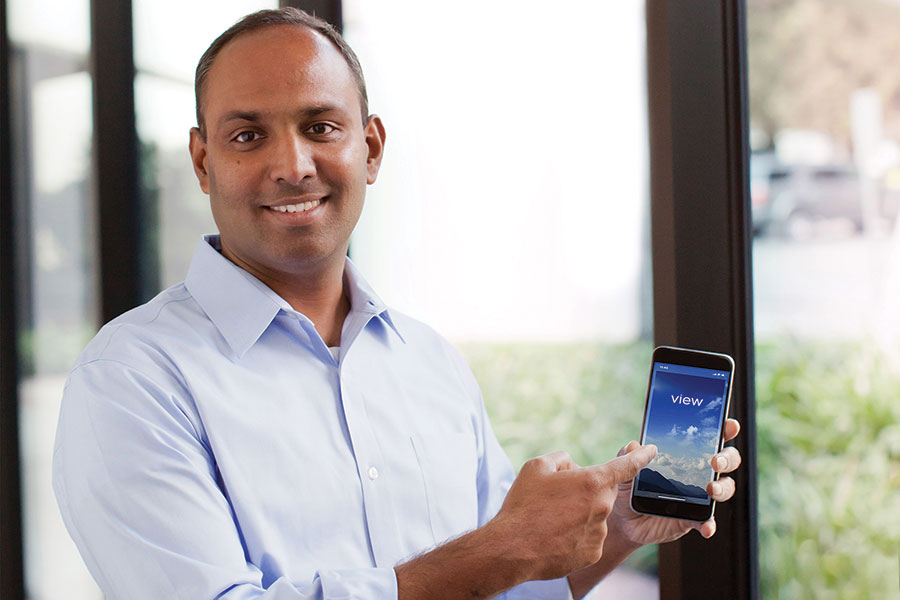
A View of Innovation – Smart Glass

Sometimes the opportunity for innovation is in plain sight. Have you ever considered how much is spent in real estate to feature picture-perfect views and install crystal-clear glass windows – only to have occupants miss those amazing views due to the heat and glare that also comes through?

Window coverings are purchased at an additional cost due to the discomfort of the individuals inside and the well-intended benefits are lost. Look around any major city, and you’ll notice that roughly two-thirds of building windows are permanently covered with blinds or shades. It defeats the whole idea of using windows in the first place. What if there was a better way?

If you like this, subscribe here for more stories that Inspire The Future.
After all, it hasn’t always been like this. For most of history, humans have lived in harmony with the outdoors; remember, we are originally an outdoor species. But over the course of history, we’ve found a way to create our own shelters, as a way of separating us from the elements and to protect ourselves. First came walls, doors, roofs and floors. Then we discovered that melting sand could make sheets of glass – a solid material you could see through. Windows were not always accessible to everyone in the early days and were indeed a source of luxury and pride for those who could afford them.

Now a staple of modern architecture, glass has kept some of its magical allure – creating a barrier to the outside world, yet still inviting in the views and natural light to lighten even the darkest of rooms. Recently, we’ve seen bigger and clearer windows appearing as the demand increases for a better connection to the outdoors. But this, “Also creates issues in terms of heat and glare – the building gets inefficient … and people are uncomfortable thermally and visually and then you are using blinds and shades to control the light,” says Dr. Rao Mulpuri, CEO of View, Inc. and a member of YPO.

My colleagues wake up each day believing in something that no one else believes yet. This common purpose and mission is what binds us together and enables us to create real change. 

Based in Silicon Valley, View manufactures a new generation of smart windows that let in natural light and views and enhance mental and physical wellbeing. View’s customers include Century Link, Overstock, FedEx, WeWork, Facebook, Hewlett Packard Enterprise, Regeneron and Kaiser Permanente across 35 million square feet of buildings space with another 35 million in progress. The company has also made great progress bringing smart windows to airports with installations at San Francisco International Airport, Boston Logan International Airport, Seattle-Tacoma International Airport and Charlotte Douglas International Airport. And in June 2018, Dallas Fort Worth International Airport announced they had awarded a contract to View to install smart windows in all DFW’s passenger terminals.

https://www.youtube.com/watch?v=B1ZI80-_feU

“While dynamically changing glass technology, that adjusts itself to light and heat is already 50 years old, it never managed to move past small applications, such as transition sunglasses, car rear-view mirrors, and some airplanes. Up until ten years ago, when View stepped in, it was an elusive technology that didn’t lend itself to large-scale use in real estate. We have developed a self-tinting smart window, powered by a sophisticated intelligence engine that responds intuitively to outside conditions, day or night,” says Mulpuri.

“Someday, every window will be smart,” muses Mulpuri. “Today, every communication device is mobile, yet landlines ruled only a short few years ago. Likewise, there’s no reason to install windows and then cover them up to the detriment of the occupants’ health and wellness.” The company has yet to come across a customer who says, “I love my blinds”.

The real estate industry is the largest in the world, to the tune of $10 trillion globally, but surprisingly, it’s also the slowest moving – partly due to risk aversion found within its ranks. Mulpuri recognized that technology advancement was the biggest disruptor of the past 100 years and wondered why real estate construction was lagging so far behind. The 21st century is not kind to slow-moving industries – think video stores, camera film and cellphones with keyboards. Mulpuri believes View’s mission is to not only make the simple window better, but to also transform the entire real estate industry. One of Mulpuri’s mentors and friends, Fred Smith, the CEO of FedEx, is keen on reminding his employees, “If you don’t like change, you will hate extinction.”

View currently holds more than 700 patents after ten years of development and an investment of around $1 billion – a hefty price-tag for staying true to their dream of developing technology that will enable smart glass to work at scale.

Aside from eliminating the need for blinds and reducing a building’s energy costs, Mulpuri is most excited about the substantial health benefits View’s windows bring to occupants. A recent HBR article  revealed natural light is the #1 office perk, and supports a research study by Cornell University Professor Dr. Alan Hedge who found optimization of natural light in an office significantly improves health and wellness among workers. In fact, this research revealed that workers in View Dynamic Glass office environments reported a 51% drop in eyestrain, a 63% drop in headaches and a 56% reduction in drowsiness.

Like most disruptive companies, success is usually a combination of great product and fearless, big thinking. Considering the advice he would give young leaders, Mulpuri believes that picking things that really mattered would be paramount. “Work on something game- changing, because then the journey becomes worth it. You’ll attract great talent and like-minded people and that powerful combination of talent, commitment, and upward spiral of creating something new will make it worthwhile. My biggest advice? Attempt bigger.” 

www.viewglass.com

If you like this, subscribe here for more stories that Inspire The Future.
A View of Innovation – Smart Glass

Sometimes the opportunity for innovation is in plain sight. Have you ever considered how much is spent in real estate to feature picture-perfect views and install crystal-clear glass windows – only to have occupants miss those amazing views due to the heat and glare that also comes through?

Window coverings are purchased at an additional cost due to the discomfort of the individuals inside and the well-intended benefits are lost. Look around any major city, and you’ll notice that roughly two-thirds of building windows are permanently covered with blinds or shades. It defeats the whole idea of using windows in the first place. What if there was a better way?

If you like this, subscribe here for more stories that Inspire The Future.
After all, it hasn’t always been like this. For most of history, humans have lived in harmony with the outdoors; remember, we are originally an outdoor species. But over the course of history, we’ve found a way to create our own shelters, as a way of separating us from the elements and to protect ourselves. First came walls, doors, roofs and floors. Then we discovered that melting sand could make sheets of glass – a solid material you could see through. Windows were not always accessible to everyone in the early days and were indeed a source of luxury and pride for those who could afford them.

Now a staple of modern architecture, glass has kept some of its magical allure – creating a barrier to the outside world, yet still inviting in the views and natural light to lighten even the darkest of rooms. Recently, we’ve seen bigger and clearer windows appearing as the demand increases for a better connection to the outdoors. But this, “Also creates issues in terms of heat and glare – the building gets inefficient … and people are uncomfortable thermally and visually and then you are using blinds and shades to control the light,” says Dr. Rao Mulpuri, CEO of View, Inc. and a member of YPO.

My colleagues wake up each day believing in something that no one else believes yet. This common purpose and mission is what binds us together and enables us to create real change. 

Based in Silicon Valley, View manufactures a new generation of smart windows that let in natural light and views and enhance mental and physical wellbeing. View’s customers include Century Link, Overstock, FedEx, WeWork, Facebook, Hewlett Packard Enterprise, Regeneron and Kaiser Permanente across 35 million square feet of buildings space with another 35 million in progress. The company has also made great progress bringing smart windows to airports with installations at San Francisco International Airport, Boston Logan International Airport, Seattle-Tacoma International Airport and Charlotte Douglas International Airport. And in June 2018, Dallas Fort Worth International Airport announced they had awarded a contract to View to install smart windows in all DFW’s passenger terminals.

https://www.youtube.com/watch?v=B1ZI80-_feU

“While dynamically changing glass technology, that adjusts itself to light and heat is already 50 years old, it never managed to move past small applications, such as transition sunglasses, car rear-view mirrors, and some airplanes. Up until ten years ago, when View stepped in, it was an elusive technology that didn’t lend itself to large-scale use in real estate. We have developed a self-tinting smart window, powered by a sophisticated intelligence engine that responds intuitively to outside conditions, day or night,” says Mulpuri.

“Someday, every window will be smart,” muses Mulpuri. “Today, every communication device is mobile, yet landlines ruled only a short few years ago. Likewise, there’s no reason to install windows and then cover them up to the detriment of the occupants’ health and wellness.” The company has yet to come across a customer who says, “I love my blinds”.

The real estate industry is the largest in the world, to the tune of $10 trillion globally, but surprisingly, it’s also the slowest moving – partly due to risk aversion found within its ranks. Mulpuri recognized that technology advancement was the biggest disruptor of the past 100 years and wondered why real estate construction was lagging so far behind. The 21st century is not kind to slow-moving industries – think video stores, camera film and cellphones with keyboards. Mulpuri believes View’s mission is to not only make the simple window better, but to also transform the entire real estate industry. One of Mulpuri’s mentors and friends, Fred Smith, the CEO of FedEx, is keen on reminding his employees, “If you don’t like change, you will hate extinction.”

View currently holds more than 700 patents after ten years of development and an investment of around $1 billion – a hefty price-tag for staying true to their dream of developing technology that will enable smart glass to work at scale.

Aside from eliminating the need for blinds and reducing a building’s energy costs, Mulpuri is most excited about the substantial health benefits View’s windows bring to occupants. A recent HBR article  revealed natural light is the #1 office perk, and supports a research study by Cornell University Professor Dr. Alan Hedge who found optimization of natural light in an office significantly improves health and wellness among workers. In fact, this research revealed that workers in View Dynamic Glass office environments reported a 51% drop in eyestrain, a 63% drop in headaches and a 56% reduction in drowsiness.

Like most disruptive companies, success is usually a combination of great product and fearless, big thinking. Considering the advice he would give young leaders, Mulpuri believes that picking things that really mattered would be paramount. “Work on something game- changing, because then the journey becomes worth it. You’ll attract great talent and like-minded people and that powerful combination of talent, commitment, and upward spiral of creating something new will make it worthwhile. My biggest advice? Attempt bigger.” 

www.viewglass.com

If you like this, subscribe here for more stories that Inspire The Future.

Barcelona to The Eiffel Tower For $50 on Methane

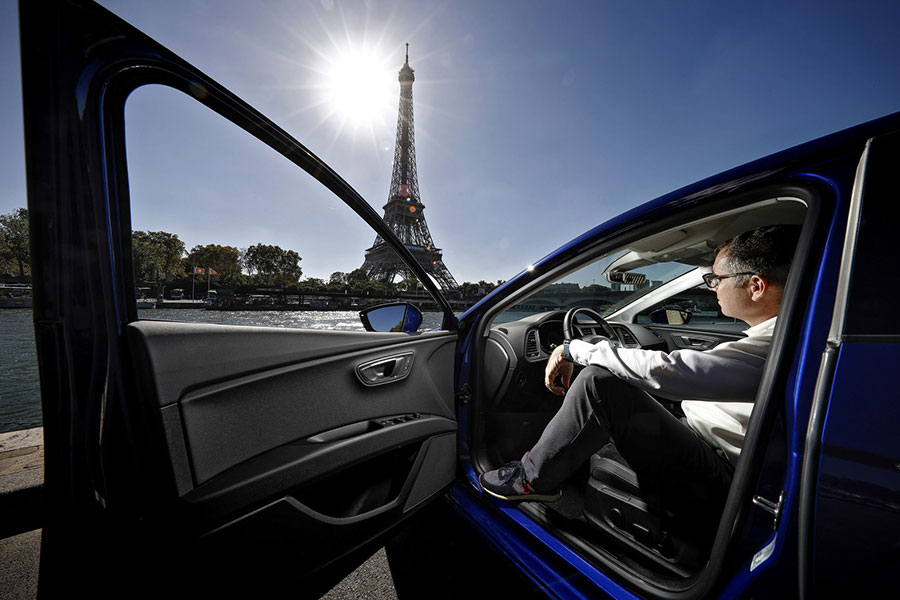
What is the fuel cost to drive from Barcelona to ParisAntonio Calvo, Head of Sustainable Mobility at Spanish car manufacturer SEAT, gets behind the wheel of a SEAT Leon 1.5 TGI to take on the more than 620 mile drive and calculate how much it costs to get there.

The catch? Calvo is attempting the trip in a gas powered car to evaluate consumption and cost. Compressed natural gas (CNG) is methane stored at high pressure and a fuel which can be used in place of gasoline, diesel fuel and propane/LPG. CNG costs about 50% less than gasoline and emits up to 90% fewer emissions than gasoline. The following log details the trip in a gas powered car to the French capital:

Starting point, the Sagrada Familia in Barcelona: Antonio Calvo sets off first thing in the morning from the steps of Antoni Gaudí’s basilica with a full tank of gas. Just a few miles into the challenge, the expert verifies that, “When you drive this kind of vehicle, the feeling is exactly the same as with a petrol car. You don’t feel any difference in the dynamic performance or power.”

– Barcelona-Toulouse, for $17: Antonio Calvo crosses the border with France and covers a distance of over 250 miles without stopping, at an average speed of 75 mph. He makes his first stop to refuel when leaving the city of Toulouse. While filling the tank, he comments that, “The process is very simple, as the universal nozzle enables you to refuel as usual at any gas station.” So far, he has spent $17 and has about 420 miles to go until reaching his final destination.

Next stop, Limoges: While driving through the French countryside, the driving expert points out that, “Driving a car powered with natural gas reduces CO2 emissions by 25% compared to a petrol car and nitrogen oxides by 75% compared to a diesel.” Calvo arrives in Limoges, where he stops again to refuel: “I’ve now covered 425 miles and spent $28 on about 53 pounds of gas,” he says. For the challenge, he has to cover the entire distance with this alternative fuel. The car drives on compressed natural gas by default, even though it also has a petrol tank, which only switches over when the compressed natural gas is depleted.

Last 243 miles to the City of Light: Calvo starts out on the last leg of his trip, and when he arrives at the city limits of Paris he faces the real possibility of being restricted from entering the city centre during episodes of air pollution. With a population of more than two million people, he recalls that this city, “Is putting more and more restrictions on the most polluting cars. But because I’m driving this CNG car I can get in without any problems, even if there happened to be traffic restrictions today from high pollution levels. Mobility using vehicular natural gas is considered by the EU as environmentally efficient due to its low emissions.”

Challenge accomplished at the foot of the Eiffel Tower: Upon arrival at the Champs-Élysées, the head of Sustainable Mobility makes his final assessment of the trip: “I covered a total distance of 670 miles and spent only $50, which amounts to an average of 8 pounds of gas for every 62 miles. The cost savings is certainly one of the many advantages of CNG. In fact, if I had made the same trip with a petrol powered car it would have cost me 50% more; and 30% more if it had been a diesel,” he concludes. Compressed natural gas cars are a growing trend, with more than 1.3 million CNG vehicles to be found on European roads, mostly in Italy.


Grain Bag Handling Fee Helps Recycling Pay For Itself

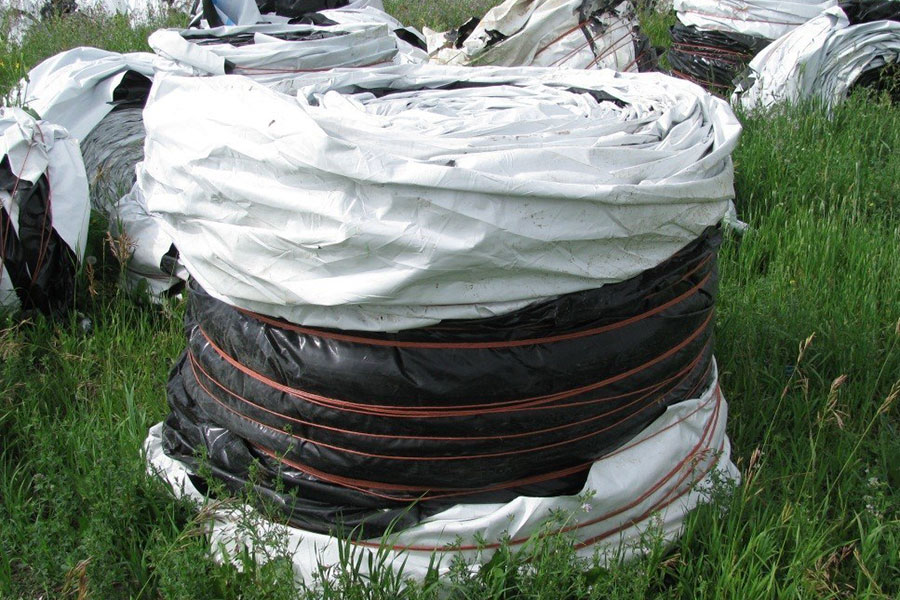
Saskatchewan farmers who purchase large plastic bags for grain storage will see a change when they buy bags after November 1. That’s when Saskatchewan’s new province-wide grain bag recycling program’s Environment Handling Fee (EHF) becomes effective.

The non-refundable EHF of 25 cents per kilogram will be added to the price of the bag based on weight and size. On a bag that is approximately 125 kg, the EHF would start at about $31 and increase proportional to the total weight of the plastic in the bag.

If you like this, subscribe here for more stories that Inspire The Future.
Most grain bag users won’t be buying bags at this time of year but will see the EHF when they purchase bags for 2019 storage.

The calculation of the EHF is based on a six-year pilot recycling program initiated by the provincial government. The government-funded pilot was operated by Simply Agriculture Solutions. Over that time, more than 3,600 tonnes of grain bags were recovered for recycling.

In July 2016, the province created The Agricultural Packaging Product Waste Stewardship Regulation establishing a regulated recycling program for grain bags similar to Canadian stewardship programs for tires, electronics, paint and oil containers. Like those, the Saskatchewan grain bag recycling program transfers financial responsibility for proper end-of-life management to businesses that supply grain bags into the market. A farmer who imports grain bags from outside of the province also falls under the same obligation.

The purpose of the recycling program is to offer farmers a responsible option for returning these single-use, large, heavy bags for recycling. End markets in North America and Malaysia shred, wash and pelletize the plastic and sell it to manufacturers who make products such as plastic garbage bags.

The EHF will be used to cover the cost of collecting the bags at designated collection sites, transporting them to end markets and administration, after deducting end-market revenues.

Cleanfarms, a not-for-profit industry stewardship organization with extensive experience in recovering agricultural plastics across Canada began administering the program when it evolved from the pilot to a permanent program. With funding assistance for the 2018 program provided, in part, by Saskatchewan’s Ministry of Agriculture through the federal-provincial Growing Forward 2 initiative, it has established more than 20 collection sites throughout the province where there is heavy grain bag use. It will add 15 collection locations in 2019.

“We know Saskatchewan farmers want to do the right thing for their land and communities, and that they’re prepared to recycle their grain bags. Since the permanent program began, we’ve shipped more than 800 tonnes of grain bags to end markets with that much or more already collected and ready to be shipped out soon. That represents thousands of grain bags that will be recycled into new products as opposed to disintegrating on farm fields or buried in landfill,” said Cleanfarms General Manager Barry Friesen.

Estimates suggest that 15,000 to 20,000 grain bags are used in Saskatchewan every year.

If you like this, subscribe here for more stories that Inspire The Future.


SodaStream Builds Massive Device to Collect Ocean Plastic

SodaStream CEO Daniel Birnbaum has led 300 executives from around the world, local youth and environmental NGOs to clean the Caribbean Sea and the shores of Roatán island in the Honduras. 

SodaStream International has launched the “Holy Turtle” – a massive ocean contraption designed to clean plastic waste from open waters. The innovative device will be initially piloted in the Caribbean Sea, off the coast of Roatán, Honduras, as part of a bold ocean clean-up lead by CEO Daniel Birnbaum

This is the first-known attempt of a commercial company to undertake a physical clean-up of trash from open waters. SodaStream’s clean-up delegation includes 150 SodaStream executives from 45 countries, international environmental specialists, NGO Plastic Soup Foundation and hundreds of children from 7 different local schools with local Honduran government officials.

If you like this, subscribe here for more stories that Inspire The Future.
The “Holy Turtle” is a 1,000 ft. long floating unit designed to be gently towed by two marine vessels along kilometers of open waters. The contraption is uniquely engineered to capture floating waste while its large vent holes act to protect wildlife. The device design was inspired by oil spill containment systems and was developed by ABBCO in Florida, USA, who are leading experts in oil spill containment.

SodaStream’s Roatán initiative was inspired by a video filmed by Caroline Powers in October 2017 featured on BBC highlighting underwater photography of a floating trash patch off the Caribbean coast of Roatán. Moved by the disturbing video, SodaStream CEO, Daniel Birnbaum, himself an experienced skipper and naval officer, lead a search for a solution to clean up this floating waste. Birnbaum noted, “We can’t clean up all the plastic waste on the planet, but we each need to do whatever we can. The most important thing is to commit ourselves to stop using single-use plastic.”

The plastic pollution collected by the “Holy Turtle” will be used to create an exhibition to raise awareness and educate consumers around the world toward reducing consumption of single use plastic in all forms including plastic cups, straws, bags and bottles.

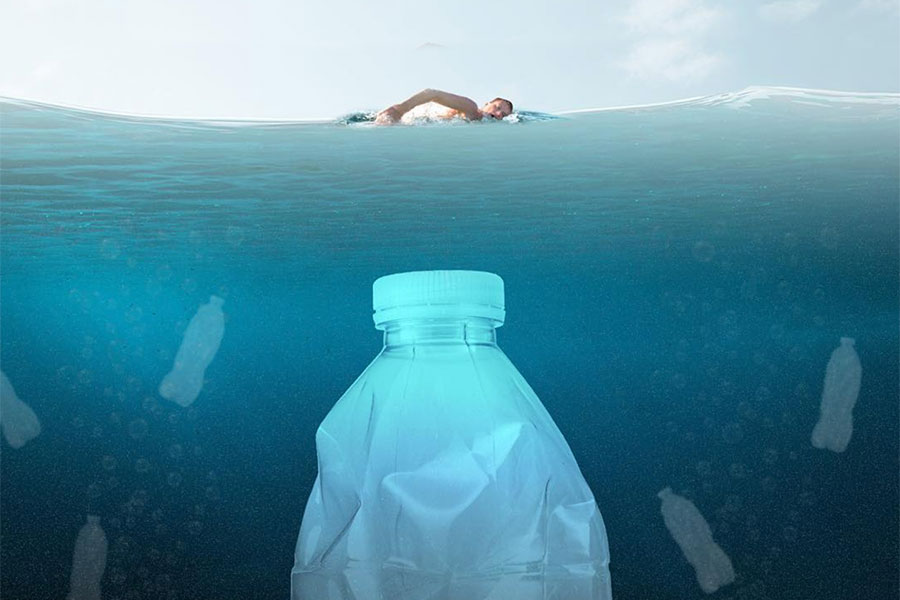
“More than 8 million tons of plastic goes into the ocean every year. This plastic doesn’t disappear. It breaks up into tiny particles, floats in the ocean, endangers marine life and ends up in our food chain,” said Birnbaum. “We must all put our hands together to reduce the use of single-use plastic and commit ourselves to changing our habits and go reusable. It’s in our hands.”

If you like this, subscribe here for more stories that Inspire The Future.

Rich Nations Must Eat Less Meat to Tackle Climate Change

The average person in Britain eats more than three times the government’s recommended 70 grams of red or processed meat each day.

Rich countries should encourage consumers to eat less meat and help farmers become more environmentally-friendly, campaigners said on Tuesday as pressure mounts to limit global warming.

If you like this, subscribe here for more stories that Inspire The Future.

Livestock – largely cattle raised for beef and milk – are responsible for about 14.5 percent of global greenhouse gas emissions, the U.N. Food and Agriculture Organization says.

“If we want earth’s temperature rise to stay below 2 degrees, especially below 1.5 degrees … then we need to tackle this overconsumption of animal products,” said Nusa Urbancic, campaign director of Changing Markets Foundation, a lobby group.

The world risks sweltering heatwaves, extreme rainfall and shrinking harvests unless unprecedented efforts are made to keep the Earth’s temperature rise to 1.5 Celsius (2.7 degrees Fahrenheit), the United Nations said last week.

Meat consumption is more than double the recommended levels for healthy diets in the United States and much of Europe, Changing Markets Foundation and Washington-based Mighty Earth said in a report calling for reform of the food industry.

Cutting animal products from the diet would be a “relatively easy and cheap way” to reduce greenhouse gas emissions and free up land for conservation and storing carbon, they said.

For example, the average person in Britain eats more than three times the government’s recommended 70 grams of red or processed meat each day, the report said.

While more people are becoming vegan and vegetarian – particularly the young – governments continue to subsidise intensive meat and dairy farming methods that exacerbate climate change, it said.

“In Europe and the U.S., a lot of public money is spent on farming subsidies but very little of it goes to environmental measures,” Urbancic told the Thomson Reuters Foundation, calling for more support for organic farming.

There is a “shocking absence” of government policies to encourage consumers to eat less meat and to promote low-carbon alternative foods, unlike in the energy and transport sectors where reforms are receiving support, they said.

One country encouraging environmentally-friendly agriculture is Wales, where the government gives financial support to farms improving water management, maintaining biodiversity and combating climate change.

Tony Davies, a Welsh farmer benefitting from the scheme, has reduced his flock by two-thirds – to 600 animals – since 2005, which has reduced his overheads and boosted profits.

“The wildlife on the farm has increased as we have kept less stock,” he said by phone from Henfron Farm.

“More trees have had a chance to regenerate and we are storing higher levels of carbon.”

By Thin Lei Win @thinink, Editing by Katy Migiro

If you like this, subscribe here for more stories that Inspire The Future.

Electric Race Cars: Learning to Drive All Over Again

A socket, a battery weighing almost half a tonne and 200 kilos of dry ice every day in the box at the race track. These are some of the features that have emerged with the rise of electric race cars, and the new models have completely changed the way racing teams do their work.
 
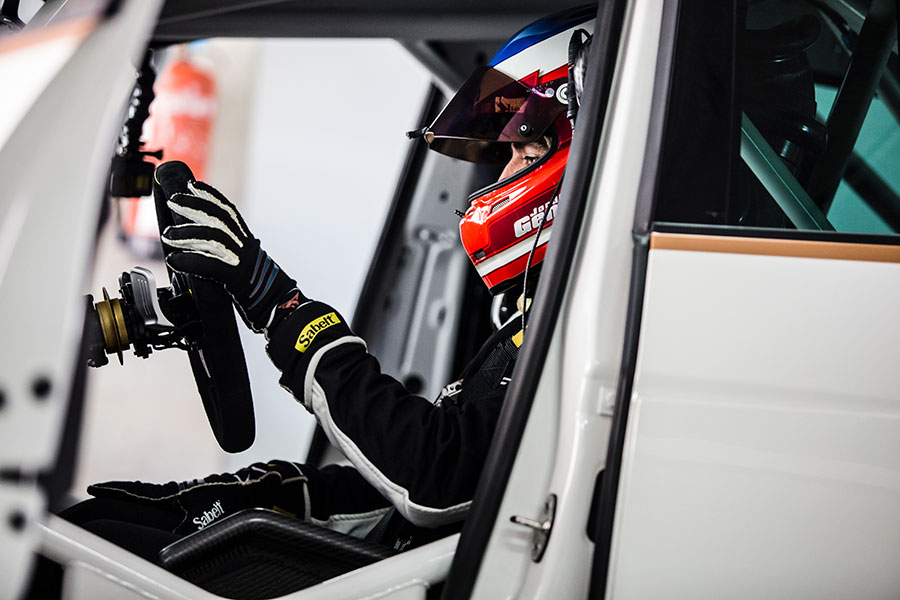
Engineer Xavier Serra, mechanic Jordi Martí and race driver Jordi Gené of sports car brand CUPRA, explain the keys of this transformation during a day of testing with an e-Racer:
 
Learning how to drive all over again: With 30 years of experience, CUPRA driver and ambassador Jordi Gené admits that getting behind the wheel of an electric race car “implies learning from scratch”. “The driving style is completely different and now you have to use other parameters in order to know t what speed you’re driving, how to negotiate a corner or the right time to apply the brake”, he adds. For example, this vehicle’s greater weight and different sound change the references received by a driver while driving. As it is able to reach 100 km/h in 3.2 seconds, Gené assures that the “the feeling of acceleration of the e-Racer is much more forceful, and the adrenaline rush is even bigger”.
 
200 kg of dry ice every day: During one of the laps, an indicator displays a warning that the driver has to return to boxes to cool the battery. Cooling it down with dry ice is one of the jobs of the mechanic. Furthermore, the engineers also have new strategies on their hands: “It’s not just about being the fastest; now we have another factor to consider: energy management. We must learn how to monitor the temperature and the range”, explains team leader Xavier Serra. In this sense, positioning the 450 kilo battery “was one of the biggest challenges we had to face” when developing this model. The team had to distribute the volume of the battery underneath the car in order to maintain its balance and functionality.
 
A new ritual: “After working for more than 20 years in this profession I never would have thought I could charge up a race car with a plug”, says CUPRA mechanic Jordi Martí while he gets the e-Racer ready to exit the box again. Even the tools he uses are different. Now he has a set of specially designed instruments to withstand high voltage, such as gloves made with insulating material that can resist up to 1,000 volts.
 
The future of motorsport: “The arrival of the electric vehicle to racing signals the beginning of a new era”, concludes Xavier Serra. Being a part of the team that has developed and is testing the first wholly electric racing touring car in the world “is like being a part of a historic moment”, says the mechanic.  “It’s a very interesting professional challenge”, adds Gené.
 

U.N. Global Compact CEO: Business Must Fight on After Climate Setback

At the U.N. General Assembly Week in New York last week, I asked Lise Kingo, CEO of the U.N. Global Compact, on her reaction to the climate crisis and if any repercussions had since come from the United States pulling out of the Paris Climate Accord back in June 2017. Should we despair and how should business react?

In 2017, the U.S withdrew from the Paris Climate Accord. Has all the hard work regarding climate action been undone? 

We are disappointed by the decision of the United States to leave the Paris Agreement, which is a historic global accord to combat climate change and protect our planet for future generations. But, despite this setback, there is also cause for optimism. The Paris Agreement has activated an unstoppable momentum for climate action, with an essential role spelled out for responsible business.

At the United Nations Global Compact, we have built a coalition of businesses taking action on climate and we are seeing private sector engagement on climate change grow exponentially across the board, with businesses everywhere committing to a suite of effective policies including pricing carbon and setting science-based targets.

Has business yet realized the value of the Sustainable Goals, especially climate change, and how addressing it might benefit their balance sheets?

Investors are increasingly demanding climate information, while consumers are demonstrating a willingness to pay a premium for environmentally-friendly products. There is a clear and growing market opportunity for climate compatible products, services and investments.

In the case of an absence by a Member State to take climate action, sub-national governments can continue to support the shift to a green, resilient economy. Individual states and cities can lead the charge and advance the goals of the Paris Agreement in the service of the health and economic prosperity of their constituents.

How will the U.N. Global Compact continue to raise awareness around climate issues, despite the world’s most powerful country deciding otherwise?

We believe that what was discussed in Paris in 2017 sends the right market signals to provide predictability, unlock capital, drive innovation and reward responsible companies. The UN Global Compact is committed to working with businesses large and small to mainstream today’s leadership standards on climate and we will continue to challenge companies to go further in transforming their business models and adopting policies that reduce their emissions and transition to a sustainable future.

Though setbacks may try to impede climate progress, we will push onwards in the spirit of solidarity and unity that first brought the world together in support of the Paris Agreement. The business community can and must rise to meet the climate change challenge. Together with Governments and civil society, the UN Global Compact stands ready to mobilize a global movement of responsible companies and stakeholders to create the world we want.

Cape Town Looks to Apartheid’s Legacy to Curb Climate Change

The outgoing mayor of Cape Town, known for averting a near catastrophic water shortage, said she hopes to leave office on the heels of another victory in the fight against climate change – slashing greenhouse emissions from transportation.

Patricia de Lille said South Africa’s second-largest city could reduce its greenhouse gas footprint by building homes for low-income residents on land left undeveloped as a legacy from apartheid.

It is a unique solution tied to the country’s cruel history.

If you like this, subscribe here for more stories that Inspire The Future.

The parcels of land were used to buffet the white-minority from members of the majority black population who were oppressed and segregated under the system of apartheid, which was imposed by white-governments from 1948 until the early 1990s.

“It’s valuable land, close to transport,” she told the Thomson Reuters Foundation on the sidelines of a climate change summit in San Francisco on Wednesday.

Under her plan, de Lille said, erecting low-cost housing on five city-owned plots will allow people to live closer to their jobs in the city center, thereby cutting car transportation and reducing carbon dioxide emissions.

“We’re using those pieces of land that belong to the city to bring about transport-oriented development,” she said, adding that transportation accounts for about 70 percent of carbon emissions in Cape Town.

“To reduce carbon emissions, you have to deal with the spatial planning of your city,” said de Lille.

Her plan was adopted by Cape Town’s government in 2016, but has not yet been put into action.

De Lille, a former anti-apartheid militant who quit as mayor of Cape Town last month after a bitter dispute within her political party, said it “must be implemented.”

“If it does not happen, I will be the first person to protest and I will mobilize the masses,” she said.

“This is an opportunity for me to drive integration of the city, by bringing people of color closer to the city.”

De Lille, whose resignation is effective Oct. 31, has been a mayor of Cape Town since 2011, and has a large support base among her fellow mixed-race residents of the city.

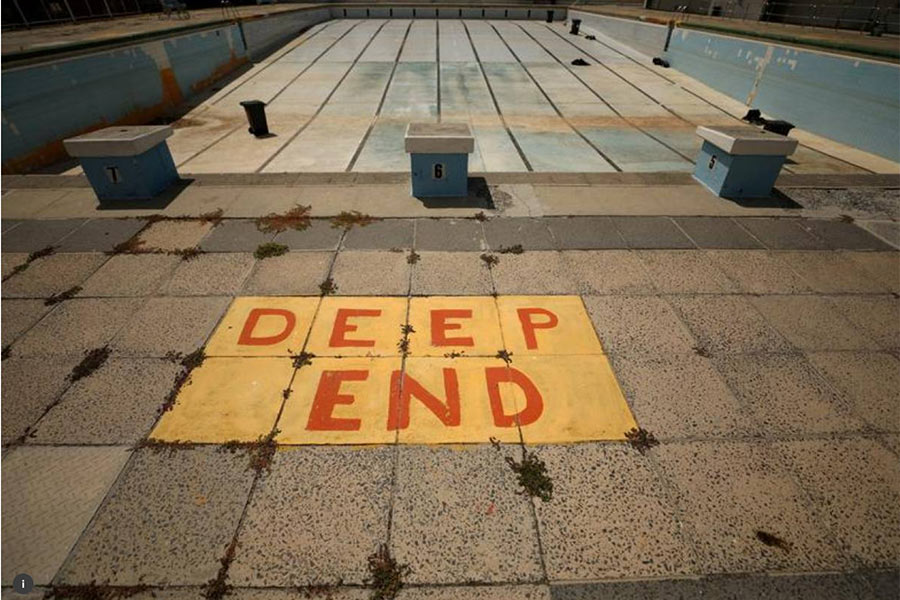
Under her tenure, the port city, a tourist hub with a population of about 4 million, avoided a feared “Day Zero” when its taps would have run dry due to severe drought after three years of low rainfall.

De Lille was speaking at the Global Climate Action Summit, a three day event that has drawn about 4,500 delegates from city and regional governments from around the world.

By Sebastien Malo @sebastienmalo, Editing by Jared Ferrie

If you like this, subscribe here for more stories that Inspire The Future.

Cape Town Looks to Apartheid’s Legacy to Curb Climate Change

The outgoing mayor of Cape Town, known for averting a near catastrophic water shortage, said she hopes to leave office on the heels of another victory in the fight against climate change – slashing greenhouse emissions from transportation.

Patricia de Lille said South Africa’s second-largest city could reduce its greenhouse gas footprint by building homes for low-income residents on land left undeveloped as a legacy from apartheid.

It is a unique solution tied to the country’s cruel history.

If you like this, subscribe here for more stories that Inspire The Future.

The parcels of land were used to buffet the white-minority from members of the majority black population who were oppressed and segregated under the system of apartheid, which was imposed by white-governments from 1948 until the early 1990s.

“It’s valuable land, close to transport,” she told the Thomson Reuters Foundation on the sidelines of a climate change summit in San Francisco on Wednesday.

Under her plan, de Lille said, erecting low-cost housing on five city-owned plots will allow people to live closer to their jobs in the city center, thereby cutting car transportation and reducing carbon dioxide emissions.

“We’re using those pieces of land that belong to the city to bring about transport-oriented development,” she said, adding that transportation accounts for about 70 percent of carbon emissions in Cape Town.

“To reduce carbon emissions, you have to deal with the spatial planning of your city,” said de Lille.

Her plan was adopted by Cape Town’s government in 2016, but has not yet been put into action.

De Lille, a former anti-apartheid militant who quit as mayor of Cape Town last month after a bitter dispute within her political party, said it “must be implemented.”

“If it does not happen, I will be the first person to protest and I will mobilize the masses,” she said.

“This is an opportunity for me to drive integration of the city, by bringing people of color closer to the city.”

De Lille, whose resignation is effective Oct. 31, has been a mayor of Cape Town since 2011, and has a large support base among her fellow mixed-race residents of the city.

Under her tenure, the port city, a tourist hub with a population of about 4 million, avoided a feared “Day Zero” when its taps would have run dry due to severe drought after three years of low rainfall.

De Lille was speaking at the Global Climate Action Summit, a three day event that has drawn about 4,500 delegates from city and regional governments from around the world.

By Sebastien Malo @sebastienmalo, Editing by Jared Ferrie

If you like this, subscribe here for more stories that Inspire The Future.

0