Will.i.am and Me Have a Dream

It was not an ordinary weekend for America, or for myself for that matter. President Obama was inaugurated for the second time and I was in complete awe as I walked away from a two and half hour conversation with global icon Will.i.am. He shared with me his purpose and love around making and producing music. “Every word I use in my songs,” he explained, “is meaningful. The messages I convey share a story, a history, an emotion, a call to action, or even the expression of the invisible and an outlet for the untold.” He mentioned that the pop songs that hit the charts often contain a different purpose – mostly to “hit” the charts. We look at him now: a global fan base, Grammy nominee and winner, an abundance of wealth. Life was not always like that.

A family of many children, and a single mom. Will explained that despite his hardships in his early life, he had an incredibly powerful passion to do something meaningful. Not only in the way rhythm moves his mind and soothes his heart, but also for spreading a message that dreams can become reality. I thought about how passion can drive how we change things, and who we become. This one conversation got me thinking, maybe it’s not about who we were yesterday or who we will be in the future, but who we are becoming. We’re changing.  

As the clock ticks, the birds chirp, as the seasons pass, we change. We are in the process of developing into who we are as a person, who we choose to become. Throughout our lives, we are evolving from caterpillars into butterflies. We live, we learn, we grow and mature: we break out of our cocoon. This transformation throughout our lives teaches us many things. The metamorphosis allows us to crawl away from the past and enter a world of undiscovered destinations. Although it may not be well-defined at this moment when we allow ourselves to change, adapt or grow we gain clarity with a new set of eyes.

These new sets of eyes allow us to see the world with clearer perspectives. With a new body we will learn to fly. Well, we might fail a few times, but eventually we will take flight. We will soar. Some of us may ask, where are we headed? No one has the answer to that, except you. That’s in your hands. It’s up to us. As Steve Jobs said, “You can’t connect the dots looking forward; you can only connect them looking backwards. You have to trust that the dots will somehow connect in your future. You have to trust in something – your gut, destiny, life, karma, whatever.” Trust in the journey of life perhaps? We live in a time where the future is ever-changing, and for that reason, we must focus our energy on today. The past is history and the future is yet unwritten.

Yesterday is long gone and tomorrow is not guaranteed. The present, today, right now, this moment in our life is what we have. Consider Walt Disney at age 22 or Debbie Fields who founded Mrs. Fields Cookies in her early 20s, 17 year-old Ingvar Kamprad founder of IKEA, or even Michael Dell who was 19 years old when he founded Dell Computers. They prove that today is our day. Any day is our day when we begin to take initiative. This is our time. No matter our age, young or old, a day is a day and an idea is an idea. I see no reason why age, for example, becomes a barrier to our success.

We can drive social change, we can become the innovators, or the entrepreneurs that generate progress. Life is too short for us to live silently. It seems as though our days are limited, and life is an uncertain length. Well if that is the case, let’s begin to speak up. I can almost guarantee that when that voice comes from within, from our passion in life, failure is not an option. Dr. Martin Luther King Jr’s. words are still relevant today: “Whatever it is you’re gonna become, become the best at it. If you’re gonna be a garbage man, be the best garbage man. To dream, dare, and do. Don’t ever let somebody else tell you what you can’t do. If you got a dream, you gotta protect it, and if you know what you want in life, you got to go do it.”

There is no reason to wait to become what he describes as the best version of ourselves. When we look in the mirror we must be proud of the person staring back at us, because that’s all we have. Let’s find that person in the mirror and say “I am somebody. I am somebody that this world needs. I’m leaving my mark. I am here.” Our future starts today. In June 2013, I gave the commencement speech at my high school graduation – a note specifically for the youth. The above is a modified version.

It was geared more towards youth entering the university environment. Nonetheless, I believe that what I have described above applies to anyone reading or listening. As the world is changing, we as leaders are changing. Our goals, ambitions and opportunities may depend on our concept of time. Is it here and now that we believe we can reach accomplishment and follow our heart? Or do we wait until those beliefs mature in our own cocoon? Yesterday feeds into today and today into tomorrow.

The common dominator is today, so we ought to begin today.

The Day I Learnt About Leadership From Bugs

As the day entered the twilight zone and a sticky breeze accompanied a transforming mountainous view, my cloudless, introspective mind indulged in the beauty of a roasted marshmallow sky. At an elevation of about 4,500 feet, almost halfway to the “top of the world,” I was captivated by a microscopic world before me. One encompassing teeny tiny crawlers. A bug’s world. What initially fostered this fascination, and a further unexpected learning experience, were my fellow classmates studying at Kopan Buddhist Monastery in the middle of Kathmandu, Nepal.

For the first time in my life I witnessed people (yes, plural) consciously saving bugs and insects. To many, a fly swatter equated to a pistol, the forceful flush of a toilet was understood to be as catastrophic as a natural disaster and insect repellent was parallel to poisonous gas. To a Buddhist, the belief that we shall not kill includes any living organism. While I was at a Buddhist monastery this vow was obeyed completely.

I saw how people were cautious about where they sat, a wrong seat may lead to the funeral of an innocent bug. People became tour guides for insects by escorting them back to their natural habitat. Additionally, they took on the role of lifeguards to save drowning bugs in a body of water (i.e., a pond, the toilet bowl, the sink, a puddle).

My compassion for insects, which matured during our retreat, was refreshing and motivating. It made me reconsider my baseless apprehension of insects. Two years ago, when I spent time in the Amazon, I would have been considered a serial bug killer. I devalued the importance and beauty of a bug’s world, stomping on the little creatures without purpose other than my own selfish fear. Living among a world with no escape of flying creatures, squirming snails, lanky spiders or buzzing bees, it made me confront fear in the face. I literally looked at my fear and ate it, to make it disappear: I consumed a maggot. Overcoming this fear certainly was not an easy one. Yet, it was advantageous in the long run.

By releasing my mind from deceptive thoughts about the nature of tiny organisms, I was able to realize and appreciate the world in a completely new way. Being in Nepal facilitated my entry to the next level. It was a transformation from disgust to neutrality, to a state of fascination and excitement. Being surrounded by people who cherished the beauty of what I used to claim as terrifying, initiated an expanded acceptance of the bug’s world.

That night when I looked out into the fading sky of fluff, a peculiar event changed my outlook. I found a number of ants frantically crawling along a concrete wall. As my fascination increased, I began to realize that these little creature’s behavior was much more complex than originally perceived. Rather, their actions personified their systematic, logical, empathetic, collaborative, determined, and strong qualities. At the center of this occurrence, was the astonishing effort of a team – about 25 ants carrying a dead bee. I was most dumbfounded by the mere fact that even if all these ant transporters were combined into one bug, this new creature would still be smaller than the size of the bee itself. These tiny, itsy-bitsy insects were carrying something that would be classified as overly obese in the ant world. Humans would be unthinkable giants to them. I stared. I watched. I contemplated.

How is it possible that these miniscule bugs could effortlessly escort something that is massive in comparison? As these ants marched across the wall for a meter or so, I first thought about the power of fear and secondly considered the strength of collaborative efforts. The bee may have been seen as overwhelmingly large in relation to the ants, yet from a desire to join together, these ants made the unthinkable possible. No matter how big or small our goal or obstacle, we are able to accomplish what we put our mind to. There is always a way.

It may require an extra person and their relative skill set, or maybe just a conversation that stimulates a ping pong game of creative thought. Personally, I used to hide when people offered a helping hand to my non-profit endeavors. I wanted to claim full responsibility and retain control. If only I knew back then that when we join forces, we become more powerful than before. Perhaps my “team” could have tackled major funding barriers, or reached a 12-month goal in 6 months. I refocused my attention on the ants. Surrounding the staggering group with the bee were about 75-100 additional ants, scrambling and strutting up, down and around the main attraction. The ants had their own path, not linear or circular, but a pattern none the less. At this point, I started to consider how our personal and professional processes go beyond the people who are directly involved. There is much “behind the scenes” that facilitate the efficiency of our activities.

Maybe the “surrounding ants” in our life are our mentors, role models, conversations or interactions. Together there are many elements, which compose our progress and ultimate success. One ant would not be capable of moving a bee single-handedly. Two ants? No, not even close. Collaboration was their only means of success. The ants marched one by one, the leaves swayed as the breeze washed over the trees and I pondered how I was even able to come to these conclusions.

There were two themes that continued to filter through my mind: letting go of our fears and embracing collaboration. The fear I once held was a blockade, but once I released that distress, it turned into a vehicle for inspiration, beauty and internalization. Fear once clouded my mind and distorted my ability to see beyond. That old-time fear guided me to recognizing and appreciating much more than I ever did before. I was able to find meaning, purpose and insight from a realm that previously terrified me.

When we let go of our fears, I have found that we are better able to take a chance, explore our curiosity and fulfill a step in the path to success. For me, my liberation enabled new practices, new knowledge, and a new appreciation. My experience helped me to realize the significance in working together, rather than pure competition which hinders other players, and also oneself.

I began to understand how our interactions with our social and physical environment all contribute as a stepping-stone to achievement. We live in a multifaceted world that consists of multiple networks, systems and relations. When we connect the pieces together, the process of understanding and achievement is simplified.

Rainbows and Failures: Value Your Mistakes

Imagine a world in which failure was not a terrible event. A place in which mistakes were valued, obstacles were short-lived barriers and questions were endless. Perhaps an environment where we had nine lives, like a cat. This place is where we would explore and learn from our experiences. It would be a world in which failures could constitute success. When I think about “success stories” or successful leaders, it’s the story, the journey that is often highlighted. How did they do it? What were the circumstance, the experiences, and the process that made it possible to accomplish their goal?

After all, at one point or another, we are all bound to fail. I don’t intend to present a pessimistic viewpoint, but rather an optimistic understanding of failure. In fact, what separates leaders and others is those who let failure take over and those who work even harder after they’ve failed.  I realized this in an unexpected environment. At the edge of a bridge, overlooking one of the most magnificent sites I had ever seen: Iguazu Falls in Argentina.

Imagine a place isolated from society. What you hear is a chorus of birds. You can feel the breeze and see trees swaying back and forth. Rich, green leaves moving back and forth to create a small force. It’s not too chilly. There is no need for you to pull a sweater out of your backpack. The sun takes care of the warmth. It’s beaming and glowing. So bright and always present. The rays of sun pass through the holes of the branches of tress. You think to yourself, how can this be real?

As you proceed to the main attraction, you observe how the water has a brown and red tint from the minerals. It’s as calm as bath water. Then as time goes on it begins to get rougher and a little choppy. Finally you arrive at the first stop to see the falls. You begin to walk down a path that acts as a bridge. There are times when you question your safety.

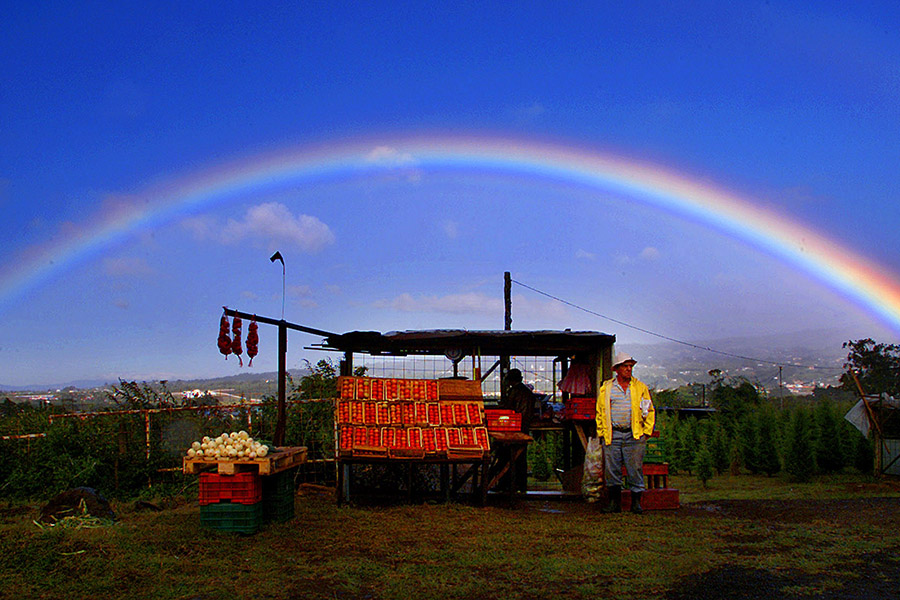
rainbow

Maybe it’s the questionable construction of the bridge or the vast number of people walking on it at the same time. Then you think, “it’ll be okay. Many people have walked this path before. I’m going to be okay.” You start to wonder how soon you’ll see the falls. The view is rather stunning. Huge trees covered in leaves surround the bridge area. You’re able to look out at the river and take in its beauty. On your journey you begin to hear sounds. It’s a sign you’re getting close. You begin to see huge clouds in the sky.

But soon realize that these aren’t clouds but actually mists coming from the falls. Consider the way a bomb explodes and takes over the purity of the air. Think about the same thing happening but with a cloud of water and mist. This is all you see on the bridge. Promising isn’t it? You finally get to the end of the bridge and Bam! The beauty is everywhere. An insane amount of water is pouring over so quickly that it looks like it’s moving in slow motion.

This particular section is called the “Devil’s Throat.” One slip on a banana peel and you’re the devil’s next meal. Nonetheless, you don’t let the panic ruin your experience. How could you when nature’s freshness fills the air? In this environment, you could never imagine how we could pollute this world. You look at the falls and wonder how this got to Earth. It’s a crushing sound that never stops and a sight that never fails to meet your expectations. It’s absolutely stunning. Rainbows appear. The most vivid rainbow you’ve ever seen.

The red is as bold as blood, orange is brighter than the fruit, yellow matches the sun, green is as dark as healthy grass, blue like in the middle of the ocean, and purple like a field of lavender combined with plums. This rainbow is also a full circle. You probably always thought there is a pot of gold at the end of each rainbow… maybe there is but you now see that a rainbow has no end. Its colors are reflected in some parts of the water. Then slowly, you see another rainbow appear behind the original one. It’s incredible; so pure and untouched, so clean and unharmed, so beautiful and perfect.

It occurred to me at that point that what I had just experienced was a walk through someone’s living hell into heaven. I embarked on a journey from a deathly forceful waterfall into magical, mystical surroundings. If nature is able to coexist and produce something like this, then it should allow humans to understand how our own nature allows a similar process. In this way I came to build a foundation for a belief I hold dear.

Namely, how a leader may be recognized for their success, but it’s the mistake and failure that makes them recognizable. In order to reach success it’s likely that mistakes, rainy days, failures and obstacles will be part of it. Ultimately, a rainbow is the product of sunshine (the good, positive and successful) and rain (seen as bad, negative and disappointment). Without the condition of a “sad, bad rainy” day, then the rainbow is not possible. A lack of optimism in the sun coming out, also erases the possibility of a rainbow.

Finally, we can see how a rainbow is mutually constituted in the good and the bad, in the happy and the sad, in failure and success. Essentially when you see a rainbow – someone’s success story – reflect on how there may have been a few rainy days that contributed to the magnificent site you now see. The ones who are able to “produce a rainbow” are the ones who danced in the rain and celebrated those cloudy days. If today there is an overarching shower from the sky, remember that your rainbow, your success, is likely to arise from conditions such as these.

Empowerment Through Change and Perseverance

Step into the shoes of an Ecuadorian women living in a small community in the Andes Mountains. It’s a Wednesday and wake up call is at 4:00 am. The sun is still a bit drowsy; the Earth and the people slowly arise for the day’s activities. With a family of growling stomachs your responsibility as a mother requires you to prepare breakfast. You’ll have to make whatever is in the house…whatever you could afford with your limited five dollars at the market yesterday. Perhaps there is some rice (1 pound is 0.50 cents), pastries (1 dollar buys you 10) or mangoes (1 dollar buys you 25) left over.

The clock is ticking; only 30 minutes left before you must go out to attend to your duties. With no time to spare, you head out into the field to tend the farm. Today’s job includes washing your donkey, feeding the sheep and collecting food for the guinea pig and rabbits. Yesterday you were watering crops, digging the buried potatoes and cutting weeds. You must allocate proper time for both the animals and agriculture. Poor time management equates to an empty pantry, no school uniforms (meaning no education), and no extra money for repairs around the house, for example.

Your back is in pain due to constant hovering and lifting in the field. Complaining might help the emotional side, but it won’t alter the physical. In fact, it won’t change the fact that tomorrow you will need to suffer the same physical challenges in order to bring health, education, clothes and shelter to your family. You’re willing to do anything for your loved ones. You grew up knowing that life can be hard; your ancestors told you that those who work the hardest are the ones that live the longest.

The sky has gotten dark and the evening chill is flowing. Dinner sounds nice, if money allows. Water would be great too, if one of your children went on a 5-8 hour walk to fetch it. A shower? Forget about that because you’ve had your shower for the week on Monday. It’s nine in the evening. You look at your successes and after a full day, the monetary gain is maybe 0.50 cents. Less than one dollar. It’s clear now that in your “free time,” before heading to bed, you need to knit a scarf for the women’s group. Someone needs t0 bring in the alternative income.

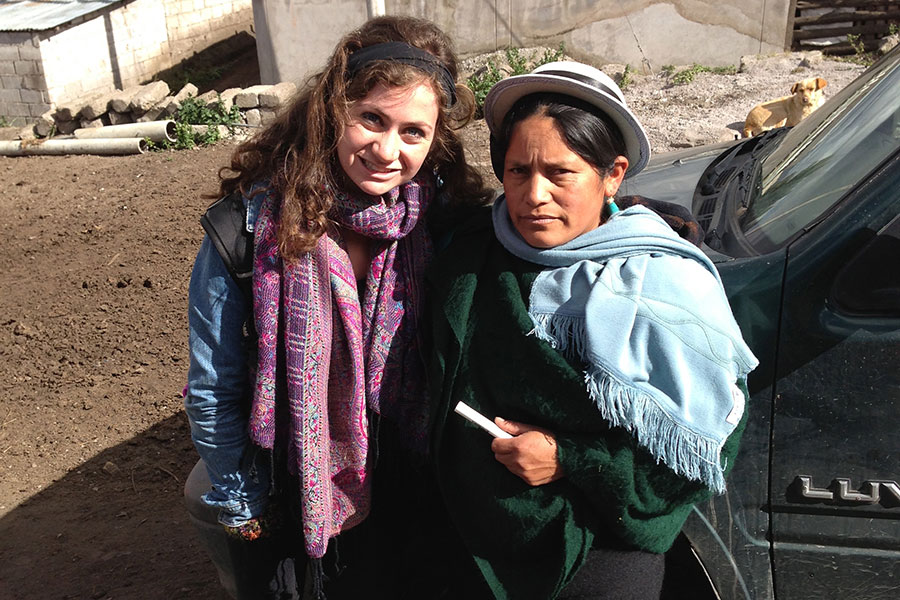
Not a second in the day goes by that your hands aren’t busy. Money means hard work and hard work means food. Your bed calls, ready for tomorrow starting at 4 am. Sleep, work, work, work, and repeat. During one of my Giveable Giggles trips to Ecuador in 2013 I met numerous women who live the daily experience described above. This, however, is the modern experience. Not too long along the communities and women, in general, lived in circumstances of extreme inequalities, violence or discrimination. One person in particular, Maria Angela Pacheco explained to us that she refused to go on living in these circumstances. She is living proof of how one’s goals combined with determination, passion, mobilization and action can make a difference.

As a young girl she grew up combatting the consequences of poverty, racism and sexism. She was raised in an environment in which women were treated and viewed as inferior and unequal. In comparison to the men of the community, there was a complete lack of opportunities for women. Perhaps it is because the culture called for the females to concentrate on domestic work, which inevitably created a barrier to the outside world. The household became a place for male domination despite it being a “women’s territory.” The men – husbands, politicians, brothers — made all of the decisions about how the women in the village lived their life.

Concerns relating to marriage, occupation and education were among some of the matters that were stripped from a women’s authority. Unsurprisingly, when a woman began to take control of her life, marriage or occupation, violence was expected. Avoiding the horrors of abuse the ladies, consequently, were silenced by the men. Once I understood this context, it began to make sense why the females I met were overwhelmingly shy. Who would want to speak out when their voice was cue for psychological or physical aggression? The women were shut out of opportunities to express their voice and opinions.

Maria Angela did not accept this reality. When she finished high school, she was disgusted with the overwhelming inequality. She took the initiative to listen to her fellow community members. Lost voices were suddenly heard. She essentially broke down the household barrier and welcomed females to speak out for what they believe in. As Maria Angela powerfully stood up for what she believed in, equality was given and respect earned. When she was 18 years old she became the first female president of her community. Following her leadership role and changing times, the community and surrounding areas have dramatically evolved. A woman’s space is no longer limited to the domestic realm. Their voices are no longer locked up in their own minds. Being a female no longer means extreme inequality or opportunities.

Through Maria Angela’s leadership and encouragement, she has introduced a number of microenterprises, for instance. She focuses on knitting projects with younger girls because it provides greater opportunities for their future and the development of the community as a whole. A young generation of educated, confident and powerful women is better equipped to succeed and start a chain reaction in modeling equality. Now even if the ladies had a tough day in the field, they have a safe place and group of like-minded women to interact with. Perhaps the past few day’s earnings were below the necessity; the profit from their group will serve as an alternative to maintain stable families. Maria Angelo has completely transformed the social structure, organization, politics, economy and institutions in these Ecuadorian communities.

When I went to visit Maria Angela, I realized that it has taken a long time for these communities to get to where they are today. Maria Angela did not wake up one day and find a suitable village in which to eradicate inequality overnight. I look towards her clarity, dedication and leadership to explain this transformation. In fact I found out that she ran leadership, ‘rights’ and self-esteem workshops to raise awareness within these communities.

In other words, she made a conscious effort to change a deeply embedded social norm of inequality to encourage positive progress. Maria Angela taught day after day, in place after place until she was able to recognize change. I would venture to believe that many of us resonate with Maria Angela. Perhaps in terms of the struggles we face as people (e.g., due to gender, religion, race or nationality) or as leaders (e.g. time, financial obstacles or space).

Often times I must remind myself that change is an ongoing process and that it may take time to reach our goals. Perseverance was key for Maria Angela. It is her dedication to seeing a change that generated a high impact. It is absolutely incredible that with the willingness to do what it takes to accomplish a goal many lives can be impacted for the better.

Maria Angelo can now measure her success based on the new laws passed, the many successful microenterprise women groups and an environment of equality. She proves that one person can make a difference.

Leadership Lessons From A Slum

In the outskirts of Buenos Aires, Argentina – a place often viewed as inferior – I learned one of those lessons that no book can teach, other than the author of their own experiences. It’s something we generally take for granted but what I learnt in Argentina changed the way I thought about influence and ability. It’s one of those things often forgotten or rarely acknowledged, such as breathing, for instance, or the fact that today we can see, feel and be.

The same way that we are able to change the pattern of our breathing when we concentrate, so too can we change our capabilities. Prior to my arrival in Argentina, I had a very romantic picture of what the country would look like. It was a perfectly painted photo: the meat and wine, the mountains and colorful buildings. To my surprise, street artists dominated and the beautifully cooked steak with a glass of Malbec wine was not guaranteed everywhere.

Furthermore, I had a rather stereotypical image of what the poorer areas would look like: dirty, the stench of excretion, unorganized, crowded and polluted. Now this is a physical description but many of these depictions cross over to the psychological realm of what we may constitute as “poor mentality.” Areas like these, often called slums, are thought to be the lowest of the low, filled with trash, poor infrastructure, diseases, lack of education and resources.

Although there is some truth to this, my perfectly painted portrait slowly turned into one big blob of mixed colors. It was through the deterioration of my preconceived notions that I began to understand why these categorizations are exceptionally misleading. The labels associated with poverty and the poor tend to ignore the fact that these people aren’t living in a documentary movie that describes their life. What Hollywood portrays is just one reality, and perhaps not even an accurate one.

The community members in these areas are living a real life. That means they form relationships, a sense of identity, roles and responsibility, and there are times of celebrations and times of struggle. There is so much more behind the scenes that exemplify their authenticity and “realness.”

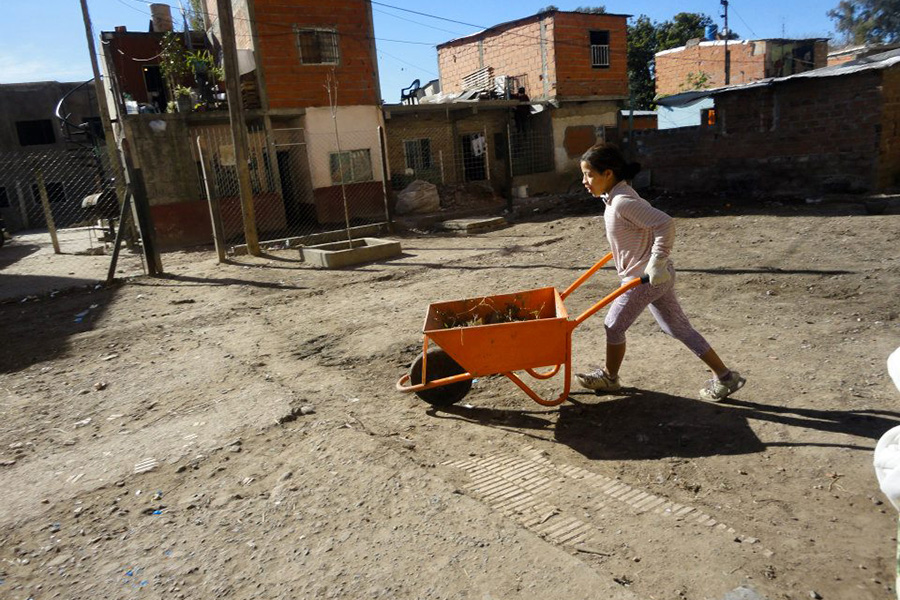
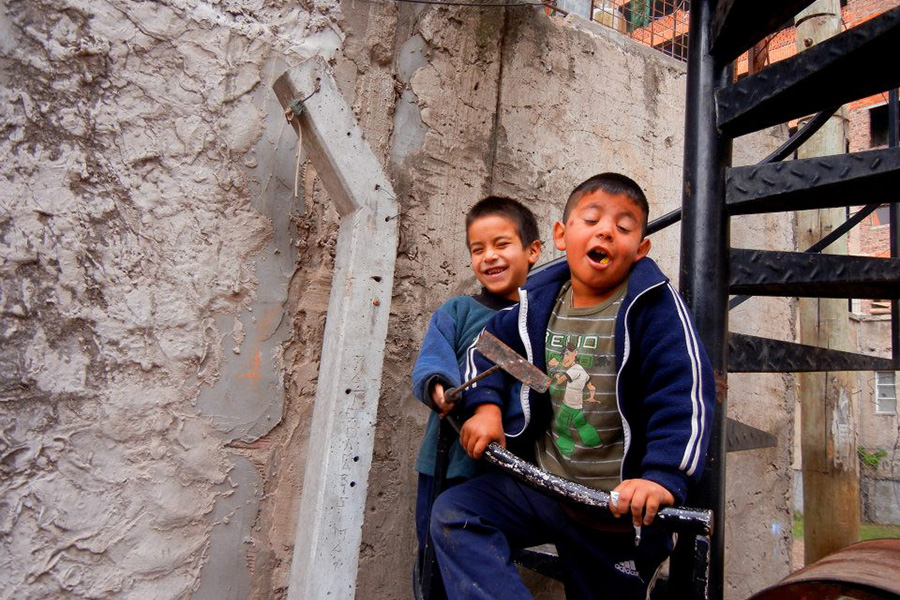
brazil_2 I certainly was guilty of being a foreigner to the truth about slums. Yet, I felt the need to make known that the youth and adults in these areas are inspirational and incredible. Some may not recognize them as the smartest against Western standards, but they are smart enough to build a house from surrounding resources and to survive with minimal assets. That, to me, is brilliance.
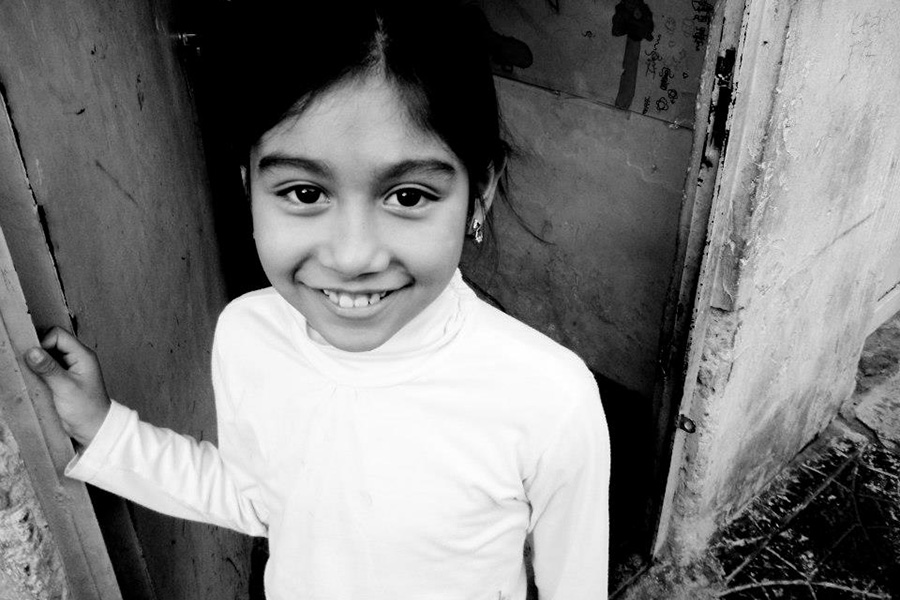
We cannot compare our context to their context and claim that their way of life is illogical. Despite some of the things they do or say not fitting into our systematic understanding, this should not mean it is wrong or less satisfactory. People tend to doubt the slums, but I see these communities as an inspiration and a powerhouse.

When we view others and the world in an egalitarian approach, we release our mind form bias and preconception. This allows us to recognize our breathing patterns… or at least the less obvious and unconscious matters in the world. It’s about finding the good out of something bad. There is beauty in ugliness. Now please don’t get me wrong, I’m not advocating that you drop your current life and move to a slum to find some inspiration. Nonetheless, I find it important that we recognize the kids and parents in such areas as real people. I simply cannot find one justification to claim superiority and deny them less of a right to their humanity.

It’s time for us to escape the bubble we are trapped in; let us accept others above and below us; learn to love and to appreciate. It’s time we make a change. It’s a challenge to put ourselves in their shoes and imagine their experiences. But what I encourage you to imagine are people who overcome numerous daily challenges by living in the present – one day at a time. If children who are barely fed are able to voluntarily lend a helping hand to build a park, what can you do?

If kids who speak broken Spanish but still try to learn English with a foreigner, what can you do? If kids in the villas are able to say no to Paco (a cocaine paste drug in Argentina, ) and carry on strongly, what can you do? If children who worry about where to sleep, what to eat, or how to stay healthy yet still come out to play, smile, and laugh for a while, what can you do?

brazil_3 For them it’s one choice at a time – sometimes a change in attitude, sometimes the motivation to find a better situation. Each step or decision leads to the next step. A baby learns to walk step by step and over time it can walk. Walking turns into jogging and jogging turns into running. Take it day-by-day, step by step.

Inspiration can come from anywhere: from the packaging of your most recent purchase to the shape of the clouds, to the original song of a street busker. It all depends on yourself. We are in charge of our destiny, our accomplishments and our happiness. No matter where we are in the world or who we talk to, everyone has his or her “story.”

Leaders do not let their challenges remain standing still. The kids I spent time with for a couple of weeks in Buenos Aires taught me what leadership means. Leadership is having the tenacity to achieve even when the world is constantly throwing rocks your way. In the worst of situations, there’s an ability to grow, improve and make a difference.

The rain clouds don’t stop the sun from shining after all.

Passion Is The Fuel For Tackling Our Fears

It often seems that each year goes by faster than the one before. Frequently I find myself reflecting and contemplating on where the time has gone. I know that there are 24 hours in a day and 365 days in a year. Yet sometimes I struggle to believe it. How have the leaves started to change color and the symphony of crickets, bees, grasshoppers and cicadas so suddenly faded? As I conceptualize time, I focus more on the way I wish to spend my days.

I imagine days where I wish I could press the “replay” button and relive them time after time. I imagine feelings that I could press “pause” and preserve. I image times that will always be “recorded” in my mind. Perhaps every second of the day is not like my description above. As I identify themes in my daily life that make certain times worth replaying and recording, I have found that passion is a common denominator.

Passion drives and motivates us; it holds a part of our happiness. We will persevere, perhaps tackle our fears, do the unexpected and live in a state of contentment and gratification. Passion is our fuel. Days occupied with passion are days worth reliving, feelings worth pausing and memories worth recording. Passion may even provide the answer to that mysterious question, “how and why do we feel that there are less than 24 hours in a day?”

Passion is my answer to how my two-month internship in India ended up feeling like two weeks. Which is a bit odd, considering I tell people that I constantly had a headache. Yes, working in India made a couple of hairs turn gray. As frustrating as it was some days, I would not change one of them. Challenging situations forced me into undiscovered environments of which I had no knowledge. Those where the experiences I ended up thanking for personal growth.

Without it there is no opportunity for maturation; without passion my aged hair would be meaningless. In fact, with a lack of passion the two months would have felt like two years. With an absence of passion, so much of the summer would have been considered a waste. Living in a world where 24 hours feels like 12, there’s no wiggle room to waste time. Whether it’s purpose we find, the success that follows us, or the potential we realize, a passionate life is one of living rather than existing.

After spending this past summer working on a tourism project called “Explore India and Hinduism” and doing non-profit and village development consulting I now intend to lead, learn and live through passion. I think part of the process for maximizing our individual humanity is developing our purpose. When we live from a place of deep authenticity, our passion is at the forefront. In other words, in order to live a life of many days that are worthy of replaying, passion is essential.

If you’d like a loop-hole for “pausing” time, I’d recommend living with passion everyday. You will continuously preserve that feeling. When our lives are passionate, other people will then be eager to “record” our own success and happiness. Passion is the building blocks of greatness, achievement and reason.

Teenager Malala Yousafzai Wins Nobel Peace Prize

Malala Yousafzai, along with Indian children’s rights campaigner, Kailash Satyarthis, have won the Nobel Peace Prize. Malala won the hearts of millions when she faced death for advocating education for girls in pakistan. She survived and has taken a global stance. On the afternoon of Tuesday, 9 October 2012, 15-year-old Malala Yousafzai boarded her school bus in the northwest Pakistani district of Swat. Shortly afterwards the bus was stopped by a gunman who boarded and asked for Malala by name. He then pointed a Colt 45 at her and fired three shots. One bullet hit the left side of Malala’s forehead, traveled under her skin the length of her face and then into her shoulder.

She remained unconscious and in critical condition for days, before being sent for specialist treatment in London, where she made a full recovery. The reason for the attack on this teenager surfaced shortly after the incident: The Taliban in the region didn’t like her promoting the education of girls, where they had recently taken control and had banned girls from attending school. From the age of 11, Malala had already been writing a blog under a pseudonym for the BBC, detailing her life under Taliban rule.

She rose to prominence and caught the attention of the Taliban after a New York Times documentary was made about her life and South African activist Desmond Tutu nominated her for the International Children’s Peace Prize.  Since her near-death incident there has been an international outpouring of support for Malala, to the point where she may have become the most famous teenager in the world.

Then Prime Minister of the U.K., Gordon Brown, launched a United Nations petition using the slogan “I am Malala” and demanded that all children worldwide be in school by the end of 2015. The petition led to the ratification of Pakistan’s first Right to Education Bill. The universal condemnation and subsequent call to action cut across cultural divides and genders.

Time magazine named her one of  The 100 Most Influential People in the World, Pakistan awarded her the country’s first National Youth Peace Prize and in 2013 she received the Sakharov Prize for Freedom of Thought, previously bestowed on the likes of Nelson Mandela, Kofi Annan and Aung San Suu Kyi. Thirty-three additional awards and honors have been given to Malala, focusing the world’s attention on what might have been just another tragic, and silent, crime against women.

On her 16th birthday, she spoke at the United Nations to call for worldwide access to education. The event was dubbed ‘Malala Day’ and was her first public speech since the attack. It also led to the first ever Youth Takeover of the U.N., with an audience of more than 500 young education advocates from around the world.

“The terrorists thought they would change my aims and stop my ambitions,” she said. “But nothing changed in my life except this: weakness, fear and hopelessness died. Strength, power and courage were born. We realize the importance of our voices only when we are silenced.”

Women Leaders: Learn To Run With Wolves

Over the years I have trained and coached hundreds of women to help them advance their careers in corporations, foundations and start-ups. From the smart engineers of ArcelorMittal who had braved their way through remote mining assignments in places where women are at serious risk, to posh strategy consultants at Boston Consulting Group who avoided political landmines on a daily basis in multi-billion dollar strategy projects…

The challenges we discussed were often similar: more networking despite life balance constraints, better visibility and greater assertiveness when negotiating were almost always on the table.

The one thing I have never discussed with women leaders is running with wolves. I was reminded this weekend of a book that’s been sitting on my shelf for the last ten years. I bought it in a small bookstore in Paris on the Rue de Rivoli because the title called me in some way: Women Who Run With The Wolves by Clarissa Pinkola Estés. I must confess I’ve picked it up several times over the years and read a couple pages, but no more. Until this weekend.

This is exactly what is missing in all our training, coaching and theorizing about women’s leadership: the pleasure of running with wild wolves. And I would go as far as inviting men to read this book as well. It’s twenty years old now. But it brings together a collection of myths and stories about the archetype of the wild woman.

That collective ideal hidden somewhere inside all our minds that describes the most animal, guttural, instinctive, passionate, unruly part of feminine nature. We have lost touch with this part of ourselves, both women and men. Because women who shy away from the wild within them can’t teach their men to adore and admire the she-wolves in other women either.

For years I’ve been telling women to learn to play the rules of male power games if they ever want to have a say in how the rules are shaped. So we talk about doing more networking and getting out there to give talks, get on high-visibility projects, smile at the camera from the center of the picture instead of the sideline. We match high-potential women with super-powerful men to help them think about business the way men do. Not because it’s any better. Just because that’s the way business has been conducted for centuries now.

To the point that the few women that do make it to the top are often accused of being more macho than the men themselves. And guess what? Women hate it. They absolutely hate it. They hate leaving their kids home alone to go schmooze after a long day of work in order to get on the CEO’s agenda. They hate having to dominate conversations to get their budgets approved and they hate working so hard they often forget what if feels like to be a woman at all. An INSEAD report by Professor Herminia Ybarra a couple of years ago showed that mentored men still got more promotions and career opportunities than mentored women.

There is something deeply insulting to all women about being made to behave like men in order to get any serious business done around here. And the insult goes way deeper because it’s not only about how we work. It’s also about how we mother our kids and how we dress, how we must diet to stay fit, and how we’re supposed to be interested in fifty shades of acrobatic sex at any given moment!! The pressure on women to fulfill ridiculous ideals of any and every kind is so pervasive across industries, stereotypes and role models, in every possible aspect of our lives, that we are all killing the woman inside ourselves. Slowly but surely.

Domesticating her to extinction, just as we’re spoiling our planet with dirt, trash, plastic and compulsive consumerist ignorance. It’s like we’re asking women to lead from their heads, leaving their bodies behind them. We advise their minds to express concepts like men do, to take over meetings like young unthinking studs do. We tell them to study men’s strategies and imitate them. And we say to their bodies: “Forget what you feel, ignore your emotions, don’t cry in the office, and for heaven’s sake, please don’t act crazy around executives because they really can’t take it!”

Is it any wonder this line of work is not getting us anywhere at all? Statistics of women in top leadership crawl up and down year after year like a depressed snail on a very slippery wall. If you want to lead, women, run with the wolves! Learn to value and honor everything that is wild inside of you. It’s the source of your passion, your creativity, your selfless nurturing of family, business and society around you.

Forget the rules of how men achieve success. Get people’s attention without doing anything to look for it. Just stand in all your feminine, provocative strength. Uncover your own way of solving problems, building business, fueling profitability that doesn’t kill nature. Above all, stop feeling ashamed of what you are. Stop believing that you are weak, helpless or in need of a protective Daddy to haul you to the top. In her book, Pinkola Estés describes a dream in which she was standing on the shoulders of an old woman, or a crone, as Irish might call her. She asks the woman to stand on her instead, but the crone tells her that it would not make sense. She too is standing on the shoulders of a much older woman.

The strength of women comes from standing on their mothers’ shoulders. Just as she-wolves learn to howl with their own mother wolves in the wilderness. We draw our strength from our mothers. It’s not about what they studied or whether they worked outside the home. It’s about the female torrent of energy that runs through generations and generations of women before us.

Even further back in time, serene wisdom and an instinct for chaos made females perfect leaders of mammal packs… even the first human deities were women. We learn to howl with power and influence by leaning on our mothers, grandmothers, and all the women who lived before us. A woman who knows her own worth is irresistible. She doesn’t go find suitors, investors or buyers. She lets them find her. A woman who dares to become crazy with emotion can conquer chaos and surf crisis like nobody else.

A woman who enjoys the sheer pleasure of running with wolves, or horses, or any other wild animal around her is in touch with the deepest currents of nature that shape our world. And the man who stands beside her will never fear the future again.


Could You Live On a Dollar a Day?

Is it possible to scale your life down to the bare minimum and survive on a daily income equivalent to buying one song on iTunes? Chris Temple and Zach Ingrasci discovered what more than one billion people face every day.

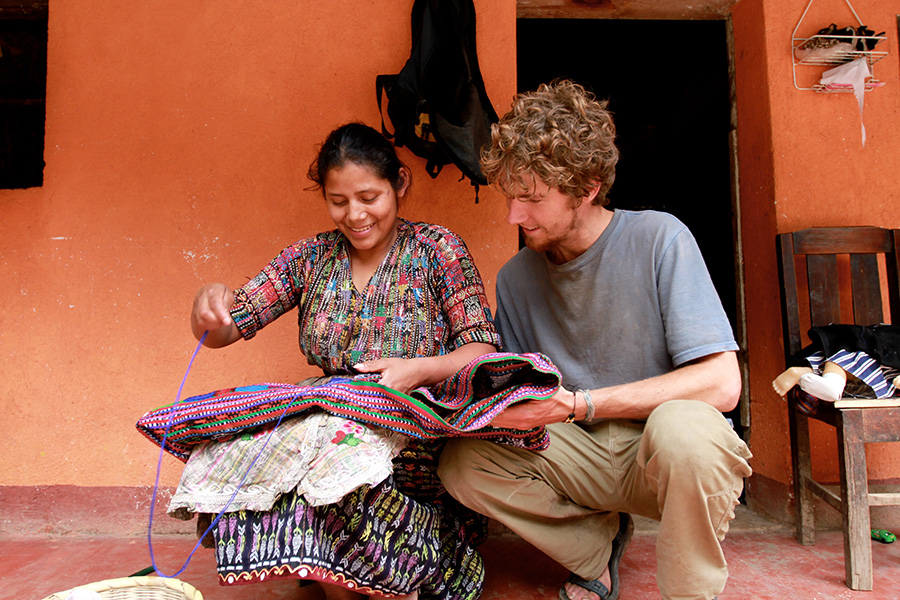
Chris Temple and Zach Ingrasci started an unusual journey in 2010. Armed with only two cameras, a handful of cash and lots of hope, they set out to spend the summer living on $1 a day in a rural Guatemalan village. Their academic and professional understanding of economic development didn’t quite prepare them for what they would experience.

They battled intense hunger, parasites and the realization that there were no easy answers, but ultimately the strength of their neighbors and friends along the way gave them hope that effective solutions to making a difference might exist. While in Guatemala, they released short YouTube videos about the experience to help their friends learn alongside them in real time.

The videos quickly received over 700,000 views, and inspired them to complete a feature-length film, Living on One Dollar, aimed at mobilizing others to help end extreme poverty. After graduating, they hit the road for four months in a renovated 1978 school bus to share the film around the U.S. The tour events sold out in 20 major cities and culminated in an extended interview on CBS This Morning with Charlie Rose. The film has gone on to win Best Documentary at the Sonoma International Film Festival, and received endorsements from Nobel Laureate Muhammad Yunus, USAID Administrator Rajiv Shah, and the Director of The Hunger Games, Gary Ross.

In 2012 the pair launched Living on One, a production and social impact studio that creates films and educational videos to raise awareness and inspire action around extreme poverty. Now two years down the line, Temple recalls the gap year that changed his life. “I grew up in Connecticut in a sheltered, small town community and I wanted to try something that was off the beaten path,” he recalls. The journey began in South America where he travelled through Argentina and then up through Bolivia and Peru.

During a home stay in a rural village in Bolivia he noticed a massive sign that read: ‘USA ID sponsored.’ The locals explained that a massive shower and bath facility had been built but no one had ever used it. When asked, community members explained that, “A guy came and built it, never asked us, and then left with the key!” It was Temple’s first frustrating glimpse at charitable development.

He couldn’t understand why something like this hadn’t been fixed yet. “My arrogant 18 year-old self decided that I would get involved and figure out a solution to global poverty,” he says, “But I was totally clueless!” Arriving home he read a couple of books about poverty alleviation, particularly The End of Poverty by Jeffrey Sachs, that mentions a concept called micro-finance. “It sounded really cool and way more grassroots and bottom-up than some of the ineffective development strategies that I had seen while travelling,” says Temple.

Fired up with enthusiasm, Temple applied for different jobs within micro-finance but didn’t get a single one – he was 18 years old and inexperienced. Eventually, a lucky break through a YPO member saw him helping out at a New York-based micro finance startup. He got to travel with one of his idols, micro finance pioneer Mohammed Yunus. Temple soaked up as much information as he could. Meanwhile, a lot of his friends were asking about his gap year and how they could get involved.

He met his co-founder Zach Ingrasci around this time and together they built the Living on One network, putting up a website and providing opportunities for people to get involved in micro-finance that served poorer communities. The website was aimed at harnessing the power of their generation and it worked. They set up Facebook page that allowed users to set up a profile and engage on forums and it grew to be one of the largest in the world, with students from 170 universities 49 countries taking part. They took 100 students to conferences in Kenya and Spain to get firsthand experience and to meet Mohammed Yunus and industry leaders.

Despite the impressive numbers and achievements Temple and Ingrasci struggled to find a job as their college years drew to an end. Industry players told them, “You don’t understand poverty and were not going to hire students fresh out of college.” “They said we had no reality of living in extreme poverty,” recalls Temple. “We were also frustrated at how the media portrayed poverty – really boring, ten-year-old, guilt-based documentaries that we fell asleep watching.” They realized that to walk the talk they needed to live on one dollar a day themselves.” They chose Guatemala.

The country has 50 percent of the population below the poverty line, with the number rising to 75 percent in rural areas. It was the perfect case study for an affliction what plagues over a billion people on the planet. It wasn’t easy. Temple contracted Giardia and E-Coli at the same time and remembers waking up in the mornings lying on a dirt floor, after being bitten by fleas all night. “We didn’t know if we had enough money for food, let alone the cost of medicine,” recalls Temple.

“We often hit a real low, when we considered going home or giving up, but sadly this is a reality that many others have no choice over,” says Temple. As economics majors, Temple and Ingrasci had to try hard to budget on a dollar a day. They realized that not having a bank account meant no access to traditional financial services. For the community around them, that daily dollar was not for food alone, but also for your kids education, firewood, transportation, medical emergencies, general emergencies and unforeseen events. Temple has learnt some lessons from his experience.

“Firstly, create understanding and real connection between people,” he says. “More fortunate people must realize that it’s not laziness or lack of ability that’s holding people back but rather a lack of opportunity. They also concluded that if they had moved from a dollar a day to a dollar fifty a day, it would have increased their daily calorie count dramatically. “Fifty cents extra might not seem like much, but it’s a massive change for someone living at that level.”

The experience would have been wasted, in their eyes, if they hadn’t shared their ordeal with as many people as possible, in the hope of sparking some kind of action. “We came home with over 300 hours of film footage and our YouTube video started getting a lot of attraction,” says Temple. “While in Guatemala, our online video received around 500,000 views,” he says.

A TEDX talk that followed made them realize it was an effective way of educating an audience and rallying people around global poverty. While the gap year had been informative and they had collected huge amounts of data they were now at a crossroads: try and find jobs or take the film, run with the idea and try to build a business out of it. It was a huge gamble. They decided to turn the idea into a viral marketable campaign and took it on the road.

“Someone gave us an old beaten-up 1978 school bus, so we took out the seats, put in beds, desks and solar panels and drove around the country for four months, visiting 25 major cities,” says Temple. “We raised about $40,000 for microfinance, poverty alleviation, education and scholarships.” Offers of free marketing exposure, donations and lots of support from the start has evolved into an enterprise that now sells T-shirts and sandals that benefit the rural Guatemalan manufacturers.

Their film is also available to download on iTunes and the pair are for hire for speaking engagements at public events. A dollar from every film downloaded goes into an educational scholarship to send one of the women they met in Guatemala to medical school. This added social dimension has resulted many people paying $20 for the movie, despite it only costing $9.99.

“To become a real leader you should want to create positive change in the world,” says Temple. “Take chances and then get out of the way for the sake of the cause.”

Happiness in a Box

A DIY knitting kit that gives you the ultimate luxury – time with yourself.

Most fashion houses spend millions researching upcoming trends to ensure they are first to market with the latest fashion, but sometimes an idea can come from simple observation. On a trip to New York in 2010 María José Marín (above, right) was astounded to see people knitting all around her. And not contemporaries of her grandmother either; young and cool people that were crazy about the idea of producing their own clothing, in their own time.

Marín decided that DIY clothing would be a hit back in her home country, Spain and set out to combine her love of wool with what she saw as a growing trend in fashion. At age 21 and working as a financial auditor at PwC, Marín already had her company name firmly in mind: We Are Knitters. While auditing was profitable, she had longed to do something creative since she was at school. Summer holidays were spent browsing the internet, looking for ideas on how she could start a brand that she was passionate about.“I just wanted to be an entrepeneur,” says Marín. “I liked fashion and knew it was very competitive, and had this love of wool, but didn’t know how to put the two together.

When she saw the knitting trend in New York and started investigating she knew she was finally onto something. Many fast fashion outlets such as Zara or H&M were using synthetic fabrics, but Marín had always been fascinated by noble and natural fibers – cashmere or rare vicuña wool from the Andes. One fashion company in particular stood out for her, Loro Piani, an Italian luxury brand that made garments from the most precious raw materials in the world. They focus on finding the best fleece and promoting the sustainable production of wool, while also helping to preserve endangered species.

The long history and values immediately appealed to Marín. She wanted to become a luxury knitting brand. It wasn’t long before all her attention was on the best wool producing country in the world, Peru. “The production process here is almost an art,” says Marín. “I knew that our raw materials would come from this amazing country.” In the Peruvian Andes, knitting is a way of life, all the women know how to knit and the men raise alpacas, llamas and sheep.

Marín chose Alberto Bravo as her business partner, someone she considers an important part of her success. “Choosing the right partner, who shares the same vision and strategy is crucial to success,” she says. The two had no fashion experience, but plenty of passion, perseverance and energy. “The unknown can no longer be a barrier,” explains Marín. “Anything can be learned these days with our easy access to information.”

In fact, they atribute their naïvity and lack of knitting skills at the start of their venture to their success. Because they understood exactly what a beginner knitter needed, they were able to put themselves into the mindset of their consumers and design a product that appealed to them. The company slogan is “All the happiness in a kit” and the DIY kits sell for up to $176. Inside the box customers get balls of Peruvian wool, knitting needles and a pattern. The We Are Knitters label is included too, which knitters must sew on themselves when complete. The results are far from that jumper made from leftover scraps that grandma gave you for the holidays with a reindeer motif on the front. The kits and patterns are being marketed as a luxury fashion brand with ranges for women, men and children.

A young designer in France contacted Marín and is now designing the knitting patterns for the kits. Attracting renowned designers is now part of the company’s future plans. In Spain, entrepreneurship is generally frowned upon and not culturally accepted as success or even ‘real work.’ Marín’s training as an auditor kept her aligned and focused on a set of principles that she saw as crucial to success. One of them is using suppliers that are in accordance with her values of producing wool and another is the preservation of ancient peruvian culture.

It was hard to manage this from Spain, without a large travel budget, but they found a local Spanish company that was accredited by the Programme for the Endorsement of Forest Certification, ensuring that their wool was already prescreened for sustainability. Even the knitting kits have been designed to be reused. Cool designs on the bags that hold the wool ensure they are kept for other storage by customers.

The business was built almost entirely by researching online fashion companies on the web and Marín and Bravo also found their first material providers online. They received a lot of support and advice from other entrepreneurs online too. “One of the most important things we learnt was not to wait until the product was perfect before launching,” says Marín. With fashion trends getting faster and faster Marín decided that sustainability was the way to go.

They promote the idea that knitting your own garment with luxury material can result in a garment for life, shunning the seasonal, and disposable, nature of mainstream fashion. Without a supply chain structured along the likes of other fashion brands, We Are Knitters easily puts out new patterns and kits as soon as designs are complete, ensuring they are in the marketplace before traditional brick and mortar stores have them on the rails.

“The idea of ‘season’ to us is just a pattern,” says Marín.“Basically, a piece of paper and a new sticker that closes the box – the wool stays the same. It’s really simple for us to adapt and we don’t have to plan a year in advance like the large fashion companies.” The time normally reserved for managing a supply chain is now spent on social networks, blogs and Pinterest looking for trends.

“I read the book by the founder of TOMS Shoes, who said that he didn’t have any customers, only supporters,” says Marín. “And so do we. Our clients are more than customers, they not only buy our kits but come back to the web or social networks to share the results of their knitting project and how much they are enjoying it.”

“We are not selling a product – we are selling an experience,” says Marín.People buy our kits for the experience and to relax. We have realised that our brand is more about the experience; the real luxury of people spending time doing things for themselves.”

0