

David Yurman Joins Executive Producing Team For ‘Gender In Hollywood’

A new film will examine Hollywood’s gender bias through personal stories, leading research, and celebrity accounts. David Yurman is joining executive producer and Academy Award- winning actor and advocate Geena Davis in the upcoming feature-length documentary ‘Gender In Hollywood’ (working title).

The film examines Hollywood’s gender bias through first-hand accounts from some of Hollywood’s leading industry professionals both in front of and behind the camera, shining a spotlight on the broader effects of bias on consumers of entertainment around the globe.

If you like this, subscribe here for more stories that Inspire The Future.

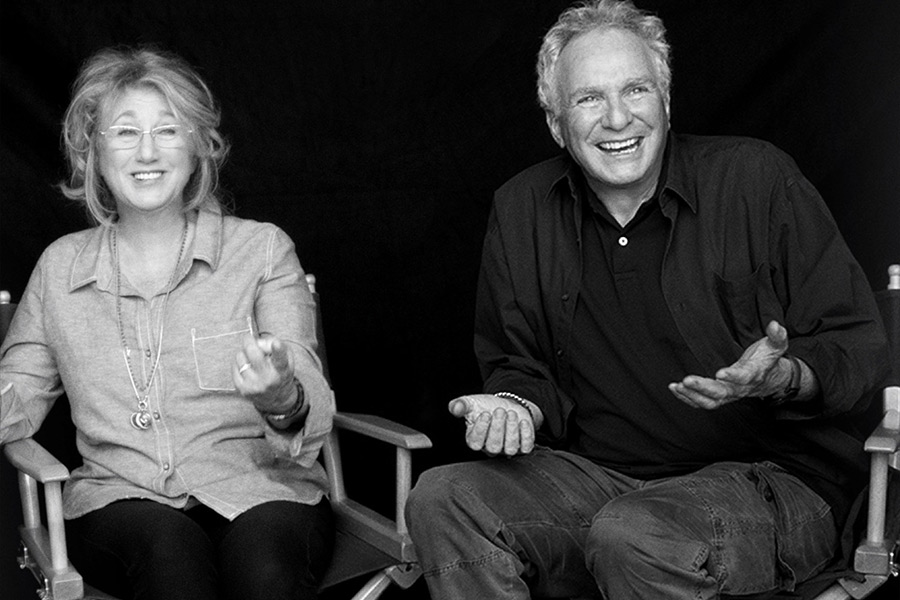
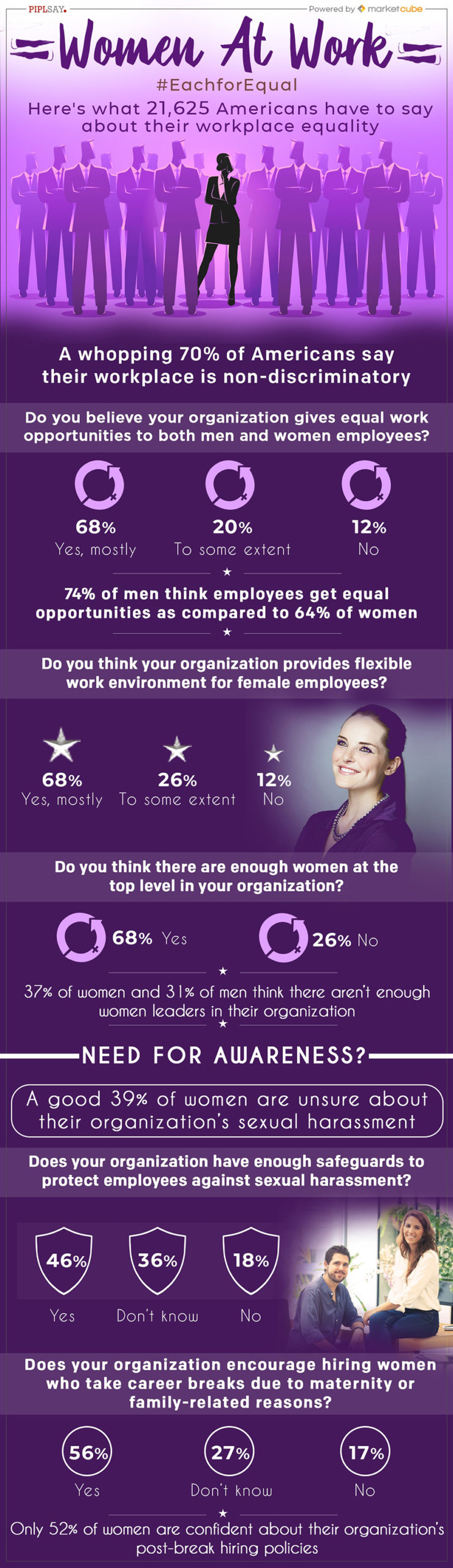
“David Yurman (pictured with his wife Sybil, above) is committed to helping raise awareness about the need for gender parity, and is honored to be a part of the documentary, which is a powerful platform to spread this message,” said David Yurman. “It is a natural fit.”

The David Yurman brand has long been a proponent of female empowerment. 75 percent of the David Yurman executive committee are women, and the company is almost 70 percent female.

“We are a company of women, led by women and co-founded by a woman,” said Sybil Yurman, co-founder David Yurman. “Since 1980 we have strived to elevate and celebrate women throughout all levels of the company.”

Through the candid testimony of high-profile actors, directors and studio executives, the film connects the dots between the disparity onscreen and the lack of opportunity women face behind the scenes, telling the story of systemic discrimination throughout Hollywood’s history. Interviewees include Geena Davis, Shonda Rhimes, Jessica ChastainZoe SaldanaJudd ApatowYara ShahidiPaul FeigChloe Grace MoretzGillian AndersonJackie CruzSharon StoneAlan Alda, and Lena Dunham.

Cutting-edge data from The Geena Davis Institute on Gender in Media is used to support the narrative of the film. The institute is the only research-based organization working behind the scenes in the media and entertainment industry to influence the need to dramatically improve gender balance, reduce stereotyping and create diverse female characters in entertainment targeting children.

“Unconscious gender bias directly correlates to the way women are represented on screen,” said Geena Davis. “When we look at how this documentary will add to the discussion about gender inequality, we hope one of the key takeaways is that a solution is only possible if both women and men in this industry work together to create change.”

Ku-Ling Yurman, independent filmmaker and daughter-in-law of David and Sybil, will act as an executive producer on the film. An alum of the American Film Institute, Ku-Ling has taken on many roles in the television/film industry.

“I first experienced institutionalized inequality when I was in film school, and quickly realized it spans all industries,” said Ku-Ling Yurman. “Our objective with this documentary is to bring about actual change. We have a collective responsibility to take ownership of this issue and activate a higher standard for gender equality.”

The film is directed by Tom Donahue (Casting By, Thank You for Your Service) and produced by CreativeChaos vmg and New Plot Films in association with the Geena Davis Institute on Gender in Media and Artemis Rising Foundation. Filming began in 2016.

In addition to Geena Davis and Ku-Ling YurmanRegina K. ScullyMadeline Di NonnoSteve EdwardsPatty Casby, and Jennie Peters are executive producers on the film. Ilan Arboleda and Kerianne Flynn are set to produce.

“Since we started the film a year and a half ago, we have conducted more than 100 interviews with some of the leading voices on the issue both inside and outside of Hollywood. Their candid testimony has not only detailed the systemic roadblocks that women face as storytellers and artists in Hollywood, but also has illuminated possible pathways toward lasting parity, “said director Tom Donahue.

If you like this, subscribe here for more stories that Inspire The Future.
David Yurman Joins Executive Producing Team For ‘Gender In Hollywood’

A new film will examine Hollywood’s gender bias through personal stories, leading research, and celebrity accounts. David Yurman is joining executive producer and Academy Award- winning actor and advocate Geena Davis in the upcoming feature-length documentary ‘Gender In Hollywood’ (working title).

The film examines Hollywood’s gender bias through first-hand accounts from some of Hollywood’s leading industry professionals both in front of and behind the camera, shining a spotlight on the broader effects of bias on consumers of entertainment around the globe.

If you like this, subscribe here for more stories that Inspire The Future.

“David Yurman (pictured with his wife Sybil, above) is committed to helping raise awareness about the need for gender parity, and is honored to be a part of the documentary, which is a powerful platform to spread this message,” said David Yurman. “It is a natural fit.”

The David Yurman brand has long been a proponent of female empowerment. 75 percent of the David Yurman executive committee are women, and the company is almost 70 percent female.

“We are a company of women, led by women and co-founded by a woman,” said Sybil Yurman, co-founder David Yurman. “Since 1980 we have strived to elevate and celebrate women throughout all levels of the company.”

Through the candid testimony of high-profile actors, directors and studio executives, the film connects the dots between the disparity onscreen and the lack of opportunity women face behind the scenes, telling the story of systemic discrimination throughout Hollywood’s history. Interviewees include Geena Davis, Shonda Rhimes, Jessica ChastainZoe SaldanaJudd ApatowYara ShahidiPaul FeigChloe Grace MoretzGillian AndersonJackie CruzSharon StoneAlan Alda, and Lena Dunham.

Cutting-edge data from The Geena Davis Institute on Gender in Media is used to support the narrative of the film. The institute is the only research-based organization working behind the scenes in the media and entertainment industry to influence the need to dramatically improve gender balance, reduce stereotyping and create diverse female characters in entertainment targeting children.

“Unconscious gender bias directly correlates to the way women are represented on screen,” said Geena Davis. “When we look at how this documentary will add to the discussion about gender inequality, we hope one of the key takeaways is that a solution is only possible if both women and men in this industry work together to create change.”

Ku-Ling Yurman, independent filmmaker and daughter-in-law of David and Sybil, will act as an executive producer on the film. An alum of the American Film Institute, Ku-Ling has taken on many roles in the television/film industry.

“I first experienced institutionalized inequality when I was in film school, and quickly realized it spans all industries,” said Ku-Ling Yurman. “Our objective with this documentary is to bring about actual change. We have a collective responsibility to take ownership of this issue and activate a higher standard for gender equality.”

The film is directed by Tom Donahue (Casting By, Thank You for Your Service) and produced by CreativeChaos vmg and New Plot Films in association with the Geena Davis Institute on Gender in Media and Artemis Rising Foundation. Filming began in 2016.

In addition to Geena Davis and Ku-Ling YurmanRegina K. ScullyMadeline Di NonnoSteve EdwardsPatty Casby, and Jennie Peters are executive producers on the film. Ilan Arboleda and Kerianne Flynn are set to produce.

“Since we started the film a year and a half ago, we have conducted more than 100 interviews with some of the leading voices on the issue both inside and outside of Hollywood. Their candid testimony has not only detailed the systemic roadblocks that women face as storytellers and artists in Hollywood, but also has illuminated possible pathways toward lasting parity, “said director Tom Donahue.

If you like this, subscribe here for more stories that Inspire The Future.
Erasing Gender & Racial Pay Gap Requires a Uniform Approach

Today marks the launch of Mind The Gap, an initiative to bring together organizations who have done the hard work of studying and correcting pay gaps.

Never before has there been a public, generally accepted methodology for measuring pay gaps across race, gender, or any other demographic segment. Mind the Gap’s methodology and implementation guide will be made available for free to organizations and companies of any size to measure and eradicate internal pay gaps.

If you like this, subscribe here for more stories that Inspire The Future.
Workplace issues such harassment, inequality, social responsibility, and the impacts of automation on the workforce continue to dominate the news. As a serial entrepreneur and CEO who led an effort to measure and fix the gender pay gap at my last company, I’m heartened by the increased awareness of the need to close the gender and racial pay gaps.

Most Americans have heard about the uproar over the pay discrepancy during the reshoot of All the Money in the World (which, oddly enough, was caused by the additional workplace issue of sexual harassment stemming from Kevin Spacey). Hollywood pay discrimination makes news when Michelle Williams is paid less than Mark Wahlberg, but similar wage discrepancies occur on a large scale in almost every organization with employees. To correct this, it needs to be accurately measured, and include not just men and women but also consider data on race, age, religion, and sexual orientation.

The Equal Pay Act of 1963 made it illegal to pay differently on the basis of gender. However, because such cases are nearly impossible to prove, the burden still lies with the employer to ensure equity in compensation. Some companies, like Salesforce.com, have undertaken deep compensation reviews and determined that indeed there was an underlying bias towards paying women less than men. After the first review in 2015, the company bravely disclosed it had uncovered $3 million in gaps which needed to be closed.

Surprisingly, in 2017 Salesforce.com conducted another study and disclosed another $3 million in gaps. This was not from unintended bias but because it had also acquired many other companies with pay gaps – illustrating the pervasiveness of this problem. While this is progress, no doubt, we don’t know what methodology was used by Salesforce.com in documenting the scope of the problem.

Without a uniform, universally accepted, and publicly available measurement methodology, companies large and small that want to eradicate the pay gap are hard-pressed to know where to start. There’s more to this than signing the White House Equal Pay Pledge or Glassdoor Equal Pay Pledge, or even he most recent announcement by Citigroup modeling disclosure and correction of the problem. Bloomberg’s new Gender Equality Index.

Bloomberg’s new Gender Equality Index includes a group of major companies committed to focusing on gender equality, but details on what the index entails are lacking. The fundamental problem is that none of these companies disclose how pay gaps are measured. And accurate measurement is no simple task.

Where to Start
To ensure equal pay for equal work, organizations must consider factors such as tenure, geography, experience and most importantly, performance. These adjustments or considerations start to cloud the picture and make it difficult for an organization to perform a simple quantifiable study. This begs the question: How are these organizations undertaking the hard work of ensuring equal pay? Salesforce founder and CEO Marc Benioff told CNN said that it’s as easy as pressing a single button, but I beg to differ. Like any human issue, it is very difficult for numbers to tell the whole story, especially without rules as to how those numbers are generated.

There is a reason the accounting industry abides by Generally Accepted Accounting Principles (GAAP). Simply put, the numbers must be normalized across companies, organizations, and sectors so that they can be compared and trusted. No such accepted methodology exists currently for pay gap reviews, until now.

GoodWell and Glassdoor both make methodologies publicly available which allow for the institutional evaluation of pay gaps free of charge. These methodologies may not be perfect (yet); however, they are consistent, transparent places to start in creating more fair, ethical and humane organizations. More work is needed to gain universal acceptance, but our open-source model is an excellent place to start.

Companies like Salesforce, Adobe and Citigroup, have done the hard work of developing methodologies, but because they have not shared them with the world, employees, peer companies, and the general public are left to guess how pay disparity is calculated. Mind the Gap will collect and confidentially analyze all of the methodologies submitted to us. This initiative will highlight the similarities and differences in the methodologies and convene experts to produce our final methodology which will be publically available to anyone, free of charge.

Let’s eliminate the confusion over how to measure pay gaps and get down to the hard work of eliminating them.

If you are interested in contributing your organization’s methodology or joining the working group, please complete this form.

If you like this, subscribe here for more stories that Inspire The Future.
Erasing Gender & Racial Pay Gap Requires a Uniform Approach

Today marks the launch of Mind The Gap, an initiative to bring together organizations who have done the hard work of studying and correcting pay gaps.

Never before has there been a public, generally accepted methodology for measuring pay gaps across race, gender, or any other demographic segment. Mind the Gap’s methodology and implementation guide will be made available for free to organizations and companies of any size to measure and eradicate internal pay gaps.

If you like this, subscribe here for more stories that Inspire The Future.
Workplace issues such harassment, inequality, social responsibility, and the impacts of automation on the workforce continue to dominate the news. As a serial entrepreneur and CEO who led an effort to measure and fix the gender pay gap at my last company, I’m heartened by the increased awareness of the need to close the gender and racial pay gaps.

Most Americans have heard about the uproar over the pay discrepancy during the reshoot of All the Money in the World (which, oddly enough, was caused by the additional workplace issue of sexual harassment stemming from Kevin Spacey). Hollywood pay discrimination makes news when Michelle Williams is paid less than Mark Wahlberg, but similar wage discrepancies occur on a large scale in almost every organization with employees. To correct this, it needs to be accurately measured, and include not just men and women but also consider data on race, age, religion, and sexual orientation.

The Equal Pay Act of 1963 made it illegal to pay differently on the basis of gender. However, because such cases are nearly impossible to prove, the burden still lies with the employer to ensure equity in compensation. Some companies, like Salesforce.com, have undertaken deep compensation reviews and determined that indeed there was an underlying bias towards paying women less than men. After the first review in 2015, the company bravely disclosed it had uncovered $3 million in gaps which needed to be closed.

Surprisingly, in 2017 Salesforce.com conducted another study and disclosed another $3 million in gaps. This was not from unintended bias but because it had also acquired many other companies with pay gaps – illustrating the pervasiveness of this problem. While this is progress, no doubt, we don’t know what methodology was used by Salesforce.com in documenting the scope of the problem.

Without a uniform, universally accepted, and publicly available measurement methodology, companies large and small that want to eradicate the pay gap are hard-pressed to know where to start. There’s more to this than signing the White House Equal Pay Pledge or Glassdoor Equal Pay Pledge, or even he most recent announcement by Citigroup modeling disclosure and correction of the problem. Bloomberg’s new Gender Equality Index.

Bloomberg’s new Gender Equality Index includes a group of major companies committed to focusing on gender equality, but details on what the index entails are lacking. The fundamental problem is that none of these companies disclose how pay gaps are measured. And accurate measurement is no simple task.

Where to Start
To ensure equal pay for equal work, organizations must consider factors such as tenure, geography, experience and most importantly, performance. These adjustments or considerations start to cloud the picture and make it difficult for an organization to perform a simple quantifiable study. This begs the question: How are these organizations undertaking the hard work of ensuring equal pay? Salesforce founder and CEO Marc Benioff told CNN said that it’s as easy as pressing a single button, but I beg to differ. Like any human issue, it is very difficult for numbers to tell the whole story, especially without rules as to how those numbers are generated.

There is a reason the accounting industry abides by Generally Accepted Accounting Principles (GAAP). Simply put, the numbers must be normalized across companies, organizations, and sectors so that they can be compared and trusted. No such accepted methodology exists currently for pay gap reviews, until now.

GoodWell and Glassdoor both make methodologies publicly available which allow for the institutional evaluation of pay gaps free of charge. These methodologies may not be perfect (yet); however, they are consistent, transparent places to start in creating more fair, ethical and humane organizations. More work is needed to gain universal acceptance, but our open-source model is an excellent place to start.

Companies like Salesforce, Adobe and Citigroup, have done the hard work of developing methodologies, but because they have not shared them with the world, employees, peer companies, and the general public are left to guess how pay disparity is calculated. Mind the Gap will collect and confidentially analyze all of the methodologies submitted to us. This initiative will highlight the similarities and differences in the methodologies and convene experts to produce our final methodology which will be publically available to anyone, free of charge.

Let’s eliminate the confusion over how to measure pay gaps and get down to the hard work of eliminating them.

If you are interested in contributing your organization’s methodology or joining the working group, please complete this form.

If you like this, subscribe here for more stories that Inspire The Future.
I Lost my Arm, But I’m Still Part of Football

The love of football helped young Serbian Ljubomir Moravac recover from the loss of part of his left arm in a road accident – which ended his promising career as a goalkeeper – and he has found a new way forward in the game as a referee
 
Every month, as part of its #EqualGame campaign, UEFA is focusing on a player from one of its 55 member associations. This person will be an example of how football promotes inclusion, accessibility and diversity; his or her story will exemplify how disability, religion, sexuality, ethnicity and social background are no barriers to playing and enjoying football.
 
 
For Ljubomir Moravac, football has been an immense healing force that has helped him deal with the aftermath of tragedy.
 
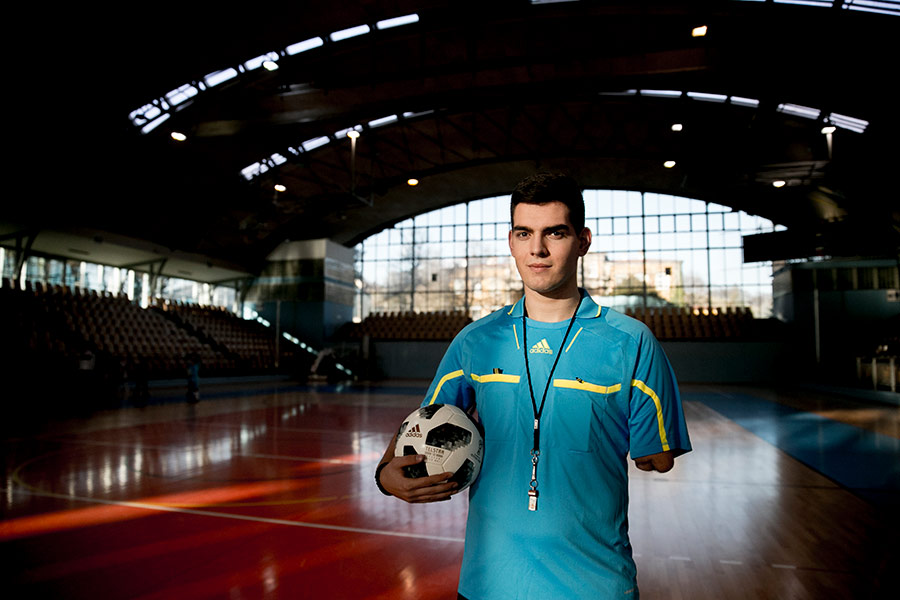
The 21-year-old from Serbia was setting out hopefully on a career as a goalkeeper with Slovenian club NK Maribor when he was involved in a road accident in 2016 that cost two teammates their lives, and left him facing the future with part of his left arm amputated.
 
His spirit could have been shattered – far from it; courage, pride, a positive outlook and, importantly, his enduring love for football have all been crucial elements on Ljubo’s road to recovery. Football’s welcoming arms have given him particular hope, comfort and solace – and the strength to rebuild and move on. Now, he is training to be a referee, and has found a new place in the game that he loves.
 
Ljubo, originally from Niš, began playing with a ball at the age of five. He is part of a football family; his father and uncle were keen players, while his elder brother Ranko, a midfielder, was capped at Serbian youth level. “Football was always present in my life,” he says.
 
Inspired by his goalkeeping uncle, Ljubo showed promise between the posts. At 16, he moved with his father, a players’ scout, and Ranko to the Slovenian city of Maribor. He eventually joined local club NK Maribor where Ranko had already signed a professional contract, and began to figure in the club’s youth teams. The two brothers spent a while as teammates in the club’s B team, and Ljubo was eager to match Ranko’s progress.
 
By the 2014/15 season, Ljubo was a member of the Maribor squad that played in the UEFA Youth League group stage. He enjoyed travelling to England, Portugal and Germany, where Maribor faced Chelsea, Sporting Clube de Portugal and Schalke 04, and he nurtured one overriding dream – to make the grade as a professional goalkeeper.
 
“When I had finished high school, I decided only to focus on football. I dedicated all my time to football, and to try and make a living out of it. This was my greatest wish.”
 
But then, on 2 August 2016, his young life was turned upside down. “I woke up ready for training and had breakfast,” he recalls. “I went to training, we were all laughing in the dressing room, everything was positive and normal. Just a usual day….”
 
After training, Ljubo and three of his teammates – striker Zoran Baljak, full-back Damjan Marjanović and defender Žiga Lipušček – set out in a car from the club training centre. Shortly afterwards, the car collided with a set of traffic lights.
 
Zoran and Damjan died at the scene of the accident, and Žiga suffered minor injuries. Ljubo was thrown out of the car. He was taken unconscious to hospital and spent several days in a coma. His left arm was so badly injured that doctors decided that amputation of part of the arm was necessary.
 
Ljubo’s world had been changed dramatically, but it was now that a naturally positive nature shone through. “I needed to adjust to this new life,” he says. “It’s not as hard as some people think. You simply need to be strong enough.”
 
Surrounded by his loving family, he refused to feel self-pity. “I thought to myself that I still had my life in front of me, and the possibility to create something out of my life.”
 
Football played a primordial role in Ljubo’s journey through recuperation. “It gave me a specific mind set. I was a sportsman who always wanted to prove himself.” He likens his fierce will to recover after the accident to a match that he had to win.
 
He always remembers the care he received from NK Maribor through the tough moments. “The club is like my second family,” he stresses. “They were always at my side, trying to find a way to help me. All my friends were by my side, too, and that was invaluable.”
 
After the initial spell of doubt, Ljubo decided that he wanted to stay in football somehow. “If you live for football, football will then help you at any moment,” he explains. Maribor suggested he take up training to be a referee, and a new football pathway opened.
 
He has been gaining experience over the past few months, in particular by refereeing children’s games. The new challenge is energising him. “After the accident” he admits, “I didn’t see how I could continue with football. I thought it was the end of my football career. But then, I found a way to return.”
 
“This is a new time for me. I am not a player anymore, now I am a referee, and my intention is to keep walking this path.”
 
The inbuilt determination to succeed will definitely stand Ljubo in great stead. “I wish to experience more and achieve as much as possible in my life,” he says. “I think I’m capable of succeeding. I survived [the accident], and this is the privilege that drives you to think positively.”
 
Ljubo completely endorses the values embedded in UEFA’s #EqualGame campaign. “I believe anybody can be part of football,” he insists. “It doesn’t matter who you are. I lost my arm … and I am still part of football. I do think that football is open to everyone.”


I Lost my Arm, But I’m Still Part of Football

The love of football helped young Serbian Ljubomir Moravac recover from the loss of part of his left arm in a road accident – which ended his promising career as a goalkeeper – and he has found a new way forward in the game as a referee
 
Every month, as part of its #EqualGame campaign, UEFA is focusing on a player from one of its 55 member associations. This person will be an example of how football promotes inclusion, accessibility and diversity; his or her story will exemplify how disability, religion, sexuality, ethnicity and social background are no barriers to playing and enjoying football.
 
 
For Ljubomir Moravac, football has been an immense healing force that has helped him deal with the aftermath of tragedy.
 
The 21-year-old from Serbia was setting out hopefully on a career as a goalkeeper with Slovenian club NK Maribor when he was involved in a road accident in 2016 that cost two teammates their lives, and left him facing the future with part of his left arm amputated.
 
His spirit could have been shattered – far from it; courage, pride, a positive outlook and, importantly, his enduring love for football have all been crucial elements on Ljubo’s road to recovery. Football’s welcoming arms have given him particular hope, comfort and solace – and the strength to rebuild and move on. Now, he is training to be a referee, and has found a new place in the game that he loves.
 
Ljubo, originally from Niš, began playing with a ball at the age of five. He is part of a football family; his father and uncle were keen players, while his elder brother Ranko, a midfielder, was capped at Serbian youth level. “Football was always present in my life,” he says.
 
Inspired by his goalkeeping uncle, Ljubo showed promise between the posts. At 16, he moved with his father, a players’ scout, and Ranko to the Slovenian city of Maribor. He eventually joined local club NK Maribor where Ranko had already signed a professional contract, and began to figure in the club’s youth teams. The two brothers spent a while as teammates in the club’s B team, and Ljubo was eager to match Ranko’s progress.
 
By the 2014/15 season, Ljubo was a member of the Maribor squad that played in the UEFA Youth League group stage. He enjoyed travelling to England, Portugal and Germany, where Maribor faced Chelsea, Sporting Clube de Portugal and Schalke 04, and he nurtured one overriding dream – to make the grade as a professional goalkeeper.
 
“When I had finished high school, I decided only to focus on football. I dedicated all my time to football, and to try and make a living out of it. This was my greatest wish.”
 
But then, on 2 August 2016, his young life was turned upside down. “I woke up ready for training and had breakfast,” he recalls. “I went to training, we were all laughing in the dressing room, everything was positive and normal. Just a usual day….”
 
After training, Ljubo and three of his teammates – striker Zoran Baljak, full-back Damjan Marjanović and defender Žiga Lipušček – set out in a car from the club training centre. Shortly afterwards, the car collided with a set of traffic lights.
 
Zoran and Damjan died at the scene of the accident, and Žiga suffered minor injuries. Ljubo was thrown out of the car. He was taken unconscious to hospital and spent several days in a coma. His left arm was so badly injured that doctors decided that amputation of part of the arm was necessary.
 
Ljubo’s world had been changed dramatically, but it was now that a naturally positive nature shone through. “I needed to adjust to this new life,” he says. “It’s not as hard as some people think. You simply need to be strong enough.”
 
Surrounded by his loving family, he refused to feel self-pity. “I thought to myself that I still had my life in front of me, and the possibility to create something out of my life.”
 
Football played a primordial role in Ljubo’s journey through recuperation. “It gave me a specific mind set. I was a sportsman who always wanted to prove himself.” He likens his fierce will to recover after the accident to a match that he had to win.
 
He always remembers the care he received from NK Maribor through the tough moments. “The club is like my second family,” he stresses. “They were always at my side, trying to find a way to help me. All my friends were by my side, too, and that was invaluable.”
 
After the initial spell of doubt, Ljubo decided that he wanted to stay in football somehow. “If you live for football, football will then help you at any moment,” he explains. Maribor suggested he take up training to be a referee, and a new football pathway opened.
 
He has been gaining experience over the past few months, in particular by refereeing children’s games. The new challenge is energising him. “After the accident” he admits, “I didn’t see how I could continue with football. I thought it was the end of my football career. But then, I found a way to return.”
 
“This is a new time for me. I am not a player anymore, now I am a referee, and my intention is to keep walking this path.”
 
The inbuilt determination to succeed will definitely stand Ljubo in great stead. “I wish to experience more and achieve as much as possible in my life,” he says. “I think I’m capable of succeeding. I survived [the accident], and this is the privilege that drives you to think positively.”
 
Ljubo completely endorses the values embedded in UEFA’s #EqualGame campaign. “I believe anybody can be part of football,” he insists. “It doesn’t matter who you are. I lost my arm … and I am still part of football. I do think that football is open to everyone.”


A 15,000 Calorie Diet, 45kg log and 100km shark-infested water swim

Endurance athlete Ross Edgley swims from Martinique to St Lucia… with a twist.

From climbing a rope the height of Mount Everest to running a marathon while pulling a MINI, Ross Edgley is no stranger to the extreme.

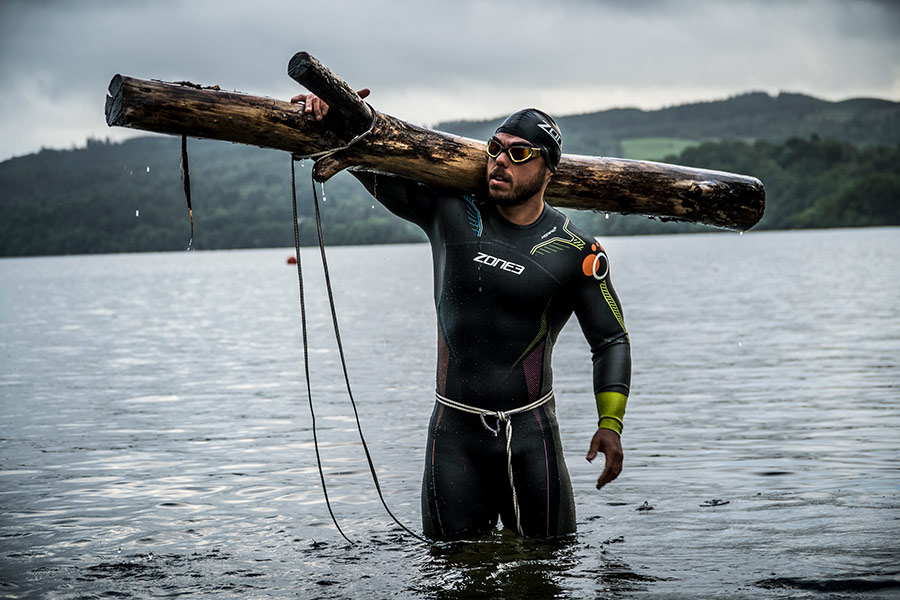
But the 32-year-old’s latest challenge is one he billed his toughest yet, swimming over 100 kilometres in jellyfish and shark-infested waters between the Caribbean Islands of Martinique and St Lucia while pulling a 45-kilogram log. Here he talks about that ultimate challenge.

If you like this, subscribe here for more stories that Inspire The Future.

The thinking behind the challenge
When you’ve run 30 marathons in 30 days and completed other aforementioned challenges, Edgley admits to having to raise the bar with the next adventure.

But this challenge was born in another Caribbean-based project.

“About a year ago I did a triathlon carrying a tree on the island of Nevis to raise awareness of its eco-friendly project to become the first carbon-neutral island by 2020,” he explains. “I called it the world’s first Tree-athlon! People seemed to like it.”

So, he set out on a similar venture across the English Channel only for red tape to get in his way. Told he needed to be registered as a vessel to carry a tree, his response was “how do I become one?” to which they put the phone down. The Caribbean red tape was easier to tackle, and the idea was born.

How suited to the challenge
Edgley likes to joke that he is the first Strongman swimmer but the reality was a sports scientist told him he could not be less well suited to the rigours of distance swimming.

“I had a body scan and was told I had none of the physical attributes to be a swimmer,” he says. “I’m built like a Hobbit with short arms, I’m carrying 13kg more muscle so I’m less buoyant and I even have a dense skull”.

He was advised to lose as much muscle as possible but, with his own background in sports science, avoided such advice in order to keep his strength to lug the tree trunk along with him.

As he puts it: “I wasn’t trying to be a shark or a dolphin but to swim slow and pull something heavy for a long time. I’m more like a whale!”

More than the Michael Phelps diet
Twenty-three-time Olympic gold medallist Michael Phelps famously had a 12,000-calorie-a-day diet, Edgley comfortably trumping that with 15,000 calories on a given day of heavy training.

That meant eating heavily before and during his marathon swims to keep up his strength. He likened it to “Christmas dinner when you’ve eaten so much you’re on the sofa and can’t move. Now imagine that with a tree across you in the Caribbean Sea”.

For him, the eating day would begin with a bowl of porridge with nut butter and protein mixed in although he was buying 25kg bags of oats at a time.

And at his local pool he would line up food such as bananas, fruit, rice pudding, homemade energy bars, coconut water, fruit loaf and chocolate at the end of the pool to eat every kilometre during his endurance training.

“When people asked what was good to eat, I’d say high calorie, some carbs, a little fat and something that you can eat in seven seconds,” the time it takes between waves hitting you in the Caribbean. “That’s weird but the reality of it.”

So he would set up food-piping bags filled with anything from rice pudding to curry and bite off seven seconds worth of food at a time.

The challenge itself
In all, Edgley swam a total of 102 kilometres in the challenge in 31 hours and 24 minutes over two separate swims, one of 61km and a second of 41km.

At one point, he swam solidly for three hours without getting anywhere so strong was the current he was facing. When told about it, “my reply was some pretty colourful language”.

There were magical moments of being accompanied by one dolphin for 5km to flying fish soaring above the log he carried to a time when he feared he was being chased by a shark of being stung in the face by jellyfish.

And with such rigours to face on a marathon swim, it’s understandable he calls it his hardest undertaking.

“I think this was the toughest because when I finally broke the height of Everest I knew if I kept awake and the body kept moving I’d finish that,” he says. “The same with the marathons but with the best intentions in the world with this mother nature might have other ideas.”

If you like this, subscribe here for more stories that Inspire The Future.

Noor Daoud is Drifting Against The Tide

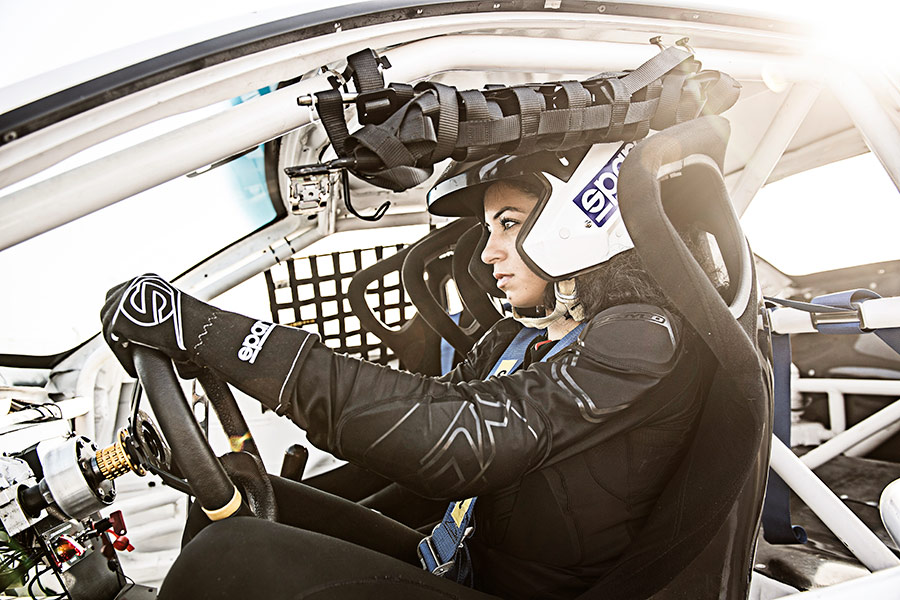
Palestinian drift racing star Noor Daoud relishes breaking down global barriers.

Palestinian drift racing star Noor Daoud has spent her adult life breaking down barriers in the world of sport and she is only getting started.

She launched her motorsport career in 2009 when she took part in a speed test, graduating to the high octane world of drifting two years later.

If you like this, subscribe here for more stories that Inspire The Future.

Not content with excelling behind the wheel, she is also a personal trainer and engages in a spot of Muy Thai Boxing and skydiving for good measure.

Growing up on the occupied West Bank, she credits her strong mother with giving her the courage to confound Arab society’s expectations at every turn.

She revealed, “I always knew I loved cars. I have a very supportive Mum. I used to take my Mum’s car and go drift (on supermarket car parks and land within range of Israeli guns).

“People say, ‘Why do you do this? You should do something better. You should get married, for example’.

“I do boxing before any race, it gets me focused. When I put the helmet on, I feel me and the car are one.

“I am a personal trainer because I love to help people achieve their goals.”

Her high profile has also helped her and a like-minded group of women called the ‘Speed Sisters’ blaze a global trail including a recent award-winning documentary.

Manager Maysoon Jayyusi, along with drivers Daoud, Mona Ali, Marah Zahalka and Betty Saadeh, formed to compete against male drivers in souped-up BMWs, Volkswagens and Datsuns.

She added, “We’re one team – we love and support each other. We’re Middle-eastern girls representing Palestine, so it wasn’t easy for us to form a team and to race.

“Many people didn’t want me to go into this sport, I endured a lot of negativity, but I never gave up and I never will. It’s my life, my passion, the only thing that really makes me happy. I believe that if someone wants something bad enough, they will achieve it.”

 If you like this, subscribe here for more stories that Inspire The Future.

Here Comes The Pride: Historic Gay Wedding At Sea

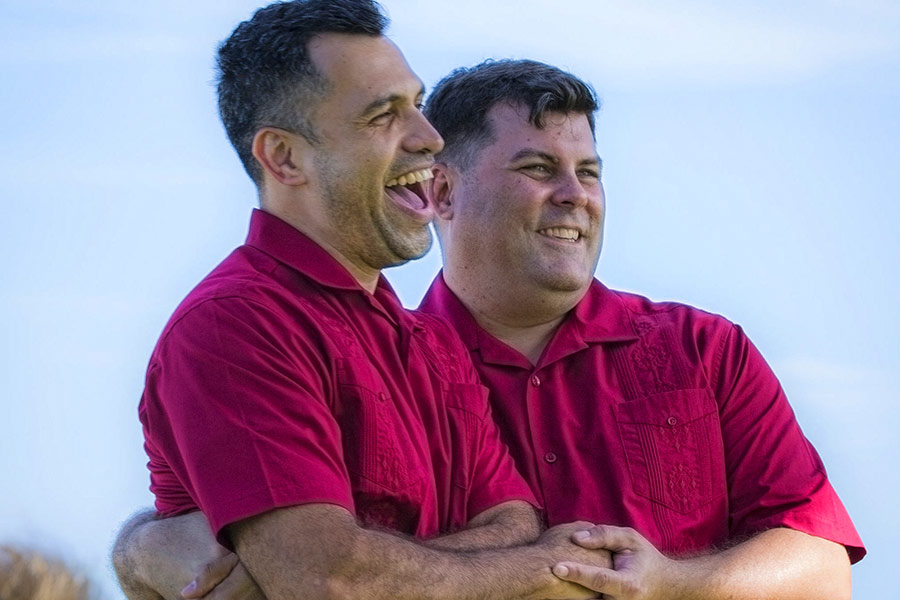
In a historic ceremony hosted on board Celebrity Equinox, Francisco Vargas and Benjamin Gray have become the first same-sex couple ever to be legally married at sea on a major cruise line.

The grooms were joined by their immediate family for an intimate ceremony officiated by Captain Dimitrios Manetas. They exchanged vows against the signature backdrop of the rose wall in Blu Restaurant, the location befitting the most memorable of moments.

If you like this, subscribe here for more stories that Inspire The Future.

“Words cannot express how proud I am to congratulate Francisco and Benjamin at this truly historic moment, both for them and for Celebrity. It’s a true privilege to know that the ceremony performed  onboard Celebrity Equinox has made history as the first legal same-sex marriage at sea,” said Lisa Lutoff-Perlo, President and CEO, Celebrity Cruises. “Together we are paving the way for couples around the world to know that their love and commitment is to be celebrated equally, and that everyone is welcome on board a Celebrity cruise.”

“There are only so many firsts in life, and we are thrilled to be the first-ever LGBTQ+ couple to marry at sea,” said Gray. “We are humbled to follow the trailblazers in the LGBTQ+ community who paved the way for us.”  

As first announced in October 2017, the motion follows a transformative vote in Malta, where a majority of the Celebrity fleet is registered, which passed the country’s parliament 66-1. The long-awaited referendum opened the door for Celebrity to legally recognize same-sex marriages performed onboard while at sea, and have the fleet’s captains officiate the ceremonies.

Vargas, who works for one of Celebrity’s top Travel Partners, Cruise Planners, said: “Traveling is in my blood – and when we heard Celebrity Cruises was celebrating equality and embracing our community, we wanted to be a part of it. We are grateful for the outpouring of support from our Cruise Planners family and hope our story brings strength for others in the LGBTQ+ community to confidently love whoever they choose.”

If you like this, subscribe here for more stories that Inspire The Future.

Venture Capitalist Messes With The Wrong Dad

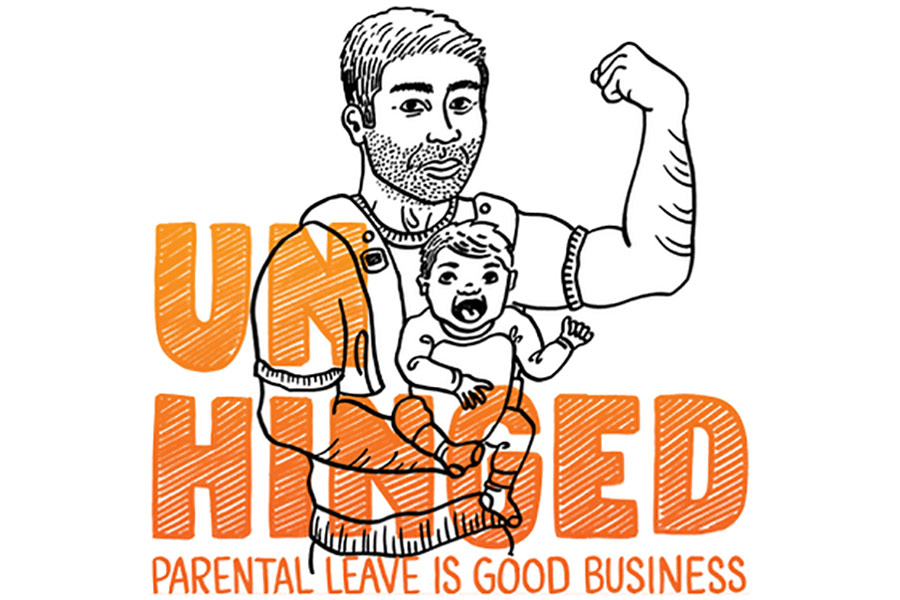
Purpose-driven agency Oliver Russell has launched a campaign to advance paid parental leave policies in the wake of venture capitalist Michael Moritz denigrating paternity leave in his Financial Times op-ed.

Moritz, a partner at Sequoia Capital, praised the 24/7 work ethic of China, singling out paternity leave and work-life balance in the United States as particular concern, writing: “These seem like the concerns of a society that has come unhinged.”

Oliver Russell’s campaign, called “Unhinged: Parental Leave is Good Business,” will offer digital resources to advocate for parental leave polices at work, regardless of employer size. The 11-person boutique creative agency has offered paid maternity leave since 2011, adding paternity leave in 2014. Agency founder and president Russ Stoddard said its clear that parental leave is good for business, and that the new website, LetsGetUnhinged.com, features a toolkit for how to develop similar policies.

In the days since Moritz’s made his views known, several multinational corporations, including Starbucks, have expanded parental leave policies. The Family Medical Leave Act covers only workplaces with more than 50 employees and doesn’t mandate that parental leave be paid. Of the 193 member countries of the United Nations, the U.S. joins just New Guinea, Suriname, and a few South Pacific islands in not having a national paid parental leave law. A 2016 study by the Center for American Progress shows that paid leave benefits even small businesses by boosting recruitment, retention, productivity, and overall performance and productivity.

“I find Moritz to be horribly out of step with the times – and the facts,” Stoddard said. “His take on human capital reminds me of the old-school approach: People are an asset to be mined and wrung out, their professional value to be extracted as quickly as possible.”

If you like this, subscribe here for more stories that Inspire The Future.

0