Why a Circular Economy is Critical Now

Forget red and blue oceans, it’s the overfished ocean that should be calling your strategy shots. Ask any experienced manager or aspiring MBA student around the world for their favorite subject in the field of business, and the answer will strike you with overwhelming consistency. Strategy! At the time when shaking economies are struggling to find their standings, developing a strategy that beats the competition is the sexiest topic around. And judging by all the strategy courses I have ever taken or been asked to teach, we seem to be focused on only two choices.

Popular strategic thought tells us that to compete well, we need to find the most advantageous position in the crowded market space and stick to it. Michael E. Porter is the guru at the helm of this thinking, and his famous 1980 menu of “generic” strategies aims to offer you the entire market landscape to consider. In a striking contrast to Michael Porter’s positioning concept, in 2005 W. Chan Kim and Renée Mauborgne invited the business world to leave behind the crowded (and often violent!) waters of the existing market and instead search for—or create demand in—the uncontested market space, the so called blue ocean.

With the powerful advice of the former, many companies for decades claimed their victory by finding and protecting the best spot—a unique position on the crowded competitive landscape. Following the fresh invitation of the latter, adventurous businesses strived to avoid the crowd by discovering a new market space—swimming into the “blue ocean” waters far away from shark-filled blood-red existing markets. Both options are great. And both are oblivious to one simple fact: whether red, blue, or rainbow, the oceans are getting excruciatingly empty. We are, simply put, running out of things to mine and places to trash.

The question of declining resources is not new. Long before current frameworks, such as the Natural Step, put declining resources at the center of attention, the issue of resource scarcity commanded the notice of theorists and practitioners alike. From Plato in the fourth century BC to Thomas Malthus in 1798 to the Club of Rome in 1972, a parade of esteemed thinkers drew our attention to the looming collapse—to no avail. Hardly any changes in the behavior of businesses, governments, and consumers alike were inspired by their powerful outcry—if anything, the global market grew tired and deaf to the calls for radically new business models. Why?

While the theory of resource decline seemed strong and sound, for nearly two centuries the market reality had been telling the opposite story. McKinsey’s 2011 report “Resource Revolution” puts it best: “Throughout the 20th century, resource prices declined in real terms or, in the case of energy, were flat overall despite periodic supply shocks and volatility. The real price of MGI’s index of the most important commodities fell by almost half. This decline is startling and impressive when we consider that, during this 100-year period, the global population quadrupled and global GDP increased by roughly 20 times.

The result was strong increases in demand for resources of 600 to 2,000 percent, depending on the resource.” In essence, what the declining prices of resources told us for so long was that we could have our cake and eat it too—grow our population, increase our consumption, and keep cutting prices, all at the same time. But that was then. The now looks drastically different—and the speed of waking up to this new reality will determine who will survive and who will vanish in the new era.

Each year, I work with about 5,000 senior managers directly, and our conversations so far suggest that the majority have not yet fully awakened to this new world of a rapidly collapsing resource base. So, here are a few alarm sirens for you—the general trends that are beyond striking:

  • One: since the turn of the 21st century, real commodity prices increased 147 percent.
  • Two: at a minimum, an additional $1 trillion annual investment in the resource system is necessary to meet future resource demands.
  • Three: three billion more middle-class consumers are expected to be in the global economy by 2030, all putting new pressures on resource demand.

Whatever key aspect of business—or life—we consider, declining resources are unraveling the very foundation on which we built our economy. As the linear throwaway economy is approaching its collapse, this old economic order is running its course, and those managers who deeply understand and master this shift are able to use the new reality to power up radical innovation and secure a remarkable competitive advantage. As they ride ahead of the wave, new products, new business models, new markets, and new profits follow. Behold the Overfished Ocean Strategy.

At the center of this approach to resource depletion is a simple strategy: it’s time to turn scarcity into competitive advantage. While this comprehensive strategic framework is built around five well-researched principles, today I will only talk about the essence. And it has to do with the nature of economy. To be able to invent products, processes, and services that do not deplete our resources our businesses need to move from linear to circular economy.

In linear economy we mine, use (usually once), and trash all of our hard-earned materials like a cheap plastic fork. In circular economy all that is used stays in the production cycle indefinitely – the waste of one product becomes raw material of another. Let’ me make it palpable for you. For years we have been hearing that the world is running out of gold. Indeed, in the linear economy, we are. So, consider this: a ton of used cell phones has up to 30 times more gold in it than a ton of gold ore.

The first piece of data breeds hopelessness. The second offers a tremendous opportunity. That is the essence of Overfished Ocean Strategy.

So, if the reports on the diminishing stocks and rising prices on every raw material possible suggest that the future of business is doom and gloom, the good news is already here: a new era of innovation for a resource-depleted world is upon us. Join.


Why 2015 Will See Global Development Leaders Support African Impact

There are interesting developments underway in Africa. The vast continent repeatedly made news in 2014 for being home to seven of the world’s fastest growing economies, and drew interest for having a large part of its growth driven by the Small & Medium Enterprise (SME) sector. This latter tidbit is crucial. It signals a move away from ‘natural resources-led’ growth in GDP to something more sustainable, and in a manner that can help reap demographic dividend of a continent where 60% of the population is less than 25 years of age.

A significant number of these SMEs are social innovators, taking head-on critical, persistent challenges faced by income-poor populations in the region. They are creating indigenous products / services, building local supply chains, hiring local people and tapping into local markets at the base of the economic pyramid. A bulk of these social innovators also imbibes a crucial tenet of modern leadership – a business philosophy of sustainability.

For example, among the bright young SMEs we have met in the past year is Sun Culture, an enterprise that sells solar-powered irrigation systems. It defines performance in more-than-revenue terms, to the tune of “USD 400,000 in economic impact, delivered in terms of labor savings, input savings and enhanced crop yields.” Sun Culture makes irrigation systems but thinks of itself as a vehicle for improving farmer income and agriculture output. Africa has emerged as a hotbed of exciting social innovations, which in turn, are playing a crucial role in enabling inclusive growth opportunities and development.

However, there isn’t adequate local capital to support a lot of these investment needs, resulting in the need for bringing in blended financing including grants and foreign aid that can support the creation of a robust entrepreneurial ecosystem, before it becomes ready for commercial money to be deployed. Outside of money, success stories have emerged from creative collaborations for SMEs with large corporations and government, both on the procurement side as well as on delivery side.

We’ve seen powerful examples of government collaboration with WeCyclers which works with local municipality bodies in Nigeria to help households extract value from waste. WeCyclers starts creating solutions by first evangelizing the problem. In the words of the entrepreneurs, “One of our biggest challenges with recycling in Lagos is that people just aren’t used to it.”

Hear more from them through the short hyperlinked videos. And finally, with a lot of cultural similarities, shared social challenges and a similar spirit of finding shrewd ‘life hacks’, Africa offers a window into how SMEs and entrepreneurs are leveraging market gaps, reaching out to customers and navigating infrastructure and regulatory hurdles, in other emerging economies like India, Brazil and Mexico. In fact, there is an innovation transfer already underway with well-known innovations like M-Pesa.

So visit Africa if you are keen to learn more about exciting social innovations, witness how creative collaborations are playing out, have an interest in investing in its local markets or if you want to get a glimpse of how other emerging economies are driving creative solutions.

Charisma Murari is a digital marketing evangelist who loves encountering path breaking, new ideas – online and offline. Working in the entrepreneurial social development space with Intellecap, she is constantly inspired by astute innovators who are turning widely held notions upside down. She tweets at @CharismaMurari

The X-Man

Peter Diamandis has a dream: to open up Earth’s final frontier to private enterprise. This is the story of how one man kick-started a disruptive new era of space exploration.

In February 2012, Peter Diamandis took the stage at TED to talk about the subject that informs his new co-authored book, Abundance: The Future is Better than you Think. Following a barrage of bad news images beamed onto a screen behind him – foundering cruise ships, famine in Somalia, black fanfares of financial doomsday – Diamandis rebutted the notion of a world in irreparable tailspin. In an age of information overload, he said, the early warning centers of our animal brains continue to prioritize bad news over good for the purposes of survival – hence the ongoing media mentality of ‘if it bleeds, it leads.’ Yet behind the headlines, positive news stories too often go unnoticed.

The average human lifespan has doubled, per capita income tripled, and child mortality fallen tenfold in the last century alone. And with the exponential rate of development for emerging technologies like AI, robotics, and digital manufacturing, Diamandis argued that humanity will not only overcome its current problems, but will make more progress in the next two decades than in the last two centuries. Where others see crisis, Diamandis sees opportunity.

That’s nowhere more apparent than in the space exploration industry most often associated with the 51-year-old MIT and Harvard-educated entrepreneur, born to Greek immigrant parents in New York’s Bronx. When the last Shuttle mission rolled to a halt on the tarmac of the Kennedy Space Center in July 2011, the mood of grimly determined cynicism that gripped the world was summed up by a withering obituary in the Economist entitled ‘The End of the Space Age.’

For Diamandis, however, it marked a beginning: A shift of power from the grasping claws of governments and state agencies into the hands of the humans of Earth. “In the fifteenth and sixteenth centuries, when the first explorers set out across the oceans, missions were sporadic and risky,” says Diamandis. “It was only later on, in the seventeenth and eighteenth centuries, when we created the first commerce between the New World and the Old World, that the frequency and safety of those missions increased, and the Atlantic opened up. It’s a similar situation in space.

We’ve had 50 years of government programs that have started and stopped, and which did an amazing job of showing what was possible early on. But it’s not until we tap into the economic engines that open space up that we’re really going to set out on the true epic of space exploration. For me, that’s just beginning.” Diamandis sees the problems of a government-sponsored space industry as being tied up not only with the exorbitant costs of space travel, but also with a reluctance to take risks for fear of federal investigations and embarrassment on the world stage when things go wrong.

As such, NASA operated an ‘ain’t broke, don’t fix it’ policy that saw the space Shuttles Discovery, Atlantis, and Endeavour flying with a 20-year-old computer program, something that seems ridiculous to a new generation of entrepreneurs with both the capital and the character to take the risks that progress demands. “We’re living on a planet with some 1,000 to 2,000 billionaires, many of whom became inspired by space exploration as kids in the 1960s, and you’re starting to see a significant number of them begin to invest in space,” Diamandis explains. “Unlike government agencies, they’re motivated by creating viable businesses and revenue flows. As they take the risks necessary to make that happen, the cost of doing things in space is going to fall, and as the costs fall, more and more individuals will get involved and more incredible things will become possible.

It’s an exciting time.” Contrast that, he says, with the way NASA managed to make space so boring with its caution, its closed doors, and its absence of emotion in missions. (Diamandis wryly notes that successful operations are deemed ‘nominal’ rather than ‘phenomenal.’) If the next generation is to view space exploration as a viable alternative to video gaming, it has to be made participatory, something Diamandis has gone to great lengths to achieve through a range of companies. Zero G has taken over 12,000 people on a modified Boeing 747, inducing states of weightlessness by performing parabolic arcs.

Space Adventures, Ltd has taken eight commercial tourists on orbital space flights, and is planning to send two commercial astronauts on a circumlunar mission by 2017 (at $150m per seat). While the embryonic Rocket Racing League envisions rocket planes tearing around virtual sky courses over desert stadiums in scenes reminiscent of Star Wars’ pod racing marathon. Yet Diamandis is best known for the X PRIZE, a competition he launched in 1996 to catalyze space exploration in the manner of the grand aviation prizes of the early twentieth century. It offered $10 million to the first private team to build their own ship, fly it into suborbital space, and land it safely twice in two weeks.

The challenge was completed in 2004 by SpaceShipOne, built by Burt Ratan and funded by Microsoft co-founder Paul Allen, pre-empting Diamandis’ theory that both the risk-taking character and the capital needed to kick-start space exploration lay in the hands not of Earth’s space agencies, but its entrepreneurs. “First and foremost these guys want to fulfill their childhood dreams,” he says. “They grew up being motivated by the Apollo missions and episodes of Star Trek, and expecting space exploration to be much further advanced than it is today. Now they can afford to go and do it for themselves.

Secondly, a lot of these guys reinvented industries: Larry Page and Sergey Brin reinvented the information industry with Google; Jeff Bezos reinvented the shopping industry with Amazon; Elon Musk reinvented banking with PayPal. And when you’ve reinvented such huge industries and you’re looking at how slowly NASA has been progressing, you start to think, ‘Well, maybe I could do better.’” And they have done better.

With SpaceX, Diamandis sees Elon Musk achieving in 10 years what NASA couldn’t do in 40 – reducing the cost of rocket launches to a fraction of that offered by major competitors, and opening up countless commercial and federal space flight opportunities as a result. Richard Branson has enlisted Burt Ratan to design SpaceShipTwo for Virgin Galactic, which could spearhead an age of suborbital space tourism as early as 2013, creating a new generation of excitable explorers along the way. For his part, Diamandis continues to divide his time between a range of commitments: From the recent announcement of a second $10 million X PRIZE purse for the invention of a Star Trek-style ‘tricorder’ – a handheld device capable of scanning the human body and diagnosing disease – to overseeing the Singularity University, an institution co-founded with friend and fellow futurist Ray Kurzweil, that educates innovators capable of meeting the future head on with its graduate and business courses in the field of emerging technologies.

Diamandis also recently founded a new company, Planetary Resources, aimed at using robots to mine asteroids for fuels and precious metals – a hugely challenging enterprise and one that offers a neat insight into his approach to running projects for which there is no prescribed blueprint. “It’s about finding people who combine the right mix of experience and determination with a desire to jump into the unknown, and finding the right investors to help develop a creative economic engine that you can sustain over decades. Asteroid mining is a big, audacious goal –it’s going to be difficult but not impossible.

We humans typically do these things: Look at modern deep-water drilling operations, which invest between five and 50 billion dollars each setting up robot cities on the ocean floor, and which would have seemed impossible not long ago. The same is true of space: It’s about making the impossible possible, about realizing that we can achieve pretty much anything we set our minds to once we bring the right people, technology, and capital to bear.”

This story was originally published on www.thinkwithgoogle.com.

Rainbows and Failures: Value Your Mistakes

Imagine a world in which failure was not a terrible event. A place in which mistakes were valued, obstacles were short-lived barriers and questions were endless. Perhaps an environment where we had nine lives, like a cat. This place is where we would explore and learn from our experiences. It would be a world in which failures could constitute success. When I think about “success stories” or successful leaders, it’s the story, the journey that is often highlighted. How did they do it? What were the circumstance, the experiences, and the process that made it possible to accomplish their goal?

After all, at one point or another, we are all bound to fail. I don’t intend to present a pessimistic viewpoint, but rather an optimistic understanding of failure. In fact, what separates leaders and others is those who let failure take over and those who work even harder after they’ve failed.  I realized this in an unexpected environment. At the edge of a bridge, overlooking one of the most magnificent sites I had ever seen: Iguazu Falls in Argentina.

Imagine a place isolated from society. What you hear is a chorus of birds. You can feel the breeze and see trees swaying back and forth. Rich, green leaves moving back and forth to create a small force. It’s not too chilly. There is no need for you to pull a sweater out of your backpack. The sun takes care of the warmth. It’s beaming and glowing. So bright and always present. The rays of sun pass through the holes of the branches of tress. You think to yourself, how can this be real?

As you proceed to the main attraction, you observe how the water has a brown and red tint from the minerals. It’s as calm as bath water. Then as time goes on it begins to get rougher and a little choppy. Finally you arrive at the first stop to see the falls. You begin to walk down a path that acts as a bridge. There are times when you question your safety.

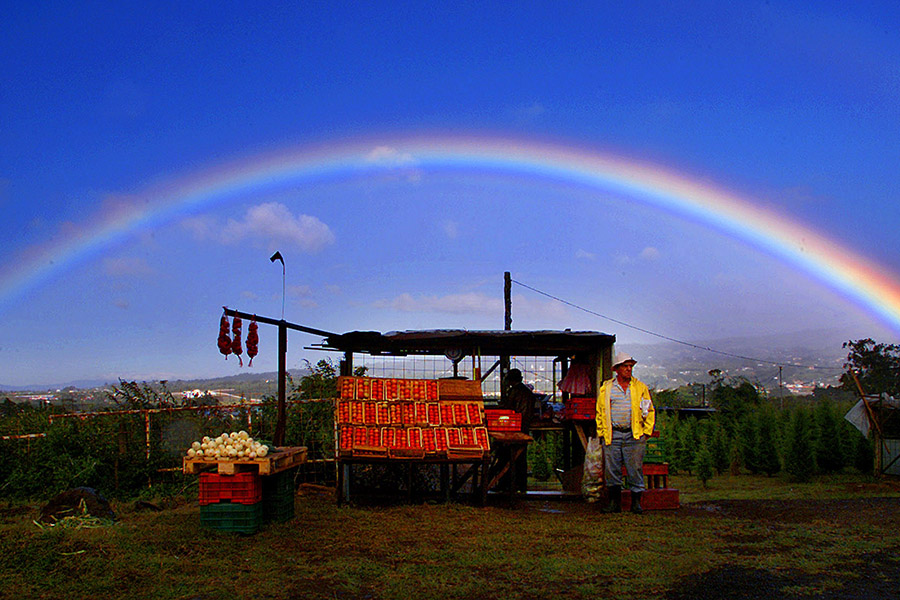
rainbow

Maybe it’s the questionable construction of the bridge or the vast number of people walking on it at the same time. Then you think, “it’ll be okay. Many people have walked this path before. I’m going to be okay.” You start to wonder how soon you’ll see the falls. The view is rather stunning. Huge trees covered in leaves surround the bridge area. You’re able to look out at the river and take in its beauty. On your journey you begin to hear sounds. It’s a sign you’re getting close. You begin to see huge clouds in the sky.

But soon realize that these aren’t clouds but actually mists coming from the falls. Consider the way a bomb explodes and takes over the purity of the air. Think about the same thing happening but with a cloud of water and mist. This is all you see on the bridge. Promising isn’t it? You finally get to the end of the bridge and Bam! The beauty is everywhere. An insane amount of water is pouring over so quickly that it looks like it’s moving in slow motion.

This particular section is called the “Devil’s Throat.” One slip on a banana peel and you’re the devil’s next meal. Nonetheless, you don’t let the panic ruin your experience. How could you when nature’s freshness fills the air? In this environment, you could never imagine how we could pollute this world. You look at the falls and wonder how this got to Earth. It’s a crushing sound that never stops and a sight that never fails to meet your expectations. It’s absolutely stunning. Rainbows appear. The most vivid rainbow you’ve ever seen.

The red is as bold as blood, orange is brighter than the fruit, yellow matches the sun, green is as dark as healthy grass, blue like in the middle of the ocean, and purple like a field of lavender combined with plums. This rainbow is also a full circle. You probably always thought there is a pot of gold at the end of each rainbow… maybe there is but you now see that a rainbow has no end. Its colors are reflected in some parts of the water. Then slowly, you see another rainbow appear behind the original one. It’s incredible; so pure and untouched, so clean and unharmed, so beautiful and perfect.

It occurred to me at that point that what I had just experienced was a walk through someone’s living hell into heaven. I embarked on a journey from a deathly forceful waterfall into magical, mystical surroundings. If nature is able to coexist and produce something like this, then it should allow humans to understand how our own nature allows a similar process. In this way I came to build a foundation for a belief I hold dear.

Namely, how a leader may be recognized for their success, but it’s the mistake and failure that makes them recognizable. In order to reach success it’s likely that mistakes, rainy days, failures and obstacles will be part of it. Ultimately, a rainbow is the product of sunshine (the good, positive and successful) and rain (seen as bad, negative and disappointment). Without the condition of a “sad, bad rainy” day, then the rainbow is not possible. A lack of optimism in the sun coming out, also erases the possibility of a rainbow.

Finally, we can see how a rainbow is mutually constituted in the good and the bad, in the happy and the sad, in failure and success. Essentially when you see a rainbow – someone’s success story – reflect on how there may have been a few rainy days that contributed to the magnificent site you now see. The ones who are able to “produce a rainbow” are the ones who danced in the rain and celebrated those cloudy days. If today there is an overarching shower from the sky, remember that your rainbow, your success, is likely to arise from conditions such as these.

7 Things I Learned in Tibet

Debbie and I just returned from almost 3 weeks in Tibet, Nepal and Bhutan. Yes, we saw Mount Everest (from a small plane… no more mountain climbing for me). But the most enriching part of the trip was spending every day with a guide who happened to be either a devout Buddhist or Hindu. This allowed us to get into extended conversations about their beliefs, their hopes and dreams, and their life strategies. Two of the guides were young women ages 30 and 27. Both of them were very open, sincere and strong.

Perhaps the most compelling realization on the trip was that the new generation of women everywhere in the world shares a mindset that things are going to be different.

The cultures of these countries are deeply rooted in Buddhism or Hinduism. These religions contain deeply held beliefs that each of us are born into circumstances we deserve… and that men are more spiritually evolved than women. In other words, if you were an awesome spirit you would’ve never been born a woman. I know, what a great way to set up a culture if you’re a man. Well the young women of Tibet, Nepal and Bhutan are not buying it.

They are pursuing educations, significant careers, marrying later, and treating their husbands like partners rather than gods. One extremely positive outcome is that women are asserting themselves in terms of resisting sexual abuse, rape and virtual enslavement. This is all happened in one generation. Universal media and the Internet are definitely impacting it. It is also driven by a new web of personal connectivity between young women around the world.  Women do network and communicate… everywhere and all the time.

One thing I can predict with high certainty is that in the next 30 years the world will change significantly because more women will make more important decisions and create greater influence than ever before in history. It’s about time! (If you like to watch a film that reinforces this idea click here.)

Since the trip also allowed me to both study and reflect, I thought I would pass on 7 ideas I found worth considering. You may not agree with all of them but if there is a nugget for you put it in your “mental pocket” and examine it more closely.

  1. Buddhism is a lot more than meditation and chanting. Hinduism is a lot more than yoga.  While it is true that all religions have serious defects… invariably caused by centuries of hard power leaders using fear to control the thoughts and behavior of their believers…the spiritual inspiration at the root focuses on inner peace and acts of compassion. Finding inner peace is the power source of true compassion.
  2. The tribes we belong to dilute our conscience. For instance, when large groups of people engage in business activity that cause employees to suffer by reducing their individual power while increasing their demands in an effort to make products that generate high profits but little value, we accept it as business as usual.  The cost of this mindset is high. If my prosperity depends on others’ suffering my soul submerges in an ocean of self-justification.
  3. My TRUE self, my intrinsic self has a manipulative roommate. He shows up as the other voice in my head insisting I need status, money, popularity and achievements I can brag about to feel secure and self-satisfied. It turns out this nasty roommate is a big fat liar. My TRUE self knows that if I put my higher attention on attaining wisdom and loving others I will learn what I need to learn and do what I need to do to be happy in any circumstances.
  4. If I consistently sell out my TRUE self to anger, jealousy or fear I will find myself trapped in a life that is smaller and more stressful than the life my heart desires.
  5. If I allow my self-interest to masquerade as virtue I will become a moral barbarian. 
  6. Our life is designed to challenge us. Our future rarely turns out as we envision.  Nearly all our plans for our career, marriage, finances and health don’t materialize as we imagined. When we are surprised by crisis and disappointment it is time to question our desires, our values and our choices. If these moments cause us to pause and reflect and realign with our inner sense of purpose we will grow. If we don’t we will re-enter the cycle of disappointment and self-frustration. This is true for everyone. It is how life is designed.
  7. While it is reasonable to forgive people who seek our forgiveness, forgiving those who hurt us without remorse is masochism.  Escaping the anger of past and unresolved pain doesn’t require forgiveness…it requires transcendence. This means that we cease to want justice or to wallow as a victim.  We literally transcend our pain by focusing on our own growth, our own power and the positive difference we are designed to make. Transcending undeserved betrayal or abuse requires not thinking about it anymore. When we stop investing our energy in our mental movie of past wrongs and disappointments we free our minds so our hearts can embrace today and generate optimism for tomorrow. As my 27-year-old Buddhist guide said, “You will gain nothing from meditation… but you will lose your anger, jealousy and fear.”

I am so grateful for our trip because it was so thought-provoking and inspirational. I would write some more but it’s time to meditate… 🙂

How To Reinvent Yourself And Change Your Life

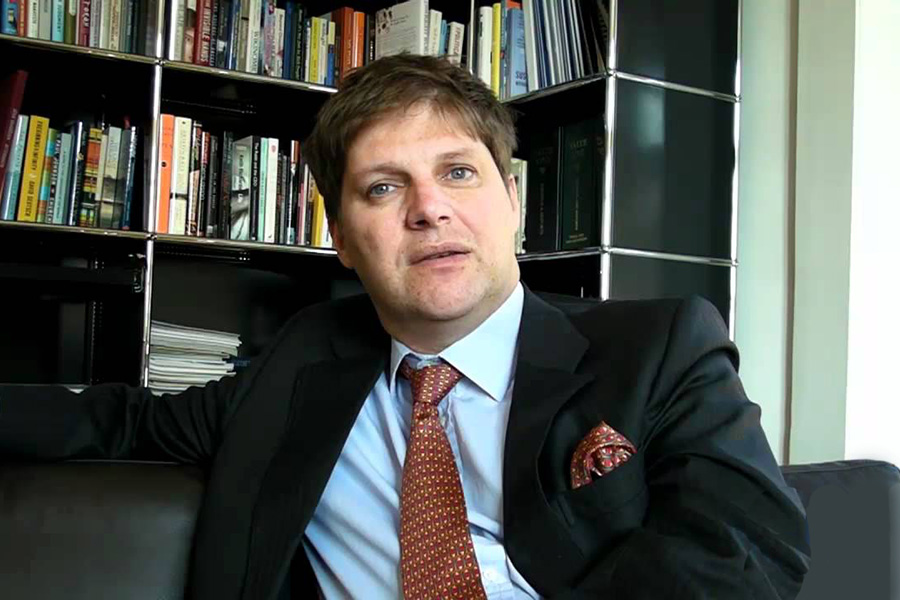
Guy Spier started his finance career with the right pedigree, from Oxford to Harvard Business School. But when he took a job at what he soon discovered was an ethically challenged Wall Street firm (a number of its top leaders later pleaded guilty to fraud charges), he was ashamed. Spier didn’t participate in the malfeasance, but he felt embarrassed and tainted by the association: how could he have chosen so poorly? “It was just a horrible place. Literally, I left it off my resume; I tried not to talk about it,” he recalls. But in his new book The Education of a Value Investor: My Transformative Quest for Wealth, Wisdom, and Enlightenment, Spier – now, years later, a prominent investment manager – shares the hard-fought lessons he learned. Too often, memoirs are whitewashed to put forward the impression that success was inevitable.

But Spier wanted to tell the full story. “I really wanted [readers] to know the failures,” he says. “Last summer when I wrote that first chapter, I was like, ‘Am I really going to write this?’ It’s slightly scary…telling people what it’s really like and trying to help people to see that they can have terrible mistakes, they can have terrible misdirections, they can have utter greed and envy and it’s okay, because the rest of us do as well. That doesn’t make them bad.

It’s okay to embrace those emotions and to sublimate them into something better.” Spier reinvented himself nearly two decades ago when he formed the Aquamarine Fund, which he still manages. But in many ways, writing the book capped his reinvention. “In that first chapter, I got the courage to say, ‘Folks, I’m a different person now and I’m going to tell my story. I’ve got to tell you about who I was.’ You know that, perhaps, you’ve fully transformed yourself when you can confidently tell the narrative of how you were without it being painful.” Here are the lessons he learned in reinventing himself and building a business to be proud of.

Learn from the best.

Spier recalls his darkest days, sitting in his office at the disgraced company and feeling disillusioned with Wall Street’s underbelly. “Take any person, put them in the wrong environment and they can get off to some pretty bad things,” he says. “Warren Buffett has said that he would not like to get into debt because he doesn’t want to discover what behavior he’s capable of. Just having that biography of Warren Buffett to read pulled me back from [that culture].

It’s an environment that’s just saying, ‘Look, we’ll have you around for a year or two and if you’re willing to do some of our dirty work, we’ll keep you around and maybe you’ll make some money.’ The dirty work is never asked for, but it’s all about misrepresenting crappy investments to an unsuspecting person.” In reading about Buffett’s more honorable approach, Spier found inspiration. “In some way, he was my savior… I was modeling him based on the books and biographies I’d read.”

Associate with the right people.

Even better than reading about your heroes, however, is meeting them – something Spier had the opportunity to do in 2007 when he went in with his friend Mohnish Pabrai to buy lunch with Warren Buffett at a charity auction, for the princely sum of $650,100. Was it worth it? Spier says absolutely. “What I never understood before that was the impact of just meeting somebody once. When you actually sit in somebody’s presence, you have so much more of an ability to model [how they would act],” he says. “You get this resonance and this sense of what it’s like to be in the person’s presence…what emotionally makes them tick,” he says. In general, says Spier, it’s critical to “spend time with people who are better than you from whom you can learn. Powerful things can happen if you do that.”

Be honest – with yourself and others.

Part of Spier’s goal in telling his story so honestly is to live up to Buffett’s example. Buffett doesn’t put profit before all else; what’s far more important is being an honest and decent businessman. “I think that he showed me a way,” says Spier. “I was transformed. I learned to see myself and my role as a capitalist…as somebody who’s trying to harness, for myself and for society, the power of greed and the power of the will to acquire into something that makes the world a better place.

That’s the version of capitalism that we want.” Through modeling himself on Warren Buffett – first through articles and books he’d read, and later by meeting Buffett in person – Spier developed the vision and direction to reinvent himself. By asking what Buffett would do in any given situation, Spier gave himself a north star to follow and built a career worthy of his hero.

Doris Clark is the author of Reinventing You and the forthcoming Stand Out. You can subscribe to her e-newsletter and follow her on Twitter.

Berkshire Beyond Buffett

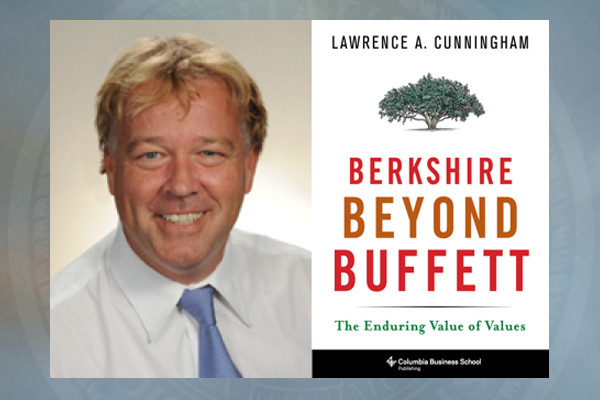
Berkshire Hathaway, the $300 billion conglomerate that Warren Buffett built, is among the world’s largest and most famous corporations. Yet, for all its power and celebrity, few people understand Berkshire, and many assume it cannot survive without Buffett. A new book by Lawrence Cunningham, Berkshire Beyond Buffett, proves them wrong. www.berkshirebeyondbuffett.com.

In a comprehensive portrait of the corporate culture that unites Berkshire’s subsidiaries, Cunningham unearths the traits that assure the conglomerate’s perpetual prosperity. Riveting stories of each subsidiary’s origins, triumphs, and journey to Berkshire reveal how managers generate economic value from intangibles like thrift, integrity, entrepreneurship, autonomy, and a sense of permanence.

Rich with lessons for those wishing to profit from the Berkshire model, this engaging book is a valuable read for entrepreneurs, business owners, managers, family business members and investors, and it makes an important resource for scholars of corporate stewardship. General readers will enjoy learning how an iconoclastic businessman transformed a struggling textile company into a corporate legacy.

Blessed by Buffett and based on interviews with Berkshire chief executives and other insiders, Berkshire Beyond Buffett provides new insights on the structure and future of the company. Cunningham, the editor and publisher since 1997 of The Essays of Warren Buffett: Lessons for Corporate America, tells riveting stories of Berkshire’s fifty most significant subsidiaries, to draw valuable takeaways about leadership, management, corporate culture, and succession.

cunninghambuffett

Some of the highlights from the book include:

1. Warren Buffett rose to prominence as a stock picker in the 1980s and 1990s, with Berkshire Hathaway then consisting 80 percent of his chosen share holdings and 20 percent of businesses; in the past decade, the mix quietly flipped and, with Berkshire now 80 percent businesses and 20 percent stocks, Buffett will soon become most famous for building and managing one of history’s largest corporations, now employing 300,000 workers.

2. People perceive Berkshire’s vastness and diversity as a throw-back to the discredited conglomerate era of the 1970s and 1980s that proved such companies unsustainable; in reality, Berkshire is united by a set of core values that give its subsidiaries coherence, common purpose, and sustenance, ratifying this business model.

3. While it isn’t easy to see how corporate culture translates into business performance or measure results, the stories of fifty Berkshire subsidiaries reveal a pattern of success from norms of thrift, integrity, entrepreneurship, trust, and a sense of permanence.

4. People don’t think of Berkshire Hathaway as an orphanage for the corporate homeless, yet a dozen of its subsidiaries, once damaged by leveraged buyouts and serial corporate parents with short-term outlooks, now prosper in Berkshire’s congenial culture that is averse to debt and adopts a long-term view.

5. Cynics doubt that big corporations can both make money and do good, but Berkshire’s subsidiaries routinely profit from virtue, whether GEICO passing on savings to customers, RC Willey furniture stores warranting merchandise out of its own pocket, or low-income housing supplier Clayton Homes assuring that customers can afford the homes they buy.

6. Skeptics warn that companies led by icons like Buffett cannot survive their passing, but Buffett’s greatest achievement is forging an institution larger than himself and designing it to outlast him. When people say, “Warren is so special that Berkshire can’t survive without him,” Cunningham counters with the book’s thesis: “Berkshire is, in fact, so special that it can thrive without Warren. That is his legacy.”

Prof. Lawrence Cunningham is a leading authority on Warren Buffett and Berkshire Hathaway and on corporate governance and culture. He is a Research Professor of Law at The George Washington University.

6 Tools For Creating High Performance Teams

The world is replete with organizations with great strategies. But how many of those great strategies are actually executed? Less than 15%. That’s the number that John Spence shared with me when we spoke recently. John is the author Awesomely Simple, and an executive trainer and coach who has worked as a trusted advisor with numerous Fortune 500 companies over the last 20 years. When we spoke, we discussed what he’s noticed about organizations that are very successful at building and sustaining high performance teams that effectively execute strategies. Following are the highlights from our discussion. (If you’d like to watch the video of the interview, click here.)

John’s advice is to focus on creating and sustaining a winning workplace culture. If we get the culture right, we can create the conditions for excellent execution. My discussion with John revealed 6 powerful, easily-actionable ideas for creating and sustaining a culture of high performance.

1. People need to feel safe in the workplace.

Of course, people need to know that they’re physically safe. But they also need to know that they are emotionally and psychologically safe. A winning culture must include an environment where people know that they will not be attacked emotionally, and they need to know that they can openly and safely share ideas.

2. People need to feel that they belong to something that matters.

As humans, we naturally seek out something bigger than ourselves to belong to. We can help fulfill this deep, human need by creating a workplace where people are inspired by the work we do, and can see how their work is tied to the big picture. Knowing how important this sense of belongingness is, when taking on new team members, we should also pay close attention to whether or not a person would be a good fit for our culture. If a person doesn’t feel that they fit in, they could quickly become disengaged.

3. People need to be appreciated frequently and authentically.

People need to be appreciated for the tasks they accomplish, for their ability to display emotional mastery, and for their ideas. Leaders of the most successful teams create a culture of catching people doing well in all three of these areas and they make it a point to offer some type of specific, genuine praise at least once every 7-10 days, like, “John, I really appreciate the way you handled the situation yesterday with the ABC client. It would have been easy to get frustrated, but you stayed cool and positive.

I’m glad you’re on the team.” We can take the power of appreciation to the next level by making sure that we have a conversation at some point with each team member to find out how they like to receive appreciation. One person may like public recognition. Another may prefer a simple written thank you. John Spence told me about an assistant he worked with at a company he ran who valued family above everything else. So, when John wanted to show deep appreciation, he wrote a letter to her family telling them how great their mom/wife is.

4. Appreciation needs to be combined with accountability.

Talented people don’t want to be on a mediocre team. Appreciation is vital for creating a culture of excellence, but so is accountability. Every member on a team needs to have clear expectations set forth and know who is accountable for what. Winning teams create a sense of mutual accountability, and have systems in place to regularly measure progress towards goals and determine what the team can do to ensure goals are met.

5. Goals need to binary.

Ambiguity will result in mediocrity. High performing teams set very specific, binary goals. A binary goal is either achieved, or it isn’t. There is no ambiguity or subjectivity. In addition to making expectations more clear, binary goals also reduce personal conflicts. Instead of having conversations like, “I don’t think you did as well on this as you could have,” which is open for debate, the conversation is simply, “Sales were not improved by the goal of 5% this quarter. What do we need to do to hit the goal next time?”

6. Create more “A” players.

All employees need to be coached and mentored. But is there one group of employees that should receive a little more attention? According to John Spence, there certainly is. It shouldn’t be the As. The best thing we can do with As is to make sure they have what they need and then get out of their way. It shouldn’t be the Cs (or Ds if you have any).

It is unlikely that they will ever become an A player. If you’re going to focus a little more energy on any group, it should be your B players – the employees that are close to being top performers, but just aren’t quite there yet. By focusing a little extra energy on moving the B players to the A level, along with the other 5 tools we discussed, we can make significant progress toward creating a high performance team that effectively executes our winning strategies.

Florence: The Art of Preservation For Future Generations

Once reserved for powerful merchants, the title ‘patron of the arts’ has been bestowed on ordinary citizens wanting to preserve the world’s most recognizable art and architecture.

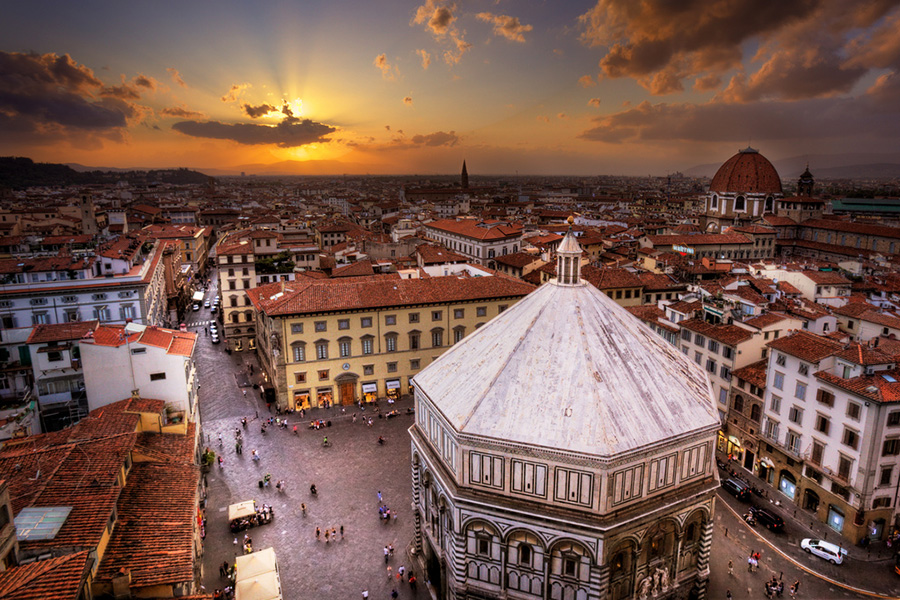
Nowhere in Italy – perhaps in the entire world – is the act of looking at art more rewarding than in Florence. Nowhere else can one be captivated by a wistful Botticelli smile, impressed by the graceful dignity of Donatello’s bronze David, and moved by Michelangelo’s provocative Slaves twisting restlessly in their marble prisons. Established by the Romans in 80 BC, Florence became a center of medieval European trade and later the birthplace of the Renaissance.

The proliferation of artworks and architecture during the Renaissance was mainly due to a system of artistic patronage by wealthy merchants, who commissioned portraits, statues and murals to celebrate and flaunt their success. The most famous of these patrons was the Medici family, which had checkered periods of fortune and influence over the city for around 300 years. Lorenzo Medici is credited with commissioning Michelangelo, Leonardo da Vinci and Botticelli with some of the worlds most recognized artworks.

Beyond the preservation of the artworks themselves, Florence is a cultural city that attracts almost 2 million tourists each year and was declared a World Heritage Site by UNESCO in 1982. Florence was also ranked by Forbes as one of the world’s most beautiful cities. It’s current status as a world fashion capital also means that preserving its past is an important factor in securing the city’s future. Friends of Florence is a U.S. non-profit organization supported by individuals from around the world who are dedicated to preserving the cultural and historical integrity of one of the worlds oldest and most creative cities.

Helping with this immensely important task is Contessa Simonetta Brandolini, the President and founder of Friends of Florence. Sixteen years ago she introduced a novel idea: why not allow ordinary people to become art patrons; those wanting to ensure the treasures of Florence are appreciated well into the future. This unique venture began in 1998 and has raised millions of dollars to restore priceless art treasures, including Michelangelo’s David, who was given a makeover for his 500th birthday in 2006.

Rather than undertake the restoration work itself, the organization provides financial support directly to the city’s restoration laboratories that refurbish, safeguard, and make available to the public a broad range of paintings and sculptures. Friends of Florence is the only organization to commit its full resources to restoration work and works closely with partners including the City of Florence, Italian Ministry of Art, and international committees.

They also work closely with the Opificio delle Pietre Dure, a leading and highly respected art restoration and teaching facility dating back to the late 1500s. Brandolini originally chose Florence for this venture as there is a perception that the majority of the world’s greatest art is found in Italy, with the best found in Florence.

So what caused Brandolini to set up an American non-profit organization, half way around the world, to preserve this important cultural city in Italy? “Italy offers almost zero tax deductions for charitable donations,” she says. “Even wealthy Italians find little incentive to be philanthropic. Americans love and appreciate this city and its art so I decided to set up Friends of Florence as a non-profit in the U.S. where tax incentives allow us to raise the amount of capital needed to fund this important work,” explains Brandolini.

Donations have ranged from $20,000 to $400,000 and a full tax deductible rating by the IRS has seen around $8,7 million in donations help preserve Florence’s extraordinary cultural legacy for future generations. The organization has attracted some household names to its advisory board including Sting, Mel Gibson and Bette Midler.

Twice a year, an intimate group of Friends of Florence patrons have a rare opportunity to become true citizens as they receive the keys to its artistic treasures and explore Florence in a way not possible for the casual visitor. They view private collections not normally open to the public and observe restoration projects. The rewards for patrons extends beyond Florence too, with unique events being held in other European cities and the U.S., offering art lovers behind-the-scenes experiences with private curators, art historians, prominent scholars and writers.

Since its creation, Friends of Florence has been the primary source of funding to the renowned Florentine restoration laboratories and the skilled preservation individuals who work to undo the damage to artworks from the ravages of time and pressures from modern development. From earthquakes to political upheaval and pollution to every-increasing tourism, Florence’s treasures have been subjected to constant stress and damage across the centuries.

Perhaps the most infamous event, broadcast around the world, was the flood of November 1966, when intense rains caused the Arno River to overflow its banks, damaging and destroying the city’s libraries, museums, churches and chapels, artistic masterpieces, precious books, and manuscripts. Great works such as Lorenzo Ghiberti’s Doors of Paradise were affected as well as Donatello’s Magdalene, Cimabue’s Santa Croce Crucifix, and hundreds more.

To consider a restoration project the organization receives a comprehensive historical documentation on the work, including a damage assessment, which is submitted to the Board for approval. A precise budget, timeline, and statement of skill for each restorer is reviewed before funding is provided directly to a pre-approved restoration laboratory.

In Florence, the organization closely monitors the terms of the contract and pace of the work to ensure the restoration proceeds on the agreed terms. This is critical when working on items that are priceless. Many artworks, such as Michelangelo’s David, have become such public icons and symbols of national pride that no insurance policy would ever be able to compensate against loss or permanent damage. They have gone beyond monetary terms.

Upon completion, projects are unveiled at a public ceremony and the donors are acknowledged with a permanent Friends of Florence plaque. The public perception of “ownership” of these historically important pieces is not lost on Brandolini who insists on keeping detailed records of each restoration. These are used for teaching and training and sometimes even a dedicated website is set up where people can follow the progress and restoration methods used. A DVD and book is made to accompany each project, which is sold to raise money. Support for Friends of Florence has come from some surprising places.

In 2011 a group of 11-year old school kids in Texas heard about the organization and decided to raise money to restore a bust of a Roman emperor. They got to work raising money through car washes and bake sales, not accepting a cent from their parents, and ended up earning $2,500. The restorer was so touched by their generosity that he agreed to restore another two busts at no extra charge. “A plaque was erected and they came to visit,” says Brandolini.

“They were so proud of what they had done and so was I. At such a young age they had become patrons of the arts. Imagine them returning in 30 years to show their children what they have done,” she says.

One Of India’s First Sugar Companies: Blessed By Ghandi

In the early 1900s Shishir Bajaj’s grandfather Jamnalal was involved in the Freedom Movement in India alongside Mahatma Ghandi, even spending time in jail as a freedom fighter in his fight against the British. Driven by strong ethics and a will for Indians to govern themselves he added philanthropy to his arsenal of weapons, alongside his strong political ideologies. So strong, in fact, that he refused the title of honorary magistrate bestowed on him by the British Raj. Instead, he opened the first temple to the downtrodden, now 100 years old.

While Jamnalal never saw his cherished dream of an independent India, dying five years before independence day celebrations in 1947, his principles and convictions have been passed down through generations of Bajaj children. His legacy is presently in the care of Shishir Bajaj, Chairman and Managing Director of Bajaj Hindusthan sugar company, the largest in Asia and fifth largest in the world.

The principles that his grandfather learnt under Gandhi have been applied to this large industrial business, one that almost qualifies as a regional government in scale and impact. Jamnalal, with Gandhi’s blessing, saw at an early stage that there was a need for new companies to feed the economic challenges of building a new nation and formed the sugar company in 1931.

“Because my grandfather was too busy with the Freedom Movement, he set up the business and let my father run it,” says Shishir. And in a move that predates Bill Gates and Warren Buffett’s Giving Pledge campaign by 80 years, Jamnalal formed a trust for the wealth because he didn’t want to own more than he needed; a very unusual move at the time.

Two foundations, the Bajaj Foundation and Jamnalal Bajaj Trust now support more than 100,000 families in 501 villages, positively affecting the lives of more than 615,000 individuals within the company’s 12 sugar production areas. In keeping with the family tradition of social change, Shishir’s son Kushagra suggested the formation of an action plan five years ago that scaled the company’s social good onto a much larger platform.

“The number of villages we’d like to cover in the next five years is 1,000,” says Shishir. “There are about 700 districts in India and if we can capture just two I think it will be a seriously good achievement.” As the most populous country on earth with just over 1.2 billion people, two districts is not the small number some would imagine. Some of the projects Shishir is involved in include sustainable agricultural practices, and women’s self help groups.

A water resource project has seen 82 rivers deepened, 120km of riverbeds rejuvenated and schools built at seven of the ten sugar factories. Other projects include an energy company that produces 450 megawatts of power, with plans for a 2,000-megawatt power plant underway that will cost $2 billion.

One wonders what Jamnalal would say today if he saw how his sugar factory, one of the first in India, had transcended profit to become a builder of infrastructure to a nation in need. As Gandhi would have said at the time, “You must be the change you wish to see in the world.”

0