Millennial Dads Turn to Digital in Their Moments of Need

Good news for moms and marketers: The new generation of millennial dads is playing a big role at home. They strive to be perfect fathers, influence purchase decisions, and turn to the web and their devices for help. The opportunity for brands is to be there in these micro-moments.

If there’s one thing that drives Tom Brantman crazy, it’s the “babysitter” comment. He hears it all the time, things like: “So nice to see a dad babysitting his kids” from a store clerk or a passerby on the street. “I understand they are trying to be nice, but the comment stings a little,” says the 35-year-old from Kansas City. “It’s not a job because I’m a father.”

Across the U.S., men like Tom are becoming much more involved in raising their children. In fact, fathers have nearly tripled their time with children since 1965, according to the Pew Research Center. And a Pew analysis of U.S. Census Bureau data shows that the number of stay-at-home dads has nearly doubled in the past two decades.

“Millennial dads are more involved in the day-to-day of childcare than any generation before them,” says Julie Michaelson, head of global sales at BabyCenter, a site for new and expecting parents. We dug into research conducted by BabyCenter, which surveyed millennial dads ages 18 to 34 who are expecting or have a child under the age of six (this is how we’ll define “millennial dads” here), and our own search data. We also spoke with a few dads around the country to figure out how dads are using the internet and mobile in their expanded roles at home.

Rising expectations lead millennial dads online
As the roles of fathers grow, so do expectations and the gap between what they know and what they think they’re supposed to know. “There’s so much to do, so much to buy,” says Duncan Snowden, a 35-year-old expectant dad from Brooklyn. “It feels insurmountable.”

These rising expectations are leading to a lot of anxiety for new dads. BabyCenter’s research revealed that 88% of millennial dads feel it’s at least somewhat important to be “the perfect dad,” a higher percentage than millennial moms who feel that way about their own role.

To help them get there, young dads are doing what they always do when they need information: They’re turning to the web. Seven in ten millennial dads seek parenting information online. They’re finding it in stolen moments throughout the day (and night), and they’re using whatever screen is at hand, often a smartphone.

Research further reveals that 59% of millennial dads looking for parenting information online use their smartphones the most when searching for that info—more than desktop, tablet, or laptop.1 Google data shows that searches for baby-related terms on mobile have grown 52% year over year (YoY).

As dads increasingly have mobile moments—we refer to these moments of need as I-want-to-know moments, I-want-to-go moments, I-want-to-do moments, and I-want-to-buy moments—what are they looking for? And how are they finding it? Are they finding it?

I-want-to-know moments
No matter what stage of fatherhood they’re in, men have questions, and they aren’t necessarily relying on traditional sources for answers. (“Ask my dad for help? Oh, God no, far too awkward a conversation,” Duncan laughs.) Forty-five percent of millennial dads are most reliant on search for parenting information, more than any other digital resource.

Duncan’s “anxiety-fueled” searches started as soon as he heard about his wife’s pregnancy. He read up on everything from birth plans to financial plans. Meanwhile, when Tom’s first child was born, he “questioned everything” and strove to learn as much as he possibly could.

“The hospital was great with providing all of the basic stuff such as how to change a diaper, how to swaddle a baby, different ways to burp your child,” he says. “But I had questions that don’t have easy answers. How do I make my baby smile? Will my kids know that dad is holding them? Where is the checklist for ‘world’s greatest dad’ and does it have an extra-credit second page?”

Once the baby comes home, I-want-to-know moments often strike in the middle of the night. Dain Van Schoyck, a new dad from Brooklyn, describes searching in “off hours”—early in the morning or middle of the night—about his baby’s health and development. He’d type in queries like “Why is he crying in the middle of the night?” and “Is he getting enough food?”

And he’s clearly not alone; we see that mobile peaks in the evenings for baby-related feeding and sleeping questions. After all, if baby doesn’t sleep, neither does dad.

And then comes the time when dads have even more questions—when their child learns the word “why?” More than half of millennial dads say they’ve used a phone to find out the answer to a question asked by their children.

I-want-to-go moments
One reason they’re using mobile so often is because new dads are constantly on the go and looking for nearby activities and baby products. Thirty-three-year-old Zack Yorke uses his phone to answer immediate questions when he’s strapped for time, which is most of the time.

A typical day with his 22-month-old is spent hustling from one activity to another around New York, and he relies on his phone to plan his next move. “I’m looking for store hours, when is the YMCA pool open, what are the family-friendly food options nearby, are there activities at the Brooklyn library or museum, things like that,” he says.

I-want-to-go moments happen even before the baby comes. Adam G. from Boston recently used his smartphone to find the chocolate-covered, peanut butter-filled pretzels his pregnant wife was craving. “I did a quick search on the phone to see where I could get them relatively close by,” he said in the moment. “Ultimately I found out Trader Joe’s has them. They got pretty good reviews, so I’m on my way right now to buy them.”

This isn’t just a dad thing. More and more, people are using local search to find things nearby. Google search interest in “near me” has increased 34X since 2011 and nearly doubled since last year.4 The vast majority come from mobile—80% in Q4 2014.5

How can you be there when dads are looking for your business location? Are you delivering useful local information? Read more about how to win I-want-to-go moments.

I-want-to-do moments
From the moment a man learns he’s going to be a dad, he has to do many things he’s never done—or even thought about—before. Suddenly he needs to know how to babyproof a house, burp a baby, warm a bottle, and on and on. Learning how to do these kinds of things used to be time-consuming, but today, dads can find out instantly. Ninety-one percent of smartphone users turn to their devices for ideas while completing a task.6 And on mobile, baby-related how-to searches are growing 49% YoY.7

These I-want-to-do moments change over the course of fatherhood. For example, when Tom found out his wife was pregnant, he started doing “nesting” research (“fresh coats of paint,” “new windows for a quiet room,” and “framing art” searches). Now that his kids are older, he’s often searching about health issues on mobile, things like “how to clean sand out of a cut.” And for many dads, mobile has become the new instruction manual. One in three dads has used a smartphone to help install or build a product he bought for his child.

Online video is especially helpful for time-strapped parents in search of quick answers. We see that baby-related searches on YouTube are growing (see chart) and watch time of parenting videos has doubled in the past year.9 “I’d often rather watch a quick five-minute video than read about something,” says Duncan.

New dad Dain uses YouTube for step-by-step instructions to learn things like how to put on a baby carrier or swaddle a baby. Many millennial dads seek out videos about parenting tips (62%), baby health (59%), product reviews (55%), and pregnancy/baby development (46%)

I-want-to-buy moments
As more parents divvy up responsibilities, the shopping list is being split as well. Seven in ten millennial fathers say they help with the shopping.

On smartphones, dads can chip away at these purchase decisions in small moments every day. For example, while waiting in line for a sandwich at lunch, expectant dad Duncan often does a search for something he needs to buy. (“Right now, that’s a stroller,” he says.) He’s not alone; searches for “strollers” on mobile have grown 80% in the last year, while “baby gear” is up 72%.10

New dads also make online purchases once the baby comes—for everything from food to financial services. When deciding what to buy, millennial dads care most about safety, brands that provide good value, and good online product reviews. Mobile gives them constant access to this information and can strongly influence what they end up buying—even if they’ve already bought it.

Adam and his wife were a month away from having their first child when they were shopping for car seats. “We bought one, and then I found it on sale as I was looking through my phone and just checking the prices. So we decided to re-buy it,” he reports. “Just did that right now. I’m pretty happy. Saved about 30 bucks.”

Not enough dad-focused content online
Despite how much they rely on the web, millennial dads aren’t finding as much relevant content there as they’d like. More than half (58%) say there is not enough or barely enough dad-focused content online, and 69% say they wish there was more parenting content available for dads online.

When they do find content, dads we spoke with were often disappointed with the user experience on mobile. Some described switching to their desktop simply for that reason.

“Some sites are not optimized for mobile, and there’s a lot of detail so it’s hard to read,” recounts Duncan. “There’s too much itty-bitty information on those comparison blogs and manufacturers’ sites.”

There’s no doubt that the mobile experience is important for anyone trying to reach young dads. Online parenting resource Fatherly reports that 75% of its traffic is from mobile.

“Parenting media and commerce consumption is not a lean-back experience; it’s generally a run-around-chasing-a-kid-with-a-phone-in-one-hand-while-trying-to-get-the-baby-in-the-room-to-stop-crying experience,” says Fatherly co-founder Mike Rothman. “We need to fit into that window of opportunity or else we’re doing our guys a disservice.”

The perfect moment to win customer loyalty
Brands that understand these windows of opportunity, these micro-moments, stand to win over the hearts and minds of a highly valuable audience. Not only do millennial dads take part in household shopping, they hold the most influence on big purchases like consumer electronics and financial services. And since starting a family, many of them report switching brand choices across a range of products, especially food/beverage/groceries and household cleaners.

“Marketers in these sectors should think about reaching both moms and dads if they want to take advantage of this important life stage, when new products are being purchased and new brand loyalties are being won,” says BabyCenter’s Michaelson.

There’s also a larger cultural shift at play that brands can’t ignore. “I think you can look at the Super Bowl from this past year, with the sheer number of dad-focused ads, as evidence that marketers are recognizing that the American family dynamic is shifting,” says Fatherly’s Rothman.

And right now, brands still have the chance to stand out by appealing to dads. Rothman continues: “Whereas moms are awash in marketing messages and socialize many of their purchasing decisions in advance with other moms, whether online or in-person, men are now making more of the decisions or influencing these decisions with significantly less information at their fingertips. As a result, men tend to be more receptive to marketing messages as those messages naturally occupy greater mindshare.”

As for Tom, he’s realized there are “10 million ways to raise a great kid,” and he needs to find his own path. Even as he draws inspiration from everywhere—websites, TV shows, books, brands—he’s constantly going online to dig deeper, learn more, and become the “best father in the world.”

By Allison Mooney, Jenny Fernandez. This story originally appeared on ThinkWithGoogle
 

Sting Has The Balls To Make A Difference!

Sometimes a soccer ball is more than just a ball. Sometimes, it’s a lifesaver.

Tim Jahnigen has always followed his heart, whether as a carpenter, a chef, a lyricist or as an entrepreneur. So in 2006, when he saw a documentary about children in Darfur who found solace playing soccer with balls made out of garbage and string, he was inspired to do something about it. The children, he learned, used trash because the balls donated by relief agencies and sporting goods companies quickly ripped or deflated on the rocky dirt that doubled as soccer fields. Kicking a ball around provided such joy in otherwise stressful and trying conditions that the children would play with practically anything that approximated a ball.

“The only thing that sustained these kids is play,” said Jahnigen of Berkeley, California. “Yet the millions of balls that are donated often go flat within hours.” During the next two years, Jahnigen, who was also working to develop an infrared medical technology, searched for something that could be made into a ball but never wear out, go flat or need a pump.

Many engineers he spoke to were wary his idea. But Jahnigen already knew the material he wanted to use – PopFoam, a type of hard foam made of ethylene-vinyl acetate, a class of material similar to that used in Crocs, the popular and durable sandals. “It’s changed my life,” he said. Figuring out how to shape PopFoam into a sphere, though, might cost hundreds of thousands of dollars and Jahnigen’s money was tied up in his other business.

Then, he happened to be having breakfast with Sting, a friend from his days in the music business. Jahnigen told him how soccer helped the children in Darfur cope with their troubles and his efforts to find an indestructible ball. Sting urged  Jahnigen to drop everything and make the ball. Once Sting heard Jahnigen’s vision for the ball, he provided the initial funding for the research and development for a prototype of the One World Futbol.

In recognition of Sting’s crucial, early support, the name of the ball, and company, are based on Sting’s song One World (Not Three). Even on the harshest of terrain and in the worst of conditions, the ball could survive and the kids could still play. Creating a prototype, it turned out, cost about one-tenth as much as expected and took about a year. To test the balls’ durability, Jahnigen sent them to places like Rwanda, where they were used at a camp for former child soldiers.

A lion at the Johannesburg Zoo, who would go through six regular balls a day, played with two balls. A German shepherd spent a year biting on a ball. In every case, the balls withstood the abuse. “When we tested the first rough prototype on the ground in Rwanda, Haiti and Iraq, it was already infinitely better than a wad of trash or a bottle,” Jahnigen said.

He carries samples around the world to conferences, and to show potential partners, organizations and sponsors. For effect, Jahnigen often squeezes the One World Futbol or steps on it. All of them bounce and hold their shape. By his estimate, the ball can last for many years, eliminating the need for thousands of hand-sewn leather balls that are typically donated by relief agencies.

One World Futbol Project has distributed more than 700,000 footballs in more than 165 countries, impacting the lives of an estimated 21 million children around the world since July 2010. For each ball purchased, another is donated to an organization working with disadvantaged communities where play and sport are used to foster social change. Word has spread. Flight attendants, Doctors Without Borders and a U.S. Army colonel in Afghanistan have taken balls with them on their travels.

“With this ball, we know they can keep the programs going when we leave,” said Nick Gates, the founder of Coaches Across Continents, which helps teachers and coaches in countries like Sudan use soccer as a tool for education and healing. “You can’t do any education without them. They’re more valuable than cows or goats because of the things you can do in the community.”

In May 2012, Chevrolet, the General Motors division, agreed to support the distribution and donation of 1.5 million One World Futbols over three years. “We believe in the power of play to unite and heal and provide development for children,” said John McFarland, a member of the global marketing strategy team at General Motors. “We don’t  want to focus on the beautiful game, but what is beautiful about the game.”

Over the past three years, retail sales have increased more than 400 percent.  To better service its growing base of customers in Europe, Africa and the Middle East, One World Futbol Project announced the addition of its European distribution center and a partnership with RHIEM Group, the e-commerce and fulfilment specialist based in Voerde, near Düsseldorf in Germany.

The distribution center is the first step in the organizations global expansion of its distribution network. It supports the company’s mission of reaching the most vulnerable members of society – our children – and igniting their potential through the power of play.

In time, Jahnigen hopes to get millions of other balls into the hands of children. “A child can play to their heart’s content where there are no contented hearts,” he said. “We don’t understand that for these kids, having a ball is like having the best PlayStation 3 or a rocket to Mars.”

For Jahnigen, using science to solve problems for children around the world is no game, but he is clearly having a ball doing it.


3 New Skills You’ll Need in the Future to Thrive

As most of you know I am not a fan of the current state of high-level leaders of our major businesses or government.

I recently saw the movie The Big Short. It’s award-winning author Michael Lewis’ journalistic account of how Wall Street bankers wrecked the world economy in 2008. Their hard power, one-dimensional thinking caused average everyday people to lose $5 trillion of their assets. The movie had funny moments and eccentric good guys who were needed to tamp down my anger. But there is nothing funny about the work lives of people who work for most big public companies. And there is nothing funny about the future damage we continue to do to our environment, our health, and our children’s future in the name of making money…dammit!

You may not be aware of this but real business results over the last two decades have been terrible.  Most large businesses are floundering.  True organic growth driven by streams of positive innovation is extremely rare.  Today most CEOs of publicly traded companies are simply expert at financial engineering.  That’s a fancy term for managing a company’s profit and loss statements, balance sheets and stock price to impress Wall Street analysts rather than to make inspiring business decisions. I know this first hand.  I have been in many meetings to hear discussions about how to cut budgets and talented people only to get a target number.

Global business has spent the last two decades focused on efficiency. Total Quality, Re-engineering, Six Sigma, Lean. It’s all good for creating efficiency that produces acceptable product quality at a low-cost. Except everyone has done the same thing. They’ve even used the same consultants. So businesses have benchmarked themselves into mediocrity. Finding efficiency in large organizations does not take imagination so it enables mediocre minds to rise to the top of institutions that in many ways rule the world.

Meanwhile all the fun, creativity and courage is taking place in startups where good ideas and being different actually create value. The problem is that the corporate dinosaurs whose stomach acids attack even the smallest amount of true inspiration soon gobble start-ups up.  Of course, there are exceptions to this picture.  But they are way too few to make a big difference.

So last year I founded the SMART Power Institute to do continuous research on what leadership mindset and practices create and maintain organizations that can continually deliver products and services that actually enhance our lives and heal our world.

I am fortunate.  I get to teach new science-based leadership practices, new innovation processes and new ways of elevating teamwork in complex webs of teams that are the new structure of business. I also get to teach people how to “work like a genius” which is a synthesis of everything we know about how to be highly creative, productive and happy at the same time.  What excites me about the intersection between leadership and positive well-being is that both are vitally needed to create organizations that thrive and make a difference.

I feel very lucky to live at the perfect time when women are flowing into leadership roles at an unprecedented rate.  The reason I am such a fan of women’s leadership development is that their social intelligence, empathetic awareness and short-term / long-term balance make them exceptionally easy to teach and coach SMART Power thinking and processes to. My job is to make sure that super-competent women don’t get stuck eighty percent up the organization chart only to waste their time trying to help hard power leaders accomplish meaningless goals.

What I focus on are the three core game changing skills of SMART Power:

  1. Increase your strategic impact.  The perceived lack of strategic vision is the most cited reason for not advancing women into senior leadership. (It holds soft power men back as well.) Yet people with creative imaginations and moral ambition need to develop and present a SMART Business Vision that becomes the leadership agenda of organizations. I get to teach high potential leaders a science-based, 6-step method to open closed minds, get buy-in, command resources and change things for the better. (I have helped women who lack formal position power use this method to change product roadmaps, recruit a more diverse workforce, acquire R&D investments etc.)
  2. Social intelligence.  The highest use for empathy is something I call CVI – Customer Valued Innovations. CVI is a process that focuses teams on creating product/service breakthroughs that customers really value. I call it disciplined empathy. I often layer a sustainability matrix so that the value can be created in a way that honors the environment rather than exploiting it.
  3. Gender Synergy.  I believe the biggest chance we have to create an enduring civilization is to equip men and women to work together in a new way.  This requires a mutual mind shift and five new powerful behaviors that unleash the strengths of our socialized and genetic differences.  This is not as hard as it sounds. I’ve been able to do this in scores of projects over the past few years.  Now it’s down to a science.

Well, I hope you can see why I am so committed to SMART Power. For 2016 my goal is to continue to use these principles and processes to transform organizations with a practical method to sharpen the SMART Power tools.  I will also be expanding the Leadership SPA in partnership with a major university and a network of professional women’s groups.  We are putting special focus on technology, biotech and entertainment companies for two reasons.  These are the industries which are on the leading edge of our future.  Second, all the research confirms that they are also the most sexist industries. That simply won’t do. We need SMART leaders to get to the next level. And we must get to the next level if we are to have an enduring civilization.


Shaping Humanity Through A Lens

Photographer Jac de Villiers spoke to influential people who have shaped our world view. They shared their message of leadership and humanity.

Portraiture is a complex affair, where the photographer shares an intimate but brief relationship with a person, often a stranger. Usually, I have a rough mental image of the result I am looking for. I like to create a narrative around my subject: although the staging can be controlled, the communication can be unpredictable, often collaborative, always challenging – the challenge to tell a story.

Over a period of three months, I travelled to nine countries to photograph eminent leaders for the Desmond Tutu Peace Trust. Each person was asked to share their experience and insights in the form of a message that they would leave behind for humanity. The portraits and messages culminated in an exhibition called Hands That Shape Humanity.  

Queen Noor Al-Hussein of Jordan

Of Arab-American decent the queen seems to embody the best qualities of these two worlds in her graceful and confident manner in front of my camera. As a human rights campaigner and environmentalist, she works tirelessly to improve the lives of people. The queen is inspired by Henri Matisse, who said: “Find joy in the sky, in the trees, in the flowers.” She believes that by discovering the blessings in our lives, infinite possibility exists in all of us.

Shimon Peres

Peres is the elder statesman of Middle Eastern politics and, as such, a great survivor. Historical photographs line the walls of his office in Tel Aviv, bearing witness to his great leadership role spanning over half a century, culminating in 1994 when he was awarded the Nobel Peace Prize. Peres believes that the highest degree of wisdom is moral consideration. “Always look back with forgiveness. Always look ahead with hope. And when you look aside, do it with love.”

Carlos Santana

I meet the musician and songwriter at his recording studio in San Francisco. He is courteous and unassuming and his talk is a kind of a pop-philosophical monologue. Santana believes the world needs moral rejuvenation. “If you put your toe in the ocean, it doesn’t  matter if it’s the Pacific or the Atlantic, there’s really only one sea. If you asked God his religion, what’s he gonna say?” Santana believes that “We are all as important as Jesus Christ.”

Jane Campion

One of the world’s outstanding woman film directors, she has won an Academy Award, a Palme d’Or and a Silver Lion for her work. Campion is engaging and imaginative – it’s a joy to photograph her as she gives her all. She says: “You have to find your own way to yourself. It’s very universal. It’s being in my body. Being relaxed. Being sensitive.”

Jei Jinsheng

A Chinese human rights activist, Jingsheng has suffered enormous hardship for his political ideals, having spent ten years of a fifteen-year prison sentence in solitary confinement. It was a humbling experience for me to create his portrait, his face showing no remorse or self-pity, only joy at being alive.

We somehow communicated without using words, as we could not understand each other’s language. His message is a personal one relating to his political experience – he believes that one should not imitate the chameleon and adapt to circumstances. Although this is a good tactic for surviving, it is bad for the course of the world. Adhering to one’s principles can avoid unexpected catastrophes.

www.jacdevilliers.com


The Super Bowl Game Powered By The Sun

San Francisco 49ers score with the world’s first LEED certified sustainable sport stadium, with games completely powered by the sun.

High-density Wi-Fi for every person in the stadium will facilitate in-seat purchases of concessions and merchandise from any smartphone, and an ability to access in-stadium camera feeds from various angles of the game will ensure fans don’t miss a thing. Cool!

The cheering crowds for the San Francisco 49ers aren’t only be about the game anymore. The American football team, founded in 1949, has combined cutting-edge technology, environmental concerns and their sporting legacy to achieve their ambitious goal of becoming the world’s first sustainable sports stadium. The Levi’s Stadium was completed in 2013.

While traditional football rivalry against the Dallas Cowboys, ongoing since the 1970s, might be restricted to the field, the 49ers have scored a touchdown by integrating sustainability with their game. Perhaps Jed York’s vision, at the oldest major professional sports team in California, was sparked by his first experience at the organization, as Director of Strategic Planning, because he’s kept a consistent long-term view ever since.

Now CEO, York previously managed the integration of brand strategies with long-term operational development. This has perfectly positioned him to grow beyond the sport itself, and while most people would assume his day is consumed with winning the NFL Championship at any cost, he’s been hard at work creating a lasting environmental legacy for Northern California too.

A real leader is someone who has a vision, passion and who isn’t afraid to fail. A lot of the time you see leaders who are not willing to fail and that’s one of the downfalls of leadership in industry today,” says York. “Sometimes youth is a blessing, because when you’re young failure doesn’t even enter your mind.

Dozens of solar panels have been installed on the roof of the stadium, covering 9,574-square-feet. They generate around 375 kW of power, enough to offset the power used at the stadium during 49ers home games. York is aware that the stadium goes beyond a venue for fans to cheer their team on. “I want to make sure the things we’re doing with the stadium fit with the values of our community,” he says.

“That might include becoming the smartest building around, by using technology found here in Silicon Valley, making sure you include the wine and food culture from Napa to San Francisco, and making sure that you embrace sustainability. It’s about the entire community coming together. After all, that’s what sports are all about.” The new Levi’s stadium will be the first LEED certified NFL stadium and will also be neutral to the power grid, meaning that games will be completely powered by the sun.

LEED certification involves value-engineering your construction process and examining how green investments will affect expenses over the life of a building. Often, cutting a seemingly expensive line item from the build can result in losing money-saving synergies on the finished building. Most switched-on architects and engineers would advise you to set your goals for the “life cycle” rather than the “first cost” at planning stage.

While most teams are preoccupied with finding soft drink, burger and beer partners for sponsorship, the 49ers can claim they have a sustainable energy partner – in the form of NRG Energy, a national renewable energy company.

THE STADIUM IN NUMBERS  Seats: 68,500 made from aluminum and plastic, both recyclable materials. Manufactured in nearby Hayward Fireproofing: 60,000 sacks of fire-retardant material sprayed onto all metal beams protect steel from melting in a fire. Thermal Insulation: Placed under the metal decking floor for energy savings in air-conditioned rooms above and visible from below as a black ceiling – its raw color, that also doesn’t require painting. 365 days: The stadium has been designed as a year-round venue to host a variety of different events, such as concerts and soccer, ensuring maximum usage.

A generally held view is that going green, or sustainable, will cost more or not perform effectively, but York is convinced he’s on the right path. “We wanted to make sure that this enhances the fan experience, but is also the right thing to do for the community, making sure everybody’s involved,” says York.

“So far we haven’t seen anything that indicates we won’t be performing at peak performance and I think it’s the right fit and the right way to build a stadium in this day and age.” Rather than keeping the sustainable elements hidden, three solar panel covered “energy bridges” that will serve as the main entry and exit to the stadium, creating a dramatic, and very visual reminder to fans, of its purpose.

We’re striving to do good and do well at the same time. The 49ers motto is to ‘win with class,’ and that’s really what we’ve tried to do both on and off the field. The stadium will be representative of that idea, as will our team on the field.

York’s investment in green and sustainable technologies are already paying dividends. More people want to become involved, especially on the sponsorship side, and they’re able to charge a premium for some of the tickets and suites.

“It just opens the door to so many other opportunities that weren’t otherwise there,” says York.  “Ultimately it makes your fan base feel connected. I consider sustainability to be very important. Teddy Roosevelt coined the term ‘conservation’ at the commonwealth club here at the turn of the century and I think we’re trying to build on that, making sure that California is a leader in conservation.”

York is also aware that sustainability is not a priority among most teams in the sporting industry and acknowledges the future value of the 49ers being at the cutting edge of what he sees as the future of all stadiums. Beyond energy considerations, York cannot ignore the host of Fortune 50 companies located within a 15-mile radius of their Santa Clara stadium, many of which are tech related. He plans to take full advantage. “Technology can enhance the user experience, but it doesn’t create user experience,” says York. The close proximity to some of the world’s most successful tech brands will see the new stadium introduce unheard of synergies with fans.

High-density Wi-Fi for every person in the stadium will facilitate in-seat purchases of concessions and merchandise from any smartphone, and an ability to access in-stadium camera feeds from various angles of the game will ensure fans don’t miss a thing. The team plans to make the stadium a cashless and ticketless venue using smart technology and might even offer updates on bathroom lines. York has realized the power of social media and how the sheer volume of press generated by a sports team means that people are always watching.

“Kids look up to us and idolize our players and if you’re fortunate to be in that position, then you have to take that with great responsibility,” says York.

Part of that responsibility has been holding community events, during the week, which have seen a 100 percent participation from all players. They’ve also raised $3 million dollars a year through the 49ers Foundation, an initiative to keep kids safe, on track and in school.

I’ve learned that first and foremost you should do something you’re passionate about,” says York. “Don’t be afraid to fail. We were told countless times that a stadium couldn’t be built our way, and were labeled failures by just about everyone at first. We didn’t let that bother us.

Perhaps York’s ambitious plans for the 49ers can best be summed up by the team slogan of 2009 – “Don’t tell me, show me.”


Become Your Own Boss AND Keep Your Job

For the past two years I’ve been teaching a course called Supercharge Your Career to corporate employees around the world. Its fundamental message is to become your own boss. You shouldn’t be surprised. This is what corporations want you to do. They are not very good at creating a great place to work. We need to do that for ourselves.

The number one reason people don’t like their job is that they don’t like their boss.  More accurately, they don’t respect their boss. In the book The Progress Principle, Harvard researcher Teresa Amabile reveals that our engagement at work is primarily driven by our personal sense that our work matters. We want to accomplish meaningful results. We don’t want to waste our energy. It turns out that our boss is critical to how successful we are. They create work priorities, allocate resources, eliminate obstacles and help us develop through feedback… or they don’t.

Unfortunately most bosses don’t. According to world-wide research from Franklin Covey only about 20% of bosses consistently manage their people in ways that actually help performance. My own observation is that many very bright, expert employees and outside contractors swim in an ocean of confusion, frantic rework, missed deadlines and needless stress. But it doesn’t have to be this way. Not for you. Not anymore. Here’s why.

Research from Towers Watson finds that people who are extraordinary at setting and achieving relevant goals are given more and more autonomy. They literally become their own boss even though their title may not change.  Look around your workplace right now. Are the top 10% of competent people largely self-governing? Are they able to set their own agendas within the context of the business strategy? Are they able to get the resources they need to do great work? Do they seem to work in a parallel universe where they enjoy ample opportunities to make their difference? I find that in many organizations extraordinary performers get extraordinary freedom.

Unfortunately this is not always true. There are companies that are so dysfunctional that not even the best and the brightest can shine.  If that describes your organization you need to move on.End-of-life research reveals that staying in a toxic job too long is one of life’s great regrets. If however, you can see that the truly effective people where you work enjoy a lot of freedom and opportunity then its time for you to become your own boss.

You become your own boss when you take full responsibility for your work and your career.  In this mindset you are no longer an employee…at least not psychologically. You may still get a paycheck based on your W-2 but you are really Me, Inc. And just like any good business, you have a unique value proposition.  This is how you create value through your work.
If you’re unsure what your value proposition is, then ask people who have seen you work or worked with you. Ask them these three questions.

  1. Ask them what they value most about what you do.
  2. Ask them what they admire most about you because that is your brand.
  3. And ask them what they think you should become more expert in…or great at.

The best way to get this data is by direct interviewing because you can ask questions and go deep for more understanding.  It is also good to ask people through e-mail. Some people may be more candid in writing.

Compile all the data then really analyze what people are saying that you do that creates value…value that people will pay for. Then consider your own passions and interests. Do you know what you would do with your gifts and talents if you were free to invest in yourself?

Next, summarize your expert value into a short elevator speech. This would be two or three sentences that describe how you create economic value through work you are passionately interested in.

Here are some examples of people I have helped:

  1. Cat: “I design and implement employee engagement programs to increase employee productivity, loyalty and customer delight.”
  2. Marjorie: “I create innovative high-speed business development programs to help accelerate growth and profitability for medical device companies.” (This person was very focused on an industry that inspired her intrinsic commitment.  It also gave her an “expert brand” that made her more attractive to potential employers in her field.)
  3. Kelly: “I do accounting, tracking physical and financial assets to help movie studios keep track and retain their unique production assets.” (This woman CPA hated traditional accounting firms but loved doing auditing. She also loves movies.  So she applied her expertise to an industry that fascinated her.  She’s goes all over the world helping movie studios keep track of their props and budgets when they’re in exotic locations.)

As for me, I simply love to help people find their purpose and turn it into a career that creates value for humanity. Yes I do. I do this mostly in large corporations and attempt to do it with the senior leaders when I can get them off their mental treadmills and help them take a deeper look inside.

And just so you know, I find it much easier to do this with women leaders than most men. I also find that women tend to actually implement their insights and change their lives more courageously than most men.  That’s why I am so committed to help more women advance their careers and take important positions of leadership. We need more purpose-driven leaders who are interested in creating value for humanity. Of course there are men who are attracted to this approach to leadership and life but I have found it is much more common among women.

I don’t have a lot of years left in my career so I am taking great care of how I invest my time to achieve the greatest impact. That’s why I am on a mission to help women lead with their strength and intelligence because I am convinced it will make the most difference right now.

To sum up:

  • Most bosses are not adequately competent to enable you to do great work.
  • Life’s too short not to do work that makes you feel great.
  • Become your own boss by consistently telling people what you really want to do and then do it really, really well.


Want To Save The World? Start Thinking Like Thomas Edison

One eighth of the wealth of the world can be traced back to the ideas of this prolific inventor. Once named by Life magazine as the single most important individual of the past thousand years, how did Edison create those ‘light bulb’ moments – before the light bulb had even been invented?

We’ve all heard of Thomas Edison, the iconic inventor, businessman and game changer, regularly mentioned alongside other great minds such as Henry Ford, Steve Jobs and Albert Einstein. During his lifetime, he created some of the world’s most famous inventions; such as the light bulb, and began industries that have matured into multi-billion dollar enterprises; such as playable (on-demand) music, which many would be unable to live without today. After a slow start at school, largely related to his family’s limited resources, Edison discovered his talents as a businessman.

His entrepreneurship was inherited from his father, a carpenter, shingle maker and land speculator. His mother, a schoolteacher, opened his eyes to the world by teaching him, “ how to read good books quickly and correctly,” as Edison later recalled. As an adult Edison was a voracious reader, and his ability to read and process large quantities of printed information contributed greatly to his success. By the time he retired Edison had founded 14 companies and planted the seeds to what was later to become General Electric, one of the biggest publicly traded companies in the world.

At age 21, he had already patented the first of 1,093 inventions in the United States. Edison did not simply set out to build a better candle; he wanted to find a whole new way to illuminate the darkness. That’s the kind of vision a real leader has. “As a measure of how Edison changed the world, consider this,” says John Keegan, President and CEO of the Edison Innovation Foundation. “When he was born in 1847, there were no industrial research laboratories, no phonographs, no motion picture cameras, and no electric power systems, let alone a practical electric light.”

When he died in 1931, the New York Times estimated the value of the industries based on his inventions at more than $15 billion. His inventions made the modern age possible. It wouldn’t inaccurate to portray Thomas Edison as a forerunner of re-cycling either, particularly in respect of his inventions. He used the state of the art research and created a development center to improve his old inventions and create new.

Today, we live in a somewhat sanitized and risk adverse twenty-first century, bound up in regulatory red tape, with lawsuits in hot pursuit of any company that builds on the innovation of others. While many have criticized Edison for taking too much credit for much of the innovation developed by his teams, he was none-the-less a forerunner in creating collaborative development – a concept that is looked on today as a standard, and good, business practice Let’s start with one of the most important factors that influenced Edison – the times in which he lived.

The late 1800s and early 1900s was the era of the Industrial Revolution in the United States and around the world. Numerous scientific discoveries were being made and becoming more important in people’s lives. Someone with mechanical abilities and scientific discipline – such as those that Edison possessed – had the opportunity to invent or improve on many needed devices, effectively solving the social needs of the time. While he was certainly an ingenious scientist, Edison had a grander entrepreneurial vision than other solo inventors of his time.

His manufacturing and business endeavors led to enormous success and were the driving forces behind much of his scientific decision-making. From the 1870’s through the 1920’s Edison’s laboratories at Menlo Park, New Jersey combined knowledge, resources and talented collaborations to turn ideas into commercial products. His laboratories introduced new products on a regular basis and his invention formula shifted from talented individuals working alone to organized groups working in laboratories, established specifically for industrial research and development.

Diversifying the products in these laboratories allowed Edison to apply ideas and concepts from one invention to another, which also helped to minimize marketing risks. Edison was a master at creating solutions through highly organized think tanks. Rather than waiting for the answer to present itself he embarked on an aggressive process of investigation to flush out an answer that he knew must already exist, somewhere.

His very pragmatic approach and the dismissal of romantic ideas around inventors of the day, had him assert that problem solving was no accident: “It is too much the fashion to attribute all inventions to accident, and a great deal of nonsense is talked on that score.” “Edison operated on an international scale before the modern globalization of the world’s economy,” says Keegan. “He manufactured and marketed his inventions in Europe, North and South America, and Asia. Heavily reliant on globally resourced raw materials and skilled workers, he was also influenced by the ideas and concepts of an international community of scientists and researchers and, in turn, a global public eagerly awaited his latest invention.”

Edison’s experience as an innovator is as relevant today as it was over a hundred years ago. He devoted considerable attention to the questions all innovators face in modern times: Which products should I develop? How should those products be designed, manufactured and marketed? How do I raise money to support research and development? How do I respond to competition and changing markets? But what made him stand out as a successful innovator? Diversity across a range of interests, the pursuing of research across many different fields, the drawing on of past experiences and solving of new problems, were his greatest strengths combined with a dual persona: the mythic, larger-than-life “Wizard of Menlo Park” – a tireless heroic inventor who gave us light, sound and moving pictures – and the innovator who spent his life solving technical problems in shops and laboratories and creating companies to manufacture and market new technologies.

One could not have existed or indeed been so successful without the other. Bill Gate’s has attributed Edison as a key inspiration in his career, and as an innovator too, quickly recognized the practicality that must exist to resolve world problems. “Edison was a very practical person,” says Gate’s. “He learned early on that it wasn’t enough to simply come up with a great idea in a vacuum; he had to invent things that people wanted.”

The same might be said today of pressing social problems that need urgent answers. It wasn’t always easy. He encountered a large number of problems along the way. He once famously said, “I haven’t failed. I’ve just found 10,000 ways that won’t work.” However he learned to pivot on problems and his ideas, recycling them into other products and successes for which they weren’t first intended. While we currently obsess about glass, paper and plastic recycling, many forget that ideas too can be recycled. “Just because something doesn’t do what you planned, doesn’t mean it’s useless,” he once said.

If you nurture the ability to pivot on projects and ideas, you’ll not only save time, but also potentially produce something even better then you might have thought possible. Perhaps one of the most telling characteristics of Edison was his work desk, still preserved intact at the National Historic Park Museum in West Orange.

Of the many cubbyholes above his work area one is marked “New things” in neat handwritten letters and filled with folded papers; proof of his irrepressible interest in the next big idea. “If he were alive today, he would be on the cutting edge of innovation,” says Keegan.

While Edison shifted our awareness of the world, connected us all for the better and put the planet on an industrious path that has made our lives easier, he would no doubt look at our current, pressing economic challenges and repeat what he told his colleagues more than 80 years ago: “There’s a better way to do it. Find it.”


Three Key Strategies that Determine Whether Purposeful Brands Succeed or Fail

One could easily assume that by committing to a brand purpose that is meaningful to consumers’ lives, companies can readily win consumer attention, engagement and amplification. Nothing could be further from the truth. Instead, social media has given consumers unprecedented information, connectivity and reach empowering them to play a pivotal role in whether purposeful brands succeed or fail at all. That result turns on what strategies brands use to engage their consumers. The right strategies can unlock the true power of social media and that is to inspire all stakeholders to use their own social media channels to amplify a brand story. The wrong strategies, however, can incite consumers to use those same channels to condemn a brand publically. So, let’s examine the three key strategies brands must use to build a self-sustaining customer community and how to execute them correctly.

1. Celebrate customers not yourself: As self-evident as it may sound, it is absolutely critical that a brand shift its focus from being the celebrity of its customer community, to being its chief celebrant. Too often brands talk about their purpose in a self-directed way, failing to realize that the customer’s experience of this strategy is a self-serving, one-way conversation. So while a brand expects engagement and recognition for the dollars it contributes to a cause, for the hours its employees volunteer, or for its long philanthropic heritage, what they typically experience is silence because consumers are not interested in simply congratulating a brand that is talking about itself. Instead, a brand must focus its attention on the lives of those it is positively impacting, and celebrate the positive effect that it’s having on the lives of others. A great example of this is the #OneStitchCloser campaign by GAP in which employees mentored young entrepreneurs to start businesses that helped others in need and the brand created short films that celebrated those entrepreneurs.

2. Upgrade and reward engagement: A second key strategy for purposeful brands is to recognize and reward customer engagement. Just as too many brands fail to give customers a ‘call to action’ in the first place, many also fail to reward customers when they do engage or share content on behalf of a brand. That reward can be as simple as a thank you, a discount on an upcoming offer, or some form of social recognition that creates currency with customers’ peers. Failure to execute this strategy correctly can be very costly to a brand, as it means their marketing efforts remain a series of independent tactics that never ladder up to a larger resonance in the minds of consumers. Further, brands miss out on optimizing their media spends by not taking a meaningful percentage of customers with them as they move through their marketing calendar. Done correctly, however, this strategy of continually engaging, upgrading and rewarding can allow a brand to build momentum and create a self-sustaining customer community that takes on a life of its own.

3. Lead with your legacy: Even when brands are being purposeful, almost all make the fatal mistake of seeing their social impact as an end result of their profit focused business, rather than recognizing that their profit is increasingly being driven by their social impact. Given that the marketplace is now being defined by Millennial and Gen Z demographics that want brands to be socially responsible and are also intimately aware of the social crises that we face, brands must now shift from being companies with a mission to being missions with a company if they hope to engage and inspire these audiences.

Executed together, these strategies of making the customer the hero, scaling intimacy, and rewarding engagement ensure that a brand combines human dynamics and social technologies in ways that encourage its customer community to partner with them in building their business and social impact.

If you are interested in learning how to build your brand, community and social impact from some of the world’s top global marketers visit wefirst15.com.


Can Men Embrace Love in Business?

Earlier this summer I co-hosted DreamChange, Inc.’s inaugural Love Summit – an unconventional business conference created to show how using love in the workplace can improve operations, increase sales, and ultimately help solve the underlying cause of the wide range of problems we face in the world today.

The Love Summit debuted at Wieden+Kennedy headquarters; the largest independently owned advertising agency in the world. They’re the guys that came up with Nike’s “Just Do It” campaign, and the creative work for many other world-changing brands such as Dodge, Chrysler, Verizon, Procter & Gamble, and Coca Cola.

It was a big deal for a small nonprofit like DreamChange to have the support of Dan Wieden, co-founder of Wieden+Kennedy. Despite Dan’s initial reservations about calling a business conference “The Love Summit”, he courageously hopped on board with his friend John Perkins, NY Times bestselling author and founder of DreamChange.

Dan’s reservations first surfaced when I met him in his office one morning to discuss plans for the event. He was worried that using the word “love” in the title of a business conference wouldn’t get us the audience we desired. Dan knew I wasn’t interested in preaching to the choir; I wanted to reach top business executives. But would those executives, who were primarily men, laugh off the idea of a Love Summit business conference? Women might be more open, but only 14.6% of executive officers are females.

It quickly became apparent that I had taken on a huge, daunting task. The doubtful look in Dan’s eyes told me that he wondered whether it was actually possible for love and business to go together. I was determined to help him see why this wasn’t only possible, but critical to the future of business and humanity.

From that point forward, every time I would meet Dan I would bring along a portfolio of research to help him understand my case. I could see that I was slowly beginning to sway his opinion, thanks to provocative articles by trendy magazines such Forbes, which posed questions like: “Is Love the Next Buzz Word in Business?”, and studies featured in places like Harvard Business Review, which found that “Employees Who Feel Love Perform Better”.

I recognized that The Love Summit was not business as usual or business as most of us knew it, and was fully prepared to use concrete reasoning to neutralize the preconceived notions that come with using the word “love” in business. In fact, it was rewarding to find the hard-evidence and objective reasoning (that especially men craved) to back up my case. This helped a lot of people, who initially resisted the concept of love in business, to begin to understand why The Love Summit was so important.

But at the end of the day, it wasn’t my portfolio of research that changed Dan’s mind; it was a personal experience he had with his own employees. In the weeks leading up to The Love Summit, Dan began to prepare for his talk and decided to interview some of his staff. The interview question he chose to ask was whether his employees felt love played a role in the workplace at Wieden+Kennedy. Their unvarnished answers were then turned into a (hilarious), mind-bending short video, which Dan presented during his Love Summit speech.

To Dan’s surprise, each one of his employees answered that love was not just a prominent force at Wieden+Kennedy, but that it was what made their work so enjoyable. Despite the fact that Dan already prided himself on the fact that Wieden+Kennedy was totally unique to other advertising agencies, he never realized that what set it apart from the others and made them so successful was love.

You can watch Dan Wieden’s talk here (if you only have a few minutes, fast forward to 16:38 for the video of his employees). And be sure to check out the 7-minute Love Summit highlight video for some serious inspiration. As you’ll see, some incredibly influential men, from Dan Wieden to Dan Price to the Mayor of Portland, have already begun to embrace love in business. Won’t you hop on board?


*DreamChange is scouting corporate venues in Europe and the United States as plans are being developed for Love Summit business conferences in 2016. If you would like to join the DreamChange millennial fundraising team and/or the movement of individual and corporate sponsors who help make The Love Summit a reality, please contact Samantha@dreamchange.org.


Nearly a Third Say Cloud Storage is Essential, But National Opinion is Divided


  • Latin America countries have highest numbers strongly agreeing that cloud storage is essential to them.
  • GermanyCanada and Australia not convinced. 

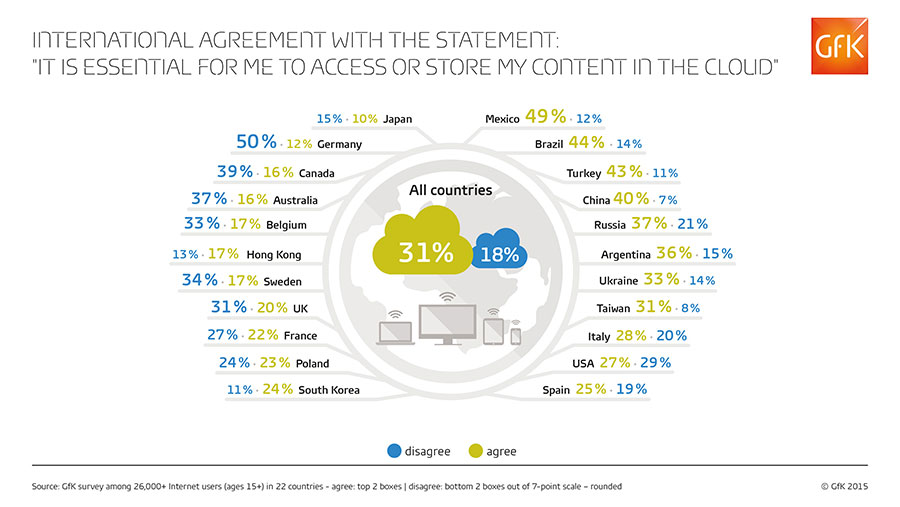
Internationally, nearly a third of all surveyed strongly agree that cloud storage is essential to them, with agreement peaking in MexicoBrazilTurkeyChina and Russia.

Market and consumer analysis company GfK asked Internet users in 22 countries about how strongly they agree or disagree with the statement “it is essential for me to access or store my photos, documents, music, and other content in ‘the cloud'” (with ‘the cloud’ defined as “a secure Internet location that you can access from any location or device”).

Almost a third (31 percent) indicate strong agreement (top two boxes in a 7-point scale) that the cloud is essential for them – consisting of 13 percent who agree completely and 18 percent who are next to agreeing completely.

This compares to 18 percent who significantly disagree (bottom two boxes in a 7-point scale) that the cloud is essential for them – made up of 10 percent who don’t agree at all and 8 percent who are just short of total disagreement.

Arno Hummerston, Global Director of Digital Market Intelligence at GfK, comments, “With a significant percentage of everyday people saying the cloud is essential to them, there is clear market potential for technology companies offering services that enhance the cloud experience – for example, increased security or customizable services, such as digital photograph albums which can easily be shared with other people.”

“The growing attraction of the cloud is not so much about storage – a decent external hard drive delivers that – but about convenience: being able to access files from any device or location, without having to carry around an external hard drive or USB stick. It also eliminates the risk of breaking or losing your storage device and all the items it contains. In particular, the cloud offers a simple way to secure the photos and videos taken with smartphones, when their internal storage capacity becomes full or the device is not accessible – with the bonus that you can then access your images from any of your devices. Bearing these usage reasons in mind will help businesses tailor their offers to resonate with the growing ‘cloud market’.”

GfK-Infographic-Cloud

30-39 year olds most dependent on the cloud

Overall, the group most dependent on the cloud is the 30-39 year olds. In this age group, 37 percent place themselves in the top two boxes for agreeing that the cloud is essential to them to access or store their photos, documents, music, and other content – compared to just 12 percent in the bottom two boxes for saying it’s not essential. They are closely followed by those aged 20-29, with 35 percent in top two boxes for agreement and 13 percent in bottom two boxes for disagreement.

It’s only when we look at the older age groups that the balance swings the other way. For those aged 50-59, only a quarter (24 percent) strongly or completely agree (top 2 boxes out of 7-point scale) that the cloud is essential to them, while 29 percent disagree (bottom two boxes). And the divide for those aged 60 or over is even clearer, with just 19 percent placing themselves in the top two boxes, while over a third (35 percent) indicate strongly that the cloud is not essential to them (bottom two boxes).

Latin Americans are cloud enthusiasts; Germans, Canadians and Australians yet to be convinced

Looking at individual countries, Mexico is the clear ‘cloud leader’, with almost half (49 percent) of its online population giving top-two agreement that the cloud is essential for them. They are followed by Brazil at 44 percent, Turkey (43 percent), China (40 percent) and Russia (37 percent). Argentina, which completes the Latin America countries included in the survey, also shows high cloud dependency, with over a third (36 percent) of the population placing themselves in the top two boxes agreeing that the cloud is essential for them.

The other end of the scale is dominated by Germany, where half (50 percent) of the online population strongly disagree (bottom two boxes) that the cloud is essential. They are followed by Canada (39 percent), Australia (37 percent) and Sweden (34 percent).

“For me, it is interesting that it is mainly countries that adopted the Internet early on, that do not see cloud storage as essential,” comments Arno Hummerston. “Late Internet adopter markets, which tend to be more mobile-oriented, having leap-frogged PCs, have more people who say cloud storage is essential. The implication is that those who started off on PCs or laptops (which have large internal storage) now have a significant mental adjustment to make, in accepting cloud storage. But those who have mostly only ever used mobile devices find cloud storage normal.”

0