‘Radical Greengrocer’ Tops Sustainability List

Volkert Engelsman, founding director of fresh organic importer and distributor Eosta, has been awarded top place in the annual Dutch Sustainability Top-100 list compiled by daily newspaper Trouw.

Recognising the Dutch entrepreneur as “a greengrocer with a radical vision,” the jury acknowledged Engelsman’s pioneering leadership in the field of sustainable food and farming, specifically in True Cost Accounting. 

If you like this, subscribe here for more stories that Inspire The Future.

Eosta, based in the Netherlands, was founded by Engelsman in 1990. With suppliers across six continents and customers in Europe, the US and the Far East, it’s now a leading European specialist in organic produce.

Since 2016, Engelsman has been active in promoting True Cost Accounting as a pathway to sustainability, giving speeches at congresses and think-tank events worldwide. True Cost Accounting is a new form of bookkeeping that makes the true price of food visible, including environmental, social and health impacts.  

The jury especially appreciated Engelsmans commitment to making True Cost practical, by bringing the numbers to store shelves in Europe, and putting hidden costs on organic apples, pears and other products.

Engelsman used his acceptance speech to call for new partnerships in the sustainable movement, especially in the finance sector. He said: “Many financial institutions are starting to realise that there is something wrong with our definition of ‘profit,’ if it results in the destruction of our natural habitat and makes life miserable for 90% of humanity, including our children’s children. There’s nothing wrong with profit, but you have to calculate it fairly.”

“As a movement we need to help financial institutions such as banks, accounting firms and institutional investors to start making better choices. The main flow of capital is still being driven by an outdated profit definition, which is basically killing the planet.”

New profit definition 

Thanking Eosta’s partners in its recent True Cost Accounting campaign, which included the FAO, WHO, NCC, Triodos Bank, EY and Soil & More, Engelsman stressed the need for a new profit definition that includes human and ecological values.

In June 2017, Eosta published a pilot study named ‘True Cost Accounting for Food, Farming and Finance’. The study resulted in a practical dashboard for investors to assess impacts on financial, natural and social capital. It was presented to Peter Bakker, president of World Business Council for Sustainable Development, and in Wales to HRH Prince Charles.

If you like this, subscribe here for more stories that Inspire The Future.

How to Get a Job With a Disability

Finding employment is quite a challenge in today’s hugely competitive jobs market. Every time a vacancy becomes available, there are dozens of qualified and capable candidates submitting applications, making it hard for employers just to screen applicants for interviews.

Finding a job can be tougher still for a jobseeker with a disability, as their condition could preclude them from many vacancies and limit their scope somewhat. Also, employers might subconsciously be reluctant to hire someone who may need to take a lot of time off work for health reasons, even if the candidate is a formidable worker.

If you like this, subscribe here for more stories that Inspire The Future.

The infographic below from Burning Nights  looks at how a disabled person can approach the job-finding process. The first step is to identify which jobs would and wouldn’t be suitable, given the conditions with which they live. A person with arthritis, for example, is not going to apply for a job which requires a lot of physical exertion every day, as they simply wouldn’t be able to persevere with it. Instead, that person could concentrate on jobs which are not physically taxing and, better still, would enable them to work from home. A job in financial planning or accountancy could be ideal, as this could be done from home with minimal stress. Alternatively, career guidance counselling could be suitable, as a person with a disability could apply their own experiences in dispensing advice to others.

The candidate then needs to conduct some self-examination and assess what they could bring to a job or how they can optimise their work-life balance. If the person has a hobby or an aptitude from which they could earn a living, this is a huge bonus. It’s worth looking at how a job fits into a candidate’s lifestyle preferences, as there is little point in taking what seems an ideal occupation if it requires a strenuous daily commute.

Should the disabled candidate tell an employer about their condition? It often helps to mention it, as the employer could then make interview arrangements that are convenient for the candidate. They don’t have to go into detail about their disability, but at least by informing the employer, they won’t run the risk of being summoned to an awkward location for the interview. When it comes to the day of the interview, disabled candidates should emphasise how they can overcome challenges to perform the job adequately rather than lamenting how the disability could make matters difficult for them. Employers love a positive, proactive attitude in candidates.

This infographic highlights ideal actions for disabled jobseekers in their quest to obtain employment.

If you like this, subscribe here for more stories that Inspire The Future.


How Tech is Disrupting Poverty, Energy & Health Care

At the recent Bloomberg Global Business Forum, held in New York, one of Wall Street’s most prominent figures, David Rubenstein, the founder and co-CEO of the private-equity firm The Carlyle Group, hosted a panel discussion between Aliko Dangote, Bill Gates, Indra Nooyi and Masayoshi Son.

David Rubenstein: I’d like to ask each of you; clearly there’s going to be a lot of innovation over the next ten years, 20 years, 30 years. All of us might not be here 30 or 40 years from now. We might if we’re lucky.

If you like this, subscribe here for more stories that Inspire The Future.

If you had the chance to give up everything you currently have; your wealth, your fame and accomplishments, and live through the next 30 years or so of innovation and start all over again, would you rather live through the next 30 years of innovation and see what the world’s going to become or would you like to stay where you are right now?

Dangote: I will give up, yes, because I’m sure great things are going to come.

Gates: Living longer is worth the better deal.

Nooyi: I’d like to say something my two kids told me. I asked them what they’d like for their birthday. They said, “We’d like a week without the Internet.” So in a way, I’d like to go back to those days when life was a little simpler.

Son: Oh, I’ll go for everything for the future.

What has been the most important innovation that you have seen in the last 10 years in the world in which you operate? What’s been the most crucial change or innovation?

Son: I think in the world in which I operate, in Africa, there’s this massive GSM revolution. If you look at us in Europe, we had about 500,000 lines in 2001. In 2017, we already have 139 million lines. So it’s a massive jump, and you can also see what happened in India, where they were able to create 100 million lines in 170 days.

Gates: I had an early career in the digital revolution, and that’s still the fastest-moving thing. It’s so horizontal in nature that it’ll change banking, education, scientific research, sales and marketing. Today, a lot of my focus is more on health, and particularly miracle vaccines – developing malaria, HIV and TB vaccines. I get to back amazing scientists.

The digital revolution isn’t slowing down. So we get the benefit of that. But regarding equity, it’s the health breakthroughs I’m most excited about.

And you think people with health breakthroughs can live to be 90, 100, 110?

Gates: Well, I’m not working on that problem. There are other Silicon Valley billionaires who want to live forever.

My main focus is on inequity. It’s 100 times more likely for a child in Africa to die than a child in the United States. And these are all solvable diseases; we can get rid of that inequity. Extending life is very difficult because your many body parts, including your brain, wear out. So I’m not in that field. I’m in the malaria, HIV and nutrition game.

I don’t think your brain’s going to wear out, but OK.

Nooyi: I think every aspect of our life is changing because of what people are doing with technology. The single biggest thing I feel good about is how technology is enabling gender inclusion. Women are being enabled a lot more and their voices are being heard. And I hope that progresses going into the future.

Well, let me ask about that. You have done two things in your career that were very innovative. One, you’re an immigrant to the United States and became the CEO of one of the most important companies in the United States and the world, but you’re also a woman. Was it more challenging to become the woman CEO or the Indian immigrant CEO?

Nooyi: All of it. I came into the workforce when there were hardly any women in senior executive positions. It’s different now, but 20 or 30 years ago when I first started working, there weren’t many women. It was difficult. Being an Indian got me attention because I was often the only colored person in the room. And so that got me attention, but I had to work harder to prove that color and gender should not be counted against me – that I could do a damn good job, too. 

Well, you have to be better qualified than white men, right? 

Nooyi: Way better. A lot more. 

What’s the most significant innovation that you’ve seen in the last ten years? 

Son: Not just ten years, but the last 30 years. Using the microprocessor as a base for creating the Internet has changed the life of almost everyone on the earth. But going forward, it’s accelerating even more on that. 

Earlier in your career, you were a technology innovator. And at one point, I think in the year 2000, you lost $70 billion of net worth. What did it feel like to lose $70 billion of net worth in one year? 

Son: Well, it was a crash. Everybody crashed. But somehow, at the bottom of the crash, I actually revived my fighting spirit, so it was good. By the way, what Bill doesn’t know is that for three days, I became richer than him. But 12 months later, I was almost broke. I had a 99% drop in our share price in one year. 

At one point, you made an investment of $20 million in a little, unknown company called Alibaba. It became worth around $90 billion and is now worth about $130 billion. How did you decide that Alibaba was a good investment and do you have more like that you could recommend to us? 

Son: Well, it was about Jack Ma. Not because of his business model or technology, but because of his charisma and leadership. China had an enormous opportunity for the upside. I said this is the guy that can be the leader of this innovation. 

Indra, you’ve tried to take a company that was known for selling sugar water – in the view of some people – and make it a more nutritionally safe and better company. Was that hard, to beat the bureaucracy back at Pepsi when many people didn’t want to do the things you wanted to do? 

Nooyi: I think it was hard within the company, it was hard outside the company. I remember investors telling me not to forget that we’re Americans – we like our soda and chips. Don’t try to change us. And when I asked them if they changed their habits, he said oh yes, we’ve changed our habits, but we don’t want you to change what you’re doing. 

We had to fight battles on multiple fronts. Change does not happen quickly in our industries. Because we have to change consumer taste, we have to change the product portfolio; we have to change the business system. So it’s still happening. It’s a work in progress. 

Now when you go to somebody’s house for dinner, and they say would you like a Coke, what do you say? Has that ever happened and would you rather leave?

Nooyi: I’d say it was nice knowing you and leave. Actually, my secretary sends them a list ahead of time in case there’s a mistake. 

Bill, I’d like to ask you a question I have asked you before, but people are still interested. All of us who use personal computers are familiar with turning them on. We need three fingers to do so, control, alt, delete. It’s a little awkward sometimes. You’re the person who came up with this idea. Why? 

Gates: The IBM PC hardware keyboard only had one way that it could get a guaranteed startup. Clearly, the people involved should have included another key to make that work. A lot of machines now days do have that as a more obvious function. 

No regrets about doing it that way? It worked out OK? 

Gates: Well, I’m not sure you can go back and change small things in your life without putting the other things at risk. Sure, if I can make a small edit, I would – I’d make that a single-key operation. 

By the way, you dropped out of college. Do you think if you’d gotten your college degree your life would have been better off? 

Gates: At the time it felt like it. There was a huge sense of urgency around the fact that the microprocessor was revolutionary and software needed to be written for it. A lot of existing companies, including IBM, with infinite resources would have gone and done that. 

So if we were to have any hope, the sooner we did it, the quicker we did it, and the more hardcore we were about it, the better. I didn’t want to waste a day. In my 20’s I worked weekends, I didn’t believe in vacations. 

We had to move at high speed because eventually, IBM did compete with us. Many companies came along later, and of the companies formed in that time, we were the sole survivor. 

It would’ve been hard to hold me back once I saw that opportunity. Harvard, which I loved, was very relaxing; where you would sit in class and stay up all night talking. It didn’t have the same intensity. Once I saw the opportunity, I knew I was going to leave.

And your parents, what did they say? 

Gates: They said: “Hey, we’re paying your tuition. What does this mean?” And I said, “well, I’m on leave,” which was true, I could have gone back. Harvard’s very generous about that but eventually, the course catalog moves on and you become a little too old for it. 

They weren’t sure if it would succeed or not so my parents thought maybe I’d head back. But, I was single and maniacal in those days, and it was the perfect thing for me. 

Now you’re innovating in a number of areas and one of them is energy. You’ve started a fund to invest in energy innovation. Why? 

Gates: With energy, we have a real danger that even with fantastic innovation it can proceed at different paces within different industries. In education, it proceeds very slowly for a variety of structural reasons. There is no one incentive because a new type of power plant is going to take decades to prove and your patents will expire. The regulatory commissions don’t want to take the risk of a new power plant. We’ve seen what’s happened with nuclear, how tough that’s been. And so, because of climate change, and because Africa has less electricity today per person than they had ten years ago because the population has exceeded the electrical generation capacity increase, we have a huge problem. We need low-cost clean energy.

For those with spare capital – risky capital – joining in on this is a great thing. 

You now have that fund?

Gates: Yes, it’s about a billion dollars, and we’ve spent the last year hiring an incredible team. It’s about a 15 to 20-year time period per person, a little longer than you’d have in, say, biology or digital investment because just proving the energy plants and scale is very hard. 

Aliko, rightly or wrongly many people think innovation is based in Silicon Valley, Seattle, Japan or China, but not Africa. Is this unfair and do you think there are African entrepreneurs who in the next ten years will change the face of Africa?

Dangote: Let me tell you a short story. We have about a million people we want to reach through the Ubuntu Foundation in various local governments– local governments are what you call counties in the USA.
We go to every local government and meet with thousands of women and give them free grants to improve their lives.

In the beginning, we did this manually, through commercial banks, but later we registered all of them and now use a mobile banking system to both pay and register everyone on our database. In doing this, we’ll be able to use the database to determine if it’s really changing lives – which it is currently doing.

The same idea is delivering results in our partnership with Bill to fight Polio. Despite vaccinators going into the field to vaccinate seven million children, we saw the incidence of Polio going up. Now we give the health workers a mobile device with a chip that shows us where they’ve been – to verify it’s being done properly.

Bill, let me ask you about your efforts to beat back malaria. What’s the argument against killing all mosquitoes? Why don’t we just eliminate all mosquitoes, which I think we have a capability of doing, to eliminate malaria. What’s the argument against that?

Gates: Malaria is only carried by the Anopheline mosquito, which is only one out of every 1,000 mosquitoes. The main reason is that it can set a precedent. If you think “OK, humans can go and eliminate this species,” then what’s your criteria for anything else that might be a nuisance? You might make a mistake; it might be key to an ecosystem.

There some bats that feed on those mosquitoes and you’d have to look at the effect on those ecosystems. There’s a new genetic approach called gene drive that’s still in the labs and not totally proven, but it has a good chance of knocking down Anopheline populations by 99% over five years. 

Indra, we often hear about great technology leaders or great innovators that are men. Is that because of a sexist thing where men don’t tend to give women opportunities? Do you think it’s going to change anytime soon?

Nooyi: I’m not an expert on women in technology, but I will say something interesting. I was at an MIT event recently, and the president of MIT told me that 50% of their engineering graduates are women. But if you go to most companies, 50% of engineering staff are not women. If you read the stories about Silicon Valley, 50% of the people getting funding are not women. There’s obviously something causing that leak between MIT and the workplace. We have to do something different.

Masa, is artificial intelligence a good thing for humans or not? Are your robots going to take over humanity?

Dangote: I think that the misuse of artificial intelligence could be horrible. But there are thousands of good reasons to utilize artificial intelligence for good – for humanity. It has solved unsolvable diseases, solved unsolvable disasters and many other things. So I think it’s really good.

If you like this, subscribe here for more stories that Inspire The Future.

SDG Pioneers Give a Glimpse of The Future of Business

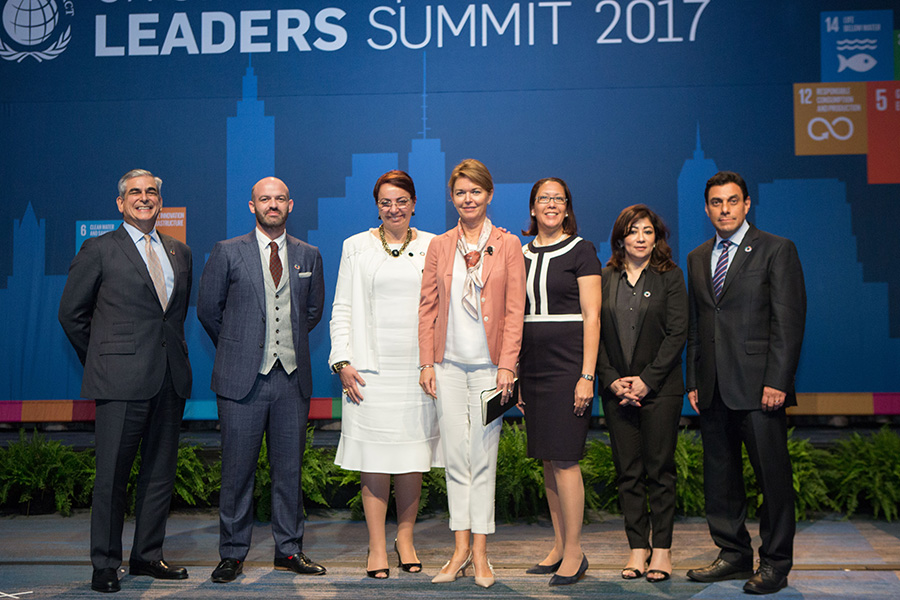
The United Nations Global Compact has recognized 10 SDG Pioneers – individuals from around the world who are championing sustainability through their own companies and mobilizing the broader business community to take action in pursuit of the 17 Sustainable Development Goals(SDGs).

Six SDG Pioneers were recognized on stage during the UN Global Compact Leaders Summit at the New York Hilton Midtown. The United Nations Global Compact is a call to companies everywhere to align their operations and strategies with ten universally accepted principles in the areas of human rights, labour, environment and anti-corruption, and to take action in support of UN goals and issues embodied in the Sustainable Development Goals. The UN Global Compact is a leadership platform for the development, implementation and disclosure of responsible corporate practices. Launched in 2000, it is the largest corporate sustainability initiative in the world, with more than 9,500 companies and 3,000 non-business signatories based in over 160 countries, and more than 70 Local Networks

The UN Global Compact received hundreds of nominations for the 2017 SDG Pioneers submissions, from which 10 finalists were selected by a Pioneers Selection Group, comprised of experts from the UN, academia, civil society and the private sector.

The 2017 SDG Pioneers are:
  • Charles Immanuel Akhimien, Co-founder, MOBicure Integrated Solutions (Nigeria)
  • Gustavo Perez Berlanga, CSR Senior VP, Restaurante Toks SA de CV (Mexico)
  • Tania Conte Cosentino, President, Schneider Electric Brasil Ltda (Brazil)
  • Teresa Jennings, Head of Rule of Law Development, LexisNexis/RELX Group Plc (U.S.A.)
  • Sonia Bashir Kabir, Managing Director, Microsoft (Bangladesh)
  • Arthur Kay, Founder and Chairman, bio-bean (United Kingdom)
  • Patrick Pouyanné, CEO, Total (France)
  • Kaan Terzioglu, CEO, Turkcell Iletisim Hizmetleri A.S. (Turkey)
  • Joseph Thompson, Co-founder and CEO, AID:Tech (United Kingdom)
  • Jaime Augusto Zobel de Ayala, Chairman and CEO, Ayala Corporation (Philippines)

The Sustainable Development Goals (SDGs) lay out a clear vision for a sustainable future and will shape a new era for business. As part of our Making Global Goals Local Business campaign, each year the UN Global Compact celebrates a group of SDG Pioneers — business leaders who are doing an exceptional job to advance the Global Goals through a principles-based approach.

Companies Challenged to Disrupt Business-As-Usual Mindset

Nearly 800 business leaders from over 70 countries joined leaders from civil society, Government and the United Nations at the UN Global Compact Leaders Summit 2017. Convened during the 72nd Regular Session of UN General Assembly, the Summit focused on driving responsible business action and partnerships to meet the Sustainable Development Goals (SDGs) and Paris Climate Agreement.

UN Deputy Secretary-General Amina Mohammed delivered a special video message to Summit attendees, emphasizing that “to achieve our goals, we need leaders from all of society, including and especially business, to show the courage that helps chart a new course for humankind.” She further highlighted that “achieving the SDGs also calls for collaboration,” encouraging participants “to partner with others, including with the United Nations, especially at the country level [where] the Global Compact Local Networks have really an important role to play.”

With a view to guide participants in rejecting the status quo and the business-as-usual mindset, the Summit featured conversations with leaders from diverse sectors on the challenges and opportunities of pursuing the Global Goals. Speakers explored the role of non-state actors and cities to protect our planet through supporting the Paris Agreement.

Phumzile Mlambo-Ngcuka, Executive Director of UN Women (pictured above), highlighted the role of technology in advancing Goal 5: Gender Equality. “Of the next 1 billion who are going to be connected to the internet, 75% of them must be women and girls. Because right now, the gap between men and women who are connecting is widening. We have to change the trend.” She continued, “Women lost out in the industrial revolution, we should not lose out in the digital revolution.”

Speaking from the perspective of his own city, the Honorable Bill Peduto, Mayor of Pittsburgh, focused on how cities can contribute to advancing the Global Goals. “There were some really smart people who started thinking about what if our future was different than our past. And instead of offering a false hope and a false narrative, they offered a long-term plan of how a city — a city that had its economic heart ripped out, a city that everyone had said had lived its time and had died — could come back,” Peduto noted.

Paul Polman, CEO of Unilever, outlined the role of business as a force for good, saying, “Business cannot be a bystander in a system that created it in the first place.” When asked what was needed to achieve the Global Goals, Polman said, “in implementing the SDGs, as in any change process, there will be bottlenecks, setbacks, cynics, skeptics. It takes courageous leadership. That’s where the breakthrough comes from: from people who understand that putting the interests of others ahead of their own is actually in their own self-interest.”

Six of the 2017 class of SDG Pioneers were also recognized at the Summit for doing an exceptional job of taking action to meet the Global Goals. They shared stories of how they are working to champion sustainability at their companies and to mobilize the broader business community.

The Summit sought to catalyze the private sector to raise their ambition level for people and planet, drive innovations and work together to create a framework for measuring progress and impact on the SDGs. With less than 5,000 days to meet these Global Goals by their 2030 deadline, the UN Global Compact released a new set of tools and resources to support business regardless of where they are on their sustainability journey.

New UN General Assembly President Calls For an End to Business as Usual

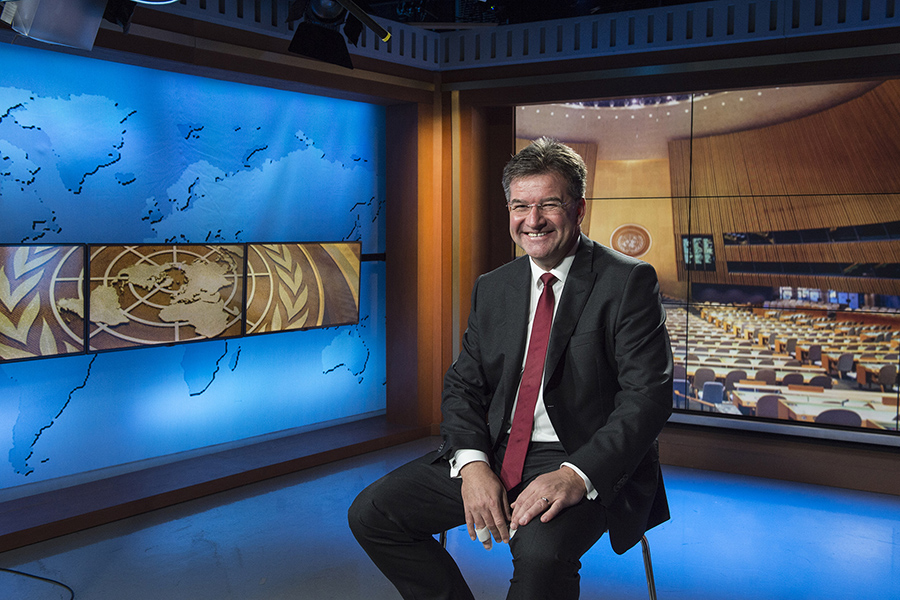
Ex Slovakian politician, diplomat and Minister of Foreign Affairs, Miroslav Lajčák has opened the 72nd session of the United Nations General Assembly in his new role as President. His fluency in English, German, Russian, Bulgarian and Serbo-Croatian, has also bestowed him with unique insights into the inter-cultural dynamics of business.

In his opening speech he expressed the wish that he could deliver the speech different to the one that he had prepared that day.

“I wish I could point to a long list of examples of mediation and early action successfully averting conflicts” he said “I would prefer to talk only about people who move and migrate out of choice – not desperation. It would be great to congratulate you all for meeting your climate-related commitments, and for relegating extreme poverty to the history books. I hope that someone will, eventually, be able to deliver such a speech from this marble podium. But it cannot be me today.”

Lajčák pointed out that conflict persists as an ugly reality of our world and that civilians – not soldiers – are paying the highest price. Schools and hospitals – not military barracks – are the targets of attacks.

More than 65 million people are currently leaving their homes because they are forced to do so – not because they want to. Lajčák indicated that he wanted to use his speech to address other major challenges, including persistent poverty, growing inequalities, indiscriminate terrorist attacks, and worsening effects of climate change.

These are global challenges, he pointed out – and that every country is coping with at least one. Yet, they are also individual in nature, touching on the lives of each person.

“That is not to say that there is nothing to celebrate today. We have made a collective promise to humanity by signing up to the SDGs. We have rallied in support of peace agreements, such as that seen in Colombia. We have said “enough is enough” when it comes to climate change by signing the Paris Agreement.”

Not wanting to dwell on past achievements, Lajčák expressed a desire to rather look ahead. “We will hear visions, ideas and – yes – criticisms and concerns over the coming week. These will chart the course of the UN as it works to address the most urgent global challenges. I am confident that they will also travel home with you, and influence your work as the world’s leaders.”

On business, Lajčák called for an end to business as usual. “If we are looking for a change in how the UN operates around the world, we should start here in New York. This can mean institutional change. But it can also mean a change in the way we work on a daily basis,” he said.

“We can engage in real dialogue – not a succession of monologues. We can concentrate on how much – and not how little – we can give up in the spirit of compromise. We can look beyond our individual agendas and positions, and see the bigger picture of why the UN is here, and what it is trying to do.”

Lajčák ended by saying that he may not have been able to deliver a happy statement in his speech, and praising us all for making the world a better place, but that he would work throughout the coming years to increase the chances that, someday, one of his successors might have this great privilege.

The App That Finds Empty Office Space

werk.place is an app that monetizes underutilized spaces of private clubs and  corporate offices for the mutual benefit of the clubs, private corporations and members of select organizations. 

Have you noticed the empty meeting rooms in office buildings and clubs?

The sharing economy has alerted entrepreneurs to reimagine and to monetize such under-utilized or dead space via technology. Vacation Timeshare was an early adopter of this business model, and more recently Airbnb revolutionized empty rooms in homes around the world – putting idle space to work.

As a member of the Harmonie Club in Manhattan, Malcolm Elvey was familiar with its facilities and saw an opportunity that would benefit both members and future guests. Clubs benefit from increased income and business travelers benefit from entree to prestigious private institutions. Via werk.place business travelers can avail themselves of prestigious accommodation, board rooms, meeting rooms and catering.

werk.place is a superlative free platform that helps business travelers identify and reserve appropriate services and accommodations on short notice. It is both an app and a website: It allows users to list or to rent boardrooms, conference rooms, offices and event spaces. It’s the solution for busy professionals, especially those who travel at short notice.

“I knew many travelers would see the benefits of finding a high-end meeting place in an unfamiliar city attractive,” says Elvey. “The flip-side is that clubs, companies and even restaurants have suddenly realized they can make money on space only used occasionally.”

As an entrepreneur, Elvey has always been disruptive and sought new ways of doing things. “You should ask lots of questions, but also learn to listen,” he says. “What excites me is finding a great team with complementary skills and sufficient capital to execute realistic ideas.” Among his characteristics he believes having a curious mind has been the most helpful – it’s what led him to ask probing questions about the costs involved at the institutions he frequented.

Based on Elvey’s knowledge, clubs would surely jump at the opportunity to increase occupancy rates on idle space to compensate for the recurring astronomical overheads each month.

But what about the executive standing on a busy street corner with a make-or-break meeting in a few hours?

“Rather than running a business, I like to think I’m helping to solve a frequent social problem,” commented Elvey. “The app can be used to make an immediate reservation or one that is weeks away; much as you would reserve a car or hotel.”

Those looking for space are given a choice based on their current location or can search a city destination in advance. Room size, occupancy and amenities are shown alongside reviews, comments and rankings from previous users.

For now, Elvey is targeting high-profile groups, such as The Young Presidents’ Organization (YPO) as trust and confidentiality are essential ingredients of the business plan.

“If you’re interviewing a prospective employee or partner, or working on a confidential deal, you need a safe space where the discussion remains in the room, and no one will reveal who you’ve met with,” explained Elvey.

Another bonus for high-end app users is access to facilities of participating private clubs: tennis, squash, golf and on-site catering. Adding a few bucks to a meeting space reservation can add a day of leisure for you and your clients – instead of forking out thousands for membership. And, of course, access to a prestigious club or office carries the chance of bumping into unexpected people – networking opportunities that are always good for new business.

The werk.place app can be found on the Apple store


Is This the Tesla of Smart Watches?

A Swiss start-up has created the world’s first kinetic self-charging smart watch.

After more than three years of intensive research and development, Swiss company, Sequent, has launched a smart watch with a breakthrough technology that may redefine the future of all smart devices. Launching on kickstarter.com on 5 July 2017, the revolutionary “SuperCharger” hybrid smart watch contains a major breakthrough in technology inside. This new generation of smart watch has a kinetic self-charging battery system, which provides infinite power supply.

Sequent reckons that it has not only solved a major problem of the smart watch industry, which suffers from insufficient battery supply for its devices, but also created a device that generates 100% clean energy. 

“We are the first ones to master the transformation of kinetic “100% clean” energy into infinite electrical energy to power a smart watch.” says CEO Petra Guhl. “Some have already said that we’ll become the Tesla of the smart watch and wearable industry, as we share the same vision.”

The best news for consumers is the end of socket charging, the search for a charging cord or trying to find a stockist to buy those easy-to-lose miniature coin batteries.

sequentwatch.com

Chinese “Take Over America” Campaign for 4th of July

A marketing agency in Shenzhen has given the world a glimpse of what the world could look like if China took over – by creating U.S. currency featuring the faces of Chinese emperors.

Timed to coincided with the yearly Fourth of July celebrations – American Independence Day – the date was chosen for maximum impact. Chinese marketing company ITTIZ and Asian business advisors Global from Asia sent out red envelopes containing U.S. banknotes to 500 of the biggest companies in Shenzhen, a commercial area of China that links it to Hong Kong.

All the bills were actual U.S. currency notes, ranging in value from $1 to $100, with a removable sticker of a Chinese emperor covering the respective images of U.S presidents that appear on the notes. *

ITTIZ came up with the idea for the campaign a few months ago when considering the outcome of the U.S. presidential election. Sean Davis, CEO of ITTIZ, said that with the current state of globalization and the general interconnectedness of countries, the likelihood of China’s rise is as probable as ever, and pulling back isn’t a reasonable option. 

The company wanted to create something that taught companies in Shenzhen the value of thinking creatively, and so the financial, political, competitive and comedic aspect of this campaign became appealing to them.


Along with support from Mike Michelini, CEO of Global from Asia, the campaign came to life. Each note is customized and titled, “Are you ready to take over America?”

The marketing company believes this was a creative way to share the importance of marketing with Chinese companies – by tying the idea directly to currency, revenues, and overseas competition. The campaign is expected to reach a wide audience spanning various industries. Thus far, there has been a range of reaction, with the majority finding the campaign humorous.

“We see Shenzhen becoming a technology hub for the 21st century,” says Davis. We feel that creative ideas will only accelerate this movement. The future is coming at us quickly, everything in today’s economy is up for grabs, and Shenzhen is ready to grab hold and take it.”

* The currency is not defaced in a way that would violate Title 18, Section 333 of the United States Code.


Will Robots Envision The Future of Art?

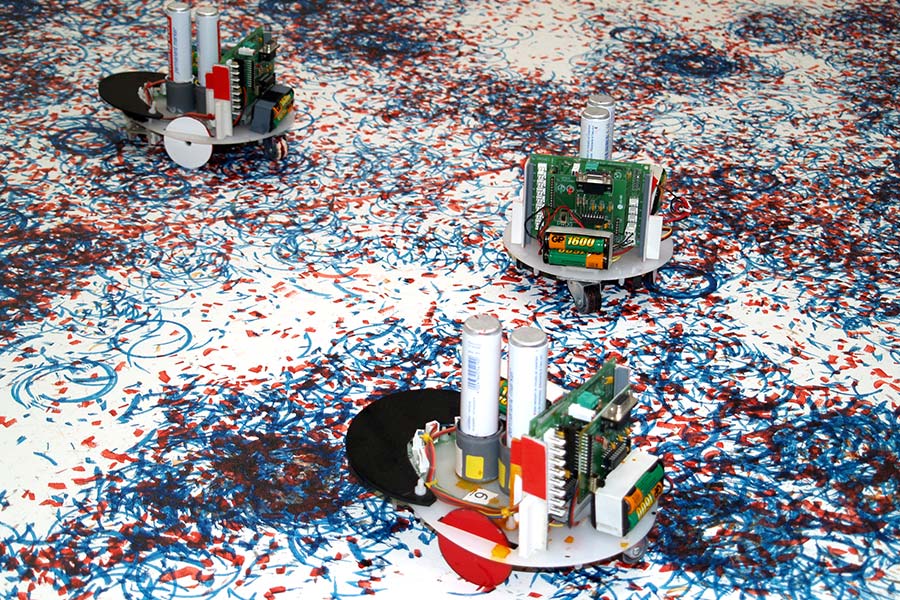
Art history provides many examples of the research and development of creative machines which in turn, generate art. Robotic art has meanwhile developed into an art form in its own right for artists who address industrial culture and its fundamental issues and contradictions.

Future Energy is the theme of this year’s world exhibition in the capital of Kazakhstan, and also the motto of the art pavilion at the EXPO 2017, which explores the influence of machines and robots on creative processes and the new energies they release. Seventeen artists from 13 countries are showing works in a collective international exhibition that is unique in the world.

The show, called “Artists & Robots,” presents robotic art for the first time at an international exhibition, showing influential artists from all over the world.

Designed as an interactive journey through dream worlds of modern art machines, the exhibition shows fascinating works created with the help of artificial intelligence and robots: on the computer with generative algorithms, with interactive creative software and with robots that can paint, draw and create sculptures. 


The show exhibits works of influential artists like Quayola, Nervous Systems (Jessica Rosenkrantz and Jesse Louis-Rosenberg) and Peter Kogler. Kogler is regarded as a pioneer of Robotic Art and a new large-scale spatial work of the Austrian artist is part of the exhibition. Watch the video above for a taste of this installation.

By releasing new creative energies with robots and computers the organizers hope to stimulate new ideas for realizing modern art forms.


0