Women–Three Strategies to Build Your Confidence and Inner Power

I recently received an e-mail from Barry Crane of Yahoo with a link to an article written by a pretty ticked off woman who is sick and tired of being told that women have less confidence than men. She even quoted some social researcher claims that there is no hard evidence that women have low self-confidence as compared to men. It is perhaps a little murky. Yet when you combine the studies of social research, leadership research, and gender differences revealed by brain science a pretty clear picture comes into view as to why women are likely to appear less confident than men.

Harvard researchers John Neffinger and Matthew Kohut have a compelling evidence-based argument that women are emotionally and mentally designed for empathy and seeking consensus. Women have also been socialized to avoid conflict with physically stronger males by acting less assertive. Those are not criticisms, only scientific observation. And there is nothing wrong with being less assertive except when it makes you less influential. Unfortunately most organizations are designed to favor highly assertive behavior as a path to power.

And there is nothing wrong with being less assertive except when it makes you less influential.

So let’s clear something up right now. My years of leadership consulting lead me to the conclusion that women are NOT less confident than men… not at all. In fact in many cases I find women’s inner confidence to be higher and more grounded in reality than men. However most women behave less confidently. I experience it this way. Men generally exhibit higher behavioral self-confidence. Yet, women more often possess something I call “soul-confidence.” I’ve come to this conclusion because when I fully excavate the inner story of most women I consult with I find a solid core of intrinsic self-worth.

It’s true. When I peel away all the self-doubt and calm the screaming inner voice of self-criticism what I find in women is an intrinsic knowing that they are valuable. What derails women is a chronic feeling of under appreciation. This is one reason women are more susceptible to depression than men. Feeling powerless and invisible will do that to you.

Men on the other hand feel much freer to push confidence into arrogance.

Men on the other hand feel much freer to push confidence into arrogance. Arrogance is the dysfunctional expression of a lack of inner confidence. When people are arrogant they are unreachable with facts, reason, values or empathy. That’s because arrogance is driven by the fear of losing control. And studies reveal that men’s brains are designed to feel most secure when they feel the most control. The result seems to explain why men are much more likely to define their worth through their status and achievements rather than through their values and character. c76c9bdb-959c-4413-8bb1-445044dec1b3 As you can see from this continuum, confidence is the balance point between insecurity and arrogance. The truly confident person is still open-minded, persuadable, and interested in evidence and different points of view. An arrogant person is only interested in getting their way and solidifying their power.

The truly confident person is still open-minded, persuadable, and interested in evidence and different points of view.

Our challenge is this. If we are going to create a better world…a world with sustainable abundance we need far fewer arrogant leaders and far more intrinsically confident ones. Fortunately research tells us how people can contain their inner demons and release their genuine inner self worth so that we authentically act more confident. (This is necessary if want good people to take over the world.) Here are the three internal habits proven to do the most to translate out intrinsic worth into external self-confidence. They tap into the strength of your mind, body and spirit…of course they do.

Invest your flow of attention on your success story.

Mind: Invest your flow of attention on your success story. There’s plenty of evidence that most people experience similar levels of success and failure. Insecure people tend to focus on their failures, which create an inner story that you are not destined for success. This “negative attention” will eventually hijack your your true identity dragged down by a litany of beliefs that you are not capable enough, smart enough, educated enough, or lucky enough. If you allow the “victim identity” to take over your attention you will simply stop looking for opportunities and look for ways to escape your pain.

The solution to this problem is simple. I have helped many leaders who suffer from the “imposter syndrome” which is the belief that if other people discovered who you really were, people would neither respect nor follow you. To break the cycle of negative self-thinking I ask clients to do two things: First, every evening before bed right down three things you did that day that you did well and that you enjoyed. Then go to sleep with a smile on your face and let your subconscious mind marinate in your successes. Second, re-frame all of your life’s failures as essential learning experiences.

Although it may sound corny it is also true that failure is never final until you stop trying. I am not aware of a single success story of remarkable people whose life was not littered with big failures. Steve Jobs was fired from his own company. Abraham Lincoln failed at business and lost elections. Eleanor Roosevelt had a philandering husband the world adored while she was ridiculed for being uppity and unpretty.

If you’re still breathing you have not failed.

Winning your life’s journey takes guts and resilience. If you’re still breathing you have not failed. Capitalize on what you have learned and keep climbing.

Other people respond to your energy.

Body: In order to project and sustain confidence you must carefully build and manage your energy. Other people respond to your energy. We can actually measure the response through brain scans. People with low or negative energy tend to be avoided. People with high, positive energy tend to be sought out. We each have five kinds of energy­–mental, emotional, social, spiritual, and physical. The boiler room of your energy is your body. The most confident, high-energy people have all the power of a deflated balloon when they are tired and hungry. You build your biological energy by getting at least seven hours of restful sleep. Eat light, healthy and often to keep your blood sugar level even.

You need to stand up, stretch and move for at least 3 minutes out of every 60. Walk 10,000 steps a day, Take a full hour break at lunch to rest your brain by doing something you enjoy. Affirm others whenever you have a positive thought about them. Promote and maintain relationships of mutual advocacy. (We all need people in our lives who root for us and whom we root for.) These simple habits will enable you to be happier, healthier and yes, more confident. Spirit: If you haven’t heard of loving kindness meditation, stop what you’re doing, go on the Internet and search the topic. (A good book to get started is Lovingkindness: The Revolutionary Art of Happiness by Sharon Salzberg.)

It is also called compassion meditation. I am teaching it in many of my business training sessions because it is proven to loosen the knots of our unconscious thinking traps so we can be more creative and collaborative. It is so simple and yet so powerful that all I can suggest is that you try it faithfully for three weeks and see if it begins to change your self-confidence at the root. First let me make a distinction.

The practice of self-compassion meditation is not the new age concept of positive affirmations. Two decades of psychological research on positive affirmations… you know the Stuart Smalley stuff…“I am smart enough, I am good enough and people like me”…actually works but only under one specific condition. You have to already believe the substance of your affirmation is true. In other words, positive affirmations work to amplify positive beliefs you already hold. But if I was to tell myself that I was tall, young and beautiful one look in the mirror would unleash my inner critic to simply yell, “you’re a liar!”

Compassion meditation is different. It has been practiced for thousands of years and builds soul-deep self-confidence by embracing the truth about you.

Compassion meditation is different. It has been practiced for thousands of years and builds soul-deep self-confidence by embracing the truth about you. It detaches the common thinking fallacy that we must be perfect to be valuable. The process begins by putting your self in a meditative state usually attained by sitting comfortably, both feet on the ground, back erect, hands relaxed with your attention focused on your deep rhythmic breathing.

Take 5 to 10 deep breath cycles and then, using one breath cycle for each statement, simply say “may I be wise today, may I be creative today, may I be collaborative today, may I be reliable today, may I be happy today.” Then repeat at least 3 times. That’s probably enough for one session. I usually try to pick 3 to 5 behaviors or feelings that I want to express and repeat them for about 5 to 10 minutes as I stay in meditation. Now I know you might be thinking this is ridiculous. How could this work at all? It’s way too simple. Well consider this, brain scans show that several weeks of consistent meditation begin to calm the parts of our brain that emotionally agitate us. 0adf1a0e-1cc6-4985-9286-9289a01d9eb3 These are the parts of the brain that go wild when we feel unsure, insecure or attacked. Our response is to either be quiet or be aggressive. These are two of the principal ways we dissipate our confidence and lose our power. This is especially true for women and soft power men. We project our confidence and increase our power when we are clear and calm.
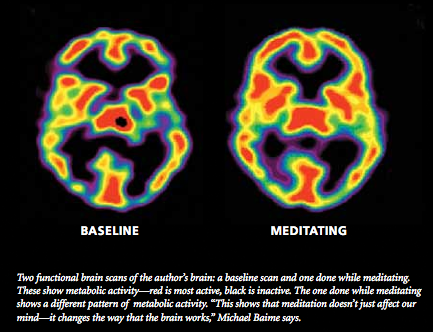
We project our confidence and increase our power when we are clear and calm.

To make this a little more vivid let me quote from Sharon Salzberg’s book. She was in a hurry to leave one morning when she dropped a jar and it shattered all over the floor. In the past when something like that happened she would always unleash a barrage of inner criticism but after weeks of compassionate meditation something changed. She writes that her inner your voice cried out “you are really a klutz, but I love you.” It’s so simple. We retain our confidence in the face of mistakes and failures by staying in mindful contact with our souls, our capacities, our values and positive intentions. We are not our behaviors, we are not our pasts, we are not our inadequacies. Rather we are in a constant act of self-creation. As long as we put full attention on that truth our confidence will clear our path forward.

We retain our confidence in the face of mistakes and failures by staying in mindful contact with our souls, our capacities, our values and positive intentions.

So try it. Try these three strategies: Focus your attention on your successes and reframe your setbacks as learning. Increase your physical energy by investing in your health and vitality. Practice compassionate meditation to become so calm and so clear that the arrogance of others is no longer a threat and your true confidence blazes your path forward.


How to Make Your Idea Change the World

Just last week I was sitting in a meeting at the Gap building overlooking San Francisco Bay. I was in the spirited conversation with Eric Severson the senior co-leader of human resources for Gap globally. Since they have over 130,000 employees it is a very big job. What we were talking about is how he could change the future of work. His vision is to transform work so that it is a primary source of growth, health and well-being instead of a life draining stress pool. He wants work to be a positive source of personal evolution.

He wants work to be a positive source of personal evolution.

This morning I had breakfast with Kristin Carroll, the new CEO of an amazing marketing agency that earned a huge multi-year federal contract to dramatically reduce smoking for at-risk youth. The company is the brainchild of Jeff Jordan, an expert at creating behavioral change based on changing the values of dominant subcultures.

For youth these would be subcultures such as hipsters, alternative, hip-hop and other peer groups that have strong behavioral norms. All of their work is science-based and is now proven to be far and away the most effective method to promote positive behavior change. The company is unlike any other I have seen. Except for the PhDs that do the science the average employee age is 26. They create witty social media campaigns, ironic websites, organic art contests and scores of other unconventional tactics to reach youth who are unreachable by conventional media and resolutely resistant to threats or preaching.

All of their work is science-based and is now proven to be far and away the most effective method to promote positive behavior change.

Saturday I spent time coach a fifty-something, multitalented artist, businesswoman who has designed a retreat center for young girls to become grounded in their own self-worth so they can be emotionally empowered to achieve their deepest goals. Yes I know that I am lucky. I spend most of my professional time being inspired by the people I am trying to help. In many ways they all have the same question… How can I make my difference? How can I change the world? What a great question! It says a lot about the soul of a person and the mindset they bring to their daily life to be tormented by a desire to make things better for others.

It says a lot about the soul of a person and the mindset they bring to their daily life to be tormented by a desire to make things better for others.

Since meeting Stephen Covey over 30 years ago so I could help bring his 7 Habits message to the world, I have felt that my life’s work has been to help other people fulfill their purpose. By now I am pretty clear on the formula whereby people make the impact they are meant to make. Here it is.

Clarify your intention.

Clarify your intention. Your inner motives construct an inner story about why you want to change the world. Sometimes it’s hard to separate our worthy desires from our egos which are voraciously hungry for validation. This is not all bad, however. I’ve come to believe there is something real called ‘healthy ego strength.’ It shows up as an inner story of confidence and commitment that drives people to keep working against long odds and difficult setbacks.

This kind of ego strength has to be guided by genuine moral ambition and not just shallow pride. I think Gandhi, Mother Teresa and Martin Luther King Jr. had this kind of competitive ego strength. Too many people who have brilliant ideas about how to improve the world believe that the purity of their idealism will be enough. Unfortunately, they usually quit at the first signs of failure. My experience is that the most powerful intention comes from having both high moral motives and something to prove. There is something powerful about thrusting your chin out when the going gets tough.

In other words, what you are truly good at is a clue as to how you are designed to change the world.

Self-knowledge. After years of helping people identify their true work using conventional methods like writing mission statements or doing personal values inventories I had a whopping Aha! While most life-coaching approaches start with deep inner reflection on what you would most passionately like to change in the world followed by a personal inventory of skills and abilities, my insight turned that process upside down.

After surveying the life satisfaction of over 26,000 people in the American Dream Project I found that the happiest most successful people came to the realization that they were designed perfectly to fulfill the deepest desires of their higher selves. In other words, what you are truly good at is a clue as to how you are designed to change the world.

What many people explained to me is that when they came to understand what their motivated talents were they became clear about what they should pursue. The most important self-knowledge is to understand clearly what you do well that you intrinsically enjoy doing.You have to be self-inspired to learn what you need to learn, and do what you need to do that will make the difference only you can make.

If you can envision how someone’s life might be better then you have a gift.

Empathetic vision. If you can envision how someone’s life might be better then you have a gift. Many people spend their whole life in a stupor of self-interest. They believe that everyone is living the life they deserve. Fortunately many others can envision creating conditions that enable people to lift themselves up, build healthy communities, and improve the quality of life of others. If you are going to intentionally improve the world empathetic vision is necessary.

The most powerful visions are stories based on emotional logic. TOMS shoes got off the ground by inspiring a Vogue magazine editor that individual American consumers could put shoes on shoeless children by buying shoes for themselves. The logic is simple… buy one, give one. That editor was so inspired she decided to put pictures of TOMS first shoes in a photo spread. Today 20 million poor rural children have enjoyed the health benefits of wearing shoes because one entrepreneur cared about them.

The most powerful visions are stories based on emotional logic.

Just start. The world is moving faster than any business plan you can develop. Venture capitalist will tell you that over 90% of successful new companies change their strategy after they have been launched to become successful. Google is an obvious example. The best way to develop your idea is to simply start building the product or providing the service you envision.

When I first met 27 year old Kate Atwood she had recently started a nonprofit dedicated to help young children of a deceased parent. She wasn’t a social worker or psychologist but rather just a young woman who at the age of 12 had lost her mother to cancer. She started providing counseling in a coffee shop, then quickly moved into donated office space at a law firm and within a few years had built a large regional non-profit with a six-figure budget and a permanent staff. Nobody gave her permission to do this. Want to do something? You don’t need permission…just start.

The best way to develop your idea is to simply start building the product or providing the service you envision.

Form alliances. If you want to change the world in a big way don’t try to do it yourself. Almost all organizations scale up by building relationships with other institutions that already have the members, audiences, or customers that need or want the solution that you’re providing. The people you want to impact have already been aggregated by other organizations and the last thing you need to do is try to attract customers or donors one by one.

Alliances only work if you are fully committed to invest the time to build strong and enduring relationships. An alliance is like a garden… if you leave it untended weeds will kill the flowers in short order. In my experience there is simply no other way to scale up to solve big problems or to make a big impact. You need big powerful friends who believe in you and your mission.

You need big powerful friends who believe in you and your mission.

Creative Grit. If you read most success stories you will find that overnight success takes 8 to 10 years. Oh, there are a few exceptions but you can ignore them. Plan on success being difficult. Plan on your best initial ideas being wrong. Expect the things you cannot control to be unfavorable. Expect employees to let you down. None of it matters. None of it. For a variety of frustrating reasons it took nearly 6 years to get the 7 Habits of Highly Effective People book written.

It was published first in hardback and the sales were surprisingly meager. My disappointment stimulated an inner rage for success. When the book came out in paperback I risked the financial future of our company by overinvesting in a massive national book tour that required renting out large concert halls and filling them with employees from local businesses. It was a crazy risk but I believed so much in the message that I would’ve much rather failed than to not try.

Today, 25 years after it was published the 7 Habits book is still a top 20 business book and has sold over 25 million copies. And nearly every week someone new tells me how that book made a difference for them. Creative grit is more than simple persistence. It’s a willingness to continuously try new ways to make your difference when your current efforts seem fruitless. For me the purpose of life is to make the difference you are designed to make.

For me the purpose of life is to make the difference you are designed to make.

And please don’t be overwhelmed by that. Remember scale, size and fame ultimately do not matter. When you change your world, the world changes.

Two Million in Jail in the US. If You Were in Charge, What Would You Do?

As a leadership consultant I cannot help but look at the leaders of our institutions and wonder, “is this really the best we can do?”

It appears to me that we have reached a level called systems failure.

It appears to me that we have reached a level called systems failure. That’s simply a way of saying what got us here won’t take us there. “There” being a future of sustainable abundance based on Nobel prize-winning John Nash’s proof that the greatest good for everyone will create the greatest good for each individual. That mindset is at odds with Hard Power systems because Hard Power is inherently fueled by self-interest and blame.

The alternative to this system is not socialism, which is based on sharing scarcity. Rather it is based on what some business people call conscious capitalism. In civics it’s called the common good. It is nothing less than moral intelligence. It the synergy of SMART Power where the sum of the parts is much greater than each part. That’s how you produce sustainable abundance.

Hard power assumes the best world is only created by relentless competition.

Let’s tackle a difficult problem. Suppose you begin with the wild proposition that the best society is one in which everyone had the best chance to live a productive life. This is not a hard power point of view. Hard power assumes the best world is only created by relentless competition. That way everyone gets what they deserve. So if your life is hard it’s your own damn fault. The problem is that simply is not true. Not really. Not at all.

Today there are over 2 million Americans locked up in jail.

Today there are over 2 million Americans locked up in jail. Most are African American. The vast majority of inmates have done bad things, often very bad things. I know, I used to be a counselor to inmates in a maximum security prison so I know what evil is. Yet I also know that for the vast majority of these prisoners their childhood was nothing like yours or mine. They were not told that they could become anything. In fact they were not told that they were good or capable.

Their early childhood programming was that they were stupid, ignorant losers with nothing to offer. Their modeling in most cases was that if you want something you need to take it, and violence is a legitimate source of power. For the most part young African American males in 21st-century America are programmed to be criminals. While it’s true that everyone has free will, our free will is constrained by the choices we can imagine. Thus some people’s will is much freer than others.

While it’s true that everyone has free will, our free will is constrained by the choices we can imagine.

Psychologists have learned that the biggest influence on our behavior is our personal story of our identity. If your identity was that you were destined for a meaningless grinding life or worse, jail, who do you think you might become? I am very lucky. I have a family story where my great-grandfather came to San Francisco when he was 16 with nothing. He was raised by loving parents who sent him to America to escape being drafted into the tragic army of Napoleon III.

When he reached California he was taken in by fellow Italian immigrants and given a job, hope and enthusiasm. He lived a remarkable life and became a successful cattle rancher and community builder in central California. That was a story I grew up with. It helped me believe that anything was possible. The inmates I counseled in prison had quite a different story. Their ancestors were slaves who were told that God had created them to be slaves.

They were told they were incapable of living independent lives. They were told they couldn’t learn. Most of them came from abusive homes where fathers were not a source of inspiration but only a threat of violence and a voice of ridicule. Many had mothers who were teenage junkies. So let me ask you. If this was your family story… if your mother was a junkie… who might you be?

If this was your family story… if your mother was a junkie… who might you be?

I have spent deep time with fellow human beings whose hope was stolen from them before they could even talk. I get exasperated when some self-righteous idiot politician points to a few who have somehow escaped an awful personal history to become a remarkable self-sufficient human being. These people amaze us because they are so exceptional.

But old white demagogues in $3000 suits don’t have a clue about what causes this infinitesimal few to transcend their conditions. And to point to them as an excuse for us to do nothing while millions of lives are flushed down the toilet of hopeless despair is simply immoral. At least it seems so to me. So let’s try a Smart Power mindset…one that includes moral empathy that seeks to remove avoidable suffering and create sustainable abundance.

Suppose for an instance we actually believed that young African American males could become well-educated, responsible husbands and fathers and yes, even leaders. Suppose they could also become scientists, inventors and innovators. Suppose we believed they could become anything that young white males could become? If we really believed that would we, as a society, continue to under invest in inner-city schools? Would we allow law enforcement to abandon major parts of our big cities to become gang run ghettos?

They need a balance of nurture and discipline, encouragement and feedback.

Smart Power leadership says no. We actually do know what works to give the most children the greatest chance of fulfilling their potential. Children without responsible parents need loving and capable early childhood teachers, a safe environment, nourishing food, healthy exercise, and opportunities to set goals and achieve them. They need a balance of nurture and discipline, encouragement and feedback.

As they get older they need opportunities to succeed and mentors who will support them. All of this has been proven to work… not with every single person… but with a vast majority. Now if we know this is true and continue to do nothing is that okay? If you’re objection is that this sounds like another massive government program, think more creatively.

A Smart Power approach to social problems begins with a new form of institutions called a Citizen Enterprise. (I have written about this in Save the World and still be Home for Dinner.) It uses the innovations and disciplines of business and universal morality of the Golden Rule to produce new standards of measurable value.

The greatest waste we make is wasting human life. This is not the best we can do. But things will only change when enough of us become unwilling to support old ways of thinking and leading, and the fears that fuel hard power. If you were in charge, what would you do? Speak up for that.

How to Lead When You Have No Power

Last week I was sitting in conference room with three women managers of one of the largest technology companies in the world. They were very frustrated. Two of them have been with the company for over a decade. All had engineering degrees and one had topped off her education with a MBA. But none had any real power. It’s not surprising.

Technology companies have become notorious wastelands for female careers.

Technology companies have become notorious wastelands for female careers.While educators are busy trying to lure more girls into science and engineering, research confirms that tech careers have a nasty history of disappointing most women. Researcher Tracey Lien recently reported that a Harvard Business Review study confirms that 50% of women who work in science, engineering and technology will leave their jobs because of hostile work environments.

Most of the time the hostility is not overt. Rather, sexism is so baked into the structure and culture that it’s difficult to address head on. The women that I am training in leadership report that they are frequently not invited to important meetings, passed over for project leadership, or are just plain ignored when they surface concerns about execution or ideas for innovation.

And of course one of their most frequent frustrations occurs in meetings when they propose a course of action that is ignored, while moments later a male makes the same suggestion and it is acknowledged and adopted. It’s hard to feel invisible and also feel self-respect.

It’s hard to feel invisible and also feel self-respect

What’s the result? Google’s engineering workforce is only 17% female. Apple’s is 20%. And Facebook’s is only 15%. This is a much bigger problem than the political correctness of gender equality. Research from the emotional intelligence expert Daniel Goleman clearly confirms that women think differently than men and that they’re thinking is proven to be more accurate as complexity increases. In other words, when the path forward is uncertain or the situation ambiguous or when the reaction to a decision is critical, a woman’s brain is much more likely to make a smart decision that a man’s brain.

This is not hard to understand. Throughout history men have generally been the makers of messes and women the cleanup crew. It’s not surprising that an avalanche of research shows that our workplaces minimize the positive impact of women…but what can be done about it? How can women managers actually get senior management to ask women to lead new initiatives that matter? New research from University of Michigan gives us a proven set of success behaviors.

I warn you these won’t work all the time. There are no magic answers. But this will increase your influence and odds of success. Let me start with what not to do. The most hilariously awful finding by the researchers who study business decision-making is a doozy. The very worst and least effective argument you can make to senior executives is one based on morality. You know…we ought to do the right thing because not doing the right thing is causing people to suffer.

The very worst and least effective argument you can make to senior executives is one based on morality.

For instance, arguments that companies who use foreign contractors to manufacture their goods ought to ensure that their impoverished supply-chain workers work in safe and fair conditions because allowing powerless young girls to work in rat infested, firetrap factories violates the Golden Rule of basic morality fell flat.

It was only when sweatshop working conditions began to affect the company’s brand that action was taken. Likewise, according to consultants I know Wal-Mart’s leaders had absolutely zero interest in environmental sustainability until shown they could save millions by doing it. Show me the money.

Hard power leaders have separated business from morality for centuries.

I am sure this doesn’t surprise you. Hard power leaders have separated business from morality for centuries. Maybe since men could talk. I just found it quite startling to see in black-and-white research that the least valued reason to do something in business is a moral one. Hard power celebrates the seductively attractive psychology of greed is good.

And hard power rules business as well as the world. So please don’t sell your idea by saying it’s the “right thing to do.” As for what works… Make your pitch strategically relevant. I am working with a client right now whose CEO is obsessed with improving their dismal customer service scores. The only action that is getting any traction has to directly improve customer delight.

Transform your request for a budget from an expense to an investment.

Make a business case. Most senior leaders are only interested in activities that will make money or save money. Growth or profits. Transform your request for a budget from an expense to an investment. And be bold when estimating the payoff. Men tend to inflate positive outcomes while women send to understate. Frame yourself as the perfect leader to lead the initiative.

You do this by making an evidence-based case on your expertise, experience and commitment. (If your track record is short, focus on your understanding of the solution you are presenting.) One more thing…never let your work speak for itself because it doesn’t. Balance both threats and opportunities as motives. People are moved to act when fear of loss is balanced with the feeling of confidence from the problem solver. So take a deep breath, quiet your self-doubts, stand up and present your action plan.

People are moved to act when fear of loss is balanced with the feeling of confidence from the problem solver.

Create allies. If you are a lone women presenting to a group of male decision makers you need a strong male sponsor who will be your champion. Be sure to directly ask him for his verbal support in the meeting as well as consistent support afterwards. Strong sponsorship is often the make or break factor in getting your project approved with you as the leader.

Strong sponsorship is often the make or break factor in getting your project approved with you as the leader.

Don’t be discouraged by initial failure. Show some grit. We are in a period of major transition in which women’s leadership is ascending. I believe this because I see it. More women in senior leadership is becoming a competitive advantage not because it is the right thing to do but because it is a smart thing to do.

How to Turn Anger into an Opportunity

All of us are emotional… thank heaven. Emotional energy motivates us to do great things. Emotion is the horsepower of sacrifice, dedication, innovation and love. Your emotions are nothing to be afraid of… not as long as they are harnessed and directed towards your deeper values that form the guardrails of your actions.

But what about bad emotions? For instance, for centuries angry emotions have had a bad reputation because irrational, fear-based behaviors often override our impulse control and make us do or say really crazy stuff. But recently social science started to turn its research eyes onto the “upside of negative emotions.” Let me explain. Anger is almost universally condemned as a very negative emotion. Virtually nothing wise is ever said or done when we are angry.

That seems true, doesn’t it? It’s certainly seems that way in my own life. For instance, I don’t believe I said anything I didn’t honestly regret whenever I have yelled. Yelling just makes me stupid. So, I think it’s true, unrestrained anger enables us to justify doing things we most often later regret. It is easy to just label anger as a “bad” emotion.

And yet… Consider this. Psychologists have concluded that our personal anger results most often when we feel undervalued. When we feel unappreciated, when our efforts seem invisible, when our ideas are ignored, when our interests are overridden, when our time is wasted, when our rights are violated… well, frankly it just pisses us off. And there’s another thing that makes us angry that isn’t so obvious.  There seems to be a deep longing in almost all of us to be respected. 

We want to be viewed as capable. This is at the root of our feelings of self -respect. So when people try to do things for us that we can do for ourselves we begin to resent them. If we sense at all that people are helping us because they think we are incapable of helping ourselves it makes us mad. The common expression is “biting the hand that feeds you.” Logically it doesn’t make a lot of sense to strike out at anyone being nice to us. 

Why would you be angry at someone who’s just trying to help?  The answer is we experience their help as an insult about our own capabilities.  This is the common type of war we have with our teenage children.  The way they know they’re capable is by cleaning up their own messes. They feel their own strength by taking responsibility for the consequences of their actions. So when parents keep bailing out their children from the natural results of bad decisions it makes them mad.

This is true whenever they ask for help they know they don’t deserve. This is not just true with our children but also with spouses, friends and co-workers. Nevertheless, when people get angry at us for our over-helping we throw up our hands and mutter to ourselves that they just don’t appreciate us.  If we don’t stop the anger cycle of mutual under–appreciation we become estranged.

Now that you know what the primary cause of anger is in ourselves and how we might trigger it in others let me give you a strategy to make the emotional energy of anger a positive force in your life rather than a destructive one. Anger is our inner alarm that we are being exploited. When we feel undervalued our anger can power up our proactive energy. We see this clearly in the efforts to extend human rights. Anger was a big catalyst in generating public demand that we extend civil rights to all. Anger also generates energy to get people to volunteer to support political candidates who promise to defend us from being undervalued by other politicians.

Clearly anger generated from feeling outraged about injustice can be hugely positive if channeled toward demanding positive change. And what’s true for societal issues of injustice can also be true for personal ones. For instance, I see a lot of resentment and anger in our modern workplaces.  In most businesses employees frequently feel undervalued. Surprisingly this doesn’t mean that they feel underpaid as much as it means that their expertise and ideas are so routinely ignored.  

In most organizations rework is constantly necessary because the people doing the work never get a chance to collaborate with the people who decide what work should be done. As you know, I frequently do leadership development for women leaders and managers.  What I find are often almost toxic levels of frustrated women because women in business are so frequently ignored or marginalized. Then male leaders wonder why all the women seem so “touchy.” The frequent male response is to “walk on eggshells” by being overly careful not to set off any of the women which leads to the women feeling even more undervalued.

So what should you do if you feel angry?  The research says that when you have a personal self-vision–which is simply a clear goal for your work and your life–and you have standards of what behavior and circumstances you will tolerate you can turn your anger into confidence, optimism and initiative to drive change. In other words, if you are really clear on what you DO WANT rather than just angry about enduring what you don’t want, angry energy can become creative energy. That kind of angry energy will sustain your consistent efforts to change your circumstances.

So here’s today’s bottom line. If someone is angry with you consider whether or not you are making them feel undervalued. You may be ignoring your needs or you may be doing something for them they should be doing for themselves. If you are angry it is probably because you feel undervalued. That means it’s time to be proactive. Get clear on what you want. Take responsibility. Be realistic. We judge ourselves by our intentions while others judge us by our behavior.

You may need to improve to get the respect and opportunities you desire. It’s not enough to be a good person…we also need to be effective. Learn what you need to learn and do what you need to do to receive the value you deserve. Deserve respect, ask for respect, and expect it. Don’t stay angry…create your future.

Can You Hold Yourself to a Higher Standard Than Self-Interest?

Business is bad. I am not referring to financial performance but rather moral performance. Capitalism is amoral. It has no intrinsic moral agenda. You can start an enterprise that makes boatloads of money selling cigarettes or selling treatments for the lung cancer it causes.  Actually both these business models are currently thriving. And as far as most Wall Street investors are concerned there is no distinction between a business whose product is designed to kill people and a business whose products are designed to save people.

How did we get here? According to the patron saint economist of modern capitalism, Milton Friedman, the purpose of business is to make money as efficiently as possible. And that’s it. According to his doctrine the only ethical obligation a business leader has is to his investors. Friedman proclaimed the glories of amoral self-interest in a series of PBS programs that aired in the 1970s.

His ideas transformed our MBA schools and sanctified the dogma that “greed is good.” So how is this working for us? Obviously some people at the top of the capitalism food-chain are doing spectacularly well. Today’s radically materialistic capitalism  also justifies workplaces in which employees have no job security, no earned retirement, and are continually told to do more with less. Business leaders have harnessed tools of modern technology to keep their employees working from dawn to midnight.

We are told that our life-balance has become both silly and irrelevant in our highly competitive economy. So get over it…“do whatever it takes.” Yet many of the same companies make so much money that they literally don’t know what to do with it. So activist investors insist leaders use the profits you gave your nights and weekends for to buy back their company’s stock.

This is simply a magic trick to try to temporarily increase the stock price so that short-term investors can cash out. How could this happen? I spent over three decades advising CEOs and executives of large publicly traded corporations. So I believe I have an answer to how it happened. It’s called Hard Power. Here’s how it works. Brain research that correlates personality types with neural networks reveal that the mental model of highly competitive people tends to focus on power, status, control and self-interest.

The areas of the brain that evaluate stimulus and drive action of hard-charging, self-focused people light up when opportunities for personal gain are detected. This focus is a significant advantage in hierarchical organizations. Since hierarchies concentrate power in the few people at the top, people who are power-driven tend to succeed. Put simply, most business organizations are rigged to reward self-centered, status seeking, goal-focused individuals. This is not a criticism. It is a description of reality. The advantage of highly competitive people is their mastery of hard power.

Hard power concentrates energy on goal setting and accountability. The most motivating goals are tangible…achievements that can be easily measured. And there is nothing easier to measure than money. As long as we cling to the insane idea that the primary purpose of business is to make money hard power leaders will define our future.

I am concerned that the myopia of hard power thinking will make the world more dangerous and less sustainable than it needs to be. Technology is the wildcard. Today, technology allows the destructive forces of what used to take thousands of people to do to be concentrated in the hands of very few. I’m not just referring to terrorism but also the fate of our entire international financial system, energy grid, clean air, plentiful water, healthy oceans and all of the rest that underlie our quality of life.

It’s simple. We are more interdependent now than ever before in history and the flaws of hard power and an amoral view of business creates unprecedented personal vulnerability.

So, what’s the solution? Well it’s not soft power. Soft power is rooted in co-operation for mutual benefit. It relies on empathy, collaboration, inclusiveness, open-mindedness and an active interest in the well-being of others. Personality studies of soft power oriented people show they are most interested in helping others achieve their goals. They also want to relieve suffering and solve problems.  In most organizations soft power people are found in mid-level management. Hard power people make the goals and soft power people help them achieve them. 

Soft power people remain stuck in middle management because they are lousy at speaking up, advocating for their self-interest and pressing their agenda. 

Often they feel victimized and overwhelmed. Many soft power people fall into the trap of “learned helplessness,” mal-adapting to an ever-decaying status quo. It shouldn’t surprise you that developmental brain research indicates that most men are primarily wired to use hard power and that women’s brains are designed to rely on soft power. Although we don’t know for sure, it appears that about midway through gestation a typical male baby’s developing brain becomes bathed in testosterone which pre-wires later cognitive development for linear thinking, competitiveness, self-interest and struggles with impulse control. Female baby’s brains are bathed in estrogen which appears to trigger their brains to develop more holistic thinking patterns, long-term thinking, empathy and collaborative intelligence. (Although this is not settled neuro-science it sure explains a lot.) When you look at the design advantages of a typical female brain; holistic, long-term, empathetic and collaborative, you can immediately recognize the inherent leadership advantages these abilities bring to modern business organizations. Unfortunately, I found that much of the time these advantages go unrewarded.

That’s because business organizations are defectively designed to reward hard power and exploit soft power.

This is not some ivory tower theory. I’ve been successfully helping women advance into the highest levels of business leadership for over two decades. I usually do this through one-on-one leadership development. But it is not enough. I have a front row seat to the advancing descent of un-inspired business leadership and the frustration of aspiring women leaders who were being told that to be successful they must become like men.  Although Sheryl Sandberg has made a great commercial success of her “Lean In” advice to women which is that they should just ‘man up,’ I have yet to speak to an audience of women who believe it is realistic or desirable. So what we have is confusion. It seems that many women aspire to power not to change things but to succeed in the system that is giving us the world we already have. I am concerned that I do not hear often enough the idea that if women ran things, things would be better. There seems to be a wavering confidence in the unique mindset that women bring to setting higher goals, a balanced work-life and accepting the mantle of moral authority.

I believe that we are at a major turning point. 

The purpose of business can be forever elevated as a means to improve the quality of life of everyone–customers, employees, suppliers and communities.  In a sane and sustainable world, profits should be a byproduct of genuine value creation.  I believe that women are naturally designed to be the new voice of business leadership. Not one that mimics the shortcomings of hard power but rather the amplifier of Smart Power.  Smart Power is the synthesis of the strengths of results-focused hard power and human-focused soft power. So no, I am not advocating for all women leadership teams. The best leadership teams I coach have a healthy balance of strong men and women who respect each other’s values and viewpoints in the pursuit of human-centered innovation…value that matters to people. I am not an unrealistic dreamer.

A great team of women clients and I recently led our first Leadership SPA (Smart Power Academy) for 33 women leaders from major organizations.  It was designed to be visionary and career changing as well as practical and realistic. What happened was something far greater than I anticipated.  The combined energy of these leaders created individual strategic aspirations and career roadmaps far more powerful than anything I could’ve anticipated. This same team of women is getting together in a few days to forge a path forward.

I don’t exactly know what the future will bring but what I do know is that as a global society we simply cannot keep doing what we have been doing. And I sincerely believe this. To go in a higher direction we need women leaders to bring their vision forward and insist that we hold ourselves to a higher standard than self-interest.

There is no better time than right now. (NOTE: I’m in the final stages of writing a new book titled Why We Need Women to Lead. This blog, except for the last paragraph, is a draft of the introduction.

Some of you may be familiar with the essence of the content from my blogs and speeches. I would appreciate any input you might have.)

How To Make Positive Emotions Last

What if you put your sincere thanks into this Thanksgiving?  It’s not as easy as it sounds. By now we should all know that gratitude is a major driver of personal happiness and feelings of well-being. But the way our brains are designed tends to minimize the benefits of thankfulness. That’s because we constantly turn our positive emotions into concepts. And concepts do not make us feel happy. Let me explain… When we first experience positive emotions our brain stimulates the production of smile–and–be happy chemicals like dopamine and serotonin.

However, novelty is a huge driver of positive stimulation so as soon as we are used to something we were initially grateful for we quit feeling the emotion of gratitude. Without emotion-stimulating neurotransmitters our feelings of gratitude decay into concepts. We know we should feel happy or should feel love but we just don’t really feel those feelings. For instance if I ask someone I’m advising “What are you most grateful for?”

Their automatic response is almost always “my family.”  But when I ask them if seeing their family on a daily basis puts them in a positive mood I get a questioning look. Of course, families who have been separated for long periods of time, for instance military families, often experience elevated positive emotions when they’re reunited. But when life normalizes and we return to our routines those things we take for granted no longer give us a happy high.

That’s because unmet needs are powerfully motivating and very emotional. As soon as those needs are consistently satisfied our motivations and emotions tend to wither. Fortunately for us, positive psychologists have done a great deal of research about how we can rekindle the emotion of gratitude so that we can feel our feelings rather than just think about them. Here’s an experiment I’d like you to try:

  1. This Thanksgiving ask yourself… who is one person that has really enriched your life.
  2. Next take a few minutes and write down the specific ways you have benefited from the love, kindness, actions or knowledge this person has provided.
  3. Write down the positive impact and results you have received that you would not have gained without this person’s effort.
  4. Write down what your life would be missing without this person in your life.
  5. Now, listen to some calm instrumental music for about three minutes, put a smile on your face and silently (in your own mind) thank this individual. This focused reflection should ignite deep feelings of gratitude.
  6. Finally, tell the individual how thankful you are for the love and support they have shown you. Tell them some things that you were specifically grateful for and the impact it had on your life. You can do this in person or by phone. Actually, leaving a voice message is sometimes best because it will cause your loved one to really listen to your message of gratitude.

Research on gratitude confirms that people who express gratefulness create more internal feelings of well-being than people receiving the acknowledgment. In short, if you want to feel happy, share your gratitude for others with them in vivid detail. This has become an annual ritual for me and it has made the holiday much more significant than a few awesome football games, great food and time to relax.

It’s pretty simple… Thanksgiving should be the happiest day of the year… and it can be if we make it so. Happy Thanksgiving!

The One Thing We All Need to be Happy and Successful

Last Friday we concluded the very first Leadership SPA (Smart Power Academy). We had 33 women leaders that range from VP’s of multibillion-dollar companies to founders of growing businesses. We had senior managers and directors and engineers and lawyers. We had women who are at the top of their careers as well as those who are looking for new starts. But by the end of the 2½ days we had one powerful team of inspired women leaders. They were united by the trust that comes from sharing mutual vulnerabilities and genuine aspirations.

They were united by the common knowledge that women have a different source of power then men and that amplifying that power can change not only their lives and their work but also the world. Yes I would have to say…. it was mind blowing. And that’s what the SPA is really designed to do…blow up old-thinking minds with a new mindset of Smart Power. Smart Power is a potent synthesis of the best parts of hard power (goal setting and accountability) and the best parts of soft power (empathy and teamwork) that enable great things to be achieved.

Our most respected president, Abraham Lincoln was a master of Smart Power. So was Mother Teresa. Smart Power is the tool set virtually every leader has used who has accomplished great things without brute force… often without any external assets or institutional power base. Smart Power begins with the new mental model of how people are inspired, directed, and developed in the pursuit of a common purpose. But just a new way of thinking about leadership is not enough to bring about fast results. And fast results are what we need today.

What’s also needed are very specific science-based leadership behaviors that research has proven to both focus attention and ignite effort. The result is positive innovation. These are innovations that address non-trivial problems. For business leaders it’s what fuels high-growth, high-margin and high-energy brands by creating value that actually has human value. For social leaders it dissolves the false choices most often advanced that pit the common good against personal freedoms…left vs. right. Smart Power is not the leadership of compromise but rather the leadership of optimize. Sounds great, right? It is.

And brain research creates an interesting wrinkle. Women are far more likely to quickly understand and adopt Smart Power as a way of leading because they’re able to deal with complexity and resolve short-term urgencies with long-term success. What inspires me is that women’s brains are more capable of thinking about money and meaning in the same thought. Perhaps that’s why women are hugely more successful at being micro-entrepreneurs around the world than men. Women everywhere tend to go into business or build their careers to serve their families, community and society rather than most chest–beating males who crave success to prove they’re the baddest gorillas in the jungle.

So if women are better wired for leadership in today’s world what is holding them back? Unfortunately it’s their brain design. Women are not only wired for complex leadership they are also designed to help, solve problems, and create harmony. This makes women vulnerable to spending their vital energy helping other people achieve their goals. But that’s not what’s needed. We don’t need high-capacity women like Sheryl Sandberg wasting their time helping Mark Zuckerberg get richer by making Facebook an advertising platform. She’s “leaning in” to the wrong thing. What we know from social science studies about what creates deep life satisfaction is that you will never be happy spending your life achieving other people’s goals. And that leads us to the one thing each one of us must know if we are going to make our difference and enjoy our lives. It is so simple. You must KNOW what your true self desires and say NO to everything else.

The first law of leadership is that you must have a personal vision of a desired future. You must have an agenda. Great leaders do not derive vision from the collective minds of confused people. Great leaders nurture visions that come from the inner reflection of their intrinsic selves. I am not just making it up because it sounds inspiring. We now know from research that daily self-reflection on the long-term difference that you want to make leads you to be crystal-clear on what’s most important to you. That clarity will enable you to see opportunities that were previously invisible. Your vision will also inspire you to learn what you need to learn and do what you need to do to bring your vision to reality.

That clarity will also motivate you to seek others who are aligned with your vision to form a dedicated team of people with diverse strengths who will do the impossible. This is exactly the path of Mother Teresa, Eleanor Roosevelt, Hannah Jones (Nike), Beth Comstock (GE) and the Mothers Against Drunk Driving. Of course we all know that great leaders have great visions. What’s difficult for women is to give themselves permission and to take the time to nurture their true selves so that they can “hear” what their hearts and minds most desire.

Neuro-science confirms that women are wired for self-doubt and self-editing that makes their confidence leak out of their minds like a bucket with holes in the bottom. Fortunately this leakage can be plugged and clarity and conviction can be gained. What’s required is self-awareness and courage. At the SPA we did a TRUE Self exercise that combines the feedback of others with a simple understanding of your unique design, drives and desires. Liberation begins when you understand that you are perfectly designed to make your difference. This not only elevates how you approach your work but also the work you choose to do. This becomes the basis of ME, Inc., which is your 40-year career. After all, we spend about 100,000 hours of our lives working, sometimes for money other times for meaning, so it makes no sense to waste your talent and sweat.

Of course it’s true, sometimes we have to work for money to make sure the gears of our life don’t grind to a halt. But as I promised all the participants, research confirms that you can change virtually everything in your life in 24 months. So the question is if you do nothing new will a life you’re living two years from now be the life you most desire? Will the work that you’ll be doing be the work your designed to do? Are you willing to invest in yourself enough to change what you need to change and grow in ways you need to grow? To make it simple, the one thing we all need to be both happy and successful is to be clear and calm.

Clear on what our TRUE Self is asking for and calm so that we are not flooded with stress and negative emotions that deplete our power. Throughout the Smart Power Academy we took time to exercise, meditate, reflect, and write about what new models and new mindsets were challenging us to do. We practiced what it means to be both passionate and calm simultaneously. And we formed Genius Circles of mutual support to help sustain the new commitments that were made.

As we reviewed the feedback from all the participants this morning what made the SPA extraordinary was the combination of self-insight and practical, research-based easy-to-do leadership behaviors that turbocharge women’s confidence, amplify their influence, inspire innovation, and drive meaningful results…all without table- banging insistence or a trace of whining. It’s true, all the leadership tips and processes are useful yet we should never forget that leadership blossoms from the soil of our souls. Research overwhelmingly confirms that great leaders, the leaders we most admire are clear and calm.

They KNOW what’s important and say NO to everything else. It’s knowing that creates clarity and saying NO that creates calm. The feedback from the SPA experience was overwhelmingly positive. My team just had a meeting that ended an hour ago. These inspired women are creating a plan to attract a national sponsor and worldwide outreach to teach Smart Power to women and girls around the world.

Hell, we might even teach a few men! If you want to know more, have some ideas or know someone who can help just send us an e-mail. In the meantime… Get CLEAR and be CALM.

7 Things I Learned in Tibet

Debbie and I just returned from almost 3 weeks in Tibet, Nepal and Bhutan. Yes, we saw Mount Everest (from a small plane… no more mountain climbing for me). But the most enriching part of the trip was spending every day with a guide who happened to be either a devout Buddhist or Hindu. This allowed us to get into extended conversations about their beliefs, their hopes and dreams, and their life strategies. Two of the guides were young women ages 30 and 27. Both of them were very open, sincere and strong.

Perhaps the most compelling realization on the trip was that the new generation of women everywhere in the world shares a mindset that things are going to be different.

The cultures of these countries are deeply rooted in Buddhism or Hinduism. These religions contain deeply held beliefs that each of us are born into circumstances we deserve… and that men are more spiritually evolved than women. In other words, if you were an awesome spirit you would’ve never been born a woman. I know, what a great way to set up a culture if you’re a man. Well the young women of Tibet, Nepal and Bhutan are not buying it.

They are pursuing educations, significant careers, marrying later, and treating their husbands like partners rather than gods. One extremely positive outcome is that women are asserting themselves in terms of resisting sexual abuse, rape and virtual enslavement. This is all happened in one generation. Universal media and the Internet are definitely impacting it. It is also driven by a new web of personal connectivity between young women around the world.  Women do network and communicate… everywhere and all the time.

One thing I can predict with high certainty is that in the next 30 years the world will change significantly because more women will make more important decisions and create greater influence than ever before in history. It’s about time! (If you like to watch a film that reinforces this idea click here.)

Since the trip also allowed me to both study and reflect, I thought I would pass on 7 ideas I found worth considering. You may not agree with all of them but if there is a nugget for you put it in your “mental pocket” and examine it more closely.

  1. Buddhism is a lot more than meditation and chanting. Hinduism is a lot more than yoga.  While it is true that all religions have serious defects… invariably caused by centuries of hard power leaders using fear to control the thoughts and behavior of their believers…the spiritual inspiration at the root focuses on inner peace and acts of compassion. Finding inner peace is the power source of true compassion.
  2. The tribes we belong to dilute our conscience. For instance, when large groups of people engage in business activity that cause employees to suffer by reducing their individual power while increasing their demands in an effort to make products that generate high profits but little value, we accept it as business as usual.  The cost of this mindset is high. If my prosperity depends on others’ suffering my soul submerges in an ocean of self-justification.
  3. My TRUE self, my intrinsic self has a manipulative roommate. He shows up as the other voice in my head insisting I need status, money, popularity and achievements I can brag about to feel secure and self-satisfied. It turns out this nasty roommate is a big fat liar. My TRUE self knows that if I put my higher attention on attaining wisdom and loving others I will learn what I need to learn and do what I need to do to be happy in any circumstances.
  4. If I consistently sell out my TRUE self to anger, jealousy or fear I will find myself trapped in a life that is smaller and more stressful than the life my heart desires.
  5. If I allow my self-interest to masquerade as virtue I will become a moral barbarian. 
  6. Our life is designed to challenge us. Our future rarely turns out as we envision.  Nearly all our plans for our career, marriage, finances and health don’t materialize as we imagined. When we are surprised by crisis and disappointment it is time to question our desires, our values and our choices. If these moments cause us to pause and reflect and realign with our inner sense of purpose we will grow. If we don’t we will re-enter the cycle of disappointment and self-frustration. This is true for everyone. It is how life is designed.
  7. While it is reasonable to forgive people who seek our forgiveness, forgiving those who hurt us without remorse is masochism.  Escaping the anger of past and unresolved pain doesn’t require forgiveness…it requires transcendence. This means that we cease to want justice or to wallow as a victim.  We literally transcend our pain by focusing on our own growth, our own power and the positive difference we are designed to make. Transcending undeserved betrayal or abuse requires not thinking about it anymore. When we stop investing our energy in our mental movie of past wrongs and disappointments we free our minds so our hearts can embrace today and generate optimism for tomorrow. As my 27-year-old Buddhist guide said, “You will gain nothing from meditation… but you will lose your anger, jealousy and fear.”

I am so grateful for our trip because it was so thought-provoking and inspirational. I would write some more but it’s time to meditate… 🙂

Are You Shrinking from Change?

I am traveling and trekking this week in the Kingdom of Happiness, Bhutan. It’s the Switzerland of Asia without the watches or the banks. Bhutan is a tiny mountain kingdom fairyland at the edge of the Himalayas jammed up against Nepal and Tibet. It’s a country of only 700,000 people with a 34-year old king and a parliament that has a public policy of investing in research based measures that promote personal happiness as well as sustainable economic growth. Although the country is jaw-dropping beautiful it is very poor by U.S. standards and grapples with the crazy problems of global modernity. It is almost universally Buddhist with temples, prayer flags, stupas, and monks just about everywhere.

The society is drenched in the spiritual mindset and ritual practice of Buddhism and yet The Big Bang Theory is the most popular show on television. Television only became available in 1997. Now you can Google and Wikipedia virtually anything and most monks seem to have a cell phone. I find this all fascinating because the country’s leaders are asking the big questions of what will make the best society. They are trying to integrate self-determination and the common good; spirituality and secular culture.

It’s all very tricky but at least they are dreaming big. 

I can’t help but contrast what Bhutan is attempting versus its giant neighbor, China. China is focused on one thing. Getting rich. Visiting China is like a visit to a capitalist’s dreamland. Think about it. Political power is focused on how they make their maniacal ambition to rule the world economically come true. Power is concentrated and corrupt.

There are no regulations or consumer rights. Climate change is something other countries should worry about because China opens high sulphur coal plants faster than KFC can open new restaurants in Shanghai. And China is so materialistic even their Buddhism is fake…at least that’s the opinion of Buddhists I’ve talked to outside of China. In China, Buddha images are of the fat, obese Buddha, sometimes called the laughing Buddha.

Their Buddha is focused on prosperity and long life…not the good works Buddhism is centered on most everywhere else. By contrast the Buddha images in other cultures are of a fit and lean Buddha reflecting an enlightened lifestyle rather than a gluttonous one. In China I found lots of people interested in lucky numbers but few in the Wheel of Life.

So what does it have to do with us?

Well it occurs to me we can either pursue our lives like the kingdom of Bhutan or the polluted mess of China. Make no mistake, pursuing happiness is tricky stuff. Our own culture has done a great job of equating fame and fortune with personal fulfillment…but it’s nothing more than worshiping a fat Buddha.

The path to happiness requires the guts to live with a purpose higher than self-interest.

As we grapple with our daily pressures it is easy to submerge our inner longings to fulfill our higher nature and just turn on The Big Bang Theory. But too often we find ourselves waiting for someone or something to change our lives. We become hypnotized by the inertia of our own bad habits. For most of us it takes a crisis to snap us out of our routine.

A useful crisis happens anytime our life does not conform to our plans.

Our work, our relationships, our finances and often our health do not turn out as we envisioned they surely would. This is exactly how life is designed…to shake us awake. We can either go inside ourselves like the Bhutanese and ask“What’s really important to me?” Or, we can just work harder at numbing ourselves with self- justification and do more of what isn’t working. I have had to face this choice many times in my life.  Sometimes I have chosen to grow. Other times I have chickened out of changing.

Shrinking from change has never worked for me. The only way out is up…at least that’s what I have found.

Here’s to the grand experiment in Bhutan! Changing your life doesn’t have to be driven by a crisis. IF you are a woman leader who wants to lead with greater confidence and greater purpose please consider joining me and a team of women leaders at the Leadership SPA Smart Power Academy. Its agenda is driven by up-to-the-minute research on women’s unique leadership power and practical tools you can use immediately. I’m on a mission to help more women ascend to the highest levels of leadership so please consider becoming a part of something big. Join us!