How Men and Women Can Co-Create Unexpected Value

Tonight I’m giving a speech to a group of senior executives on the strategic advantage of men and women working together. This is new territory, and new thinking for most male leaders. The current drive to elevate more women into leadership is largely driven by the pressure to be politically correct.  It is, after all, the right thing to do. What’s both sad and bad about that kind of thinking is that it simply marginalizes women’s potential contribution to success.

In a survey project I’m just starting it seems that many, many women in the workplace feel either invisible or patronized…but not valued.

The deeper problem is that simply telling men they should  value women as leaders only adds energy to the stereotype that women need ‘special’ help because they are the weaker sex.  This kind of thinking is not confined to the ‘Mad Men’ era.
It’s the unspoken bias that stubbornly persists.

I call it the cycle of “Bitchiness.”  It works like this.

Psychological research reveals that feeling powerless or under-appreciated leads to feelings of frustration and anger that produce either aggressive or passive-aggressive behavior.
Passive-aggressiveness is usually played out in behaviors such as complaining, blaming, silence, gossip and acting like a victim.  Low-power people tended to be passive-aggressive because it’s one way of maintaining psychological strength.
For instance it’s common for teenagers to be passive aggressive. (I have raised 6 teenagers so I am an expert in responding to passive aggressive strategies.)

Sociologists tell us that when a whole class of people, in this case women, try to effectively operate with low-power in organizations that favor high-power, that class will tend to perpetuate passive-aggressive behavior.  This of course produces the evidence that confirms the common male bias that women are too emotional, sensitive and indirect to be senior leaders.

So when I give speeches on this subject I point out that a working culture that subtly de-values the ideas, work ethic, and contributions of women will continually produce the superficial evidence to justify the dysfunction of the culture.

I take great care not to be a man basher. It’s not that men have ill-will toward women.  They just need a change of mindset. Here’s what I mean.

Men and women literally see the world differently.  Psychological research confirms that men and women regularly look at the same set of facts and see different opportunities and different threats. This is true with men and women with the same IQ, the same education, and similar work experiences. Men and women will notice different things and assign greater importance to them.

These differences offer tremendous new opportunities in both innovation and execution. Research reported in the Strategic Management Journal (September 2014) uncovered that organizations that have the most women in senior leadership positions grow faster because they produce more innovations that creates customer value. (High value innovations have higher profit margins.)

We believe that this is no accident. Neurological research confirms that male brains are wired for linear thinking.  This kind of thinking is ideal for creating consistent, incremental improvements in efficiency.  Many, many companies today make data-driven decisions to reduce costs by increasing labor and process-efficiency. This has proven to be very valuable. Male dominant skills of goal-setting and relentless accountability have been essential to building big, efficient enterprises.  However, what if being efficiency-focused is now actually getting in the way bigger bolder success?

Linear thinking tends to confine a leader’s thinking about innovation for product or service improvements.  Linear thinkers often get very excited when they can combine product and service enhancements with the mistaken notion that it represents an innovation breakthrough. Many companies are so busy working on process-efficiency they have to hire strategy consultants to come up with product or service improvements.  The problem is your competitors are hiring consultants with the same mindsets and data that your consultants have, so creating unique value becomes almost impossible. This level of innovation leads to slow growth and shrinking margins, which puts more pressure on operating efficiency. It’s very difficult to break out of this vicious and slow death cycle.

This is where women can make a big difference. For me, this is not theoretical as I’ve seen it time and again in my own leadership practice. It works like this.  Most women’s brains are wired for ‘practical empathy.’  This is also known as ‘social intelligence.’ Unlike linear thinking it is holistic, which enables people with this kind of brain design to both feel and understand what other people are feeling and experiencing.  (About 30% of men also have ‘practical empathy’ brain design. Few however rise to high levels in an organization because they are viewed as too “soft.”)

Leaders with practical empathy more naturally understand what ‘invisible needs’ their current customers and potential new customers have.  They are also more likely to come up with unexpected solutions that no one else has seemed to think of.

men and women

A great current example of this is Elizabeth Holmes the founder of Theranos.  You may have heard of her.  She is a 30-year-old Stanford dropout who developed a revolutionary way to do extremely cheap blood tests that can predict a wide spectrum of life-threatening diseases.  This is a really good idea. It’s estimated that she has a nearly $5 billion net worth.  She is described as “Steve Job’s with a big heart,” meaning that she is brilliant but driven to save lives and reduce misery for literally billions of people who otherwise would not get, or could not get their blood tested.

A major driver of her innovations is that one of the primary reasons people don’t get blood tests, even when they’re prescribed, is that they hate the pain of a blood draw.  Her test requires only a few drops of blood from a simple pinprick rather than being hooked up to a scary looking tube being jammed into your vein.

Here’s what I want to emphasize. Holmes’s motivation to innovate wasn’t because a market analysis showed that inexpensive blood testing was a multibillion-dollar market, but rather that there was a critical human problem that stood in the way of implementing our existing medical knowledge to immediately save millions of lives.

In my experience Elizabeth Holmes is not the exception when it comes to the thinking that women bring to generate high-value innovation.  When I run innovation workshops I make sure that at least half the participants are women.  I begin by asking the question, “If you look at our company’s total capabilities, how much good can we do?  How much value can we create to improve the quality of life for our current and potential customers?”  And what I see is that the people with the highest social intelligence and genuine practical empathy come up with the most astonishing and executable ideas.  And most of those people turn out to be women.

When I work with HR leaders on their struggles to attract, develop and retain talent I frame the challenge as this opportunity…“If you need to vastly improve employee talent quality, engagement, creativity, collaboration and productivity within your existing budget, what should you do?” Again, I find their social intelligence to be a volcano of unexpected solutions in spite of existing constraints.

I am a big believer in rapid, revolutionary change. We have entered the “Age of Relationships.” The value that we create is increasingly due to the quality of the relationships we are nurturing.  Relationships with customers, with employees, with society, and with the unborn. When I was working with Stephen Covey we called it “Synergy.”  One plus one equals three…or sometimes thirty.

I’m not suggesting that men are wrong and that women are right.  I am only pointing out that women are simply not valued in the essential way they bring value.  We need the synergy of  both efficiency and empathy.

Now is the time for true synergy between men and women in the quest to create a world of sustainable abundance.

5 Brain-Based Tips for Negotiating with a Bully

I am constantly training women how to win in the workplace. I also work with many soft power male leaders who need to influence hard power leaders. And when I work on culture change projects I often work with low-power leaders (director-level–where all the work gets done) who need to influence high power (C-level) leaders. So I have a lot of experience helping people get what they want when they don’t have power to insist on it.

Win-Win is a powerful negotiating paradigm especially when no deal is a viable option.

Win-Win is a powerful negotiating paradigm especially when no deal is a viable option. I focused on training Win-Win for the many years I was with Stephen Covey. After all its habit number five. Win-Win works marvelously in many circumstances, especially when goals are similar and values are shared. However, there are many instances in which the people you are negotiating with have no interest in your best interests or even their own…what then?

Researcher Heidi Halvorson (No One Understands You and What to Do About It) shows that as people move up in organizations their emotional intelligence begins to wither.

First, we should all be aware that we live in a world filled with asymmetrical power. Researcher Heidi Halvorson (No One Understands You and What to Do About It) shows that as people move up in organizations their emotional intelligence begins to wither. When you don’t have much power you have to use Win-Win strategies to convince people to do things that will help you succeed. After all, you can’t simply insist that others do what you want. But as you grow in power you can begin to order people to do things to help you succeed. When you get powerful enough you don’t have to go for win-win. You can become an institutionally empowered bully. You can just go for “I win.”

So what can we do when we have low-power and we find ourselves having to negotiate with a high-powered individual that doesn’t seem to know how to spell win-win let alone face inconvenient truths or make courageous choices?

I call it SMART Power Negotiating. It’s based on what we’ve learned about our brains and biology.

1. Take control of the place you negotiate. It’s much better to negotiate in a neutral room away from a powerful person’s office where their trappings of success and symbols of power permeate the atmosphere. If you have to negotiate in an office setting, do it in the conference room. If you are negotiating business to business, meet at your offices, or choose a neutral spot like a restaurant. Some of the best negotiating I’ve ever done has been on long walks. There are some very specific reasons walking negotiations work well. First, you’re not staring into the eyes of the person with whom you’re trying to achieve agreement. This makes their facial expressions of disagreement or resistance invisible to you. This helps you maintain your confidence. Second, after about seven minutes, walking in a matched cadence tends to synchronize brain waves. This promotes more empathy and mutual understanding. (I highly recommend walking and talking with teenagers if you’re trying to influence their decisions or behavior.)

Some of the best negotiating I’ve ever done has been on long walks.

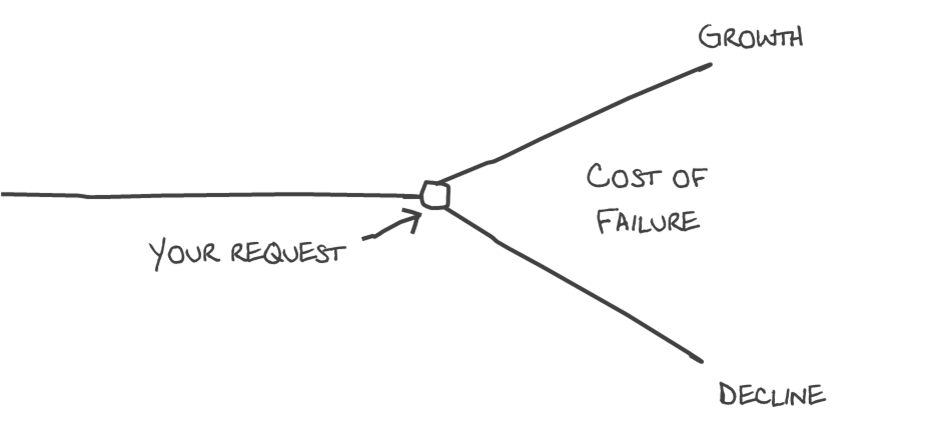
2. Make your WHY compelling. When powerful people don’t want to do WHAT you want them to do your best strategy is to amplify WHY they should go along. Gandhi negotiated India’s independence by dramatizing the moral imperative that triggered England’s higher conscience. Low power leaders who take control of the WHY bring about virtually all social change. A moral WHY works very effectively on social issues but not very effectively in business settings. In business you take control of the WHY by making a clear and graphic business case argument. One of the best graphics to use is a Y resting on its side. decision treeThis graphic allows you to focus a leader’s attention on the reality that they are at a crossroads. The correct decision will lead to an upward path towards greater growth and profitability. The wrong decision will lead to a steep and steady decline. The gap between the upward path and the downward path is the cost of not making the decision you’re advocating. You will need evidence and data to back up your graphic. But the visual depiction of the consequences of not making the right decision is what will stand out in the optic nerves in the heads of your leaders. Our brains are dominated by our optic nerves system which enables us to visualize. This triggers fear-of-loss emotions which are necessary to make hard decisions.

7ed2db41-8d4d-47de-9038-d12ac541fcad Negotiating
3. Be confident. William Ury the co-founder of the Harvard Negotiation Projectnoticed that people who have already decided they could live with a no-deal option negotiated in a much more emotionally powerful way than people who felt they had to make a deal no matter what. He called this knowing your ‘Best Alternative to a Negotiated Agreement’ or BATNA. What he discovered is that when negotiators had accepted their BATNA they had the mind of a Samurai. This is a state-of-mind that results in getting the deal they wanted more often. Samurai are trained to “die before they go into battle.” This simply means they accept the possibility that fighting for their noble cause might lead to their death, and that was okay. This enabled them to fight with more skill, bravery and confidence than if they approach their battles fearfully. You can attain a similar, confident mindset by pre-accepting consequences of not being able to make a deal. Always remember that there are many times when getting “half a loaf” is worse than getting no bread. I have often seen projects approved without the resources or funding that makes their success possible. It is better to walk away than make a bad deal.

You can attain a similar, confident mindset by pre-accepting consequences of not being able to make a deal.

4. Give first. Recent university research confirms that you are more likely to have your way with powerful people if you use persuasive phrasing. This means that you tell the powerful person what they get first before you make a request for what you get. This is very simple and you can try it out now. “I’ll work Saturday if you give me my bonus.” Is more effective than “If you give me my bonus, I will work Saturday.” Another might be “I’ll paint the dresser now if I can go to the football game later” which works better than “If I can go to the football game later, I will paint the dresser now.” Psychologists believe that giving the person you’re negotiating with what they want first makes them less defensive and more agreeable. It ‘feels’ like they are giving up less to get what they want.

Psychologists believe that giving the person you’re negotiating with what they want first makes them less defensive and more agreeable.

5. Take charge of the time of day you negotiate. If you have a complicated problem that requires a lot of creative problem-solving, risk-taking or thinking out-of-the-box, make sure you schedule negotiating sessions mid-morning. Ideally sometime between 9 am and 11 am. Complex resolutions take a lot of mental energy. When groups are asked to multiply compound numbers like 96 x 74 at 10 am about 40% will voluntarily turn their phone into a calculator or reach for a pen to do a hand computation. If you asked a similar group to do that multiplication at 3 pm about 15% of people will work on the problem. The rest of the group will wait for someone else to do it. The difference is that we have more mental energy in the morning and are usually not hungry for lunch until 11:30 am or so. Researchers confirm that tired, hungry people do not want to change the status quo so don’t negotiate difficult issues when people are not at their energetic best.

Researchers confirm that tired, hungry people do not want to change the status quo so don’t negotiate difficult issues when people are not at their energetic best.

In summary SMART Power Negotiating enables you to negotiate with anyone no matter how powerful they are. That’s a condition of life and something that all of us need to become better at if we have any hope of creating a better world.

Want Your Work to Be More Rewarding? Millennials Have the Answer

I am sick and tired of seeing so many good, hard working people that are sick and tired. In case you haven’t noticed, times have changed. If you work for a large employer the chances are you’re working very, very hard.

According to Gallup, American workers, on average, are now logging 47 hours of work every week. If you compare that to the old eight-hours-a day-five-days-a-week work schedule, we are working almost 6 days a week. And 40% of us work more than 50 hours a week!

That may seem like a lot but experts say the amount of time we’re working or thinking about work is only going in one direction…up. As you think about your own work consider how much time you spend checking your e-mail or responding to it when you’re away from your workplace…in the evenings and on weekends. I know some of you are able to shutdown. When you leave work you really leave it. But that’s not the trend. The trend is called ‘work-life integration’ which means you really never completely turn work off. Work-life integration sounds almost high-techie. Something cool. But it’s not.

The trend is called ‘work-life integration’ which means you really never completely turn work off.

The Human Performance Institute’s research is very clear that if you resist taking a complete strategic break from your work you will get less and less productive. In fact, two university studies proved that if you give one work team 40 hours to do their work and mandate that another work team, who does the same kind of work, spend 50 hours working, the 50-hour team will be producing no more than the 40-hour team within six weeks.

Americans pride themselves on being productive. But, according to the OCED, we are less productive in output per hour than eight other major nations including France! It turns out we only have so many productive hours each day so working more doesn’t produce more.

It turns out we only have so many productive hours each day so working more doesn’t produce more.

You’ve may have read that Americans are vacationing less than they did in the 1970s. In fact, according to Google Consumer Surveys 42% of Americans didn’t take any vacation last year. We are the only ‘advanced’ nation in the world that doesn’t provide for mandated paid time off. (After all you know how regulations can get in the way of making money.)

The primary reason reported by people who don’t take vacations or who do work while on vacation is that they simply have too much work to do and they don’t want it to pile up. The second reason is that they’re afraid that they may be viewed as uncommitted or disposable employees to be put on the list to be terminated during the next reorganization. (Why would you willingly work for an organization that created a culture steeped in that kind of fear?)

The reasons people are working so hard and afraid to take vacations are very rational. Two decades of business process reengineering culminating in the great recession has led to chronic understaffing, less training, fewer resources and more pressure to get more done in less time. The reason is simple. Getting more work done without having to pay for it is the easiest way to increase earnings. It’s not that businesses don’t have the money to hire more people and let people go home at night or take a vacation.

According to his analysis there has been a 75% drop in the amount of profits reinvested in hiring to support growth and innovation since 1980.

According to research by an economist J.W. Mason it’s simply because businesses have learned they can make more money by making fewer employees do more. According to his analysis there has been a 75% drop in the amount of profits reinvested in hiring to support growth and innovation since 1980. That’s not a misprint. 75%!

The business reason we are working so hard is that capitalism has been ruined. Start-ups are virtually the only companies that are serious about investing in and hiring smart talent for every job. As soon as a company gets to be big enough to become a target of a private equity firm or investment banker’s dream IPO, management shifts it’s focus to squeezing profits out of the business. Instead of growing the topline, executives focus on building the bottom line by reducing costs, cutting staff and skimping on quality wherever they can get away it. And managing this way really pays off. Since 1980 the average CEO’s pay has jumped from 40 times to 342 times the average salary of the people they employee.

Since 1980 the average CEO’s pay has jumped from 40 times to 342 times the average salary of the people they employee.

One group that has noticed that hard work does not result in reliable rewards is Millennials. This group of 35-year-olds and younger have seen their parents work their guts out only to be outsourced, downsized, marginalized or laid off. They realize that there is no payoff in ‘working for the man.’ So mentally they’re working for themselves.

They want flexibility, interesting work, a stimulating work environment and lots of autonomy. Gray-haired leaders shake their heads at this generation of “indulged slackers.” Personally I don’t. I think they are smart. Asking to be empowered to do meaningful work is a sign of intelligence not laziness. And my personal experience is that younger workers will work ferociously hard when they understand why their work is important and what is clearly expected of them. That’s just good management practice which is far too uncommon.

Asking to be empowered to do meaningful work is a sign of intelligence not laziness.

Perhaps the most impressive thing about Millennial’s is that they put such a high-value on having a fulfilling lifestyle. This drives exploitative employers crazy. I know several very smart young professionals that have asked for three months off or even quit their jobs to pursue exotic travel while they are young enough to enjoy it. As a group I find them to be savers. It’s true that many of them are already hampered by student debt so they are nervous about digging that hole deeper. They often live together in small tribes to minimize rent. Many don’t own cars. They may have expensive smart phones and ear buds but they don’t pay for cable TV.

They carefully build their consumption around the lifestyle they value so they don’t get hung in the same bloated mortgage and debt noose that stressed out their parents for 30 years.

If you think Millennials’ values are just a copout to avoid hard work consider Dan Buettner’s famous Blue Zone research. He has spent years investigating the lifestyles and habits of people who live the longest, experience the most daily happiness, and maintain a zest for life. They have a lot more in common with the mindset of Millennials than Baby Boomers.

Here’s what I think we can learn from the millennial mindset.

Have a vision for your best life. Be clear on where you want to live and how you want to live. Then move there and start living. Every beautiful and amazing place I have ever travelled has residents living and working with every level of education and income. If you’re beating your brains out spending over an hour every day commuting consider that there are hundreds of thousands of people who commute to work by walking or biking.

When you invest the energy into your intrinsic values with your unique ability, every day will be purposeful.

Look at your life purpose as a gift you give to someone else each day. You have some unique ability. You have a hierarchy of values that matter deeply to you. When you invest the energy into your intrinsic values with your unique ability, every day will be purposeful. You don’t have to work for a nonprofit or become a scientist. You simply have to become aware of your giftedness and pay attention to the needs of others. Then you will see how to make your difference. If you use your daily work as a vehicle to express your purpose, your work will have great dignity. But always remember…DO NOT WORK FOR A JERK… it will wreck your life.
Form healthy and enjoyable habits that increase your mental, emotional and physical vitality. People who make gardening, cooking, forms of exercise and games, or art their hobbies are happier and more content than those who just watch TV.

Hope is optimism with a vision.

My final thought is this. Research studies conclude that hope is more powerful than plain vanilla optimism. Hope is optimism with a vision. It is more than simply having a sunny outlook on life. With hope you can ‘see’ the future you most want and believe you can create it. Please don’t be seduced into pursuing a life that others expect of you. Please don’t be trapped by the giant economic machine run by people who don’t care at all about you.

Instead, envision the best life you can imagine and do one thing today to bring it into reality. Repeat tomorrow.

How to Coach Yourself to Greatness

I love to go surfing with my friend Jim. He is a great coach in the water. He always encourages me to ride the biggest and best waves even when the waves are a little scary big. He will frequently encourage me to paddle over to where he’s sitting and when his mystic vision spots a prime “outside” wave he points to where I should paddle and says “that’s your wave Will.” His encouragement literally en-courages me to take off on waves that I normally would be too chicken to paddle into. Jim has a greater confidence in my ability than I do and it makes all the difference. Jim is a superb informal surf coach.

Research on the effectiveness of coaching reveals several reasons it is proven to be the key to growth, stress resilience, performance, learning and mastery.

  1. Having a coach increases your confidence and your calm. A great coach sees your real potential and motivates you to act from your highest and best ability.
  2. Affirmation from a third person helps quash self-doubt and silences your inner critic.
  3. A great coach heals you from failure by being supportive in helping you learn important lessons when you are not performing well.
  4. A wise coach will increase your “grit”…the will to persist and keep trying when success is elusive.

Most parents are great coaches when it’s time to help their pre-toddlers to start toddling. It’s true. Learning to walk is a very difficult motor skill. We have to coordinate our eyesight, balance, agility and judgment simultaneously. It is common for new walkers to fall down 200 to 500 times before they become dependable performers. That’s pretty amazing. There are not too many things a human being will fail at hundreds of times and yet keep trying.

Developmental psychologists tell us that what helps children learn is highly supportive coaching from parents or other caring adults and a silent inner critic. Like most parents when my children learned to walk, a single step was met with a boisterous celebration declaring my child to be completely awesome.

What’s also helpful is that when most one-year-olds begin walking they don’t have a psychological voice doing a play-by-play of their life. Instead our brains are completely focused on the present moment without self-judgment. That enables us to notice that we are falling down without labeling ourselves as hopelessly clumsy. Just think about this…if we waited until we were teenagers before we tried to walk most of us would give up after falling down 10 or 20 times, label ourselves as a hopelessly uncoordinated loser and become permanently dependent on wheelchairs to get around.

Now the good news. Recent research from Dr. Ethan Kross at University of Michigan has uncovered the secret to self-coaching. It’s talking to yourself in the third person. I know we don’t like this when we hear it from others like LeBron James saying, “I’m moving back to Cleveland because that’s best for LeBron James.” It sounds a bit elitist. But actually Dr. Kross’s research reveals that that kind of third person self talk is much more likely to lead LeBron James to actually move back to Cleveland without regret. And that, I think you would agree, is a pretty big challenge.

Here is what the research says. When we use first person affirmations to encourage ourselves such as “I should go for it, I can ride this wave,” that message hit’s a power switch in our cerebral cortex which actually increases the emotional intensity of fear. This is a serious problem for most of us because it seems natural to encourage ourselves using the “I can do this” first person. But this is unwise. Brain scans reveal that addressing our inner doubts with “I” messages amplifies our stress and fears of failure. 

However making a simple change of calling yourself by your own name or using the pronoun ‘you’ switches you’re thinking like switching a train track. Your new ‘train of thought’ creates focus, clarity and confidence. So for me the difference between saying, “I should paddle into this wave” versus “you should take this wave” greatly increases my success. All I am doing is mimicking my friend Jim when he coaches me.

That’s simple enough. Just coach yourself as if you’re coaching advice was coming from someone else… “You can do this Will!”

As for your inner critic… you just have take charge of that fearful, whiny, judgmental voice. Here’s how. Harvard business school professor Alison Wood Brooks has conducted experiments with people who were told that they have to give a speech. This immediately creates anxiety. She told some members of the group to try self-relaxation and tell themselves “I am calm.” The problem was people who are effective at self-calming we’re judged by the audience as giving very boring speeches. So the stress reduction techniques had a negative impact on performance. She told others that it was natural to be “excited” before giving a speech. She simply re-labeled their stress as positive excitement. The result was performance excellence in terms of audience reaction. The speakers who saw themselves as excited we’re judged to be more persuasive, confident and competent. According to Dr. Kross’s research the best way to raise your positive excitement level would be to say to yourself, “you are excited” just like a good coach would say.

In another experiment with high stakes test-takers, people were told that feeling anxiety and stress can actually help test performance. They were coached that anytime they became aware of their anxiety it was an opportunity to remind themselves that their stress give them energy to excel.

Test results showed that students who embraced their stress as positive outperformed students who tried to calm themselves. Additional research confirmed that the test-takers who exceled maintained high levels of stress hormones throughout the testing but this did not negatively impact the results. This leads researchers to believe that it isn’t so much that stress kills performance as much as our story about our stress drives our results.

So here is how you become your own best coach.

  1. Talk to yourself like a Coach using your name or the pronoun “you” (instead of “I”) when you’re telling yourself to go for it.
  2. Tell yourself that stress is excitement. Turn the energy of stress into enthusiasm and focus (like my surf coach Jim) rather than let fear wipe you out.

The great thing about being your own best coach is that you are always available. So go for it. Go for the life you want and the work you want. Now, say it with me, “You can do it!”

Now Women CAN Win

Fund Athena… that’s the name of a new venture aimed at getting tens of millions of investment dollars in the hands of women business leaders with great ideas. It’s about time. For the most part women-lead businesses have been starved for capital. Only 2.7% of venture capital is invested in women-led or owned businesses. Yet, according to Dow Jones research, women entrepreneurs are twice as likely to be successful as men. With the failure rate of venture capital backed business now being an amazingly awful 75% it makes you wonder why the smart guys with all the money are investing in other guys who only sound smart but act dumb.

Only 2.7% of venture capital is invested in women-led or owned businesses.

You can get the full story of Fund Athena on their website. But the short story is that it’s a crowdsourcing investor site where everyday people can invest savings or 401(k) retirement funds in small companies with big growth prospects, owned and run by women. This is not Kickstarter… you don’t make donations… you make an investment in a business you believe in, with the expectation that the value of your investment will grow. This is a big deal. It took a change in the investment laws that made it possible for all of us to be venture capitalists.

So here’s why I am excited about Fund Athena.

The research on women-owned businesses indicates that most of them stay small. That’s a problem. We need them to grow. We need them to make a difference.

Sexist thinking has generated a story that women are only interested in small lifestyle businesses built around their work-life balance needs. While that’s an interesting theory there’s not a shred of evidence to support it. Interviews with male venture capitalists reveal that they are mentally handicapped by their unconscious bias that successful entrepreneurs should primarily be aggressive, competitive and decisive, which they think are key success factors. Actually, these attributes have a very low correlation with business success. In fact, leadership factor analysis points to evidence that competitive aggression and decisiveness tends to generate high-risk, impulsive decision-making, stubbornness, excessive optimism, and arrogance. Furthermore, research reveals that male entrepreneurs are much more likely to demand excessive start-up salaries and much more apt to buy Ferrari’s than more modestly-minded women.

Nearly all micro-finance institutions make loans primarily to women.

Perhaps some of the most informative evidence to support the business value of female ownership comes from the micro loan world. These are tiny loans… usually less than $200… given to impoverished women in developing nations to start home businesses. Nearly all micro-finance institutions make loans primarily to women. That’s because they have found that men are much higher risk. Frequently, loans made to men are spent on drinking, gambling or prostitutes, which virtually never happen with female borrowers. Loan losses to women typically run only 2%. That means over 98% of loans to women are paid back. Now, with gender-based brain research we may suspect there is neurological reason why.

Women’s neuro-pathways to brain centers that focus on social responsibility, connection, and long-term consequences are far more active than most male brains.

Women’s neuro-pathways to brain centers that focus on social responsibility, connection, and long-term consequences are far more active than most male brains. Studies of women’s entrepreneurship show a higher level of stick-to-it-tive-ness and business model flexibility than male entrepreneurs. Men seem to link their egos to their business plans and focus on “being right” rather than being effective. Women are more apt to change their business strategy, and shift how their business makes money faster than males.

If you think I’m going overboard in my praise of women in business just consider this. A Dow Jones study of 20,194 venture-capital backed start-ups discovered that successful startups had twice the number of females in leadership then failed startups. Yet women have a far harder time borrowing money or raising capital than men do.

There are several university research studies in which identical business loan applications with a male named applicant and a female named applicant have been submitted to the same financial institution. And guess what? Applications with male names are typically approved significantly more often. Don’t you think it’s time for this nonsense to end? I know my daughters sure do. (For up-to-date research on gender discrimination for business financing see this Princeton University link.)

I’m sure it doesn’t surprise you to learn that the co-founder of Fund Athena is an African-American woman serial entrepreneur named Kim Folsom. Over the course of her young life she has brought five separate businesses out of the ground using venture capital. She knows how finance works and she knows the extra difficulties women face in being taken seriously to start and grow significant businesses.

What particularly excites me about this new source of investment capital for women is that maybe they will finally have the chance to change the “game of business” into the serious work of harnessing business to create sustainable abundance.

When I worked with Stephen Covey we spent years helping companies craft lofty mission statements. After about a decade it became clear these mission statements weren’t worth brass plaques they were etched on. For obvious reasons business leaders became hypnotized by Jack Welch’s ridiculous commandment that the purpose of business was to create shareholder value. A glorified greed and short-term financial engineering to improve stock prices at the cost of virtually everything else.

After corporate mission statements failed to inspire leaders I got involved in the quality movement which evolved into Six Sigma, which should have brought about the synthesis of productivity and sustainability but disappointed me by mostly becoming a tool for layoffs. I then turned to Corporate Social Responsibility as a framework to help companies rethink their strategy to focus on creating prosperity through innovations that improve the future for everyone. Unfortunately this kind of thinking takes courage, imagination and a time horizon greater than the next fiscal quarter. The recession killed CSR… it seemed no one could afford to be responsible.

When executives ask me why I am so driven to promote women in leadership I look at them with wonder. The world we have today is the best that 10,000 years of hard power (male-based) leadership can produce. Sure, we have made technological progress but are we now not regressing? Do sky high stock prices and inventions like Twitter compensate for crazy wars, a degraded environment, dysfunctional education, a decaying infrastructure, bulging jails, downward economic mobility and a money-driven congress lead you to believe that the future for our children will be better? Is the status quo really the best we can do?

Do sky high stock prices and inventions like Twitter compensate for crazy wars, a degraded environment, dysfunctional education, a decaying infrastructure, bulging jails, downward economic mobility and a money-driven congress lead you to believe that the future for our children will be better? Is the status quo really the best we can do?

As for me, after 35 years of witnessing the downward spiral of moral inspiration in business leadership I am convinced the problems we face today of leadership arrogance, employee exhaustion and corporate stupidity cannot be solved from the inside.

We need a parallel economy. A better, smarter capitalism. One that’s based on a different set of principles than unlimited self-interest and negative innovation. I believe that the leaders of the new, true economy will be mostly women who are working well with SMART Power men in highly effective teams.

Before now, I was very concerned that women would be disadvantaged and limited by a lack of capital. But with innovations like Fund Athena it dawned on me that the people who will fund the revolution are you and me. This is just the beginning.

And I find that pretty damn exciting!

(Disclaimer: I am not an owner, nor a consultant to Fund Athena, nor does their management necessarily share my views of the limitations of male-based leadership.)

How to Create a Women-Friendly Workplace

Last night I served on a panel discussion in front of hundreds of women working for a well-known global tech company. I gave them three specific habits designed to evolve their culture to a higher state. (More on that in a minute.) The challenge topic was “How can women better support each other in the workplace?”  The topic is hot for three reasons. They are supported by studies from firms like McKinsey that clearly show that corporate cultures are biased against women in three ways:

  1. Advancement and leadership opportunities strongly favor men because of the mistaken belief that dominant male (hard power) traits of assertiveness, confidence and decisiveness actually define superior leadership. This is simply not true. A meta-research analysis reported in the Journal of Applied Psychology of over 95 studies on leadership show that these factors do not predict effective leadership. (Iraq war anyone.) What they do predict is dominance. Nevertheless, evolutionary anthropology has seemingly wired our brains to mistake dominance for leadership. That’s a problem.
  1. Organizations favor people who dedicate virtually all their time and attention to organizational priorities in urgencies. It is well documented that women have a disproportionately high “home workload.” The traditional roles of childcare, managing the household, cleaning and cooking etc. mostly fall to women. Due to their higher levels of hormones related to empathy and nurturing they also take on greater emotional responsibility for the development and well-being of their children and loved ones. Yet in many organizations the idea of work-life balance is ridiculed as a failed ideal. In these organizations women are told that they can receive the same opportunities as men when they make the same commitment to their work. This might be legitimate if the contributions that women make at work were interchangeable with men’s contributions. If leaders of organizations do not believe that women’s holistic thinking and soft power traits of social intelligence, active collaboration, and value driven innovation bring a distinctive competitive advantage they will treat them like interchangeable miners in their salt mines.
  1. The third reason is perhaps the most frustrating.  My decades of experience helping companies navigate the stormy seas of cultural evolution and leadership excellence have revealed a disturbing observation. Generally, women are not proactive advocates of their distinctive value. And they seem reluctant to actively support other women as they ascend into leadership. Of course there are many exceptions to my last observation but it is what I see too often. I have noticed that women seem very comfortable working in peer teams. Yet if one is chosen to become a leader often the un-chosen women begin to distance themselves and even become critical of their former peer. This even has a name. It’s called the prom queen effect.(This is when a group of high school girls become jealous and gossipy when one of them becomes the prom queen.) This of course is not exclusively a woman problem. Men are frequently dysfunctionally competitive and downright cutthroat with their male colleagues. What disturbs me about women behaving this way is that they need all the mutual support they can get as a disadvantaged group.

So this is what I told hundreds of extremely smart professional women last night. There is ample proof that having significant numbers of women in all levels of leadership lead businesses to have distinct competitive advantages, especially in innovation. (A good starting place to examine the research is found in the Strategic Management Journal, September 2012.) Proactively working together to create a culture that approaches work achievement through the feminine strengths of holistic thinking, inclusion, and agile collaboration is a very smart thing to do…not just for women but also for your enterprise. Now here are the three simple habits I told last night’s audience that they can start doing to drive their culture forward:

  1. PLUS: Women need to “plus” each other. This means when you’re in a meeting and one of your female colleagues makes a suggestion or offers an insight that you immediately seize on the kernel of wisdom and “plus” it. You give her attribution by name saying something like this… “I think Kathy’s point that a root cause of missing deadlines may be not having the entire team meet together often enough is right on target…” then proceed with your point which builds on Kathy’s. The key to “plussing” is using the person’s name that you were trying to amplify and linking your point to hers. “Plussing” each other is very important because women report they often feel invisible in meetings. They tell me that they will frequently make a suggestion that no one even acknowledges. Then three minutes later a male will make the same suggestion and all of a sudden that male becomes the smartest person in the room. This, they tell me, is very frustrating!
  1. PUSH: Women need to push each other to take on greater responsibility and “sell” their good ideas. As I’ve written before, there was a mistaken notion that women are less confident than men. The research actually says that women only behave less confidently. Internally women are just as confident as men in their ideas, perceptions and decisions. Yet women are less likely to assert their points of view, ask for a promotion or take an unpopular position. For women to make a positive impact on organizations they need to push each other to say what they think, present their ideas, voice their criticisms and contribute all that they can. So when women hear other women expressing doubt as to whether they should “go for it” they need to push each other upward.
  1. PROMOTE: Women in leadership positions should promote the careers of other women. The best women leaders I have worked with have aggressively and consistently fought for big opportunities for younger women to leapfrog forward in their careers. It is very encouraging when a young woman knows that her career opportunities are being promoted when she is not in the room.

If you are a woman in business you are in a disadvantaged group. A minority group is disadvantaged when treating them equally to the advantaged group perpetuates unfairness. In most business organizations work-obsessed males have set the standards of success behavior. As long as those standards and expectations are unquestioned women will be disadvantaged. Yet women do not have to be victimized. When they act together using the simple habits of PLUS, PUSH and PROMOTE they can change the business culture. And that would be a big PLUS!

Shortcuts to Expressing Your Purpose Every Day

What if there was something you could do that was absolutely free that was proven to:

  • Give you a longer life
  • Protect you against heart attack or stroke
  • Ensure you are half as likely to get Alzheimer’s Disease
  • Protect you against depression, anxiety, obesity and insomnia
  • Cause you to be happier and healthier at all life stages
  • Feel more life satisfaction
  • Enjoy more satisfaction with work
  • Improve your sex life
  • Recover more quickly from serious setbacks
  • Be more tolerant open-minded
  • Handle pain better
  • Have better repair of chromosomes to keep you youthful and cancer resistant
  • Have more satisfying relationships with your family, loved ones, colleagues and neighbors.

So according to researcher Dr. Michael Steger there is one thing. It is indeed free. It is both simple and hard. It is to become conscious of your purpose in life and seek to fulfill it. As most of you know this is been a major theme of my life’s work… helping people uncover and express their purpose. Perhaps because I’ve been doing this for so long I figured out a few shortcuts that help people cut through the voices in their head, their early life-programming, their feelings of guilt and doubt to come up with a purpose so tangible that they can it express every day.

Human beings are designed to feel personally fulfilled by improving the quality of life for others.

First some principles: Your purpose does not have to be unique. In fact, it is unlikely that it is. Human beings are designed to feel personally fulfilled by improving the quality of life for others. While some people hold this as their conscious goal, most do not. Developmental psychologists tell us that most people do not consciously follow a purpose-driven path most of time. The reason is that life is very stressful. Our disappointments and our common fears of loneliness, poverty, illness and death drive us to be preoccupied by the pursuit of pleasure and the avoidance of pain. We need to decide to be bigger than our fears.

Achieving goals other people set will not make you feel fulfilled.

Achieving goals other people set will not make you feel fulfilled. Most of us are seduced into hyper-achievement by a common fallacy that if we achieve a difficult goal we will feel fulfilled. It is easy to make this mistake because achieving difficult goals make us feel more capable. But that’s not the same as feeling fulfilled. We also face the challenge of swimming in a world in which other people are constantly telling us what our goals must be. Yet, achieving goals that others set only results in feelings of relief, not personal fulfillment. Just think about the word fulfill. Its simple meaning is to fill up the empty space. The only thing that can fill up the empty space of our individual potential is the continual expression of our personal way of creating value. We can’t fill that space up with earning a bonus, awards, or even appreciation. Achievement may satisfy our needs for status and external validation but it won’t fill up that hole in our soul that only comes by making a positive difference for another human being.

Recent research confirms that GRIT is the single most important ingredient to the kind of success that fulfills us.

Pursuing your purpose is messy. Our most altruistic plans and noble efforts are often blown to smithereens by forces we cannot control and often seem unfair. I believe that is because our life’s ultimate purpose is to evolve into our best possible self and that can only happen in the face of nasty, undeserved adversity. Recent research confirms that GRIT is the single most important ingredient to the kind of success that fulfills us. If you are interested in fulfilling your purpose get serious about your creative persistence also known as grit. So are you still interested in pursuing your purpose? If you are, here is the way I help people think about it. First, get the idea that you have to change the world or the world will go to hell out of your thinking. The earth has been around for billions of years and human beings have survived for many thousands.

You don’t have to save the world. Instead turn your attention to the difference you can make right now, today, in the circumstances you’re in, with the people in your personal universe. As I said, I believe your purpose is to become the best person you can imagine. The means by which you achieve that is to create value for others. That doesn’t require you saving Western civilization. What it does require is that you become conscious of how you create extraordinary value and show up every day to do it.

You don’t have to save the world. Instead turn your attention to the difference you can make right now, today, in the circumstances you’re in, with the people in your personal universe.

The renowned psychologist Carl Jung laid the groundwork for a matrix of 12 principal ways people create value. He calls these common patterns archetypes. See if you relate to at least one or two of them. “I create value by…”

  • Explorer: Helping people find new solutions and opportunities.
  • Jester: Using fun and humor to create insights and enjoyment
  • Sage: Creating clarity when people are confused
  • Teammate: Inspiring groups and teams to achieve significant goals
  • Idealist: Using values to help others make better decisions
  • Magician: Reframing challenges into unique opportunities
  • Lover: Making people feel special and included
  • Caregiver: Providing exceptional levels of service
  • Hero: Doing whatever it takes to make worthwhile things happen
  • Ruler: Developing standards and processes that ensure safety and quality.
  • Creator: Creating useful innovations that make life easier
  • Revolutionary: Pushing beyond the status quo to create positive change.

Go ahead read this list over two or three times. Write down the statements that sound a lot like what you do that helps make life better for others. Test these statements out in your personal, family and friends and work life. Ask yourself…What do people compliment you on? What do they appreciate about you? Take some time and really reflect on these statements. Let your subconscious mind work with this list over and over this coming week and see if you get greater clarity.

Many people identify with two of these iconic archetypes.

Many people identify with two of these iconic archetypes. For instance, I am a Magician-Sage. The way I create value for individuals and organizations is by reframing challenges into opportunities by creating clarity in confusing circumstances. I do this all the time. I can’t help myself. I do it with my children’s friends who may be grappling with both simple and serious life decisions. I do it with CEOs and I do it at parties. The way this makes me a better person is that in order to do what I am intrinsically motivated to do, I have to listen carefully and be extremely empathetic so I don’t try to force my agenda on someone else’s life or business. It’s also made me deeply care about the success and happiness that other people are striving for.

Here are some more examples. My wife finally saw that her gift was to make people feel special and included. (Lover) She always goes out of her way to encourage anyone in her universe who’s discouraged. Let me tell you she is powerful at it. She can get any dog’s tail to wag and nearly any human to get up off the mat of temporary defeat and keep fighting for the things that matter to them. Once she understood her purpose is a personal gift she began to see a river of opportunities to give it every single day. She is a magnet of optimism for family and friends who find themselves struggling. She goes through every day offering sincere affirmations to anyone who she notices is just trying to do their best.

Her purposes made her a better person because she too has become much more empathetic, encouraging, and a fearless advocate for people who feel under appreciated or invisible. Not long ago I was helping a young artist, a painter, discovers she was a Creator–Magician. She began to see her gift as creating beauty every day in every way she could. Her personal identity expanded from just being a painter to creating beauty through order and cleanliness in her apartment. It positively impacted the way she presented meals, dressed, and affirms the beauty of others. She is becoming a better person by being more present so she can notice the beauty in every moment and help other people see the beauty that is already around them.

I believe the world needs everyone…even hard-asses if they invest their purpose to benefiting human beings.

I recently helped a hard-ass executive see that his purpose is as a Ruler-Sage. He has a ruthless and useful ability to create focus and efficiency on the few things that matter most to make businesses work. He literally rewrites the business rules so employees can succeed. His native instinct is to make strategy and priorities crystal-clear. People who work for him have no confusion about what’s important and what’s expected. If he sounds tough it’s because he is. Yet, I’ve seen him turn a huge organization around with such integrity that employees embraced and relied on his uncommon competence. I believe the world needs everyone…even hard-asses if they invest their purpose to benefiting human beings. This executive is evolving into a better person by learning to listen more deeply so that he can get to the root of problems and frustrations. He has become better at trusting others and thanking them for their efforts.

We don’t need to start a new business, found a nonprofit, or even change careers to start living a fulfilling and purposeful life.

This is my simple point. I believe each one of us is designed to improve humanity and in the process improve ourselves. We don’t need to start a new business, found a nonprofit, or even change careers to start living a fulfilling and purposeful life. Once you become aware of the difference you can make in the way you create value you will see opportunities every day to feel fulfilled. When you do, you will also begin to be flooded with the benefits stated at the beginning of this message. So go ahead and become the best person you can imagine.

Why You Are Blind to Opportunities

I just got a whole lot smarter by understanding more about what makes me dumb. I just got back from a three-hour workshop presented by Mahzarin Banaji, who is an award-winning Harvard professor specializing in how our brain biases secretly control our thinking. Her book is called Blind Spot, Hidden Biases of Good People.

We all have opinions that are not based on facts or direct experience but rather on thinking shortcuts.

She makes the case that the smartest thing each one of us can do is face the fact that we are all irrationally biased. We all have opinions that are not based on facts or direct experience but rather on thinking shortcuts. You see thinking takes a lot of energy and discipline but our brains are built for efficiency so it is always designing shortcuts. The name of these mental-shortcuts is stereotypes.

When we hold tight to stereotypes they become prejudices.

When we hold tight to stereotypes they become prejudices. Once we have a prejudice we’re constantly selecting evidence to support our prejudice so we don’t have to go to the effort of opening our minds to new data or considering that in this specific case, what is usually true is not true.

So when we see people that are a lot like us we tend to trust them.

These thinking shortcuts of stereotyping and prejudice are difficult to tame. We have spent thousands of years finding security believing that our tribe offers protection from other tribes who want to kill us and take our stuff. So when we see people that are a lot like us we tend to trust them. When we worry about people who do not seem to be a lot alike us as to how they look, what they like to eat, how they like to live, or appear to have different standards and values, we seek to protect ourselves. This is the natural state of human emotions…and it is increasingly dysfunctional. Never before in history have human beings been exposed to so many other human beings who are not like us. I grew up on a ranch near a small-town populated by Leave it to Beaver families.

Yet, today my grandchildren attend schools with multi-ethnic students, some who have come from parts of the world that I have had no desire to visit. I did not know that homosexuality existed in human beings until I was 16. I did not have any gay friends until I was in my 50s. I did not have a serious understanding of non-Christian religious beliefs until I was in my 40s. I think my mind has been more challenged in the last 15 years of my life than in the previous 50.

And that is simply awesome because it forces me to literally… stop and think. Professor Banaji points out that we live in an age where political correctness has made explicit forms of bias relatively rare. We don’t openly talk about feelings of racism, or why we have a hard time believing that women would be successful CEOs or Presidents. But her research conclusively points out that our implicit biases and prejudices are pervasive. We simply have automatic preferences toward people who look like us, act like us, and seem to believe what we believe.

We simply have automatic preferences toward people who look like us, act like us, and seem to believe what we believe.

As many of you know I constantly deal with unconscious bias as I help women advance in leadership. Most men have a strong belief that typical male behaviors of assertiveness and taking control is ideal leadership behavior because that’s what they are biased to believe from working in business structures that favor those behaviors. So they tend to give women who act in these “male” ways more leadership opportunities. The problem is our research (Apple to Zappos) clearly indicates that in today’s radically competitive business environment, old-school, stereotypical male leadership is more likely to fail than succeed. And yet when women who use male leadership strategies fail, the secret opinion of many males is that the core cause of failure is that women are not “strong enough” to be effective…as if the male style of hard power causes effectiveness.

What is true is that hard power style seems to create efficiency and quash innovation.

What is true is that hard power style seems to create efficiency and quash innovation. The new book, Becoming Steve Jobs: The Evolution of a Reckless Upstart into a Visionary Leader is about the transformation of Steve Jobs and shows that his later success was not driven by his previous hard power craziness, but rather his evolution to an empowering collaborator…which are more typically female traits. What impacted Jobs to overcome his previous blind spot is the humility that comes from failure and the SMART Power modeling of Pixar CEO Ed Catmull.

Our own growth comes from opening our minds to new possibilities.

Our own growth comes from opening our minds to new possibilities. Economists have discovered that opportunity is usually a function of seeing what was previously unseen but is right in front of us. Our unconscious bias is psychological blindness. We literally don’t see opportunity when we are either judgmental or fearful. The only solution to overcoming biases is to become more aware of what they are. When you feel yourself making snap judgments ask yourself… “What if the opposite could also be true?” The question I came away with from Dr. Banaji session is “What am I blind to?”


7 Effective Things You Probably Don’t Get From Your Manager

We want to be empowered. Google’s internal research reveals that personal work empowerment is the second highest value that Google employees have. We want to be able to do our work when we want, where we want, and with whom we want. Psychologist Edward Deci confirmed that autonomy is one of the core motivators the drive us to do great work. This seems to be especially true in the U.S. where our culture values personal freedom above virtually anything else. This is not surprising when you consider the fact that our nation has been a magnet for people who want to live differently than they were being forced to live in the country of their birth. We relish our independence.

We work in an increasingly complicated, fast-changing, ambiguous world, which makes it difficult to know what you need to know to make good judgments and avoid causing unintended negative effects.

But making true working-autonomy effective is not easy. We work in an increasingly complicated, fast-changing, ambiguous world, which makes it difficult to know what you need to know to make good judgments and avoid causing unintended negative effects. In the workplaces where I train leaders I find that the tension between the desire for personal autonomy and the need for constant collaboration extremely problematic. On the one hand, if personal autonomy is strangled people quit taking initiative, and lose their imagination. If, on the other hand, personal autonomy is expressed recklessly, rivalries, blame and rework become the hallmarks of the culture.

The truth is today’s most successful organizations are ones in which leaders are masters of executive management.

Thankfully there is a way out of this dilemma. It is the lost art of management. Over the last 30 years management has gotten a bad name. Books have been written about the difference between leadership, which we are told is awesome, and management which we are told is boring. The truth is today’s most successful organizations are ones in which leaders are masters of executive management. The old idea that leaders can just paint a vision and hire smart people to find their own best way to success is the sure path to failure. It’s appealing because it’s easy. It’s a lot harder for leaders to stay engaged with the actual work being done but it’s absolutely necessary to avoid making stupid decisions and keeping organizations focused on what really matters every day.

The leadership secret for scaling success is to follow the disciplined process of empowerment.

I know…empowerment is a tired word that’s been so abused it causes eyes to roll and a gag response. But stay with me. If you want to experience the inner dignity of autonomy and avoid chaos caused by being in the dark as to what others are doing take a close look at the Seven Steps of Empowerment. One more thing before I start. It is very unlikely you will be led or managed in this way. You will have to manage yourself. You will need to seek the answers to these 7 questions and make yourself a pest if need be to get the answers. Otherwise you are being set up to fail. Work will be frustrating, draining and stressful. What you are seeking to become on the most important work you are doing is what Apple calls the Directly Responsible Individual (DRI).

This doesn’t mean you’re in charge or you can order people to follow your commands. Rather it means that you will take the responsibility to achieve the goals of your work no matter what. This will cause you to become more persuasive and influential. You will be motivated to engage more deeply in the work and your relationships with your colleagues. And it’s at the core of what makes work satisfying. Here are the Seven Steps to Empowerment. If you are the manager you are responsible for providing these.

If you are the person seeking empowerment it is up to you to make sure that you have each of these 7 elements clear. Clear goals: Your objectives should be strategic, specific and prioritized. Most of us feel bombarded with urgencies caused by internal failures or external threats. When everything is important nothing extraordinary gets done. To be empowered you must know what is most important every day. Clear reasons: Research from Zenger|Folkman (Extraordinary Leader) showed that most leaders and managers are very weak positive motivators.

This is sad. Many managers seem to use an authoritarian mindset that assumes that people just need to obey whatever commands are issued. This is fundamentally disrespectful. People work better, harder and smarter when they know how their work matters to the larger success of the enterprise. If you’re a manager, explain in detail how the work of your team helps important goals to be achieved that ultimately benefit your customer.If you’re a team member working in the dark, ask your manager why your work matters. (If they think you’re a dingbat for asking you probably need a new manager.)

Clear role: In order to be empowered you need to know what is specifically expected of you. Increasingly, roles have become very ambiguous leading to amazing levels of needless friction. Imagine an athletic team that was constantly being told that it was vital that they win while most of the players were confused about the position they were supposed to play. Pretty soon everyone would simply be at each other. Welcome to absolute chaos and guaranteed failure. Yet I see this all the time. Know your role and what is expected of you. Clear measures and milestones: Perhaps the most important element of being empowered is to know how to measure progress towards ultimate success.

I find this is relatively common for work team results. There are numerous software packages that track projects using green, yellow and red to show the state of the project. Yet I see virtually none of this for individuals. You cannot be truly empowered if you don’t know if you’re individual work is contributing to the success of your team or organization in the way that is needed. It may take some thoughtful analysis and imagination to come up with it personal dash board of success indicators.

It is worth it. Once you are clear on how to connect your daily effort with work success you will feel truly empowered to put as much effort, skill and energy as needed. Clear resources: We live in an age where the mantra “do more with less” has been forced on us by the Wall Street mindset that the surest way to productivity is to reduce payroll costs while insisting employees do more work. This dumbness has seeped into every part of our work-life. We are constantly asked to achieve “stretch” goals without clear agreement on how much time, money or talented people we need to make it happen. Too many organizations glorify heroes who make extraordinary sacrifices to achieve objectives of little strategic value.

To be empowered we really need to know what our resources are so they can be deployed in the most productive way. Clear Guidelines: Nearly all organizations work within constraints. Laws and regulations, company policies, business rules and processes are all important guidelines that should be spelled out so you don’t step in something you regret.

Clear feedback: There is a mountain of research that confirms that the fastest way to improve is to get clear and precise feedback, which is very rare in a business situation. If you want to be empowered you need to ask for feedback on an ongoing, even daily basis. The best teams and the best organizations produce a river of feedback that flows easily so that everyone can make corrections and improvements in real-time. It’s refreshing to work in environments where people are so committed to extraordinary success that they are willing to coach each other to make sure it happens.

So, as you look at this list of seven conditions of empowerment ask yourself… how often do I have clear goals, clear reasons, clear role, clear measures, clear resources, clear guidelines, and clear feedback? In my experience I simply don’t see this very often. Yet most of the problems that I get involved in trying to solve for business organizations would not arise if employees were truly empowered to achieve success. I don’t believe anyone wakes up in the morning with the goal to screw-up.

We want to be successful but few of us are well-managed. The answer, I believe, is to manage yourself by insisting that you know the answers to these seven conditions of empowerment. When you do you will be surprised by how competent you already are.

Why Your Loyalty Might Be Killing You

Loyalty is the most overvalued value. The plea for loyalty is almost always invoked when loyalty is not deserved. When people demand your loyalty what they’re usually trying to do is escape accountability. I am not saying loyalty has no value but rather being loyal to people and organizations who do not keep their promises, maintain standards, play favorites or exploit you is self-destructive. Being loyal to the undeserving is also bad for society because tolerating bad behavior actually condones it.

I am not saying loyalty has no value but rather being loyal to people and organizations who do not keep their promises, maintain standards, play favorites or exploit you is self-destructive.

So consider this… Would you be loyal to a group that: constantly pressures you to do more and work harder regardless of its impact on your health and well-being? rarely listens to your requests or acknowledges your efforts? issues demands for greater goals, in less time with fewer resources? rewards other people primarily because they are aggressive and self-serving? demands that you follow work processes that consistently create errors and require rework? keeps you in a constant state of stress and uncertainty over job and income loss due to job consolidations, workflow automation, re-organization and potential mergers?

I sincerely hope this does not describe your work life. But it does for many of the employees of the companies where I consult. It wasn’t always this way. It is entirely unnecessary. And even though it is exploitative and abusive we have come to expect and even accept it as an unavoidable reality. It is called mal-adaptation. It means that we get used to things that we should not accept. We see it clearly in abusive family relationships. It happens because a spouse believes that loyalty is more virtuous than self-respect. Because of fear we cling to loyalty as we reduce our expectations and throw away our standards.

Unfortunately our loyalty persists even if we end up in the hospital or others in our family are being abused. And the more we accept what should be unacceptable the more our self-confidence, pro-activity and creative problem-solving diminish… until we think “I have no choice.”

And the more we accept what should be unacceptable the more our self-confidence, pro-activity and creative problem-solving diminish…

Believing you have no choices is hitting rock-bottom. It is easy to believe you have no choice when you’re trapped in a work culture that is controlled by external forces that has no empathy for you as an individual, but rather sees you as a cog in their financially driven machine. The stresses and sacrifices you are expected to make are unlimited. One organization I know is currently requiring project teams to hold 90 conference calls three nights a week in order to achieve wildly unrealistic goals as they spend their days putting out fires that they create from making stupid decisions because they’re so damn tired.

This course started several months ago as an exceptional response to business emergencies. Now it is the way that managers are expected to work. Crazy has become normal. If you wonder why most corporations are unhealthy places to work I’ll explain. The renowned Cooper Clinic in Dallas now estimates that 54% of people who work as business managers will die from stress-related diseases caused by their work life.

The renowned Cooper Clinic in Dallas now estimates that 54% of people who work as business managers will die from stress-related diseases caused by their work life.

The primary cause is Wall Street. And no I am not a communist. I am a genuine capitalist who believes that the purpose of business is to improve the economic well-being and quality of life for all stakeholders. But that is not what Wall Street believes. It believes the purpose of business is to create wealth for stock traders. Notice I did not say investors. According to economist Michael Hudson the average length of time a stock is now held is 22 seconds. This seems incredible but he claims that due to computerized high-speed trading the sheer volume of stock churn makes this possible.

Fifty years ago the average length of time stock was held was eight months by mutual funds and over seven years by individuals. Treating stock traders as investors is ruining capitalism. Here’s how it’s happening. According to economist J.W. Mason in 1970 corporations invested 40% of their profits and borrowings into research and development, buildings and equipment, and hiring and increasing wages. Today they spend about 10%. Where do all those lost billions go? The profits that today’s employees are literally killing themselves to make are temporarily juicing the stock through corporate stock buybacks, paid out as dividends or extravagant executive compensation. That’s what happens when you let finance takeover true capitalism. All this became possible when the financial markets were deregulated in the 1980s and Wall Street moved to K Street in Washington D.C.

The cruel irony of financial greed is that by restraining wage growth our system is also restraining demand for goods and services because fewer people have the money to pay for them.

The cruel irony of financial greed is that by restraining wage growth our system is also restraining demand for goods and services because fewer people have the money to pay for them. Over a century ago Henry Ford raised the daily wages of his workers from a $1.50 a day to $5 a day because of the dramatic increases in productivity due to the assembly line. He also did it because he said it only made sense that his workers could afford to buy the cars they were making. His fellow industrialists hated him and labeled him a socialist. It’s so strange to me that we would come so far as a society and then seem to have devolved into a version of the Middle Ages when aristocrats had great farms run by fear driven overseers who intimidated the peasants to create more for the nobility.

If an organization is unwilling to provide conditions under which you can do satisfying and productive work, find an organization that will.

Maybe that’s a little dramatic but I say it to make two points. First, don’t mal-adapt! And don’t be loyal to organizations that do not deserve your loyalty. If an organization is unwilling to provide conditions under which you can do satisfying and productive work, find an organization that will. There are plenty of people who love their work and have healthy working conditions. Economist John Asker points out that privately held firms invest twice the percentage of their assets into future growth than publicly traded companies. Go on glassdoor.com and find companies where people truly love their work and how they’re treated.

What I found is that the biggest wake-up call for senior executives to change the quality of work-life is when their most talented people walk out the door. So if you’re working in a salt mine do your coworkers a favor… get a better, happier job. My second point is that smarter people need to take over the economy. We need smarter people, as in better people, becoming leaders of our biggest institutions. That’s one reason why I am so engaged in helping more women get in to senior roles so they can change the future. As I’ve written many times it’s the reason our economy is so underperforming and that our priorities are so shortsighted.

It is a biological fact that female brains are designed to be more holistic and future focused than most male brains. I really don’t care what gender you are, what I care about is that wise and competent people with moral ambition rise up. There are very few people at the top who have the perspective or the desire to make the changes that need to be made. It is up to us.

There are very few people at the top who have the perspective or the desire to make the changes that need to be made. It is up to us.

You can start that today. Be a force in your workplace. Advocate for goals that create real value, and processes that make work easier. Advocate for real wage growth that is consistent with your organization’s success. Advocate for a work life that promotes positive well-being. And please don’t just “lean in” and work harder to make a broken system less toxic. Change the damn system.